


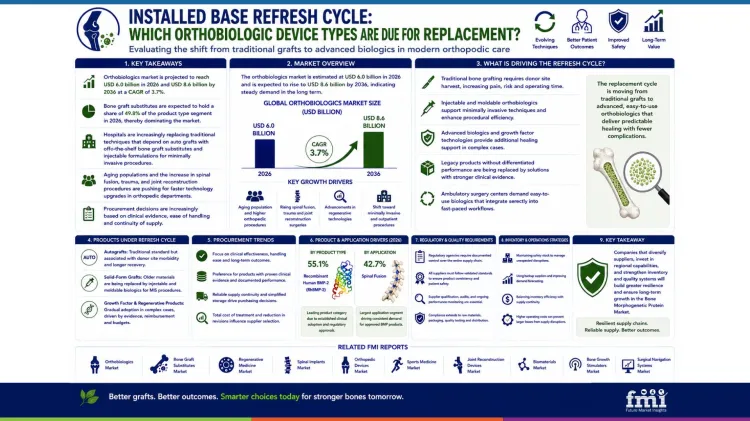
- Orthobiologics market is projected to reach USD 6.0 billion by 2026 and USD 8.6 billion by 2036 at a CAGR of 3.7%.
- Bone graft substitutes are expected to hold a share of 49.8% of the product type segment in 2026, thereby dominating the market.
- Hospitals are increasingly replacing traditional techniques that depend on auto grafts with off-the-shelf bone graft substitutes and injectable formulations for minimally invasive procedures.
- Aging populations and the increase in spinal fusion, trauma, and joint reconstruction procedures are pushing for faster technology upgrades in orthopedic departments.
- Procurement decisions are increasingly based on clinical evidence, ease of handling and continuity of supply.
- The United States is expected to remain one of the leading revenue-generating markets for orthobiologics throughout the forecast period due to high procedure volumes and continued adoption of advanced biologic solutions
The orthobiologics market is entering a replacement cycle that is moving beyond traditional orthopedic implants. Instead of just replacing hardware, hospitals are revisiting biologic materials used in spine, trauma and reconstructive procedures. As surgical techniques continue to evolve, surgeons are seeking products that facilitate procedures, minimize complications at donor sites and deliver predictable healing performance.
According to Future Market Insights, the orthobiologics market is estimated at USD 6.0 billion in 2026 and is expected to rise to USD 8.6 billion by 2036, indicating steady demand in the long term. Bone graft substitutes are expected to hold a share of 49.8% of the product type segment by 2026, indicating the vital role these grafts play in modern orthopedic practice.
Traditional bone grafting is the first category to undergo a refresh cycle. But autograft harvesting has been the clinical standard for a long time but it requires another surgical site and can increase patient discomfort and operating time. Hospitals are turning more to synthetic and allograft-derived replacements that overcome many of these limitations but serve similar clinical goals in selected procedures.
Older solid-form materials are also being replaced by injectable and moldable orthobiologics. Minimally invasive spinal fusion techniques require products that can be delivered via smaller access points while not compromising handling performance. As such, surgeons with an interest in procedural efficiency are taking notice of manufacturers offering easy-to-place formulations.
Growth factor technologies and advanced regenerative products are another area of gradual replacement. Surgeons are looking for additional healing support and are increasingly using premium biologics in complex orthopedic cases. Specialized application demand is strong but adoption depends on clinical evidence, reimbursement policies, and procurement budgets.
Legacy product portfolios are also under review by hospital purchasing teams. Older biologic products without differentiated performance are facing pressure from newer solutions backed by stronger clinical documentation and easier storage requirements. Procurement managers increasingly are looking at products that provide effectiveness combined with predictable logistics and proven manufacturing quality.
The trend is just as clear in ambulatory surgery centers. With the expansion of outpatient orthopedic procedures, facilities are seeking biologics with shorter preparation times that can easily integrate into existing surgical workflows. These settings create an environment attractive to products that require minimal processing prior to implantation, thus increasing operating room efficiency.
Thus, equipment replacement is not the only part that defines the installed base refresh cycle. It demonstrates the transition from traditional grafting methods to biological answers for minimally invasive surgery, foreseeable healing and easier hospital procedures. Companies that can deliver these benefits are likely to gain a competitive advantage over the next decade.
Bottom Line
The orthobiologics replacement cycle is about biological technologies, not mechanical devices. Hospitals are moving away from traditional graft harvesting to advanced bone graft substitutes and injectable regenerative materials that are critical to modern orthopedic procedures. The market share of bone graft substitutes is expected to be 49.8% by 2026. The total market value is projected to be USD 8.6 billion by 2036, while innovation of products and clinical validation will continue to be the key drivers for purchase decisions.
Related FMI Reports
- Orthobiologics Market
- Bone Graft Substitutes Market
- Regenerative Medicine Market
- Spinal Implants and Devices Market
- Orthotic Devices, Orthotic Splints, and Orthopedic Braces and Support Market
- Sports Medicine Market
- Joint Reconstruction Devices Market
- Biomaterials Market
- Bone Growth Stimulators Market
- Surgical Navigation Systems Market

