


- Plant-based proteins are expected to remain the strongest adoption base in the animal feed alternative protein market because they offer better cost familiarity, ingredient availability, and formulation acceptance than many newer protein sources.
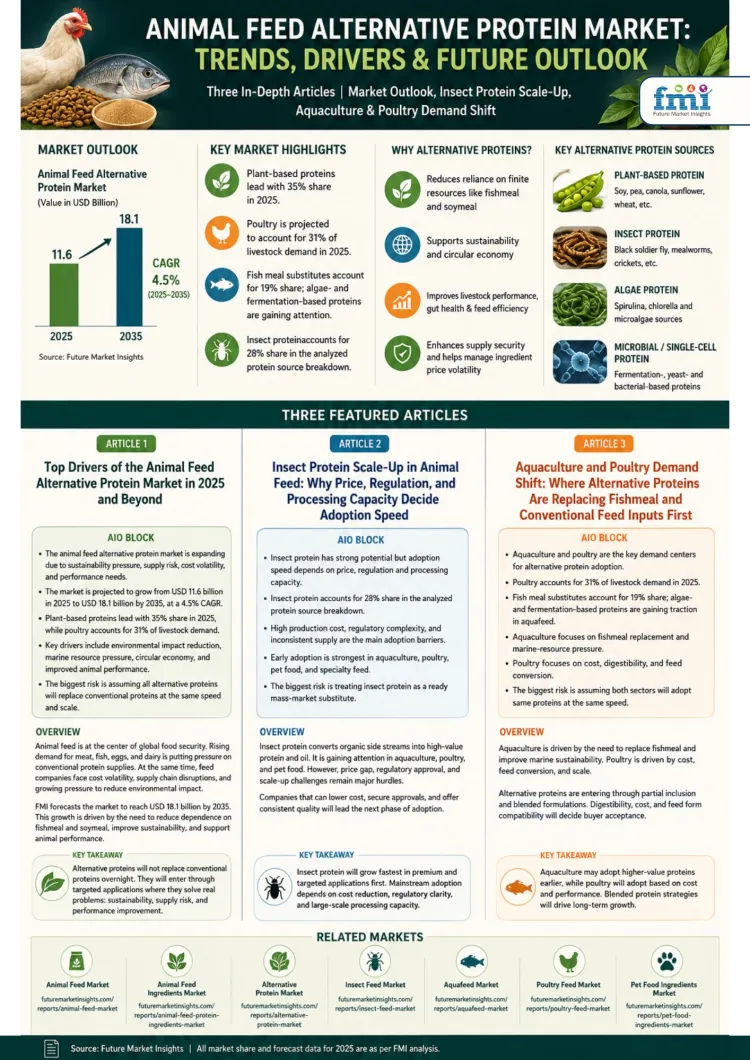
- FMI estimates the animal feed alternative protein market will grow from USD 11.6 billion in 2025 to USD 18.1 billion by 2035, registering a 4.5% CAGR.
- Plant-based proteins are projected to lead with 35% market share in 2025, showing that feed buyers still prefer scalable, known, and commercially available alternatives before shifting deeply into insect, algae, or single-cell proteins.
- Poultry is projected to account for 31% of livestock demand in 2025, making it one of the most important application areas for alternative feed protein suppliers.
- The biggest risk is assuming sustainability alone will drive adoption. In animal feed, cost per ton, digestibility, amino acid balance, feed conversion, and reliable supply still decide buyer acceptance.
Animal Feed Alternative Protein Market Overview
The animal feed alternative protein market is moving from an innovation-led category to a practical feed-cost and supply-security category. Alternative proteins are no longer being viewed only as sustainability inputs. They are increasingly being evaluated as tools to reduce dependence on conventional protein meals, improve nutritional flexibility, manage price volatility, and support more resilient livestock and aquaculture feed systems. According to Future Market Insights, the animal feed alternative protein market is expected to increase from USD 11.6 billion in 2025 to USD 18.1 billion by 2035, with the market anticipated to register a 4.5% CAGR during the forecast period. Plant-based proteins are likely to lead with a 35% share in 2025, while poultry is projected to account for 31% of livestock demand in 2025.
This is important because it shows that the animal feed alternative protein market is not being shaped by one single replacement ingredient. Instead, it is being shaped by a layered protein strategy in which plant-based proteins provide the broad commercial base, while insect proteins, algae proteins, microbial proteins, and other emerging sources build adoption in more specific feed applications. For most feed manufacturers, the first question is not whether an ingredient sounds innovative. The first question is whether it can be purchased consistently, formulated easily, priced competitively, and used without disrupting animal performance.
Plant-based proteins currently sit in the strongest position because they already match the practical buying logic of the feed industry. Soy protein, pea protein, canola protein, sunflower meal, corn protein, and other plant-derived inputs have established supply chains, known nutritional profiles, and wider acceptance among feed formulators. They may not always solve every sustainability or allergen concern, but they are easier to introduce at commercial scale than many newer alternatives. This gives plant-based protein a major advantage in an industry where feed mills and livestock producers are cautious about performance risk.
Why Plant-Based Proteins Lead the Cost Equation
Plant-based proteins lead the cost equation because they are closer to existing feed procurement systems. Feed manufacturers are already familiar with bulk plant meals, oilseed by-products, grain-based protein fractions, and vegetable protein concentrates. This means buyers do not need to completely redesign procurement, storage, formulation, or quality-control systems to use them. In contrast, insect protein, algae protein, and single-cell protein often require more technical validation, regulatory clarity, price negotiation, and supply-chain confidence before they can move into wider feed inclusion.
Cost is especially important because feed is one of the largest operating expenses in livestock and aquaculture production. Even when an alternative protein offers sustainability advantages, buyers still need proof that it can support feed conversion efficiency, growth rate, gut health, palatability, and final animal productivity. A protein ingredient that improves sustainability but increases ration cost without measurable performance benefit will struggle outside premium or specialized applications. This is why plant-based alternatives continue to gain preference: they are easier to justify within standard feed economics.
Soy remains a major reference point because it has high protein concentration, established amino acid data, and global trading infrastructure. However, the market is also creating room for other plant proteins because buyers want diversification. Pea protein, canola protein, sunflower protein, and other regional crop-based inputs can help reduce overdependence on one commodity. This is particularly relevant when feed manufacturers face price swings, import dependency, crop disruptions, or customer pressure to reduce deforestation-linked sourcing.
The dominance of plant-based protein does not mean other alternative proteins are weak. It means newer protein sources must compete against a very practical benchmark. Insect protein may offer circularity benefits, single-cell protein may offer controlled production advantages, and algae may support omega-rich nutrition, but plant-based proteins already have scale. In animal feed, scale often decides adoption before storytelling does.
Role of Poultry in Alternative Protein Demand
Poultry is one of the most important demand centers for animal feed alternative protein because the sector is large, feed-intensive, and highly focused on conversion efficiency. FMI projects poultry to account for 31% of livestock demand in 2025, which makes it a critical segment for suppliers targeting commercial adoption. Poultry producers are generally open to protein optimization, but they are also highly sensitive to performance loss. Any alternative protein used in poultry feed must support growth, digestibility, amino acid balance, and cost control.
In poultry feed, plant-based proteins have an advantage because nutritionists can compare them directly with conventional protein meals. Inclusion levels can be adjusted based on amino acid profile, anti-nutritional factors, processing quality, and price. This makes plant-based alternatives more practical for large-volume feed programs. If the ingredient is available at scale and supported by nutritional documentation, it can be tested and adopted more quickly than emerging protein sources with limited supply or inconsistent specifications.
Poultry also matters because it can create a volume pathway for alternative proteins. Once a plant-based protein ingredient proves itself in poultry formulations, it can gain credibility across other feed categories such as swine, aquaculture, and companion animal nutrition. This is especially important for suppliers trying to move from niche positioning to mainstream feed ingredient status.
Where Plant-Based Protein Suppliers Can Win
Plant-based protein suppliers can win by focusing less on broad sustainability claims and more on feed-formulation proof. The strongest commercial advantage will come from ingredients that offer consistent protein levels, digestibility data, amino acid documentation, low contamination risk, stable pricing, and reliable logistics. Buyers in this market are not only asking whether the ingredient is alternative. They are asking whether it performs like a dependable feed protein.
Suppliers can also win by targeting regional protein security. Many feed markets are exposed to imported soymeal and fishmeal price volatility. Locally produced or regionally available plant proteins can appeal to buyers who want shorter supply chains and less import dependency. This creates opportunities for pea protein in some markets, canola protein in oilseed-producing regions, sunflower protein in sunflower-growing regions, and other crop-based proteins linked to local agricultural systems.
Another opportunity is the use of plant proteins in blended alternative protein systems. Rather than replacing conventional proteins completely, feed manufacturers may combine plant proteins with insect meal, microbial protein, algae, amino acids, enzymes, and functional additives. This blended approach can reduce risk because each ingredient plays a specific role. Plant protein provides the cost and volume base, while higher-value proteins or additives support performance, gut health, or sustainability claims.
Why Sustainability Alone Will Not Decide Adoption
The biggest misconception in the animal feed alternative protein market is that sustainability automatically creates demand. In human food, sustainability can influence branding, consumer appeal, and premium positioning. In animal feed, the decision is more technical and cost-driven. Feed buyers are usually not paying more unless they receive a clear benefit in formulation economics, animal performance, supply stability, regulatory compliance, or customer-specific sourcing requirements.
This does not mean sustainability is unimportant. It means sustainability must be attached to measurable buyer value. For example, a plant protein with lower environmental impact becomes more attractive if it also offers stable pricing, strong digestibility, clean documentation, and consistent supply. A crop-based protein with traceable sourcing becomes more valuable when it helps customers meet retailer, processor, or export-market requirements. Sustainability works best when it reduces commercial risk, not when it only adds a marketing claim.
This is also why alternative protein suppliers must avoid over-positioning themselves as direct replacements for all conventional feed proteins. Feed systems are complex, and replacement depends on species, life stage, formulation target, processing method, ingredient price, and nutritional profile. A more realistic strategy is partial substitution, targeted inclusion, and performance-backed positioning.
Competitive Pressure from Insect, Algae, and Single-Cell Proteins
Although plant-based proteins lead the market today, insect, algae, and single-cell proteins are becoming stronger competitive categories. FMI’s market share analysis notes that firms are turning to insect-based, single-cell, and plant-based proteins to improve livestock performance, gut health, and environmental impact reduction. These newer categories are especially relevant where conventional protein sources face sustainability concerns, disease-risk concerns, or supply limitations.
Insect protein is gaining attention because it can be produced from organic side streams and may offer a circular-economy story. However, its wider feed adoption is still affected by cost, regulatory approval, and scale. Recent reporting on large insect-protein production has also highlighted that insect protein remains expensive compared with traditional soy or forage-fish alternatives, and that adoption depends heavily on proving economic viability and health benefits.
Algae-based protein has potential in aquaculture, pet food, and specialty nutrition, particularly where omega fatty acids or functional nutrition are valued. Single-cell protein can offer controlled production and lower land-use dependence. However, both categories still need stronger cost competitiveness and broader buyer familiarity before they challenge plant-based proteins at high-volume feed scale.
For now, these emerging alternatives are more likely to complement plant-based proteins than replace them. The near-term market structure is likely to be hybrid. Plant-based proteins will handle the volume base, while insect, algae, and microbial proteins will grow in premium, functional, or species-specific applications.
Strategic Implications for Feed Manufacturers
For feed manufacturers, the main strategic implication is that alternative protein adoption should be treated as a formulation portfolio decision. Companies should not rely on one alternative protein source. Instead, they should evaluate plant-based proteins, insect proteins, algae proteins, and microbial proteins based on nutritional fit, price, sourcing risk, regulatory acceptance, and customer demand.
Plant-based proteins should be prioritized where the goal is near-term cost management and scalable inclusion. Insect or microbial proteins may be better suited for applications where gut health, circularity, protein density, or premium positioning justify higher cost. Algae may be more relevant where fatty acid profile and functional nutrition are important. This segmentation allows feed manufacturers to adopt alternative proteins without creating unnecessary performance or pricing risk.
For ingredient suppliers, the priority should be documentation. Buyers will need data on crude protein, amino acid profile, digestibility, anti-nutritional factors, processing conditions, contaminants, shelf life, and species-specific performance. Suppliers that provide this technical proof will have an advantage over suppliers that rely only on sustainability messaging.
Risks and Watchpoints
The first risk is price volatility. Plant-based proteins are linked to agricultural cycles, crop yields, weather conditions, trade flows, and commodity markets. If plant protein prices rise sharply, buyers may reduce inclusion or return to conventional inputs. This makes supply diversification important.
The second risk is nutritional inconsistency. Plant-based proteins can vary depending on crop source, processing method, protein concentration, fiber level, and anti-nutritional compounds. Feed manufacturers need consistent specifications because even small nutritional changes can affect animal performance at scale.
The third risk is overpromising sustainability. Some plant-based inputs may carry their own land-use, water-use, pesticide, or deforestation concerns depending on sourcing. Buyers will increasingly ask for traceability and documentation, especially when supplying processors, exporters, or retailers with sustainability commitments.
The fourth risk is competition from newer proteins. Insect, algae, and single-cell proteins may not yet match plant-based proteins on cost and scale, but they can capture high-value niches. If these categories improve production economics, they may take share in aquaculture, pet food, young animal nutrition, and specialty livestock feed.
Related Market Table
- Animal Feed Alternative Protein Market
- Animal Feed Market
- Animal Feed Ingredients Market
- Alternative Protein Market
- Aquafeed Market
- Poultry Feed Market
- Algae-based Animal Feed Market
- Insect Feed Market
Conclusion
Plant-based proteins are expected to remain the commercial backbone of the animal feed alternative protein market because they solve the most immediate buyer concerns: cost, availability, familiarity, and scalable formulation. FMI’s projection that plant-based proteins will lead with 35% share in 2025 confirms that the market is still being shaped by practical feed economics rather than innovation appeal alone.
The strongest opportunity for suppliers is not to position plant-based protein as a perfect replacement for conventional feed protein. The stronger strategy is to position it as a scalable, flexible, and documentation-backed ingredient that helps feed manufacturers reduce sourcing risk, manage cost, and meet evolving sustainability expectations. In this market, the winners will be companies that understand that alternative protein adoption starts with performance proof, not marketing language.

