

- Industry Size (2026)
- USD 34.7 Bn
- Forecast (2036)
- USD 81.3 Bn
- CAGR (2026 to 2036)
- 8.9%
Automotive Garage Equipment Market Size, Market Forecast and Outlook By FMI
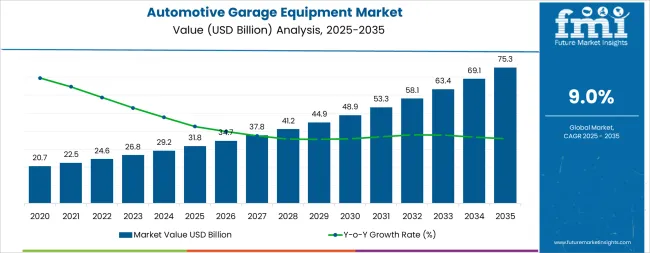
The automotive garage equipment market is estimated to reach USD 34.7 billion in 2026 and is projected to expand to USD 81.3 billion by 2036, registering a CAGR of 8.9% during the forecast period. Between 2026 and 2036, the category is expected to create an absolute dollar opportunity of USD 46.6 billion.
Summary of the Automotive Garage Equipment Market
- Demand and growth drivers
- ADAS-equipped vehicles are raising calibration demand after routine repairs, replacements, and collision-related service work.
- Electric vehicle servicing is creating new demand for insulated tools, battery handling systems, and EV-specific service infrastructure.
- Workshop digitization is increasing investment in software-led diagnostics, predictive service tools, and multi-brand scanning systems.
- Product and segment view
- Vehicle lifts and hoists remain the leading equipment type because nearly every workshop workflow depends on reliable underbody access.
- Fixed or in-bay systems dominate installation demand because high-volume workshops prefer stable and permanent service setups.
- Independent garages remain the largest end-use group as aging vehicles and multi-brand service demand keep throughput high.
- Geography and competitive outlook
- China and India are expected to remain the strongest growth centers due to EV penetration, workshop formalization, and service infrastructure buildout.
- The USA, Germany, France, and the UK represent mature but technically demanding service environments shaped by inspection rules and large vehicle parcs.
- Competition is shifting toward integrated hardware, software, training, and after-sales support instead of stand-alone equipment sales.
- Analyst opinion
- Nikhil Kaitwade, Principal Consultant at FMI says, “Automotive garage equipment demand is shifting toward diagnostic intelligence, calibration precision, and workshop software compatibility rather than simple mechanical replacement. Suppliers that align with ADAS servicing, EV workshop safety, and higher-throughput service bay design are better placed to capture value through the forecast period. The strongest gains will come from manufacturers that can combine equipment reliability with digital workflow integration, direct technical support, and product portfolios that fit both organized dealership networks and independent multi-brand workshops.”
- Automotive Garage Equipment Market value analysis
- Garage equipment is moving from mechanical workshop hardware toward digitally enabled service infrastructure with higher average equipment value.
- Vehicle complexity and inspection requirements are shortening replacement cycles for precision-oriented service equipment.
- EV, ADAS, and electronics-heavy vehicle platforms are pushing workshops to invest in newer and more specialized tools.
- Value capture is strongest where manufacturers combine hardware, software, installation, and service support into integrated workshop offerings.
Key Takeaways, Market Size, and Forecast
| Metric | Value |
|---|---|
| Market Size (2026) | USD 34.7 Billion |
| Market Size (2036) | USD 81.3 Billion |
| Leading Equipment Type (2026) | Vehicle Lifts And Hoists |
| Vehicle Lifts And Hoists Share (2026) | 27% |
| Leading Installation Type (2026) | Fixed Or In-Bay Systems |
| Fixed Or In-Bay Systems Share (2026) | 63% |
| Leading Vehicle Type Serviced (2026) | Passenger Cars |
| Passenger Cars Share (2026) | 62% |
| Fastest-Growing Country | China |
| China CAGR | 10.8% |
| 2nd Fastest-Growing Country | India |
| India CAGR | 10.9% |
Vehicle lifts and hoists are expected to lead equipment type demand with a 27% share in 2026. Fixed or in-bay installations are projected to account for 63% of installation type demand and direct OEM or brand sales are expected to hold 46% by sales channel in 2026. The market is being shaped by ADAS calibration demand, EV servicing needs, workshop digitization, and more frequent equipment replacement in organized service networks. China at 10.8% CAGR and India at 10.9% CAGR are expected to lead country-level growth through 2036.
Automotive Garage Equipment Market definition
The automotive garage equipment market covers specialized systems and tools used for vehicle lifting, inspection, diagnostics, calibration, repair, and service support across passenger and commercial vehicles. It includes hardware and software-linked equipment deployed by independent garages, OEM workshops, fleet service centers, and inspection facilities.
Automotive Garage Equipment Market inclusions
Market scope includes lifts, wheel alignment systems, tire changers and balancers, diagnostic and ADAS calibration systems, brake and service equipment, EV servicing tools, and workshop automation platforms used in repair, maintenance, and inspection settings. Counted channels include OEM workshops, independent garages, fleet service centers, and organized distribution routes.
Automotive Garage Equipment Market exclusions
The scope excludes handheld basic tools, lubricants, spare parts, detailing-only systems, car wash equipment, and production-line machinery used only in automotive manufacturing. It excludes workshop consumables and vehicle components sold outside service-equipment applications.
Automotive Garage Equipment Market research methodology
- Primary Research: FMI analysts reviewed demand shifts through interviews with garage equipment manufacturers, distributors, workshop owners, service network managers, and EV or ADAS specialists.
- Desk Research: The study incorporated company reports, regulatory publications, technical white papers, automotive association data, and public transport authority references.
- Market Sizing and Forecasting: Estimates were developed through bottom-up aggregation across equipment types, end users, and regional workshop infrastructure patterns.
- Data Validation: Forecasts were checked through triangulation of manufacturer revenue, distributor insight, service volume trends, and ongoing product-launch tracking.
Why is the Automotive Garage Equipment Market growing?
- ADAS-equipped vehicles require more recalibration after routine repairs and replacements.
- EV workshops need insulated tools, battery handling systems, and high-voltage safety infrastructure.
- Independent and OEM networks are digitizing workflows to improve throughput and diagnostic accuracy.
- Inspection rules and vehicle complexity are accelerating equipment upgrades across organized workshops.
The market is expanding because workshop economics are now shaped by electronic diagnostics, calibration frequency, and software-linked service quality rather than mechanical troubleshooting alone. The source file notes that the increase in ADAS-equipped vehicles and EV-specific servicing requirements is changing capital expenditure priorities across both OEM and independent service networks. Hunter Road Force Walkaway Wheel Balancer and Toyota approval of the John Bean Tru-Point ADAS calibration system both reflect how workshops are investing in equipment that improves service speed and calibration accuracy in more complex repair environments.
Equipment suppliers are responding by broadening product portfolios and improving interoperability. The source file notes that APEX by BendPak expanded into two-post lifts, tire changers, and wheel balancers in January 2026, which illustrates how manufacturers are widening their addressable workshop footprint. Direct sales remain important because advanced systems require installation guidance, software updates, and technical support that smaller workshops often prefer to source from the equipment brand itself.
Market segmentation analysis
- Vehicle lifts and hoists are expected to account for 27% of equipment type demand in 2026 because they remain indispensable across repair workflows.
- Fixed or in-bay systems are projected to contribute 63% of installation type demand in 2026 due to stability and higher workshop throughput.
- Independent garages are likely to represent 39% of end-use demand in 2026 because multi-brand servicing keeps them central in the aftermarket.
- Passenger cars are set to make up 62% of vehicle type serviced demand in 2026 because global vehicle parc size remains overwhelmingly larger.
- Direct OEM or brand sales are expected to account for 46% of sales channel demand in 2026 due to installation, warranty, and software-support needs.
Segment structure matters in automotive garage equipment because workshop investment priorities vary sharply with service format, vehicle mix, and technology burden. Equipment type captures the mechanical and digital tool base, installation type reflects workshop permanence and bay structure, end use shows where service throughput sits, vehicle type serviced changes equipment specification, and sales channel determines how customers access support and software. This segmentation model is highly relevant for a market that is moving from stand-alone machines toward connected, calibration-led service systems.
Automotive Garage Equipment Market Analysis by Equipment Type
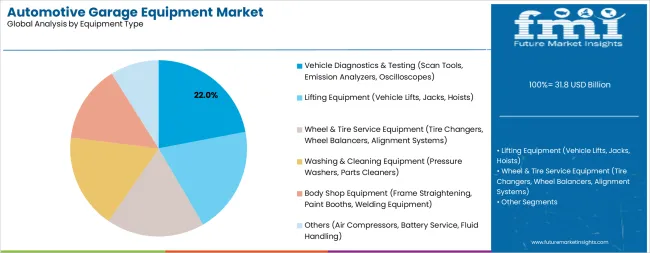
- Vehicle lifts and hoists are expected to account for 27% of equipment type demand in 2026 because they remain essential across underbody inspection, transmission work, and EV battery servicing. No other equipment family can replace their role in core workshop workflow. Their non-substitutable nature keeps them central in both new workshop setups and replacement spending.
- Vehicle Lifts & Hoists remains the reference point for this primary segment because the source file gives it the strongest 2026 share position.
- Within equipment type, purchase decisions reflect workflow intensity, technology burden, and service model requirements across the workshop base.
Insights into the Diagnostics & ADAS Calibration Equipment Type Segment
-
Diagnostics and ADAS calibration systems are likely to post faster expansion during the forecast period because workshops are handling more electronically complex vehicles that require sensor alignment, software diagnostics, and post-repair recalibration. Growth is supported by wider ADAS fitment and by the rising value of software-enabled servicing infrastructure.
- Diagnostics & ADAS Calibration benefits from structural changes in vehicle complexity, service format, or procurement method during the forecast period.
- This faster-rising subsegment improves future equipment mix even though Vehicle Lifts & Hoists remains the dominant 2026 base.
Automotive Garage Equipment Market Analysis by Installation Type
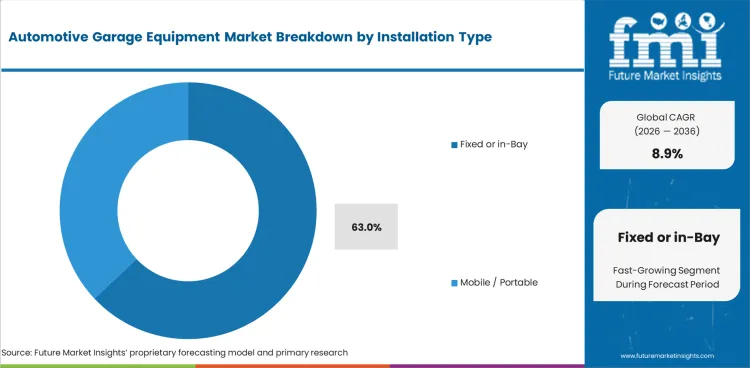
- Fixed or in-bay equipment is projected to hold 63% of installation type demand in 2026 because organized workshops prioritize permanent setups that improve throughput, load-bearing stability, and process standardization. These systems fit multi-bay operations where repeat servicing volume justifies dedicated floor space and higher equipment permanence.
- Fixed / In-bay remains the reference point for this primary segment because the source file gives it the strongest 2026 share position.
- Within installation type, purchase decisions reflect workflow intensity, technology burden, and service model requirements across the workshop base.
Insights into the Mobile / Portable Installation Type Segment
-
Mobile or portable systems are expected to advance faster in smaller-format workshops and flexible service environments because they reduce space constraints and lower initial equipment burden. Their appeal improves where workshops are expanding gradually or where on-site service support is becoming more relevant for fleets and field work.
- Mobile / Portable benefits from structural changes in vehicle complexity, service format, or procurement method during the forecast period.
- This faster-rising subsegment improves future equipment mix even though Fixed / In-bay remains the dominant 2026 base.
Automotive Garage Equipment Market Analysis by End Use
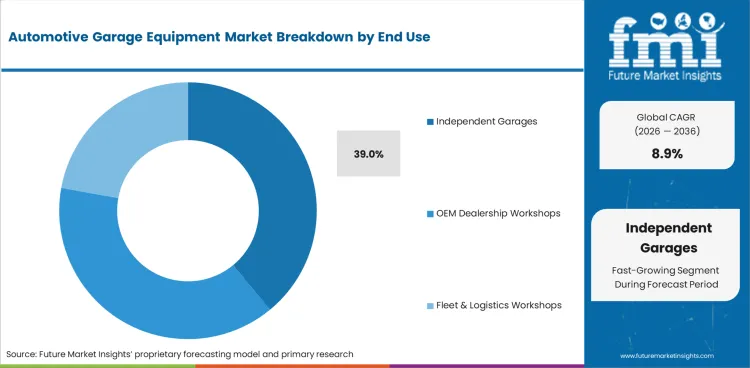
- Independent garages are expected to account for 39% of end-use demand in 2026 because they remain the primary touchpoint for a large volume of out-of-warranty vehicle service. Their multi-brand servicing model requires versatile equipment and keeps replacement demand active across diagnostics, lifting, and wheel service platforms.
- Independent Garages remains the reference point for this primary segment because the source file gives it the strongest 2026 share position.
- Within end use, purchase decisions reflect workflow intensity, technology burden, and service model requirements across the workshop base.
Insights into the Fleet & Logistics Workshops End Use Segment
- Fleet and logistics workshops are likely to grow faster through the forecast period because delivery networks, ride-hailing fleets, and commercial transport operators need higher-throughput service infrastructure. Consistent uptime requirements encourage organized equipment investment, especially where labor pressure and vehicle utilization are both intensifying.
- Fleet & Logistics Workshops benefits from structural changes in vehicle complexity, service format, or procurement method during the forecast period.
- This faster-rising subsegment improves future equipment mix even though Independent Garages remains the dominant 2026 base.
Automotive Garage Equipment Market Analysis by Vehicle Type Serviced
- Passenger cars are projected to represent 62% of vehicle type serviced demand in 2026 because global ownership penetration and service frequency remain higher than for commercial segments. Their rising electronic complexity is increasing need for diagnostic, calibration, and lifting equipment across both dealership and independent networks.
- Passenger Cars remains the reference point for this primary segment because the source file gives it the strongest 2026 share position.
- Within vehicle type serviced, purchase decisions reflect workflow intensity, technology burden, and service model requirements across the workshop base.
Insights into the Light Commercial Vehicles Vehicle Type Serviced Segment
- Light commercial vehicles are likely to record faster equipment demand growth because e-commerce, last-mile delivery, and small fleet expansion are increasing maintenance intensity in service bays. These vehicles create recurring demand for efficient lifting, alignment, and diagnostic infrastructure in mixed-use workshops.
- Light Commercial Vehicles benefits from structural changes in vehicle complexity, service format, or procurement method during the forecast period.
- This faster-rising subsegment improves future equipment mix even though Passenger Cars remains the dominant 2026 base.
Automotive Garage Equipment Market Analysis by Sales Channel
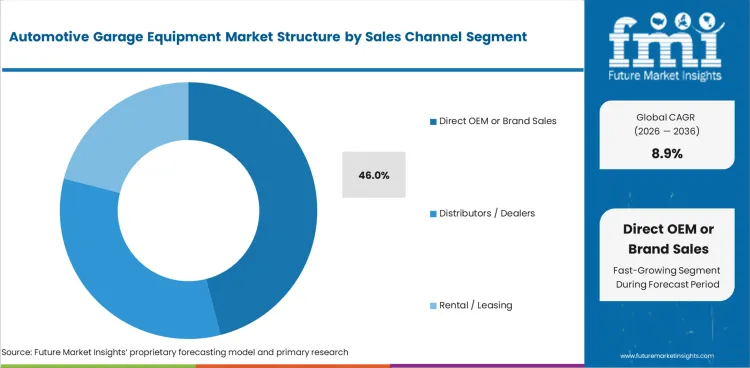
- Direct OEM or brand sales are expected to account for 46% of sales channel demand in 2026 because customers value installation support, warranty coverage, approved software updates, and technical training for advanced workshop systems. This route remains especially important for diagnostics, ADAS calibration, and integrated workshop equipment.
- Direct OEM / Brand Sales remains the reference point for this primary segment because the source file gives it the strongest 2026 share position.
- Within sales channel, purchase decisions reflect workflow intensity, technology burden, and service model requirements across the workshop base.
Insights into the E-commerce Sales Channel Segment
- E-commerce is likely to expand faster during the forecast period for selected product tiers because digital procurement improves price discovery and access for independent workshops. Growth will remain strongest in standardized categories, though technically complex systems will continue to depend more heavily on direct sales and guided installation support.
- E-commerce benefits from structural changes in vehicle complexity, service format, or procurement method during the forecast period.
- This faster-rising subsegment improves future equipment mix even though Direct OEM / Brand Sales remains the dominant 2026 base.
Automotive Garage Equipment Market drivers, restraints, and opportunities
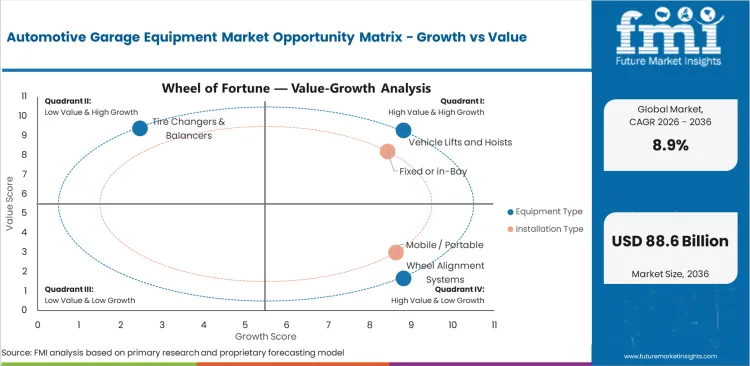
- Driver: ADAS integration, EV servicing, and inspection rules are increasing demand for precision-led workshop infrastructure.
- Restraint: High upfront capital costs and skill shortages limit advanced equipment adoption in smaller workshops.
- Opportunity: Digital workflow integration and organized multi-brand service chains are creating room for scalable, connected equipment platforms.
The market is being pushed by structural change in the service bay rather than simple vehicle parc growth. Workshops now require equipment that can lift heavier vehicles, diagnose electronic faults, recalibrate ADAS systems, and serve EV architectures safely. That raises average equipment value and gives software, training, and technical support a larger place in buying decisions. Smaller workshops still face capital and skill barriers, yet organized service chains, inspection-driven service needs, and higher frequency of calibration work continue to improve the business case for upgraded infrastructure.
Technology adoption and innovation
Garage equipment is becoming more software-led as diagnostics, ADAS calibration, and workshop automation move closer to the center of service economics. The source file repeatedly points to digital diagnostics, predictive tools, and connected platforms as the strongest structural demand shifts, which means technical interoperability is becoming more important for both independent and OEM service networks.
Regulatory compliance and certification
Inspection mandates such as TÜV and MOT continue to support replacement demand for certified testing and calibration equipment. Workshops operating in tightly controlled environments need stable measurement capability and service traceability, which supports premium demand for approved and support-backed equipment rather than bare mechanical hardware.
Channel expansion and distribution
Sales channels are changing because buyers are no longer comparing equipment only on upfront cost. Direct sales retain strength where installation, software updates, and technical training matter most, while distributors and e-commerce support broader reach in standardized equipment categories. Organized service chains continue to reward suppliers with stronger application support and after-sales depth.
Analysis of Automotive Garage Equipment Market by key countries
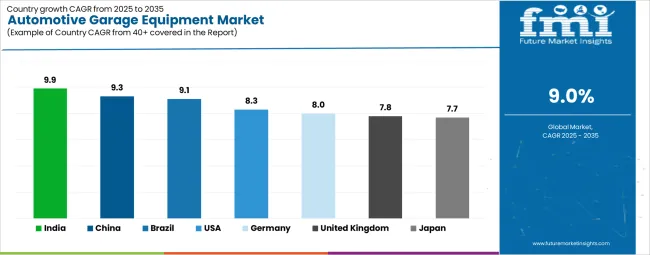
- India is projected to record the fastest growth at 10.9% CAGR through 2036 as vehicle ownership and organized service networks expand.
- China follows at 10.8% CAGR due to EV adoption, workshop formalization, and wider service infrastructure modernization.
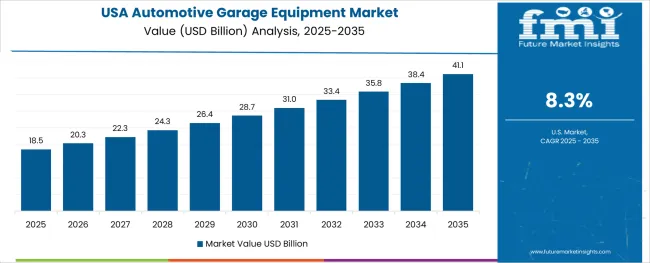
- Germany at 8.8% and the USA at 8.7% remain strong technically demanding markets shaped by large service bases and tighter inspection expectations.
- Japan at 8.3% remains comparatively measured, though precision diagnostics and compact workshop requirements continue to support replacement demand.
.webp "Top Country Growth Comparison Automotive Garage Equipment Market Cagr (2026 2036)")
| Country | CAGR |
|---|---|
| USA | 8.7% |
| Germany | 8.8% |
| UK | 8.5% |
| France | 8.6% |
| Japan | 8.3% |
| China | 10.8% |
| India | 10.9% |
Source: FMI analysis based on proprietary forecasting model and primary research.
Demand Outlook for Automotive Lighting Market in the United States
The United States market is projected to rise at a CAGR of 6.0% through 2036 as regulatory acceptance of adaptive lighting, premium vehicle demand, and steady replacement activity support higher-value module adoption. Automakers and suppliers in this market place strong weight on validated beam performance, compliance, and software-linked functions that improve night visibility without raising glare. A large installed base and active dealer network also support authorized replacement demand for LED and advanced lighting systems.
- Adaptive lighting approval supports demand for higher-specification forward lighting systems.
- Authorized replacement channels remain important for premium and electronically integrated modules.
- Compliance and validation standards favor suppliers with documented performance consistency.
Future Outlook for Automotive Lighting Market in China
China is expected to expand at a CAGR of 8.1% through 2036 because large vehicle production volumes, fast-moving EV programs, and strong electronics integration are lifting lighting content per vehicle. Domestic OEM scale supports faster diffusion of LED signatures, intelligent lighting controls, and premium front modules across a broad vehicle mix. Local manufacturing depth also gives suppliers the ability to commercialize new designs quickly as styling refresh cycles remain active.
- Large EV output supports faster uptake of intelligent and signature lighting systems.
- Domestic manufacturing scale helps suppliers commercialize new designs more quickly.
- Platform refresh activity keeps demand firm for front and rear module upgrades.
In-Depth Analysis of Automotive Lighting Market in India
India is projected to record the fastest CAGR at 8.2% through 2036 as vehicle ownership expands, safety expectations improve, and OEM programs move more decisively toward LED systems. Mid-range passenger vehicles and utility-focused light commercial platforms are both widening the addressable base for efficient and durable lighting solutions. Local sourcing expansion and platform standardization are likely to support broader penetration of advanced front and rear lamp assemblies over the forecast period.
- LED migration is widening from premium vehicles into mid-range and utility-oriented models.
- Local production growth supports stronger OEM sourcing for lighting modules.
- Safety awareness is improving demand for better visibility and signaling systems.
Opportunity Analysis of Automotive Lighting Market in Germany
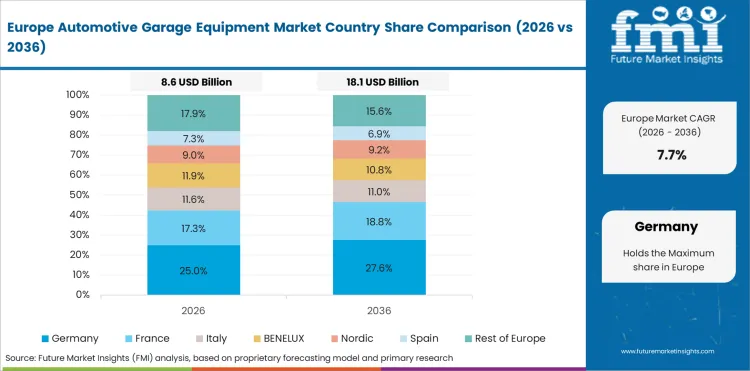
Germany is anticipated to grow at a CAGR of 6.1% through 2036 as premium vehicle engineering, advanced optics expertise, and early adoption of matrix lighting continue to support above-average content value. Domestic automakers use lighting as a performance and brand differentiation tool, which supports demand for high-specification headlamps and digitally controlled systems. Supplier competitiveness remains tied to precision optics, thermal discipline, and strong integration with vehicle electronics platforms.
- Premium engineering programs support sustained demand for matrix and adaptive lighting.
- Optics precision and electronics integration remain important supplier differentiators.
- Brand-led design signatures keep content value high in front lighting modules.
Demand Analysis of Automotive Lighting Market in France
France is expected to expand at a CAGR of 5.9% through 2036 as energy-efficient vehicle design, regulatory compliance, and established automotive manufacturing keep demand stable for LED-centered lighting systems. The market benefits from steady OEM integration rather than exceptionally rapid volume gains. Growth is likely to remain measured, though higher-value content should continue to improve as automakers raise electronics adoption across passenger platforms.
- Energy-efficient vehicle design supports steady migration toward LED-based systems.
- OEM integration remains the main route for value creation in this market.
- Measured vehicle output growth keeps expansion stable rather than aggressive.
Sales Outlook for Automotive Lighting Market in Japan
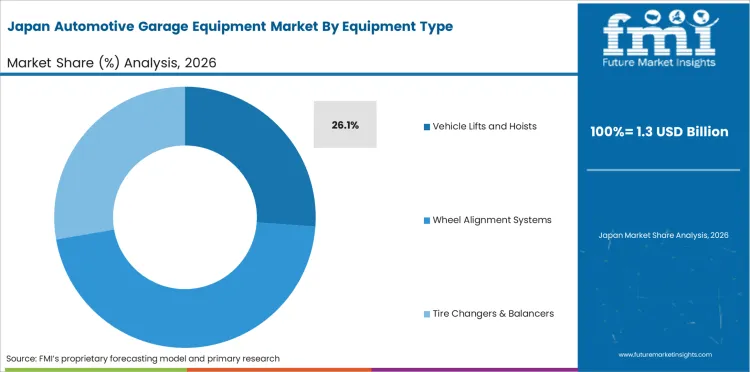
Japan is forecast to rise at a CAGR of 5.6% through 2036 as mature automotive production and rigorous validation standards support stable demand for high-quality lighting systems. Buyers in this market place importance on compact design, durable electronics, and precise optical performance that align with tightly engineered vehicle programs. Expansion remains moderate, though the market retains solid value density because advanced specifications are well established.
- Compact packaging and precision performance remain central purchasing priorities.
- Validation discipline supports steady demand for dependable advanced lighting systems.
- Mature production keeps growth moderate while preserving strong value density.
Industry Analysis of Automotive Lighting Market in South Korea
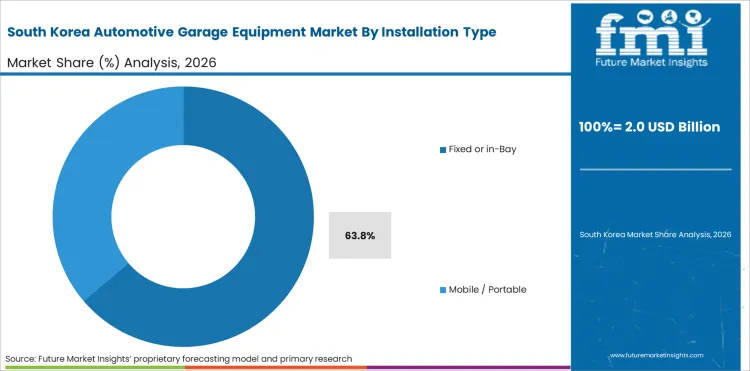
South Korea is projected to grow at a CAGR of 7.0% through 2036 due to strong OEM capabilities, export-oriented vehicle production, and leadership in automotive electronics integration. Suppliers in this market benefit from close alignment between lighting modules, control architecture, and fast model development cycles. That combination supports faster use of smart lighting functions and visually distinctive LED signatures in both domestic and export programs.
- Automotive electronics strength supports wider use of smart lighting functions.
- Export-focused OEM programs encourage rapid rollout of new lighting designs.
- Close supplier integration helps compress development cycles for advanced modules.
Competitive landscape and strategic positioning
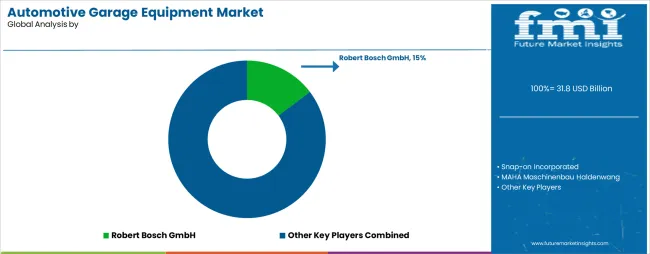
- Competition is moderately fragmented between global technology-led brands, regional specialists, and lower-cost local suppliers.
- ADAS calibration, software integration, training support, and direct technical service are becoming stronger differentiators.
- Regional manufacturers continue to compete aggressively on modular and affordable offerings for price-sensitive workshops.
- Recurring revenue is becoming more important through software subscriptions, training, and after-sales service support.
Leading companies compete less on stand-alone hardware and more on integrated workshop solutions that connect equipment, software, installation support, and training. This shift is visible in the source material through repeated references to ADAS calibration, digital diagnostics, direct sales support, and connected workflow integration. As workshops become more software-dependent, interoperability and after-sales support become more valuable than isolated machine specifications.
Recent developments reinforce this move toward higher-spec service infrastructure. Hunter’s 2025 TCX53Pro tire changer launch improved fitment capability including EV-oriented applications, APEX by BendPak expanded into additional professional workshop categories in January 2026, and Toyota approved the John Bean Tru-Point ADAS calibration tool in January 2026 for service and repair on its vehicles. These events show that suppliers and OEMs are strengthening both product breadth and calibration accuracy.
Global brands retain stronger positioning where workshops prefer approved systems, direct installation assistance, and reliable software updates. Regional and cost-focused suppliers remain relevant in emerging markets where affordability and modular expansion shape purchasing decisions. This creates a layered competitive environment in which premium and price-led equipment can both find room, though not in the same service settings.
Key companies in the Automotive Garage Equipment Market
Key companies active in the automotive garage equipment market include the following groups.
- Global leaders: Bosch Automotive Service Solutions, Snap-on, Continental, Rotary Lift, Hunter Engineering, and John Bean compete through integrated diagnostics, calibration capability, software support, and wide service network reach.
- Regional players: MAHA, Nussbaum, Ravaglioli, and Launch Tech remain important through focused product depth, workshop application expertise, and regional distribution strength.
- Emerging and portfolio expanders: APEX by BendPak and selected Chinese suppliers are broadening access through cost-aware product lines, workshop standardization, and modular equipment bundles.
Competitive benchmarking: Automotive Garage Equipment Market
| Company | Product Breadth | Software and Diagnostics Depth | After-sales Support Geographic Footprint | Region |
|---|---|---|---|---|
| Bosch Automotive Service Solutions | High | High | Strong | Global |
| Snap-on | High | High | Strong | Global |
| Continental | High | High | Strong | Global |
| Hunter Engineering | Medium | High | Strong | North America |
| John Bean | Medium | High | Strong | Global |
| MAHA | Medium | Moderate | Moderate | Europe |
| Nussbaum | Medium | Moderate | Moderate | Europe |
| Ravaglioli | Medium | Moderate | Moderate | Europe |
| Launch Tech | Medium | High | Moderate | Asia |
Source: Future Market Insights competitive analysis, 2026. Ratings reflect relative positioning based on product breadth, software and diagnostics depth, and after-sales support.
Key developments in the Automotive Garage Equipment Market
- In March 2025, Hunter introduced the TCX53Pro table-top tire changer to support advanced fitments and faster service flow in workshops.
- In January 2026, APEX by BendPak expanded its line into two-post lifts, tire changers, wheel balancers, and related workshop accessories.
- In January 2026, Toyota approved the John Bean Tru-Point ADAS calibration tool for service and repair on Toyota vehicles.
Key players in the Automotive Garage Equipment Market
Major global players
- MAHA
- Snap-on
- Bosch Automotive Service Solutions
- Nussbaum
- Continental
- Ravaglioli
- Rotary Lift (Dover)
- Hunter Engineering
- Launch Tech
- Hofmann (Snap-on)
- John Bean (Dover/TXS)
Emerging players and portfolio expanders
- APEX by BendPak
- Selected Chinese modular equipment suppliers
Report Scope and Coverage
| Metric | Details |
|---|---|
| Quantitative Units | USD 34.7 billion to USD 81.3 billion, at a CAGR of 8.9% |
| Market Definition | Specialized tools, machines, and systems used for vehicle inspection, maintenance, diagnostics, repair, and calibration across service workshops. |
| Regions Covered | North America, Latin America, Europe, East Asia, South Asia and Pacific, Middle East and Africa |
| Countries Covered | USA, Germany, UK, France, Japan, China, India, and 30+ countries |
| Key Companies Profiled | MAHA, Snap-on, Bosch Automotive Service Solutions, Nussbaum, Continental, Ravaglioli, Rotary Lift, Hunter Engineering, Launch Tech, Hofmann, John Bean |
| Forecast Period | 2026 to 2036 |
| Approach | Hybrid bottom-up and top-down methodology validated through manufacturer sales, service center volumes, installation rates, and regional vehicle parc trends. |
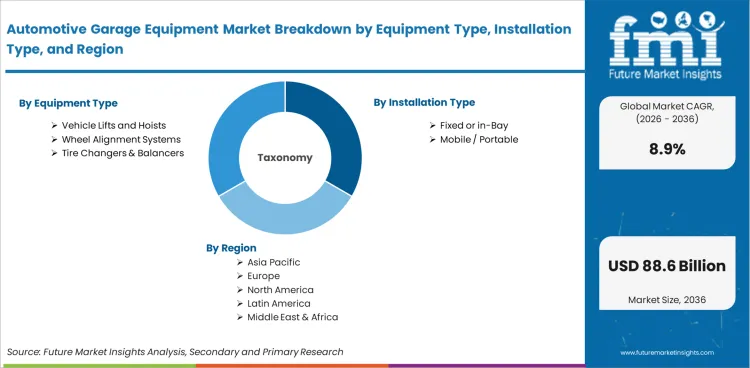
Automotive Garage Equipment Market breakdown by Equipment Type, Installation Type, End Use, Vehicle Type Serviced, and Sales Channel
Automotive Garage Equipment Market Segmented by Equipment Type
- Vehicle Lifts & Hoists
- Wheel Alignment Systems
- Tire Changers & Balancers
- Diagnostics & ADAS Calibration
- Brake / Service Equipment
- Wash & Detailing Equipment
Automotive Garage Equipment Market Segmented by Installation Type
- Fixed / In-bay
- Mobile / Portable
Automotive Garage Equipment Market Segmented by End Use
- Independent Garages
- OEM Dealership Workshops
- Fleet & Logistics Workshops
- Collision / Body Shops
Automotive Garage Equipment Market Segmented by Vehicle Type Serviced
- Passenger Cars
- Light Commercial Vehicles
- Heavy Commercial Vehicles
Automotive Garage Equipment Market Segmented by Sales Channel
- Direct OEM / Brand Sales
- Distributors / Dealers
- E-commerce
- Rental / Leasing
Automotive Garage Equipment Market by Region
- North America
- USA
- Canada
- Mexico
- Latin America
- Brazil
- Chile
- Rest of Latin America
- Western Europe
- Germany
- UK
- France
- Italy
- Spain
- Rest of Western Europe
- Eastern Europe
- Russia
- Poland
- Hungary
- Balkan & Baltic
- Rest of Eastern Europe
- East Asia
- China
- Japan
- South Korea
- South Asia and Pacific
- India
- Australia
- Rest of South Asia and Pacific
- Middle East and Africa
- GCC Countries
- Turkiye
- South Africa
- Rest of Middle East and Africa
Research sources and bibliography
- AftermarketNews. (2025). Hunter launches Road Force WalkAway Wheel Balancer. AftermarketNews
- Hunter Engineering. (2025). Hunter introduces TCX53Pro table-top tire changer. Hunter Engineering
- BodyShop Business. (2026). APEX by BendPak launches affordable two-post car lifts, tire changers and wheel balancers. BodyShop Business
- Brake & Front End. (2026). Toyota approves John Bean Tru-Point ADAS calibration system. Brake & Front End
This bibliography is provided for reader reference and is not exhaustive. The full report contains the complete reference list and detailed citations.
This report answers
- What is the current and future size of the automotive garage equipment market through 2036?
- How fast is global demand expected to expand between 2026 and 2036?
- Which equipment type, installation type, and end-use segments lead 2026 demand?
- How are ADAS calibration and EV servicing changing workshop equipment priorities?
- Why do direct OEM sales remain important in advanced garage equipment procurement?
- Which countries are expected to record the strongest growth through 2036?
- Which companies remain most visible in diagnostic, lifting, and calibration systems?
Frequently Asked Questions
What is the global market demand for Automotive Garage Equipment in 2026?
In 2026, the global automotive garage equipment market is expected to be worth USD 34.7 billion.
How big will the Automotive Garage Equipment market be in 2036?
By 2036, the automotive garage equipment market is projected to reach USD 81.3 billion.
How fast will Automotive Garage Equipment demand grow between 2026 and 2036?
Demand is expected to expand at a CAGR of 8.9% between 2026 and 2036.
Which equipment type segment will lead the Automotive Garage Equipment market by 2026?
Vehicle lifts and hoists are projected to lead with 27% of equipment type demand in 2026.
Which installation type leads global demand in 2026?
Fixed or in-bay systems are expected to account for 63% of installation type demand in 2026.
Which end-use segment leads the market in 2026?
Independent garages are projected to account for 39% of end-use demand in 2026.
What is driving demand in China?
China is projected to grow at 10.8% CAGR through 2036, supported by EV adoption and workshop infrastructure modernization.
Preview the report firsthand - request a free sample
Get SampleGet the brochure for pricing and purchase details.
Get PDFTable of Content
- Executive Summary
- Global Market Outlook
- Demand-side Trends
- Supply-side Trends
- Technology Roadmap Analysis
- Analysis and Recommendations
- Market Overview
- Market Coverage / Taxonomy
- Market Definition / Scope / Limitations
- Research Methodology
- Chapter Orientation
- Analytical Lens and Working Hypotheses
- Market Structure, Signals, and Trend Drivers
- Benchmarking and Cross-market Comparability
- Market Sizing, Forecasting, and Opportunity Mapping
- Research Design and Evidence Framework
- Desk Research Programme (Secondary Evidence)
- Company Annual and Sustainability Reports
- Peer-reviewed Journals and Academic Literature
- Corporate Websites, Product Literature, and Technical Notes
- Earnings Decks and Investor Briefings
- Statutory Filings and Regulatory Disclosures
- Technical White Papers and Standards Notes
- Trade Journals, Industry Magazines, and Analyst Briefs
- Conference Proceedings, Webinars, and Seminar Materials
- Government Statistics Portals and Public Data Releases
- Press Releases and Reputable Media Coverage
- Specialist Newsletters and Curated Briefings
- Sector Databases and Reference Repositories
- FMI Internal Proprietary Databases and Historical Market Datasets
- Subscription Datasets and Paid Sources
- Social Channels, Communities, and Digital Listening Inputs
- Additional Desk Sources
- Expert Input and Fieldwork (Primary Evidence)
- Primary Modes
- Qualitative Interviews and Expert Elicitation
- Quantitative Surveys and Structured Data Capture
- Blended Approach
- Why Primary Evidence is Used
- Field Techniques
- Interviews
- Surveys
- Focus Groups
- Observational and In-context Research
- Social and Community Interactions
- Stakeholder Universe Engaged
- C-suite Leaders
- Board Members
- Presidents and Vice Presidents
- R&D and Innovation Heads
- Technical Specialists
- Domain Subject-matter Experts
- Scientists
- Physicians and Other Healthcare Professionals
- Governance, Ethics, and Data Stewardship
- Research Ethics
- Data Integrity and Handling
- Primary Modes
- Tooling, Models, and Reference Databases
- Desk Research Programme (Secondary Evidence)
- Data Engineering and Model Build
- Data Acquisition and Ingestion
- Cleaning, Normalisation, and Verification
- Synthesis, Triangulation, and Analysis
- Quality Assurance and Audit Trail
- Market Background
- Market Dynamics
- Drivers
- Restraints
- Opportunity
- Trends
- Scenario Forecast
- Demand in Optimistic Scenario
- Demand in Likely Scenario
- Demand in Conservative Scenario
- Opportunity Map Analysis
- Product Life Cycle Analysis
- Supply Chain Analysis
- Investment Feasibility Matrix
- Value Chain Analysis
- PESTLE and Porter’s Analysis
- Regulatory Landscape
- Regional Parent Market Outlook
- Production and Consumption Statistics
- Import and Export Statistics
- Market Dynamics
- Global Market Analysis 2021 to 2025 and Forecast, 2026 to 2036
- Historical Market Size Value (USD Million) Analysis, 2021 to 2025
- Current and Future Market Size Value (USD Million) Projections, 2026 to 2036
- Y-o-Y Growth Trend Analysis
- Absolute $ Opportunity Analysis
- Global Market Pricing Analysis 2021 to 2025 and Forecast 2026 to 2036
- Global Market Analysis 2021 to 2025 and Forecast 2026 to 2036, By Equipment Type
- Introduction / Key Findings
- Historical Market Size Value (USD Million) Analysis By Equipment Type , 2021 to 2025
- Current and Future Market Size Value (USD Million) Analysis and Forecast By Equipment Type , 2026 to 2036
- Vehicle Lifts and Hoists
- Wheel Alignment Systems
- Tire Changers & Balancers
- Vehicle Lifts and Hoists
- Y-o-Y Growth Trend Analysis By Equipment Type , 2021 to 2025
- Absolute $ Opportunity Analysis By Equipment Type , 2026 to 2036
- Global Market Analysis 2021 to 2025 and Forecast 2026 to 2036, By Installation Type
- Introduction / Key Findings
- Historical Market Size Value (USD Million) Analysis By Installation Type, 2021 to 2025
- Current and Future Market Size Value (USD Million) Analysis and Forecast By Installation Type, 2026 to 2036
- Fixed or in-Bay
- Mobile / Portable
- Fixed or in-Bay
- Y-o-Y Growth Trend Analysis By Installation Type, 2021 to 2025
- Absolute $ Opportunity Analysis By Installation Type, 2026 to 2036
- Global Market Analysis 2021 to 2025 and Forecast 2026 to 2036, By End Use
- Introduction / Key Findings
- Historical Market Size Value (USD Million) Analysis By End Use, 2021 to 2025
- Current and Future Market Size Value (USD Million) Analysis and Forecast By End Use, 2026 to 2036
- Independent Garages
- OEM Dealership Workshops
- Fleet & Logistics Workshops
- Independent Garages
- Y-o-Y Growth Trend Analysis By End Use, 2021 to 2025
- Absolute $ Opportunity Analysis By End Use, 2026 to 2036
- Global Market Analysis 2021 to 2025 and Forecast 2026 to 2036, By Vehicle Type
- Introduction / Key Findings
- Historical Market Size Value (USD Million) Analysis By Vehicle Type, 2021 to 2025
- Current and Future Market Size Value (USD Million) Analysis and Forecast By Vehicle Type, 2026 to 2036
- Passenger Cars
- Light Commercial Vehicles
- Heavy Commercial Vehicles
- Passenger Cars
- Y-o-Y Growth Trend Analysis By Vehicle Type, 2021 to 2025
- Absolute $ Opportunity Analysis By Vehicle Type, 2026 to 2036
- Global Market Analysis 2021 to 2025 and Forecast 2026 to 2036, By Sales Channel
- Introduction / Key Findings
- Historical Market Size Value (USD Million) Analysis By Sales Channel, 2021 to 2025
- Current and Future Market Size Value (USD Million) Analysis and Forecast By Sales Channel, 2026 to 2036
- Direct OEM or Brand Sales
- Distributors / Dealers
- Rental / Leasing
- Direct OEM or Brand Sales
- Y-o-Y Growth Trend Analysis By Sales Channel, 2021 to 2025
- Absolute $ Opportunity Analysis By Sales Channel, 2026 to 2036
- Global Market Analysis 2021 to 2025 and Forecast 2026 to 2036, By Region
- Introduction
- Historical Market Size Value (USD Million) Analysis By Region, 2021 to 2025
- Current Market Size Value (USD Million) Analysis and Forecast By Region, 2026 to 2036
- North America
- Latin America
- Western Europe
- Eastern Europe
- East Asia
- South Asia and Pacific
- Middle East & Africa
- Market Attractiveness Analysis By Region
- North America Market Analysis 2021 to 2025 and Forecast 2026 to 2036, By Country
- Historical Market Size Value (USD Million) Trend Analysis By Market Taxonomy, 2021 to 2025
- Market Size Value (USD Million) Forecast By Market Taxonomy, 2026 to 2036
- By Country
- USA
- Canada
- Mexico
- By Equipment Type
- By Installation Type
- By End Use
- By Vehicle Type
- By Sales Channel
- By Country
- Market Attractiveness Analysis
- By Country
- By Equipment Type
- By Installation Type
- By End Use
- By Vehicle Type
- By Sales Channel
- Key Takeaways
- Latin America Market Analysis 2021 to 2025 and Forecast 2026 to 2036, By Country
- Historical Market Size Value (USD Million) Trend Analysis By Market Taxonomy, 2021 to 2025
- Market Size Value (USD Million) Forecast By Market Taxonomy, 2026 to 2036
- By Country
- Brazil
- Chile
- Rest of Latin America
- By Equipment Type
- By Installation Type
- By End Use
- By Vehicle Type
- By Sales Channel
- By Country
- Market Attractiveness Analysis
- By Country
- By Equipment Type
- By Installation Type
- By End Use
- By Vehicle Type
- By Sales Channel
- Key Takeaways
- Western Europe Market Analysis 2021 to 2025 and Forecast 2026 to 2036, By Country
- Historical Market Size Value (USD Million) Trend Analysis By Market Taxonomy, 2021 to 2025
- Market Size Value (USD Million) Forecast By Market Taxonomy, 2026 to 2036
- By Country
- Germany
- UK
- Italy
- Spain
- France
- Nordic
- BENELUX
- Rest of Western Europe
- By Equipment Type
- By Installation Type
- By End Use
- By Vehicle Type
- By Sales Channel
- By Country
- Market Attractiveness Analysis
- By Country
- By Equipment Type
- By Installation Type
- By End Use
- By Vehicle Type
- By Sales Channel
- Key Takeaways
- Eastern Europe Market Analysis 2021 to 2025 and Forecast 2026 to 2036, By Country
- Historical Market Size Value (USD Million) Trend Analysis By Market Taxonomy, 2021 to 2025
- Market Size Value (USD Million) Forecast By Market Taxonomy, 2026 to 2036
- By Country
- Russia
- Poland
- Hungary
- Balkan & Baltic
- Rest of Eastern Europe
- By Equipment Type
- By Installation Type
- By End Use
- By Vehicle Type
- By Sales Channel
- By Country
- Market Attractiveness Analysis
- By Country
- By Equipment Type
- By Installation Type
- By End Use
- By Vehicle Type
- By Sales Channel
- Key Takeaways
- East Asia Market Analysis 2021 to 2025 and Forecast 2026 to 2036, By Country
- Historical Market Size Value (USD Million) Trend Analysis By Market Taxonomy, 2021 to 2025
- Market Size Value (USD Million) Forecast By Market Taxonomy, 2026 to 2036
- By Country
- China
- Japan
- South Korea
- By Equipment Type
- By Installation Type
- By End Use
- By Vehicle Type
- By Sales Channel
- By Country
- Market Attractiveness Analysis
- By Country
- By Equipment Type
- By Installation Type
- By End Use
- By Vehicle Type
- By Sales Channel
- Key Takeaways
- South Asia and Pacific Market Analysis 2021 to 2025 and Forecast 2026 to 2036, By Country
- Historical Market Size Value (USD Million) Trend Analysis By Market Taxonomy, 2021 to 2025
- Market Size Value (USD Million) Forecast By Market Taxonomy, 2026 to 2036
- By Country
- India
- ASEAN
- Australia & New Zealand
- Rest of South Asia and Pacific
- By Equipment Type
- By Installation Type
- By End Use
- By Vehicle Type
- By Sales Channel
- By Country
- Market Attractiveness Analysis
- By Country
- By Equipment Type
- By Installation Type
- By End Use
- By Vehicle Type
- By Sales Channel
- Key Takeaways
- Middle East & Africa Market Analysis 2021 to 2025 and Forecast 2026 to 2036, By Country
- Historical Market Size Value (USD Million) Trend Analysis By Market Taxonomy, 2021 to 2025
- Market Size Value (USD Million) Forecast By Market Taxonomy, 2026 to 2036
- By Country
- Kingdom of Saudi Arabia
- Other GCC Countries
- Turkiye
- South Africa
- Other African Union
- Rest of Middle East & Africa
- By Equipment Type
- By Installation Type
- By End Use
- By Vehicle Type
- By Sales Channel
- By Country
- Market Attractiveness Analysis
- By Country
- By Equipment Type
- By Installation Type
- By End Use
- By Vehicle Type
- By Sales Channel
- Key Takeaways
- Key Countries Market Analysis
- USA
- Pricing Analysis
- Market Share Analysis, 2025
- By Equipment Type
- By Installation Type
- By End Use
- By Vehicle Type
- By Sales Channel
- Canada
- Pricing Analysis
- Market Share Analysis, 2025
- By Equipment Type
- By Installation Type
- By End Use
- By Vehicle Type
- By Sales Channel
- Mexico
- Pricing Analysis
- Market Share Analysis, 2025
- By Equipment Type
- By Installation Type
- By End Use
- By Vehicle Type
- By Sales Channel
- Brazil
- Pricing Analysis
- Market Share Analysis, 2025
- By Equipment Type
- By Installation Type
- By End Use
- By Vehicle Type
- By Sales Channel
- Chile
- Pricing Analysis
- Market Share Analysis, 2025
- By Equipment Type
- By Installation Type
- By End Use
- By Vehicle Type
- By Sales Channel
- Germany
- Pricing Analysis
- Market Share Analysis, 2025
- By Equipment Type
- By Installation Type
- By End Use
- By Vehicle Type
- By Sales Channel
- UK
- Pricing Analysis
- Market Share Analysis, 2025
- By Equipment Type
- By Installation Type
- By End Use
- By Vehicle Type
- By Sales Channel
- Italy
- Pricing Analysis
- Market Share Analysis, 2025
- By Equipment Type
- By Installation Type
- By End Use
- By Vehicle Type
- By Sales Channel
- Spain
- Pricing Analysis
- Market Share Analysis, 2025
- By Equipment Type
- By Installation Type
- By End Use
- By Vehicle Type
- By Sales Channel
- France
- Pricing Analysis
- Market Share Analysis, 2025
- By Equipment Type
- By Installation Type
- By End Use
- By Vehicle Type
- By Sales Channel
- India
- Pricing Analysis
- Market Share Analysis, 2025
- By Equipment Type
- By Installation Type
- By End Use
- By Vehicle Type
- By Sales Channel
- ASEAN
- Pricing Analysis
- Market Share Analysis, 2025
- By Equipment Type
- By Installation Type
- By End Use
- By Vehicle Type
- By Sales Channel
- Australia & New Zealand
- Pricing Analysis
- Market Share Analysis, 2025
- By Equipment Type
- By Installation Type
- By End Use
- By Vehicle Type
- By Sales Channel
- China
- Pricing Analysis
- Market Share Analysis, 2025
- By Equipment Type
- By Installation Type
- By End Use
- By Vehicle Type
- By Sales Channel
- Japan
- Pricing Analysis
- Market Share Analysis, 2025
- By Equipment Type
- By Installation Type
- By End Use
- By Vehicle Type
- By Sales Channel
- South Korea
- Pricing Analysis
- Market Share Analysis, 2025
- By Equipment Type
- By Installation Type
- By End Use
- By Vehicle Type
- By Sales Channel
- Russia
- Pricing Analysis
- Market Share Analysis, 2025
- By Equipment Type
- By Installation Type
- By End Use
- By Vehicle Type
- By Sales Channel
- Poland
- Pricing Analysis
- Market Share Analysis, 2025
- By Equipment Type
- By Installation Type
- By End Use
- By Vehicle Type
- By Sales Channel
- Hungary
- Pricing Analysis
- Market Share Analysis, 2025
- By Equipment Type
- By Installation Type
- By End Use
- By Vehicle Type
- By Sales Channel
- Kingdom of Saudi Arabia
- Pricing Analysis
- Market Share Analysis, 2025
- By Equipment Type
- By Installation Type
- By End Use
- By Vehicle Type
- By Sales Channel
- Turkiye
- Pricing Analysis
- Market Share Analysis, 2025
- By Equipment Type
- By Installation Type
- By End Use
- By Vehicle Type
- By Sales Channel
- South Africa
- Pricing Analysis
- Market Share Analysis, 2025
- By Equipment Type
- By Installation Type
- By End Use
- By Vehicle Type
- By Sales Channel
- USA
- Market Structure Analysis
- Competition Dashboard
- Competition Benchmarking
- Market Share Analysis of Top Players
- By Regional
- By Equipment Type
- By Installation Type
- By End Use
- By Vehicle Type
- By Sales Channel
- Competition Analysis
- Competition Deep Dive
- MAHA
- Overview
- Product Portfolio
- Profitability by Market Segments (Product/Age /Sales Channel/Region)
- Sales Footprint
- Strategy Overview
- Marketing Strategy
- Product Strategy
- Channel Strategy
- Snap-on
- Bosch Automotive Service Solutions
- Nussbaum
- Continental
- Ravaglioli
- MAHA
- Competition Deep Dive
- Assumptions & Acronyms Used


