

- Market Size (2026)
- USD 3.1 Bn
- Forecast (2036)
- USD 6.2 Bn
- CAGR (2026 to 2036)
- 7.2%
How big is Bagasse Tableware Products Market in 2026?
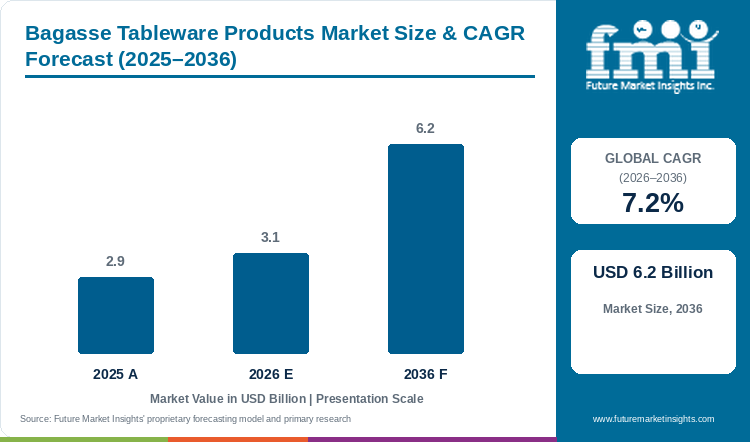
The bagasse tableware products market is up from USD 2.9 billion in 2025, and worth USD 3.1 billion in 2026. The industry is projected to reach USD 6.2 billion by 2036 at a 7.2% CAGR.
Thermoforming wet depithed Saccharum officinarum fibrous residue from sugar mills converts agricultural boiler byproduct into rigid foodservice plates and hinged clamshells that replace banned polystyrene foam. On the global valuation scale, industry turnover advances from USD 2.9 billion in 2025 to USD 3.1 billion in 2026 and will reach USD 6.2 billion by 2036 at a 7.2% CAGR, with USD 3.1 billion added over the ten-year forecast. Plates account for the largest product type share at 35.2% in 2026 as quick-service chains standardize on high-rim molded fiber flatware. Under European Union Regulation (EU) 2025/40 food-contact packaging placed on the EU market from August 2026 must comply with a 25 ppb targeted PFAS limit and a 50 ppm total organic fluorine cap, accelerating buyer conversion to fluorine-free bagasse formulations [1].
Key Market Trends & Insights
- By product type: High-volume single-serve meal plating across quick-service chains and institutional cafeterias puts Plates at 35.2% of 2026 product type sales.
- By finish type: Statutory bans on fluorinated grease-proofing chemicals push No-Added-PFAS Fiber to 41.8% of 2026 finish turnover.
- By application: Hot-meal and sauced entree containment requirements give Food Applications 72.0% of 2026 application volume.
- By end use: Recurring case-lot replenishment across restaurants and cloud kitchens anchors Commercial Use at 59.0% of 2026 end-use spending.
- By sales channel: Consolidated weekly truck deliveries to multi-unit hospitality operators place Distributors at 34.9% of 2026 channel sales.
Regional Highlights
- Fastest-growing evaluated country: Co-located sugarcane pulp mills and national plastic bans put India at the front of the eight analyzed markets with an 8.4% CAGR from 2026 to 2036.
- By country: China (8.0%) and Mexico (7.8%) post strong gains on meal-delivery and export manufacturing while the UK (7.4%) and Germany (6.9%) lead European conversion ahead of France (6.8%) and North American demand in the USA (6.7%) and Canada (6.6%).
Market Size & Forecast
Table 1: Market Size and Forecast for the Bagasse Tableware Products Market (USD billion and CAGR percentage), 2025 to 2036
| Metric | Value |
|---|---|
| Global Market Value (2025) | USD 2.9 billion |
| Global Market Value (2026) | USD 3.1 billion |
| Projected Market Value (2036) | USD 6.2 billion |
| Forecast CAGR (2026 to 2036) | 7.2% |
| Absolute Dollar Opportunity (2026 to 2036) | USD 3.1 billion |
Manufacturing economics across countries depend on proximity to raw cane crushing mills and municipal composting infrastructure. Pulp mills integrated with sugar refineries in India and China convert wet depithed bagasse directly into thermoformed plates and clamshells at low feedstock cost, whereas European and North American distributors focus on EN 13432 and ASTM D6868 compostability auditing across biodegradable disposable tableware. The USDA Foreign Agricultural Service reported in April 2026 that Brazil's sugarcane harvest reached 677 million metric tons in marketing year 2025/26, sustaining abundant fibrous residue supply alongside India and Thailand [2]. Converters are pairing this agricultural fiber base with internal alkyl ketene dimer sizing to achieve 90°C oil holdout without fluorinated chemicals.
Sugarcane Crushing Residue and Thermoformed Pulp Conversion Sizing
Table 2: Sugarcane Bagasse Feedstock and Molded Tableware Conversion Metrics (Million Metric Tons and USD billion), mixed historical and forecast years from 2025 to 2036
| Feedstock & Conversion Metric | 2025 | 2026 | 2036 | Industrial & Agronomic Basis |
|---|---|---|---|---|
| Global Crushed Sugarcane Volume | 1,890 million MT | 1,920 million MT | 2,180 million MT | Anchored by Brazil, India, China, Thailand, and Mexico cane harvests |
| Wet Bagasse Residue Generated (~28% to 30% of cane) | 548 million MT | 557 million MT | 632 million MT | Majority burned for sugar-mill cogeneration; packaging share rising |
| Chemical & Mechanical Depithed Bagasse Tableware Pulp | 1.42 million MT | 1.52 million MT | 3.05 million MT | Bleached and unbleached virgin cane pulp directed to platen thermoforming |
| PFAS-Free Barrier Share of Molded Bagasse Tableware | 68.5% | 76.2% | 98.5% | Driven by EU PPWR Aug 2026 enforcement and U.S. FDA / state PFAS bans |
Operational note: Roughly 80% to 85% of raw sugarcane bagasse is burned at sugar mills for boilers and cogeneration. Tableware converters purchase the surplus depithed long-fiber fraction, where 1 metric ton of wet bagasse yields approximately 0.22 to 0.25 metric tons of dry bleached or unbleached thermoforming pulp.
Per Capita & Foodservice Outlet Tableware Intensity
Sugarcane bagasse tableware has gained rapid commercial traction across quick-service restaurants and institutional cafeterias because high-temperature platen pressing creates a dense cellulose network that holds heavy sauces without buckling. Unlike paperboard plates that require polyethylene extrusion coatings, wet-pressed bagasse slurries form rigid three-dimensional compartment trays and hinged clamshells in a single molding cycle. Stackable nesting profiles also allow converters to pack 500 to 1,000 plates per master carton, lowering warehouse storage space per meal served.
Table 3: Per Capita and Foodservice Outlet Spending Indicators for the Bagasse Tableware Products Market (USD), mixed historical and forecast years from 2025 to 2036
| Country / Region | 2026 Per Capita Spend (USD) | 2036 Per Capita Spend (USD) | Annual Spend per Quick-Service Outlet (USD) |
|---|---|---|---|
| United States | USD 2.45 | USD 4.50 | USD 4,850 |
| United Kingdom | USD 2.15 | USD 4.25 | USD 4,120 |
| Germany | USD 1.80 | USD 3.40 | USD 3,680 |
| China | USD 0.48 | USD 1.05 | USD 2,150 |
| India | USD 0.19 | USD 0.44 | USD 1,480 |
Table 4: Foodservice & Institutional Channel Indicators for the Bagasse Tableware Products Market (USD and percentages), mixed reporting years from 2025 to 2026
| End-Use Buyer Category | Share of Tableware Volume (2026) | Typical GSM / Wall Thickness | Primary Functional Specification |
|---|---|---|---|
| Quick-Service Restaurants & Cloud Kitchens | 41.5% | 350 to 450 GSM (0.8 to 1.1 mm) | 3-compartment hinged clamshells and burger boxes with 90°C oil resistance |
| Corporate, Healthcare & University Dining | 24.0% | 300 to 380 GSM (0.7 to 0.9 mm) | 5-compartment school lunch trays and oval cafeteria platters (BPI certified) |
| Event Catering, Stadiums & Airline Hospitality | 18.5% | 280 to 350 GSM (0.6 to 0.8 mm) | Round 9-inch and 10-inch rimmed dinner plates and portion soufflé cups |
| Retail Household & Eco-Party Packs | 16.0% | 250 to 320 GSM (0.6 to 0.7 mm) | Shrink-wrapped 25- to 50-count microwave-safe plates and soup bowls |
Analyst Perspective
"Foodservice operators are rapidly replacing polystyrene foam and fluorinated fiber with fluorine-free bagasse plates and hinged clamshells. However, longer platen press dwell times for PFAS-free chemistries and anti-dumping duties on imported bowls continue to test converter margins."
- Nandini Roy Choudhury, Principal Consultant, Future Market Insights.
How is the Bagasse Tableware Products Market Segmented?
The market is segmented by product type, finish type, application, end use, sales channel, and region. Plates lead product type at 35.2% share in 2026, while No-Added-PFAS Fiber accounts for 41.8% of finish type revenue.
By product type: Plates, Bowls, Clamshells & Hinged Containers, Meal Trays, and Cups & Portion Pots.
By finish type: No-Added-PFAS Fiber, Uncoated Natural Fiber, Bio-Laminated Fiber, and Printed Fiber.
By application: Food Applications and Beverage Applications.
By end use: Commercial Use, Institutional Use, and Household Use.
By sales channel: Distributors, Direct Sales, Online Channels, and Retail Stores.
By region: North America, Latin America, Western Europe, Eastern Europe, East Asia, South Asia and Pacific, and Middle East and Africa.
Why Do Plates Lead Bagasse Tableware Product Type Demand?
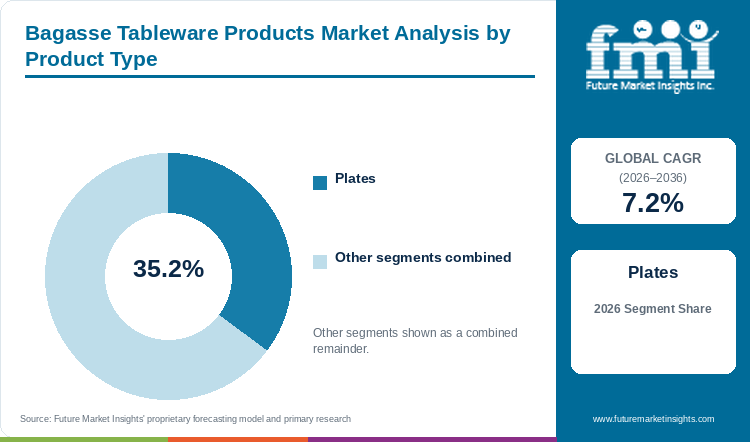
Plates represent 35.2% of product type revenue in 2026 because hot-pressed rim ribs prevent flexing under heavy entrees.
Table 5: Bagasse Tableware Products Market Share by Product Type (2026)
| Product Type Segment | 2026 Value Share (%) |
|---|---|
| Plates | 35.2% |
| All Other Product Types* | 64.8% |
| Total | 100.0% |
*Calculated as the balance remaining after deducting the leading segment's reported share from 100.0%.
Table 6: Product Type Segment Context for the Bagasse Tableware Products Market (2026 to 2036)
| Metric | Value |
|---|---|
| Leading Product Type (2026) | Plates (35.2%) |
| Second-Largest Product Type (2026) | Clamshells & Hinged Containers (24.6%) |
| Third-Largest Product Type (2026) | Bowls (21.4%) |
| Primary Tooling & Press Standard | Reciprocating hot-platen pulp thermoforming at 160°C to 200°C |
Round and compartmentalized bagasse plates generate the largest unit and value share because quick-service chains and corporate cafeterias consume flatware across every meal daypart. Unlike thin paper plates that sag under hot gravies, thermoformed molded fiber pulp packaging plates feature densified outer rims that withstand knife cutting and microwave reheating up to 120°C. Clamshells & Hinged Containers represent the second-largest product tier at 24.6% in 2026 for meal delivery while Bowls (21.4%) and Meal Trays (11.8%) alongside Cups & Portion Pots (7.0%) serve soup chains and school cafeterias.
- Hot-pressed rim rigidity keeps Plates at 35.2% of product type turnover in 2026 across buffet and outdoor catering service.
- In January 2026, Dart Container expanded its DART Compostable Fiber Containers portfolio with PFAS-free molded fiber plates and hinged trays carrying the ProPlanet sustainability seal [3].
What Makes No-Added-PFAS Fiber Central to Finish Type Selection?
No-Added-PFAS Fiber is expected to capture 41.8% share of 2026 finish demand as regulators ban fluorinated grease barriers.
No-Added-PFAS Fiber has overtaken fluorinated wet-end formulations to become the leading finish category as restaurant chains enforce strict chemical-compliance specifications. Following the U.S. Food and Drug Administration's market phase-out of PFAS grease-proofing agents and the European Union's PPWR 25 ppb limit, national foodservice buyers now reject fluorinated fiber outright. Converters achieve hot-oil holdout in PFAS-free foodservice packaging by combining high-pressure platen densification with internal cellulose cross-linkers and alkyl ketene dimer (AKD) sizing. Uncoated Natural Fiber holds 29.5% share in 2026 for dry bakery items, while Bio-Laminated Fiber (19.2% using PLA orPHA films) and Printed Fiber (9.5%) serve sauced meals and branded catering.
- BPI and EN 13432 certification rules requiring below-100-ppm total fluorine keep No-Added-PFAS Fiber at 41.8% of 2026 finish sales.
- In November 2025, Sabert Corporation's no-intentionally-added-PFAS Pulp Ultra molded fiber formulation won the 2025 U.S. Plastics Pact Sustainable Packaging Innovation Award [4].
Why Do Food Applications Anchor Bagasse Tableware Consumption?
Food Applications is anticipated to command 72.0% share in 2026 based on application as breathable fiber walls prevent takeaway meal sogginess.
Direct food service accounts for nearly three-quarters of market revenue because hot entrees and sauced curries require breathable yet grease-tight containment during 30-to-45-minute delivery windows. Sealed plastic containers trap steam and turn fried foods soggy, whereas micro-porous bagasse clamshells allow excess vapor to escape while retaining heat. Beverage Applications represent the remaining 28.0% share in 2026, consisting of molded bagasse cup lids and four-cup delivery carriers used alongside compostable tableware and paper cups and paper bowls across coffee chains.
- Food applications sustains the 72.0% share by applications in 2026 across fried chicken and burger delivery orders.
- In May 2026, the U.S. Census Bureau reported that U.S. food services and drinking places sales reached USD 95.8 billion in April 2026 (up 4.1% year-over-year), supporting steady takeaway container consumption [5].
What Supports Commercial Use Leadership Across End-Use Sectors?
Commercial Use is set to secure a 59.0% share in 2026 by end-use through daily restaurant and food-delivery case volume.
Commercial hospitality operators led by quick-service restaurant chains and fast-casual salad bars alongside cloud kitchens drive the majority of bagasse tableware purchasing. These businesses operate under municipal single-use plastic bans and rely on disposable fiber plates and hinged boxes to avoid dishwashing labor and water expenses. Institutional Use represents 26.5% of 2026 demand across school districts and hospitals procuring compartmentalized lunch trays alongside PLA coated boards to meet public green-procurement mandates, while Household Use accounts for 14.5%.
- Municipal foam bans and commercial dishwashing labor shortages keep Commercial Use at 59.0% of 2026 end-use revenue.
- In December 2025, Dart Container recognized its top-performing North American manufacturing and distribution sites for scaling sustainable foodservice container fulfillment across commercial restaurant accounts [6].
How Do Distributors Maintain Sales Channel Leadership?
Distributors account for 34.9% of 2026 channel turnover by bundling fiber tableware with weekly restaurant food deliveries.
Broadline foodservice distributors and specialized janitorial-and-packaging wholesalers lead channel sales because independent restaurants and regional chains prefer consolidated weekly truck deliveries covering food ingredients and takeaway boxes. Distributors maintain multi-container buffer inventories imported from Asian and Latin American pulp mills, insulating local restaurants from ocean freight delays across foodservice disposable supply lines. Direct Sales from manufacturers to national quick-service chains hold 31.4% share in 2026, followed by Online Channels (18.6%) for small-business case orders and Retail Stores (15.1%) for consumer picnic packs.
- Consolidated LTL warehouse distribution keeps Distributors at 34.9% of 2026 sales channel revenue across regional restaurant groups.
- In July 2025, Huhtamaki launched new home- and industrially-compostable fiber foodservice cups and lids utilizing bio-based barrier coatings for European and North American distributors [7].
What Are the Drivers, Restraints, and Opportunities in the Bagasse Tableware Products Market?
Statutory single-use plastic bans and PFAS phase-out rules drive global conversion to sugarcane bagasse tableware, while elevated platen cycle times for fluorine-free barriers and trade tariffs on imported Chinese fiberware restrain margins. Bio-laminated wet-entree trays and co-located sugar-mill thermoforming plants unlock long-term growth opportunities.
- Driver: National prohibitions on expanded polystyrene foam and single-use plastic plates force restaurants and caterers to adopt compostable sugarcane fiber alternatives.
- Restraint: Fluorine-free oil-barrier chemistries and longer platen pressing cycles raise unit production costs by 18% to 25% above conventional plastic and foam containers.
- Opportunity: Integrating PHA and PLA bio-laminations onto molded bagasse trays unlocks modified-atmosphere chilled ready-meal and airline catering contracts.
Statutory Polystyrene and Single-Use Plastic Prohibitions Across Hospitality
Enforced prohibitions on expanded polystyrene food containers and oxo-degradable plastics across Europe and North America alongside India serve as the primary catalyst for bagasse tableware adoption. Unlike PLA-lined paperboard that requires industrial composting temperatures, unbleached and fluorine-free bagasse plates disintegrate cleanly in both home and municipal composting systems within 60 to 90 days. In March 2026 Environment and Climate Change Canada reaffirmed full enforcement of the Single-use Plastics Prohibition Regulations banning the commercial manufacture and sale of plastic foodservice ware and expanded polystyrene takeout containers nationwide [8]. Restaurant chains and stadium concessionaires are therefore standardizing on BPI-certified bagasse plates and bagasse bowls.
PFAS-Free Barrier Cost Premiums and Trade Tariff Friction
Transitioning from low-cost fluorinated wet-end additives to PFAS-free oil-and-grease barriers has increased chemical and energy costs for pulp thermoformers. Achieving 90°C oil holdout without PFAS requires tighter platen thermoforming cycles, which reduces press output by 10% to 15% and raises piece prices above polypropylene containers. At the same time, restaurant operators face tight operating margins: in May 2026, the U.S. Bureau of Labor Statistics reported that the food-away-from-home Consumer Price Index rose 3.8% year-over-year, making independent diners sensitive to packaging surcharges [9]. In addition, U.S. Section 301 tariffs and anti-dumping/countervailing duties on Chinese molded fiber containers complicate distributor landed costs.
Bio-Laminated Ready-Meal Trays and Sugar-Belt Mill Co-Location
Laminating thin polylactic acid (PLA) or aqueous dispersion barrier coatings onto thermoformed bagasse trays enables converters to penetrate supermarket chilled ready-meals and airline ovenable entrees. Co-locating automated pulp molding presses directly beside cane crushing mills in India and Thailand as well as Brazil and Mexico also eliminates wet-pulp drying and baling expenses. In April 2026, the USDA Foreign Agricultural Service reported that Thailand's 2025/26 sugarcane crush reached 92.0 million metric tons, providing abundant low-cost bagasse fiber for export-oriented Southeast Asian tableware plants [10]. This mill-integrated model narrows the price gap with disposable foodservice packaging and molded pulp packaging.
Bagasse Tableware Products Market by Country (2026 to 2036)
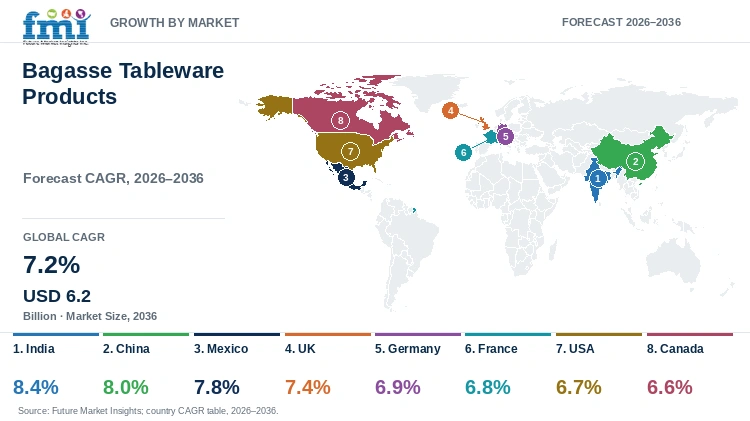
Growth across the eight evaluated nations reflects domestic sugarcane crushing scale alongside hospitality plastic bans. India leads global expansion at an 8.4% CAGR from 2026 to 2036 as sugar mills in Uttar Pradesh and Maharashtra add integrated pulp thermoforming lines, followed by China at 8.0% and nearshoring converter hubs in Mexico at 7.8%. Statutory foam and plastic plate prohibitions lift the United Kingdom to a 7.4% CAGR while Germany (6.9%) and France (6.8%) join the United States (6.7%) and Canada (6.6%) in advancing PFAS-free institutional and restaurant procurement.
Table 7: Bagasse Tableware Products Market CAGR by Country (2026 to 2036)
| Country | CAGR (2026 to 2036) | Primary Growth Lever |
|---|---|---|
| India | 8.4% | Integrated Uttar Pradesh/Maharashtra sugar-mill pulp plants, railway catering, and SUP ban enforcement |
| China | 8.0% | Guangxi/Yunnan cane pulp capacity, 5.5+ trillion yuan catering delivery volume, and NDRC plastic rules |
| Mexico | 7.8% | Veracruz/Jalisco sugarcane crushing, USMCA duty-free export converting, and Mexico City plastic bans |
| UK | 7.4% | DEFRA ban on single-use plastic plates/trays/polystyrene and supermarket chilled fiber meal trays |
| Germany | 6.9% | VerpackG & EU PPWR PFAS-free compliance across organic foodservice and festival catering |
| France | 6.8% | AGEC law plastic elimination in delivery/takeaway and August 2026 EU 25 ppb PFAS cap |
| USA | 6.7% | State EPS & PFAS bans (CA, NY, WA), BPI institutional composting, and domestic thermoforming lines |
| Canada | 6.6% | Federal Single-use Plastics Prohibition Regulations banning EPS and plastic foodservice ware |
Source: Future Market Insights analysis
India Bagasse Tableware Products Market Outlook (2026 to 2036)
Co-locating reciprocating pulp thermoforming presses directly inside Uttar Pradesh and Maharashtra sugar complexes allows Indian converters to pump wet depithed bagasse slurry straight to molding lines without bale-drying costs. According to March 2025 crop estimates from India's Ministry of Agriculture and Farmers Welfare national sugarcane output reached 4350.79 lakh metric tonnes in 2024-25, ensuring a massive domestic fiber surplus [11]. Indian molded cane tableware turnover will advance at an 8.4% CAGR through 2036 as railway catering and cloud kitchens replace banned plastic plates. However, fragmented municipal wet-waste segregation and intense price competition from illicit thin-walled polypropylene containers in tier-3 towns restrain margin expansion for domestic converters.
Key takeaway: In India, integrated sugar-mill pulp availability and national single-use plastic bans drive a leading 8.4% CAGR across food-delivery and railway catering channels.
China Bagasse Tableware Products Market Outlook (2026 to 2036)
Massive urban meal-delivery order density exceeding 80 million daily parcels across Meituan and Ele.me makes China the world's largest volume producer and consumer of hinged bagasse lunch boxes. China's National Bureau of Statistics reported in February 2026 that national catering revenue reached CNY 5,571.8 billion in 2025 (up 5.3% year-over-year), expanding takeaway container consumption across tier-1 and tier-2 cities [12]. Chinese bagasse tableware demand is forecast to climb at an 8.0% CAGR from 2026 to 2036 across Guangxi and Yunnan pulp hubs. Yet commercial uptake faces friction from steep U.S. and EU trade duties on exported Chinese fiberware, forcing mills to pivot toward domestic tea chains.
Key takeaway: In China, high-frequency urban meal delivery and domestic airline and high-speed rail plastic bans sustain an 8.0% CAGR for molded cane clamshells.
Mexico Bagasse Tableware Products Market Outlook (2026 to 2036)
Duty-free trade access under the United States-Mexico-Canada Agreement (USMCA) combined with domestic cane harvesting in Veracruz and Jalisco positions Mexico as North America's primary nearshoring hub for molded fiber tableware. The USDA Foreign Agricultural Service Mexico City office forecast Mexico's 2025/26 sugarcane harvest at 47.9 million metric tons in April 2026, supplying ample bagasse residue for regional pulping [13]. Mexican bagasse flatware and clamshell sales are projected to expand at a 7.8% CAGR through 2036 as municipal plastic bans spread across Mexico City and tourist resorts. Nonetheless, seasonal water scarcity in northern industrial parks and imported platen tooling costs challenge smaller regional converters that rely on imported reciprocating thermoforming molds from East Asia.
Key takeaway: In Mexico, abundant Veracruz sugarcane fiber and tariff-free USMCA export access to U.S. foodservice distributors underpin a 7.8% CAGR.
UK Bagasse Tableware Products Market Outlook (2026 to 2036)
Statutory prohibitions on single-use plastic plates and expanded polystyrene takeaway boxes across England and Wales alongside Scotland have structurally shifted British hospitality procurement toward molded sugarcane fiber. The UK Department for Environment and Rural Affairs (DEFRA) reported in July 2025 that the UK achieved a 64.8% packaging waste recycling and recovery rate as Extended Producer Responsibility fee schedules took effect [14]. British bagasse tableware revenue is expected to progress at a 7.4% CAGR between 2026 and 2036. The central commercial obstacle involves limited industrial in-vessel composting access for food-soiled fiberware in high-density urban boroughs, prompting British supermarkets to favor high-density bagasse clamshells and peelable bio-laminated meal trays across nationwide grocery meal-deal counters.
Key takeaway: In the UK, bans on plastic plates and polystyrene takeaway boxes make sugarcane bagasse the default rigid disposable format across hospitality.
Germany Bagasse Tableware Products Market Outlook (2026 to 2036)
Strict enforcement of the German Packaging Act (VerpackG) alongside mandatory reusable tableware options for dine-in restaurants shapes a specialized German market focused on takeaway delivery and outdoor festival catering. Germany's Federal Statistical Office (Destatis) reported in May 2026 that the nominal hospitality turnover index rose 2.1% year-over-year in early 2026, led by quick-service and catering segments [15]. German demand for certified PFAS-free bagasse plates and bowls is projected to record a 6.9% CAGR over the 2026 to 2036 period. However, municipal Bioabfall organic waste operators frequently screen out slow-degrading thick fiberware, pushing German catering and organic grocery buyers toward thin-walled TÜV OK compost HOME certified bagasse plates and trays.
Key takeaway: In Germany, EU PPWR fluorine limits and festival catering demand drive 6.9% annual growth for home-compostable bagasse flatware.
France Bagasse Tableware Products Market Outlook (2026 to 2036)
France's AGEC anti-waste law bans disposable tableware for on-premise fast-food dining while simultaneously prohibiting expanded polystyrene and fluorinated food-contact materials in takeaway channels. France's National Institute of Statistics and Economic Studies (INSEE) documented resilient household spending across commercial catering and bakery-traiteur outlets in November 2025, supporting demand for microwaveable takeaway trays [16]. French sales of bagasse meal trays and hinged containers are predicted to advance at a 6.8% CAGR through 2036. While on-premise reusable crockery rules cap indoor fast-food volume, bakery lunch counters and corporate delivery canteens increasingly specify PFAS-free bagasse bowls to comply with the August 2026 European Union total organic fluorine threshold across metropolitan Paris and regional foodservice chains.
Key takeaway: In France, takeaway polystyrene bans and the August 2026 EU PFAS threshold channel growth into fluorine-free bagasse traiteur and delivery trays.
USA Bagasse Tableware Products Market Outlook (2026 to 2036)
State-level prohibitions on intentionally added PFAS in food packaging across California and New York alongside Washington and Minnesota paired with municipal polystyrene bans anchor United States demand for BPI-certified bagasse tableware. The U.S. Environmental Protection Agency's January 2026 waste and materials update emphasized expanding municipal organic composting infrastructure to divert food-soiled paper and fiber from landfills [17]. United States bagasse tableware turnover is forecast to rise at a 6.7% CAGR from 2026 to 2036. Nevertheless, trade duties on imported Asian molded fiber have raised distributor case prices, prompting major foodservice converters including Sabert and Dart Container to expand domestic United States molded fiber thermoforming capacity across Texas and Pennsylvania.
Key takeaway: In the USA, state PFAS and polystyrene bans paired with domestic thermoforming expansions support a 6.7% CAGR across quick-service and campus dining.
Canada Bagasse Tableware Products Market Outlook (2026 to 2036)
Nationwide federal prohibitions on single-use plastic cutlery and problematic plastic foodservice ware give Canada a unified regulatory baseline favoring molded sugarcane fiber. Statistics Canada reported in June 2025 that while provincial diversion programs increased organic and fiber recovery, commercial foodservice waste remains a priority target for municipal composting expansion [18]. Canadian demand for bagasse plates and hinged containers is anticipated to grow at a 6.6% CAGR through 2036. While national coffee and fast-casual chains have standardized on bagasse bowls and cup carriers, total lack of domestic sugarcane cultivation leaves Canadian distributors 100% reliant on ocean-freighted Asian and Mexican container supply to stock provincial restaurant distribution warehouses across Ontario and British Columbia.
Key takeaway: In Canada, national single-use plastic prohibitions and provincial EPR fee structures sustain institutional and quick-service adoption of bagasse tableware.
Full report country CAGRs cover: North America; Latin America; Western Europe; Eastern Europe; East Asia; South Asia and Pacific; Middle East and Africa.
Who Are the Notable Companies in the Bagasse Tableware Products Market?
Leading suppliers include Huhtamäki Oyj, Dart Container Corporation, Sabert Corporation, Pactiv Evergreen Inc., and Pakka Limited. Manufacturers compete on proprietary PFAS-free oil-barrier formulations, BPI and TÜV home-compostable certifications, and sugar-mill pulp vertical integration.
Competitive differentiation in bagasse tableware centers on eliminating fluorinated grease-proofing chemicals without sacrificing 90°C hot-oil holdout or platen press cycle speed. Multinational foodservice converters led by Huhtamäki Oyj and Sabert Corporation alongside Dart Container and Pactiv Evergreen leverage deep broadline distributor relationships in North America and Europe. Simultaneously, vertically integrated Asian pulp-and-tableware producers led by Pakka Limited and Zhejiang Zhongxin Environmental Protection Technology control upstream depithed sugarcane pulp mills.
- Global Multinational Foodservice Packaging Leaders: Huhtamäki Oyj, Dart Container Corporation, Sabert Corporation, and Pactiv Evergreen Inc. (Novolex) supply BPI-certified PFAS-free molded fiber plates, bowls, and hinged clamshells to global quick-service restaurant brands.
- Vertically Integrated Sugarcane Pulp & Thermoforming Mills: Pakka Limited (Chuk), Zhejiang Zhongxin Environmental Protection Technology Group, Guangxi Qiaowang Pulp Packing Products, and DevEuro Paper Products operate integrated cane-depithing and high-speed reciprocating thermoforming lines.
- Specialty Eco-Disposables & Regional Branded Distributors: Vegware Ltd., Eco-Products, Inc. (Novolex), BioPak Pty Ltd., Duni Group, and Stora Enso Oyj provide closed-loop composting collection services alongside EN 13432 and ASTM D6868 certified bagasse tableware.
Competitive Benchmarking: Bagasse Tableware Products Market
Table 8: Competitive Benchmarking of Key Players in the Bagasse Tableware Products Market (2026)
| Company | Product & Compartment Breadth | PFAS-Free Barrier Technology | Compostability Certifications | Mill Integration & Global Reach |
|---|---|---|---|---|
| Huhtamäki Oyj | High (Plates, bowls, clamshells, fiber lids, ready-meal trays) | High (Proprietary bio-based fluorine-free oil & moisture barriers) | High (EN 13432, ASTM D6400, TÜV OK compost HOME/INDUSTRIAL) | High (37 countries; 100+ manufacturing sites globally) |
| Sabert Corporation | High (Pulp Ultra & Pulp Plus plates, bowls, hinged containers) | High (GreenScreen Gold & BPI certified no-added-PFAS Pulp Ultra) | High (BPI, WMU recyclability, and home/industrial compostability) | High (Manufacturing in USA, Europe, and Asia) |
| Dart Container Corporation | High (ProPlanet molded fiber dinnerware, hinged trays, bowls) | High (100% no-intentionally-added-PFAS fiber dinnerware portfolio) | High (TÜV Austria Home Compostable & BPI Commercial certifications) | High (40+ North American & international production/distribution sites) |
| Pactiv Evergreen (Novolex) | High (EarthChoice & Eco-Products Vanguard sugarcane lines) | High (Vanguard no-added-PFAS proprietary grease-resistant formula) | High (BPI, CMA, and GreenScreen Silver/Gold certified lines) | High (Extensive North American & European distributor footprint) |
| Pakka Limited (Chuk) | Medium (Unbleached bagasse plates, bowls, meal trays, delivery lids) | High (Chemical-free and fluorine-free unbleached cane pulp) | High (ISO 17088 / IS 17088 and global compostable compliance) | Medium (Integrated Ayodhya, India cane mill & Guatemala expansion) |
| Duni Group (incl. BioPak) | High (Bagasse plates, sushi trays, bowls, PHA/PLA-lined containers) | High (Fluorine-free natural & bio-laminated sugarcane ranges) | High (EN 13432, AS 4736 Home & Industrial Compostable) | High (Europe, Australia/NZ, and Asia-Pacific hospitality reach) |
Evaluation criteria: Benchmark scores measure each supplier's molded product SKU range and verified below-25-ppb fluorine compliance alongside third-party compostability certificates and direct ownership of thermoforming presses.
Key Developments in the Bagasse Tableware Products Market (2025 to 2036)
- In August 2026, Sabert Corporation won two 2026 AmeriStar Awards from the Institute of Packaging Professionals for its Pulp Ultra PFAS-free coated molded fiber foodservice containers and r-PRO trays [19].
- In April 2026, Sabert Corporation released its 2025 Sustainability Report and announced a new 2030 circular packaging goal centered on scaling its award-winning Pulp Ultra no-added-PFAS bagasse tableware across North American and European foodservice accounts [20].
- In February 2025, Pakka Limited reported third-quarter financial results and advanced its Project Jagriti capacity expansion in Ayodhya, India alongside its Central American bagasse pulp and compostable tableware manufacturing project [21].
Key Players in the Bagasse Tableware Products Market
Tier 1: Global Foodservice Packaging & Molded Fiber Leaders
- Huhtamäki Oyj
- Dart Container Corporation
- Sabert Corporation
- Pactiv Evergreen Inc. / Novolex (Eco-Products)
- Genpak LLC
- Duni Group (including BioPak)
Tier 2: Vertically Integrated Sugarcane Pulp & Tableware Manufacturers
- Pakka Limited (Chuk)
- Zhejiang Zhongxin Environmental Protection Technology Group Co., Ltd.
- Guangxi Qiaowang Pulp Packing Products Co., Ltd.
- Xiamen Jiekun Technology Corp.
- Shandong Shengquan New Materials Co., Ltd.
- DevEuro Paper Products LLP
Tier 3: Regional Compostable Foodservice & Specialty Fiber Innovators
- Vegware Ltd.
- Stora Enso Oyj
- Pappco Greenware
- dinearth (Abhinav Industries)
- PrimeWare (acr Corp.)
- World Centric
Bagasse Tableware Products Market - Report Scope
Table 9: Report Scope and Market Definition for the Bagasse Tableware Products Market
| Coverage field | Report scope |
|---|---|
| Market Definition | Rigid and semi-rigid disposable foodservice tableware thermoformed from depithed sugarcane fibrous residue (Saccharum officinarum bagasse), encompassing plates, bowls, hinged clamshells, compartmentalized meal trays, and portion pots/lids. Category Scope Note: Market valuation captures finished thermoformed bagasse tableware sold to commercial foodservice, institutional, and retail buyers; upstream bulk bagasse bales burned for sugar-mill cogeneration, wood-pulp paperboard plates, and non-tableware industrial protective molded pulp are excluded. |
| Base Year & Forecast Period | Base Year: 2025 | Estimated Year: 2026 | Forecast Period: 2026 to 2036 |
| Historical Data Horizon | 2020 to 2025 |
| Quantitative Units | Revenue in USD billion; pulp conversion volume in million metric tons; growth in CAGR (%) |
| Segmentation Axes Covered | Product Type (5), Finish Type (4), Application (2), End Use (3), Sales Channel (4), Region (7) & 8 Key Countries |
Bagasse Tableware Products Market - Research Methodology
Table 10: Research Methodology and Analytical Framework for the Bagasse Tableware Products Market
| Method | Approach |
|---|---|
| Primary Research Validation | Structured interviews with 38 sugarcane pulp mill engineers, molded-fiber thermoforming plant directors, PFAS-free barrier chemists, and quick-service restaurant packaging procurement leads across India, China, North America, and Western Europe. |
| Bottom-Up Market Sizing & Triangulation | Global valuation is constructed bottom-up by tracking commercial depithed bagasse tableware pulp tonnage (1.52 million MT in 2026) across active thermoforming platen presses, multiplied by average converted selling prices across uncoated, PFAS-free, and bio-laminated grades. |
| Country Forecasting Econometric Model | Country CAGRs (2026 to 2036) are modeled using a weighted econometric framework combining national foodservice and meal-delivery order growth (35%), statutory EPS/single-use plastic and PFAS ban enforcement timelines (30%), domestic sugarcane crushing and depithed pulp availability (20%), and municipal composting diversion rates (15%) relative to the 7.2% global baseline. |
| Operational Benchmark Traceability | Agronomic and conversion parameters in Tables 2, 3, and 4 (28% to 30% wet bagasse yield per crushed cane ton, 250 to 450 GSM basis weights, 25 ppb targeted PFAS and 250 ppm TOF thresholds, and 90°C oil holdout standards) are verified against USDA FAS Sugar Annual reports, EU PPWR Regulation 2025/40, and BPI / TÜV Austria certification specifications. |
Bagasse Tableware Products Market by Segments
Bagasse Tableware Products Market segmented by Product Type:
- Plates
- Bowls
- Clamshells & Hinged Containers
- Meal Trays
- Cups & Portion Pots
Bagasse Tableware Products Market segmented by Finish Type:
- No-Added-PFAS Fiber
- Uncoated Natural Fiber
- Bio-Laminated Fiber
- Printed Fiber
Bagasse Tableware Products Market segmented by Application:
- Food Applications
- Beverage Applications
Bagasse Tableware Products Market segmented by End Use:
- Commercial Use
- Institutional Use
- Household Use
Bagasse Tableware Products Market segmented by Sales Channel:
- Distributors
- Direct Sales
- Online Channels
- Retail Stores
Bagasse Tableware Products Market by Region
- North America
- United States
- Canada
- Latin America
- Mexico
- Brazil
- Colombia
- Rest of Latin America
- Western Europe
- United Kingdom
- Germany
- France
- Italy
- Spain
- BENELUX
- Rest of Western Europe
- Eastern Europe
- Poland
- Czechia
- Hungary
- Rest of Eastern Europe
- East Asia
- China
- Japan
- South Korea
- South Asia and Pacific
- India
- Thailand
- Australia & New Zealand
- Indonesia
- Rest of South Asia and Pacific
- Middle East and Africa
- GCC Countries
- South Africa
- Egypt
- Rest of Middle East and Africa
Research Sources and Bibliography
- [1] European Parliament and Council of the European Union. (2025, January 22). Regulation (EU) 2025/40 of the European Parliament and of the Council of 19 December 2024 on packaging and packaging waste, amending Regulation (EU) 2019/1020 and Directive (EU) 2019/904, and repealing Directive 94/62/EC. Official Journal of the European Union (EUR-Lex).
- [2] U.S. Department of Agriculture, Foreign Agricultural Service (USDA FAS). (2026, April 20). Brazil: Sugar Annual. USDA Foreign Agricultural Service GAIN (Report BR2026-0020).
- [3] Dart Container Corporation. (2026, January 15). DART® Compostable* Fiber Containers. Dart Container Corporation.
- [4] Sabert Corporation. (2025, November 19). Sabert Corporation's Pulp Ultra® Wins 2025 U.S. Plastics Pact Packaging Innovation Award. Sabert Corporation.
- [5] U.S. Census Bureau. (2026, May 15). Advance Monthly Sales for Retail and Food Services, April 2026. U.S. Department of Commerce.
- [6] Dart Container Corporation. (2025, December 18). Dart celebrates best performers of 2025. Dart Corporate.
- [7] Huhtamäki Oyj. (2025, July 16). Huhtamaki launches new compostable ice cream cups. Huhtamaki.
- [8] Environment and Climate Change Canada (ECCC). (2026, March 02). Single-use Plastics Prohibition Regulations: Overview. Government of Canada (Canada.ca).
- [9] U.S. Bureau of Labor Statistics (BLS). (2026, May 13). Consumer Price Index - April 2026. U.S. Department of Labor.
- [10] U.S. Department of Agriculture, Foreign Agricultural Service (USDA FAS). (2026, April 20). Sugar Annual: Bangkok, Thailand (Report TH2026-0011). USDA Foreign Agricultural Service GAIN.
- [11] Ministry of Agriculture and Farmers Welfare, Government of India. (2025, March 10). Final Estimates of Production of Major Crops for 2024-25. Directorate of Economics and Statistics, Government of India.
- [12] National Bureau of Statistics of China (NBS). (2026, February 28). Statistical Communiqué of the People's Republic of China on the 2025 National Economic and Social Development. National Bureau of Statistics of China.
- [13] U.S. Department of Agriculture, Foreign Agricultural Service (USDA FAS). (2026, April 21). Mexico: Sugar Annual. USDA Foreign Agricultural Service GAIN (Report MX2026-0025).
- [14] Department for Environment, Food & Rural Affairs (DEFRA). (2025, July 23). UK statistics on waste. GOV.UK Official Statistics.
- [15] Federal Statistical Office of Germany (Destatis). (2026, May 08). Turnover in accommodation and food service activities, March 2026. Statistisches Bundesamt (Destatis).
- [16] National Institute of Statistics and Economic Studies (INSEE). (2025, November 18). Household consumption expenditure on goods and food services in 2025. Institut National de la Statistique et des Études Économiques (INSEE).
- [17] U.S. Environmental Protection Agency (EPA). (2026, January 30). Facts and Figures about Materials, Waste and Recycling. U.S. Environmental Protection Agency.
- [18] Statistics Canada. (2025, June 05). More plastic diverted from landfills in Canada, but waste and pollution remain high. Statistics Canada (StatCan Plus).
- [19] Sabert Corporation. (2026, August 13). Sabert Wins Two 2026 AmeriStar Awards for r-PRO™ and Pulp Ultra®. Sabert Corporation.
- [20] Sabert Corporation. (2026, April 30). Sabert Corporation Releases 2025 Sustainability Report and Announces New 2030 Goal Signaling Next Phase of Sustainable Growth. Sabert Corporation.
- [21] Pakka Limited. (2025, February 08). Pakka Limited Reports Earnings Results for the Third Quarter and Nine Months Ended December 31, 2024. Pakka Limited.
- [22] Huhtamäki Oyj. (2026, January 12). Huhtamaki Solutions Recognised at the WorldStar Awards 2026. Huhtamaki.
- [23] Huhtamäki Oyj. (2026, September 10). Preparing flexible packaging for what comes next. Huhtamaki.
This bibliography is provided for reader reference and is not exhaustive. The full report contains the complete reference list and detailed citations.
This Report Answers
- How big is the global bagasse tableware products market in 2025 and 2026, and what is the projected valuation by 2036?
- Why do Plates capture 35.2% of product type demand ahead of hinged clamshells and bowls?
- How does the August 2026 EU PPWR 25 ppb PFAS limit reshape finish type selection toward No-Added-PFAS Fiber (41.8%)?
- What agronomic and thermoforming factors give India (8.4% CAGR), China (8.0% CAGR), and Mexico (7.8% CAGR) the fastest growth rates?
- How do anti-dumping tariffs and platen press dwell times affect landed case prices for U.S. and European foodservice distributors?
- How are Huhtamaki, Sabert, Dart Container, Pactiv Evergreen, and Pakka Limited positioning their molded fiber portfolios?
Frequently Asked Questions
How large is the global bagasse tableware products market in 2026 and 2036?
According to Future Market Insights, the global bagasse tableware products market is valued at USD 3.1 billion in 2026 (rising from USD 2.9 billion in 2025) and is projected to reach USD 6.2 billion by 2036, expanding at a 7.2% CAGR.
Which product type holds the largest share in the bagasse tableware products market?
Plates account for the largest product type share at 35.2% in 2026, driven by high-volume single-serve meal service across quick-service restaurants, corporate cafeterias, and event catering.
Why is No-Added-PFAS Fiber the leading finish type in 2026?
No-Added-PFAS Fiber holds 41.8% of finish demand in 2026 because U.S. state laws, FDA phase-outs, and the EU PPWR August 2026 fluorine threshold prohibit fluorinated grease-proofing chemicals in food-contact tableware.
Which country is forecast to grow fastest in the bagasse tableware products market?
FMI projects India to record the fastest growth among evaluated countries at an 8.4% CAGR from 2026 to 2036, followed by China at 8.0% and Mexico at 7.8%.
How much raw sugarcane bagasse is converted into tableware pulp globally?
Out of roughly 557 million metric tons of wet bagasse generated globally in 2026, approximately 1.52 million metric tons of depithed bleached and unbleached bagasse pulp are converted into thermoformed tableware, projected to reach 3.05 million metric tons by 2036.
Preview the report firsthand - request a free sample
Get SampleGet the brochure for pricing and purchase details.
Get PDFTable of Content
- Key Takeaways
- Market Size and CAGR
- Top Growth Driver
- Fastest Growing Segment
- Leading Region
- Key Companies
- Emerging Opportunities
- Executive Summary
- Global Market Outlook
- Demand-side Trends
- Supply-side Trends
- Technology Roadmap Analysis
- Analysis and Recommendations
- Analyst Perspective (What is happening? Why now? What should investors know?)
- Key Questions Answered
- How large is the market?
- What is the CAGR?
- What are key trends?
- Which region dominates?
- Who are the leaders?
- Market Overview
- Market Coverage / Taxonomy
- Market Definition / Scope / Limitations
- Research Methodology
- Chapter Orientation
- Analytical Lens and Working Hypotheses
- Market Structure, Signals, and Trend Drivers
- Benchmarking and Cross-market Comparability
- Market Sizing, Forecasting, and Opportunity Mapping
- Research Design and Evidence Framework
- Desk Research Programme (Secondary Evidence)
- Expert Input and Fieldwork (Primary Evidence)
- Tooling, Models, and Reference Databases
- Data Engineering and Model Build
- Quality Assurance and Audit Trail
- Market Background
- Market Dynamics (Drivers, Restraints, Opportunity, Trends)
- Scenario Forecast (Optimistic, Likely, Conservative)
- Impact Analysis
- AI Impact
- Sustainability Impact
- Regulatory Impact
- Technology Impact
- Consumer / Buyer Analysis
- Purchase Drivers
- Adoption Barriers
- Buyer Journey
- Opportunity Map Analysis
- Product Life Cycle Analysis
- Supply Chain Analysis
- Investment Feasibility Matrix
- Value Chain Analysis
- PESTLE and Porter's Analysis
- Regulatory Landscape
- Regional Parent Market Outlook
- Production and Consumption Statistics
- Import and Export Statistics
- Global Market Analysis and Forecast, 2021 to 2036
- Historical Market Size Value (USD Billion) Analysis, 2021 to 2025
- Current and Future Market Size Value (USD Billion) Projections, 2026 to 2036
- Y-o-Y Growth Trend Analysis
- Absolute $ Opportunity Analysis
- Global Market Pricing Analysis, 2021 to 2036
- Global Market Analysis and Forecast, By Product Type, 2021 to 2036
- Introduction / Key Findings
- Historical Market Size Value (USD Billion) Analysis By Product Type, 2021 to 2025
- Current and Future Market Size Value (USD Billion) Analysis and Forecast By Product Type, 2026 to 2036
- Plates
- Bowls
- Clamshells & Hinged Containers
- Meal Trays
- Cups & Portion Pots
- Y-o-Y Growth Trend Analysis By Product Type, 2021 to 2025
- Absolute $ Opportunity Analysis By Product Type, 2026 to 2036
- Global Market Analysis and Forecast, By Finish Type, 2021 to 2036
- Introduction / Key Findings
- Historical Market Size Value (USD Billion) Analysis By Finish Type, 2021 to 2025
- Current and Future Market Size Value (USD Billion) Analysis and Forecast By Finish Type, 2026 to 2036
- No-Added-PFAS Fiber
- Uncoated Natural Fiber
- Bio-Laminated Fiber
- Printed Fiber
- Y-o-Y Growth Trend Analysis By Finish Type, 2021 to 2025
- Absolute $ Opportunity Analysis By Finish Type, 2026 to 2036
- Global Market Analysis and Forecast, By Application, 2021 to 2036
- Introduction / Key Findings
- Historical Market Size Value (USD Billion) Analysis By Application, 2021 to 2025
- Current and Future Market Size Value (USD Billion) Analysis and Forecast By Application, 2026 to 2036
- Food Applications
- Beverage Applications
- Y-o-Y Growth Trend Analysis By Application, 2021 to 2025
- Absolute $ Opportunity Analysis By Application, 2026 to 2036
- Global Market Analysis and Forecast, By End Use, 2021 to 2036
- Introduction / Key Findings
- Historical Market Size Value (USD Billion) Analysis By End Use, 2021 to 2025
- Current and Future Market Size Value (USD Billion) Analysis and Forecast By End Use, 2026 to 2036
- Commercial Use
- Institutional Use
- Household Use
- Y-o-Y Growth Trend Analysis By End Use, 2021 to 2025
- Absolute $ Opportunity Analysis By End Use, 2026 to 2036
- Global Market Analysis and Forecast, By Sales Channel, 2021 to 2036
- Introduction / Key Findings
- Historical Market Size Value (USD Billion) Analysis By Sales Channel, 2021 to 2025
- Current and Future Market Size Value (USD Billion) Analysis and Forecast By Sales Channel, 2026 to 2036
- Distributors
- Direct Sales
- Online Channels
- Retail Stores
- Y-o-Y Growth Trend Analysis By Sales Channel, 2021 to 2025
- Absolute $ Opportunity Analysis By Sales Channel, 2026 to 2036
- Global Market Analysis and Forecast, By Region, 2021 to 2036
- Introduction
- Historical Market Size Value (USD Billion) Analysis By Region, 2021 to 2025
- Current Market Size Value (USD Billion) Analysis and Forecast By Region, 2026 to 2036
- North America
- Latin America
- Western Europe
- Eastern Europe
- East Asia
- South Asia and Pacific
- Middle East and Africa
- Market Attractiveness Analysis By Region
- North America Market Analysis and Forecast, By Country, 2021 to 2036
- Historical Market Size Value (USD Billion) Trend Analysis By Market Taxonomy, 2021 to 2025
- Market Size Value (USD Billion) Forecast By Market Taxonomy, 2026 to 2036
- By Country
- United States
- Canada
- By Product Type
- By Finish Type
- By Application
- By End Use
- By Sales Channel
- By Country
- Market Attractiveness Analysis
- By Country
- By Product Type
- By Finish Type
- By Application
- By End Use
- By Sales Channel
- Key Takeaways
- Latin America Market Analysis and Forecast, By Country
- Historical Market Size Value (USD Billion) Trend Analysis By Market Taxonomy, 2021 to 2025
- Market Size Value (USD Billion) Forecast By Market Taxonomy, 2026 to 2036
- By Country
- Mexico
- Brazil
- Colombia
- Rest of Latin America
- By Product Type
- By Finish Type
- By Application
- By End Use
- By Sales Channel
- By Country
- Market Attractiveness Analysis
- By Country
- By Product Type
- By Finish Type
- By Application
- By End Use
- By Sales Channel
- Key Takeaways
- Western Europe Market Analysis and Forecast, By Country
- Historical Market Size Value (USD Billion) Trend Analysis By Market Taxonomy, 2021 to 2025
- Market Size Value (USD Billion) Forecast By Market Taxonomy, 2026 to 2036
- By Country
- United Kingdom
- Germany
- France
- Italy
- Spain
- BENELUX
- Rest of Western Europe
- By Product Type
- By Finish Type
- By Application
- By End Use
- By Sales Channel
- By Country
- Market Attractiveness Analysis
- By Country
- By Product Type
- By Finish Type
- By Application
- By End Use
- By Sales Channel
- Key Takeaways
- Eastern Europe Market Analysis and Forecast, By Country
- Historical Market Size Value (USD Billion) Trend Analysis By Market Taxonomy, 2021 to 2025
- Market Size Value (USD Billion) Forecast By Market Taxonomy, 2026 to 2036
- By Country
- Poland
- Czechia
- Hungary
- Rest of Eastern Europe
- By Product Type
- By Finish Type
- By Application
- By End Use
- By Sales Channel
- By Country
- Market Attractiveness Analysis
- By Country
- By Product Type
- By Finish Type
- By Application
- By End Use
- By Sales Channel
- Key Takeaways
- East Asia Market Analysis and Forecast, By Country
- Historical Market Size Value (USD Billion) Trend Analysis By Market Taxonomy, 2021 to 2025
- Market Size Value (USD Billion) Forecast By Market Taxonomy, 2026 to 2036
- By Country
- China
- Japan
- South Korea
- By Product Type
- By Finish Type
- By Application
- By End Use
- By Sales Channel
- By Country
- Market Attractiveness Analysis
- By Country
- By Product Type
- By Finish Type
- By Application
- By End Use
- By Sales Channel
- Key Takeaways
- South Asia and Pacific Market Analysis and Forecast, By Country
- Historical Market Size Value (USD Billion) Trend Analysis By Market Taxonomy, 2021 to 2025
- Market Size Value (USD Billion) Forecast By Market Taxonomy, 2026 to 2036
- By Country
- India
- Thailand
- Australia & New Zealand
- Indonesia
- Rest of South Asia and Pacific
- By Product Type
- By Finish Type
- By Application
- By End Use
- By Sales Channel
- By Country
- Market Attractiveness Analysis
- By Country
- By Product Type
- By Finish Type
- By Application
- By End Use
- By Sales Channel
- Key Takeaways
- Middle East and Africa Market Analysis and Forecast, By Country
- Historical Market Size Value (USD Billion) Trend Analysis By Market Taxonomy, 2021 to 2025
- Market Size Value (USD Billion) Forecast By Market Taxonomy, 2026 to 2036
- By Country
- GCC Countries
- South Africa
- Egypt
- Rest of Middle East and Africa
- By Product Type
- By Finish Type
- By Application
- By End Use
- By Sales Channel
- By Country
- Market Attractiveness Analysis
- By Country
- By Product Type
- By Finish Type
- By Application
- By End Use
- By Sales Channel
- Key Takeaways
- Key Countries Market Analysis
- United States
- Pricing Analysis
- Market Share Analysis, 2025
- By Product Type
- By Finish Type
- By Application
- By End Use
- By Sales Channel
- Canada
- Pricing Analysis
- Market Share Analysis, 2025
- By Product Type
- By Finish Type
- By Application
- By End Use
- By Sales Channel
- Mexico
- Pricing Analysis
- Market Share Analysis, 2025
- By Product Type
- By Finish Type
- By Application
- By End Use
- By Sales Channel
- Brazil
- Pricing Analysis
- Market Share Analysis, 2025
- By Product Type
- By Finish Type
- By Application
- By End Use
- By Sales Channel
- Germany
- Pricing Analysis
- Market Share Analysis, 2025
- By Product Type
- By Finish Type
- By Application
- By End Use
- By Sales Channel
- United Kingdom
- Pricing Analysis
- Market Share Analysis, 2025
- By Product Type
- By Finish Type
- By Application
- By End Use
- By Sales Channel
- Italy
- Pricing Analysis
- Market Share Analysis, 2025
- By Product Type
- By Finish Type
- By Application
- By End Use
- By Sales Channel
- Spain
- Pricing Analysis
- Market Share Analysis, 2025
- By Product Type
- By Finish Type
- By Application
- By End Use
- By Sales Channel
- France
- Pricing Analysis
- Market Share Analysis, 2025
- By Product Type
- By Finish Type
- By Application
- By End Use
- By Sales Channel
- India
- Pricing Analysis
- Market Share Analysis, 2025
- By Product Type
- By Finish Type
- By Application
- By End Use
- By Sales Channel
- Australia & New Zealand
- Pricing Analysis
- Market Share Analysis, 2025
- By Product Type
- By Finish Type
- By Application
- By End Use
- By Sales Channel
- China
- Pricing Analysis
- Market Share Analysis, 2025
- By Product Type
- By Finish Type
- By Application
- By End Use
- By Sales Channel
- Japan
- Pricing Analysis
- Market Share Analysis, 2025
- By Product Type
- By Finish Type
- By Application
- By End Use
- By Sales Channel
- South Korea
- Pricing Analysis
- Market Share Analysis, 2025
- By Product Type
- By Finish Type
- By Application
- By End Use
- By Sales Channel
- Poland
- Pricing Analysis
- Market Share Analysis, 2025
- By Product Type
- By Finish Type
- By Application
- By End Use
- By Sales Channel
- Hungary
- Pricing Analysis
- Market Share Analysis, 2025
- By Product Type
- By Finish Type
- By Application
- By End Use
- By Sales Channel
- South Africa
- Pricing Analysis
- Market Share Analysis, 2025
- By Product Type
- By Finish Type
- By Application
- By End Use
- By Sales Channel
- United States
- Market Structure Analysis
- Competition Dashboard
- Competition Benchmarking
- Market Share Analysis of Top Players
- By Regional
- By Product Type
- By Finish Type
- By Application
- By End Use
- By Sales Channel
- Emerging Startups
- Innovation Benchmarking
- Competition Analysis
- Competition Deep Dive
- Huhtamäki Oyj
- Overview
- Product Portfolio
- Profitability by Market Segments
- Sales Footprint
- Strategy Overview
- Marketing Strategy
- Product Strategy
- Channel Strategy
- Sabert Corporation
- Dart Container Corporation
- Pactiv Evergreen (Novolex)
- Pakka Limited (Chuk)
- Duni Group (incl. BioPak)
- Pactiv Evergreen Inc. / Novolex (Eco-Products)
- Genpak LLC
- Duni Group (including BioPak)
- Zhejiang Zhongxin Environmental Protection Technology Group Co., Ltd.
- Guangxi Qiaowang Pulp Packing Products Co., Ltd.
- Xiamen Jiekun Technology Corp.
- Shandong Shengquan New Materials Co., Ltd.
- DevEuro Paper Products LLP
- Vegware Ltd.
- Stora Enso Oyj
- Pappco Greenware
- dinearth (Abhinav Industries)
- PrimeWare (acr Corp.)
- World Centric
- Huhtamäki Oyj
- Case Studies
- Success Stories
- Recent Developments
- Competition Deep Dive
- Assumptions & Acronyms Used


