

- Industry Size (2026)
- USD 13.51 Bn
- Forecast (2036)
- USD 21.38 Bn
- CAGR (2026 to 2036)
- 4.7%
Abyssinian Oil Market size, market forecast and outlook by FMI
The Abyssinian oil market was worth USD 12.90 billion in 2025, and it is expected to grow to USD 21.38 billion by 2036 at a rate of 4.7% per year. According to Future Market Insights, the market is about to gain an extra chance worth USD 7.87 billion. According to FMI, clean-beauty ingredient sourcing, premium hair and skin care formulation, and B2B cosmetic ingredient supply expansion are all changing demand.
Summary of Abyssinian Oil Market
- By 2036, the market is expected to be worth USD 21.38 billion.
- From 2026 to 2036, the market is expected to grow at a rate of 4.7% per year.
- In 2025, the market was thought to be worth $12.90 billion.
- The forecast period gives you an extra chance to make $7.87 billion.
- Organic makes up 58.7% of the nature segment, which shows that there is a high demand for premium organic sources.
- With 41.3% of the market, cosmetics and personal care is the leader, thanks to skincare, hair care, and high-end personal care products.
- B2B makes up 52.1% of sales, which is in line with the B2B ingredient supply structure.
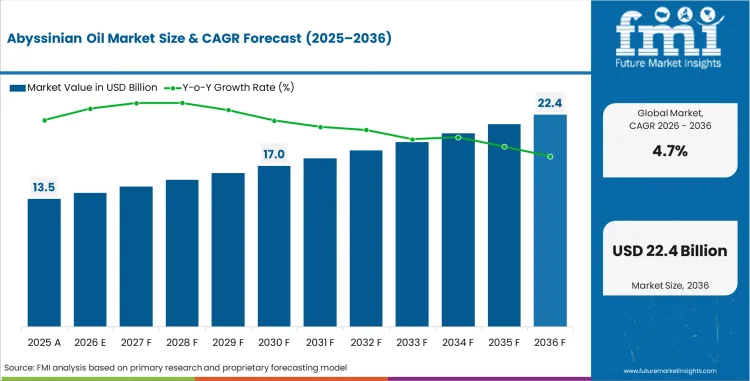
Key Takeaways, Market Size, and Forecast
- 2025 market size: USD 12.9 billion
- 2026 market size: Not specified
- 2036 forecast: Not specified
- 2035 forecast: USD 19.8 billion
- CAGR: 4.7%
- Top nature: Organic
- Top application: Moisturizing agent
- Top growth market: Japan (5.9% CAGR)
Abyssinian Oil Market key Takeaways
| Parameter | Details |
|---|---|
| Market value (2026) | USD 13.51 billion |
| Forecast value (2036) | USD 21.38 billion |
| CAGR (2026 to 2036) | 4.7% |
| Estimated market value (2025) | USD 12.90 billion |
| Incremental opportunity | USD 7.87 billion |
| Leading nature | Organic (58.7%) |
| Leading end use | Cosmetics and Personal Care (41.3%) |
| Leading sales channel | B2B (52.1%) |
| Key players | Croda International PLC, DoTERRA International LLC, Leffingwell and Associates, Venkatramna Industries, Tate & Lyle |
Source: Future Market Insights, 2026
There are three things that affect the Abyssinian oil market. First, the use of clean-beauty ingredients makes this lightweight, non-greasy botanical oil a popular choice for people who want a better alternative to silicone-based hair and skin conditioners. Second, the oil's unique fatty acid profile, which is high in erucic acid, makes hair shine better and skin barriers work better, which sets it apart from other oils. Third, the number of B2B cosmetic ingredient supply channels is growing, linking producers of Abyssinian oil with cosmetic companies all over the world.
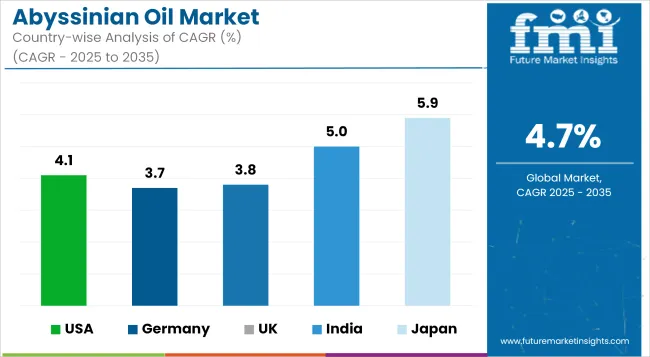
Japan is the fastest-growing country in the world, with a CAGR of 5.9%. Next is India with 5.0%. The US comes next with 4.1%. The UK comes in third with 3.8%. Germany is next with 3.7%.
Abyssinian Oil Market Definition
The Abyssinian oil market sells cold-pressed and refined oils made from Crambe abyssinica seeds. These oils come in organic and conventional grades and can be used for cosmetics, personal care, skin care, hair care, personal hygiene, aromatherapy, and dermatological purposes. They are sold through both B2B and B2C channels.
Abyssinian Oil Market Inclusions
The market scope includes all types of Abyssinian oil that are sold, broken down by type, use, end use, and sales channel. Sizing of revenue goes from 2026 to 2036.
Abyssinian Oil Market Exclusions
Does not include synthetic erucic acid derivatives or industrial lubricants made with Crambe oil that have not been processed for use in cosmetics.
Abyssinian Oil Market Research Methodology
- Primary Research: FMI analysts talked to cosmetic ingredient suppliers, personal care formulators, and specialty oil producers for their primary research.
- Desk Research: Combined reports from manufacturers and data on cosmetic ingredients.
- Market Sizing and Forecasting: adding up data from skincare, haircare, and wellness applications from the bottom up.
- Data validation: Cross-validated quarterly against trade data for cosmetic ingredients to check the data.
Why is the Abyssinian Oil Market Growing?
- People want clean beauty products, so they are switching to plant-based conditioners instead of silicone ones because they are lighter and absorb better.
- The oil's unique erucic acid profile makes it useful for hair shine, skin barrier repair, and keeping moisture in.
- Japan is in the lead with a 5.9% CAGR, which shows that there is a high demand for premium cosmetic ingredients and that people prefer products made from plants.
The Abyssinian oil market is growing steadily because people want clean-beauty ingredients, premium cosmetic formulations, and fatty acids that work in unique ways. This oil comes from Crambe abyssinica seeds and is light enough to moisturize, condition hair, and protect skin without being as heavy as other plant oils.
The clean-beauty movement is what drives most of the growth. Abyssinian oil is a good choice for cosmetic brands that want to replace silicone-based conditioners with plant-based ones because it feels light and makes hair shine better.
The main way that cosmetic ingredients are sold is through B2B supply, which has a 52.1% share. Cosmetic companies get Abyssinian oil from suppliers of industrial ingredients and long-term contracts. B2C retail is where they sell the products directly to consumers.
Segmental Analysis
- Organic at 58.7% shows that there is a high demand for premium sourcing. Certified organic Abyssinian oil has the highest price per liter.
- Moisturizing Agent at 34.6% is the most popular application, with skin hydration and barrier repair formulations being the most in demand.
- Cosmetics and Personal Care make up 41.3% of the total. This includes skincare, haircare, personal hygiene, and high-end cosmetics.
There are different types of products based on their nature (organic or conventional), their use (moisturizing, conditioning, emollient, multi-functional, aromatherapy, dermatological), their end use (cosmetics, skincare, haircare, personal hygiene), and their sales channel (B2B, B2C, supermarkets, specialty stores, e-retail).
Insights into the Organic Nature Segment
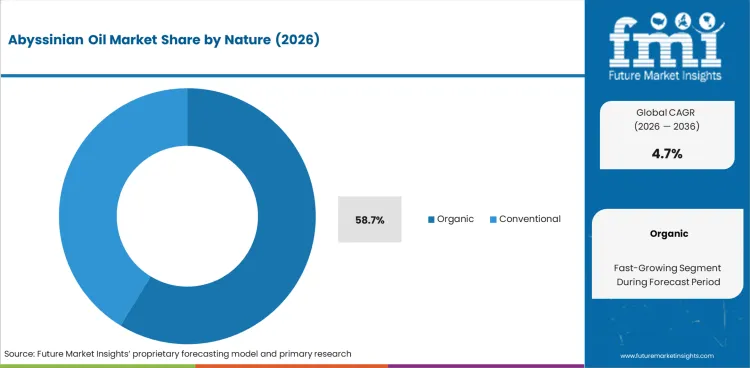
Organic has a 58.7% share. Cold-pressed and certified organic versions of clean-beauty products cost more.
Conventional grade is used for mass-market cosmetics that need to be cheap and for making products on a large scale.
Insights into the Cosmetics and Personal Care End Use Segment
Cosmetics and personal care make up 41.3% of the end use. Serums, moisturizers, and anti-aging creams are the main things that people want when it comes to skincare products.
The demand for hair care products like shine serums, conditioning treatments, and leave-on products is growing because of the trend toward silicone-free formulations.
What are the Drivers, Restraints, and Key Trends of the Abyssinian Oil Market?
- The main reasons are the demand for clean-beauty ingredients and the trend of replacing silicone.
- Limited areas for growing and changing supplies of Crambe seeds make it hard to scale up production.
- The unique erucic acid fatty acid profile makes cosmetic formulations work differently.
The market is steadily growing because people want clean beauty products. Even though there aren't enough supplies, there are still chances for growth in premium cosmetic formulation and distribution in new markets.
Clean-Beauty Silicone Replacement
Cosmetic companies are switching from silicone-based conditioners to plant-based ones, which is why Abyssinian oil is becoming more popular because it feels lighter and works better.
Supply and Cultivation Constraints
Crambe abyssinica can only be grown in certain places, which makes the supply vary and keeps prices high.
Premium Cosmetic Ingredient Positioning
A unique fatty acid profile sets these products apart and allows them to charge more for luxury hair and skin care.
B2B Supply Chain Expansion
B2B ingredient supply networks are getting bigger and connecting Abyssinian oil producers with cosmetic manufacturers all over the world.
Analysis of Abyssinian Oil Market By Key Countries
.webp "Top Country Growth Comparison Abyssinian Oil Market Cagr (2026 2036)")
| Country | CAGR |
|---|---|
| USA | 4.1% |
| Germany | 3.7% |
| UK | 3.8% |
| India | 5.0% |
| Japan | 5.9% |
- Japan is in the lead with 5.9%, thanks to a culture of high-end cosmetics and a need for plant-based ingredients.
- India's 5.0% growth shows that more people are using natural cosmetics and that the country is making more of them.
- The USA (4.1%) and the UK (3.8%) are still growing thanks to clean-beauty trends.
- Germany's 3.7% shows that there is a demand for organic cosmetic ingredients.
From 2026 to 2036, the global abyssinian oil market is expected to grow at a CAGR of 4.7%.
Demand Outlook in the United States
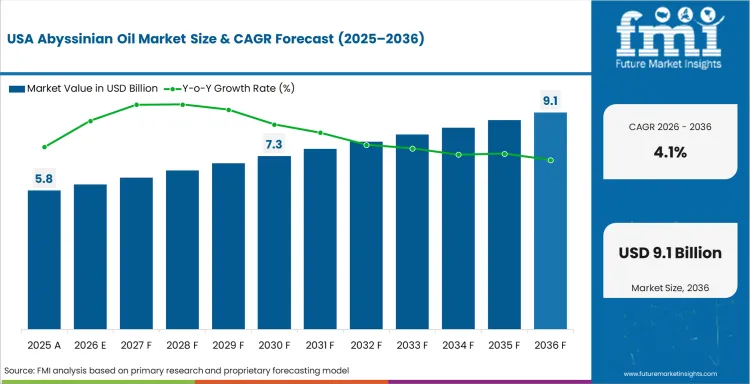
The US economy will grow by 4.1% through 2036, thanks to trends in clean beauty and the need for silicone-free formulations.
- Demand for clean beauty drives adoption.
- Trends that don't use silicone are speeding up.
- Positioning at a premium supports value.
Future Outlook in the United Kingdom
The UK economy grows by 3.8% thanks to a focus on ethical sourcing and demand for natural cosmetics.
- There is more demand for natural cosmetics.
- Ethical sourcing helps with positioning.
- Premium retail gives you access.
Opportunity Analysis in Germany
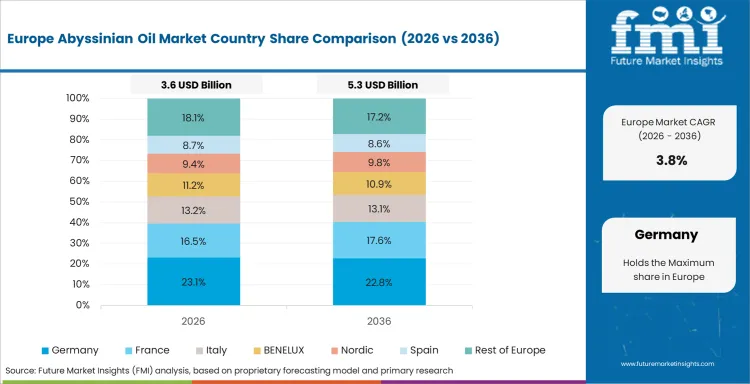
Germany shows growth because of the EU's rules and the culture of organic cosmetics.
- The culture of organic cosmetics fits together.
- EU frameworks help people get into the market.
- Demand for high-quality ingredients stays strong.
In-depth Analysis in Japan
Japan is in the lead with 5.9% because people want high-end cosmetic ingredients and prefer plant-based formulations.
- The demand is driven by a culture of high-end cosmetics.
- Botanical formulation preference helps.
- High-end skincare makes a high-end channel.
Sales Analysis in China
China is growing by getting more people to buy premium cosmetics and by spreading e-commerce beauty platforms.
- The use of high-end cosmetics is on the rise.
- Beauty websites that sell things online are growing.
- New trends in clean beauty are coming up.
In-depth Analysis in India
India grows at a rate of 5.0% thanks to the use of natural cosmetics, the growth of domestic production, and the alignment of Ayurvedic beauty.
- More and more people are using natural cosmetics.
- The production of goods in the country grows.
- Ayurvedic alignment helps with positioning.
Competitive Landscape of Abyssinian Oil Market
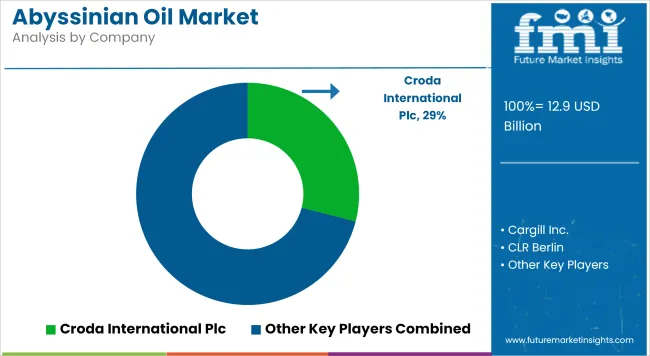
- Croda International is the leader in making specialty chemicals and cosmetic ingredients on a large scale.
- Producers of specialty botanical oils stand out by getting their oils from certified organic farms and buying them directly from farmers.
- New Indian and Asian producers use their access to raw materials in their own countries.
Croda International PLC is the leader in making specialty cosmetic ingredients. DoTERRA International sells and distributes botanical oils.
Regional market activity comes from specialty botanical oil producers and cosmetic ingredient suppliers serving local customers. Nature's Crops International makes oils from Crambe.
Crambe seed sourcing, cold-press extraction, organic certification, and relationships with cosmetic manufacturers are some of the things that get in the way.
Major Industry Players
Key global companies leading the Abyssinian oil market include:
- Key market participants in the Abyssinian oil market include specialty cosmetic ingredient suppliers and botanical oil producers serving regional and global markets.
- New specialty botanical oil producers have made a name for themselves in organic-certified and direct-sourcing markets.
Competitive Benchmarking: Abyssinian Oil Market
| Company | Oil Sourcing | Cosmetic Mfr Access | Product Grade | Geographic Footprint |
|---|---|---|---|---|
| Croda International | High | Strong | High | Global |
| DoTERRA International | High | Moderate | High | Global |
| Venkatramna Industries | High | Moderate | Medium | India, Asia |
| Tate & Lyle | Medium | Moderate | Medium | Europe |
| Nature's Crops International | High | Moderate | High | N. America |
Source: Future Market Insights competitive analysis, 2026.
Key Developments in Abyssinian Oil Market
- In 2025, Croda International did not increase Abyssinian oil production. The company continued supplying Abyssinian oil as part of its clean-beauty portfolio with no specific production expansion announced for this ingredient.
- Nature's Crops International offers Natralipid® Abyssinian seed oil (including organic options), valued for high-end hair care due to its moisturizing, shine, and detangling benefits. No new organic-certified cold-pressed line was launched in 2025.
Key Players in the Abyssinian Oil Market:
Major Global Players:
- Croda International PLC
- DoTERRA International LLC
- Leffingwell and Associates
- Venkatramna Industries
- Tate & Lyle
- Phyto Life Sciences P. Ltd.
Emerging Players/Startups
- Carrubba Inc
- Nature's Crops International
- Hunan Sunfull Bio tech Co., Ltd.
- Henry Lamotte OILS GmbH
- Pure Path Essential Oils
- Moksha Lifestyle Products
- Katyani Exports
- Ahimsa Oils
- Piping Rock
Scope of the report
| Parameter | Details |
|---|---|
| Quantitative Units | USD 13.51 billion to USD 21.38 billion, at a CAGR of 4.7% |
| Market Definition | Encompasses oils from Crambe abyssinica seeds for cosmetic, skincare, haircare, and wellness applications. |
| Regions Covered | North America, Latin America, Europe, East Asia, South Asia and Pacific, Middle East and Africa |
| Countries Covered | USA, Germany, UK, India, Japan, China, 30 plus countries |
| Key Companies Profiled | Croda International PLC, DoTERRA International LLC, Leffingwell and Associates, Venkatramna Industries, Tate & Lyle, Phyto Life Sciences P. Ltd., Carrubba Inc, AVT Tea Services, Nature's Crops International, Hunan Sunfull Bio tech Co., Ltd., Henry Lamotte OILS GmbH Indian Aroma Exports, Pure Path Essential Oils, Moksha Lifestyle Products, Katyani Exports, Ahimsa Oils, Piping Rock. |
| Forecast Period | 2026 to 2036 |
| Approach | Hybrid bottom-up and top-down methodology. |
Abyssinian Oil Market by Segments
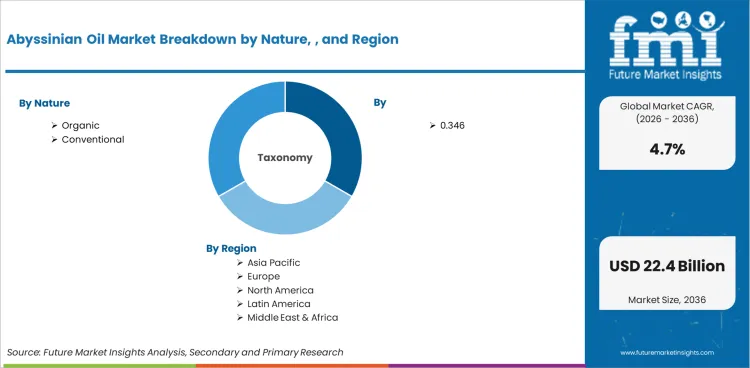
Abyssinian Oil Market Market Segmented by Nature:
- Organic
- Conventional
Abyssinian Oil Market Market by Region:
- North America
- USA
- Canada
- Mexico
- Latin America
- Brazil
- Chile
- Rest of Latin America
- Western Europe
- Germany
- UK
- Italy
- Spain
- France
- Nordic
- BENELUX
- Rest of Western Europe
- Eastern Europe
- Russia
- Poland
- Hungary
- Balkan & Baltic
- Rest of Eastern Europe
- East Asia
- China
- Japan
- South Korea
- South Asia and Pacific
- India
- ASEAN
- Australia & New Zealand
- Rest of South Asia and Pacific
- Middle East & Africa
- Kingdom of Saudi Arabia
- Other GCC Countries
- Turkiye
- South Africa
- Other African Union
- Rest of Middle East & Africa
Bibliography
- 1. Personal Care Products Council. (2025). Cosmetic Ingredient Review: Crambe Abyssinica. PCPC.
- 2. European Commission. (2024). EU Cosmetics Regulation: Botanical Ingredient Standards. EC.
- 3. International Nomenclature of Cosmetic Ingredients. (2024). INCI Database: Abyssinian Oil. INCI.
- 4. Cosmetic Ingredient Review Expert Panel. (2024). CIR Safety Assessment: Plant-Derived Oils. CIR.
- 5. International Federation of Societies of Cosmetic Chemists. (2025). IFSCC Ingredient Innovation Report. IFSCC.
This bibliography is provided for reader reference.
Frequently Asked Questions
What is the global market demand for Abyssinian Oil in 2026?
In 2026, the global market for abyssinian oil is expected to be worth USD 13.51 billion.
How big will the market for Abyssinian Oil be in 2036?
By 2036, the market for abyssinian oil is expected to be worth USD 21.38 billion.
How much do you think demand for Abyssinian Oil will grow between 2026 and 2036?
Between 2026 and 2036, the demand for abyssinian oil is expected to grow at a CAGR of 4.7%.
Which Nature segment is likely to be the best seller in the world by 2026?
Organic will make up 58.7% of the market in 2026. This shows that consumers prefer organically sourced abyssinian oil for premium cosmetic and personal care formulations.
How is the use of Abyssinian Oil in cosmetics and personal care driving its adoption?
Cosmetics and personal care account for 41.3% of end-use demand because the oil's lightweight texture and high erucic acid content make it a preferred ingredient in hair care and skin care products.
What is causing demand to rise in Japan?
Japan's economy will grow at a rate of 5.9% per year through 2036, thanks to growing demand for high-end cosmetics and the preference for natural plant-based beauty ingredients.
What does this report mean by "Abyssinian Oil Market definition"?
The abyssinian oil market includes crambe abyssinica oils extracted and processed for use in cosmetics, personal care products, and specialty industrial applications.
How does FMI make the Abyssinian Oil forecast and check it?
Forecasting models use a mix of bottom-up and top-down methods, starting with verified transaction data and checking it against cosmetic ingredient market statistics and manufacturer disclosures.
Preview the report firsthand - request a free sample
Get SampleGet the brochure for pricing and purchase details.
Get PDFTable of Content
- Executive Summary
- Global Market Outlook
- Demand-side Trends
- Supply-side Trends
- Technology Roadmap Analysis
- Analysis and Recommendations
- Market Overview
- Market Coverage / Taxonomy
- Market Definition / Scope / Limitations
- Research Methodology
- Chapter Orientation
- Analytical Lens and Working Hypotheses
- Market Structure, Signals, and Trend Drivers
- Benchmarking and Cross-market Comparability
- Market Sizing, Forecasting, and Opportunity Mapping
- Research Design and Evidence Framework
- Desk Research Programme (Secondary Evidence)
- Company Annual and Sustainability Reports
- Peer-reviewed Journals and Academic Literature
- Corporate Websites, Product Literature, and Technical Notes
- Earnings Decks and Investor Briefings
- Statutory Filings and Regulatory Disclosures
- Technical White Papers and Standards Notes
- Trade Journals, Industry Magazines, and Analyst Briefs
- Conference Proceedings, Webinars, and Seminar Materials
- Government Statistics Portals and Public Data Releases
- Press Releases and Reputable Media Coverage
- Specialist Newsletters and Curated Briefings
- Sector Databases and Reference Repositories
- FMI Internal Proprietary Databases and Historical Market Datasets
- Subscription Datasets and Paid Sources
- Social Channels, Communities, and Digital Listening Inputs
- Additional Desk Sources
- Expert Input and Fieldwork (Primary Evidence)
- Primary Modes
- Qualitative Interviews and Expert Elicitation
- Quantitative Surveys and Structured Data Capture
- Blended Approach
- Why Primary Evidence is Used
- Field Techniques
- Interviews
- Surveys
- Focus Groups
- Observational and In-context Research
- Social and Community Interactions
- Stakeholder Universe Engaged
- C-suite Leaders
- Board Members
- Presidents and Vice Presidents
- R&D and Innovation Heads
- Technical Specialists
- Domain Subject-matter Experts
- Scientists
- Physicians and Other Healthcare Professionals
- Governance, Ethics, and Data Stewardship
- Research Ethics
- Data Integrity and Handling
- Primary Modes
- Tooling, Models, and Reference Databases
- Desk Research Programme (Secondary Evidence)
- Data Engineering and Model Build
- Data Acquisition and Ingestion
- Cleaning, Normalisation, and Verification
- Synthesis, Triangulation, and Analysis
- Quality Assurance and Audit Trail
- Market Background
- Market Dynamics
- Drivers
- Restraints
- Opportunity
- Trends
- Scenario Forecast
- Demand in Optimistic Scenario
- Demand in Likely Scenario
- Demand in Conservative Scenario
- Opportunity Map Analysis
- Product Life Cycle Analysis
- Supply Chain Analysis
- Investment Feasibility Matrix
- Value Chain Analysis
- PESTLE and Porter’s Analysis
- Regulatory Landscape
- Regional Parent Market Outlook
- Production and Consumption Statistics
- Import and Export Statistics
- Market Dynamics
- Global Market Analysis 2021 to 2025 and Forecast, 2026 to 2036
- Historical Market Size Value (USD Million) Analysis, 2021 to 2025
- Current and Future Market Size Value (USD Million) Projections, 2026 to 2036
- Y-o-Y Growth Trend Analysis
- Absolute $ Opportunity Analysis
- Global Market Pricing Analysis 2021 to 2025 and Forecast 2026 to 2036
- Global Market Analysis 2021 to 2025 and Forecast 2026 to 2036, By Nature
- Introduction / Key Findings
- Historical Market Size Value (USD Million) Analysis By Nature , 2021 to 2025
- Current and Future Market Size Value (USD Million) Analysis and Forecast By Nature , 2026 to 2036
- Organic
- Conventional
- Organic
- Y-o-Y Growth Trend Analysis By Nature , 2021 to 2025
- Absolute $ Opportunity Analysis By Nature , 2026 to 2036
- Global Market Analysis 2021 to 2025 and Forecast 2026 to 2036, By Region
- Introduction
- Historical Market Size Value (USD Million) Analysis By Region, 2021 to 2025
- Current Market Size Value (USD Million) Analysis and Forecast By Region, 2026 to 2036
- North America
- Latin America
- Western Europe
- Eastern Europe
- East Asia
- South Asia and Pacific
- Middle East & Africa
- Market Attractiveness Analysis By Region
- North America Market Analysis 2021 to 2025 and Forecast 2026 to 2036, By Country
- Historical Market Size Value (USD Million) Trend Analysis By Market Taxonomy, 2021 to 2025
- Market Size Value (USD Million) Forecast By Market Taxonomy, 2026 to 2036
- By Country
- USA
- Canada
- Mexico
- By Nature
- By Country
- Market Attractiveness Analysis
- By Country
- By Nature
- Key Takeaways
- Latin America Market Analysis 2021 to 2025 and Forecast 2026 to 2036, By Country
- Historical Market Size Value (USD Million) Trend Analysis By Market Taxonomy, 2021 to 2025
- Market Size Value (USD Million) Forecast By Market Taxonomy, 2026 to 2036
- By Country
- Brazil
- Chile
- Rest of Latin America
- By Nature
- By Country
- Market Attractiveness Analysis
- By Country
- By Nature
- Key Takeaways
- Western Europe Market Analysis 2021 to 2025 and Forecast 2026 to 2036, By Country
- Historical Market Size Value (USD Million) Trend Analysis By Market Taxonomy, 2021 to 2025
- Market Size Value (USD Million) Forecast By Market Taxonomy, 2026 to 2036
- By Country
- Germany
- UK
- Italy
- Spain
- France
- Nordic
- BENELUX
- Rest of Western Europe
- By Nature
- By Country
- Market Attractiveness Analysis
- By Country
- By Nature
- Key Takeaways
- Eastern Europe Market Analysis 2021 to 2025 and Forecast 2026 to 2036, By Country
- Historical Market Size Value (USD Million) Trend Analysis By Market Taxonomy, 2021 to 2025
- Market Size Value (USD Million) Forecast By Market Taxonomy, 2026 to 2036
- By Country
- Russia
- Poland
- Hungary
- Balkan & Baltic
- Rest of Eastern Europe
- By Nature
- By Country
- Market Attractiveness Analysis
- By Country
- By Nature
- Key Takeaways
- East Asia Market Analysis 2021 to 2025 and Forecast 2026 to 2036, By Country
- Historical Market Size Value (USD Million) Trend Analysis By Market Taxonomy, 2021 to 2025
- Market Size Value (USD Million) Forecast By Market Taxonomy, 2026 to 2036
- By Country
- China
- Japan
- South Korea
- By Nature
- By Country
- Market Attractiveness Analysis
- By Country
- By Nature
- Key Takeaways
- South Asia and Pacific Market Analysis 2021 to 2025 and Forecast 2026 to 2036, By Country
- Historical Market Size Value (USD Million) Trend Analysis By Market Taxonomy, 2021 to 2025
- Market Size Value (USD Million) Forecast By Market Taxonomy, 2026 to 2036
- By Country
- India
- ASEAN
- Australia & New Zealand
- Rest of South Asia and Pacific
- By Nature
- By Country
- Market Attractiveness Analysis
- By Country
- By Nature
- Key Takeaways
- Middle East & Africa Market Analysis 2021 to 2025 and Forecast 2026 to 2036, By Country
- Historical Market Size Value (USD Million) Trend Analysis By Market Taxonomy, 2021 to 2025
- Market Size Value (USD Million) Forecast By Market Taxonomy, 2026 to 2036
- By Country
- Kingdom of Saudi Arabia
- Other GCC Countries
- Turkiye
- South Africa
- Other African Union
- Rest of Middle East & Africa
- By Nature
- By Country
- Market Attractiveness Analysis
- By Country
- By Nature
- Key Takeaways
- Key Countries Market Analysis
- USA
- Pricing Analysis
- Market Share Analysis, 2025
- By Nature
- Canada
- Pricing Analysis
- Market Share Analysis, 2025
- By Nature
- Mexico
- Pricing Analysis
- Market Share Analysis, 2025
- By Nature
- Brazil
- Pricing Analysis
- Market Share Analysis, 2025
- By Nature
- Chile
- Pricing Analysis
- Market Share Analysis, 2025
- By Nature
- Germany
- Pricing Analysis
- Market Share Analysis, 2025
- By Nature
- UK
- Pricing Analysis
- Market Share Analysis, 2025
- By Nature
- Italy
- Pricing Analysis
- Market Share Analysis, 2025
- By Nature
- Spain
- Pricing Analysis
- Market Share Analysis, 2025
- By Nature
- France
- Pricing Analysis
- Market Share Analysis, 2025
- By Nature
- India
- Pricing Analysis
- Market Share Analysis, 2025
- By Nature
- ASEAN
- Pricing Analysis
- Market Share Analysis, 2025
- By Nature
- Australia & New Zealand
- Pricing Analysis
- Market Share Analysis, 2025
- By Nature
- China
- Pricing Analysis
- Market Share Analysis, 2025
- By Nature
- Japan
- Pricing Analysis
- Market Share Analysis, 2025
- By Nature
- South Korea
- Pricing Analysis
- Market Share Analysis, 2025
- By Nature
- Russia
- Pricing Analysis
- Market Share Analysis, 2025
- By Nature
- Poland
- Pricing Analysis
- Market Share Analysis, 2025
- By Nature
- Hungary
- Pricing Analysis
- Market Share Analysis, 2025
- By Nature
- Kingdom of Saudi Arabia
- Pricing Analysis
- Market Share Analysis, 2025
- By Nature
- Turkiye
- Pricing Analysis
- Market Share Analysis, 2025
- By Nature
- South Africa
- Pricing Analysis
- Market Share Analysis, 2025
- By Nature
- USA
- Market Structure Analysis
- Competition Dashboard
- Competition Benchmarking
- Market Share Analysis of Top Players
- By Regional
- By Nature
- Competition Analysis
- Competition Deep Dive
- Croda International PLC
- Overview
- Product Portfolio
- Profitability by Market Segments (Product/Age /Sales Channel/Region)
- Sales Footprint
- Strategy Overview
- Marketing Strategy
- Product Strategy
- Channel Strategy
- DoTERRA International LLC
- Leffingwell and Associates
- Venkatramna Industries
- Tate & Lyle
- Phyto Life Sciences P. Ltd.
- Carrubba Inc, AVT Tea Services
- Nature's Crops International
- Hunan Sunfull Bio-tech Co., Ltd.
- Henry Lamotte OILS GmbH Indian Aroma Exports
- Pure Path Essential Oils
- Moksha Lifestyle Products
- Katyani Exports
- Ahimsa Oils
- Piping Rock
- Abyssinian Australia Health and Wellbeing Pty
- Croda International PLC
- Competition Deep Dive
- Assumptions & Acronyms Used


