

- Market Size (2026)
- USD 510.3 Mn
- Forecast (2036)
- USD 1013.3 Mn
- CAGR (2026 to 2036)
- 7.1%
How big is Active Compact Filters Market in 2026?
USD 510.3 million in 2026 and USD 1013.3 million by 2036 at a 7.1% CAGR.
Demand for active compact filters is projected to expand at 7.1% CAGR between 2026 and 2036 as power-dense facilities add nonlinear electronic loads. Market valuation is forecast to rise from USD 510.3 million in 2026 to USD 1013.3 million by 2036. Data-center expansion strengthens that load-density route because the IEA reported in April 2026 that data-center electricity use rose 17% during 2025. Rising electrical density gives harmonic filter selection a clearer role in protecting feeder capacity and uptime during equipment expansion.
National growth differs as power-dense loads enter facilities at different speeds and retrofit approvals follow different operating priorities. The IEA reported in April 2025 that data-center electricity consumption to 2030 is projected to increase 130% in the United States and 80% in Japan. That gap gives USA data-center power projects a larger survey pipeline while Japanese facilities place more weight on compact installation and controlled qualification.
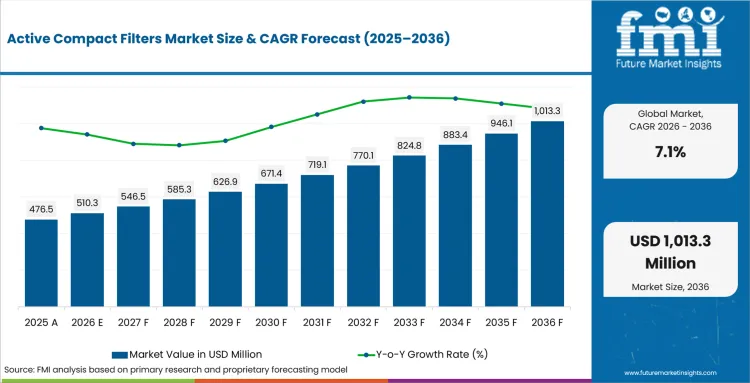
Key Takeaways of Active Compact Filters Market
- Demand rises as data centers and automated facilities add nonlinear electronic loads that require measurable harmonic correction around critical feeders.
- Based on filter type, active harmonic filters are projected to account for 38.0% in 2026 due to dynamic compensation across changing load profiles.
- Low voltage is set to lead the voltage category with 66.0% share in 2026 due to direct connection near drives and branch distribution.
- In 2026, the 50-200 A class is expected to lead power rating with 39.0% share because modular retrofits favor zone-level correction.
- Engineering assessment and commissioning requirements can lengthen approval cycles where simpler passive measures remain technically adequate for stable loads.
- Key companies are Schneider Electric and Danfoss alongside MTE Corporation and Comsys plus Merus Power and SINEXCEL with TDK Electronics and YT Electric.
Analyst Perspective
"Facility engineers should judge active compact filters against the measured harmonic spectrum and the electrical node that must meet the correction target. Commercial advantage comes from accurate sizing and commissioning that fits switchboard space, verifies performance and limits plant downtime during retrofit work."
- Nikhil Kaitwade, Principal Consultant, Future Market Insights
How is the Active Compact Filters Market segmented?
Filter type, voltage, power rating, application, sales channel and region.
Filter type spans active harmonic filters, EMI active compact filters, active power line filters, compact power quality filters and servo drive active filters. Voltage covers low voltage, medium voltage and DC bus / drive level. Power rating covers below 50 A, 50-200 A, 200-600 A and above 600 A. Applications cover variable speed drives, data centers, industrial automation, renewable integration and commercial buildings. Sales channels cover power quality integrators, direct OEM, electrical distributors and panel builders.
What makes active harmonic filters central to the filter type category?
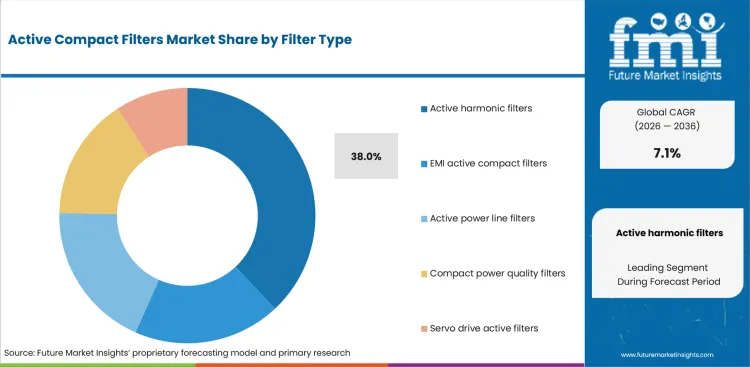
Active harmonic filters continuously measure distorted current and inject compensating current as nonlinear loads change. YT Electric expanded its active harmonic filter rollout in January 2026 for industrial facilities and data centers. The release documents current commercial positioning for variable-load correction across power-quality equipment at individual sites.
- Based on filter type, active harmonic filters are projected to account for 38.0% in 2026 due to dynamic compensation across changing load profiles.
- Facility engineers can apply one active platform across several distortion states, reducing fixed-network redesign as server, drive and converter loads change during staged equipment additions.
Why does low voltage lead the voltage category?
Low-voltage networks place compact active filters close to low-voltage drives and branch systems that produce most facility-level harmonic concerns. Direct connection avoids a medium-voltage interface and reduces retrofit scope inside constrained electrical rooms.
- Low voltage is set to lead the voltage category with 66.0% share in 2026 due to direct connection near common building and industrial loads. Comsys reported in June 2025 that its UL-certified PPM300 v4 covers 480 V applications from 50 A to 125 A.
- Integrators can therefore use modular low-voltage components near measured distortion sources without adding the transformer interface required for medium-voltage correction.
How does 50-200 A define the power rating center of demand?
The 50-200 A range fits industrial automation zones needing modular correction, and Danfoss expanded AAF 007 to 100/150 A modules in January 2025 for higher-efficiency harmonic mitigation.
- In 2026, the 50-200 A class is expected to lead power rating with 39.0% share because modular retrofits favor repeatable mid-range current blocks.
- Parallel modules let facility engineers add correction as loads expand without replacing the first installation or changing the main switchboard. The middle current band also fits production zones where a large central cabinet would consume scarce electrical-room space and exceed the initial correction requirement during phased equipment additions.
What supports variable speed drives in the application category?
Variable speed drives create nonlinear input current as rectifier front ends switch under changing motor loads. Engineers can correct several variable frequency drives at a common electrical node. Site surveys then translate measured distortion into a clearly defined correction current.
- By application, variable speed drives are estimated to hold 31.0% in 2026 owing to their recurring harmonic signature across industrial motor systems.
- Danfoss launched the AAF 007 in February 2025 for harmonic distortion from variable speed drives and related nonlinear loads. Its upstream or downstream installation options let engineers align correction with the measured feeder problem.
What are the drivers, restraints and opportunities in the Active Compact Filters Market?
Denser nonlinear loads increase correction needs, while engineering effort and capital review slow deployment and compact modular designs widen the retrofit base.
- Driver: Data centers and automated facilities add electronic loads that raise dynamic harmonic exposure at monitored feeders.
- Restraint: Harmonic assessment and control integration must be completed before facility teams can verify correction performance.
- Opportunity: Compact modular filters reduce installation work and let retrofit capacity expand in repeatable current blocks.
Power-Dense Electronic Loads Increase Measured Harmonic Exposure
Power-dense facilities add more converters and switch-mode supplies to shared electrical nodes, so harmonic exposure rises with load density. The IEA projected in April 2025 that global data-center electricity demand would reach about 945 TWh by 2030. That increase enlarges the site base needing measured data-center power quality monitoring before feeder capacity or uptime limits become binding.
Control Integration Extends Commissioning and Approval
Active filters depend on accurate current-transformer placement and compatible power quality meters, which makes control integration part of site acceptance. Comsys updated SCC2 software in March 2025 with improved EtherNet/IP control, confirming that industrial interfaces can extend commissioning scope before engineers verify filter performance.
Compact Modular Designs Widen the Retrofit Addressable Base
Compact modular filters reduce installation work inside crowded switchrooms and leave room for later current expansion. Comsys introduced the smaller ADF P100 G4 in March 2026 with front-access connections and preconfigured options for common grid conditions. The design broadens power conditioning services for retrofit packages that would not justify a bespoke central cabinet.
Which country CAGRs are profiled in the active compact filters market?
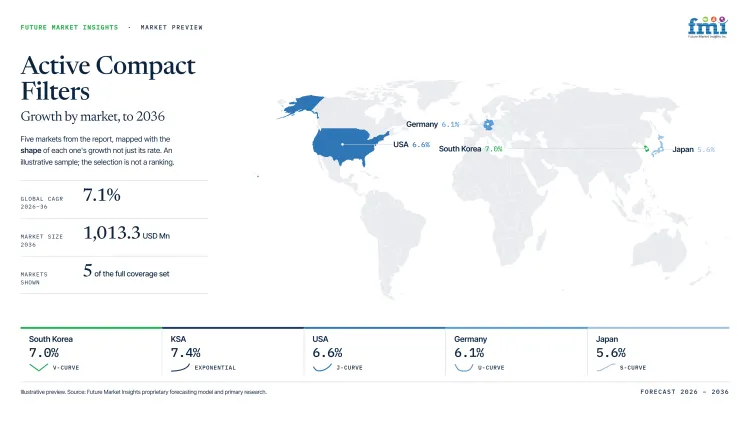
| Country | CAGR |
| KSA | 7.4% |
| South Korea | 7.0% |
| USA | 6.6% |
| Germany | 6.1% |
| Japan | 5.6% |
How do country-level CAGRs compare in the Active Compact Filters Market?
The 1.8 percentage-point range forms a compact upper pair and a mature lower group, with the USA positioned between them. KSA and South Korea add concentrated digital or semiconductor loads through new projects. Germany and Japan rely more on retrofit qualification inside established electrical systems with longer equipment lives today.
- KSA places harmonic correction inside data-center EPC packages before switchboard specifications are finalized.
- South Korea concentrates qualification around semiconductor campuses where uptime limits unplanned electrical changes.
- USA projects often begin with harmonic surveys across established drives and data-center feeders.
- Germany combines inverter-rich generation with mature switchboards that require coordinated retrofit engineering.
- Japan emphasizes compact modules and documented service continuity inside tightly qualified electrical rooms.
Comparable CAGRs describe forecast pace, not identical installed bases or purchase routes.
The full report provides country-level CAGR analysis across North America, Latin America, Europe, East Asia, South Asia, Oceania and the Middle East and Africa.
Country-wise Analysis
- Saudi data-center projects reserve switchboard space and commissioning time inside fast-moving EPC packages well before energization at large digital infrastructure sites under construction today. The Saudi Press Agency reported in July 2026 that operational data-center capacity reached 467 MW and 6.9 GW was being built toward 2034 nationwide. Active compact filter sales in KSA are forecast to expand at 7.4% CAGR by 2036 as new digital loads raise site-level harmonic-control requirements. Local integrators can place filters into new electrical packages early, but active-filter manufacturers need IEC-compatible configurations and commissioning support that fits strict EPC schedules before specifications convert into orders.
- South Korean semiconductor campuses run dense process equipment and automation loads under qualification rules that protect uptime across high-value fabrication lines. MOTIR reported in January 2026 that semiconductor exports reached USD 173.4 billion during 2025, confirming the scale of fabrication activity tied to AI data-center demand nationwide. The South Korean active compact filters sector is projected to record 7.0% CAGR during the assessment period as fab expansion adds nonlinear electrical loads. Local application engineers can address concentrated campus projects, but active-filter manufacturers need documented commissioning performance and nearby service coverage because plants tightly restrict electrical changes that could interrupt production.
- USA facilities often approve active filtering after harmonic studies identify feeder problems across data centers, industrial drives or mixed electronic loads at established operating sites. Adoption of active compact filters in the USA is estimated to expand at 6.6% CAGR through 2036 as retrofit volume grows across established electrical systems. Lawrence Berkeley National Laboratory reported in January 2025 that data centers used 4.4% of USA electricity in 2023 and could reach 6.7% to 12.0% by 2028. Facility engineers therefore compare accurate sizing and measured post-installation performance against lower-cost passive alternatives during formal capital reviews for active correction retrofit projects nationwide.
- Bundesnetzagentur reported in January 2025 that Germany added 16.2 GW of solar during 2024 and reached 99.3 GW installed capacity nationwide. German industrial sites combine that inverter-rich generation with long equipment lives and mature switchboards that make retrofit integration a recurring engineering task across established production facilities. Germany is estimated to post 6.1% CAGR over the forecast period as panel-builder experience supports mixed drive and inverter correction projects. Limited switchroom space and established protection schemes remain the main friction for retrofit work. Active-filter manufacturers therefore need modular configurations and clear compatibility records for plant approval during planned maintenance windows and phased electrical upgrades.
- Japanese factories and digital facilities prioritize compact equipment with predictable service behavior because electrical changes inside established rooms follow careful internal qualification. Japan's active compact filters outlook is anticipated to advance at 5.6% CAGR over the assessment period as space-efficient retrofit needs remain important in mature facilities. Regional grid constraints and conservative site approval make dependable local support a material condition for converting technical fit into approved low-disruption retrofit orders. METI's June 2025 Watt-Bit report coordinated electricity and telecommunications planning for data-center development, giving integrators a clearer infrastructure route while facilities retain strict local technical documentation requirements for electrical modifications.
Who are the notable companies in the Active Compact Filters Market?
Schneider Electric, Danfoss, MTE Corporation, Comsys, Merus Power, SINEXCEL, TDK Electronics and YT Electric serve the active compact filters market.
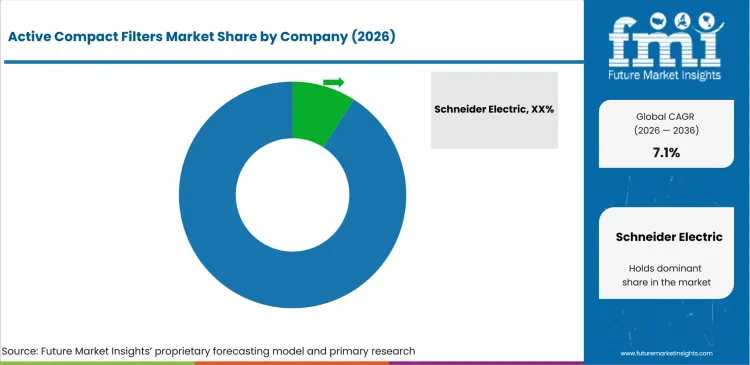
Competition separates broad electrical platforms from drive-linked specialists and dedicated active-filter manufacturers. Large groups bundle monitoring or distribution equipment with correction hardware while specialists compete on modularity and commissioning support. Entry barriers center on electrical integration evidence and channel competence. Smart factory projects reward application engineering that gets filter placement and commissioning right.
- Electrical and drive-linked platforms: Schneider Electric and Danfoss pair active filtering with broader distribution or drive engineering routes for integrated projects.
- Specialist active-filter platforms: MTE Corporation, Comsys and Merus Power concentrate on modular harmonic correction with application engineering for retrofit and industrial sites.
- Electronics and modular power-quality platforms: SINEXCEL, TDK Electronics and YT Electric compete around compact power electronics and configurable active compensation.
Competitive Benchmarking: Active Compact Filters Market
| Company | Compensation Function Breadth | Compact Modular Deployment | Drive and Panel Integration | Geographic Reach |
| Schneider Electric | High | High | High | Global electrical infrastructure channels |
| Danfoss | High | High | High | Global drives and industrial channels |
| MTE Corporation | High | High | High | North America and international industrial distribution |
| Comsys | High | High | High | Europe and North America with partner-led routes |
| Merus Power | High | High | High | Europe, Middle East and international partner markets |
| SINEXCEL | High | High | Medium | 60+ countries and regions |
| TDK Electronics | High | Medium | Medium | Global electronics and power-quality channels |
| YT Electric | High | High | Medium | China with international industrial distribution |
Key Developments in the Active Compact Filters Market
- In July 2026, YT Electric launched a silicon-carbide AHF/SVG platform for industrial and commercial power systems with high-frequency switching for dynamic correction.
- In September 2025, MTE Corporation launched the SyntriX AHF with silicon-carbide switching and modular scaling from 50 A to more than 450 A.
- In June 2025, Merus Power secured its largest single active-filter order for an Egyptian infrastructure project with ETA Electric supporting local commissioning.
Key Players in the Active Compact Filters Market
Integrated Electrical and Drive Platforms
- Schneider Electric
- Danfoss
Specialist Active Filtering Platforms
- MTE Corporation
- Comsys
- Merus Power
Electronics and Modular Power-Quality Platforms
- SINEXCEL
- TDK Electronics
- YT Electric
Active Compact Filters Market - Report Scope
| Coverage field | Report scope |
| Market breakdown | By filter type, voltage, power rating, application, sales channel and region. |
| Quantitative Units | Revenue in USD million and CAGR in %. |
| Market Definition | Commercial revenue from compact powered electronic filters and active-filter modules within the stated segmentation. Passive filters, reactors and downstream finished equipment are excluded unless active-filter revenue is separately attributable. |
| Regions Covered | North America, Latin America, Europe, East Asia, South Asia and Pacific, and Middle East and Africa. |
| Countries Covered | KSA, South Korea, USA, Germany, Japan, and 20+ countries included in the full report. |
| Key Companies Profiled | Schneider Electric, Danfoss, MTE Corporation, Comsys, Merus Power, SINEXCEL, TDK Electronics, YT Electric. |
| Forecast Period | 2026 to 2036. |
| Approach | Primary and secondary research with market triangulation. |
Active Compact Filters Market - Research Methodology
| Method | Approach |
| Primary Research | FMI analysts gathered input from manufacturers, service providers, technology developers, distributors, end users, procurement teams, and subject-matter experts. Interviews examined purchasing decisions, product or service evaluation, adoption barriers, approval requirements, pricing considerations, and expectations for technical or commercial support. Respondents were also asked what evidence is required before a trial, pilot, or initial order develops into regular purchasing. |
| Desk Research | Desk research covered government statistics, regulatory publications, trade data, industry associations, technical literature, standards, company filings, product information, and official corporate announcements. Sources were reviewed for relevance, publication date, geographic coverage, and consistency with the defined market scope. Claims relating to performance, applications, approvals, capacity, investment, and commercial activity were retained only when supported by credible public evidence. |
| Market Sizing and Forecasting | The market model combined the baseline value with historical performance, segment structure, pricing and volume indicators, adoption levels, company participation, and country-level demand conditions. Forecast assumptions considered economic activity, investment trends, regulatory developments, technology adoption, purchasing cycles, supply availability, and barriers to wider market use. Segment and regional estimates were reconciled before the final market total was calculated. |
| Data Validation | Estimates were checked against multiple independent indicators, including public data, company activity, trade patterns, industry developments, and findings from primary interviews. Validation also tested whether products, services, applications, and company revenues fell within the defined market boundaries. Adjacent categories, unsupported claims, overlapping revenues, and activities without direct market relevance were excluded to reduce double counting and maintain consistency across segments and countries. |
Active Compact Filters Market by Segments
Active Compact Filters Market segmented by Filter Type:
- Active harmonic filters
- EMI active compact filters
- Active power line filters
- Compact power quality filters
- Servo drive active filters
Active Compact Filters Market segmented by Voltage:
- Low voltage
- Medium voltage
- DC bus / drive level
Active Compact Filters Market segmented by Power Rating:
- 50-200 A
- Below 50 A
- 200-600 A
- Above 600 A
Active Compact Filters Market segmented by Application:
- Variable speed drives
- Data centers
- Industrial automation
- Renewable integration
- Commercial buildings
Active Compact Filters Market segmented by Sales Channel:
- Power quality integrators
- Direct OEM
- Electrical distributors
- Panel builders
Active Compact Filters Market by Region:
- North America
- United States
- Canada
- Latin America
- Brazil
- Mexico
- Chile
- Rest of Latin America
- Western Europe
- Germany
- United Kingdom
- Italy
- Spain
- France
- Nordics
- Benelux
- Rest of Western Europe
- Eastern Europe
- Russia
- Poland
- Hungary
- Balkan and Baltic States
- Rest of Eastern Europe
- East Asia
- China
- Japan
- South Korea
- South Asia and Pacific
- India
- ASEAN
- Australia and New Zealand
- Rest of South Asia and Pacific
- Middle East and Africa
- Kingdom of Saudi Arabia
- Other GCC Countries
- Türkiye
- South Africa
- Other African Union Countries
- Rest of Middle East and Africa
Research Sources and Bibliography
- International Energy Agency. (2026, April 16). Data centre electricity use surged in 2025, even with tightening bottlenecks driving a scramble for solutions.
- International Energy Agency. (2025, April 10). Energy demand from AI.
- YT Electric. (2026, January 9). Next-Gen Active Harmonic Filters to Combat Rising Power Quality Challenges in Global Industries.
- Comsys. (2025, June 17). Latest system integration components now fully UL certified and released to the NEMA market.
- Danfoss. (2025, January 30). Danfoss to showcase technologies that drive innovation and advance efficiency at AHR Expo.
- Danfoss. (2025, February 18). Danfoss Drives Advanced Active Filter 007 Offers High Efficiency in Harmonic Mitigation.
- International Energy Agency. (2025, April 10). Executive summary - Energy and AI.
- Comsys. (2025, March 18). SCC2 Software Update: Improved EtherNet/IP Integration & Control.
- Comsys. (2026, March 10). Introducing the ADF P100 G4 - Power quality made easy.
- Saudi Press Agency. (2026, July 8). Communications Minister at LEAP East: Saudi Arabia Is Global Hub Connecting AI Ecosystem Between East and West.
- Ministry of Trade, Industry and Resources, Republic of Korea. (2026, January 2). Korea's Annual Exports Reach New Highs in 2025.
- Lawrence Berkeley National Laboratory. (2025, January 15). Berkeley Lab Report Evaluates Increase in Electricity Demand from Data Centers.
- Bundesnetzagentur. (2025, January 8). Growth in renewable energy in 2024.
- Ministry of Economy, Trade and Industry, Japan. (2025, June 12). Report 1.0 of the Public-Private Advisory Council on Watt-Bit Collaboration Published.
- YT Electric. (2026, July 10). YT ELECTRIC's SiC Solution: High Efficiency, Ultra-Fast Power Quality.
- MTE Corporation. (2025, September 22). MTE Launches Next-Gen Active Harmonic Filter.
- Merus Power. (2025, June 4). Ensuring power quality and improving energy efficiency with Merus’ active filter technology will contribute to the success of the significant infrastructure project in Egypt.
This bibliography is provided for reader reference and is not exhaustive. The full report contains the complete reference list and detailed citations.
This Report Answers
- How does the active compact filters market change in value between 2026 and 2036?
- Which electrical conditions convert measured harmonic distortion into active-filter purchase decisions?
- Why do active harmonic filters lead the filter type category in 2026?
- How does low-voltage deployment shape installation choices for active compact filters?
- Why does the 50-200 A range fit a broad group of modular retrofit projects?
- How do market-entry conditions differ across KSA, South Korea, USA, Germany and Japan?
- Which engineering and commissioning requirements extend active-filter purchase timing?
- Which supplier capabilities matter beyond the purchase price of an active compact filter?
- Which recent company actions are changing available active-filter choices?
Frequently Asked Questions
How big is the Active Compact Filters Market in 2026?
The active compact filters market is expected to be valued at USD 510.3 million in 2026 and reach USD 1013.3 million by 2036. Growth reflects denser nonlinear electronic loads that require measurable harmonic correction around critical electrical feeders.
What is the CAGR of the Active Compact Filters Market from 2026 to 2036?
The active compact filters market is projected to grow at a CAGR of 7.1% between 2026 and 2036. Expansion reflects higher electronic-load density and greater retrofit use of compact dynamic correction around existing electrical distribution systems.
Which filter type leads the Active Compact Filters Market?
The active harmonic filters are projected to account for 38.0% of filter type in 2026. Dynamic compensation lets the segment follow changing nonlinear loads while combining several power-quality correction functions.
How much value will the Active Compact Filters Market add between 2026 and 2036?
The active compact filters market is expected to add USD 503.0 million in value between 2026 and 2036. Incremental opportunity comes from facilities adding variable speed drives and denser electronic infrastructure that increase measured harmonic-correction requirements.
Which companies are active in the Active Compact Filters Market?
The active compact filters market includes Schneider Electric, Danfoss, MTE Corporation, Comsys, Merus Power, SINEXCEL, TDK Electronics and YT Electric. These companies compete through electrical integration, drive engineering and specialist active-filter platforms for industrial and digital facilities.
Preview the report firsthand - request a free sample
Get SampleGet the brochure for pricing and purchase details.
Get PDFTable of Content
- Key Takeaways
- Market Size and CAGR
- Top Growth Driver
- Fastest Growing Segment
- Leading Region
- Key Companies
- Emerging Opportunities
- Executive Summary
- Global Market Outlook
- Demand-side Trends
- Supply-side Trends
- Technology Roadmap Analysis
- Analysis and Recommendations
- Analyst Perspective (What is happening? Why now? What should investors know?)
- Key Questions Answered
- How large is the market?
- What is the CAGR?
- What are key trends?
- Which region dominates?
- Who are the leaders?
- Market Overview
- Market Coverage / Taxonomy
- Market Definition / Scope / Limitations
- Research Methodology
- Chapter Orientation
- Analytical Lens and Working Hypotheses
- Market Structure, Signals, and Trend Drivers
- Benchmarking and Cross-market Comparability
- Market Sizing, Forecasting, and Opportunity Mapping
- Research Design and Evidence Framework
- Desk Research Programme (Secondary Evidence)
- Expert Input and Fieldwork (Primary Evidence)
- Tooling, Models, and Reference Databases
- Data Engineering and Model Build
- Quality Assurance and Audit Trail
- Market Background
- Market Dynamics (Drivers, Restraints, Opportunity, Trends)
- Scenario Forecast (Optimistic, Likely, Conservative)
- Impact Analysis
- AI Impact
- Sustainability Impact
- Regulatory Impact
- Technology Impact
- Consumer / Buyer Analysis
- Purchase Drivers
- Adoption Barriers
- Buyer Journey
- Opportunity Map Analysis
- Product Life Cycle Analysis
- Supply Chain Analysis
- Investment Feasibility Matrix
- Value Chain Analysis
- PESTLE and Porter's Analysis
- Regulatory Landscape
- Regional Parent Market Outlook
- Production and Consumption Statistics
- Import and Export Statistics
- Global Market Analysis and Forecast, 2021 to 2036
- Historical Market Size Value (USD Million) Analysis, 2021 to 2025
- Current and Future Market Size Value (USD Million) Projections, 2026 to 2036
- Y-o-Y Growth Trend Analysis
- Absolute $ Opportunity Analysis
- Global Market Pricing Analysis, 2021 to 2036
- Global Market Analysis and Forecast, By Filter Type, 2021 to 2036
- Introduction / Key Findings
- Historical Market Size Value (USD Million) Analysis By Filter Type, 2021 to 2025
- Current and Future Market Size Value (USD Million) Analysis and Forecast By Filter Type, 2026 to 2036
- Active harmonic filters
- EMI active compact filters
- Active power line filters
- Compact power quality filters
- Servo drive active filters
- Active harmonic filters
- Y-o-Y Growth Trend Analysis By Filter Type, 2021 to 2025
- Absolute $ Opportunity Analysis By Filter Type, 2026 to 2036
- Global Market Analysis and Forecast, By Voltage, 2021 to 2036
- Introduction / Key Findings
- Historical Market Size Value (USD Million) Analysis By Voltage, 2021 to 2025
- Current and Future Market Size Value (USD Million) Analysis and Forecast By Voltage, 2026 to 2036
- Low voltage
- Medium voltage
- DC bus / drive level
- Low voltage
- Y-o-Y Growth Trend Analysis By Voltage, 2021 to 2025
- Absolute $ Opportunity Analysis By Voltage, 2026 to 2036
- Global Market Analysis and Forecast, By Power Rating, 2021 to 2036
- Introduction / Key Findings
- Historical Market Size Value (USD Million) Analysis By Power Rating, 2021 to 2025
- Current and Future Market Size Value (USD Million) Analysis and Forecast By Power Rating, 2026 to 2036
- 50-200 A
- Below 50 A
- 200-600 A
- Above 600 A
- 50-200 A
- Y-o-Y Growth Trend Analysis By Power Rating, 2021 to 2025
- Absolute $ Opportunity Analysis By Power Rating, 2026 to 2036
- Global Market Analysis and Forecast, By Application, 2021 to 2036
- Introduction / Key Findings
- Historical Market Size Value (USD Million) Analysis By Application, 2021 to 2025
- Current and Future Market Size Value (USD Million) Analysis and Forecast By Application, 2026 to 2036
- Variable speed drives
- Data centers
- Industrial automation
- Renewable integration
- Commercial buildings
- Variable speed drives
- Y-o-Y Growth Trend Analysis By Application, 2021 to 2025
- Absolute $ Opportunity Analysis By Application, 2026 to 2036
- Global Market Analysis and Forecast, By Sales Channel, 2021 to 2036
- Introduction / Key Findings
- Historical Market Size Value (USD Million) Analysis By Sales Channel, 2021 to 2025
- Current and Future Market Size Value (USD Million) Analysis and Forecast By Sales Channel, 2026 to 2036
- Power quality integrators
- Direct OEM
- Electrical distributors
- Panel builders
- Power quality integrators
- Y-o-Y Growth Trend Analysis By Sales Channel, 2021 to 2025
- Absolute $ Opportunity Analysis By Sales Channel, 2026 to 2036
- Global Market Analysis and Forecast, By Region, 2021 to 2036
- Introduction
- Historical Market Size Value (USD Million) Analysis By Region, 2021 to 2025
- Current Market Size Value (USD Million) Analysis and Forecast By Region, 2026 to 2036
- North America
- Latin America
- Western Europe
- Eastern Europe
- East Asia
- South Asia and Pacific
- Middle East & Africa
- Market Attractiveness Analysis By Region
- North America Market Analysis and Forecast, By Country, 2021 to 2036
- Historical Market Size Value (USD Million) Trend Analysis By Market Taxonomy, 2021 to 2025
- Market Size Value (USD Million) Forecast By Market Taxonomy, 2026 to 2036
- By Country
- USA
- Canada
- By Filter Type
- By Voltage
- By Power Rating
- By Application
- By Sales Channel
- By Country
- Market Attractiveness Analysis
- By Country
- By Filter Type
- By Voltage
- By Power Rating
- By Application
- By Sales Channel
- Key Takeaways
- Latin America Market Analysis and Forecast, By Country
- Historical Market Size Value (USD Million) Trend Analysis By Market Taxonomy, 2021 to 2025
- Market Size Value (USD Million) Forecast By Market Taxonomy, 2026 to 2036
- By Country
- Brazil
- Mexico
- Chile
- Rest of Latin America
- By Filter Type
- By Voltage
- By Power Rating
- By Application
- By Sales Channel
- By Country
- Market Attractiveness Analysis
- By Country
- By Filter Type
- By Voltage
- By Power Rating
- By Application
- By Sales Channel
- Key Takeaways
- Western Europe Market Analysis and Forecast, By Country
- Historical Market Size Value (USD Million) Trend Analysis By Market Taxonomy, 2021 to 2025
- Market Size Value (USD Million) Forecast By Market Taxonomy, 2026 to 2036
- By Country
- Germany
- UK
- Italy
- Spain
- France
- Nordic
- BENELUX
- Rest of Western Europe
- By Filter Type
- By Voltage
- By Power Rating
- By Application
- By Sales Channel
- By Country
- Market Attractiveness Analysis
- By Country
- By Filter Type
- By Voltage
- By Power Rating
- By Application
- By Sales Channel
- Key Takeaways
- Eastern Europe Market Analysis and Forecast, By Country
- Historical Market Size Value (USD Million) Trend Analysis By Market Taxonomy, 2021 to 2025
- Market Size Value (USD Million) Forecast By Market Taxonomy, 2026 to 2036
- By Country
- Russia
- Poland
- Hungary
- Balkan & Baltic
- Rest of Eastern Europe
- By Filter Type
- By Voltage
- By Power Rating
- By Application
- By Sales Channel
- By Country
- Market Attractiveness Analysis
- By Country
- By Filter Type
- By Voltage
- By Power Rating
- By Application
- By Sales Channel
- Key Takeaways
- East Asia Market Analysis and Forecast, By Country
- Historical Market Size Value (USD Million) Trend Analysis By Market Taxonomy, 2021 to 2025
- Market Size Value (USD Million) Forecast By Market Taxonomy, 2026 to 2036
- By Country
- China
- Japan
- South Korea
- By Filter Type
- By Voltage
- By Power Rating
- By Application
- By Sales Channel
- By Country
- Market Attractiveness Analysis
- By Country
- By Filter Type
- By Voltage
- By Power Rating
- By Application
- By Sales Channel
- Key Takeaways
- South Asia and Pacific Market Analysis and Forecast, By Country
- Historical Market Size Value (USD Million) Trend Analysis By Market Taxonomy, 2021 to 2025
- Market Size Value (USD Million) Forecast By Market Taxonomy, 2026 to 2036
- By Country
- India
- ASEAN
- Australia & New Zealand
- Rest of South Asia and Pacific
- By Filter Type
- By Voltage
- By Power Rating
- By Application
- By Sales Channel
- By Country
- Market Attractiveness Analysis
- By Country
- By Filter Type
- By Voltage
- By Power Rating
- By Application
- By Sales Channel
- Key Takeaways
- Middle East & Africa Market Analysis and Forecast, By Country
- Historical Market Size Value (USD Million) Trend Analysis By Market Taxonomy, 2021 to 2025
- Market Size Value (USD Million) Forecast By Market Taxonomy, 2026 to 2036
- By Country
- Kingdom of Saudi Arabia
- Other GCC Countries
- Türkiye
- South Africa
- Other African Union
- Rest of Middle East & Africa
- By Filter Type
- By Voltage
- By Power Rating
- By Application
- By Sales Channel
- By Country
- Market Attractiveness Analysis
- By Country
- By Filter Type
- By Voltage
- By Power Rating
- By Application
- By Sales Channel
- Key Takeaways
- Key Countries Market Analysis
- USA
- Pricing Analysis
- Market Share Analysis, 2025
- By Filter Type
- By Voltage
- By Power Rating
- By Application
- By Sales Channel
- Canada
- Pricing Analysis
- Market Share Analysis, 2025
- By Filter Type
- By Voltage
- By Power Rating
- By Application
- By Sales Channel
- Mexico
- Pricing Analysis
- Market Share Analysis, 2025
- By Filter Type
- By Voltage
- By Power Rating
- By Application
- By Sales Channel
- Brazil
- Pricing Analysis
- Market Share Analysis, 2025
- By Filter Type
- By Voltage
- By Power Rating
- By Application
- By Sales Channel
- Chile
- Pricing Analysis
- Market Share Analysis, 2025
- By Filter Type
- By Voltage
- By Power Rating
- By Application
- By Sales Channel
- Germany
- Pricing Analysis
- Market Share Analysis, 2025
- By Filter Type
- By Voltage
- By Power Rating
- By Application
- By Sales Channel
- UK
- Pricing Analysis
- Market Share Analysis, 2025
- By Filter Type
- By Voltage
- By Power Rating
- By Application
- By Sales Channel
- Italy
- Pricing Analysis
- Market Share Analysis, 2025
- By Filter Type
- By Voltage
- By Power Rating
- By Application
- By Sales Channel
- Spain
- Pricing Analysis
- Market Share Analysis, 2025
- By Filter Type
- By Voltage
- By Power Rating
- By Application
- By Sales Channel
- France
- Pricing Analysis
- Market Share Analysis, 2025
- By Filter Type
- By Voltage
- By Power Rating
- By Application
- By Sales Channel
- India
- Pricing Analysis
- Market Share Analysis, 2025
- By Filter Type
- By Voltage
- By Power Rating
- By Application
- By Sales Channel
- ASEAN
- Pricing Analysis
- Market Share Analysis, 2025
- By Filter Type
- By Voltage
- By Power Rating
- By Application
- By Sales Channel
- Australia & New Zealand
- Pricing Analysis
- Market Share Analysis, 2025
- By Filter Type
- By Voltage
- By Power Rating
- By Application
- By Sales Channel
- China
- Pricing Analysis
- Market Share Analysis, 2025
- By Filter Type
- By Voltage
- By Power Rating
- By Application
- By Sales Channel
- Japan
- Pricing Analysis
- Market Share Analysis, 2025
- By Filter Type
- By Voltage
- By Power Rating
- By Application
- By Sales Channel
- South Korea
- Pricing Analysis
- Market Share Analysis, 2025
- By Filter Type
- By Voltage
- By Power Rating
- By Application
- By Sales Channel
- Russia
- Pricing Analysis
- Market Share Analysis, 2025
- By Filter Type
- By Voltage
- By Power Rating
- By Application
- By Sales Channel
- Poland
- Pricing Analysis
- Market Share Analysis, 2025
- By Filter Type
- By Voltage
- By Power Rating
- By Application
- By Sales Channel
- Hungary
- Pricing Analysis
- Market Share Analysis, 2025
- By Filter Type
- By Voltage
- By Power Rating
- By Application
- By Sales Channel
- Kingdom of Saudi Arabia
- Pricing Analysis
- Market Share Analysis, 2025
- By Filter Type
- By Voltage
- By Power Rating
- By Application
- By Sales Channel
- Türkiye
- Pricing Analysis
- Market Share Analysis, 2025
- By Filter Type
- By Voltage
- By Power Rating
- By Application
- By Sales Channel
- South Africa
- Pricing Analysis
- Market Share Analysis, 2025
- By Filter Type
- By Voltage
- By Power Rating
- By Application
- By Sales Channel
- USA
- Market Structure Analysis
- Competition Dashboard
- Competition Benchmarking
- Market Share Analysis of Top Players
- By Regional
- By Filter Type
- By Voltage
- By Power Rating
- By Application
- By Sales Channel
- Emerging Startups
- Innovation Benchmarking
- Competition Analysis
- Competition Deep Dive
- Schneider Electric
- Overview
- Product Portfolio
- Profitability by Market Segments
- Sales Footprint
- Strategy Overview
- Marketing Strategy
- Product Strategy
- Channel Strategy
- Eaton
- ABB
- Siemens
- Schaffner
- Danfoss
- TDK Electronics
- MTE Corporation
- Comsys
- Delta Electronics
- Schneider Electric
- Case Studies
- Success Stories
- Recent Developments
- Competition Deep Dive
- Assumptions & Acronyms Used


