

- Industry Size (2025)
- USD 88.7 Bn
- Forecast (2035)
- USD 229.6 Bn
- CAGR (2025 to 2035)
- 10.0%
AI Image Editor Market Size and Share Forecast Outlook 2025 to 2035
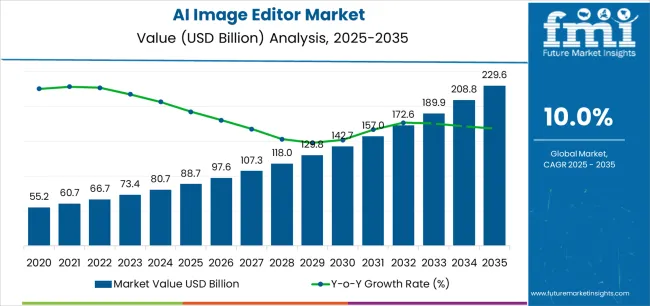
The AI Image Editor Market is estimated to be valued at USD 88.7 billion in 2025 and is projected to reach USD 229.6 billion by 2035, registering a compound annual growth rate (CAGR) of 10.0% over the forecast period.
The AI Image Editor market is witnessing significant growth, driven by the increasing demand for automated image editing solutions across professional, creative, and commercial sectors. Advances in artificial intelligence, machine learning, and computer vision technologies have enabled platforms to perform complex image enhancement, retouching, and manipulation tasks with high precision and efficiency. Organizations and individuals are increasingly adopting AI image editors to reduce manual editing time, improve content quality, and optimize creative workflows.
Integration with cloud-based storage, collaborative tools, and digital asset management systems is further accelerating adoption. Rising demand for personalized visual content in marketing, social media, e-commerce, and entertainment is fueling market expansion. Additionally, enterprises are leveraging AI image editing to maintain brand consistency, enhance product presentation, and deliver visually engaging content to customers.
Regulatory compliance related to copyright, image authenticity, and ethical use of AI is shaping platform features As technological innovation continues and demand for scalable, AI-powered image editing solutions rises, the market is poised for sustained growth across multiple sectors globally.
Quick Stats for AI Image Editor Market
- AI Image Editor Market Industry Value (2025): USD 88.7 billion
- AI Image Editor Market Forecast Value (2035): USD 229.6 billion
- AI Image Editor Market Forecast CAGR: 10.0%
- Leading Segment in AI Image Editor Market in 2025: Windows (36.3%)
- Key Growth Region in AI Image Editor Market: North America, Asia-Pacific, Europe
- Top Key Players in AI Image Editor Market: Adobe Inc., Canva, Corel Corporation, ACD Systems International Inc., Pixelmator, Fotor, GIMP, BeFunky, Ribbet, piZap
| Metric | Value |
|---|---|
| AI Image Editor Market Estimated Value in (2025 E) | USD 88.7 billion |
| AI Image Editor Market Forecast Value in (2035 F) | USD 229.6 billion |
| Forecast CAGR (2025 to 2035) | 10.0% |
Segmental Analysis
The market is segmented by Platform and End User and region. By Platform, the market is divided into Windows, Android, iOS, and Others. In terms of End User, the market is classified into Enterprise Users, Educational Users, and Artists/Individuals. Regionally, the market is classified into North America, Latin America, Western Europe, Eastern Europe, Balkan & Baltic Countries, Russia & Belarus, Central Asia, East Asia, South Asia & Pacific, and the Middle East & Africa.
Insights into the Windows Platform Segment
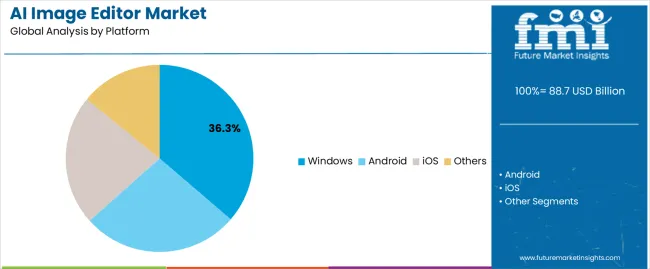
The Windows platform segment is projected to hold 36.3% of the AI Image Editor market revenue in 2025, establishing it as the leading platform. Growth in this segment is being driven by the widespread adoption of Windows operating systems across enterprise and professional environments, which provides a stable and compatible platform for AI-based image editing software. Windows-compatible AI editors benefit from extensive hardware support, high processing power, and integration with productivity and creative software ecosystems.
Enterprises and creative professionals favor Windows platforms due to ease of deployment, software compatibility, and scalability for high-resolution and batch image processing tasks. Continuous updates and support from Microsoft enhance platform stability, reliability, and security, increasing user confidence in adopting AI solutions.
The growing demand for AI-driven automation, real-time editing, and seamless integration with enterprise workflows is further reinforcing adoption As AI-powered image editing becomes integral to digital content creation, Windows is expected to maintain its leading position due to performance, compatibility, and user familiarity.
Insights into the Enterprise Users End User Segment
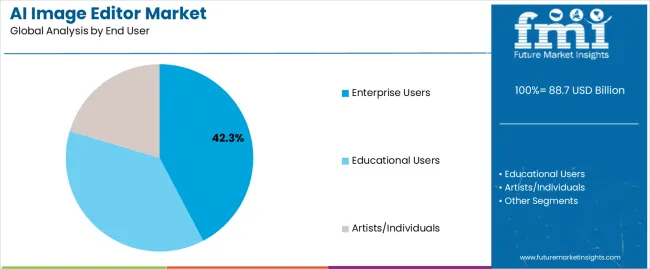
The enterprise users segment is expected to account for 42.3% of the market revenue in 2025, making it the leading end-user category. Growth is being driven by the increasing adoption of AI image editing solutions in marketing, e-commerce, advertising, media, and publishing industries to streamline workflows, enhance content quality, and reduce operational costs. Enterprises leverage AI image editors for batch processing, brand consistency, automated retouching, and rapid creation of visual content at scale.
Integration with enterprise content management, collaborative tools, and digital asset management platforms enables seamless workflows and improved productivity. Rising emphasis on delivering personalized and visually engaging content to target audiences has increased demand for advanced editing capabilities powered by AI.
Regulatory and compliance considerations related to copyright, brand protection, and content authenticity further influence enterprise adoption As organizations continue to prioritize efficiency, scalability, and high-quality visual content creation, the enterprise users segment is expected to remain the primary driver of AI image editor market growth globally.
Key Investment Opportunities in the AI Image Editing Sector
Development of Machine Learning Models and New Algorithms
The development of machine learning models and new algorithms is one of the lucrative investment opportunities in the market. New machine learning is able to analyze the image and work according to consumer demand, which is anticipated to gain market potential during the forecast period.
Creating Individual Software Platforms
Creating individual software platforms that can use all professionals, such as graphic designers, visual content editors, and image editors. That platform also offers a wide range of features and tools that provide convenience to consumers according to their needs. Also, the platform can be customizable according to the work of those professionals.
Developing Innovative Mobile Apps
Manufacturers can gain major market share by developing mobile apps in the coming years. With help of the mobile apps, individuals can edit their images and their content on the go. These mobile applications are offering a wide range of features and tools that have attracted consumers in recent years.
Investment in Research and Development of Innovative Features
Investment in research and development of innovative features that can streamline and automate the essential process represents immense opportunities for stakeholders. Companies have to increase funding for their R&D department to gain maximum market share during the forecast period.
Challenges Constraining Growth in the AI Image Editor Market
- Maintaining the pace with innovations and technological advances is anticipated to create challenges for the companies. The key players are increasingly developing updated software and applications in the current period which increases market competition.
- Balancing the demand for usability and functionality with increasing security and privacy is creating some barriers for manufacturers in the current period. Increasing concerns regarding the misuse of the tools are expected to hamper the market growth during the forecast period.
AI Image Editor Industry Analysis by Top Investment Segments
The Windows Segment is dominating the Market by Platform
| Attributes | Details |
|---|---|
| Top Platform | Windows |
| Market share in 2025 | 36.30% |
The availability of powerful hardware and operating systems is maintaining the dominance of the Windows segment in the market. More professional graphic designers and image editors are actively using the Windows platform. Having a vast ecosystem of third-party developers and vendors, windows is anticipated to gain attraction in the coming years. A larger user base all over the world is driving the demand for the segment in the current period.
The Enterprise Users Segment is Gaining popularity in the Market by End Use
| Attributes | Details |
|---|---|
| Top End Use | Enterprise Users |
| Market share in 2025 | 42.30% |
The need for a cost-effective solution as compared to traditional image editors is driving the segment growth. As AI imaging tools reduce operational costs and labor charges, gaining popularity among enterprise users. Also, the AI image editor software is considered a time-saving aspect for them in the current period.
Analysis of Top Countries Deploying AI Image Editing Solutions
| Countries | CAGR through 2035 |
|---|---|
| United States | 7.40% |
| China | 11.0% |
| Germany | 2.00% |
| Japan | 3.30% |
| Australia | 14.00% |
United States
In the current period, artificial intelligence gained much popularity in various industries in the United States. The need for ease and convenience in the photography and design sector has been observed in recent years. The graphic designers and photo editors are using AI in their work to reduce time and operational costs in the country.
The social media industry on its peak in the United States. Due to the rise of social media platforms, there is demand for high-quality images and graphics has increased over the years. With the use of AI, image editors are improving their work potential in the country.
The business sector is contributing to the AI image editor market growth in the United States. Business sectors are engaging their clients through online media and social media channels. Thus, the demand for quality videography and image editing has increased throughout the years.
China
The use of smartphones and other devices is gaining a major market share in the country. The need for photo editing while on the go has increased in recent years in China. People are actively looking for a platform where they complete their editing work on the go, thus AI has emerged as an important aspect for them.
By providing easy-to-use solutions and convenience to image editors, AI has gained attraction over the years in China. Moreover, mobile photography has increased in recent years in China.
The government is playing a major role in the growth of the market in China. The Chinese government is heavily investing in technological advancements and their promotions. Also, providing funding for the companies, who are working on new technologies and implementing them.
United Kingdom
Surge in demand for visual content in the marketing and advertising sector in Germany. The business sector is actively looking for high-quality content visuals to attract their clients and gain potential in the business industry. Thus, many businesses are relying on technological advances such as AI and others in Germany. Also, AI is helping businesses to create high-quality graphics and images without investing much in equipment or hiring individuals in Germany.
The use of AI by professional graphic designers and photographers has been observed in recent years in the country. Demand for high-quality videography and images by consumers. Thus, professionals are using AI to streamline their workflow and enhance their work in the region.
Japan
Japan is considered a technologically advanced region across the world. Software developers are increasingly investing in research and development activities in the country. Several players in the country are looking to enhance and making more advanced their AI software. People are heavily adopting AI tools to reform their work potential in Japan.
South Korea
Mobile photography has played a major role in contributing to the AI image editor market growth in recent years. People prefer modern AI tools to edit their visual content and images. There is a wide range of AI image editor software available in the South Korean market which makes easier adoption of affordable AI image editor tools.
Competitive Landscape of the AI Image Editor Market
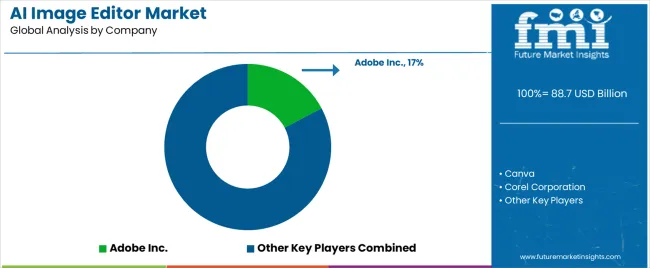
As the demand for AI-powered image editing tools continues to grow, we can expect to see more companies entering the market and offering innovative new features and capabilities. The AI image editor market is anticipated to gain potential growth during the forecast period owing to innovations and research.
As manufacturers are expanding their product range to gain customer attraction. Several companies are looking to improvising consumer experience by implementing new marketing strategies in the current period.
Recent Developments
- In 2025, Adobe has recently launched a beta version of its content creation app, Adobe Express, on Android and iOS platforms. This app not only offers image editing features but also uses AI-powered tools to create high-quality content. With Adobe Express, users can easily create stunning graphics, social media posts, and videos on-the-go, without any prior design experience. The app provides a simple and intuitive interface that allows users to choose from a wide range of templates, fonts, and filters to create their desired content.
- In 2025, Apple's researchers have recently unveiled a new AI-powered photo editing tool called MGIE. This tool is designed to help users enhance their images with minimal effort by using advanced machine learning algorithms. Unlike traditional photo editing tools that require manual adjustments, MGIE is capable of automatically adjusting various aspects of an image such as contrast, brightness, and color balance to improve its overall quality. Additionally, this tool can also remove unwanted objects from an image and apply artistic filters to create stunning effects. The MGIE tool is currently being developed by Apple's Machine Learning and Computer Vision teams.
- In 2025, Photoroom, a photo editing platform for businesses, announced the launch of its next-generation AI-powered photo editor following the successful completion of a USD 43 million funding round. The new photo editor, which is designed for businesses, leverages the latest advances in AI technology to provide a suite of advanced editing tools that enable users to quickly and easily enhance and edit photos. With its intuitive and user-friendly interface, Photoroom's new photo editor is poised to revolutionize the way businesses approach photo editing and is expected to be a game changer in the industry.
Leading Players in the AI Image Editor Industry
- Adobe Inc.
- Corel Corporation
- ACD Systems International Inc.
- GIMP
- Canva
- Pixelmator
- Fotor
- BeFunky
- piZap
- Ribbet
Coverage of the AI Image Editor Market Report
- AI Image Maker Market Report
- Photo Editor Market Analysis
- AI Picture Trends Assessment
- Image Editing Software Market Overview
- AI Imaging Tool Pricing Outlook
Top Segments Studied in the AI Image Editor Market Report
By Platform:
- Android
- iOS
- Windows
- Others
By End User:
- Artists/Individuals
- Enterprise Users
- Educational Users
By Region:
- North America
- Latin America
- Asia Pacific
- MEA
- Europe
Frequently Asked Questions
How big is the AI image editor market in 2025?
The global AI image editor market is estimated to be valued at USD 88.7 billion in 2025.
What will be the size of AI image editor market in 2035?
The market size for the AI image editor market is projected to reach USD 229.6 billion by 2035.
How much will be the AI image editor market growth between 2025 and 2035?
The AI image editor market is expected to grow at a 10.0% CAGR between 2025 and 2035.
What are the key product types in the AI image editor market?
The key product types in AI image editor market are windows, android, ios and others.
Which end user segment to contribute significant share in the AI image editor market in 2025?
In terms of end user, enterprise users segment to command 42.3% share in the AI image editor market in 2025.
Preview the report firsthand - request a free sample
Get SampleGet the brochure for pricing and purchase details.
Get PDFTable of Content
- Executive Summary
- Global Market Outlook
- Demand-side Trends
- Supply-side Trends
- Technology Roadmap Analysis
- Analysis and Recommendations
- Market Overview
- Market Coverage / Taxonomy
- Market Definition / Scope / Limitations
- Market Background
- Market Dynamics
- Drivers
- Restraints
- Opportunity
- Trends
- Scenario Forecast
- Demand in Optimistic Scenario
- Demand in Likely Scenario
- Demand in Conservative Scenario
- Opportunity Map Analysis
- Product Life Cycle Analysis
- Supply Chain Analysis
- Investment Feasibility Matrix
- Value Chain Analysis
- PESTLE and Porter’s Analysis
- Regulatory Landscape
- Regional Parent Market Outlook
- Production and Consumption Statistics
- Import and Export Statistics
- Market Dynamics
- Global Market Analysis 2020 to 2024 and Forecast, 2025 to 2035
- Historical Market Size Value (USD Million) Analysis, 2020 to 2024
- Current and Future Market Size Value (USD Million) Projections, 2025 to 2035
- Y-o-Y Growth Trend Analysis
- Absolute $ Opportunity Analysis
- Global Market Pricing Analysis 2020 to 2024 and Forecast 2025 to 2035
- Global Market Analysis 2020 to 2024 and Forecast 2025 to 2035, By Platform
- Introduction / Key Findings
- Historical Market Size Value (USD Million) Analysis By Platform , 2020 to 2024
- Current and Future Market Size Value (USD Million) Analysis and Forecast By Platform , 2025 to 2035
- Windows
- Android
- iOS
- Others
- Y-o-Y Growth Trend Analysis By Platform , 2020 to 2024
- Absolute $ Opportunity Analysis By Platform , 2025 to 2035
- Global Market Analysis 2020 to 2024 and Forecast 2025 to 2035, By End User
- Introduction / Key Findings
- Historical Market Size Value (USD Million) Analysis By End User, 2020 to 2024
- Current and Future Market Size Value (USD Million) Analysis and Forecast By End User, 2025 to 2035
- Enterprise Users
- Educational Users
- Artists/Individuals
- Y-o-Y Growth Trend Analysis By End User, 2020 to 2024
- Absolute $ Opportunity Analysis By End User, 2025 to 2035
- Global Market Analysis 2020 to 2024 and Forecast 2025 to 2035, By Region
- Introduction
- Historical Market Size Value (USD Million) Analysis By Region, 2020 to 2024
- Current Market Size Value (USD Million) Analysis and Forecast By Region, 2025 to 2035
- North America
- Latin America
- Western Europe
- Eastern Europe
- East Asia
- South Asia and Pacific
- Middle East & Africa
- Market Attractiveness Analysis By Region
- North America Market Analysis 2020 to 2024 and Forecast 2025 to 2035, By Country
- Historical Market Size Value (USD Million) Trend Analysis By Market Taxonomy, 2020 to 2024
- Market Size Value (USD Million) Forecast By Market Taxonomy, 2025 to 2035
- By Country
- USA
- Canada
- Mexico
- By Platform
- By End User
- By Country
- Market Attractiveness Analysis
- By Country
- By Platform
- By End User
- Key Takeaways
- Latin America Market Analysis 2020 to 2024 and Forecast 2025 to 2035, By Country
- Historical Market Size Value (USD Million) Trend Analysis By Market Taxonomy, 2020 to 2024
- Market Size Value (USD Million) Forecast By Market Taxonomy, 2025 to 2035
- By Country
- Brazil
- Chile
- Rest of Latin America
- By Platform
- By End User
- By Country
- Market Attractiveness Analysis
- By Country
- By Platform
- By End User
- Key Takeaways
- Western Europe Market Analysis 2020 to 2024 and Forecast 2025 to 2035, By Country
- Historical Market Size Value (USD Million) Trend Analysis By Market Taxonomy, 2020 to 2024
- Market Size Value (USD Million) Forecast By Market Taxonomy, 2025 to 2035
- By Country
- Germany
- UK
- Italy
- Spain
- France
- Nordic
- BENELUX
- Rest of Western Europe
- By Platform
- By End User
- By Country
- Market Attractiveness Analysis
- By Country
- By Platform
- By End User
- Key Takeaways
- Eastern Europe Market Analysis 2020 to 2024 and Forecast 2025 to 2035, By Country
- Historical Market Size Value (USD Million) Trend Analysis By Market Taxonomy, 2020 to 2024
- Market Size Value (USD Million) Forecast By Market Taxonomy, 2025 to 2035
- By Country
- Russia
- Poland
- Hungary
- Balkan & Baltic
- Rest of Eastern Europe
- By Platform
- By End User
- By Country
- Market Attractiveness Analysis
- By Country
- By Platform
- By End User
- Key Takeaways
- East Asia Market Analysis 2020 to 2024 and Forecast 2025 to 2035, By Country
- Historical Market Size Value (USD Million) Trend Analysis By Market Taxonomy, 2020 to 2024
- Market Size Value (USD Million) Forecast By Market Taxonomy, 2025 to 2035
- By Country
- China
- Japan
- South Korea
- By Platform
- By End User
- By Country
- Market Attractiveness Analysis
- By Country
- By Platform
- By End User
- Key Takeaways
- South Asia and Pacific Market Analysis 2020 to 2024 and Forecast 2025 to 2035, By Country
- Historical Market Size Value (USD Million) Trend Analysis By Market Taxonomy, 2020 to 2024
- Market Size Value (USD Million) Forecast By Market Taxonomy, 2025 to 2035
- By Country
- India
- ASEAN
- Australia & New Zealand
- Rest of South Asia and Pacific
- By Platform
- By End User
- By Country
- Market Attractiveness Analysis
- By Country
- By Platform
- By End User
- Key Takeaways
- Middle East & Africa Market Analysis 2020 to 2024 and Forecast 2025 to 2035, By Country
- Historical Market Size Value (USD Million) Trend Analysis By Market Taxonomy, 2020 to 2024
- Market Size Value (USD Million) Forecast By Market Taxonomy, 2025 to 2035
- By Country
- Kingdom of Saudi Arabia
- Other GCC Countries
- Turkiye
- South Africa
- Other African Union
- Rest of Middle East & Africa
- By Platform
- By End User
- By Country
- Market Attractiveness Analysis
- By Country
- By Platform
- By End User
- Key Takeaways
- Key Countries Market Analysis
- USA
- Pricing Analysis
- Market Share Analysis, 2024
- By Platform
- By End User
- Canada
- Pricing Analysis
- Market Share Analysis, 2024
- By Platform
- By End User
- Mexico
- Pricing Analysis
- Market Share Analysis, 2024
- By Platform
- By End User
- Brazil
- Pricing Analysis
- Market Share Analysis, 2024
- By Platform
- By End User
- Chile
- Pricing Analysis
- Market Share Analysis, 2024
- By Platform
- By End User
- Germany
- Pricing Analysis
- Market Share Analysis, 2024
- By Platform
- By End User
- UK
- Pricing Analysis
- Market Share Analysis, 2024
- By Platform
- By End User
- Italy
- Pricing Analysis
- Market Share Analysis, 2024
- By Platform
- By End User
- Spain
- Pricing Analysis
- Market Share Analysis, 2024
- By Platform
- By End User
- France
- Pricing Analysis
- Market Share Analysis, 2024
- By Platform
- By End User
- India
- Pricing Analysis
- Market Share Analysis, 2024
- By Platform
- By End User
- ASEAN
- Pricing Analysis
- Market Share Analysis, 2024
- By Platform
- By End User
- Australia & New Zealand
- Pricing Analysis
- Market Share Analysis, 2024
- By Platform
- By End User
- China
- Pricing Analysis
- Market Share Analysis, 2024
- By Platform
- By End User
- Japan
- Pricing Analysis
- Market Share Analysis, 2024
- By Platform
- By End User
- South Korea
- Pricing Analysis
- Market Share Analysis, 2024
- By Platform
- By End User
- Russia
- Pricing Analysis
- Market Share Analysis, 2024
- By Platform
- By End User
- Poland
- Pricing Analysis
- Market Share Analysis, 2024
- By Platform
- By End User
- Hungary
- Pricing Analysis
- Market Share Analysis, 2024
- By Platform
- By End User
- Kingdom of Saudi Arabia
- Pricing Analysis
- Market Share Analysis, 2024
- By Platform
- By End User
- Turkiye
- Pricing Analysis
- Market Share Analysis, 2024
- By Platform
- By End User
- South Africa
- Pricing Analysis
- Market Share Analysis, 2024
- By Platform
- By End User
- USA
- Market Structure Analysis
- Competition Dashboard
- Competition Benchmarking
- Market Share Analysis of Top Players
- By Regional
- By Platform
- By End User
- Competition Analysis
- Competition Deep Dive
- Adobe Inc.
- Overview
- Product Portfolio
- Profitability by Market Segments (Product/Age /Sales Channel/Region)
- Sales Footprint
- Strategy Overview
- Marketing Strategy
- Product Strategy
- Channel Strategy
- Canva
- Corel Corporation
- ACD Systems International Inc.
- Pixelmator
- Fotor
- GIMP
- BeFunky
- Ribbet
- piZap
- Adobe Inc.
- Competition Deep Dive
- Assumptions & Acronyms Used
- Research Methodology


