

- Industry Size (2025)
- USD 4.5 Bn
- Forecast (2035)
- USD 9.4 Bn
- CAGR (2025 to 2035)
- 7.6%
Air Circuit Breaker Market Size and Share Forecast Outlook 2025 to 2035
The air circuit breaker market is valued at USD 4.5 billion in 2025 and is projected to reach USD 9.4 billion by 2035, rising at a 7.6% CAGR and adding USD 4.9 billion over the decade. Growth aligns with continuous modernization of power distribution networks, expansion of industrial loads, and the replacement of aging switchgear across utilities, commercial buildings, and manufacturing facilities. Between 2025 and 2030, the market increases to roughly USD 6.7 to 7.0 billion, contributing close to 45% of decade growth as countries accelerate infrastructure upgrades, reinforce grid reliability, and deploy safer low and medium-voltage systems. The remaining growth from 2030 to 2035 reflects deeper integration of digitalized protection technologies, remote monitoring, and arc fault detection systems that enhance operational continuity and reduce downtime.
Voltage segmentation confirms the dominance of low-voltage air circuit breakers with 48.9% share, supported by widespread use in commercial buildings, smart homes, and low-capacity industrial systems. Medium and high-voltage categories expand steadily as utilities strengthen substation automation and transmission reliability. By application, power distribution leads with 57.4% share, driven by demand for stable load management, fault isolation, and efficient switching in substations, distribution panels, and industrial grids. End-use patterns show the residential sector at 36.1%, followed by commercial and industrial facilities and utilities adopting ACBs to improve safety and meet regulatory requirements.
The increasing global focus on grid modernization and renewable energy integration is also accelerating market growth. Power utilities are upgrading outdated electrical infrastructure to improve reliability, efficiency, and energy distribution quality. Air circuit breakers are integral to these upgrades, ensuring safe and stable operation of substations and distribution networks. Additionally, the rapid adoption of renewable energy sources, such as solar and wind, is creating new challenges for grid stability. These systems require efficient switching and protection equipment capable of handling fluctuating loads, making ACBs a preferred choice for renewable power plants and hybrid grids. As renewable energy installations expand, the demand for air circuit breakers will continue to grow.
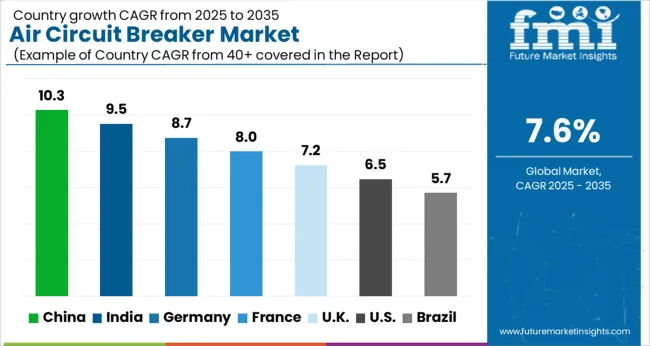
Geographically, the market is led by China at 10.3% CAGR and India at 9.5%, supported by rapid urbanization, industrial expansion, and aggressive investments in transmission and distribution upgrades. Germany at 8.7% and France at 8.0% maintain strong demand through engineering excellence, robust safety standards, and modernization of legacy grids. Mature markets including the United Kingdom at 7.2% and the United States at 6.5% expand steadily as utilities replace outdated breakers and integrate smart grid capabilities.
Quick Stats for Air Circuit Breaker Market
- Air Circuit Breaker Market Value (2025): USD 4.5 billion
- Air Circuit Breaker Market Forecast Value (2035): USD 9.4 billion
- Air Circuit Breaker Market Forecast CAGR: 7.6%
- Leading Segment in Air Circuit Breaker Market in 2025: Low (48.9%)
- Key Growth Regions in Air Circuit Breaker Market: North America, Asia-Pacific, Europe
- Top Players in Air Circuit Breaker Market: ABB, Alfanar Group, CG Power & Industrial Solutions, Eaton, General Electric, HD Hyundai Electric, Kirloskar Electric Company, LS Electric, Mitsubishi Electric, Powell Industries, Schneider Electric, and Sensata Technologies
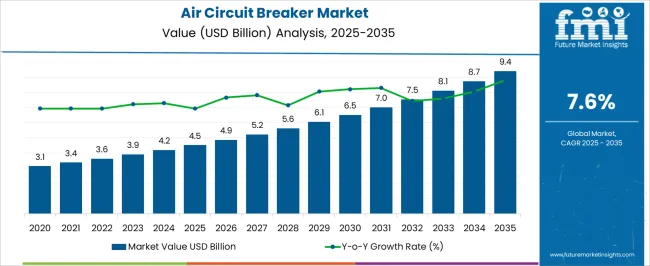
Air Circuit Breaker Market Key Takeaways
| Metric | Value |
|---|---|
| Air Circuit Breaker Market Estimated Value in (2025E) | USD 4.5 billion |
| Air Circuit Breaker Market Forecast Value in (2035F) | USD 9.4 billion |
| Forecast CAGR (2025 to 2035) | 7.6% |
Why is the Air Circuit Breaker Market Growing?
The air circuit breaker market is witnessing accelerated demand due to increasing investments in electrical infrastructure modernization, smart grid deployment, and urban expansion projects. These systems are essential for reliable fault interruption and system protection across low and medium-voltage networks, especially in environments requiring high safety and operational uptime. The current market landscape is marked by an upsurge in commercial and residential electrical consumption, which is fueling the need for efficient circuit protection technologies.
Furthermore, the transition toward digitalized power distribution networks and rising industrial automation are enhancing product uptake. The market outlook remains positive as nations continue investing in renewable integration, electrical safety standards, and energy-efficient transmission systems.
Future growth is expected to be driven by heightened focus on grid reliability, along with technological advancements in air circuit breaker designs offering features such as remote monitoring, modularity, and arc fault detection. This steady demand trajectory is underpinned by regulatory mandates for equipment upgrades and the replacement of aging infrastructure across multiple regions.
Segmental Analysis
The air circuit breaker market is segmented by voltage, application, end use, and geographic regions. By voltage, air circuit breaker market is divided into Low, Medium, and High. In terms of application, air circuit breaker market is classified into Power distribution and Power transmission. Based on end use, air circuit breaker market is segmented into Residential, Commercial & industrial, and Utility. Regionally, the air circuit breaker industry is classified into North America, Latin America, Western Europe, Eastern Europe, Balkan & Baltic Countries, Russia & Belarus, Central Asia, East Asia, South Asia & Pacific, and the Middle East & Africa.
Insights into the Low Voltage Segment
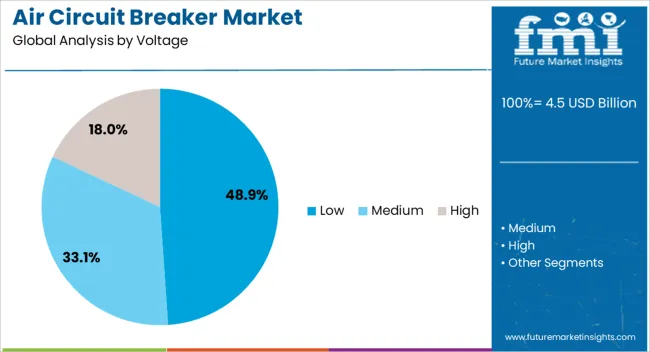
The low voltage segment commands a significant share of approximately 48.9% in the air circuit breaker market, driven by its extensive use in commercial, residential, and light industrial applications. Products within this category are preferred for their compact design, ease of installation, and compatibility with low-capacity distribution networks. These breakers play a critical role in protecting equipment from overloads and short circuits, especially in small to medium-scale facilities.
Demand is being reinforced by expanding electrification in developing regions and the proliferation of low voltage appliances and control systems in modern smart homes and offices. Moreover, supportive regulations mandating reliable protection systems in construction and infrastructure projects have accelerated adoption.
Manufacturers are also focusing on developing energy-efficient and intelligent low voltage breakers equipped with real-time monitoring and digital communication capabilities. With continued growth in urban construction, building automation, and distributed energy systems, the low voltage segment is projected to maintain its dominant share in the foreseeable future.
Insights into the Power Distribution Segment
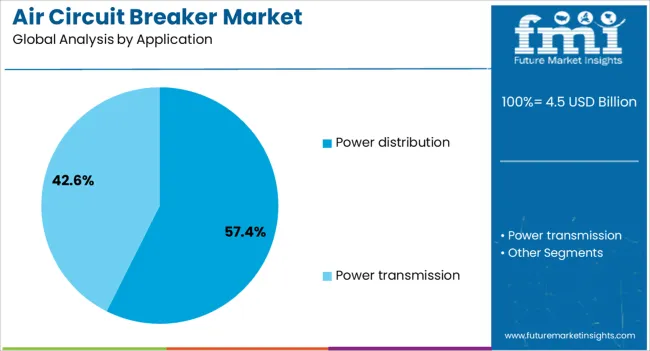
The power distribution segment leads the market by application, accounting for nearly 57.4% of the total share, owing to the critical role of air circuit breakers in maintaining grid stability and operational safety. These devices are deployed extensively across substations, switchgear systems, and transmission networks where rapid fault isolation is essential to minimize downtime.
The rising complexity of modern power networks, coupled with the integration of variable energy sources, has increased the need for robust circuit protection and responsive fault management tools. Market growth is further reinforced by global initiatives to strengthen power reliability in both urban and rural areas, where dependable distribution infrastructure is vital.
Air circuit breakers are also favored for their low maintenance, arc quenching capacity, and scalability, making them ideal for use in high-load distribution panels. As utilities continue to prioritize automation, fault diagnostics, and operational resilience, the power distribution segment is expected to remain the dominant application category.
Insights into the Residential Segment
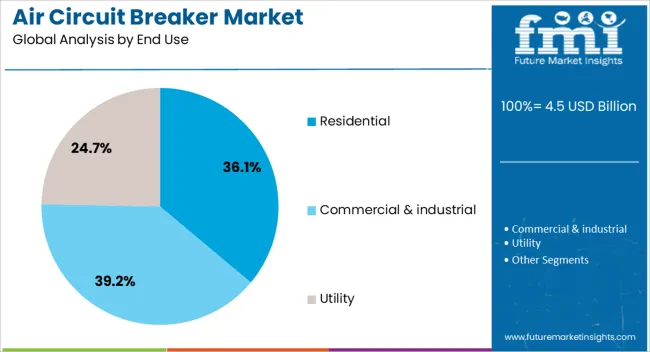
The residential segment holds a substantial 36.1% share of the air circuit breaker market within the end use category, supported by growing urbanization and rising electricity demand from homes and multi-family dwellings. Increasing electrification of household systems, from HVAC and lighting to home automation and electric vehicle charging, has led to a greater need for reliable circuit protection solutions.
Air circuit breakers are being increasingly specified for high-end and smart residential projects due to their enhanced safety features, longer operational life, and adaptability to intelligent energy systems. Furthermore, policy-driven initiatives promoting energy efficiency and safety compliance in building codes have played a pivotal role in segment expansion.
Consumer preference for technologically advanced and remotely manageable safety devices is also influencing product design and adoption. With the global residential sector undergoing transformation due to digitization, green building trends, and energy security mandates, the residential segment is expected to sustain robust demand in the coming years.
What are the Drivers, Restraints, and Key Trends of the Air Circuit Breaker Market?
The air circuit breaker market has been influenced by increasing demand for reliable electrical protection, efficient fault interruption, and high operational safety in industrial, commercial, and utility sectors. Adoption has been driven by growing electrification projects, modernization of power distribution networks, and rising industrial power requirements. Opportunities are emerging in retrofitting older systems, expanding into emerging markets, and integrating digital monitoring solutions. Trends are being observed in modular designs, smart diagnostics, and remote monitoring, while challenges persist in high capital costs, complex installation, and regulatory compliance. The market outlook remains robust with consistent infrastructure growth.
Rising Demand Driven by Industrial and Utility Electrical Protection Needs
The demand for air circuit breakers has been strongly influenced by their critical role in protecting electrical systems from overcurrent, short circuits, and faults. Utilities, industrial plants, and commercial facilities have been observed increasingly adopting air circuit breakers to ensure operational safety, minimize downtime, and maintain system reliability. In opinion, this demand has been reinforced by the expansion of power generation and distribution infrastructure, where reliable protection equipment is essential to prevent equipment damage and financial losses. High-voltage industrial installations, data centers, and manufacturing units are also prioritizing the use of air circuit breakers for precise fault isolation and improved operational continuity. The growing complexity of electrical networks and integration of heavy machinery has further strengthened reliance on these devices, highlighting that demand is structurally driven by operational safety requirements and efficiency standards rather than temporary market fluctuations.
Expanding Opportunities in Retrofitting and Emerging Market Adoption
Opportunities in the air circuit breaker market have been largely defined by retrofitting aging electrical systems, replacing obsolete breakers, and expanding into emerging regions with increasing electrification needs. Industrial facilities and utilities are actively exploring opportunities to enhance system reliability and reduce maintenance costs by integrating modern air circuit breakers. In opinion, these opportunities are further amplified in emerging markets where power infrastructure is being upgraded to meet growing industrial and commercial demand. Manufacturers are also exploring additional revenue streams through service contracts, predictive maintenance, and integrated monitoring solutions. Adoption of modular air circuit breaker designs allows flexible installation and easier scalability, creating further market potential. Overall, the combination of retrofitting projects, industrial growth, and regional infrastructure investments is expected to accelerate adoption, enhance grid resilience, and support long-term market growth.
Prominent Trends Observed in Modular and Smart Diagnostic Designs
The air circuit breaker market has been shaped by notable trends in modular configurations, smart diagnostics, and remote monitoring systems. Modular designs are increasingly being preferred for their ease of installation, scalability, and compatibility with modern switchgear systems. Smart diagnostic features, including real-time fault detection, predictive maintenance, and operational monitoring, have strengthened the position of air circuit breakers in industrial and utility applications. In opinion, these trends are expected to define market strategies as stakeholders focus on reducing unplanned downtime and improving system efficiency. Integration with digital substation systems and automation platforms has further reinforced the adoption of smart breakers. The convergence of modular design and digital monitoring allows operators to manage complex networks efficiently, optimize maintenance cycles, and enhance overall system reliability, highlighting that innovation in design and monitoring is central to maintaining competitive advantage.
Persistent Challenges in High Costs, Installation, and Compliance Standards
The air circuit breaker market has faced ongoing challenges related to high capital costs, complex installation procedures, and strict regulatory standards. The initial investment required for high-voltage and industrial-grade breakers can be a significant barrier for smaller utilities and commercial operators. In opinion, installation complexities, including specialized assembly, testing, and commissioning, have been underestimated in several large-scale projects, causing project delays and operational risk. Regulatory frameworks governing electrical safety, environmental compliance, and product certification vary across regions, further complicating adoption and cross-border deployment. Supply chain dependencies for critical components, such as contacts and arc extinguishing mechanisms, have occasionally constrained market growth. Addressing these challenges requires detailed project planning, adherence to international standards, and strong collaboration between manufacturers, system integrators, and regulatory authorities. Overcoming these barriers is essential to ensure reliable adoption and sustained growth of air circuit breaker solutions in modern power networks.
Analysis of Air Circuit Breaker Market By Key Countries
| Country | CAGR |
|---|---|
| China | 10.3% |
| India | 9.5% |
| Germany | 8.7% |
| France | 8.0% |
| UK | 7.2% |
| USA | 6.5% |
| Brazil | 5.7% |
The global air circuit breaker (ACB) market is projected to grow at a CAGR of 7.6% from 2025 to 2035. China leads with 10.3% growth, followed by India at 9.5%, and France at 8%. The United Kingdom records 7.2%, while the United States shows the slowest growth at 6.5%. Expansion is being driven by increasing demand for reliable, safe, and compact protection devices in power distribution networks, industrial plants, and commercial infrastructure. Emerging markets such as China and India witness faster adoption due to expanding transmission and distribution networks, industrialization, and urban infrastructure projects, while developed markets focus on upgrading aging electrical systems, integrating smart protection, and improving operational efficiency. This report includes insights on 40+ countries; the top markets are shown here for reference.
Sales Outlook for Air Circuit Breaker Market in China
The air circuit breaker market in China is growing at a CAGR of 10.3%, driven by rapid industrialization, expanding power infrastructure, and rising construction of commercial and industrial facilities. Chinese utilities and industrial operators are increasingly adopting ACBs for reliable overload and short circuit protection, space efficiency, and ease of maintenance. Growth is supported by government policies promoting safe and stable power distribution systems. Market penetration is further reinforced by investments in industrial automation and urban electrification, where ACBs play a critical role in protecting electrical equipment and ensuring uninterrupted power supply.
- Industrialization and power infrastructure expansion drive ACB adoption in China.
- Government initiatives for safe distribution systems enhance market growth.
- Integration in automation and urban electrification strengthens reliability.
Demand Analysis for Air Circuit Breaker Market in India
The air circuit breaker market in India is advancing at a CAGR of 9.5%, supported by increasing electricity demand, industrial growth, and expansion of commercial infrastructure. Indian operators are replacing outdated protection systems with modern ACBs to improve safety, reduce downtime, and enhance operational efficiency. Growth is reinforced by renewable energy projects, smart grid implementation, and infrastructure modernization programs. Adoption is further boosted by domestic manufacturing capabilities and the availability of cost-effective solutions for large-scale industrial and utility applications.
- Replacement of outdated systems drives ACB adoption in India.
- Renewable energy and smart grid projects enhance market expansion.
- Cost-effective solutions support industrial and utility applications.
In-depth Analysis of Air Circuit Breaker Market in France
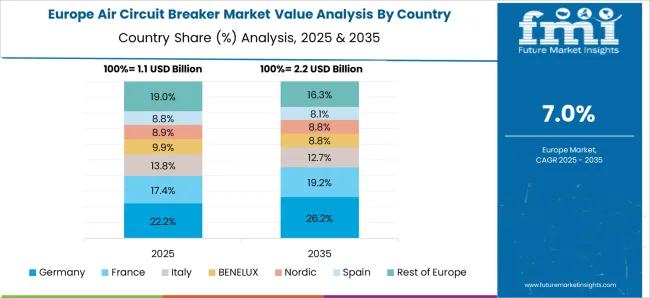
The air circuit breaker market in France is projected to grow at a CAGR of 8%, driven by modernization of aging electrical networks and adoption in industrial and commercial sectors. Utilities and manufacturers are deploying ACBs to ensure reliable protection against overloads and short circuits while maintaining operational efficiency. Growth is also supported by stringent safety regulations and increased focus on automation in power distribution systems. Adoption is concentrated in high-value industrial projects and urban infrastructure upgrades where equipment reliability is essential.
- Network modernization and industrial adoption drive ACB growth in France.
- Strict safety regulations support increased usage.
- Automation in power distribution enhances operational efficiency.
Opportunity Analysis for Air Circuit Breaker Market in United Kingdom
The air circuit breaker market in the United Kingdom is expanding at a CAGR of 7.2%, fueled by demand for reliable protection devices in commercial, industrial, and utility sectors. British operators are upgrading existing distribution systems with ACBs to improve fault protection, reduce downtime, and enhance safety. Market growth is also influenced by renewable energy connections, urban infrastructure development, and regulatory compliance standards. Adoption is further strengthened by integration with monitoring systems and smart distribution technologies.
- Upgrading distribution systems drives ACB adoption in the UK
- Renewable energy and infrastructure development support market growth.
- Integration with smart monitoring enhances system reliability.
Growth and Expansion Outlook for Air Circuit Breaker Market in the United States
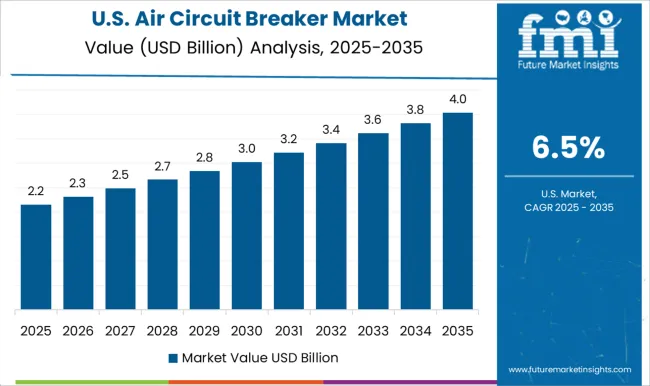
The air circuit breaker market in the United States is growing at a CAGR of 6.5%, supported by modernization of aging electrical networks, industrial expansion, and demand for reliable fault protection. USA operators are investing in ACBs to optimize safety, reduce downtime, and maintain system stability. Growth is reinforced by integration with automation and smart grid solutions, as well as regulatory requirements for power system reliability. While growth is slower compared to emerging markets, adoption remains steady in industrial, commercial, and utility sectors due to consistent demand for high-quality protection devices.
- Modernization of aging networks drives ACB adoption in the USA
- Integration with automation and smart grids enhances operational efficiency.
- Industrial and commercial demand supports steady market growth.
Competitive Landscape of Air Circuit Breaker Market
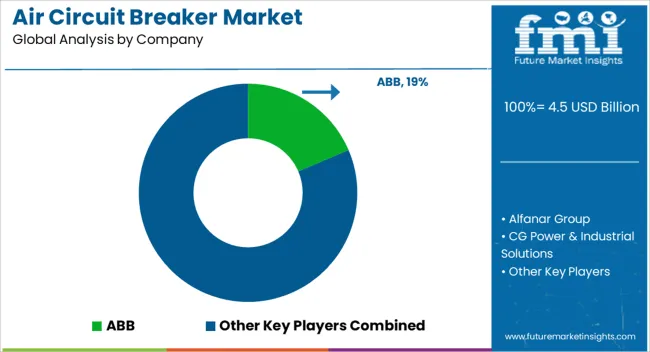
The air circuit breaker market consists of 12 to 15 major global manufacturers, with the top five companies holding 58–63% of worldwide market share. Growth is driven by increasing investments in power transmission and distribution, industrial automation, commercial infrastructure, and renewable energy integration, where air circuit breakers are essential for overcurrent protection, fault interruption, and system reliability. Competition centers on interrupting capacity, arc quenching efficiency, smart protection features, durability, compliance with IEC and ANSI standards, and integration with digital monitoring systems, rather than price alone. ABB leads the market with an 19% share, supported by its strong low-voltage switchgear portfolio and global service ecosystem.
Other leading players such as Alfanar Group, CG Power & Industrial Solutions, Eaton, and General Electric maintain solid positions with technologically advanced ACBs featuring high breaking capacity, compact frames, communication-enabled trip units, and plug-and-play installation suitable for industrial, utility, and commercial environments.
Challengers including HD Hyundai Electric, Kirloskar Electric Company, LS Electric, and Mitsubishi Electric compete with high-efficiency protection systems, strong brand presence in Asia, and cost-effective manufacturing, addressing both large infrastructure projects and regional distribution networks.
Additional players such as Powell Industries, Schneider Electric, and Sensata Technologies strengthen the competitive landscape through custom-engineered ACB solutions, IoT-enabled protection modules, and advanced thermal-magnetic or electronic trip systems, supporting diverse customer needs across global power, oil and gas, metal processing, and data center applications.
Key Players in the Air Circuit Breaker Market
- ABB
- Alfanar Group
- CG Power & Industrial Solutions
- Eaton
- General Electric
- HD Hyundai Electric
- Kirloskar Electric Company
- LS Electric
- Mitsubishi Electric
- Powell Industries
- Schneider Electric
- Sensata Technologies
Scope of the Report
| Item | Value |
|---|---|
| Quantitative Units | USD 4.5 Billion |
| Voltage | Low, Medium, and High |
| Application | Power distribution and Power transmission |
| End Use | Residential, Commercial & industrial, and Utility |
| Regions Covered | North America, Europe, Asia-Pacific, Latin America, Middle East & Africa |
| Country Covered | United States, Canada, Germany, France, United Kingdom, China, Japan, India, Brazil, South Africa |
| Key Companies Profiled | ABB, Alfanar Group, CG Power & Industrial Solutions, Eaton, General Electric, HD Hyundai Electric, Kirloskar Electric Company, LS Electric, Mitsubishi Electric, Powell Industries, Schneider Electric, and Sensata Technologies |
| Additional Attributes | Dollar sales by breaker type (fixed, withdrawable, vacuum, SF₆) and application (industrial, commercial, power generation, utilities) are key metrics. Trends include rising demand for reliable overcurrent protection, growth in industrial and infrastructure projects, and increasing adoption of advanced monitoring and control features. Regional deployment, technological advancements, and regulatory compliance are driving market growth. |
Air Circuit Breaker Market by Segments
Voltage:
- Low
- Medium
- High
Application:
- Power distribution
- Power transmission
End Use:
- Residential
- Commercial & industrial
- Utility
Region:
- North America
- USA
- Canada
- Mexico
- Latin America
- Brazil
- Chile
- Rest of Latin America
- Western Europe
- Germany
- UK
- Italy
- Spain
- France
- Nordic
- BENELUX
- Rest of Western Europe
- Eastern Europe
- Russia
- Poland
- Hungary
- Balkan & Baltic
- Rest of Eastern Europe
- East Asia
- China
- Japan
- South Korea
- South Asia and Pacific
- India
- ASEAN
- Australia & New Zealand
- Rest of South Asia and Pacific
- Middle East & Africa
- Kingdom of Saudi Arabia
- Other GCC Countries
- Turkiye
- South Africa
- Other African Union
- Rest of Middle East & Africa
Frequently Asked Questions
How big is the air circuit breaker market in 2025?
The global air circuit breaker market is estimated to be valued at USD 4.5 billion in 2025.
What will be the size of air circuit breaker market in 2035?
The market size for the air circuit breaker market is projected to reach USD 9.4 billion by 2035.
How much will be the air circuit breaker market growth between 2025 and 2035?
The air circuit breaker market is expected to grow at a 7.6% CAGR between 2025 and 2035.
What are the key product types in the air circuit breaker market?
The key product types in air circuit breaker market are low, medium and high.
Which application segment to contribute significant share in the air circuit breaker market in 2025?
In terms of application, power distribution segment to command 57.4% share in the air circuit breaker market in 2025.
Preview the report firsthand - request a free sample
Get SampleGet the brochure for pricing and purchase details.
Get PDFTable of Content
- Executive Summary
- Global Market Outlook
- Demand-side Trends
- Supply-side Trends
- Technology Roadmap Analysis
- Analysis and Recommendations
- Market Overview
- Market Coverage / Taxonomy
- Market Definition / Scope / Limitations
- Market Background
- Market Dynamics
- Drivers
- Restraints
- Opportunity
- Trends
- Scenario Forecast
- Demand in Optimistic Scenario
- Demand in Likely Scenario
- Demand in Conservative Scenario
- Opportunity Map Analysis
- Product Life Cycle Analysis
- Supply Chain Analysis
- Investment Feasibility Matrix
- Value Chain Analysis
- PESTLE and Porter’s Analysis
- Regulatory Landscape
- Regional Parent Market Outlook
- Production and Consumption Statistics
- Import and Export Statistics
- Market Dynamics
- Global Air Circuit Breaker Market Analysis 2020-2024 and Forecast, 2025-2035
- Historical Market Size Value (USD Mn) Analysis, 2020-2024
- Current and Future Market Size Value (USD Mn) Projections, 2025-2035
- Y-o-Y Growth Trend Analysis
- Absolute $ Opportunity Analysis
- Global Air Circuit Breaker Market Pricing Analysis 2020-2024 and Forecast 2025-2035
- Global Air Circuit Breaker Market Analysis 2020-2024 and Forecast 2025-2035, By Voltage
- Introduction / Key Findings
- Historical Market Size Value (USD Mn) Analysis By Voltage , 2020-2024
- Current and Future Market Size Value (USD Mn) Analysis and Forecast By Voltage , 2025-2035
- Low
- Medium
- High
- Y-o-Y Growth Trend Analysis By Voltage , 2020-2024
- Absolute $ Opportunity Analysis By Voltage , 2025-2035
- Global Air Circuit Breaker Market Analysis 2020-2024 and Forecast 2025-2035, By Application
- Introduction / Key Findings
- Historical Market Size Value (USD Mn) Analysis By Application, 2020-2024
- Current and Future Market Size Value (USD Mn) Analysis and Forecast By Application, 2025-2035
- Power distribution
- Power transmission
- Y-o-Y Growth Trend Analysis By Application, 2020-2024
- Absolute $ Opportunity Analysis By Application, 2025-2035
- Global Air Circuit Breaker Market Analysis 2020-2024 and Forecast 2025-2035, By End Use
- Introduction / Key Findings
- Historical Market Size Value (USD Mn) Analysis By End Use, 2020-2024
- Current and Future Market Size Value (USD Mn) Analysis and Forecast By End Use, 2025-2035
- Residential
- Commercial & industrial
- Utility
- Y-o-Y Growth Trend Analysis By End Use, 2020-2024
- Absolute $ Opportunity Analysis By End Use, 2025-2035
- Global Air Circuit Breaker Market Analysis 2020-2024 and Forecast 2025-2035, By Region
- Introduction
- Historical Market Size Value (USD Mn) Analysis By Region, 2020-2024
- Current Market Size Value (USD Mn) Analysis and Forecast By Region, 2025-2035
- North America
- Latin America
- Western Europe
- Eastern Europe
- East Asia
- South Asia and Pacific
- Middle East & Africa
- Market Attractiveness Analysis By Region
- North America Air Circuit Breaker Market Analysis 2020-2024 and Forecast 2025-2035, By Country
- Historical Market Size Value (USD Mn) Trend Analysis By Market Taxonomy, 2020-2024
- Market Size Value (USD Mn) Forecast By Market Taxonomy, 2025-2035
- By Country
- USA
- Canada
- Mexico
- By Voltage
- By Application
- By End Use
- By Country
- Market Attractiveness Analysis
- By Country
- By Voltage
- By Application
- By End Use
- Key Takeaways
- Latin America Air Circuit Breaker Market Analysis 2020-2024 and Forecast 2025-2035, By Country
- Historical Market Size Value (USD Mn) Trend Analysis By Market Taxonomy, 2020-2024
- Market Size Value (USD Mn) Forecast By Market Taxonomy, 2025-2035
- By Country
- Brazil
- Chile
- Rest of Latin America
- By Voltage
- By Application
- By End Use
- By Country
- Market Attractiveness Analysis
- By Country
- By Voltage
- By Application
- By End Use
- Key Takeaways
- Western Europe Air Circuit Breaker Market Analysis 2020-2024 and Forecast 2025-2035, By Country
- Historical Market Size Value (USD Mn) Trend Analysis By Market Taxonomy, 2020-2024
- Market Size Value (USD Mn) Forecast By Market Taxonomy, 2025-2035
- By Country
- Germany
- UK
- Italy
- Spain
- France
- Nordic
- BENELUX
- Rest of Western Europe
- By Voltage
- By Application
- By End Use
- By Country
- Market Attractiveness Analysis
- By Country
- By Voltage
- By Application
- By End Use
- Key Takeaways
- Eastern Europe Air Circuit Breaker Market Analysis 2020-2024 and Forecast 2025-2035, By Country
- Historical Market Size Value (USD Mn) Trend Analysis By Market Taxonomy, 2020-2024
- Market Size Value (USD Mn) Forecast By Market Taxonomy, 2025-2035
- By Country
- Russia
- Poland
- Hungary
- Balkan & Baltic
- Rest of Eastern Europe
- By Voltage
- By Application
- By End Use
- By Country
- Market Attractiveness Analysis
- By Country
- By Voltage
- By Application
- By End Use
- Key Takeaways
- East Asia Air Circuit Breaker Market Analysis 2020-2024 and Forecast 2025-2035, By Country
- Historical Market Size Value (USD Mn) Trend Analysis By Market Taxonomy, 2020-2024
- Market Size Value (USD Mn) Forecast By Market Taxonomy, 2025-2035
- By Country
- China
- Japan
- South Korea
- By Voltage
- By Application
- By End Use
- By Country
- Market Attractiveness Analysis
- By Country
- By Voltage
- By Application
- By End Use
- Key Takeaways
- South Asia and Pacific Air Circuit Breaker Market Analysis 2020-2024 and Forecast 2025-2035, By Country
- Historical Market Size Value (USD Mn) Trend Analysis By Market Taxonomy, 2020-2024
- Market Size Value (USD Mn) Forecast By Market Taxonomy, 2025-2035
- By Country
- India
- ASEAN
- Australia & New Zealand
- Rest of South Asia and Pacific
- By Voltage
- By Application
- By End Use
- By Country
- Market Attractiveness Analysis
- By Country
- By Voltage
- By Application
- By End Use
- Key Takeaways
- Middle East & Africa Air Circuit Breaker Market Analysis 2020-2024 and Forecast 2025-2035, By Country
- Historical Market Size Value (USD Mn) Trend Analysis By Market Taxonomy, 2020-2024
- Market Size Value (USD Mn) Forecast By Market Taxonomy, 2025-2035
- By Country
- Kingdom of Saudi Arabia
- Other GCC Countries
- Turkiye
- South Africa
- Other African Union
- Rest of Middle East & Africa
- By Voltage
- By Application
- By End Use
- By Country
- Market Attractiveness Analysis
- By Country
- By Voltage
- By Application
- By End Use
- Key Takeaways
- Key Countries Air Circuit Breaker Market Analysis
- USA
- Pricing Analysis
- Market Share Analysis, 2024
- By Voltage
- By Application
- By End Use
- Canada
- Pricing Analysis
- Market Share Analysis, 2024
- By Voltage
- By Application
- By End Use
- Mexico
- Pricing Analysis
- Market Share Analysis, 2024
- By Voltage
- By Application
- By End Use
- Brazil
- Pricing Analysis
- Market Share Analysis, 2024
- By Voltage
- By Application
- By End Use
- Chile
- Pricing Analysis
- Market Share Analysis, 2024
- By Voltage
- By Application
- By End Use
- Germany
- Pricing Analysis
- Market Share Analysis, 2024
- By Voltage
- By Application
- By End Use
- UK
- Pricing Analysis
- Market Share Analysis, 2024
- By Voltage
- By Application
- By End Use
- Italy
- Pricing Analysis
- Market Share Analysis, 2024
- By Voltage
- By Application
- By End Use
- Spain
- Pricing Analysis
- Market Share Analysis, 2024
- By Voltage
- By Application
- By End Use
- France
- Pricing Analysis
- Market Share Analysis, 2024
- By Voltage
- By Application
- By End Use
- India
- Pricing Analysis
- Market Share Analysis, 2024
- By Voltage
- By Application
- By End Use
- ASEAN
- Pricing Analysis
- Market Share Analysis, 2024
- By Voltage
- By Application
- By End Use
- Australia & New Zealand
- Pricing Analysis
- Market Share Analysis, 2024
- By Voltage
- By Application
- By End Use
- China
- Pricing Analysis
- Market Share Analysis, 2024
- By Voltage
- By Application
- By End Use
- Japan
- Pricing Analysis
- Market Share Analysis, 2024
- By Voltage
- By Application
- By End Use
- South Korea
- Pricing Analysis
- Market Share Analysis, 2024
- By Voltage
- By Application
- By End Use
- Russia
- Pricing Analysis
- Market Share Analysis, 2024
- By Voltage
- By Application
- By End Use
- Poland
- Pricing Analysis
- Market Share Analysis, 2024
- By Voltage
- By Application
- By End Use
- Hungary
- Pricing Analysis
- Market Share Analysis, 2024
- By Voltage
- By Application
- By End Use
- Kingdom of Saudi Arabia
- Pricing Analysis
- Market Share Analysis, 2024
- By Voltage
- By Application
- By End Use
- Turkiye
- Pricing Analysis
- Market Share Analysis, 2024
- By Voltage
- By Application
- By End Use
- South Africa
- Pricing Analysis
- Market Share Analysis, 2024
- By Voltage
- By Application
- By End Use
- USA
- Market Structure Analysis
- Competition Dashboard
- Competition Benchmarking
- Market Share Analysis of Top Players
- By Regional
- By Voltage
- By Application
- By End Use
- Competition Analysis
- Competition Deep Dive
- ABB
- Overview
- Product Portfolio
- Profitability by Market Segments (Product/Age /Sales Channel/Region)
- Sales Footprint
- Strategy Overview
- Marketing Strategy
- Product Strategy
- Channel Strategy
- Alfanar Group
- CG Power & Industrial Solutions
- Eaton
- General Electric
- HD Hyundai Electric
- Kirloskar Electric Company
- LS Electric
- Mitsubishi Electric
- Powell Industries
- Schneider Electric
- Sensata Technologies
- ABB
- Competition Deep Dive
- Assumptions & Acronyms Used
- Research Methodology


