

- Market Size (2026)
- USD 93.6 Mn
- Forecast (2036)
- USD 204.0 Mn
- CAGR (2026 to 2036)
- 8.1%
How big is Amaranth Flour Market in 2026?
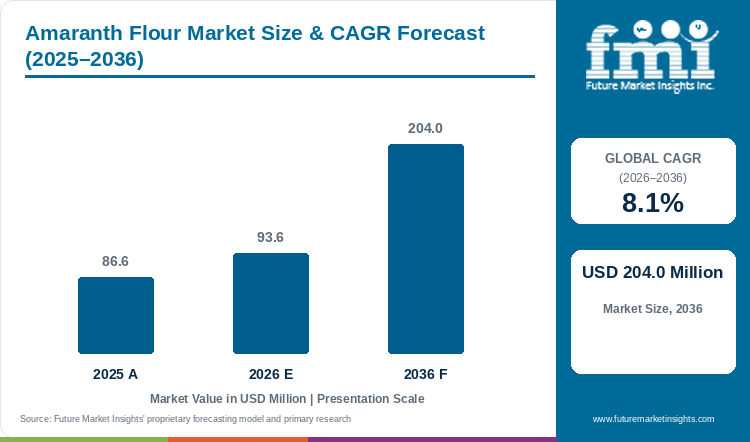
Registering a value of USD 86.6 million in 2025, the global amaranth flour market expanded to USD 93.6 million in 2026 and is anticipated to achieve USD 204.0 million by 2036, driven by an 8.1% CAGR.
Higher consumer prevalence of celiac disease and growing shopper demand for plant-protein fortification are prompting bakery and snack manufacturers to replace refined rice and corn starches with nutrient-dense pseudocereal flours. Unlike standard cereal grains that are deficient in the essential amino acid lysine, amaranth grain provides complete protein and dietary fiber that elevate front-of-pack nutrition claims. An April 2026 peer-reviewed study by Atudorei et al. in Foods confirmed that incorporating amaranth flour into gluten-free breads and biscuits substantially improves protein and mineral density compared with refined starch controls [1]. Driven by these reformulation projects across commercial bakeries, global amaranth flour market value rises from a 2025 base of USD 86.6 million to a 2026 figure of USD 93.6 million and reaches a 2036 target of USD 204.0 million under an 8.1% CAGR, yielding USD 110.4 million in cumulative market growth. Standard Milling Grade is forecast to account for 35.0% of the grade category in 2026 as commercial bakeries blend amaranth with commercial gluten-free flours. However, amaranth lacks gluten-forming proteins and can make bread crumb dense above 20% inclusion while introducing earthy flavor notes that restrain single-grain substitution.
Key Market Trends & Insights
- By grade: Standard Milling Grade is forecast to account for 35.0% of the grade category in 2026, linked to consistent water-absorption curves across high-volume multigrain bread and tortilla lines.
- By form: Powder / Dry is expected to represent 42.0% of the form category in 2026, driven by smooth dosing through existing bulk tote dischargers and pneumatic flour scales.
- By application: Bread & Rolls are estimated to garner 33.0% of the application category in 2026, supported by daily commercial loaf production that rewards lysine-rich ancient-grain label positioning.
- By claim: Conventional is projected to register 53.0% of the claim category in 2026, owing to lower farm-gate grain contracting costs for mainstream multigrain snacks and breads.
- By sales channel: Direct to Industrial Bakeries is anticipated to hold 50.0% within sales channels in 2026, enabled by plant-level lot traceability and joint pilot-bake qualification.
Regional Highlights
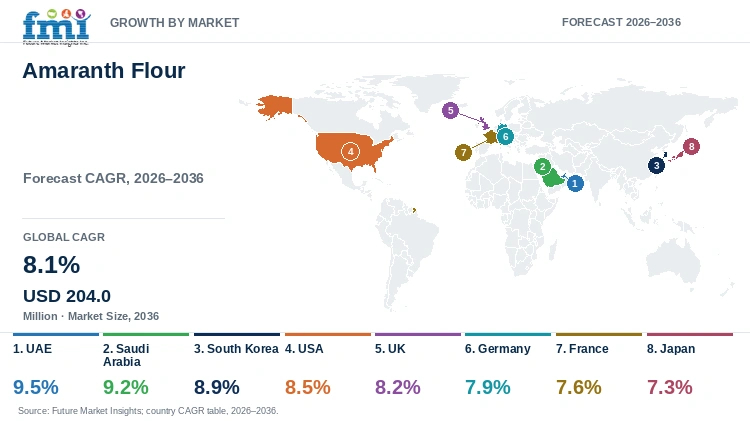
- Gulf specialty import growth: The UAE leads national expansion under a 9.5% ten-year CAGR to 2036 while Saudi Arabia tracks a 9.2% rate as specialty bakeries source certified gluten-free ancient-grain flours.
- Asia-Pacific and Western celiac compliance: South Korea delivers an 8.9% compound annual pace followed by the USA with 8.5% and the UK with 8.2%, while Germany maintains 7.9% and France posts 7.6% coupled with Japan with 7.3% under strict allergen audit frameworks.
Market Size & Forecast
Table 1: Market Size and Forecast for the Amaranth Flour Market (USD million and CAGR percentage), 2025 to 2036
| Metric | Value |
|---|---|
| 2025 Market Size | USD 86.6 million |
| Estimated Market Size in 2026 | USD 93.6 million |
| Projected Market Size by 2036 | USD 204.0 million |
| CAGR, 2026 to 2036 | 8.1% |
| Added Revenue, 2026 to 2036 | USD 110.4 million |
Although amaranth seed is naturally free of wheat gluten, accidental cross-contact with wheat or barley during farm harvesting and shared roller milling can disqualify an entire flour lot from celiac-safe food labels. Because a single contaminated batch can trigger costly retail recalls, industrial bakery buyers enforce strict supplier audits before moving amaranth flour from pilot trials into bulk purchasing. Under USA Food and Drug Administration gluten-free labeling rules updated in March 2026, finished foods bearing a voluntary gluten-free claim must contain fewer than 20 parts per million of gluten and maintain verified cross-contact controls [2]. To meet this threshold while managing ingredient costs, commercial bakers source audited lots from dedicated gluten-free mills and blend amaranth with dry-milled sorghum flour. As a result, millers that provide lot-specific ELISA gluten certificates are capturing multi-year industrial supply contracts.
Milled Tonnage and Bakery Inclusion Sizing
Table 2: Milled Flour Volume and Commercial Bakery Inclusion Sizing for the Amaranth Flour Market (USD million and operational ranges), 2025 to 2036
| Metric | 2025 | 2026 | 2036 |
|---|---|---|---|
| Market size (USD million) | 86.6 | 93.6 | 204.0 |
| Commercial amaranth flour volume (thousand metric tons) | 27.1 to 29.8 | 29.0 to 31.9 | 58.3 to 64.1 |
| Finished bakery & snack output using amaranth (thousand MT) | 180.5 to 198.6 | 193.3 to 212.7 | 388.7 to 427.3 |
| Average wholesale price per metric ton (USD) | 2,910 to 3,195 | 2,935 to 3,225 | 3,180 to 3,500 |
Operational note: Finished bakery tonnage applies a 12% to 18% average amaranth flour blend ratio across gluten-free loaves and ancient-grain tortillas or extruded multigrain snacks while excluding unmilled whole seed.
Commercial volume growth in the amaranth flour market depends on helping industrial bakeries overcome the texture and loaf-volume trade-offs of gluten-free pseudocereals. When coarse or unevenly milled amaranth flour is added to bread dough, it absorbs water rapidly and creates a gritty mouthfeel that limits consumer repeat purchases. To solve this formulation hurdle and enable higher inclusion rates, specialty millers supply finely classified amaranth flour paired with food starch binders that trap fermentation gas and keep gluten-free loaves soft.
Per Capita & Specialty Milling Facility Sizing
Table 3: Per Capita and Specialty Bakery Procurement Indicators for the Amaranth Flour Market (USD), 2025 to 2036
| Metric | 2025 | 2026 | 2036 |
|---|---|---|---|
| Global population (billion) | 8.2 | 8.3 | 9.0 |
| Market value per 1,000 people (USD) | 10.6 | 11.3 | 22.7 |
| Annual amaranth flour spend per qualified bakery plant (USD) | 19,800 to 23,400 | 21,100 to 24,900 | 38,500 to 45,200 |
| GFCO / <20 ppm certified lot share (%) | 58.0% to 62.0% | 60.5% to 64.5% | 71.0% to 75.0% |
Table 4: Milling & Industrial Bakery Procurement Indicators for the Amaranth Flour Market (USD and percentages), 2026
| Metric | Value | Institutional Reference Basis |
|---|---|---|
| Market size, 2026 | USD 93.6 million | 2026 global milled amaranth flour baseline |
| Commercial gluten-free & ancient-grain bakeries globally | 4,150 plants | Industrial bakery, snack & tortilla processor registry |
| Average annual amaranth flour spend per plant | USD 22,554.2 | Annualized B2B and foodservice ingredient allocation |
| Direct to industrial bakeries allocation, 2026 | USD 46.8 million | 50.0% primary sales-channel share allocation |
Because whole-grain amaranth contains unsaturated germ oils and squalene that can oxidize during warm warehouse storage, shelf-life stability is a critical variable for industrial buyers ordering 1,000-kilogram bulk totes. Off-odors from lipid rancidity can ruin entire production runs of multigrain crackers and nutrition bars. By adopting low-heat milling and protective packaging, suppliers prevent oil oxidation and allow food manufacturers to blend stabilized amaranth into cereal and grain fortification ingredients, which is expanding adoption across B2B bakery accounts.
Analyst Perspective
"Amaranth flour transitions from an R&D ancient-grain callout into recurring bulk-tote procurement only when millers guarantee sub-20-ppm gluten purity coupled with tightly controlled particle-size distributions. Suppliers that pair identity-preserved grain cleaning with enzyme-assisted bakery formulation support will capture long-term industrial bread and snack contracts."
- Nandini Roy Choudhury, Principal Consultant, Future Market Insights.
How is the amaranth flour market segmented?
The amaranth flour market is segmented by grade, form, application, claim, and sales channel. In 2026, Standard Milling Grade is projected at 35.0%, Powder / Dry at 42.0%, Bread & Rolls at 33.0%, Conventional at 53.0%, and Direct to Industrial Bakeries at 50.0%.
By grade: Standard Milling Grade, Fine / Patisserie Grade, Organic Certified, and Identity-Preserved Specialty.
By form: Powder / Dry, Liquid, Paste / Semi-Solid, and Granules / Pieces.
By application: Bread & Rolls, Cakes & Muffins, Biscuits & Cookies, Viennoiserie & Pastry, and Other Bakery & Snacks.
By claim: Conventional, Clean Label, Organic, and Non-GMO / Identity Preserved.
By sales channel: Direct to Industrial Bakeries, Ingredient Distributors, Foodservice & Artisan Supply, and Online B2B.
Why is Standard milling grade the primary Grade specification?
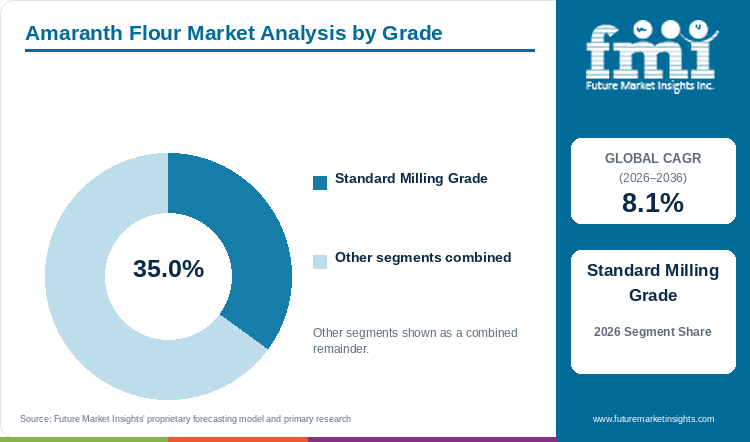
Standard Milling Grade is forecast to account for 35.0% of the grade category in 2026, linked to batch consistency.
Table 5: Grade Share for the Amaranth Flour Market (percentage share), 2026
| Grade | Share (2026) |
|---|---|
| Standard Milling Grade | 35.0% |
| Other Segments Combined* | 65.0% |
| Total | 100.0% |
*Calculated as the balance remaining after deducting the leading segment's reported share from 100.0%.
Table 6: Grade Leadership and Market Growth for the Amaranth Flour Market (segment and CAGR percentage), 2026 to 2036
| Metric | Value |
|---|---|
| Global CAGR (2026 to 2036) | 8.1% |
| Leading Segment | Standard Milling Grade |
Industrial bakeries concentrate their purchasing in Standard Milling Grade amaranth flour because it delivers consistent water absorption and dough mixing behavior without the steep processing surcharge of ultra-fine air-classified powders. When bakeries blend amaranth at 8% to 15% into multigrain breads and muffins, controlled standard granulation helps improve nutritional value while keeping crumb texture soft. For instance, an October 2025 peer-reviewed study by Paucar-Menacho et al. in Foods demonstrated that an optimal 9.16% amaranth flour and 12.94% quinoa flour substitution reduced muffin crumb hardness by up to 33.0% while boosting polyphenol content [3]. These texture and nutrition gains encourage commercial bakers to pair standard-grade amaranth with whole-wheat bakery flour blends across mainstream pan-bread lines.
- Roller and stone milling efficiency keeps Standard Milling Grade at a forecast 35.0% share within grades in 2026 across routine bakery batching.
- Medium particle fractions between 180 and 300 micrometers balance Chopin Mixolab dough development time and gas retention during two-hour sponge fermentation.
What sustains Powder / dry leadership across Form purchases?
Industrial flour buyers concentrate an expected 42.0% of 2026 form demand in Powder / Dry, supported by pneumatic silo dosing.
Powder / Dry amaranth flour holds the largest form share because commercial bakeries and snack plants are already equipped with dry-ingredient silos and pneumatic weigh-hoppers designed for free-flowing powders. Switching to liquid or paste grain fractions would require costly refrigerated tanks and CIP sanitation retrofits. By contrast, dry-milled amaranth powder stores at ambient warehouse temperatures in 25-kilogram bags or super-sacks and blends directly into industrial cereal flour mixes, lowering adoption friction for plant managers.
- A May 2025 study by Toimbayeva et al. in Foods confirmed that dry-milled Amaranthus cruentus and Amaranthus hypochondriacus flours are gliadin-free and supply elevated albumin and lysine levels for celiac-safe bakery foods [4].
- Within the form breakdown, Powder / Dry is expected to represent a 42.0% share in 2026, attributable to ambient warehouse stability and automated dry-ingredient scaling.
Why do Bread & rolls anchor amaranth flour applications?
Bakery consumption patterns place Bread & Rolls at an estimated 33.0% application share in 2026, owing to daily loaf production.
Bread & Rolls represent the largest application segment because sandwich loaves and dinner rolls are high-frequency household staples that generate continuous weekly bulk-tote reorders once a bakery qualifies an ancient-grain recipe. However, because amaranth lacks wheat gluten and can reduce loaf volume when used above 15% to 20% of flour weight, bread formulators rarely use it as a standalone flour. Instead, commercial bakeries co-formulate amaranth bread doughs with roasted buckwheat seed flours and baking enzymes so loaves achieve high oven spring and repeat consumer purchases.
- A June 2026 peer-reviewed study by Valderrama Sánchez et al. in Plant Foods for Human Nutrition demonstrated that baking amaranth flour into gluten-free formulations increased extractable phenolics from 40.77 to 281.4 mg GAE per 100 grams dry basis [5].
- Bread & Rolls are estimated to garner a 33.0% share within applications in 2026, reinforced by continuous supermarket demand for ancient-grain and gluten-free sandwich loaves.
Why does Conventional remain the largest claim category?
Within the claim structure, Conventional amaranth flour is projected to register a 53.0% share in 2026, due to competitive landed cost.
Mainstream bakery and snack brands favor Conventional amaranth flour because it allows them to highlight ancient-grain protein and dietary fiber on front-of-pack labels without paying the high farm-gate price premiums of certified organic seed. Even in conventional form, amaranth delivers a substantial nutritional upgrade over standard gluten-free starches. Confirming this advantage, a March 2025 study of 30 flours and 24 breads by González et al. in Foods showed that pseudocereal flours such as amaranth preserve significantly higher dietary fiber and healthy unsaturated lipids than refined gluten-free cereal flours [6]. Because of this built-in nutritional value, bread and tortilla manufacturers can use conventional amaranth flour to meet health-conscious shopper demand at competitive retail price points.
- Conventional is projected to register a 53.0% share across claims in 2026, influenced by broad price compatibility across mainstream multigrain bakery SKUs.
- Processors targeting celiac consumers verify dedicated gluten-free milling and lot-level ELISA testing separately from organic chain-of-custody certificates.
What gives Direct to industrial bakeries an edge in Sales Channel?
Direct to Industrial Bakeries is anticipated to hold a 50.0% sales-channel share in 2026, enabled by technical baking service.
Direct to Industrial Bakeries accounts for half of total market sales because large bread and snack manufacturers cannot risk spot-market supply gaps or unverified gluten cross-contact once a national retail SKU is launched. By contracting directly with specialty millers, industrial buyers lock in annual identity-preserved grain volume and lot-specific ELISA gluten certificates with joint pilot-bakery formulation support that third-party resellers rarely provide.
- March 2025 regulatory guidance from the U.S. Food and Drug Administration outlines allergen cross-contact prevention and gluten-free compliance controls for commercial ingredient suppliers [7].
- Procurement patterns across plant bakeries give Direct to Industrial Bakeries an anticipated 50.0% channel share in 2026, stemming from multi-ton contract volumes and joint formulation troubleshooting.
What are the drivers, restraints, and opportunities in the amaranth flour market?
Celiac-safe bakery reformulation and complete plant-protein positioning drive amaranth flour demand, whereas dough-density loss and cross-contact testing costs restrain inclusion rates and identity-preserved gluten-free grades create value-add opportunities.
- Driver: Bakery and snack reformulation around naturally gluten-free, lysine-rich ancient grains generates recurring flour qualification projects.
- Restraint: Absence of gluten viscoelasticity, earthy peppery flavor notes, and shared-equipment cross-contact risks limit inclusion percentages.
- Opportunity: Identity-preserved seed cleaning paired with enzyme-modified fine flours enables higher inclusion in gluten-free breads and clean-label snacks.
Growth Analysis and Future Potential: Ancient-Grain Amino Acid Density and Gluten-Free Reformulation
Consumer dissatisfaction with the low protein and fiber content of first-generation gluten-free foods made from refined rice and tapioca starch is a major factor driving demand for amaranth flour. Food manufacturers are reformulating breads and extruded snacks with amaranth to raise complete protein and lysine levels on nutrition panels. An August 2026 systematic review by Roobab and Maqsood in Food Chemistry demonstrated that 10% to 25% amaranth flour inclusion significantly boosts lysine bioavailability and dietary fiber density when paired with hydrocolloids and controlled hydration [8]. By capturing these nutritional benefits, commercial processors are blending amaranth into gluten-free food formulations that command higher retail margins.
Risk Assessment of the Amaranth Flour Market: Crumb Densification and Grain Cross-Contact Liability
The primary factors restraining higher inclusion rates of amaranth flour in commercial baking are dough densification at elevated substitution levels and batch-to-batch protein variability across raw grain harvests. Because amaranth seed proteins consist mainly of albumins and globulins rather than elastic wheat gluten, adding more than 20% amaranth flour weakens gas retention and produces a compact loaf unless seed quality is tightly controlled. Addressing this raw-material variable, a March 2026 genome-wide study by Chauhan et al. in Theoretical and Applied Genetics across 192 Amaranthus hypochondriacus accessions identified genetic markers with 0.91 heritability for seed protein and albumin-globulin fractions [9]. While selective breeding improves grain uniformity, commercial bakers still need to pair amaranth flour with modified starch systems to prevent dense crumb structure.
Commercial Opportunity Analysis: Identity-Preserved Seed Cleaning and Certified Gluten-Free Milling
Stronger demand from industrial bakeries for guaranteed gluten-free purity and farm-to-mill traceability is creating a lucrative opportunity for vertically integrated specialty millers. Because small pseudocereal seeds are easily contaminated by volunteer wheat or foreign grains during harvesting and storage, food manufacturers pay price premiums to suppliers that own dedicated optical seed-cleaning and gluten-free milling plants. In July 2025, Ardent Mills agreed to acquire Stone Mill in Richardton to expand its certified gluten-free and identity-preserved grain cleaning and processing capabilities [10]. Through such upstream supply-chain integration, millers can guarantee sub-10-ppm gluten purity and secure long-term contracts for certified gluten-free tortillas and multigrain bakery mixes.
Amaranth Flour Market by Country (2026 to 2036)
Global trade patterns show the UAE leading national amaranth flour growth under a 9.5% ten-year CAGR, while Japan sustains a 7.3% compound annual rate. Commercial adoption across Middle Eastern specialty importers, East Asian allergen-regulated bakeries, and Western celiac-certified food manufacturers depends on lot-level gluten verification and particle-size stability.
Table 7: Country CAGR and Primary Growth Levers for the Amaranth Flour Market (CAGR percentage and operational drivers), 2026 to 2036
| Country | CAGR (2026 to 2036) | Primary Growth Lever |
|---|---|---|
| UAE | 9.5% | Municipality-registered gluten-free bakery imports and health-focused hotel catering |
| Saudi Arabia | 9.2% | SFDA Arabic-labeled free-from retail expansion and multigrain industrial baking |
| South Korea | 8.9% | MFDS wheat-allergen substitution in rice-and-pseudocereal bakery snacks |
| USA | 8.5% | FDA <20 ppm gluten-free claim enforcement and GFCO-certified industrial milling |
| UK | 8.2% | Coeliac UK 20 ppm diligence standards and supermarket free-from bread reformulation |
| Germany | 7.9% | DGE celiac nutrition guidance and EU 20 mg/kg gluten-free bakery production |
| France | 7.6% | AFDIAG crossed-grain logo auditing and specialty organic boulangerie blends |
| Japan | 7.3% | CAA allergen-controlled import specifications and fine-mesh bakery blending |
Source: Future Market Insights analysis
UAE Amaranth Flour Market Outlook (2026 to 2036)
Because the UAE produces minimal domestic grain, its amaranth flour market is uniquely driven by luxury hotel wellness bakeries and expatriate free-from grocers that rely on certified specialty imports. In July 2026, exporter guidance from Dubai USDA Foreign Agricultural Service staff showed agricultural shipments from the USA into the UAE reaching USD 1.5 billion in 2025, with over 83% of growth led by consumer-oriented foods [11]. This strong import demand lifts commercial amaranth flour volume across the UAE at a leading 9.5% annual growth clip through 2036 across luxury hospitality and specialty grocery accounts. However, high Persian Gulf humidity accelerates oil rancidity in whole-grain flours, compelling importers to specify nitrogen-flushed bags and ELISA gluten certificates.
Key takeaway: In the UAE, expanding hotel wellness menus and municipality-verified specialty imports are projected to increase distributor uptake of certified gluten-free amaranth flour.
Saudi Arabia Amaranth Flour Market Outlook (2026 to 2036)
In Saudi Arabia, rising prevalence of metabolic health concerns and government support for domestic food manufacturing are prompting local biscuit and flatbread plants to add ancient-grain flours to their product lines. Commercial amaranth flour shipments across Saudi Arabia maintain a 9.2% compound annual expansion through 2036 supported by supermarket free-from aisles across Riyadh and Jeddah. Confirming this industrial demand, an April 2026 grain annual by the USDA Foreign Agricultural Service projected that wheat and grain imports into Saudi Arabia will rise 2% to 3.5 million metric tons in MY 2026/27 due to expanding local food processing [12]. However, foreign millers must provide Arabic labeling and peroxide-stability certificates to clear port inspections.
Key takeaway: In Saudi Arabia, mandatory Arabic labeling compliance and supermarket free-from bakery expansion are expected to govern importer qualification of amaranth flour.
South Korea Amaranth Flour Market Outlook (2026 to 2036)
What makes South Korea distinct is how domestic bakeries blend fine amaranth powder into rice-flour breads and infant snacks to boost protein while avoiding mandatory wheat-allergen warnings. Amaranth flour procurement in South Korea delivers an 8.9% annual growth pace over the decade to 2036 through health-positioned bakery and snack launches. Reinforcing this ingredient import channel, May 2026 statistics from USDA Foreign Agricultural Service staff in Seoul show domestic food manufacturing sales in South Korea hitting USD 82.1 billion with heavy reliance on imported specialty grain inputs [13]. However, strict national cross-contact inspections mean local buyers reject shared-mill lots that lack batch-level PCR absence testing for wheat and buckwheat.
Key takeaway: In South Korea, strict wheat-allergen labeling rules and functional rice-bakery blending are forecast to sustain industrial demand for purity-verified amaranth flour.
USA Amaranth Flour Market Outlook (2026 to 2036)
The USA is uniquely positioned as both a major producer and the largest commercial buyer of amaranth flour, driven by flat conventional wheat acreage and rising demand for GLP-1-friendly high-protein bakery foods. In April 2026, long-term crop projections from USDA Economic Research Service analysts placed traditional USA wheat acreage flat at 44.0 million acres through 2035/36, encouraging specialty millers to contract higher-margin alternative grains [14]. Consequently, volume across the USA sustains an 8.5% annual expansion from 2026 to 2036 across industrial bread and extruded-snack plants. While domestic GFCO-certified mills in North America ensure steady bulk supply, commercial formulators still require enzyme-conditioned blends to prevent dense loaf crumb.
Key takeaway: In the USA, domestic GFCO-certified milling capacity and clean-label multigrain bakery launches are anticipated to anchor recurring bulk and retail amaranth flour orders.
UK Amaranth Flour Market Outlook (2026 to 2036)
In the UK, mature supermarket free-from aisles and domestic wheat supply shifts are pushing plant bakeries to diversify into ancient-grain sourdoughs and seeded multigrain crackers. In April 2026, UK grain market analysis issued through USDA Foreign Agricultural Service offices noted that domestic flour millers and bakeries are adjusting grain sourcing and specialty flour imports for the 2026/27 marketing year [15]. This formulation shift lifts commercial amaranth flour procurement in the UK at an 8.2% ten-year annual rate to 2036 across domestic industrial and specialty retail packers. However, strict retailer private-label audits under the 20-ppm gluten-free threshold require BRCGS-certified mill segregation to prevent oat or wheat cross-contact.
Key takeaway: In the UK, strict 20-ppm free-from retail standards and artisan multigrain bread reformulation are estimated to drive demand for audited gluten-free amaranth flour.
Germany Amaranth Flour Market Outlook (2026 to 2036)
Germany differs from other European markets because its deep Reformhaus health-food tradition and Europe's largest organic whole-grain baking sector create strong demand for certified organic pseudocereal flours. Commercial amaranth flour turnover in Germany tracks a 7.9% yearly expansion through 2036 across organic muesli blenders and industrial gluten-free bread plants. Backing this channel structure, September 2025 retail food statistics for Germany from USDA Foreign Agricultural Service staff in Berlin show national grocery sales of USD 293 billion and sustained shopper demand for organic packaged foods [16]. However, strict pesticide-residue limits and crumb-elasticity standards mean bakers across Germany require specification-locked organic amaranth flour lots with verified starch hydration curves.
Key takeaway: In Germany, EU 20 mg/kg celiac labeling rules and organic whole-grain bakery demand are predicted to sustain contract purchasing of specification-locked amaranth flour.
France Amaranth Flour Market Outlook (2026 to 2036)
In France, amaranth flour adoption is governed by fine patisserie and organic biscuit manufacturers that demand smooth crumb texture and zero earthy bitterness paired with strict celiac certification. Commercial amaranth flour shipments in France reach a 7.6% compound annual pace over the ten-year horizon to 2036 owing to specialty dietary brands blending pseudocereals with chestnut and buckwheat flours. According to a November 2025 France retail brief by the USDA Foreign Agricultural Service, food processors and retailers are actively reformulating packaged bakery ranges to meet national nutritional and environmental standards [17]. Because coarse meal is rejected by patisserie chefs across France, air-classified debittered flour grades with certified sub-20-ppm gluten purity capture the highest commercial margins.
Key takeaway: In France, AFDIAG crossed-grain audit requirements and fine patisserie texture standards are slated to favor air-classified, low-bitterness gluten-free amaranth flour.
Japan Amaranth Flour Market Outlook (2026 to 2036)
Japan represents a specialized import market where shifting domestic rice and wheat economics are prompting food processors to blend iron-rich pseudocereal flours into rice breads and functional wafers. In September 2026, grain market updates compiled by Tokyo USDA Foreign Agricultural Service specialists showed that food processors in Japan are adjusting cereal and specialty flour formulations amid changing rice and wheat supply balances [18]. Supported by this reformulation trend, amaranth flour procurement in Japan sustains a 7.3% decadal CAGR through 2036 across health-oriented bakeries. However, strict Consumer Affairs Agency allergen rules and Positive List pesticide-residue inspections require exporters to work through established trading houses in Japan.
Key takeaway: In Japan, strict Consumer Affairs Agency allergen and residue standards are projected to reward trading-house-verified fine amaranth flour for rice-bakery blending.
Full report country CAGRs cover: North America; Latin America; Western Europe; Eastern Europe; East Asia; South Asia and Pacific; Middle East and Africa.
Who are the notable companies in the amaranth flour market?
Ardent Mills, ADM, Bay State Milling, Limagrain Ingredients, GoodMills Group, King Arthur Baking, Bob's Red Mill, Doves Farm, Manildra Group, and Scoular are the notable companies in the amaranth flour market.
Competitive participation in the amaranth flour market separates dedicated GFCO-certified ancient-grain millers from multinational functional-flour compounders and specialty retail flour packers. Industrial leaders Ardent Mills and Bay State Milling supply bulk identity-preserved and certified gluten-free amaranth flours directly to plant bakeries, whereas Bob's Red Mill and Doves Farm anchor packaged organic and free-from retail channels.
- Documented amaranth flour suppliers: Ardent Mills and Bay State Milling alongside Bob's Red Mill supply documented gluten-free conventional and organic amaranth flours.
- Broader flour and bakery formulation platforms: ADM and Limagrain Ingredients provide ancient-grain blends and bakery formulation systems, while GoodMills Group and King Arthur Baking support specialty flour applications.
- Specialty channels and adjacent grain ingredient providers: Doves Farm and Manildra Group operate specialty flour lines, while Scoular manages identity-preserved grain supply chains.
Competitive Benchmarking: Amaranth Flour Market
Table 8: Competitive Benchmarking for the Amaranth Flour Market (qualitative capability ratings), 2026
| Company | Amaranth flour offer | Gluten-free assurance | Bakery application support | Geographic Reach |
|---|---|---|---|---|
| Ardent Mills | High | High | High | High |
| ADM | Medium | High | High | High |
| Bay State Milling | High | High | High | High |
| Limagrain Ingredients | Medium | Medium | High | High |
| GoodMills Group | Medium | Medium | High | High |
| King Arthur Baking | Medium | Medium | High | Medium |
| Bob's Red Mill | High | High | Medium | High |
| Doves Farm | Medium | High | Medium | Medium |
| Manildra Group | Medium | Medium | High | High |
| Scoular | High | High | Medium | High |
Scoring basis: Matrix benchmarks reflect documented standalone amaranth flour and ancient-grain milling breadth paired with third-party gluten-free certification and pilot-bakery rheology support.
Key Developments in the Amaranth Flour Market
- In December 2025, Ardent Mills published its 2026 formulation strategy highlighting rising commercial bakery demand for protein-dense, fiber-rich ancient grains that support GLP-1-aligned and clean-label diets [19].
- In October 2026, Dubai agricultural trade analysts at the USDA Foreign Agricultural Service reported in the UAE Retail Foods Annual that consumer-oriented food imports into the UAE rose 9.3% to USD 17.7 billion as grocery retail exceeded USD 20 billion [20].
- In January 2026, the Oldways Whole Grains Council outlined its 2026 whole-grain labeling and ancient-grain education programs supporting commercial bakery adoption of pseudocereals [21].
Key Players in the Amaranth Flour Market
Documented amaranth flour suppliers
- Ardent Mills
- Bay State Milling
- Bob's Red Mill
Broader flour and bakery formulation platforms
- ADM
- Limagrain Ingredients
- GoodMills Group
- King Arthur Baking
Specialty channels and adjacent grain ingredient providers
- Doves Farm
- Manildra Group
- Scoular
Amaranth Flour Market - Report Scope
Table 9: Report Scope for the Amaranth Flour Market (coverage fields and definitions), 2026 to 2036
| Coverage field | Report scope |
|---|---|
| Market breakdown | Grade; Form; Application; Claim; Sales Channel |
| Quantitative Units | USD Million |
| Market Definition | Includes commercial supplier revenue from dry-milled, stone-ground, air-classified, and pre-gelatinized amaranth flour sold as a food and bakery ingredient across the stated grades, forms, applications, claims, and sales channels. Category Scope Note: Excludes unmilled whole amaranth seed, non-amaranth flours, and downstream finished bread or snack retail revenues. |
| Regions Covered | North America; Latin America; Western Europe; Eastern Europe; East Asia; South Asia and Pacific; Middle East and Africa |
| Countries Covered | UAE, Saudi Arabia, South Korea, USA, UK, Germany, France, Japan, and additional countries in the full report |
| Key Companies Covered | Ardent Mills, ADM, Bay State Milling, Limagrain Ingredients, GoodMills Group, King Arthur Baking, Bob's Red Mill, Doves Farm, Manildra Group, Scoular |
| Forecast Period | 2026 to 2036 |
| Approach | Primary and secondary research with top-down and bottom-up market triangulation. |
Amaranth Flour Market - Research Methodology
Table 10: Research Methodology for the Amaranth Flour Market (research methods and approach), 2026 edition
| Method | Approach |
|---|---|
| Primary Research | Structured interviews with specialty ancient-grain millers, GFCO quality-assurance auditors, industrial gluten-free bakery R&D directors, and B2B ingredient distributors to validate bulk-tote pricing and inclusion limits. |
| Secondary Research | Review of FDA gluten-free labeling guidance, USDA Foreign Agricultural Service grain and retail annuals, PubMed-indexed pseudocereal rheology studies, Oldways Whole Grains Council reports, and official corporate milling disclosures. |
| Market Sizing and Forecasting | Top-down specialty pseudocereal milling output reconciled against bottom-up industrial bakery inclusion tonnage and packaged free-from flour velocity from 2025 to 2036. |
| Country Forecasting Model | National projections weight celiac prevalence, statutory gluten-free labeling enforcement, and multigrain bakery reformulation across eight focal countries and seven global regions. |
| Operational Benchmark Traceability | Milled metric tonnage, composite bakery output, and per-plant ingredient spend indicators in Tables 2, 3, and 4 trace to peer-reviewed inclusion trials, GFCO plant schedules, and B2B miller catalogs. |
| Data Triangulation and Validation | Revenue estimates are cross-checked against dedicated gluten-free mill capacity while excluding unmilled whole amaranth grain, non-amaranth blended flours, and finished bakery goods. |
Amaranth Flour Market by Segments
Amaranth Flour Market segmented by Grade:
- Standard Milling Grade
- Fine / Patisserie Grade
- Organic Certified
- Identity-Preserved Specialty
Amaranth Flour Market segmented by Form:
- Powder / Dry
- Liquid
- Paste / Semi-Solid
- Granules / Pieces
Amaranth Flour Market segmented by Application:
- Bread & Rolls
- Cakes & Muffins
- Biscuits & Cookies
- Viennoiserie & Pastry
- Other Bakery & Snacks
Amaranth Flour Market segmented by Claim:
- Conventional
- Clean Label
- Organic
- Non-GMO / Identity Preserved
Amaranth Flour Market segmented by Sales Channel:
- Direct to Industrial Bakeries
- Ingredient Distributors
- Foodservice & Artisan Supply
- Online B2B
Amaranth Flour Market by Region
- North America
- United States
- Canada
- Latin America
- Brazil
- Mexico
- Argentina
- Chile
- Western Europe
- Germany
- France
- United Kingdom
- Italy
- Spain
- Benelux
- Nordics
- Eastern Europe
- Poland
- Czech Republic
- Romania
- Hungary
- East Asia
- China
- Japan
- South Korea
- South Asia and Pacific
- India
- ASEAN
- Australia and New Zealand
- Middle East and Africa
- GCC Countries
- South Africa
- Türkiye
- Israel
Research Sources and Bibliography
- [1] Atudorei, O., Atudorei, D., & Codină, G. G. (2026, April 8). Pseudocereals in Bakery Products: A Review of Nutritional Composition, Health Benefits and Bakery Applications. Foods (PubMed PMID 42073170).
- [2] U.S. Food and Drug Administration. (2026, March 17). Gluten-Free Labeling of Foods | FDA. FDA Center for Food Safety and Applied Nutrition.
- [3] Paucar-Menacho, L. M., Salvador-Reyes, R., et al. (2025, October 14). Optimization of Functional Muffins with Germinated Andean Pseudocereal Flours as Partial Wheat Flour Replacers. Foods (PubMed PMID 41085771).
- [4] Toimbayeva, D., Saduakhasova, S., et al. (2025, May 1). Prospects for the Use of Amaranth Grain in the Production of Functional and Specialized Food Products. Foods (PubMed PMID 40361686).
- [5] Valderrama Sánchez, V., Sabbione, A. C., et al. (2026, June 6). Functional and Bioactive Characterization of Amaranth-Based Cookies: Antioxidant and Hypocholesterolemic Activities After Simulated Gastrointestinal Digestion. Plant Foods for Human Nutrition (PubMed PMID 42249246).
- [6] González, M. P., López-Laiz, P., et al. (2025, March 5). Determination and Comparison of Fat and Fibre Contents in Gluten-Free and Gluten-Containing Flours and Breads: Nutritional Implications. Foods (PubMed PMID 40077597).
- [7] U.S. Food and Drug Administration. (2025, March 20). Food Allergens/Gluten-Free Guidance Documents & Regulatory Information | FDA. FDA Center for Food Safety and Applied Nutrition.
- [8] Roobab, U., & Maqsood, S. (2026, August 30). Amaranth Fortification in Pasta: A Systematic Review of Nutritional Enhancement, Processing Parameters, and Sensory Attributes Across Wheat, Semolina, and Gluten-Free Formulations. Food Chemistry (PubMed PMID 42235225).
- [9] Chauhan, R., Prabhakaran, S., et al. (2026, March 10). Genetic architecture of seed protein composition in grain amaranth (Amaranthus hypochondriacus): a multi-environment genome-wide association study. Theoretical and Applied Genetics (PubMed PMID 41883418).
- [10] Ardent Mills, LLC. (2025, July 31). Ardent Mills Enters Agreement to Acquire Stone Mill in North Dakota, Expanding Emerging Nutrition Portfolio | Ardent Mills. Ardent Mills Corporate Newsroom.
- [11] USDA Foreign Agricultural Service. (2026, July 3). United Arab Emirates: Exporter Guide Annual | USDA Foreign Agricultural Service. U.S. Department of Agriculture GAIN.
- [12] USDA Foreign Agricultural Service. (2026, April 6). Saudi Arabia: Grain and Feed Annual | USDA Foreign Agricultural Service. U.S. Department of Agriculture GAIN.
- [13] USDA Foreign Agricultural Service. (2026, May 27). South Korea: Food Processing Ingredients Annual | USDA Foreign Agricultural Service. U.S. Department of Agriculture GAIN.
- [14] USDA Economic Research Service. (2026, April 21). U.S. major field crop acreage projected to decline | Economic Research Service. U.S. Department of Agriculture ERS.
- [15] USDA Foreign Agricultural Service. (2026, April 30). United Kingdom: Grain and Feed Annual | USDA Foreign Agricultural Service. U.S. Department of Agriculture GAIN.
- [16] USDA Foreign Agricultural Service. (2025, September 24). Germany: Retail Foods Annual | USDA Foreign Agricultural Service. U.S. Department of Agriculture GAIN.
- [17] USDA Foreign Agricultural Service. (2025, November 19). France: Retail Foods Annual | USDA Foreign Agricultural Service. U.S. Department of Agriculture GAIN.
- [18] USDA Foreign Agricultural Service. (2026, September 30). Japan: Grain and Feed Update | USDA Foreign Agricultural Service. U.S. Department of Agriculture GAIN.
- [19] Ardent Mills, LLC. (2025, December 19). Strategies for Success in 2026 | Ardent Mills. Ardent Mills Corporate Newsroom.
- [20] USDA Foreign Agricultural Service. (2026, October 19). United Arab Emirates: Retail Foods Annual | USDA Foreign Agricultural Service. U.S. Department of Agriculture GAIN.
- [21] Oldways Whole Grains Council. (2026, January 15). WGC Plans & Projects for 2026 | The Whole Grains Council. Oldways Whole Grains Council.
- [22] Archer Daniels Midland Company (ADM). (2025, October 14). ADM Advances Quality Capabilities with opening of New Central Lab-Milling | ADM. ADM Corporate Newsroom.
- [23] Archer Daniels Midland Company (ADM). (2025, October 9). ADM Continues to Support Customer Needs and Supply Chain Resilience with Expansion of Electric Truck Fleet for UK Flour Deliveries | ADM. ADM Corporate Newsroom.
This bibliography is provided for reader reference and is not exhaustive. The full report contains the complete reference list and detailed citations.
This Report Answers
- What is the global amaranth flour market size in 2026 and its projected valuation in 2036?
- Which celiac-labeling rules and amino acid fortification goals support amaranth flour procurement?
- Why does Standard Milling Grade hold the leading grade share?
- Why does Powder / Dry represent the largest form category?
- How do national growth rates compare across the UAE, Saudi Arabia, South Korea, and the USA?
- Which grain millers supply certified standalone amaranth flour versus functional multi-grain blends?
- What limits amaranth inclusion percentages in yeast-leavened bakery doughs?
- Which particle-size, ELISA gluten-purity, and enzyme-conditioning records should buyers verify?
Frequently Asked Questions
How big is the amaranth flour market in 2026, and what is the 2036 forecast?
From a 2025 base of USD 86.6 million, global amaranth flour ingredient sales reach USD 93.6 million in 2026 and are projected to hit USD 204.0 million by 2036 across industrial bakery and specialty distribution channels.
What is the projected amaranth flour market CAGR from 2026 to 2036?
Global demand is forecast to expand at an 8.1% compound annual growth rate between 2026 and 2036, yielding USD 110.4 million in incremental annual flour ingredient sales.
Which grade segment leads the amaranth flour market in 2026?
Standard Milling Grade is forecast to account for 35.0% within grades in 2026, linked to consistent granulation and predictable dough hydration in commercial multigrain baking.
Which form category leads the amaranth flour market in 2026?
Powder / Dry is expected to represent 42.0% across forms in 2026, driven by compatibility with standard pneumatic flour silos and dry ribbon blenders.
Which countries record the fastest growth in amaranth flour demand?
The UAE under a 9.5% CAGR and Saudi Arabia at 9.2% CAGR ahead of South Korea at 8.9% CAGR lead national growth projections through 2036 as importers expand certified gluten-free bakery lines.
Which companies are profiled in the amaranth flour market?
Ardent Mills, ADM, Bay State Milling, Limagrain Ingredients, GoodMills Group, King Arthur Baking, Bob's Red Mill, Doves Farm, Manildra Group, and Scoular are the notable companies in the amaranth flour market.
Preview the report firsthand - request a free sample
Get SampleGet the brochure for pricing and purchase details.
Get PDFTable of Content
- Key Takeaways
- Market Size and CAGR
- Top Growth Driver
- Fastest Growing Segment
- Leading Region
- Key Companies
- Emerging Opportunities
- Executive Summary
- Global Market Outlook
- Demand-side Trends
- Supply-side Trends
- Technology Roadmap Analysis
- Analysis and Recommendations
- Analyst Perspective (What is happening? Why now? What should investors know?)
- Key Questions Answered
- How large is the market?
- What is the CAGR?
- What are key trends?
- Which region dominates?
- Who are the leaders?
- Market Overview
- Market Coverage / Taxonomy
- Market Definition / Scope / Limitations
- Research Methodology
- Chapter Orientation
- Analytical Lens and Working Hypotheses
- Market Structure, Signals, and Trend Drivers
- Benchmarking and Cross-market Comparability
- Market Sizing, Forecasting, and Opportunity Mapping
- Research Design and Evidence Framework
- Desk Research Programme (Secondary Evidence)
- Expert Input and Fieldwork (Primary Evidence)
- Tooling, Models, and Reference Databases
- Data Engineering and Model Build
- Quality Assurance and Audit Trail
- Market Background
- Market Dynamics (Drivers, Restraints, Opportunity, Trends)
- Scenario Forecast (Optimistic, Likely, Conservative)
- Impact Analysis
- AI Impact
- Sustainability Impact
- Regulatory Impact
- Technology Impact
- Consumer / Buyer Analysis
- Purchase Drivers
- Adoption Barriers
- Buyer Journey
- Opportunity Map Analysis
- Product Life Cycle Analysis
- Supply Chain Analysis
- Investment Feasibility Matrix
- Value Chain Analysis
- PESTLE and Porter's Analysis
- Regulatory Landscape
- Regional Parent Market Outlook
- Production and Consumption Statistics
- Import and Export Statistics
- Global Market Analysis and Forecast, 2021 to 2036
- Historical Market Size Value (USD Million) Analysis, 2021 to 2025
- Current and Future Market Size Value (USD Million) Projections, 2026 to 2036
- Y-o-Y Growth Trend Analysis
- Absolute $ Opportunity Analysis
- Global Market Pricing Analysis, 2021 to 2036
- Global Market Analysis and Forecast, By Grade, 2021 to 2036
- Introduction / Key Findings
- Historical Market Size Value (USD Million) Analysis By Grade, 2021 to 2025
- Current and Future Market Size Value (USD Million) Analysis and Forecast By Grade, 2026 to 2036
- Standard Milling Grade
- Fine / Patisserie Grade
- Organic Certified
- Identity-Preserved Specialty
- Y-o-Y Growth Trend Analysis By Grade, 2021 to 2025
- Absolute $ Opportunity Analysis By Grade, 2026 to 2036
- Global Market Analysis and Forecast, By Form, 2021 to 2036
- Introduction / Key Findings
- Historical Market Size Value (USD Million) Analysis By Form, 2021 to 2025
- Current and Future Market Size Value (USD Million) Analysis and Forecast By Form, 2026 to 2036
- Powder / Dry
- Liquid
- Paste / Semi-Solid
- Granules / Pieces
- Y-o-Y Growth Trend Analysis By Form, 2021 to 2025
- Absolute $ Opportunity Analysis By Form, 2026 to 2036
- Global Market Analysis and Forecast, By Application, 2021 to 2036
- Introduction / Key Findings
- Historical Market Size Value (USD Million) Analysis By Application, 2021 to 2025
- Current and Future Market Size Value (USD Million) Analysis and Forecast By Application, 2026 to 2036
- Bread & Rolls
- Cakes & Muffins
- Biscuits & Cookies
- Viennoiserie & Pastry
- Other Bakery & Snacks
- Y-o-Y Growth Trend Analysis By Application, 2021 to 2025
- Absolute $ Opportunity Analysis By Application, 2026 to 2036
- Global Market Analysis and Forecast, By Claim, 2021 to 2036
- Introduction / Key Findings
- Historical Market Size Value (USD Million) Analysis By Claim, 2021 to 2025
- Current and Future Market Size Value (USD Million) Analysis and Forecast By Claim, 2026 to 2036
- Conventional
- Clean Label
- Organic
- Non-GMO / Identity Preserved
- Y-o-Y Growth Trend Analysis By Claim, 2021 to 2025
- Absolute $ Opportunity Analysis By Claim, 2026 to 2036
- Global Market Analysis and Forecast, By Sales Channel, 2021 to 2036
- Introduction / Key Findings
- Historical Market Size Value (USD Million) Analysis By Sales Channel, 2021 to 2025
- Current and Future Market Size Value (USD Million) Analysis and Forecast By Sales Channel, 2026 to 2036
- Direct to Industrial Bakeries
- Ingredient Distributors
- Foodservice & Artisan Supply
- Online B2B
- Y-o-Y Growth Trend Analysis By Sales Channel, 2021 to 2025
- Absolute $ Opportunity Analysis By Sales Channel, 2026 to 2036
- Global Market Analysis and Forecast, By Region, 2021 to 2036
- Introduction
- Historical Market Size Value (USD Million) Analysis By Region, 2021 to 2025
- Current Market Size Value (USD Million) Analysis and Forecast By Region, 2026 to 2036
- North America
- Latin America
- Western Europe
- Eastern Europe
- East Asia
- South Asia and Pacific
- Middle East and Africa
- Market Attractiveness Analysis By Region
- North America Market Analysis and Forecast, By Country, 2021 to 2036
- Historical Market Size Value (USD Million) Trend Analysis By Market Taxonomy, 2021 to 2025
- Market Size Value (USD Million) Forecast By Market Taxonomy, 2026 to 2036
- By Country
- United States
- Canada
- By Grade
- By Form
- By Application
- By Claim
- By Sales Channel
- By Country
- Market Attractiveness Analysis
- By Country
- By Grade
- By Form
- By Application
- By Claim
- By Sales Channel
- Key Takeaways
- Latin America Market Analysis and Forecast, By Country
- Historical Market Size Value (USD Million) Trend Analysis By Market Taxonomy, 2021 to 2025
- Market Size Value (USD Million) Forecast By Market Taxonomy, 2026 to 2036
- By Country
- Brazil
- Mexico
- Argentina
- Chile
- By Grade
- By Form
- By Application
- By Claim
- By Sales Channel
- By Country
- Market Attractiveness Analysis
- By Country
- By Grade
- By Form
- By Application
- By Claim
- By Sales Channel
- Key Takeaways
- Western Europe Market Analysis and Forecast, By Country
- Historical Market Size Value (USD Million) Trend Analysis By Market Taxonomy, 2021 to 2025
- Market Size Value (USD Million) Forecast By Market Taxonomy, 2026 to 2036
- By Country
- Germany
- France
- United Kingdom
- Italy
- Spain
- Benelux
- Nordics
- By Grade
- By Form
- By Application
- By Claim
- By Sales Channel
- By Country
- Market Attractiveness Analysis
- By Country
- By Grade
- By Form
- By Application
- By Claim
- By Sales Channel
- Key Takeaways
- Eastern Europe Market Analysis and Forecast, By Country
- Historical Market Size Value (USD Million) Trend Analysis By Market Taxonomy, 2021 to 2025
- Market Size Value (USD Million) Forecast By Market Taxonomy, 2026 to 2036
- By Country
- Poland
- Czech Republic
- Romania
- Hungary
- By Grade
- By Form
- By Application
- By Claim
- By Sales Channel
- By Country
- Market Attractiveness Analysis
- By Country
- By Grade
- By Form
- By Application
- By Claim
- By Sales Channel
- Key Takeaways
- East Asia Market Analysis and Forecast, By Country
- Historical Market Size Value (USD Million) Trend Analysis By Market Taxonomy, 2021 to 2025
- Market Size Value (USD Million) Forecast By Market Taxonomy, 2026 to 2036
- By Country
- China
- Japan
- South Korea
- By Grade
- By Form
- By Application
- By Claim
- By Sales Channel
- By Country
- Market Attractiveness Analysis
- By Country
- By Grade
- By Form
- By Application
- By Claim
- By Sales Channel
- Key Takeaways
- South Asia and Pacific Market Analysis and Forecast, By Country
- Historical Market Size Value (USD Million) Trend Analysis By Market Taxonomy, 2021 to 2025
- Market Size Value (USD Million) Forecast By Market Taxonomy, 2026 to 2036
- By Country
- India
- ASEAN
- Australia and New Zealand
- By Grade
- By Form
- By Application
- By Claim
- By Sales Channel
- By Country
- Market Attractiveness Analysis
- By Country
- By Grade
- By Form
- By Application
- By Claim
- By Sales Channel
- Key Takeaways
- Middle East and Africa Market Analysis and Forecast, By Country
- Historical Market Size Value (USD Million) Trend Analysis By Market Taxonomy, 2021 to 2025
- Market Size Value (USD Million) Forecast By Market Taxonomy, 2026 to 2036
- By Country
- GCC Countries
- South Africa
- Türkiye
- Israel
- By Grade
- By Form
- By Application
- By Claim
- By Sales Channel
- By Country
- Market Attractiveness Analysis
- By Country
- By Grade
- By Form
- By Application
- By Claim
- By Sales Channel
- Key Takeaways
- Key Countries Market Analysis
- United States
- Pricing Analysis
- Market Share Analysis, 2025
- By Grade
- By Form
- By Application
- By Claim
- By Sales Channel
- Canada
- Pricing Analysis
- Market Share Analysis, 2025
- By Grade
- By Form
- By Application
- By Claim
- By Sales Channel
- Mexico
- Pricing Analysis
- Market Share Analysis, 2025
- By Grade
- By Form
- By Application
- By Claim
- By Sales Channel
- Brazil
- Pricing Analysis
- Market Share Analysis, 2025
- By Grade
- By Form
- By Application
- By Claim
- By Sales Channel
- Chile
- Pricing Analysis
- Market Share Analysis, 2025
- By Grade
- By Form
- By Application
- By Claim
- By Sales Channel
- Germany
- Pricing Analysis
- Market Share Analysis, 2025
- By Grade
- By Form
- By Application
- By Claim
- By Sales Channel
- United Kingdom
- Pricing Analysis
- Market Share Analysis, 2025
- By Grade
- By Form
- By Application
- By Claim
- By Sales Channel
- Italy
- Pricing Analysis
- Market Share Analysis, 2025
- By Grade
- By Form
- By Application
- By Claim
- By Sales Channel
- Spain
- Pricing Analysis
- Market Share Analysis, 2025
- By Grade
- By Form
- By Application
- By Claim
- By Sales Channel
- France
- Pricing Analysis
- Market Share Analysis, 2025
- By Grade
- By Form
- By Application
- By Claim
- By Sales Channel
- India
- Pricing Analysis
- Market Share Analysis, 2025
- By Grade
- By Form
- By Application
- By Claim
- By Sales Channel
- ASEAN
- Pricing Analysis
- Market Share Analysis, 2025
- By Grade
- By Form
- By Application
- By Claim
- By Sales Channel
- Australia and New Zealand
- Pricing Analysis
- Market Share Analysis, 2025
- By Grade
- By Form
- By Application
- By Claim
- By Sales Channel
- China
- Pricing Analysis
- Market Share Analysis, 2025
- By Grade
- By Form
- By Application
- By Claim
- By Sales Channel
- Japan
- Pricing Analysis
- Market Share Analysis, 2025
- By Grade
- By Form
- By Application
- By Claim
- By Sales Channel
- South Korea
- Pricing Analysis
- Market Share Analysis, 2025
- By Grade
- By Form
- By Application
- By Claim
- By Sales Channel
- Poland
- Pricing Analysis
- Market Share Analysis, 2025
- By Grade
- By Form
- By Application
- By Claim
- By Sales Channel
- Hungary
- Pricing Analysis
- Market Share Analysis, 2025
- By Grade
- By Form
- By Application
- By Claim
- By Sales Channel
- Türkiye
- Pricing Analysis
- Market Share Analysis, 2025
- By Grade
- By Form
- By Application
- By Claim
- By Sales Channel
- South Africa
- Pricing Analysis
- Market Share Analysis, 2025
- By Grade
- By Form
- By Application
- By Claim
- By Sales Channel
- UAE
- Pricing Analysis
- Market Share Analysis, 2025
- By Grade
- By Form
- By Application
- By Claim
- By Sales Channel
- Saudi Arabia
- Pricing Analysis
- Market Share Analysis, 2025
- By Grade
- By Form
- By Application
- By Claim
- By Sales Channel
- United States
- Market Structure Analysis
- Competition Dashboard
- Competition Benchmarking
- Market Share Analysis of Top Players
- By Regional
- By Grade
- By Form
- By Application
- By Claim
- By Sales Channel
- Emerging Startups
- Innovation Benchmarking
- Competition Analysis
- Competition Deep Dive
- Ardent Mills
- Overview
- Product Portfolio
- Profitability by Market Segments
- Sales Footprint
- Strategy Overview
- Marketing Strategy
- Product Strategy
- Channel Strategy
- ADM
- Bay State Milling
- Limagrain Ingredients
- GoodMills Group
- King Arthur Baking
- Bob's Red Mill
- Doves Farm
- Manildra Group
- Scoular
- Ardent Mills
- Case Studies
- Success Stories
- Recent Developments
- Competition Deep Dive
- Assumptions & Acronyms Used


