

- Industry Size (2026)
- USD 561.3 Mn
- Forecast (2036)
- USD 1469.2 Mn
- CAGR (2026 to 2036)
- 10.1%
Amine Alternatives for CO2 Capture Market Forecast and Outlook 2026 to 2036
The amine alternatives for CO₂ capture market is valued at USD 561.3 million in 2026 and is expected to reach USD 1,469.2 million by 2036, growing at a compound annual growth rate (CAGR) of 10.1%. Dominant players in this market maintain pricing power through economies of scale, strong IP portfolios, and long-standing relationships with large industrial clients. They defend their positions by offering proven, efficient alternatives to traditional amine-based capture methods, ensuring high operational performance.
Barriers to entry are maintained by the significant R&D investments required to develop competitive solutions, along with regulatory certifications that can be costly and time-consuming. While the market remains fragmented with new entrants pursuing niche applications, the trend toward consolidation is expected as the technology matures. As large players scale their operations, fragmentation will likely narrow, especially as cost pressures push smaller firms toward partnerships or acquisition by more established market leaders focused on market dominance and regulatory compliance.
Quick Stats of the Amine Alternatives for CO₂ Capture Market
- Amine Alternatives for CO₂ Capture Market Value (2026): USD 561.3 million
- Amine Alternatives for CO₂ Capture Market Forecast Value (2036): USD 1,469.2 million
- Amine Alternatives for CO₂ Capture Market Global Forecast CAGR (2026-2036): 10.1%
- Amine Alternatives for CO₂ Capture Market Leading Segment: Integration Type (Post-Combustion CO₂ Capture) 48%
- Key Growth Regions in Amine Alternatives for CO₂ Capture Market: China
- Top Players in Amine Alternatives for CO₂ Capture Market: Aker Carbon Capture, Carbon Clean, Mitsubishi Heavy Industries (MHI), Climeworks, Honeywell UOP
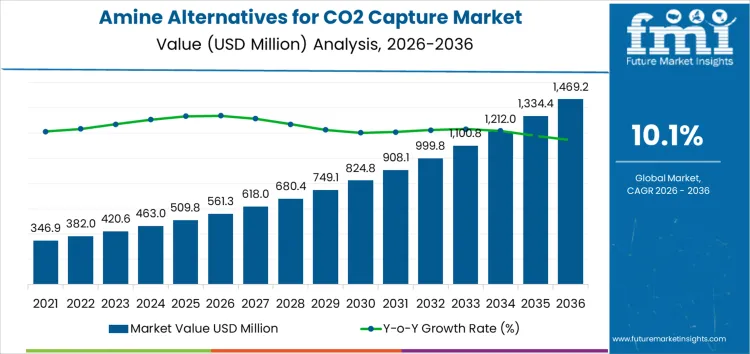
What is the Growth Forecast for the Amine Alternatives for CO₂ Capture Market through 2036?
The growth rate volatility index for the amine alternatives for CO₂ capture market shows moderate fluctuations in the early years, followed by more stable growth as the market matures. Initially, the market will experience relatively higher volatility, as industries move toward adopting amine alternatives in response to evolving regulations and the increasing emphasis on emission reduction. The growth rate will experience more pronounced increases from 2026 to 2031, driven by innovation in chemical formulations and an increasing focus on sustainable carbon capture methods.
From 2031 onwards, as the technology becomes more widely implemented and standardized, the market growth rate will stabilize, leading to a lower volatility index. This deceleration in volatility is typical of a maturing market, where the demand becomes more predictable, and the technology is more integrated into industrial applications. Despite this, the market will continue to grow at a steady pace, driven by ongoing regulatory pressures and technological advancements that continue to enhance the performance and cost-effectiveness of amine alternatives. Overall, the volatility index reflects both the dynamic early adoption phase and the steady growth during market maturation.
Amine Alternatives for CO₂ Capture Market Key Takeaways
| Metric | Value |
|---|---|
| Industry Sales Value (2026) | USD 561.3 million |
| Industry Forecast Value (2036) | USD 1,469.2 million |
| Industry Forecast CAGR (2026-2036) | 10.1% |
What Is Driving the Demand for the Amine Alternatives for CO₂ Capture Market Globally?
The global demand for amine alternatives for CO₂ capture is driven by increasing pressure on industries to reduce greenhouse gas emissions and meet more stringent climate and air quality regulations. Traditional amine based solvents have been widely used in post combustion carbon capture because of their ability to bind CO₂, but they can present challenges including high energy demands for solvent regeneration, degradation products that require management, and corrosion of equipment. Industries such as power generation, cement, steel, and chemical processing are seeking more efficient, cost effective, and environmentally friendly capture options that can lower operational costs and reduce lifecycle impact.
Additionally, national and regional commitments under frameworks such as the Paris Agreement and evolving corporate net zero goals are encouraging adoption of advanced carbon capture technologies. Research investment and pilot projects around solvent innovation, solid adsorbents, metal organic frameworks, and ionic liquids reflect the urgency to find alternatives that can maintain or improve capture performance while addressing drawbacks associated with conventional amines. Market interest is also supported by climate policy mechanisms, carbon pricing, and eligibility for climate finance programs that reward lower carbon intensity solutions.
Future demand for amine alternatives for CO₂ capture is expected to grow as technology maturity, cost competitiveness, and deployment scale improve. Advances in material science are producing capture media that operate at lower regeneration energy, exhibit greater thermal stability, and resist degradation, which can reduce the total cost of capture and associated infrastructure requirements. Integration of capture systems with industrial heat sources and renewable energy further enhances the economic case for alternatives.
As net zero targets become more common among national governments and industrial sectors, demand for scalable, reliable capture technologies that can be retrofitted into existing facilities will continue to rise. Regulatory frameworks that recognise performance beyond traditional metrics and incentivize lower emission solutions will shape adoption and drive investment. Emerging market deployment will be influenced by availability of financing, technology transfer, and capacity building to manage advanced capture systems. As carbon capture moves from demonstration to commercial scale in heavy industry and power sectors, solutions that balance efficiency, cost, and environmental impact are expected to expand across global markets.
What are the Leading Segments in the Global Amine Alternatives for CO₂ Capture Market?
The global amine alternatives for CO₂ capture market is segmented by integration type and end-use industry. Among integration types, post-combustion CO₂ capture leads the market, capturing 48% of the share, followed by pre-combustion capture, oxyfuel combustion, hybrid & emerging capture technologies, and direct air capture integration. Post-combustion CO₂ capture is the most widely used method, particularly in industries where CO₂ is produced after fuel combustion. On the end-use industry side, power generation & utilities dominates the market, holding 34% of the share, followed by petrochemical & refineries, cement & steel manufacturing, waste-to-energy & incineration, and other industrial emitters. Power generation is the largest sector driving the adoption of CO₂ capture technologies due to its high CO₂ emissions.
What Drives the Growth of Post-Combustion CO₂ Capture in the Amine Alternatives for CO₂ Capture Market?
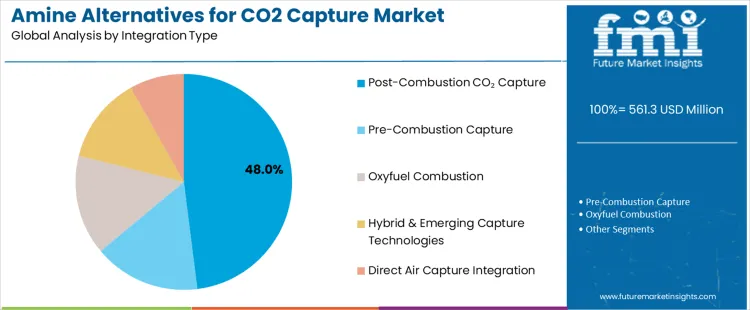
Post-combustion CO₂ capture is the leading integration type in the amine alternatives for CO₂ capture market, holding 48% of the share. This method captures CO₂ from exhaust gases produced after combustion, making it ideal for industries like power generation, where CO₂ is generated after burning fossil fuels. Post-combustion capture technologies are increasingly being adopted due to their ability to retrofit existing power plants, providing a cost-effective way to reduce CO₂ emissions. The growing global demand for carbon capture and storage (CCS) technologies, combined with regulatory pressures to reduce emissions, drives the market for post-combustion CO₂ capture solutions. Furthermore, advancements in amine alternatives for CO₂ capture, which offer lower energy consumption and environmental impact, are further accelerating the adoption of post-combustion capture in power generation and other high-emission industries. As industries continue to seek effective and sustainable ways to mitigate their carbon footprints, post-combustion CO₂ capture will remain a dominant solution in the market.
What is Driving the Demand for Power Generation & Utilities in the Amine Alternatives for CO₂ Capture Market?
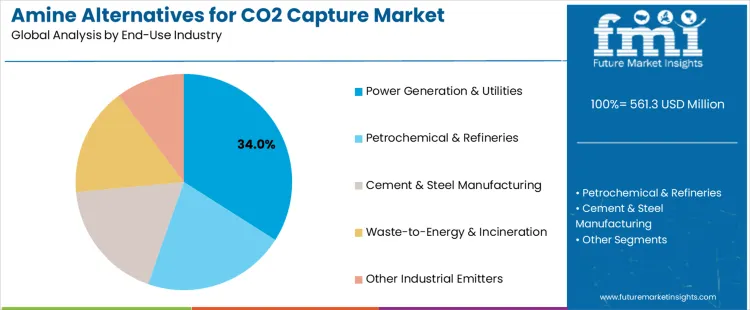
Power generation & utilities is the leading end-use industry in the amine alternatives for CO₂ capture market, holding 34% of the share. This demand is driven by the significant CO₂ emissions produced by power plants, particularly those fueled by coal, natural gas, and oil. Power generation accounts for a large portion of global CO₂ emissions, making it a key target for CO₂ capture technologies. The need to reduce greenhouse gas emissions and comply with stringent environmental regulations is propelling the adoption of carbon capture solutions, including amine alternatives. As governments and industries seek to transition toward low-carbon energy systems, the power generation sector is at the forefront of implementing CO₂ capture technologies, particularly post-combustion capture. The growing focus on sustainability, climate change mitigation, and the increasing number of carbon capture projects within the power generation & utilities sector ensure that this end-use industry remains a significant driver of market growth.
What are the Key Dynamics in the Global Amine Alternatives for CO₂ Capture Market?
The global amine alternatives for CO₂ capture market is expanding as industrial, power generation and energy transition stakeholders seek effective carbon capture solutions with reduced environmental impact, lower energy penalties and improved operational performance. Alternatives to conventional amine solvents include advanced solvents, sorbents, membranes and hybrid systems that enhance absorption or separation of carbon dioxide from flue gas and industrial emissions. Growth reflects tightening climate policies, corporate decarbonization commitments and rising deployment of carbon capture, utilization and storage projects worldwide. Adoption occurs in heavy industry, cement, steel and natural gas processing where scalable CO₂ removal technologies are critical to emissions reduction strategies.
What are the Key Drivers for the Amine Alternatives for CO₂ Capture Market?
Stronger regulatory frameworks targeting greenhouse gas emissions drive investment in carbon capture technologies that align with national and corporate net zero goals. Conventional amine systems have limitations such as high heat duty, solvent degradation and corrosion, which motivate interest in alternative chemistries and technologies with improved energy efficiency and lower lifecycle cost. Expansion of carbon management policies, carbon pricing and incentives such as tax credits support commercial deployment. Growth in pilot and full scale CO₂ capture facilities encourages technology diversification. Collaboration among research institutions, technology developers and industrial adopters accelerates innovation and validation of next generation capture solutions.
What are the Restraints for the Amine Alternatives for CO₂ Capture Market?
One restraint is the technical and economic maturity gap between established amine processes and emerging alternatives. Novel solvents, sorbents or membrane systems may require extensive field testing and scale up validation to demonstrate reliability, durability and cost competitiveness in real world industrial environments. High upfront capital expenditure for retrofit or new capture infrastructure can deter adoption in cost sensitive sectors. Integration complexity with existing plant operations, energy systems and CO₂ handling infrastructure influences project feasibility. Variation in regulatory acceptance and certification timelines across regions adds planning uncertainty for technology providers and end users.
What are the Key Trends in the Amine Alternatives for CO₂ Capture Market?
A key trend is development of advanced capture media such as solid sorbents, metal organic frameworks, ionic liquids and tailored solvent blends that aim to lower regeneration energy and improve CO₂ selectivity. Hybrid capture strategies that combine physical and chemical separation are gaining interest for handling diverse emission profiles. Digital simulation, pilot demonstrations and performance analytics help optimize process design and reduce risk. Increased focus on modular, scalable capture units supports deployment in distributed industrial facilities and pairing with utilization pathways such as enhanced oil recovery or carbon sequestration. Partnerships across industry, government and research networks continue to build data and confidence for broader adoption of next-generation CO₂ capture technologies.
What is the Country-Wise Analysis of the Amine Alternatives for CO₂ Capture Market?
The amine alternatives for CO₂ capture market is expected to grow steadily, driven by the increasing global focus on reducing carbon emissions and combating climate change. These alternatives are used in carbon capture and storage (CCS) technologies to capture CO₂ from industrial emissions, natural gas processing, and power generation, offering a more sustainable and cost-effective solution compared to traditional amine-based solvents. High-growth markets like China and India are seeing strong demand due to their expanding industrial sectors, energy needs, and government commitments to environmental sustainability. Developed markets such as the United States, Germany, and South Korea are also experiencing steady growth, supported by stricter environmental regulations, technological advancements in CCS, and increasing investments in clean energy technologies.
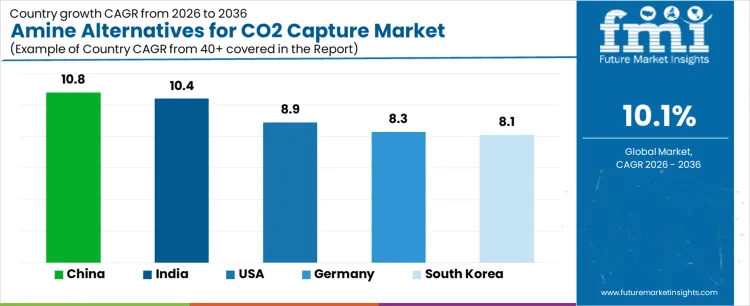
| Country | CAGR (2026-2036) |
|---|---|
| China | 10.8% |
| India | 10.4% |
| USA | 8.9% |
| Germany | 8.3% |
| South Korea | 8.1% |
What is the Growth Outlook for the Amine Alternatives for CO₂ Capture Market in China?
The amine alternatives for CO₂ capture market in China is expected to grow at the highest rate, with a projected CAGR of 10.8%. China’s industrial and energy sectors are significant contributors to CO₂ emissions, which is driving the demand for efficient carbon capture technologies. As the country seeks to meet its environmental goals, there is increasing investment in CO₂ capture solutions that can reduce emissions from industrial processes, particularly in coal-fired power plants and heavy industries. The Chinese government’s commitment to reducing its carbon footprint and adopting cleaner energy technologies is further boosting demand for amine alternatives for CO₂ capture. With continued industrial growth and regulatory pressure to cut greenhouse gas emissions, the market for CO₂ capture technologies in China is poised for substantial growth.
What is the Market Outlook for the Amine Alternatives for CO₂ Capture Market in India?
The amine alternatives for CO₂ capture market in India is projected to grow steadily, with a projected CAGR of 10.4%. India’s rapidly expanding industrial base, energy sector, and increasing focus on sustainability are driving the demand for carbon capture technologies. As the country looks to reduce its carbon emissions and meet international climate commitments, there is rising interest in more sustainable and cost-effective alternatives to traditional CO₂ capture solvents. The Indian government’s emphasis on clean energy initiatives, renewable energy, and pollution control is expected to support the adoption of amine alternatives for CO₂ capture in key industries, including power generation and manufacturing. With a strong focus on sustainable development and a growing awareness of climate change issues, India’s market for CO₂ capture technologies is set for continued growth.
What is the Growth Forecast for the Amine Alternatives for CO₂ Capture Market in the United States?
The amine alternatives for CO₂ capture market in the United States is expected to grow steadily, with a projected CAGR of 8.9%. The U.S. market is driven by a growing focus on environmental sustainability, stricter carbon emission regulations, and the increasing need to address climate change. As industries such as power generation, oil and gas, and manufacturing seek to reduce their CO₂ emissions, the demand for efficient and cost-effective carbon capture technologies, including amine alternatives, is rising. The U.S. government’s efforts to invest in clean energy technologies and the ongoing shift toward decarbonization of industrial sectors are expected to further drive the adoption of amine alternatives for CO₂ capture. As the market for CCS solutions continues to expand, the U.S. is well-positioned for steady growth in this sector.
What is the Market Outlook for the Amine Alternatives for CO₂ Capture Market in Germany?
The amine alternatives for CO₂ capture market in Germany is projected to grow at a steady pace, with a projected CAGR of 8.3%. Germany’s commitment to sustainability and stringent environmental regulations are key drivers of the market. The country is actively investing in clean technologies and aiming to reduce CO₂ emissions in line with the European Union’s climate goals. As part of its efforts to decarbonize the industrial sector, Germany is increasingly adopting carbon capture technologies, including amine alternatives, to address emissions from power plants, manufacturing, and chemical industries. With Germany’s strong focus on green technologies and sustainable energy solutions, the market for CO₂ capture solutions is expected to continue growing steadily as industries and governments seek to meet regulatory requirements and environmental targets.
What are the Growth Prospects for the Amine Alternatives for CO₂ Capture Market in South Korea?
The amine alternatives for CO₂ capture market in South Korea is expected to grow steadily, with a projected CAGR of 8.1%. South Korea’s industrial base, which includes significant energy, manufacturing, and chemical industries, is a major source of CO₂ emissions, creating a strong demand for carbon capture technologies. The country is investing heavily in clean energy technologies and emissions reduction strategies to meet its environmental goals. South Korea’s government is increasingly focused on decarbonizing its industrial sectors, which is expected to drive the adoption of more sustainable CO₂ capture solutions, such as amine alternatives. As environmental regulations tighten and sustainability becomes a greater priority, the market for amine alternatives for CO₂ capture in South Korea is expected to grow steadily, supported by both industrial and governmental efforts to reduce emissions.
What is the Competitive Landscape for the Amine Alternatives for CO₂ Capture Market?
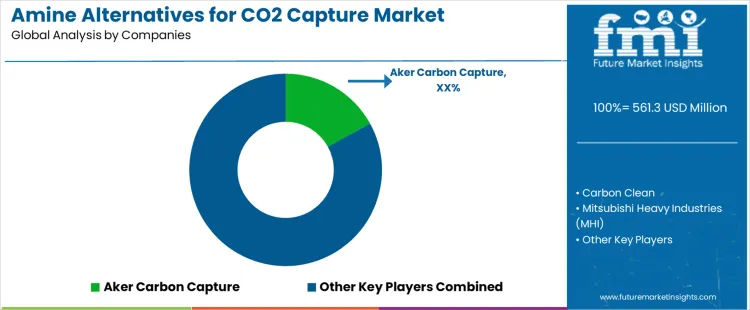
The amine alternatives for CO₂ capture market is growing rapidly as industries look for more efficient, sustainable, and environmentally friendly solutions for carbon capture and reduction. Aker Carbon Capture leads the market with its innovative CO₂ capture technologies, providing amine alternative solutions that offer lower energy consumption and reduced environmental impact compared to traditional amine-based systems. Their strong focus on reducing costs and enhancing the efficiency of carbon capture processes has positioned them as a dominant player in the market. Carbon Clean, Mitsubishi Heavy Industries (MHI), and Climeworks are key competitors, each offering specialized technologies for CO₂ capture using amine alternatives. Carbon Clean provides advanced solutions that improve efficiency while minimizing energy use, while Mitsubishi Heavy Industries (MHI) focuses on large-scale capture systems, and Climeworks uses direct air capture technology to remove CO₂ from the atmosphere.
Honeywell UOP further contributes to the competitive landscape with its cutting-edge CO₂ capture solutions, offering innovative technologies aimed at reducing carbon emissions in various industrial processes. Honeywell UOP focuses on providing efficient, cost-effective CO₂ capture systems that can be integrated into existing facilities. These companies compete by focusing on technological innovation, cost efficiency, and the ability to meet the growing demand for sustainable CO₂ capture solutions that support climate change mitigation goals. As global environmental regulations tighten and the demand for carbon reduction technologies increases, the market for amine alternatives in CO₂ capture is expected to grow, driving further competition and innovation.
Key Players of the Amine Alternatives for CO₂ Capture Market
- Aker Carbon Capture
- Carbon Clean
- Mitsubishi Heavy Industries (MHI)
- Climeworks
- Honeywell UOP
Scope of the Report
| Items | Values |
|---|---|
| Quantitative Units (2026) | USD Million |
| Capture Chemistry Type | Amino Acid Salt Solutions, Ionic Liquids, Solid Sorbents (MOFs, Zeolites, Activated Carbon), Membrane-Based Solvent Alternatives, Other Novel CO₂ Capture Agents |
| End-Use Industry | Power Generation & Utilities, Petrochemical & Refineries, Cement & Steel Manufacturing, Waste-to-Energy & Incineration, Other Industrial Emitters |
| Integration Type | Post-Combustion CO₂ Capture, Pre-Combustion Capture, Oxyfuel Combustion, Hybrid & Emerging Capture Technologies, Direct Air Capture Integration |
| Companies | Aker Carbon Capture, Carbon Clean, Mitsubishi Heavy Industries (MHI), Climeworks, Honeywell UOP |
| Regions Covered | North America, Latin America, Western Europe, Eastern Europe, South Asia and Pacific, East Asia, Middle East & Africa |
| Countries Covered | United States, Canada, Mexico, Brazil, Argentina, Germany, France, United Kingdom, Italy, Spain, Netherlands, China, India, Japan, South Korea, ANZ, GCC Countries, South Africa |
| Additional Attributes | Dollar by sales by capture chemistry type, end-use industry, integration type, and region. Includes market trends in amine alternatives for CO₂ capture, performance in various CO₂ capture applications, cost-effectiveness, sustainability practices, regulatory compliance, market share and competitive positioning of key companies, and the role of amine alternatives in improving CO₂ capture efficiency, supporting environmental goals, and enhancing emission reduction technologies across industries. |
Amine Alternatives for CO₂ Capture Market Segmentation
Capture Chemistry Type
- Amino Acid Salt Solutions
- Ionic Liquids
- Solid Sorbents (MOFs, Zeolites, Activated Carbon)
- Membrane-Based Solvent Alternatives
- Other Novel CO₂ Capture Agents
End-Use Industry
- Power Generation & Utilities
- Petrochemical & Refineries
- Cement & Steel Manufacturing
- Waste-to-Energy & Incineration
- Other Industrial Emitters
Integration Type
- Post-Combustion CO₂ Capture
- Pre-Combustion Capture
- Oxyfuel Combustion
- Hybrid & Emerging Capture Technologies
- Direct Air Capture Integration
Region
- Asia Pacific
- China
- Japan
- South Korea
- India
- Australia & New Zealand
- ASEAN
- Rest of Asia Pacific
- Europe
- Germany
- United Kingdom
- France
- Italy
- Spain
- Nordic
- BENELUX
- Rest of Europe
- North America
- United States
- Canada
- Mexico
- Latin America
- Brazil
- Chile
- Rest of Latin America
- Middle East & Africa
- Kingdom of Saudi Arabia
- Other GCC Countries
- Turkey
- South Africa
- Other African Union
- Rest of Middle East & Africa
Bibliography
- Aker Carbon Capture. (n.d.). Amine alternatives for CO₂ capture solutions.
- Carbon Clean. (n.d.). Innovative CO₂ capture technologies.
Frequently Asked Questions
How big is the amine alternatives for CO2 capture market in 2026?
The global amine alternatives for CO2 capture market is estimated to be valued at USD 561.3 million in 2026.
What will be the size of amine alternatives for CO2 capture market in 2036?
The market size for the amine alternatives for CO2 capture market is projected to reach USD 1,469.2 million by 2036.
How much will be the amine alternatives for CO2 capture market growth between 2026 and 2036?
The amine alternatives for CO2 capture market is expected to grow at a 10.1% CAGR between 2026 and 2036.
What are the key product types in the amine alternatives for CO2 capture market?
The key product types in amine alternatives for CO2 capture market are amino acid salt solutions, ionic liquids, solid sorbents (mofs, zeolites, activated carbon), membrane-based solvent alternatives and other novel co₂ capture agents.
Which end-use industry segment to contribute significant share in the amine alternatives for CO2 capture market in 2026?
In terms of end-use industry, power generation & utilities segment to command 34.0% share in the amine alternatives for CO2 capture market in 2026.
Preview the report firsthand - request a free sample
Get SampleGet the brochure for pricing and purchase details.
Get PDFTable of Content
- Executive Summary
- Global Market Outlook
- Demand-side Trends
- Supply-side Trends
- Technology Roadmap Analysis
- Analysis and Recommendations
- Market Overview
- Market Coverage / Taxonomy
- Market Definition / Scope / Limitations
- Market Background
- Market Dynamics
- Drivers
- Restraints
- Opportunity
- Trends
- Scenario Forecast
- Demand in Optimistic Scenario
- Demand in Likely Scenario
- Demand in Conservative Scenario
- Opportunity Map Analysis
- Product Life Cycle Analysis
- Supply Chain Analysis
- Investment Feasibility Matrix
- Value Chain Analysis
- PESTLE and Porter’s Analysis
- Regulatory Landscape
- Regional Parent Market Outlook
- Production and Consumption Statistics
- Import and Export Statistics
- Market Dynamics
- Global Market Analysis 2021 to 2025 and Forecast, 2026 to 2036
- Historical Market Size Value (USD Million) Analysis, 2021 to 2025
- Current and Future Market Size Value (USD Million) Projections, 2026 to 2036
- Y-o-Y Growth Trend Analysis
- Absolute $ Opportunity Analysis
- Global Market Pricing Analysis 2021 to 2025 and Forecast 2026 to 2036
- Global Market Analysis 2021 to 2025 and Forecast 2026 to 2036, By Capture Chemistry Type
- Introduction / Key Findings
- Historical Market Size Value (USD Million) Analysis By Capture Chemistry Type , 2021 to 2025
- Current and Future Market Size Value (USD Million) Analysis and Forecast By Capture Chemistry Type , 2026 to 2036
- Amino Acid Salt Solutions
- Ionic Liquids
- Solid Sorbents (MOFs, Zeolites, Activated Carbon)
- Membrane-Based Solvent Alternatives
- Other Novel CO₂ Capture Agents
- Amino Acid Salt Solutions
- Y-o-Y Growth Trend Analysis By Capture Chemistry Type , 2021 to 2025
- Absolute $ Opportunity Analysis By Capture Chemistry Type , 2026 to 2036
- Global Market Analysis 2021 to 2025 and Forecast 2026 to 2036, By End-Use Industry
- Introduction / Key Findings
- Historical Market Size Value (USD Million) Analysis By End-Use Industry, 2021 to 2025
- Current and Future Market Size Value (USD Million) Analysis and Forecast By End-Use Industry, 2026 to 2036
- Power Generation & Utilities
- Petrochemical & Refineries
- Cement & Steel Manufacturing
- Waste-to-Energy & Incineration
- Other Industrial Emitters
- Power Generation & Utilities
- Y-o-Y Growth Trend Analysis By End-Use Industry, 2021 to 2025
- Absolute $ Opportunity Analysis By End-Use Industry, 2026 to 2036
- Global Market Analysis 2021 to 2025 and Forecast 2026 to 2036, By Integration Type
- Introduction / Key Findings
- Historical Market Size Value (USD Million) Analysis By Integration Type, 2021 to 2025
- Current and Future Market Size Value (USD Million) Analysis and Forecast By Integration Type, 2026 to 2036
- Post-Combustion CO₂ Capture
- Pre-Combustion Capture
- Oxyfuel Combustion
- Hybrid & Emerging Capture Technologies
- Direct Air Capture Integration
- Post-Combustion CO₂ Capture
- Y-o-Y Growth Trend Analysis By Integration Type, 2021 to 2025
- Absolute $ Opportunity Analysis By Integration Type, 2026 to 2036
- Global Market Analysis 2021 to 2025 and Forecast 2026 to 2036, By Region
- Introduction
- Historical Market Size Value (USD Million) Analysis By Region, 2021 to 2025
- Current Market Size Value (USD Million) Analysis and Forecast By Region, 2026 to 2036
- North America
- Latin America
- Western Europe
- Eastern Europe
- East Asia
- South Asia and Pacific
- Middle East & Africa
- Market Attractiveness Analysis By Region
- North America Market Analysis 2021 to 2025 and Forecast 2026 to 2036, By Country
- Historical Market Size Value (USD Million) Trend Analysis By Market Taxonomy, 2021 to 2025
- Market Size Value (USD Million) Forecast By Market Taxonomy, 2026 to 2036
- By Country
- USA
- Canada
- Mexico
- By Capture Chemistry Type
- By End-Use Industry
- By Integration Type
- By Country
- Market Attractiveness Analysis
- By Country
- By Capture Chemistry Type
- By End-Use Industry
- By Integration Type
- Key Takeaways
- Latin America Market Analysis 2021 to 2025 and Forecast 2026 to 2036, By Country
- Historical Market Size Value (USD Million) Trend Analysis By Market Taxonomy, 2021 to 2025
- Market Size Value (USD Million) Forecast By Market Taxonomy, 2026 to 2036
- By Country
- Brazil
- Chile
- Rest of Latin America
- By Capture Chemistry Type
- By End-Use Industry
- By Integration Type
- By Country
- Market Attractiveness Analysis
- By Country
- By Capture Chemistry Type
- By End-Use Industry
- By Integration Type
- Key Takeaways
- Western Europe Market Analysis 2021 to 2025 and Forecast 2026 to 2036, By Country
- Historical Market Size Value (USD Million) Trend Analysis By Market Taxonomy, 2021 to 2025
- Market Size Value (USD Million) Forecast By Market Taxonomy, 2026 to 2036
- By Country
- Germany
- UK
- Italy
- Spain
- France
- Nordic
- BENELUX
- Rest of Western Europe
- By Capture Chemistry Type
- By End-Use Industry
- By Integration Type
- By Country
- Market Attractiveness Analysis
- By Country
- By Capture Chemistry Type
- By End-Use Industry
- By Integration Type
- Key Takeaways
- Eastern Europe Market Analysis 2021 to 2025 and Forecast 2026 to 2036, By Country
- Historical Market Size Value (USD Million) Trend Analysis By Market Taxonomy, 2021 to 2025
- Market Size Value (USD Million) Forecast By Market Taxonomy, 2026 to 2036
- By Country
- Russia
- Poland
- Hungary
- Balkan & Baltic
- Rest of Eastern Europe
- By Capture Chemistry Type
- By End-Use Industry
- By Integration Type
- By Country
- Market Attractiveness Analysis
- By Country
- By Capture Chemistry Type
- By End-Use Industry
- By Integration Type
- Key Takeaways
- East Asia Market Analysis 2021 to 2025 and Forecast 2026 to 2036, By Country
- Historical Market Size Value (USD Million) Trend Analysis By Market Taxonomy, 2021 to 2025
- Market Size Value (USD Million) Forecast By Market Taxonomy, 2026 to 2036
- By Country
- China
- Japan
- South Korea
- By Capture Chemistry Type
- By End-Use Industry
- By Integration Type
- By Country
- Market Attractiveness Analysis
- By Country
- By Capture Chemistry Type
- By End-Use Industry
- By Integration Type
- Key Takeaways
- South Asia and Pacific Market Analysis 2021 to 2025 and Forecast 2026 to 2036, By Country
- Historical Market Size Value (USD Million) Trend Analysis By Market Taxonomy, 2021 to 2025
- Market Size Value (USD Million) Forecast By Market Taxonomy, 2026 to 2036
- By Country
- India
- ASEAN
- Australia & New Zealand
- Rest of South Asia and Pacific
- By Capture Chemistry Type
- By End-Use Industry
- By Integration Type
- By Country
- Market Attractiveness Analysis
- By Country
- By Capture Chemistry Type
- By End-Use Industry
- By Integration Type
- Key Takeaways
- Middle East & Africa Market Analysis 2021 to 2025 and Forecast 2026 to 2036, By Country
- Historical Market Size Value (USD Million) Trend Analysis By Market Taxonomy, 2021 to 2025
- Market Size Value (USD Million) Forecast By Market Taxonomy, 2026 to 2036
- By Country
- Kingdom of Saudi Arabia
- Other GCC Countries
- Turkiye
- South Africa
- Other African Union
- Rest of Middle East & Africa
- By Capture Chemistry Type
- By End-Use Industry
- By Integration Type
- By Country
- Market Attractiveness Analysis
- By Country
- By Capture Chemistry Type
- By End-Use Industry
- By Integration Type
- Key Takeaways
- Key Countries Market Analysis
- USA
- Pricing Analysis
- Market Share Analysis, 2025
- By Capture Chemistry Type
- By End-Use Industry
- By Integration Type
- Canada
- Pricing Analysis
- Market Share Analysis, 2025
- By Capture Chemistry Type
- By End-Use Industry
- By Integration Type
- Mexico
- Pricing Analysis
- Market Share Analysis, 2025
- By Capture Chemistry Type
- By End-Use Industry
- By Integration Type
- Brazil
- Pricing Analysis
- Market Share Analysis, 2025
- By Capture Chemistry Type
- By End-Use Industry
- By Integration Type
- Chile
- Pricing Analysis
- Market Share Analysis, 2025
- By Capture Chemistry Type
- By End-Use Industry
- By Integration Type
- Germany
- Pricing Analysis
- Market Share Analysis, 2025
- By Capture Chemistry Type
- By End-Use Industry
- By Integration Type
- UK
- Pricing Analysis
- Market Share Analysis, 2025
- By Capture Chemistry Type
- By End-Use Industry
- By Integration Type
- Italy
- Pricing Analysis
- Market Share Analysis, 2025
- By Capture Chemistry Type
- By End-Use Industry
- By Integration Type
- Spain
- Pricing Analysis
- Market Share Analysis, 2025
- By Capture Chemistry Type
- By End-Use Industry
- By Integration Type
- France
- Pricing Analysis
- Market Share Analysis, 2025
- By Capture Chemistry Type
- By End-Use Industry
- By Integration Type
- India
- Pricing Analysis
- Market Share Analysis, 2025
- By Capture Chemistry Type
- By End-Use Industry
- By Integration Type
- ASEAN
- Pricing Analysis
- Market Share Analysis, 2025
- By Capture Chemistry Type
- By End-Use Industry
- By Integration Type
- Australia & New Zealand
- Pricing Analysis
- Market Share Analysis, 2025
- By Capture Chemistry Type
- By End-Use Industry
- By Integration Type
- China
- Pricing Analysis
- Market Share Analysis, 2025
- By Capture Chemistry Type
- By End-Use Industry
- By Integration Type
- Japan
- Pricing Analysis
- Market Share Analysis, 2025
- By Capture Chemistry Type
- By End-Use Industry
- By Integration Type
- South Korea
- Pricing Analysis
- Market Share Analysis, 2025
- By Capture Chemistry Type
- By End-Use Industry
- By Integration Type
- Russia
- Pricing Analysis
- Market Share Analysis, 2025
- By Capture Chemistry Type
- By End-Use Industry
- By Integration Type
- Poland
- Pricing Analysis
- Market Share Analysis, 2025
- By Capture Chemistry Type
- By End-Use Industry
- By Integration Type
- Hungary
- Pricing Analysis
- Market Share Analysis, 2025
- By Capture Chemistry Type
- By End-Use Industry
- By Integration Type
- Kingdom of Saudi Arabia
- Pricing Analysis
- Market Share Analysis, 2025
- By Capture Chemistry Type
- By End-Use Industry
- By Integration Type
- Turkiye
- Pricing Analysis
- Market Share Analysis, 2025
- By Capture Chemistry Type
- By End-Use Industry
- By Integration Type
- South Africa
- Pricing Analysis
- Market Share Analysis, 2025
- By Capture Chemistry Type
- By End-Use Industry
- By Integration Type
- USA
- Market Structure Analysis
- Competition Dashboard
- Competition Benchmarking
- Market Share Analysis of Top Players
- By Regional
- By Capture Chemistry Type
- By End-Use Industry
- By Integration Type
- Competition Analysis
- Competition Deep Dive
- Aker Carbon Capture
- Overview
- Product Portfolio
- Profitability by Market Segments (Product/Age /Sales Channel/Region)
- Sales Footprint
- Strategy Overview
- Marketing Strategy
- Product Strategy
- Channel Strategy
- Carbon Clean
- Mitsubishi Heavy Industries (MHI)
- Climeworks
- Honeywell UOP
- Aker Carbon Capture
- Competition Deep Dive
- Assumptions & Acronyms Used
- Research Methodology


