

- Industry Size (2026)
- USD 4.0 Bn
- Forecast (2036)
- USD 8.3 Bn
- CAGR (2026 to 2036)
- 7.6%
Milk Protein Outlook in Asia Pacific 2026 to 2036
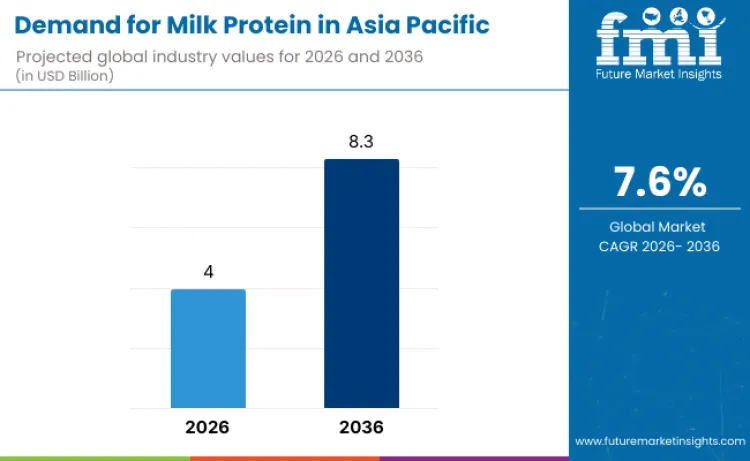
As per FMI, demand for milk protein in Asia Pacific is projected at USD 4.0 billion in 2026 and is expected to reach USD 8.3 billion by 2036, progressing at a 7.6% CAGR. Expansion is being shaped by how manufacturers across China, India, Japan, South Korea, and Australia move protein enrichment from niche portfolios into scale-led platforms. Procurement teams prioritize functional stability because proteins influence viscosity, taste neutrality, heat tolerance, dispersion behavior, and yield outcomes across high-throughput production environments.
Supplier selection is increasingly tied to qualification discipline and predictable performance across formats that range from high-protein everyday foods to RTD shakes and clinical-adjacent nutrition. Growth also reflects the region’s widening user base for sports and active nutrition formats, where protein density expectations are high and rework risks are closely managed through tighter specifications.
Quick Stats for Milk Protein Demand In Asia Pacific
- Industry Value (2026): USD 4.0 billion
- Forecast Value (2036): USD 8.3 billion
- Forecast CAGR (2026 to 2036): 7.6%
- Leading Growth Country: India (8.2%)
- Leading Product Type: Milk Protein Concentrates (MPC) (45.0% share)
- Leading Form: Powder (84.0% share)
- Leading Application: Functional Foods (high-protein everyday foods) (50.0% share)
- Leading End User: Food & Beverage Manufacturers (51.3% share)
Macro-Level Food Beverage Trends Influencing Milk Protein Consumption in Asia Pacific
Expansion prospects in Asia Pacific are closely linked with mainstream protein fortification in packaged foods, where manufacturers are targeting daily consumption occasions rather than purely performance-led positioning. RTD functional beverages continue to gain shelf space across metro retail networks, which increases pull for dispersible systems that can deliver stable mouthfeel and predictable protein contribution. Sports and active nutrition adoption is also widening, supporting stronger usage of whey systems in powders, ready mixes, and high-protein beverages.
Clinical and medical nutrition programs remain structurally important where consistency, documentation readiness, and specification discipline govern supplier qualification. Infant and early-life nutrition keeps demand anchored through long-cycle approvals, with protein system selection tied to strict compliance and repeat performance.
Milk Protein Industry Key Takeaways in Asia Pacific
| Metric | Value |
|---|---|
| Industry Value (2026) | USD 4.0 billion |
| Industry Forecast Value (2036) | USD 8.3 billion |
| Forecast CAGR (2026 to 2036) | 7.6% |
Source: FMI analysis based on primary research and proprietary forecasting model
Portfolio planning for regional dairy proteins is often aligned with the broader frameworks covered in milk protein and supplier footprint decisions are frequently benchmarked against dairy ingredients.
Why is Asia Pacific emerging as a Stronger Consumption of Milk Proteins?
Consumption growth in Asia Pacific is sustained by three operating realities across major food and beverage categories. First, everyday protein fortification is becoming a standardized renovation pathway in snacks, dairy formats, and packaged foods, which creates recurring ingredient pull.
Second, functional beverages and RTDs are scaling through modern trade and convenience networks, supporting wider adoption of ready-to-blend formats. Third, demand growth is supported by expanding sports nutrition participation across key cities, which pushes brands to prioritize protein density, sensory control, and stable supply continuity.
FMI forecasts that the most scalable growth comes from manufacturers that treat protein systems as long-term input platforms, not short-cycle promotional formulations. This approach increases the value of suppliers that can provide consistent batch performance, stable composition targets, and strong technical responsiveness during ramp-ups.
How is the Milk Protein Landscape in Asia Pacific Segmented?
Asia Pacific demand reflects a mix of scale-led functional foods, RTD beverages, and performance nutrition formats where operational repeatability defines supplier success.
Why Milk Protein Concentrates hold the Lead Across Asia Pacific?
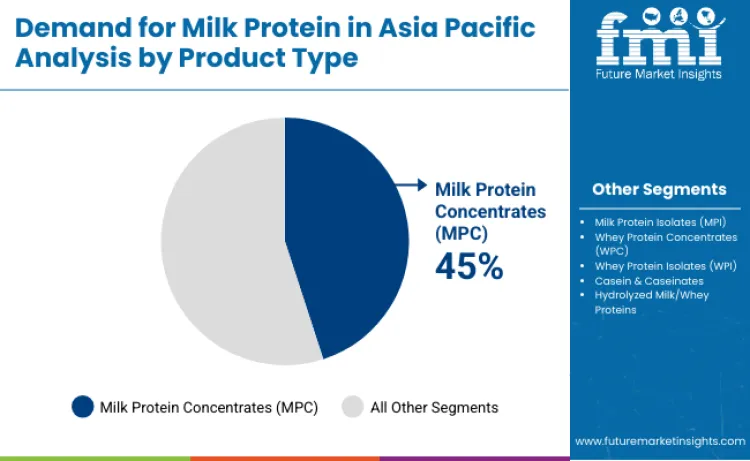
As per FMI, MPC accounts for a 45.0% share, supported by its balance of protein economics and functional stability across high-volume food programs. MPC is widely selected where manufacturers need controlled texture outcomes, predictable dispersion, and repeatability across multiple SKUs.
Which Other Product Categories Influence Consumer Purchase Decisions?
Milk protein isolates are chosen when brands want higher protein density with tighter formulation control. WPC and WPI scale strongly in sports and active nutrition products where performance positioning and protein contribution targets are high. Casein and caseinates remain relevant in applications where functional behavior and structured nutrition positioning align with end-use requirements.
Hydrolyzed milk and whey proteins are adopted in clinical-adjacent programs that demand stricter performance consistency and documentation. Procurement teams often align these decisions with adjacent category structures seen in protein ingredients and whey protein ingredients.
Why Powder remains the Preferred Form Across Applications?
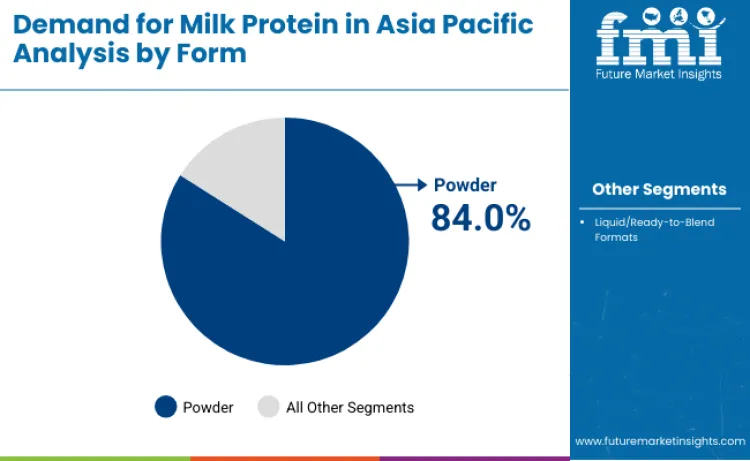
FMI is of the opinion that powder represents 84.0% of demand because it supports dosing accuracy, storage stability, transport efficiency, and consistent blending performance across industrial plants. Powder-led handling also reduces variability and supports multi-site standardization for large manufacturers.
Why Functional Foods Lead Application Demand In Asia Pacific?
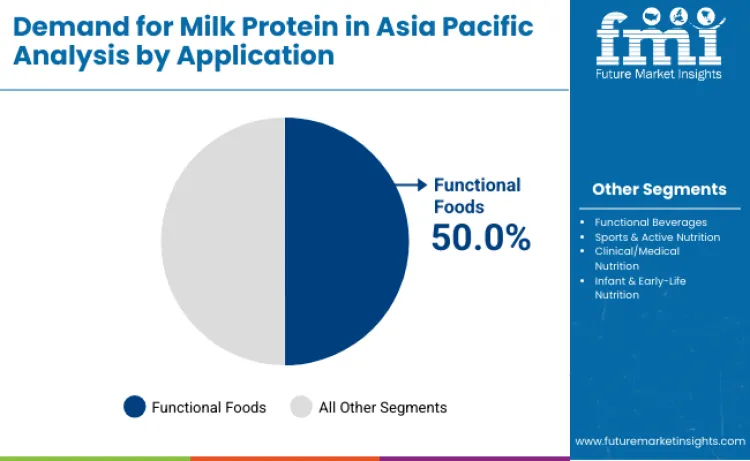
As per FMI, functional foods account for a 50.0% share, reflecting how protein enrichment is being embedded into everyday consumption formats rather than limited to niche performance products. Many formulation teams align this shift with portfolio priorities reflected in functional foods.
Which End User Group Controls The Largest Procurement Share?
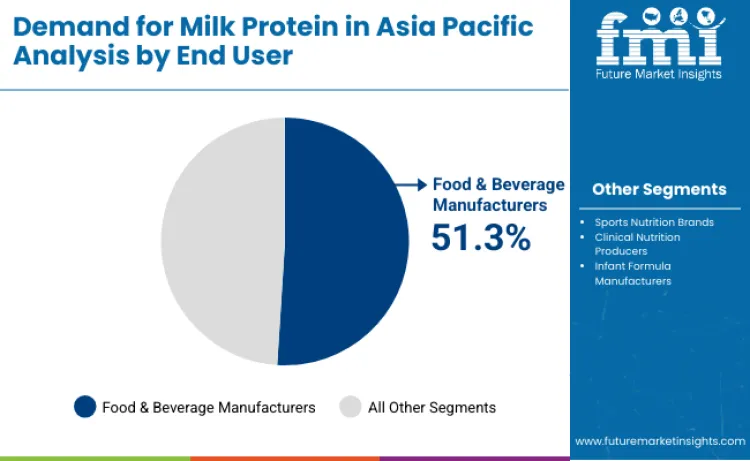
As per FMI, food and beverage manufacturers hold 51.3% share, supported by their scale requirements and recurring replenishment cycles. Sports nutrition brands and clinical nutrition producers contribute higher-spec demand, while infant formula manufacturers operate through longer qualification cycles aligned with structured compliance expectations.
What Dynamics Restraints Opportunities Threats Shape Milk Protein Sales in Asia Pacific?
What Dynamics Influence the Expansion of Milk Protein Consumption in Asia Pacific?
Expansion is supported by daily-use protein renovation across mainstream foods, wider adoption of RTD functional beverages, and rising sports nutrition consumption in urban clusters. These shifts reward suppliers that can maintain stable performance across high-throughput environments and respond quickly during formulation adjustments.
What Restraints Limit Faster Scale-Up?
Qualification complexity remains a key restraint because changing protein systems can disrupt taste profile, viscosity, heat stability, and shelf performance. Cost discipline is also critical in high-volume foods, where manufacturers protect cost-per-serving targets and reduce variability risk.
Where Strongest Opportunities Emerging For Suppliers?
Growth opportunities are strongest in functional foods, RTD shakes, and performance nutrition formats that demand repeatable dispersibility and stable sensory outcomes. Product teams also evaluate beverage innovation pathways through category structures reflected in functional beverages, while performance-led protein systems are aligned with sports nutrition ingredients. Infant and early-life nutrition remains a structured opportunity where procurement is governed by long approval cycles, supported by the frameworks reflected in infant formula ingredients.
What Threats Could Pressure Competitive Stability?
Competitive pressure from alternative proteins can constrain pricing in selected applications. Supply inconsistency and input volatility can also affect contract stability, especially where manufacturers require uninterrupted delivery to protect production efficiency.
How Country-Level Growth Prospects Evolve Across Asia Pacific?
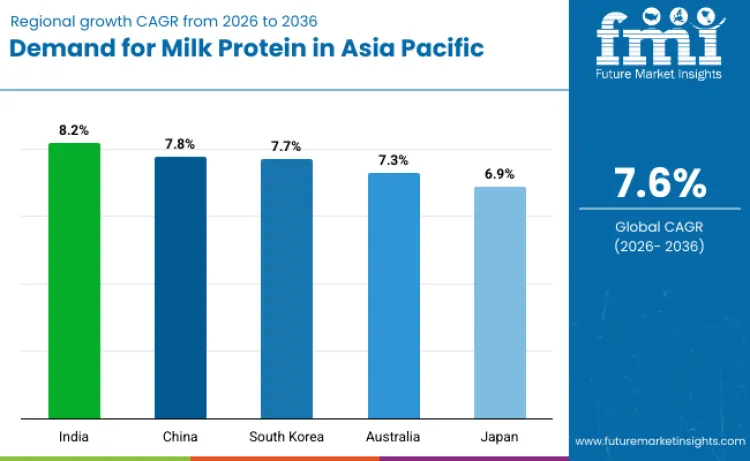
| Country | CAGR (2026-2036) |
|---|---|
| China | 7.8% |
| India | 8.2% |
| Japan | 6.9% |
| South Korea | 7.7% |
| Australia | 7.3% |
Source: Future Market Insights analysis, supported by a proprietary forecasting model and primary research
Why China Sustains High-Volume Growth Through Scale-Led Product Renovation?
China expands at 7.8%, driven by strong production scale in functional foods and a widening RTD beverage ecosystem that supports ongoing protein fortification. The growth profile benefits from broad retail and e-commerce distribution, which lifts demand for powder-based systems used in daily foods, shakes, and fortified formats. Supplier performance is increasingly judged by consistency and the ability to serve large buyers with stable batches and dependable lead times.
Why does India emerge as the Fastest-Growing Milk Protein Consumption Base?
FMI expects India’s progress at an 8.2% CAGR, reflecting rapid protein-led portfolio expansion in functional foods and growing acceptance of sports and active nutrition formats. Scale comes from a mix of mainstream packaged foods and affordable protein formats that support higher penetration beyond premium cohorts. Demand expansion favors suppliers that can maintain cost discipline while supporting reliable dispersion performance and predictable sensory outcomes.
What Keeps Japan On A Stable Growth Trajectory With Strong Specification Discipline?
Japan grows at 6.9%, shaped by disciplined procurement cycles and preference for highly repeatable ingredient performance across large manufacturers. Functional foods remain the primary volume anchor, supported by steady growth in RTD protein beverages and clinical-adjacent formats. Buyers maintain strict tolerance bands for formulation performance, which increases the value of consistent batch control and technical responsiveness.
Why does South Korea Strong Momentum Through Performance-Led Consumption?
South Korea advances at 7.7%, supported by strong sports and active nutrition participation and premium demand for protein systems that deliver clean taste and high density. RTD beverages, protein mixes, and functional dairy programs contribute to steady consumption growth. Demand patterns favor suppliers that combine fast innovation support with reliable service continuity.
How does Australia Maintain Expansion Through Mature Sports Nutrition And Clinical Demand?
Australia rises at 7.3%, supported by steady demand across sports nutrition products and structured nutrition formats where quality governance remains strong. Growth is paced by consistent consumption habits rather than short-cycle shifts, with procurement favoring established suppliers that can deliver stable specifications and strong compliance readiness.
What Defines Competitive Landscape For Milk Protein In Asia Pacific?
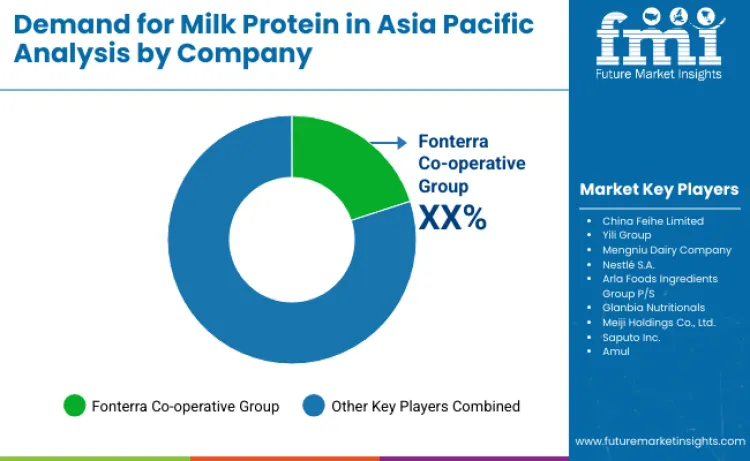
Competition is shaped by portfolio depth, ability to serve multiple application classes, technical support capability, and supply reliability across diverse buyer types. Leading suppliers compete by securing long-term approvals with large food and beverage manufacturers while maintaining specialized capacity for sports nutrition, clinical nutrition, and infant formula pipelines.
Fonterra, China Feihe, Yili, Mengniu, and Nestlé hold strong positions through scale and channel access. Arla Foods Ingredients, Glanbia Nutritionals, Meiji Holdings, Saputo, and Amul contribute through diversified portfolios and regional servicing capabilities. Supply partnerships are designed around stable formulation platforms rather than frequent supplier switches, which strengthens demand continuity for approved vendors.
Key Industry Participants
- Fonterra Co-operative Group
- China Feihe Limited
- Yili Group
- Mengniu Dairy Company
- Nestlé S.A.
- Arla Foods Ingredients Group P/S
- Glanbia Nutritionals
- Meiji Holdings Co., Ltd.
- Saputo Inc.
- Amul
Scope of Report
| Items | Values |
|---|---|
| Quantitative Units | USD Billion |
| Product Type | Milk Protein Concentrates (MPC); Milk Protein Isolates (MPI); Whey Protein Concentrates (WPC); Whey Protein Isolates (WPI); Casein & Caseinates; Hydrolyzed Milk/Whey Proteins |
| Form | Powder; Liquid / Ready-to-Blend Formats |
| Application | Functional Foods (high-protein everyday foods); Functional Beverages (RTDs, protein shakes); Sports & Active Nutrition; Clinical / Medical Nutrition; Infant & Early-Life Nutrition |
| End User | Food & Beverage Manufacturers; Sports Nutrition Brands; Clinical Nutrition Producers; Infant Formula Manufacturers |
| Countries Covered | China; India; Japan; South Korea; Australia |
| Key Companies Profiled | Fonterra; China Feihe; Yili; Mengniu; Nestlé |
Source: FMI’s proprietary forecasting model and primary research
Frequently Asked Questions
How much value will the Asia Pacific generate in the Milk Protein Landscape in 2026?
Milk protein demand in Asia Pacific is likely to total USD 4.0 billion in 2026.
In 2036, what is the expected valuation of the Asia Pacific Milk Protein Industry?
The milk protein industry in Asia Pacific is slated to reach USD 8.3 billion by 2036, according to FMI.
What CAGR Expected For Milk Protein Demand In Asia Pacific During 2026-2036?
Milk protein demand in Asia Pacific is expected to expand at a 7.6% CAGR from 2026 to 2036.
Which Product Type Leads Milk Protein Consumption in the Asia Pacific?
Milk protein concentrates (MPC) lead consumption in Asia Pacific, holding a 45.0% share.
Which Form Leads Milk Protein Sales in the Asia Pacific?
Powder leads sales in Asia Pacific, accounting for 84.0% of total demand.
Which Application Leads Milk Protein Consumption in the Asia Pacific?
Functional foods (high-protein everyday foods) represent the leading application in Asia Pacific, accounting for 50.0% of demand.
Preview the report firsthand - request a free sample
Get SampleGet the brochure for pricing and purchase details.
Get PDFTable of Content
- Executive Summary
- Industry Introduction, including Taxonomy and Market Definition
- Trends and Success Factors, including Macro-economic Factors, Market Dynamics, and Recent Industry Developments
- Asia Pacific Demand Analysis 2021 to 2025 and Forecast 2026 to 2036, including Historical Analysis and Future Projections
- Pricing Analysis
- Asia Pacific Analysis 2021 to 2025 and Forecast 2026 to 2036
- Product Type
- Form
- Application
- End User
- Country
- By Product Type
- Milk Protein Concentrates (MPC)
- Milk Protein Isolates (MPI)
- Whey Protein Concentrates (WPC)
- Whey Protein Isolates (WPI)
- Casein & Caseinates
- Hydrolyzed Milk/Whey Proteins
- By Form
- Powder
- Liquid / Ready-to-Blend Formats
- By Application
- Functional Foods (high-protein everyday foods)
- Functional Beverages (RTDs, protein shakes)
- Sports & Active Nutrition
- Clinical / Medical Nutrition
- Infant & Early-Life Nutrition
- By End User
- Food & Beverage Manufacturers
- Sports Nutrition Brands
- Clinical Nutrition Producers
- Infant Formula Manufacturers
- By Country
- China
- India
- Japan
- South Korea
- Australia
- China Sales Analysis 2021 to 2025 and Forecast 2026 to 2036, by Key Segments
- India Sales Analysis 2021 to 2025 and Forecast 2026 to 2036, by Key Segments
- Japan Sales Analysis 2021 to 2025 and Forecast 2026 to 2036, by Key Segments
- South Korea Sales Analysis 2021 to 2025 and Forecast 2026 to 2036, by Key Segments
- Australia Sales Analysis 2021 to 2025 and Forecast 2026 to 2036, by Key Segments
- Sales Forecast to 2036 by Product Type, Form, Application, End User, and Country
- Competitive Assessment, Company Share Analysis by Key Players, and Competition Dashboard
- Company Profile
- Fonterra Co-operative Group
- China Feihe Limited
- Yili Group
- Mengniu Dairy Company
- Nestlé S.A.
- Arla Foods Ingredients Group P/S
- Glanbia Nutritionals
- Meiji Holdings Co., Ltd.
- Saputo Inc.
- Amul
- Other Players


