

- Industry Size (2025)
- USD 138.7 Mn
- Forecast (2035)
- USD 301.9 Mn
- CAGR (2025 to 2035)
- 8.1%
Automated Radionuclide Elution System Market Forecast and Outlook 2025 to 2035
The global automated radionuclide elution system market is projected to reach USD 301.9 million by 2035, recording an absolute increase of USD 163.2 million over the forecast period. This market is valued at USD 138.7 million in 2025 and is set to rise at a CAGR of 8.1% during the assessment period. Expansion is driven by increasing demand for safe, efficient, and standardized radiopharmaceutical production systems across nuclear medicine, diagnostic imaging, and research applications worldwide.
Technological advancements are central to growth. Modern systems incorporate automated elution modules, purification mechanisms, shielding, and advanced software for real-time process monitoring, error detection, and workflow optimization. Integration with automated synthesizers and high-throughput production platforms allows efficient handling of short-lived isotopes such as technetium-99m and fluorine-18. These features ensure compliance with stringent regulatory standards while supporting rapid and reproducible production of radiopharmaceuticals in clinical and research environments.
Quick Stats for Automated Radionuclide Elution System Market
- Automated Radionuclide Elution System Market Value (2025): USD 138.7 million
- Automated Radionuclide Elution System Market Forecast Value (2035): USD 301.9 million
- Automated Radionuclide Elution System Market Forecast CAGR: 8.1%
- Leading Isotope/Generator Type in Automated Radionuclide Elution System Market: 99Mo/99mTc generator (46.8% share)
- Key Growth Regions in Automated Radionuclide Elution System Market: Asia Pacific, Europe, and North America
- Top Players in Automated Radionuclide Elution System Market: Comecer (ATS Group), TemaSinergie, Eckert & Ziegler, IBA Radiopharma Solutions, Bracco Diagnostics, Mirion Technologies, Trasis, LemerPax, Siemens Healthineers, Others
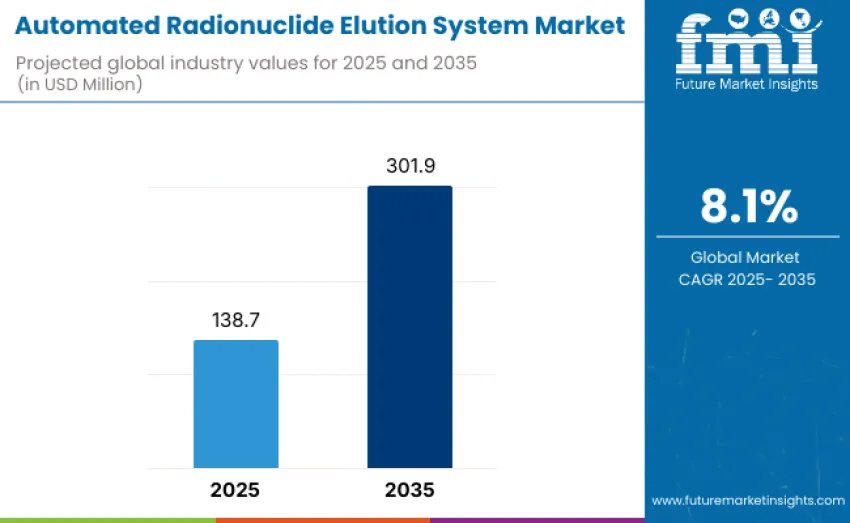
Expansion is fueled by rising prevalence of cardiovascular diseases, cancer, and neurological disorders, driving increased demand for diagnostic imaging procedures. Adoption of PET and SPECT imaging in clinical diagnostics, expansion of nuclear medicine infrastructure, and growing investment in radiopharmacy automation support deployment of automated elution systems. Government initiatives and regulatory incentives to modernize nuclear medicine facilities and enhance radiopharmaceutical safety standards contribute to growth. Rising demand for radiopharmaceuticals and the need for safe, reproducible, and efficient radionuclide production drive adoption across hospitals, research institutions, and radiopharmacies.
Automated Radionuclide Elution System Market Year-over-Year Forecast 2025 to 2035
Between 2025 and 2030, the automated radionuclide elution system market is projected to expand from USD 138.7 million to USD 204.6 million, resulting in a value increase of USD 65.9 million, which represents 40.4% of total forecast growth for the decade. This phase is expected to be driven by rising demand for efficient and standardized radionuclide elution processes in nuclear medicine and diagnostic imaging. Growth during this period is anticipated to be supported by technological advancements in automated systems, including enhanced safety features, improved yield efficiency, and integration with hospital radiopharmacy workflows.
From 2030 to 2035, growth is forecast from USD 204.6 million to USD 301.9 million, adding USD 97.3 million, which constitutes 59.6% of overall ten-year expansion. This period is expected to be characterized by development of highly specialized and scalable elution systems with multi-isotope compatibility, advanced monitoring capabilities, and enhanced user safety features. Expansion is likely to be supported by collaborations between system manufacturers and healthcare providers, regulatory compliance optimization, and growing adoption of nuclear medicine procedures in emerging regions.
Automated Radionuclide Elution System Market Key Takeaways
| Metric | Value |
|---|---|
| Market Value (2025) | USD 138.7 million |
| Market Forecast Value (2035) | USD 301.9 million |
| Forecast CAGR (2025 to 2035) | 8.1% |
Why Is the Automated Radionuclide Elution System Market Growing Worldwide?
The automated radionuclide elution system market is growing due to increasing use of radiopharmaceuticals in nuclear medicine and diagnostic imaging. These systems are designed to elute radionuclides, such as technetium-99m, from generators in a controlled, automated manner, ensuring consistent yield, purity, and sterility. Automated systems minimize human error and exposure to radiation, which is critical for both operator safety and regulatory compliance in hospital and research environments. Growing adoption of nuclear medicine procedures for diagnosing cardiovascular diseases, cancer, and neurological disorders drives demand.
Global emphasis on improving radiopharmaceutical production, quality control, and automation in clinical workflows drives adoption. Regulatory requirements for Good Manufacturing Practices and stringent radiation safety standards favor automated systems over manual elution methods. The combination of increased nuclear medicine procedures, safety and regulatory considerations, workflow efficiency, and continuous technological innovation fuels growth. These systems are becoming essential tools in modern diagnostic imaging and radiopharmacy operations.
How Are the Automated Radionuclide Elution System Market Segmented by Isotope/Generator Type, System Configuration and Region?
The automated radionuclide elution system market is segmented by isotope/generator type, system configuration and regions. By isotope/generator type, division includes 99Mo/99mTc generator elution, 68Ge/68Ga generator elution, 82Sr/82Rb generator elution, and other generators. In terms of system configuration, categorization covers standalone automated eluters, integrated hot cell elution modules, shielded mobile elution carts, and multi isotope elution controllers. Regionally, segmentation spans Asia Pacific, Europe, North America, Latin America, and Middle East & Africa.
By Isotope/Generator Type, 99Mo/99mTc Generator Elution Leads

The 99Mo/99mTc generator elution segment holds the largest share, accounting for 46.8% of revenue in 2025. Leadership stems from widespread clinical use in SPECT imaging and the critical need for high-purity, reliable elution in diagnostic procedures. The 68Ge/68Ga segment follows with 28.4% revenue share, driven by growing PET imaging adoption and targeted radiopharmaceutical applications. The 82Sr/82Rb segment accounts for 18.7% of revenue, primarily supporting cardiac perfusion studies, while other generators represent 6.1%, catering to specialized clinical and research requirements.
Key advantages driving the 99Mo/99mTc generator elution segment include high clinical reliability ensuring consistent elution of 99mTc for accurate SPECT imaging and patient safety. Regulatory compliance with well-established protocols supports standardized clinical use and quality assurance. Operational efficiency enables rapid, high-purity elution suitable for high-throughput nuclear medicine workflows. Broad applicability across hospitals, diagnostic centers, and imaging facilities supports both routine and specialized procedures.
By System Configuration, Standalone Automated Eluters Account for Largest Share
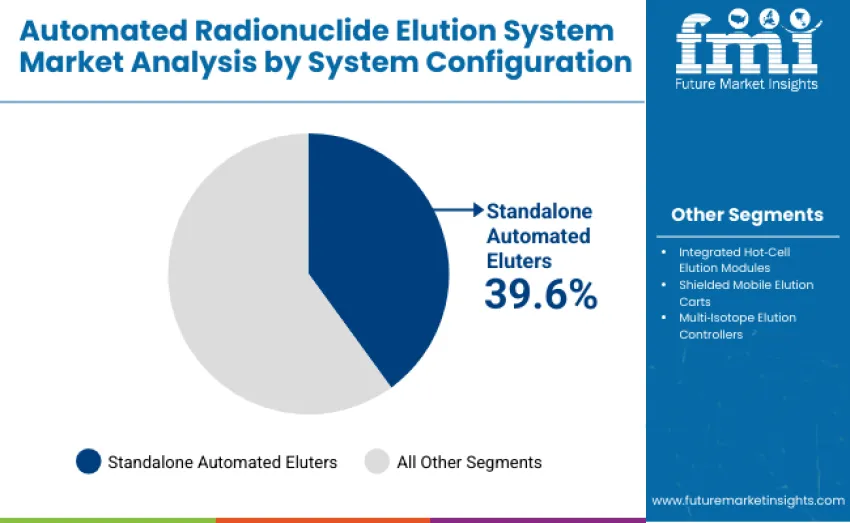
Standalone automated eluters lead with a 39.6% revenue share, offering flexible deployment and straightforward operation for facilities of varying sizes. Integrated hot-cell elution modules capture 34.7%, favored in high-volume departments prioritizing shielding, workflow integration, and throughput. Shielded mobile elution carts hold 16.2%, providing mobility for multi-room or decentralized operations, while multi-isotope elution controllers account for 9.5%, supporting advanced laboratories requiring centralized control of multiple isotopes.
Key advantages driving standalone automated eluters include simple operation allowing clinical staff to perform reliable elutions with minimal training. Flexible deployment suits small to mid-sized facilities without extensive infrastructure requirements. High reproducibility ensures consistent radionuclide quality across repeated elution cycles. Integration compatibility supports connection with existing laboratory equipment and workflows for efficient operations.
What Are the Major Drivers, Restraints, and Emerging Trends Influencing the Automated Radionuclide Elution System Market?
The automated radionuclide elution system market has been characterized by steady growth as nuclear medicine procedures, radiopharmaceutical production, and diagnostic imaging workflows have expanded globally. Demand has been reinforced by increasing adoption of PET and SPECT imaging, rising use of technetium-99m and other short-lived radionuclides, and need for standardized, high-throughput elution processes that ensure operator safety and regulatory compliance. Strong growth has been supported by rising utilization of automated elution systems in hospital radiopharmacies and centralized nuclear medicine facilities.
What Are the Major Restraints Limiting Adoption in the Automated Radionuclide Elution System Market?
The adoption of automated radionuclide elution systems is limited by the high initial capital investment required, which can be a barrier for smaller hospitals and research centers. Ongoing maintenance costs and the technical complexity of these systems further contribute to the challenges, as they require skilled personnel for operation and troubleshooting. Additionally, supply chain disruptions for radionuclide generators and essential system components have created hurdles in consistent product availability, hindering widespread adoption, particularly in emerging markets.
What Emerging Trends Are Shaping the Automated Radionuclide Elution System Market?
An emerging trend in the automated radionuclide elution system market is the development of compact, fully integrated, multi-isotope elution platforms. These systems are designed to support high-throughput workflows while minimizing operator intervention, enhancing overall efficiency. Digital monitoring, remote control capabilities, and software-enabled compliance tracking are increasingly being incorporated into these systems to improve usability, data accuracy, and regulatory adherence. These innovations aim to streamline radiopharmaceutical preparation, reduce human error, and increase operational efficiency in both clinical and research settings.
How Are Leading Countries Driving Growth in the Automated Radionuclide Elution System Market?
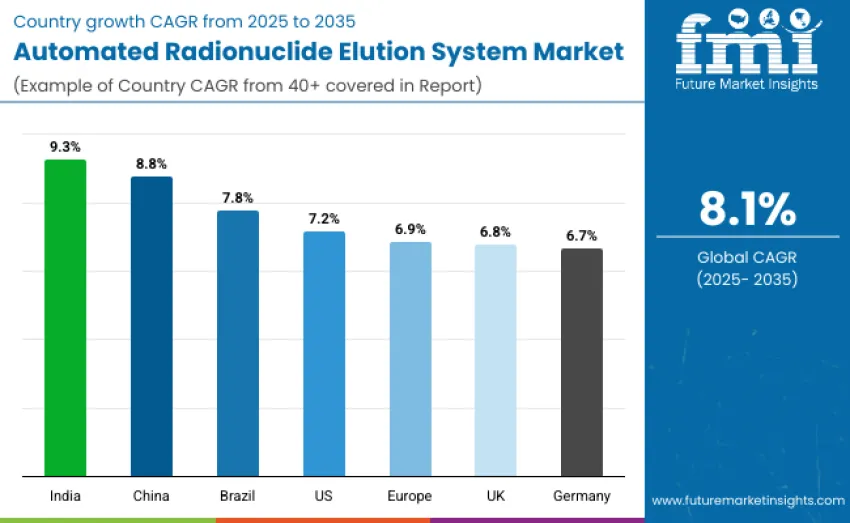
| Country/Region | CAGR (2025 to 2035)% |
|---|---|
| United States | 7.2 |
| Brazil | 7.8 |
| China | 8.8 |
| India | 9.3 |
| Europe | 6.9 |
| Germany | 6.7 |
| United Kingdom | 6.8 |
The automated radionuclide elution system market is growing globally, with India leading at a 9.3% CAGR due to expanding nuclear medicine infrastructure and government support for radiopharmaceutical production. China follows at 8.8%, driven by hospital modernization and radiopharmacy research. Brazil grows at 7.8%, supported by increasing hospital adoption of automated systems. The U.S. records 7.2% growth, reflecting mature healthcare and widespread use of automated platforms. Europe grows at 6.9%, with the U.K. at 6.8% and Germany at 6.7%, fueled by strong research hospitals and radiopharmacy infrastructure.
The report covers an in-depth analysis of 40+ countries top-performing countries are highlighted below.
How Is Healthcare Modernization Driving Growth in China?
The automated radionuclide elution system market in China is projected to grow at a CAGR of 8.8% from 2025 to 2035. Expansion has been facilitated by modernization of nuclear medicine laboratories in Beijing, Shanghai, Shenzhen, and Guangzhou, where automated elution systems are integrated for preparation of radiopharmaceuticals used in PET and SPECT imaging. Government initiatives under the "Made in China 2025" and National Health Commission programs have provided funding for procurement of automated systems and laboratory upgrades.
Adoption has been driven by increasing cancer diagnosis rates and clinical demand for standardized, reproducible radiopharmaceutical preparation. Domestic manufacturers have scaled production capacity of elution systems and consumables, improving availability and reducing import dependence. Collaborative programs between hospitals, academic institutions, and suppliers have enabled workflow standardization, technical training, and operational efficiency. Over 150 nuclear medicine laboratories were reported to have implemented automated elution systems by 2024. Integration of automated systems with clinical imaging workflows has enhanced safety, throughput, and compliance.
Why Are Radiopharmacy Network Expansion and Local Production Accelerating Growth in India?
India's automated radionuclide elution system market is projected to grow at a CAGR of 9.3% from 2025 to 2035. Growth has been supported by expansion of radiopharmacy units and nuclear medicine laboratories in Bengaluru, Mumbai, Hyderabad, and Pune, where automated elution systems are deployed for PET/SPECT radiopharmaceutical preparation. Government initiatives under the National Health Mission and Make in India program have incentivized domestic production of elution platforms and consumables, improving supply chain reliability.
Public and private hospitals have adopted automated systems to standardize radiopharmaceutical doses, improve operational efficiency, and ensure safety during handling of radioactive materials. Academic and clinical research collaborations have implemented personnel training and workflow standardization to meet quality and regulatory standards. Over 120 laboratories had adopted automated systems by 2024. Integration with local distributors has strengthened technical support, reagent availability, and timely maintenance services, enabling scalable deployment across metropolitan and regional healthcare centers.
How Are Regulatory Standards and High-Precision Automation Supporting Growth in Germany?
Germany's automated radionuclide elution system market is projected to grow at a CAGR of 6.7% from 2025 to 2035. Adoption has been driven by compliance with European and national regulations, where nuclear medicine laboratories in Berlin, Munich, and Frankfurt employ automated elution systems for PET and SPECT radiopharmaceutical preparation. Hospitals and academic research centers have integrated high-precision automation to increase reproducibility, throughput, and operational safety.
Collaborative programs between imaging system manufacturers and universities have supported development of advanced platforms and technical training for laboratory personnel. Sustainability initiatives have encouraged energy-efficient systems and reduction of radioactive waste during elution processes. Reports indicate that over 100 nuclear medicine laboratories had implemented automated systems by 2024. Integration with advanced software for workflow management and radiation monitoring has strengthened analytical accuracy and compliance with stringent safety standards.
Why Is Healthcare Network Expansion Driving Growth in Brazil?
Brazil's automated radionuclide elution system market is projected to grow at a CAGR of 7.8% from 2025 to 2035. Expansion has been supported by modernization of nuclear medicine laboratories in São Paulo, Rio de Janeiro, Brasília, and Porto Alegre, where automated elution systems are deployed for PET and SPECT radiopharmaceutical preparation. Government funding under the Ministry of Health laboratory modernization program has accelerated procurement of automated platforms, improving throughput, dosage standardization, and safety.
Hospitals and diagnostic centers have adopted automated systems to reduce manual handling of radioactive isotopes and ensure regulatory compliance. Partnerships with international distributors have strengthened availability of equipment, consumables, and technical services. Reports indicate that over 90 laboratories had adopted automated elution systems by 2024. Integration with clinical imaging workflows and standardized protocols has enhanced operational efficiency and reproducibility, supporting broader deployment across metropolitan and regional healthcare networks.
How Are Advanced R&D and Clinical Adoption Supporting Growth in the United States?
The automated radionuclide elution system market in the United States is projected to grow at a CAGR of 7.2% from 2025 to 2035. Growth has been driven by extensive research and development investments and deployment in nuclear medicine laboratories across California, Massachusetts, Texas, and New York. Hospitals, pharmaceutical research centers, and academic institutions have integrated automated elution systems for PET/SPECT radiopharmaceutical preparation, improving throughput, reproducibility, and radiation safety.
Federal funding programs including NIH grants have supported acquisition of advanced platforms. Collaborations between manufacturers and hospital networks have enabled customized solutions for clinical workflows. Over 400 laboratories had adopted automated elution systems by 2024. Standardized protocols, training programs, and integration with clinical imaging software have enhanced analytical accuracy and operational efficiency. Federal research grants have supported procurement of automated elution systems across hospitals and research centers.
Why Is Laboratory Modernization and NHS Adoption Strengthening Growth in the U.K.?
The automated radionuclide elution system market in the U.K. is projected to grow at a CAGR of 6.8% from 2025 to 2035. Adoption has been facilitated by modernization of nuclear medicine laboratories in London, Manchester, Bristol, and Edinburgh, where automated elution systems are deployed for PET/SPECT radiopharmaceutical production. NHS funding programs and academic-industry collaborations have supported platform acquisition, workflow standardization, and personnel training.
Hospitals have implemented automated systems to improve operational safety, throughput, and regulatory compliance. Reports indicate that over 80 laboratories had adopted automated systems by 2024. Integration with clinical imaging workflows and software-based monitoring has enhanced data reproducibility and efficiency across healthcare centers. NHS modernization programs and respiratory therapy standardization drive demand for automated systems supporting improved safety, throughput, and compliance with established protocols.
How Are Nuclear Medicine and Radiopharmacy Investments Driving Growth Across Europe?
The automated radionuclide elution system market in Europe is projected to grow from USD 43 million in 2025 to USD 89.1 million by 2035, registering a CAGR of 6.9% over the forecast period. Germany is expected to lead with a 27.5% share in 2025, rising slightly to 27.8% by 2035, supported by widespread adoption of automated Tc-99m and F-18 elution systems in hospitals, nuclear medicine departments, and radiopharmacy units, alongside strong investments in diagnostic imaging infrastructure.
France holds a 19.5% share in 2025, increasing to 19.7% by 2035, driven by growth in clinical nuclear medicine workflows, expansion of hospital radiopharmacy facilities, and modernization of automated elution technologies across diagnostic centers. The United Kingdom accounts for 17.5% in 2025, rising to 17.7% by 2035, supported by increased use of PET and SPECT imaging, centralized radiopharmacies, and strong hospital network integration of automated systems. Italy maintains a 12.5% share throughout the forecast period, backed by adoption in university hospitals and regional nuclear medicine departments.
How Competitive Is the Global Automated Radionuclide Elution System Market and What Defines Its Structure?
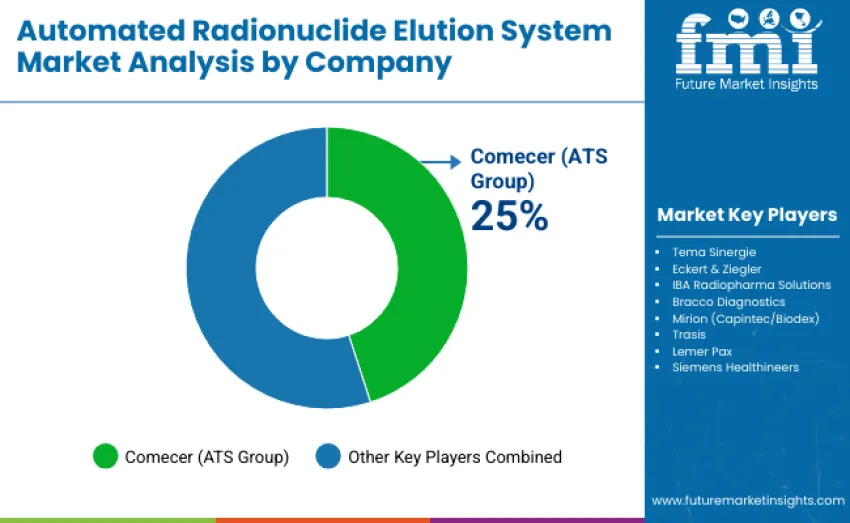
The global automated radionuclide elution system market is moderately concentrated, with 10-12 manufacturers competing across hospital, nuclear medicine, and radiopharmacy applications. The top three companies collectively hold about 55-60% of the global share, driven by extensive product portfolios, validated system performance, and strong adoption in clinical and research facilities. Comecer (ATS Group) leads with a 25% share, supported by its integrated hot-cell systems and full workflow integration options. Competition is shaped by factors such as elution efficiency, automation capabilities, radiation safety features, system reliability, and workflow integration rather than price alone.
Leaders like Comecer, Eckert & Ziegler, and Trasis maintain competitive advantages through their expertise in radiopharmaceutical automation, modular system design, and compliance with GMP and nuclear safety standards. Eckert & Ziegler excels in modular generator-linked elution technologies known for high reliability, while Trasis offers compact automation solutions that enable flexibility for small and mid-sized nuclear medicine facilities.
Challenger companies such as IBA Radiopharma Solutions, Bracco Diagnostics, and TemaSinergie differentiate through innovation, offering cyclotron-compatible modules and engineered solutions. Specialist manufacturers like Mirion, LemerPax, Siemens Healthineers, and regional OEMs focus on shielding, handling, and ancillary modules, contributing to a diversified competitive landscape.
Key Players in the Automated Radionuclide Elution System Market
- Comecer (ATS Group)
- TemaSinergie
- Eckert & Ziegler
- IBA Radiopharma Solutions
- Bracco Diagnostics
- Mirion (Capintec/Biodex)
- Trasis
- Lemer Pax
- Siemens Healthineers
Scope of the Report
| Items | Values |
|---|---|
| Quantitative Units | USD 138.7 million |
| Isotope/Generator Type | 99Mo/99mTc Generator Elution, 68Ge/68Ga Generator Elution, 82Sr/82Rb Generator Elution, Other Generators |
| System Configuration | Standalone Automated Eluters, Integrated Hot Cell Elution Modules, Shielded Mobile Elution Carts, Multi Isotope Elution Controllers |
| Regions Covered | Asia Pacific, Europe, North America, Latin America, Middle East & Africa |
| Country Covered | China, India, Germany, Brazil, USA, UK, Japan, and 40+ countries |
| Key Companies Profiled | Comecer (ATS Group), Tema Sinergie, Eckert & Ziegler, IBA Radiopharma Solutions, Bracco Diagnostics, Mirion Technologies, Trasis, Lemer Pax, Siemens Healthineers |
| Additional Attributes | Dollar sales by isotope/generator type and system configuration, regional trends across Asia Pacific, Europe, and North America, competitive landscape of elution system manufacturers, integration with radiopharmacy workflows, innovations in elution efficiency, radiation shielding, automation, and system safety features with regulatory compliance |
Automated Radionuclide Elution System Market by Segments
By Isotope / Generator Type:
- 99Mo/99mTc Generator Elution
- 68Ge/68Ga Generator Elution
- 82Sr/82Rb Generator Elution
- Other Generators
By System Configuration:
- Standalone Automated Eluters
- Integrated HotCell Elution Modules
- Shielded Mobile Elution Carts
- MultiIsotope Elution Controllers
By Region:
- Asia Pacific
- China
- India
- Japan
- South Korea
- Vietnam
- Australia & New Zealand
- ASEAN
- Rest of Asia Pacific
- Europe
- Germany
- United Kingdom
- France
- Italy
- Spain
- Netherlands
- Nordic
- BENELUX
- Rest of Europe
- North America
- United States
- Canada
- Mexico
- Latin America
- Brazil
- Argentina
- Rest of Latin America
- Middle East & Africa
- Kingdom of Saudi Arabia
- Other GCC Countries
- Turkey
- South Africa
- Other African Union
- Rest of Middle East & Africa
Frequently Asked Questions
How big is the automated radionuclide elution system market in 2025?
The global automated radionuclide elution system market is valued at USD 138.7 million in 2025.
What will be the size of the automated radionuclide elution system market in 2035?
The market is projected to reach USD 301.9 million by 2035.
How fast will the automated radionuclide elution system market grow between 2025 and 2035?
The market will grow at a CAGR of 8.1% from 2025 to 2035.
Which isotope/generator type leads the automated radionuclide elution system market in 2025?
The 99Mo/99mTc generator elution segment leads the market with a 46.8% share in 2025.
Who are the major players in the automated radionuclide elution system market?
Key players include Comecer, Tema Sinergie, Eckert & Ziegler, IBA Radiopharma Solutions, Bracco Diagnostics, Mirion, Trasis, Lemer Pax, and Siemens Healthineers.
Preview the report firsthand - request a free sample
Get SampleGet the brochure for pricing and purchase details.
Get PDFTable of Content
- Executive Summary
- Regional Level Market Outlook
- Demand-side Trends
- Supply-side Trends
- Technology Roadmap Analysis
- Analysis and Recommendations
- Market Overview
- Market Coverage / Taxonomy
- Market Definition / Scope / Limitations
- Market Background
- Market Dynamics
- Drivers
- Restraints
- Opportunity
- Trends
- Scenario Forecast
- Demand in Optimistic Scenario
- Demand in Likely Scenario
- Demand in Conservative Scenario
- Opportunity Map Analysis
- Investment Feasibility Matrix
- PESTLE and Porter’s Analysis
- Regulatory Landscape
- By Key Regions
- By Key Countries
- Regional Parent Market Outlook
- Technological Advancements
- Market Dynamics
- Regional Level Market Analysis 2020 to 2024 and Forecast, 2025 to 2035
- Historical Market Size USD Million Analysis, 2020 to 2024
- Current and Future Market Size USD Million Projections, 2025 to 2035
- Y-o-Y Growth Trend Analysis
- Absolute $ Opportunity Analysis
- Regional Level Market Analysis 2020 to 2024 and Forecast 2025 to 2035, By Isotope / Generator Type
- Introduction / Key Findings
- Historical Market Size USD Million Analysis By Isotope / Generator Type, 2020 to 2024
- Current and Future Market Size USD Million Analysis and Forecast By Isotope / Generator Type, 2025 to 2035
- 99Mo/99mTc Generator Elution
- 68Ge/68Ga Generator Elution
- 82Sr/82Rb Generator Elution (Infusion Systems)
- Other Generators (e.g., 90Y/90Sr, 188W/188Re)
- Y-o-Y Growth Trend Analysis By Isotope / Generator Type, 2020 to 2024
- Absolute $ Opportunity Analysis By Isotope / Generator Type, 2025 to 2035
- Regional Level Market Analysis 2020 to 2024 and Forecast 2025 to 2035, By System Configuration
- Introduction / Key Findings
- Historical Market Size USD Million Analysis By System Configuration, 2020 to 2024
- Current and Future Market Size USD Million Analysis and Forecast By System Configuration, 2025 to 2035
- Standalone Automated Eluters
- Integrated Hot Cell Elution Modules
- Shielded Mobile Elution Carts
- Multi Isotope Elution Controllers
- Y-o-Y Growth Trend Analysis By System Configuration, 2020 to 2024
- Absolute $ Opportunity Analysis By System Configuration, 2025 to 2035
- Regional Level Market Analysis 2020 to 2024 and Forecast 2025 to 2035, By End User
- Introduction / Key Findings
- Historical Market Size USD Million Analysis By End User, 2020 to 2024
- Current and Future Market Size USD Million Analysis and Forecast By End User, 2025 to 2035
- Centralized Radiopharmacies
- Hospital Nuclear Medicine Departments
- PET Centers
- Isotope Production & QC Labs
- Y-o-Y Growth Trend Analysis By End User, 2020 to 2024
- Absolute $ Opportunity Analysis By End User, 2025 to 2035
- Regional Level Market Analysis 2020 to 2024 and Forecast 2025 to 2035, By Region
- Introduction
- Historical Market Size USD Million Analysis By Region, 2020 to 2024
- Current Market Size USD Million Analysis and Forecast By Region, 2025 to 2035
- North America
- Latin America
- East Asia
- South Asia
- Western Europe
- Eastern Europe
- Middle East & Africa
- Market Attractiveness Analysis By Region
- North America Market Analysis 2020 to 2024 and Forecast 2025 to 2035, By Country
- Historical Market Size USD Million Trend Analysis By Market Taxonomy, 2020 to 2024
- Market Size USD Million Forecast By Market Taxonomy, 2025 to 2035
- By Country
- USA
- Canada
- Mexico
- By Isotope / Generator Type
- By System Configuration
- By End User
- By Country
- Market Attractiveness Analysis
- By Country
- By Isotope / Generator Type
- By System Configuration
- By End User
- Key Takeaways
- Latin America Market Analysis 2020 to 2024 and Forecast 2025 to 2035, By Country
- Historical Market Size USD Million Trend Analysis By Market Taxonomy, 2020 to 2024
- Market Size USD Million Forecast By Market Taxonomy, 2025 to 2035
- By Country
- Brazil
- Argentina
- Rest of Latin America
- By Isotope / Generator Type
- By System Configuration
- By End User
- By Country
- Market Attractiveness Analysis
- By Country
- By Isotope / Generator Type
- By System Configuration
- By End User
- Key Takeaways
- East Asia Market Analysis 2020 to 2024 and Forecast 2025 to 2035, By Country
- Historical Market Size USD Million Trend Analysis By Market Taxonomy, 2020 to 2024
- Market Size USD Million Forecast By Market Taxonomy, 2025 to 2035
- By Country
- China
- Japan
- South Korea
- By Isotope / Generator Type
- By System Configuration
- By End User
- By Country
- Market Attractiveness Analysis
- By Country
- By Isotope / Generator Type
- By System Configuration
- By End User
- Key Takeaways
- South Asia Market Analysis 2020 to 2024 and Forecast 2025 to 2035, By Country
- Historical Market Size USD Million Trend Analysis By Market Taxonomy, 2020 to 2024
- Market Size USD Million Forecast By Market Taxonomy, 2025 to 2035
- By Country
- India
- ASEAN Countries
- Australia & New Zealand
- Rest of South Asia
- By Isotope / Generator Type
- By System Configuration
- By End User
- By Country
- Market Attractiveness Analysis
- By Country
- By Isotope / Generator Type
- By System Configuration
- By End User
- Key Takeaways
- Western Europe Market Analysis 2020 to 2024 and Forecast 2025 to 2035, By Country
- Historical Market Size USD Million Trend Analysis By Market Taxonomy, 2020 to 2024
- Market Size USD Million Forecast By Market Taxonomy, 2025 to 2035
- By Country
- Germany
- UK
- France
- Italy
- Spain
- BENELUX
- Nordic Countries
- Rest of Western Europe
- By Isotope / Generator Type
- By System Configuration
- By End User
- By Country
- Market Attractiveness Analysis
- By Country
- By Isotope / Generator Type
- By System Configuration
- By End User
- Key Takeaways
- Eastern Europe Market Analysis 2020 to 2024 and Forecast 2025 to 2035, By Country
- Historical Market Size USD Million Trend Analysis By Market Taxonomy, 2020 to 2024
- Market Size USD Million Forecast By Market Taxonomy, 2025 to 2035
- By Country
- Russia
- Hungary
- Poland
- Rest of Eastern Europe
- By Isotope / Generator Type
- By System Configuration
- By End User
- By Country
- Market Attractiveness Analysis
- By Country
- By Isotope / Generator Type
- By System Configuration
- By End User
- Key Takeaways
- Middle East & Africa Market Analysis 2020 to 2024 and Forecast 2025 to 2035, By Country
- Historical Market Size USD Million Trend Analysis By Market Taxonomy, 2020 to 2024
- Market Size USD Million Forecast By Market Taxonomy, 2025 to 2035
- By Country
- Saudi Arabia
- Other GCC Countries
- Türkiye
- South Africa
- Rest of MEA
- By Isotope / Generator Type
- By System Configuration
- By End User
- By Country
- Market Attractiveness Analysis
- By Country
- By Isotope / Generator Type
- By System Configuration
- By End User
- Key Takeaways
- Market Structure Analysis
- Competition Dashboard
- Competition Benchmarking
- Market Share Analysis of Top Players
- By Regional
- By Isotope / Generator Type
- By System Configuration
- By End User
- Competition Analysis
- Competition Deep Dive
- Comecer (ATS Group)
- Overview
- Product Portfolio
- Profitability by Market Segments
- Sales Footprint
- Strategy Overview
- Marketing Strategy
- Product Strategy
- Channel Strategy
- Tema Sinergie
- Overview
- Product Portfolio
- Profitability by Market Segments
- Sales Footprint
- Strategy Overview
- Marketing Strategy
- Product Strategy
- Channel Strategy
- Eckert & Ziegler (Modular Lab / GalliaPharm elution modules)
- Overview
- Product Portfolio
- Profitability by Market Segments
- Sales Footprint
- Strategy Overview
- Marketing Strategy
- Product Strategy
- Channel Strategy
- IBA Radiopharma Solutions
- Overview
- Product Portfolio
- Profitability by Market Segments
- Sales Footprint
- Strategy Overview
- Marketing Strategy
- Product Strategy
- Channel Strategy
- Bracco Diagnostics (CardioGen 82 infusion systems)
- Overview
- Product Portfolio
- Profitability by Market Segments
- Sales Footprint
- Strategy Overview
- Marketing Strategy
- Product Strategy
- Channel Strategy
- Mirion Technologies (Capintec/Biodex elution interfaces)
- Overview
- Product Portfolio
- Profitability by Market Segments
- Sales Footprint
- Strategy Overview
- Marketing Strategy
- Product Strategy
- Channel Strategy
- Trasis
- Overview
- Product Portfolio
- Profitability by Market Segments
- Sales Footprint
- Strategy Overview
- Marketing Strategy
- Product Strategy
- Channel Strategy
- Lemer Pax
- Overview
- Product Portfolio
- Profitability by Market Segments
- Sales Footprint
- Strategy Overview
- Marketing Strategy
- Product Strategy
- Channel Strategy
- Siemens Healthineers (select elution modules)
- Overview
- Product Portfolio
- Profitability by Market Segments
- Sales Footprint
- Strategy Overview
- Marketing Strategy
- Product Strategy
- Channel Strategy
- Comecer (ATS Group)
- Competition Deep Dive
- Assumptions & Acronyms Used
- Research Methodology


