

- Industry Size (2026)
- USD 2.1 Bn
- Forecast (2036)
- USD 3.7 Bn
- CAGR (2026 to 2036)
- 5.8%
B2C Finished Products Market Forecast and Outlook 2026 to 2036
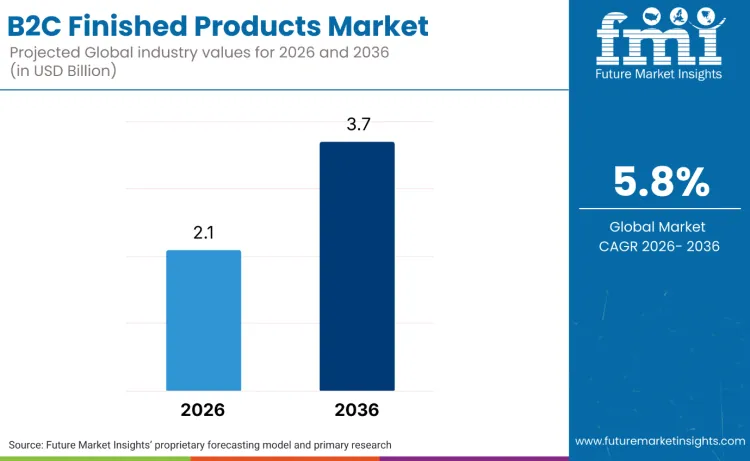
The B2C Finished Products market is projected to expand from USD 2.1 Billion in 2026 to USD 3.7 Billion by 2036, at a 5.8% CAGR. The decade’s growth quality is being anchored in a measurable shift of consumer demand into digital checkout and networked fulfilment, which changes how brands allocate capital toward merchandising, last-mile capability, and first-party data. P&G reports, "E-commerce sales increased 9%, now representing 18% of the Company total," signalling that scaled FMCG operators are treating e-commerce as a structural sales lane rather than a marginal channel. Nestlé reports e-commerce sales growing organically 18.9% of Group sales in 2024, reinforcing that digital share is now material across packaged goods portfolios.
In China, policy-led replacement cycles are directly expanding addressable demand for finished goods, including appliances and digital products. Official releases cite consumer goods trade-in sales of 3.92 trillion yuan across 2024 to 2025, indicating a state-supported consumption mechanism that raises volumes in discretionary categories. In parallel, global majors continue to tighten portfolio focus around fewer, larger brands, as evidenced by Unilever’s 2024 turnover disclosure and its stated emphasis on scale brands in investor reporting, which stabilises supply investment and retail execution in core categories.
Summary of the B2C Finished Products Market
What is the B2C Finished Products Market size in 2026 and 2036 as per FMI projection?
It is projected to be USD 2.1 Billion in 2026 and USD 3.7 Billion by 2036 at a 5.8% CAGR.
FMI Research Approach: Forecast anchored in category-level consumption, digital checkout share, and policy-driven replacement cycles in large consumer economies.
Which product category leads in 2026 and why does it hold that position?
Personal care products lead with a 28.6% share in 2026 due to high repeat purchase cadence and brand-led price realisation supported by scaled retail execution.
FMI Research Approach: Segment share mapped to replenishment frequency, portfolio concentration by large FMCG groups, and channel economics.
Which distribution channel dominates in 2026 and what makes it structurally advantaged?
Offline retail leads with a 52.4% share in 2026 because grocery, mass, and pharmacy formats remain the primary volume engine for finished goods replenishment.
FMI Research Approach: Channel sizing linked to store-based throughput, category penetration, and country-specific retail structure.
Which end-user group drives most demand in 2026?
Urban consumers lead with a 63.1% share in 2026 due to higher organised retail access, faster delivery coverage, and higher exposure to retail media and premium tiers.
FMI Research Approach: End-user split modelled on city-level retail density, last-mile availability, and income-linked discretionary mix.
Which country is expected to post the highest growth rate through 2036?
China leads with a 7.4% CAGR from 2026 to 2036, supported by policy-backed trade-in demand and scaled digital commerce infrastructure.
FMI Research Approach: Country outlook weighted to policy stimulus, retail digitisation, and domestic demand support mechanisms.
B2C Finished Products Market Key Takeaways
| Items | Values |
|---|---|
| Market Size (2026) | USD 2.1 Billion |
| Market Size (2036) | USD 3.7 Billion |
| CAGR (2026 to 2036) | 5.8% |
Why is the Demand for B2C Finished Products Accelerating?
Future Market Insights analysts perceive the B2C finished products market evolving toward digitally mediated, policy-amplified, and convenience-led consumption ecosystems, where growth is no longer driven solely by brand equity but by distribution reach, transaction ease, and state-supported demand stimulation. The structural shift toward e-commerce as a primary sales engine is clearly visible across global FMCG leaders. Procter & Gamble reported that e-commerce sales increased 12%, now accounting for 19% of total company sales, underscoring how everyday consumer staples are increasingly purchased through online channels rather than traditional retail. A similar trajectory is evident at Nestlé, where e-commerce sales grew organically by 9.7%, reaching 18.5% of total group sales, confirming that digital channels are becoming structurally embedded in mass-market consumption rather than serving as incremental add-ons.
Demand expansion is further reinforced by macro-level policy interventions that directly stimulate household purchasing power. According to official releases from the China Ministry of Commerce, China’s policy-backed consumer goods trade-in program generated 3.92 trillion yuan (approximately USD 558.6 billion) in sales across 2024 and 2025, benefiting consumers on 494 million occasions. This scale of intervention demonstrates how government-led replacement and upgrade programs can rapidly accelerate turnover in durable and semi-durable B2C categories. Collectively, the convergence of rising e-commerce penetration, omnichannel normalization, and state-supported consumption incentives is driving sustained, structurally resilient growth in the global B2C finished products market.
How is the B2C Finished Products Market Segmented?
The market for B2C finished products is segmented into Product Category (personal care products, home care products, packaged food and beverages, consumer electronics, and apparel and footwear), Distribution Channel (offline retail, e-commerce, and direct-to-consumer platforms), and End User (urban consumers and rural consumers). This segmentation reflects how finished goods demand is structured around replenishment-led FMCG consumption, policy-influenced replacement cycles for durable categories, and differentiated access to organised retail and digital checkout infrastructure. Category mix captures the balance between high-frequency staples and discretionary upgrades, channels reflect the coexistence of store throughput and digital fulfilment, and end-user segmentation highlights the concentration of demand in urban consumption clusters with higher retail density, delivery coverage, and exposure to retail media and premium assortments.
Why do Personal Care Products Anchor the Largest Product Category Share in 2026?
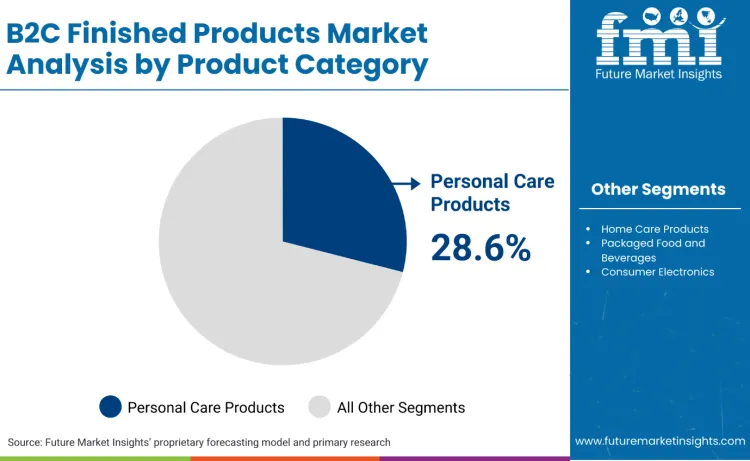
Personal care products lead with a 28.6% share in 2026 because they combine high replenishment frequency with brand-led price architecture, which scaled operators can defend across both store and digital lanes. The structural signal is repeatable capital allocation by large FMCG groups into fewer, larger brands with superior retail execution and repeat purchase. Unilever’s reporting of €60.8 billion turnover in 2024, alongside its investor emphasis on scale brands, indicates that global majors are building finished goods portfolios around categories where shelf presence, advertising weight, and distribution discipline convert into repeat volume. Personal care also benefits from digital reinforcement. P&G’s disclosure that e-commerce sales are 18% of company total shows that repeat categories are being engineered for online conversion and replenishment, strengthening personal care’s ability to hold share across channels.
What Keeps Offline Retail as the Primary Distribution Spine Despite E-commerce Scale-Up?
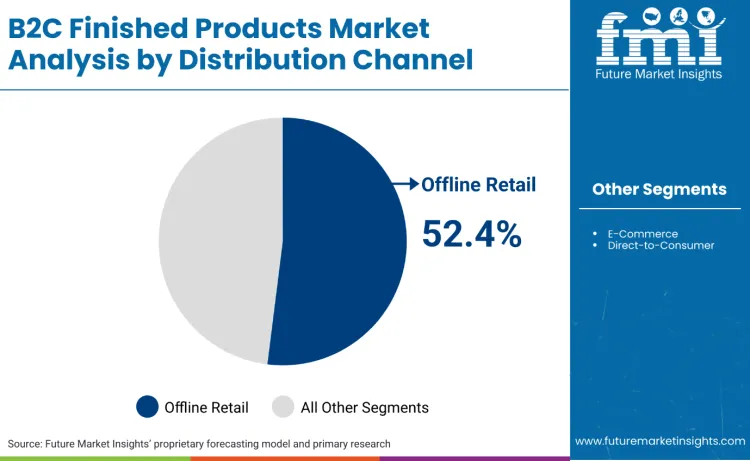
Offline retail leads with a 52.4% share in 2026 because physical retail remains the throughput engine for high-velocity replenishment categories, particularly where immediate availability and basket-building drive purchase economics. The evidence is not that e-commerce is small, but that store-based infrastructure still carries the largest share of day-to-day volume. In the US, e-commerce accounted for 16.1% of total retail sales in 2024, which implies the remaining majority continues to transact offline even in the world’s most digitised retail environment. In parallel, the largest brand owners are optimising omnichannel rather than abandoning stores. P&G’s 18% e-commerce share indicates meaningful online scale, yet it also signals that most volume still moves through physical retail, which requires trade terms, shelf execution, and in-store availability discipline. Offline remains structurally advantaged for packaged foods, home care, and staple personal care where trip frequency and immediate fulfilment matter more than delivery lead times, keeping store networks central to finished goods demand capture.
Why are Urban Consumers the Dominant End-user Base for Finished Goods Spend in 2026?
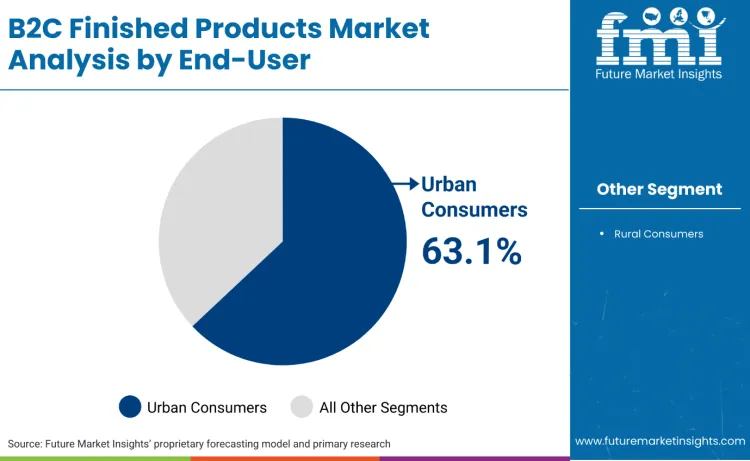
Urban consumers lead with a 63.1% share in 2026 because demand capture is increasingly determined by access to organised retail, delivery density, and digital payment readiness, all of which concentrate in cities. India’s public information on ONDC shows 1.16 lakh plus retail sellers live across 630 plus cities and towns as of December 2025, indicating a state-supported mechanism widening digital commerce participation, but still anchored in urban coverage and logistics viability. Japan’s METI reports a 42.8% cashless payment ratio in 2024, which strengthens frictionless urban purchasing across convenience retail, specialty stores, and digital channels where payments and loyalty systems integrate. These mechanisms reinforce concentration: faster delivery windows, higher retail media exposure, and broader assortment access lead to higher purchase frequency and higher discretionary mix in urban areas, making urban consumers the dominant end-user pool for finished products across categories.
How Is E-commerce Normalisation Influencing Finished Products Demand Capture?
Industry evolution in the B2C finished products market is being shaped by the normalisation of e-commerce as a structurally material share of total finished goods sales rather than a supplementary channel. This shift is forcing brand owners to redesign demand generation around performance marketing, retail media optimisation, and fulfilment reliability instead of relying primarily on in-store visibility and assortment breadth. As digital checkout becomes a default behaviour for replenishment and discretionary purchases alike, competitive advantage increasingly depends on execution discipline across search visibility, conversion efficiency, and last-mile performance. Brand owners are reinforcing this transition through disclosed channel scale, signalling that digital commerce is now embedded into core operating models rather than treated as a cyclical growth lever.
Why Is Compliance and Due-Diligence Load Reshaping Supplier and Portfolio Strategy?
Rising compliance and due-diligence obligations across finished goods supply chains represent a core structural restraint, increasing documentation costs and slowing supplier onboarding and assortment agility. Germany’s Federal Ministry of Labour and Social Affairs explains that the Supply Chain Act obligates companies to implement due-diligence requirements extending across both their own operations and their suppliers. The expansion of the Act in 2024 to include companies with at least 1,000 employees in Germany has widened the compliance perimeter, directly affecting finished goods buyers and vendors. This governance shift pushes procurement toward fewer, better documented suppliers, favouring scale and audit readiness while reducing the speed at which smaller brands can be integrated into large retail and FMCG portfolios.
How Are Portfolio Concentration and Execution Discipline Becoming Competitive Filters?
The combined effect of e-commerce normalisation and rising compliance burden is accelerating portfolio concentration across the B2C finished products market. As documentation, traceability, and fulfilment reliability become gating requirements, companies are prioritising fewer, larger brands and SKUs that can be executed consistently across offline and digital channels. This dynamic reshapes innovation timelines, where new product launches must clear both digital performance thresholds and regulatory due-diligence checks before scaling. Smaller brands face longer ramp-up cycles, while incumbents with established compliance systems and omnichannel infrastructure gain structural advantage. As a result, market growth is increasingly driven by execution quality and operational readiness rather than assortment expansion alone.
How Will B2C Finished Products Market Expansion Unfold Across Key Global Regions?
Future Market Insights identifies China (CAGR 7.4%), India (6.8%), Germany (6.3%), Brazil (5.7%), United States (5.2%), the United Kingdom (4.6%), and Japan (4.1%) as the core regional growth engines for the B2C finished products market between 2026 and 2036. China leads expansion through policy-backed replacement cycles that directly stimulate demand for appliances, electronics, and household finished goods, combined with scaled digital commerce infrastructure that absorbs incremental spend. India’s growth is driven by rapid expansion of public digital commerce rails and rising urban consumption density, which increase finished goods penetration across personal care, home care, and packaged foods.
The United States benefits from a high and stable digital checkout baseline that sustains predictable demand capture across finished goods categories. Germany’s growth reflects procurement consolidation under expanded due-diligence obligations, favouring compliant scale suppliers. Brazil’s expansion is supported by resilient retail turnover in staples and durable-linked categories despite macro volatility. The UK and Japan show comparatively moderate growth, constrained by market maturity, but supported by steady omnichannel optimisation and payment digitisation that reinforce repeat purchasing. FMI emphasizes that across regions, growth durability is shaped by digital checkout normalisation, policy-driven demand mechanisms, and execution discipline through 2036.
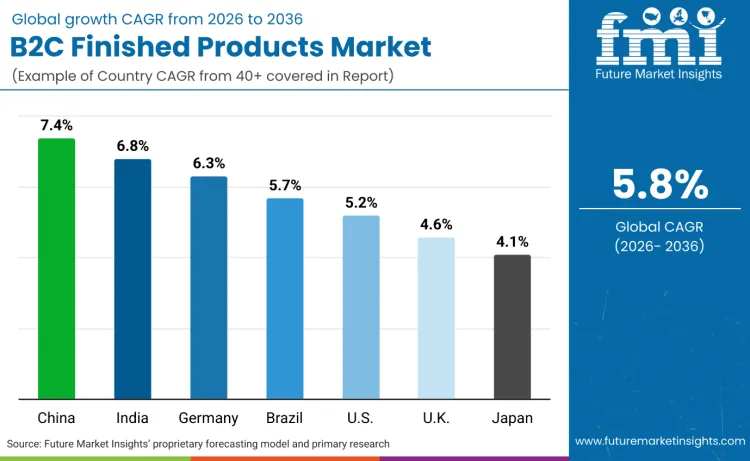
| Country | CAGR (2026-2036) |
|---|---|
| China | 7.4% |
| India | 6.8% |
| Germany | 6.3% |
| Brazil | 5.7% |
| United States | 5.2% |
| United Kingdom | 4.6% |
| Japan | 4.1% |
Source: Future Market Insights (FMI) analysis, based on proprietary forecasting model and primary research
Why does China Sustain the Highest CAGR in Finished Products through 2036?
China expands at a 7.4% CAGR from 2026 to 2036 because policy-backed replacement cycles are directly expanding finished goods volumes in appliances, electronics, and associated household categories, while digital commerce infrastructure continues to absorb incremental spend. Official releases cite 3.92 trillion yuan in sales generated by the consumer goods trade-in program across 2024 and 2025, indicating a large, state-supported demand mechanism tied to household upgrades. This is not a generic consumption tailwind. It is a quantified program that increases purchase probability for durables and raises cross-category basket demand via household refresh cycles. The mechanism also supports brand execution because large operators can align assortments, pricing packs, and channel partnerships to subsidy-driven demand patterns. The result is a growth pathway shaped by programmatic demand creation rather than only income growth, which materially lifts finished product sell-through rates across priority categories.
What is Fueling India’s Above-Global Growth Rate for Finished Products from 2026 to 2036?
India grows at a 6.8% CAGR from 2026 to 2036 because public digital commerce rails are widening seller participation and strengthening multi-seller fulfilment ecosystems, which increases assortment availability and price competition without requiring single-platform dependency. The Government of India’s PIB release states that as of 9 December 2025 there were 1.16 lakh plus retail sellers live on ONDC across 630 plus cities and towns. This creates a concrete mechanism for finished goods distribution, more sellers become digitally discoverable, logistics partners integrate into the network, and local retail shifts into an addressable online demand pool. The effect is stronger penetration of personal care, home care, and packaged foods into digital baskets while sustaining offline growth, supporting higher overall market expansion than mature retail systems.
How does Germany’s Compliance Perimeter Translate into a Higher CAGR for Finished Products?
Germany expands at a 6.3% CAGR from 2026 to 2036 because due diligence obligations are reshaping finished goods procurement toward larger, better documented supply bases, which favours scaled manufacturers and accelerates consolidation-led growth in organised channels. The German government explains that the Supply Chain Act obligates companies to respect human rights and environmental protection by implementing defined due diligence obligations that extend across supply chains. The official overview further states that from 2024 the Act applies to companies with at least 1,000 employees in Germany, widening compliance coverage and increasing procurement discipline across finished product categories. This governance mechanism reduces supplier churn, increases the value of audited processes, and supports stable rollouts of finished goods in categories where traceability and documentation are now procurement gating factors.
Why does Brazil Show Mid-to-High Growth Despite Macro Volatility?
Brazil grows at a 5.7% CAGR from 2026 to 2036 because consumption in finished goods remains supported by resilient retail turnover in staples and durable-linked categories, with measurable year-on-year retail volume expansion reported by the national statistics agency. IBGE’s monthly trade releases report that retail sales volume increased year on year in 2025 reference periods, providing a factual signal that consumer purchasing has remained active even under tighter financial conditions. The mechanism for finished goods suppliers is distribution-led resilience: large grocery and mass formats continue to move packaged foods and home care, while household appliance and electronics cycles remain sensitive to credit conditions. Companies that align pack sizes, pricing ladders, and local manufacturing footprints to Brazil’s retail cadence are better positioned to sustain growth through the cycle.
What Underpins the US Growth Rate for Finished Products through 2036?
The US expands at a 5.2% CAGR from 2026 to 2036 because digital checkout has stabilised at a high baseline, sustaining steady demand capture for finished goods brands that can win search, retail media, and fulfilment performance. The Census Bureau reports that e-commerce sales in 2024 accounted for 16.1% of total retail sales, and that total 2024 e-commerce sales were estimated at $1,192.6 billion. This directly shapes category economics for consumer electronics, packaged food replenishment, and personal care subscriptions. Brands that can maintain pricing integrity while securing digital shelf visibility gain predictable volume, supporting stable market expansion rather than boom-bust cycles.
Why is the UK’s CAGR Lower than China and India but Still Positive through 2036?
The UK grows at a 4.6% CAGR from 2026 to 2036 because online penetration has normalised below pandemic peaks, keeping growth tied to incremental efficiency in omnichannel execution rather than a step-change in channel mix. UK Parliament retail sector briefing analysis notes that total online retail sales as a percentage of all retail sales increased only very slightly in 2023 and 2024 and remained below peak levels seen earlier in the decade. This mechanism caps acceleration but supports steady growth as retailers optimise fulfilment costs and category mix, especially for health, beauty, and small-ticket discretionary finished goods.
How does Japan’s Payments Infrastructure Shape Finished Goods Growth through 2036?
Japan expands at a 4.1% CAGR from 2026 to 2036 because payment digitisation is strengthening frictionless repeat purchasing across convenience retail, specialty formats, and digital channels, while the market’s maturity limits explosive volume growth. METI reports that Japan’s cashless payment ratio in 2024 was 42.8% and that the government goal of 40% was achieved, formalising a consumer mechanism that supports subscription-like replenishment and loyalty-led purchasing. For finished products, this supports steady conversion in personal care, packaged foods, and small electronics accessories, but overall growth remains moderate due to saturation in core categories.
How is Competition Structured in the Global B2C Finished Products Market?
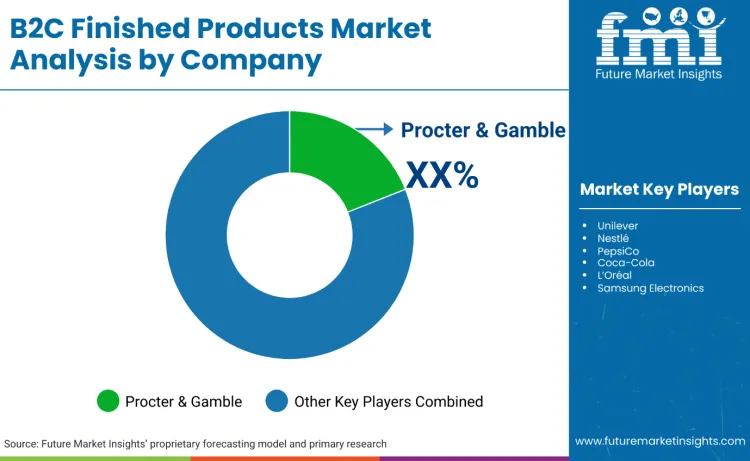
Competition is led by diversified consumer goods and electronics majors with scale across manufacturing, retail execution, and digital demand capture. Scope includes finished B2C goods across personal care, home care, packaged food and beverages, apparel and footwear, and consumer electronics sold through offline retail, e-commerce, and direct-to-consumer models. Scope excludes commodities sold without branded finished product positioning, industrial intermediates, and services. In packaged food and beverages, Nestlé’s scale and its disclosure that e-commerce reached Group sales in 2024 reinforce its ability to win both store and digital lanes. In Asia, leadership does not always translate directly from global FMCG to electronics, where regional device ecosystems and replacement policies can reshape winners, particularly in China where trade-in stimulus supports demand cycles. Japan remains structurally distinct because payments digitisation supports repeat purchasing but category maturity constrains rapid share swings.
Recent developments
- In January 2026, L’Oréal introduced Light Straight + Multi-styler and an LED Face Mask, award-winning Beauty Tech innovations using infrared and light-based technologies to deliver faster, lower-temperature hair styling and enhanced skin results, reinforcing science-led personalization in beauty.
- In January 2026, Samsung Electronics earned its first Enterprise Technology Innovation Award for Spatial Signage, a glasses-free 3D commercial display delivering immersive depth from 2D content, remote content deployment via Samsung VXT, and reinforcing Samsung’s leadership in digital signage globally.
Key Players
- Procter & Gamble
- Unilever
- Nestlé
- PepsiCo
- The Coca-Cola Company
- L’Oréal
- Samsung Electronics
- Apple Inc.
- Reckitt
- Colgate-Palmolive
Market Definition
The B2C Finished Products market covers branded, packaged consumer goods and finished durable products sold directly to end consumers through retail and direct channels. It includes personal care, home care, packaged foods and beverages, apparel and footwear, and consumer electronics as finished goods. The market is defined by consumer checkout activity across offline retail, e-commerce, and direct-to-consumer routes, where demand is influenced by digital penetration, policy-led replacement cycles, and compliance expectations that shape procurement and supplier selection for branded finished products. The market captures manufacturer and brand-owner revenues from finished goods sales into consumer channels.
Market Inclusion
Included revenues cover finished, packaged and branded products sold through supermarkets, mass retail, pharmacy, specialty retail, marketplaces, brand-owned e-commerce, and direct-to-consumer channels. Included also covers finished product sales stimulated by formal policy mechanisms that create replacement demand, such as China’s consumer goods trade-in program, where official reporting shows large sales generation tied to upgrades. Included end users cover urban and rural consumers, with channel mix reflecting country retail structure. Company scope includes diversified FMCG majors and electronics majors whose disclosed scale, omnichannel execution, and documented digital share indicate structural leadership.
Market Exclusion
Excluded revenues cover bulk commodities without finished branded positioning, B2B intermediates, contract manufacturing revenues not tied to branded finished product sell-through, and services such as logistics, payments, and advertising sold to retailers or brands. Also excluded are industrial equipment and non-consumer product categories that do not transact as finished B2C goods. Regulatory and compliance systems that do not directly govern finished goods placement, pricing, or sell-through are out of scope unless they materially shape procurement obligations for companies distributing finished consumer products.
Scope of Report
| Items | Values |
|---|---|
| Quantitative Units (2026) | USD 2.1 Billion |
| Product Category Segments | Personal Care Products; Home Care Products; Packaged Food & Beverages; Consumer Electronics; Apparel & Footwear |
| Distribution Channel Segments | Offline Retail; E-commerce; Direct-to-Consumer |
| End-user Categories | Urban Consumers; Rural Consumers |
| Regions Covered | North America, Latin America, Western Europe, Eastern Europe, South Asia & Pacific, East Asia, Middle East & Africa |
| Key Countries | China, India, Germany, Brazil, United States, United Kingdom, Japan |
| Key Companies Profiled | Procter & Gamble; Unilever; Nestlé; PepsiCo; The Coca-Cola Company; L’Oréal; Samsung Electronics; Apple Inc.; Reckitt; Colgate-Palmolive |
| Additional Attributes | Dollar sales measured for branded finished consumer products across personal care, home care, packaged foods, apparel, and electronics, segmented by category mix, omnichannel sales share, policy-driven replacement demand impact, compliance and supply-chain due-diligence effects, urban versus rural consumption concentration, and execution performance across offline retail, e-commerce, and direct-to-consumer platforms |
B2C Finished Products Market by Key Segments
Product Category:
- Personal Care Products
- Home Care Products
- Packaged Food and Beverages
- Consumer Electronics
- Apparel and Footwear
Distribution Channel:
- Offline Retail
- E-commerce
- Direct-to-Consumer
End-user:
- Urban Consumers
- Rural Consumers
Bibliography (APA)
- USA Census Bureau. (2025). Quarterly retail e-commerce sales, 2024 (Q4 release). USA Department of Commerce.
- State Council Information Office of the People’s Republic of China. (2026). Trade-in policy drives 3.92 trillion yuan in consumer goods sales.
- Press Information Bureau, Government of India. (2025). ONDC enables fair, transparent and inclusive e-commerce. Ministry of Commerce & Industry.
- Ministry of Economy, Trade and Industry. (2025). 2024 ratio of cashless payment among total amount of payments.
Frequently Asked Questions
What is the current global market size for the B2C Finished Products Market?
The global B2C finished products market is valued at USD 2.1 billion in 2026, supported by rising digital checkout penetration and policy-driven replacement demand.
What is the projected CAGR for the B2C Finished Products Market?
The market is projected to expand at a 5.8% CAGR from 2026 to 2036.
Which segment currently dominates the market?
Personal care products lead with a 28.6% share while offline retail dominates distribution with 52.4% of total sales.
What are the primary drivers of market growth?
Growth is driven by normalization of e-commerce purchasing, government-supported replacement cycles, and stronger omnichannel execution by major consumer brands.
Who are the leading players in the B2C Finished Products Market?
Major players include Procter & Gamble, Unilever, Nestlé, L’Oréal, Samsung Electronics, Apple Inc., and Reckitt.
Preview the report firsthand - request a free sample
Get SampleGet the brochure for pricing and purchase details.
Get PDFTable of Content
- Executive Summary
- Global Market Outlook
- Demand Side Trends
- Supply Side Trends
- Technology Roadmap Analysis
- Analysis and Recommendations
- Market Overview
- Market Coverage / Taxonomy
- Market Definition / Scope / Limitations
- Research Methodology
- Chapter Orientation
- Analytical Lens and Working Hypotheses
- Market Structure, Signals, and Trend Drivers
- Benchmarking and Cross-market Comparability
- Market Sizing, Forecasting, and Opportunity Mapping
- Research Design and Evidence Framework
- Desk Research Programme (Secondary Evidence)
- Company Annual Reports and Integrated Reports
- Consumer Goods Regulatory Publications
- Corporate Websites and Investor Communications
- Retail and E-commerce Statistics
- Government Trade and Consumption Data
- Policy and Due Diligence Frameworks
- Industry Whitepapers and Trade Journals
- Press Releases and Verified Media Coverage
- FMI Internal Knowledge Base
- Subscription-based Industry Databases
- Additional Desk Sources
- Expert Input and Fieldwork (Primary Evidence)
- Primary Modes
- Qualitative Interviews
- Quantitative Surveys
- Hybrid Validation Approach
- Why Primary Evidence is Used
- Field Techniques
- Brand and Portfolio Manager Interviews
- Retail and Channel Partner Consultations
- Supply Chain and Compliance Expert Interviews
- Digital Commerce and Fulfilment Reviews
- Stakeholder Universe Engaged
- C-suite Executives
- Brand and Category Heads
- Supply Chain and Compliance Leaders
- Digital Commerce and Growth Teams
- Retail and Distribution Executives
- Governance, Ethics, and Data Stewardship
- Research Ethics
- Data Integrity and Handling
- Primary Modes
- Tooling, Models, and Reference Databases
- Desk Research Programme (Secondary Evidence)
- Data Engineering and Model Build
- Data Acquisition and Ingestion
- Cleaning, Normalisation, and Verification
- Synthesis, Triangulation, and Analysis
- Quality Assurance and Audit Trail
- Market Background
- Market Dynamics
- Drivers
- Restraints
- Opportunity
- Trends
- Scenario Forecast
- Demand in Optimistic Scenario
- Demand in Likely Scenario
- Demand in Conservative Scenario
- Opportunity Map Analysis
- Product Life Cycle Analysis
- Supply Chain Analysis
- Investment Feasibility Matrix
- Value Chain Analysis
- PESTLE and Porter’s Analysis
- Regulatory and Policy Landscape
- Regional Parent Market Outlook
- Retail and Consumption Statistics
- Import and Export Statistics
- Market Dynamics
- Global Market Analysis 2021 to 2025 and Forecast, 2026 to 2036
- Historical Market Size Value (USD Billion) Analysis, 2021 to 2025
- Current and Future Market Size Value (USD Billion) Projections, 2026 to 2036
- Year-on-Year Growth Trend Analysis
- Absolute $ Opportunity Analysis
- Global Market Pricing Analysis 2021 to 2025 and Forecast 2026 to 2036
- Global Market Analysis 2021 to 2025 and Forecast 2026 to 2036, By Product Category
- Year-on-Year Growth Trend Analysis By Product Category
- Absolute $ Opportunity Analysis By Product Category
- Global Market Analysis 2021 to 2025 and Forecast 2026 to 2036, By Distribution Channel
- Year-on-Year Growth Trend Analysis By Distribution Channel
- Absolute $ Opportunity Analysis By Distribution Channel
- Global Market Analysis 2021 to 2025 and Forecast 2026 to 2036, By End-user
- Year-on-Year Growth Trend Analysis By End-user
- Absolute $ Opportunity Analysis By End-user
- Global Market Analysis 2021 to 2025 and Forecast 2026 to 2036, By Region
- Introduction
- Historical Market Size Value (USD Billion) Analysis By Region, 2021 to 2025
- Current Market Size Value (USD Billion) Analysis and Forecast By Region, 2026 to 2036
- North America
- Latin America
- Western Europe
- Eastern Europe
- East Asia
- South Asia and Pacific
- Middle East & Africa
- Market Attractiveness Analysis By Region
- Key Countries Market Analysis
- Market Structure Analysis
- Competition Dashboard
- Competition Benchmarking
- Market Share Analysis of Top Players
- By Product Category
- By Distribution Channel
- By End-user
- By Region
- Competition Analysis
- Competition Deep Dive
- Assumptions & Acronyms Used


