

- Industry Size (2026)
- USD 0.3 Bn
- Forecast (2036)
- USD 1.0 Bn
- CAGR (2026 to 2036)
- 13.5%
Bacterial Cellulose Packaging Market Size, Market Forecast and Outlook By FMI
The bacterial cellulose packaging market was valued at USD 0.2 billion in 2025. The market is projected to reach USD 0.3 billion in 2026 and USD 1.0 billion by 2036, expanding at a CAGR of 13.5% during the forecast period. Films and membranes are expected to lead form demand with a 44.1% share in 2026. Food and beverage packaging is projected to remain the leading application with a 38.6% share in 2026. Food and beverage is expected to lead end-use demand with a 41.2% share in 2026.
Summary of Bacterial Cellulose Packaging Market
- Key Drivers
- Ultra-pure cellulose demand: Bacterial cellulose delivers higher purity and crystallinity than plant-derived cellulose, opening premium packaging and biomedical applications where plant fiber cannot meet dimensional or contamination specifications.
- Brand-level sustainability differentiation: Luxury and premium consumer goods brands are investing in bacterial cellulose packaging as a storytelling material that communicates next-generation bio-based commitment to sustainability-conscious buyers.
- Fermentation scale-up investment: Industrial fermentation advances and process engineering improvements are beginning to reduce bacterial cellulose production costs, improving the economic case for packaging scale-up beyond laboratory and pilot programs.
- Key Segments Analyzed in the Report
- Form: films and membranes, sheets and boards, composite formats, and others
- Application: food and beverage packaging, pharmaceutical packaging, cosmetics and personal care packaging, industrial wrapping, and others
- End use industry: food and beverage, pharmaceutical, personal care, electronics, and others
- Region: North America, Latin America, Western Europe, Eastern Europe, East Asia, South Asia and Pacific, and Middle East and Africa
- Analyst Opinion
- Ismail Sutaria, Sr. Consultant at FMI says, "Bacterial cellulose packaging sits at the frontier of bio-based materials science. The commercial trajectory depends entirely on fermentation cost reduction and the ability to bridge from premium pilot formats into repeatable industrial supply that packaging converters can confidently run at scale. The brands willing to co-invest in that transition will define the early commercial architecture of this category."
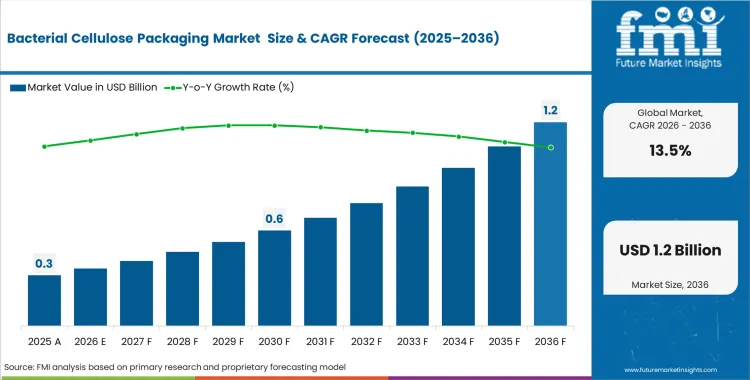
Bacterial Cellulose Packaging Market Definition
The bacterial cellulose packaging market covers packaging films, sheets, composites, and structural forms produced through microbial fermentation using cellulose-synthesizing bacteria. It includes standalone bacterial cellulose films and membranes, composite formats incorporating bacterial cellulose with other biopolymers, and sheet-format packaging materials used in food and beverage, pharmaceutical, cosmetics, and industrial wrapping applications. These materials are valued for their exceptional purity, high crystallinity, superior mechanical strength per unit mass, and compatibility with biodegradable and compostable packaging programs.
Bacterial Cellulose Packaging Market Inclusions
- Sales of bacterial cellulose films, membranes, sheets, and composite packaging materials produced through microbial fermentation routes for commercial packaging applications.
- Revenue from packaging formats incorporating bacterial cellulose as the primary structural or active component in food contact, pharmaceutical, cosmetics, and industrial wrapping end uses.
- All commercial demand across global fermentation and converting networks where bacterial cellulose constitutes the defining functional material in the packaging format.
Bacterial Cellulose Packaging Market Exclusions
- Plant-derived cellulose packaging including wood pulp, cotton linter, and agricultural residue cellulose films and papers that are not produced through bacterial fermentation.
- Chitosan, alginate, starch, and other biopolymer packaging formats that do not incorporate bacterial cellulose as a primary structural component.
- Bacterial cellulose used in medical device, wound care, acoustic membrane, or electronic applications outside commercial packaging functions.
Bacterial Cellulose Packaging Market Research Methodology
This study evaluates the bacterial cellulose packaging market by form, application, and end use industry using 2025 as the base year and 2026 to 2036 as the forecast period in value terms. Evidence inputs include European packaging regulation, biotechnology industry investment data, peer-reviewed literature on bacterial cellulose fermentation and film properties, startup and corporate technology disclosures, and first-party documentation from bacterial cellulose producers and packaging developers. Market estimates are built through triangulation of fermentation scale-up economics, premium packaging substitution rates, brand co-development activity, and the pace of food-contact and pharmaceutical regulatory clearance for fermented cellulose materials.
Key Drivers, Restraints, and Trends in Bacterial Cellulose Packaging market
Drivers
Bacterial cellulose packaging is advancing because premium brands and pharmaceutical packagers are looking for bio-based materials that deliver engineering-grade performance alongside verifiable sustainability credentials. The category benefits from bacterial cellulose's uniquely high crystallinity, tensile strength, and water retention relative to plant-derived alternatives, which allows it to compete with polymer films on performance terms in select high-value applications. Investment in industrial fermentation is also lowering the cost curve gradually, while luxury brand interest in novel packaging narratives is creating a premium price umbrella that supports commercialization in cosmetics, specialty food, and pharmaceutical packaging before broader adoption is possible.
Restraints
The market remains constrained by the fundamental economics of fermentation. Bacterial cellulose production is inherently slower and more energy-intensive than mechanical or chemical pulping of plant biomass, keeping cost per unit significantly above conventional packaging alternatives at comparable volumes. The converter ecosystem is narrow because only a limited number of producers can supply consistent bacterial cellulose at packaging-relevant volumes and specifications. Mechanical property gaps also require composite engineering to build sufficient structural strength and moisture resistance for packaging line compatibility, adding formulation complexity and qualification time.
Trends
The market is moving toward composite formats that combine bacterial cellulose with PLA, starch, or chitosan to build structural performance without losing biodegradability. Consumer and startup interest in kombucha culture-derived cellulose is generating visible brand narratives around circular bioprocessing that appeal to premium food and cosmetics buyers. Electronics packaging is also emerging as a secondary development track because the purity and dimensional stability of bacterial cellulose attract interest for precision inserts and protective liners where contamination control matters. Fermentation technology companies are increasingly pursuing co-development partnerships with packaging brands to share qualification costs and accelerate the pathway from pilot to commercial supply.
Segmental Analysis
Bacterial Cellulose Packaging market Analysis by Product Type
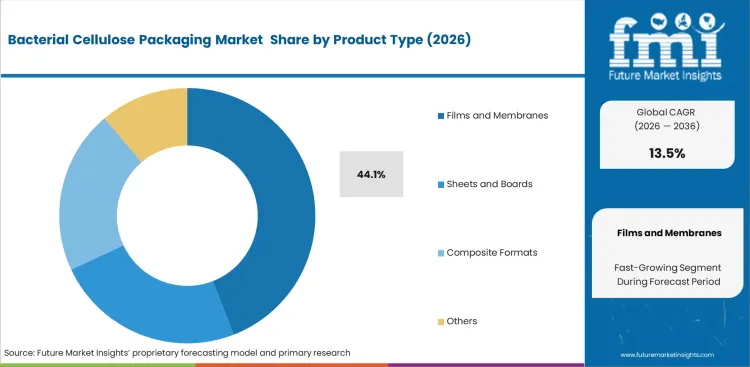
Films and membranes are projected to hold 44.1% of market value in 2026. They offer the highest surface-to-volume ratio and are the most directly substitutable form for conventional polymer films in food wrapping, pharmaceutical blister backing, and cosmetic sachet applications. Thin-film forming is also the most technically mature bacterial cellulose fabrication route, which means converter know-how and tooling investment are more advanced here than in sheet or composite formats. The segment benefits from recurring qualification interest among premium food and cosmetics brands that want verifiable bio-based film alternatives to existing laminate structures.
Bacterial Cellulose Packaging market Analysis by End Use Industry
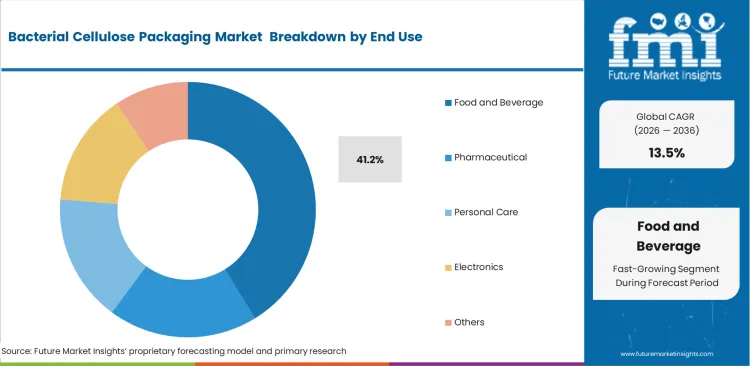
Food and beverage is expected to account for 41.2% of demand in 2026. Oxygen barrier performance, grease resistance, and compostability credentials are creating qualification interest among premium food brands that face regulatory pressure on fossil-based packaging in the European Union and parts of Asia Pacific. The segment benefits from active consumer preference for packaging that communicates natural ingredient and bio-based material credentials, which supports a premium price for bacterial cellulose-based formats in specialty and health food categories.
Competitive Aligners for Market Players
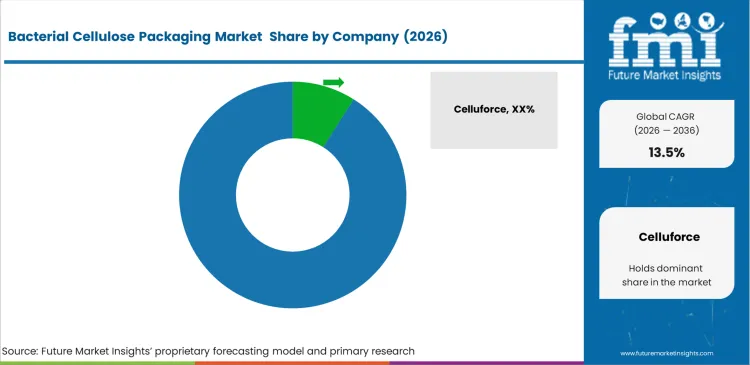
Competitive advantage in bacterial cellulose packaging is forming around fermentation process control, composite formulation capability, and the ability to co-develop packaging solutions with brand partners willing to share qualification investment. Generic bio-based claims will not sustain premium pricing as the market matures. Buyers will increasingly judge suppliers on batch consistency, food-contact documentation, film mechanical performance on converting lines, and total cost transparency across the fermentation-to-packaging supply chain. Early movers who build application credibility in specific food or cosmetics categories will define the commercial benchmarks that later entrants must match.
Key Players in Bacterial Cellulose Packaging market
- Celluforce
- Nanollose
- Polybion
- Biocouture
- Modern Meadow
- Ecovative Design
- Scoby Tech
- Mogu S.r.l.
- Nadura
- Suzanne Lee (Biocouture)
Strategic Outlook by FMI on Bacterial Cellulose Packaging market
FMI sees bacterial cellulose packaging as the highest-CAGR segment in bio-based packaging materials through 2036. Commercial growth will be paced by fermentation cost reduction, composite engineering maturity, and brand co-investment in qualification programs that move bacterial cellulose from pilot curiosity to scalable supply. Producers that build consistent fermentation yield, application engineering depth, and regulatory documentation capability will capture the premium value that this category can sustain.
Scope of the Report
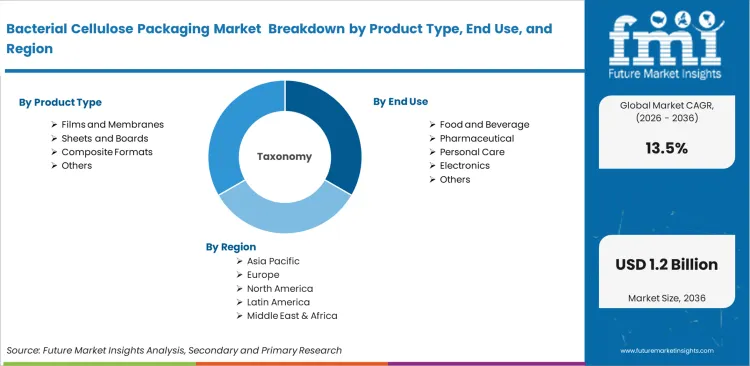
| Market Value | USD 0.2 billion in 2025 to USD 1.0 billion by 2036 |
|---|---|
| CAGR | 13.5% from 2026 to 2036 |
| Base Year | 2025 |
| Forecast Period | 2026 to 2036 |
| Form Segmentation | Films and Membranes, Sheets and Boards, Composite Formats, Others |
| Application Segmentation | Food and Beverage Packaging, Pharmaceutical Packaging, Cosmetics and Personal Care Packaging, Industrial Wrapping, Others |
| End Use Industry Segmentation | Food and Beverage, Pharmaceutical, Personal Care, Electronics, Others |
| Regions Covered | North America, Latin America, Western Europe, Eastern Europe, East Asia, South Asia and Pacific, Middle East and Africa |
Bibliography
- Regulation (EU) 2025/40 on packaging and packaging waste.
- Klemm, D. et al. (2011). Nanocelluloses: A New Family of Nature-Based Materials. Angewandte Chemie International Edition. DOI: 10.1002/anie.201001273.
- Cacicedo, M. L. et al. (2016). Progress in bacterial cellulose matrices for biotechnological applications. Bioresource Technology.
- Shi, Z. et al. (2014). Utilization of bacterial cellulose in food. Food Hydrocolloids.
Frequently Asked Questions
What is the size and growth rate of the bacterial cellulose packaging market?
The market was valued at USD 0.2 billion in 2025 and is forecast to reach USD 1.0 billion by 2036, growing at a CAGR of 13.5%. It is among the fastest-growing segments in bio-based packaging materials globally.
Why is bacterial cellulose more expensive than plant-derived cellulose packaging?
Bacterial fermentation is slower and more energy-intensive than mechanical or chemical pulping of plant biomass. Controlled fermentation, purification, and drying steps add cost that currently keeps price per unit well above plant-derived alternatives at comparable volumes.
Which industries are the earliest commercial adopters of bacterial cellulose packaging?
Food and beverage brands, premium cosmetics companies, and pharmaceutical packagers are the most active early adopters, driven by sustainability mandates, active consumer preference for bio-based materials, and the need for chemically inert packaging.
What is holding back broader market adoption right now?
The combination of high unit cost, a narrow supplier base capable of consistent packaging-grade supply, and the need for composite formulation to meet mechanical and moisture-resistance standards is slowing the transition from pilot programs to scaled purchasing.
How does bacterial cellulose compare to plant cellulose in packaging performance?
Bacterial cellulose offers higher purity, crystallinity, and water retention than plant-derived cellulose, giving it superior barrier and tensile properties per unit mass. This performance advantage comes at significantly higher cost, which currently restricts it to premium applications.
Preview the report firsthand - request a free sample
Get SampleGet the brochure for pricing and purchase details.
Get PDFTable of Content
- Executive Summary
- Global Market Outlook
- Demand-side Trends
- Supply-side Trends
- Technology Roadmap Analysis
- Analysis and Recommendations
- Market Overview
- Market Coverage / Taxonomy
- Market Definition / Scope / Limitations
- Research Methodology
- Chapter Orientation
- Analytical Lens and Working Hypotheses
- Market Structure, Signals, and Trend Drivers
- Benchmarking and Cross-market Comparability
- Market Sizing, Forecasting, and Opportunity Mapping
- Research Design and Evidence Framework
- Desk Research Programme (Secondary Evidence)
- Company Annual and Sustainability Reports
- Peer-reviewed Journals and Academic Literature
- Corporate Websites, Product Literature, and Technical Notes
- Earnings Decks and Investor Briefings
- Statutory Filings and Regulatory Disclosures
- Technical White Papers and Standards Notes
- Additional Desk Sources
- Expert Input and Fieldwork (Primary Evidence)
- Primary Modes
- Qualitative Interviews and Expert Elicitation
- Quantitative Surveys and Structured Data Capture
- Blended Approach
- Why Primary Evidence is Used
- Field Techniques
- Interviews
- Surveys
- Focus Groups
- Observational and In-context Research
- Social and Community Interactions
- Stakeholder Universe Engaged
- C-suite Leaders
- Board Members
- Presidents and Vice Presidents
- R&D and Innovation Heads
- Technical Specialists
- Domain Subject-matter Experts
- Scientists
- Physicians and Other Healthcare Professionals
- Governance, Ethics, and Data Stewardship
- Research Ethics
- Data Integrity and Handling
- Primary Modes
- Tooling, Models, and Reference Databases
- Desk Research Programme (Secondary Evidence)
- Data Engineering and Model Build
- Data Acquisition and Ingestion
- Cleaning, Normalisation, and Verification
- Synthesis, Triangulation, and Analysis
- Quality Assurance and Audit Trail
- Market Background
- Market Dynamics
- Drivers
- Restraints
- Opportunity
- Trends
- Scenario Forecast
- Demand in Optimistic Scenario
- Demand in Likely Scenario
- Demand in Conservative Scenario
- Opportunity Map Analysis
- Product Life Cycle Analysis
- Supply Chain Analysis
- Investment Feasibility Matrix
- Value Chain Analysis
- PESTLE and Porter’s Analysis
- Regulatory Landscape
- Regional Parent Market Outlook
- Production and Consumption Statistics
- Import and Export Statistics
- Market Dynamics
- Global Market Analysis 2021 to 2025 and Forecast, 2026 to 2036
- Historical Market Size Value (USD Million) Analysis, 2021 to 2025
- Current and Future Market Size Value (USD Million) Projections, 2026 to 2036
- Y-o-Y Growth Trend Analysis
- Absolute $ Opportunity Analysis
- Global Market Pricing Analysis 2021 to 2025 and Forecast 2026 to 2036
- Global Market Analysis 2021 to 2025 and Forecast 2026 to 2036, By Product Type
- Introduction / Key Findings
- Historical Market Size Value (USD Million) Analysis By Product Type , 2021 to 2025
- Current and Future Market Size Value (USD Million) Analysis and Forecast By Product Type , 2026 to 2036
- Films and Membranes
- Sheets and Boards
- Composite Formats
- Others
- Films and Membranes
- Y-o-Y Growth Trend Analysis By Product Type , 2021 to 2025
- Absolute $ Opportunity Analysis By Product Type , 2026 to 2036
- Global Market Analysis 2021 to 2025 and Forecast 2026 to 2036, By End Use
- Introduction / Key Findings
- Historical Market Size Value (USD Million) Analysis By End Use, 2021 to 2025
- Current and Future Market Size Value (USD Million) Analysis and Forecast By End Use, 2026 to 2036
- Food and Beverage
- Pharmaceutical
- Personal Care
- Electronics
- Others
- Food and Beverage
- Y-o-Y Growth Trend Analysis By End Use, 2021 to 2025
- Absolute $ Opportunity Analysis By End Use, 2026 to 2036
- Global Market Analysis 2021 to 2025 and Forecast 2026 to 2036, By Region
- Introduction
- Historical Market Size Value (USD Million) Analysis By Region, 2021 to 2025
- Current Market Size Value (USD Million) Analysis and Forecast By Region, 2026 to 2036
- North America
- Latin America
- Western Europe
- Eastern Europe
- East Asia
- South Asia and Pacific
- Middle East & Africa
- Market Attractiveness Analysis By Region
- North America Market Analysis 2021 to 2025 and Forecast 2026 to 2036, By Country
- Historical Market Size Value (USD Million) Trend Analysis By Market Taxonomy, 2021 to 2025
- Market Size Value (USD Million) Forecast By Market Taxonomy, 2026 to 2036
- By Country
- USA
- Canada
- Mexico
- By Product Type
- By End Use
- By Country
- Market Attractiveness Analysis
- By Country
- By Product Type
- By End Use
- Key Takeaways
- Latin America Market Analysis 2021 to 2025 and Forecast 2026 to 2036, By Country
- Historical Market Size Value (USD Million) Trend Analysis By Market Taxonomy, 2021 to 2025
- Market Size Value (USD Million) Forecast By Market Taxonomy, 2026 to 2036
- By Country
- Brazil
- Chile
- Rest of Latin America
- By Product Type
- By End Use
- By Country
- Market Attractiveness Analysis
- By Country
- By Product Type
- By End Use
- Key Takeaways
- Western Europe Market Analysis 2021 to 2025 and Forecast 2026 to 2036, By Country
- Historical Market Size Value (USD Million) Trend Analysis By Market Taxonomy, 2021 to 2025
- Market Size Value (USD Million) Forecast By Market Taxonomy, 2026 to 2036
- By Country
- Germany
- UK
- Italy
- Spain
- France
- Nordic
- BENELUX
- Rest of Western Europe
- By Product Type
- By End Use
- By Country
- Market Attractiveness Analysis
- By Country
- By Product Type
- By End Use
- Key Takeaways
- Eastern Europe Market Analysis 2021 to 2025 and Forecast 2026 to 2036, By Country
- Historical Market Size Value (USD Million) Trend Analysis By Market Taxonomy, 2021 to 2025
- Market Size Value (USD Million) Forecast By Market Taxonomy, 2026 to 2036
- By Country
- Russia
- Poland
- Hungary
- Balkan & Baltic
- Rest of Eastern Europe
- By Product Type
- By End Use
- By Country
- Market Attractiveness Analysis
- By Country
- By Product Type
- By End Use
- Key Takeaways
- East Asia Market Analysis 2021 to 2025 and Forecast 2026 to 2036, By Country
- Historical Market Size Value (USD Million) Trend Analysis By Market Taxonomy, 2021 to 2025
- Market Size Value (USD Million) Forecast By Market Taxonomy, 2026 to 2036
- By Country
- China
- Japan
- South Korea
- By Product Type
- By End Use
- By Country
- Market Attractiveness Analysis
- By Country
- By Product Type
- By End Use
- Key Takeaways
- South Asia and Pacific Market Analysis 2021 to 2025 and Forecast 2026 to 2036, By Country
- Historical Market Size Value (USD Million) Trend Analysis By Market Taxonomy, 2021 to 2025
- Market Size Value (USD Million) Forecast By Market Taxonomy, 2026 to 2036
- By Country
- India
- ASEAN
- Australia & New Zealand
- Rest of South Asia and Pacific
- By Product Type
- By End Use
- By Country
- Market Attractiveness Analysis
- By Country
- By Product Type
- By End Use
- Key Takeaways
- Middle East & Africa Market Analysis 2021 to 2025 and Forecast 2026 to 2036, By Country
- Historical Market Size Value (USD Million) Trend Analysis By Market Taxonomy, 2021 to 2025
- Market Size Value (USD Million) Forecast By Market Taxonomy, 2026 to 2036
- By Country
- Kingdom of Saudi Arabia
- Other GCC Countries
- Turkiye
- South Africa
- Other African Union
- Rest of Middle East & Africa
- By Product Type
- By End Use
- By Country
- Market Attractiveness Analysis
- By Country
- By Product Type
- By End Use
- Key Takeaways
- Key Countries Market Analysis
- USA
- Pricing Analysis
- Market Share Analysis, 2025
- By Product Type
- By End Use
- Canada
- Pricing Analysis
- Market Share Analysis, 2025
- By Product Type
- By End Use
- Mexico
- Pricing Analysis
- Market Share Analysis, 2025
- By Product Type
- By End Use
- Brazil
- Pricing Analysis
- Market Share Analysis, 2025
- By Product Type
- By End Use
- Chile
- Pricing Analysis
- Market Share Analysis, 2025
- By Product Type
- By End Use
- Germany
- Pricing Analysis
- Market Share Analysis, 2025
- By Product Type
- By End Use
- UK
- Pricing Analysis
- Market Share Analysis, 2025
- By Product Type
- By End Use
- Italy
- Pricing Analysis
- Market Share Analysis, 2025
- By Product Type
- By End Use
- Spain
- Pricing Analysis
- Market Share Analysis, 2025
- By Product Type
- By End Use
- France
- Pricing Analysis
- Market Share Analysis, 2025
- By Product Type
- By End Use
- India
- Pricing Analysis
- Market Share Analysis, 2025
- By Product Type
- By End Use
- ASEAN
- Pricing Analysis
- Market Share Analysis, 2025
- By Product Type
- By End Use
- Australia & New Zealand
- Pricing Analysis
- Market Share Analysis, 2025
- By Product Type
- By End Use
- China
- Pricing Analysis
- Market Share Analysis, 2025
- By Product Type
- By End Use
- Japan
- Pricing Analysis
- Market Share Analysis, 2025
- By Product Type
- By End Use
- South Korea
- Pricing Analysis
- Market Share Analysis, 2025
- By Product Type
- By End Use
- Russia
- Pricing Analysis
- Market Share Analysis, 2025
- By Product Type
- By End Use
- Poland
- Pricing Analysis
- Market Share Analysis, 2025
- By Product Type
- By End Use
- Hungary
- Pricing Analysis
- Market Share Analysis, 2025
- By Product Type
- By End Use
- Kingdom of Saudi Arabia
- Pricing Analysis
- Market Share Analysis, 2025
- By Product Type
- By End Use
- Turkiye
- Pricing Analysis
- Market Share Analysis, 2025
- By Product Type
- By End Use
- South Africa
- Pricing Analysis
- Market Share Analysis, 2025
- By Product Type
- By End Use
- USA
- Market Structure Analysis
- Competition Dashboard
- Competition Benchmarking
- Market Share Analysis of Top Players
- By Regional
- By Product Type
- By End Use
- Competition Analysis
- Competition Deep Dive
- Celluforce
- Overview
- Product Portfolio
- Profitability by Market Segments (Product/Age /Sales Channel/Region)
- Sales Footprint
- Strategy Overview
- Marketing Strategy
- Product Strategy
- Channel Strategy
- Nanollose
- Polybion
- Biocouture
- Modern Meadow
- Ecovative Design
- Scoby Tech
- Mogu S.r.l.
- Nadura
- Suzanne Lee (Biocouture)
- Celluforce
- Competition Deep Dive
- Assumptions & Acronyms Used


