

- Market Size (2026)
- USD 154.7 Mn
- Forecast (2036)
- USD 298.7 Mn
- CAGR (2026 to 2036)
- 6.8%
How big is Bamboo Fiber for Bakery Market in 2026?
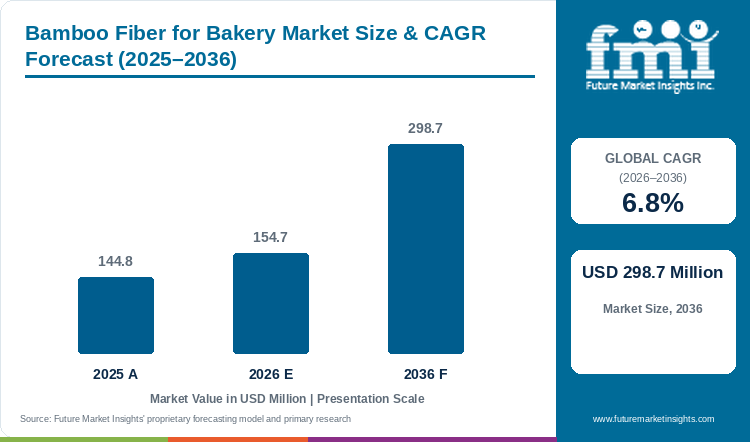
Assessed at USD 144.8 million in 2025 and progressing to USD 154.7 million in 2026, the global bamboo fiber for bakery market valuation is on course to reach USD 298.7 million by 2036, supported by a forecast-period CAGR of 6.8%.
Consumer demand for low-net-carbohydrate ketogenic breads and gluten-free pan loaves has created a structural formulation challenge for industrial bakeries. Removing wheat starch and gluten weakens gas-cell walls during proofing, which causes baked loaves to keyhole or collapse upon cooling. This generates a need for neutral insoluble cellulose fibers that reinforce dough structure while binding free water without gummy viscosity. For instance, in January 2025, experimental baking trials published in Processes by researchers at the University of Life Sciences in Lublin demonstrated that replacing 2% to 10% of flour weight with insoluble bamboo cellulose directly increases dough water absorption and stabilizes gluten-free loaf volume [1]. Owing to these rheological advantages, industrial bakeries place Fine milled grades at a projected 43.8% of type demand in 2026 when formulating pan loaves with functional dietary fibres. Global bamboo fiber for bakery market value moved from a 2025 baseline of USD 144.8 million to USD 154.7 million in 2026 and are forecast to reach USD 298.7 million by 2036 at a 6.8% CAGR, adding USD 144.0 million in ten-year market value. However, federal FDA restrictions on isolated carbohydrate nutrition claims and pilot-oven farinograph retesting continue to lengthen mill qualification cycles.
Key Market Trends & Insights
- By type: Particle lengths between 40 and 90 micrometers enable Fine milled bamboo cellulose to account for a projected 43.8% in 2026 by dispersing evenly inside yeast-leavened doughs.
- By form: Powder / dry grades are estimated to hold 68.4% in 2026 owing to pneumatic flour-handling compatibility and 24-month ambient storage stability.
- By application: Continuous daily tunnel-oven production of wrapped sandwich loaves and ketogenic buns positions Bread & rolls at an expected 39.2% in 2026.
- By claim: Conventional bamboo cellulose is forecast to secure 54.6% in 2026 because FSSC 22000 and Food Chemicals Codex purity standards satisfy mainstream bread specifications without organic premiums.
- By sales channel: Direct to industrial bakeries is anticipated to command 57.5% in 2026 through multi-plant supply tenders and joint farinograph calibration.
Regional Highlights
- Ketogenic baking acceleration: Commercial demand in the USA expands at a leading 7.6% CAGR through 2036 as national bread brands replace digestible wheat starch in low-net-carb loaves and tortillas.
- European and Asian mill adoption: Domestic cellulose processing pushes Germany at a 7.3% CAGR ahead of the UK (7.0%) and South Korea (6.7%), whereas industrial flatbread trials in Saudi Arabia progress at 5.3% per year.
Market Size & Forecast
Table 1: Market Size and Forecast for the Bamboo Fiber for Bakery Market (USD million and CAGR percentage), 2025 to 2036
| Metric | Value |
|---|---|
| 2025 Market Size | USD 144.8 million |
| Estimated Market Size in 2026 | USD 154.7 million |
| Projected Market Size by 2036 | USD 298.7 million |
| CAGR, 2026 to 2036 | 6.8% |
| Added Revenue, 2026 to 2036 | USD 144.0 million |
High-speed rotary dough dividers and wafer baking plates suffer from severe operational downtime when soluble hydrocolloids make doughs sticky or overly viscous. Unlike soluble gums that form heavy gels, purified moso bamboo culm cellulose (>90% insoluble dietary fiber) binds 5.0 to 7.0 grams of water per gram of dry powder through capillary lumen action, keeping dough surfaces dry and machinable. As a matter of fact, June 2025 response-surface baking experiments published in Foods by researchers at University College Cork confirmed that combining insoluble cellulose and oat fibers with soluble fibers elevated total dietary fiber in white wheat bread to 10.72 grams per 100 grams while maintaining loaf specific volume at 4.2 mL/g [2]. Consequently, commercial baking groups co-process neutral bamboo fibrils with food dietary fibers to cut wafer sheet breakage and retard sandwich-loaf staling.
Industrial Tonnage and Flour-Replacement Sizing
Table 2: Industrial Tonnage and Flour-Replacement Sizing for the Bamboo Fiber for Bakery Market (USD million and operational ranges), 2025 to 2036
| Metric | 2025 | 2026 | 2036 |
|---|---|---|---|
| Market size (USD million) | 144.8 | 154.7 | 298.7 |
| Food-grade bamboo fiber bakery volume (thousand MT) | 45.4 to 48.2 | 48.1 to 51.2 | 84.5 to 91.0 |
| Finished bakery dough fortified annually (million MT) | 1.1 to 1.4 | 1.2 to 1.5 | 2.1 to 2.6 |
| Average B2B contract price per kilogram (USD) | 3.0 to 3.2 | 3.0 to 3.3 | 3.3 to 3.5 |
Operational note: Tonnage and dough-fortification ranges reconcile global food-grade bamboo cellulose extraction capacity against 2.5% to 6.0% flour-weight inclusion rates across pan bread and keto tortillas as well as anti-breakage wafer sheets.
Seasonal protein fluctuations in incoming wheat harvests frequently disrupt dough water absorption and mixing arrival times in automated plant bakeries. When flour hydration shifts between lots, high-speed pan-bread lines experience slack dough handling and uneven loaf height. To eliminate this production variability, cereal chemists test insoluble cellulose shipments on Brabender farinograph curves and pre-blend 40-micrometer bamboo grades into commercial bakery mixes so automated lines maintain uniform water absorption year-round.
Per Capita & Industrial Bakery Plant Sizing
Table 3: Per Capita and Plant Spending Indicators for the Bamboo Fiber for Bakery Market (USD and percentages), 2025 to 2036
| Metric | 2025 | 2026 | 2036 |
|---|---|---|---|
| World population (billion) | 8.2 | 8.3 | 9.0 |
| Spend per 1,000 people (USD) | 17.7 | 18.6 | 33.2 |
| Annual bamboo fiber spend per qualified bakery plant (USD) | 16,800 to 19,200 | 17,600 to 20,100 | 28,400 to 32,500 |
| Direct industrial contract procurement share (%) | 55.0% to 58.0% | 56.0% to 59.0% | 61.0% to 65.0% |
Table 4: Plant & Channel Spending Indicators for the Bamboo Fiber for Bakery Market (USD and percentages), 2026
| Metric | Value | Institutional Reference Basis |
|---|---|---|
| Market size, 2026 | USD 154.7 million | 2026 global B2B ingredient revenue baseline |
| Qualified industrial & specialty bakery plants | 8,250 facilities | Global commercial baking & premix plant base |
| Average annual bamboo fiber spend per plant | USD 18,751.5 | Annualized B2B ingredient procurement per facility |
| Direct industrial bakery channel revenue, 2026 | USD 89.0 million | 57.5% sales-channel segment allocation |
Consumer rejection of dark, bitter whole-wheat bran specks in soft white sandwich bread and sponge cakes has pushed R&D teams toward decolorized plant fibers. Traditional cereal brans contain phytic acid and polyphenols that darken crumb color and leave an astringent aftertaste. By contrast, delignified bamboo cellulose achieves L* whiteness values above 92 with zero bitter off-notes, allowing plant procurement officers to benchmark its per-ton water-binding yield favorably against microcrystalline cellulose gel and oat hull fibers during annual contract tenders.
Analyst Perspective
"Commercial bakeries specify bamboo fiber not as a generic filler, but as a precision capillary water-binding agent that prevents keto loaf collapse and wafer sheet checking at high line speeds. Ingredient processors that pair tight 40-to-90-micrometer particle grading with validated farinograph hydration curves and EU/FDA regulatory dossiers win multi-year industrial mill contracts."
- Nandini Roy Choudhury, Principal Consultant, Future Market Insights.
How is the bamboo fiber for bakery market segmented?
The bamboo fiber for bakery market is segmented by type, form, application, claim, and sales channel. In 2026, fine milled accounts for 43.8%, powder / dry for 68.4%, bread & rolls for 39.2%, conventional for 54.6%, and direct to industrial bakeries for 57.5%.
By type: Fine milled; coarse; micronized; and organic.
By form: Powder / dry; liquid; paste / semi-solid; and granules / pieces.
By application: Bread & rolls; cakes & muffins; biscuits & cookies; viennoiserie & pastry; and other bakery & snacks.
By claim: Conventional; clean label; organic; and non-GMO / identity preserved.
By sales channel: Direct to industrial bakeries; ingredient distributors; foodservice & artisan supply; and online B2B.
Why does Fine milled lead the type category?
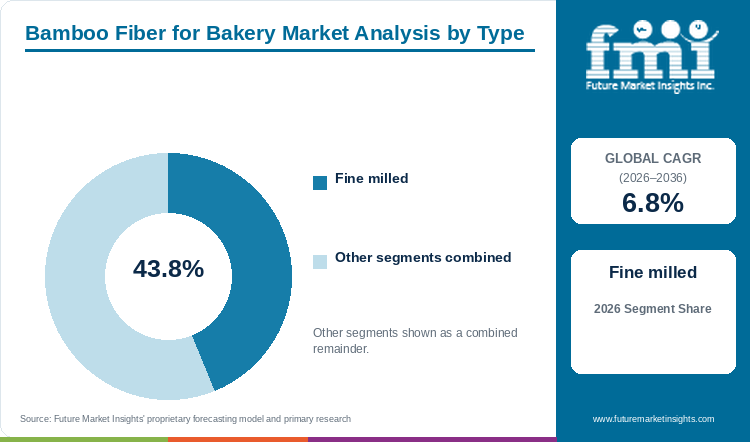
Fine milled bamboo cellulose is projected to account for 43.8% of the type category in 2026 by retaining 6.0 grams of water per gram without gritty crumb mouthfeel.
Table 5: Type Share for the Bamboo Fiber for Bakery Market (percentage share), 2026
| Type | Share (2026) |
|---|---|
| Fine milled | 43.8% |
| Other Segments Combined | 56.2%* |
| Total | 100.0% |
*Calculated as the balance remaining after deducting the leading segment's reported share from 100.0%.
Table 6: Type Leadership and Market Growth for the Bamboo Fiber for Bakery Market (segment and CAGR percentage), 2026 to 2036
| Metric | Value |
|---|---|
| Global CAGR (2026 to 2036) | 6.8% |
| Leading Segment | Fine milled |
Capillary water retention balanced against smooth oral texture determines fiber particle-length selection in commercial bread doughs. Industrial R&D teams specify 40-to-90-micrometer fine milled grades (such as VITACEL BAF 90 and SANACEL bamboo 90) because sub-25-micrometer micronized powders lose internal lumen water capacity while coarse 200-micrometer fibers shear delicate gluten films. Close alignment with wheat flour granulation allows fine bamboo cellulose to blend evenly with insoluble dietary fiber concentrates in spiral dough mixers.
- Adoption dynamics across commercial pan-bread plants give Fine milled a projected 43.8% share in 2026 by boosting dough yield without chalky crumb texture.
- For instance, a November 2025 study in Nutrients analyzing 58 commercial bread samples on PubMed Central found that standard white wheat bread averaged just 2.9 grams of dietary fiber per 100 grams versus 7.5 grams in wholegrain loaves, driving white fine-milled fiber fortification [3].
What sustains Powder / dry within the form category?
Powder / dry grades are estimated to hold 68.4% of the form category in 2026 through automated flour-silo dosing and 24-month ambient stability.
Automated pneumatic flour conveying and dry-premix blending economics explain why dry cellulose powders dominate industrial bakery procurement. Purified bamboo cellulose contains over 90% water-insoluble alpha-cellulose and hemicellulose, allowing mills to ship free-flowing white powder under 8% moisture in 20-kilogram multi-wall bags and bulk tote sacks. As a result, dry powders meter directly through loss-in-weight screw feeders into plant-based fiber premixes prior to liquid addition, avoiding the preservative and water-freight costs of liquid or paste / semi-solid dispersions.
- Volume realization across premix blenders keeps Powder / dry at an estimated 68.4% of form demand in 2026 due to zero water-freight weight and rapid dry dispersion.
- As a matter of fact, in January 2025, gluten-free baking experiments in Processes confirmed that dry bamboo fiber powder blends directly into rice and tapioca starch bases before dough hydration [1].
Why do Bread & rolls anchor the application category?
Bread & rolls are expected to represent 39.2% of application demand in 2026 owing to continuous daily pan-bread output and keto sandwich-bun reformulation.
High daily tunnel-oven tonnage and strict supermarket shelf-softness targets make yeast-leavened loaves and sandwich buns the primary volume outlet for bamboo cellulose. Wrapped toast bread and ketogenic loaf bakeries run 24-hour lines where a 2.5% to 4.5% bamboo fiber dosage locks in free water and slows amylopectin retrogradation over seven-day retail shelf cycles. In low-carb and gluten-free doughs, three-dimensional cellulose fibrils reinforce gas-cell walls in combination with bread improvers to prevent post-bake side-wall collapse.
- Industrial consumption analysis places Bread & rolls at an expected 39.2% of the application category in 2026 on the back of recurring daily pan-bread and keto bun tonnage.
- For example, in May 2025, a food-engineering review in Foods confirmed that insoluble dietary fibers function as weak-gel rheological modifiers and clean-label structuring agents that strengthen dough networks [4].
How does Conventional retain the leading claim position?
Conventional grades are forecast to secure 54.6% of the claim category in 2026 through wild-harvested moso bamboo economics and Food Chemicals Codex purity.
Raw material forestry economics and strict cost ceilings in mainstream grocery bread aisles favor standard food-grade bamboo cellulose over organic-certified lots. Commercial bakeries procure conventional bamboo fiber audited under FSSC 22000 and Food Chemicals Codex (FCC) protocols because moso bamboo forests grow naturally without synthetic agrochemicals, making paid organic certification unnecessary for standard bread labels. Every conventional batch still undergoes heavy-metal and microbiological testing along with AOAC 991.43 dietary-fiber verification.
- Contract purchasing patterns assign Conventional a forecast 54.6% of claim volume in 2026 because standard food-grade pricing protects gross margins in high-volume pan loaves and tortillas.
- In addition to this, in January 2025, U.S. Food and Drug Administration food-labeling guidance maintained strict physiological-benefit standards for isolated carbohydrate claims, leading bakers in the USA to specify conventional bamboo cellulose for net-carb reduction and moisture retention [5].
What makes Direct to industrial bakeries the largest sales channel?
Direct to industrial bakeries is anticipated to command 57.5% of sales channel turnover in 2026 through plant-level farinograph qualification and full-container contracts.
Need for customized particle-size grading and joint pilot-bakery rheological calibration drives direct contracting between primary cellulose mills and multi-plant baking groups. Large commercial bakeries bypass general wholesale brokers to lock in narrow micron tolerances and annual container-load pricing directly with fiber processors. Direct technical service teams then calibrate dough water absorption on the customer's exact wheat-flour stream before commercial line rollout.
- B2B procurement behavior gives Direct to industrial bakeries an anticipated 57.5% of sales channel revenue in 2026 via multi-year container tenders and custom granulometry tolerances.
- For instance, a February 2026 consumer bread-labeling study in Nutrients covering 289 respondents demonstrated that perceived taste deterioration increases shopper scrutiny of fiber labels by 16.5%, reinforcing direct technical collaboration between fiber mills and plant bakeries [6].
What are the drivers, restraints, and opportunities in the bamboo fiber for bakery market?
National 30-gram daily fiber targets and ketogenic bread reformulation accelerate bamboo cellulose demand, whereas gluten dilution above 5% dosage and FDA/EU regulatory rules restrain rapid substitution and co-processed hydrocolloid blends unlock premium margins.
- Driver: Public-health 30-gram daily fiber benchmarks paired with low-net-carb keto bread and tortilla production expand insoluble bamboo cellulose inclusion.
- Restraint: Specific loaf-volume compression above 5% flour replacement and divergent FDA 21 CFR 101.9 versus EU Novel Food rules slow formula switches.
- Opportunity: Dust-free agglomerated bamboo granules / pieces and co-processed enzyme-hydrocolloid blends cut plant qualification time and wafer breakage.
Growth Analysis and Future Potential: Qualitative Demand Catalysts
Persistent population dietary-fiber deficits across Western Europe and North America are pressuring commercial bakeries to fortify everyday white sandwich loaves and morning goods. Specifically, an October 2026 attaché study published by the USDA Foreign Agricultural Service covering the USD 343 billion grocery sector in the UK highlighted sustained retailer investment in health and free-from bakery lines [7]. To meet these retailer nutrition targets without darkening crumb color or altering yeast fermentation, formulators combine insoluble bamboo fibrils with prebiotic fiber in soft bread doughs. Unlike cereal brans that impart bitter phenolic off-notes, delignified bamboo cellulose remains odorless and bright white at 3% to 5% dosage.
Risk Assessment of the Bamboo Fiber for Bakery Market: Operational and Formulation Friction
Competitive water stripping from gluten proteins at elevated dosages and cross-border regulatory divergence create technical hurdles for bakery R&D teams. Dosing insoluble bamboo fiber above 5% of flour weight in yeast-leavened wheat dough starves gliadin and glutenin hydration and compresses baked loaf height. In addition to this rheological ceiling, regulatory treatment differs sharply between Brussels and Washington: the European Commission's Novel Food Status Catalogue updated in February 2025 monitors plant-fiber extraction purity across member states [8], whereas January 2025 U.S. Food and Drug Administration labeling guidance excludes isolated bamboo cellulose from its approved physiological dietary-fiber list for Nutrition Facts gram declarations [5]. Consequently, bakers seeking fiber-gram claims in the USA must blend bamboo cellulose with resistant starch or intact cereal fibers.
Commercial Opportunity Analysis: Formulation Differentiation and Value-Add Formats
Airborne dust reduction in pneumatic flour lines and extended ambient bread freshness represent major value-creation opportunities for specialty fiber suppliers. Cellulose processors capture higher unit margins by supplying narrow-distribution 35-micrometer grades and agglomerated low-dust granules / pieces that pair with psyllium husk and HPMC to stop post-bake keyholing in keto loaves. Ingredient houses also co-blend bamboo fiber with fermented wheat starch and baking enzymes to extend ambient softness. For instance, in July 2025, Manildra Group commercialized its GemMate natural ingredient system to curb bakery food waste and maintain packaged crumb freshness [9].
Bamboo Fiber for Bakery Market by Country (2026 to 2036)
Ten-year national growth rates span from 7.6% CAGR in the USA and 7.3% in Germany to 5.3% in Saudi Arabia. Country adoption patterns track commercial ketogenic bread output and statutory nutrition-claim thresholds along with domestic flour-mill premix integration.
Table 7: Country CAGR and Primary Growth Levers for the Bamboo Fiber for Bakery Market (CAGR percentage and operational drivers), 2026 to 2036
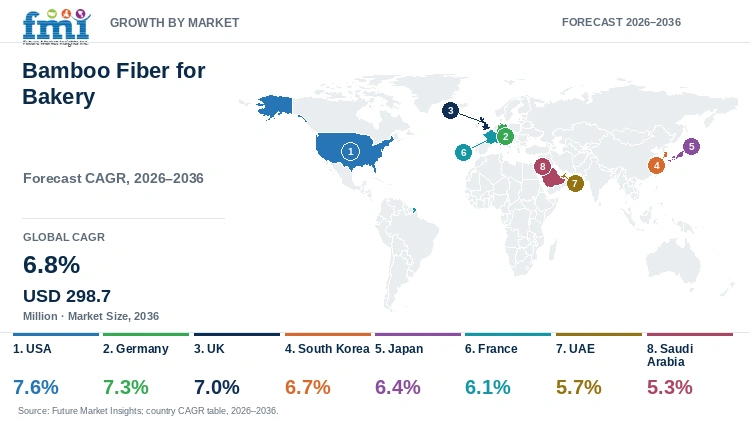
| Country | CAGR (2026 to 2036) | Primary Growth Lever |
|---|---|---|
| USA | 7.6% | Commercial keto bread, low-carb tortilla, and gluten-free loaf structural bulking |
| Germany | 7.3% | Domestic insoluble fiber manufacturing leadership and DGE 30g/day fiber reformulation |
| UK | 7.0% | Private-label health bread reformulation and Chorleywood high-speed bread hydration control |
| South Korea | 6.7% | Low-calorie convenience bakery reformulation and micronized fiber batter dispersion |
| Japan | 6.4% | 2025 Dietary Reference Intakes fiber targets and low-carbohydrate ('teishitsu') soft bakery lines |
| France | 6.1% | Manger Bouger fiber guidance and industrial pain de mie / viennoiserie moisture retention |
| UAE | 5.7% | Expanding UAE grocery retail and hospitality baking with imported functional flour premixes |
| Saudi Arabia | 5.3% | SFDA healthy community nutrition regulations and industrial flatbread/bun conditioning |
Source: Future Market Insights analysis
USA Bamboo Fiber for Bakery Market Outlook (2026 to 2036)
Commercial ketogenic pan breads and low-net-carb flour tortillas as well as gluten-free sandwich buns propel demand for insoluble bamboo cellulose across industrial bakeries in the USA. For instance, in January 2025 Ardent Mills published its CPG, Bread & Bakery Flour Trend Guide highlighting accelerating baker investment in functional and fiber-enriched flour systems across North America [10]. Driven by national bread brands displacing digestible wheat starch with structural cellulose fibrils that prevent keto loaf collapse, bamboo fiber for bakery revenue in the USA is projected to expand at a global-leading 7.6% CAGR through 2036. However, because federal FDA labeling guidance restricts isolated carbohydrate claims [5], formulators in the USA specify bamboo cellulose primarily for net-calorie reduction and slice elasticity.
Key takeaway: In the USA, large-scale keto bread and low-net-carb tortilla production anchors industrial procurement of fine milled bamboo fiber.
Germany Bamboo Fiber for Bakery Market Outlook (2026 to 2036)
Industrial bamboo fiber demand across commercial bakeries in Germany grows at an estimated 7.3% annual rate between 2026 and 2036 across frozen bake-off commissaries and commercial wafer bakeries. Domestic cellulose engineering leaders J. Rettenmaier & Söhne and CFF GmbH make Germany the primary European technical hub for insoluble bakery fiber production and par-baked roll formulation [20]. As a matter of fact, in January 2025, scientific guidance updated by the nutrition authority DGE in Germany recommended a minimum adult intake of 30 grams of dietary fiber per day [11]. In addition to this, September 2026 USDA Foreign Agricultural Service reporting valued retail food sales in Germany at USD 323.8 billion with rising health-conscious private-label demand [12].
Key takeaway: In Germany, domestic insoluble fiber processing expertise and DGE 30-gram daily fiber guidance sustain industrial bake-off adoption.
UK Bamboo Fiber for Bakery Market Outlook (2026 to 2036)
High-speed Chorleywood Bread Process lines across plant bakeries in the UK require rapid mechanical dough development and exact water-absorption control during short three-minute mixing cycles. Plant-bakery expenditure on bamboo fiber in the UK rises at an expected 7.0% annual rate through 2036 across wrapped supermarket sandwich loaves and breakfast crumpets or muffins. According to October 2026 USDA Foreign Agricultural Service analysis of the USD 343 billion grocery market in the UK, private-label lines captured a record 52.2% of spending while health and free-from bakery demand continued to expand [7]. Consequently, plant production managers in the UK dose fine milled bamboo cellulose at 2% to 4% flour weight to eliminate dough stickiness on conical rounders.
Key takeaway: In the UK, high-speed Chorleywood plant bread hydration requirements and private-label health bread reformulation drive direct industrial demand.
South Korea Bamboo Fiber for Bakery Market Outlook (2026 to 2036)
Convenience-store meal replacements and protein-fortified sweet pastries drive bakery reformulation in South Korea around ultra-smooth crumb mouthfeel and reduced net digestible calories. In May 2026, findings from the USDA Foreign Agricultural Service covering food-processing ingredients in South Korea documented heavy processor reliance on imported functional baking inputs across an industry generating over KRW 111.9 trillion (USD 82.1 billion) in annual sales [13]. Because shoppers in South Korea reject gritty bran textures in soft pastries, ingredient distributors import 35-micrometer micronized bamboo grades that disperse invisibly inside high-moisture cake and steamed-bun batters. Supported by convenience-chain health bakery rollouts in Seoul and Gyeonggi, bamboo fiber for bakery demand in South Korea is forecast to grow at a 6.7% annual rate through 2036.
Key takeaway: In South Korea, convenience-store health bakery launches and strict soft-crumb sensory standards favor micronized bamboo fiber.
Japan Bamboo Fiber for Bakery Market Outlook (2026 to 2036)
Mature retail 'teishitsu' (low-carbohydrate) bread aisles and exacting consumer expectations for pillowy shokupan crumb elasticity govern ingredient qualification across commercial bakeries in Japan. Demand for bakery bamboo fiber in Japan is anticipated to register a 6.4% CAGR over 2026 to 2036 across low-carb table rolls and packaged sponge cakes. For instance, July 2025 public-health research published on PubMed Central analyzing the 2025 Dietary Reference Intakes for cohorts in Japan highlighted persistent dietary-fiber inadequacy, encouraging staple bread fortification [14]. However, because coarse insoluble fibrils toughen delicate milk bread in Japan, commercial flour premixers blend ultra-fine 35-micrometer bamboo cellulose with vital wheat gluten and emulsified vegetable oils to preserve soft bite during ambient storage.
Key takeaway: In Japan, 2025 Dietary Reference Intake fiber benchmarks and retail low-carbohydrate shokupan lines support ultra-fine bamboo cellulose adoption.
France Bamboo Fiber for Bakery Market Outlook (2026 to 2036)
Commercial bamboo fiber turnover in bakery applications in France is predicted to rise at a 6.1% compound annual rate from 2026 to 2036 across industrial boulangerie and viennoiserie commissaries. Packaged pain de mie and brioche plants in France structure fiber procurement around fat-and-moisture retention and front-of-pack Nutri-Score optimization. As a matter of fact, in January 2025, Santé publique France's national Manger Bouger nutrition guidance directed consumers in France toward fiber-rich cereal staples while Nutri-Score algorithms reward higher dietary fiber grams per 100 grams of baked product [15]. Consequently, bakery formulators in France benchmark bamboo cellulose against cereal fibers from Limagrain Ingredients [23], selecting purified bamboo grades for white brioche and gluten-free loaves requiring L* whiteness above 92.
Key takeaway: In France, Nutri-Score fiber optimization in packaged pain de mie and brioche drives adoption of high-whiteness bamboo fiber.
UAE Bamboo Fiber for Bakery Market Outlook (2026 to 2036)
Airline flight kitchens and hotel commissaries along with regional flatbread plants make the UAE an import-driven baking hub that procures pre-blended functional flour concentrates from European mills. According to October 2026 data published in the USDA Foreign Agricultural Service UAE Retail Foods Annual, grocery sales exceeded USD 20 billion with consumer-oriented food imports rising 9.3% to USD 17.7 billion [16]. Owing to keto bakery brand expansion and institutional flight-kitchen demand, commercial bamboo fiber sales in the UAE expand at a 5.7% annual rate over the 2026 to 2036 window. In addition to this, April 2026 USDA Foreign Agricultural Service grain and feed assessments confirm rising demand across the UAE for specialty baking inputs shipped through Jebel Ali port [17].
Key takeaway: In the UAE, expanding food-processing infrastructure and hospitality keto bakery demand support functional bamboo fiber premix imports.
Saudi Arabia Bamboo Fiber for Bakery Market Outlook (2026 to 2036)
High-speed samoli roll and packaged pita flatbread bakeries in Riyadh and Jeddah as well as Dammam anchor demand in Saudi Arabia while processors reformulate staple breads under Vision 2030 health initiatives. For instance, in February 2025, Saudi Arabia's SFDA nutrition directorate issued three new community nutrition regulations to promote healthier food formulations and transparent nutrition labeling in commercial food establishments [18]. Imported food-grade bamboo fiber consignments entering Jeddah Islamic Port and Dammam must carry bilingual certificates of analysis verifying heavy-metal limits and AOAC 991.43 dietary fiber purity. Enabled by industrial bakers dosing insoluble cellulose to retard bun staling along hot ambient transport routes, bamboo fiber turnover in Saudi Arabia climbs at a 5.3% annual pace through 2036.
Key takeaway: In Saudi Arabia, SFDA community nutrition reforms and ambient bun anti-staling requirements guide industrial bakery trials of bamboo fiber.
Full report country CAGRs cover: North America; Latin America; Western Europe; Eastern Europe; East Asia; South Asia and Pacific; Middle East and Africa.
Who are the notable companies in the bamboo fiber for bakery market?
J. Rettenmaier & Söhne (JRS), CFF GmbH & Co. KG, InterFiber Sp. z o.o., CreaFill Fibers Corp., Batory Foods, GoodMills Group, Limagrain Ingredients, Ardent Mills, King Arthur Baking Company, and Manildra Group are the notable companies in the bamboo fiber for bakery market.
Supply-chain participation in bakery-grade bamboo fiber brings together primary plant-cellulose extractors and specialty flour millers along with bulk B2B ingredient integrators. Cellulose processors in Germany and Poland as well as the USA run dedicated moso bamboo delignification and air-jet micronization lines (35 to 200 micrometers) with low-dust granulation. Industrial milling groups and B2B ingredient distributors combine bamboo cellulose with hydrocolloids and enzymes or high-fiber cereal flours to deliver ready-to-dose dough systems to commercial bakeries.
- Primary Bamboo Cellulose Fiber Manufacturers: J. Rettenmaier & Söhne (VITACEL Bamboo Fiber) and CFF GmbH & Co. KG (SANACEL bamboo); InterFiber Sp. z o.o. (UNICEL Bamboo Fiber) and CreaFill Fibers Corp. (CreaFibe Bamboo) produce graded food-grade bamboo fibers.
- Functional Bakery Fiber & Milling Innovators: GoodMills Group (GoodMills Innovation) and Limagrain Ingredients; Ardent Mills and Manildra Group engineer multi-fiber baking concentrates and moisture-retention systems.
- B2B Bakery Ingredient & Specialty Mix Channels: Batory Foods and King Arthur Baking Company supply bulk bamboo fiber and gluten-free roll or bun mixes across commercial and specialty channels.
Competitive Benchmarking: Bamboo Fiber for Bakery Market
Table 8: Competitive Benchmarking for the Bamboo Fiber for Bakery Market (qualitative capability ratings), 2026
| Company | Bamboo Fiber Grade Breadth | Bakery Rheology & Premix Fit | Industrial Bakery Channel Access | Geographic Reach |
|---|---|---|---|---|
| J. Rettenmaier & Söhne (JRS) | High | High | High | Europe, North America, Asia-Pacific, and global plants |
| CFF GmbH & Co. KG | High | High | High | Germany, Europe, and international ingredient export |
| InterFiber Sp. z o.o. | High | High | High | Poland, Western Europe, North America, and Asia |
| CreaFill Fibers Corp. | High | Medium | High | USA and North America commercial bakeries |
| Batory Foods | High | High | High | USA nationwide B2B bakery distribution |
| GoodMills Group | Medium | High | High | Germany, Central and Western Europe industrial bakeries |
| Limagrain Ingredients | Medium | High | High | France, UK, and Europe industrial baking accounts |
| Ardent Mills | Medium | High | High | USA and Canada commercial milling and bakery channels |
| King Arthur Baking Company | Medium | High | Medium | USA specialty retail and gluten-free baking mix channels |
| Manildra Group | Medium | High | High | Australia, USA, and international bakery export |
Evaluation criteria: Tier assignments assess food-grade bamboo cellulose particle-length coverage (35 to 200 micrometers) and pilot-bakery farinograph or ketogenic dough formulation support as well as direct contract supply into industrial bakeries.
Key Developments in the Bamboo Fiber for Bakery Market
- J. Rettenmaier & Söhne (JRS) expanded technical application protocols for its VITACEL BAF Bamboo Fiber grades across Europe and North America gluten-free pan breads and anti-breakage wafer sheets in March 2025 [19].
- Manildra Group commercialized its GemMate clean-label bakery freshness and moisture-retention ingredient system in July 2025 to extend packaged bread shelf life and reduce commercial food waste [9].
- King Arthur Baking Company expanded its gluten-free mix lineup in April 2026 with the launch of Gluten-Free Roll & Bun Mix and Soft Golden Roll & Bun Mix Kit for retail and online channels [22].
Key Players in the Bamboo Fiber for Bakery Market
Primary Bamboo Cellulose Fiber Manufacturers
- J. Rettenmaier & Söhne (JRS)
- CFF GmbH & Co. KG
- InterFiber Sp. z o.o.
- CreaFill Fibers Corp.
Functional Bakery Fiber & Milling Innovators
- GoodMills Group
- Limagrain Ingredients
- Ardent Mills
- Manildra Group
B2B Bakery Ingredient & Specialty Mix Channels
- Batory Foods
- King Arthur Baking Company
Bamboo Fiber for Bakery Market - Report Scope
Table 9: Report Scope for the Bamboo Fiber for Bakery Market (coverage fields and definitions), 2026 to 2036
| Coverage field | Report scope |
|---|---|
| Market breakdown | Type; Form; Application; Claim; Sales Channel |
| Quantitative Units | USD Million |
| Market Definition | Includes B2B supplier revenue from food-grade insoluble bamboo cellulose fiber ingredients sold for commercial, artisanal, and premix bakery production. Category Scope Note: Excludes retail or foodservice sales of finished baked goods (such as challah or Texas toast), non-bamboo dietary fibers (wheat, oat, pea, inulin), and non-food industrial bamboo pulp. |
| Regions Covered | North America; Latin America; Western Europe; Eastern Europe; East Asia; South Asia and Pacific; Middle East and Africa |
| Countries Covered | USA, Germany, UK, South Korea, Japan, France, UAE, Saudi Arabia, and additional countries in the full report |
| Key Companies Covered | J. Rettenmaier & Söhne (JRS), CFF GmbH & Co. KG, InterFiber Sp. z o.o., CreaFill Fibers Corp., Batory Foods, GoodMills Group, Limagrain Ingredients, Ardent Mills, King Arthur Baking Company, Manildra Group |
| Forecast Period | 2026 to 2036 |
| Approach | Primary and secondary research with top-down and bottom-up market triangulation. |
Bamboo Fiber for Bakery Market - Research Methodology
Table 10: Research Methodology for the Bamboo Fiber for Bakery Market (research methods and approach), 2026 edition
| Method | Approach |
|---|---|
| Primary Research | Structured interviews with cellulose fiber plant directors, industrial bakery R&D rheologists, keto and gluten-free premix formulators, and B2B ingredient procurement managers to validate inclusion rates and per-ton contract pricing. |
| Secondary Research | Analysis of peer-reviewed cereal chemistry studies in Processes, Foods, and Nutrients, FDA 21 CFR 101.9 dietary fiber guidance, EU Novel Food rules, USDA GAIN reports, and manufacturer technical data sheets. |
| Market Sizing and Forecasting | Top-down global insoluble dietary fiber production models reconciled against bottom-up commercial bakery flour-replacement tonnage (2% to 6% dosing) and B2B kilogram realization from 2025 to 2036. |
| Country Forecasting Model | Econometric national projections weight industrial pan-bread and keto-bakery output, statutory dietary-fiber claim thresholds, and domestic milling premix adoption across eight country markets. |
| Operational Benchmark Traceability | Tonnage, dough-fortification, and per-plant spend indicators in Tables 2, 3, and 4 trace to Lublin gluten-free bread trials, Cork response-surface bread fortification benchmarks, and industrial cellulose fiber specifications. |
| Data Triangulation and Validation | Ingredient revenue estimates are cross-checked against dedicated food-grade bamboo cellulose plant capacities while excluding non-bamboo cereal fibers and downstream retail baked-good revenues. |
Bamboo Fiber for Bakery Market by Segments
Bamboo Fiber for Bakery Market segmented by Type:
- Fine milled
- Coarse
- Micronized
- Organic
Bamboo Fiber for Bakery Market segmented by Form:
- Powder / dry
- Liquid
- Paste / semi-solid
- Granules / pieces
Bamboo Fiber for Bakery Market segmented by Application:
- Bread & rolls
- Cakes & muffins
- Biscuits & cookies
- Viennoiserie & pastry
- Other bakery & snacks
Bamboo Fiber for Bakery Market segmented by Claim:
- Conventional
- Clean label
- Organic
- Non-GMO / identity preserved
Bamboo Fiber for Bakery Market segmented by Sales Channel:
- Direct to industrial bakeries
- Ingredient distributors
- Foodservice & artisan supply
- Online B2B
Bamboo Fiber for Bakery Market by Region
- North America
- United States
- Canada
- Latin America
- Brazil
- Mexico
- Argentina
- Chile
- Western Europe
- Germany
- France
- United Kingdom
- Italy
- Spain
- Benelux
- Nordics
- Eastern Europe
- Poland
- Czech Republic
- Romania
- Hungary
- East Asia
- China
- Japan
- South Korea
- South Asia and Pacific
- India
- ASEAN
- Australia and New Zealand
- Middle East and Africa
- GCC Countries
- South Africa
- Türkiye
- Israel
Research Sources and Bibliography
- [1] Wójcik, M., Matwijczuk, A., Ślusarczyk, L., & Różyło, R. (2025, January 2). The Use of Bamboo Fiber in the Production of High-Fiber, Low-Carbohydrate, and Gluten-Free Bread: Physicochemical and Spectroscopic Properties. Processes, 13(1), 83.
- [2] Boudrag, S., Arendt, E. K., Godoy, C. S., Sahin, A. W., Nyhan, L., Cashman, K. D., & Zannini, E. (2025, June 10). Optimising White Wheat Bread Fortification with Vitamin D3 and Dietary Fibre: Balancing Nutritional Enhancement and Technological Quality. Foods, 14(12), 2055.
- [3] Hristov, H., Lavriša, Ž., & Pravst, I. (2025, November 11). Bread Composition and Dietary Fibre Intake: Modelling Consumption Patterns and Substitution of White with Wholegrain Bread. Nutrients, 17(22), 3523 (PMC12655406).
- [4] Mammolenti, D., Lupi, F. R., Baldino, N., & Gabriele, D. (2025, May 20). Technological Advancements of Insoluble Dietary Fiber from Food By-Product Processing: A Review. Foods, 14(10), 1822.
- [5] U.S. Food and Drug Administration. (2025, January 14). Labeling & Nutrition Guidance Documents & Regulatory Information. U.S. Department of Health and Human Services.
- [6] Sajdakowska, M., Gniotek, D., & Gębski, J. (2026, February 10). Selected Consumer Behaviours in the Bread Market: Does Dietary Fibre Labelling Influence Consumer Decisions? A Preliminary Study. Nutrients, 18(4), 587.
- [7] USDA Foreign Agricultural Service. (2026, October 1). United Kingdom: Retail Foods Annual. Global Agricultural Information Network (GAIN).
- [8] European Commission. (2025, February 18). Novel Food status Catalogue - Food Safety - European Commission. Directorate-General for Health and Food Safety.
- [9] Manildra Group. (2025, July 9). Natural Ingredient Reduces Food Waste - Manildra Group. Manildra Group Technical Newsroom.
- [10] Ardent Mills. (2025, January 21). CPG, Bread & Bakery Flour Trend Guide | Ardent Mills. Ardent Mills Insights.
- [11] Deutsche Gesellschaft für Ernährung (DGE). (2025, January 15). Ausgewählte Fragen und Antworten zu Ballaststoffen. DGE Wissenschaftliche Empfehlungen.
- [12] USDA Foreign Agricultural Service. (2026, September 25). Germany: Retail Foods Annual. Global Agricultural Information Network (GAIN).
- [13] USDA Foreign Agricultural Service. (2026, May 27). South Korea: Food Processing Ingredients Annual. Global Agricultural Information Network (GAIN).
- [14] National Institute of Health and Nutrition / MHLW Study. (2025, July 15). Nutrient Inadequacy Rates Among Japanese Adolescents Aged 10–14 Years Based on the 2025 Dietary Reference Intakes for Japanese. Nutrients / PubMed Central (PMC12313374).
- [15] Santé publique France. (2025, January 20). Aller vers les féculents complets | Manger Bouger. Programme National Nutrition Santé.
- [16] USDA Foreign Agricultural Service. (2026, October 19). United Arab Emirates: Retail Foods Annual. Global Agricultural Information Network (GAIN).
- [17] USDA Foreign Agricultural Service. (2026, April 17). United Arab Emirates: Grain and Feed Annual. Global Agricultural Information Network (GAIN).
- [18] Saudi Food and Drug Authority (SFDA). (2025, February 27). The SFDA Issues Three New Regulations to Promote Healthy Community Nutrition. Kingdom of Saudi Arabia SFDA.
- [19] J. Rettenmaier & Söhne GmbH + Co KG (JRS). (2025, March 14). VITACEL® BAF Bamboo Fiber. JRS Food Ingredients Division.
- [20] CFF GmbH & Co. KG. (2025, February 28). SANACEL® bamboo - CFF - Cellulose Fibers. CFF Functional Cellulose Fibers.
- [21] InterFiber Sp. z o.o. (2025, April 10). Bamboo Fiber - InterFiber. InterFiber Technical Product Catalog.
- [22] King Arthur Baking Company. (2026, April 21). King Arthur Baking Taps Celebrations, Gluten-Free Demand, and Everyday Ease with Five New Mixes This Spring. King Arthur Baking Newsroom.
- [23] Limagrain Ingredients. (2025, May 12). Fibre & germs ingredients for cereal bars, biscuits, breakfast mixes. Limagrain Ingredients Bakery Division.
This bibliography is provided for reader reference and is not exhaustive. The full report contains the complete reference list and detailed citations.
This Report Answers
- How large is the bamboo fiber for bakery market in 2026 and what is forecast for 2036?
- Which ketogenic and dietary-fiber reformulation pressures support demand for bamboo fiber?
- Why does Fine milled lead the type category?
- Why does powder / dry lead the form category globally?
- How do growth rates differ between the USA and Germany as well as the UK?
- Which leading manufacturers supply food-grade bamboo cellulose and functional bakery fiber blends today?
- What dough hydration and FDA/EU regulatory barriers limit rapid supplier switching?
- What particle-length and purity criteria should bakery buyers evaluate before approving bamboo fiber?
Frequently Asked Questions
How big is the bamboo fiber for bakery market in 2026, and what is forecast for 2036?
B2B sales of bakery-grade bamboo fiber stood at USD 144.8 million in 2025 and reach USD 154.7 million in 2026. Global demand climbs to USD 298.7 million by 2036 as commercial plants expand ketogenic and fiber-fortified bread lines.
What is the CAGR for the bamboo fiber for bakery market from 2026 to 2036?
Ingredient revenue progresses at an anticipated 6.8% compound annual growth rate from 2026 through 2036, adding USD 144.0 million in annual B2B sales across industrial baking and flour-premix accounts.
Which type segment leads the bamboo fiber for bakery market?
Intermediate 35-to-90-micrometer Fine milled grades account for a projected 43.8% of type demand in 2026 by binding 6.0 grams of water per gram of fiber without creating gritty crumb mouthfeel.
Which form segment leads the bamboo fiber for bakery market?
Free-flowing Powder / dry grades hold an estimated 68.4% of the form category in 2026 because dry cellulose meters directly into automated flour silos and dry-premix ribbon blenders.
Which country has a notable growth outlook during the assessment period?
Industrial bakery procurement in the USA leads profiled countries at a 7.6% CAGR through 2036 due to high-volume ketogenic pan bread and low-net-carb tortilla reformulation.
Who are the key players in the market?
J. Rettenmaier & Söhne (JRS); CFF GmbH & Co. KG; InterFiber Sp. z o.o.; CreaFill Fibers Corp.; Batory Foods; GoodMills Group; Limagrain Ingredients; Ardent Mills; King Arthur Baking Company; and Manildra Group supply commercial baking plants.
Preview the report firsthand - request a free sample
Get SampleGet the brochure for pricing and purchase details.
Get PDFTable of Content
- Key Takeaways
- Market Size and CAGR
- Top Growth Driver
- Fastest Growing Segment
- Leading Region
- Key Companies
- Emerging Opportunities
- Executive Summary
- Global Market Outlook
- Demand-side Trends
- Supply-side Trends
- Technology Roadmap Analysis
- Analysis and Recommendations
- Analyst Perspective (What is happening? Why now? What should investors know?)
- Key Questions Answered
- How large is the market?
- What is the CAGR?
- What are key trends?
- Which region dominates?
- Who are the leaders?
- Market Overview
- Market Coverage / Taxonomy
- Market Definition / Scope / Limitations
- Research Methodology
- Chapter Orientation
- Analytical Lens and Working Hypotheses
- Market Structure, Signals, and Trend Drivers
- Benchmarking and Cross-market Comparability
- Market Sizing, Forecasting, and Opportunity Mapping
- Research Design and Evidence Framework
- Desk Research Programme (Secondary Evidence)
- Expert Input and Fieldwork (Primary Evidence)
- Tooling, Models, and Reference Databases
- Data Engineering and Model Build
- Quality Assurance and Audit Trail
- Market Background
- Market Dynamics (Drivers, Restraints, Opportunity, Trends)
- Scenario Forecast (Optimistic, Likely, Conservative)
- Impact Analysis
- AI Impact
- Sustainability Impact
- Regulatory Impact
- Technology Impact
- Consumer / Buyer Analysis
- Purchase Drivers
- Adoption Barriers
- Buyer Journey
- Opportunity Map Analysis
- Product Life Cycle Analysis
- Supply Chain Analysis
- Investment Feasibility Matrix
- Value Chain Analysis
- PESTLE and Porter's Analysis
- Regulatory Landscape
- Regional Parent Market Outlook
- Production and Consumption Statistics
- Import and Export Statistics
- Global Market Analysis and Forecast, 2021 to 2036
- Historical Market Size Value (USD Million) Analysis, 2021 to 2025
- Current and Future Market Size Value (USD Million) Projections, 2026 to 2036
- Y-o-Y Growth Trend Analysis
- Absolute $ Opportunity Analysis
- Global Market Pricing Analysis, 2021 to 2036
- Global Market Analysis and Forecast, By Type, 2021 to 2036
- Introduction / Key Findings
- Historical Market Size Value (USD Million) Analysis By Type, 2021 to 2025
- Current and Future Market Size Value (USD Million) Analysis and Forecast By Type, 2026 to 2036
- Fine milled
- Coarse
- Micronized
- Organic
- Y-o-Y Growth Trend Analysis By Type, 2021 to 2025
- Absolute $ Opportunity Analysis By Type, 2026 to 2036
- Global Market Analysis and Forecast, By Form, 2021 to 2036
- Introduction / Key Findings
- Historical Market Size Value (USD Million) Analysis By Form, 2021 to 2025
- Current and Future Market Size Value (USD Million) Analysis and Forecast By Form, 2026 to 2036
- Powder / dry
- Liquid
- Paste / semi-solid
- Granules / pieces
- Y-o-Y Growth Trend Analysis By Form, 2021 to 2025
- Absolute $ Opportunity Analysis By Form, 2026 to 2036
- Global Market Analysis and Forecast, By Application, 2021 to 2036
- Introduction / Key Findings
- Historical Market Size Value (USD Million) Analysis By Application, 2021 to 2025
- Current and Future Market Size Value (USD Million) Analysis and Forecast By Application, 2026 to 2036
- Bread & rolls
- Cakes & muffins
- Biscuits & cookies
- Viennoiserie & pastry
- Other bakery & snacks
- Y-o-Y Growth Trend Analysis By Application, 2021 to 2025
- Absolute $ Opportunity Analysis By Application, 2026 to 2036
- Global Market Analysis and Forecast, By Claim, 2021 to 2036
- Introduction / Key Findings
- Historical Market Size Value (USD Million) Analysis By Claim, 2021 to 2025
- Current and Future Market Size Value (USD Million) Analysis and Forecast By Claim, 2026 to 2036
- Conventional
- Clean label
- Organic
- Non-GMO / identity preserved
- Y-o-Y Growth Trend Analysis By Claim, 2021 to 2025
- Absolute $ Opportunity Analysis By Claim, 2026 to 2036
- Global Market Analysis and Forecast, By Sales Channel, 2021 to 2036
- Introduction / Key Findings
- Historical Market Size Value (USD Million) Analysis By Sales Channel, 2021 to 2025
- Current and Future Market Size Value (USD Million) Analysis and Forecast By Sales Channel, 2026 to 2036
- Direct to industrial bakeries
- Ingredient distributors
- Foodservice & artisan supply
- Online B2B
- Y-o-Y Growth Trend Analysis By Sales Channel, 2021 to 2025
- Absolute $ Opportunity Analysis By Sales Channel, 2026 to 2036
- Global Market Analysis and Forecast, By Region, 2021 to 2036
- Introduction
- Historical Market Size Value (USD Million) Analysis By Region, 2021 to 2025
- Current Market Size Value (USD Million) Analysis and Forecast By Region, 2026 to 2036
- North America
- Latin America
- Western Europe
- Eastern Europe
- East Asia
- South Asia and Pacific
- Middle East and Africa
- Market Attractiveness Analysis By Region
- North America Market Analysis and Forecast, By Country, 2021 to 2036
- Historical Market Size Value (USD Million) Trend Analysis By Market Taxonomy, 2021 to 2025
- Market Size Value (USD Million) Forecast By Market Taxonomy, 2026 to 2036
- By Country
- United States
- Canada
- By Type
- By Form
- By Application
- By Claim
- By Sales Channel
- By Country
- Market Attractiveness Analysis
- By Country
- By Type
- By Form
- By Application
- By Claim
- By Sales Channel
- Key Takeaways
- Latin America Market Analysis and Forecast, By Country
- Historical Market Size Value (USD Million) Trend Analysis By Market Taxonomy, 2021 to 2025
- Market Size Value (USD Million) Forecast By Market Taxonomy, 2026 to 2036
- By Country
- Brazil
- Mexico
- Argentina
- Chile
- By Type
- By Form
- By Application
- By Claim
- By Sales Channel
- By Country
- Market Attractiveness Analysis
- By Country
- By Type
- By Form
- By Application
- By Claim
- By Sales Channel
- Key Takeaways
- Western Europe Market Analysis and Forecast, By Country
- Historical Market Size Value (USD Million) Trend Analysis By Market Taxonomy, 2021 to 2025
- Market Size Value (USD Million) Forecast By Market Taxonomy, 2026 to 2036
- By Country
- Germany
- France
- United Kingdom
- Italy
- Spain
- Benelux
- Nordics
- By Type
- By Form
- By Application
- By Claim
- By Sales Channel
- By Country
- Market Attractiveness Analysis
- By Country
- By Type
- By Form
- By Application
- By Claim
- By Sales Channel
- Key Takeaways
- Eastern Europe Market Analysis and Forecast, By Country
- Historical Market Size Value (USD Million) Trend Analysis By Market Taxonomy, 2021 to 2025
- Market Size Value (USD Million) Forecast By Market Taxonomy, 2026 to 2036
- By Country
- Poland
- Czech Republic
- Romania
- Hungary
- By Type
- By Form
- By Application
- By Claim
- By Sales Channel
- By Country
- Market Attractiveness Analysis
- By Country
- By Type
- By Form
- By Application
- By Claim
- By Sales Channel
- Key Takeaways
- East Asia Market Analysis and Forecast, By Country
- Historical Market Size Value (USD Million) Trend Analysis By Market Taxonomy, 2021 to 2025
- Market Size Value (USD Million) Forecast By Market Taxonomy, 2026 to 2036
- By Country
- China
- Japan
- South Korea
- By Type
- By Form
- By Application
- By Claim
- By Sales Channel
- By Country
- Market Attractiveness Analysis
- By Country
- By Type
- By Form
- By Application
- By Claim
- By Sales Channel
- Key Takeaways
- South Asia and Pacific Market Analysis and Forecast, By Country
- Historical Market Size Value (USD Million) Trend Analysis By Market Taxonomy, 2021 to 2025
- Market Size Value (USD Million) Forecast By Market Taxonomy, 2026 to 2036
- By Country
- India
- ASEAN
- Australia and New Zealand
- By Type
- By Form
- By Application
- By Claim
- By Sales Channel
- By Country
- Market Attractiveness Analysis
- By Country
- By Type
- By Form
- By Application
- By Claim
- By Sales Channel
- Key Takeaways
- Middle East and Africa Market Analysis and Forecast, By Country
- Historical Market Size Value (USD Million) Trend Analysis By Market Taxonomy, 2021 to 2025
- Market Size Value (USD Million) Forecast By Market Taxonomy, 2026 to 2036
- By Country
- GCC Countries
- South Africa
- Türkiye
- Israel
- By Type
- By Form
- By Application
- By Claim
- By Sales Channel
- By Country
- Market Attractiveness Analysis
- By Country
- By Type
- By Form
- By Application
- By Claim
- By Sales Channel
- Key Takeaways
- Key Countries Market Analysis
- United States
- Pricing Analysis
- Market Share Analysis, 2025
- By Type
- By Form
- By Application
- By Claim
- By Sales Channel
- Canada
- Pricing Analysis
- Market Share Analysis, 2025
- By Type
- By Form
- By Application
- By Claim
- By Sales Channel
- Mexico
- Pricing Analysis
- Market Share Analysis, 2025
- By Type
- By Form
- By Application
- By Claim
- By Sales Channel
- Brazil
- Pricing Analysis
- Market Share Analysis, 2025
- By Type
- By Form
- By Application
- By Claim
- By Sales Channel
- Chile
- Pricing Analysis
- Market Share Analysis, 2025
- By Type
- By Form
- By Application
- By Claim
- By Sales Channel
- Germany
- Pricing Analysis
- Market Share Analysis, 2025
- By Type
- By Form
- By Application
- By Claim
- By Sales Channel
- United Kingdom
- Pricing Analysis
- Market Share Analysis, 2025
- By Type
- By Form
- By Application
- By Claim
- By Sales Channel
- Italy
- Pricing Analysis
- Market Share Analysis, 2025
- By Type
- By Form
- By Application
- By Claim
- By Sales Channel
- Spain
- Pricing Analysis
- Market Share Analysis, 2025
- By Type
- By Form
- By Application
- By Claim
- By Sales Channel
- France
- Pricing Analysis
- Market Share Analysis, 2025
- By Type
- By Form
- By Application
- By Claim
- By Sales Channel
- India
- Pricing Analysis
- Market Share Analysis, 2025
- By Type
- By Form
- By Application
- By Claim
- By Sales Channel
- ASEAN
- Pricing Analysis
- Market Share Analysis, 2025
- By Type
- By Form
- By Application
- By Claim
- By Sales Channel
- Australia and New Zealand
- Pricing Analysis
- Market Share Analysis, 2025
- By Type
- By Form
- By Application
- By Claim
- By Sales Channel
- China
- Pricing Analysis
- Market Share Analysis, 2025
- By Type
- By Form
- By Application
- By Claim
- By Sales Channel
- Japan
- Pricing Analysis
- Market Share Analysis, 2025
- By Type
- By Form
- By Application
- By Claim
- By Sales Channel
- South Korea
- Pricing Analysis
- Market Share Analysis, 2025
- By Type
- By Form
- By Application
- By Claim
- By Sales Channel
- Poland
- Pricing Analysis
- Market Share Analysis, 2025
- By Type
- By Form
- By Application
- By Claim
- By Sales Channel
- Hungary
- Pricing Analysis
- Market Share Analysis, 2025
- By Type
- By Form
- By Application
- By Claim
- By Sales Channel
- Türkiye
- Pricing Analysis
- Market Share Analysis, 2025
- By Type
- By Form
- By Application
- By Claim
- By Sales Channel
- South Africa
- Pricing Analysis
- Market Share Analysis, 2025
- By Type
- By Form
- By Application
- By Claim
- By Sales Channel
- UAE
- Pricing Analysis
- Market Share Analysis, 2025
- By Type
- By Form
- By Application
- By Claim
- By Sales Channel
- Saudi Arabia
- Pricing Analysis
- Market Share Analysis, 2025
- By Type
- By Form
- By Application
- By Claim
- By Sales Channel
- United States
- Market Structure Analysis
- Competition Dashboard
- Competition Benchmarking
- Market Share Analysis of Top Players
- By Regional
- By Type
- By Form
- By Application
- By Claim
- By Sales Channel
- Emerging Startups
- Innovation Benchmarking
- Competition Analysis
- Competition Deep Dive
- J. Rettenmaier & Söhne (JRS)
- Overview
- Product Portfolio
- Profitability by Market Segments
- Sales Footprint
- Strategy Overview
- Marketing Strategy
- Product Strategy
- Channel Strategy
- CFF GmbH & Co. KG
- InterFiber Sp. z o.o.
- CreaFill Fibers Corp.
- Batory Foods
- GoodMills Group
- Limagrain Ingredients
- Ardent Mills
- King Arthur Baking Company
- Manildra Group
- J. Rettenmaier & Söhne (JRS)
- Case Studies
- Success Stories
- Recent Developments
- Competition Deep Dive
- Assumptions & Acronyms Used


