

- Industry Size (2026)
- USD 520 Mn
- Forecast (2036)
- USD 815.3 Mn
- CAGR (2026 to 2036)
- 4.6%
Borewell Compressor Pump Market Forecast and Outlook 2026 to 2036
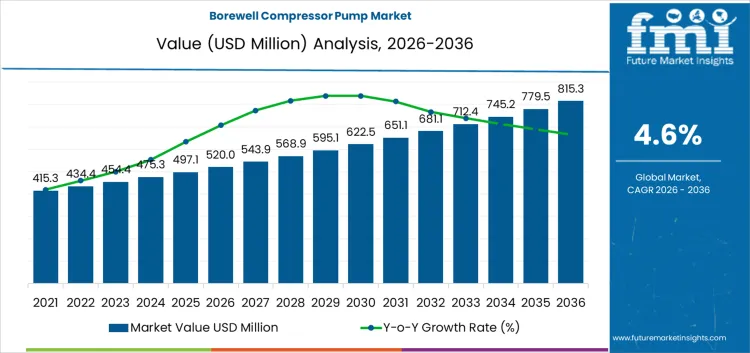
The borewell compressor pump market is projected to reach USD 815.3 million by 2036, growing at a CAGR of 4.6% from its 2026 valuation of USD 520 million. Dominant players in this market defend pricing power through a combination of established brand reputation, advanced technology, and long-term customer relationships, allowing them to set premium prices. Entry barriers are maintained by the significant capital investment required for manufacturing and the specialized knowledge needed to design high-efficiency pumps that meet varying regional needs. Smaller players face challenges in scaling production and achieving the reliability required for widespread adoption, leading to market fragmentation. However, as demand grows, the market may narrow, with larger firms acquiring smaller competitors or establishing strategic partnerships to increase their market share. Companies that invest in R&D and optimize production processes will likely capture more value, consolidating their positions and reducing fragmentation over time.
Quick Stats for the Borewell Compressor Pump Market
- Borewell Compressor Pump Market Value (2026): USD 520 million
- Borewell Compressor Pump Market Forecast Value (2036): USD 815.3 million
- Borewell Compressor Pump Market Global Forecast CAGR (2026-2036): 4.6%
- Borewell Compressor Pump Market Leading Segment: Borewell Drilling Contractors (62%)
- Key Growth Regions in Borewell Compressor Pump Market: India
- Top Players in Borewell Compressor Pump Market: Atlas Copco, Ingersoll Rand, Kirloskar Pneumatic, ELGi Equipments, Doosan Portable Power, Sullair (Hitachi), Kaeser Kompressoren, Chicago Pneumatic (Atlas Copco), CompAir (Gardner Denver), Regional OEMs
What is the 10-Year Growth Comparison for the Borewell Compressor Pump Market through 2036?
The 10-year growth comparison for the borewell compressor pump market indicates a gradual increase in market size over the forecast period, with steady annual growth. Starting from USD 520 million in 2026, the market will experience consistent, moderate growth in the early years, reaching USD 568.9 million by 2028. This early growth is driven primarily by the rising demand for water-efficient solutions, particularly in agricultural regions that rely on borewell pumps for irrigation.
Between 2028 and 2032, the market will continue its steady growth trajectory, reaching USD 681.1 million by 2032. This phase reflects the growing adoption of more energy-efficient and durable compressor pumps that can withstand harsh environmental conditions. From 2032 to 2036, the market will see a continued, albeit slower, expansion, reaching USD 815.3 million by 2036. This period will be characterized by increasing market maturity, with continued demand for reliable water extraction solutions and further technological enhancements in pump systems. Overall, the growth pattern reflects the ongoing need for efficient water management, particularly in agriculture and rural areas.
Borewell Compressor Pump Market Key Takeaways
| Metric | Value |
|---|---|
| Industry Sales Value (2026) | USD 520 million |
| Industry Forecast Value (2036) | USD 815.3 million |
| Industry Forecast CAGR 2026 to 2036 | 4.6% |
What Is Driving the Borewell Compressor Pump Market?
Historically, the borewell compressor pump market evolved alongside conventional groundwater extraction and drilling practices used in agriculture, construction, and municipal water supply, where dependable water access was critical. Early borewell systems relied mainly on electric or diesel-powered deep well pumps to draw water from aquifers for irrigation, domestic use, and industrial applications. These systems required stable power availability and faced constraints related to energy efficiency, cooling performance, and adaptability to varying bore depths and yield conditions.
As drilling activity increased, particularly in arid and semi-arid regions, auxiliary air injection became essential for effective drilling. Air compressors were introduced to support drilling mud circulation, cuttings removal, and borehole cleaning, improving drilling speed and penetration in difficult geological conditions. Initial adoption was driven by drilling contractors and rural irrigation service providers that prioritized operational reliability and compatibility with existing rigs.
Looking ahead, demand will be driven by water security needs, agricultural mechanization, and infrastructure development. Advances in portable, energy-efficient, and rugged compressor designs, along with digital monitoring capabilities, will support wider adoption, while high capital costs and technical skill requirements remain key challenges.
What are the Key Segments in the Borewell Compressor Pump Market?
The Borewell Compressor Pump market is segmented by end use and equipment type. End-use segments include borewell drilling contractors, agriculture water supply, construction dewatering, and others, with borewell drilling contractors leading the market at 62%. Equipment types include portable borewell air compressors, compressor pump combos, high-pressure drill compressors, and others, with portable borewell air compressors representing the largest share at 54%. The market is driven by the increasing demand for efficient and reliable pumping systems for various water extraction applications, including borewell drilling, agriculture irrigation, and construction dewatering. The growth of infrastructure projects, agricultural demands, and the need for sustainable water management are key factors driving the market.
What is Driving Growth in the Borewell Drilling Contractors End-Use Segment?
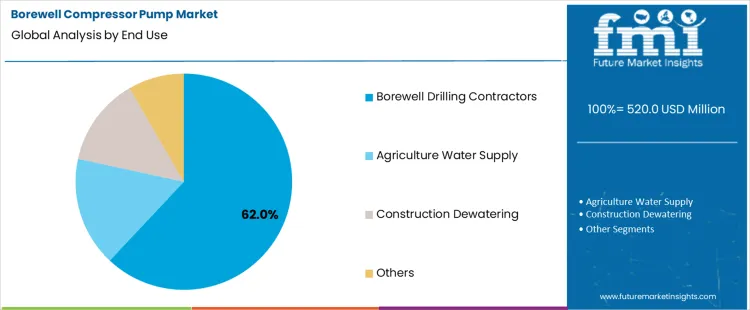
Borewell drilling contractors are the largest end-use segment in the Borewell Compressor Pump market, accounting for 62% of the market share. This growth is driven by the rising demand for water extraction systems, especially in regions facing water scarcity or where groundwater is the primary source of drinking and irrigation water. Borewell drilling contractors require reliable, high-performance compressor pumps to efficiently drill borewells and pump water from deep underground sources.
As urbanization and industrialization continue, the demand for borewell drilling services is increasing, particularly in rural and semi-urban areas where centralized water supply systems may be insufficient. Borewell compressors are essential for ensuring efficient drilling and water extraction, making them critical for the operations of drilling contractors. Additionally, as groundwater extraction for agricultural purposes grows, especially in regions like India and parts of Africa, the demand for borewell compressors in drilling operations is expected to remain strong.
What is Driving the Demand for Portable Borewell Air Compressors in the Equipment Type Segment?
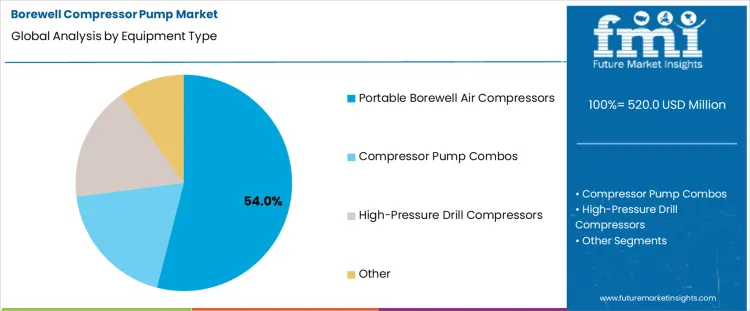
Portable borewell air compressors are the leading equipment type in the Borewell Compressor Pump market, holding 54% of the market share. This growth is driven by the portability, ease of use, and cost-effectiveness of these compressors, which are ideal for mobile borewell drilling operations. Portable compressors provide the flexibility to be used in remote or inaccessible areas, making them particularly valuable for agricultural and rural applications. They can be easily transported to different drilling sites, allowing for faster setup and operation. The ability to quickly adjust the compressor’s output to meet specific drilling requirements further enhances the appeal of portable air compressors for borewell drilling contractors.
As the demand for decentralized water sources grows, particularly in regions with limited access to water infrastructure, portable borewell air compressors are increasingly preferred for their adaptability and mobility. The ongoing expansion of agriculture and construction projects, along with the need for efficient water supply systems in rural areas, is expected to drive continued demand for portable borewell air compressors in the market.
What are the Key Dynamics in the Borewell Compressor Pump Market?
The borewell compressor pump market is growing due to the increasing demand for water extraction solutions in agriculture, construction, and industrial sectors. Borewell compressor pumps are widely used for lifting water from deep underground sources, particularly in areas with limited access to surface water. These pumps are ideal for applications where traditional submersible pumps are not suitable, offering high efficiency and durability. The market is driven by factors such as the need for reliable irrigation systems, expanding agricultural activities, and increasing demand for water supply solutions in remote areas. Additionally, advancements in pump technology, energy efficiency, and automation are contributing to market growth, making borewell compressor pumps a popular choice for water extraction.
What are the Key Drivers of Growth in the Borewell Compressor Pump Market?
The primary drivers of growth in the borewell compressor pump market include the increasing demand for water in agricultural irrigation systems, particularly in water-scarce regions. As the global population grows, the need for efficient and reliable water extraction systems becomes more pressing, especially for farming in areas that rely on borewells. Additionally, the expansion of industries such as construction and mining, where water is needed for dust suppression and other operations, is contributing to the demand for borewell compressor pumps.
The growing adoption of mechanized farming, which requires irrigation systems that can handle deep-water extraction, is also driving the market. Furthermore, advancements in pump design, including energy-efficient models that reduce operational costs, are increasing the attractiveness of these pumps. Government initiatives to improve water management and provide better irrigation infrastructure in rural and remote areas further support market growth.
What are the Key Restraints in the Borewell Compressor Pump Market?
Despite its growth potential, the borewell compressor pump market faces several challenges. One major restraint is the high initial cost of installing borewell compressor pumps, which can be a barrier for small-scale farmers or businesses in regions with limited access to capital. Additionally, these pumps require regular maintenance and specialized knowledge to ensure optimal performance, adding to their overall cost of ownership. Another challenge is the dependence on a reliable power supply, as borewell compressor pumps typically require significant energy to operate.
In areas with inconsistent or expensive electricity, this can increase operational costs and reduce the economic viability of these systems. Furthermore, the availability of alternative water extraction methods, such as solar-powered pumps, could limit the demand for traditional compressor pumps, especially in areas where renewable energy solutions are becoming more popular.
What are the Key Trends in the Borewell Compressor Pump Market?
Several trends are shaping the borewell compressor pump market. One significant trend is the increasing integration of solar power in borewell compressor pump systems. Solar-powered pumps are gaining popularity as a sustainable and cost-effective alternative to conventional electrically powered pumps, particularly in rural and off-grid areas. Another trend is the development of energy-efficient compressor pumps that reduce fuel consumption and lower operational costs, making them more attractive to farmers and businesses. The growing use of automation and remote monitoring in irrigation systems is also influencing the market, as it allows for real-time control and maintenance of borewell pumps, increasing efficiency and reducing downtime.
Additionally, the trend towards modular and portable pump systems that can be easily installed and relocated is gaining traction, particularly in areas where water requirements fluctuate or where infrastructure is temporary. As these trends continue, the borewell compressor pump market is expected to see increased adoption across various sectors, driven by the growing need for efficient, sustainable, and flexible water extraction solutions.
What is the Country-Wise Analysis of the Borewell Compressor Pump Market?
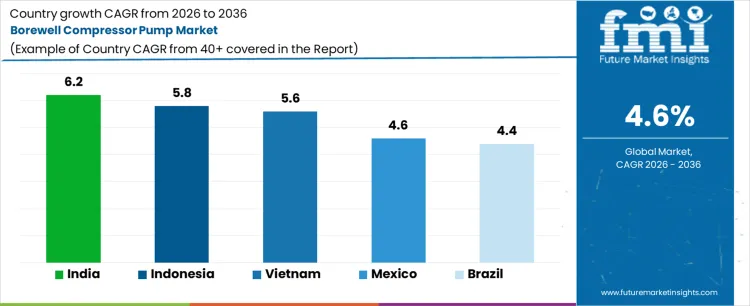
The borewell compressor pump market is growing as the demand for efficient water pumping solutions increases, particularly in regions with water scarcity and in agricultural sectors that rely on groundwater. Borewell compressor pumps are essential for extracting water from deep wells, providing reliable and consistent water supply for irrigation, domestic, and industrial uses. The market is driven by factors such as the need for irrigation in water-scarce regions, increasing agricultural activities, and government initiatives to improve water management. Countries like India, Indonesia, Vietnam, Mexico, and Brazil are witnessing growth in this market, driven by expanding agricultural sectors, infrastructure development, and the need for efficient water pumping technologies.
| Country | CAGR (%) |
|---|---|
| India | 6.2 |
| Indonesia | 5.8 |
| Vietnam | 5.6 |
| Mexico | 4.6 |
| Brazil | 4.4 |
What is Driving the Growth of the Borewell Compressor Pump Market in India?
India’s borewell compressor pump market is growing at a CAGR of 6.2%, the highest among the countries analyzed. The growth is largely driven by India’s significant reliance on groundwater for irrigation, particularly in rural areas. Borewell compressor pumps are essential for ensuring efficient water extraction, which is critical for agricultural productivity. The government’s focus on improving water management and irrigation systems, along with initiatives to increase agricultural output, is contributing to the market’s growth. Additionally, the growing need for reliable water sources in both rural and urban areas is boosting the demand for borewell compressor pumps. As India continues to invest in water infrastructure and agricultural modernization, the demand for these pumps is expected to rise steadily.
How is the Borewell Compressor Pump Market Performing in Indonesia?
Indonesia’s borewell compressor pump market is growing at a CAGR of 5.8%. The market growth is driven by the need for efficient water pumping solutions in the country’s agricultural sector, where irrigation is vital for crop production. Indonesia’s agricultural base, which includes large-scale rice cultivation and other crops, is increasingly relying on borewell compressor pumps for groundwater extraction. The government’s focus on improving irrigation systems and water management technologies is further supporting the adoption of borewell pumps. As Indonesia continues to expand its agricultural and industrial sectors, the demand for reliable and efficient water pumping solutions is expected to continue growing.
What Factors are Shaping the Borewell Compressor Pump Market in Vietnam?
Vietnam’s borewell compressor pump market is growing at a CAGR of 5.6%. The growth is driven by the country’s increasing agricultural activities, particularly in rice farming, which requires efficient irrigation solutions. Borewell compressor pumps are essential for extracting water from deep wells to ensure consistent water supply for agricultural and industrial uses. Vietnam’s focus on improving irrigation systems and water management technologies is contributing to the growth of the market. As the country’s agricultural sector continues to modernize and expand, the need for reliable and efficient water pumps will continue to drive the adoption of borewell compressor pumps.
How is the Borewell Compressor Pump Market Evolving in Mexico?
Mexico’s borewell compressor pump market is growing at a CAGR of 4.6%. The country’s agricultural sector, which heavily depends on groundwater for irrigation, is driving the demand for borewell compressor pumps. With a growing need for efficient water management solutions in agriculture, borewell compressor pumps are becoming essential for extracting water from deep wells. Additionally, the government’s initiatives to improve irrigation systems and ensure water supply to rural and urban areas are contributing to the market growth. As Mexico continues to invest in agricultural infrastructure and water management systems, the demand for borewell compressor pumps is expected to rise steadily.
What is Contributing to the Growth of the Borewell Compressor Pump Market in Brazil?
Brazil’s borewell compressor pump market is growing at a CAGR of 4.4%. The country’s vast agricultural sector, particularly in areas like soybean, sugarcane, and coffee production, is driving the demand for efficient water pumping solutions. Borewell compressor pumps are increasingly being used to extract water from deep wells, ensuring reliable irrigation in regions that face water scarcity. The government’s focus on improving water management and irrigation infrastructure, along with the growing need for sustainable farming practices, is contributing to market growth. As Brazil’s agricultural sector continues to modernize, the demand for borewell compressor pumps is expected to increase.
What is the Competitive Landscape for the Borewell Compressor Pump Market?
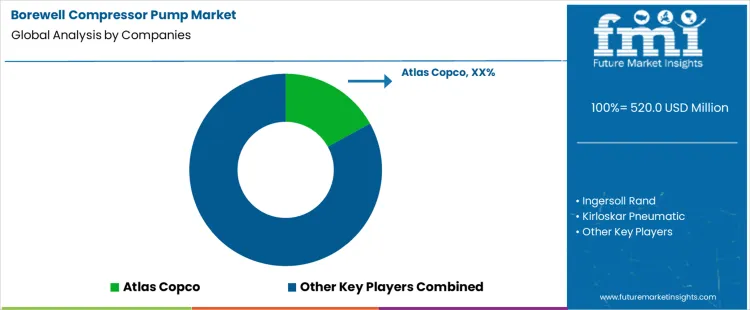
The borewell compressor pump market is expanding as agriculture, construction, and water management sectors increasingly depend on efficient and high-performance equipment for borewell drilling and water extraction. Atlas Copco leads the landscape with robust compressor pumps known for durability, energy efficiency, and reliable performance in demanding operating conditions. Its advanced technologies and strong service network position the company as a preferred supplier across industrial and infrastructure applications.
Ingersoll Rand is a key competitor, offering energy-efficient compressor pumps widely used in water well drilling and industrial operations, with a focus on reducing operating costs and improving productivity. Kirloskar Pneumatic competes through cost-effective, low-maintenance solutions designed specifically for borewell applications, making it a strong player in price-sensitive markets. ELGi Equipments adds competitive strength with innovative compressor pumps that emphasize efficiency, reliability, and long service life.
Doosan Portable Power specializes in portable compressor pumps suited for remote and challenging locations, supporting borewell and water well drilling activities. Sullair (Hitachi) and Kaeser Kompressoren focus on high-quality, energy-saving compressor pumps that ensure continuous, reliable operations in industrial environments. Chicago Pneumatic and CompAir offer versatile, user-friendly pumps designed for efficiency and ease of operation, while regional OEMs contribute affordable, locally tailored solutions.
Key Players of the Borewell Compressor Pump Market
- Atlas Copco
- Ingersoll Rand
- Kirloskar Pneumatic
- ELGi Equipments
- Doosan Portable Power
- Sullair (Hitachi)
- Kaeser Kompressoren
- Chicago Pneumatic (Atlas Copco)
- CompAir (Gardner Denver)
- Regional OEMs
Scope of the Report
| Items | Values |
|---|---|
| Quantitative Units (2026) | USD Million |
| Equipment Type | Portable Borewell Air Compressors, Compressor Pump Combos, High-Pressure Drill Compressors, Other |
| Pressure Class | 12-20 bar, Up to 12 bar, Above 20 bar, Other |
| End Use | Borewell Drilling Contractors, Agriculture Water Supply, Construction Dewatering, Others |
| Sales Channel | Dealer Networks, Direct OEM Sales, Rental & Used Market, Other |
| Companies | Atlas Copco, Ingersoll Rand, Kirloskar Pneumatic, ELGi Equipments, Doosan Portable Power, Sullair (Hitachi), Kaeser Kompressoren, Chicago Pneumatic (Atlas Copco), CompAir (Gardner Denver), Regional OEMs |
| Regions Covered | North America, Latin America, Western Europe, Eastern Europe, South Asia and Pacific, East Asia, Middle East & Africa |
| Countries Covered | United States, Canada, Mexico, Brazil, Argentina, Germany, France, United Kingdom, Italy, Spain, Netherlands, China, India, Japan, South Korea, ANZ, GCC Countries, South Africa |
| Additional Attributes | Dollar sales by equipment type, pressure class, end use, and sales channel. Includes market trends towards cost-effectiveness, efficiency, regulatory compliance, and the role of borewell compressors in agriculture and construction applications. |
Borewell Compressor Pump Market Segmentation
Equipment Type
- Portable Borewell Air Compressors
- Compressor Pump Combos
- High-Pressure Drill Compressors
- Other
Pressure Class
- 12-20 bar
- Up to 12 bar
- Above 20 bar
- Other
End Use
- Borewell Drilling Contractors
- Agriculture Water Supply
- Construction Dewatering
- Others
Sales Channel
- Dealer Networks
- Direct OEM Sales
- Rental & Used Market
- Other
Region
- Asia Pacific
- China
- Japan
- India
- Australia & New Zealand
- ASEAN
- Rest of Asia Pacific
- Europe
- Germany
- United Kingdom
- France
- Italy
- Spain
- Nordic
- BENELUX
- Rest of Europe
- North America
- United States
- Canada
- Mexico
- Latin America
- Brazil
- Argentina
- Rest of Latin America
- Middle East & Africa
- Kingdom of Saudi Arabia
- Other GCC Countries
- South Africa
- Rest of Middle East & Africa
Bibliography
- Atlas Copco. (2023). Borewell compressor pumps for efficient water extraction. Atlas Copco.
- Ingersoll Rand. (2023). Energy-efficient compressor solutions for groundwater and irrigation systems. Ingersoll Rand.
- Kirloskar Pneumatic Company Limited. (2023). Agricultural and industrial borewell compressors: Performance overview. Kirloskar Pneumatic Company Limited.
Frequently Asked Questions
How big is the borewell compressor pump market in 2026?
The global borewell compressor pump market is estimated to be valued at USD 520.0 million in 2026.
What will be the size of borewell compressor pump market in 2036?
The market size for the borewell compressor pump market is projected to reach USD 815.3 million by 2036.
How much will be the borewell compressor pump market growth between 2026 and 2036?
The borewell compressor pump market is expected to grow at a 4.6% CAGR between 2026 and 2036.
What are the key product types in the borewell compressor pump market?
The key product types in borewell compressor pump market are portable borewell air compressors, compressor pump combos, high-pressure drill compressors and other.
Which pressure class segment to contribute significant share in the borewell compressor pump market in 2026?
In terms of pressure class, 12–20 bar segment to command 46.0% share in the borewell compressor pump market in 2026.
Preview the report firsthand - request a free sample
Get SampleGet the brochure for pricing and purchase details.
Get PDFTable of Content
- Executive Summary
- Global Market Outlook
- Demand-side Trends
- Supply-side Trends
- Technology Roadmap Analysis
- Analysis and Recommendations
- Market Overview
- Market Coverage / Taxonomy
- Market Definition / Scope / Limitations
- Market Background
- Market Dynamics
- Drivers
- Restraints
- Opportunity
- Trends
- Scenario Forecast
- Demand in Optimistic Scenario
- Demand in Likely Scenario
- Demand in Conservative Scenario
- Opportunity Map Analysis
- Product Life Cycle Analysis
- Supply Chain Analysis
- Investment Feasibility Matrix
- Value Chain Analysis
- PESTLE and Porter’s Analysis
- Regulatory Landscape
- Regional Parent Market Outlook
- Production and Consumption Statistics
- Import and Export Statistics
- Market Dynamics
- Global Market Analysis 2021 to 2025 and Forecast, 2026 to 2036
- Historical Market Size Value (USD Million) Analysis, 2021 to 2025
- Current and Future Market Size Value (USD Million) Projections, 2026 to 2036
- Y-o-Y Growth Trend Analysis
- Absolute $ Opportunity Analysis
- Global Market Pricing Analysis 2021 to 2025 and Forecast 2026 to 2036
- Global Market Analysis 2021 to 2025 and Forecast 2026 to 2036, By Equipment Type
- Introduction / Key Findings
- Historical Market Size Value (USD Million) Analysis By Equipment Type, 2021 to 2025
- Current and Future Market Size Value (USD Million) Analysis and Forecast By Equipment Type, 2026 to 2036
- Portable Borewell Air Compressors
- Compressor Pump Combos
- High-Pressure Drill Compressors
- Other
- Portable Borewell Air Compressors
- Y-o-Y Growth Trend Analysis By Equipment Type, 2021 to 2025
- Absolute $ Opportunity Analysis By Equipment Type, 2026 to 2036
- Global Market Analysis 2021 to 2025 and Forecast 2026 to 2036, By Pressure Class
- Introduction / Key Findings
- Historical Market Size Value (USD Million) Analysis By Pressure Class, 2021 to 2025
- Current and Future Market Size Value (USD Million) Analysis and Forecast By Pressure Class, 2026 to 2036
- 12-20 bar
- Up to 12 bar
- Above 20 bar
- Other
- 12-20 bar
- Y-o-Y Growth Trend Analysis By Pressure Class, 2021 to 2025
- Absolute $ Opportunity Analysis By Pressure Class, 2026 to 2036
- Global Market Analysis 2021 to 2025 and Forecast 2026 to 2036, By End Use
- Introduction / Key Findings
- Historical Market Size Value (USD Million) Analysis By End Use, 2021 to 2025
- Current and Future Market Size Value (USD Million) Analysis and Forecast By End Use, 2026 to 2036
- Borewell Drilling Contractors
- Agriculture Water Supply
- Construction Dewatering
- Others
- Borewell Drilling Contractors
- Y-o-Y Growth Trend Analysis By End Use, 2021 to 2025
- Absolute $ Opportunity Analysis By End Use, 2026 to 2036
- Global Market Analysis 2021 to 2025 and Forecast 2026 to 2036, By Sales Channel
- Introduction / Key Findings
- Historical Market Size Value (USD Million) Analysis By Sales Channel, 2021 to 2025
- Current and Future Market Size Value (USD Million) Analysis and Forecast By Sales Channel, 2026 to 2036
- Dealer Networks
- Direct OEM Sales
- Rental & Used Market
- Other
- Dealer Networks
- Y-o-Y Growth Trend Analysis By Sales Channel, 2021 to 2025
- Absolute $ Opportunity Analysis By Sales Channel, 2026 to 2036
- Global Market Analysis 2021 to 2025 and Forecast 2026 to 2036, By Region
- Introduction
- Historical Market Size Value (USD Million) Analysis By Region, 2021 to 2025
- Current Market Size Value (USD Million) Analysis and Forecast By Region, 2026 to 2036
- North America
- Latin America
- Western Europe
- Eastern Europe
- East Asia
- South Asia and Pacific
- Middle East & Africa
- Market Attractiveness Analysis By Region
- North America Market Analysis 2021 to 2025 and Forecast 2026 to 2036, By Country
- Historical Market Size Value (USD Million) Trend Analysis By Market Taxonomy, 2021 to 2025
- Market Size Value (USD Million) Forecast By Market Taxonomy, 2026 to 2036
- By Country
- USA
- Canada
- Mexico
- By Equipment Type
- By Pressure Class
- By End Use
- By Sales Channel
- By Country
- Market Attractiveness Analysis
- By Country
- By Equipment Type
- By Pressure Class
- By End Use
- By Sales Channel
- Key Takeaways
- Latin America Market Analysis 2021 to 2025 and Forecast 2026 to 2036, By Country
- Historical Market Size Value (USD Million) Trend Analysis By Market Taxonomy, 2021 to 2025
- Market Size Value (USD Million) Forecast By Market Taxonomy, 2026 to 2036
- By Country
- Brazil
- Chile
- Rest of Latin America
- By Equipment Type
- By Pressure Class
- By End Use
- By Sales Channel
- By Country
- Market Attractiveness Analysis
- By Country
- By Equipment Type
- By Pressure Class
- By End Use
- By Sales Channel
- Key Takeaways
- Western Europe Market Analysis 2021 to 2025 and Forecast 2026 to 2036, By Country
- Historical Market Size Value (USD Million) Trend Analysis By Market Taxonomy, 2021 to 2025
- Market Size Value (USD Million) Forecast By Market Taxonomy, 2026 to 2036
- By Country
- Germany
- UK
- Italy
- Spain
- France
- Nordic
- BENELUX
- Rest of Western Europe
- By Equipment Type
- By Pressure Class
- By End Use
- By Sales Channel
- By Country
- Market Attractiveness Analysis
- By Country
- By Equipment Type
- By Pressure Class
- By End Use
- By Sales Channel
- Key Takeaways
- Eastern Europe Market Analysis 2021 to 2025 and Forecast 2026 to 2036, By Country
- Historical Market Size Value (USD Million) Trend Analysis By Market Taxonomy, 2021 to 2025
- Market Size Value (USD Million) Forecast By Market Taxonomy, 2026 to 2036
- By Country
- Russia
- Poland
- Hungary
- Balkan & Baltic
- Rest of Eastern Europe
- By Equipment Type
- By Pressure Class
- By End Use
- By Sales Channel
- By Country
- Market Attractiveness Analysis
- By Country
- By Equipment Type
- By Pressure Class
- By End Use
- By Sales Channel
- Key Takeaways
- East Asia Market Analysis 2021 to 2025 and Forecast 2026 to 2036, By Country
- Historical Market Size Value (USD Million) Trend Analysis By Market Taxonomy, 2021 to 2025
- Market Size Value (USD Million) Forecast By Market Taxonomy, 2026 to 2036
- By Country
- China
- Japan
- South Korea
- By Equipment Type
- By Pressure Class
- By End Use
- By Sales Channel
- By Country
- Market Attractiveness Analysis
- By Country
- By Equipment Type
- By Pressure Class
- By End Use
- By Sales Channel
- Key Takeaways
- South Asia and Pacific Market Analysis 2021 to 2025 and Forecast 2026 to 2036, By Country
- Historical Market Size Value (USD Million) Trend Analysis By Market Taxonomy, 2021 to 2025
- Market Size Value (USD Million) Forecast By Market Taxonomy, 2026 to 2036
- By Country
- India
- ASEAN
- Australia & New Zealand
- Rest of South Asia and Pacific
- By Equipment Type
- By Pressure Class
- By End Use
- By Sales Channel
- By Country
- Market Attractiveness Analysis
- By Country
- By Equipment Type
- By Pressure Class
- By End Use
- By Sales Channel
- Key Takeaways
- Middle East & Africa Market Analysis 2021 to 2025 and Forecast 2026 to 2036, By Country
- Historical Market Size Value (USD Million) Trend Analysis By Market Taxonomy, 2021 to 2025
- Market Size Value (USD Million) Forecast By Market Taxonomy, 2026 to 2036
- By Country
- Kingdom of Saudi Arabia
- Other GCC Countries
- Turkiye
- South Africa
- Other African Union
- Rest of Middle East & Africa
- By Equipment Type
- By Pressure Class
- By End Use
- By Sales Channel
- By Country
- Market Attractiveness Analysis
- By Country
- By Equipment Type
- By Pressure Class
- By End Use
- By Sales Channel
- Key Takeaways
- Key Countries Market Analysis
- USA
- Pricing Analysis
- Market Share Analysis, 2025
- By Equipment Type
- By Pressure Class
- By End Use
- By Sales Channel
- Canada
- Pricing Analysis
- Market Share Analysis, 2025
- By Equipment Type
- By Pressure Class
- By End Use
- By Sales Channel
- Mexico
- Pricing Analysis
- Market Share Analysis, 2025
- By Equipment Type
- By Pressure Class
- By End Use
- By Sales Channel
- Brazil
- Pricing Analysis
- Market Share Analysis, 2025
- By Equipment Type
- By Pressure Class
- By End Use
- By Sales Channel
- Chile
- Pricing Analysis
- Market Share Analysis, 2025
- By Equipment Type
- By Pressure Class
- By End Use
- By Sales Channel
- Germany
- Pricing Analysis
- Market Share Analysis, 2025
- By Equipment Type
- By Pressure Class
- By End Use
- By Sales Channel
- UK
- Pricing Analysis
- Market Share Analysis, 2025
- By Equipment Type
- By Pressure Class
- By End Use
- By Sales Channel
- Italy
- Pricing Analysis
- Market Share Analysis, 2025
- By Equipment Type
- By Pressure Class
- By End Use
- By Sales Channel
- Spain
- Pricing Analysis
- Market Share Analysis, 2025
- By Equipment Type
- By Pressure Class
- By End Use
- By Sales Channel
- France
- Pricing Analysis
- Market Share Analysis, 2025
- By Equipment Type
- By Pressure Class
- By End Use
- By Sales Channel
- India
- Pricing Analysis
- Market Share Analysis, 2025
- By Equipment Type
- By Pressure Class
- By End Use
- By Sales Channel
- ASEAN
- Pricing Analysis
- Market Share Analysis, 2025
- By Equipment Type
- By Pressure Class
- By End Use
- By Sales Channel
- Australia & New Zealand
- Pricing Analysis
- Market Share Analysis, 2025
- By Equipment Type
- By Pressure Class
- By End Use
- By Sales Channel
- China
- Pricing Analysis
- Market Share Analysis, 2025
- By Equipment Type
- By Pressure Class
- By End Use
- By Sales Channel
- Japan
- Pricing Analysis
- Market Share Analysis, 2025
- By Equipment Type
- By Pressure Class
- By End Use
- By Sales Channel
- South Korea
- Pricing Analysis
- Market Share Analysis, 2025
- By Equipment Type
- By Pressure Class
- By End Use
- By Sales Channel
- Russia
- Pricing Analysis
- Market Share Analysis, 2025
- By Equipment Type
- By Pressure Class
- By End Use
- By Sales Channel
- Poland
- Pricing Analysis
- Market Share Analysis, 2025
- By Equipment Type
- By Pressure Class
- By End Use
- By Sales Channel
- Hungary
- Pricing Analysis
- Market Share Analysis, 2025
- By Equipment Type
- By Pressure Class
- By End Use
- By Sales Channel
- Kingdom of Saudi Arabia
- Pricing Analysis
- Market Share Analysis, 2025
- By Equipment Type
- By Pressure Class
- By End Use
- By Sales Channel
- Turkiye
- Pricing Analysis
- Market Share Analysis, 2025
- By Equipment Type
- By Pressure Class
- By End Use
- By Sales Channel
- South Africa
- Pricing Analysis
- Market Share Analysis, 2025
- By Equipment Type
- By Pressure Class
- By End Use
- By Sales Channel
- USA
- Market Structure Analysis
- Competition Dashboard
- Competition Benchmarking
- Market Share Analysis of Top Players
- By Regional
- By Equipment Type
- By Pressure Class
- By End Use
- By Sales Channel
- Competition Analysis
- Competition Deep Dive
- Atlas Copco
- Overview
- Product Portfolio
- Profitability by Market Segments (Product/Age /Sales Channel/Region)
- Sales Footprint
- Strategy Overview
- Marketing Strategy
- Product Strategy
- Channel Strategy
- Ingersoll Rand
- Kirloskar Pneumatic
- ELGi Equipments
- Doosan Portable Power
- Sullair (Hitachi)
- Kaeser Kompressoren
- Chicago Pneumatic (Atlas Copco)
- CompAir (Gardner Denver)
- Regional OEMs
- Atlas Copco
- Competition Deep Dive
- Assumptions & Acronyms Used
- Research Methodology


