

- Industry Size (2025)
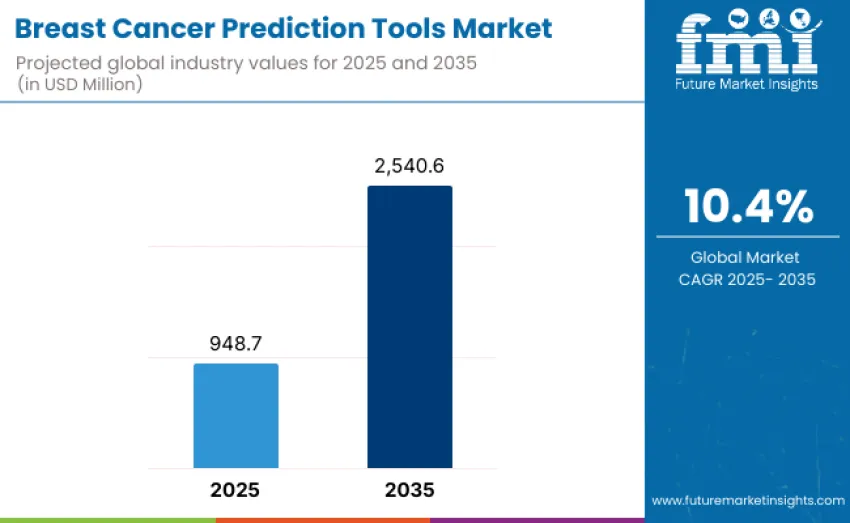
- USD 948.7 Mn
- Forecast (2035)
- USD 2540.6 Mn
- CAGR (2025 to 2035)
- 10.4%
Breast Cancer Prediction Tools Market Forecast and Outlook 2025 to 2035
The global breast cancer prediction tools market is projected to reach USD 2,540.6 million by 2035, recording an absolute increase of USD 1,591.9 million over the forecast period. This market is valued at USD 948.7 million in 2025 and is set to rise at a CAGR of 10.4% during the assessment period. Overall size is anticipated to expand by nearly 2.7 times over the decade, supported by increasing adoption of advanced diagnostic solutions, personalized medicine, and early detection tools in hospitals, diagnostic centers, and research institutions worldwide.
Technological advancements in machine learning algorithms, bioinformatics, and imaging analytics are reshaping the breast cancer prediction landscape. Modern systems incorporate multi-modal data integration, cloud-based analytics, and real-time risk scoring, enabling precise and actionable insights. Seamless interoperability with electronic health records and hospital information systems ensures efficient clinical workflow integration. Advanced predictive models enhance diagnostic confidence, reduce false-positive rates, and support personalized screening and treatment planning, helping healthcare professionals meet rising patient expectations for accurate, timely, and non-invasive diagnostic solutions.
Quick Stats for Breast Cancer Prediction Tools Market
- Breast Cancer Prediction Tools Market Value (2025): USD 948.7 million
- Breast Cancer Prediction Tools Market Forecast Value (2035): USD 2,540.6 million
- Breast Cancer Prediction Tools Market Forecast CAGR: 10.4%
- Leading Tool Type in Breast Cancer Prediction Tools Market: Advanced imaging-based risk & triage with 34.8% share
- Key Growth Regions in Breast Cancer Prediction Tools Market: Asia Pacific, Europe, and North America
- Top Players in Breast Cancer Prediction Tools Market: Hologic, Inc., iCAD, Inc., Volpara Health Technologies Limited, Kheiron Medical Technologies Ltd, Lunit Inc., GE HealthCare Technologies Inc., Myriad Genetics, Inc., Ambry Genetics Corporation and Others
Government health programs, cancer screening initiatives, and investments in precision medicine infrastructure accelerate growth. Healthcare providers, diagnostic labs, and research organizations globally are adopting predictive oncology tools to improve patient care and streamline operations. Corporate collaborations between technology developers, pharmaceutical companies, and academic institutions advance tool capabilities. Patient awareness campaigns and advocacy programs drive sustained demand for breast cancer prediction solutions, positioning these tools as critical enablers of early detection, preventive care, and personalized oncology across global healthcare ecosystems.
Breast Cancer Prediction Tools Market Year-over-Year Forecast (2025 to 2035)
Between 2025 and 2030, the breast cancer prediction tools market is projected to expand from USD 948.7 million to USD 1,552.5 million, resulting in a value increase of USD 603.8 million, which represents 37.9% of total forecast growth for the decade. This phase will be driven by rising demand for early detection solutions, integration of machine learning algorithms in predictive analytics, and increased adoption of non-invasive imaging modalities. Companies are strengthening competitive positions through investment in algorithm accuracy, cloud-based risk assessment platforms, and strategic collaborations with healthcare providers.
From 2030 to 2035, growth is forecast from USD 1,552.5 million to USD 2,540.6 million, adding USD 988.1 million, which constitutes 62.1% of overall ten-year expansion. This period is expected to be shaped by wider integration of multi-modal diagnostic tools, enhanced predictive capabilities, personalized risk assessment solutions, and improved patient data interoperability. Strategic partnerships between technology providers, genomics companies, and healthcare systems, along with regulatory approvals and reimbursement support, will accelerate adoption. Growing global awareness of breast cancer screening, coupled with expanding healthcare infrastructure in emerging regions, will drive demand.
Breast Cancer Prediction Tools Market Key Takeaways
| Metric | Value |
|---|---|
| Market Value (2025) | USD 948.7 million |
| Market Forecast Value (2035) | USD 2,540.6 million |
| Forecast CAGR (2025 to 2035) | 10.4% |
Why Is the Breast Cancer Prediction Tools Market Growing Worldwide?
The breast cancer prediction tools market is growing by enabling healthcare providers and diagnostic professionals to achieve higher accuracy in early detection and risk assessment, improving patient outcomes and workflow efficiency in clinical settings. Hospitals, diagnostic labs, and telemedicine platforms face mounting pressure to deliver timely, accurate predictions, with advanced predictive models typically improving diagnostic accuracy over conventional methods, making these tools essential for personalized patient care and preventive oncology strategies. The global emphasis on early detection and risk stratification drives demand for advanced software and predictive algorithms.
Government initiatives promoting cancer screening programs, healthcare infrastructure development, and personalized medicine adoption accelerate uptake in hospitals, research centers, and community health networks, where predictive tools directly impact clinical decision-making and patient outcomes. The global shift toward digital health solutions, telemedicine, and remote patient monitoring fuels adoption as healthcare providers seek tools that enable accurate risk assessment without requiring in-person visits. These systems provide comprehensive predictive capabilities for early detection and patient management across diverse healthcare settings.
How Is the Breast Cancer Prediction Tools Market Segmented by Tool Type, Application, and Region?
The breast cancer prediction tools market is segmented by tool type, application, and region. By tool type, division includes advanced imaging-based risk & triage, polygenic risk score assays, clinical risk calculators/APIs, integrated decision-support platforms/workflows, and others. Based on application, categorization covers population screening stratification, diagnostic recall/triage, high-risk clinic management & surveillance, and prevention planning & eligibility. Regionally, segmentation spans Asia Pacific, Europe, North America, Latin America, and Middle East & Africa.
By Tool Type, Advanced Imaging-Based Risk & Triage Dominates
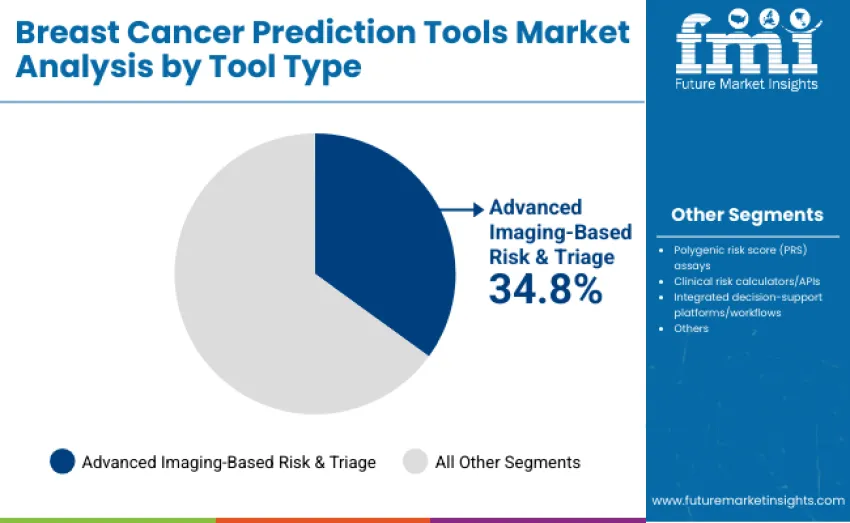
The advanced imaging-based risk & triage segment represents the dominant force, capturing 34.8% of total share in 2025. This advanced category encompasses automated imaging analysis, automated risk scoring, triage prioritization, and integration with clinical workflows, delivering comprehensive predictive capabilities for early detection and patient management. Leadership stems from its essential role in healthcare settings where accurate and timely risk assessment directly impacts patient outcomes, clinical decision-making, and resource optimization.
The polygenic risk score assays segment holds a substantial 27.1% share, serving healthcare providers and research institutions requiring genetic risk profiling and personalized risk assessment through reliable assay platforms and validated algorithms. Clinical risk calculators/APIs account for 18.2%, integrated decision-support platforms/workflows contribute 14.3%, and others represent 5.6% of revenue. Key advantages driving the advanced imaging-based risk & triage segment include sophisticated algorithms enabling accurate risk prediction and early detection through automated imaging analysis.
By Application, Population Screening Stratification Accounts for Largest Share
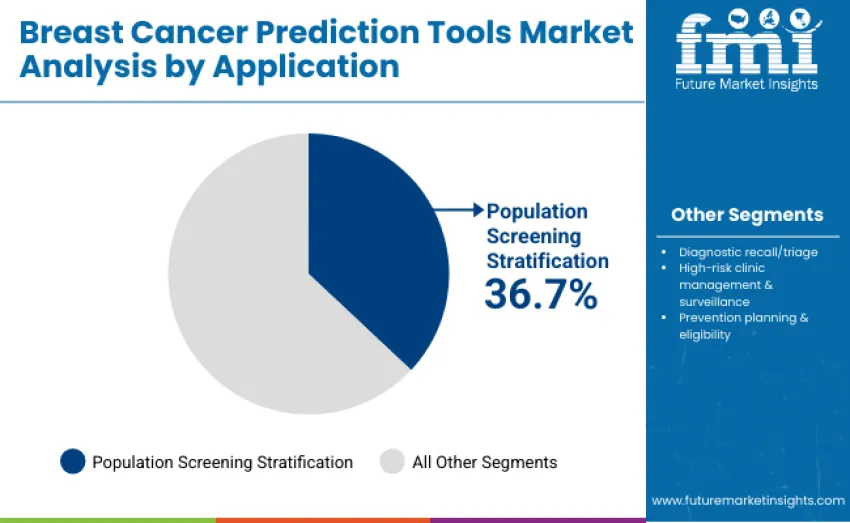
Population screening stratification dominates with 36.7% share in 2025, reflecting increasing emphasis on early detection programs, public health initiatives, and preventive care strategies. Leadership is reinforced by widespread adoption across hospitals, diagnostic centers, and community health programs that aim to identify at-risk populations efficiently and implement timely screening protocols. This segment supports comprehensive risk assessment and population-level health management across diverse healthcare settings.
High-risk clinic management & surveillance represents 24.3%, supporting specialized monitoring of individuals with elevated genetic or clinical risk profiles through continuous risk assessment and tailored management plans. Diagnostic recall/triage accounts for 21.8%, while prevention planning & eligibility contributes 17.2% of revenue. Key dynamics include population screening adoption driven by national screening programs and growing awareness of early detection benefits. High-risk clinic management emphasizes continuous monitoring and personalized care plans.
What Are the Major Drivers, Restraints, and Emerging Trends Influencing the Breast Cancer Prediction Tools Market?
The breast cancer prediction tools market is driven by three primary factors tied to healthcare advancements, early detection initiatives, and technology integration. Rising emphasis on early detection and preventive oncology programs creates increasing demand for accurate and scalable breast cancer prediction tools, with national screening programs, healthcare providers, and research institutions expanding their diagnostic capabilities annually to improve patient outcomes and optimize resource allocation. Integration of advanced computing and machine learning in predictive tools enables faster and more accurate risk assessment, supporting clinical decision-making.
What Are the Major Restraints Limiting the Adoption of Breast Cancer Prediction Tools?
The adoption of breast cancer prediction tools is limited by several factors. High software and platform costs create barriers for smaller clinics and resource-limited healthcare facilities, restricting accessibility. Integration challenges with existing hospital information systems further complicate deployment. The need for regulatory approvals can cause delays in implementation. The technical complexity of these tools and the need for extensive training of medical staff also pose significant hurdles, slowing down the widespread adoption and effective use of these prediction tools across healthcare settings.
What Emerging Trends Are Shaping the Future of the Breast Cancer Prediction Tools Market?
Key trends indicate accelerated adoption in emerging regions, particularly Asia-Pacific countries such as China and India, where government initiatives supporting cancer screening programs, digital health infrastructure, and healthcare workforce training provide subsidies and funding incentives that promote adoption of predictive tools. Technology advancement trends toward multi-modal data integration, cloud-based analytics platforms, and interoperable solutions are driving next-generation product development. Strategic collaborations between technology developers and healthcare providers advance predictive capabilities.
How Are Leading Countries Driving Growth in the Breast Cancer Prediction Tools Market?
| Country | CAGR (2025 to 2035)% |
|---|---|
| United States | 9.9 |
| Brazil | 7.3 |
| China | 11.0 |
| India | 9.4 |
| Europe | 9.9 |
| Germany | 5.4 |
| United Kingdom | 5.3 |
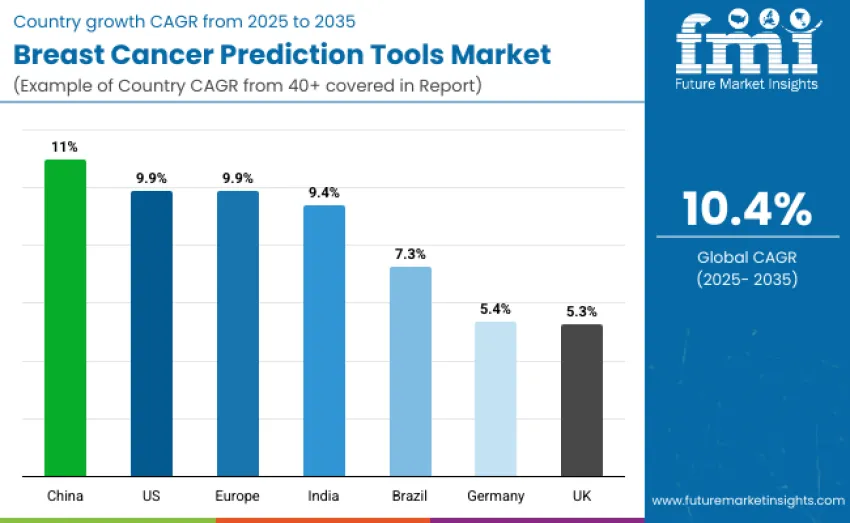
The breast cancer prediction tools market is growing globally, with China leading at an 11.0% CAGR driven by strong digital health initiatives and government support. India follows with 9.4% growth, fueled by healthcare digitization and rising patient awareness. The USA grows at 9.9%, supported by a mature healthcare ecosystem and ongoing innovation in oncology diagnostics. Brazil records 7.3% growth, driven by increased healthcare access and public-private investment in oncology tools. Europe grows at 9.9%, with Germany at 5.4% and the UK at 5.3%, supported by strong healthcare infrastructure and professional training programs.
How Is Digital Health Infrastructure Accelerating Growth in China?
China demonstrates significant growth potential with a CAGR of 11.0% through 2035, driven by the country's advanced digital health ecosystem and strong technology infrastructure. Expansion is supported by large-scale adoption of digital platforms in hospitals, imaging centers, and community health networks, enabling predictive risk models and early detection solutions. Growth is concentrated in major technology and healthcare clusters, including Beijing, Shanghai, Shenzhen, and Hangzhou, where research institutions, medical device firms, and digital-health companies are developing and deploying breast cancer prediction tools.
Distribution channels through digital-health platforms, telemedicine networks, and hospital-integrated solutions expand deployment across urban and semi-urban populations, while government policy under "Health China 2030" provides funding and regulatory support for innovative predictive diagnostic tools. Rapid digital-health adoption in hospitals and community clinics is supported by assisted imaging and risk-prediction platforms. Policy support from national and provincial health programs promotes early detection and technology integration. Strong technology ecosystem in major clusters enables imaging and data analytics capabilities.
Why Are Skill Development Programs Enhancing Adoption in India?
India's breast cancer prediction tools market demonstrates strong growth momentum with a CAGR of 9.4% through 2035, driven by national digital health priorities and local capacity building programs. Cities such as Bangalore, Hyderabad, Mumbai, and Pune are equipping community health teams, diagnostic centers, and disease screening programs with advanced tools that analyze clinical, imaging, and lifestyle data to identify high-risk cohorts. The country's strong focus on IT and digital services transformation, coupled with training programs for frontline health workers, positions India strategically.
State and national health initiatives are deploying screening and risk prediction tools in community health settings. Community-based screening and mobile diagnostics campaigns reach rural and semi-urban populations, enabling widespread adoption beyond major hospital networks. Growth of digital health and analytics infrastructure, including centers of excellence and health tech partnerships, enables domestic technology suppliers to build localized prediction models and platforms. Policy development and technical assessments are formalizing use of predictive diagnostics.
How Does Healthcare Infrastructure and Clinical Excellence Sustain Leadership in Germany?
Germany's advanced healthcare system demonstrates sophisticated implementation of breast cancer prediction tools, with documented clinical studies showing significant improvements in early detection and risk-stratification accuracy across university hospitals, oncology centers, and community diagnostic networks. Major medical and research hubs, including Berlin, Munich, Hamburg, and Frankfurt, showcase integration of predictive diagnostic platforms with existing clinical workflows, leveraging expertise in precision medicine, high-quality imaging, and evidence-based care protocols.
German healthcare professionals emphasize tool accuracy, long-term reliability, and compliance with regulatory standards, creating demand for premium predictive solutions that support clinical commitments and rigorous daily diagnostic use. Growth maintains steady momentum with a CAGR of 5.4% through 2035 through focus on professional healthcare segments and premium technology adoption. University hospitals and oncology centers implement predictive workflows with comprehensive staff training programs. Strategic partnerships between European distributors and technology providers ensure reliable product availability and local support.
Why Is the Expanding Health Network Fueling Demand in Brazil?
Brazil is emerging as a key growth market with a CAGR of 7.3% through 2035, thanks to expanding healthcare networks, rising diagnostics adoption, and the growing independent health tech and data science community. The country's strong base of digital diagnosticians, academic researchers, and community screening programs helps drive usage of predictive risk platforms and analytics tools among both private and public healthcare segments. Growth is focused in major metropolitan areas such as São Paulo, Rio de Janeiro, Brasília, and Porto Alegre.
Independent data science teams and health tech developers are implementing risk prediction and modeling workflows for client projects and public health screening initiatives. Technology partnerships between international diagnostics platform vendors and local distributors enable Brazilian access through pricing strategies and payment structures tailored for smaller clinics and regional outreach programs. Collaboration between health industry associations, academic institutions, and equipment suppliers facilitates group deployment programs and training workshops. Focus on predictive analytics adoption in the Brazilian unified health system and private clinic networks drives investment.
How Do Established Healthcare Ecosystems Strengthen Performance in the United States?
The USA breast cancer prediction tools market demonstrates mature implementation with a CAGR of 9.9% through 2035, focused on large hospital systems, research institutions, and independent diagnostic centers across major healthcare hubs including California, New York, Texas, and Massachusetts. Growth maintains steady momentum, driven by widespread adoption of advanced risk-prediction platforms, integration with electronic health records, and high awareness among healthcare professionals and patients. Leading technology providers and research institutions collaborate to refine predictive models.
Adoption in large hospital systems and cancer centers includes standardized platform specifications ensuring workflow efficiency, data interoperability, and consistent risk-assessment outputs. Established distribution and service infrastructure through medical device suppliers, specialized technology vendors, and digital-health platforms enables nationwide deployment and technical support. Collaboration between professional healthcare associations, research networks, and platform manufacturers integrates clinical feedback into next-generation predictive tools. Focus on usability, integration, and reliability drives preference for premium predictive platforms.
How Is Healthcare Infrastructure Expansion Supporting Growth in the United Kingdom?
In London, Manchester, Bristol, and Edinburgh healthcare and research clusters, hospitals, diagnostic centers, and community health programs are implementing advanced breast cancer prediction tools to improve early detection and risk stratification workflows with a CAGR of 5.3% through 2035. Documented studies indicate that integrating predictive platforms into existing clinical systems can enhance patient throughput and screening efficiency, enabling greater population coverage without proportionally increasing staff. Growth shows solid potential, supported by national health initiatives and digital health strategies.
Hospital and diagnostic center adoption of predictive workflows includes comprehensive staff training and standardized implementation protocols. Educational and professional partnerships provide medical students, residents, and radiology trainees with hands-on exposure to predictive diagnostic tools and analytical workflows. Strategic collaborations between NHS programs, technology suppliers, and research institutions facilitate evaluation, clinical validation, and local deployment of predictive platforms. Emphasis on tool reliability, integration with electronic health records, and long-term support drives preference for high-quality solutions.
How Are Healthcare Infrastructure Investments Advancing Expansion Across Europe?
The breast cancer prediction tools market in Europe is projected to grow from USD 205.9 million in 2025 to USD 531 million by 2035, registering a CAGR of 9.9% over the forecast period. Germany is expected to maintain leadership with a 28.5% share in 2025, slightly declining to 27.8% by 2035, supported by advanced healthcare infrastructure and major hospital and oncology clusters in Berlin, Munich, and Hamburg. France follows with a 22.3% share in 2025, projected to reach 22.6% by 2035, driven by breast cancer screening programs.
The United Kingdom holds a 19.5% share in 2025, expected to reach 19.8% by 2035 through national screening initiatives and adoption in London, Manchester, and Edinburgh healthcare networks. Italy commands a 13.2% share in both 2025 and 2035, backed by advanced oncology centers in Rome, Milan, and Florence. Spain accounts for 9.5% in 2025, rising to 9.7% by 2035 on increasing hospital adoption. The Netherlands maintains 6.8% share throughout the forecast period.
How Competitive Is the Global Breast Cancer Prediction Tools Market and What Defines Its Structure?
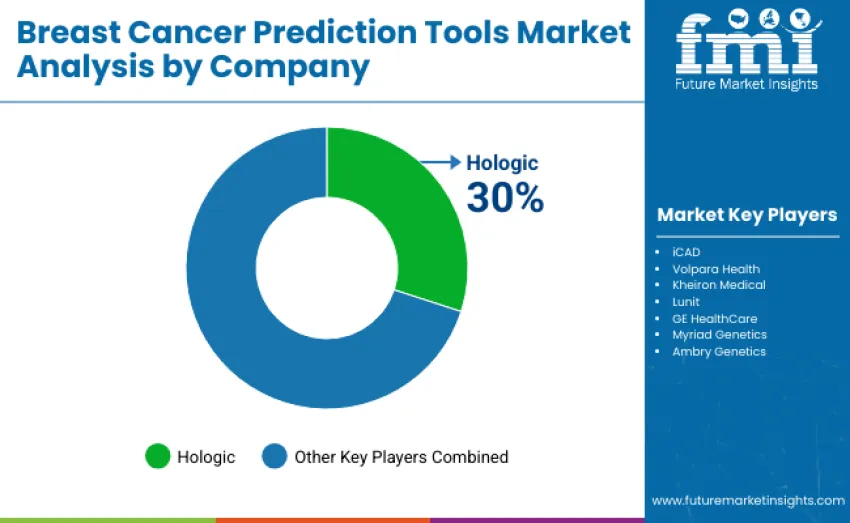
The global breast cancer prediction tools market is moderately concentrated, with 12-15 players shaping the competitive landscape. The top three companies, Hologic, iCAD, and Volpara Health, collectively hold around 45% of the global market share, with Hologic leading at 30%. These companies maintain dominance through established brand recognition, validated predictive algorithms, and comprehensive diagnostic portfolios. Competition is primarily driven by algorithmic accuracy, integration with imaging systems, clinical workflow compatibility, and predictive reliability rather than price alone.
Leaders such as Hologic, iCAD, and Volpara Health differentiate themselves with proprietary risk-prediction algorithms, proven clinical performance, and strong relationships with hospitals, diagnostic centers, and research institutions. These companies invest heavily in ongoing research and development to improve imaging analysis, risk stratification workflows, and user-friendly software interfaces, ensuring they maintain competitive advantages while expanding into emerging healthcare segments and regional screening programs.
Challengers like Kheiron Medical, Lunit, and GE HealthCare offer specialized predictive platforms that integrate seamlessly with hospital systems and diagnostic networks. Niche players, including Myriad Genetics and Ambry Genetics, focus on genetic risk assessment and precision medicine. Emerging providers add competitive pressure through scalable, cloud-based platforms and rapid deployment cycles.
Key Players in the Breast Cancer Prediction Tools Market
- Hologic
- iCAD
- Volpara Health
- Kheiron Medical
- Lunit
- GE HealthCare
- Myriad Genetics
- Ambry Genetics
Scope of the Report
| Items | Values |
|---|---|
| Quantitative Units | USD 948.7 million |
| Tool Type | Advanced imaging-based risk & triage, Polygenic risk score assays, Clinical risk calculators/APIs, Integrated decision-support platforms/workflows, Others |
| Application | Population screening stratification, Diagnostic recall/triage, High-risk clinic management & surveillance, Prevention planning & eligibility |
| Regions Covered | Asia Pacific, Europe, North America, Latin America, Middle East & Africa |
| Country Covered | USA, Brazil, China, India, Europe, Germany, France, UK |
| Key Companies Profiled | Hologic , iCAD , Volpara Health, Kheiron Medical, Lunit , GE HealthCare, Myriad Genetics, Ambry Genetics |
| Additional Attributes | Dollar sales by tool type and clinical application, regional trends across North America, Europe, and Asia-Pacific, competitive landscape of breast cancer prediction tool providers, integration with imaging systems and EHR workflows, AI-based risk stratification innovations, and specialized predictive platforms for high-risk patient management |
Breast Cancer Prediction Tools Market by Segments
By Tool Type:
- AI imaging-based risk & triage
- Polygenic risk score (PRS) assays
- Clinical risk calculators/APIs
- Integrated decision-support platforms/workflows
- Others
By Application:
- Population screening stratification
- Diagnostic recall/triage
- High-risk clinic management & surveillance
- Prevention planning & eligibility
By Region:
- Asia Pacific
- China
- India
- Japan
- South Korea
- Vietnam
- Australia & New Zealand
- ASEAN
- Rest of Asia Pacific
- Europe
- Germany
- United Kingdom
- France
- Italy
- Spain
- Netherlands
- Nordic
- BENELUX
- Rest of Europe
- North America
- United States
- Canada
- Mexico
- Latin America
- Brazil
- Argentina
- Rest of Latin America
- Middle East & Africa
- Kingdom of Saudi Arabia
- Other GCC Countries
- Turkey
- South Africa
- Other African Union
- Rest of Middle East & Africa
Frequently Asked Questions
How big is the breast cancer prediction tools market in 2025?
The global breast cancer prediction tools market is valued at USD 948.7 million in 2025.
What will be the size of the breast cancer prediction tools market in 2035?
The market is projected to reach USD 2,540.6 million by 2035.
How fast will the breast cancer prediction tools market grow between 2025 and 2035?
The market will grow at a CAGR of 10.4% from 2025 to 2035.
Which tool type leads the breast cancer prediction tools market in 2025?
Advanced imaging-based risk & triage tools lead the market with a 34.8% share in 2025.
Who are the major players in the breast cancer prediction tools market?
Key players include Hologic, iCAD, Volpara Health, Kheiron Medical, Lunit, GE HealthCare, Myriad Genetics, and Ambry Genetics.
Preview the report firsthand - request a free sample
Get SampleGet the brochure for pricing and purchase details.
Get PDFTable of Content
- Executive Summary
- Regional Level Market Outlook
- Demand-side Trends
- Supply-side Trends
- Technology Roadmap Analysis
- Analysis and Recommendations
- Market Overview
- Market Coverage / Taxonomy
- Market Definition / Scope / Limitations
- Market Background
- Market Dynamics
- Drivers
- Restraints
- Opportunity
- Trends
- Scenario Forecast
- Demand in Optimistic Scenario
- Demand in Likely Scenario
- Demand in Conservative Scenario
- Opportunity Assessment
- Strategic Investments
- PESTLE and Porter’s Analysis
- Regulatory Landscape
- By Key Regions
- By Key Countries
- Regional Parent Market Outlook
- Technological Advancement
- Market Dynamics
- Regional Level Market Analysis 2020 to 2024 and Forecast, 2025 to 2035
- Historical Market Size USD Million Analysis, 2020 to 2024
- Current and Future Market Size USD Million Projections, 2025 to 2035
- Y-o-Y Growth Trend Analysis
- Absolute $ Opportunity Analysis
- Regional Level Market Analysis 2020 to 2024 and Forecast 2025 to 2035, By Tool Type
- Introduction / Key Findings
- Historical Market Size USD Million Analysis By Tool Type, 2020 to 2024
- Current and Future Market Size USD Million Analysis and Forecast By Tool Type, 2025 to 2035
- AI imaging-based risk & triage
- Polygenic risk score (PRS) assays
- Clinical risk calculators/APIs (e.g., Tyrer-Cuzick, Gail)
- Integrated decision-support platforms/workflows
- Others (data services, analytics)
- Y-o-Y Growth Trend Analysis By Tool Type, 2020 to 2024
- Absolute $ Opportunity Analysis By Tool Type, 2025 to 2035
- Regional Level Market Analysis 2020 to 2024 and Forecast 2025 to 2035, By Application
- Introduction / Key Findings
- Historical Market Size USD Million Analysis By Application, 2020 to 2024
- Current and Future Market Size USD Million Analysis and Forecast By Application, 2025 to 2035
- Population screening stratification
- Diagnostic recall/triage
- High-risk clinic management & surveillance
- Prevention planning & eligibility
- Y-o-Y Growth Trend Analysis By Application, 2020 to 2024
- Absolute $ Opportunity Analysis By Application, 2025 to 2035
- Regional Level Market Analysis 2020 to 2024 and Forecast 2025 to 2035, By End User
- Introduction / Key Findings
- Historical Market Size USD Million Analysis By End User, 2020 to 2024
- Current and Future Market Size USD Million Analysis and Forecast By End User, 2025 to 2035
- Hospitals & IDNs
- Imaging centers & screening programs
- Reference labs & genomics providers
- Primary care & OB-GYN
- Y-o-Y Growth Trend Analysis By End User, 2020 to 2024
- Absolute $ Opportunity Analysis By End User, 2025 to 2035
- Regional Level Market Analysis 2020 to 2024 and Forecast 2025 to 2035, By Region
- Introduction
- Historical Market Size USD Million Analysis By Region, 2020 to 2024
- Current Market Size USD Million Analysis and Forecast By Region, 2025 to 2035
- North America
- Latin America
- East Asia
- South Asia
- Western Europe
- Eastern Europe
- Middle East & Africa
- Market Attractiveness Analysis By Region
- North America Market Analysis 2020 to 2024 and Forecast 2025 to 2035, By Country
- Historical Market Size USD Million Trend Analysis By Market Taxonomy, 2020 to 2024
- Market Size USD Million Forecast By Market Taxonomy, 2025 to 2035
- By Country
- USA
- Canada
- Mexico
- By Tool Type
- By Application
- By End User
- By Country
- Market Attractiveness Analysis
- By Country
- By Tool Type
- By Application
- By End User
- Key Takeaways
- Latin America Market Analysis 2020 to 2024 and Forecast 2025 to 2035, By Country
- Historical Market Size USD Million Trend Analysis By Market Taxonomy, 2020 to 2024
- Market Size USD Million Forecast By Market Taxonomy, 2025 to 2035
- By Country
- Brazil
- Argentina
- Rest of Latin America
- By Tool Type
- By Application
- By End User
- By Country
- Market Attractiveness Analysis
- By Country
- By Tool Type
- By Application
- By End User
- Key Takeaways
- East Asia Market Analysis 2020 to 2024 and Forecast 2025 to 2035, By Country
- Historical Market Size USD Million Trend Analysis By Market Taxonomy, 2020 to 2024
- Market Size USD Million Forecast By Market Taxonomy, 2025 to 2035
- By Country
- China
- Japan
- South Korea
- By Tool Type
- By Application
- By End User
- By Country
- Market Attractiveness Analysis
- By Country
- By Tool Type
- By Application
- By End User
- Key Takeaways
- South Asia Market Analysis 2020 to 2024 and Forecast 2025 to 2035, By Country
- Historical Market Size USD Million Trend Analysis By Market Taxonomy, 2020 to 2024
- Market Size USD Million Forecast By Market Taxonomy, 2025 to 2035
- By Country
- India
- ASEAN Countries
- Australia & New Zealand
- Rest of South Asia
- By Tool Type
- By Application
- By End User
- By Country
- Market Attractiveness Analysis
- By Country
- By Tool Type
- By Application
- By End User
- Key Takeaways
- Western Europe Market Analysis 2020 to 2024 and Forecast 2025 to 2035, By Country
- Historical Market Size USD Million Trend Analysis By Market Taxonomy, 2020 to 2024
- Market Size USD Million Forecast By Market Taxonomy, 2025 to 2035
- By Country
- Germany
- UK
- France
- Italy
- Spain
- BENELUX
- Nordic Countries
- Rest of Western Europe
- By Tool Type
- By Application
- By End User
- By Country
- Market Attractiveness Analysis
- By Country
- By Tool Type
- By Application
- By End User
- Key Takeaways
- Eastern Europe Market Analysis 2020 to 2024 and Forecast 2025 to 2035, By Country
- Historical Market Size USD Million Trend Analysis By Market Taxonomy, 2020 to 2024
- Market Size USD Million Forecast By Market Taxonomy, 2025 to 2035
- By Country
- Russia
- Hungary
- Poland
- Rest of Eastern Europe
- By Tool Type
- By Application
- By End User
- By Country
- Market Attractiveness Analysis
- By Country
- By Tool Type
- By Application
- By End User
- Key Takeaways
- Middle East & Africa Market Analysis 2020 to 2024 and Forecast 2025 to 2035, By Country
- Historical Market Size USD Million Trend Analysis By Market Taxonomy, 2020 to 2024
- Market Size USD Million Forecast By Market Taxonomy, 2025 to 2035
- By Country
- Saudi Arabia
- Other GCC Countries
- Türkiye
- South Africa
- Rest of MEA
- By Tool Type
- By Application
- By End User
- By Country
- Market Attractiveness Analysis
- By Country
- By Tool Type
- By Application
- By End User
- Key Takeaways
- Market Structure Analysis
- Competition Dashboard
- Competition Benchmarking
- Market Share Analysis of Top Players
- By Regional
- By Tool Type
- By Application
- By End User
- Competition Analysis
- Competition Deep Dive
- Hologic
- Overview
- Product Portfolio
- Key Financials
- Key Developments
- Global/Regional Footprint
- Strategy Overview
- Marketing Strategy
- SWOT
- Analyst Comment
- iCAD
- Overview
- Product Portfolio
- Key Financials
- Key Developments
- Global/Regional Footprint
- Strategy Overview
- Marketing Strategy
- SWOT
- Analyst Comment
- Volpara Health
- Overview
- Product Portfolio
- Key Financials
- Key Developments
- Global/Regional Footprint
- Strategy Overview
- Marketing Strategy
- SWOT
- Analyst Comment
- Kheiron Medical
- Overview
- Product Portfolio
- Key Financials
- Key Developments
- Global/Regional Footprint
- Strategy Overview
- Marketing Strategy
- SWOT
- Analyst Comment
- Lunit
- Overview
- Product Portfolio
- Key Financials
- Key Developments
- Global/Regional Footprint
- Strategy Overview
- Marketing Strategy
- SWOT
- Analyst Comment
- GE HealthCare
- Overview
- Product Portfolio
- Key Financials
- Key Developments
- Global/Regional Footprint
- Strategy Overview
- Marketing Strategy
- SWOT
- Analyst Comment
- Myriad Genetics
- Overview
- Product Portfolio
- Key Financials
- Key Developments
- Global/Regional Footprint
- Strategy Overview
- Marketing Strategy
- SWOT
- Analyst Comment
- Ambry Genetics
- Overview
- Product Portfolio
- Key Financials
- Key Developments
- Global/Regional Footprint
- Strategy Overview
- Marketing Strategy
- SWOT
- Analyst Comment
- Hologic
- Competition Deep Dive
- Assumptions & Acronyms Used
- Research Methodology


