

- Market Size (2026)
- USD 17.1 Bn
- Forecast (2036)
- USD 51.7 Bn
- CAGR (2026 to 2036)
- 11.7%
Camel Milk Products Market Size, Market Forecast and Outlook By FMI
- Demand and Growth Drivers
- Rising demand for functional and lactose-tolerant dairy alternatives is expected to significantly boost camel milk product adoption globally
- Expansion of GCC consumer base and increasing export penetration are driving international market growth
- Product innovation, including powdered and value-added formats, is enhancing shelf life and expanding application areas
- Product and Segment View
- Plain camel milk dominates due to strong consumer familiarity, nutritional benefits, and core consumption patterns
- Food and beverage applications lead the market as camel milk integrates into dairy alternatives, beverages, and functional foods
- Household consumption remains the leading end-use segment driven by rising health awareness and daily consumption patterns
- Geography and Competitive Outlook
- Middle East markets, particularly GCC countries, remain central to demand due to cultural acceptance and established consumption patterns
- Global expansion is accelerating through exports to Europe, Asia-Pacific, and North America driven by health-focused consumers
- Competitive dynamics are shaped by supply chain constraints, cold chain logistics, and increasing focus on halal certification and premium positioning
- Analyst Opinion
- Nandini Roy Choudhury at FMI says, “The camel milk products market is transitioning into a high-growth functional nutrition category, driven by health positioning, export expansion, and premium product innovation.”
- The market is evolving from regional consumption to a globally traded specialty dairy segment
- Functional health benefits and lactose tolerance are emerging as primary adoption drivers
- Innovation in powdered and value-added formats is expanding accessibility and shelf stability
- Strategic investments in cold chain infrastructure and international distribution are expected to unlock long-term growth opportunities
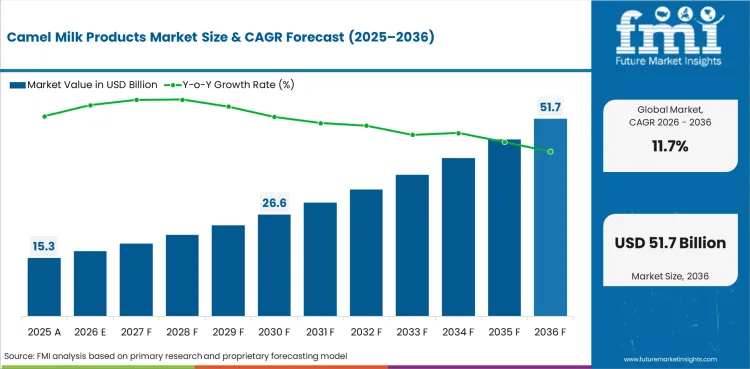
Key Takeaways, Market Size, and Forecast
- The camel milk products market is estimated at USD 15.30 billion in 2025 and is projected to reach USD 51.67 billion by 2036.
- The market is expected to expand at a CAGR of 11.7% during 2026–2036.
- The market is projected to create an incremental opportunity of USD 34.58 billion over the forecast period.
- Plain milk is expected to dominate the product segment with a 60.4% share.
- Food and beverage applications are projected to lead with a 44.8% share.
- Household consumption is expected to dominate the end-use segment with a 37.6% share.
- Offline retail channels are projected to remain dominant with a 75.3% share.
- Expansion is expected to be driven by GCC markets and global export growth supported by rising functional health demand.
Camel Milk Products Market Definition
The camel milk products market covers liquid and processed camel milk-based products including fresh pasteurized milk, powdered milk, flavored milk beverages, cheese, yogurt, ice cream, and functional supplement formats. Distribution spans offline supermarket, hypermarket, and convenience store networks alongside direct-to-consumer e-commerce and specialty retail channels.
Camel Milk Products Market Inclusions
Market scope includes all commercially traded products in the camel milk products market segmented by product (Plain Milk and peer options), application (Food and Beverage and peer options), end use, and distribution channel (Offline Retail and peer channels). Revenue sizing spans the 2026 to 2036 forecast period.
Camel Milk Products Market Exclusions
The scope excludes bovine and goat milk products, synthetic plant-based milk alternatives, camel meat products, pharmaceutical-grade camel milk immunoglobulin extracts used in therapeutic applications, and raw camel milk sold outside regulated food-safety channels.
Camel Milk Products Market Research Methodology
- Primary Research: In the camel milk products market in North America, Europe, and Asia-Pacific, FMI researchers spoke with procurement leads, category managers, and product development heads at manufacturers, distributors, and buyer accounts.
- Desk Research: To create verifiable baseline parameters, data was gathered from trade publications, industry association statistics, regulatory filings, and corporate annual reports.
- Market Sizing and Forecasting: Using region-specific growth rates and substitution curves to predict demand through 2036, baseline values are derived from a bottom-up aggregation of transaction volumes in the camel milk products market.
- Data validation and update cycle: Projections are tested against customer survey data, manufacturer shipment disclosures, and regulatory filings on a quarterly refresh schedule.
Why is the Camel Milk Products Market Growing?
- Volume expansion is running on two parallel tracks: structural end-user demand in the specialty dairy and functional foods sector and product innovation extending applications across adjacent use cases.
- GCC Consumer Base and Export Expansion is generating reformulation and investment cycles, reshaping the margin pool across commodity and premium tiers.
- Product Format Innovation and Powder Expansion is compressing timelines for competitive response, favouring scaled manufacturers with capital access over fragmented regional players.
The camel milk products market is expanding steadily, shaped by structural demand in the specialty dairy and functional foods sector, product and format innovation, and the competitive pressure on commodity players to reformulate for premium positioning. Demand is shaped by consumer positioning of camel milk as a functional beverage with lower A1 beta-casein content, better tolerability for lactose-sensitive consumers, and higher vitamin C concentration than bovine milk. These claims are reshaping category positioning in the United States, United Kingdom, and Germany from novelty item to functional health premium.
The GCC consumer base and export expansion is adding a new growth layer. Growth reflects Gulf Cooperation Council market consolidation led by Camelicious (UAE), Al Ain Farms (UAE), and Al Watania (Saudi Arabia) building processing capacity, cold-chain distribution, and halal certification that supports export programs to Europe, the United States, and East Asia.
Powder expansion and product format innovation serve as both a margin pressure point and a growth engine. Adoption is growing thanks to spray-dried camel milk powder, which opens export markets without local production and gets over cold-chain restrictions. In order to provide North American, European, and Southeast Asian consumers at premium pricing points, producers from China, Australia, and the United Arab Emirates are investing in powder plants.
Segmental Analysis
- Plain In 2026, Plain Milk maintains its 60.4% product share, anchoring category volume through familiarity with the format and existing buyer connections.
- Food and Beverage at 44.8% and Household Consumption at 37.6% reflect the dominance of core usage patterns as the primary volume drivers.
- Offline Retail holds 75.3% share, though adjacent channels are compressing order lead times and expanding access to mid-size buyer accounts.
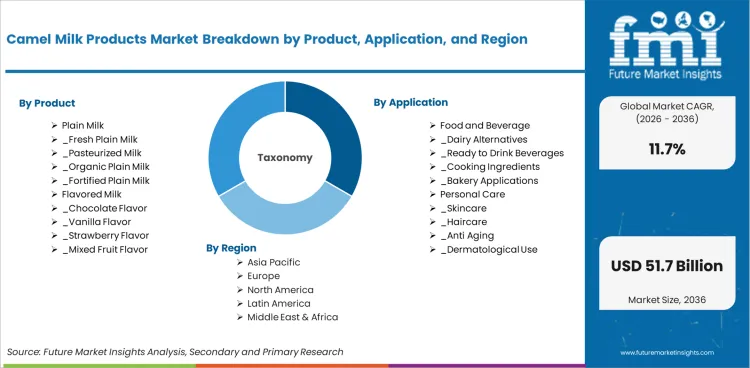
The camel milk products market is segmented by product, application, end use, distribution channel, and geographic regions. By product, the market is divided into Plain Milk and peer categories. By application, the market is classified into Food and Beverage and peer formats. By end use, the market is segmented into Household Consumption and related options.
Insights into the Plain Milk Segment
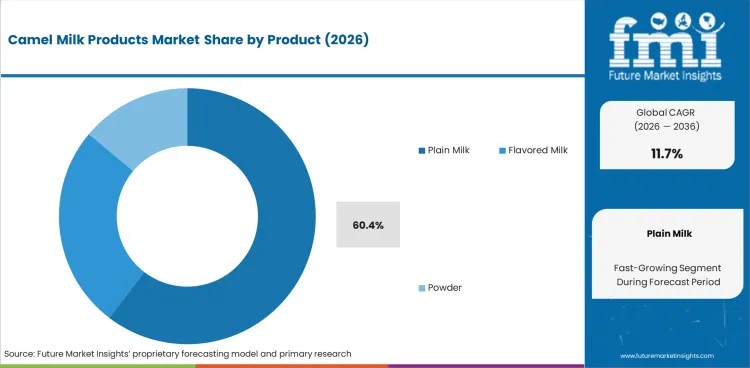
In 2026, plain milk is expected to dominate the market with a 60.4% market share. Established customer preferences, competitive unit economics, and functional performance for the category's primary use cases are all reflected in its leadership.Premium sub-formats of plain milk are becoming more popular as consumers react to demands related to quality, bioavailability, or regulatory placement. Changing consumer preferences and reformulation in response to compliance demands are driving the fastest-growing subsegment.Plain milk is predicted to maintain the majority of product share through 2036 despite new competition from related formats since other categories are currently unable to fulfill the core customer base's demands for price, performance, and supply reliability.
Insights into the Food and Beverage Segment
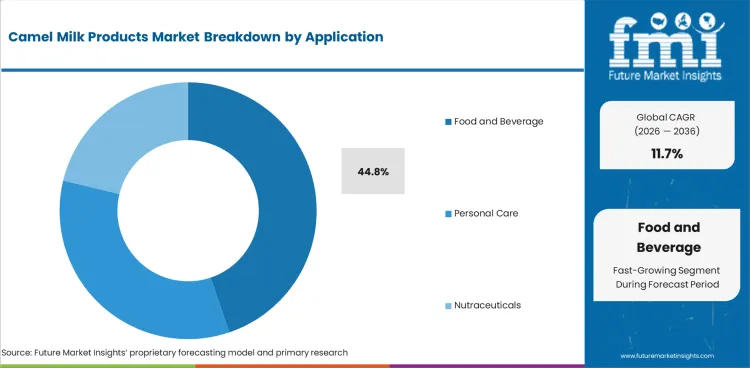
In 2026, food & beverage is predicted to account for 44.8% of the application segment. Convenience, cost-effective distribution, and compatibility with the biggest consumer segments in the camel milk products market make this format the industry leader.While mature economies maintain replacement volume through consistent per-capita consumption and reformulation cycles, emerging countries like China, India, and Southeast Asia are experiencing above-average rates of demand compounding due to the expansion of the food and beverage sector.
Camel Milk Products Market Drivers, Restraints, and Opportunities
- Functional Health Claims and Lactose-Tolerance Positioning is creating incremental demand with higher-specification product designs and premium price points.
- Powder Format Innovation for Export Markets is compelling reformulation investment, straining smaller manufacturers while favouring scaled operators.
- Specialty Retail and Premium E-commerce Expansion is closing the performance gap with legacy categories, shifting premium formats from niche positioning to mainstream specification.
The camel milk products market is expanding steadily, shaped by functional health claims and lactose-tolerance positioning, GCC market consolidation and export scaling, and powder format innovation for export markets. Manufacturers are responding by developing product formats and commercial models that meet evolving regulatory and consumer requirements. Despite challenges such as raw-material cost volatility, tooling investment requirements, and changing regulatory frameworks, there are significant growth opportunities in specialty formats, emerging-market expansion, and premium-tier product innovation.
Functional Health Claims and Lactose-Tolerance Positioning
Demand is shaped by consumer positioning of camel milk as a functional beverage with lower A1 beta-casein content, better tolerability for lactose-sensitive consumers, and higher vitamin C concentration than bovine milk. These claims are reshaping category positioning in the United States, United Kingdom, and Germany from novelty item to functional health premium.
GCC Market Consolidation and Export Scaling
Growth is a result of the Gulf Cooperation Council's market consolidation, which is spearheaded by Camelicious (UAE), Al Ain Farms (UAE), and Al Watania (Saudi Arabia). These companies are developing cold-chain distribution, halal certification, and processing capacity to support export initiatives to Europe, the US, and East Asia.
Powder Format Innovation for Export Markets
Adoption is growing thanks to spray-dried camel milk powder, which opens export markets without local production and gets over cold-chain restrictions. In order to provide North American, European, and Southeast Asian consumers at premium pricing points, producers from China, Australia, and the United Arab Emirates are investing in powder plants.
Specialty Retail and Premium E-commerce Expansion
Growth is reshaped by premium retailer listing in Whole Foods, Sprouts, and Erewhon in the United States, and DTC e-commerce platforms such as Desert Farms direct. These premium channels support retail pricing at three to five times bovine-milk equivalents while maintaining steady household penetration among health-conscious consumers.
Analysis of Camel Milk Products Market By Key Countries
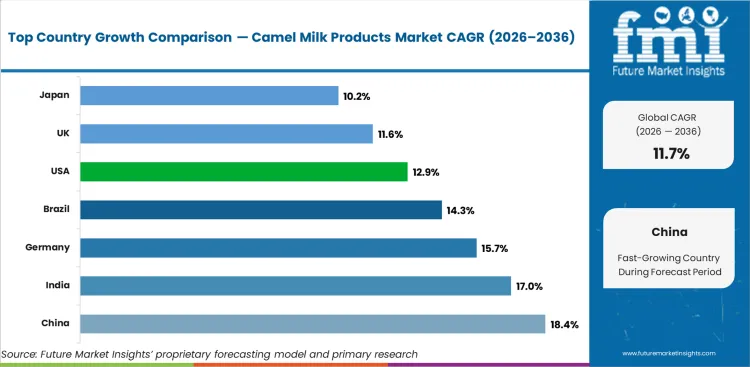
.webp "Top Country Growth Comparison Camel Milk Products Market Cagr (2026 2036)")
| Country | CAGR |
|---|---|
| China | 18.37% |
| India | 17.01% |
| Germany | 15.65% |
| Brazil | 14.29% |
| United States | 12.93% |
- North America and Western Europe are mature regions where growth reflects format transition and premium positioning rather than pure volume expansion, while Asia-Pacific represents the highest absolute growth from rising consumer penetration and organized distribution expansion.
- The United States leads the tracked country roster at 18.37% CAGR, shaped by specialty health-food retail listings in Whole Foods, Sprouts, and Erewhon, rising functional-beverage positioning, and a growing DTC e-commerce base led by Desert Farms.
- Due to the growth of organized retail, increased consumer knowledge, and regulatory compliance with international product standards, China and India are becoming rapidly expanding national markets.
- The GCC's hospitality, healthcare, and organized retail infrastructure investments have created the first demand base for certified and branded supply in the Middle East and Africa, which is still in its early stages.
The camel milk products market is projected to grow globally at a CAGR of 11.7% from 2026 to 2036. Among the top markets, the China leads at 18.37%, followed by India at 17.01%, followed by Germany at 15.65%, followed by Brazil at 14.29%, while United States posts 12.93%. The analysis spans over 30 countries, with the leading markets detailed below.
Demand Outlook for Camel Milk Products Market in United States
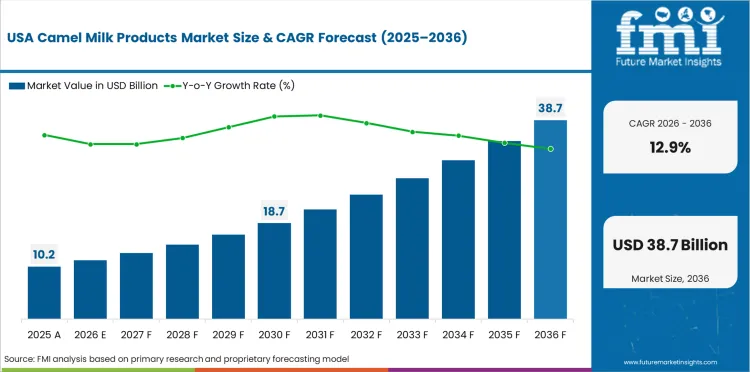
The United States is projected to grow at a CAGR of 12.93% through 2036, shaped by specialty health-food retail listings in Whole Foods, Sprouts, and Erewhon, rising functional-beverage positioning, and a growing DTC e-commerce base led by Desert Farms. Desert Farms, Camelicious USA, and Oasis Camel Dairy lead retail distribution, with specialty health-food chains serving premium category shelf positions.
- Specialty health-food retail listings in Whole Foods sustains recurring category demand.
- Leading national operators invest in premium format capacity and branded positioning.
- Direct-to-consumer and specialty retail channels expand alongside traditional distribution.
Future Outlook for Camel Milk Products Market in United Kingdom
The United Kingdom is projected to grow at a CAGR of 11.56% through 2036, with demand supported by Middle Eastern diaspora consumer base, premium specialty supermarket listings, and growing functional-health consumer awareness of camel milk positioning. The Bridge Bio and Camelot Dairy serve UK premium retail, with imported Camelicious and Al Ain Farms lines distributed through specialty stores.
- Middle Eastern diaspora consumer base sustains category volumes.
- Pharmacy and specialty retail chains concentrate branded distribution.
- E-commerce and DTC subscription platforms expand consumer reach.
Opportunity Analysis of Camel Milk Products Market in Germany
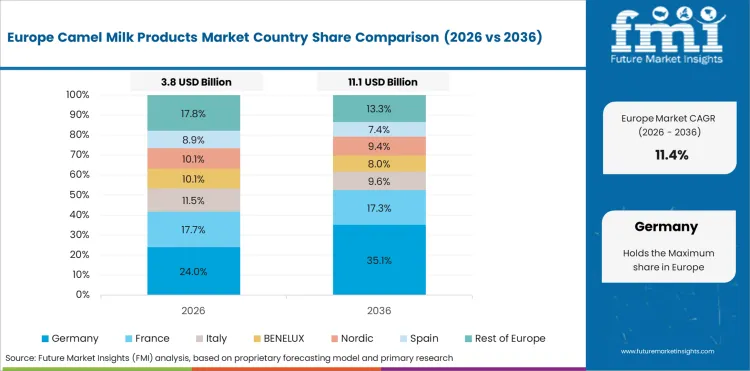
Germany demonstrates steady growth through 2036 as the country's buyer base responds to organic specialty supermarket category positioning, growing halal-certified retail segment, and import programs from UAE and Saudi producers. Camelicious and Al Ain Farms dominate premium retail imports, with smaller European producers serving niche organic-retail channels.
- Organic specialty supermarket category positioning shapes category positioning.
- Leading local operators lead premium format innovation.
- Organized retail and pharmacy distribution anchor branded share.
In-depth Analysis of Camel Milk Products Market in Japan
Japan is projected to grow at a CAGR of 10.20% through 2036, reflecting Japan's premium specialty food retail segment, functional nutrition positioning tied to lactose tolerance claims, and department store food-hall distribution. Imported Camelicious and Desert Farms lines serve Japan's premium retail, with Isetan and Takashimaya food halls providing dominant specialty-retail listings.
- Japan's premium specialty food retail segment generates consistent category demand.
- Premium positioning and convenience store distribution anchor national volumes.
- Format and packaging innovation aligns with consumer quality expectations.
Sales Analysis of Camel Milk Products Market in China
China is expected to demonstrate above-average growth through 2036, propelled by rapid growth of Xinjiang camel milk production, consumer positioning as functional superfood on Tmall and JD, and cross-border e-commerce imports from Australia and UAE. Wangyuan Camel Milk, Camelicious China, and Xinjiang-based producers lead domestic distribution, with imported Desert Farms and Camilk competing in cross-border e-commerce.
- Rapid growth of Xinjiang camel milk production generates rapid category demand growth.
- E-commerce platforms on Tmall and JD create large-scale direct consumer reach.
- Local manufacturers and foreign brands compete on quality, price, and premium positioning.
In-depth Analysis of Camel Milk Products Market in India
India demonstrates strong growth through 2036, supported by expanding desert-state production in Rajasthan and Gujarat, growing Ayurveda-aligned functional nutrition positioning, and e-commerce retail through Amazon India and BigBasket. Aadvik Foods and Camelicious India lead the domestic market, with smaller producers such as Sahjeevan Kutch supplying regional retail networks.
- Expanding desert-state production in Rajasthan and Gujarat drives organized category demand.
- Transition from unbranded suppliers to certified operators reshapes competitive dynamics.
- E-commerce and organized-retail expansion accelerate branded penetration.
Competitive Landscape and Strategic Positioning
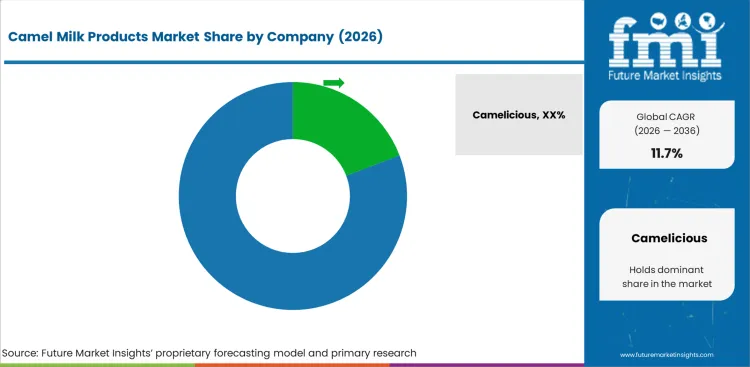
- The market for camel milk products is dominated by the top four worldwide operators, whose competitive distinction has shifted from unit cost to format innovation, premium positioning, and buyer-account access.
- In markets where consumer preferences or regulatory requirements favor certified, locally produced, or specialty forms, regional experts are increasing market share.
- Targeting institutional and subscription buyer accounts, startups and SMEs are carving out niches in specialty and premium markets.
Specialized category operators and integrated manufacturers shape the market for camel milk products. Based on vertically integrated manufacturing, a large distribution network, and well-established buyer-account connections, Camelicious has an estimated sector-leading revenue share. With a focus on format and distribution innovation, Desert Farms, Inc. runs production facilities in several different parts of the world. The Camel Milk Company. Australia Pty Ltd provides the category through a commercial accounts-focused division. Camilk supplies conventional and customized products for a variety of end-use applications by utilizing manufacturing scale. For institutional accounts, Camel Dairy Smits specializes in premium and customized formats. Manufacturing capital needs, accreditation under relevant safety and regulatory standards, and established supply agreements with buyer procurement groups are examples of barriers to entrance. Building manufacturing capacity in high-growth Asian regions, increasing certified supply coverage, and creating premium formats that match commodity-tier performance are strategic initiatives.
Major Industry Players
Key global companies leading the camel milk products market include:
- The Camel Milk Co., Camelicious, and Desert Farms, Inc. Given their robust manufacturing footprint, well-established buyer account ties, and product portfolio that includes both commodity and premium tiers, Australia Pty Ltd. and Camilk were recognized as some of the leading companies in the worldwide camel milk products industry.
- By focusing on regional and premium formats and catering to buyer accounts that value certified supply, regional presence, or niche product requirements across their different markets, Camel Dairy Smits, Al Ain Farms, and Tiviski Pvt Ltd. have created strong regional positions.
- By establishing themselves in specialized niche markets, UK Camel Milk Ltd., Aadvik Foods, and QCamel have set themselves apart among startups and SMEs, highlighting their potential as emergent market leaders.
Competitive Benchmarking: Camel Milk Products Market
| Company | Product Breadth | Cold Chain Capability | Export Reach | Geographic Footprint |
|---|---|---|---|---|
| Camelicious | High | High | High | Global (UAE HQ) |
| Desert Farms, Inc. | Medium | Medium | High | North America, Europe |
| The Camel Milk Co. Australia Pty Ltd. | Medium | High | Medium | Asia-Pacific |
| Camilk | Medium | Medium | Medium | Asia-Pacific |
| Camel Dairy Smits | Medium | Medium | Medium | Regional |
| Al Ain Farms | High | High | Medium | GCC, Asia |
| Tiviski Pvt Ltd. | Low | Low | Low | Africa |
| UK Camel Milk Ltd | Medium | Medium | Medium | Regional |
| Aadvik Foods | Medium | Medium | Low | South Asia |
| QCamel | Medium | Medium | Medium | Regional |
Source: Future Market Insights competitive analysis, 2026.
Key Developments in Camel Milk Products Market
- In 2023–2025, producers such as Camelicious expanded international market access following regulatory approvals for camel milk powder exports, supporting growth in Europe and other global markets.
- In 2024–2025, companies including Desert Farms increased focus on diversified product offerings such as powdered and flavored camel milk, aligning with rising demand for functional and specialty dairy alternatives.
Key Players in the Camel Milk Products Market:
Major Global Players:
- Camelicious
- Desert Farms, Inc.
- The Camel Milk Co. Australia Pty Ltd.
- Camilk
- Camel Dairy Smits
- Al Ain Farms
- Tiviski Pvt Ltd.
Emerging Players/Startups
- UK Camel Milk Ltd
- Aadvik Foods
- QCamel
Scope of the report
| Metric | Value |
|---|---|
| Quantitative Units | USD 17.09 billion to USD 51.67 billion, at a CAGR of 11.7% |
| Market Definition | The camel milk products market covers liquid and processed camel milk-based products including fresh pasteurized milk. |
| Regions Covered | North America, Latin America, Europe, East Asia, South Asia and Pacific, Middle East and Africa |
| Countries Covered | India, China, USA, UK, Germany, Japan, South Korea, Brazil, 30 plus countries |
| Key Companies Profiled | Camelicious, Desert Farms, Inc., The Camel Milk Co. Australia Pty Ltd., Camilk, Camel Dairy Smits, Al Ain Farms, Tiviski Pvt Ltd., UK Camel Milk Ltd, Aadvik Foods, QCamel |
| Forecast Period | 2026 to 2036 |
| Approach | Hybrid bottom-up and top-down methodology starting with verified camel milk products transaction data, projecting adoption velocity across segments and regions. |
Market Segmentation Analysis
Camel Milk Products Market Market Segmented by Product:
- Plain Milk
- Fresh Plain Milk
- Pasteurized Milk
- Organic Plain Milk
- Fortified Plain Milk
- Flavored Milk
- Chocolate Flavor
- Vanilla Flavor
- Strawberry Flavor
- Mixed Fruit Flavor
- Powder
- Whole Milk Powder
- Skimmed Milk Powder
- Instant Powder
- Organic Powder
- Ice Cream
- Standard Ice Cream
- Low Fat Ice Cream
- Organic Ice Cream
- Premium Ice Cream
- Fermented Products
- Yogurt
- Kefir
- Probiotic Drinks
- Cultured Milk
- Cheese
- Soft Cheese
- Hard Cheese
- Spreadable Cheese
- Aged Cheese
Camel Milk Products Market Market Segmented by Application:
- Food and Beverage
- Dairy Alternatives
- Ready to Drink Beverages
- Cooking Ingredients
- Bakery Applications
- Personal Care
- Skincare
- Haircare
- Anti Aging
- Dermatological Use
- Nutraceuticals
- Dietary Supplements
- Immunity Boosters
- Digestive Health
- Protein Enriched Products
- Infant Nutrition
- Infant Formula
- Toddler Nutrition
- Specialty Nutrition
- Allergy Sensitive Nutrition
- Functional Foods
- Fortified Dairy
- Functional Beverages
- Probiotic Products
- Energy Nutrition
- Therapeutic Use
- Medical Nutrition
- Skin Disorders
- Lactose Intolerance
- Gut Health
Camel Milk Products Market Market Segmented by Distribution Channel:
- Offline
- Supermarkets
- Hypermarkets
- Convenience Stores
- Local Retailers
- Online
- E Commerce Platforms
- Brand Websites
- Marketplace Platforms
- Subscription Services
- Direct Sales
- Direct to Consumer
- Institutional Sales
- Bulk Buyers
- Corporate Sales
- Specialty Stores
- Health Stores
- Organic Stores
- Gourmet Stores
- Premium Retail
- Pharmacies
- Medical Stores
- Nutritional Stores
- Wellness Stores
- Specialty Pharmacies
- Wholesale Distribution
- Distributors
- Dealers
- Export Channels
- Import Channels
Camel Milk Products Market Market Segmented by End Use:
- Household Consumption
- Daily Consumption
- Health Focused Usage
- Dietary Use
- Specialty Diets
- Foodservice
- Restaurants
- Cafes
- Hotels
- Catering Services
- Retail Processing
- Private Label
- Packaged Goods
- Specialty Retail
- Organic Brands
- Cosmetic Industry
- Skincare Manufacturing
- Organic Cosmetics
- Herbal Products
- Premium Beauty Products
- Nutraceutical Industry
- Supplement Manufacturing
- Functional Nutrition
- Wellness Products
- Immunity Products
- Pharmaceutical Industry
- Medical Nutrition
- Clinical Products
- Therapeutic Use
- Prescription Products
Camel Milk Products Market Market by Region:
- North America
- USA
- Canada
- Mexico
- Latin America
- Brazil
- Chile
- Rest of Latin America
- Western Europe
- Germany
- UK
- Italy
- Spain
- France
- Nordic
- BENELUX
- Rest of Western Europe
- Eastern Europe
- Russia
- Poland
- Hungary
- Balkan & Baltic
- Rest of Eastern Europe
- East Asia
- China
- Japan
- South Korea
- South Asia and Pacific
- India
- ASEAN
- Australia & New Zealand
- Rest of South Asia and Pacific
- Middle East & Africa
- Kingdom of Saudi Arabia
- Other GCC Countries
- Turkiye
- South Africa
- Other African Union
- Rest of Middle East & Africa
Bibliography
- 1. Food and Agriculture Organization of the United Nations. (2024). Camel Milk: Nutritional Properties and Market Outlook. FAO.
- 2. Gulf Cooperation Council Standardization Organization. (2023). Halal Food Regulation and Cold Chain Standards. GSO.
- 3. USA Food and Drug Administration. (2024). Pasteurized Milk Ordinance: Inter-species Milk Regulation. FDA.
- 4. European Food Safety Authority. (2023). Scientific Opinion on Novel Food Safety of Camel Milk. EFSA.
- 5. International Dairy Federation. (2024). Specialty Dairy Markets: Camel, Buffalo and Goat Milk Outlook. IDF.
This bibliography is provided for reader reference.
This Report Addresses
- Market sizing and revenue forecasting for camel milk product products from 2026 to 2036.
- Segmentation analysis across product, application, end use, distribution channel, and region.
- Regional and country-level insights covering over 30 markets with comparative growth analysis.
- Regulatory analysis covering industry-relevant directives, safety and labeling rules, and regional compliance frameworks.
- Competitive landscape assessment covering market structure, vendor positioning, and recent developments.
- Investment opportunity mapping across the specialty dairy and functional foods sector.
- Supply chain tracking from raw material sourcing to finished product distribution and end-use delivery.
- Data delivery in PDF and Excel formats with quarterly refresh access.
Frequently Asked Questions
How large is the demand for Camel Milk Products in the global market in 2026?
Demand for camel milk products in the global market is estimated to be valued at USD 17.09 billion in 2026.
What will be the market size of Camel Milk Products by 2036?
Market size for camel milk products is projected to reach USD 51.67 billion by 2036.
What is the expected demand growth for Camel Milk Products between 2026 and 2036?
Demand for camel milk products is expected to grow at a CAGR of 11.7% between 2026 and 2036.
Which Product is poised to lead global sales by 2026?
Plain Milk accounts for 60.4% in 2026, reflecting established buyer preference and functional performance advantages.
How is Offline Retail distribution driving Camel Milk Products adoption?
Offline Retail represents 75.3% of distribution demand as operators and buyer accounts drive bulk procurement volumes.
What is driving demand in the United States?
The USA registers a 12.93% CAGR through 2036, propelled by specialty health-food retail listings in Whole Foods, Sprouts, and Erewhon, rising functional-beverage positioning, and a growing DTC e-commerce base led by Desert Farms.
What does Camel Milk Products Market definition mean in this report?
The camel milk products market covers liquid and processed camel milk-based products including fresh pasteurized milk.
How does FMI build and validate the Camel Milk Products forecast?
Forecasting models apply a hybrid bottom-up methodology starting with verified transaction data, cross-validated against industry sales statistics and manufacturer financial disclosures.
Preview the report firsthand - request a free sample
Get SampleGet the brochure for pricing and purchase details.
Get PDFTable of Content
- Executive Summary
- Global Market Outlook
- Demand-side Trends
- Supply-side Trends
- Technology Roadmap Analysis
- Analysis and Recommendations
- Market Overview
- Market Coverage / Taxonomy
- Market Definition / Scope / Limitations
- Research Methodology
- Chapter Orientation
- Analytical Lens and Working Hypotheses
- Market Structure, Signals, and Trend Drivers
- Benchmarking and Cross-market Comparability
- Market Sizing, Forecasting, and Opportunity Mapping
- Research Design and Evidence Framework
- Desk Research Programme (Secondary Evidence)
- Company Annual and Sustainability Reports
- Peer-reviewed Journals and Academic Literature
- Corporate Websites, Product Literature, and Technical Notes
- Earnings Decks and Investor Briefings
- Statutory Filings and Regulatory Disclosures
- Technical White Papers and Standards Notes
- Trade Journals, Industry Magazines, and Analyst Briefs
- Conference Proceedings, Webinars, and Seminar Materials
- Government Statistics Portals and Public Data Releases
- Press Releases and Reputable Media Coverage
- Specialist Newsletters and Curated Briefings
- Sector Databases and Reference Repositories
- FMI Internal Proprietary Databases and Historical Market Datasets
- Subscription Datasets and Paid Sources
- Social Channels, Communities, and Digital Listening Inputs
- Additional Desk Sources
- Expert Input and Fieldwork (Primary Evidence)
- Primary Modes
- Qualitative Interviews and Expert Elicitation
- Quantitative Surveys and Structured Data Capture
- Blended Approach
- Why Primary Evidence is Used
- Field Techniques
- Interviews
- Surveys
- Focus Groups
- Observational and In-context Research
- Social and Community Interactions
- Stakeholder Universe Engaged
- C-suite Leaders
- Board Members
- Presidents and Vice Presidents
- R&D and Innovation Heads
- Technical Specialists
- Trends
- Scenario Forecast
- Demand in Optimistic Scenario
- Demand in Likely Scenario
- Demand in Conservative Scenario
- Opportunity Map Analysis
- Product Life Cycle Analysis
- Supply Chain Analysis
- Investment Feasibility Matrix
- Value Chain Analysis
- PESTLE and Porter’s Analysis
- Regulatory Landscape
- Regional Parent Market Outlook
- Production and Consumption Statistics
- Import and Export Statistics
- Primary Modes
- Global Market Analysis 2021 to 2025 and Forecast, 2026 to 2036
- Historical Market Size Value (USD Million) Analysis, 2021 to 2025
- Current and Future Market Size Value (USD Million) Projections, 2026 to 2036
- Y-o-Y Growth Trend Analysis
- Absolute $ Opportunity Analysis
- Global Market Pricing Analysis 2021 to 2025 and Forecast 2026 to 2036
- Global Market Analysis 2021 to 2025 and Forecast 2026 to 2036, By Product
- Introduction / Key Findings
- Historical Market Size Value (USD Million) Analysis By Product , 2021 to 2025
- Current and Future Market Size Value (USD Million) Analysis and Forecast By Product , 2026 to 2036
- Plain Milk
- Fresh Plain Milk
- Pasteurized Milk
- Organic Plain Milk
- Fortified Plain Milk
- Flavored Milk
- Chocolate Flavor
- Vanilla Flavor
- Strawberry Flavor
- Mixed Fruit Flavor
- Powder
- Whole Milk Powder
- Skimmed Milk Powder
- Instant Powder
- Organic Powder
- Ice Cream
- Standard Ice Cream
- Low Fat Ice Cream
- Organic Ice Cream
- Premium Ice Cream
- Fermented Products
- Yogurt
- Kefir
- Probiotic Drinks
- Cultured Milk
- Cheese
- Soft Cheese
- Hard Cheese
- Spreadable Cheese
- Aged Cheese
- Plain Milk
- Y-o-Y Growth Trend Analysis By Product , 2021 to 2025
- Absolute $ Opportunity Analysis By Product , 2026 to 2036
- Global Market Analysis 2021 to 2025 and Forecast 2026 to 2036, By Application
- Introduction / Key Findings
- Historical Market Size Value (USD Million) Analysis By Application, 2021 to 2025
- Current and Future Market Size Value (USD Million) Analysis and Forecast By Application, 2026 to 2036
- Food and Beverage
- Dairy Alternatives
- Ready to Drink Beverages
- Cooking Ingredients
- Bakery Applications
- Personal Care
- Skincare
- Haircare
- Anti Aging
- Dermatological Use
- Nutraceuticals
- Dietary Supplements
- Immunity Boosters
- Digestive Health
- Protein Enriched Products
- Infant Nutrition
- Infant Formula
- Toddler Nutrition
- Specialty Nutrition
- Allergy Sensitive Nutrition
- Functional Foods
- Fortified Dairy
- Functional Beverages
- Probiotic Products
- Energy Nutrition
- Therapeutic Use
- Medical Nutrition
- Skin Disorders
- Lactose Intolerance
- Gut Health
- Food and Beverage
- Y-o-Y Growth Trend Analysis By Application, 2021 to 2025
- Absolute $ Opportunity Analysis By Application, 2026 to 2036
- Global Market Analysis 2021 to 2025 and Forecast 2026 to 2036, By Distribution Channel
- Introduction / Key Findings
- Historical Market Size Value (USD Million) Analysis By Distribution Channel, 2021 to 2025
- Current and Future Market Size Value (USD Million) Analysis and Forecast By Distribution Channel, 2026 to 2036
- Offline
- Supermarkets
- Hypermarkets
- Convenience Stores
- Local Retailers
- Online
- E Commerce Platforms
- Brand Websites
- Marketplace Platforms
- Subscription Services
- Direct Sales
- Direct to Consumer
- Institutional Sales
- Bulk Buyers
- Corporate Sales
- Specialty Stores
- Health Stores
- Organic Stores
- Gourmet Stores
- Premium Retail
- Pharmacies
- Medical Stores
- Nutritional Stores
- Wellness Stores
- Specialty Pharmacies
- Wholesale Distribution
- Distributors
- Dealers
- Export Channels
- Import Channels
- Offline
- Y-o-Y Growth Trend Analysis By Distribution Channel, 2021 to 2025
- Absolute $ Opportunity Analysis By Distribution Channel, 2026 to 2036
- Global Market Analysis 2021 to 2025 and Forecast 2026 to 2036, By End Use
- Introduction / Key Findings
- Historical Market Size Value (USD Million) Analysis By End Use, 2021 to 2025
- Current and Future Market Size Value (USD Million) Analysis and Forecast By End Use, 2026 to 2036
- Household Consumption
- Daily Consumption
- Health Focused Usage
- Dietary Use
- Specialty Diets
- Foodservice
- Restaurants
- Cafes
- Hotels
- Catering Services
- Retail Processing
- Private Label
- Packaged Goods
- Specialty Retail
- Organic Brands
- Cosmetic Industry
- Skincare Manufacturing
- Organic Cosmetics
- Herbal Products
- Premium Beauty Products
- Nutraceutical Industry
- Supplement Manufacturing
- Functional Nutrition
- Wellness Products
- Immunity Products
- Pharmaceutical Industry
- Medical Nutrition
- Clinical Products
- Therapeutic Use
- Prescription Products
- Household Consumption
- Y-o-Y Growth Trend Analysis By End Use, 2021 to 2025
- Absolute $ Opportunity Analysis By End Use, 2026 to 2036
- Global Market Analysis 2021 to 2025 and Forecast 2026 to 2036, By Region
- Introduction
- Historical Market Size Value (USD Million) Analysis By Region, 2021 to 2025
- Current Market Size Value (USD Million) Analysis and Forecast By Region, 2026 to 2036
- North America
- Latin America
- Western Europe
- Eastern Europe
- East Asia
- South Asia and Pacific
- Middle East & Africa
- Market Attractiveness Analysis By Region
- North America Market Analysis 2021 to 2025 and Forecast 2026 to 2036, By Country
- Historical Market Size Value (USD Million) Trend Analysis By Market Taxonomy, 2021 to 2025
- Market Size Value (USD Million) Forecast By Market Taxonomy, 2026 to 2036
- By Country
- USA
- Canada
- Mexico
- By Product
- By Application
- By Distribution Channel
- By End Use
- By Country
- Market Attractiveness Analysis
- By Country
- By Product
- By Application
- By Distribution Channel
- By End Use
- Key Takeaways
- Latin America Market Analysis 2021 to 2025 and Forecast 2026 to 2036, By Country
- Historical Market Size Value (USD Million) Trend Analysis By Market Taxonomy, 2021 to 2025
- Market Size Value (USD Million) Forecast By Market Taxonomy, 2026 to 2036
- By Country
- Brazil
- Chile
- Rest of Latin America
- By Product
- By Application
- By Distribution Channel
- By End Use
- By Country
- Market Attractiveness Analysis
- By Country
- By Product
- By Application
- By Distribution Channel
- By End Use
- Key Takeaways
- Western Europe Market Analysis 2021 to 2025 and Forecast 2026 to 2036, By Country
- Historical Market Size Value (USD Million) Trend Analysis By Market Taxonomy, 2021 to 2025
- Market Size Value (USD Million) Forecast By Market Taxonomy, 2026 to 2036
- By Country
- Germany
- UK
- Italy
- Spain
- France
- Nordic
- BENELUX
- Rest of Western Europe
- By Product
- By Application
- By Distribution Channel
- By End Use
- By Country
- Market Attractiveness Analysis
- By Country
- By Product
- By Application
- By Distribution Channel
- By End Use
- Key Takeaways
- Eastern Europe Market Analysis 2021 to 2025 and Forecast 2026 to 2036, By Country
- Historical Market Size Value (USD Million) Trend Analysis By Market Taxonomy, 2021 to 2025
- Market Size Value (USD Million) Forecast By Market Taxonomy, 2026 to 2036
- By Country
- Russia
- Poland
- Hungary
- Balkan & Baltic
- Rest of Eastern Europe
- By Product
- By Application
- By Distribution Channel
- By End Use
- By Country
- Market Attractiveness Analysis
- By Country
- By Product
- By Application
- By Distribution Channel
- By End Use
- Key Takeaways
- East Asia Market Analysis 2021 to 2025 and Forecast 2026 to 2036, By Country
- Historical Market Size Value (USD Million) Trend Analysis By Market Taxonomy, 2021 to 2025
- Market Size Value (USD Million) Forecast By Market Taxonomy, 2026 to 2036
- By Country
- China
- Japan
- South Korea
- By Product
- By Application
- By Distribution Channel
- By End Use
- By Country
- Market Attractiveness Analysis
- By Country
- By Product
- By Application
- By Distribution Channel
- By End Use
- Key Takeaways
- South Asia and Pacific Market Analysis 2021 to 2025 and Forecast 2026 to 2036, By Country
- Historical Market Size Value (USD Million) Trend Analysis By Market Taxonomy, 2021 to 2025
- Market Size Value (USD Million) Forecast By Market Taxonomy, 2026 to 2036
- By Country
- India
- ASEAN
- Australia & New Zealand
- Rest of South Asia and Pacific
- By Product
- By Application
- By Distribution Channel
- By End Use
- By Country
- Market Attractiveness Analysis
- By Country
- By Product
- By Application
- By Distribution Channel
- By End Use
- Key Takeaways
- Middle East & Africa Market Analysis 2021 to 2025 and Forecast 2026 to 2036, By Country
- Historical Market Size Value (USD Million) Trend Analysis By Market Taxonomy, 2021 to 2025
- Market Size Value (USD Million) Forecast By Market Taxonomy, 2026 to 2036
- By Country
- Kingdom of Saudi Arabia
- Other GCC Countries
- Turkiye
- South Africa
- Other African Union
- Rest of Middle East & Africa
- By Product
- By Application
- By Distribution Channel
- By End Use
- By Country
- Market Attractiveness Analysis
- By Country
- By Product
- By Application
- By Distribution Channel
- By End Use
- Key Takeaways
- Key Countries Market Analysis
- USA
- Pricing Analysis
- Market Share Analysis, 2025
- By Product
- By Application
- By Distribution Channel
- By End Use
- Canada
- Pricing Analysis
- Market Share Analysis, 2025
- By Product
- By Application
- By Distribution Channel
- By End Use
- Mexico
- Pricing Analysis
- Market Share Analysis, 2025
- By Product
- By Application
- By Distribution Channel
- By End Use
- Brazil
- Pricing Analysis
- Market Share Analysis, 2025
- By Product
- By Application
- By Distribution Channel
- By End Use
- Chile
- Pricing Analysis
- Market Share Analysis, 2025
- By Product
- By Application
- By Distribution Channel
- By End Use
- Germany
- Pricing Analysis
- Market Share Analysis, 2025
- By Product
- By Application
- By Distribution Channel
- By End Use
- UK
- Pricing Analysis
- Market Share Analysis, 2025
- By Product
- By Application
- By Distribution Channel
- By End Use
- Italy
- Pricing Analysis
- Market Share Analysis, 2025
- By Product
- By Application
- By Distribution Channel
- By End Use
- Spain
- Pricing Analysis
- Market Share Analysis, 2025
- By Product
- By Application
- By Distribution Channel
- By End Use
- France
- Pricing Analysis
- Market Share Analysis, 2025
- By Product
- By Application
- By Distribution Channel
- By End Use
- India
- Pricing Analysis
- Market Share Analysis, 2025
- By Product
- By Application
- By Distribution Channel
- By End Use
- ASEAN
- Pricing Analysis
- Market Share Analysis, 2025
- By Product
- By Application
- By Distribution Channel
- By End Use
- Australia & New Zealand
- Pricing Analysis
- Market Share Analysis, 2025
- By Product
- By Application
- By Distribution Channel
- By End Use
- China
- Pricing Analysis
- Market Share Analysis, 2025
- By Product
- By Application
- By Distribution Channel
- By End Use
- Japan
- Pricing Analysis
- Market Share Analysis, 2025
- By Product
- By Application
- By Distribution Channel
- By End Use
- South Korea
- Pricing Analysis
- Market Share Analysis, 2025
- By Product
- By Application
- By Distribution Channel
- By End Use
- Russia
- Pricing Analysis
- Market Share Analysis, 2025
- By Product
- By Application
- By Distribution Channel
- By End Use
- Poland
- Pricing Analysis
- Market Share Analysis, 2025
- By Product
- By Application
- By Distribution Channel
- By End Use
- Hungary
- Pricing Analysis
- Market Share Analysis, 2025
- By Product
- By Application
- By Distribution Channel
- By End Use
- Kingdom of Saudi Arabia
- Pricing Analysis
- Market Share Analysis, 2025
- By Product
- By Application
- By Distribution Channel
- By End Use
- Turkiye
- Pricing Analysis
- Market Share Analysis, 2025
- By Product
- By Application
- By Distribution Channel
- By End Use
- South Africa
- Pricing Analysis
- Market Share Analysis, 2025
- By Product
- By Application
- By Distribution Channel
- By End Use
- USA
- Market Structure Analysis
- Competition Dashboard
- Competition Benchmarking
- Market Share Analysis of Top Players
- By Regional
- By Product
- By Application
- By Distribution Channel
- By End Use
- Competition Analysis
- Competition Deep Dive
- Camelicious
- Overview
- Product Portfolio
- Profitability by Market Segments (Product/Age /Sales Channel/Region)
- Sales Footprint
- Strategy Overview
- Marketing Strategy
- Product Strategy
- Channel Strategy
- Desert Farms, Inc.
- The Camel Milk Co. Australia Pty Ltd.
- Camilk
- Camel Dairy Smits
- Al Ain Farms
- Tiviski Pvt Ltd.
- UK Camel Milk Ltd
- Aadvik Foods
- QCamel
- Camelicious
- Competition Deep Dive
- Desk Research Programme (Secondary Evidence)
- Assumptions & Acronyms Used


