

- Market Size (2026)
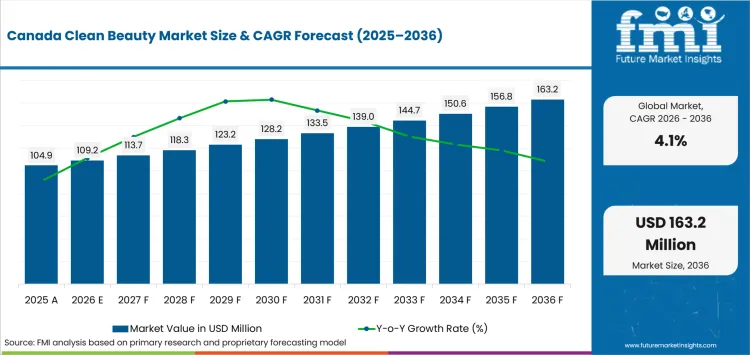
- USD 109.2 Mn
- Forecast (2036)
- USD 163.2 Mn
- CAGR (2026 to 2036)
- 4.1%
How big is Canada Clean Beauty Market in 2026?
USD 109.2 million in 2026 and USD 163.2 million by 2036 at a 4.1% CAGR.
Demand for clean beauty in Canada is projected to expand at 4.1% CAGR between 2026 and 2036, increasing valuation from USD 109.2 million to USD 163.2 million. Established beauty and personal care routines give ingredient-led brands a familiar path to repeat purchase. Health Canada confirmed in April 2026 that manufacturers and importers must notify it within 10 days after first sale. The filing requirement makes formulation records part of routine portfolio management as brands refresh everyday products.
Canada-specific packaging work also affects conversion from discovery to repeat purchase in cosmetics retail channels. Health Canada’s November 2025 labelling guidance requires product identity and warnings in English and French, while ingredient lists use INCI names. Imported clean-beauty SKUs therefore need Canada-ready artwork before wider retail or online distribution expands, and centralized formula records let companies update labels without delaying replenishment or rework.
Key Takeaways of Canada Clean Beauty Market
- Canadian clean-beauty demand rises as consumers compare ingredient and ethical claims without accepting weaker performance in routine products.
- Core - classic lines are projected to account for 33.0% by product type revenue in 2026, supported by familiar replenishment routines.
- Conventional formulations are estimated to hold 51.0% share in 2026 because clean positioning does not require natural-only formulas.
- Cream & balm products are forecast to represent 26.0% of format revenue in 2026 owing to familiar moisturization and barrier-care use.
- Canadian notification and labelling requirements can slow assortment changes whenever brands lack current formula records or Canada-ready packaging.
- Some of the key players in this market include Procter & Gamble, Estee Lauder Companies, L'Oreal, Unilever, Beiersdorf, Shiseido, Kao Corporation, and e.l.f. Beauty.
Analyst Perspective
"Prominent clean-beauty offer pairs a claim consumers can verify with performance they already expect from the category. Canadian execution then depends on disciplined formula records and channel coverage that keeps a successful routine easy to replenish."
- Rahul Pandita, Principal Consultant, Future Market Insights
How is the Canada clean beauty market segmented?
The Canada clean beauty market is segmented by product type, nature, format, price positioning, sales channel and region.
Product type covers core - classic lines, targeted treatment lines, sensitive & gentle lines, premium & clinical lines and kits & sets. Nature includes conventional, vegan & cruelty-free, natural & organic, dermocosmetic / clinical and fragrance-free & sensitive formulations. Formats comprise cream & balm, liquid & serum, stick & solid, spray & mist, sheet & patch and powder options. Price positioning includes mass, masstige, premium and professional tiers within the defined Canadian market scope for this forecast. Sales channels include e-commerce & DTC, specialty beauty retail, pharmacies & drugstores, supermarkets & hypermarkets and salons & spas.
Why do Core - classic lines lead the Product Type category?
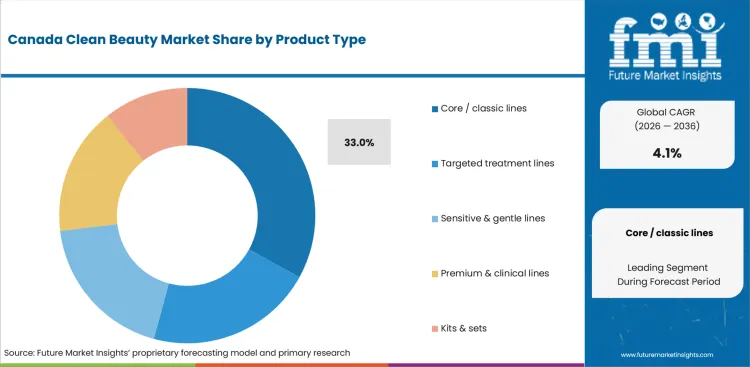
Core - classic lines fit routines consumers already understand, so clean claims can change brand choice without introducing a new regimen. In June 2026, Procter & Gamble expanded Native into detoxifying body scrubs with vegan and cruelty-free positioning. The launch placed limited-ingredient positioning inside a familiar body-care step while organic personal care shows similar reliance on familiar formats.
- Core - classic lines are estimated to hold 33.0% of 2026 product type revenue, owing to familiar products that support regular replenishment and direct comparison.
- Routine body and hair products support repeat orders because shoppers can compare ingredient claims inside categories they already replenish without learning a specialist regimen.
Why does Conventional lead the Nature category?
Conventional formulas let brands use selective exclusion, ethical or sensitivity claims without sacrificing ingredients that support texture and shelf stability.
- Conventional formulations are projected to represent 51.0% of nature revenue in 2026, supported by familiar textures and performance within clean-positioned products.
- Health Canada stated in March 2025 that natural and synthetic cosmetic ingredients are equally suitable for cosmetic use. Health Canada's position keeps conventional formulation routes available provided brands substantiate the clean or ethical claims used in Canadian marketing.
Why do Cream & balm formats lead the Format category?
Cream & balm formats tie clean positioning to moisturization and barrier-care routines in facial and body care, where texture influences repeat use and product tolerance. Beiersdorf's March 2026 annual report documented four Eucerin facial refill capsules launched in June 2025 for established day and night routines. Soothing skin care and healing skin care categories support familiar topical use in comfort-led purchasing.
- Cream & balm products are forecast to hold 26.0% of 2026 format revenue, attributable to familiar moisturization and barrier-care routines.
- Ingredient-conscious shoppers can assess texture and comfort during routine use, making creams and balms practical formats for repeated facial and body-care purchases.
Why does E-commerce & DTC lead the Sales Channel category?
E-commerce & DTC channels let clean-beauty brands explain ingredients before checkout and preserve those details during replenishment, extending access beyond major urban prestige locations without removing Canadian product-safety duties.
- E-commerce & DTC is estimated to account for 29.0% of 2026 sales channel revenue, driven by product comparison and repeat ordering in digital channels.
- Health Canada reported in May 2026 that four online marketplaces had joined the Canadian Product Safety Pledge, including Amazon Canada. The pledge sets expectations for seller identification, product recalls and safety controls that make third-party marketplace accountability more visible during cosmetics purchasing in Canada.
What are the drivers, restraints and opportunities in the Canada Clean Beauty Market?
Ingredient transparency supports demand, Canadian claim and labelling requirements raise operating friction, and performance-led omnichannel access gives brands the clearest revenue route.
- Driver: Ingredient disclosure and verifiable ethical positioning make clean claims easier for Canadian consumers to compare before purchase.
- Restraint: Formula changes and marketing claims require documentation that can slow launches or raise the cost of maintaining broad assortments.
- Opportunity: Brands can expand trial and replenishment by pairing specific clean cues with proven performance and wider digital or specialty distribution.
Ingredient transparency now shapes how Canadian shoppers evaluate clean positioning beside established organic cosmetics categories during routine product comparison. Health Canada’s April 2026 labelling guide requires disclosure of 24 fragrance allergens above defined thresholds and expands the list to 81 for new cosmetics from August 2026. The change gives brands a commercial reason to maintain precise ingredient data because shoppers can compare more formulation detail directly on the package.
Claim substantiation imposes a separate operating restraint because clean-beauty language often extends beyond ingredient lists into environmental or performance statements. The Competition Bureau’s June 2025 guidance states that product performance claims require adequate and proper testing completed before the claim is made. Weak testing records can therefore delay campaigns or force narrower wording even if the underlying formula is unchanged.
Omnichannel expansion offers a practical route to convert clean-beauty interest into repeat purchasing, especially for brands centered on rebalancing skin care and other routine-led propositions. In September 2025, e.l.f. Beauty moved rhode from direct-to-consumer sales into Sephora stores and online channels in Canada and the United States. Wider retail access can extend a digital brand while preserving the product education established in direct channels.
Who are the notable companies in the Canada Clean Beauty Market?
Procter & Gamble, Estee Lauder Companies, L'Oreal, Unilever, Beiersdorf, Shiseido, Kao Corporation, and e.l.f. Beauty are the notable companies profiled in this market.
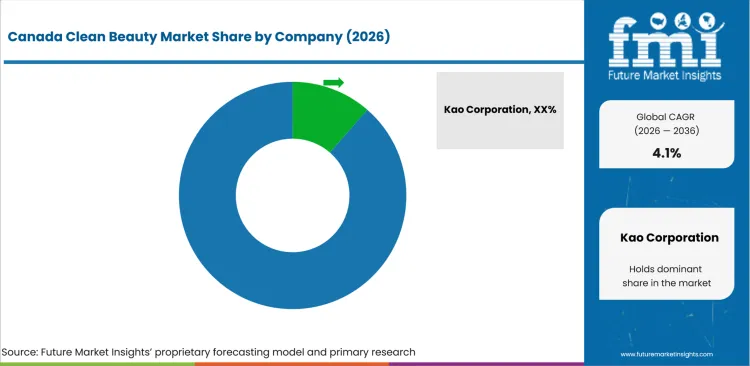
Competition divides among scaled portfolios and specialist skin-care positions plus clean-forward digital brands serving Canada. Entry requires documented claims and retail reach because chitosan-based natural cosmetics give shoppers another ingredient-led alternative.
- Broad routine platforms: Procter & Gamble and Estee Lauder Companies plus L'Oreal and Unilever bring large portfolios through Canadian retail channels.
- Skin-science positions: Beiersdorf and Shiseido plus Kao Corporation provide documented dermatological or sensitive-skin depth for efficacy comparisons.
- Clean-forward digital position: e.l.f. Beauty pairs explicit clean and cruelty-free standards with expanding Canadian retail coverage.
Competitive Benchmarking: Canada Clean Beauty Market
| Company | Clean-Positioned Portfolio Breadth | Sensitive / Clinical Depth | Omnichannel Route Strength | Geographic Reach |
|---|---|---|---|---|
| Procter & Gamble | Medium | Medium | High | Canada, North America and global consumer markets |
| Estee Lauder Companies | High | High | High | Canada and global prestige beauty markets |
| L'Oreal | Medium | High | High | Canada, North America and global beauty markets |
| Unilever | High | Medium | High | Canada and broad global consumer markets |
| Beiersdorf | Medium | High | High | Canada, North America, Europe and Asia |
| Shiseido | Medium | High | High | Canada, North America, Asia and Europe |
| Kao Corporation | Medium | High | Medium | Asia, Europe and selected North American markets |
| e.l.f. Beauty | High | Medium | High | Canada, United States, United Kingdom and expanding Europe |
Clean-positioned breadth rates High for several documented clean or ethical families, Medium for one family plus adjacent beauty exposure, and Low for narrow isolated positioning. Sensitive or clinical depth rates High for several specialist lines, Medium for one substantial specialist line or program, and Low for limited documented depth. Omnichannel strength rates High for Canadian stores plus e-commerce through several routes, Medium for two documented routes, and Low for one documented route.
Key Developments in the Canada Clean Beauty Market
- In June 2026, Procter & Gamble reformulated Native deodorants and body washes to improve performance while retaining clean and simple positioning.
- In June 2025, Estee Lauder Companies launched Aveda in Amazon.ca Premium Beauty with nationwide access to its vegan hair and skin portfolio.
- In April 2025, Unilever acquired Wild as a natural personal-care brand centered on refillable formats and direct-to-consumer distribution.
Key Players in the Canada Clean Beauty Market
Broad Routine and Omnichannel Beauty Platforms
- Procter & Gamble
- Estee Lauder Companies
- L'Oreal
- Unilever
Skin-Science and Sensitive-Skin Platforms
- Beiersdorf
- Shiseido
- Kao Corporation
Clean-Forward Digital Beauty Platform
- e.l.f. Beauty
Canada Clean Beauty Market - Report Scope
| Coverage field | Report scope |
|---|---|
| Market breakdown | By product type, nature, format, price positioning, sales channel and region. |
| Quantitative Units | USD million. |
| Market Definition | Finished cosmetics and personal-care products sold in Canada with clean-positioning based on ingredient, ethical, sensitivity or related consumer-facing criteria. |
| Regions Covered | North America |
| Countries Covered | Canada. |
| Key Companies Profiled | Procter & Gamble, Estee Lauder Companies, L'Oreal, Unilever, Beiersdorf, Shiseido, Kao Corporation, e.l.f. Beauty. |
| Forecast Period | 2026 to 2036. |
| Approach | Primary and secondary research with market triangulation. |
Canada Clean Beauty Market - Research Methodology
| Method | Approach |
|---|---|
| Primary Research | FMI analysts gathered input from manufacturers, service providers, technology developers, distributors, end users, procurement teams, and subject-matter experts. Interviews examined purchasing decisions, product or service evaluation, adoption barriers, approval requirements, pricing considerations, and expectations for technical or commercial support. Respondents were also asked what evidence is required before a trial, pilot, or initial order develops into regular purchasing. |
| Desk Research | Desk research covered government statistics, regulatory publications, trade data, industry associations, technical literature, standards, company filings, product information, and official corporate announcements. Sources were reviewed for relevance, publication date, geographic coverage, and consistency with the defined market scope. Claims relating to performance, applications, approvals, capacity, investment, and commercial activity were retained only when supported by credible public evidence. |
| Market Sizing and Forecasting | The market model combined the baseline value with historical performance, segment structure, pricing and volume indicators, adoption levels, company participation, and country-level demand conditions. Forecast assumptions considered economic activity, investment trends, regulatory developments, technology adoption, purchasing cycles, supply availability, and barriers to wider market use. Segment and regional estimates were reconciled before the final market total was calculated. |
| Data Validation | Estimates were checked against multiple independent indicators, including public data, company activity, trade patterns, industry developments, and findings from primary interviews. Validation also tested whether products, services, applications, and company revenues fell within the defined market boundaries. Adjacent categories, unsupported claims, overlapping revenues, and activities without direct market relevance were excluded to reduce double counting and maintain consistency across segments and countries. |
Canada Clean Beauty Market by Segments
Canada Clean Beauty Market segmented by Product Type:
- Core - classic lines
- Targeted treatment lines
- Sensitive & gentle lines
- Premium & clinical lines
- Kits & sets
Canada Clean Beauty Market segmented by Nature:
- Conventional
- Vegan & cruelty-free
- Natural & organic
- Dermocosmetic / clinical
- Fragrance-free & sensitive
Canada Clean Beauty Market segmented by Format:
- Cream & balm
- Liquid & serum
- Stick & solid
- Spray & mist
- Sheet & patch
- Powder
Canada Clean Beauty Market segmented by Price Positioning:
- Mass
- Masstige
- Premium
- Professional
Canada Clean Beauty Market segmented by Sales Channel:
- E-commerce & DTC
- Specialty beauty retail
- Pharmacies & drugstores
- Supermarkets & hypermarkets
- Salons & spas
Research Sources and Bibliography
- Health Canada. (2026, April 2). Notification of Cosmetics: Common issues when submitting a notification.
- Health Canada. (2025, November 4). Labelling of Cosmetics - Consumer product safety.
- Procter & Gamble. (2026, June 26). Native Shakes Up the Body Care Category with New Detoxifying Body Scrub Collection.
- Health Canada. (2025, March 17). Cosmetic advertising, labelling and ingredients.
- Beiersdorf. (2026, March 3). Research and Development - Beiersdorf Annual Report 2025.
- Health Canada. (2026, May 1). Online marketplaces, third-party sellers and the safety pledge for consumer products and cosmetics.
- Health Canada. (2026, April 24). Industry Guide for the labelling of cosmetics.
- Competition Bureau Canada. (2025, June 5). Environmental claims and the Competition Act.
- e.l.f. Beauty. (2025, September 4). rhode Launches in Sephora.
- Statistics Canada. (2026, April 9). Retail Commodity Survey, January 2026.
- Procter & Gamble. (2026, June 25). Native Launches Reformulated Deodorant and Body Washes with Enhanced Performance and Improved Formulations.
- The Estée Lauder Companies. (2025, June 26). Aveda Launches In The Amazon.ca Premium Beauty Store.
- Unilever. (2025, April 1). Unilever acquires personal care brand Wild.
- Procter & Gamble. (2025, August 30). Annual Report 2025.
- The Estée Lauder Companies. (2026, August 19). The Estée Lauder Companies Reports Fiscal 2026 Results.
- L'Oréal. (2026, March 18). 2025 Universal Registration Document.
- Unilever. (2026, March 4). Unilever Annual Report and Accounts 2025.
- Beiersdorf. (2026, March 3). Beiersdorf Annual Report 2025.
- Shiseido Company, Limited. (2026, April 27). Integrated Report 2025.
- Kao Corporation. (2025, June 13). Kao Releases the Kao Integrated Report 2025.
- e.l.f. Beauty. (2025, October 29). e.l.f. Beauty Releases FY2025 Impact Report with Emphasis on ‘the Every’.
- Procter & Gamble. (2026, June 30). Native Launches Upgraded Mineral Sun Care, Designed for Lightweight Broad-Spectrum UVA/UVB Protection Exclusively Available at Target.
- The Estée Lauder Companies. (2025, October 1). Origins Launches in the Amazon.ca Premium Beauty Store.
- L'Oréal. (2025, June 9). L’Oréal Groupe to acquire a majority stake in Medik8.
- Unilever. (2025, June 23). Unilever to acquire men’s personal care brand Dr. Squatch.
- Beiersdorf. (2025, December 11). Beiersdorf launches Eucerin in Japan.
- Shiseido Company, Limited. (2025, January 22). SHISEIDO’s NEW ULTIMUNE is a serum reborn.
- Kao Corporation. (2025, November 6). Consolidated Financial Results for the Nine Months Ended September 30, 2025.
- e.l.f. Beauty. (2026, April 30). rhode Continues Its Global Retail Expansion Into Sephora Europe.
- Procter & Gamble. (2026, June 24). Native Launches Reformulated Moisturizing Body Wash Designed to Gently Cleanse and Hydrate Skin.
- The Estée Lauder Companies. (2025, June 12). Estée Lauder Launches in the Amazon.ca Premium Beauty Store.
- L'Oréal. (2025, April 18). L'Oréal First Quarter 2025 Sales.
- e.l.f. Beauty. (2025, August 6). e.l.f. Beauty Announces First Quarter Fiscal 2026 Results.
This bibliography is provided for reader reference and is not exhaustive. The full report contains the complete reference list and detailed citations
This Report Answers
- What are the 2026 and 2036 values for the Canada clean beauty market?
- Which operating conditions support Canadian clean-beauty demand?
- Why do core - classic lines hold 33.0% of 2026 product type revenue?
- Why do conventional formulations hold 51.0% of 2026 nature revenue?
- How does e-commerce & DTC support Canadian discovery and replenishment?
- How should Canada’s 4.8% CAGR guide commercial planning?
- How do the eight profiled companies differ by market position?
- Which Canadian claim and labelling rules can delay assortment changes?
Frequently Asked Questions
How big is the Canada Clean Beauty Market in 2026?
Canada clean beauty market is expected to be valued at USD 109.2 million in 2026 and is projected to reach USD 163.2 million by 2036. Growth depends on verifiable ingredient positioning that preserves expected performance inside familiar daily beauty routines for Canadian consumers.
What is the CAGR of the Canada Clean Beauty Market from 2026 to 2036?
The Canada clean beauty market is projected to grow at a CAGR of 4.1% between 2026 and 2036. Expansion is supported by ingredient transparency, ethical positioning and wider access through established retail and digital channels.
Which product type leads the Canada Clean Beauty Market?
The core - classic lines segment is expected to hold 33.0% of the Canada clean beauty market in 2026, supported by familiar routine use and regular replenishment. Ingredient-conscious consumers can compare claims within established routines, which lowers switching friction during repeat purchasing decisions.
Which format leads the Canada Clean Beauty Market?
The cream & balm segment is expected to hold 26.0% of the Canada clean beauty market in 2026, attributable to familiar moisturization and barrier-care routines. These formats let consumers judge texture and comfort during frequent facial and body-care purchases within familiar moisturization categories.
Which companies are active in the Canada Clean Beauty Market?
Key companies operating in the Canada clean beauty market include Procter & Gamble, Estee Lauder Companies, L'Oreal, Unilever, Beiersdorf, Shiseido, Kao Corporation, and e.l.f. Beauty. These companies compete through portfolio breadth and skin science plus omnichannel reach and documented clean standards.
Preview the report firsthand - request a free sample
Get SampleGet the brochure for pricing and purchase details.
Get PDFTable of Content
- Key Takeaways
- Market Size and CAGR
- Top Growth Driver
- Fastest Growing Segment
- Leading Region
- Key Companies
- Emerging Opportunities
- Executive Summary
- Canada Market Outlook
- Demand-side Trends
- Supply-side Trends
- Technology Roadmap Analysis
- Analysis and Recommendations
- Analyst Perspective (What is happening? Why now? What should investors know?)
- Key Questions Answered
- How large is the market?
- What is the CAGR?
- What are key trends?
- Which region dominates?
- Who are the leaders?
- Market Overview
- Market Coverage / Taxonomy
- Market Definition / Scope / Limitations
- Research Methodology
- Chapter Orientation
- Analytical Lens and Working Hypotheses
- Market Structure, Signals, and Trend Drivers
- Benchmarking and Cross-market Comparability
- Market Sizing, Forecasting, and Opportunity Mapping
- Research Design and Evidence Framework
- Desk Research Programme (Secondary Evidence)
- Expert Input and Fieldwork (Primary Evidence)
- Tooling, Models, and Reference Databases
- Data Engineering and Model Build
- Quality Assurance and Audit Trail
- Market Background
- Market Dynamics (Drivers, Restraints, Opportunity, Trends)
- Scenario Forecast (Optimistic, Likely, Conservative)
- Impact Analysis
- AI Impact
- Sustainability Impact
- Regulatory Impact
- Technology Impact
- Consumer / Buyer Analysis
- Purchase Drivers
- Adoption Barriers
- Buyer Journey
- Opportunity Map Analysis
- Product Life Cycle Analysis
- Supply Chain Analysis
- Investment Feasibility Matrix
- Value Chain Analysis
- PESTLE and Porter's Analysis
- Regulatory Landscape
- Regional Parent Market Outlook
- Production and Consumption Statistics
- Import and Export Statistics
- Canada Market Analysis and Forecast, 2021 to 2036
- Historical Market Size Value (USD Million) Analysis, 2021 to 2025
- Current and Future Market Size Value (USD Million) Projections, 2026 to 2036
- Y-o-Y Growth Trend Analysis
- Absolute $ Opportunity Analysis
- Canada Market Pricing Analysis, 2021 to 2036
- Canada Market Analysis and Forecast, By Product Type, 2021 to 2036
- Introduction / Key Findings
- Historical Market Size Value (USD Million) Analysis By Product Type, 2021 to 2025
- Current and Future Market Size Value (USD Million) Analysis and Forecast By Product Type, 2026 to 2036
- Core / classic lines
- Targeted treatment lines
- Sensitive & gentle lines
- Premium & clinical lines
- Kits & sets
- Core / classic lines
- Y-o-Y Growth Trend Analysis By Product Type, 2021 to 2025
- Absolute $ Opportunity Analysis By Product Type, 2026 to 2036
- Canada Market Analysis and Forecast, By Nature, 2021 to 2036
- Introduction / Key Findings
- Historical Market Size Value (USD Million) Analysis By Nature, 2021 to 2025
- Current and Future Market Size Value (USD Million) Analysis and Forecast By Nature, 2026 to 2036
- Conventional
- Vegan & cruelty-free
- Natural & organic
- Dermocosmetic / clinical
- Fragrance-free & sensitive
- Conventional
- Y-o-Y Growth Trend Analysis By Nature, 2021 to 2025
- Absolute $ Opportunity Analysis By Nature, 2026 to 2036
- Canada Market Analysis and Forecast, By Format, 2021 to 2036
- Introduction / Key Findings
- Historical Market Size Value (USD Million) Analysis By Format, 2021 to 2025
- Current and Future Market Size Value (USD Million) Analysis and Forecast By Format, 2026 to 2036
- Cream & balm
- Liquid & serum
- Stick & solid
- Spray & mist
- Sheet & patch
- Powder
- Cream & balm
- Y-o-Y Growth Trend Analysis By Format, 2021 to 2025
- Absolute $ Opportunity Analysis By Format, 2026 to 2036
- Canada Market Analysis and Forecast, By Price Positioning, 2021 to 2036
- Introduction / Key Findings
- Historical Market Size Value (USD Million) Analysis By Price Positioning, 2021 to 2025
- Current and Future Market Size Value (USD Million) Analysis and Forecast By Price Positioning, 2026 to 2036
- Mass
- Masstige
- Premium
- Professional
- Mass
- Y-o-Y Growth Trend Analysis By Price Positioning, 2021 to 2025
- Absolute $ Opportunity Analysis By Price Positioning, 2026 to 2036
- Canada Market Analysis and Forecast, By Sales Channel, 2021 to 2036
- Introduction / Key Findings
- Historical Market Size Value (USD Million) Analysis By Sales Channel, 2021 to 2025
- Current and Future Market Size Value (USD Million) Analysis and Forecast By Sales Channel, 2026 to 2036
- E-commerce & DTC
- Specialty beauty retail
- Pharmacies & drugstores
- Supermarkets & hypermarkets
- Salons & spas
- E-commerce & DTC
- Y-o-Y Growth Trend Analysis By Sales Channel, 2021 to 2025
- Absolute $ Opportunity Analysis By Sales Channel, 2026 to 2036
- Canada Market Analysis and Forecast, By Region, 2021 to 2036
- Introduction
- Historical Market Size Value (USD Million) Analysis By Region, 2021 to 2025
- Current Market Size Value (USD Million) Analysis and Forecast By Region, 2026 to 2036
- Canada
- Market Attractiveness Analysis By Region
- Canada Market Analysis and Forecast, By Country, 2021 to 2036
- Historical Market Size Value (USD Million) Trend Analysis By Market Taxonomy, 2021 to 2025
- Market Size Value (USD Million) Forecast By Market Taxonomy, 2026 to 2036
- By Country
- By Product Type
- By Nature
- By Format
- By Price Positioning
- By Sales Channel
- By Country
- Market Attractiveness Analysis
- By Country
- By Product Type
- By Nature
- By Format
- By Price Positioning
- By Sales Channel
- Key Takeaways
- Key Countries Market Analysis
- Canada
- Pricing Analysis
- Market Share Analysis, 2025
- By Product Type
- By Nature
- By Format
- By Price Positioning
- By Sales Channel
- Canada
- Market Structure Analysis
- Competition Dashboard
- Competition Benchmarking
- Market Share Analysis of Top Players
- By Regional
- By Product Type
- By Nature
- By Format
- By Price Positioning
- By Sales Channel
- Emerging Startups
- Innovation Benchmarking
- Competition Analysis
- Competition Deep Dive
- Kao Corporation
- Overview
- Product Portfolio
- Profitability by Market Segments
- Sales Footprint
- Strategy Overview
- Marketing Strategy
- Product Strategy
- Channel Strategy
- Amorepacific
- Procter & Gamble
- Estee Lauder Companies
- Shiseido
- L'Oreal
- Coty
- e.l.f. Beauty
- Unilever
- Beiersdorf
- Kao Corporation
- Case Studies
- Success Stories
- Recent Developments
- Competition Deep Dive
- Assumptions & Acronyms Used


