

- Industry Size (2026)
- USD 418.9 Mn
- Forecast (2036)
- USD 919.6 Mn
- CAGR (2026 to 2036)
- 8.18%
Child-Resistant Compostable Closures Market Size, Market Forecast and Outlook By FMI
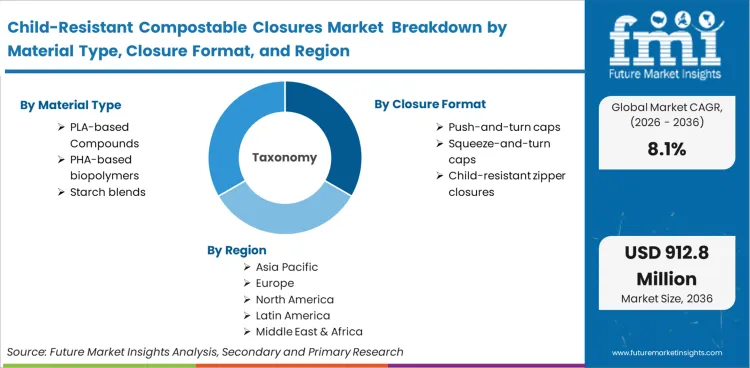
The child-resistant compostable closures market was valued at USD 386.4 million in 2025. The sector is set to reach USD 418.9 million in 2026 at a CAGR of 8.18% during the forecast period. Demand outlook pushes the valuation to USD 919.6 million through 2036 as closure suppliers able to pass child-resistance testing while retaining compostability certification move from niche pilots into regulated consumer-pack adoption cycles.
Design decisions in this category are no longer driven by sustainability claims alone. Brand owners in cannabis, medicated over-the-counter products, and concentrated household care are being pushed toward packs that satisfy both access-control rules and end-of-life claims, which turns the closure into the hardest component to redesign. According to FMI's estimates, converters that still rely on conventional resin caps or mixed-material zipper tracks lose specification preference when the rest of the pack is shifted to compostable films or fibers. That is why interest is rising around compostable packaging, where the closure has become the technical bottleneck rather than the pouch or container body.
Summary of Child-Resistant Compostable Closures Market
- Child-Resistant Compostable Closures Market Definition
- Child-resistant compostable closures cover reclosable closure systems that combine restricted child access with certified compostability performance in regulated consumer packaging formats.
- Demand Drivers in the Market
- Regulation (EU) 2025/40 increases scrutiny around compostable packaging claims, forcing EU packaging specifiers to validate closure compatibility rather than certify only the pouch or tub body.
- PPPA-linked child-resistant expectations compel household-care and ingestible-pack developers in North America to keep access-control performance intact while changing closure materials.
- Cannabis packaging rules in Canada and comparable regulated channels push licensed producers to seek safer packs that also fit sustainability commitments and material-reduction targets.
- Key Segments Analyzed in the FMI Report
- PLA-based compounds: 38.0% share in 2026, supported by broader processing familiarity, tooling adaptability, and certification pathways already recognized by compostability programs.
- Cannabis packaging: 41.0% share in 2026, reflecting the tight overlap between child-resistance requirements and visible sustainability positioning in regulated retail channels.
- Industrial compostable certified: 44.0% share in 2026, as municipal and commercial compost standards remain more established than home-compost pathways for specialty closures.
- Germany: 8.9% compound growth, driven by the combination of EU packaging regulation and disciplined producer-responsibility execution in packaged goods systems.
- Analyst Opinion at FMI
- Ismail Sutaria, Principal Consultant, Packaging, opines, "I see the real bottleneck in this category at the hinge between certification and repeat-use mechanics. Many teams assume the compostable resin choice is the hard part, but the real failure point usually appears after repeated openings, when torque retention, zipper memory, or snap-fit rebound shifts outside the child-resistant window. Brands that ignore that interaction will pass early material screens yet fail late-stage qualification, delaying launches and raising tooling costs."
- Strategic Implications / Executive Takeaways
- Licensed cannabis pack suppliers must qualify closure geometry and compostability claims together before 2028 launch windows to avoid dual revalidation and lost shelf resets.
- Closure converters should build resin-specific tooling libraries and repeat-open cycle data so brand owners can shorten approval timelines for new sustainable packaging formats.
- Compostability certifiers and packaging developers need tighter protocol alignment or suppliers will continue to absorb the cost of fragmented testing sequences.
- Methodology
- Primary Research: Executive interviews focused on closure selectors, brand sustainability teams, line-commissioning engineers, and specialty packaging distributors serving regulated end uses.
- Desk Research: FMI reviewed regulatory texts, compostability certification bodies, bioplastics market updates, and public company disclosures on closure and materials innovation.
- Market-Sizing and Forecasting: The model mapped end-use pack demand to closure format penetration, then applied commercialization probabilities by region, material family, and certification route.
- Data Validation and Update Cycle: Estimates were validated through triangulation with converter capacity indicators, public material roadmaps, and buyer qualification requirements cited in official and industry-association publications.
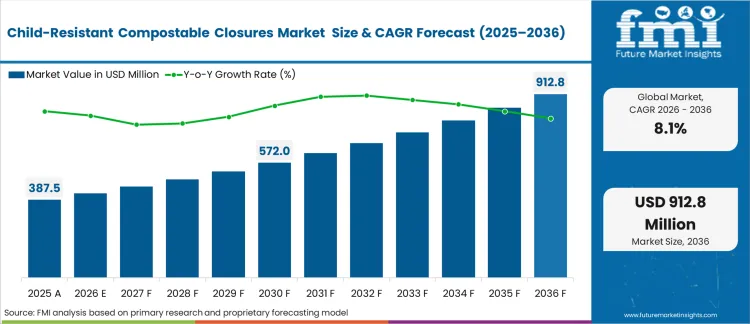
Child-Resistant Compostable Closures Market Key Takeaways
| Metric | Details |
|---|---|
| Industry Size (2026) | USD 418.9 million |
| Industry Value (2036) | USD 919.6 million |
| CAGR (2026-2036) | 8.18% |
Source: Future Market Insights (FMI) analysis, based on proprietary forecasting model and primary research
Self-sustaining growth begins only after buyers stop treating compostability and child resistance as sequential projects. Procurement teams, certification leads, and package engineers must freeze resin systems, torque profiles, and opening-force windows before commercial tooling is approved for 2027 to 2029 product launches. Once those qualification routines stabilize, line changeovers become repeatable and the category scales beyond pilot volumes.
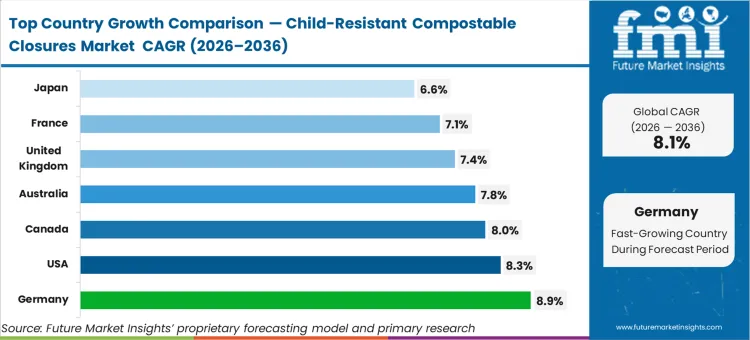
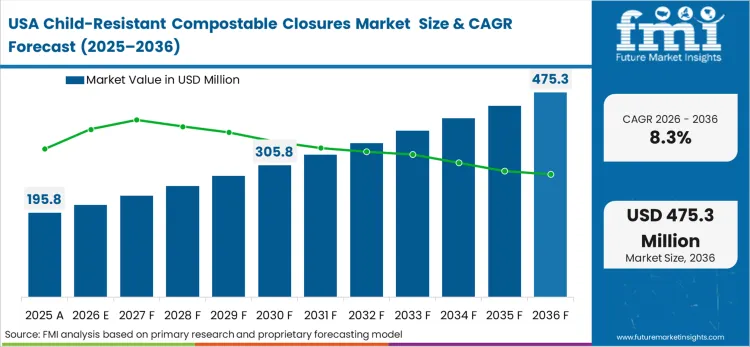
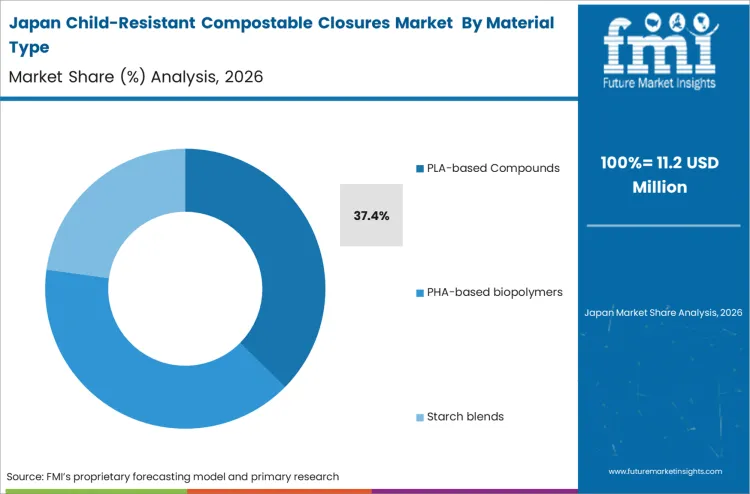
Germany advances at 8.9%, supported by PPWR-driven design scrutiny and packaging compliance workflows tied to compostability claims. The United States records 8.3% as child-resistant performance remains anchored by PPPA expectations for hazardous and ingestible products. Canada tracks 8.0% on licensed cannabis pack demand requiring child-resistant containers. Australia reaches 7.8% as AS 4736 and AS 5810 certification increasingly shape compostable pack acceptance. The United Kingdom posts 7.4%, France grows 7.1%, and Japan follows at 6.6% as buyer adoption reflects the slower alignment between composting infrastructure, labeling discipline, and specialty closure qualification.
Child-Resistant Compostable Closures Market Definition
Child-resistant compostable closures are reclosable or repeat-access pack-closing systems engineered to make opening significantly difficult for young children while allowing adult usability, and at the same time meeting recognized compostability criteria under controlled end-of-life conditions. This market includes caps, zipper tracks, fitments, and locking closure assemblies sold with compostable pouches, bottles, jars, tubes, or specialty packs. It is structurally distinct from mainstream child-resistant packaging because the functional burden sits on a compostable or partially compostable closure architecture rather than on fossil-based polypropylene or polyethylene parts alone.
Child-Resistant Compostable Closures Market Inclusions
Scope includes molded or extruded closure components made from compostable polymer systems, fiber-based locking elements, bio-based sliders, torque-managed caps, and matching seal interfaces used in regulated consumer packs. It also covers package-development services, certification support, and closure-converter work needed to align child-resistance testing with compostability validation. Products developed alongside caps and closures programs, but redesigned specifically for compostable pack systems, are included when the closure itself is a value-bearing technical component.
Child-Resistant Compostable Closures Market Exclusions
Standard child-resistant caps made only from conventional PE, PP, PET, or multilayer fossil resin structures are excluded even when they are used on partially sustainable packs. Non-reclosable child-resistant blisters, mono-material recyclable closures without compostability claims, and tamper-evident bands that do not perform the core access-control function are also outside scope. Compostable films or jars sold without a differentiated child-resistant closure mechanism are not counted because this market is centered on the engineering and qualification value of the closure assembly.
Child-Resistant Compostable Closures Market Research Methodology
- Primary Research: FMI analysts engaged packaging development directors, closure-tooling engineers, regulatory affairs managers, compostability certification advisors, and cannabis packaging procurement leads across key demand countries.
- Desk Research: Analysis incorporated Regulation (EU) 2025/40, PPPA guidance, ISO 8317 references, ASTM D6400 specifications, BPI certification materials, and recent bioplastics capacity updates from European Bioplastics.
- Market-Sizing and Forecasting: The baseline was built from specialty closure revenues, compostable packaging conversion programs, regulated end-use pack counts, and the attach rate of child-resistant formats within compostable package launches.
- Data Validation and Update Cycle: Forecasts were cross-checked against company sustainability disclosures, converter capability announcements, packaging standard references, and country-level compostable packaging policy movements.
Segmental Analysis
Child-Resistant Compostable Closures Market Analysis by Material Type
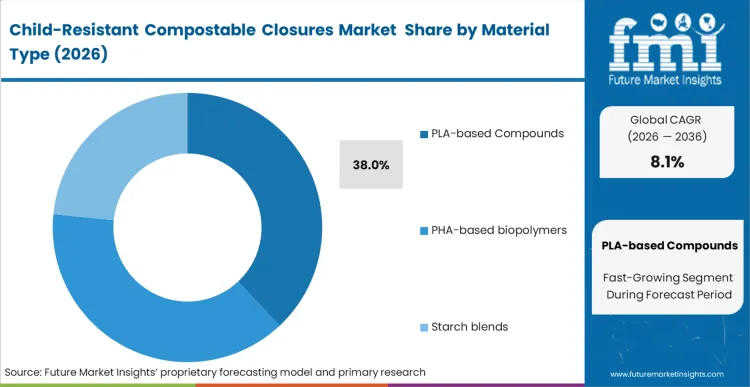
Legacy closure programs built around polypropylene and polyethylene are being displaced not because pack developers suddenly prefer novelty, but because compostable pack conversions break when the closure remains non-compostable. PLA-based compounds hold 38.0% share in 2026 because they sit at the most workable intersection of process familiarity, cost visibility, and certification readiness for specialty closure suppliers. In FMI's view, tooling teams prefer PLA-led systems when they need a nearer-term route to molded caps, rigid fitments, or zipper-adjacent parts without jumping into less-scaled resin economics. Performance still depends on additive packages, crystallization control, and repeated-opening retention. Brand owners choosing the wrong formulation risk failing opening-force stability after line validation, which can force commercial launches back into fossil-based fallback formats.
- Heat-window discipline: PLA closure conversion remains sensitive to thermal processing windows. Converters that master this reduce scrap and keep opening performance more consistent.
- Certification familiarity: Buyers have more precedent data for PLA-based compostability submissions. That lowers approval friction for regulated pack launches.
- Tooling carryover: Existing rigid-part tooling knowledge translates more readily into PLA programs. That speeds pilot scale-up for closure manufacturers.
Child-Resistant Compostable Closures Market Analysis by Closure Format
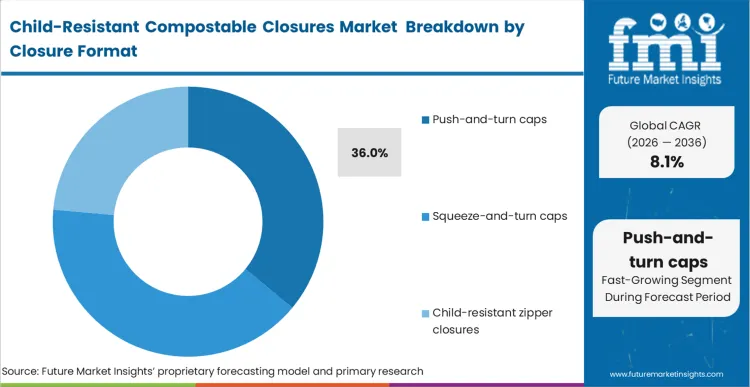
Opening resistance is won or lost in mechanism design rather than in broad sustainability messaging. Push-and-turn caps account for 36.0% of 2026 revenue because they fit the most established child-resistant user training pattern across ingestible and household-risk categories while remaining compatible with rigid compostable pack concepts. Based on FMI's assessment, packaging engineers continue to favor this format when adult usability, cap-torque repeatability, and familiar regulatory interpretation matter more than maximum lightweighting. It also adapts well to jars and short-neck containers used in supplements and cannabis edibles. The commercial problem appears after repeated consumer use, when thread wear and compression-set behavior can drift faster in compostable material systems. Closure suppliers that cannot stabilize those variables lose qualification status once brand validation moves from bench testing to filled-pack abuse trials.
- Thread retention balance: Child resistance depends on maintaining force thresholds across repeated openings. Material creep can quickly undermine a cap that passed an early panel test.
- Adult-use tolerance: Senior-friendly operation remains essential alongside child resistance. Mechanisms with poor grip or inconsistent reclosure lose favor in regulated packs.
- Container-fit precision: Cap success depends on neck-finish accuracy and liner behavior. Closure suppliers with tighter dimensional control secure better repeat business.
Child-Resistant Compostable Closures Market Analysis by End Use
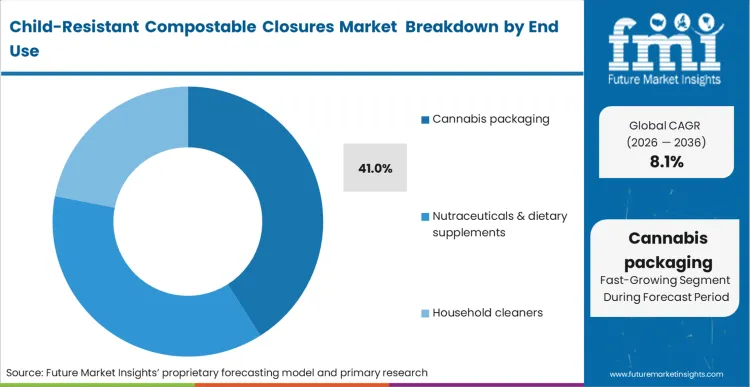
Regulated cannabis channels turned the closure from a minor fitment into a visible compliance feature long before many consumer-pack sectors did. Cannabis packaging captures 41.0% share in 2026 because licensed producers need child-resistant functionality by rule, while retailers and brands increasingly want sustainability claims that stand out without compromising store acceptance. According to FMI's estimates, this segment adopts compostable closures faster than nutraceuticals or cleaners because the package itself carries both safety and identity value at the point of sale. Odor control, reclosure integrity, and repeated access matter as much as compostability. Brands that launch compostable bodies with conventional caps undercut the sustainability narrative immediately. Licensed pack suppliers that cannot show a reliable access-control mechanism and compatible disposal claim face redesign cycles that can erase margin on short production runs.
- Retail-shelf signaling: Cannabis brands use sustainable pack choices as a visible differentiator. A non-aligned closure weakens that message instantly.
- Compliance urgency: Child-resistant functionality is not optional in this channel. That keeps qualified closure demand structurally ahead of many adjacent end uses.
- Small-batch economics: Many SKUs run in short lots, so converters offering flexible tooling and lower minimums gain an advantage.
Child-Resistant Compostable Closures Market Analysis by Certification Type
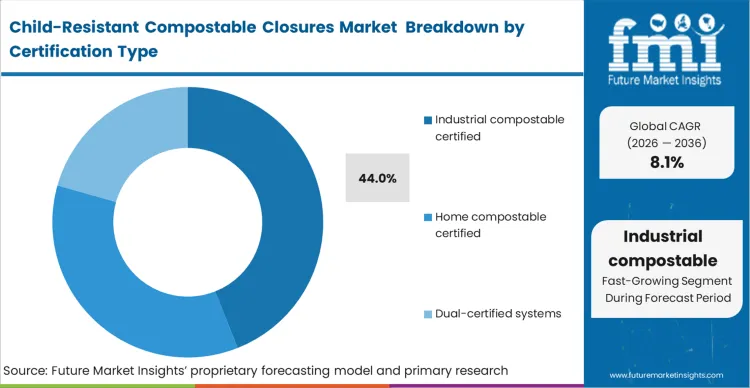
Commercial adoption rarely starts with home compostability, even when marketing teams prefer that message. Industrial compostable certified systems lead with 44.0% share in 2026 because they sit on clearer standards pathways through ASTM D6400, EN 13432-linked practice, and BPI-oriented market communication. FMI analysts opine that buyers opt for industrial certification first because specialty closures already carry enough mechanical risk without adding the tougher disintegration expectations of home-compost conditions. Municipal or commercial compost framing is easier to document in technical files and easier to explain across cross-border product portfolios. The trade-off is consumer confusion when disposal infrastructure is patchy. Brand owners that overstate disposal ease invite relabeling work, retailer pushback, or delayed product approvals when local waste systems do not support the claim.
- Claim defensibility: Industrial certification offers a more established proof path. That matters when legal, sustainability, and sales teams all review the pack language.
- Cross-border usability: One industrial-compostability route can support broader regional portfolios. Home-compost claims remain less portable between markets.
- Mechanics-first sequencing: Buyers often stabilize closure performance before pursuing broader end-of-life claims. That sequencing favors industrially certified systems.
Child-Resistant Compostable Closures Market Drivers, Restraints, and Opportunities
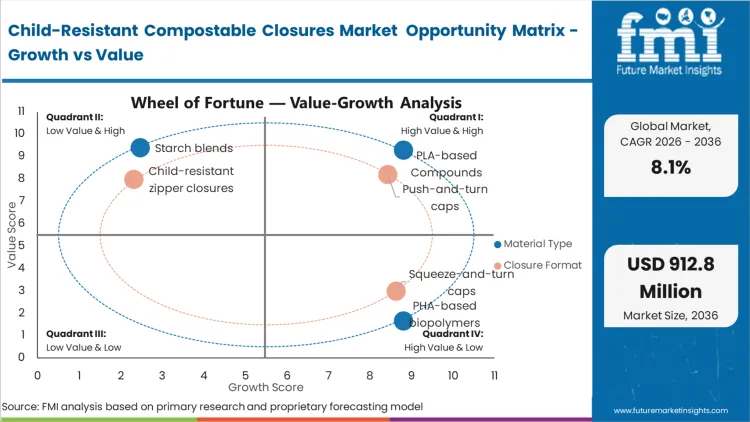
The strongest driver is the collision of safety regulation with packaging sustainability. Child-resistant access control cannot be relaxed in categories such as cannabis, household chemicals, or selected ingestibles, while packaging policy and buyer mandates are pressing suppliers to reduce reliance on conventional plastics and unsupported environmental claims. That combination moves the closure to the center of package redesign. A pouch body or jar shell can be converted relatively quickly; the closure cannot. Suppliers that solve repeat-open performance, certification documentation, and line-speed compatibility gain influence well beyond their bill-of-material share because they unlock the entire pack transition.
The core restraint is mechanical inconsistency under repeated use. Compostable polymer systems and fiber-linked designs still face narrower processing windows, lower long-cycle dimensional stability, and less commercial testing history than mainstream polyolefin closures. Many projects pass initial compostability screening yet fail later on torque retention, zipper memory, or crack resistance after fill-line handling and consumer reopening. Software-led tooling simulation helps, but it does not remove the need for costly physical validation across multiple pack and climate conditions. That keeps commercialization slower than demand narratives suggest.
Opportunities in the Child-Resistant Compostable Closures Market
- Dual-qualification platforms: Suppliers that certify one closure family for both access control and compostability can serve more brands with fewer redesign loops. This is especially valuable for converters building adjacent biodegradable packaging programs.
- Cannabis refill formats: Refill-ready jars and pouches need reliable repeated-opening performance, which creates room for premium compostable closure systems. Licensed pack providers capture this by pairing closure IP with branded sustainability claims.
- Fiber-rigid hybrids: Compostable packs using fiber bodies still need precise locking components. Closure developers that create low-mass hybrid systems can win specification in higher-margin specialty formats.
Regional Analysis
Based on the regional analysis, the child-resistant compostable closures market is segmented into North America, Latin America, Europe, East Asia, South Asia, Oceania, and Middle East & Africa across 40 plus countries.
.webp "Top Country Growth Comparison Child Resistant Compostable Closures Market Cagr (2026 2036)")
| Country | CAGR (2026 to 2036) |
|---|---|
| Germany | 8.9% |
| United States | 8.3% |
| Canada | 8.0% |
| Australia | 7.8% |
| United Kingdom | 7.4% |
| France | 7.1% |
| Japan | 6.6% |
Source: Future Market Insights (FMI) analysis, based on proprietary forecasting model and primary research
Europe Child-Resistant Compostable Closures Market Analysis
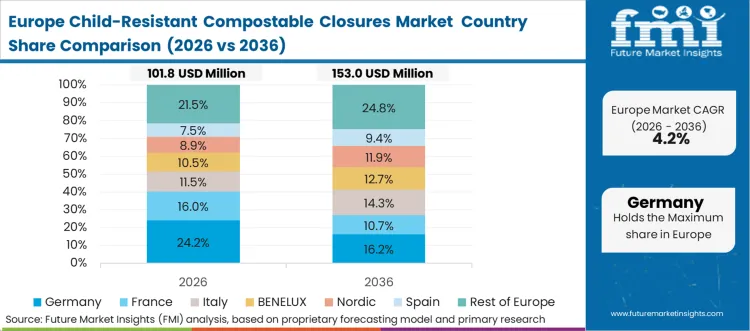
Policy-led packaging redesign gives Europe a distinctive position in this market. Regulation (EU) 2025/40 pushes packaging producers to document sustainability, labeling, and end-of-life logic more rigorously, which raises scrutiny over any closure that breaks the compostability story of the wider pack. As per FMI's projection, European buyers are not simply asking for greener materials; they are asking whether the whole format can survive certification review, retailer compliance checks, and producer-responsibility reporting. That shifts demand toward closure suppliers that can speak the language of testing, waste-system fit, and claim discipline. Brand owners evaluating caps and closures options in Europe therefore spend more time on the technical dossier than on the cosmetic pack brief.
- Germany: Germany’s position is defined by the interaction between EU packaging regulation and the country’s strict producer-responsibility routines under VerpackG. Pack developers serving food supplements, cleaners, and controlled retail channels are projected at an 8.9% compound annual rate through 2036 because they need closure systems that do not undermine broader compostable pack claims while still meeting child-resistant expectations. Evidence of this discipline already exists in the country’s formal packaging registration and system-participation environment, which pushes material declarations and labeling accuracy into normal commercial practice [9]. Procurement specification leads that cannot document closure-material compatibility and opening-force consistency risk delayed acceptance in national retail and private-label programs.
- United Kingdom: Producer responsibility reform and tighter buyer attention to packaging evidence shape the UK opportunity more than headline compostables enthusiasm alone. Demand is expanding at 7.4% between 2026 and 2036 as pack suppliers align child-resistant functionality with clearer sustainability narratives for household and wellness categories. Compostable plastic guidance from WRAP also reinforces the point that compostables have a role only when they are well designed, clearly labeled, and supported by the right waste infrastructure. System integrators and packaging technologists in the UK therefore favor closure systems that limit disposal ambiguity. Suppliers that cannot support disposal language, repeat-use performance, and closure-body compatibility together lose share in specification-driven retail channels.
- France: Organic-waste collection expansion and food-contact sustainability programs define France’s medium-term outlook in this niche. French demand is sustaining a 7.1% CAGR to 2036 because packaging teams are under pressure to prove that material simplification does not compromise consumer safety or product access control. Compostable pack trials move more slowly in France when the closure remains mechanically uncertain, which keeps the value concentrated among specialty suppliers able to provide validation data rather than material claims alone. Facility owners and consumer-goods packagers that misjudge local composting acceptance or closure durability face relabeling costs and shelf-delivery delays.
FMI's report includes Italy, Spain, the Benelux region, the Nordics, and Central & Eastern Europe. A shared structural pattern across these countries is that closure acceptance depends less on abstract sustainability intent and more on evidence that safety, labeling, and disposal pathways remain aligned.
North America Child-Resistant Compostable Closures Market Analysis
Buyer behavior-led adoption distinguishes North America. The region combines mature child-resistant packaging expectations with a faster commercial willingness to test differentiated sustainable formats, especially in cannabis, nutraceuticals, and concentrated household packs. FMI analysts opine that North American converters move when the closure solves a commercial problem, not when it simply meets a climate target. That is why qualification efforts concentrate on line compatibility, repeated opening behavior, and claims that can survive retail or regulatory review. BPI’s certification framework and ASTM-linked compostability language help give brands a recognizable route for pack communication in the United States and Canada. Commercialization is strongest where the closure can support both compliance and merchandising.
- United States: The United States market is driven by the need to preserve child-resistant performance under PPPA-linked expectations while brands pursue safer sustainability messaging in ingestible and hazardous-pack categories. USA demand is projected at 8.3% compound growth over the forecast period because conventional closure replacement cannot compromise accessibility tests or adult usability standards. BPI certification also matters commercially, since North American compostable products seeking recognition are expected to meet ASTM compostability standards and program eligibility criteria. Technology vendors serving American packers must therefore optimize resin selection, cap geometry, and panel-test reliability together. Those that fail at this gate lose access to premium accounts in cannabis, supplements, and specialty home-care packaging.
- Canada: Health Canada’s cannabis packaging and labelling framework keeps child-resistant containers central to legal product presentation, which gives Canada a stronger structural pull than many similarly sized packaging markets. Canadian demand is advancing at 8.0% compound between 2026 and 2036 as licensed producers and packaging suppliers look for ways to reduce material intensity and improve environmental positioning without weakening regulated access-control features. Canada’s packaging rules are already explicit enough that closure redesign must happen inside a compliance-first process rather than as a late-stage branding exercise. Capital project directors and sourcing teams that adopt compostable closure systems without repeated-use validation risk requalification cycles that are costly for small and mid-volume product runs.
FMI's report includes Mexico and selected Latin American export-linked supply chains serving North American packaged goods. The broader pattern is that commercialization improves when closure suppliers can bundle certification support, test evidence, and short-run manufacturing flexibility.
Asia Pacific Child-Resistant Compostable Closures Market Analysis
Infrastructure-led adoption is the defining lens in Asia Pacific. Growth is not only about consumer sentiment; it depends on whether compostability claims map to accepted standards, organics-processing practices, and packaging-specification habits in each country. In FMI's view, the region rewards suppliers that can localize material claims to actual disposal systems and regulatory expectations rather than importing a North American or European closure script unchanged. That is especially true in markets where compostable packaging has stronger acceptance in food-service and organics collection than in controlled-risk consumer packs. Suppliers with adaptable validation packages can use sustainable packaging know-how from broader pack formats to gain closure business.
- Australia: Australia’s opportunity is anchored by a clearer standards conversation around certified compostables than many peer markets can offer. Demand is anchored to a 7.8% annual expansion through the decade because AS 4736 and AS 5810 continue to shape what compostable claims are credible in organics systems and labeling practice. South Australian guidance, for example, explicitly distinguishes industrial and home-compostable certification pathways and states that both AS 4736 and AS 5810 certified products can be processed at commercial composting facilities in the state. Procurement leads in Australia therefore expect more precise claim language. Closure suppliers that cannot align child-resistant mechanics with the correct certification route face rejection before national rollout.
- Japan: Precision manufacturing culture defines Japan’s position in this market more than volume leadership. Japanese demand is tracking 6.6% annual growth to 2036 as adoption centers on high-reliability closure systems for wellness, specialty consumer goods, and controlled premium formats rather than broad commodity substitution. Buyers in Japan are less tolerant of closure inconsistency over repeated openings, which favors suppliers with stronger dimensional control and better endurance data. Network operators, specialty retailers, and brand owners that shift too quickly into compostable claims without durable opening performance risk consumer dissatisfaction that outweighs sustainability gains. That keeps commercialization disciplined, but profitable for qualified suppliers.
FMI's report includes South Korea, China, India, New Zealand, and selected ASEAN markets. Across these countries, the structural pattern is that compostable closure adoption expands first where standards recognition and waste-system messaging are clear enough to support premium specialty-pack launches.
Competitive Aligners for Market Players
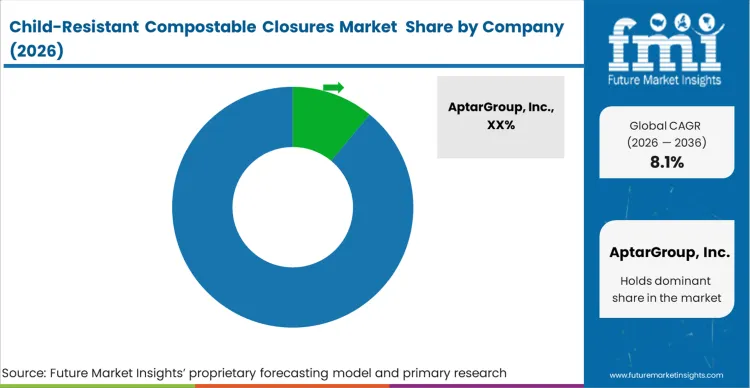
Buyer selection in this market is moving away from broad sustainability narratives and toward proof-heavy technical qualification. That favors a moderately consolidated structure in which closure specialists, compostable materials players, and large packaging companies compete on mechanism reliability, certification support, and pack-integration speed rather than on resin cost alone. Aptar, Berry Global, and Amcor benefit from established packaging development infrastructure and deep customer access, while specialist compostable-pack providers and flexible-pack closure developers gain ground where they can move faster on niche format design. The primary variable buyers use to separate qualified suppliers from unqualified ones is not simply compostability, but whether the closure retains child-resistant performance after repeated real-world use.
Aptar and Berry carry structural advantages because they already operate inside demanding closure and dispensing programs, while Amcor’s packaging innovation investment gives it stronger collaboration capacity for material redesign and pack testing. Challengers must build more than a clever bio-based cap. They need access to pilot tooling, repeated-opening validation, adult-use testing knowledge, and enough package-conversion fluency to support customers moving across adjacent compostable packaging formats. Without that stack, newcomers can win prototypes but struggle to survive scale-up. TIPA, TricorBraun Flex, and Fresh-Lock-adjacent programs are better placed where flexible formats and specialty sustainable-pack demand intersect.
Large buyers still try to prevent lock-in by dual-sourcing pouches, containers, and closure components separately, or by pushing vendors to document material compatibility in standardized qualification files. That creates tension because dominant suppliers prefer proprietary package architectures, while brand owners want enough modularity to switch films, bodies, or closure partners without restarting the whole validation cycle. As a result, pricing power remains constrained even when the technical bar is high. By 2036, the market is likely to become somewhat more structured, but not fully concentrated, because commercialization will keep rewarding suppliers that combine application engineering with flexible customer-specific validation.
Key Players in Child-Resistant Compostable Closures Market
- AptarGroup, Inc.
- Berry Global Group, Inc.
- Amcor plc
- TIPA Corp Ltd.
- Fresh-Lock
- TricorBraun Flex
- BERICAP Holding GmbH
- Danimer Scientific, Inc.
Scope of the Report
| Item | Value |
|---|---|
| Quantitative Units | USD 418.9 million to USD 919.6 million, at a CAGR of 8.18% |
| Market Definition | Child-resistant compostable closures are closure systems designed to restrict child access while meeting recognized compostability criteria for controlled end-of-life processing. The market includes caps, zipper tracks, fitments, and specialty locking systems used in regulated consumer packs. |
| Material Type Segmentation | PLA-based compounds, PHA-based biopolymers, cellulose-fiber composites, starch blends |
| Closure Format Segmentation | Push-and-turn caps, Squeeze-and-turn caps, Child-resistant zipper closures, Press-fit lids |
| End Use Segmentation | Cannabis packaging, Nutraceuticals & dietary supplements, Household cleaners, Pharmaceuticals |
| Certification Type Segmentation | Industrial compostable certified, Home compostable certified, Dual-certified systems, Custom validated formulations |
| Regions Covered | North America, Latin America, Europe, East Asia, South Asia, Oceania, Middle East & Africa |
| Countries Covered | Germany, United States, Canada, Australia, United Kingdom, France, Japan, and 40 plus countries |
| Key Companies Profiled | AptarGroup, Inc.; Berry Global Group, Inc.; Amcor plc; TIPA Corp Ltd.; Fresh-Lock; TricorBraun Flex; BERICAP Holding GmbH; Danimer Scientific, Inc. |
| Forecast Period | 2026 to 2036 |
| Approach | FMI combined primary interviews with closure engineers, brand procurement leads, regulatory specialists, and certification stakeholders. Forecasting used specialty closure demand, format attach rates, compostable-pack conversion assumptions, and cross-validation against regulatory, standards, and company disclosure evidence. |
Source: Future Market Insights (FMI) analysis, based on proprietary forecasting model and primary research
Child-Resistant Compostable Closures Market Analysis by Segments
Material Type:
- PLA-based compounds
- PHA-based biopolymers
- Cellulose-fiber composites
- Starch blends
Closure Format:
- Push-and-turn caps
- Squeeze-and-turn caps
- Child-resistant zipper closures
- Press-fit lids
End Use:
- Cannabis packaging
- Nutraceuticals & dietary supplements
- Household cleaners
- Pharmaceuticals
Certification Type:
- Industrial compostable certified
- Home compostable certified
- Dual-certified systems
- Custom validated formulations
Region:
- North America
- United States
- Canada
- Mexico
- Europe
- Germany
- United Kingdom
- France
- Italy
- Spain
- Benelux
- Nordics
- Asia Pacific
- Japan
- South Korea
- China
- India
- Oceania
- Australia
- New Zealand
- Latin America
- Brazil
- Argentina
- Rest of Latin America
- Middle East & Africa
- GCC Countries
- South Africa
- Rest of Middle East & Africa
Bibliography
- European Union. (2025, January 22). Regulation (EU) 2025/40 of the European Parliament and of the Council of 19 December 2024 on packaging and packaging waste. EUR-Lex.
- USA Consumer Product Safety Commission. (2025, January 1). Poison Prevention Packaging Act Business Guidance. CPSC.
- Health Canada. (2025, July 15). Packaging and labelling guide for cannabis products. Government of Canada.
- Government of South Australia. (2024, September 1). Guide to labelling requirements for certified compostable products and packaging. Replace the Waste SA.
- Biodegradable Products Institute. (2025, January 1). BPI - Certified Compostable. BPI.
- Amcor plc. (2024, May 30). Amcor’s new European Innovation Center brings brands the latest in material science and packaging design. Amcor.
- Stiftung Zentrale Stelle Verpackungsregister (ZSVR). Registering with the LUCID Packaging Register / packaging obligations guidance
- UK Government. (2024, January 1). The Producer Responsibility Obligations (Packaging and Packaging Waste) Regulations 2024. legislation.gov.uk.
This bibliography is provided for reader reference. The full FMI report contains the complete reference list with primary source documentation.
This Report Addresses
- Market intelligence to support strategic decision making across compostable caps, zipper closures, specialty fitments, and regulated reclosable pack systems.
- Market size estimation and 10-year revenue forecasts from 2026 to 2036, supported by specialty closure attach-rate modeling and certification-pathway analysis.
- Growth opportunity mapping across material type, closure format, end use, and certification type with emphasis on dual-qualification commercialization bottlenecks.
- Segment and regional revenue forecasts covering cannabis packaging, nutraceuticals, household cleaners, and pharmaceuticals across regulated and sustainability-led packaging contexts.
- Competition strategy assessment including repeat-open performance, certification. support, tooling readiness, line compatibility, and closure-body material matching.
- Closure development tracking including ISO 8317 relevance, ASTM D6400 pathways, BPI alignment, PPWR implications, and AS 4736/AS 5810 certification use.
- Market access analysis covering cannabis packaging rules, PPPA-linked expectations, producer responsibility frameworks, and compostable packaging labeling systems.
- Market report delivery in PDF, Excel, PPT, and interactive dashboard formats for executive. strategy, packaging specification planning, and operational benchmarking use.
Frequently Asked Questions
How large is the Child-Resistant Compostable Closures Market in 2026?
The market is projected at USD 418.9 million in 2026, supported by regulated pack formats that need both verified child resistance and credible compostability positioning.
What will the Child-Resistant Compostable Closures Market be valued at by 2036?
It is expected to reach USD 919.6 million by 2036 as qualified closure systems move from pilot-stage specialty packs into broader regulated consumer applications.
What CAGR is projected for the Child-Resistant Compostable Closures Market?
FMI projects an 8.18% CAGR because buyers increasingly need closure solutions that satisfy safety rules, pack differentiation goals, and formal compostability evidence together.
Which Material Type segment leads the market?
PLA-based compounds lead with 38.0% share in 2026 because they offer better processing familiarity and a clearer certification route than many alternatives.
Which Closure Format segment leads the market?
Push-and-turn caps lead the format landscape because they match familiar child-resistant use patterns while still fitting rigid compostable pack development programs.
Which End Use segment leads the market?
Cannabis packaging leads in 2026 with 41.0% share, reflecting mandatory child-resistant requirements and stronger willingness to commercialize differentiated sustainable formats.
Which Certification Type segment leads the market?
Industrial compostable certified systems lead because municipal and commercial compost pathways remain more established than home-compost validation for specialty reclosable closures.
What drives rapid growth in this market?
Growth comes from the overlap of child-safety compliance and sustainability-led packaging redesign, which makes the closure the decisive technical component in pack conversion.
What is the primary restraint in this market?
Repeated-use mechanical instability remains the main restraint, especially when torque retention, zipper memory, or snap-fit rebound drift after real-world opening cycles.
Which country grows fastest in this report?
Germany leads at 8.9% CAGR, driven by stronger packaging-compliance discipline and rising scrutiny over whether full-pack compostability claims remain technically defensible.
Which regulation most strongly shapes the European outlook?
Regulation (EU) 2025/40 is central because it heightens design, labeling, and end-of-life scrutiny for packaging, including compostability-related specification decisions.
Which standard matters most for industrial compostability claims?
ASTM D6400 remains highly relevant because it defines labeling requirements for plastics intended for municipal or industrial aerobic composting conditions.
What is the core competitive battleground for suppliers?
Suppliers compete on repeat-open reliability, certification support, tooling readiness, and closure compatibility with compostable films, jars, or fiber-based containers.
Why does North America remain a priority region?
North America combines mature child-resistant packaging expectations with faster commercial testing of sustainable formats, especially in cannabis and ingestible specialty products.
Why is Canada important in this market?
Canada matters because legal cannabis packaging rules keep child-resistant containers mandatory, creating steady demand for safer and more sustainable closure development.
Why does Australia show strong demand?
Australia benefits from clearer compostable-pack standards language, with AS 4736 and AS 5810 helping buyers distinguish credible industrial and home-compost claims.
Why is Japan comparatively slower than Europe and North America?
Japan advances more carefully because buyers prioritize repeat-use precision and dependable closure mechanics before scaling compostable claims across broader product portfolios.
What makes cannabis packaging such a strong demand center?
Cannabis packaging combines mandatory child resistance, repeated consumer opening, shelf-level differentiation, and sustainability signaling, making closure innovation commercially visible and urgent.
Are home-compostable closures becoming mainstream already?
Not yet at scale, because many suppliers still prioritize industrial certification first while they stabilize mechanical performance and broader qualification routines.
What is included within market scope?
The market includes compostable caps, zipper tracks, fitments, and locking systems, plus related development services supporting certified child-resistant pack commercialization.
What is excluded from market scope?
Excluded categories include conventional fossil-based child-resistant closures, non-reclosable blister systems, and compostable pack bodies sold without differentiated access-control mechanisms.
How does FMI build this forecast?
FMI combines primary interviews, regulatory review, standards analysis, end-use pack modeling, and commercialization probability mapping across materials, formats, and regions.
Preview the report firsthand - request a free sample
Get SampleGet the brochure for pricing and purchase details.
Get PDFTable of Content
- Executive Summary
- Global Market Outlook
- Demand-side Trends
- Supply-side Trends
- Technology Roadmap Analysis
- Analysis and Recommendations
- Market Overview
- Market Coverage / Taxonomy
- Market Definition / Scope / Limitations
- Research Methodology
- Chapter Orientation
- Analytical Lens and Working Hypotheses
- Market Structure, Signals, and Trend Drivers
- Benchmarking and Cross-market Comparability
- Market Sizing, Forecasting, and Opportunity Mapping
- Research Design and Evidence Framework
- Desk Research Programme (Secondary Evidence)
- Company Annual and Sustainability Reports
- Peer-reviewed Journals and Academic Literature
- Corporate Websites, Product Literature, and Technical Notes
- Earnings Decks and Investor Briefings
- Statutory Filings and Regulatory Disclosures
- Technical White Papers and Standards Notes
- Trade Journals, Industry Magazines, and Analyst Briefs
- Conference Proceedings, Webinars, and Seminar Materials
- Government Statistics Portals and Public Data Releases
- Press Releases and Reputable Media Coverage
- Specialist Newsletters and Curated Briefings
- Sector Databases and Reference Repositories
- FMI Internal Proprietary Databases and Historical Market Datasets
- Subscription Datasets and Paid Sources
- Social Channels, Communities, and Digital Listening Inputs
- Additional Desk Sources
- Expert Input and Fieldwork (Primary Evidence)
- Primary Modes
- Qualitative Interviews and Expert Elicitation
- Quantitative Surveys and Structured Data Capture
- Blended Approach
- Why Primary Evidence is Used
- Field Techniques
- Interviews
- Surveys
- Focus Groups
- Observational and In-context Research
- Social and Community Interactions
- Stakeholder Universe Engaged
- C-suite Leaders
- Board Members
- Presidents and Vice Presidents
- R&D and Innovation Heads
- Technical Specialists
- Domain Subject-matter Experts
- Scientists
- Physicians and Other Healthcare Professionals
- Governance, Ethics, and Data Stewardship
- Research Ethics
- Data Integrity and Handling
- Primary Modes
- Tooling, Models, and Reference Databases
- Desk Research Programme (Secondary Evidence)
- Data Engineering and Model Build
- Data Acquisition and Ingestion
- Cleaning, Normalisation, and Verification
- Synthesis, Triangulation, and Analysis
- Quality Assurance and Audit Trail
- Market Background
- Market Dynamics
- Drivers
- Restraints
- Opportunity
- Trends
- Scenario Forecast
- Demand in Optimistic Scenario
- Demand in Likely Scenario
- Demand in Conservative Scenario
- Opportunity Map Analysis
- Product Life Cycle Analysis
- Supply Chain Analysis
- Investment Feasibility Matrix
- Value Chain Analysis
- PESTLE and Porter’s Analysis
- Regulatory Landscape
- Regional Parent Market Outlook
- Production and Consumption Statistics
- Import and Export Statistics
- Market Dynamics
- Global Market Analysis 2021 to 2025 and Forecast, 2026 to 2036
- Historical Market Size Value (USD Million) Analysis, 2021 to 2025
- Current and Future Market Size Value (USD Million) Projections, 2026 to 2036
- Y-o-Y Growth Trend Analysis
- Absolute $ Opportunity Analysis
- Global Market Pricing Analysis 2021 to 2025 and Forecast 2026 to 2036
- Global Market Analysis 2021 to 2025 and Forecast 2026 to 2036, By Material Type
- Introduction / Key Findings
- Historical Market Size Value (USD Million) Analysis By Material Type , 2021 to 2025
- Current and Future Market Size Value (USD Million) Analysis and Forecast By Material Type , 2026 to 2036
- PLA-based Compounds
- PHA-based biopolymers
- Starch blends
- PLA-based Compounds
- Y-o-Y Growth Trend Analysis By Material Type , 2021 to 2025
- Absolute $ Opportunity Analysis By Material Type , 2026 to 2036
- Global Market Analysis 2021 to 2025 and Forecast 2026 to 2036, By Closure Format
- Introduction / Key Findings
- Historical Market Size Value (USD Million) Analysis By Closure Format, 2021 to 2025
- Current and Future Market Size Value (USD Million) Analysis and Forecast By Closure Format, 2026 to 2036
- Push-and-turn caps
- Squeeze-and-turn caps
- Child-resistant zipper closures
- Push-and-turn caps
- Y-o-Y Growth Trend Analysis By Closure Format, 2021 to 2025
- Absolute $ Opportunity Analysis By Closure Format, 2026 to 2036
- Global Market Analysis 2021 to 2025 and Forecast 2026 to 2036, By End Use
- Introduction / Key Findings
- Historical Market Size Value (USD Million) Analysis By End Use, 2021 to 2025
- Current and Future Market Size Value (USD Million) Analysis and Forecast By End Use, 2026 to 2036
- Cannabis packaging
- Nutraceuticals & dietary supplements
- Household cleaners
- Cannabis packaging
- Y-o-Y Growth Trend Analysis By End Use, 2021 to 2025
- Absolute $ Opportunity Analysis By End Use, 2026 to 2036
- Global Market Analysis 2021 to 2025 and Forecast 2026 to 2036, By Certification Type
- Introduction / Key Findings
- Historical Market Size Value (USD Million) Analysis By Certification Type, 2021 to 2025
- Current and Future Market Size Value (USD Million) Analysis and Forecast By Certification Type, 2026 to 2036
- Industrial compostable certified
- Home compostable certified
- Dual-certified systems
- Industrial compostable certified
- Y-o-Y Growth Trend Analysis By Certification Type, 2021 to 2025
- Absolute $ Opportunity Analysis By Certification Type, 2026 to 2036
- Global Market Analysis 2021 to 2025 and Forecast 2026 to 2036, By Region
- Introduction
- Historical Market Size Value (USD Million) Analysis By Region, 2021 to 2025
- Current Market Size Value (USD Million) Analysis and Forecast By Region, 2026 to 2036
- North America
- Latin America
- Western Europe
- Eastern Europe
- East Asia
- South Asia and Pacific
- Middle East & Africa
- Market Attractiveness Analysis By Region
- North America Market Analysis 2021 to 2025 and Forecast 2026 to 2036, By Country
- Historical Market Size Value (USD Million) Trend Analysis By Market Taxonomy, 2021 to 2025
- Market Size Value (USD Million) Forecast By Market Taxonomy, 2026 to 2036
- By Country
- USA
- Canada
- Mexico
- By Material Type
- By Closure Format
- By End Use
- By Certification Type
- By Country
- Market Attractiveness Analysis
- By Country
- By Material Type
- By Closure Format
- By End Use
- By Certification Type
- Key Takeaways
- Latin America Market Analysis 2021 to 2025 and Forecast 2026 to 2036, By Country
- Historical Market Size Value (USD Million) Trend Analysis By Market Taxonomy, 2021 to 2025
- Market Size Value (USD Million) Forecast By Market Taxonomy, 2026 to 2036
- By Country
- Brazil
- Chile
- Rest of Latin America
- By Material Type
- By Closure Format
- By End Use
- By Certification Type
- By Country
- Market Attractiveness Analysis
- By Country
- By Material Type
- By Closure Format
- By End Use
- By Certification Type
- Key Takeaways
- Western Europe Market Analysis 2021 to 2025 and Forecast 2026 to 2036, By Country
- Historical Market Size Value (USD Million) Trend Analysis By Market Taxonomy, 2021 to 2025
- Market Size Value (USD Million) Forecast By Market Taxonomy, 2026 to 2036
- By Country
- Germany
- UK
- Italy
- Spain
- France
- Nordic
- BENELUX
- Rest of Western Europe
- By Material Type
- By Closure Format
- By End Use
- By Certification Type
- By Country
- Market Attractiveness Analysis
- By Country
- By Material Type
- By Closure Format
- By End Use
- By Certification Type
- Key Takeaways
- Eastern Europe Market Analysis 2021 to 2025 and Forecast 2026 to 2036, By Country
- Historical Market Size Value (USD Million) Trend Analysis By Market Taxonomy, 2021 to 2025
- Market Size Value (USD Million) Forecast By Market Taxonomy, 2026 to 2036
- By Country
- Russia
- Poland
- Hungary
- Balkan & Baltic
- Rest of Eastern Europe
- By Material Type
- By Closure Format
- By End Use
- By Certification Type
- By Country
- Market Attractiveness Analysis
- By Country
- By Material Type
- By Closure Format
- By End Use
- By Certification Type
- Key Takeaways
- East Asia Market Analysis 2021 to 2025 and Forecast 2026 to 2036, By Country
- Historical Market Size Value (USD Million) Trend Analysis By Market Taxonomy, 2021 to 2025
- Market Size Value (USD Million) Forecast By Market Taxonomy, 2026 to 2036
- By Country
- China
- Japan
- South Korea
- By Material Type
- By Closure Format
- By End Use
- By Certification Type
- By Country
- Market Attractiveness Analysis
- By Country
- By Material Type
- By Closure Format
- By End Use
- By Certification Type
- Key Takeaways
- South Asia and Pacific Market Analysis 2021 to 2025 and Forecast 2026 to 2036, By Country
- Historical Market Size Value (USD Million) Trend Analysis By Market Taxonomy, 2021 to 2025
- Market Size Value (USD Million) Forecast By Market Taxonomy, 2026 to 2036
- By Country
- India
- ASEAN
- Australia & New Zealand
- Rest of South Asia and Pacific
- By Material Type
- By Closure Format
- By End Use
- By Certification Type
- By Country
- Market Attractiveness Analysis
- By Country
- By Material Type
- By Closure Format
- By End Use
- By Certification Type
- Key Takeaways
- Middle East & Africa Market Analysis 2021 to 2025 and Forecast 2026 to 2036, By Country
- Historical Market Size Value (USD Million) Trend Analysis By Market Taxonomy, 2021 to 2025
- Market Size Value (USD Million) Forecast By Market Taxonomy, 2026 to 2036
- By Country
- Kingdom of Saudi Arabia
- Other GCC Countries
- Turkiye
- South Africa
- Other African Union
- Rest of Middle East & Africa
- By Material Type
- By Closure Format
- By End Use
- By Certification Type
- By Country
- Market Attractiveness Analysis
- By Country
- By Material Type
- By Closure Format
- By End Use
- By Certification Type
- Key Takeaways
- Key Countries Market Analysis
- USA
- Pricing Analysis
- Market Share Analysis, 2025
- By Material Type
- By Closure Format
- By End Use
- By Certification Type
- Canada
- Pricing Analysis
- Market Share Analysis, 2025
- By Material Type
- By Closure Format
- By End Use
- By Certification Type
- Mexico
- Pricing Analysis
- Market Share Analysis, 2025
- By Material Type
- By Closure Format
- By End Use
- By Certification Type
- Brazil
- Pricing Analysis
- Market Share Analysis, 2025
- By Material Type
- By Closure Format
- By End Use
- By Certification Type
- Chile
- Pricing Analysis
- Market Share Analysis, 2025
- By Material Type
- By Closure Format
- By End Use
- By Certification Type
- Germany
- Pricing Analysis
- Market Share Analysis, 2025
- By Material Type
- By Closure Format
- By End Use
- By Certification Type
- UK
- Pricing Analysis
- Market Share Analysis, 2025
- By Material Type
- By Closure Format
- By End Use
- By Certification Type
- Italy
- Pricing Analysis
- Market Share Analysis, 2025
- By Material Type
- By Closure Format
- By End Use
- By Certification Type
- Spain
- Pricing Analysis
- Market Share Analysis, 2025
- By Material Type
- By Closure Format
- By End Use
- By Certification Type
- France
- Pricing Analysis
- Market Share Analysis, 2025
- By Material Type
- By Closure Format
- By End Use
- By Certification Type
- India
- Pricing Analysis
- Market Share Analysis, 2025
- By Material Type
- By Closure Format
- By End Use
- By Certification Type
- ASEAN
- Pricing Analysis
- Market Share Analysis, 2025
- By Material Type
- By Closure Format
- By End Use
- By Certification Type
- Australia & New Zealand
- Pricing Analysis
- Market Share Analysis, 2025
- By Material Type
- By Closure Format
- By End Use
- By Certification Type
- China
- Pricing Analysis
- Market Share Analysis, 2025
- By Material Type
- By Closure Format
- By End Use
- By Certification Type
- Japan
- Pricing Analysis
- Market Share Analysis, 2025
- By Material Type
- By Closure Format
- By End Use
- By Certification Type
- South Korea
- Pricing Analysis
- Market Share Analysis, 2025
- By Material Type
- By Closure Format
- By End Use
- By Certification Type
- Russia
- Pricing Analysis
- Market Share Analysis, 2025
- By Material Type
- By Closure Format
- By End Use
- By Certification Type
- Poland
- Pricing Analysis
- Market Share Analysis, 2025
- By Material Type
- By Closure Format
- By End Use
- By Certification Type
- Hungary
- Pricing Analysis
- Market Share Analysis, 2025
- By Material Type
- By Closure Format
- By End Use
- By Certification Type
- Kingdom of Saudi Arabia
- Pricing Analysis
- Market Share Analysis, 2025
- By Material Type
- By Closure Format
- By End Use
- By Certification Type
- Turkiye
- Pricing Analysis
- Market Share Analysis, 2025
- By Material Type
- By Closure Format
- By End Use
- By Certification Type
- South Africa
- Pricing Analysis
- Market Share Analysis, 2025
- By Material Type
- By Closure Format
- By End Use
- By Certification Type
- USA
- Market Structure Analysis
- Competition Dashboard
- Competition Benchmarking
- Market Share Analysis of Top Players
- By Regional
- By Material Type
- By Closure Format
- By End Use
- By Certification Type
- Competition Analysis
- Competition Deep Dive
- AptarGroup, Inc.
- Overview
- Product Portfolio
- Profitability by Market Segments (Product/Age /Sales Channel/Region)
- Sales Footprint
- Strategy Overview
- Marketing Strategy
- Product Strategy
- Channel Strategy
- Berry Global Group, Inc.
- Amcor plc
- TIPA Corp Ltd.
- Fresh-Lock
- TricorBraun Flex
- AptarGroup, Inc.
- Competition Deep Dive
- Assumptions & Acronyms Used


