

- Industry Size (2025)
- USD 43.3 Mn
- Forecast (2035)
- USD 108.1 Mn
- CAGR (2025 to 2035)
- 9.6%
Cholesterol Fatty Acid Complexes Market Forecast and Outlook 2025 to 2035
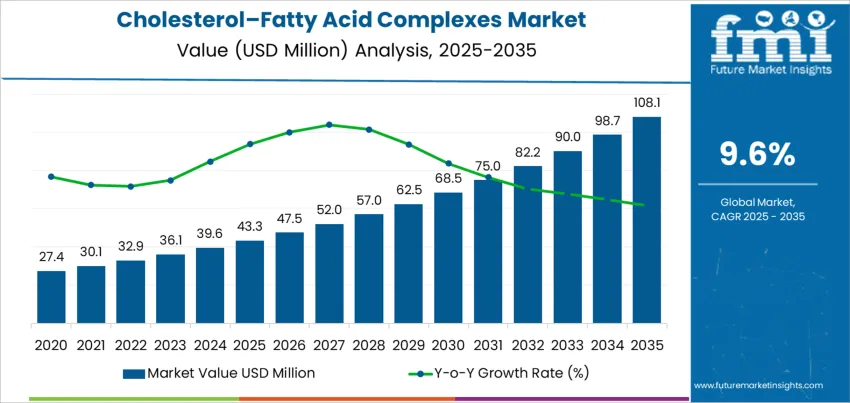
The global demand for cholesterol-fatty acid complexes is expected to grow from USD 43.3 million in 2025 to USD 108.1 million by 2035, reflecting a compound annual growth rate (CAGR) of 9.6%. These complexes, known for their role in cellular function, metabolism, and cholesterol regulation, are increasingly utilized in pharmaceutical formulations, functional foods, and nutraceuticals. Market growth is driven by rising awareness of the importance of healthy cholesterol levels and increasing demand for functional ingredients that support cardiovascular health. As consumers and healthcare providers focus more on preventive health, cholesterol-fatty acid complexes are expected to gain wider adoption.
The market will experience steady growth, starting at USD 43.3 million in 2025 and rising to USD 47.5 million in 2026, USD 52.0 million in 2027, and USD 57.0 million in 2028. By 2029, demand for cholesterol-fatty acid complexes will rise to USD 62.5 million, continuing its upward trajectory through the 2030s. By 2035, the demand for these complexes is projected to reach USD 108.1 million, driven by the increasing adoption of functional foods and supplements aimed at improving cardiovascular health, alongside growing consumer awareness of the benefits of cholesterol regulation.
Quick Stats of the Cholesterol-Fatty Acid Complexes Market
- Cholesterol-Fatty Acid Complexes Market Value (2025): USD 43.3 million
- Cholesterol-Fatty Acid Complexes Market Forecast Value (2035): USD 108.1 million
- Cholesterol-Fatty Acid Complexes Market Forecast CAGR (2025 to 2035): 9.6%
- Cholesterol-Fatty Acid Complexes Market Leading Product Form: Powder (16%)
- Cholesterol-Fatty Acid Complexes Market Key Growth Regions: India, China, Japan, UK, Germany, USA
- Cholesterol-Fatty Acid Complexes Market Key Players: BASF SE, Croda International, Evonik Industries, Symrise (incl. IFF/Givaudan actives), Dow / Dow Inc., Ashland, Clariant, Seppic
What is the Growth Forecast for the Global Cholesterol-Fatty Acid Complexes Industry through 2035?
The breakpoint analysis for the Cholesterol-Fatty Acid Complexes Market highlights a shift in growth patterns that is expected to occur around 2029. From 2025 to 2029, the market will experience consistent and incremental growth, with demand moving from USD 43.3 million in 2025 to USD 62.5 million in 2029. This period is characterized by the growing awareness of the health benefits of cholesterol-fatty acid complexes, particularly in the context of cardiovascular health and metabolic disorders.
After 2029, the market is expected to experience a faster growth phase as cholesterol-fatty acid complexes gain broader acceptance in the mainstream healthcare and wellness sectors. From USD 62.5 million in 2029, the market will expand to USD 108.1 million by 2035, reflecting a more pronounced acceleration in demand. This shift is due to factors such as the increasing adoption of cholesterol regulation supplements, the development of new functional foods incorporating these complexes, and the growing consumer trend toward preventive health measures. The breakpoint analysis indicates that the second half of the forecast period will be marked by greater market penetration and more significant consumer adoption, particularly as more health-conscious products featuring cholesterol-fatty acid complexes enter the market.
Cholesterol-Fatty Acid Complexes Market Key Takeaways
| Metric | Value |
|---|---|
| Industry Sales Value (2025) | USD 43.3 million |
| Industry Forecast Value (2035) | USD 108.1 million |
| Industry Forecast CAGR (2025 to 2035) | 9.6% |
Why is the Demand for Cholesterol-Fatty Acid Complexes Growing Globally?
Demand for cholesterol-fatty acid complexes is increasing as the broader market for lipids and lipid-derived functional ingredients expands across many industries including cosmetics, pharmaceuticals, and nutraceuticals. Cholesterol and fatty acids are fundamental components of biological membranes and skin lipids, and when combined as complexes they can mimic natural skin barrier lipids. This makes them especially valuable in skincare products aimed at repairing skin barrier function, improving hydration, and supporting skin health. As awareness grows about skin barrier integrity, sensitivity, dryness, and the need for biomimetic ingredients, formulations using cholesterol-fatty acid complexes become more popular among skincare and personal-care brands.
At the same time, growth in demand for functional lipids for health and pharmaceutical applications supports the market for cholesterol-fatty acid complexes. The global fatty acids market - of which such complexes are partly a segment - is expanding steadily, driven by demand from food, personal-care, nutraceutical and pharmaceutical sectors. Advances in lipid-formulation science, including improved extraction, synthesis, and use of lipid complexes for drug delivery, skin care, and nutritional products have made cholesterol-fatty acid complexes more commercially viable. As industries continue to prioritize biocompatible, functional, and lipid-based ingredients for both external and internal health applications, demand for cholesterol-fatty acid complexes is expected to grow steadily.
What Drives the Global Demand for Cholesterol–Fatty Acid Complexes in Terms of Application and Product Form?
The global demand for cholesterol-fatty acid complexes is primarily driven by application and product form. The leading end-use application is skin care, which accounts for 10.3% of the market share, while powder holds the largest share in the product form segment, capturing 16%. Cholesterol-fatty acid complexes are known for their ability to strengthen the skin’s barrier, improve hydration, and promote overall skin health. As consumers continue to seek natural, effective ingredients that support skin function and protect the skin from environmental stressors, cholesterol-fatty acid complexes are gaining traction in the global beauty and personal care market.
Why Is Skin Care the Leading Application for Cholesterol-Fatty Acid Complexes?
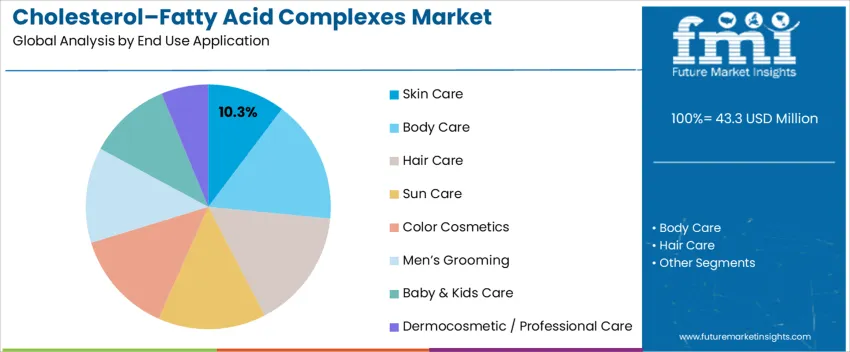
Skin care leads the end-use application demand for cholesterol-fatty acid complexes, accounting for 10.3% of the market share. These complexes are highly valued in skincare products for their ability to restore and enhance the skin’s natural barrier, prevent moisture loss, and improve skin elasticity. Cholesterol-fatty acid complexes are commonly used in moisturizers, serums, and creams aimed at improving skin texture, reducing dryness, and protecting against external irritants.
The demand for cholesterol-fatty acid complexes in skin care is driven by the increasing focus on skin health and barrier repair. As consumers prioritize products that offer long-lasting hydration and protect the skin from aging and environmental damage, cholesterol-fatty acid complexes are becoming key ingredients in formulations. The growing interest in natural, sustainable, and clean beauty products, as well as the need for skin barrier protection, ensures the continued growth of cholesterol-fatty acid complexes in global skincare markets.
Why Is Powder the Leading Product Form for Cholesterol-Fatty Acid Complexes?
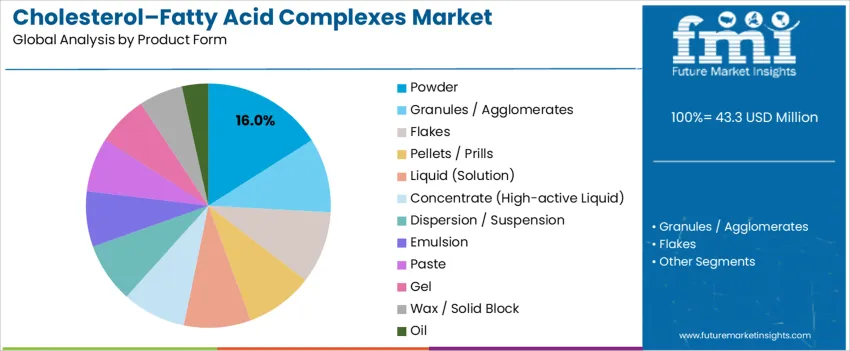
Powder is the leading product form for cholesterol-fatty acid complexes globally, holding 16% of the market share. The powdered form is preferred for its stability, longer shelf life, and ease of incorporation into a variety of cosmetic and personal care formulations. It offers the advantage of precise control over ingredient concentration, allowing manufacturers to create effective and high-performance products.
The demand for powdered cholesterol-fatty acid complexes is driven by their versatility and cost-effectiveness in production. Powders are easier to store, handle, and ship compared to liquids or gels, making them more efficient for large-scale production. Additionally, powdered forms can be used in a wide range of product formulations, from face creams and serums to professional treatments. As the beauty and skincare market continues to prioritize customizable and targeted solutions, the popularity of powdered cholesterol-fatty acid complexes is expected to grow, ensuring their continued prominence in the global market.
What is the Summary of Demand for Cholesterol–Fatty Acid Complexes Globally?
Demand for cholesterol-fatty acid complexes is rising globally as consumers and skincare manufacturers increasingly recognize the importance of maintaining the skin’s natural lipid barrier. These complexes, which combine cholesterol and fatty acids, replicate part of the skin's natural lipid matrix, helping to retain moisture, protect against environmental stress, and repair the skin’s barrier. As skin dryness, irritation, and sensitivity become more common, particularly due to environmental factors, pollution, and aging, products containing cholesterol-fatty acid complexes are becoming more widely adopted in skincare. The growing global skincare market is expanding the reach of these ingredients across various regions.
What are the Drivers of Global Demand for Cholesterol-Fatty Acid Complexes?
Several factors are driving the global demand for cholesterol-fatty acid complexes. Growing consumer awareness about skin health, particularly the role of the skin’s barrier in hydration and protection, is a key driver. Many consumers are looking for products to address dry or sensitive skin, which makes cholesterol-fatty acid complexes increasingly popular. Additionally, the rise of the global skincare industry, including anti-aging and sensitive-skin products, is contributing to the growing use of these ingredients. The demand for skin-compatible, clean-label formulations is also increasing, with consumers preferring natural, lipid-based ingredients. Furthermore, the increasing understanding of the role cholesterol and fatty acids play in skin barrier function is pushing the demand for these complexes in skin-care products.
What are the Restraints on Global Demand for Cholesterol-Fatty Acid Complexes?
Despite growing demand, several challenges limit the widespread adoption of cholesterol-fatty acid complexes. The primary restraint is cost. High-quality lipid-based ingredients like cholesterol and fatty acids are more expensive to produce than simpler moisturizers, which limits their use in mass-market products. Another challenge is consumer awareness. While awareness of skin health is rising, many consumers are still unfamiliar with the specific benefits of cholesterol and fatty acid complexes, which may slow their adoption. Additionally, there is competition from other moisturizing ingredients, such as glycerin, hyaluronic acid, and synthetic emollients, which may be preferred for their established efficacy and lower cost. Finally, the complexity of formulating stable and effective cholesterol-fatty acid complexes can be a barrier for some manufacturers, which may deter adoption.
What are the Key Trends Influencing Global Demand for Cholesterol-Fatty Acid Complexes?
A significant trend influencing the demand for cholesterol-fatty acid complexes is the increasing focus on skin barrier health and long-term skin protection. As consumers become more aware of the importance of skin barrier function, products with lipid-based ingredients like cholesterol-fatty acid complexes are becoming more popular. Another trend is the growing use of multi-lipid formulations that combine cholesterol, fatty acids, and other lipids to better replicate the skin's natural lipid matrix. This approach is gaining traction in skincare, particularly in products aimed at dry, sensitive, and aging skin. The clean-beauty movement, which prioritizes natural, safe, and effective ingredients, also supports the demand for cholesterol-fatty acid complexes. Additionally, there is an expansion of these complexes into broader product categories, such as body lotions, hand creams, and even hair care products, as consumers seek to address skin health across different parts of the body. Lastly, the global rise in skincare awareness and disposable income, especially in emerging markets, is boosting the adoption of these complexes in skincare products.
What is the Regional Demand Outlook for the Cholesterol-Fatty Acid Complexes Market?
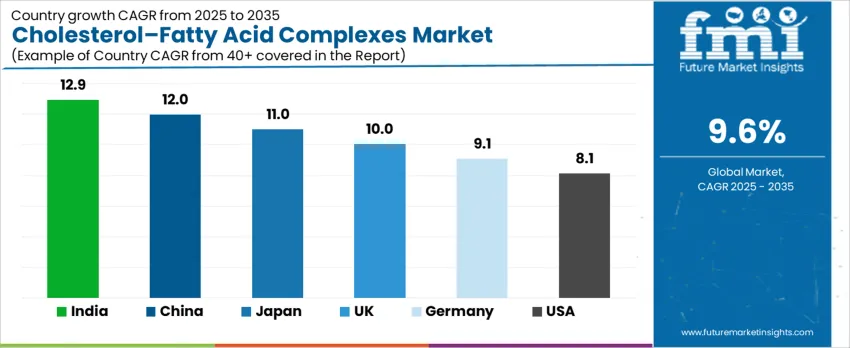
The global market for Cholesterol-Fatty Acid Complexes is experiencing steady growth, with India leading the way at a projected CAGR of 12.9%. China follows closely with a growth rate of 12%, while Japan is expected to grow at 11%. The UK, Germany, and the USA show moderate growth with CAGRs of 10%, 9.1%, and 8.1%, respectively. The increasing awareness of the benefits of cholesterol-fatty acid complexes in improving heart health, reducing cholesterol levels, and supporting overall wellness is driving this market's growth. These complexes, which combine the beneficial effects of cholesterol and fatty acids, are gaining popularity in dietary supplements, functional foods, and skincare formulations across regions.
| Country | CAGR (%) |
|---|---|
| India | 12.9 |
| China | 12.0 |
| Japan | 11.0 |
| UK | 10.0 |
| Germany | 9.1 |
| USA | 8.1 |
What is Driving the Growth of Cholesterol-Fatty Acid Complexes in India?
In India, the projected CAGR of 12.9% for Cholesterol-Fatty Acid Complexes reflects a growing consumer interest in heart health, cholesterol management, and overall wellness. With increasing awareness about the importance of healthy cholesterol levels and the role of fatty acids in improving heart function, more consumers are turning to supplements and functional foods that contain these complexes. Rising disposable incomes, urbanization, and the growth of the health-conscious middle class are driving demand for products that support cardiovascular health. Additionally, India’s expanding retail and e-commerce platforms make it easier for consumers to access products containing cholesterol-fatty acid complexes. As the demand for preventive healthcare solutions continues to rise, particularly in urban areas, cholesterol-fatty acid complexes are expected to gain significant traction in the Indian market.
Why is Cholesterol-Fatty Acid Complex Demand Growing in China?
In China, the demand for Cholesterol-Fatty Acid Complexes is projected to grow at a CAGR of 12%. This growth is driven by the rising concern over heart disease, high cholesterol, and the increasing focus on preventive health. As China’s middle class expands, there is a growing preference for dietary supplements and functional foods that support cardiovascular health. Cholesterol-fatty acid complexes are increasingly recognized for their ability to manage cholesterol levels and promote heart health. With the rising number of health-conscious consumers and the government’s efforts to improve public health, the demand for products containing cholesterol-fatty acid complexes is expected to grow steadily. The country’s strong focus on traditional and modern wellness solutions, combined with increased accessibility to such products, makes China a key market for these complexes.
How is the Cholesterol-Fatty Acid Complex Market Expanding in Japan?
In Japan, the projected CAGR of 11% for Cholesterol-Fatty Acid Complexes reflects the country’s growing awareness of cardiovascular health and the increasing demand for functional ingredients. Japanese consumers are particularly concerned about cholesterol management and heart health, and cholesterol-fatty acid complexes offer a solution that aligns with these health priorities. The Japanese market has a long-standing tradition of incorporating functional foods and supplements into daily life, and as aging populations seek preventive health solutions, demand for these complexes is expected to rise. The increasing availability of these products in both traditional retail and e-commerce platforms, along with the growing emphasis on scientific research supporting their health benefits, positions Japan as a strong market for cholesterol-fatty acid complexes.
What Drives the Growth of Cholesterol-Fatty Acid Complexes in the UK?
In the UK, the demand for Cholesterol-Fatty Acid Complexes is projected to grow at a CAGR of 10%. This growth is primarily driven by the increasing focus on heart health and cholesterol management. As awareness about the link between high cholesterol and cardiovascular diseases rises, consumers are turning to products that can help manage cholesterol levels effectively. Cholesterol-fatty acid complexes, which provide a natural way to improve heart health, are becoming an integral part of health-conscious consumers' diets. The UK’s mature healthcare and wellness market, combined with a growing interest in functional foods and supplements, supports the increasing adoption of these complexes. Furthermore, as the demand for preventive healthcare solutions continues to rise, cholesterol-fatty acid complexes are expected to see wider acceptance in the UK.
Why is Cholesterol-Fatty Acid Complex Growth Steady in Germany?
Germany’s projected CAGR of 9.1% for Cholesterol-Fatty Acid Complexes reflects the growing interest in heart health and cholesterol-lowering solutions. The German market has long emphasized preventive health and wellness, and cholesterol-fatty acid complexes align with this trend. These complexes, which help manage cholesterol levels and promote cardiovascular health, are becoming more widely accepted in functional foods, dietary supplements, and even skincare formulations. As the German population ages, the demand for heart health products is expected to continue growing. Additionally, Germany’s well-established regulatory environment for health products ensures that cholesterol-fatty acid complexes meet high standards, which builds consumer confidence in these products. The increasing consumer focus on heart health, coupled with Germany’s strong market for health supplements, supports the growth of cholesterol-fatty acid complexes in the country.
What is Driving Cholesterol-Fatty Acid Complexes Demand in the USA?
In the USA, the demand for Cholesterol-Fatty Acid Complexes is expected to grow at a CAGR of 8.1%. The USA market is driven by rising awareness of the importance of maintaining healthy cholesterol levels and the growing focus on cardiovascular health. Cholesterol-fatty acid complexes, which are recognized for their ability to lower cholesterol and support heart health, are gaining popularity among consumers who seek natural, preventative solutions for managing their cardiovascular risk. The demand for dietary supplements and functional foods that address heart health is increasing, with cholesterol-fatty acid complexes becoming a key ingredient in many of these products. The growing awareness of lifestyle-related diseases, particularly heart disease, further supports the adoption of these complexes. Additionally, the USA market’s expanding focus on natural and bioactive ingredients in supplements and foods ensures steady demand for cholesterol-fatty acid complexes.
What is the Competitive Landscape for the Global Cholesterol-Fatty Acid Complexes Market?
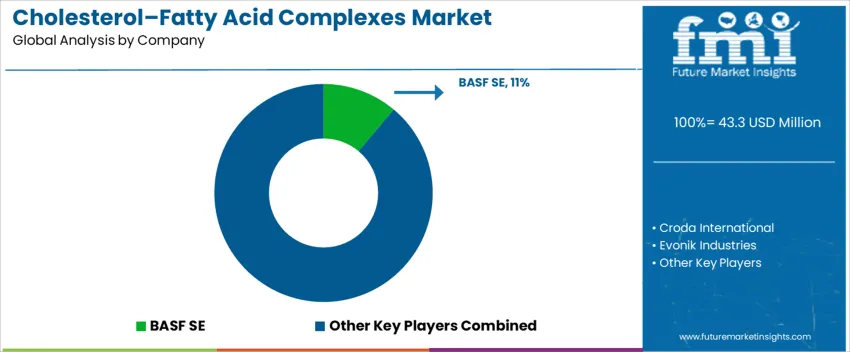
Global demand for cholesterol-fatty acid complexes has increased as skincare and personal care manufacturers seek ingredients that support skin barrier repair, hydration, and resilience. Cholesterol combined with certain fatty acids helps mimic the natural lipid matrix of the skin, improving moisture retention, barrier function, and overall skin health. Rising consumer awareness about barrier-focused skincare, sensitive-skin needs, and the benefits of lipid-based formulations fuels interest in products containing cholesterol-fatty acid complexes. As populations in North America, Europe, and Asia Pacific show growing demand for moisturizing, anti-aging, and barrier-restoring skincare, the market for these lipid complexes expands accordingly.
On the supply side, a core group of global specialty-ingredient firms competes to serve this growing demand. Key suppliers include BASF SE, Croda International, Evonik Industries, Symrise (including IFF/Givaudan actives), Dow Inc., Ashland, Clariant, and Seppic. Among these, BASF SE holds a notable share of supply. These firms supply standardized, cosmetic-grade cholesterol-fatty acid complexes suitable for creams, lotions, serums and barrier-repair formulations. Competition among them is shaped by factors such as purity of lipid blends, molecular-structure fidelity to human skin lipids, batch consistency, regulatory compliance, and capability to scale production globally. Some suppliers differentiate through broad lipid-portfolio offerings that combine cholesterol, fatty acids and additional barrier-supportive lipids to boost formulation versatility. Others emphasize cost-effective supply chains for high-volume skincare brands. Firms that deliver high-quality, stable, and compliant lipid complexes with robust manufacturing and supply-chain practices are well positioned to capture growth as demand rises for barrier-focused, sensitive-skin and anti-aging skincare worldwide.
Key Players of the Cholesterol-Fatty Acid Complexes Market
- BASF SE
- Croda International
- Evonik Industries
- Symrise (incl. IFF/Givaudan actives)
- Dow / Dow Inc.
- Ashland
- Clariant
- Seppic
Scope of the Report
| Items | Details |
|---|---|
| Quantitative Units | USD Million |
| Regions Covered | North America, Europe, Asia Pacific, The Middle East & Africa, Latin America |
| Countries Covered | United States, Canada, United Kingdom, Germany, France, China, Japan, South Korea, Brazil, Australia |
| End Use Application | Skin Care, Body Care, Hair Care, Sun Care, Color Cosmetics, Men’s Grooming, Baby & Kids Care, Dermocosmetic / Professional Care |
| Product Form | Powder, Granules / Agglomerates, Flakes, Pellets / Prills, Liquid (Solution), Concentrate (High-active Liquid), Dispersion / Suspension, Emulsion, Paste, Gel, Wax / Solid Block, Oil |
| Key Companies Profiled | BASF SE, Croda International, Evonik Industries, Symrise (incl. IFF/Givaudan actives), Dow / Dow Inc., Ashland, Clariant, Seppic |
| Additional Attributes | Dollar sales by end-use application and product form show strong demand for inulin, particularly in skin care and body care products. Powder and liquid forms dominate, with concentrate and emulsion forms also growing in demand. Major companies like BASF, Evonik, and Ashland are key players, providing a wide range of inulin-based products for the cosmetic and dermocosmetic industries. The market is expected to grow with increasing demand for natural ingredients and innovative skincare solutions. |
Key Segments in the Cholesterol-Fatty Acid Complexes Market
End Use Application
- Skin Care
- Body Care
- Hair Care
- Sun Care
- Color Cosmetics
- Men’s Grooming
- Baby & Kids Care
- Dermocosmetic / Professional Care
Product Form
- Powder
- Granules / Agglomerates
- Flakes
- Pellets / Prills
- Liquid (Solution)
- Concentrate (High-active Liquid)
- Dispersion / Suspension
- Emulsion
- Paste
- Gel
- Wax / Solid Block
- Oil
Region
- Asia Pacific
- China
- Japan
- South Korea
- India
- Australia & New Zealand
- ASEAN
- Rest of Asia Pacific
- Europe
- Germany
- United Kingdom
- France
- Italy
- Spain
- Nordic
- BENELUX
- Rest of Europe
- North America
- United States
- Canada
- Mexico
- Latin America
- Brazil
- Chile
- Rest of Latin America
- Middle East & Africa
- Kingdom of Saudi Arabia
- Other GCC Countries
- Turkey
- South Africa
- Other African Union
- Rest of Middle East & Africa
Frequently Asked Questions
How big is the cholesterol-fatty acid complexes market in 2025?
The global cholesterol-fatty acid complexes market is estimated to be valued at USD 43.3 million in 2025.
What will be the size of cholesterol-fatty acid complexes market in 2035?
The market size for the cholesterol-fatty acid complexes market is projected to reach USD 108.1 million by 2035.
How much will be the cholesterol-fatty acid complexes market growth between 2025 and 2035?
The cholesterol-fatty acid complexes market is expected to grow at a 9.6% CAGR between 2025 and 2035.
What are the key product types in the cholesterol-fatty acid complexes market?
The key product types in cholesterol-fatty acid complexes market are skin care, body care, hair care, sun care, color cosmetics, men’s grooming, baby & kids care and dermocosmetic / professional care.
Which product form segment to contribute significant share in the cholesterol-fatty acid complexes market in 2025?
In terms of product form , powder segment to command 16.0% share in the cholesterol-fatty acid complexes market in 2025.
Preview the report firsthand - request a free sample
Get SampleGet the brochure for pricing and purchase details.
Get PDFTable of Content
- Executive Summary
- Global Market Outlook
- Demand-side Trends
- Supply-side Trends
- Technology Roadmap Analysis
- Analysis and Recommendations
- Market Overview
- Market Coverage / Taxonomy
- Market Definition / Scope / Limitations
- Market Background
- Market Dynamics
- Drivers
- Restraints
- Opportunity
- Trends
- Scenario Forecast
- Demand in Optimistic Scenario
- Demand in Likely Scenario
- Demand in Conservative Scenario
- Opportunity Map Analysis
- Product Life Cycle Analysis
- Supply Chain Analysis
- Investment Feasibility Matrix
- Value Chain Analysis
- PESTLE and Porter’s Analysis
- Regulatory Landscape
- Regional Parent Market Outlook
- Production and Consumption Statistics
- Import and Export Statistics
- Market Dynamics
- Global Market Analysis 2020 to 2024 and Forecast, 2025 to 2035
- Historical Market Size Value (USD Million) Analysis, 2020 to 2024
- Current and Future Market Size Value (USD Million) Projections, 2025 to 2035
- Y-o-Y Growth Trend Analysis
- Absolute $ Opportunity Analysis
- Global Market Pricing Analysis 2020 to 2024 and Forecast 2025 to 2035
- Global Market Analysis 2020 to 2024 and Forecast 2025 to 2035, By End Use Application
- Introduction / Key Findings
- Historical Market Size Value (USD Million) Analysis By End Use Application , 2020 to 2024
- Current and Future Market Size Value (USD Million) Analysis and Forecast By End Use Application , 2025 to 2035
- Skin Care
- Body Care
- Hair Care
- Sun Care
- Color Cosmetics
- Men’s Grooming
- Baby & Kids Care
- Dermocosmetic / Professional Care
- Y-o-Y Growth Trend Analysis By End Use Application , 2020 to 2024
- Absolute $ Opportunity Analysis By End Use Application , 2025 to 2035
- Global Market Analysis 2020 to 2024 and Forecast 2025 to 2035, By Product Form
- Introduction / Key Findings
- Historical Market Size Value (USD Million) Analysis By Product Form, 2020 to 2024
- Current and Future Market Size Value (USD Million) Analysis and Forecast By Product Form, 2025 to 2035
- Powder
- Granules / Agglomerates
- Flakes
- Pellets / Prills
- Liquid (Solution)
- Concentrate (High-active Liquid)
- Dispersion / Suspension
- Emulsion
- Paste
- Gel
- Wax / Solid Block
- Y-o-Y Growth Trend Analysis By Product Form, 2020 to 2024
- Absolute $ Opportunity Analysis By Product Form, 2025 to 2035
- Global Market Analysis 2020 to 2024 and Forecast 2025 to 2035, By Region
- Introduction
- Historical Market Size Value (USD Million) Analysis By Region, 2020 to 2024
- Current Market Size Value (USD Million) Analysis and Forecast By Region, 2025 to 2035
- North America
- Latin America
- Western Europe
- Eastern Europe
- East Asia
- South Asia and Pacific
- Middle East & Africa
- Market Attractiveness Analysis By Region
- North America Market Analysis 2020 to 2024 and Forecast 2025 to 2035, By Country
- Historical Market Size Value (USD Million) Trend Analysis By Market Taxonomy, 2020 to 2024
- Market Size Value (USD Million) Forecast By Market Taxonomy, 2025 to 2035
- By Country
- USA
- Canada
- Mexico
- By End Use Application
- By Product Form
- By Country
- Market Attractiveness Analysis
- By Country
- By End Use Application
- By Product Form
- Key Takeaways
- Latin America Market Analysis 2020 to 2024 and Forecast 2025 to 2035, By Country
- Historical Market Size Value (USD Million) Trend Analysis By Market Taxonomy, 2020 to 2024
- Market Size Value (USD Million) Forecast By Market Taxonomy, 2025 to 2035
- By Country
- Brazil
- Chile
- Rest of Latin America
- By End Use Application
- By Product Form
- By Country
- Market Attractiveness Analysis
- By Country
- By End Use Application
- By Product Form
- Key Takeaways
- Western Europe Market Analysis 2020 to 2024 and Forecast 2025 to 2035, By Country
- Historical Market Size Value (USD Million) Trend Analysis By Market Taxonomy, 2020 to 2024
- Market Size Value (USD Million) Forecast By Market Taxonomy, 2025 to 2035
- By Country
- Germany
- UK
- Italy
- Spain
- France
- Nordic
- BENELUX
- Rest of Western Europe
- By End Use Application
- By Product Form
- By Country
- Market Attractiveness Analysis
- By Country
- By End Use Application
- By Product Form
- Key Takeaways
- Eastern Europe Market Analysis 2020 to 2024 and Forecast 2025 to 2035, By Country
- Historical Market Size Value (USD Million) Trend Analysis By Market Taxonomy, 2020 to 2024
- Market Size Value (USD Million) Forecast By Market Taxonomy, 2025 to 2035
- By Country
- Russia
- Poland
- Hungary
- Balkan & Baltic
- Rest of Eastern Europe
- By End Use Application
- By Product Form
- By Country
- Market Attractiveness Analysis
- By Country
- By End Use Application
- By Product Form
- Key Takeaways
- East Asia Market Analysis 2020 to 2024 and Forecast 2025 to 2035, By Country
- Historical Market Size Value (USD Million) Trend Analysis By Market Taxonomy, 2020 to 2024
- Market Size Value (USD Million) Forecast By Market Taxonomy, 2025 to 2035
- By Country
- China
- Japan
- South Korea
- By End Use Application
- By Product Form
- By Country
- Market Attractiveness Analysis
- By Country
- By End Use Application
- By Product Form
- Key Takeaways
- South Asia and Pacific Market Analysis 2020 to 2024 and Forecast 2025 to 2035, By Country
- Historical Market Size Value (USD Million) Trend Analysis By Market Taxonomy, 2020 to 2024
- Market Size Value (USD Million) Forecast By Market Taxonomy, 2025 to 2035
- By Country
- India
- ASEAN
- Australia & New Zealand
- Rest of South Asia and Pacific
- By End Use Application
- By Product Form
- By Country
- Market Attractiveness Analysis
- By Country
- By End Use Application
- By Product Form
- Key Takeaways
- Middle East & Africa Market Analysis 2020 to 2024 and Forecast 2025 to 2035, By Country
- Historical Market Size Value (USD Million) Trend Analysis By Market Taxonomy, 2020 to 2024
- Market Size Value (USD Million) Forecast By Market Taxonomy, 2025 to 2035
- By Country
- Kingdom of Saudi Arabia
- Other GCC Countries
- Turkiye
- South Africa
- Other African Union
- Rest of Middle East & Africa
- By End Use Application
- By Product Form
- By Country
- Market Attractiveness Analysis
- By Country
- By End Use Application
- By Product Form
- Key Takeaways
- Key Countries Market Analysis
- USA
- Pricing Analysis
- Market Share Analysis, 2024
- By End Use Application
- By Product Form
- Canada
- Pricing Analysis
- Market Share Analysis, 2024
- By End Use Application
- By Product Form
- Mexico
- Pricing Analysis
- Market Share Analysis, 2024
- By End Use Application
- By Product Form
- Brazil
- Pricing Analysis
- Market Share Analysis, 2024
- By End Use Application
- By Product Form
- Chile
- Pricing Analysis
- Market Share Analysis, 2024
- By End Use Application
- By Product Form
- Germany
- Pricing Analysis
- Market Share Analysis, 2024
- By End Use Application
- By Product Form
- UK
- Pricing Analysis
- Market Share Analysis, 2024
- By End Use Application
- By Product Form
- Italy
- Pricing Analysis
- Market Share Analysis, 2024
- By End Use Application
- By Product Form
- Spain
- Pricing Analysis
- Market Share Analysis, 2024
- By End Use Application
- By Product Form
- France
- Pricing Analysis
- Market Share Analysis, 2024
- By End Use Application
- By Product Form
- India
- Pricing Analysis
- Market Share Analysis, 2024
- By End Use Application
- By Product Form
- ASEAN
- Pricing Analysis
- Market Share Analysis, 2024
- By End Use Application
- By Product Form
- Australia & New Zealand
- Pricing Analysis
- Market Share Analysis, 2024
- By End Use Application
- By Product Form
- China
- Pricing Analysis
- Market Share Analysis, 2024
- By End Use Application
- By Product Form
- Japan
- Pricing Analysis
- Market Share Analysis, 2024
- By End Use Application
- By Product Form
- South Korea
- Pricing Analysis
- Market Share Analysis, 2024
- By End Use Application
- By Product Form
- Russia
- Pricing Analysis
- Market Share Analysis, 2024
- By End Use Application
- By Product Form
- Poland
- Pricing Analysis
- Market Share Analysis, 2024
- By End Use Application
- By Product Form
- Hungary
- Pricing Analysis
- Market Share Analysis, 2024
- By End Use Application
- By Product Form
- Kingdom of Saudi Arabia
- Pricing Analysis
- Market Share Analysis, 2024
- By End Use Application
- By Product Form
- Turkiye
- Pricing Analysis
- Market Share Analysis, 2024
- By End Use Application
- By Product Form
- South Africa
- Pricing Analysis
- Market Share Analysis, 2024
- By End Use Application
- By Product Form
- USA
- Market Structure Analysis
- Competition Dashboard
- Competition Benchmarking
- Market Share Analysis of Top Players
- By Regional
- By End Use Application
- By Product Form
- Competition Analysis
- Competition Deep Dive
- BASF SE
- Overview
- Product Portfolio
- Profitability by Market Segments (Product/Age /Sales Channel/Region)
- Sales Footprint
- Strategy Overview
- Marketing Strategy
- Product Strategy
- Channel Strategy
- Croda International
- Evonik Industries
- Symrise (incl. IFF/Givaudan actives)
- Dow / Dow Inc.
- Ashland
- Clariant
- Seppic
- BASF SE
- Competition Deep Dive
- Assumptions & Acronyms Used
- Research Methodology


