

- Market Size (2026)
- Forecast (2036)
- CAGR
- (2026 to 2036)
CLV And Churn Prediction AI MarketCLV and Churn Prediction AI Market size, market forecast and outlook by analystFMI
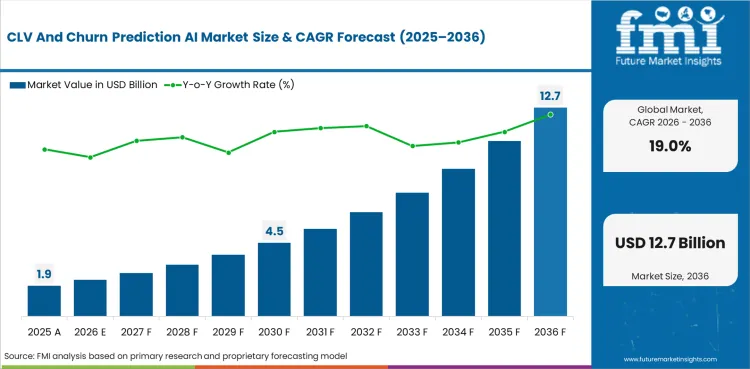
The CLV and Churn Prediction AI Market was valued at an estimated USD 1.62 billion in 2025, is projected to reach USD 1.88 billion in 2026, and is forecast to expand to USD 10.74 billion by 2036 at a CAGR of 19.0%. The forecast period implies an incremental opportunity of USD 8.86 billion.
Summary of CLV and Churn Prediction AI Market
- The market is forecast to reach USD 10.74 billion by 2036.
- The market is expected to grow at a CAGR of 19.0% from 2026 to 2036.
- The market was estimated at USD 1.62 billion in 2025.
- The forecast period represents an incremental opportunity of USD 8.86 billion.
- SaaS platforms account for 61.4% of the component segment in 2025, reflecting stronger buyer preference for packaged predictive workflows over custom model development.
- Churn prediction and retention intervention holds 37.2% of the use-case segment, supported by recurring revenue pressure and more mature retention playbooks.
- Large enterprises represent 64.8% of enterprise-size demand, indicating concentration among organizations with large customer bases, richer behavioral data, and integrated marketing stacks.
CLV and Churn Prediction AI Market key Takeaways
| Parameter | Details |
|---|---|
| Market value (2026) | USD 1.88 billion |
| Forecast value (2036) | USD 10.74 billion |
| CAGR (2026 to 2036) | 19.0% |
| Estimated market value (2025) | USD 1.62 billion |
| Incremental opportunity | USD 8.86 billion |
| Leading component | SaaS platforms, 61.4% of component revenue |
| Leading use case | Churn prediction and retention intervention, 37.2% of use-case revenue |
| Leading enterprise size | Large enterprises, 64.8% of enterprise-size revenue |
| Key players | Salesforce, Twilio Segment, Optimove, HubSpot, SAP, Amplitude |
Source: Analyst synthesis from authoritative sources, 2026.
Key Takeaways, Market Size, and Forecast
- CLV and Churn Prediction AI Market is projected to grow from USD 1.88 billion in 2026 to USD 10.74 billion by 2036, at a CAGR of 19.0%.
- The CLV and churn prediction AI market was valued at USD 1.62 billion in 2025.
- By 2036, the CLV and Churn Prediction AI Market is expected to be worth USD 10.74 billion.
- From 2026 to 2036, the market is anticipated to expand at a CAGR of 19.0%.
- The market is predicted to create an incremental opportunity of USD 8.86 billion between 2026 and 2036.
- In 2026, SaaS Platforms are expected to account for 61.4% of the component segment.
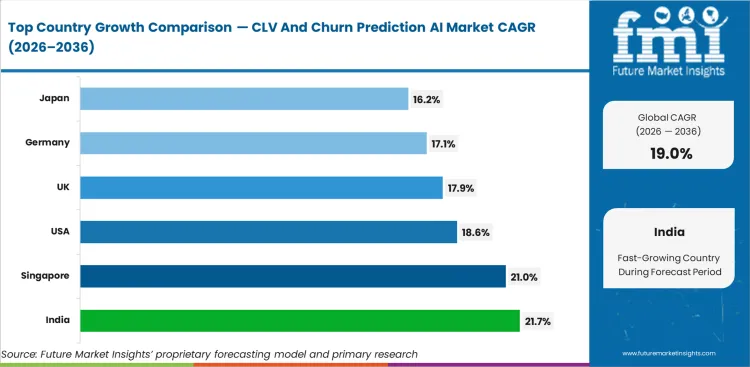
- India (21.7%) and Singapore (21.0%) are projected to be two of the fastest growing markets.
The market is being shaped by the integration of predictive customer intelligence into production revenue workflows. Salesforce, Twilio Segment, and Optimove are embedding CLV forecasting, churn prediction, and audience decisioning inside customer-data and retention platforms. This places predictive models closer to campaign execution, customer prioritization, and revenue planning.
Across tracked geographies, India sets the pace at 21.7% CAGR. Singapore follows at 21.0%. United States follows at 18.6%. United Kingdom follows at 17.9%. Germany follows at 17.1%. Japan follows at 16.2%.
CLV And Churn Prediction AI MarketCLV and Churn Prediction AI Market Definition
The CLV and Churn Prediction AI Market covers software platforms and related services that use machine learning, predictive analytics, customer data unification, and automated decisioning to estimate customer lifetime value, predict churn risk, and trigger retention or growth actions. The market includes packaged AI features inside CRMs, CDPs, customer engagement platforms, product analytics stacks, and customer intelligence software.
CLV and Churn Prediction AI Market Inclusions
Market scope includes customer data platforms with predictive audiences, CRMs with AI scoring for churn or lifetime value, retention marketing platforms with behavior prediction, product analytics platforms with churn prediction workflows, and associated integration and advisory services. Revenue sizing spans subscriptions and services tied to CLV prediction, churn scoring, audience prioritization, next-best-action delivery, and retention campaign orchestration.
CLV and Churn Prediction AI Market Exclusions
The scope excludes generic BI tools without predictive customer value or churn capability, broad martech revenue not tied to predictive customer outcomes, data science consulting not attached to production software deployment, and point loyalty systems that do not use predictive AI for CLV or churn actioning.
CLV and Churn Prediction AI Market Research Methodology
- Primary Research: FMI analysts reviewed official product materials, platform documentation, and publicly stated capability updates from vendors active in customer intelligence, retention software, CRM, and customer data platforms.
- Desk Research: Data collection consolidated vendor documentation, pricing signals, customer-data platform materials, and predictive workflow disclosures from Salesforce, Twilio Segment, Optimove, HubSpot, SAP, and Amplitude to establish verifiable baseline parameters.
- Market Sizing and Forecasting: Baseline values were derived from the installed base of CDPs, CRMs, product analytics, and retention platforms that embed predictive customer models, and then cross-checked against enterprise spending on customer intelligence, platform pricing logic, and conversion from custom-model workflows into packaged AI subscriptions through 2036.
- Data validation and update cycle: Projections were tested against product disclosures, deployment patterns in customer-data stacks, and adoption of vendor-led predictive workflows, with periodic review to keep the forecast aligned with changes in platform capability and deployment trends.
Why is the CLV and Churn Prediction AI Market Growing?
Recurring revenue businesses can no longer rely on basic reporting to protect growth. They need earlier signals on churn risk, stronger prioritization of high-value users, and better targeting of intervention budgets.
Customer data is more accessible than before, but activation remains uneven. Many teams have event streams, CRM records, and transaction data, yet still struggle to translate that data into retention or value-growth action.
Vendors are productizing the missing layer. Segment, Amplitude, and Optimove all position predictive customer intelligence as an embedded operational capability rather than a separate data science exercise.
The market is growing because the economics of retention and expansion are becoming more visible. Acquisition costs remain high, and executives increasingly want provable gains from upsell, reactivation, and churn prevention. That makes CLV and churn prediction valuable not just as analytics outputs but as budget allocation signals.
Another driver is operational maturity inside customer data platforms. Earlier generations required teams to export data to custom modeling workflows. Current platforms increasingly package prediction directly into segmentation, activation, and orchestration layers. That shortens time to value and broadens adoption beyond advanced data science teams.
The category also benefits from AI normalization in go-to-market systems. Once buyers accept AI scoring for sales, service, or marketing execution, predictive CLV and churn become a natural extension. The strongest platforms win when they connect prediction to action rather than stopping at dashboards.
Segmental Analysis
SaaS platforms command 61.4% of component revenue in 2025. Buyers prefer packaged prediction workflows because they reduce model maintenance and improve time to activation.
Churn prediction and retention intervention accounts for 37.2% of use-case revenue in 2025. This segment leads because churn prevention has the clearest short-term ROI in subscription and repeat-purchase environments.
Large enterprises hold 64.8% of enterprise-size revenue in 2025. Their bigger customer bases and richer behavior data make predictive models easier to justify and operationalize.
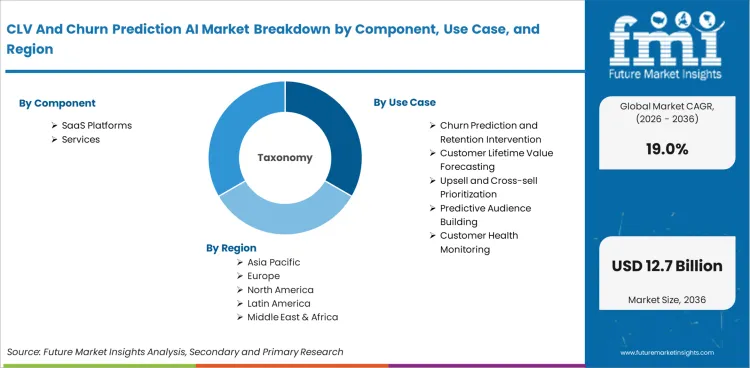
The market is segmented by component, deployment mode, use case, enterprise size, end use, and region. By component, the market includes SaaS platforms and services. By use case, the market covers churn prediction and retention intervention, customer lifetime value forecasting, upsell and cross-sell prioritization, predictive audience building, and customer health monitoring.
Insights into the SaaS Platform Segment
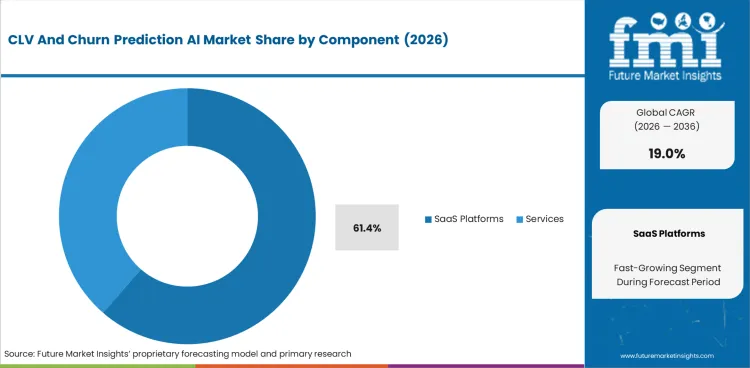
SaaS platforms are projected to hold 61.4% of component revenue in 2026. This lead reflects stronger demand for packaged predictive models, easier integration into marketing and CRM systems, and faster deployment compared with custom in-house stacks.
Insights into the Churn Prediction and Retention Intervention Segment
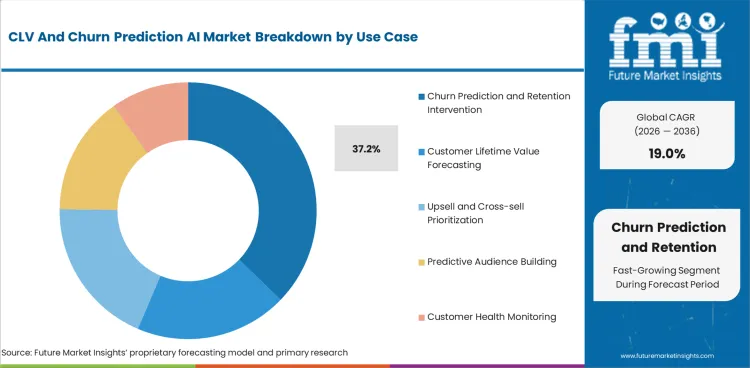
Churn prediction and retention intervention is expected to capture 37.2% of use-case revenue in 2026. This segment leads because revenue retention is easier to connect to financial outcomes than broader customer intelligence use cases. Vendors that link prediction directly to campaign or product action are likely to capture the most value.
Insights into the Large Enterprise Segment
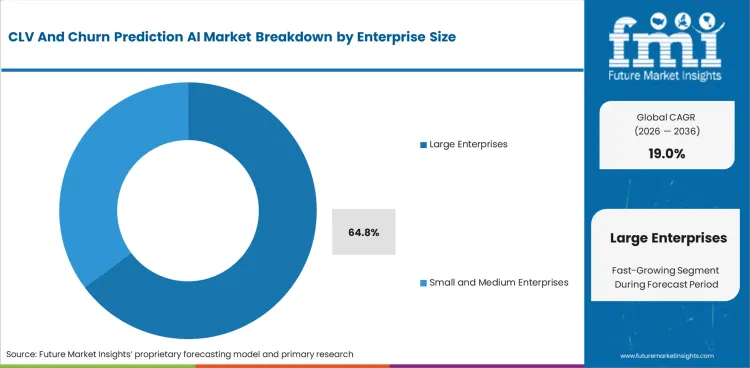
Large enterprises are projected to account for 64.8% of enterprise-size revenue in 2026. They are earlier adopters because they already run complex customer data stacks and can spread the cost of predictive infrastructure across more brands, products, and channels.
What are the Drivers, Restraints, and Key Trends of the CLV and Churn Prediction AI Market?
Driver: retention pressure and rising acquisition cost are forcing organizations to use prediction for customer prioritization and intervention timing.
Restraint: fragmented customer identity, weak historical data quality, and leakage-prone model design still limit model reliability.
Trend: predictive AI is moving inside CDPs, CRMs, and product analytics platforms rather than remaining a separate modeling layer.
Value capture depends on data quality, model monitoring, and workflow integration. Teams that unify customer data and connect predictions to campaign, service, or product actions are seeing stronger results. Weak identity resolution and poor intervention design reduce model value.
Retention Economics and Revenue Efficiency
Growth is supported by the need to improve revenue efficiency. When acquisition becomes more expensive, companies need better ways to protect and expand the value of existing customers. CLV and churn models provide a defensible way to concentrate spend on the highest-impact accounts or segments.
Data Quality and Model Leakage Risks
Model reliability remains a core market constraint. Churn and CLV systems weaken when customer identity is fragmented, event data is incomplete, or training logic uses future information. Buyers therefore place more weight on platforms that explain inputs, support validation, and monitor prediction quality over time.
Embedded Prediction Inside Customer Platforms
Predictive audiences, behavioral scoring, and churn signals are increasingly built into the systems already used by marketers, product teams, and revenue teams. This expands adoption beyond specialist data-science environments.
Analysis of CLV and Churn Prediction AI Market By Key Countries
.webp "Top Country Growth Comparison Clv And Churn Prediction Ai Market Cagr (2026 2036)")
North America remains the largest market because customer data infrastructure, subscription software maturity, and AI-enabled CRM adoption are strongest there.
Asia-Pacific grows fastest because cloud-native digital businesses are scaling quickly and newer companies can adopt packaged predictive workflows without as much legacy burden.
Europe grows steadily with stronger focus on governance, consent, and customer data controls, which can slow activation but support higher-trust deployments over time.
| Country | CAGR |
|---|---|
| India | 21.7% |
| Singapore | 21.0% |
| United States | 18.6% |
| United Kingdom | 17.9% |
| Germany | 17.1% |
| Japan | 16.2% |
Demand Outlook for CLV and Churn Prediction AI Market in the United States
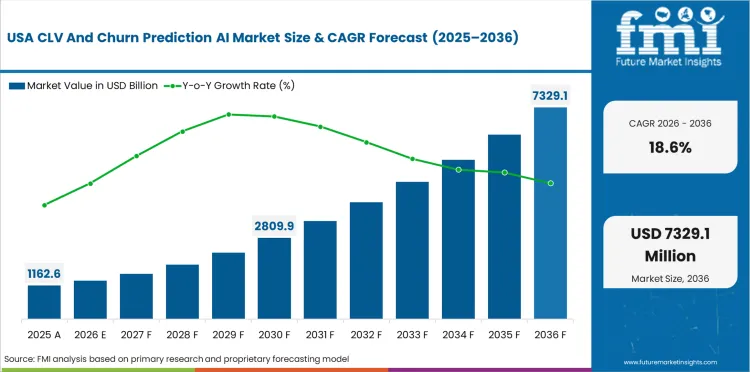
The United States remains the largest revenue base because CRM, CDP, product analytics, and retention platforms are mature and widely deployed there.
- Large software and subscription businesses provide strong category demand.
- Vendor concentration strengthens awareness and integration depth.
- Customer data platform maturity supports better predictive activation.
Future Outlook for CLV and Churn Prediction AI Market in the United Kingdom
The United Kingdom is expected to grow steadily as enterprises seek more efficient retention and revenue-growth workflows under tighter spending discipline.
- B2B and subscription software adoption supports use-case depth.
- Governance and consent requirements shape deployment design.
- Marketing and revenue operations teams are adopting packaged prediction tools faster.
Opportunity Analysis of CLV and Churn Prediction AI Market in Germany
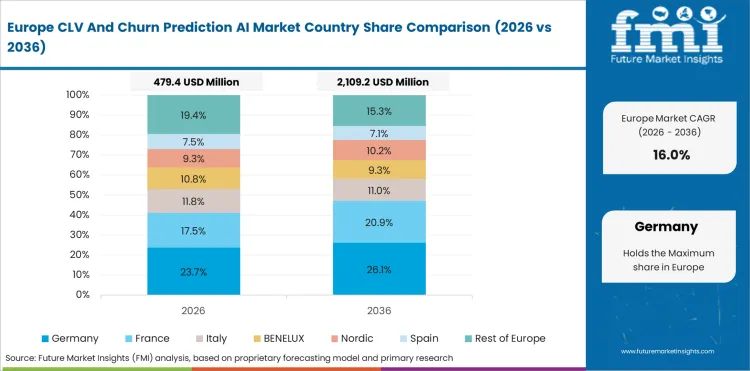
Germany demonstrates solid potential because enterprise customer data modernization is improving and retention-oriented analytics are gaining budget support.
- Customer data integration remains a core buying requirement.
- Execution quality matters as much as model quality.
- Enterprise buyers favor well-governed platform deployments.
In-depth Analysis of CLV and Churn Prediction AI Market in Japan
Japan is likely to expand through steady digital customer engagement modernization, especially in sectors with recurring service relationships and loyalty economics.
- Large service organizations support CLV use cases.
- Deployment patterns tend to be measured and enterprise-led.
- Operational integration is a key differentiator.
Sales Analysis of CLV and Churn Prediction AI Market in India
India is among the fastest-growing major markets because digital-first businesses, fintech, e-commerce, and SaaS adoption are expanding quickly.
- Cloud-native companies can deploy packaged prediction systems faster.
- High-growth digital sectors raise the value of retention analytics.
- Modern data stacks reduce some integration friction.
In-depth Analysis of CLV and Churn Prediction AI Market in Singapore
Singapore functions as a high-growth hub where data-driven customer operations, cloud adoption, and regional enterprise coordination support predictive customer intelligence demand.
- Regional headquarters support premium software adoption.
- High digital maturity supports faster activation of predictive workflows.
- Cross-market customer intelligence use cases strengthen the business case.
Competitive Landscape of CLV and Churn Prediction AI Market
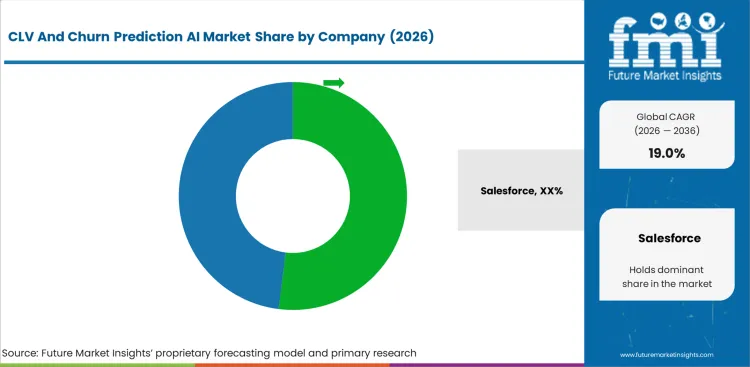
The competitive landscape spans CRM vendors, CDP providers, retention marketing platforms, and product analytics vendors. Competitive advantage depends on identity resolution, predictive accuracy, activation workflow depth, and the ability to connect scoring to action.
Salesforce, Twilio Segment, Optimove, HubSpot, SAP, and Amplitude are among the most relevant vendors in this space. Their importance comes from existing customer data footprints and the ability to embed prediction inside systems of engagement.
Optimove is notable because it explicitly links CLV and churn prediction inside retention decisioning. Segment is notable because predictive audience logic sits close to customer data unification and downstream activation. Amplitude is notable because product behavior and churn insights are tied tightly together in product analytics workflows.
Competition centers on platforms that connect prediction to action. Vendors that unify customer data, prioritization logic, and execution workflows hold a stronger market position.
Major Industry Players
Salesforce and SAP are strong because they can connect predictive customer intelligence with broader enterprise customer workflows. Twilio Segment and HubSpot are strong because they sit close to activation and customer journey tooling.
Optimove remains highly relevant through its retention and lifecycle orientation. Amplitude remains relevant where product usage behavior is central to churn or value prediction.
The market still allows specialists to compete, but platform breadth and integration depth are becoming more important as buyers seek fewer disconnected customer systems.
Competitive Benchmarking: CLV and Churn Prediction AI Market
| Company | Customer Data Strength | Prediction-to-Action Depth | Enterprise Reach | Geographic Reach |
|---|---|---|---|---|
| Salesforce | High | High | Strong | Strong |
| Twilio Segment | High | High | Moderate | Strong |
| Optimove | Medium | High | Moderate | Moderate |
| HubSpot | Medium | Medium | Strong | Strong |
| SAP | High | Medium | Strong | Strong |
| Amplitude | Medium | Medium | Strong | Strong |
Source: Analyst synthesis from authoritative sources, 2026. Ratings reflect relative positioning based on disclosed capabilities and market presence.
Key Developments in CLV and Churn Prediction AI Market
- In 2025 and 2026, Salesforce continued to position customer lifetime value as a forward‑looking metric within its AI‑driven customer and sales workflows, emphasizing how AI‑powered insights can guide targeting, retention, and revenue planning across its CRM and marketing stack.
- Twilio Segment kept expanding its predictive audiences and customer‑data activation capabilities in 2025 and 2026, adding more AI‑driven traits and audience‑building features that allow marketers to automatically target at‑risk or high‑value users based on behavior and engagement signals.
- Optimove continued to emphasize CLV‑driven churn prediction and retention decisioning in its official educational content and product materials, framing churn as a byproduct of customer‑value decline and using predictive CLV models to recommend personalized retention actions.
Key Players in the CLV and Churn Prediction AI Market:
Major Global Players:
- Salesforce
- Twilio Segment
- Optimove
- HubSpot
- SAP
- Amplitude
Emerging Players/Startups
- predictive retention intelligence startups
- vertical customer analytics specialists
- AI-native customer health scoring vendors
Scope of the report
| Metric | Value |
|---|---|
| Quantitative Units | USD 1.88 billion to USD 10.74 billion, at a CAGR of 19.0% |
| Market Definition | Software platforms and related services that use machine learning, predictive analytics, customer data unification, and automated decisioning to estimate customer lifetime value, predict churn risk, and trigger retention or growth actions. |
| Segmentation | Component: SaaS platforms, services. Deployment mode: cloud, hybrid. Use case: churn prediction and retention intervention, customer lifetime value forecasting, upsell and cross-sell prioritization, predictive audience building, customer health monitoring. Enterprise size: large enterprises, small and medium enterprises. End use: e-commerce and retail, SaaS and software, BFSI, telecom, media and entertainment, travel and hospitality, consumer services. |
| Regions Covered | North America, Europe, Asia-Pacific, Latin America, Middle East and Africa |
| Countries Covered | United States, United Kingdom, Germany, Japan, India, Singapore and others |
| Key Companies Profiled | Salesforce, Twilio Segment, Optimove, HubSpot, SAP, Amplitude |
| Forecast Period | 2026 to 2036 |
| Approach | Analyst-built hybrid top-down and bottom-up model using official vendor disclosures, predictive workflow capability expansion, and installed base conversion across customer data and retention platforms. |
| Historical Period | 2020 to 2025 |
CLV And Churn Prediction AI MarketCLV and Churn Prediction AI Market Segments Analysis:
CLV and Churn Prediction AI Market segmented as Component:
- SaaS Platforms
- Services
CLV and Churn Prediction AI Market classified by Deployment Mode:
- Cloud
- Hybrid
CLV and Churn Prediction AI Market analysed by Use Case:
- Churn Prediction and Retention Intervention
- Customer Lifetime Value Forecasting
- Upsell and Cross-sell Prioritization
- Predictive Audience Building
- Customer Health Monitoring
CLV and Churn Prediction AI Market segmented as Enterprise Size:
- Large Enterprises
- Small and Medium Enterprises
CLV and Churn Prediction AI Market classified by End Use:
- E-commerce and Retail
- SaaS and Software
- BFSI
- Telecom
- Media and Entertainment
- Travel and Hospitality
- Consumer Services
CLV and Churn Prediction AI Market by Region and Country:
- North America
- United States
- Canada
- Europe
- United Kingdom
- Germany
- France
- Rest of Europe
- Asia-Pacific
- India
- Singapore
- Japan
- Australia
- Rest of Asia-Pacific
- Latin America
- Middle East and Africa
Bibliography
- Salesforce official materials on customer lifetime value and AI-led customer workflows. 2025 and 2026.
- Twilio Segment official materials on predictive audiences and customer data activation. 2025 and 2026.
- Optimove official educational and product materials on CLV and churn prediction. 2025 and 2026.
- HubSpot official materials on predictive scoring and customer intelligence. 2025 and 2026.
- SAP official materials on customer data and predictive customer intelligence. 2025 and 2026.
- Amplitude official materials on churn prediction and customer behavior analytics. 2025 and 2026.
This Report Addresses
- Market sizing and revenue forecasting for CLV and churn prediction AI through 2036.
- Segmentation by component, deployment, use case, enterprise size, and end use.
- Regional and country-level growth outlook.
- Competitive landscape across CRM, CDP, retention, and product analytics vendors.
- The shift from dashboard-based customer analytics to prediction-driven action systems.
- Data quality, identity resolution, and activation challenges affecting market scale.
Frequently Asked Questions
How large is the demand for CLV And Churn Prediction AI in the global market in 2026?
Demand for CLV and churn prediction AI in the global market is estimated at USD 1.88 billion in 2026.
What will be the market size by 2036?
Market size is projected to reach USD 10.74 billion by 2036.
What is the expected demand growth between 2026 and 2036?
Demand is expected to grow at a CAGR of 19.0% between 2026 and 2036.
Which component is poised to lead by 2025?
SaaS platforms lead the market in 2025 with 61.4% of component revenue.
How are large enterprises driving adoption?
Large enterprises account for 64.8% of enterprise-size revenue because they have richer customer data, larger installed stacks, and stronger budgets for predictive activation.
What is driving demand in the United States?
The United States remains the largest market because CRM, CDP, product analytics, and retention platforms are mature and widely deployed there.
What does the market definition mean?
The market covers software platforms and related services that use machine learning, predictive analytics, customer data unification, and automated decisioning to estimate customer lifetime value, predict churn risk, and trigger retention or growth actions.
How does the analyst validate the forecast?
The forecast is validated through a hybrid model using official vendor disclosures, workflow expansion, and bottom-up checks on installed customer data and retention software bases converting into packaged predictive AI deployments.
Preview the report firsthand - request a free sample
Get SampleGet the brochure for pricing and purchase details.
Get PDFTable of Content
- Executive Summary
- Global Market Outlook
- Demand-side Trends
- Supply-side Trends
- Technology Roadmap Analysis
- Analysis and Recommendations
- Market Overview
- Market Coverage / Taxonomy
- Market Definition / Scope / Limitations
- Research Methodology
- Chapter Orientation
- Analytical Lens and Working Hypotheses
- Market Structure, Signals, and Trend Drivers
- Benchmarking and Cross-market Comparability
- Market Sizing, Forecasting, and Opportunity Mapping
- Research Design and Evidence Framework
- Desk Research Programme (Secondary Evidence)
- Company Annual and Sustainability Reports
- Peer-reviewed Journals and Academic Literature
- Corporate Websites, Product Literature, and Technical Notes
- Earnings Decks and Investor Briefings
- Statutory Filings and Regulatory Disclosures
- Technical White Papers and Standards Notes
- Trade Journals, Industry Magazines, and Analyst Briefs
- Conference Proceedings, Webinars, and Seminar Materials
- Government Statistics Portals and Public Data Releases
- Press Releases and Reputable Media Coverage
- Specialist Newsletters and Curated Briefings
- Sector Databases and Reference Repositories
- FMI Internal Proprietary Databases and Historical Market Datasets
- Subscription Datasets and Paid Sources
- Social Channels, Communities, and Digital Listening Inputs
- Additional Desk Sources
- Expert Input and Fieldwork (Primary Evidence)
- Primary Modes
- Qualitative Interviews and Expert Elicitation
- Quantitative Surveys and Structured Data Capture
- Blended Approach
- Why Primary Evidence is Used
- Field Techniques
- Interviews
- Surveys
- Focus Groups
- Observational and In-context Research
- Social and Community Interactions
- Stakeholder Universe Engaged
- C-suite Leaders
- Board Members
- Presidents and Vice Presidents
- R&D and Innovation Heads
- Technical Specialists
- Domain Subject-matter Experts
- Scientists
- Physicians and Other Healthcare Professionals
- Governance, Ethics, and Data Stewardship
- Research Ethics
- Data Integrity and Handling
- Primary Modes
- Tooling, Models, and Reference Databases
- Desk Research Programme (Secondary Evidence)
- Data Engineering and Model Build
- Data Acquisition and Ingestion
- Cleaning, Normalisation, and Verification
- Synthesis, Triangulation, and Analysis
- Quality Assurance and Audit Trail
- Market Background
- Market Dynamics
- Drivers
- Restraints
- Opportunity
- Trends
- Scenario Forecast
- Demand in Optimistic Scenario
- Demand in Likely Scenario
- Demand in Conservative Scenario
- Opportunity Map Analysis
- Product Life Cycle Analysis
- Supply Chain Analysis
- Investment Feasibility Matrix
- Value Chain Analysis
- PESTLE and Porter’s Analysis
- Regulatory Landscape
- Regional Parent Market Outlook
- Production and Consumption Statistics
- Import and Export Statistics
- Market Dynamics
- Global Market Analysis 2021 to 2025 and Forecast, 2026 to 2036
- Historical Market Size Value (USD Million) Analysis, 2021 to 2025
- Current and Future Market Size Value (USD Million) Projections, 2026 to 2036
- Y-o-Y Growth Trend Analysis
- Absolute $ Opportunity Analysis
- Global Market Pricing Analysis 2021 to 2025 and Forecast 2026 to 2036
- Global Market Analysis 2021 to 2025 and Forecast 2026 to 2036, By Component
- Introduction / Key Findings
- Historical Market Size Value (USD Million) Analysis By Component , 2021 to 2025
- Current and Future Market Size Value (USD Million) Analysis and Forecast By Component , 2026 to 2036
- SaaS Platforms
- Services
- SaaS Platforms
- Y-o-Y Growth Trend Analysis By Component , 2021 to 2025
- Absolute $ Opportunity Analysis By Component , 2026 to 2036
- Global Market Analysis 2021 to 2025 and Forecast 2026 to 2036, By Use Case
- Introduction / Key Findings
- Historical Market Size Value (USD Million) Analysis By Use Case, 2021 to 2025
- Current and Future Market Size Value (USD Million) Analysis and Forecast By Use Case, 2026 to 2036
- Churn Prediction and Retention Intervention
- Customer Lifetime Value Forecasting
- Upsell and Cross-sell Prioritization
- Predictive Audience Building
- Customer Health Monitoring
- Churn Prediction and Retention Intervention
- Y-o-Y Growth Trend Analysis By Use Case, 2021 to 2025
- Absolute $ Opportunity Analysis By Use Case, 2026 to 2036
- Global Market Analysis 2021 to 2025 and Forecast 2026 to 2036, By Enterprise Size
- Introduction / Key Findings
- Historical Market Size Value (USD Million) Analysis By Enterprise Size, 2021 to 2025
- Current and Future Market Size Value (USD Million) Analysis and Forecast By Enterprise Size, 2026 to 2036
- Large Enterprises
- Small and Medium Enterprises
- Large Enterprises
- Y-o-Y Growth Trend Analysis By Enterprise Size, 2021 to 2025
- Absolute $ Opportunity Analysis By Enterprise Size, 2026 to 2036
- Global Market Analysis 2021 to 2025 and Forecast 2026 to 2036, By Region
- Introduction
- Historical Market Size Value (USD Million) Analysis By Region, 2021 to 2025
- Current Market Size Value (USD Million) Analysis and Forecast By Region, 2026 to 2036
- North America
- Latin America
- Western Europe
- Eastern Europe
- East Asia
- South Asia and Pacific
- Middle East & Africa
- Market Attractiveness Analysis By Region
- North America Market Analysis 2021 to 2025 and Forecast 2026 to 2036, By Country
- Historical Market Size Value (USD Million) Trend Analysis By Market Taxonomy, 2021 to 2025
- Market Size Value (USD Million) Forecast By Market Taxonomy, 2026 to 2036
- By Country
- USA
- Canada
- Mexico
- By Component
- By Use Case
- By Enterprise Size
- By Country
- Market Attractiveness Analysis
- By Country
- By Component
- By Use Case
- By Enterprise Size
- Key Takeaways
- Latin America Market Analysis 2021 to 2025 and Forecast 2026 to 2036, By Country
- Historical Market Size Value (USD Million) Trend Analysis By Market Taxonomy, 2021 to 2025
- Market Size Value (USD Million) Forecast By Market Taxonomy, 2026 to 2036
- By Country
- Brazil
- Chile
- Rest of Latin America
- By Component
- By Use Case
- By Enterprise Size
- By Country
- Market Attractiveness Analysis
- By Country
- By Component
- By Use Case
- By Enterprise Size
- Key Takeaways
- Western Europe Market Analysis 2021 to 2025 and Forecast 2026 to 2036, By Country
- Historical Market Size Value (USD Million) Trend Analysis By Market Taxonomy, 2021 to 2025
- Market Size Value (USD Million) Forecast By Market Taxonomy, 2026 to 2036
- By Country
- Germany
- UK
- Italy
- Spain
- France
- Nordic
- BENELUX
- Rest of Western Europe
- By Component
- By Use Case
- By Enterprise Size
- By Country
- Market Attractiveness Analysis
- By Country
- By Component
- By Use Case
- By Enterprise Size
- Key Takeaways
- Eastern Europe Market Analysis 2021 to 2025 and Forecast 2026 to 2036, By Country
- Historical Market Size Value (USD Million) Trend Analysis By Market Taxonomy, 2021 to 2025
- Market Size Value (USD Million) Forecast By Market Taxonomy, 2026 to 2036
- By Country
- Russia
- Poland
- Hungary
- Balkan & Baltic
- Rest of Eastern Europe
- By Component
- By Use Case
- By Enterprise Size
- By Country
- Market Attractiveness Analysis
- By Country
- By Component
- By Use Case
- By Enterprise Size
- Key Takeaways
- East Asia Market Analysis 2021 to 2025 and Forecast 2026 to 2036, By Country
- Historical Market Size Value (USD Million) Trend Analysis By Market Taxonomy, 2021 to 2025
- Market Size Value (USD Million) Forecast By Market Taxonomy, 2026 to 2036
- By Country
- China
- Japan
- South Korea
- By Component
- By Use Case
- By Enterprise Size
- By Country
- Market Attractiveness Analysis
- By Country
- By Component
- By Use Case
- By Enterprise Size
- Key Takeaways
- South Asia and Pacific Market Analysis 2021 to 2025 and Forecast 2026 to 2036, By Country
- Historical Market Size Value (USD Million) Trend Analysis By Market Taxonomy, 2021 to 2025
- Market Size Value (USD Million) Forecast By Market Taxonomy, 2026 to 2036
- By Country
- India
- ASEAN
- Australia & New Zealand
- Rest of South Asia and Pacific
- By Component
- By Use Case
- By Enterprise Size
- By Country
- Market Attractiveness Analysis
- By Country
- By Component
- By Use Case
- By Enterprise Size
- Key Takeaways
- Middle East & Africa Market Analysis 2021 to 2025 and Forecast 2026 to 2036, By Country
- Historical Market Size Value (USD Million) Trend Analysis By Market Taxonomy, 2021 to 2025
- Market Size Value (USD Million) Forecast By Market Taxonomy, 2026 to 2036
- By Country
- Kingdom of Saudi Arabia
- Other GCC Countries
- Turkiye
- South Africa
- Other African Union
- Rest of Middle East & Africa
- By Component
- By Use Case
- By Enterprise Size
- By Country
- Market Attractiveness Analysis
- By Country
- By Component
- By Use Case
- By Enterprise Size
- Key Takeaways
- Key Countries Market Analysis
- USA
- Pricing Analysis
- Market Share Analysis, 2025
- By Component
- By Use Case
- By Enterprise Size
- Canada
- Pricing Analysis
- Market Share Analysis, 2025
- By Component
- By Use Case
- By Enterprise Size
- Mexico
- Pricing Analysis
- Market Share Analysis, 2025
- By Component
- By Use Case
- By Enterprise Size
- Brazil
- Pricing Analysis
- Market Share Analysis, 2025
- By Component
- By Use Case
- By Enterprise Size
- Chile
- Pricing Analysis
- Market Share Analysis, 2025
- By Component
- By Use Case
- By Enterprise Size
- Germany
- Pricing Analysis
- Market Share Analysis, 2025
- By Component
- By Use Case
- By Enterprise Size
- UK
- Pricing Analysis
- Market Share Analysis, 2025
- By Component
- By Use Case
- By Enterprise Size
- Italy
- Pricing Analysis
- Market Share Analysis, 2025
- By Component
- By Use Case
- By Enterprise Size
- Spain
- Pricing Analysis
- Market Share Analysis, 2025
- By Component
- By Use Case
- By Enterprise Size
- France
- Pricing Analysis
- Market Share Analysis, 2025
- By Component
- By Use Case
- By Enterprise Size
- India
- Pricing Analysis
- Market Share Analysis, 2025
- By Component
- By Use Case
- By Enterprise Size
- ASEAN
- Pricing Analysis
- Market Share Analysis, 2025
- By Component
- By Use Case
- By Enterprise Size
- Australia & New Zealand
- Pricing Analysis
- Market Share Analysis, 2025
- By Component
- By Use Case
- By Enterprise Size
- China
- Pricing Analysis
- Market Share Analysis, 2025
- By Component
- By Use Case
- By Enterprise Size
- Japan
- Pricing Analysis
- Market Share Analysis, 2025
- By Component
- By Use Case
- By Enterprise Size
- South Korea
- Pricing Analysis
- Market Share Analysis, 2025
- By Component
- By Use Case
- By Enterprise Size
- Russia
- Pricing Analysis
- Market Share Analysis, 2025
- By Component
- By Use Case
- By Enterprise Size
- Poland
- Pricing Analysis
- Market Share Analysis, 2025
- By Component
- By Use Case
- By Enterprise Size
- Hungary
- Pricing Analysis
- Market Share Analysis, 2025
- By Component
- By Use Case
- By Enterprise Size
- Kingdom of Saudi Arabia
- Pricing Analysis
- Market Share Analysis, 2025
- By Component
- By Use Case
- By Enterprise Size
- Turkiye
- Pricing Analysis
- Market Share Analysis, 2025
- By Component
- By Use Case
- By Enterprise Size
- South Africa
- Pricing Analysis
- Market Share Analysis, 2025
- By Component
- By Use Case
- By Enterprise Size
- USA
- Market Structure Analysis
- Competition Dashboard
- Competition Benchmarking
- Market Share Analysis of Top Players
- By Regional
- By Component
- By Use Case
- By Enterprise Size
- Competition Analysis
- Competition Deep Dive
- Salesforce
- Overview
- Product Portfolio
- Profitability by Market Segments (Product/Age /Sales Channel/Region)
- Sales Footprint
- Strategy Overview
- Marketing Strategy
- Product Strategy
- Channel Strategy
- Twilio Segment
- Optimove
- HubSpot
- SAP
- Amplitude
- Salesforce
- Competition Deep Dive
- Assumptions & Acronyms Used


