

- Market Size (2026)
- USD 320.8 Mn
- Forecast (2036)
- USD 667.4 Mn
- CAGR (2026 to 2036)
- 7.6%
How big is Collagen-Fortified Bakery Market in 2026?
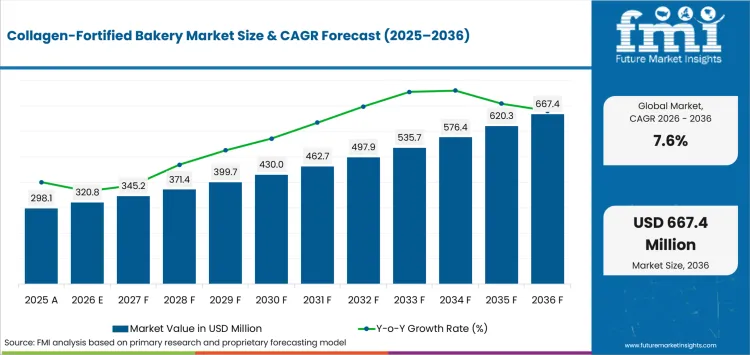
USD 320.8 million in 2026 and USD 667.4 million by 2036 at a 7.6% CAGR.
Demand for collagen-fortified bakery is projected to expand at 7.6% CAGR between 2026 and 2036 as functional protein enters familiar breakfast and snack routines. Flowers Foods gave that route a current bakery benchmark in April 2025 by extending better-for-you breads and baked snacks within its innovation program. That activity does not prove collagen demand, but it lowers the format risk for bakery ingredients designed for familiar products.
Country economics change how quickly a fortified loaf or cookie converts from trial to repeat purchase. USA Bureau of Labor Statistics data released in August 2026 showed bakery product prices 2.4% above July 2025 and bread prices 3.7% higher. A collagen premium therefore faces a sharper household value test even as collagen peptides gain wider food-formulation attention.
Key Takeaways of Collagen-Fortified Bakery Market
- Demand depends on placing collagen inside familiar bakery occasions without asking consumers to maintain a separate supplement routine.
- By product type, classic - original is estimated to hold 40.0% in 2026 because familiar flavor and usage reduce first-trial risk.
- Conventional is projected to account for 59.0% of claim - nature demand in 2026 because brands avoid stacking extra certification work onto collagen fortification.
- Fresh is anticipated to represent 34.0% of format demand in 2026 because shorter shelf-life targets give formulators more room to protect texture.
- Premium pricing and claim credibility can limit repeat purchase even after a fortified formula performs correctly on the bakery line.
- Some of the key players in this market include Taylor Chip, Prime Bites, ChunkyFit, Munch Better, Flowers Foods, Warburtons, Dr. Schär, and Doughlicious.
Analyst Perspective
"Collagen bakery should be evaluated first as a baked product and then as a functional proposition. Commercial value is earned if the formula keeps familiar texture and the channel can support a premium without weakening repeat purchase."
- Nandini Roy Choudhury, Principal Consultant, Future Market Insights
How is the Collagen-Fortified Bakery Market segmented?
The market is segmented by product type, claim - nature, format, packaging format and sales channel.
Product types cover classic - original, whole grain and seeded, flavored and filled, mini and snacking, and premium / artisan products. Claim - nature includes conventional, clean label, organic, gluten-free, and high-protein / fortified. Formats include fresh, frozen, ambient packaged, chilled, and par-baked. Packaging covers multipack, single-serve, family / loaf pack, and bulk foodservice. Sales channels include supermarkets and hypermarkets, artisan bakeries, convenience outlets, online and DTC, and foodservice distributors.
Why does Conventional lead the Claim - nature category?
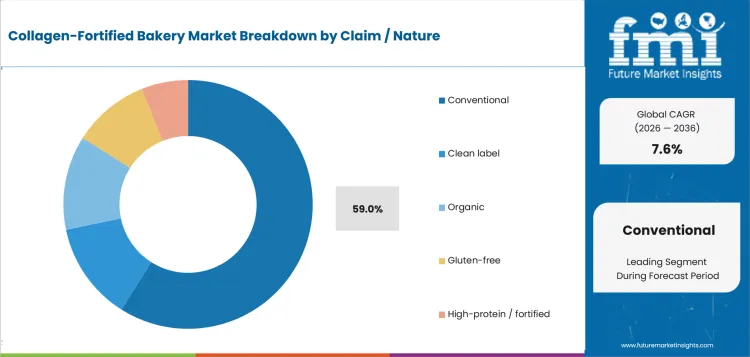
- Collagen already requires source documentation and label review, so an additional specialty claim can require another qualification step. Conventional positioning lets bakery teams focus first on dough performance and a clear protein message before considering extra certification routes for national retail.
- Within claim - nature, conventional is projected to represent 59.0% in 2026 as brands limit overlapping certification and reformulation work.
What makes Classic - original central to the Product type category?
Classic recipes give product developers a fixed sensory reference before collagen changes dough or crumb behavior. The route also lets brands compare fortified products directly with ordinary bread or cookies rather than teaching a new eating occasion in the functional foods category.
- By product type, classic - original is estimated to hold 40.0% in 2026 owing to familiar flavor and predictable use occasions.
- Taylor Chip launched a protein cookie in May 2025 with 17 grams of collagen and 30 grams of protein. The launch shows collagen can enter an ordinary cookie format without changing the basic dessert cue.
The USA FDA moved the updated "healthy" nutrient-content rule to an April 2025 effective date. The change illustrates why optional nutrition claims require their own criteria even if the base functional food ingredients are otherwise acceptable.
How does Fresh hold the lead in the Format category?
Fresh production gives bakery teams shorter storage targets during collagen tuning for dough handling and crumb performance. Shorter production runs also expose weak texture quickly. The trade-off is tighter scheduling because a premium functional product cannot absorb high waste or poor store rotation.
- Fresh is anticipated to account for 34.0% of the format category in 2026 owing to shorter shelf-life targets that reduce long ambient-stability requirements.
- BLS data for July 2026 recorded a 4.4% annual price increase for fresh cakes and cupcakes. That price environment raises the cost of failed batches and makes texture control commercially relevant.
Why does multipack lead the packaging format category?
Multipacks spread a functional premium over several servings and give households more than one consumption occasion before deciding whether to repurchase. Pack structure must also protect bakery texture without adding avoidable material weight or handling costs throughout routine household storage.
- Multipack is projected to represent 32.0% of packaging-format demand in 2026 because several servings improve household trial depth and value comparison during routine grocery purchasing.
- Defra published first-year UK packaging EPR rules in June 2025 using full-year 2024 packaging tonnage reported by producers. That regime makes packaging weight and recyclability part of commercial pack design beside shelf-life protection.
What drives Supermarkets and Hypermarkets leadership in the Sales channel category?
Supermarkets place fortified bakery beside ordinary bread and protein snacks during the same shopping trip. That comparison makes the functional premium visible and gives successful products a direct route from trial to routine household replenishment.
- Supermarkets and hypermarkets are forecast to hold 37.0% of sales channel demand in 2026 because frequent grocery visits shorten the path to repeat purchase.
- Flowers Foods reported in May 2026 that the Nature’s Own relaunch had received positive customer and distributor feedback at national scale. Large retail systems therefore give better-for-you bakery platforms a clearer route to repeated national replenishment.
What are the drivers, restraints and opportunities in the Collagen-Fortified Bakery Market?
Protein bakery adoption supports demand despite price and claim credibility limiting repeat purchase, and wider retail access offers the clearest revenue route.
- Driver: Protein nutrition is being merchandised inside everyday bakery formats instead of relying only on powders and bars.
- Restraint: Functional premiums and weak claim credibility can stop trial from becoming a regular bakery purchase.
- Opportunity: Brands that protect baked texture and secure grocery distribution can extend collagen into more frequent eating occasions.
Protein bakery already receives active consumer marketing in mainstream channels, which reduces the behavioral gap between bread and protein supplements. Warburtons launched its Snacktive campaign in January 2025 around a protein range spanning bread, pittas, bagels, and flatbreads. Collagen bakery can use the same routine-meal logic if taste stays familiar.
A notable restraint is whether the premium produces enough repeat value after trial. Japan’s Consumer Affairs Agency reported in May 2026 that 43.2% of functional-food nonusers cited high prices and 23.6% cited doubts about claimed functions. A collagen bakery premium therefore needs a clear serving proposition before fortified food positioning earns repeat demand.
Retail expansion offers the strongest route once a specialist baked product has acceptable taste and unit economics. Munch Better announced in April 2025 that its protein brownies had entered Milam’s Markets in Miami. For collagen bakery, regional grocery wins can prove replenishment before a brand spends heavily on national healthy snacks distribution.
Which country CAGRs are profiled in the Collagen-Fortified Bakery Market?
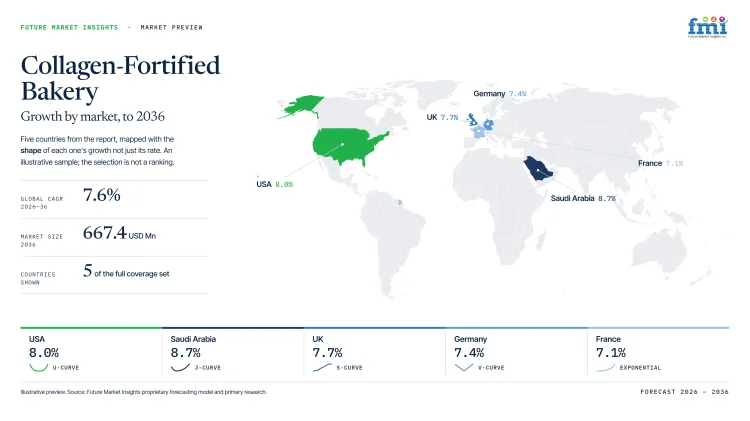
| Country | CAGR |
|---|---|
| UAE | 9.0% |
| Saudi Arabia | 8.7% |
| South Korea | 8.3% |
| USA | 8.0% |
| UK | 7.7% |
| Germany | 7.4% |
| France | 7.1% |
| Japan | 6.8% |
How do country-level CAGRs compare in the Collagen-Fortified Bakery Market?
The forecasts span 2.2 percentage points from UAE at 9.0% CAGR to Japan at 6.8% through 2036. UAE and Saudi Arabia form the faster Gulf pair with South Korea next through premium hospitality and functional-food channels. USA and UK follow above Germany and France before Japan closes the group with a slower forecast rate. The ranking separates hospitality-led trial markets from mature grocery systems where claim discipline and household value determine repeat purchase.
- UAE hospitality and premium grocery channels give functional bakery frequent trial occasions before brands commit national household distribution.
- Saudi Arabia gains more licensed hospitality outlets that create standardized purchasing points for portioned fortified bakery products.
- South Korea brings formal functional-ingredient familiarity that lowers explanation costs while bakery-specific labeling still requires careful qualification.
- USA gains from broad packaged-bakery distribution but household value pressure limits easy premium expansion after initial trial.
- UK protein bakery familiarity reduces explanation needs although current bread pricing keeps value comparisons visible at shelf.
- Germany pairs an aging population with strict nutrition-claim controls that narrow acceptable functional messaging during national launch.
- France offers dense bakery access which makes fresh texture and small-batch formulation more decisive than national shelf breadth.
- Japan provides a formal functional-food route while documented benefits and price remain strong purchase filters for repeat demand.
The wider forecast spread reflects different trial routes and does not make the fastest country the easiest commercial entry. The full report provides country-level CAGR analysis across North America, Latin America, Europe, East Asia, South Asia, Oceania and the Middle East and Africa.
Country-wise Analysis
- UAE hospitality and premium grocery channels create frequent trial occasions for functional bakery products without requiring an immediate national household launch. Collagen-fortified bakery in the UAE is projected to expand at 9.0% CAGR through 2036 because hotels and urban retail broaden premium breakfast placement. The Ministry of Economy and Tourism reported in April 2026 that UAE hotels received 32.34 million guests during 2025. That visitor base gives portioned bakery formats a practical foodservice route before wider retail expansion. Imported products still need stable heat performance and local label compliance before repeat purchasing develops through local hospitality and premium grocery channels.
- Saudi Arabia's expanding hospitality base creates controlled breakfast and snack channels where premium fortified bakery can be tested before broader grocery distribution. The market is anticipated to rise at 8.7% CAGR through 2036 as more licensed hospitality outlets create standardized purchasing points. GASTAT reported in January 2026 that licensed tourism hospitality facilities reached 5,622 during the third quarter of 2025. The licensed facility count was 40.6% higher than one year earlier which broadens the number of standardized commercial trial locations. More licensed outlets increase trial locations while functional premiums still need to fit foodservice margins during repeated menu purchasing cycles.
- South Korea has a formal functional-food system that gives collagen a recognized technical reference outside ordinary bakery positioning. Collagen-fortified bakery in South Korea is projected to grow at 8.3% CAGR through 2036 because regulated collagen supply lowers ingredient explanation costs for new formats. The MFDS import database recorded a low-molecular-weight collagen peptide health functional food permit on March 19 2026. That permit confirms current regulated commercial supply while leaving bakery-specific claims subject to separate formulation and labeling requirements. Brands still need bakery-specific labeling and texture validation before functional positioning converts into repeat grocery orders through mainstream retail channels and established bakery aisles.
- Packaged bakery in the USA reaches consumers through dense grocery distribution and collagen products can also use DTC for narrower launches before wider retail, testing household acceptance before committing national shelf space. The USA collagen-fortified bakery outlook is projected to record 8.0% CAGR during the assessment period because collagen supplements give consumers a clear functional reference, though bakery prices leave limited room for an automatic premium. BLS reported in August 2026 that producer prices for bakery products were 1.6% above July 2025, which means brands need enough margin for collagen without pushing an everyday loaf or cookie beyond routine snack economics.
- Protein-positioned loaves and bagels already occupy mainstream UK grocery shelves, giving collagen bakery a familiar comparison point during the same shopping trip and reducing the need to explain protein fortification from the beginning. ONS data released in August 2026 placed the bread CPI index at 140.8 for July 2026 against a 2015 base of 100, so functional lines face visible value comparisons beside standard bread. Collagen-fortified bakery sales in the UK are forecast to expand at 7.7% CAGR by 2036 owing to familiar protein bakery use, though brands still need ordinary taste and pack economics before a premium becomes a repeat household purchase.
- German functional bakery enters a mature packaged-bread market with strong older-consumer demand and strict European controls on nutrition or health claims, so product teams must settle permitted wording before national retail negotiations begin. Germany is estimated to post 7.4% CAGR over the forecast period given interest in protein-rich everyday foods, although compliant wording narrows how collagen benefits can be presented on pack. In May 2026 Destatis stated that Germany had 19.0 million people aged at least 65 during 2024 or 23% of the population, so commercial entry depends on pairing an age-relevant nutrition proposition with sensory parity instead of broad collagen-specific health promises.
- Fresh bakery has unusual commercial weight in France because neighborhood boulangeries give consumers frequent access to products judged immediately on crust and texture, making small-batch performance as relevant as packaged shelf life for a new fortified recipe. INSEE counted more than 50 thousand boulangerie-pâtisserie locations during 2024 compared with 14,871 large food stores and established how strongly neighborhood bakery shapes local food access. Collagen-fortified bakery demand in France is forecast to rise at 7.1% CAGR over the forecast period tied to established fresh-bakery purchasing and clean-label ingredients, yet brands that cannot support small-batch formulation or protect eating quality risk losing the channel where local bakery credibility is strongest.
- Japan gives function-positioned foods a formal consumer reference but shoppers scrutinize stated benefits and price before a routine purchase develops, which puts more weight on clear evidence and ordinary bakery quality at the first trial. Adoption of collagen-fortified bakery in Japan is estimated to expand at 6.8% CAGR through 2036 attributable to established functional-food familiarity, though the bakery proposition must work without relying on a claim that needs stronger evidence. The Consumer Affairs Agency’s May 2026 survey found that 57.3% of current or prospective functional-food users expected the stated function, so brands face a higher proof threshold if collagen is the main reason for paying more.
Who are the notable companies in the Collagen-Fortified Bakery Market?
Taylor Chip, Prime Bites, ChunkyFit, Munch Better, Flowers Foods, Warburtons, Dr. Schär, and Doughlicious are the notable companies serving this market.
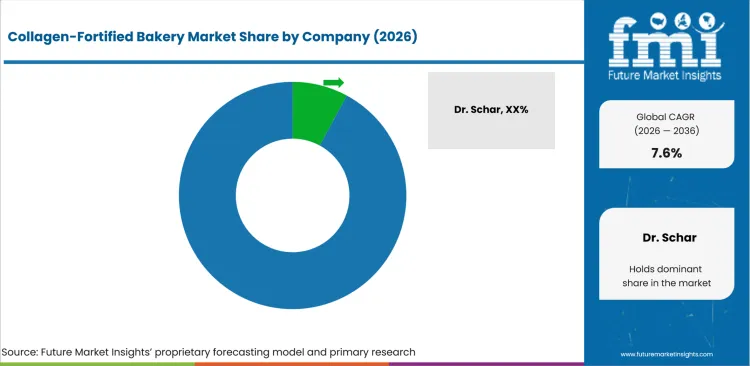
Public evidence shows a fragmented field with no scaled collagen-bakery company proving clear category leadership. Taylor Chip, Prime Bites, ChunkyFit, and Munch Better sell baked protein products with collagen or documented collagen formulations. Flowers Foods and Warburtons supply protein-oriented bakery at much larger retail scale. Dr. Schär contributes special-nutrition formulation depth. Doughlicious is an edge-of-scope comparator because its 2025 skillet used a plant-based blend intended to support natural collagen production instead of added collagen.
- Direct collagen bakery specialists: Taylor Chip, Prime Bites, ChunkyFit, and Munch Better concentrate on cookies or brownies with explicit collagen content.
- Scaled protein bakery platforms: Flowers Foods and Warburtons bring national manufacturing and retail systems that lower distribution risk for functional bakery concepts.
- Special-formulation comparators: Dr. Schär brings dedicated special-nutrition R&D and Doughlicious tests functional cookie formats through premium grocery channels.
Competitive Benchmarking: Collagen-Fortified Bakery Market
| Company | Direct Functional Bakery Readiness | Special-Formulation Depth | Retail Execution | Geographic Reach |
|---|---|---|---|---|
| Taylor Chip | High | Medium | Medium | United States and DTC |
| Prime Bites | High | Medium | High | United States with online and retail channels |
| ChunkyFit | High | Medium | High | United States with nationwide retail and DTC |
| Munch Better | High | High | Medium | United States with regional grocery and DTC |
| Flowers Foods | Medium | High | High | United States |
| Warburtons | Medium | Medium | High | United Kingdom |
| Dr. Schär | Low | High | High | Europe, North America and international markets |
| Doughlicious | Low | High | Medium | United Kingdom and United States |
Scoring basis: High direct functional-bakery readiness requires a documented collagen bakery line or several current protein-bakery formats. Medium reflects current protein bakery without direct collagen proof. Low marks adjacent special bakery with no added-collagen product evidence. High special-formulation depth requires several documented dietary or formulation demands. High retail execution requires national or multi-region availability, Medium reflects regional retail plus DTC, and Low identifies mainly direct online reach.
Key Developments in the Collagen-Fortified Bakery Market
- In July 2026, Dr. Schär inaugurated a €1.2 million high-tech pilot plant at its R&D Centre in Trieste to accelerate formulation development and the transition from research to industrial production across specialised nutrition applications.
- In October 2025, Flowers Foods expanded its Nature’s Own Life portfolio with a Wheat + Protein loaf containing 22 grams of protein per two-slice serving, targeting demand for high-protein bakery products.
- In October 2025, Doughlicious launched baked cookie dough skillets in the UK and United States, including one formula with a plant-based collagen-support blend.
Key Players in the Collagen-Fortified Bakery Market
Direct collagen bakery specialists
- Taylor Chip
- Prime Bites
- ChunkyFit
- Munch Better
Scaled protein bakery platforms
- Flowers Foods
- Warburtons
Special-formulation bakery comparators
- Dr. Schär
- Doughlicious
Collagen-Fortified Bakery Market - Report Scope
| Coverage field | Report scope |
|---|---|
| Market breakdown | By product type, claim - nature, format, packaging format, sales channel and region. |
| Quantitative Units | USD Million. |
| Market Definition | Commercial bakery products formulated with collagen as an added functional ingredient. Revenue excludes standalone collagen ingredients, conventional bakery without collagen, and downstream retail or foodservice markups. |
| Regions Covered | North America, Latin America, Western Europe, Eastern Europe, East Asia, South Asia and Pacific, and Middle East and Africa. |
| Countries Covered | UAE, Saudi Arabia, South Korea, USA, UK, Germany, France, Japan, and 20+ countries included in the full report. |
| Key Companies Profiled | Taylor Chip, Prime Bites, ChunkyFit, Munch Better, Flowers Foods, Warburtons, Dr. Schär, and Doughlicious. |
| Forecast Period | 2026 to 2036. |
| Approach | Primary and secondary research with market triangulation. |
Collagen-Fortified Bakery Market - Research Methodology
| Method | Approach |
|---|---|
| Primary Research | FMI analysts gathered input from manufacturers, service providers, technology developers, distributors, end users, procurement teams, and subject-matter experts. Interviews examined purchasing decisions, product or service evaluation, adoption barriers, approval requirements, pricing considerations, and expectations for technical or commercial support. Respondents were also asked what evidence is required before a trial, pilot, or initial order develops into regular purchasing. |
| Desk Research | Desk research covered government statistics, regulatory publications, trade data, industry associations, technical literature, standards, company filings, product information, and official corporate announcements. Sources were reviewed for relevance, publication date, geographic coverage, and consistency with the defined market scope. Claims relating to performance, applications, approvals, capacity, investment, and commercial activity were retained only when supported by credible public evidence. |
| Market Sizing and Forecasting | The market model combined the baseline value with historical performance, segment structure, pricing and volume indicators, adoption levels, company participation, and country-level demand conditions. Forecast assumptions considered economic activity, investment trends, regulatory developments, technology adoption, purchasing cycles, supply availability, and barriers to wider market use. Segment and regional estimates were reconciled before the final market total was calculated. |
| Data Validation | Estimates were checked against multiple independent indicators, including public data, company activity, trade patterns, industry developments, and findings from primary interviews. Validation also tested whether products, services, applications, and company revenues fell within the defined market boundaries. Adjacent categories, unsupported claims, overlapping revenues, and activities without direct market relevance were excluded to reduce double counting and maintain consistency across segments and countries. |
Collagen-Fortified Bakery Market by Segments
Collagen-Fortified Bakery Market segmented by Product Type:
- Classic - original
- Whole grain & seeded
- Flavored & filled
- Mini & snacking formats
- Premium / artisan
Collagen-Fortified Bakery Market segmented by Claim - nature:
- Conventional
- Clean label
- Organic
- Gluten-free
- High-protein / fortified
Collagen-Fortified Bakery Market segmented by Format:
- Fresh
- Frozen
- Ambient packaged
- Chilled
- Par-baked / thaw-and-serve
Collagen-Fortified Bakery Market segmented by Packaging Format:
- Multipack
- Single-serve
- Family / loaf pack
- Bulk foodservice
Collagen-Fortified Bakery Market segmented by Sales Channel:
- Supermarkets & hypermarkets
- Artisan & specialty bakeries
- Convenience & forecourt
- Online & DTC
- Foodservice distributors
Collagen-Fortified Bakery Market by Region:
- North America
- United States
- Canada
- Latin America
- Brazil
- Mexico
- Chile
- Rest of Latin America
- Western Europe
- Germany
- United Kingdom
- Italy
- Spain
- France
- Nordics
- Benelux
- Rest of Western Europe
- Eastern Europe
- Russia
- Poland
- Hungary
- Balkan and Baltic States
- Rest of Eastern Europe
- East Asia
- China
- Japan
- South Korea
- South Asia and Pacific
- India
- ASEAN
- Australia and New Zealand
- Rest of South Asia and Pacific
- Middle East and Africa
- Kingdom of Saudi Arabia
- Other GCC Countries
- Türkiye
- South Africa
- Other African Union Countries
- Rest of Middle East and Africa
Research Sources and Bibliography
- Flowers Foods. (2025, April 16). Flowers Foods launches new products and line expansions to meet consumer needs.
- USA Bureau of Labor Statistics. (2026, August 12). Consumer Price Index News Release - July 2026.
- Specialty Food Association. (2025, June 23). Taylor Chip launches first of its kind protein cookie.
- USA Food and Drug Administration. (2025, February 24). FDA finalizes updated “healthy” nutrient content claim.
- Flowers Foods. (2026, May 21). Flowers Foods, Inc. reports first quarter 2026 results.
- Warburtons. (2025, January). Get Snack-tive: Warburtons combines fitness and flavour with its debut athleisure range.
- Consumer Affairs Agency of Japan. (2026, May 21). FY2025 survey report on consumer attitudes toward food labeling.
- Munch Better. (2025, April 8). Munch Better brownies now at Milam’s Markets.
- USA Bureau of Labor Statistics. (2026, August 13). Producer Price Index - July 2026.
- Office for National Statistics. (2026, August 19). CPI index 01.1.1.3 bread 2015=100.
- Statistisches Bundesamt. (2026, May 18). Bevölkerung: Ältere Menschen.
- INSEE. (2025, July 10). Équipements et services à la population en 2024 - France.
- Prime Bites. (2026). How Prime Bites started.
- Startup CPG. (2026, February 18). ChunkyFit Protein Cookies launches a reformulated recipe.
- Munch Better. (2025, May 5). What makes collagen a game-changer in snacks?
- Dr. Schär. (2026, July 22). In Trieste, Italy, a new plant to shape the future of nutrition.
- Flowers Foods. (2025, October 27). Flowers Foods taps into higher-protein and sourdough trends with new products.
- Doughlicious. (2025, October 13). Doughlicious redefines cosy with new cookie dough skillets.
- Flowers Foods. (2025, February 21). Flowers Foods, Inc. completes acquisition of Simple Mills.
- Dr. Schär. (2026, February 26). Dr. Schär confirms the strength of its business model.
- Dr. Schär. (2025, May 8). Always tastier, always more balanced.
- Scotland Food & Drink. (2025, September 3). Genius Foods launch Naturally Genius, transforming the standards of gluten free bread, in collaboration with Megan McKenna.
- Siete Foods. (2025, April 2). Introducing our new Maíz corn taco shells.
- Warburtons. (2026, March). New packaging redesign unveiled for our 150th anniversary.
- Doughlicious. (2025, November 3). Doughlicious launches festive countdown calendar - 12 days of frozen joy!
- Department for Environment, Food & Rural Affairs. (2025, June 30). Extended Producer Responsibility for Packaging: 2025 base fees.
- Ministry of Economy and Tourism, United Arab Emirates. (2026, April 13). Emirates Tourism Council discusses new action plans to enhance sector growth and resilience.
- General Authority for Statistics, Saudi Arabia. (2026, January 8). Licensed tourism hospitality facilities reach 5,622 in Q3 2025.
- Ministry of Food and Drug Safety, Republic of Korea. (2026, March 19). Imported food record: Low molecular weight collagen peptide.
This bibliography is provided for reader reference and is not exhaustive. The full report contains the complete reference list and detailed citations
This Report Answers
- What is the collagen-fortified bakery market size in 2026 and what value is forecast for 2036?
- Which bakery and functional-nutrition conditions support demand for collagen-fortified products?
- Why does classic - original hold the leading position within product type?
- Why does conventional account for the largest claim - nature share in 2026?
- How does fresh production affect formulation and shelf-life decisions?
- How do growth rates differ among USA, UK, Germany, France, and Japan?
- Which companies provide direct collagen bakery products and which firms act as adjacent bakery comparators?
- How do formulation cost and functional premiums limit repeat purchase in collagen-fortified bakery?
- Which retail routes are best suited to scaling collagen bakery after product-market fit is proven?
Frequently Asked Questions
How big is the collagen-fortified bakery market in 2026?
The collagen-fortified bakery market is valued at USD 320.8 million in 2026 and is projected to reach USD 667.4 million by 2036. Growth is supported by placing collagen inside familiar bread, cookie, and snack occasions.
What is the CAGR of the collagen-fortified bakery market from 2026 to 2036?
The collagen-fortified bakery market is projected to grow at a CAGR of 7.6% between 2026 and 2036. Expansion depends on acceptable baked texture, credible functional positioning, and retail formats that sustain repeat purchase.
Which product type leads the collagen-fortified bakery market?
The classic - original segment is expected to hold 40.0% of the collagen-fortified bakery market in 2026, driven by familiar flavor and everyday use occasions. Familiar recipes also give formulators a clearer sensory benchmark during collagen inclusion.
Which format holds a major current share in the collagen-fortified bakery market?
The fresh segment is anticipated to hold 34.0% of the collagen-fortified bakery market in 2026, attributable to shorter stability requirements during early formulation. Fresh production gives bakery teams more room to protect crumb and eating quality.
Which companies are active in the collagen-fortified bakery market?
Key companies operating in the market include Taylor Chip, Prime Bites, ChunkyFit, Munch Better, Flowers Foods, Warburtons, Dr. Schär, and Doughlicious. The set spans direct collagen bakery specialists and larger bakery platforms with relevant protein or special-formulation capabilities.
Preview the report firsthand - request a free sample
Get SampleGet the brochure for pricing and purchase details.
Get PDFTable of Content
- Key Takeaways
- Market Size and CAGR
- Top Growth Driver
- Fastest Growing Segment
- Leading Region
- Key Companies
- Emerging Opportunities
- Executive Summary
- Global Market Outlook
- Demand-side Trends
- Supply-side Trends
- Technology Roadmap Analysis
- Analysis and Recommendations
- Analyst Perspective (What is happening? Why now? What should investors know?)
- Key Questions Answered
- How large is the market?
- What is the CAGR?
- What are key trends?
- Which region dominates?
- Who are the leaders?
- Market Overview
- Market Coverage / Taxonomy
- Market Definition / Scope / Limitations
- Research Methodology
- Chapter Orientation
- Analytical Lens and Working Hypotheses
- Market Structure, Signals, and Trend Drivers
- Benchmarking and Cross-market Comparability
- Market Sizing, Forecasting, and Opportunity Mapping
- Research Design and Evidence Framework
- Desk Research Programme (Secondary Evidence)
- Expert Input and Fieldwork (Primary Evidence)
- Tooling, Models, and Reference Databases
- Data Engineering and Model Build
- Quality Assurance and Audit Trail
- Market Background
- Market Dynamics (Drivers, Restraints, Opportunity, Trends)
- Scenario Forecast (Optimistic, Likely, Conservative)
- Impact Analysis
- AI Impact
- Sustainability Impact
- Regulatory Impact
- Technology Impact
- Consumer / Buyer Analysis
- Purchase Drivers
- Adoption Barriers
- Buyer Journey
- Opportunity Map Analysis
- Product Life Cycle Analysis
- Supply Chain Analysis
- Investment Feasibility Matrix
- Value Chain Analysis
- PESTLE and Porter's Analysis
- Regulatory Landscape
- Regional Parent Market Outlook
- Production and Consumption Statistics
- Import and Export Statistics
- Global Market Analysis and Forecast, 2021 to 2036
- Historical Market Size Value (USD Million) Analysis, 2021 to 2025
- Current and Future Market Size Value (USD Million) Projections, 2026 to 2036
- Y-o-Y Growth Trend Analysis
- Absolute $ Opportunity Analysis
- Global Market Pricing Analysis, 2021 to 2036
- Global Market Analysis and Forecast, By Product Type, 2021 to 2036
- Introduction / Key Findings
- Historical Market Size Value (USD Million) Analysis By Product Type, 2021 to 2025
- Current and Future Market Size Value (USD Million) Analysis and Forecast By Product Type, 2026 to 2036
- Classic / original
- Whole grain & seeded
- Flavored & filled
- Mini & snacking formats
- Premium / artisan
- Classic / original
- Y-o-Y Growth Trend Analysis By Product Type, 2021 to 2025
- Absolute $ Opportunity Analysis By Product Type, 2026 to 2036
- Global Market Analysis and Forecast, By Claim / Nature, 2021 to 2036
- Introduction / Key Findings
- Historical Market Size Value (USD Million) Analysis By Claim / Nature, 2021 to 2025
- Current and Future Market Size Value (USD Million) Analysis and Forecast By Claim / Nature, 2026 to 2036
- Conventional
- Clean label
- Organic
- Gluten-free
- High-protein / fortified
- Conventional
- Y-o-Y Growth Trend Analysis By Claim / Nature, 2021 to 2025
- Absolute $ Opportunity Analysis By Claim / Nature, 2026 to 2036
- Global Market Analysis and Forecast, By Format, 2021 to 2036
- Introduction / Key Findings
- Historical Market Size Value (USD Million) Analysis By Format, 2021 to 2025
- Current and Future Market Size Value (USD Million) Analysis and Forecast By Format, 2026 to 2036
- Fresh
- Frozen
- Ambient packaged
- Chilled
- Par-baked / thaw-and-serve
- Fresh
- Y-o-Y Growth Trend Analysis By Format, 2021 to 2025
- Absolute $ Opportunity Analysis By Format, 2026 to 2036
- Global Market Analysis and Forecast, By Packaging Format, 2021 to 2036
- Introduction / Key Findings
- Historical Market Size Value (USD Million) Analysis By Packaging Format, 2021 to 2025
- Current and Future Market Size Value (USD Million) Analysis and Forecast By Packaging Format, 2026 to 2036
- Multipack
- Single-serve
- Family / loaf pack
- Bulk foodservice
- Multipack
- Y-o-Y Growth Trend Analysis By Packaging Format, 2021 to 2025
- Absolute $ Opportunity Analysis By Packaging Format, 2026 to 2036
- Global Market Analysis and Forecast, By Sales Channel, 2021 to 2036
- Introduction / Key Findings
- Historical Market Size Value (USD Million) Analysis By Sales Channel, 2021 to 2025
- Current and Future Market Size Value (USD Million) Analysis and Forecast By Sales Channel, 2026 to 2036
- Supermarkets & hypermarkets
- Artisan & specialty bakeries
- Convenience & forecourt
- Online & DTC
- Foodservice distributors
- Supermarkets & hypermarkets
- Y-o-Y Growth Trend Analysis By Sales Channel, 2021 to 2025
- Absolute $ Opportunity Analysis By Sales Channel, 2026 to 2036
- Global Market Analysis and Forecast, By Region, 2021 to 2036
- Introduction
- Historical Market Size Value (USD Million) Analysis By Region, 2021 to 2025
- Current Market Size Value (USD Million) Analysis and Forecast By Region, 2026 to 2036
- North America
- Latin America
- Western Europe
- Eastern Europe
- East Asia
- South Asia and Pacific
- Middle East & Africa
- Market Attractiveness Analysis By Region
- North America Market Analysis and Forecast, By Country, 2021 to 2036
- Historical Market Size Value (USD Million) Trend Analysis By Market Taxonomy, 2021 to 2025
- Market Size Value (USD Million) Forecast By Market Taxonomy, 2026 to 2036
- By Country
- USA
- Canada
- By Product Type
- By Claim / Nature
- By Format
- By Packaging Format
- By Sales Channel
- By Country
- Market Attractiveness Analysis
- By Country
- By Product Type
- By Claim / Nature
- By Format
- By Packaging Format
- By Sales Channel
- Key Takeaways
- Latin America Market Analysis and Forecast, By Country
- Historical Market Size Value (USD Million) Trend Analysis By Market Taxonomy, 2021 to 2025
- Market Size Value (USD Million) Forecast By Market Taxonomy, 2026 to 2036
- By Country
- Brazil
- Mexico
- Chile
- Rest of Latin America
- By Product Type
- By Claim / Nature
- By Format
- By Packaging Format
- By Sales Channel
- By Country
- Market Attractiveness Analysis
- By Country
- By Product Type
- By Claim / Nature
- By Format
- By Packaging Format
- By Sales Channel
- Key Takeaways
- Western Europe Market Analysis and Forecast, By Country
- Historical Market Size Value (USD Million) Trend Analysis By Market Taxonomy, 2021 to 2025
- Market Size Value (USD Million) Forecast By Market Taxonomy, 2026 to 2036
- By Country
- Germany
- UK
- Italy
- Spain
- France
- Nordic
- BENELUX
- Rest of Western Europe
- By Product Type
- By Claim / Nature
- By Format
- By Packaging Format
- By Sales Channel
- By Country
- Market Attractiveness Analysis
- By Country
- By Product Type
- By Claim / Nature
- By Format
- By Packaging Format
- By Sales Channel
- Key Takeaways
- Eastern Europe Market Analysis and Forecast, By Country
- Historical Market Size Value (USD Million) Trend Analysis By Market Taxonomy, 2021 to 2025
- Market Size Value (USD Million) Forecast By Market Taxonomy, 2026 to 2036
- By Country
- Russia
- Poland
- Hungary
- Balkan & Baltic
- Rest of Eastern Europe
- By Product Type
- By Claim / Nature
- By Format
- By Packaging Format
- By Sales Channel
- By Country
- Market Attractiveness Analysis
- By Country
- By Product Type
- By Claim / Nature
- By Format
- By Packaging Format
- By Sales Channel
- Key Takeaways
- East Asia Market Analysis and Forecast, By Country
- Historical Market Size Value (USD Million) Trend Analysis By Market Taxonomy, 2021 to 2025
- Market Size Value (USD Million) Forecast By Market Taxonomy, 2026 to 2036
- By Country
- China
- Japan
- South Korea
- By Product Type
- By Claim / Nature
- By Format
- By Packaging Format
- By Sales Channel
- By Country
- Market Attractiveness Analysis
- By Country
- By Product Type
- By Claim / Nature
- By Format
- By Packaging Format
- By Sales Channel
- Key Takeaways
- South Asia and Pacific Market Analysis and Forecast, By Country
- Historical Market Size Value (USD Million) Trend Analysis By Market Taxonomy, 2021 to 2025
- Market Size Value (USD Million) Forecast By Market Taxonomy, 2026 to 2036
- By Country
- India
- ASEAN
- Australia & New Zealand
- Rest of South Asia and Pacific
- By Product Type
- By Claim / Nature
- By Format
- By Packaging Format
- By Sales Channel
- By Country
- Market Attractiveness Analysis
- By Country
- By Product Type
- By Claim / Nature
- By Format
- By Packaging Format
- By Sales Channel
- Key Takeaways
- Middle East & Africa Market Analysis and Forecast, By Country
- Historical Market Size Value (USD Million) Trend Analysis By Market Taxonomy, 2021 to 2025
- Market Size Value (USD Million) Forecast By Market Taxonomy, 2026 to 2036
- By Country
- Kingdom of Saudi Arabia
- Other GCC Countries
- Türkiye
- South Africa
- Other African Union
- Rest of Middle East & Africa
- By Product Type
- By Claim / Nature
- By Format
- By Packaging Format
- By Sales Channel
- By Country
- Market Attractiveness Analysis
- By Country
- By Product Type
- By Claim / Nature
- By Format
- By Packaging Format
- By Sales Channel
- Key Takeaways
- Key Countries Market Analysis
- USA
- Pricing Analysis
- Market Share Analysis, 2025
- By Product Type
- By Claim / Nature
- By Format
- By Packaging Format
- By Sales Channel
- Canada
- Pricing Analysis
- Market Share Analysis, 2025
- By Product Type
- By Claim / Nature
- By Format
- By Packaging Format
- By Sales Channel
- Mexico
- Pricing Analysis
- Market Share Analysis, 2025
- By Product Type
- By Claim / Nature
- By Format
- By Packaging Format
- By Sales Channel
- Brazil
- Pricing Analysis
- Market Share Analysis, 2025
- By Product Type
- By Claim / Nature
- By Format
- By Packaging Format
- By Sales Channel
- Chile
- Pricing Analysis
- Market Share Analysis, 2025
- By Product Type
- By Claim / Nature
- By Format
- By Packaging Format
- By Sales Channel
- Germany
- Pricing Analysis
- Market Share Analysis, 2025
- By Product Type
- By Claim / Nature
- By Format
- By Packaging Format
- By Sales Channel
- UK
- Pricing Analysis
- Market Share Analysis, 2025
- By Product Type
- By Claim / Nature
- By Format
- By Packaging Format
- By Sales Channel
- Italy
- Pricing Analysis
- Market Share Analysis, 2025
- By Product Type
- By Claim / Nature
- By Format
- By Packaging Format
- By Sales Channel
- Spain
- Pricing Analysis
- Market Share Analysis, 2025
- By Product Type
- By Claim / Nature
- By Format
- By Packaging Format
- By Sales Channel
- France
- Pricing Analysis
- Market Share Analysis, 2025
- By Product Type
- By Claim / Nature
- By Format
- By Packaging Format
- By Sales Channel
- India
- Pricing Analysis
- Market Share Analysis, 2025
- By Product Type
- By Claim / Nature
- By Format
- By Packaging Format
- By Sales Channel
- ASEAN
- Pricing Analysis
- Market Share Analysis, 2025
- By Product Type
- By Claim / Nature
- By Format
- By Packaging Format
- By Sales Channel
- Australia & New Zealand
- Pricing Analysis
- Market Share Analysis, 2025
- By Product Type
- By Claim / Nature
- By Format
- By Packaging Format
- By Sales Channel
- China
- Pricing Analysis
- Market Share Analysis, 2025
- By Product Type
- By Claim / Nature
- By Format
- By Packaging Format
- By Sales Channel
- Japan
- Pricing Analysis
- Market Share Analysis, 2025
- By Product Type
- By Claim / Nature
- By Format
- By Packaging Format
- By Sales Channel
- South Korea
- Pricing Analysis
- Market Share Analysis, 2025
- By Product Type
- By Claim / Nature
- By Format
- By Packaging Format
- By Sales Channel
- Russia
- Pricing Analysis
- Market Share Analysis, 2025
- By Product Type
- By Claim / Nature
- By Format
- By Packaging Format
- By Sales Channel
- Poland
- Pricing Analysis
- Market Share Analysis, 2025
- By Product Type
- By Claim / Nature
- By Format
- By Packaging Format
- By Sales Channel
- Hungary
- Pricing Analysis
- Market Share Analysis, 2025
- By Product Type
- By Claim / Nature
- By Format
- By Packaging Format
- By Sales Channel
- Kingdom of Saudi Arabia
- Pricing Analysis
- Market Share Analysis, 2025
- By Product Type
- By Claim / Nature
- By Format
- By Packaging Format
- By Sales Channel
- Türkiye
- Pricing Analysis
- Market Share Analysis, 2025
- By Product Type
- By Claim / Nature
- By Format
- By Packaging Format
- By Sales Channel
- South Africa
- Pricing Analysis
- Market Share Analysis, 2025
- By Product Type
- By Claim / Nature
- By Format
- By Packaging Format
- By Sales Channel
- USA
- Market Structure Analysis
- Competition Dashboard
- Competition Benchmarking
- Market Share Analysis of Top Players
- By Regional
- By Product Type
- By Claim / Nature
- By Format
- By Packaging Format
- By Sales Channel
- Emerging Startups
- Innovation Benchmarking
- Competition Analysis
- Competition Deep Dive
- Dr. Schar
- Overview
- Product Portfolio
- Profitability by Market Segments
- Sales Footprint
- Strategy Overview
- Marketing Strategy
- Product Strategy
- Channel Strategy
- Flowers Foods
- BFree Foods
- Katz Gluten Free
- Base Culture
- Hero Group
- Genius Foods
- Warburtons
- Simple Mills
- Siete Foods
- Dr. Schar
- Case Studies
- Success Stories
- Recent Developments
- Competition Deep Dive
- Assumptions & Acronyms Used


