

- Market Size (2026)
- USD 193.5 Mn
- Forecast (2036)
- USD 520.5 Mn
- CAGR (2026 to 2036)
- 10.4%
How big is Crop Residue Digesters Market in 2026?
Demand for crop residue digesters is projected to expand at 10.4% CAGR between 2026 and 2036. Industry value grows from USD 175.3 million in 2025 to USD 193.5 million in 2026 and is projected to reach USD 520.5 million by 2036.
Crop residue is increasingly retained because straw and stalks contain nutrients, although it must break down before the following crop. Digesters are applied on retained residue to soften cellulose and support nutrient cycling, working alongside soil rejuvenation enzymes. A 2025 dataset covering 158 crops and 210 countries showed that residue removal changes nitrogen, phosphorus and potassium balance.[1] FMI estimates that market value will rise from USD 175.3 million in 2025 to USD 193.5 million in 2026 and reach USD 520.5 million by 2036, registering 10.4% CAGR during 2026 to 2036. Shorter harvest-to-planting periods are therefore expected to upkeep demand for formulations which support timely decomposition.
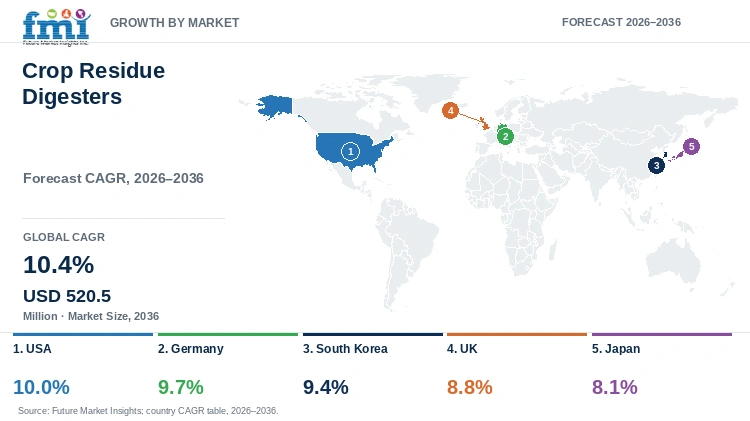
Growth prospects differ between the USA and Germany owing to separate residue and agronomy practices. The USA is projected to expand at 10.0% CAGR during 2026 to 2036, while Germany is anticipated to advance at 9.7%. Broad cereal acreage in the USA creates regular residue volumes and allows dealer-supported field trials. Germany connects retained straw with humus management and nutrient planning. Federal guidance updated in 2025 states that straw can provide 50% to 90% of humus-increasing components in annual arable humus balance.[12] FMI expects residue-specific instructions and local agronomy support to improve repeat purchasing, whereas unclear moisture needs or decomposition periods can hamper wider adoption.
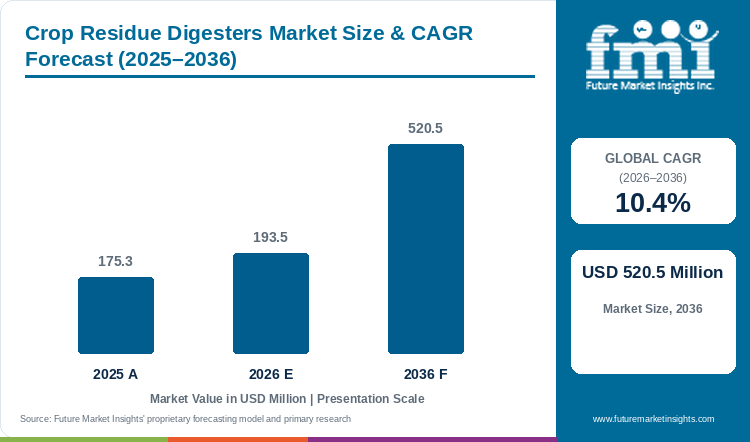
Crop Residue Digesters Market Size & CAGR Forecast (2025-2036)
| Year | Basis | Market value (USD million) |
|---|---|---|
| 2025 | Actual | 175.3 |
| 2026 | Estimate | 193.5 |
| 2036 | Forecast | 520.5 |
| CAGR, 2026 to 2036 | 10.4% | |
Source: Future Market Insights proprietary forecasting model and primary research.
Key Takeaways
- Residue retention supports demand when decomposition fits the next field operation and preserves nutrient value.
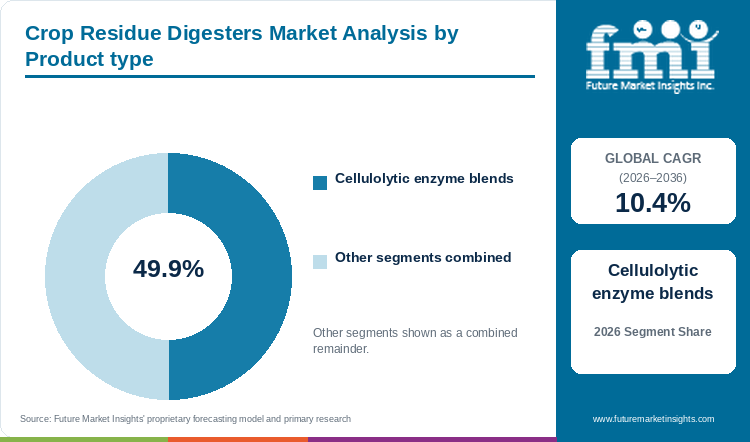
- Based on product type, cellulolytic enzyme blends are projected to account for 49.9% in 2026, owing to broad cellulose content in crop residues.
- By crop type, cereals and grains are estimated to hold 43.2% in 2026, supported by recurring straw volumes after harvest.
- In 2026, soil application is expected to lead application method with 44.9% share because treatments contact retained biomass directly.
- USA is projected at 10.0% CAGR through 2036, while Germany is forecast at 9.7% under different residue-management systems.
- Notable companies in the crop residue digesters market include Novonesis, BASF, Syngenta, Andermatt Group, Locus Agricultural Solutions, and Loam Bio.
Analyst Perspective
“I see stronger demand where crop residue digesters can complete breakdown within the available post-harvest period. Growers will prefer crop-specific formulations which remain active under the moisture and temperature available on their farms.”
- Nikhil Kaitwade, Principal Consultant, Future Market Insights.
How is the crop residue digesters market segmented?
Crop residue digesters market is segmented by five primary commercial axes and region: product type, crop type, application method, farm type, sales channel, and region. In 2026, cellulolytic enzyme blends are projected at 49.9%, cereals and grains at 43.2%, soil application at 44.9%, large commercial farms at 38.3%, and agri-input distributors at 40.1%.
Crop residue digesters market is segmented by product type, crop type, application method, farm type, sales channel, and region.
By product type: cellulolytic enzyme blends, ligninolytic blends, enzyme + microbe combos, and others.
By crop type: cereals and grains, fruits and vegetables, oilseeds and pulses, turf and ornamentals, and others.
By application method: soil application, foliar application, fertigation or drip, seed application, and others.
By farm type: large commercial farms, mid-size farms, smallholders, greenhouses and nurseries, and others.
By sales channel: agri-input distributors, cooperatives, agri-retail chains, online or direct-to-farm, and others.
By region: North America, Latin America, Western Europe, Eastern Europe, East Asia, South Asia and Pacific, and Middle East and Africa.
Why do cellulolytic enzyme blends remain relevant by product type?
Cellulolytic enzyme blends are projected to capture 49.9% of product type demand in 2026, driven by high cellulose levels in field straw.
| Product type | Share (2026) |
|---|---|
| Cellulolytic enzyme blends | 49.9% |
| Other segments combined | 50.1%* |
| Total | 100.0% |
| Metric | Value |
|---|---|
| Global CAGR (2026-2036) | 10.4% |
| Leading segment | Cellulolytic enzyme blends |
Straw, stalks and other crop residue contain a high proportion of cellulose, due to which cellulolytic enzyme blends are used across different crop fields. A 2025 organic matter database consolidated residue quantities and nutrient concentrations from agricultural and related industries [3]. This difference in residue quantity and composition is also creating need for crop-specific enzyme combinations. FMI research indicates that cellulolytic blends, often enriched with targeted bacillus metabolites, are expected to gain preference where growers require faster softening and breakdown of cereal straw before sowing the following crop.
- Cellulolytic enzyme blends are projected to hold 49.9% of product type demand in 2026 because cellulose is a common structural fraction.
- Formulation stability and moisture availability determine how quickly enzyme blends soften tough cereal straw.
What supports cereals and grains as the preferred crop category?
Cereals and grains are estimated to represent 43.2% of crop type demand in 2026, reflecting recurring straw volumes after each harvest.
Cereal and grain harvesting leaves large quantity of straw within a short period after harvest, which makes residue handling difficult before the next crop. The FAO 2025 Statistical Yearbook provides production details for major crops and agricultural inputs [4]. Wheat, rice and corn also return residue every season and allow the same spray or incorporation equipment used for advanced seed treatment materials to cover wide acreage. Owing to this recurring volume, cereals and grains are expected to remain a major crop category for digester suppliers during the forecast period.
- Cereals and grains are estimated to hold 43.2% of crop type demand in 2026 as straw returns after each harvest.
- Short post-harvest windows and high straw volume require rapid breakdown before the next crop is established.
How does soil application meet residue decomposition needs?
Soil application is expected to command 44.9% of application method revenue in 2026, supported by direct contact with incorporated crop residue.
Soil application brings enzymes and microbes closer to retained or incorporated residue and provides better contact with the material requiring breakdown. In May 2026, BASF commissioned a fermentation plant and started commercial production of key biological active ingredients [5]. Wider production of biological inputs is expected to improve product availability across agricultural channels, delivering benefits comparable to commercial biofertilizers in soil conditioning. Also, soil placement is gaining preference where residue is incorporated and sufficient moisture is available for biological activity after harvesting.
- Soil application is expected to represent 44.9% of application demand in 2026 because active biology reaches the residue directly.
- Treatment efficacy relies on adequate soil moisture and thorough contact between biological agents and incorporated residue.
Why do large commercial farms hold notable farm-type demand?
Large commercial farms are projected to capture 38.3% of farm type demand in 2026, enabled by standardized equipment and strip trials.
Large commercial farms can test crop residue digesters on treated and untreated strips before using the product across complete acreage. In February 2026, USDA recorded 1.865 million farms operating across 873.95 million acres, while farms with USD 1 million or more sales were the only class which increased [6]. Larger fields make it easier to compare dose, equipment compatibility, decomposition period and per-acre treatment cost. These conditions are supporting adoption among commercial farms where one successful protocol can be paired with microbial carbon inputs across wider acreage.
- Large commercial farms are projected to hold 38.3% of farm-type demand in 2026 because trials can be extended across larger acreage.
- Standardized spraying protocols and replicated strip trials allow commercial growers to verify per-acre treatment returns.
Which conditions keep agri-input distributors relevant in sales channels?
Agri-input distributors are anticipated to contribute 40.1% of sales channel revenue in 2026, underpinned by local agronomic advice and regional inventory.
Crop residue digesters require guidance for residue type, mixing, moisture, dose and treatment timing, which is keeping agri-input distributors important in this market. In February 2025, Syngenta expanded its natural-product and genetic-strain assets and opened a biologicals production facility in South Carolina [7]. Distributors can connect the product with local crop conditions, recommend compatible agricultural surfactants, and also support growers during first application. Easy availability, smaller order quantities and field guidance are expected to increase purchasing through this channel.
- Agri-input distributors are estimated to hold 40.1% of sales in 2026 because local advice supports correct placement and timing.
- Distributor value grows when field staff provide practical advice on residue mixing, moisture thresholds, and application timing.
What are the drivers, restraints, and opportunities in the crop residue digesters market?
In the crop residue digesters market, the key driver is residue retention, the key restraint is field variability, and the key opportunity is combined formulations.
- Driver: Farms need residue breakdown that fits narrower harvest-to-planting windows and reduces reliance on burning.
- Restraint: Moisture, temperature, residue chemistry, and contact can change decomposition performance between fields.
- Opportunity: Enzyme + microbe combinations can address different residue fractions when field evidence supports the formulation.
Residue Retention Expands Managed Treatment
Crop residue contains nutrients which can be returned to soil, but slow breakdown can interfere with seedbed preparation and the next planting operation. A 2025 agricultural soil study documented that managed microbial decomposition of cereal straw releases approximately 25% of residual nitrogen and phosphorus and 75% of potassium for subsequent crop uptake [8]. This nutrient value is shifting attention from residue removal towards managed decomposition inside the field, often combined with microbial seed primers during early crop establishment. As a result, products which fit the existing post-harvest pass and reduce handling requirement are expected to witness higher demand.
Field Conditions Limit Repeat Performance
Moisture, temperature, lignin content and contact with residue can change the performance of enzymes and microbes from one field to another. India’s 2025 crop-residue guidelines estimate that burning one tonne of paddy straw releases 1,460 kg carbon dioxide and destroys valuable plant nutrients [9]. This is increasing requirement for non-burning solutions, including microbial disease suppressors and bio-digesters, especially across paddy-growing areas. However, adoption can remain limited where the supplier does not provide crop-specific dose, moisture range and realistic decomposition period.
Combined Formulations Broaden Activity
Enzymes and microbes are being combined to work on cellulose, lignin and later stages of residue decomposition through one formulation. In June 2026, Novonesis partnered with Rovensa Next to expand distribution of agricultural biosolutions and enzyme technologies across North America [10]. Such commercial distribution and strain-development activities are creating more scope for combined agricultural biologicals, expanding beyond standalone agricultural biostimulants into complete residue-digestion programs. Enzyme and microbe combinations are expected to gain higher interest where field trials show better breakdown on the named crop residue than a single-mode treatment.
Which country CAGRs are profiled in the crop residue digesters market?
| Country | CAGR |
|---|---|
| USA | 10.0% |
| Germany | 9.7% |
| South Korea | 9.4% |
| UK | 8.8% |
| Japan | 8.1% |
How do country-level CAGRs compare in the crop residue digesters market?
As noted by FMI, country growth rates differ through 2036 because crop acreage, residue handling, water management, and burning controls vary across key farming markets. The USA and Germany lead projected growth above 9.6 per cent, while Japan and South Korea follow distinct paddy and methane-management structures.
- USA demand is linked to broad cereal acreage, conservation practice, and dealer-led field programs.
- Germany connects residue retention with humus management and crop-specific agronomy.
- South Korea weighs residue treatment against methane control in rice systems.
- The UK favors workable non-burning routes under cool and wet post-harvest conditions.
- Japan requires paddy timing that complements water and methane management.
Full report country CAGRs cover: North America; Latin America; Western Europe; Eastern Europe; East Asia; South Asia and Pacific; Middle East and Africa.
Country-wise Analysis
- By 2036, the USA is projected to grow at 10.0% CAGR, supported by broad cereal acreage and established crop-input channels. In March 2026, USDA projected 95.3 million acres under corn, down 3% from the previous year [11]. Large corn acreage generates substantial stalk and stover volume after harvesting, which is increasing residue-management requirements. Growers are comparing digesters with tillage, baling, grazing and natural decomposition according to field conditions. Products which can be applied through existing sprayers alongside nutrient release modifiers or incorporation equipment are expected to witness higher adoption. Moreover, dealer-led field trials are helping growers compare decomposition before the next planting window.
- Germany's crop residue digesters outlook is anticipated to advance at 9.7% CAGR, driven by humus management across arable farms. Federal guidance updated in 2025 states that straw can provide 50% to 90% of humus-increasing components in annual arable humus balance [12]. Retained straw holds agronomic value, due to which growers require decomposition without removing the material from fields. Compatibility with nutrient plans, tillage practices and seasonal moisture is also influencing product selection. Distributors are likely to support adoption by linking residue type with application rate and timing. Digesters which reduce interference with the following crop are expected to gain higher preference.
- Adoption of crop residue digesters in South Korea is estimated to expand at 9.4% CAGR through 2036, influenced by methane management in rice farming. In November 2025, Statistics Korea reported that domestic rice cultivation covered 678,000 hectares, generating extensive post-harvest straw across paddy regions [15]. This has increased attention towards the condition in which rice straw is returned to soil. Product application needs to match drainage, incorporation and water-management stages to avoid uncontrolled anaerobic decomposition. Paddy-specific trials are therefore expected to support adoption of digesters which can reduce handling requirement without affecting methane-management practices.
- The UK crop residue digesters market is anticipated to grow at 8.8% CAGR from 2026 to 2036, owing to cereal residue management and restricted burning. The 2026 farming evidence pack recorded 6.1 million hectares of croppable area, while cereal farms used 33% of England’s farmed area [13]. This creates repeated straw-management requirements after wheat and other cereal harvesting. Cool and wet autumn conditions may slow biological activity and reduce the available decomposition period. Products supported by low-temperature performance and clear moisture guidance are expected to witness higher preference. Agronomist-led sales will remain important as rotation and local weather decide the suitable application window.
- In Japan, crop residue digester demand is predicted to advance at 8.1% CAGR through 2036, owing to paddy residue and methane-management requirements. Japan’s agriculture ministry expanded agricultural J-Credit methods during 2025, including rice-farming practices which support verified emission reduction [14]. FMI data suggests that water management is important because residue decomposition under flooded conditions can increase methane generation. Crop residue digesters therefore need to be applied according to drainage and incorporation timing. Products supported by paddy-specific protocols are likely to gain adoption where residue condition, water stage and crop establishment are covered together.
Who are the notable companies in the crop residue digesters market?
Novonesis, BASF, Syngenta, Andermatt Group, Locus Agricultural Solutions, and Loam Bio are notable companies profiled in this market.
Competition in crop residue digesters market includes enzyme companies, microbial developers, crop-input suppliers and biological distribution specialists. In the FMI report, supplier positioning is linked to residue breakdown speed and ease of incorporating formulations into existing spraying or tillage passes. BASF and Syngenta are expanding fermentation and strain-development capacity, while Novonesis is active across enzyme and microbial solutions. Andermatt Group and Locus Agricultural Solutions are supporting farm-level biological distribution and application. Loam Bio is also working across soil-microbial and carbon programs. Buyers are selecting suppliers according to residue-specific performance, storage stability, product availability, application timing and local technical support.
- Fermentation and biological scale: BASF, Syngenta, and Novonesis bring industrial biological development and manufacturing capability.
- Farm biology and distribution: Andermatt Group and Locus Agricultural Solutions connect specialist products with grower channels.
- Soil carbon adjacency: Loam Bio brings microbial soil and carbon programs that influence buyer expectations for field evidence.
Competitive Benchmarking: Crop Residue Digesters Market
| Company | Biological platform | Residue application fit | Current activity | Reach |
|---|---|---|---|---|
| Novonesis | High | High | High | High |
| BASF | High | Medium | High | High |
| Syngenta | High | Medium | High | High |
| Andermatt Group | Medium | Medium | High | High |
| Locus Agricultural Solutions | Medium | High | Medium | Medium |
| Loam Bio | Medium | Medium | Medium | Medium |
High represents broad public evidence across the stated capability, Medium represents narrower evidence, and Low represents limited documented breadth. These ratings describe public company capability and do not indicate product quality, revenue share or company ranking.
Key Developments in the Crop Residue Digesters Market
- In June 2026, Novonesis partnered with Rovensa Next to distribute agricultural biosolutions and enzyme technologies across North America.
- In May 2026, BASF commissioned its BioHub fermentation plant in Ludwigshafen and began commercial production of key biological active ingredients.
- In February 2025, Syngenta expanded its natural-products and genetic-strains assets and opened a biologicals production facility in South Carolina.
- In September 2025, South Korea reported lower methane from fermented rice-straw compost than from raw straw treatment.
Key Players in the Crop Residue Digesters Market
Industrial biological platforms
- Novonesis
- BASF
- Syngenta
Farm biology and distribution platforms
- Andermatt Group
- Locus Agricultural Solutions
Soil carbon platform
- Loam Bio
Crop Residue Digesters Market - Report Scope
| Coverage field | Report scope |
|---|---|
| Market breakdown | Product type, crop type, application method, farm type, sales channel, and region. |
| Quantitative units | USD million. |
| Market definition | Supplier revenue from enzyme, microbial, and enzyme + microbe formulations sold to accelerate in-field decomposition of post-harvest crop residues. |
| Regions covered | North America; Latin America; Western Europe; Eastern Europe; East Asia; South Asia and Pacific; Middle East and Africa. |
| Countries covered | USA, Germany, South Korea, UK, Japan, and additional countries in the full report. |
| Key companies profiled | Novonesis, BASF, Syngenta, Andermatt Group, Locus Agricultural Solutions, Loam Bio. |
| Forecast period | 2026 to 2036. |
| Approach | The report covers segment structure, supplier activity, application routes, and country adoption within the defined boundary. |
Crop Residue Digesters Market - Research Methodology
| Method | Approach |
|---|---|
| Primary Research | Analysts gathered input from manufacturers, service providers, technology developers, distributors, end users, procurement teams, and subject-matter experts. Interviews examined purchasing decisions, product or service evaluation, adoption barriers, approval requirements, pricing considerations, and expectations for technical or commercial support. Respondents were also asked what evidence is required before a trial, pilot, or initial order develops into regular purchasing. |
| Desk Research | Desk research covered government statistics, regulatory publications, trade data, industry associations, technical literature, standards, company filings, product information, and official corporate announcements. Sources were reviewed for relevance, publication date, geographic coverage, and consistency with the defined market scope. Claims relating to performance, applications, approvals, capacity, investment, and commercial activity were retained only when supported by credible public evidence. |
| Market Sizing and Forecasting | The market model combined the baseline value with historical performance, segment structure, pricing and volume indicators, adoption levels, company participation, and country-level demand conditions. Forecast assumptions considered economic activity, investment trends, regulatory developments, technology adoption, purchasing cycles, supply availability, and barriers to wider market use. Segment and regional estimates were reconciled before the final market total was calculated. |
| Data Validation | Estimates were checked against multiple independent indicators, including public data, company activity, trade patterns, industry developments, and findings from primary interviews. Validation also tested whether products, services, applications, and company revenues fell within the defined market boundaries. Adjacent categories, unsupported claims, overlapping revenues, and activities without direct market relevance were excluded to reduce double counting and maintain consistency across segments and countries. |
Crop Residue Digesters Market by Segments
Crop Residue Digesters Market segmented by Product type:
- Cellulolytic enzyme blends
- Ligninolytic blends
- Enzyme + microbe combos
- Others
Crop Residue Digesters Market segmented by Crop type:
- Cereals and grains
- Fruits and vegetables
- Oilseeds and pulses
- Turf and ornamentals
- Others
Crop Residue Digesters Market segmented by Application method:
- Soil application
- Foliar application
- Fertigation or drip
- Seed application
- Others
Crop Residue Digesters Market segmented by Farm type:
- Large commercial farms
- Mid-size farms
- Smallholders
- Greenhouses and nurseries
- Others
Crop Residue Digesters Market segmented by Sales channel:
- Agri-input distributors
- Cooperatives
- Agri-retail chains
- Online or direct-to-farm
- Others
Crop Residue Digesters Market by Region
- North America
- United States
- Canada
- Latin America
- Brazil
- Mexico
- Argentina
- Chile
- Western Europe
- Germany
- France
- United Kingdom
- Italy
- Spain
- Benelux
- Nordics
- Eastern Europe
- Poland
- Czech Republic
- Romania
- Hungary
- East Asia
- China
- Japan
- South Korea
- South Asia and Pacific
- India
- ASEAN
- Australia and New Zealand
- Middle East and Africa
- GCC Countries
- South Africa
- Türkiye
- Israel
Research Sources and Bibliography
- [1] Aramburu-Merlos, F., et al. (2025, December 16). Global dataset on nutrient removal with crop residues. Dryad.
- [2] Rural Development Administration, Republic of Korea. (2025, September 16). Using rice-straw compost reduces methane emissions compared with raw rice straw.
- [3] Sileshi, G. W., et al. (2025, February 3). An organic matter database: Consolidating global residue data. Earth System Science Data, 17, 369-391.
- [4] Food and Agriculture Organization. (2025). World Food and Agriculture: Statistical Yearbook 2025. Rome: FAO.
- [5] BASF. (2026, May 11). BASF Agricultural Solutions commissions new fermentation plant in Ludwigshafen.
- [6] U.S. Department of Agriculture, National Agricultural Statistics Service. (2026, February 13). Farms and Land in Farms 2025 Summary.
- [7] Syngenta. (2025, February 26). Syngenta strengthens global leadership in agricultural biologicals.
- [8] Kumar, R., et al. (2025). Rice crop residue as fertiliser substitute for enhancing yield and soil sustainability. Frontiers in Soil Science, 5, 1649105.
- [9] Government of India, Ministry of Agriculture and Farmers Welfare. (2025). Revised Crop Residue Management Operational Guidelines 2025.
- [10] Novonesis. (2026, June 11). Rovensa Next to distribute Novonesis' biosolutions for plant health in the United States.
- [11] U.S. Department of Agriculture, National Agricultural Statistics Service. (2026, March). Prospective Plantings: Corn acreage.
- [12] German Federal Ministry of Food and Agriculture. (2025, January 30). Humus: Grundlage der Bodenfruchtbarkeit.
- [13] Department for Environment, Food and Rural Affairs. (2026, September). Farming evidence pack: A high-level overview of the UK agricultural industry.
- [14] Ministry of Agriculture, Forestry and Fisheries of Japan. (2025). Agricultural J-Credit methods and rice-farming emissions reduction.
- [15] Statistics Korea. (2025, November 13). Final results of the cultivated area and production of rice in 2025.
This bibliography is provided for reader reference. The full report contains the complete reference list and detailed citations.
This Report Answers
- What is Crop Residue Digesters Market worth during 2026?
- What value is Crop Residue Digesters Market projected by 2036?
- Which product type holds notable crop residue digesters share?
- Which crop type holds notable crop residue digesters demand share?
- Which countries have notable crop residue digesters expansion outlooks?
- Which companies are notable in Crop Residue Digesters Market today?
Frequently Asked Questions
How large is the Crop Residue Digesters Market expected to be in 2026?
Future Market Insights estimates that the crop residue digesters market will reach USD 193.5 million in 2026. The market is projected to expand further and reach USD 520.5 million by 2036.
What CAGR is forecast for the Crop Residue Digesters Market through 2036?
As per FMI, the crop residue digesters market is projected to grow at a 10.4% CAGR from 2026 to 2036. Growth is supported by increasing need for residue breakdown and alternatives to open-field burning.
Which product type holds a notable crop residue digesters demand share in 2026?
Future Market Insights projects cellulolytic enzyme blends to hold 49.9% of product type demand in 2026. Wide presence of cellulose in straw and stalks is supporting adoption of these blends.
Which crop type holds a notable crop residue digesters share in 2026?
FMI finds that cereals and grains will hold 43.2% of crop type demand in 2026. Repeated generation of wheat, rice and corn residue is supporting treatment demand across large acreage.
Which country has a notable crop residue digesters expansion outlook during the forecast period?
Future Market Insights predicts the USA to expand at a 10.0% CAGR during the 2026 to 2036 assessment period. Large cereal acreage and dealer-supported field trials are increasing adoption across commercial farms.
Which companies are active in the Crop Residue Digesters Market during 2026?
As per FMI analysis, notable companies include Novonesis, BASF, Syngenta, Andermatt Group, Locus Agricultural Solutions, and Loam Bio. These companies are focusing on biological production, formulation development, farm channels and application support.
Preview the report firsthand - request a free sample
Get SampleGet the brochure for pricing and purchase details.
Get PDFTable of Content
- Key Takeaways
- Market Size and CAGR
- Top Growth Driver
- Fastest Growing Segment
- Leading Region
- Key Companies
- Emerging Opportunities
- Executive Summary
- Global Market Outlook
- Demand-side Trends
- Supply-side Trends
- Technology Roadmap Analysis
- Analysis and Recommendations
- Analyst Perspective (What is happening? Why now? What should investors know?)
- Key Questions Answered
- How large is the market?
- What is the CAGR?
- What are key trends?
- Which region dominates?
- Who are the leaders?
- Market Overview
- Market Coverage / Taxonomy
- Market Definition / Scope / Limitations
- Research Methodology
- Chapter Orientation
- Analytical Lens and Working Hypotheses
- Market Structure, Signals, and Trend Drivers
- Benchmarking and Cross-market Comparability
- Market Sizing, Forecasting, and Opportunity Mapping
- Research Design and Evidence Framework
- Desk Research Programme (Secondary Evidence)
- Expert Input and Fieldwork (Primary Evidence)
- Tooling, Models, and Reference Databases
- Data Engineering and Model Build
- Quality Assurance and Audit Trail
- Market Background
- Market Dynamics (Drivers, Restraints, Opportunity, Trends)
- Scenario Forecast (Optimistic, Likely, Conservative)
- Impact Analysis
- AI Impact
- Sustainability Impact
- Regulatory Impact
- Technology Impact
- Consumer / Buyer Analysis
- Purchase Drivers
- Adoption Barriers
- Buyer Journey
- Opportunity Map Analysis
- Product Life Cycle Analysis
- Supply Chain Analysis
- Investment Feasibility Matrix
- Value Chain Analysis
- PESTLE and Porter's Analysis
- Regulatory Landscape
- Regional Parent Market Outlook
- Production and Consumption Statistics
- Import and Export Statistics
- Global Market Analysis and Forecast, 2021 to 2036
- Historical Market Size Value (USD Million) Analysis, 2021 to 2025
- Current and Future Market Size Value (USD Million) Projections, 2026 to 2036
- Y-o-Y Growth Trend Analysis
- Absolute $ Opportunity Analysis
- Global Market Pricing Analysis, 2021 to 2036
- Global Market Analysis and Forecast, By Product type, 2021 to 2036
- Introduction / Key Findings
- Historical Market Size Value (USD Million) Analysis By Product type, 2021 to 2025
- Current and Future Market Size Value (USD Million) Analysis and Forecast By Product type, 2026 to 2036
- Cellulolytic enzyme blends
- Ligninolytic blends
- Enzyme + microbe combos
- Others
- Y-o-Y Growth Trend Analysis By Product type, 2021 to 2025
- Absolute $ Opportunity Analysis By Product type, 2026 to 2036
- Global Market Analysis and Forecast, By Crop type, 2021 to 2036
- Introduction / Key Findings
- Historical Market Size Value (USD Million) Analysis By Crop type, 2021 to 2025
- Current and Future Market Size Value (USD Million) Analysis and Forecast By Crop type, 2026 to 2036
- Cereals and grains
- Fruits and vegetables
- Oilseeds and pulses
- Turf and ornamentals
- Others
- Y-o-Y Growth Trend Analysis By Crop type, 2021 to 2025
- Absolute $ Opportunity Analysis By Crop type, 2026 to 2036
- Global Market Analysis and Forecast, By Application method, 2021 to 2036
- Introduction / Key Findings
- Historical Market Size Value (USD Million) Analysis By Application method, 2021 to 2025
- Current and Future Market Size Value (USD Million) Analysis and Forecast By Application method, 2026 to 2036
- Soil application
- Foliar application
- Fertigation or drip
- Seed application
- Others
- Y-o-Y Growth Trend Analysis By Application method, 2021 to 2025
- Absolute $ Opportunity Analysis By Application method, 2026 to 2036
- Global Market Analysis and Forecast, By Farm type, 2021 to 2036
- Introduction / Key Findings
- Historical Market Size Value (USD Million) Analysis By Farm type, 2021 to 2025
- Current and Future Market Size Value (USD Million) Analysis and Forecast By Farm type, 2026 to 2036
- Large commercial farms
- Mid-size farms
- Smallholders
- Greenhouses and nurseries
- Others
- Y-o-Y Growth Trend Analysis By Farm type, 2021 to 2025
- Absolute $ Opportunity Analysis By Farm type, 2026 to 2036
- Global Market Analysis and Forecast, By Sales channel, 2021 to 2036
- Introduction / Key Findings
- Historical Market Size Value (USD Million) Analysis By Sales channel, 2021 to 2025
- Current and Future Market Size Value (USD Million) Analysis and Forecast By Sales channel, 2026 to 2036
- Agri-input distributors
- Cooperatives
- Agri-retail chains
- Online or direct-to-farm
- Others
- Y-o-Y Growth Trend Analysis By Sales channel, 2021 to 2025
- Absolute $ Opportunity Analysis By Sales channel, 2026 to 2036
- Global Market Analysis and Forecast, By Region, 2021 to 2036
- Introduction
- Historical Market Size Value (USD Million) Analysis By Region, 2021 to 2025
- Current Market Size Value (USD Million) Analysis and Forecast By Region, 2026 to 2036
- North America
- Latin America
- Western Europe
- Eastern Europe
- East Asia
- South Asia and Pacific
- Middle East and Africa
- Market Attractiveness Analysis By Region
- North America Market Analysis and Forecast, By Country, 2021 to 2036
- Historical Market Size Value (USD Million) Trend Analysis By Market Taxonomy, 2021 to 2025
- Market Size Value (USD Million) Forecast By Market Taxonomy, 2026 to 2036
- By Country
- United States
- Canada
- By Product type
- By Crop type
- By Application method
- By Farm type
- By Sales channel
- By Country
- Market Attractiveness Analysis
- By Country
- By Product type
- By Crop type
- By Application method
- By Farm type
- By Sales channel
- Key Takeaways
- Latin America Market Analysis and Forecast, By Country
- Historical Market Size Value (USD Million) Trend Analysis By Market Taxonomy, 2021 to 2025
- Market Size Value (USD Million) Forecast By Market Taxonomy, 2026 to 2036
- By Country
- Brazil
- Mexico
- Argentina
- Chile
- By Product type
- By Crop type
- By Application method
- By Farm type
- By Sales channel
- By Country
- Market Attractiveness Analysis
- By Country
- By Product type
- By Crop type
- By Application method
- By Farm type
- By Sales channel
- Key Takeaways
- Western Europe Market Analysis and Forecast, By Country
- Historical Market Size Value (USD Million) Trend Analysis By Market Taxonomy, 2021 to 2025
- Market Size Value (USD Million) Forecast By Market Taxonomy, 2026 to 2036
- By Country
- Germany
- France
- United Kingdom
- Italy
- Spain
- Benelux
- Nordics
- By Product type
- By Crop type
- By Application method
- By Farm type
- By Sales channel
- By Country
- Market Attractiveness Analysis
- By Country
- By Product type
- By Crop type
- By Application method
- By Farm type
- By Sales channel
- Key Takeaways
- Eastern Europe Market Analysis and Forecast, By Country
- Historical Market Size Value (USD Million) Trend Analysis By Market Taxonomy, 2021 to 2025
- Market Size Value (USD Million) Forecast By Market Taxonomy, 2026 to 2036
- By Country
- Poland
- Czech Republic
- Romania
- Hungary
- By Product type
- By Crop type
- By Application method
- By Farm type
- By Sales channel
- By Country
- Market Attractiveness Analysis
- By Country
- By Product type
- By Crop type
- By Application method
- By Farm type
- By Sales channel
- Key Takeaways
- East Asia Market Analysis and Forecast, By Country
- Historical Market Size Value (USD Million) Trend Analysis By Market Taxonomy, 2021 to 2025
- Market Size Value (USD Million) Forecast By Market Taxonomy, 2026 to 2036
- By Country
- China
- Japan
- South Korea
- By Product type
- By Crop type
- By Application method
- By Farm type
- By Sales channel
- By Country
- Market Attractiveness Analysis
- By Country
- By Product type
- By Crop type
- By Application method
- By Farm type
- By Sales channel
- Key Takeaways
- South Asia and Pacific Market Analysis and Forecast, By Country
- Historical Market Size Value (USD Million) Trend Analysis By Market Taxonomy, 2021 to 2025
- Market Size Value (USD Million) Forecast By Market Taxonomy, 2026 to 2036
- By Country
- India
- ASEAN
- Australia and New Zealand
- By Product type
- By Crop type
- By Application method
- By Farm type
- By Sales channel
- By Country
- Market Attractiveness Analysis
- By Country
- By Product type
- By Crop type
- By Application method
- By Farm type
- By Sales channel
- Key Takeaways
- Middle East and Africa Market Analysis and Forecast, By Country
- Historical Market Size Value (USD Million) Trend Analysis By Market Taxonomy, 2021 to 2025
- Market Size Value (USD Million) Forecast By Market Taxonomy, 2026 to 2036
- By Country
- GCC Countries
- South Africa
- Türkiye
- Israel
- By Product type
- By Crop type
- By Application method
- By Farm type
- By Sales channel
- By Country
- Market Attractiveness Analysis
- By Country
- By Product type
- By Crop type
- By Application method
- By Farm type
- By Sales channel
- Key Takeaways
- Key Countries Market Analysis
- United States
- Pricing Analysis
- Market Share Analysis, 2025
- By Product type
- By Crop type
- By Application method
- By Farm type
- By Sales channel
- Canada
- Pricing Analysis
- Market Share Analysis, 2025
- By Product type
- By Crop type
- By Application method
- By Farm type
- By Sales channel
- Mexico
- Pricing Analysis
- Market Share Analysis, 2025
- By Product type
- By Crop type
- By Application method
- By Farm type
- By Sales channel
- Brazil
- Pricing Analysis
- Market Share Analysis, 2025
- By Product type
- By Crop type
- By Application method
- By Farm type
- By Sales channel
- Chile
- Pricing Analysis
- Market Share Analysis, 2025
- By Product type
- By Crop type
- By Application method
- By Farm type
- By Sales channel
- Germany
- Pricing Analysis
- Market Share Analysis, 2025
- By Product type
- By Crop type
- By Application method
- By Farm type
- By Sales channel
- United Kingdom
- Pricing Analysis
- Market Share Analysis, 2025
- By Product type
- By Crop type
- By Application method
- By Farm type
- By Sales channel
- Italy
- Pricing Analysis
- Market Share Analysis, 2025
- By Product type
- By Crop type
- By Application method
- By Farm type
- By Sales channel
- Spain
- Pricing Analysis
- Market Share Analysis, 2025
- By Product type
- By Crop type
- By Application method
- By Farm type
- By Sales channel
- France
- Pricing Analysis
- Market Share Analysis, 2025
- By Product type
- By Crop type
- By Application method
- By Farm type
- By Sales channel
- India
- Pricing Analysis
- Market Share Analysis, 2025
- By Product type
- By Crop type
- By Application method
- By Farm type
- By Sales channel
- ASEAN
- Pricing Analysis
- Market Share Analysis, 2025
- By Product type
- By Crop type
- By Application method
- By Farm type
- By Sales channel
- Australia and New Zealand
- Pricing Analysis
- Market Share Analysis, 2025
- By Product type
- By Crop type
- By Application method
- By Farm type
- By Sales channel
- China
- Pricing Analysis
- Market Share Analysis, 2025
- By Product type
- By Crop type
- By Application method
- By Farm type
- By Sales channel
- Japan
- Pricing Analysis
- Market Share Analysis, 2025
- By Product type
- By Crop type
- By Application method
- By Farm type
- By Sales channel
- South Korea
- Pricing Analysis
- Market Share Analysis, 2025
- By Product type
- By Crop type
- By Application method
- By Farm type
- By Sales channel
- Poland
- Pricing Analysis
- Market Share Analysis, 2025
- By Product type
- By Crop type
- By Application method
- By Farm type
- By Sales channel
- Hungary
- Pricing Analysis
- Market Share Analysis, 2025
- By Product type
- By Crop type
- By Application method
- By Farm type
- By Sales channel
- Türkiye
- Pricing Analysis
- Market Share Analysis, 2025
- By Product type
- By Crop type
- By Application method
- By Farm type
- By Sales channel
- South Africa
- Pricing Analysis
- Market Share Analysis, 2025
- By Product type
- By Crop type
- By Application method
- By Farm type
- By Sales channel
- United States
- Market Structure Analysis
- Competition Dashboard
- Competition Benchmarking
- Market Share Analysis of Top Players
- By Regional
- By Product type
- By Crop type
- By Application method
- By Farm type
- By Sales channel
- Emerging Startups
- Innovation Benchmarking
- Competition Analysis
- Competition Deep Dive
- Novonesis
- Overview
- Product Portfolio
- Profitability by Market Segments
- Sales Footprint
- Strategy Overview
- Marketing Strategy
- Product Strategy
- Channel Strategy
- BASF
- Syngenta
- Andermatt Group
- Locus Agricultural Solutions
- Loam Bio
- Novonesis
- Case Studies
- Success Stories
- Recent Developments
- Competition Deep Dive
- Assumptions & Acronyms Used


