

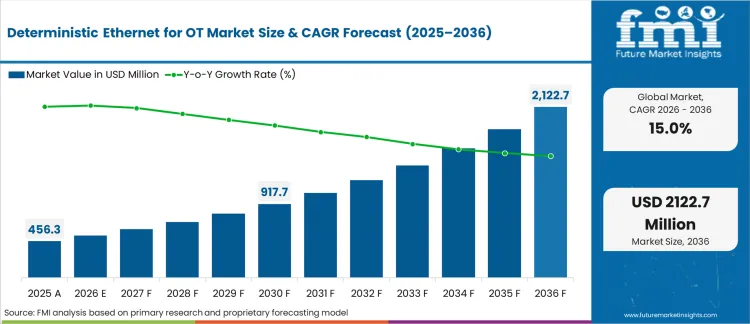
- Industry Size (2026)
- USD 524.7 Mn
- Forecast (2036)
- USD 2122.7 Mn
- CAGR (2026 to 2036)
- 15.0%
Deterministic Ethernet for OT Market Size, Market Forecast and Outlook By FMI
In 2025, the deterministic ethernet for OT market surpassed a value of USD 456.3 million, is projected at USD 524.7 million in 2026 and USD 2,122.7 million by 2036. Demand outlook is implying a 15.0% CAGR, with converging IT and OT network requirements forcing industrial operators to abandon legacy proprietary protocols.
Network convergence projects mandate standardized hardware capable of prioritizing mission-critical control traffic alongside high-bandwidth video and sensor data. Microchip introduced the LAN9645xF/LAN9645xS GbE switches in September 2025, embedding Time-Sensitive Networking and redundancy protocols directly into the silicon layer [6]. Component manufacturers interpret silicon-level integration as proof that software-based scheduling cannot meet the microsecond latency thresholds modern robotics require. As per FMI's projection, buyers who deploy hardware lacking native TSN capabilities risk stranding capital as production facilities transition to unified architectures. Facility managers must procure IEC/IEEE certified industrial ethernet infrastructure before the 2027 automation scale-up cycle begins.
Summary of Deterministic Ethernet for OT Market
- Deterministic Ethernet for OT Market Definition:
- Deterministic Ethernet networks utilize synchronized timing and traffic shaping protocols to guarantee microsecond-level packet delivery across converged industrial control environments.
- Demand Drivers in the Market:
- Legacy protocol phase-outs force plant operators to replace aging fieldbus architectures with unified Ethernet backbones.
- Rapid factory automation expansions mandate ultra-low latency connections to coordinate multi-axis robotic movements safely.
- Strict regulatory cybersecurity frameworks compel facilities to implement certified network segmentation down to the machine level.
- Key Segments Analyzed in the FMI Report:
- TSN switches & endpoints: 46.0% volume share as operators require hardened hardware to execute complex traffic scheduling algorithms.
- Factory automation: 42.0% volume share due to the severe precision requirements of synchronized assembly and handling tasks.
- Asia Pacific: High-growth trajectory shaped by massive government-subsidized smart manufacturing initiatives and greenfield facility construction.
- Analyst Opinion at FMI:
- Nikhil Kaitwade, Principal Consultant for Process Automation at Future Market Insights, opines, “Legacy fieldbus replacement timelines are accelerating as high-fidelity sensor integration overwhelms existing bandwidth capacity. Plant operators refusing to implement time-slotted traffic routing face severe jitter issues, rendering advanced motion control investments ineffective during peak production cycles.”
- Strategic Implications / Executive Takeaways:
- Mandate IEEE 802.1AS compliance across all new hardware procurement to prevent future vendor lock-in scenarios.
- Deploy isolated management networks immediately to secure telemetry data extraction without exposing active control loops.
- Qualify silicon providers integrating hardware-based TSN functions to reduce bill-of-material costs on edge devices.
- Methodology:
- Primary Research: Direct interviews with automation architects, network component product managers, and industrial cybersecurity officers.
- Desk Research: Custom procurement datasets, official network standards organization filings, and certified product registry logs.
- Market-Sizing and Forecasting: Bottom-up capacity modeling starting from regional factory automation build-out rates.
- Data Validation and Update Cycle: Findings underwent cross-verification against certified automation component shipments before final integration.
As industrial networks evolve toward fully deterministic, safety‑certified architectures, technology leaders are deepening strategic collaborations to handle rising system complexity across automotive, Industrial IoT, and autonomous operations. Reflecting this shift, TTTech’s leadership emphasizes how strengthening its engineering base enables more sophisticated project execution, with Stefan Poledna noting that “This step will open great new opportunities to accelerate the transition to software-defined vehicles in the automotive industry and we are now taking a decisive step that will further strengthen our technology leadership and engineering resources in Europe. This strategic move allows us to strengthen our great existing commercial partnerships with TTTech in multiple industries and to jointly focus even more on our strategy to be the leader in intelligent edge systems in automotive and Industrial IoT. [31]” This momentum aligns directly with the industry’s broader transition toward software‑defined systems, where semiconductor and deterministic‑networking ecosystems must integrate far more tightly than before.
China commands an 18.0% CAGR through 2036 as massive state-backed industrial modernization programs compel manufacturers to replace fragmented serial networks and incorporate global industrial wireless broken signal solutions to maintain continuous operations. India follows at a 17.0% CAGR, driven by rapid greenfield facility construction demanding future-proof, high-bandwidth backbones requiring advanced microservices orchestration to manage distributed control logic. USA investments yield a 13.0% CAGR as aging manufacturing bases execute mandatory cybersecurity upgrades by integrating security orchestration automation and response soar platforms natively.
Germany posts a 12.0% CAGR while specialized automotive OEMs integrate converged networking by deploying policy ochestration software to govern complex data flows. South Korea expands at an 11.0% CAGR as semiconductor foundries tighten latency requirements for precision material handling. Japan progresses at a 10.0% CAGR, focusing heavily on legacy robotic fleet modernization strategies. UK facilities generate a 9.0% CAGR as operators prioritize secure-by-design retrofits while managing virtual power plant vpp and v2g orchestration deployments across utility grids.
Deterministic Ethernet for OT Market Definition
Deterministic Ethernet networks utilize specific IEEE 802.1 protocols, including precise time synchronization and traffic shaping, to guarantee packet delivery within strict microsecond deadlines. Industrial operators deploy these networks to transform isolated data lakes into a unified data fabric. Control loops rely on this hardware-enforced determinism to orchestrate synchronized physical actions across multi-axis robotic cells safely.
Deterministic Ethernet for OT Market Inclusions
Market coverage includes managed TSN switches, ruggedized endpoints, silicon MAC components, and network interface cards designed specifically for harsh industrial conditions. Software stacks implementing core TSN profile algorithms alongside service orchestration software are fully captured. Hardware providing frame replication and elimination for reliability features forms a critical inclusion segment.
Deterministic Ethernet for OT Market Exclusions
Consumer-grade networking equipment lacking certified deterministic features falls entirely outside the analytical scope. Standard IT data center routing hardware and standalone data centre security firewalls without embedded OT capabilities are excluded. General-purpose cloud orchestration software lacking sub-millisecond physical execution interfaces is explicitly omitted.
Deterministic Ethernet for OT Market Research Methodology
- Primary Research: Analysts conducted direct interviews with factory network architects, component engineering directors, and institutional standard body representatives across top automation hubs.
- Desk Research: Data compilation relied strictly on official standards organization membership logs, verified cybersecurity agency incident reports, and validated corporate hardware release documentation.
- Market-Sizing and Forecasting: Analysts constructed a bottom-up adoption model anchoring on regional industrial robotics installation volumes to calculate corresponding deterministic port demand.
- Data Validation and Update Cycle: Initial port-count projections underwent rigorous cross-verification against certified automation component registry databases before final baseline integration.
Deterministic Ethernet for OT Market Key Takeaways
| Metric | Details |
|---|---|
| Industry Size (2026) | USD 524.7 million |
| Industry Value (2036) | USD 2,122.7 million |
| CAGR (2026-2036) | 15.0% |
Segmental Analysis
Deterministic Ethernet for OT Market Analysis by Component
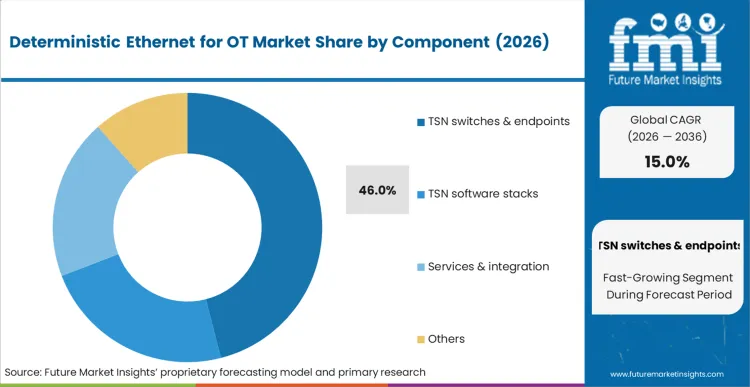
Hardware commoditization forces networking vendors to differentiate through embedded security features rather than raw throughput. TSN switches & endpoints command 46.0% of volumes in 2026 as factory integrators prioritize drop-in replacements for aging fieldbus nodes. Rockwell Automation introduced the Stratix 2100 unmanaged industrial Ethernet switch in October 2025 [5]. FMI analysts opine that unmanaged devices now serve as the primary entry point for facilities beginning their digital integration journeys. Engineers deploying tsn ethernet chips require ruggedized switching equipment to guarantee data delivery in high-interference environments. Operators lacking basic switching infrastructure cannot proceed with planned predictive maintenance initiatives.
- Protocol standardization: Interoperability mandates force component buyers to specify hardware supporting open, unified TSN profiles. Moxa posted TSN series resources including a FOSS Statement with release date Feb 18, 2025 [28], signaling that open-source documentation is becoming a prerequisite for vendor shortlisting.
- Bandwidth capacity: High-resolution optical inspection tools saturate legacy 100Mbps links. Facilities must deploy Gigabit-capable endpoints to prevent traffic bottlenecks during active production runs.
- Form factor density: Control cabinet space constraints dictate compact switch designs. Engineers reject bulky networking gear regardless of performance specifications.
Deterministic Ethernet for OT Market Analysis by Application
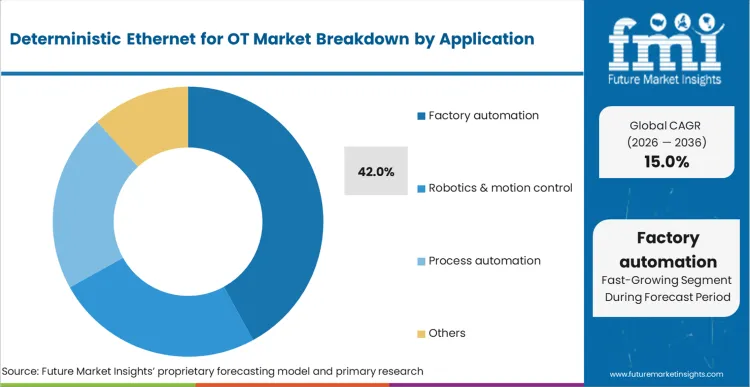
Precision manufacturing lines require deterministic data delivery to synchronize complex multi-axis movements perfectly. Factory automation represents 42.0% of segment share as operators integrate autonomous guided vehicles alongside stationary robotic arms. International Federation of Robotics data indicates 542,000 industrial robots were installed globally in 2024 [2]. Volume surges prove that continuous high-speed automation dictates factory floor designs. Incorporating time sensitive networking tsn capabilities ensures zero packet loss for safety-critical interlocks. Plant managers must overhaul network topologies before deploying next-generation collaborative robots.
- Motion synchronization: High-speed assembly operations demand secure, sub-millisecond communication cycles seamlessly. Siemens listed SINEC Secure Connect as a one-stop OT connection security platform in October 2025 [27], confirming that motion synchronization now requires integrated security validation at the routing layer.
- Topology flexibility: Expanding production lines requires adaptable network configurations. Planners must select architectures supporting ring and star topologies natively.
- Traffic isolation: Mixing safety signals with diagnostic data creates severe reliability risks. Systems must provide hard partitions to ensure critical commands preempt background transfers.
Deterministic Ethernet for OT Market Analysis by End Use
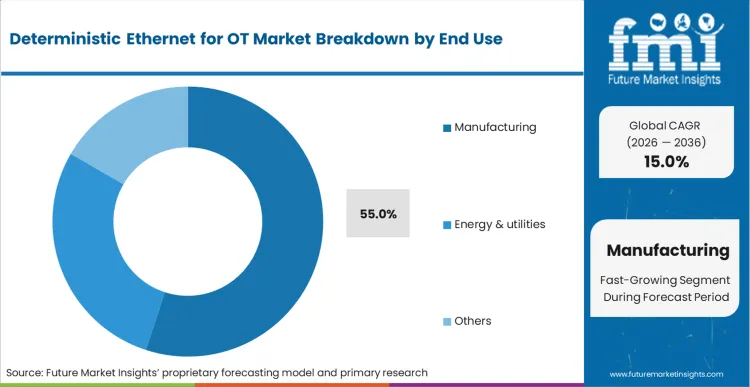
Heavy industrial operators face escalating pressure to maximize yield while minimizing unplanned downtime events. Manufacturing accounts for 55.0% of segment volume as production directors mandate real-time visibility into machine health metrics. United States Bureau of Labor Statistics data confirms manufacturing labor productivity increased 3.7% in Q3 2025 [3]. Output gains rely directly on continuous data extraction from floor-level assets. According to FMI's estimates, integrating specialized industrial control network modules into legacy machine centers remains the primary bottleneck for data-driven optimization strategies. Facility directors must secure reliable networking hardware before initiating advanced analytics programs.
- Downtime prevention: Unscheduled equipment failures and cyber-physical disruptions destroy quarterly margin targets directly. Australia’s ACSC reported responding to over 1,200 cyber security incidents in FY2024-25 [21], compelling maintenance teams to secure uninterrupted sensor telemetry across isolated management networks to execute predictive repair models securely.
- Harsh environment resilience: Steel mills and chemical plants subject electronics to extreme temperatures and vibration. Procurement officers mandate industrial-grade certifications for all network appliances.
- Asset visibility: Blind spots across sprawling factory floors hide efficiency losses. Operations managers deploy managed switches to map network traffic flows comprehensively.
Deterministic Ethernet for OT Market Analysis by TSN Function
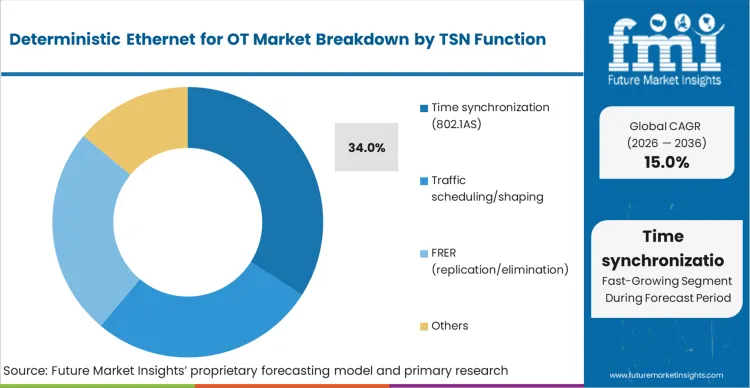
Distributed control systems require perfectly aligned internal clocks to sequence concurrent physical actions accurately. Time synchronization (802.1AS) captures 34.0% share in 2026 as engineers enforce strict timing boundaries across heterogeneous equipment clusters. Belden announced BOBCAT switches certified to IEC 62443-4-2 SL2 in August 2025 [18]. Certification milestones signal that precise timing mechanisms now require embedded cryptographic security to prevent malicious manipulation. Securing industrial communication links protects timing protocols from targeted disruption campaigns. Automation architects must integrate secure synchronization standards into foundational network designs immediately.
- Jitter elimination: Microsecond variations in signal delivery disrupt precise machining operations. Quality control managers reject network designs lacking hardware-based timestamping capabilities.
- Standardized timing: Proprietary synchronization methods trap facilities in single-vendor ecosystems. Moxa updated EDS-205 resources showing a datasheet release date of Dec 31, 2025 [29], proving that hardware manufacturers are rapidly updating documentation to assure compatibility as system architects demand standardized compliance to enable competitive bidding.
- Security integration: Timing manipulation attacks cause catastrophic physical damage. Security officers force network engineers to implement cryptographically signed synchronization messages.
Deterministic Ethernet for OT Market Drivers, Restraints, and Opportunities
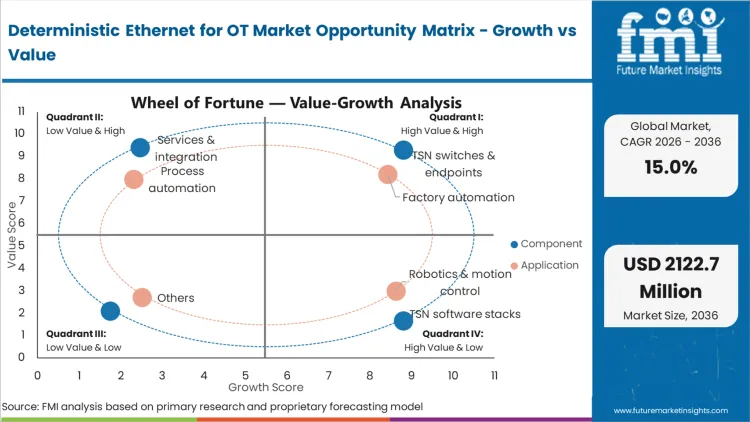
Proprietary fieldbus phase-outs compel facility operators to adopt unified Ethernet backbones rapidly. OPC Foundation documents forecast membership reached 1,019 companies on December 3, 2025 [19]. Expanded institutional backing proves manufacturers are actively aligning around standardized, vendor-neutral communication protocols. Integrating comprehensive industrial media converter arrays allows legacy equipment to participate in converged network architectures. Plant managers who delay protocol standardization face isolated data silos that prevent facility-wide automation. Engineers must implement OPC UA over TSN frameworks before the current hardware lifecycle ends.
Ransomware threats targeting industrial control systems severely complicate network convergence initiatives. Cyber Security Agency of Singapore officials stated reported ransomware cases increased by 21% in 2024 [10]. Escalating attack frequencies force operations technology teams to implement costly micro-segmentation strategies that disrupt planned network upgrades. Utilizing advanced routing hardware isolates vulnerable legacy nodes from direct internet exposure. Chief Information Security Officers must mandate secure-by-design network architectures to prevent lateral threat movement across production environments.
- Private 5G Integration: Wireless hybrid networks enable flexible automated guided vehicle deployment across massive facility footprints. Siemens scaled private 5G infrastructure and introduced a compact 5G router for cabinet use in January 2025 [8].
- Automotive Ethernet Testing: Next-generation vehicle platforms require rigorous validation of high-speed deterministic networking components. Keysight introduced the AE6980T nGBASE-AU optical automotive Ethernet transmitter test solution in October 2025 [13].
- Embedded Protocol Support: Silicon vendors are incorporating industrial protocols natively to simplify edge computing architectures. Texas Instruments updated the AM2434 product page to list TSN among supported industrial protocol features [14].
Regional Analysis
Based on the regional analysis, the Deterministic Ethernet for OT market is segmented into North America, Latin America, Europe, East Asia, South Asia, Oceania and Middle East & Africa across 40+ countries. The full report also offers market attractiveness analysis based on regional trends.
.webp "Top Country Growth Comparison Deterministic Ethernet For Ot Market Cagr (2026 2036)")
| Country | CAGR (2026 to 2036) |
|---|---|
| China | 18.0% |
| India | 17.0% |
| USA | 13.0% |
| Germany | 12.0% |
| South Korea | 11.0% |
| Japan | 10.0% |
| UK | 9.0% |
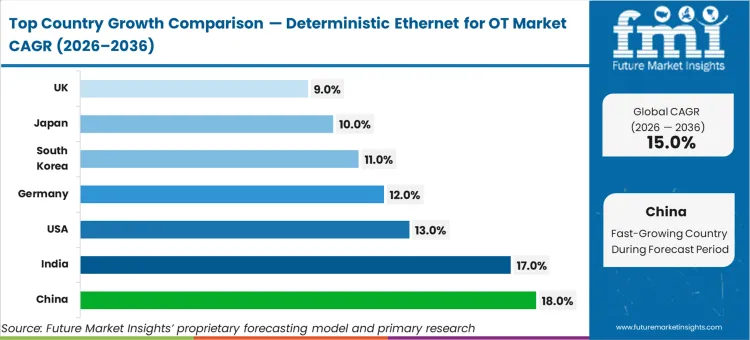
Source: Future Market Insights (FMI) analysis, based on proprietary forecasting model and primary research
Asia Pacific Deterministic Ethernet for OT Market Analysis
Asia Pacific accelerates modernization programs as regional governments combat escalating cyber-physical threats across smart manufacturing transitions. Singapore Police reported scams and cybercrime fell by 24.8% in 2025 and funds lost to scams decreased to USD 913.1M [24], demonstrating that aggressive regional cybersecurity enforcement is driving critical infrastructure upgrades. Deploying reliable fiber network latency sync test equipment guarantees network performance while securing automated production lines against localized extortion attempts. Regional operations directors must establish definitive latency and security budgets to prevent disruption events across high-speed robotic assets.
- China: State-driven industrial upgrading initiatives force local manufacturers to abandon isolated control systems in favor of fully integrated data networks. Manufacturers across China push demand toward an 18.0% CAGR through 2036 as they deploy high-density automation clusters. CC-Link Partner Association reported it had over 4,429 corporate members worldwide by March 2025 [1]. Mass adoption of standardized industrial ethernet protocols eliminates interoperability barriers that previously stalled large-scale factory deployments. Procurement directors operating within these industrial zones must secure long-term hardware supply contracts to avoid impending TSN switch shortages.
- India: Greenfield manufacturing investments require scalable communication backbones capable of supporting massive sensor arrays natively. ABB India launched the machinery drive ACS380-E featuring dual built-in Ethernet ports in December 2025 [11]. Expanding production capacities drive a 17.0% CAGR as operators prioritize equipment with native network connectivity over cheaper standalone alternatives. Local system integrators must train engineering teams on deterministic network design principles before bidding on upcoming mega-factory construction projects.
- Japan: Aging workforce demographics compel heavy industries to automate previously manual material handling and assembly processes rapidly. World Economic Forum documentation reported 58% of employers expect robotics and automation to be transformative by 2030 [17]. Demographic pressures sustain a 10.0% CAGR as facility planners redesign floor layouts around autonomous mobile robots requiring zero-packet-loss wireless handoffs. Plant managers must overhaul existing wireless infrastructure to guarantee the deterministic performance necessary for safe human-machine collaboration.
- South Korea: Semiconductor fabrication facilities enforce microscopic precision standards that tolerate zero network-induced timing variations. Keysight expanded its Novus portfolio with the Novus mini automotive software-defined vehicle test solution in January 2025 [15]. Rigorous testing requirements underpin an 11.0% CAGR as foundries validate every network component before deployment into cleanroom environments. Quality assurance executives must mandate millisecond-level packet delivery verification protocols to prevent catastrophic wafer processing errors.
FMI's report includes extensive coverage of expanding automation frameworks across Taiwan, Vietnam, and Malaysia. Contract manufacturers operating within these secondary hubs face intense pressure from global brands to provide real-time production telemetry. Providing continuous data streams requires these facilities to replace basic switching equipment with managed industrial networks capable of precise traffic shaping.
North America Deterministic Ethernet for OT Market Analysis
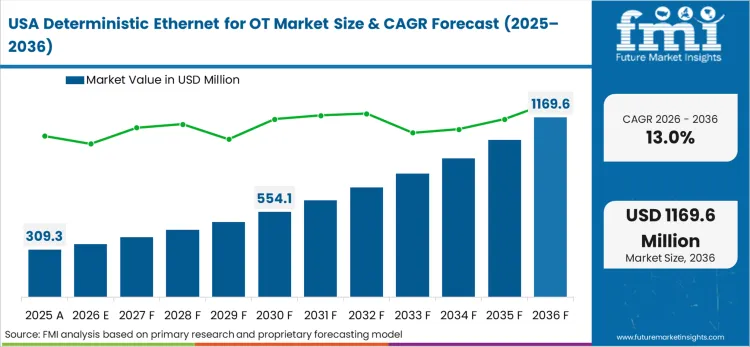
United States operators execute extensive brownfield modernization strategies driven heavily by rising industrial cybersecurity mandates. Federal Bureau of Investigation records confirm 2024 Internet Crime Report complaints combined with reported losses exceeded USD 16 Billion [12]. Severe financial damages force corporate boards to mandate strict network segmentation between corporate IT and factory OT environments. Integrating in vehicle ethernet system architectures provides a blueprint for securing deterministic networks against external manipulation. Facility security officers must deploy certified firewall appliances at every critical network boundary immediately.
- USA: National critical infrastructure directives compel energy and manufacturing operators to eliminate vulnerable legacy serial connections completely. Sweeping modernization efforts generate a 13.0% CAGR as corporations replace unpatchable hardware with modern managed Ethernet switches. The FBI IC3 reported that of about 1,900 ATM jackpotting incidents since 2020, over 700 occurred in 2025 with $20M+ in losses [22]. Escalating kinetic cyber-physical attacks guarantee continuous standard development and enforcement, signaling to buyers that segmented OT networking remains a safe architectural bet. Industrial automation engineers must transition proprietary control loops to standardized IP-based protocols before compliance audits begin.
FMI's report includes detailed analysis of cross-border manufacturing integration occurring across Canada and Mexico. Automotive suppliers distributed throughout these adjacent territories require synchronized production schedules to maintain just-in-time delivery models. Cross-facility synchronization demands deterministic network bridges capable of linking remote production lines securely.
Europe Deterministic Ethernet for OT Market Analysis
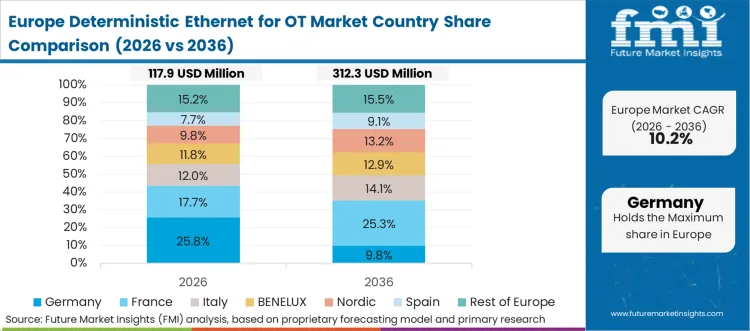
European industrial consortiums dominate the development of global deterministic networking standards through rigorous multi-vendor testing frameworks. United Kingdom National Cyber Security Centre databases reported 429 incidents handled from 1,727 total tips in 2024-2025 [4]. Persistent threat activity forces regional regulators to impose stringent secure-by-design requirements on all new industrial equipment deployments. Advanced automotive network testing methodologies ensure components resist injection attacks while maintaining microsecond timing accuracy. Compliance officers must reject uncertified network hardware to avoid crippling regulatory penalties.
- Germany: Specialized machinery builders face intense global competition forcing them to embed advanced diagnostic capabilities directly into their equipment. Engineering innovations drive a 12.0% CAGR as original equipment manufacturers standardize on TSN-capable internal machine networks. The OPC Foundation’s CLPA collaboration page states CLPA has over 2,800 member companies and 1,500 certified products from 300 manufacturers [20]. Deep hardware ecosystems provide equipment designers specific form factors required for tight machine integration. Automation vendors must certify product lines against prevailing IEC standards to remain eligible for European procurement tenders.
- UK: Critical manufacturing sectors struggle to maintain operational uptime while deploying required cybersecurity overlay networks. Facilities across the region support a 9.0% CAGR as operators cautiously upgrade core routing infrastructure without disrupting active production schedules. Minnesota’s 2025 Cybersecurity Incident Report states that among 215 incident-response partners, 6 confirmed critical incidents were prevented in 2025 [23], proving that proactive threat intelligence and data-driven security optimization strategies deliver measurable operational resilience. Regional plant directors must implement isolated management networks to securely extract performance telemetry without exposing active control loops.
FMI's report includes comprehensive tracking of industrial networking dynamics across France, Italy, and Spain. Facilities processing pharmaceuticals and food products within these jurisdictions face strict traceability mandates requiring continuous data logging. Maintaining immutable production records forces operators to deploy redundant network rings that guarantee telemetry delivery even during physical link failures.
Competitive Aligners for Market Players
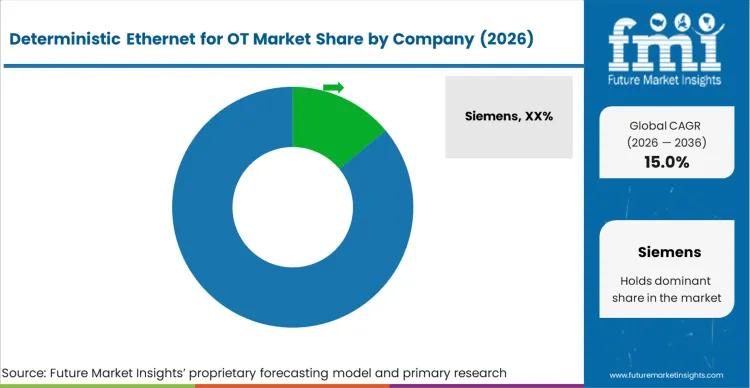
Network convergence projects require suppliers to deliver comprehensive hardware portfolios spanning harsh industrial environments to climate-controlled data centers. Belden launched the Hirschmann GREYHOUND2000 industrial Ethernet switch in April 2025 [7]. Expanding hardware lines enables vendors to capture entire facility upgrade contracts rather than competing for isolated machine-level deployments. Implementing high-capacity ethernet storage solutions relies on these unified backbones to aggregate massive sensor datasets efficiently. Hardware manufacturers must develop integrated software management platforms to simplify the deployment of massive switch networks.
Strategic partnerships dictate market access as IT networking giants collaborate with specialized industrial automation providers to bridge domain expertise gaps. ABB posted a web story documenting the ABB-KEPCO KDN strategic partnership announcement in May 2025 [16]. Joint development initiatives produce pre-validated reference architectures that drastically reduce commissioning times for complex utility and smart grid projects. Deploying united states as interface modules requires deterministic gateways to link legacy sensor arrays to these modern cloud-connected cores. System integrators must secure certification across both IT and OT vendor ecosystems to bid on converged infrastructure projects successfully.
Silicon integration fundamentally alters competitive dynamics as microprocessor vendors embed deterministic switching logic directly into primary computing cores. NXP announced the i.MX 94 family featuring an integrated 2.5 Gbps Ethernet TSN switch in November 2024 [9]. Embedding networking capabilities eliminates the need for discrete switching chips, lowering bill-of-material costs for end-device manufacturers significantly. Realizing true physical digital integration demands edge processing units capable of routing critical traffic autonomously. Embedded board designers must migrate to TSN-capable processors to keep future automation products competitive on both price and performance.
Recent Developments:
Analytical coverage includes key trends from competitive benchmarking. Some of the recent developments covered in the reports:
- In February 2026, a Cisco support page listed an End-of-Sale and End-of-Life Announcement for the Cisco IC3000 Industrial Compute Gateway, accelerating hardware modernization cycles natively. [30]
- In May 2025, Singapore’s PDPC reported a ransomware-linked breach involving exfiltration of personal data belonging to 10,281 customers, reinforcing the mandate for strict industrial network segmentation. [25]
- In May 2025, the International Labour Organization reported that 1 in 4 jobs worldwide is potentially exposed to generative AI, accelerating autonomous networking integration directly. [26]
Key Players in Deterministic Ethernet for OT Market
- Siemens
- Cisco
- Schneider Electric
- Rockwell Automation
- ABB
- Belden/Hirschmann
- Beckhoff Automation
- Microchip Technology
- NXP Semiconductors
- Texas Instruments
- Keysight Technologies
Scope of the Report
| Metric | Value |
|---|---|
| Quantitative Units | USD 524.7 million (2026) to USD 2,122.7 million (2036), at a CAGR of 15.0% |
| Market Definition | Deterministic Ethernet networks utilize synchronized timing and traffic shaping protocols to guarantee microsecond-level packet delivery across converged industrial control environments. |
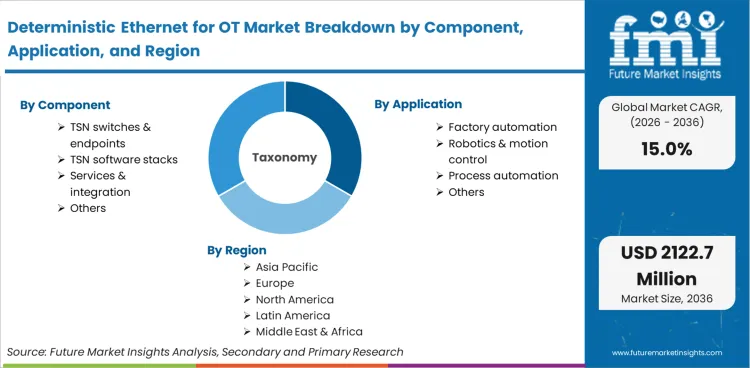
| Component Segmentation | TSN switches & endpoints, TSN software stacks, Services & integration, Others |
| Application Segmentation | Factory automation, Robotics & motion control, Process automation, Others |
| End Use Segmentation | Manufacturing, Energy & utilities, Others |
| TSN Function Segmentation | Time synchronization (802.1AS), Traffic scheduling/shaping, FRER (replication/elimination), Others |
| Regions Covered | North America, Latin America, Europe, East Asia, South Asia, Oceania, Middle East and Africa |
| Countries Covered | China, India, USA, Germany, Japan, South Korea, UK, and 40 plus countries |
| Key Companies Profiled | Siemens, Cisco, Schneider Electric, Rockwell Automation, ABB, Belden/Hirschmann |
| Forecast Period | 2026 to 2036 |
| Approach | Bottom-up capacity modeling starting from regional factory automation build-out rates validated by primary interviews. |
Deterministic Ethernet for OT Market Analysis by Segments
Component:
- TSN switches & endpoints
- TSN software stacks
- Services & integration
- Others
Application:
- Factory automation
- Robotics & motion control
- Process automation
- Others
End Use:
- Manufacturing
- Energy & utilities
- Others
TSN Function:
- Time synchronization (802.1AS)
- Traffic scheduling/shaping
- FRER (replication/elimination)
- Others
Region:
- Asia Pacific
- India
- China
- Japan
- South Korea
- Indonesia
- Australia & New Zealand
- ASEAN
- Rest of Asia Pacific
- Europe
- Germany
- Italy
- France
- United Kingdom
- Spain
- Benelux
- Nordics
- Central & Eastern Europe
- Rest of Europe
- North America
- United States
- Canada
- Mexico
- Latin America
- Brazil
- Argentina
- Chile
- Rest of Latin America
- Middle East & Africa
- Kingdom of Saudi Arabia
- United Arab Emirates
- South Africa
- Turkey
- Rest of Middle East & Africa
Bibliography
- [1] CC-Link Partner Association. (2025, March). Global corporate members milestone (Company news release).
- [2] International Federation of Robotics (IFR). (2025, September 25). Global robot demand in factories doubles over 10 years (Press release).
- [3] Bureau of Labor Statistics. (2025, November). Productivity and costs third quarter 2025 (Government report).
- [4] National Cyber Security Centre (NCSC). (2025, December). NCSC annual review 2025 incident management (Government report).
- [5] Rockwell Automation. (2025, October 21). New solutions automation fair 2025 (Press release).
- [6] Microchip Technology Incorporated. (2025, September 18). Microchip introduces flexible new family of gigabit ethernet switches (Press release).
- [7] Belden. (2025, April 17). Belden sets new industrial ethernet switch standards (Press release).
- [8] Siemens Press. (2025, January 16). Siemens scales private 5g infrastructure expanded coverage and availability (Press release).
- [9] NXP. (2024, November 12). NXP new i.MX 94 applications processors (Press release).
- [10] Cyber Security Agency of Singapore. (2025, November 24). Opening address at the aisp cybersecurity awards (Government report).
- [11] ABB Group. (2025, December 03). ABB India launches next gen machinery drive (Press release).
- [12] Federal Bureau of Investigation. (2025, April 23). FBI releases annual internet crime report (Press release).
- [13] Keysight United States. (2025, October 14). Keysight introduces optical automotive ethernet transmitter test solution (Press release).
- [14] Texas Instruments. (2025, December). AM2434 industrial communications processor (Product page).
- [15] Keysight United States. (2025, January 07). Keysight expands novus portfolio with compact automotive software defined vehicle test solution (Press release).
- [16] ABB Group. (2025, May 23). ABB KDN strategic partnership accelerates Koreas energy digital transformation (Company news release).
- [17] World Economic Forum. (2025, January). The future of jobs report 2025 digest (Industry report).
- [18] Belden. (2025, August 28). Belden launches next gen connectivity and cybersecurity products for critical applications (Press release).
- [19] OPC Connect. (2025, December). OPC Foundation general assembly 2025 key highlights (Industry report).
- [20] OPC Foundation. (2025, March). CLPA collaboration members overview (Company news release).
- [21] Cyber Security Australia. (2025, October). Annual cyber threat report 2024-2025 (Government report).
- [22] Federal Bureau of Investigation IC3. (2026, February 19). FBI IC3 ATM jackpotting statistics flash (Government report).
- [23] Minnesota IT Services. (2025, January). Minnesota 2025 cybersecurity incident report (Government report).
- [24] Singapore Police Force. (2026, February). Scams and cybercrime fell by almost a quarter in 2025 (Government report).
- [25] PDPC. (2025, May 21). New undertaking on 21 May 2025 (Government report).
- [26] International Labour Organization. (2025, May). One in four jobs at risk being transformed by GenAI (Government report).
- [27] Siemens Press. (2025, October 01). Siemens SPS fair 2025 feature (Press release).
- [28] Moxa. (2025, February 18). TSN-G5008 Series FOSS statements and resources (Product page).
- [29] Moxa. (2025, December 31). EDS-205 Series switch resources and datasheets (Product page).
- [30] Cisco. (2026, February 13). Cisco IC3000 Industrial Compute Gateway End-of-Life Announcement (Company news release).
- [31] TTTech Group. (2025, May 20). TTTech divests strategic stake in landmark transaction to NXP to fuel future growth.
This bibliography is provided for reader reference and is not exhaustive. The full report contains the complete reference list and detailed citations.
This Report Addresses
- Market size estimation establishing deterministic equipment demand baselines validating capacity across global industrial manufacturing networks.
- Protocol phase-out mapping revealing aggressive fieldbus replacement cycles executed by mid-market machinery builders.
- Component-level revenue forecasts isolating dedicated TSN switch adoption versus software stack overlay strategies.
- Regional capacity modeling benchmarking automated facility modernization expenditures across North America and East Asia.
- Regulatory impact analysis evaluating critical infrastructure directives forcing accelerated network segmentation architecture overhauls.
- Competitive posture benchmarking tracking silicon-level consolidation strategies led by specialized industrial microprocessor manufacturers.
- Private 5G synergy assessment defining specific interoperability requirements for wireless deterministic traffic routing.
- Market report delivery covering PDF, Excel, PPT, and interactive dashboard formats for executive and operational planning processes.
Frequently Asked Questions
How large is the demand for Deterministic Ethernet for OT in the global market in 2026?
Demand for Deterministic Ethernet for OT in the global market is estimated to be valued at USD 524.7 million in 2026.
What will be the market size of Deterministic Ethernet for OT in the global market by 2036?
Market size for Deterministic Ethernet for OT is projected to reach USD 2,122.7 million by 2036.
What is the expected demand growth for Deterministic Ethernet for OT in the global market between 2026 and 2036?
Demand for Deterministic Ethernet for OT is expected to grow at a CAGR of 15.0% between 2026 and 2036.
Which Component is poised to lead global sales by 2026?
TSN switches & endpoints commands 46.0% in 2026 as factory integrators prioritize drop-in hardware replacements for aging fieldbus nodes natively.
How significant is the role of Factory automation in driving Deterministic Ethernet for OT adoption in 2026?
Factory automation represents 42.0% of segment share as operators integrate autonomous guided vehicles alongside stationary robotic arms securely.
What is driving demand in China?
State-driven industrial upgrading initiatives force local manufacturers to abandon isolated control systems in favor of fully integrated data networks rapidly.
What compliance standards or regulations are referenced for China?
CC-Link Partner Association interoperability standards dictate foundational architectural guidelines.
What is the China growth outlook in this report?
China is projected to grow at a CAGR of 18.0% during 2026 to 2036.
Why is North America described as a priority region in this report?
Rising industrial cybersecurity mandates force corporate boards to mandate strict network segmentation between IT and OT systems defensively.
What type of demand dominates in North America?
Cybersecurity-driven architectural overhauls replacing unpatchable legacy serial connections systematically.
What is India's growth outlook in this report?
India is projected to expand at a CAGR of 17.0% during 2026 to 2036.
Does the report cover USA in its regional analysis?
Yes, USA is included within North America under the regional scope of analysis natively.
What are the sources referred to for analyzing USA?
Official cybercrime threat data from the Federal Bureau of Investigation forms the analytical basis heavily.
What is the main demand theme linked to USA in its region coverage?
Strict critical infrastructure directives compelling energy and manufacturing operators to eliminate vulnerable legacy endpoints thoroughly.
Does the report cover Germany in its regional analysis?
Yes, Germany is included within Europe under the regional coverage framework entirely.
What is the main Germany related demand theme in its region coverage?
Original equipment manufacturers standardizing internal machine networks around certified TSN-capable diagnostic architectures structurally.
Which product formats or configurations are strategically important for Asia Pacific supply chains?
Gigabit-capable switching hardware supporting complex multi-axis robotic synchronization deployments reliably.
What is Deterministic Ethernet for OT and what is it mainly used for?
Deterministic Ethernet networks utilize synchronized timing protocols to guarantee microsecond-level packet delivery perfectly.
What does Deterministic Ethernet for OT mean in this report?
Market boundaries capture the physical components and specialized software stacks executing standardized traffic shaping across active industrial environments.
What is included in the scope of this Deterministic Ethernet for OT report?
Managed TSN switches, ruggedized endpoints, silicon MAC components, and network interface cards designed specifically for harsh conditions actively.
What is excluded from the scope of this report?
Consumer-grade networking equipment lacking certified deterministic features falls entirely outside the analytical scope definitively.
What does market forecast mean on this page?
The market forecast represents a model-based projection built on defined industrial capacity and automation adoption assumptions for strategic planning purposes natively.
How does FMI build and validate the Deterministic Ethernet for OT forecast?
Forecasts combine bottom-up robotic installation data with certified automation component registry logs validated continuously.
What does zero reliance on speculative third-party market research mean here?
Primary interviews, verified official standards organization filings, and institutional cybersecurity reports are used exclusively instead of unverified syndicated estimates strictly.
Preview the report firsthand - request a free sample
Get SampleGet the brochure for pricing and purchase details.
Get PDFTable of Content
- Executive Summary
- Global Market Outlook
- Demand-side Trends
- Supply-side Trends
- Technology Roadmap Analysis
- Analysis and Recommendations
- Market Overview
- Market Coverage / Taxonomy
- Market Definition / Scope / Limitations
- Research Methodology
- Chapter Orientation
- Analytical Lens and Working Hypotheses
- Market Structure, Signals, and Trend Drivers
- Benchmarking and Cross-market Comparability
- Market Sizing, Forecasting, and Opportunity Mapping
- Research Design and Evidence Framework
- Desk Research Programme (Secondary Evidence)
- Company Annual and Sustainability Reports
- Peer-reviewed Journals and Academic Literature
- Corporate Websites, Product Literature, and Technical Notes
- Earnings Decks and Investor Briefings
- Statutory Filings and Regulatory Disclosures
- Technical White Papers and Standards Notes
- Trade Journals, Industry Magazines, and Analyst Briefs
- Conference Proceedings, Webinars, and Seminar Materials
- Government Statistics Portals and Public Data Releases
- Press Releases and Reputable Media Coverage
- Specialist Newsletters and Curated Briefings
- Sector Databases and Reference Repositories
- FMI Internal Proprietary Databases and Historical Market Datasets
- Subscription Datasets and Paid Sources
- Social Channels, Communities, and Digital Listening Inputs
- Additional Desk Sources
- Expert Input and Fieldwork (Primary Evidence)
- Primary Modes
- Qualitative Interviews and Expert Elicitation
- Quantitative Surveys and Structured Data Capture
- Blended Approach
- Why Primary Evidence is Used
- Field Techniques
- Interviews
- Surveys
- Focus Groups
- Observational and In-context Research
- Social and Community Interactions
- Stakeholder Universe Engaged
- C-suite Leaders
- Board Members
- Presidents and Vice Presidents
- R&D and Innovation Heads
- Technical Specialists
- Domain Subject-matter Experts
- Scientists
- Physicians and Other Healthcare Professionals
- Governance, Ethics, and Data Stewardship
- Research Ethics
- Data Integrity and Handling
- Primary Modes
- Tooling, Models, and Reference Databases
- Desk Research Programme (Secondary Evidence)
- Data Engineering and Model Build
- Data Acquisition and Ingestion
- Cleaning, Normalisation, and Verification
- Synthesis, Triangulation, and Analysis
- Quality Assurance and Audit Trail
- Market Background
- Market Dynamics
- Drivers
- Restraints
- Opportunity
- Trends
- Scenario Forecast
- Demand in Optimistic Scenario
- Demand in Likely Scenario
- Demand in Conservative Scenario
- Opportunity Map Analysis
- Product Life Cycle Analysis
- Supply Chain Analysis
- Investment Feasibility Matrix
- Value Chain Analysis
- PESTLE and Porter’s Analysis
- Regulatory Landscape
- Regional Parent Market Outlook
- Production and Consumption Statistics
- Import and Export Statistics
- Market Dynamics
- Global Market Analysis 2021 to 2025 and Forecast, 2026 to 2036
- Historical Market Size Value (USD Million) Analysis, 2021 to 2025
- Current and Future Market Size Value (USD Million) Projections, 2026 to 2036
- Y-o-Y Growth Trend Analysis
- Absolute $ Opportunity Analysis
- Global Market Pricing Analysis 2021 to 2025 and Forecast 2026 to 2036
- Global Market Analysis 2021 to 2025 and Forecast 2026 to 2036, By Component
- Introduction / Key Findings
- Historical Market Size Value (USD Million) Analysis By Component , 2021 to 2025
- Current and Future Market Size Value (USD Million) Analysis and Forecast By Component , 2026 to 2036
- TSN switches & endpoints
- TSN software stacks
- Services & integration
- Others
- TSN switches & endpoints
- Y-o-Y Growth Trend Analysis By Component , 2021 to 2025
- Absolute $ Opportunity Analysis By Component , 2026 to 2036
- Global Market Analysis 2021 to 2025 and Forecast 2026 to 2036, By Application
- Introduction / Key Findings
- Historical Market Size Value (USD Million) Analysis By Application, 2021 to 2025
- Current and Future Market Size Value (USD Million) Analysis and Forecast By Application, 2026 to 2036
- Factory automation
- Robotics & motion control
- Process automation
- Others
- Factory automation
- Y-o-Y Growth Trend Analysis By Application, 2021 to 2025
- Absolute $ Opportunity Analysis By Application, 2026 to 2036
- Global Market Analysis 2021 to 2025 and Forecast 2026 to 2036, By End Use
- Introduction / Key Findings
- Historical Market Size Value (USD Million) Analysis By End Use, 2021 to 2025
- Current and Future Market Size Value (USD Million) Analysis and Forecast By End Use, 2026 to 2036
- Manufacturing
- Energy & utilities
- Others
- Manufacturing
- Y-o-Y Growth Trend Analysis By End Use, 2021 to 2025
- Absolute $ Opportunity Analysis By End Use, 2026 to 2036
- Global Market Analysis 2021 to 2025 and Forecast 2026 to 2036, By TSN Function
- Introduction / Key Findings
- Historical Market Size Value (USD Million) Analysis By TSN Function, 2021 to 2025
- Current and Future Market Size Value (USD Million) Analysis and Forecast By TSN Function, 2026 to 2036
- Time synchronization (802.1AS)
- Traffic scheduling/shaping
- FRER (replication/elimination)
- Others
- Time synchronization (802.1AS)
- Y-o-Y Growth Trend Analysis By TSN Function, 2021 to 2025
- Absolute $ Opportunity Analysis By TSN Function, 2026 to 2036
- Global Market Analysis 2021 to 2025 and Forecast 2026 to 2036, By Region
- Introduction
- Historical Market Size Value (USD Million) Analysis By Region, 2021 to 2025
- Current Market Size Value (USD Million) Analysis and Forecast By Region, 2026 to 2036
- North America
- Latin America
- Western Europe
- Eastern Europe
- East Asia
- South Asia and Pacific
- Middle East & Africa
- Market Attractiveness Analysis By Region
- North America Market Analysis 2021 to 2025 and Forecast 2026 to 2036, By Country
- Historical Market Size Value (USD Million) Trend Analysis By Market Taxonomy, 2021 to 2025
- Market Size Value (USD Million) Forecast By Market Taxonomy, 2026 to 2036
- By Country
- USA
- Canada
- Mexico
- By Component
- By Application
- By End Use
- By TSN Function
- By Country
- Market Attractiveness Analysis
- By Country
- By Component
- By Application
- By End Use
- By TSN Function
- Key Takeaways
- Latin America Market Analysis 2021 to 2025 and Forecast 2026 to 2036, By Country
- Historical Market Size Value (USD Million) Trend Analysis By Market Taxonomy, 2021 to 2025
- Market Size Value (USD Million) Forecast By Market Taxonomy, 2026 to 2036
- By Country
- Brazil
- Chile
- Rest of Latin America
- By Component
- By Application
- By End Use
- By TSN Function
- By Country
- Market Attractiveness Analysis
- By Country
- By Component
- By Application
- By End Use
- By TSN Function
- Key Takeaways
- Western Europe Market Analysis 2021 to 2025 and Forecast 2026 to 2036, By Country
- Historical Market Size Value (USD Million) Trend Analysis By Market Taxonomy, 2021 to 2025
- Market Size Value (USD Million) Forecast By Market Taxonomy, 2026 to 2036
- By Country
- Germany
- UK
- Italy
- Spain
- France
- Nordic
- BENELUX
- Rest of Western Europe
- By Component
- By Application
- By End Use
- By TSN Function
- By Country
- Market Attractiveness Analysis
- By Country
- By Component
- By Application
- By End Use
- By TSN Function
- Key Takeaways
- Eastern Europe Market Analysis 2021 to 2025 and Forecast 2026 to 2036, By Country
- Historical Market Size Value (USD Million) Trend Analysis By Market Taxonomy, 2021 to 2025
- Market Size Value (USD Million) Forecast By Market Taxonomy, 2026 to 2036
- By Country
- Russia
- Poland
- Hungary
- Balkan & Baltic
- Rest of Eastern Europe
- By Component
- By Application
- By End Use
- By TSN Function
- By Country
- Market Attractiveness Analysis
- By Country
- By Component
- By Application
- By End Use
- By TSN Function
- Key Takeaways
- East Asia Market Analysis 2021 to 2025 and Forecast 2026 to 2036, By Country
- Historical Market Size Value (USD Million) Trend Analysis By Market Taxonomy, 2021 to 2025
- Market Size Value (USD Million) Forecast By Market Taxonomy, 2026 to 2036
- By Country
- China
- Japan
- South Korea
- By Component
- By Application
- By End Use
- By TSN Function
- By Country
- Market Attractiveness Analysis
- By Country
- By Component
- By Application
- By End Use
- By TSN Function
- Key Takeaways
- South Asia and Pacific Market Analysis 2021 to 2025 and Forecast 2026 to 2036, By Country
- Historical Market Size Value (USD Million) Trend Analysis By Market Taxonomy, 2021 to 2025
- Market Size Value (USD Million) Forecast By Market Taxonomy, 2026 to 2036
- By Country
- India
- ASEAN
- Australia & New Zealand
- Rest of South Asia and Pacific
- By Component
- By Application
- By End Use
- By TSN Function
- By Country
- Market Attractiveness Analysis
- By Country
- By Component
- By Application
- By End Use
- By TSN Function
- Key Takeaways
- Middle East & Africa Market Analysis 2021 to 2025 and Forecast 2026 to 2036, By Country
- Historical Market Size Value (USD Million) Trend Analysis By Market Taxonomy, 2021 to 2025
- Market Size Value (USD Million) Forecast By Market Taxonomy, 2026 to 2036
- By Country
- Kingdom of Saudi Arabia
- Other GCC Countries
- Turkiye
- South Africa
- Other African Union
- Rest of Middle East & Africa
- By Component
- By Application
- By End Use
- By TSN Function
- By Country
- Market Attractiveness Analysis
- By Country
- By Component
- By Application
- By End Use
- By TSN Function
- Key Takeaways
- Key Countries Market Analysis
- USA
- Pricing Analysis
- Market Share Analysis, 2025
- By Component
- By Application
- By End Use
- By TSN Function
- Canada
- Pricing Analysis
- Market Share Analysis, 2025
- By Component
- By Application
- By End Use
- By TSN Function
- Mexico
- Pricing Analysis
- Market Share Analysis, 2025
- By Component
- By Application
- By End Use
- By TSN Function
- Brazil
- Pricing Analysis
- Market Share Analysis, 2025
- By Component
- By Application
- By End Use
- By TSN Function
- Chile
- Pricing Analysis
- Market Share Analysis, 2025
- By Component
- By Application
- By End Use
- By TSN Function
- Germany
- Pricing Analysis
- Market Share Analysis, 2025
- By Component
- By Application
- By End Use
- By TSN Function
- UK
- Pricing Analysis
- Market Share Analysis, 2025
- By Component
- By Application
- By End Use
- By TSN Function
- Italy
- Pricing Analysis
- Market Share Analysis, 2025
- By Component
- By Application
- By End Use
- By TSN Function
- Spain
- Pricing Analysis
- Market Share Analysis, 2025
- By Component
- By Application
- By End Use
- By TSN Function
- France
- Pricing Analysis
- Market Share Analysis, 2025
- By Component
- By Application
- By End Use
- By TSN Function
- India
- Pricing Analysis
- Market Share Analysis, 2025
- By Component
- By Application
- By End Use
- By TSN Function
- ASEAN
- Pricing Analysis
- Market Share Analysis, 2025
- By Component
- By Application
- By End Use
- By TSN Function
- Australia & New Zealand
- Pricing Analysis
- Market Share Analysis, 2025
- By Component
- By Application
- By End Use
- By TSN Function
- China
- Pricing Analysis
- Market Share Analysis, 2025
- By Component
- By Application
- By End Use
- By TSN Function
- Japan
- Pricing Analysis
- Market Share Analysis, 2025
- By Component
- By Application
- By End Use
- By TSN Function
- South Korea
- Pricing Analysis
- Market Share Analysis, 2025
- By Component
- By Application
- By End Use
- By TSN Function
- Russia
- Pricing Analysis
- Market Share Analysis, 2025
- By Component
- By Application
- By End Use
- By TSN Function
- Poland
- Pricing Analysis
- Market Share Analysis, 2025
- By Component
- By Application
- By End Use
- By TSN Function
- Hungary
- Pricing Analysis
- Market Share Analysis, 2025
- By Component
- By Application
- By End Use
- By TSN Function
- Kingdom of Saudi Arabia
- Pricing Analysis
- Market Share Analysis, 2025
- By Component
- By Application
- By End Use
- By TSN Function
- Turkiye
- Pricing Analysis
- Market Share Analysis, 2025
- By Component
- By Application
- By End Use
- By TSN Function
- South Africa
- Pricing Analysis
- Market Share Analysis, 2025
- By Component
- By Application
- By End Use
- By TSN Function
- USA
- Market Structure Analysis
- Competition Dashboard
- Competition Benchmarking
- Market Share Analysis of Top Players
- By Regional
- By Component
- By Application
- By End Use
- By TSN Function
- Competition Analysis
- Competition Deep Dive
- Siemens
- Overview
- Product Portfolio
- Profitability by Market Segments (Product/Age /Sales Channel/Region)
- Sales Footprint
- Strategy Overview
- Marketing Strategy
- Product Strategy
- Channel Strategy
- Cisco
- Schneider Electric
- Rockwell Automation
- ABB
- Belden/Hirschmann
- Beckhoff Automation
- Microchip Technology
- NXP Semiconductors
- Texas Instruments
- Keysight Technologies
- Siemens
- Competition Deep Dive
- Assumptions & Acronyms Used


