

- Industry Size (2026)
- USD 0.5 Bn
- Forecast (2036)
- USD 0.9 Bn
- CAGR (2026 to 2036)
- 6.2%
Demand for AS-Interface in USA 2026 to 2036
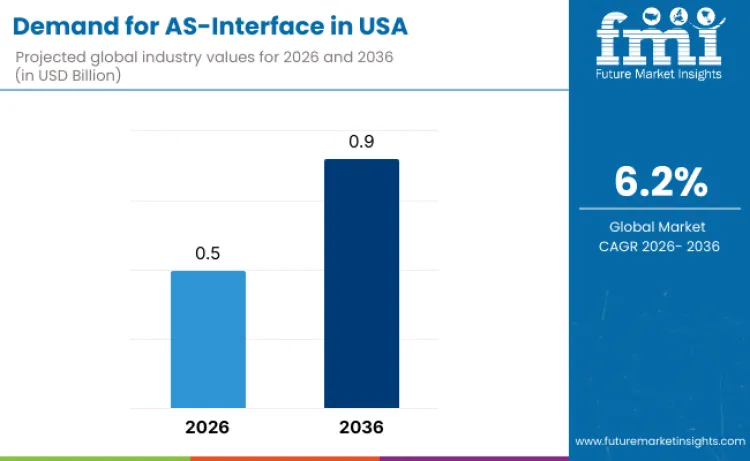
Demand for AS-Interface in USA is valued at USD 0.5 billion in 2026 and is projected to reach USD 0.9 billion by 2036, reflecting a CAGR of 6.2%. Demand expands as industrial and commercial facilities pursue simplified field-level communication, reduced wiring complexity, and cost-efficient automation architectures. Growth in smart buildings, retrofitting activity, and integration of distributed sensors and actuators supports steady adoption.
AS-Interface power supply leads component-segment usage because reliable power delivery and integrated communication ensure stable network performance across distributed nodes. Users favor power supplies with diagnostics, fault isolation, and seamless interoperability with PLCs and higher-level networks. Compact form factors and ease of installation strengthen suitability for space-constrained environments. Building automation leads application-segment usage due to rising deployment of HVAC controls, lighting systems, access management, and energy monitoring within commercial properties. AS-Interface enables fast installation, flexible expansion, and dependable operation for building control networks aligned with efficiency and safety objectives.
West USA, South USA, Northeast USA, and Midwest USA represent key growth regions driven by commercial construction, infrastructure modernization, and automation investment. Rockwell Automation, Siemens, Schneider Electric, Pepperl+Fuchs, and Balluff Inc. anchor competitive activity through automation portfolios, localized engineering support, and solutions aligned with USA building automation standards and industrial communication requirements.
Quick Stats for Demand for AS-Interface in USA
- USA AS-Interface Sales Value (2026): USD 0.5 billion
- USA AS-Interface Forecast Value (2036): USD 0.9 billion
- USA AS-Interface Forecast CAGR (2026 to 2036): 6.2%
- Leading Component Segment in USA: AS-Interface Power Supply
- Key Growth Regions in USA: West USA, South USA, Northeast USA, Midwest USA
- Top Players in USA: Rockwell Automation, Siemens, Schneider Electric, Pepperl+Fuchs, Balluff Inc.
USA AS-Interface Key Takeaways
| Metric | Value |
|---|---|
| USA AS-Interface Sales Value (2026) | USD 0.5 billion |
| USA AS-Interface Forecast Value (2036) | USD 0.9 billion |
| USA AS-Interface Forecast CAGR (2026 to 2036) | 6.2% |
How Are the Segments Classified in the Demand for AS-Interface in USA?
Demand for AS-Interface in USA is shaped by factory automation expansion, deterministic field communication requirements, and simplified sensor-actuator connectivity. Industrial buyers prioritize reliable power delivery, diagnostic transparency, and seamless integration with PLC and SCADA architectures. Adoption patterns reflect deployment across manufacturing facilities, logistics hubs, and commercial buildings, where reduced wiring complexity and predictable system behavior support operational efficiency under USA industrial automation standards.
By Component, Does AS-I Power Supply Hold the Largest Share of Demand in USA?
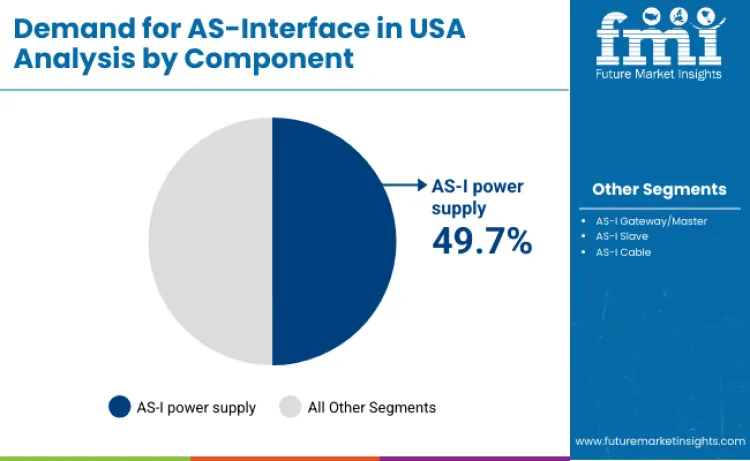
AS-I power supply holds 49.7%, making it the leading component segment in USA demand. Power supplies deliver both communication and electrical power through a single cable, reducing installation effort and minimizing wiring errors. Stable voltage output supports consistent operation of distributed sensors and actuators in electrically noisy industrial environments. AS-I gateway or master holds 44.3%, enabling diagnostics, network management, and communication with higher-level control systems. AS-I slaves hold 3.0%, supporting device-level connectivity, while AS-I cables also hold 3.0% as standardized network infrastructure. Component distribution reflects priority on reliable power delivery and centralized network control.
Key Points
- Power supplies dominate due to combined power and data transmission.
- Gateways support diagnostics and system-level integration.
- Slaves and cables provide standardized connectivity support.
By Application, Does Building Automation Represent the Largest Share of Demand in USA?
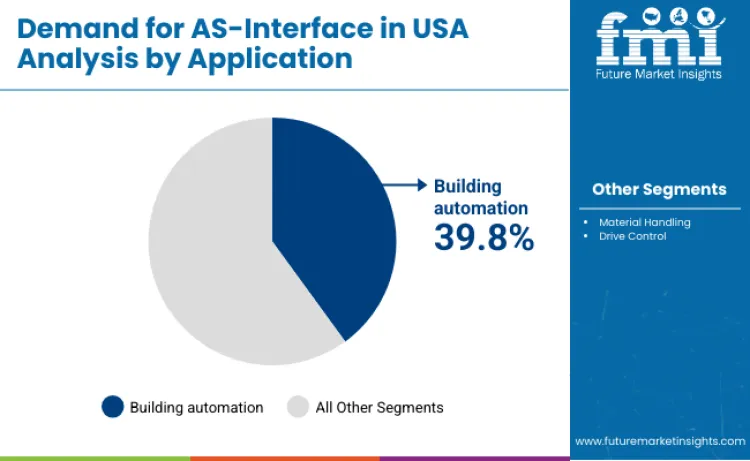
Building automation holds 39.8%, making it the leading application segment in USA. AS-Interface is applied in lighting control, access systems, and HVAC signaling requiring simplified installation and dependable diagnostics. Material handling holds 30.2%, using AS-Interface in conveyors, sortation lines, and warehouse automation where deterministic response timing is essential. Drive control holds 30.0%, supporting motor start-stop functions and status monitoring in compact machinery. Application distribution reflects strong adoption in buildings and logistics, where uptime reliability, maintenance clarity, and space efficiency align with AS-Interface capabilities.
Key Points
- Building automation leads due to simplified wiring requirements.
- Material handling depends on deterministic communication behavior.
- Drive control supports compact and distributed machinery systems.
What are the Key Dynamics in the AS-Interface Industry in USA?
Demand increases as industrial automation in USA production facilities places emphasis on robust, simple networking of sensors and actuators at the machine level. AS-Interface supports cost-effective digitization of discrete I/O, safety monitoring, and decentralized control in manufacturing cells and packaging lines. Adoption aligns with digital transformation objectives, Industry 4.0 pilot programmes, and established automation practices within automotive, electronics, food & beverage, and machinery sectors concentrated across Midwest, Southeast, and West Coast industrial regions.
How do factory modernization and discrete automation requirements drive AS-Interface adoption in USA?
US manufacturers pursue upgrades to improve productivity, reduce changeover time, and lower wiring cost in new and retrofit installations. AS-Interface offers a fieldbus solution that simplifies connection of sensors, actuators, and safety devices while reducing installation complexity relative to point-to-point wiring. Automotive and tier-1 suppliers implement the technology in body shops and assembly cells where modular production and quick line changeovers are common. Electronics manufacturers use AS-Interface for conveyor gating and part detection due to predictable performance and straightforward diagnostics. Food and beverage plants adopt the technology for hygiene-friendly designs requiring frequent washdown and minimal cabling. Demand reflects preference for stable, well-supported field networking standards compatible with broader control systems.
How do competition from alternative protocols, integration complexity, and cost considerations influence demand in USA?
Alternative industrial networking technologies such as industrial Ethernet, PROFINET, and EtherNet-IP shape specification choices for new automation projects, particularly where high data rates or extensive diagnostics are prioritized. AS-Interface remains valuable for simpler I/O layers but competes with IP-based solutions that converge networking across control hierarchies. Integration with PLCs and higher-level MES platforms requires careful engineering, adding design effort in mixed protocol environments. Per-node cost, cable topology planning, and training for maintenance personnel affect project economics. Legacy installations using AS-Interface influence incremental adoption in retrofit scenarios. Demand remains stable where simplicity, reliability, and predictable performance outweigh broader network unification pressures within USA manufacturing automation strategies.
How Is Demand for AS-Interface in USA Evolving by Region?
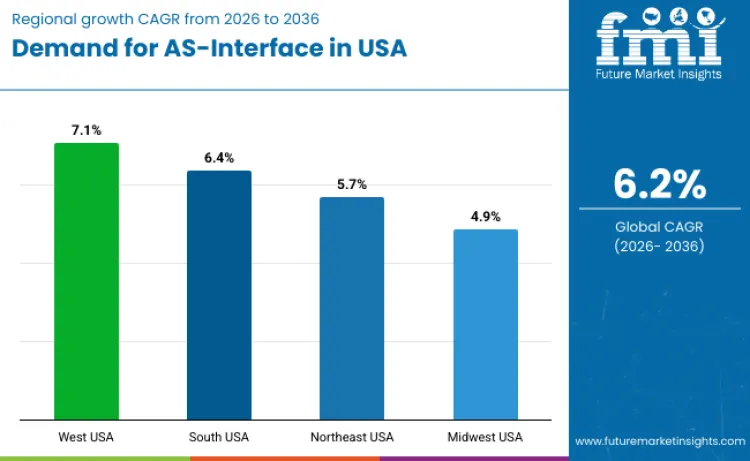
Demand for AS-Interface in the USA is increasing due to factory automation retrofits, simplified sensor connectivity needs, and safety system integration across discrete manufacturing. West USA leads with a 7.1% CAGR, supported by advanced automation adoption and electronics manufacturing. South USA follows at 6.4%, driven by greenfield plants, logistics automation, and cost-focused upgrades. Northeast USA records a 5.7% CAGR, shaped by retrofit projects in legacy facilities and system integrator activity. Midwest USA posts 4.9%, reflecting automotive and industrial automation maintenance. Regional differences reflect automation maturity, pace of retrofitting, safety compliance priorities, and industrial structure across the USA.
| Region | CAGR (2026 to 2036) |
|---|---|
| West USA | 7.1% |
| South USA | 6.4% |
| Northeast USA | 5.7% |
| Midwest USA | 4.9% |
How is West USA driving demand for AS-Interface in the USA?
West USA drives demand through advanced manufacturing facilities, high automation intensity, and early adoption of modular production architectures. Region’s CAGR of 7.1% reflects widespread use of AS-Interface for connecting sensors, actuators, and safety devices with reduced wiring complexity. Electronics, semiconductor equipment, and advanced machinery plants deploy AS-Interface to support flexible line layouts and frequent configuration changes. Manufacturers value fast commissioning, diagnostic transparency, and compatibility with higher-level industrial Ethernet networks. System integrators actively promote AS-Interface for safety interlocks and material handling systems. Demand favors standardized components with strong vendor ecosystems. Growth remains productivity-led and retrofit-driven across automated production environments.
- Advanced automation and modular production lines
- Electronics and machinery manufacturing usage
- Safety interlock and diagnostics integration
- Strong system integrator involvement
How is South USA driving demand for AS-Interface in the USA?
South USA demand is shaped by expansion of manufacturing capacity, logistics automation, and cost-efficient plant design. Region’s CAGR of 6.4% reflects adoption of AS-Interface in new factories and distribution centers seeking simplified installation and lower lifecycle costs. Automotive assembly, food processing, and packaging facilities use AS-Interface for conveyor systems, sensors, and safety circuits. Operators prioritize reduced cabling, faster deployment, and ease of maintenance. State-level incentives and workforce availability support automation investments. Demand favors proven AS-Interface solutions compatible with diverse PLC platforms. Growth remains capacity-led and efficiency-focused within rapidly expanding industrial footprints.
- Greenfield manufacturing and logistics facilities
- Conveyor and packaging line automation
- Cost and installation efficiency priorities
- Broad PLC compatibility requirements
How is Northeast USA driving demand for AS-Interface in the USA?
Northeast USA demand is driven by modernization of legacy manufacturing sites and strong presence of automation integrators. Region’s CAGR of 5.7% reflects retrofit adoption of AS-Interface to replace complex point-to-point wiring in older plants. Pharmaceuticals, specialty chemicals, and food manufacturers deploy AS-Interface to improve safety compliance and diagnostics. Facilities emphasize minimal downtime during upgrades and compatibility with existing control systems. System integrators play a central role in design and commissioning. Demand growth aligns with compliance upgrades and maintenance-driven automation rather than large-scale capacity expansion.
- Legacy plant automation retrofits
- Pharmaceutical and specialty manufacturing usage
- Downtime-minimized upgrade requirements
- Integrator-led deployment models
How is Midwest USA driving demand for AS-Interface in the USA?
Midwest USA demand reflects automotive manufacturing, heavy industry, and process standardization priorities. Region’s CAGR of 4.9% is supported by use of AS-Interface for assembly lines, material handling, and safety monitoring in established plants. Manufacturers value robustness, deterministic communication, and ease of troubleshooting. Adoption supports lean manufacturing and continuous improvement programs. Investment decisions align with maintenance cycles and incremental upgrades rather than transformational automation. Demand remains steady and reliability-focused, tied to sustaining operational efficiency across mature industrial facilities.
- Automotive and heavy industrial automation
- Assembly line and material handling usage
- Reliability and troubleshooting focus
- Maintenance-cycle-driven adoption
What is the competitive landscape of demand for AS-Interface in the USA?
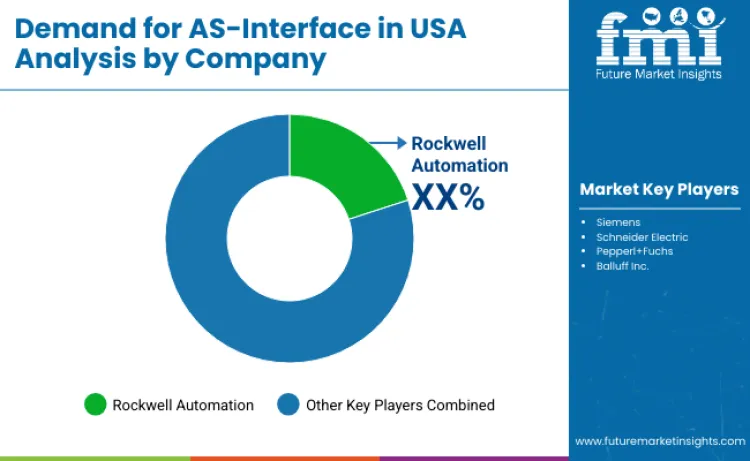
Demand for AS-Interface in the USA is driven by industrial automation requirements in automotive assembly, electronics fabrication, packaging, and material-handling systems. AS-Interface (Actuator-Sensor Interface) networks enable simplified wiring of discrete sensors and actuators, reducing installation complexity and supporting modular machine architectures. Buyers evaluate communication reliability, ease of integration with PLCs and industrial Ethernet systems, diagnostics capability, and compatibility with safety devices. Procurement teams prioritize suppliers with strong USA technical support, localized training, and seamless integration with broader automation solutions. Trend in the USA market reflects continued adoption of hybrid networking approaches that blend discrete I/O simplicity with powerful fieldbus and industrial Ethernet backbones used in smart factories.
Rockwell Automation holds a strong position in the USA through integrated automation portfolios that include AS-Interface solutions and extensive local service and support networks. Siemens USA participates with AS-Interface components integrated into broader factory automation platforms used across automotive and discrete manufacturing. Schneider Electric maintains visibility through AS-Interface products and power supplies distributed across North American industrial automation channels with localized application support. Pepperl+Fuchs USA contributes with AS-Interface interface modules, power supplies, and sensor technologies tailored for USA manufacturing environments. Balluff Inc. supports demand with AS-Interface-capable devices and field network solutions used in factory and logistics automation. Competitive positioning in the USA reflects integration depth with leading automation systems, localized service capability, regulatory compliance, and ability to support diverse industrial applications.
Key Players in USA AS-Interface Industry
- Rockwell Automation
- Siemens
- Schneider Electric
- Pepperl+Fuchs
- Balluff Inc.
Scope of the Report
| Items | Details |
|---|---|
| Quantitative Units | USD billion |
| Component | AS-I Power Supply; AS-I Gateway/Master; AS-I Slave; AS-I Cable |
| Application | Building Automation; Material Handling; Drive Control |
| Regions Covered | West USA; South USA; Northeast USA; Midwest USA |
| Key Companies Profiled | Rockwell Automation; Siemens; Schneider Electric; Pepperl+Fuchs; Balluff Inc. |
| Additional Attributes | Demand is supported by factory automation upgrades, simplified field-level networking requirements, and growing adoption of smart manufacturing. Material handling and building automation dominate installations. Gateways and slaves account for higher value contribution due to system integration needs and compatibility with higher-level industrial Ethernet protocols. |
USA AS-Interface Demand by Segments
By Component:
- AS-I Power Supply
- AS-I Gateway/Master
- AS-I Slave
- AS-I Cable
By Application:
- Building Automation
- Material Handling
- Drive Control
By Region:
- West USA
- South USA
- Northeast USA
- Midwest USA
Frequently Asked Questions
How big is the demand for AS-Interface in USA in 2026?
The demand for AS-Interface in USA is estimated to be valued at USD 0.5 billion in 2026.
What will be the size of AS-Interface demand in USA in 2036?
The demand size for AS-Interface in USA is projected to reach USD 0.9 billion by 2036.
How much will the demand for AS-Interface in USA grow between 2026 and 2036?
The demand for AS-Interface in USA is expected to grow at a 6.2% CAGR between 2026 and 2036.
What are the key components in the AS-Interface demand in USA?
The key components in AS-Interface demand in USA include AS-i power supply, AS-i masters, AS-i slaves, and communication modules.
Which application segment is expected to contribute a significant share in the AS-Interface demand in USA in 2026?
In terms of application, building automation is expected to command 39.8% share in the AS-Interface demand in USA in 2026.
Preview the report firsthand - request a free sample
Get SampleGet the brochure for pricing and purchase details.
Get PDFTable of Content
- Executive Summary
- USA Market Outlook
- Demand Side Trends
- Supply Side Trends
- Automation, Industrial, and Building Context
- Analysis and Recommendations
- Market Overview
- Market Coverage and Taxonomy
- Market Definition Scope and Limitations
- Market Background
- Market Dynamics
- Drivers
- Restraints
- Opportunities
- Trends
- Scenario Forecast
- Demand in Optimistic Scenario
- Demand in Likely Scenario
- Demand in Conservative Scenario
- Opportunity Map Analysis
- Technology Life Cycle Analysis
- Industrial Automation Value Chain Analysis
- Investment Feasibility Matrix
- PESTLE and Porter Analysis
- Industrial Communication Standards and Compliance Framework
- Regional Parent Market Outlook
- USA AS-Interface Demand Analysis 2021 to 2025 and Forecast 2026 to 2036
- Historical Demand Value USD Billion Analysis 2021 to 2025
- Current and Future Demand Value USD Billion Projections 2026 to 2036
- Year on Year Growth Trend Analysis
- Absolute Dollar Opportunity Analysis
- USA AS-Interface Pricing Analysis 2021 to 2025 and Forecast 2026 to 2036
- USA AS-Interface Demand Analysis 2021 to 2025 and Forecast 2026 to 2036 By Component
- Introduction and Key Findings
- Historical Demand Value USD Billion Analysis by Component 2021 to 2025
- Current and Future Demand Value USD Billion Analysis and Forecast by Component 2026 to 2036
- AS-I Power Supply
- AS-I Gateway or Master
- AS-I Slave
- AS-I Cable
- Year on Year Growth Trend Analysis by Component
- Absolute Dollar Opportunity Analysis by Component
- USA AS-Interface Demand Analysis 2021 to 2025 and Forecast 2026 to 2036 By Application
- Introduction and Key Findings
- Historical Demand Value USD Billion Analysis by Application 2021 to 2025
- Current and Future Demand Value USD Billion Analysis and Forecast by Application 2026 to 2036
- Building Automation
- Material Handling
- Drive Control
- Year on Year Growth Trend Analysis by Application
- Absolute Dollar Opportunity Analysis by Application
- USA AS-Interface Demand Analysis 2021 to 2025 and Forecast 2026 to 2036 By Region
- West USA
- South USA
- Northeast USA
- Midwest USA
- Market Structure Analysis
- Competition Dashboard
- Competition Benchmarking
- Market Share Analysis of Key Players
- By Component
- By Application
- By Region
- Competition Analysis
- Competition Deep Dive
- Rockwell Automation
- Siemens
- Schneider Electric
- Pepperl and Fuchs
- Balluff
- Assumptions and Acronyms Used
- Research Methodology


