

- Market Size (2026)
- USD 1.3 Bn
- Forecast (2036)
- USD 2.3 Bn
- CAGR (2026 to 2036)
- 5.9%
How big is Electromagnetic Radio Frequency Interference Coating Market in 2026?
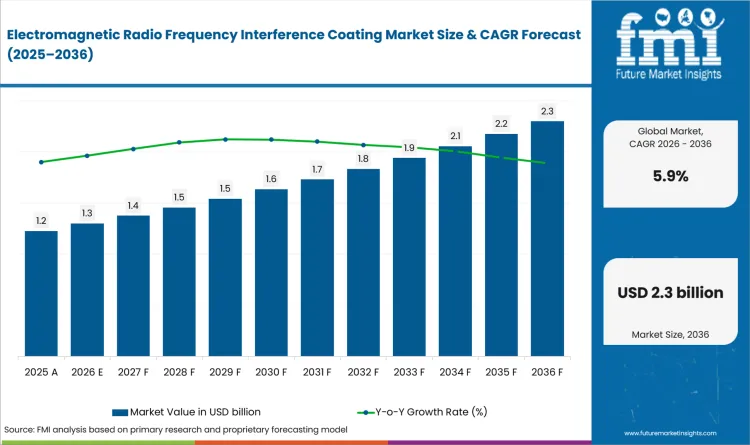
USD 1.3 billion in 2026 and USD 2.3 billion by 2036 at a 5.9% CAGR.
Sales of electromagnetic radio frequency interference coatings are estimated to rise at 5.9% CAGR through 2036, increasing valuation from USD 1.3 billion in 2026 to USD 2.3 billion by 2036. Conductive and absorptive layers address enclosures that cannot control interference through geometry and grounding alone. High-frequency equipment requires test procedures aligned with operating bands and complete assembly configurations across representative production units. Federal Communications Commission guidance issued in March 2025 established measurement procedures for millimeter-wave devices operating above conventional test ranges. Frequency-specific testing connects coating selection with attenuation measured across the finished radio enclosure during formal compliance evaluation, while EMC shielding equipment frames the broader compliance environment for electronic systems that need coordinated testing and material selection.
Japanese electronics programs need repeatable emissions control across compact multimedia equipment that changes between product generations. VCCI requires members to test covered equipment at registered facilities and submit a conformity confirmation report ahead of shipment. Registered testing gives application engineers a consistent basis for comparing revised housings and grounding layouts. German equipment programs face a risk through active surveillance of finished products across distribution channels. Bundesnetzagentur reported in February 2025 that around 8,000 product types failed legal requirements during 2024. The enforcement record raises the commercial value of traceable film thickness and corrective application support. Both systems favor formulations that fit established masking and curing routines across production lines and model revisions, making electronic materials and chemicals relevant to processing compatibility as well as conductivity and shielding performance.
Key Takeaways of Electromagnetic Radio Frequency Interference Coating Market
- Higher circuit density increases shielding pressure across molded enclosures that cannot control emissions through geometry and grounding alone.
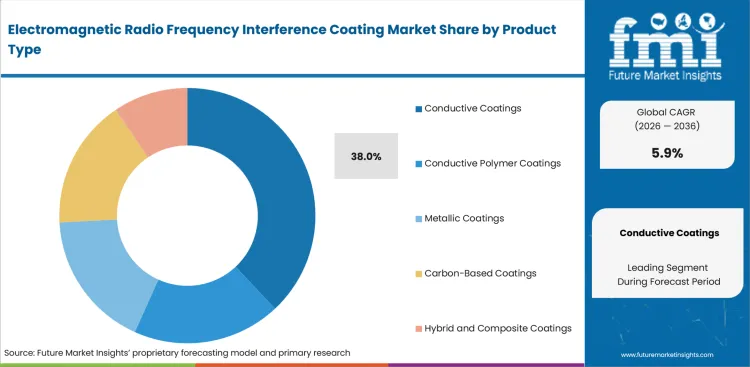
- Conductive coatings are expected to account for 38.0% of product type in 2026 because selective spray application supports varied enclosure shapes.
- Consumer electronics is projected to represent 28.0% by application in 2026 as compact devices combine several radios with sensitive circuits.
- Direct sales is anticipated to capture 36.0% in 2026 due to coordinated formulation support and application engineering.
- Weak adhesion and incomplete edge coverage can erase laboratory shielding gains during volume production across complex molded components.
- Formulation competition spans Henkel AG & Co. KGaA, PPG Industries, Inc., Parker-Hannifin Corporation, MG Chemicals Ltd., Mueller Corporation, and Cambium Biomaterials, Inc., while Curtiss-Wright Corporation and Applied Coating Technologies Ltd. compete through controlled application services across qualified electronics programs.
Analyst Perspective
“Electromagnetic interference coatings earn repeat orders through controlled application across the complete enclosure rather than isolated material conductivity. Untreated seams and poorly connected ground points can erase attenuation produced by an otherwise suitable formulation. Electronics manufacturers should approve cleaning and film thickness together with finished-assembly testing so later design revisions preserve traceable compliance performance.”
- Nikhil Kaitwade, Principal Analyst, Future Market Insights
How is the Electromagnetic Radio Frequency Interference Coating Market segmented?
The electromagnetic radio frequency interference coating market is segmented by product type, application, end user, distribution channel, technology, and region.
The market is segmented by product type, application, end user, distribution channel, technology, and region. Product type covers conductive, metallic, carbon-based, polymer, and hybrid coating systems used across molded or metal housings. Application analysis includes consumer electronics, telecommunications, automotive, aerospace and defense, medical equipment, and industrial electronics. End-user analysis separates electronics manufacturers from telecommunications, automotive, aerospace, medical, and industrial producers with separate qualification priorities. Distribution channels include direct manufacturer sales, chemical distributors, coating applicators, system integrators, and purchasing platforms. Technology analysis compares metallic particles, conductive polymers, carbon fillers, coated fillers, and hybrid nanocomposites across process requirements. Regional analysis considers approval routes, electronics production conditions, application capacity, and technical service access across locations, while printed circuit boards add related context for grounded assemblies that must operate with coated enclosures.
What supports demand for conductive coatings within the product type category?
Conductive coatings form an electrical path across molded housings that cannot attenuate interference through the base material. Application engineers must control cleaning and film thickness across edges and grounded interfaces during representative production runs. Level-three equipment programs require independent electromagnetic compatibility evidence from representative finished products for commercial release. The Australian Communications and Media Authority confirmed this requirement in June 2026 through accredited testing rules, reinforcing demand for electrically conductive coating materials that combine surface coverage with measured conductivity.
- The conductive coatings segment is likely to capture 38.0% share in 2026 attributable to flexible spray and selective application across molded housings. Application engineers can adjust film thickness around apertures during enclosure development without replacing the complete base material. The segment retains its position through stable resistance across seams and ground points during repeated production batches.
- Demand for conductive coatings is expected to expand among electronics manufacturers seeking lightweight shielding across plastic housings. Production approval requires controlled cleaning and masking with resistance measurements across finished seams during representative assembly runs. Repeat purchasing depends on adhesion surviving humidity and temperature cycling without substantial variation across application batches and enclosure revisions.
How does consumer electronics shape demand within the application category?
Compact consumer devices place several radios beside high-speed processors inside housings with limited room for separate metal shields. Material selection must preserve antenna clearances and industrial design throughout every product generation and model revision. Mueller Coatings described conductive polymers, metallic systems, graphene, and hybrid coatings for consumer products in February 2025. Each redesign requires finished-device testing as antenna or ground changes can alter attenuation across the assembled housing, and recurring consumer electronics design programs support repeated material qualification and purchasing.
- In 2026, consumer electronics is expected to lead application with 28.0% share due to frequent enclosure redesign and dense wireless integration. Thin coating layers preserve internal space across phones and wearable devices with complex radio layouts. Approved material families support recurring models without replacing the complete housing design or assembly route.
- Consumer electronics manufacturers are increasing purchases of thin shielding coatings that preserve internal space across compact wireless products. Revised housings require fresh finished-device emissions testing across representative production units and normal assembly conditions. Adoption weakens if each model needs different spray equipment or cure conditions that interrupt established assembly routines and output targets.
How is the electronics manufacturers segment positioned within the end user category?
Electronics manufacturers control coating specifications and validation through process engineering teams and internal compliance functions throughout qualification. Medical electronics add strict application tolerances and resistance to cleaning or sterilization procedures used during routine service. Regulated programs therefore need application controls connecting material selection with documented production records and audit requirements. Mueller Coatings described EMI and RFI shielding for medical electronics in August 2025 through processes managed under ISO 13485 controls. Internal ownership lets manufacturers extend an approved process across related housings and preserve finished-enclosure testing for grounded board interfaces.
- Electronics manufacturers are projected to hold 30.0% share in 2026 owing to direct control over specifications and validation budgets. Process engineers can extend one approved material system across related device families and established production equipment. Internal control supports repeat purchasing as enclosure dimensions and circuit layouts change between production programs.
- Electronics manufacturer adoption is gaining momentum through representative molded-part trials and resistance mapping across finished edges. Process engineers widen approved use following stable results across several production batches and documented environmental tests. Deployment slows if cure conditions damage existing plastics or add handling stages across final assembly operations and quality inspection.
What makes direct sales central to the distribution channel category?
Direct sales suits programs requiring joint review of substrate treatment and finished-device results across representative assemblies. Regulated equipment programs require clear responsibility for technical documentation across each commercial channel and qualification stage. United Kingdom electromagnetic compatibility guidance updated in March 2025 defined duties for manufacturers and distributors placing equipment on the market. Direct account support carries commercial value across repeated design changes and formal compliance records throughout qualification, especially where 5G technology requires frequency-specific material decisions across dense radio systems.
- Based on distribution channel, direct sales is projected to account for 36.0% in 2026 due to application engineering during qualification. Direct engagement reduces errors in substrate preparation and grounding design across complex housings during pilot production. Account engineers can adjust coating parameters inside an approved material family without restarting the complete qualification route.
- Purchase activity through direct sales is anticipated to rise across accounts requiring batch records and rapid technical response. Contract value comes from agreed test methods and corrective support rather than lower material pricing. Repeat demand strengthens as account engineers adjust parameters inside the approved coating family for revised enclosure designs and production conditions.
How do operators evaluate metallic particle-based shielding within the technology category?
Metallic particle systems use silver or copper fillers to form a conductive path through the cured coating. Familiar resistance tests suit production lines, but certification programs require attenuation across approved enclosure configurations and operating bands. Innovation, Science and Economic Development Canada retained certification requirements through a July 2025 amendment covering land mobile and fixed radio equipment. Metallic systems remain attractive for production teams valuing established measurements across varied substrates and application equipment, while conductive polymer coating alternatives offer lower-density options with different processing requirements and application controls.
- By technology, metallic particle-based shielding is estimated to hold 31.0% in 2026 owing to established conductivity and familiar resistance tests. Existing spray equipment reduces process uncertainty across programs accepting higher material costs and controlled curing requirements. Production engineers can compare cured film performance through established thickness and surface-resistance controls across representative enclosure areas.
- Sales of metallic particle-based shielding are forecast to gain traction across established spray lines with documented resistance controls. Application teams match particle size and binder chemistry with substrate requirements across molded components and grounded interfaces. Commercial use broadens as cured films retain conductivity across edges and fastener zones during temperature changes and repeated handling.
What are the drivers, restraints, and opportunities in the Electromagnetic Radio Frequency Interference Coating Market?
Compact electronic assemblies support coating demand by concentrating several radios and sensitive circuits inside molded housings. Poor surface preparation restricts qualification because interrupted conductive paths weaken attenuation across seams and grounded interfaces. Lower-emission formulations provide a practical development route through controlled spray processes and documented electrical performance.
- Driver: Dense electronic assemblies increase interference paths that enclosure designers must control during finished-product authorization and production testing.
- Restraint: Surface contamination and incomplete edge coverage produce unstable shielding across coating formulations that perform adequately on flat test panels.
- Opportunity: Waterborne and lower-emission systems can combine simpler material handling with verified conductivity across controlled automated application processes.
Dense electronic assemblies increase interference paths as several radios and high-speed processors share smaller enclosure volumes. Connected vehicle modules add simultaneous signals that require controlled radiated performance across compact housings and coordinated antenna systems. Federal Communications Commission guidance issued in February 2025 defined certification procedures for cellular vehicle communication devices under revised rules. The certification route connects finished-enclosure attenuation with formal measurements across the complete communication assembly during product authorization, and automotive semiconductor use extends the same pressure across sensors and communication hardware in connected vehicles.
Surface contamination materially restrains adoption through weak adhesion and interrupted ground paths that conductivity cannot overcome. Aerosol delivery formats add chemical controls and reporting duties beside application qualification for functional shielding performance. The U.S. Environmental Protection Agency finalized aerosol coating amendments in January 2025 with updated test methods and electronic reporting. Poor cleaning or uneven thickness increases rework across otherwise suitable formulations and delays recurring production orders. Capacity investment remains exposed until application providers control preparation and record approved process limits across representative assemblies.
Lower-emission formulations provide a practical route for electronics plants seeking simpler ventilation and material handling. Waterborne and high-solids systems can reduce volatile emissions without removing functional validation across finished enclosure assemblies. The U.S. Environmental Protection Agency listed both approaches among compliant lower-emission coating techniques in November 2025. Electronics manufacturers can combine cleaner processing with automated spray control and resistance mapping across finished parts, while medical coatings show why sensitive applications value cleaner processing beside controlled durability and repeatable application performance.
Which country CAGRs are profiled in the Electromagnetic Radio Frequency Interference Coating Market?
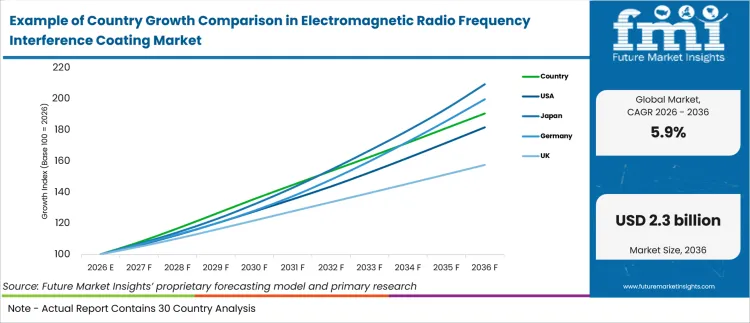
| Country | CAGR |
|---|---|
| Japan | 7.7% |
| Germany | 7.2% |
| USA | 6.2% |
| Australia | 5.7% |
| Canada | 5.1% |
| UK | 4.6% |
| South Korea | 4.1% |
How do country-level CAGRs compare in the Electromagnetic Radio Frequency Interference Coating Market?
The country rates span 3.6 percentage points between Japan at 7.7% CAGR and South Korea at 4.1% CAGR. Japan and Germany form a closely spaced upper group separated by exactly 0.5 percentage point. The USA and Australia occupy the middle range through another clearly measured 0.5-point forecast interval. Canada and the UK follow with the same 0.5-point separation across their approved national forecasts. South Korea sits 0.5 percentage point below the UK despite its larger electronics production base. The comparison measures coating revenue expectations rather than total electronic device output across each economy.
- Japan stands 0.5 percentage point above Germany as compact electronics production requires frequent enclosure qualification across several device categories.
- Germany remains 1.0 percentage point above the USA as specification-led machinery programs support recurring coating validation across exported electronic controls.
- The USA exceeds Australia by 0.5 percentage point as larger electronics programs support repeated qualification across automotive and communications equipment.
- Australia remains 0.6 percentage point above Canada as accredited testing obligations support focused coating demand across regulated equipment programs.
- Canada holds a 0.5-point advantage over the UK as certification updates maintain material review across land mobile and fixed radio equipment.
- The UK exceeds South Korea by 0.5 percentage point through the model balance between addressable coating revenue and domestic production intensity.
- South Korea remains 0.5 percentage point below the UK despite dense electronics production that supports specialist demand for high-frequency and heat-resistant shielding coatings.
Comparable CAGRs can produce different market entry conditions across countries with distinct manufacturing and regulatory systems. Manufacturing scale and compliance routes directly affect coating qualification timing across the seven profiled countries. The full report provides country-level CAGR analysis across North America, Latin America, Europe, East Asia, South Asia, Oceania and the Middle East and Africa.
Country-wise Analysis
- Japanese electronics plants require coatings that fit compact production lines and detailed material qualification routines. Electromagnetic interference coating sales in Japan are forecast to expand at 7.7% CAGR by 2036, supported by frequent qualification across compact electronics programs. Local programs depend on facilities evaluating radiated emissions and immunity across representative finished assemblies and operating configurations. The Chubu Bureau of Economy, Trade and Industry described that route in November 2025 through a public testing center using CISPR and IEC methods. Large-equipment chamber access provides a direct enabler near customer production sites and application engineering teams. Lengthy approval routines remain a material friction for unfamiliar formulations entering established device programs and validated production lines.
- German equipment programs require documented material performance across domestic retail channels and wider European distribution networks. Germany’s electromagnetic interference coating market outlook is anticipated to advance at 7.2% CAGR over the assessment period, underpinned by specification-led equipment manufacturing. Market surveillance makes finished-device performance a direct part of material qualification across exported electronics and industrial controls. Bundesnetzagentur reported in February 2026 that 58% of nearly 2,100 equipment types checked during 2025 were noncompliant. Established industrial coating channels provide a direct enabler through local application support near major manufacturing clusters. Long validation cycles and strict process records delay revenue across accounts evaluating unfamiliar materials and revised application procedures.
- United States electronics programs combine large production runs with formal equipment authorization and product liability requirements. The USA electromagnetic interference coating market is estimated to post 6.2% CAGR over the forecast period, shaped by automotive and communications electronics. Multi-antenna products require methods reflecting coordinated transmitters inside one operating band and complete enclosure configuration. The Federal Communications Commission updated measurement guidance in March 2025 for devices using coordinated antenna systems and multiple outputs. Large engineering programs provide a direct enabler for repeated qualification across automotive and network equipment production. Uneven application quality across distant manufacturing regions remains a material service friction for national account expansion.
- Australian equipment providers must document electromagnetic compatibility through the national compliance route for covered electronic products. By 2036, Australia’s electromagnetic interference coating market is projected to grow at 5.7% CAGR and is aided by accredited testing requirements. Product records connect coating selection with evidence held by the responsible Australian entity throughout commercial supply. The Australian Communications and Media Authority updated its record guidance in March 2025 and required declarations with relevant test reports ahead of supply. Accredited laboratories provide a direct enabler for regulated equipment programs across major urban manufacturing centers. Geographic distance and limited application capacity raise service costs during qualification and corrective work outside those centers.
- Canadian radio equipment programs operate within certification rules defining frequency coverage and technical records for commercial release. The Canada electromagnetic interference coating sector is projected to record 5.1% CAGR during the assessment period, influenced by certification updates for radio equipment. High-frequency programs require enclosure materials preserving attenuation across narrow operating bands and compact grounded assemblies. Innovation, Science and Economic Development Canada published RSS-193 in July 2025 for broadband equipment operating between 27.5 and 28.35 GHz. Cross-border laboratory access provides a direct enabler for technical evaluation across major electronics and communications programs. Long service distances weaken local economics for smaller accounts outside established electronics centers and application hubs.
- United Kingdom manufacturers must satisfy electromagnetic compatibility obligations through documented conformity procedures for covered electronic equipment. Electromagnetic interference coating demand in the UK is forecast to rise at 4.6% CAGR over the forecast period, linked to regulated product placement and specialist electronics production. Product marking determines the technical records maintained for covered equipment entering the Great Britain market. The Department for Business and Trade restated in March 2026 that covered equipment can use UKCA or CE marking across Great Britain. Specialist electronics production provides a direct enabler for complex molded housings and low-volume technical programs. Smaller program volumes restrict material revenue for application providers carrying local technical support and qualification resources.
- South Korean electronics plants combine dense production clusters with short design cycles across advanced communications equipment. Adoption of electromagnetic interference coatings in South Korea is estimated to expand at 4.1% CAGR through 2036, reinforced by rapid redesign across communications electronics. Recognized test reports require laboratories using current electromagnetic compatibility measurement methods across approved equipment categories. The National Radio Research Agency updated its recognition annex in August 2025 and specified radiated-emission measurement distances below 6 GHz. Concentrated electronics production provides a direct enabler for technical support near major accounts and application lines. Strong incumbent relationships make unfamiliar coating approval difficult across established production programs and qualified material lists.
Who are the notable companies in the Electromagnetic Radio Frequency Interference Coating Market?
Henkel AG & Co. KGaA, PPG Industries, Inc., Parker-Hannifin Corporation, MG Chemicals Ltd., Curtiss-Wright Corporation, Mueller Corporation (dba Mueller Coatings), Cambium Biomaterials, Inc., and Applied Coating Technologies Ltd. are notable companies shaping the market.
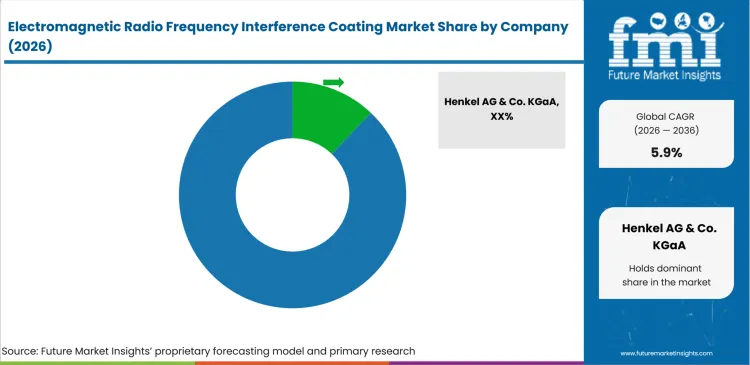
The competitive field is fragmented between global material groups and specialist application houses with different technical boundaries. Large companies pursue multi-program accounts through formulation breadth and regional engineering support across several electronics sectors. Specialist formulators enter through substrate-specific chemistry or rapid changes during qualification for demanding enclosure designs. Coating applicators defend established positions through controlled spray processes and responsibility for repeatable film thickness. High-frequency and severe-temperature programs provide entry scope for differentiated materials, although approved production records raise switching costs. Conductive chemistry used in printed electronics provides related context for printed components and flexible electronic assemblies. Finished-enclosure testing remains a separate commercial barrier for every coating provider seeking qualified production approval.
- Henkel AG & Co. KGaA, PPG Industries, Inc., and Parker-Hannifin Corporation compete through broad coating portfolios and regional engineering support. Their scale supports qualification across several electronics sectors, although each customer program requires substrate-specific testing and finished-enclosure evidence across production batches.
- MG Chemicals Ltd., Mueller Corporation operating as Mueller Coatings, and Cambium Biomaterials, Inc. compete through specialist chemistry or demanding temperature capability. Responsive formulation support gives these companies credible entry routes during prototype qualification and controlled production expansion across technical programs.
- Curtiss-Wright Corporation and Applied Coating Technologies Ltd. compete through engineered application services across qualified production programs. Controlled coating processes support manufacturers lacking internal spray expertise across complex components and regulated equipment assemblies during recurring production and formal inspection cycles across customer programs.
Competitive Benchmarking: Electromagnetic Radio Frequency Interference Coating Market
| Company | Conductive Coating Portfolio | RF Absorption and Frequency Control | Application Engineering | Geographic Reach |
|---|---|---|---|---|
| Henkel AG & Co. KGaA | High | Low | High | Global |
| PPG Industries, Inc. | High | High | High | Global |
| Parker-Hannifin Corporation | High | High | High | Global |
| MG Chemicals Ltd. | High | Low | Medium | Multi-country |
| Curtiss-Wright Corporation | Medium | Low | High | Global |
| Mueller Corporation (dba Mueller Coatings) | Medium | Low | High | North America |
| Cambium Biomaterials, Inc. | Medium | Medium | Medium | United States and Europe |
| Applied Coating Technologies Ltd. | High | Low | High | Europe |
Key Developments in the Electromagnetic Radio Frequency Interference Coating Market
- In March 2025, Vergason Technology confirmed that HEF Groupe acquired all outstanding shares of the coating equipment and service provider. The business now operates as TS VTI and continues EMI and RFI shielding services beside physical vapor deposition equipment. HEF stated that the combination would expand coating equipment and technical services across additional international markets. The transaction gives enclosure manufacturers an outsourced route for qualification and production application without dedicated equipment investment.
- In June 2026, Cambium Biomaterials launched ApexShield 3000 as a sprayable high-temperature coating for metallic and composite substrates. The company described electromagnetic and radio frequency shielding across electronics programs operating under severe thermal conditions. Its performance range gives aerospace and defense manufacturers a specialist route for components that cannot use standard conductive coatings. Commercial qualification requires finished-component testing across intended temperature ranges and operating frequencies during representative service conditions.
- In May 2026, MG Chemicals developed 842ARL as a thinner silver-flake conductive paint for electromagnetic shielding. The company reported 60 to 100 dB attenuation across a wide frequency range at a 25-micrometer coating thickness. The formulation gives electronics manufacturers a lower-material route for programs whose compliance target does not require maximum silver loading. Finished-enclosure testing remains necessary across intended frequencies and representative production assemblies under normal operating conditions.
Electromagnetic Radio Frequency Interference Coating Market - Report Scope
| Coverage field | Report scope |
|---|---|
| Market breakdown | Product type, application, end user, distribution channel, technology, and region. |
| Quantitative Units | Revenue in USD Billion, CAGR in %. |
| Market Definition | Conductive and absorptive coatings applied to plastic, composite, or metal enclosures and components to reduce electromagnetic and radio-frequency interference. |
| Regions Covered | North America, Latin America, Western Europe, Eastern Europe, East Asia, South Asia and Pacific, and Middle East and Africa. |
| Countries Covered | Japan, Germany, USA, Australia, Canada, UK, and South Korea. |
| Key Companies Profiled | Henkel AG & Co. KGaA, PPG Industries, Inc., Parker-Hannifin Corporation, MG Chemicals Ltd., Curtiss-Wright Corporation, Mueller Corporation (dba Mueller Coatings), Cambium Biomaterials, Inc., and Applied Coating Technologies Ltd. |
| Forecast Period | 2026 to 2036. |
| Approach | Hybrid bottom-up and top-down market sizing supported by primary interviews and official desk research. |
Electromagnetic Radio Frequency Interference Coating Market - Research Methodology
| Method | Approach |
|---|---|
| Primary Research | FMI analysts gathered input from manufacturers, service providers, technology developers, distributors, end users, procurement teams, and subject-matter experts. Interviews examined purchasing decisions, product or service evaluation, adoption barriers, approval requirements, pricing considerations, and expectations for technical or commercial support. Respondents were also asked what evidence is required before a trial, pilot, or initial order develops into regular purchasing. |
| Desk Research | Desk research covered government statistics, regulatory publications, trade data, industry associations, technical literature, standards, company filings, product information, and official corporate announcements. Sources were reviewed for relevance, publication date, geographic coverage, and consistency with the defined market scope. Claims relating to performance, applications, approvals, capacity, investment, and commercial activity were retained only when supported by credible public evidence. |
| Market Sizing and Forecasting | The market model combined the baseline value with historical performance, segment structure, pricing and volume indicators, adoption levels, company participation, and country-level demand conditions. Forecast assumptions considered economic activity, investment trends, regulatory developments, technology adoption, purchasing cycles, supply availability, and barriers to wider market use. Segment and regional estimates were reconciled before the final market total was calculated. |
| Data Validation | Estimates were checked against multiple independent indicators, including public data, company activity, trade patterns, industry developments, and findings from primary interviews. Validation also tested whether products, services, applications, and company revenues fell within the defined market boundaries. Adjacent categories, unsupported claims, overlapping revenues, and activities without direct market relevance were excluded to reduce double counting and maintain consistency across segments and countries. |
Electromagnetic Radio Frequency Interference Coating Market by Segments
Electromagnetic Radio Frequency Interference Coating Market segmented by Product Type:
- Conductive Coatings
- Silver-Based Coatings
- Copper-Based Coatings
- Conductive Polymer Coatings
- Carbon-Based Polymer Coatings
- Intrinsically Conductive Polymer Coatings
- Metallic Coatings
- Nickel-Based Coatings
- Aluminum-Based Coatings
- Carbon-Based Coatings
- Graphite-Based Coatings
- Carbon Nanotube and Graphene Coatings
- Hybrid and Composite Coatings
- Metal-Polymer Hybrid Coatings
- Multi-Filler Composite Coatings
Electromagnetic Radio Frequency Interference Coating Market segmented by Application:
- Consumer Electronics
- Smartphones and Tablets
- Laptops and Wearable Devices
- Telecommunications
- Communication Equipment
- 5G and Network Infrastructure
- Automotive
- Electric Vehicles
- Conventional Automotive Electronics
- Aerospace and Defense
- Avionics and Aircraft Systems
- Radar and Defense Electronics
- Medical
- Medical Imaging Equipment
- Diagnostic and Monitoring Devices
- Industrial and Other Applications
- Industrial Electronics
- Testing and Measurement Equipment
Electromagnetic Radio Frequency Interference Coating Market segmented by End User:
- Electronics Manufacturers
- Consumer Electronics Manufacturers
- Industrial Electronics Manufacturers
- Telecommunication Equipment Manufacturers
- Network Equipment Manufacturers
- Wireless Communication Equipment Manufacturers
- Automotive OEMs and Tier Suppliers
- Vehicle OEMs
- Automotive Component Suppliers
- Aerospace and Defense Manufacturers
- Aerospace System Manufacturers
- Defense Electronics Manufacturers
- Medical Device Manufacturers
- Medical Equipment Manufacturers
- Diagnostic Device Manufacturers
- Other Industrial End Users
- Testing and Measurement Companies
- Industrial Equipment Manufacturers
Electromagnetic Radio Frequency Interference Coating Market segmented by Distribution Channel:
- Direct Sales
- Direct Manufacturer Sales
- Long-Term OEM Contracts
- Specialty Chemical Distributors
- Regional Chemical Distributors
- Electronic Materials Distributors
- Industrial Coating Distributors
- Industrial Coating Suppliers
- Specialized Coating Applicators
- OEM and System Integrator Channels
- Electronics OEM Partnerships
- System Integration Contracts
- Online and B2B Procurement Channels
- Industrial E-Commerce Platforms
- B2B Procurement Portals
Electromagnetic Radio Frequency Interference Coating Market segmented by Technology:
- Metallic Particle-Based Shielding
- Silver Particle Technology
- Nickel and Copper Particle Technology
- Carbon-Based Shielding
- Graphite-Based Technology
- Carbon Nanotube and Graphene Technology
- Conductive Polymer Technology
- Polyaniline-Based Technology
- Polypyrrole-Based Technology
- Metal-Coated Filler Technology
- Metal-Coated Carbon Fillers
- Metal-Coated Polymer Fillers
- Hybrid Nanocomposite Technology
- Metal-Carbon Nanocomposites
- Multi-Filler Nanocomposites
Electromagnetic Radio Frequency Interference Coating Market by Region:
- North America
- United States
- Canada
- Latin America
- Brazil
- Mexico
- Argentina
- Chile
- Western Europe
- Germany
- France
- United Kingdom
- Italy
- Spain
- Benelux
- Nordics
- Eastern Europe
- Poland
- Czech Republic
- Romania
- Hungary
- East Asia
- China
- Japan
- South Korea
- South Asia and Pacific
- India
- ASEAN
- Australia and New Zealand
- Middle East and Africa
- GCC Countries
- South Africa
- Türkiye
- Israel
Research Sources and Bibliography
- Australian Communications and Media Authority. (2026, June 18).
- Australian Communications and Media Authority. (2025, March 31).
- Federal Communications Commission. (2025, March 6).
- Federal Communications Commission. (2025, February 24)
- Federal Communications Commission. (2025, March 31).
- Innovation, Science and Economic Development Canada. (2025, July 28).
- Innovation, Science and Economic Development Canada. (2025, July 11).
- VCCI Council. (n.d.).
- Chubu Bureau of Economy, Trade and Industry. (2025, November 17).
- National Radio Research Agency. (2025, August 11).
- Office for Product Safety and Standards. (2025, March 24).
- Department for Business and Trade. (2026, March 31).
- Mueller Coatings. (2025, February 3)
- U.S. Environmental Protection Agency. (2025, January 17)
- U.S. Environmental Protection Agency. (2025, November 10)
- Bundesnetzagentur. (2025, February 6).
- Bundesnetzagentur. (2026, February 5).
- Mueller Coatings. (2025, August 23).
- PPG Industries, Inc. (2026, April 20).
- Vergason Technology, Inc. (2025, March 26).
- TS VTI. (n.d.).
- Cambium. (2026, June 3)
- Mueller Coatings. (2025, February 13).
- Henkel Adhesive Technologies. (n.d.).
- PPG Industries, Inc. (n.d.).
- PPG Industries, Inc. (n.d.).
- Parker-Hannifin Corporation. (n.d.).
- Mueller Coatings. (2025, August 22).
- MG Chemicals Ltd. (2026, May).
This bibliography is provided for reader reference and is not exhaustive. The full report contains the complete reference list and detailed citations
This Report Answers
- How large is the electromagnetic radio frequency interference coating market in 2026 and 2036?
- Which operating pressures support investment in conductive shielding coatings across compact electronic enclosure programs?
- Why do conductive coatings account for the largest product type share across molded enclosure applications?
- How does consumer electronics influence coating qualification and repeat purchasing across compact wireless device programs?
- Why does metallic particle-based shielding retain the largest technology share across frequency-specific enclosure applications?
- How do country growth conditions differ across Japan, Germany, the USA, Australia, Canada, the UK, and South Korea?
- Which companies provide conductive formulations, engineered shielding materials, or specialist application services across the market?
- What limits repeatable coating performance across seams, edges, grounded interfaces, and complex molded geometries?
- How can lower-emission formulations provide differentiated value without sacrificing adhesion, conductivity, or frequency-specific attenuation?
Frequently Asked Questions
How big is the Electromagnetic Radio Frequency Interference Coating Market in 2026?
The electromagnetic radio frequency interference coating market is valued at USD 1.3 billion in 2026 and is forecast to reach USD 2.3 billion by 2036. Growth is supported by increasing circuit density inside molded enclosures that cannot control emissions through geometry and grounding alone, sustaining recurring demand for conductive and absorptive coating formulations across consumer electronics, automotive, and telecommunications equipment programs.
What is the CAGR of the Electromagnetic Radio Frequency Interference Coating Market from 2026 to 2036?
The electromagnetic radio frequency interference coating market grows at a CAGR of 5.9% between 2026 and 2036, supported by electronics manufacturers adopting qualified conductive coating systems once film thickness, substrate adhesion, and finished-enclosure attenuation performance are validated within direct supply arrangements linking formulation support with traceable compliance records across recurring production programs.
Which product type leads the Electromagnetic Radio Frequency Interference Coating Market?
Conductive coatings account for 38.0% of the electromagnetic radio frequency interference coating market by product type in 2026, driven by flexible spray and selective application capability that allows process engineers to adjust film thickness around apertures and grounded interfaces across varied molded enclosure geometries without replacing the complete base material or established assembly routine.
How much will the Electromagnetic Radio Frequency Interference Coating Market add between 2026 and 2036?
The electromagnetic radio frequency interference coating market is set to add USD 1.0 billion between 2026 and 2036, growing from USD 1.3 billion to USD 2.3 billion as conductive, metallic particle, and lower-emission waterborne coating systems enter qualified production programs across a widening base of consumer electronics, automotive, aerospace, and medical equipment manufacturers globally.
Who are the leading companies in the Electromagnetic Radio Frequency Interference Coating Market?
Notable companies competing in the electromagnetic radio frequency interference coating market include Henkel AG & Co. KGaA, PPG Industries Inc., Parker-Hannifin Corporation, MG Chemicals Ltd., Curtiss-Wright Corporation, Mueller Corporation, Cambium Biomaterials Inc., and Applied Coating Technologies Ltd., differentiating through conductive coating portfolio breadth, radio frequency absorption capability, application engineering depth, and the geographic reach of their technical qualification and production support networks.
Preview the report firsthand - request a free sample
Get SampleGet the brochure for pricing and purchase details.
Get PDFTable of Content
- Key Takeaways
- Market Size and CAGR
- Top Growth Driver
- Fastest Growing Segment
- Leading Region
- Key Companies
- Emerging Opportunities
- Executive Summary
- Global Market Outlook
- Demand-side Trends
- Supply-side Trends
- Technology Roadmap Analysis
- Analysis and Recommendations
- Analyst Perspective (What is happening? Why now? What should investors know?)
- Key Questions Answered
- How large is the market?
- What is the CAGR?
- What are key trends?
- Which region dominates?
- Who are the leaders?
- Market Overview
- Market Coverage / Taxonomy
- Market Definition / Scope / Limitations
- Research Methodology
- Chapter Orientation
- Analytical Lens and Working Hypotheses
- Market Structure, Signals, and Trend Drivers
- Benchmarking and Cross-market Comparability
- Market Sizing, Forecasting, and Opportunity Mapping
- Research Design and Evidence Framework
- Desk Research Programme (Secondary Evidence)
- Expert Input and Fieldwork (Primary Evidence)
- Tooling, Models, and Reference Databases
- Data Engineering and Model Build
- Quality Assurance and Audit Trail
- Market Background
- Market Dynamics (Drivers, Restraints, Opportunity, Trends)
- Scenario Forecast (Optimistic, Likely, Conservative)
- Impact Analysis
- AI Impact
- Sustainability Impact
- Regulatory Impact
- Technology Impact
- Consumer / Buyer Analysis
- Purchase Drivers
- Adoption Barriers
- Buyer Journey
- Opportunity Map Analysis
- Product Life Cycle Analysis
- Supply Chain Analysis
- Investment Feasibility Matrix
- Value Chain Analysis
- PESTLE and Porter's Analysis
- Regulatory Landscape
- Regional Parent Market Outlook
- Production and Consumption Statistics
- Import and Export Statistics
- Global Market Analysis and Forecast, 2021 to 2036
- Historical Market Size Value (USD billion) Analysis, 2021 to 2025
- Current and Future Market Size Value (USD billion) Projections, 2026 to 2036
- Y-o-Y Growth Trend Analysis
- Absolute $ Opportunity Analysis
- Global Market Pricing Analysis, 2021 to 2036
- Global Market Analysis and Forecast, By Product Type, 2021 to 2036
- Introduction / Key Findings
- Historical Market Size Value (USD billion) Analysis By Product Type, 2021 to 2025
- Current and Future Market Size Value (USD billion) Analysis and Forecast By Product Type, 2026 to 2036
- Conductive Coatings
- Silver-Based Conductive Coatings
- Copper-Based Conductive Coatings
- Conductive Polymer Coatings
- Carbon-Based Polymer Coatings
- Inherently Conductive Polymer Coatings
- Metallic Coatings
- Nickel-Based Coatings
- Aluminum-Based Coatings
- Carbon-Based Coatings
- Graphite-Based Coatings
- Carbon Nanotube and Graphene Coatings
- Hybrid and Composite Coatings
- Metal-Polymer Hybrid Coatings
- Multi-Filler Composite Coatings
- Conductive Coatings
- Y-o-Y Growth Trend Analysis By Product Type, 2021 to 2025
- Absolute $ Opportunity Analysis By Product Type, 2026 to 2036
- Global Market Analysis and Forecast, By Application, 2021 to 2036
- Introduction / Key Findings
- Historical Market Size Value (USD billion) Analysis By Application, 2021 to 2025
- Current and Future Market Size Value (USD billion) Analysis and Forecast By Application, 2026 to 2036
- Consumer Electronics
- Smartphones and Tablets
- Laptops and Wearable Devices
- Telecommunications
- Communication Equipment
- 5G and Network Infrastructure
- Automotive
- Electric Vehicles
- Conventional Automotive Electronics
- Aerospace and Defense
- Avionics and Aircraft Systems
- Radar and Defense Electronics
- Medical
- Medical Imaging Equipment
- Diagnostic and Monitoring Devices
- Industrial and Other Applications
- Industrial Electronics
- Testing and Measurement Equipment
- Consumer Electronics
- Y-o-Y Growth Trend Analysis By Application, 2021 to 2025
- Absolute $ Opportunity Analysis By Application, 2026 to 2036
- Global Market Analysis and Forecast, By End User, 2021 to 2036
- Introduction / Key Findings
- Historical Market Size Value (USD billion) Analysis By End User, 2021 to 2025
- Current and Future Market Size Value (USD billion) Analysis and Forecast By End User, 2026 to 2036
- Electronics Manufacturers
- Consumer Electronics Manufacturers
- Industrial Electronics Manufacturers
- Telecommunication Equipment Manufacturers
- Network Equipment Manufacturers
- Wireless Communication Equipment Manufacturers
- Automotive OEMs and Tier Suppliers
- Vehicle OEMs
- Automotive Component Suppliers
- Aerospace and Defense Manufacturers
- Aerospace System Manufacturers
- Defense Electronics Manufacturers
- Medical Device Manufacturers
- Medical Equipment Manufacturers
- Diagnostic Device Manufacturers
- Other Industrial End Users
- Testing and Measurement Companies
- Industrial Equipment Manufacturers
- Electronics Manufacturers
- Y-o-Y Growth Trend Analysis By End User, 2021 to 2025
- Absolute $ Opportunity Analysis By End User, 2026 to 2036
- Global Market Analysis and Forecast, By Distribution Channel, 2021 to 2036
- Introduction / Key Findings
- Historical Market Size Value (USD billion) Analysis By Distribution Channel, 2021 to 2025
- Current and Future Market Size Value (USD billion) Analysis and Forecast By Distribution Channel, 2026 to 2036
- Direct Sales
- Direct Manufacturer Sales
- Long-Term OEM Contracts
- Specialty Chemical Distributors
- Regional Chemical Distributors
- Electronic Materials Distributors
- Industrial Coating Distributors
- Industrial Coating Suppliers
- Specialized Coating Applicators
- OEM and System Integrator Channels
- Electronics OEM Partnerships
- System Integration Contracts
- Online and B2B Procurement Channels
- Industrial E-Commerce Platforms
- B2B Procurement Portals
- Direct Sales
- Y-o-Y Growth Trend Analysis By Distribution Channel, 2021 to 2025
- Absolute $ Opportunity Analysis By Distribution Channel, 2026 to 2036
- Global Market Analysis and Forecast, By Technology, 2021 to 2036
- Introduction / Key Findings
- Historical Market Size Value (USD billion) Analysis By Technology, 2021 to 2025
- Current and Future Market Size Value (USD billion) Analysis and Forecast By Technology, 2026 to 2036
- Metallic Particle-Based Shielding
- Silver Particle Technology
- Nickel and Copper Particle Technology
- Carbon-Based Shielding
- Graphite-Based Technology
- Carbon Nanotube and Graphene Technology
- Conductive Polymer Technology
- Polyaniline-Based Technology
- Polypyrrole-Based Technology
- Metal-Coated Filler Technology
- Metal-Coated Carbon Fillers
- Metal-Coated Polymer Fillers
- Hybrid Nanocomposite Technology
- Metal-Carbon Nanocomposites
- Multi-Filler Nanocomposites
- Metallic Particle-Based Shielding
- Y-o-Y Growth Trend Analysis By Technology, 2021 to 2025
- Absolute $ Opportunity Analysis By Technology, 2026 to 2036
- Global Market Analysis and Forecast, By Region, 2021 to 2036
- Introduction
- Historical Market Size Value (USD billion) Analysis By Region, 2021 to 2025
- Current Market Size Value (USD billion) Analysis and Forecast By Region, 2026 to 2036
- North America
- Latin America
- Western Europe
- Eastern Europe
- East Asia
- South Asia and Pacific
- Middle East & Africa
- Market Attractiveness Analysis By Region
- North America Market Analysis and Forecast, By Country, 2021 to 2036
- Historical Market Size Value (USD billion) Trend Analysis By Market Taxonomy, 2021 to 2025
- Market Size Value (USD billion) Forecast By Market Taxonomy, 2026 to 2036
- By Country
- USA
- Canada
- By Product Type
- By Application
- By End User
- By Distribution Channel
- By Technology
- By Country
- Market Attractiveness Analysis
- By Country
- By Product Type
- By Application
- By End User
- By Distribution Channel
- By Technology
- Key Takeaways
- Latin America Market Analysis and Forecast, By Country
- Historical Market Size Value (USD billion) Trend Analysis By Market Taxonomy, 2021 to 2025
- Market Size Value (USD billion) Forecast By Market Taxonomy, 2026 to 2036
- By Country
- Brazil
- Mexico
- Chile
- Rest of Latin America
- By Product Type
- By Application
- By End User
- By Distribution Channel
- By Technology
- By Country
- Market Attractiveness Analysis
- By Country
- By Product Type
- By Application
- By End User
- By Distribution Channel
- By Technology
- Key Takeaways
- Western Europe Market Analysis and Forecast, By Country
- Historical Market Size Value (USD billion) Trend Analysis By Market Taxonomy, 2021 to 2025
- Market Size Value (USD billion) Forecast By Market Taxonomy, 2026 to 2036
- By Country
- Germany
- UK
- Italy
- Spain
- France
- Nordic
- BENELUX
- Rest of Western Europe
- By Product Type
- By Application
- By End User
- By Distribution Channel
- By Technology
- By Country
- Market Attractiveness Analysis
- By Country
- By Product Type
- By Application
- By End User
- By Distribution Channel
- By Technology
- Key Takeaways
- Eastern Europe Market Analysis and Forecast, By Country
- Historical Market Size Value (USD billion) Trend Analysis By Market Taxonomy, 2021 to 2025
- Market Size Value (USD billion) Forecast By Market Taxonomy, 2026 to 2036
- By Country
- Russia
- Poland
- Hungary
- Balkan & Baltic
- Rest of Eastern Europe
- By Product Type
- By Application
- By End User
- By Distribution Channel
- By Technology
- By Country
- Market Attractiveness Analysis
- By Country
- By Product Type
- By Application
- By End User
- By Distribution Channel
- By Technology
- Key Takeaways
- East Asia Market Analysis and Forecast, By Country
- Historical Market Size Value (USD billion) Trend Analysis By Market Taxonomy, 2021 to 2025
- Market Size Value (USD billion) Forecast By Market Taxonomy, 2026 to 2036
- By Country
- China
- Japan
- South Korea
- By Product Type
- By Application
- By End User
- By Distribution Channel
- By Technology
- By Country
- Market Attractiveness Analysis
- By Country
- By Product Type
- By Application
- By End User
- By Distribution Channel
- By Technology
- Key Takeaways
- South Asia and Pacific Market Analysis and Forecast, By Country
- Historical Market Size Value (USD billion) Trend Analysis By Market Taxonomy, 2021 to 2025
- Market Size Value (USD billion) Forecast By Market Taxonomy, 2026 to 2036
- By Country
- India
- ASEAN
- Australia & New Zealand
- Rest of South Asia and Pacific
- By Product Type
- By Application
- By End User
- By Distribution Channel
- By Technology
- By Country
- Market Attractiveness Analysis
- By Country
- By Product Type
- By Application
- By End User
- By Distribution Channel
- By Technology
- Key Takeaways
- Middle East & Africa Market Analysis and Forecast, By Country
- Historical Market Size Value (USD billion) Trend Analysis By Market Taxonomy, 2021 to 2025
- Market Size Value (USD billion) Forecast By Market Taxonomy, 2026 to 2036
- By Country
- Kingdom of Saudi Arabia
- Other GCC Countries
- Türkiye
- South Africa
- Other African Union
- Rest of Middle East & Africa
- By Product Type
- By Application
- By End User
- By Distribution Channel
- By Technology
- By Country
- Market Attractiveness Analysis
- By Country
- By Product Type
- By Application
- By End User
- By Distribution Channel
- By Technology
- Key Takeaways
- Key Countries Market Analysis
- USA
- Pricing Analysis
- Market Share Analysis, 2025
- By Product Type
- By Application
- By End User
- By Distribution Channel
- By Technology
- Canada
- Pricing Analysis
- Market Share Analysis, 2025
- By Product Type
- By Application
- By End User
- By Distribution Channel
- By Technology
- Mexico
- Pricing Analysis
- Market Share Analysis, 2025
- By Product Type
- By Application
- By End User
- By Distribution Channel
- By Technology
- Brazil
- Pricing Analysis
- Market Share Analysis, 2025
- By Product Type
- By Application
- By End User
- By Distribution Channel
- By Technology
- Chile
- Pricing Analysis
- Market Share Analysis, 2025
- By Product Type
- By Application
- By End User
- By Distribution Channel
- By Technology
- Germany
- Pricing Analysis
- Market Share Analysis, 2025
- By Product Type
- By Application
- By End User
- By Distribution Channel
- By Technology
- UK
- Pricing Analysis
- Market Share Analysis, 2025
- By Product Type
- By Application
- By End User
- By Distribution Channel
- By Technology
- Italy
- Pricing Analysis
- Market Share Analysis, 2025
- By Product Type
- By Application
- By End User
- By Distribution Channel
- By Technology
- Spain
- Pricing Analysis
- Market Share Analysis, 2025
- By Product Type
- By Application
- By End User
- By Distribution Channel
- By Technology
- France
- Pricing Analysis
- Market Share Analysis, 2025
- By Product Type
- By Application
- By End User
- By Distribution Channel
- By Technology
- India
- Pricing Analysis
- Market Share Analysis, 2025
- By Product Type
- By Application
- By End User
- By Distribution Channel
- By Technology
- ASEAN
- Pricing Analysis
- Market Share Analysis, 2025
- By Product Type
- By Application
- By End User
- By Distribution Channel
- By Technology
- Australia & New Zealand
- Pricing Analysis
- Market Share Analysis, 2025
- By Product Type
- By Application
- By End User
- By Distribution Channel
- By Technology
- China
- Pricing Analysis
- Market Share Analysis, 2025
- By Product Type
- By Application
- By End User
- By Distribution Channel
- By Technology
- Japan
- Pricing Analysis
- Market Share Analysis, 2025
- By Product Type
- By Application
- By End User
- By Distribution Channel
- By Technology
- South Korea
- Pricing Analysis
- Market Share Analysis, 2025
- By Product Type
- By Application
- By End User
- By Distribution Channel
- By Technology
- Russia
- Pricing Analysis
- Market Share Analysis, 2025
- By Product Type
- By Application
- By End User
- By Distribution Channel
- By Technology
- Poland
- Pricing Analysis
- Market Share Analysis, 2025
- By Product Type
- By Application
- By End User
- By Distribution Channel
- By Technology
- Hungary
- Pricing Analysis
- Market Share Analysis, 2025
- By Product Type
- By Application
- By End User
- By Distribution Channel
- By Technology
- Kingdom of Saudi Arabia
- Pricing Analysis
- Market Share Analysis, 2025
- By Product Type
- By Application
- By End User
- By Distribution Channel
- By Technology
- Türkiye
- Pricing Analysis
- Market Share Analysis, 2025
- By Product Type
- By Application
- By End User
- By Distribution Channel
- By Technology
- South Africa
- Pricing Analysis
- Market Share Analysis, 2025
- By Product Type
- By Application
- By End User
- By Distribution Channel
- By Technology
- USA
- Market Structure Analysis
- Competition Dashboard
- Competition Benchmarking
- Market Share Analysis of Top Players
- By Regional
- By Product Type
- By Application
- By End User
- By Distribution Channel
- By Technology
- Emerging Startups
- Innovation Benchmarking
- Competition Analysis
- Competition Deep Dive
- Henkel AG & Co. KGaA
- Overview
- Product Portfolio
- Profitability by Market Segments
- Sales Footprint
- Strategy Overview
- Marketing Strategy
- Product Strategy
- Channel Strategy
- PPG Industries, Inc.
- 3M Company
- Akzo Nobel N.V.
- The Sherwin-Williams Company
- BASF SE
- Axalta Coating Systems Ltd.
- Laird Performance Materials
- Parker Hannifin Corporation
- Dow Inc.
- Henkel AG & Co. KGaA
- Case Studies
- Success Stories
- Recent Developments
- Competition Deep Dive
- Assumptions & Acronyms Used


