

- Industry Size (2026)
- USD 11.37 Bn
- Forecast (2036)
- USD 20.95 Bn
- CAGR (2026 to 2036)
- 6.30%
Electronics Films Market Size, Market Forecast and Outlook By FMI
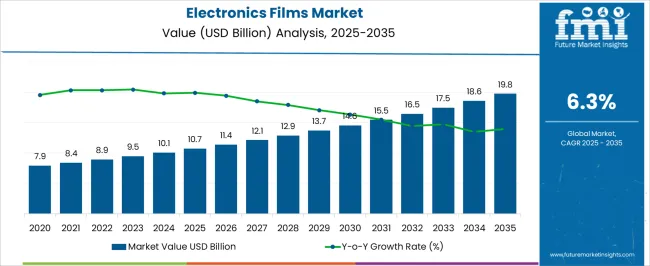
The electronics films market was valued at USD 10.70 billion in 2025, projected to reach USD 11.37 billion in 2026, and is forecast to expand to USD 20.95 billion by 2036 at a 6.30% CAGR. Expanding display panel production for OLED smartphones, automotive displays, and micro-LED signage is driving sustained demand for optical-grade polymer and metal thin films. Photovoltaic cell manufacturing capacity expansion and the growing adoption of perovskite-silicon tandem solar cell architectures require advanced functional film layers that create new addressable demand beyond traditional display and semiconductor applications.
The absolute dollar opportunity of approximately USD 9.58 billion over the forecast period reflects the broadening application base from established display and semiconductor segments into photovoltaic, smart window, and printed electronics categories. Atomic layer deposition and roll-to-roll processing technology improvements are enabling higher-throughput production of precision functional coatings, reducing per-square-metre film costs while maintaining the optical and electrical performance specifications required for advanced electronics applications. Flexible electronics adoption for wearable devices and foldable displays is creating new film substrate requirements that command premium pricing for dimensional stability under repeated bending cycles.
China sets the pace at an 8.5% CAGR, driven by OLED display panel fab expansion, photovoltaic manufacturing capacity buildout, and semiconductor packaging material demand. India follows at 7.9% as solar cell manufacturing investment under PLI scheme incentives generates electronics film procurement. Germany registers 7.2% growth supported by automotive display integration and photovoltaic module manufacturing. France maintains 6.6% driven by semiconductor fab investment and smart window technology adoption. UK expands at 6.0% anchored by printed electronics research commercialization. USA tracks at 5.4% supported by display panel material procurement and semiconductor advanced packaging film demand. Brazil registers 4.7% with photovoltaic module assembly and electronics manufacturing growth.
Summary of Electronics Films Market
- Electronics Films Market Definition
- Electronics films are thin-film materials providing optical, electrical, thermal, or protective functionality in electronic devices, spanning polymer, metal, and oxide films for display, photovoltaic, semiconductor, smart window, and printed electronics applications.
- Demand Drivers in the Market
- OLED display panel fab expansion for smartphones, automotive displays, and signage is generating sustained demand for optical-grade polymer and metal barrier films that meet the stringent moisture and oxygen transmission requirements of organic emissive layers.
- Photovoltaic manufacturing capacity expansion and perovskite-silicon tandem cell architecture adoption require advanced functional film layers including transparent conductive oxides and encapsulation barriers that create new addressable demand.
- Flexible electronics adoption for wearable devices and foldable displays creates premium-priced film substrate requirements where dimensional stability under repeated bending cycles commands specifications above standard rigid device films.
- Key Segments Analyzed in the FMI Report
- Polymer Films by Materials: 41.2% share in 2026, reflecting the broad application range of optical-grade polyester, polyimide, and cyclo-olefin polymer films across display, photovoltaic, and flexible electronics manufacturing.
- Deposition Techniques by Technology: 47.3% share in 2026, as vacuum deposition, sputtering, and atomic layer deposition processes constitute the primary manufacturing methods for precision electronics film production.
- China: 8.5% compound growth driven by OLED fab expansion, photovoltaic manufacturing buildout, and semiconductor packaging material demand across electronics manufacturing clusters.
- Analyst Opinion at FMI
- The electronics films market is entering a technology diversification phase where traditional display-centric demand is supplemented by rapid growth in photovoltaic, flexible electronics, and smart window applications that require different film performance specifications. Film manufacturers who maintain only display-optimized product portfolios forfeit the faster-growing adjacent application segments. The critical supply chain risk centers on high-purity raw material availability for specialty polymer and metal target production, as electronics film quality is directly limited by precursor material purity.
- Strategic Implications / Executive Takeaways
- Electronics film manufacturers must diversify product portfolios beyond display-centric optical films to capture growth in photovoltaic encapsulation, flexible device substrates, and smart window functional coatings.
- Display panel fabs must qualify multiple film suppliers for critical barrier and optical layers to mitigate single-source supply risks during periods of capacity expansion-driven material allocation competition.
- Photovoltaic manufacturers must secure long-term electronics film supply agreements aligned with module production capacity ramp schedules to prevent material availability gaps during manufacturing scale-up.
Electronics Films Market Key Takeaways
| Metric | Details |
|---|---|
| Industry Size (2026) | USD 11.37 Billion |
| Industry Value (2036) | USD 20.95 Billion |
| CAGR (2026-2036) | 6.30% |
Source: Future Market Insights, 2026
Electronics Films Market Definition
Electronics films encompass thin-film materials deposited or laminated onto substrates to provide optical, electrical, thermal, or protective functionality in electronic device manufacturing. These films include polymer optical films, metal conductor and barrier films, transparent oxide films, and functional coating layers used in display panels, photovoltaic cells, semiconductor devices, smart windows, printed electronics, and anti-static protection applications.
Electronics Films Market Inclusions
Market scope includes optical-grade polymer films, metal thin films for conductor and barrier applications, transparent conductive oxide films, functional coating films, and substrate films for flexible electronics. Coverage spans display manufacturing, photovoltaic cell production, semiconductor packaging, smart glass, printed electronics, and anti-static protection applications.
Electronics Films Market Exclusions
Bulk polymer films for packaging without electronic functionality, structural lamination films, and decorative window tinting films without electronic properties are excluded. Semiconductor wafer substrates and bare silicon materials fall outside analytical parameters.
Electronics Films Market Research Methodology
- Primary Research: Analysts engaged with display panel fab procurement engineers, photovoltaic cell manufacturing material sourcing managers, and electronics film manufacturer application engineers to map the specification triggers for film material selection.
- Desk Research: Data collection phases aggregated display panel fab capacity expansion announcements, photovoltaic manufacturing investment plans, and semiconductor advanced packaging material consumption forecasts.
- Market-Sizing and Forecasting: Baseline values derive from a bottom-up aggregation of electronics film square metre consumption multiplied by average per-unit prices across material and application categories, applying region-specific fab expansion and technology adoption curves.
- Data Validation and Update Cycle: Projections are tested against publicly reported advanced materials segment revenues from leading electronics film manufacturers and chemical companies.
Why is the Electronics Films Market Growing?
The electronics films market is experiencing strong growth due to the rising demand for advanced materials in consumer electronics, automotive electronics, and industrial devices. The market is being driven by the increasing adoption of lightweight, flexible, and high-performance films that enable enhanced device functionality, energy efficiency, and durability. Technological advancements in deposition and coating techniques are improving material properties such as thermal stability, conductivity, and optical clarity, supporting their integration into a wide range of applications.
Growth in the display and semiconductor sectors is further fueling market expansion as manufacturers prioritize innovation and precision in device fabrication. Regulatory focus on energy efficiency, product safety, and environmental compliance is influencing material selection and process optimization.
The increasing prevalence of flexible electronics, foldable displays, and high-resolution screens is creating new growth opportunities for polymer-based and advanced film technologies. With ongoing investment in research and development, along with rising consumer and industrial demand, the electronics films market is poised for sustained expansion over the coming years.
Segmental Analysis
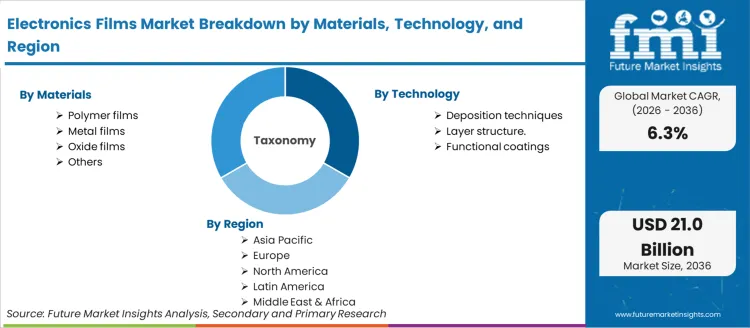
The electronics films market is segmented by materials, technology, application, and geographic regions. By materials, electronics films market is divided into polymer films, metal films, oxide films, and others. In terms of technology, electronics films market is classified into deposition techniques, layer structure, and functional coatings. Based on application, electronics films market is segmented into displays, photovoltaic cells, semiconductors, smart windows, printed electronics, and anti-static films. Regionally, the electronics films industry is classified into North America, Latin America, Western Europe, Eastern Europe, Balkan & Baltic Countries, Russia & Belarus, Central Asia, East Asia, South Asia & Pacific, and the Middle East & Africa.
Insights into the Polymer Films Materials Segment
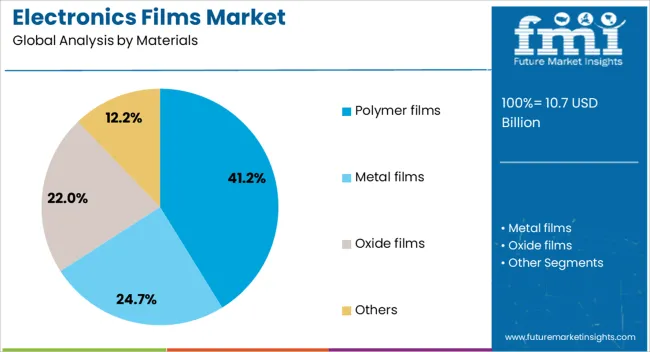
The polymer films materials segment is projected to hold 41.2% of the electronics films market revenue share in 2026, making it the leading material type. Its dominance is driven by superior flexibility, lightweight characteristics, and excellent chemical and thermal resistance, which make it suitable for a wide variety of electronic applications. Polymer films are being increasingly adopted in flexible circuits, printed electronics, and protective coatings for displays due to their high optical clarity and mechanical strength.
The segment benefits from ongoing material innovations, including improved dielectric properties and enhanced adhesion, which allow for more reliable integration into complex electronic systems. Manufacturers prefer polymer films for their cost-effectiveness, ease of processing, and compatibility with emerging deposition techniques.
The ability to tailor material properties through chemical modification or multi-layer construction is further reinforcing its market leadership. Increasing demand for polymer films in high-performance and miniaturized devices is expected to sustain the segment’s growth in the near term.
Insights into the Deposition Techniques Technology Segment
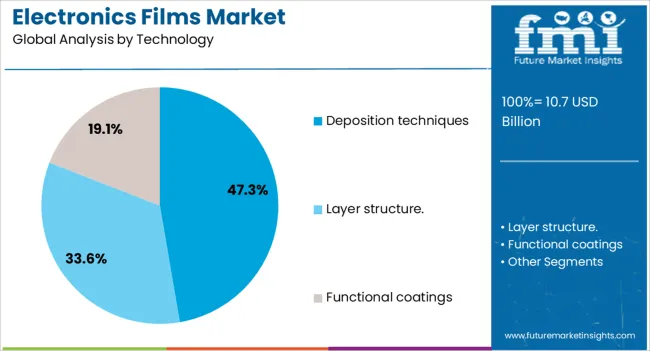
The deposition techniques technology segment is anticipated to account for 47.3% of the electronics films market revenue share in 2026, establishing itself as the leading technology category. Its prominence is being driven by the requirement for precise and uniform thin-film coatings, which enhance device performance, durability, and functional efficiency.
Techniques such as chemical vapor deposition and physical vapor deposition allow for controlled layering, high uniformity, and integration of functional materials, supporting applications in displays, semiconductors, and flexible electronics. The adoption of advanced deposition technologies is being reinforced by increasing demand for miniaturized components, higher resolution displays, and flexible device architectures.
These methods provide manufacturers with the flexibility to customize film properties, optimize production efficiency, and reduce material waste, making them highly attractive for large-scale industrial use. Continuous innovation in deposition processes, including low-temperature and scalable methods, is expected to further drive adoption and maintain the segment’s leading position.
Insights into the Displays Application Segment
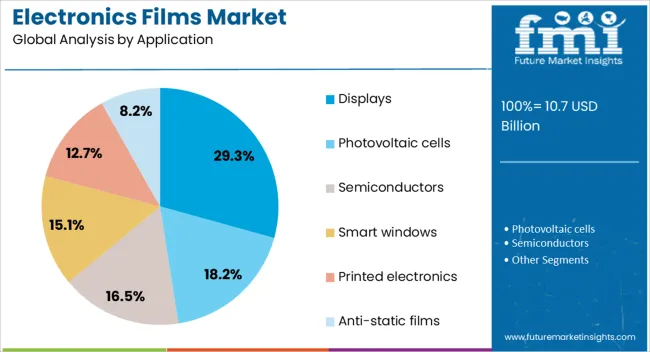
The displays application segment is projected to hold 29.3% of the electronics films market revenue share in 2026, positioning it as the dominant application area. Its growth is being driven by the rapid expansion of consumer electronics, including smartphones, tablets, televisions, and wearable devices, where high-performance films enhance screen brightness, color accuracy, and durability. The segment benefits from the adoption of polymer films and advanced deposition techniques, which enable thin, flexible, and high-clarity display panels.
Increasing investments in high-resolution and flexible display technologies are further accelerating demand. The ability of electronics films to provide consistent optical and mechanical performance in challenging environments has made them indispensable for modern display manufacturing.
Rising consumer expectations for better visual quality, energy efficiency, and long-lasting device performance are reinforcing the growth of this segment. As manufacturers continue to innovate and incorporate new film technologies into next-generation display solutions, the segment is expected to maintain its leadership in market revenue share.
What are the Drivers, Restraints, and Key Trends of the Electronics Films Market?
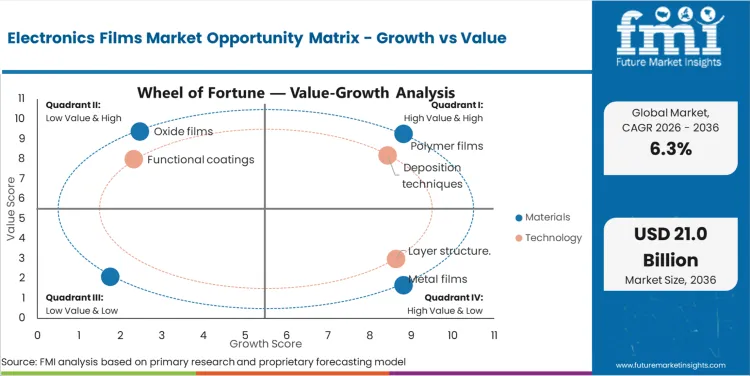
Electronics films are witnessing strong growth across consumer electronics, automotive, industrial, and renewable energy applications. Consumer devices and automotive systems dominate demand, while industrial automation and energy solutions provide diversified expansion opportunities. High-performance materials, protective coatings, and functional enhancements further strengthen market adoption. Regional manufacturing hubs in Asia and innovation-driven markets in Europe and North America continue to shape global growth trajectories, emphasizing both large-scale production and specialized application development. The market is expected to see steady CAGR growth, driven by expanding device penetration, EV adoption, and the integration of films into next-generation electronic and energy systems.
Expanding Adoption in Consumer Electronics Sector
The consumer electronics market remains the largest driver for electronics films, accounting for the majority of global demand. Films are essential in smartphones, tablets, laptops, and wearable devices, providing protection, flexibility, and enhanced display performance. Flexible OLED and LCD panels rely on ultra-thin films for durability, transparency, and scratch resistance, while touch-sensitive interfaces use specialized films to improve responsiveness. Rising disposable incomes and demand for premium devices are fueling adoption, particularly in Asia Pacific, where electronics manufacturing hubs supply global markets. Consumer preferences for sleek designs and high-performance displays push manufacturers to invest in high-quality films, creating opportunities for new entrants and niche suppliers targeting specialized protective, functional, and decorative film applications.
Integration of Electronics Films in Automotive Applications
Electronics films are increasingly utilized in automotive applications, driven by electric vehicles, infotainment systems, and safety sensors. Films serve as insulating layers for batteries, wiring, and circuit boards, ensuring performance reliability under high temperatures and mechanical stress. Flexible films are used in display panels, touch interfaces, and HUDs (head-up displays), enabling modern vehicle interiors with advanced infotainment and driver-assistance functionalities. Automotive OEMs prioritize lightweight, durable, and high-performance films to reduce energy consumption and meet regulatory standards. Growing investments in electric mobility and smart vehicle technologies, particularly in North America, Europe, and China, are creating strong demand for films that combine electrical insulation, thermal stability, and structural resilience for both interior and under-the-hood applications.
Industrial and Renewable Energy Applications Driving Growth
Industrial electronics and renewable energy sectors are emerging as significant adopters of electronics films. In industrial automation, films are applied in sensors, control panels, and protective covers to enhance equipment reliability and operational safety. Photovoltaic panels, battery storage systems, and energy conversion devices utilize films to improve efficiency, provide electrical insulation, and reduce heat-related degradation. Manufacturing plants in Asia, Europe, and North America are increasingly integrating high-performance films into process equipment to reduce downtime and extend service life. Demand is further reinforced by energy storage adoption, smart meters, and power electronics requiring precise film properties for insulation, optical clarity, and mechanical durability, expanding the addressable market beyond conventional consumer and automotive segments.
Advancements in Materials and Functional Film Features
The performance of electronics films is enhanced through tailored material selection, coatings, and functional additives. Anti-reflective, scratch-resistant, and heat-stable films are gaining prominence in displays, automotive panels, and industrial equipment. Films with high dielectric strength, thermal conductivity, or moisture resistance are essential in batteries, capacitors, and flexible circuits. Suppliers focus on producing films with consistent thickness, transparency, and mechanical resilience to meet diverse application needs. Co-extrusion, lamination, and surface treatments allow multifunctional performance, expanding usability across electronics, automotive, and energy sectors. These developments drive differentiation among suppliers, with technical support, customization, and compliance with industrial standards serving as critical competitive levers.
Analysis of Electronics Films Market By Key Countries
.webp "Top Country Growth Comparison Electronics Films Market Cagr (2026 2036)")
| Country | CAGR |
|---|---|
| China | 8.5% |
| India | 7.9% |
| Germany | 7.2% |
| France | 6.6% |
| UK | 6.0% |
| USA | 5.4% |
| Brazil | 4.7% |
Source: FMI analysis based on primary research and proprietary forecasting model
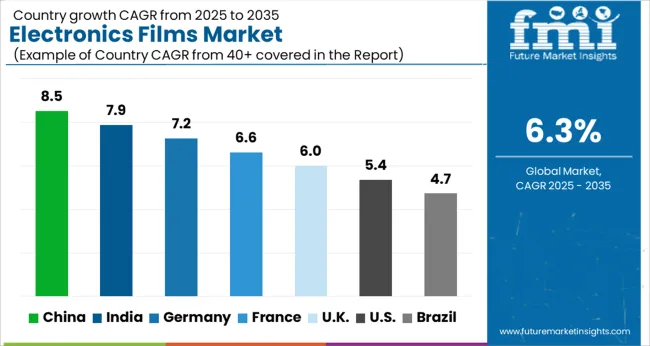
The global electronics film market is projected to grow at a CAGR of 6.3% from 2026 to 2036. China leads with 8.5%, followed by India at 7.9%, Germany at 7.2%, France at 6.6%, the UK at 6.0%, the USA at 5.4%, and Brazil at 4.7%. Growth is driven by increasing demand for high-performance films in displays, touchscreens, flexible electronics, solar panels, and electronic components. BRICS countries, particularly China and India, are leading large-scale manufacturing and export initiatives, while OECD nations focus on premium films, R&D, and material innovation. Production capacity, supply chain integration, and technological advancements remain key growth levers across all regions.
Growth Analysis of Electronics Film Market in China
China’s electronics film market is projected to grow at a CAGR of 8.5% from 2026 to 2036, driven by strong domestic production of PET, PI, and specialty films for displays, solar panels, and flexible electronics. Manufacturers such as Toray, SKC, and DuPont are expanding production and introducing innovative films with improved thermal, optical, and electrical properties. Government initiatives to promote high-tech manufacturing and R&D investments enhance competitiveness. Supply chain integration and regional production hubs support both domestic demand and exports.
- Strong adoption in displays, touchscreens, and flexible electronics
- Local manufacturers expanding production and R&D
- Government-backed initiatives enhancing competitiveness
Demand Forecast for Electronics Film Market in India
India’s electronics film market is expected to grow at a CAGR of 7.9% from 2026 to 2036, fueled by rising electronics manufacturing, solar panel installations, and adoption of advanced films in industrial applications. Companies are focusing on local production under initiatives like “Make in India,” improving affordability and supply chain efficiency. Tier-2 and tier-3 cities are emerging as high-growth regions for industrial and consumer electronics applications.
- Growth driven by industrial and consumer electronics
- Local production enhancing supply and affordability
- Expansion in solar and display applications
Market Growth Outlook for Electronics Film Market in Germany
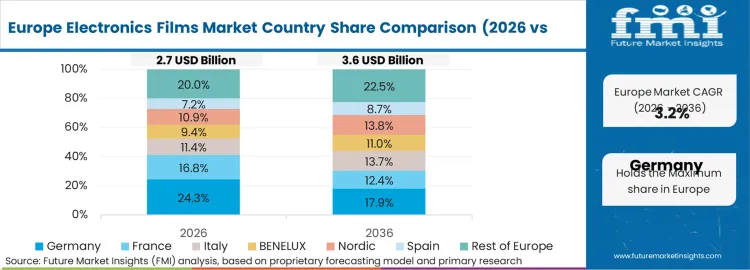
Germany’s electronics film market is projected to grow at a CAGR of 7.2% from 2026 to 2036, supported by demand for high-quality, energy-efficient films in automotive, display, and industrial electronics. Manufacturers focus on premium films with advanced thermal, optical, and dielectric properties. R&D in material innovation and regulatory compliance remains central to competitiveness.
- High-quality films for automotive and industrial electronics
- Focus on material innovation and regulatory compliance
- Strong R&D supporting growth
Expansion Prospects in France
The electronics film market in France is expected to grow at a CAGR of 6.6% from 2026 to 2036, led by demand in displays, flexible electronics, and renewable energy applications. Manufacturers are adopting advanced coating and lamination technologies to meet performance requirements.
- Demand from displays and flexible electronics increasing
- Advanced film technologies enhancing performance
- Renewable energy applications supporting growth
Growth Analysis in the United Kingdom
The UK electronics film market is projected to grow at a CAGR of 6.0% from 2026 to 2036, driven by industrial electronics, touchscreens, and emerging flexible devices. Companies focus on high-performance films with durability and thermal stability.
- Industrial and touchscreen applications driving growth
- Focus on durability and thermal stability
- Adoption of flexible electronic solutions increasing
Electronics Film Market Outlook in the United States
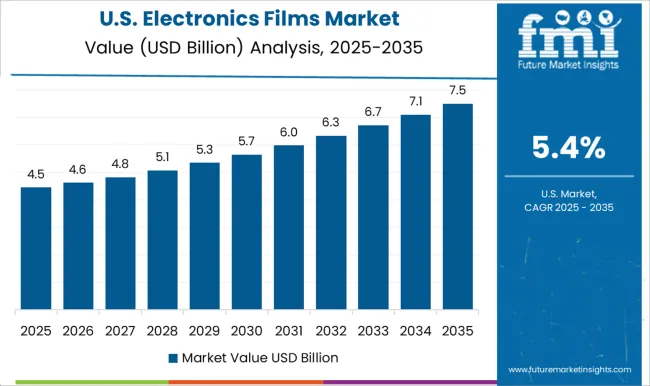
The USA market is projected to grow at a CAGR of 5.4% from 2026 to 2036, fueled by demand in consumer electronics, displays, and flexible circuits. Leading manufacturers invest in R&D for advanced polymer films with enhanced optical, dielectric, and thermal performance.
- Consumer electronics and flexible circuits driving demand
- R&D investments supporting innovation
- Premium films for high-performance applications
Competitive Landscape of Electronics Films Market
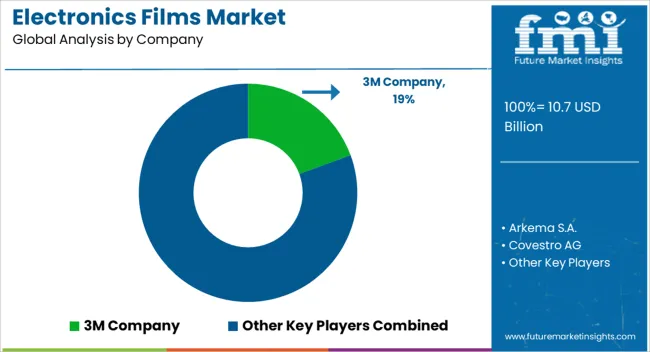
The electronics film market is highly competitive, driven by increasing demand for high-performance films used in displays, touchscreens, flexible electronics, solar panels, and electronic components. Market rivalry is shaped by film type (PET, PI, PEN, and specialty films), thickness, thermal and electrical properties, optical clarity, and cost. Companies differentiate through advanced materials, precision coating, enhanced durability, and customization to meet specific electronic applications and regulatory standards.
Key players such as DuPont, Toray Industries, SKC Group, Mitsubishi Polyester Film, UBE Industries, Kaneka Corporation, 3M, Honeywell, Covestro, and Jindal Poly Films dominate the market by offering technologically advanced, reliable, and versatile electronics films. Strategic partnerships with device manufacturers, display producers, and component suppliers are leveraged to expand market presence. Regional and emerging manufacturers compete by providing cost-effective, flexible, and application-specific films. The market is moderately consolidated, with leading companies focusing on innovation, quality control, regulatory compliance, and long-term technical support to strengthen market share and meet growing demand for electronics films across multiple high-tech sectors.
Key Players in the Electronics Films Market
- 3M Company
- Arkema S.A.
- Covestro AG
- DuPont de Nemours, Inc.
- Eastman Chemical Company
- Evonik Industries AG
- LG Chem Ltd.
Scope of the Report
| Metric | Value |
|---|---|
| Quantitative Units | USD 11.37 Billion to USD 20.95 Billion, at a CAGR of 6.30% |
| Market Definition | Electronics films are thin-film materials providing optical, electrical, thermal, or protective functionality in electronic devices, spanning polymer, metal, and oxide films for display, photovoltaic, semiconductor, smart window, and printed electronics applications. |
| Segmentation | Materials: Polymer Films, Metal Films, Oxide Films, and Others; Technology: Deposition Techniques, Layer Structure, and Functional Coatings; Application: Displays, Photovoltaic Cells, Semiconductors, Smart Windows, Printed Electronics, and Anti-static Films |
| Regions Covered | North America, Latin America, Europe, East Asia, South Asia, Oceania, Middle East & Africa |
| Countries Covered | China, India, Germany, France, UK, USA, Brazil, and 40 plus countries |
| Key Companies Profiled | 3M Company, Arkema S.A., Covestro AG, DuPont de Nemours, Inc., Eastman Chemical Company, Evonik Industries AG, LG Chem Ltd. |
| Forecast Period | 2026 to 2036 |
| Approach | Forecasting models apply a bottom-up methodology starting with installed base metrics and projecting conversion rates to technology adoption. |
Electronics Films Market by Segments
Materials:
- Polymer films
- Metal films
- Oxide films
- Others
Technology:
- Deposition techniques
- Layer structure.
- Functional coatings
Application:
- Displays
- Photovoltaic cells
- Semiconductors
- Smart windows
- Printed electronics
- Anti-static films
Region:
- North America
- USA
- Canada
- Mexico
- Latin America
- Brazil
- Chile
- Rest of Latin America
- Western Europe
- Germany
- UK
- Italy
- Spain
- France
- Nordic
- BENELUX
- Rest of Western Europe
- Eastern Europe
- Russia
- Poland
- Hungary
- Balkan & Baltic
- Rest of Eastern Europe
- East Asia
- China
- Japan
- South Korea
- South Asia and Pacific
- India
- ASEAN
- Australia & New Zealand
- Rest of South Asia and Pacific
- Middle East & Africa
- Kingdom of Saudi Arabia
- Other GCC Countries
- Turkiye
- South Africa
- Other African Union
- Rest of Middle East & Africa
Bibliography
- 1. International Energy Agency. (2024). Solar PV Global Supply Chains: Materials and Manufacturing Assessment. IEA.
- 2. Display Supply Chain Consultants. (2024). OLED Panel Manufacturing: Material Consumption and Capacity Forecast. DSCC.
- 3. Semiconductor Industry Association. (2024). Advanced Packaging Materials: Technology Roadmap Update. SIA.
- 4. European Commission. (2024). Critical Raw Materials Act: Electronics Material Supply Chain Assessment. European Commission.
- 5. Ministry of Industry and Information Technology, China. (2024). New Display Industry Development Plan: Manufacturing Capacity Targets. MIIT.
- 6. International Organization for Standardization. (2024). ISO 9276: Thin Film Characterization and Measurement Standards. ISO.
- This bibliography is provided for reader reference. The full FMI report contains the complete reference list with primary research documentation.
This bibliography is provided for reader reference and is not exhaustive. The full report contains the complete reference list and detailed citations.
Frequently Asked Questions
How large is the demand for Electronics Films in the global market in 2026?
Demand is estimated to be valued at USD 11.37 billion in 2026.
What will be the market size by 2036?
Market size is projected to reach USD 20.95 billion by 2036.
What is the expected CAGR between 2026 and 2036?
Demand is expected to grow at a CAGR of 6.30% between 2026 and 2036.
Which Materials segment is poised to lead global sales by 2026?
Polymer Films accounts for 41.2% share in 2026 across display, photovoltaic, and flexible electronics applications.
How is Displays positioned as an Application in 2026?
Displays represents 29.3% share in 2026 as OLED panel manufacturing drives optical and barrier film consumption.
What is driving demand in China?
OLED fab expansion, PV manufacturing buildout, and semiconductor packaging demand fuel the fastest growth at 8.5% CAGR through 2036.
What is included in the scope of this report?
The market covers polymer, metal, oxide, and functional coating films for displays, PV cells, semiconductors, smart windows, printed electronics, and anti-static applications.
What is excluded from the scope of this report?
Bulk packaging films, structural lamination, decorative window tinting, semiconductor wafer substrates, and bare silicon are excluded.
Preview the report firsthand - request a free sample
Get SampleGet the brochure for pricing and purchase details.
Get PDFTable of Content
- Executive Summary
- Global Market Outlook
- Demand-side Trends
- Supply-side Trends
- Technology Roadmap Analysis
- Analysis and Recommendations
- Market Overview
- Market Coverage / Taxonomy
- Market Definition / Scope / Limitations
- Research Methodology
- Chapter Orientation
- Analytical Lens and Working Hypotheses
- Market Structure, Signals, and Trend Drivers
- Benchmarking and Cross-market Comparability
- Market Sizing, Forecasting, and Opportunity Mapping
- Research Design and Evidence Framework
- Desk Research Programme (Secondary Evidence)
- Company Annual and Sustainability Reports
- Peer-reviewed Journals and Academic Literature
- Corporate Websites, Product Literature, and Technical Notes
- Earnings Decks and Investor Briefings
- Statutory Filings and Regulatory Disclosures
- Technical White Papers and Standards Notes
- Trade Journals, Industry Magazines, and Analyst Briefs
- Conference Proceedings, Webinars, and Seminar Materials
- Government Statistics Portals and Public Data Releases
- Press Releases and Reputable Media Coverage
- Specialist Newsletters and Curated Briefings
- Sector Databases and Reference Repositories
- FMI Internal Proprietary Databases and Historical Market Datasets
- Subscription Datasets and Paid Sources
- Social Channels, Communities, and Digital Listening Inputs
- Additional Desk Sources
- Expert Input and Fieldwork (Primary Evidence)
- Primary Modes
- Qualitative Interviews and Expert Elicitation
- Quantitative Surveys and Structured Data Capture
- Blended Approach
- Why Primary Evidence is Used
- Field Techniques
- Interviews
- Surveys
- Focus Groups
- Observational and In-context Research
- Social and Community Interactions
- Stakeholder Universe Engaged
- C-suite Leaders
- Board Members
- Presidents and Vice Presidents
- R&D and Innovation Heads
- Technical Specialists
- Domain Subject-matter Experts
- Scientists
- Physicians and Other Healthcare Professionals
- Governance, Ethics, and Data Stewardship
- Research Ethics
- Data Integrity and Handling
- Primary Modes
- Tooling, Models, and Reference Databases
- Desk Research Programme (Secondary Evidence)
- Data Engineering and Model Build
- Data Acquisition and Ingestion
- Cleaning, Normalisation, and Verification
- Synthesis, Triangulation, and Analysis
- Quality Assurance and Audit Trail
- Market Background
- Market Dynamics
- Drivers
- Restraints
- Opportunity
- Trends
- Scenario Forecast
- Demand in Optimistic Scenario
- Demand in Likely Scenario
- Demand in Conservative Scenario
- Opportunity Map Analysis
- Product Life Cycle Analysis
- Supply Chain Analysis
- Investment Feasibility Matrix
- Value Chain Analysis
- PESTLE and Porter’s Analysis
- Regulatory Landscape
- Regional Parent Market Outlook
- Production and Consumption Statistics
- Import and Export Statistics
- Market Dynamics
- Global Market Analysis 2021 to 2025 and Forecast, 2026 to 2036
- Historical Market Size Value (USD Million) Analysis, 2021 to 2025
- Current and Future Market Size Value (USD Million) Projections, 2026 to 2036
- Y-o-Y Growth Trend Analysis
- Absolute $ Opportunity Analysis
- Global Market Pricing Analysis 2021 to 2025 and Forecast 2026 to 2036
- Global Market Analysis 2021 to 2025 and Forecast 2026 to 2036, By Materials
- Introduction / Key Findings
- Historical Market Size Value (USD Million) Analysis By Materials , 2021 to 2025
- Current and Future Market Size Value (USD Million) Analysis and Forecast By Materials , 2026 to 2036
- Polymer films
- Metal films
- Oxide films
- Others
- Polymer films
- Y-o-Y Growth Trend Analysis By Materials , 2021 to 2025
- Absolute $ Opportunity Analysis By Materials , 2026 to 2036
- Global Market Analysis 2021 to 2025 and Forecast 2026 to 2036, By Technology
- Introduction / Key Findings
- Historical Market Size Value (USD Million) Analysis By Technology, 2021 to 2025
- Current and Future Market Size Value (USD Million) Analysis and Forecast By Technology, 2026 to 2036
- Deposition techniques
- Layer structure.
- Functional coatings
- Deposition techniques
- Y-o-Y Growth Trend Analysis By Technology, 2021 to 2025
- Absolute $ Opportunity Analysis By Technology, 2026 to 2036
- Global Market Analysis 2021 to 2025 and Forecast 2026 to 2036, By Application
- Introduction / Key Findings
- Historical Market Size Value (USD Million) Analysis By Application, 2021 to 2025
- Current and Future Market Size Value (USD Million) Analysis and Forecast By Application, 2026 to 2036
- Displays
- Photovoltaic cells
- Semiconductors
- Smart windows
- Printed electronics
- Anti-static films
- Displays
- Y-o-Y Growth Trend Analysis By Application, 2021 to 2025
- Absolute $ Opportunity Analysis By Application, 2026 to 2036
- Global Market Analysis 2021 to 2025 and Forecast 2026 to 2036, By Region
- Introduction
- Historical Market Size Value (USD Million) Analysis By Region, 2021 to 2025
- Current Market Size Value (USD Million) Analysis and Forecast By Region, 2026 to 2036
- North America
- Latin America
- Western Europe
- Eastern Europe
- East Asia
- South Asia and Pacific
- Middle East & Africa
- Market Attractiveness Analysis By Region
- North America Market Analysis 2021 to 2025 and Forecast 2026 to 2036, By Country
- Historical Market Size Value (USD Million) Trend Analysis By Market Taxonomy, 2021 to 2025
- Market Size Value (USD Million) Forecast By Market Taxonomy, 2026 to 2036
- By Country
- USA
- Canada
- Mexico
- By Materials
- By Technology
- By Application
- By Country
- Market Attractiveness Analysis
- By Country
- By Materials
- By Technology
- By Application
- Key Takeaways
- Latin America Market Analysis 2021 to 2025 and Forecast 2026 to 2036, By Country
- Historical Market Size Value (USD Million) Trend Analysis By Market Taxonomy, 2021 to 2025
- Market Size Value (USD Million) Forecast By Market Taxonomy, 2026 to 2036
- By Country
- Brazil
- Chile
- Rest of Latin America
- By Materials
- By Technology
- By Application
- By Country
- Market Attractiveness Analysis
- By Country
- By Materials
- By Technology
- By Application
- Key Takeaways
- Western Europe Market Analysis 2021 to 2025 and Forecast 2026 to 2036, By Country
- Historical Market Size Value (USD Million) Trend Analysis By Market Taxonomy, 2021 to 2025
- Market Size Value (USD Million) Forecast By Market Taxonomy, 2026 to 2036
- By Country
- Germany
- UK
- Italy
- Spain
- France
- Nordic
- BENELUX
- Rest of Western Europe
- By Materials
- By Technology
- By Application
- By Country
- Market Attractiveness Analysis
- By Country
- By Materials
- By Technology
- By Application
- Key Takeaways
- Eastern Europe Market Analysis 2021 to 2025 and Forecast 2026 to 2036, By Country
- Historical Market Size Value (USD Million) Trend Analysis By Market Taxonomy, 2021 to 2025
- Market Size Value (USD Million) Forecast By Market Taxonomy, 2026 to 2036
- By Country
- Russia
- Poland
- Hungary
- Balkan & Baltic
- Rest of Eastern Europe
- By Materials
- By Technology
- By Application
- By Country
- Market Attractiveness Analysis
- By Country
- By Materials
- By Technology
- By Application
- Key Takeaways
- East Asia Market Analysis 2021 to 2025 and Forecast 2026 to 2036, By Country
- Historical Market Size Value (USD Million) Trend Analysis By Market Taxonomy, 2021 to 2025
- Market Size Value (USD Million) Forecast By Market Taxonomy, 2026 to 2036
- By Country
- China
- Japan
- South Korea
- By Materials
- By Technology
- By Application
- By Country
- Market Attractiveness Analysis
- By Country
- By Materials
- By Technology
- By Application
- Key Takeaways
- South Asia and Pacific Market Analysis 2021 to 2025 and Forecast 2026 to 2036, By Country
- Historical Market Size Value (USD Million) Trend Analysis By Market Taxonomy, 2021 to 2025
- Market Size Value (USD Million) Forecast By Market Taxonomy, 2026 to 2036
- By Country
- India
- ASEAN
- Australia & New Zealand
- Rest of South Asia and Pacific
- By Materials
- By Technology
- By Application
- By Country
- Market Attractiveness Analysis
- By Country
- By Materials
- By Technology
- By Application
- Key Takeaways
- Middle East & Africa Market Analysis 2021 to 2025 and Forecast 2026 to 2036, By Country
- Historical Market Size Value (USD Million) Trend Analysis By Market Taxonomy, 2021 to 2025
- Market Size Value (USD Million) Forecast By Market Taxonomy, 2026 to 2036
- By Country
- Kingdom of Saudi Arabia
- Other GCC Countries
- Turkiye
- South Africa
- Other African Union
- Rest of Middle East & Africa
- By Materials
- By Technology
- By Application
- By Country
- Market Attractiveness Analysis
- By Country
- By Materials
- By Technology
- By Application
- Key Takeaways
- Key Countries Market Analysis
- USA
- Pricing Analysis
- Market Share Analysis, 2025
- By Materials
- By Technology
- By Application
- Canada
- Pricing Analysis
- Market Share Analysis, 2025
- By Materials
- By Technology
- By Application
- Mexico
- Pricing Analysis
- Market Share Analysis, 2025
- By Materials
- By Technology
- By Application
- Brazil
- Pricing Analysis
- Market Share Analysis, 2025
- By Materials
- By Technology
- By Application
- Chile
- Pricing Analysis
- Market Share Analysis, 2025
- By Materials
- By Technology
- By Application
- Germany
- Pricing Analysis
- Market Share Analysis, 2025
- By Materials
- By Technology
- By Application
- UK
- Pricing Analysis
- Market Share Analysis, 2025
- By Materials
- By Technology
- By Application
- Italy
- Pricing Analysis
- Market Share Analysis, 2025
- By Materials
- By Technology
- By Application
- Spain
- Pricing Analysis
- Market Share Analysis, 2025
- By Materials
- By Technology
- By Application
- France
- Pricing Analysis
- Market Share Analysis, 2025
- By Materials
- By Technology
- By Application
- India
- Pricing Analysis
- Market Share Analysis, 2025
- By Materials
- By Technology
- By Application
- ASEAN
- Pricing Analysis
- Market Share Analysis, 2025
- By Materials
- By Technology
- By Application
- Australia & New Zealand
- Pricing Analysis
- Market Share Analysis, 2025
- By Materials
- By Technology
- By Application
- China
- Pricing Analysis
- Market Share Analysis, 2025
- By Materials
- By Technology
- By Application
- Japan
- Pricing Analysis
- Market Share Analysis, 2025
- By Materials
- By Technology
- By Application
- South Korea
- Pricing Analysis
- Market Share Analysis, 2025
- By Materials
- By Technology
- By Application
- Russia
- Pricing Analysis
- Market Share Analysis, 2025
- By Materials
- By Technology
- By Application
- Poland
- Pricing Analysis
- Market Share Analysis, 2025
- By Materials
- By Technology
- By Application
- Hungary
- Pricing Analysis
- Market Share Analysis, 2025
- By Materials
- By Technology
- By Application
- Kingdom of Saudi Arabia
- Pricing Analysis
- Market Share Analysis, 2025
- By Materials
- By Technology
- By Application
- Turkiye
- Pricing Analysis
- Market Share Analysis, 2025
- By Materials
- By Technology
- By Application
- South Africa
- Pricing Analysis
- Market Share Analysis, 2025
- By Materials
- By Technology
- By Application
- USA
- Market Structure Analysis
- Competition Dashboard
- Competition Benchmarking
- Market Share Analysis of Top Players
- By Regional
- By Materials
- By Technology
- By Application
- Competition Analysis
- Competition Deep Dive
- 3M Company
- Overview
- Product Portfolio
- Profitability by Market Segments (Product/Age /Sales Channel/Region)
- Sales Footprint
- Strategy Overview
- Marketing Strategy
- Product Strategy
- Channel Strategy
- Arkema S.A.
- Covestro AG
- DuPont de Nemours, Inc.
- Eastman Chemical Company
- Evonik Industries AG
- LG Chem Ltd.
- 3M Company
- Competition Deep Dive
- Assumptions & Acronyms Used


