

- Industry Size (2026)
- USD 3.33 Bn
- Forecast (2036)
- USD 4.93 Bn
- CAGR (2026 to 2036)
- 4.0%
End Mill Holders Market Size, Market Forecast and Outlook By FMI
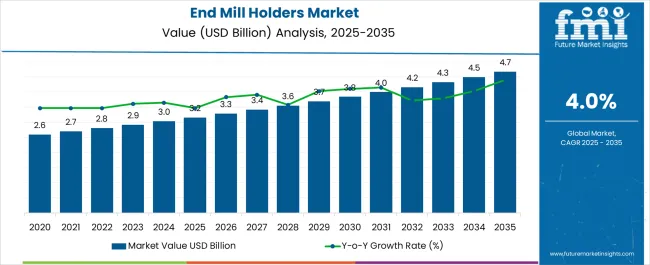
The end mill holders market was valued at USD 3.20 billion in 2025, projected to reach USD 3.33 billion in 2026, and is forecast to expand to USD 4.93 billion by 2036 at a 4.0% CAGR. As per FMI, sustained global investment in CNC machining infrastructure, combined with tightening tolerance specifications in automotive, aerospace, and medical component manufacturing, is sustaining demand for precision tool holding systems that deliver the concentricity and rigidity required for high-speed milling operations. End mill holders serve as the critical interface between machine spindle and cutting tool, where runout control directly determines surface finish quality and tool life economics.
Summary of End Mill Holders Market
- Market snapshot
- The end mill holders market is valued at USD 3.20 billion in 2025 and is projected to reach USD 4.93 billion by 2036.
- The industry is expected to grow at a 4.0% CAGR from 2026 to 2036, creating an incremental opportunity of USD 1.60 billion.
- The market is a precision tooling consumable category where spindle interface accuracy, runout control, and high-speed balance requirements define procurement specifications.
- Demand and growth drivers
- Demand is sustained by expanding CNC machining infrastructure and tightening tolerance specifications across automotive, aerospace, and medical component manufacturing.
- HSK and PSC taper designs are gaining share as five-axis machining centres require face-and-taper contact geometry for high-speed positional accuracy.
- Shrink-fit and hydraulic clamping technologies are reducing runout to sub-3-micron levels for medical implant and semiconductor tooling applications.
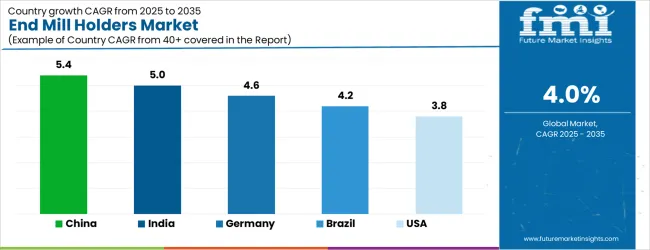
- Among key countries, China leads at 5.4% CAGR, followed by India at 5.0%, Germany at 4.6%, Brazil at 4.2%, the USA at 3.8%, the UK at 3.4%, and Japan at 3.0%.
- Product and segment view
- End mill holders are precision tool holding devices that secure end mills in machine tool spindles, providing the concentricity, rigidity, and balance required for milling operations.
- Machine types served include CNC machining centres, vertical machining centres (VMC), horizontal machining centres (HMC), and CNC turning machines with live tooling.
- CNC leads by Machine Type with 35.0% share in 2026 as general-purpose CNC machining centres account for the largest end mill holder consumption base.
- Standard End Mill Holders leads by Length with 45.0% share in 2026, serving the majority of general-purpose milling operations.
- Scope includes end mill holders across all taper types; excludes collet chucks, drill chucks, boring bar holders, and standalone machine tool spindles.
- Geography and competitive outlook
- China and India are the fastest-growing markets due to CNC infrastructure expansion. Germany and Japan anchor precision engineering and high-speed machining demand.
- Competition is shaped by runout accuracy, balance grade certification, and taper interface compatibility across machine tool OEM installed bases.
- Key players include Mitsubishi Materials, Big Daishowa, Walter AG, Iscar, Sandvik, MariTool Inc., Briney Tooling, and GLACERN MACHINE TOOLS.
- Analyst opinion at FMI
- Nikhil Kaitwade, Principal Consultant for Industrial Tooling, opines: 'FMI is of the opinion that end mill holder procurement is bifurcating between commodity replacement purchases for general machining and specification-led procurement for high-speed precision applications. Manufacturers that continue using legacy BT taper holders on five-axis high-speed spindles face accelerating tool wear and surface finish rejection rates. HSK holder suppliers with documented G2.5 balance certification at rated spindle speeds hold a qualification advantage in aerospace and medical machining bid packages where runout specifications are contractually binding.'
- Strategic implications / Executive takeaways
- Manufacturing engineers must specify HSK or PSC taper holders for all new five-axis machining centre installations to ensure positional accuracy at high-speed spindle operations.
- Tooling procurement teams should evaluate end mill holders on total indicated runout specifications and balance grade certification rather than unit price alone.
- Machine tool OEMs must include pre-qualified holder specification lists in equipment commissioning packages to ensure spindle performance guarantees are maintained.
End Mill Holders Market key takeaways
| Metric | Details |
|---|---|
| Industry Size (2026) | USD 3.33 billion |
| Industry Value (2036) | USD 4.93 billion |
| CAGR (2026 to 2036) | 4.0% |
Source: Future Market Insights, 2026
FMI opines that the market is transitioning from commodity tool holding toward high-precision, balanced holders designed for spindle speeds exceeding 20,000 RPM. HSK (hollow taper shank) and PSC (polygonal clamping system) tapers are gaining share from legacy BT and R8 taper designs as five-axis machining centres require the face-and-taper contact geometry that ensures positional accuracy at elevated rotational speeds. The parallel adoption of shrink-fit and hydraulic clamping technologies within end mill holder assemblies is reducing total indicated runout to sub-3-micron levels, enabling manufacturers to meet the surface finish specifications demanded by medical implant, optical, and semiconductor tooling applications.
China leads with a 5.4% CAGR through 2036, driven by expanding CNC machining capacity in automotive supply chains and defence manufacturing. India follows at 5.0%, supported by PLI scheme investments in precision machining for electronics and defence. Germany registers a 4.6% pace as its machine tool sector demands next-generation holders for high-speed five-axis aerospace machining. Brazil expands at 4.2% on automotive supply chain growth and agricultural machinery production. The United States tracks at 3.8%, reflecting mature automotive and aerospace machining operations. The United Kingdom maintains a 3.4% trajectory driven by aerospace engine component precision requirements. Japan expands at 3.0%, anchored by its machine tool OEM ecosystem and ultra-precision machining specialisation.
End Mill Holders Market definition
End mill holders are precision tool holding devices that secure end mills within machine tool spindles, providing the concentricity, clamping force, and rotational balance required for milling, slotting, profiling, and contouring operations. The category covers multiple taper interface standards (R8, BT, HSK, PSC, Morse) across standard, stubby, and extended length configurations serving CNC machining centres, VMCs, HMCs, and turning machines with live tooling capability.
End Mill Holders Market inclusions
Market scope includes end mill holders across all taper types and length configurations. The report covers global and regional market sizes for 2026 to 2036 with segment breakdowns by machine type, length, taper type, and end use industry.
End Mill Holders Market exclusions
The scope excludes collet chucks, drill chucks, tap holders, boring bar holders, face mill arbors, and standalone machine tool spindle assemblies. Cutting tool inserts and end mills themselves are outside the defined boundary.
End Mill Holders Market research methodology
- Primary research: Analysts engaged with manufacturing plant tooling engineers, machine tool OEM application specialists, and industrial distributor product managers to map holder selection criteria.
- Desk research: Data collection aggregated machine tool shipment statistics, ISO tool holder dimensional standards, and published automotive and aerospace production volume forecasts.
- Market sizing and forecasting: Baseline values derive from a bottom-up aggregation of end mill holder consumption by machine type and end use, applying CNC installed base growth and high-speed machining adoption curves.
- Data validation and update cycle: Projections are cross-validated against published cutting tool company revenue disclosures and machine tool industry association production statistics.
Why is the End Mill Holders Market Growing?
The End Mill Holders market is experiencing steady growth driven by the increasing adoption of precision machining and automated manufacturing technologies across industries. The future outlook for this market is influenced by the rising demand for high-efficiency machining operations, particularly in automotive, aerospace, and industrial machinery sectors.
Continuous advancements in machine tool technology, including enhanced CNC capabilities, have facilitated the need for reliable and high-precision end mill holders. Additionally, the focus on reducing production cycle times, improving surface finish quality, and minimizing tool wear has further strengthened the demand for advanced end mill holders.
The market is also supported by the shift towards smart manufacturing and Industry 4.0 initiatives, which require optimized tooling solutions for automated and flexible production setups As manufacturers increasingly prioritize accuracy, productivity, and operational efficiency, the End Mill Holders market is expected to sustain its growth trajectory across both established and emerging regions.
Segmental Analysis
The end mill holders market is segmented by machine type, length, taper type, end use industry, and geographic regions. By machine type, end mill holders market is divided into CNC (Computer Numerical Controlled) Machines, VMC (Vertical Machine Center) Machines, HMC (Horizontal Machine Center) Machines, CNC Turning Machines, and Others (Drill Taps, Milling Machines, Lathe Machines, etc.). In terms of length, end mill holders market is classified into Standard End Mill Holders, Stubby End Mill Holders, and Extended Length End Mill Holders.
Based on taper type, end mill holders market is segmented into R8 Tapers, Straight Shanks, PSC (Polygonal Shanks), Morse Tapers, V - Flange Tapers, BT Flange Tapers, NMTB, and HSK. By end use industry, end mill holders market is segmented into Automotive & Transportation, Heavy Engineering, Defense & Aerospace, Medical & Research, Construction, Consumer Goods & Electronics, Woodworking & Carpentry, and General Manufacturing & Fabrication. Regionally, the end mill holders industry is classified into North America, Latin America, Western Europe, Eastern Europe, Balkan & Baltic Countries, Russia & Belarus, Central Asia, East Asia, South Asia & Pacific, and the Middle East & Africa.
Insights into the CNC Machine Type Segment
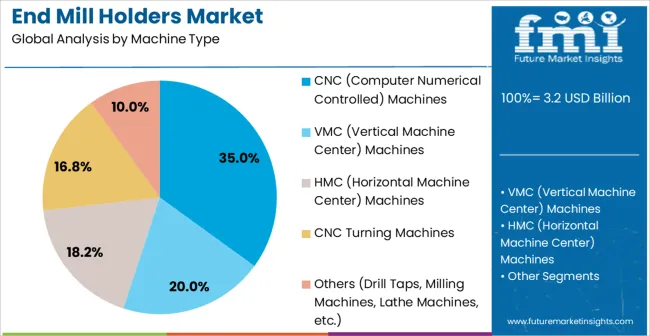
The CNC machine type segment is projected to hold 35.0% of the End Mill Holders market revenue share in 2026, making it the leading machine type. This dominance is attributed to the increasing use of computer numerical controlled machines for high-precision and automated manufacturing processes.
The adoption of CNC machines enables consistent accuracy, repeatability, and faster production cycles, which drives the demand for compatible end mill holders. The segment’s growth is further supported by advancements in software integration, enabling seamless machine-tool coordination and real-time monitoring of machining parameters.
Additionally, the rising focus on complex component manufacturing and miniaturization in automotive, aerospace, and industrial applications has reinforced the preference for CNC-compatible end mill holders The combination of operational efficiency, precision, and adaptability has cemented the leading position of this segment in the market.
Insights into the Standard End Mill Holders Segment
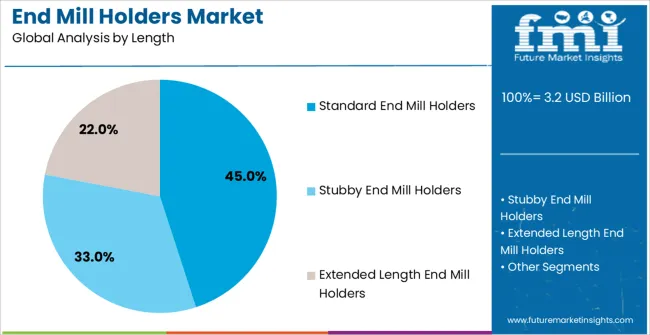
The standard end mill holders segment is expected to capture 45.0% of the End Mill Holders market revenue share in 2026, making it the dominant type. The growth of this segment is driven by the widespread adoption of standardized tooling solutions that offer versatility, ease of installation, and compatibility with multiple machine types.
Standard end mill holders provide reliable performance for general-purpose machining applications while maintaining cost-effectiveness and reducing downtime. Additionally, their ability to accommodate various end mill sizes and materials has reinforced their position as a preferred choice among manufacturers.
The segment’s expansion is further accelerated by the demand for consistent tool holding accuracy, efficient torque transmission, and minimized tool runout, which are critical for high-quality machining The established presence of standard end mill holders in the machining ecosystem continues to support their leading market share.
Insights into the R8 Taper Segment
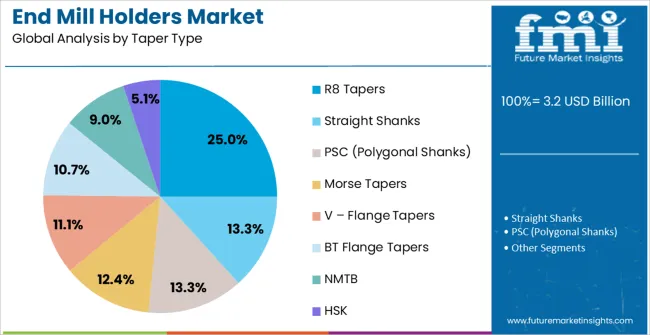
The R8 taper segment is anticipated to account for 25.0% of the End Mill Holders market revenue in 2026, establishing it as a prominent taper type. This growth is attributed to the compatibility of R8 tapers with a wide range of milling machines and their ability to provide stable and precise tool holding.
The design of R8 tapers allows for easy installation, secure clamping, and consistent concentricity, which enhances machining accuracy and reduces tool wear. The segment has also benefited from increasing adoption in small to medium-sized workshops and CNC setups where versatility and cost-efficiency are prioritized.
Additionally, the taper’s suitability for various materials and machining conditions has reinforced its prominence in the market Continuous utilization in general-purpose and production-oriented milling operations ensures sustained growth of the R8 taper segment.
Market Overview
End Mill Holders Introduction
Mainly used to hold end mills, end mill holders are employed in heavy engineering and machining applications. When compared to collets, end mill holders offer more rigidity in holding a tool at its center, but are not versatile to the same degree. For instance, end mill holders are able to hold only a single size of shank, which means an undersized shank will not be on the center, whereas, any sized shank can be accommodated within a collet’s range.
Analysis of End Mill Holders Market By Key Countries
.webp "Top Country Growth Comparison End Mill Holders Market Cagr (2026 2036)")
| Country | CAGR |
|---|---|
| China | 5.4% |
| India | 5.0% |
| Germany | 4.6% |
| Brazil | 4.2% |
| USA | 3.8% |
| UK | 3.4% |
| Japan | 3.0% |
Source: FMI analysis based on primary research and proprietary forecasting model
Country-wise Analysis
The End Mill Holders Market is expected to register a CAGR of 4.0% during the forecast period, exhibiting varied country level momentum. China leads with the highest CAGR of 5.4%, followed by India at 5.0%. Developed markets such as Germany, France, and the UK continue to expand steadily, while the USA is likely to grow at consistent rates. Japan posts the lowest CAGR at 3.0%, yet still underscores a broadly positive trajectory for the global End Mill Holders Market. In 2024, Germany held a dominant revenue in the Western Europe market and is expected to grow with a CAGR of 4.6%. The USA End Mill Holders Market is estimated to be valued at USD 1.1 billion in 2026 and is anticipated to reach a valuation of USD 1.1 billion by 2036. Sales are projected to rise at a CAGR of 0.0% over the forecast period between 2026 and 2036. While Japan and South Korea markets are estimated to be valued at USD 170.7 million and USD 107.1 million respectively in 2026.
Key Players in the End Mill Holders Market
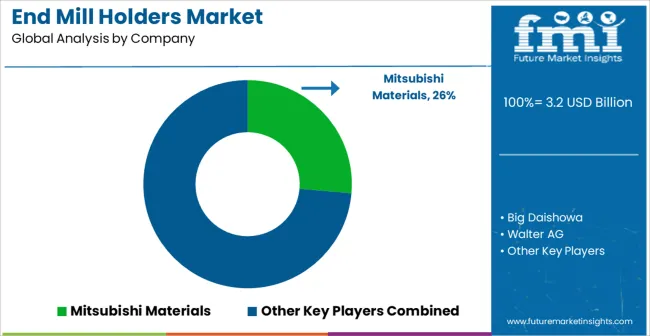
- Mitsubishi Materials
- Big Daishowa
- Walter AG
- Iscar
- Sandvik
- MariTool, Inc.
- Briney Tooling
- GLACERN MACHINE TOOLS
Scope of the report
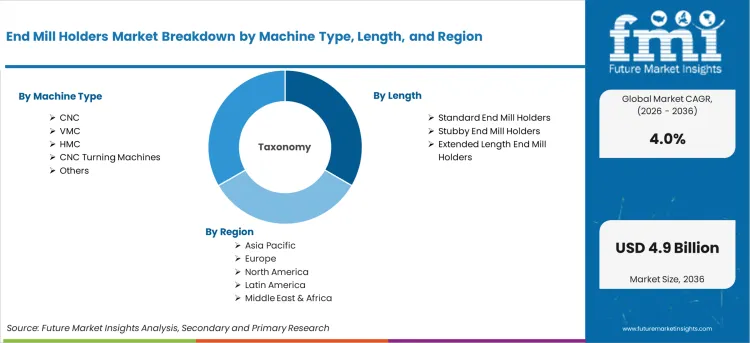
| Metric | Value |
|---|---|
| Quantitative Units | USD 3.33 billion to USD 4.93 billion, at a CAGR of 4.0% |
| Market Definition | End mill holders are precision tool holding devices securing end mills in machine spindles with controlled concentricity and balance for milling operations. |
| Machine Type Segmentation | CNC, VMC, HMC, CNC Turning Machines, Others |
| Length Segmentation | Standard End Mill Holders, Stubby End Mill Holders, Extended Length End Mill Holders |
| Taper Type Segmentation | R8 Tapers, Straight Shanks, PSC, Morse Tapers, V-Flange Tapers, BT Flange Tapers, NMTB, HSK |
| End Use Industry Segmentation | Automotive & Transportation, Heavy Engineering, Defense & Aerospace, Medical & Research, Construction, Consumer Goods & Electronics, Woodworking & Carpentry, General Manufacturing & Fabrication |
| Regions Covered | North America, Latin America, Europe, East Asia, South Asia, Oceania, Middle East & Africa |
| Countries Covered | China, India, Germany, Brazil, USA, UK, Japan, and 40 plus countries |
| Key Companies Profiled | Mitsubishi Materials, Big Daishowa, Walter AG, Iscar, Sandvik, MariTool Inc., Briney Tooling, GLACERN MACHINE TOOLS |
| Forecast Period | 2026 to 2036 |
| Approach | Bottom-up methodology starting with holder consumption by machine type and end use, projecting CNC growth and high-speed machining adoption. |
End Mill Holders Market by Segments
Machine Type:
- CNC (Computer Numerical Controlled) Machines
- VMC (Vertical Machine Center) Machines
- HMC (Horizontal Machine Center) Machines
- CNC Turning Machines
- Others (Drill Taps, Milling Machines, Lathe Machines, etc.)
Length:
- Standard End Mill Holders
- Stubby End Mill Holders
- Extended Length End Mill Holders
Taper Type:
- R8 Tapers
- Straight Shanks
- PSC (Polygonal Shanks)
- Morse Tapers
- V - Flange Tapers
- BT Flange Tapers
- NMTB
- HSK
End Use Industry:
- Automotive & Transportation
- Heavy Engineering
- Defense & Aerospace
- Medical & Research
- Construction
- Consumer Goods & Electronics
- Woodworking & Carpentry
- General Manufacturing & Fabrication
Region:
- North America
- USA
- Canada
- Mexico
- Latin America
- Brazil
- Chile
- Rest of Latin America
- Western Europe
- Germany
- UK
- Italy
- Spain
- France
- Nordic
- BENELUX
- Rest of Western Europe
- Eastern Europe
- Russia
- Poland
- Hungary
- Balkan & Baltic
- Rest of Eastern Europe
- East Asia
- China
- Japan
- South Korea
- South Asia and Pacific
- India
- ASEAN
- Australia & New Zealand
- Rest of South Asia and Pacific
- Middle East & Africa
- Kingdom of Saudi Arabia
- Other GCC Countries
- Turkiye
- South Africa
- Other African Union
- Rest of Middle East & Africa
Bibliography
- 1. International Organization for Standardization. (2024). ISO 12164: Hollow taper interface with flange contact surface (HSK). ISO.
- 2. International Organization for Standardization. (2024). ISO 1940-1: Mechanical vibration, balance quality requirements for rotors. ISO.
- 3. Gardner Intelligence. (2024). World machine tool output and consumption survey 2024. Gardner Business Media.
- 4. European Committee for Standardization. (2024). EN ISO 7388: Tool shanks with 7/24 taper. CEN.
- 5. Organisation for Economic Co-operation and Development. (2024). Structural and demographic business statistics: Machinery manufacturing. OECD.
- 6. Semiconductor Equipment and Materials International. (2024). SEMI standards for precision machined components. SEMI.
This bibliography is provided for reader reference. The full Future Market Insights report contains the complete reference list with primary research documentation.
Frequently Asked Questions
How large is the demand for end mill holders in 2026?
Demand for end mill holders in the global market is estimated to be valued at USD 3.33 billion in 2026.
What will be the market size by 2036?
Market size for end mill holders is projected to reach USD 4.93 billion by 2036.
What is the expected demand growth between 2026 and 2036?
Demand for end mill holders is expected to grow at a CAGR of 4.0% between 2026 and 2036.
Which Machine Type leads in 2026?
CNC accounts for 35.0% in 2026 as general-purpose CNC machining centres consume the largest holder volumes.
Which Length leads in 2026?
Standard End Mill Holders accounts for 45.0% in 2026, serving the majority of general-purpose milling operations.
What is driving demand in China?
Expanding CNC machining capacity in automotive supply chains and defence manufacturing sustains holder consumption growth.
What is included in the scope?
The scope covers end mill holders across all taper types and lengths; excludes collet chucks, drill chucks, boring bar holders, and cutting tools.
Preview the report firsthand - request a free sample
Get SampleGet the brochure for pricing and purchase details.
Get PDFTable of Content
- Executive Summary
- Global Market Outlook
- Demand-side Trends
- Supply-side Trends
- Technology Roadmap Analysis
- Analysis and Recommendations
- Market Overview
- Market Coverage / Taxonomy
- Market Definition / Scope / Limitations
- Research Methodology
- Chapter Orientation
- Analytical Lens and Working Hypotheses
- Market Structure, Signals, and Trend Drivers
- Benchmarking and Cross-market Comparability
- Market Sizing, Forecasting, and Opportunity Mapping
- Research Design and Evidence Framework
- Desk Research Programme (Secondary Evidence)
- Company Annual and Sustainability Reports
- Peer-reviewed Journals and Academic Literature
- Corporate Websites, Product Literature, and Technical Notes
- Earnings Decks and Investor Briefings
- Statutory Filings and Regulatory Disclosures
- Technical White Papers and Standards Notes
- Trade Journals, Industry Magazines, and Analyst Briefs
- Conference Proceedings, Webinars, and Seminar Materials
- Government Statistics Portals and Public Data Releases
- Press Releases and Reputable Media Coverage
- Specialist Newsletters and Curated Briefings
- Sector Databases and Reference Repositories
- FMI Internal Proprietary Databases and Historical Market Datasets
- Subscription Datasets and Paid Sources
- Social Channels, Communities, and Digital Listening Inputs
- Additional Desk Sources
- Expert Input and Fieldwork (Primary Evidence)
- Primary Modes
- Qualitative Interviews and Expert Elicitation
- Quantitative Surveys and Structured Data Capture
- Blended Approach
- Why Primary Evidence is Used
- Field Techniques
- Interviews
- Surveys
- Focus Groups
- Observational and In-context Research
- Social and Community Interactions
- Stakeholder Universe Engaged
- C-suite Leaders
- Board Members
- Presidents and Vice Presidents
- R&D and Innovation Heads
- Technical Specialists
- Domain Subject-matter Experts
- Scientists
- Physicians and Other Healthcare Professionals
- Governance, Ethics, and Data Stewardship
- Research Ethics
- Data Integrity and Handling
- Primary Modes
- Tooling, Models, and Reference Databases
- Desk Research Programme (Secondary Evidence)
- Data Engineering and Model Build
- Data Acquisition and Ingestion
- Cleaning, Normalisation, and Verification
- Synthesis, Triangulation, and Analysis
- Quality Assurance and Audit Trail
- Market Background
- Market Dynamics
- Drivers
- Restraints
- Opportunity
- Trends
- Scenario Forecast
- Demand in Optimistic Scenario
- Demand in Likely Scenario
- Demand in Conservative Scenario
- Opportunity Map Analysis
- Product Life Cycle Analysis
- Supply Chain Analysis
- Investment Feasibility Matrix
- Value Chain Analysis
- PESTLE and Porter’s Analysis
- Regulatory Landscape
- Regional Parent Market Outlook
- Production and Consumption Statistics
- Import and Export Statistics
- Market Dynamics
- Global Market Analysis 2021 to 2025 and Forecast, 2026 to 2036
- Historical Market Size Value (USD Million) Analysis, 2021 to 2025
- Current and Future Market Size Value (USD Million) Projections, 2026 to 2036
- Y-o-Y Growth Trend Analysis
- Absolute $ Opportunity Analysis
- Global Market Pricing Analysis 2021 to 2025 and Forecast 2026 to 2036
- Global Market Analysis 2021 to 2025 and Forecast 2026 to 2036, By Machine Type
- Introduction / Key Findings
- Historical Market Size Value (USD Million) Analysis By Machine Type , 2021 to 2025
- Current and Future Market Size Value (USD Million) Analysis and Forecast By Machine Type , 2026 to 2036
- CNC
- VMC
- HMC
- CNC Turning Machines
- Others
- CNC
- Y-o-Y Growth Trend Analysis By Machine Type , 2021 to 2025
- Absolute $ Opportunity Analysis By Machine Type , 2026 to 2036
- Global Market Analysis 2021 to 2025 and Forecast 2026 to 2036, By Length
- Introduction / Key Findings
- Historical Market Size Value (USD Million) Analysis By Length, 2021 to 2025
- Current and Future Market Size Value (USD Million) Analysis and Forecast By Length, 2026 to 2036
- Standard End Mill Holders
- Stubby End Mill Holders
- Extended Length End Mill Holders
- Standard End Mill Holders
- Y-o-Y Growth Trend Analysis By Length, 2021 to 2025
- Absolute $ Opportunity Analysis By Length, 2026 to 2036
- Global Market Analysis 2021 to 2025 and Forecast 2026 to 2036, By Taper Type
- Introduction / Key Findings
- Historical Market Size Value (USD Million) Analysis By Taper Type, 2021 to 2025
- Current and Future Market Size Value (USD Million) Analysis and Forecast By Taper Type, 2026 to 2036
- R8 Tapers
- Straight Shanks
- PSC
- Morse Tapers
- V - Flange Tapers
- BT Flange Tapers
- NMTB
- HSK
- R8 Tapers
- Y-o-Y Growth Trend Analysis By Taper Type, 2021 to 2025
- Absolute $ Opportunity Analysis By Taper Type, 2026 to 2036
- Global Market Analysis 2021 to 2025 and Forecast 2026 to 2036, By End Use Industry
- Introduction / Key Findings
- Historical Market Size Value (USD Million) Analysis By End Use Industry, 2021 to 2025
- Current and Future Market Size Value (USD Million) Analysis and Forecast By End Use Industry, 2026 to 2036
- Automotive & Transportation
- Heavy Engineering
- Defense & Aerospace
- Medical & Research
- Construction
- Consumer Goods & Electronics
- Woodworking & Carpentry
- General Manufacturing & Fabrication
- Automotive & Transportation
- Y-o-Y Growth Trend Analysis By End Use Industry, 2021 to 2025
- Absolute $ Opportunity Analysis By End Use Industry, 2026 to 2036
- Global Market Analysis 2021 to 2025 and Forecast 2026 to 2036, By Region
- Introduction
- Historical Market Size Value (USD Million) Analysis By Region, 2021 to 2025
- Current Market Size Value (USD Million) Analysis and Forecast By Region, 2026 to 2036
- North America
- Latin America
- Western Europe
- Eastern Europe
- East Asia
- South Asia and Pacific
- Middle East & Africa
- Market Attractiveness Analysis By Region
- North America Market Analysis 2021 to 2025 and Forecast 2026 to 2036, By Country
- Historical Market Size Value (USD Million) Trend Analysis By Market Taxonomy, 2021 to 2025
- Market Size Value (USD Million) Forecast By Market Taxonomy, 2026 to 2036
- By Country
- USA
- Canada
- Mexico
- By Machine Type
- By Length
- By Taper Type
- By End Use Industry
- By Country
- Market Attractiveness Analysis
- By Country
- By Machine Type
- By Length
- By Taper Type
- By End Use Industry
- Key Takeaways
- Latin America Market Analysis 2021 to 2025 and Forecast 2026 to 2036, By Country
- Historical Market Size Value (USD Million) Trend Analysis By Market Taxonomy, 2021 to 2025
- Market Size Value (USD Million) Forecast By Market Taxonomy, 2026 to 2036
- By Country
- Brazil
- Chile
- Rest of Latin America
- By Machine Type
- By Length
- By Taper Type
- By End Use Industry
- By Country
- Market Attractiveness Analysis
- By Country
- By Machine Type
- By Length
- By Taper Type
- By End Use Industry
- Key Takeaways
- Western Europe Market Analysis 2021 to 2025 and Forecast 2026 to 2036, By Country
- Historical Market Size Value (USD Million) Trend Analysis By Market Taxonomy, 2021 to 2025
- Market Size Value (USD Million) Forecast By Market Taxonomy, 2026 to 2036
- By Country
- Germany
- UK
- Italy
- Spain
- France
- Nordic
- BENELUX
- Rest of Western Europe
- By Machine Type
- By Length
- By Taper Type
- By End Use Industry
- By Country
- Market Attractiveness Analysis
- By Country
- By Machine Type
- By Length
- By Taper Type
- By End Use Industry
- Key Takeaways
- Eastern Europe Market Analysis 2021 to 2025 and Forecast 2026 to 2036, By Country
- Historical Market Size Value (USD Million) Trend Analysis By Market Taxonomy, 2021 to 2025
- Market Size Value (USD Million) Forecast By Market Taxonomy, 2026 to 2036
- By Country
- Russia
- Poland
- Hungary
- Balkan & Baltic
- Rest of Eastern Europe
- By Machine Type
- By Length
- By Taper Type
- By End Use Industry
- By Country
- Market Attractiveness Analysis
- By Country
- By Machine Type
- By Length
- By Taper Type
- By End Use Industry
- Key Takeaways
- East Asia Market Analysis 2021 to 2025 and Forecast 2026 to 2036, By Country
- Historical Market Size Value (USD Million) Trend Analysis By Market Taxonomy, 2021 to 2025
- Market Size Value (USD Million) Forecast By Market Taxonomy, 2026 to 2036
- By Country
- China
- Japan
- South Korea
- By Machine Type
- By Length
- By Taper Type
- By End Use Industry
- By Country
- Market Attractiveness Analysis
- By Country
- By Machine Type
- By Length
- By Taper Type
- By End Use Industry
- Key Takeaways
- South Asia and Pacific Market Analysis 2021 to 2025 and Forecast 2026 to 2036, By Country
- Historical Market Size Value (USD Million) Trend Analysis By Market Taxonomy, 2021 to 2025
- Market Size Value (USD Million) Forecast By Market Taxonomy, 2026 to 2036
- By Country
- India
- ASEAN
- Australia & New Zealand
- Rest of South Asia and Pacific
- By Machine Type
- By Length
- By Taper Type
- By End Use Industry
- By Country
- Market Attractiveness Analysis
- By Country
- By Machine Type
- By Length
- By Taper Type
- By End Use Industry
- Key Takeaways
- Middle East & Africa Market Analysis 2021 to 2025 and Forecast 2026 to 2036, By Country
- Historical Market Size Value (USD Million) Trend Analysis By Market Taxonomy, 2021 to 2025
- Market Size Value (USD Million) Forecast By Market Taxonomy, 2026 to 2036
- By Country
- Kingdom of Saudi Arabia
- Other GCC Countries
- Turkiye
- South Africa
- Other African Union
- Rest of Middle East & Africa
- By Machine Type
- By Length
- By Taper Type
- By End Use Industry
- By Country
- Market Attractiveness Analysis
- By Country
- By Machine Type
- By Length
- By Taper Type
- By End Use Industry
- Key Takeaways
- Key Countries Market Analysis
- USA
- Pricing Analysis
- Market Share Analysis, 2025
- By Machine Type
- By Length
- By Taper Type
- By End Use Industry
- Canada
- Pricing Analysis
- Market Share Analysis, 2025
- By Machine Type
- By Length
- By Taper Type
- By End Use Industry
- Mexico
- Pricing Analysis
- Market Share Analysis, 2025
- By Machine Type
- By Length
- By Taper Type
- By End Use Industry
- Brazil
- Pricing Analysis
- Market Share Analysis, 2025
- By Machine Type
- By Length
- By Taper Type
- By End Use Industry
- Chile
- Pricing Analysis
- Market Share Analysis, 2025
- By Machine Type
- By Length
- By Taper Type
- By End Use Industry
- Germany
- Pricing Analysis
- Market Share Analysis, 2025
- By Machine Type
- By Length
- By Taper Type
- By End Use Industry
- UK
- Pricing Analysis
- Market Share Analysis, 2025
- By Machine Type
- By Length
- By Taper Type
- By End Use Industry
- Italy
- Pricing Analysis
- Market Share Analysis, 2025
- By Machine Type
- By Length
- By Taper Type
- By End Use Industry
- Spain
- Pricing Analysis
- Market Share Analysis, 2025
- By Machine Type
- By Length
- By Taper Type
- By End Use Industry
- France
- Pricing Analysis
- Market Share Analysis, 2025
- By Machine Type
- By Length
- By Taper Type
- By End Use Industry
- India
- Pricing Analysis
- Market Share Analysis, 2025
- By Machine Type
- By Length
- By Taper Type
- By End Use Industry
- ASEAN
- Pricing Analysis
- Market Share Analysis, 2025
- By Machine Type
- By Length
- By Taper Type
- By End Use Industry
- Australia & New Zealand
- Pricing Analysis
- Market Share Analysis, 2025
- By Machine Type
- By Length
- By Taper Type
- By End Use Industry
- China
- Pricing Analysis
- Market Share Analysis, 2025
- By Machine Type
- By Length
- By Taper Type
- By End Use Industry
- Japan
- Pricing Analysis
- Market Share Analysis, 2025
- By Machine Type
- By Length
- By Taper Type
- By End Use Industry
- South Korea
- Pricing Analysis
- Market Share Analysis, 2025
- By Machine Type
- By Length
- By Taper Type
- By End Use Industry
- Russia
- Pricing Analysis
- Market Share Analysis, 2025
- By Machine Type
- By Length
- By Taper Type
- By End Use Industry
- Poland
- Pricing Analysis
- Market Share Analysis, 2025
- By Machine Type
- By Length
- By Taper Type
- By End Use Industry
- Hungary
- Pricing Analysis
- Market Share Analysis, 2025
- By Machine Type
- By Length
- By Taper Type
- By End Use Industry
- Kingdom of Saudi Arabia
- Pricing Analysis
- Market Share Analysis, 2025
- By Machine Type
- By Length
- By Taper Type
- By End Use Industry
- Turkiye
- Pricing Analysis
- Market Share Analysis, 2025
- By Machine Type
- By Length
- By Taper Type
- By End Use Industry
- South Africa
- Pricing Analysis
- Market Share Analysis, 2025
- By Machine Type
- By Length
- By Taper Type
- By End Use Industry
- USA
- Market Structure Analysis
- Competition Dashboard
- Competition Benchmarking
- Market Share Analysis of Top Players
- By Regional
- By Machine Type
- By Length
- By Taper Type
- By End Use Industry
- Competition Analysis
- Competition Deep Dive
- Mitsubishi Materials
- Overview
- Product Portfolio
- Profitability by Market Segments (Product/Age /Sales Channel/Region)
- Sales Footprint
- Strategy Overview
- Marketing Strategy
- Product Strategy
- Channel Strategy
- Big Daishowa
- Walter AG
- Iscar
- Sandvik
- MariTool, Inc.
- Briney Tooling
- GLACERN MACHINE TOOLS
- Mitsubishi Materials
- Competition Deep Dive
- Assumptions & Acronyms Used


