

- Industry Size (2026)
- USD 1.3 Bn
- Forecast (2036)
- USD 2.3 Bn
- CAGR (2026 to 2036)
- 6.0%
Hearing Safe Tool Market Forecast and Outlook 2026 to 2036
The hearing safe tool market is likely to be valued at USD 1.3 billion in 2026 and is expected to reach USD 2.3 billion by 2036, reflecting a CAGR of 6.0%. The economic logic behind adoption centers on managing cumulative noise exposure rather than on extracting incremental productivity. In construction, utilities, mining, and industrial maintenance, exposure limits increasingly influence crew rotation, task sequencing, and shift design. Lower noise tools allow longer continuous work intervals and reduce the administrative burden of monitoring and documentation. This places operational planning, not tool speed or power, at the center of purchasing decisions.
Use patterns reflect how organizations structure safety oversight and workforce deployment. Large contractors and asset owners embed low noise tools into standard task procedures to simplify compliance and reduce supervision overhead. Smaller operators adopt selectively, often in environments with strict site rules or urban noise restrictions. Procurement teams focus on measured sound profiles, durability, and platform compatibility rather than on unit price. The market expands through stricter enforcement of exposure standards and tighter labor availability, not through broad replacement of conventional tools across all job types.
Quick Stats for Hearing Safe Tool Market
- Hearing Safe Tool Market Value (2026): USD 1.3 billion
- Hearing Safe Tool Market Forecast Value (2036): USD 2.3 billion
- Hearing Safe Tool Market Forecast CAGR 2026 to 2036: 6.0%
- Leading Tool Type in Hearing Safe Tool Market: Low-noise power tools
- Leading End-Use Industry in Hearing Safe Tool Market: Construction and building
- Key Growth Regions in Hearing Safe Tool Market: Asia Pacific, Europe, North America
- Top Players in Hearing Safe Tool Market: Bosch, DeWalt (Stanley Black & Decker), Makita, Hilti, Festool, Metabo
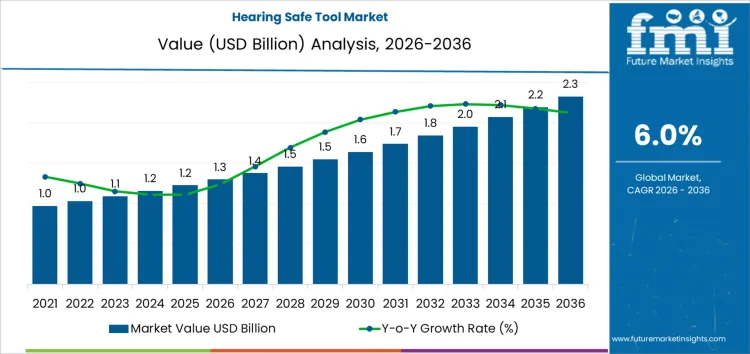
What is the Growth Forecast for the Hearing Safe Tool Market through 2036?
The hearing safe tool segment is expanding as occupational health policies and employer liability concerns increasingly influence equipment purchasing decisions across construction, manufacturing, and maintenance operations. In the early stage, adoption is mainly concentrated in larger industrial sites where formal safety programs and regular noise exposure assessments are already in place. Over time, quieter tools are no longer purchased only to support compliance audits. They are increasingly specified as standard equipment to reduce long-term hearing damage risks, minimize compensation claims, and lower worker fatigue. At this stage, demand is driven more by workforce protection and risk management priorities than by tool performance differentiation alone.
In the later stage, growth is shaped by the wider institutionalization of noise control practices rather than a major increase in the number of worksites. Hearing safe tools become embedded into procurement standards followed by contractors, rental fleets, and large industrial operators. Adoption expands into mid-sized enterprises as noise-related health compliance becomes more structured and measurable. Demand is also supported by higher tool density per site and the replacement of older, high-noise equipment with quieter alternatives. Purchasing decisions continue to prioritize certified noise performance, durability, and a strong balance between productivity and safety, reflecting how hearing protection objectives are becoming part of everyday operational and asset management policies.
Hearing-Safe Tool Market Key Takeaways
| Metric | Value |
|---|---|
| Market Value (2026) | USD 1.3 billion |
| Forecast Value (2036) | USD 2.3 billion |
| Forecast CAGR 2026 to 2036 | 6.0% |
How Is the Hearing-Safe Tool Market Supporting Worker Safety and Productivity?
Hearing-safe tools are increasingly adopted to reduce noise exposure in industrial, construction, and manufacturing environments while maintaining operational performance. Traditionally, high-noise hand and power tools posed risks of hearing damage, regulatory non-compliance, and reduced worker comfort. Modern hearing-safe tools incorporate low-noise motors, vibration-dampening mechanisms, and acoustic insulation to provide effective operation with minimal sound emissions. Equipment manufacturers, construction firms, and industrial operators prioritize tool performance, durability, and compliance with occupational health standards. Early adoption focused on high-noise environments such as metalworking and woodworking facilities, while current demand spans construction sites, assembly lines, and maintenance operations, driven by workplace safety regulations, employee well-being, and operational efficiency. Noise reduction, ergonomics, and tool reliability influence supplier selection.
Protecting hearing while maintaining task efficiency is shaping market adoption. Compared with conventional tools, hearing-safe versions reduce noise-related health risks, enhance worker focus, and support compliance with safety guidelines. Cost considerations involve motor design, acoustic engineering, and durability, concentrating margins among suppliers capable of delivering high-performance, low-noise tools. Operators implement these tools to maintain productivity, minimize hearing-related liabilities, and foster safer work environments. In the coming years, hearing-safe tools are expected to become standard across industrial, construction, and maintenance applications, enabling quieter operations, improved workforce health, and consistent task performance.
What Is Driving Demand for Hearing Safe Tools Across Key Segments in 2026?
The Hearing Safe Tool Market in 2026 is structured primarily by occupational health regulation, audit enforcement mechanisms, and employer liability exposure rather than by tool performance metrics alone. By tool type, demand in the Hearing Safe Tool Market is distributed across low-noise power tools, acoustically optimized hand tools, battery-powered low-noise tools, and insulated or vibration-dampened tool systems. By end-use industry, demand in the Hearing Safe Tool Market is concentrated in construction and building, woodworking and carpentry, industrial maintenance, and home improvement and DIY. These segments reflect differences in how noise exposure is measured, how compliance is documented, and how responsibility for long-term hearing damage is assigned within organizations.
How Do Regulatory Compliance and Legal Liability Shape Tool Type Demand in the Hearing Safe Tool Market?
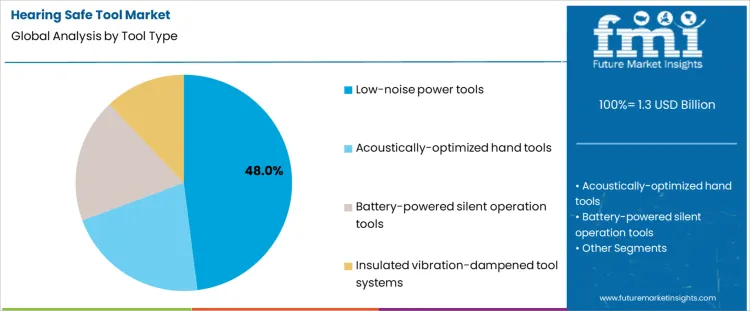
Low-noise power tools account for approximately 48% of demand in the Hearing Safe Tool Market because they provide the most direct and verifiable method of reducing measured workplace noise levels at the source. In many jurisdictions, employers are required to demonstrate that engineering controls have been applied before relying solely on personal protective equipment. Tool substitution therefore becomes a primary compliance strategy, as it can be documented through procurement records, equipment specifications, and audit reports.
Battery-powered low-noise tools and acoustically optimized hand tools are often adopted following regulatory inspections, insurance reviews, or occupational health claims rather than through discretionary upgrade programs. Insulated and vibration-dampened systems are specified where long-term exposure monitoring and cumulative injury risk are under review, particularly in environments with formal health surveillance programs. The structure of the Hearing Safe Tool Market is therefore shaped less by operator preference and more by the need for organizations to reduce measurable exposure levels, limit legal risk, and demonstrate due diligence in regulatory and insurance assessments.
Why Does Construction and Building Represent the Largest End Use Segment in the Hearing Safe Tool Market?

Construction and building account for approximately 45% of demand in the Hearing Safe Tool Market because this sector combines high noise exposure, dispersed worksites, and intensive regulatory oversight. Unlike fixed manufacturing environments, construction sites involve constantly changing equipment, tasks, and crews, which limits the effectiveness of administrative noise controls and acoustic isolation measures. This shifts compliance strategy toward equipment-level noise reduction, making tool selection a central component of occupational health management.
Construction firms often operate under public safety scrutiny and contractual safety requirements, which increases the importance of demonstrable preventive measures. Woodworking and carpentry operations and industrial maintenance facilities also face significant noise exposure, but these environments are more stable and allow greater reliance on enclosure, scheduling, and personal protective equipment programs. Home improvement and DIY applications contribute to demand through consumer preference and local noise restrictions, but they do not operate under the same legal and institutional constraints. The combination of regulatory intensity, workforce exposure, and site variability explains why construction and building remains the dominant end-use segment in the Hearing Safe Tool Market.
How Are the Key Dynamics Reshaping the Hearing Safe Tool Market?
Noise reduction in tools is not being adopted because of safety posters. It is being adopted because modern worksites are becoming more compact, more automated, and more schedule constrained. In tight factories and indoor construction, multiple trades now operate simultaneously in shared space. Loud tools no longer just harm ears. They interrupt coordination, communication, and sequencing. The Hearing Safe Tool Market benefits from this collision of density and parallel work. Quiet tools are becoming enablers of mixed-activity workflows. This shifts the category from health equipment into productivity infrastructure, where sound becomes a planning variable, not just a compliance statistic.
Why the Hearing Safe Tool Market Is Workflow-Compatibility Driven?
On modern sites, work is layered. Electricians, fitters, inspectors, and installers occupy the same zone. A single loud operation now blocks many other tasks. Quieter tools allow overlapping work instead of serialized scheduling. That changes project critical paths. In these environments, the value of low-noise equipment shows up in calendar time, not medical charts. The Hearing Safe Tool Market therefore grows fastest in interiors, retrofit projects, and automated plants where space and sequencing are tight. It grows because silence allows parallelism, not because someone finally decided to care about decibels.
Why the Hearing Safe Tool Market Faces Engineering Tradeoffs?
Quieter tools are not simply muffled versions of loud ones. They often require different motors, gearing, airflow, or cutting strategies. That can change weight, balance, and cutting feel. In some tasks, operators still prefer the older, louder behavior because it matches muscle memory or delivers different feedback. Tool designers are trading acoustic output against torque density, heat, and durability. This slows universal substitution. The Hearing Safe Tool Market therefore advances unevenly, winning in some applications and losing in others, depending on how much performance compromise users are willing to accept.
Why the Hearing Safe Tool Market Tracks Construction and Factory Layout Trends?
As more work moves indoors, into finished spaces, or into partially occupied buildings, noise becomes an operational constraint. Hospitals, data centers, commercial retrofits, and residential towers already limit what can be used and when. In such environments, low-noise tools are not upgrades. They are the only tools allowed. This ties the Hearing Safe Tool Market to how and where work is performed, not to generic tool replacement cycles. The category grows with urbanization, indoorization, and multi-trade density, not simply with safety campaigns or regulation changes.
What is the Demand for Hearing-Safe Tools by Country?
| Country | CAGR (%) |
|---|---|
| USA | 5.5% |
| UK | 5.2% |
| China | 6.5% |
| India | 6.8% |
| Brazil | 5.9% |
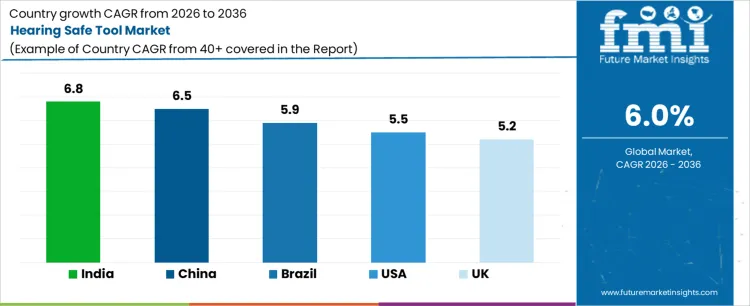
Demand for hearing-safe tools is rising as manufacturers, construction companies, and workshops adopt equipment designed to reduce noise exposure and protect worker hearing. India leads with a 6.8% CAGR, driven by growing industrial activity, increasing workplace safety regulations, and adoption of low-noise tools. China follows at 6.5%, supported by expansion of manufacturing operations and safety-conscious equipment use. Brazil records 5.9% growth, shaped by adoption in industrial and construction sectors. The USA grows at 5.5%, influenced by replacement demand and integration of hearing-safe solutions. The UK shows 5.2% CAGR, reflecting steady adoption of low-noise tools across industrial, commercial, and residential applications.
How do compliance programs shape hear safe tool adoption in the United States?
Workplace safety enforcement and litigation exposure shape equipment selection in United States industrial environments, with hearing safe tool demand expanding at a 5.5% CAGR. Procurement decisions sit with safety officers and risk management teams rather than production supervisors. Large employers in construction, utilities, manufacturing, and mining standardize low noise tools across entire fleets. Equipment replacement follows audit findings and insurance reviews. Tool choice emphasizes certified noise output, durability, and training documentation. Distributors support rollout through fleet contracts and compliance bundles. Brand preference depends on test data and legal defensibility more than marginal performance. Budget approval follows annual safety planning cycles. Adoption accelerates after regulatory inspections and incident reviews. Commercial success depends on presence inside approved safety catalogs and corporate procurement frameworks rather than individual site purchasing behavior.
Why do regulatory audits influence purchase behavior in the United Kingdom?
Health and safety inspection regimes guide tool standardization in United Kingdom workplaces, with hearing safe tool usage rising at a 5.2% CAGR. Large contractors and infrastructure operators manage noise exposure through centralized procurement policies. Tool selection focuses on certified noise ratings, documentation clarity, and audit traceability. Equipment rollout often follows inspection findings and compliance improvement plans. Service contractors influence brand lists through framework agreements. New project activity adds incremental volume while existing fleets drive baseline demand. Training requirements and record keeping shape supplier acceptance. Local distributor support affects deployment speed across multi-site operations. Spending follows annual safety budget cycles. Commercial visibility depends on inclusion inside contractor frameworks and safety approved equipment lists rather than sales to individual crews or site managers.
What institutional forces drive scale adoption in China?
Industrial safety policy enforcement and workforce protection programs keep China on a 6.5% growth path for hearing safe tool deployment. Large state owned groups and manufacturing clusters drive standardization across factories, construction sites, and infrastructure projects. Central procurement teams define acceptable tool categories. Domestic brands dominate standard segments through pricing and supply capacity. International suppliers retain positions in premium certified ranges. Adoption often follows regulatory campaigns and inspection cycles. Documentation and certification carry strong weight in approval processes. Volume grows through enterprise wide rollout programs rather than site by site decisions. Training materials and compliance records influence supplier choice. Commercial success depends on access to group purchasing lists and government aligned safety programs rather than fragmented contractor sales.
Why does workforce formalization accelerate demand in India?
Expansion of organized construction, manufacturing, and infrastructure workforces keeps India on a 6.8% growth track for hearing safe tool purchases. Safety compliance requirements rise as more employers operate under structured audit regimes. Procurement responsibility shifts from site supervisors to central safety and administration teams. Tool choice emphasizes certified noise performance, durability, and cost control. Import brands serve premium segments while domestic suppliers cover volume categories. Adoption often follows corporate safety policy updates and inspection outcomes. Distributor networks support multi-site rollout. Spending follows annual safety planning and insurance review cycles. Volume growth comes from enterprise standardization rather than individual worker choice. Commercial success depends on inclusion in corporate safety catalogs and preferred supplier programs.
How do liability management practices shape Brazil demand?
Employer risk management and insurance requirements shape equipment purchasing in Brazil, with hearing safe tool demand advancing at a 5.9% CAGR. Large contractors, mining groups, and industrial operators adopt standardized low noise tool policies. Procurement teams focus on certification, documentation, and audit defensibility. Replacement follows inspection findings and incident prevention programs. Import products serve premium compliance categories. Local distributors manage training and deployment logistics. Tool choice reflects legal exposure and workforce protection goals more than productivity differences. Spending aligns with annual safety budgets and contract renewals. Multi-site employers drive most volume through centralized purchasing. Commercial position depends on acceptance inside corporate safety programs and insurer recommended equipment lists rather than direct selling to individual job sites.
How Are Manufacturers Distinguishing Products in the Hearing Safe Tool Market?
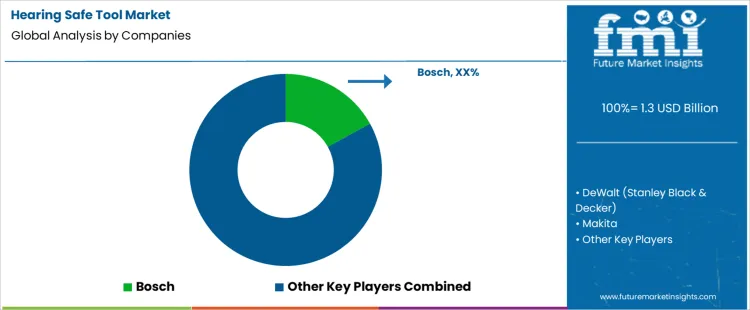
Leaders in the hearing safe tool market design equipment that limits noise exposure while preserving cutting, drilling, and fastening performance. Bosch supplies tools engineered with reduced acoustic signatures and vibration damping to lower operator exposure during prolonged use. DeWalt (Stanley Black & Decker) offers models tuned for balanced power delivery and noise management in construction and renovation tasks. Makita emphasizes brushless motor efficiency and internal components that moderate sound output across common woodworking and metalworking operations. Hilti develops professional grade tools with engineered housings and active noise reduction features targeting trade professionals. Festool’s systems integrate dust extraction and optimized drive systems that contribute to quieter operation.
Metabo focuses on tools with robust build quality and noise attenuation tailored to demanding jobsites where hearing protection is a priority. Other niche suppliers provide variants optimized for specific applications such as sawing, grinding, or sanding where noise levels traditionally exceed safe thresholds. Differences among offerings arise from measured decibel output, ergonomic design that reduces strain, and compatibility with hearing safety standards. Buyers weigh durability, service support, and performance under load alongside acoustic performance when specifying tools for contractors, workshops, and industrial applications. Suppliers that document noise ratings and integrate hearing safe design features maintain relevance as users seek to protect operators without sacrificing productivity.
Key Players in the Hearing Safe Tool Market
- Bosch
- DeWalt (Stanley Black & Decker)
- Makita
- Hilti
- Festool
- Metabo
Scope of the Report
| Items | Values |
|---|---|
| Quantitative Units (2026) | USD billion |
| Tool Type | Low-noise power tools, Acoustically-optimized hand tools, Battery-powered silent operation tools, Insulated vibration-dampened tool systems |
| End-Use Industry | Construction and building, Woodworking and carpentry, Industrial maintenance, Home improvement and DIY |
| Region | Asia Pacific, Europe, North America, Latin America, Middle East & Africa |
| Countries Covered | China, Japan, South Korea, India, Australia & New Zealand, ASEAN, Germany, United Kingdom, France, Italy, Spain, Nordic, BENELUX, United States, Canada, Mexico, Brazil, Chile, Saudi Arabia, Turkey, South Africa, and other regional markets |
| Key Companies Profiled | Bosch, DeWalt (Stanley Black & Decker), Makita, Hilti, Festool, Metabo |
| Additional Attributes | Dollar sales by tool type and end-use; demand driven by occupational noise regulations, audit enforcement, and liability management; growth led by fleet standardization and wider penetration across contractors and industrial operators; purchasing shaped by certified noise ratings, durability, workflow compatibility, and compliance documentation rather than unit price. |
Hearing Safe Tool Market Segmentation
Tool Type:
- Low-noise power tools
- Acoustically-optimized hand tools
- Battery-powered silent operation tools
- Insulated vibration-dampened tool systems
End-Use Industry:
- Construction and building
- Woodworking and carpentry
- Industrial maintenance
- Home improvement and DIY
Region:
- Asia Pacific
- China
- Japan
- South Korea
- India
- Australia & New Zealand
- ASEAN
- Rest of Asia Pacific
- Europe
- Germany
- United Kingdom
- France
- Italy
- Spain
- Nordic
- BENELUX
- Rest of Europe
- North America
- United States
- Canada
- Mexico
- Latin America
- Brazil
- Chile
- Rest of Latin America
- Middle East & Africa
- Kingdom of Saudi Arabia
- Other GCC Countries
- Turkey
- South Africa
- Other African Union
- Rest of Middle East & Africa
Bibliography
- National Institute for Occupational Safety and Health. (2024, January 30). Noise-induced hearing loss. Centers for Disease Control and Prevention.
- Safe Work Australia. (2024, November). Model code of practice: Managing noise and preventing hearing loss at work. Australian Government.
- Department of Justice Canada. (2024, November 30). Canada Occupational Health and Safety Regulations (SOR/86-304) (Amended by SOR/2024-118). Government of Canada.
Frequently Asked Questions
How big is the hearing safe tool market in 2026?
The global hearing safe tool market is estimated to be valued at USD 1.3 billion in 2026.
What will be the size of hearing safe tool market in 2036?
The market size for the hearing safe tool market is projected to reach USD 2.3 billion by 2036.
How much will be the hearing safe tool market growth between 2026 and 2036?
The hearing safe tool market is expected to grow at a 6.0% CAGR between 2026 and 2036.
What are the key product types in the hearing safe tool market?
The key product types in hearing safe tool market are low‑noise power tools, acoustically‑optimized hand tools, battery‑powered silent operation tools and insulated vibration‑dampened tool systems.
Which end‑use industry segment to contribute significant share in the hearing safe tool market in 2026?
In terms of end‑use industry, construction and building segment to command 45.0% share in the hearing safe tool market in 2026.
Preview the report firsthand - request a free sample
Get SampleGet the brochure for pricing and purchase details.
Get PDFTable of Content
- Executive Summary
- Global Market Outlook
- Demand-side Trends
- Supply-side Trends
- Technology Roadmap Analysis
- Analysis and Recommendations
- Market Overview
- Market Coverage / Taxonomy
- Market Definition / Scope / Limitations
- Market Background
- Market Dynamics
- Drivers
- Restraints
- Opportunity
- Trends
- Scenario Forecast
- Demand in Optimistic Scenario
- Demand in Likely Scenario
- Demand in Conservative Scenario
- Opportunity Map Analysis
- Product Life Cycle Analysis
- Supply Chain Analysis
- Investment Feasibility Matrix
- Value Chain Analysis
- PESTLE and Porter’s Analysis
- Regulatory Landscape
- Regional Parent Market Outlook
- Production and Consumption Statistics
- Import and Export Statistics
- Market Dynamics
- Global Market Analysis 2021 to 2025 and Forecast, 2026 to 2036
- Historical Market Size Value (USD Million) Analysis, 2021 to 2025
- Current and Future Market Size Value (USD Million) Projections, 2026 to 2036
- Y-o-Y Growth Trend Analysis
- Absolute $ Opportunity Analysis
- Global Market Pricing Analysis 2021 to 2025 and Forecast 2026 to 2036
- Global Market Analysis 2021 to 2025 and Forecast 2026 to 2036, By Tool Type
- Introduction / Key Findings
- Historical Market Size Value (USD Million) Analysis By Tool Type , 2021 to 2025
- Current and Future Market Size Value (USD Million) Analysis and Forecast By Tool Type , 2026 to 2036
- Low‑noise power tools
- Acoustically‑optimized hand tools
- Battery‑powered silent operation tools
- Insulated vibration‑dampened tool systems
- Low‑noise power tools
- Y-o-Y Growth Trend Analysis By Tool Type , 2021 to 2025
- Absolute $ Opportunity Analysis By Tool Type , 2026 to 2036
- Global Market Analysis 2021 to 2025 and Forecast 2026 to 2036, By End‑Use Industry
- Introduction / Key Findings
- Historical Market Size Value (USD Million) Analysis By End‑Use Industry, 2021 to 2025
- Current and Future Market Size Value (USD Million) Analysis and Forecast By End‑Use Industry, 2026 to 2036
- Construction and building
- Woodworking and carpentry
- Industrial maintenance
- Home improvement and DIY
- Construction and building
- Y-o-Y Growth Trend Analysis By End‑Use Industry, 2021 to 2025
- Absolute $ Opportunity Analysis By End‑Use Industry, 2026 to 2036
- Global Market Analysis 2021 to 2025 and Forecast 2026 to 2036, By Region
- Introduction
- Historical Market Size Value (USD Million) Analysis By Region, 2021 to 2025
- Current Market Size Value (USD Million) Analysis and Forecast By Region, 2026 to 2036
- North America
- Latin America
- Western Europe
- Eastern Europe
- East Asia
- South Asia and Pacific
- Middle East & Africa
- Market Attractiveness Analysis By Region
- North America Market Analysis 2021 to 2025 and Forecast 2026 to 2036, By Country
- Historical Market Size Value (USD Million) Trend Analysis By Market Taxonomy, 2021 to 2025
- Market Size Value (USD Million) Forecast By Market Taxonomy, 2026 to 2036
- By Country
- USA
- Canada
- Mexico
- By Tool Type
- By End‑Use Industry
- By Country
- Market Attractiveness Analysis
- By Country
- By Tool Type
- By End‑Use Industry
- Key Takeaways
- Latin America Market Analysis 2021 to 2025 and Forecast 2026 to 2036, By Country
- Historical Market Size Value (USD Million) Trend Analysis By Market Taxonomy, 2021 to 2025
- Market Size Value (USD Million) Forecast By Market Taxonomy, 2026 to 2036
- By Country
- Brazil
- Chile
- Rest of Latin America
- By Tool Type
- By End‑Use Industry
- By Country
- Market Attractiveness Analysis
- By Country
- By Tool Type
- By End‑Use Industry
- Key Takeaways
- Western Europe Market Analysis 2021 to 2025 and Forecast 2026 to 2036, By Country
- Historical Market Size Value (USD Million) Trend Analysis By Market Taxonomy, 2021 to 2025
- Market Size Value (USD Million) Forecast By Market Taxonomy, 2026 to 2036
- By Country
- Germany
- UK
- Italy
- Spain
- France
- Nordic
- BENELUX
- Rest of Western Europe
- By Tool Type
- By End‑Use Industry
- By Country
- Market Attractiveness Analysis
- By Country
- By Tool Type
- By End‑Use Industry
- Key Takeaways
- Eastern Europe Market Analysis 2021 to 2025 and Forecast 2026 to 2036, By Country
- Historical Market Size Value (USD Million) Trend Analysis By Market Taxonomy, 2021 to 2025
- Market Size Value (USD Million) Forecast By Market Taxonomy, 2026 to 2036
- By Country
- Russia
- Poland
- Hungary
- Balkan & Baltic
- Rest of Eastern Europe
- By Tool Type
- By End‑Use Industry
- By Country
- Market Attractiveness Analysis
- By Country
- By Tool Type
- By End‑Use Industry
- Key Takeaways
- East Asia Market Analysis 2021 to 2025 and Forecast 2026 to 2036, By Country
- Historical Market Size Value (USD Million) Trend Analysis By Market Taxonomy, 2021 to 2025
- Market Size Value (USD Million) Forecast By Market Taxonomy, 2026 to 2036
- By Country
- China
- Japan
- South Korea
- By Tool Type
- By End‑Use Industry
- By Country
- Market Attractiveness Analysis
- By Country
- By Tool Type
- By End‑Use Industry
- Key Takeaways
- South Asia and Pacific Market Analysis 2021 to 2025 and Forecast 2026 to 2036, By Country
- Historical Market Size Value (USD Million) Trend Analysis By Market Taxonomy, 2021 to 2025
- Market Size Value (USD Million) Forecast By Market Taxonomy, 2026 to 2036
- By Country
- India
- ASEAN
- Australia & New Zealand
- Rest of South Asia and Pacific
- By Tool Type
- By End‑Use Industry
- By Country
- Market Attractiveness Analysis
- By Country
- By Tool Type
- By End‑Use Industry
- Key Takeaways
- Middle East & Africa Market Analysis 2021 to 2025 and Forecast 2026 to 2036, By Country
- Historical Market Size Value (USD Million) Trend Analysis By Market Taxonomy, 2021 to 2025
- Market Size Value (USD Million) Forecast By Market Taxonomy, 2026 to 2036
- By Country
- Kingdom of Saudi Arabia
- Other GCC Countries
- Turkiye
- South Africa
- Other African Union
- Rest of Middle East & Africa
- By Tool Type
- By End‑Use Industry
- By Country
- Market Attractiveness Analysis
- By Country
- By Tool Type
- By End‑Use Industry
- Key Takeaways
- Key Countries Market Analysis
- USA
- Pricing Analysis
- Market Share Analysis, 2025
- By Tool Type
- By End‑Use Industry
- Canada
- Pricing Analysis
- Market Share Analysis, 2025
- By Tool Type
- By End‑Use Industry
- Mexico
- Pricing Analysis
- Market Share Analysis, 2025
- By Tool Type
- By End‑Use Industry
- Brazil
- Pricing Analysis
- Market Share Analysis, 2025
- By Tool Type
- By End‑Use Industry
- Chile
- Pricing Analysis
- Market Share Analysis, 2025
- By Tool Type
- By End‑Use Industry
- Germany
- Pricing Analysis
- Market Share Analysis, 2025
- By Tool Type
- By End‑Use Industry
- UK
- Pricing Analysis
- Market Share Analysis, 2025
- By Tool Type
- By End‑Use Industry
- Italy
- Pricing Analysis
- Market Share Analysis, 2025
- By Tool Type
- By End‑Use Industry
- Spain
- Pricing Analysis
- Market Share Analysis, 2025
- By Tool Type
- By End‑Use Industry
- France
- Pricing Analysis
- Market Share Analysis, 2025
- By Tool Type
- By End‑Use Industry
- India
- Pricing Analysis
- Market Share Analysis, 2025
- By Tool Type
- By End‑Use Industry
- ASEAN
- Pricing Analysis
- Market Share Analysis, 2025
- By Tool Type
- By End‑Use Industry
- Australia & New Zealand
- Pricing Analysis
- Market Share Analysis, 2025
- By Tool Type
- By End‑Use Industry
- China
- Pricing Analysis
- Market Share Analysis, 2025
- By Tool Type
- By End‑Use Industry
- Japan
- Pricing Analysis
- Market Share Analysis, 2025
- By Tool Type
- By End‑Use Industry
- South Korea
- Pricing Analysis
- Market Share Analysis, 2025
- By Tool Type
- By End‑Use Industry
- Russia
- Pricing Analysis
- Market Share Analysis, 2025
- By Tool Type
- By End‑Use Industry
- Poland
- Pricing Analysis
- Market Share Analysis, 2025
- By Tool Type
- By End‑Use Industry
- Hungary
- Pricing Analysis
- Market Share Analysis, 2025
- By Tool Type
- By End‑Use Industry
- Kingdom of Saudi Arabia
- Pricing Analysis
- Market Share Analysis, 2025
- By Tool Type
- By End‑Use Industry
- Turkiye
- Pricing Analysis
- Market Share Analysis, 2025
- By Tool Type
- By End‑Use Industry
- South Africa
- Pricing Analysis
- Market Share Analysis, 2025
- By Tool Type
- By End‑Use Industry
- USA
- Market Structure Analysis
- Competition Dashboard
- Competition Benchmarking
- Market Share Analysis of Top Players
- By Regional
- By Tool Type
- By End‑Use Industry
- Competition Analysis
- Competition Deep Dive
- Bosch
- Overview
- Product Portfolio
- Profitability by Market Segments (Product/Age /Sales Channel/Region)
- Sales Footprint
- Strategy Overview
- Marketing Strategy
- Product Strategy
- Channel Strategy
- DeWalt (Stanley Black & Decker)
- Makita
- Hilti
- Festool
- Metabo
- Bosch
- Competition Deep Dive
- Assumptions & Acronyms Used
- Research Methodology


