

- Industry Size (2026)
- USD 1.3 Bn
- Forecast (2036)
- USD 2.5 Bn
- CAGR (2026 to 2036)
- 6.5%
Ingrown Nail Treatment Products Market Forecast and Outlook 2026 to 2036
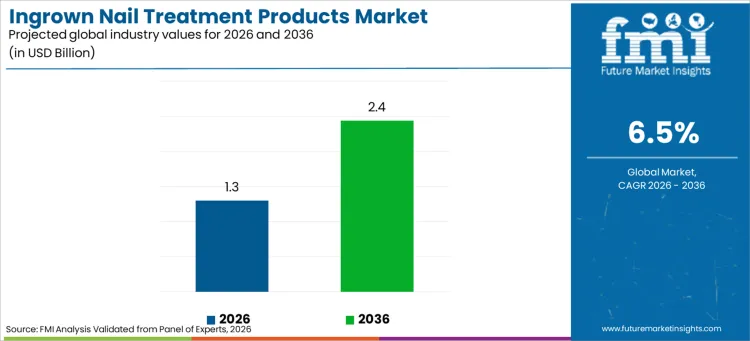
Ingrown nail treatment products market is expected to cross USD 1.3 billion in 2026, driven by a growing preference for non-invasive correction methods over surgical avulsion. Revenue generation is projected to expand at a steady CAGR of 6.5% through 2036, pushing total industry worth beyond USD 2.5 billion by the end of this period. Rising prevalence of diabetic foot ulcers and obesity-related nail deformities acts as a primary catalyst for this financial trajectory.
Pharmaceutical entities are channeling significant investments into developing home-use orthonyxia devices, aiming to reduce patient dependency on frequent clinic visits. Consumers are shifting focus from temporary pain relief to long-term structural correction, redefining spending habits in major healthcare economies. Such behavioral changes encourage manufacturers to introduce advanced bracing systems that offer permanent straightening without downtime.
Lifestyle choices, including the regular use of constrictive footwear in corporate and athletic settings, are significantly influencing industry expansion. Healthcare professionals emphasize preventative care, utilizing corrective strips to guide nail growth and prevent soft tissue impalement. Clinical trials investigating novel memory-metal braces are showing positive outcomes, instilling confidence among investors and podiatrists regarding future product pipelines.
Growing awareness regarding the risks of untreated onychocryptosis, such as cellulitis and osteomyelitis, continues to fuel demand for effective management tools, creating sustained opportunities for medical-grade solutions. Government health initiatives targeting diabetic limb preservation are facilitating faster regulatory approvals for safe, user-friendly devices. Companies are witnessing robust growth potential in developing nations, where improving podiatric infrastructure and rising disposable incomes are aligning with increased personal hygiene standards.
Quick Stats for Ingrown Nail Treatment Products Market
- Ingrown Nail Treatment Products Industry Value (2026): USD 1.3 Billion
- Ingrown Nail Treatment Products Industry Forecast Value (2036): USD 2.5 Billion
- Ingrown Nail Treatment Products Industry Forecast CAGR: 6.5%
- Ingrown Nail Treatment Products Industry Leading Form: Corrective braces & strips (28%)
- Ingrown Nail Treatment Products Industry Leading End Use: Podiatry clinics (44%)
- Ingrown Nail Treatment Products Industry Leading Functionality: Nail Correction
- Ingrown Nail Treatment Products Industry Key Growth Regions: India, Brazil, China
- Ingrown Nail Treatment Products Industry Key Players: 3M, Smith & Nephew, B. Braun, Medline, Convatec
Researchers are combining podiatry services with advanced foot care product lines that utilize tension-adjustable braces. Development of foot care for diabetic patients compatible devices is gaining traction, addressing safety barriers that often hinder treatment in high-risk groups. Focus is shifting toward comprehensive corn and callus remover kits that include precision tools for preparing the nail sulcus. Advancements in healthcare services enable better distribution of these specialized products, enhancing therapeutic outcomes while significantly reducing recurrence rates. These innovations are pivotal in shaping a future where correction is both effective and accessible.
Ingrown Nail Treatment Products Market Key Takeaways
| Metric | Value |
|---|---|
| Industry Size (2026) | USD 1.3 Billion |
| Industry Value (2036) | USD 2.5 Billion |
| CAGR (2026-2036) | 6.5% |
Source: Future Market Insights’ proprietary forecasting model and primary research
What Factors Are Propelling Non-Invasive Solutions?
Shift toward minimally invasive orthonyxia is serving as a significant catalyst for broader acceptance of corrective braces. Recent breakthroughs in orthopedic insole designs have complemented treatment protocols by offloading pressure from affected toes during recovery. This holistic approach appeals to healthcare providers managing patients with chronic recurrence. Clinical success of medical footwear integration in preventing relapse has expanded prescribing precision. Education programs highlighting amputation risks associated with surgical nail removal in diabetics are driving patient proactivity. Pharmaceutical firms are capitalizing on these trends by introducing foot patches that protect sensitive areas while braces work. Integrating tinea pedis treatment into routine care is becoming standard practice, ensuring fungal infections do not compromise correction efforts.
How Is the Ingrown Nail Treatment Products Market Segmented Across Key Categories?
Podiatry clinics are projected to capture 44% of revenue share in 2026, cementing their status as primary setting for specialized nail care. Dominance stems from patient reliance on specialist expertise to perform delicate procedures like partial nail avulsion or brace application. Dermatology clinics follow, driven by need for managing infectious complications. In terms of product categories, Corrective braces & strips hold largest share due to their ability to provide permanent relief without surgery. Industry structure highlights clear preference for mechanical correction over purely pharmaceutical management. Understanding these dynamics is crucial as foot fungus treatments overlaps with ingrown care, creating new avenues for cross-selling professional-grade products.
Why Do Corrective Braces Maintain Dominance?
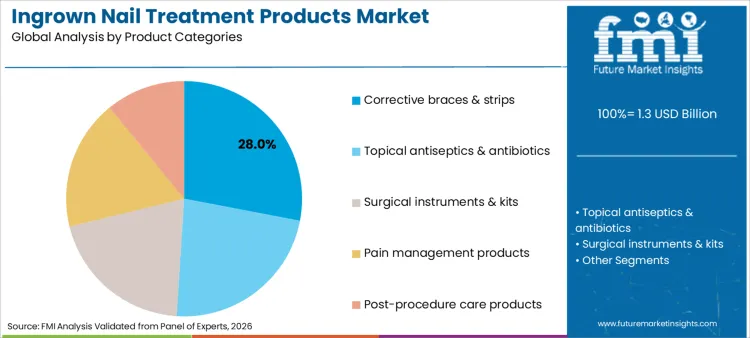
Corrective braces & strips account for 28% of share in 2026, driven by their high success rate in reshaping nail curvature. Leadership position is underpinned by clinical guidelines recommending orthonyxia as a first-line alternative to surgery for suitable candidates. Segment benefits from continuous material improvements, such as use of resin-coated wires that offer better adhesion and aesthetics. Research focused on minimizing application time is renewing interest among busy practitioners. Critical role in onychomycosis treatment further solidifies standing, as braces can be used alongside antifungals to treat deformed, infected nails. As healthcare systems prioritize cost-effective disease management, demand for reusable or long-lasting bracing systems is expected to remain robust.
Why Are Podiatry Clinics the Preferred Setting?
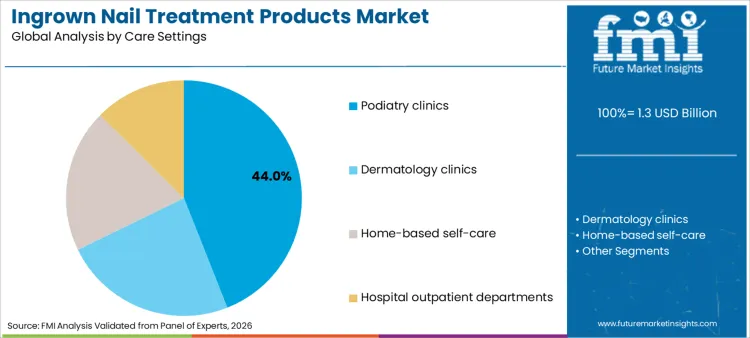
Podiatry clinics command 44% share of sector in 2026, reflecting global preference for dedicated foot care specialists. Dominance is inextricably linked to technical skill required to apply corrective devices correctly without causing trauma. Clinics rely on specialized brittle nails treatment tools to prepare fragile nails for bracing. These settings are essential for monitoring progress in high-risk diabetic populations, driving priority status in healthcare funding. Relentless pursuit of permanent cure ensures products designed specifically for professional manipulation remain top priority. High patient trust levels necessitate long-term clinic relationships, bolstering sustained revenue streams for these facilities.
Ingrown Nail Treatment Products Market Dynamics
How Will Home-Care Trends Impact Sales?
Home-care adoption is set to reshape sales landscapes by democratizing access to professional-grade tools. As nail care products demand evolve, consumers access DIY correction kits that mimic clinical devices, expanding reach beyond urban centers. Shift toward self-management creates demand for safe, easy-to-use strips requiring minimal training. Manufacturers failing to create retail-friendly packaging risk losing visibility among cost-conscious demographics. Availability of fungal testing kits for home use drives complimentary consumption volume. Rise of telemedicine stimulates innovation, with companies differentiating offerings by bundling products with virtual nurse support.
How Are Regulatory Frameworks Influencing Development?
Regulatory bodies are increasingly demanding rigorous safety data for home-use medical devices, directly impacting development costs. Shift forces manufacturers to prove not just efficacy but also usability by laypersons, raising entry barriers. Opportunities for differentiation emerge as devices demonstrating fool-proof safety mechanisms gain rapid endorsement. Strict sterilization standards impact production of surgical kits. Manufacturers must ensure rigorous quality control to prevent infection risks. While regulations drive development of superior products, they impose higher compliance burdens. Companies proactively aligning with global guidelines regarding over-the-counter medical devices gain competitive edge, positioning brands as trusted leaders.
How Will the Ingrown Nail Treatment Industry Evolve in Major Nations?
Global landscape for ingrown nail treatment is characterized by diverse growth patterns, influenced by footwear habits and healthcare access. Established markets prioritize advanced orthonyxia and specialized podiatry services, whereas emerging economies rely on affordable surgical kits and antibiotics. Asia-Pacific is emerging as rapid growth hub due to increasing urbanization and westernization of footwear. Conversely, North American and Western European sectors pivot towards non-surgical preservation. Government initiatives in developing nations supporting diabetic foot screening ensure sustained demand for essential care tools across all geographies.
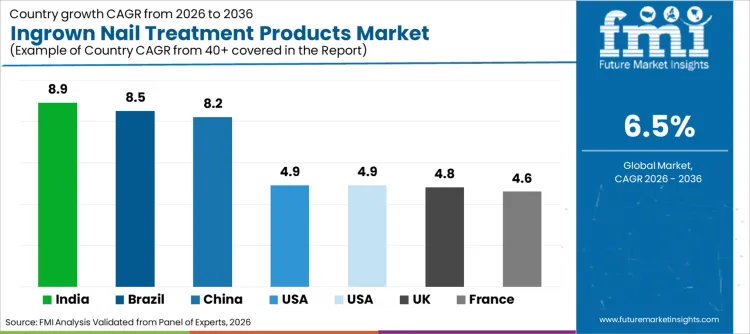
| Country | CAGR (2026 to 2036) |
|---|---|
| USA | 4.9% |
| Brazil | 8.5% |
| China | 8.2% |
| India | 8.9% |
| Germany | 4.9% |
| France | 4.6% |
| UK | 4.8% |
Source: Future Market Insights’ proprietary forecasting model and primary research
Why is the Ingrown Nail Treatment Industry in the USA Growing?
Sales of ingrown nail treatments in USA are set to grow at 4.9% CAGR through 2036. Expansion is underpinned by high prevalence of obesity and diabetes, driving need for specialized foot care. Growth is fueled by widespread availability of podiatry clinics, often necessitating preventative tools for chronic sufferers. Rapid adoption of advanced memory-metal braces drives revenue generation per unit. Presence of major medical device players headquartered within country streamlines supply chains. Emphasis on avoiding surgical complications continues to be primary driver, maintaining USA position as critical revenue generator.
Why is the Ingrown Nail Treatment Sector in China Expanding?
Demand for correction solutions in China is projected to rise at 8.2% CAGR during assessment period. Initiatives emphasizing elder care and diabetes management foster favorable environment for domestic and international brands. Increasing investment in private foot care clinics creates massive supply channel for premium tools. Rising popularity of western-style shoes among youth prompts local pharmacies to stock advanced relief products. Shift is supported by e-commerce platforms promoting niche personal care tools, accelerating uptake of specialized products across country and fueling sector expansion.
Why is the Ingrown Nail Treatment Industry in India Showing High Potential?
Ingrown nail treatment industry in India is poised to expand at 8.9% CAGR, representing highest growth rate among analyzed nations. Surge is largely attributed to growing diabetic population and increasing awareness of foot hygiene. Government focus on reducing amputation rates encourages population to upgrade from home remedies to clinically proven devices. Increasing partnerships between Indian distributors and global manufacturers necessitate production of affordable, high-quality kits. Cost advantages of local manufacturing combined with rising middle-class purchasing power attract significant investment. Generic availability of antibiotics and basic tools further democratizes access.
What is the Competitive Outlook for the Ingrown Nail Treatment Products Market?
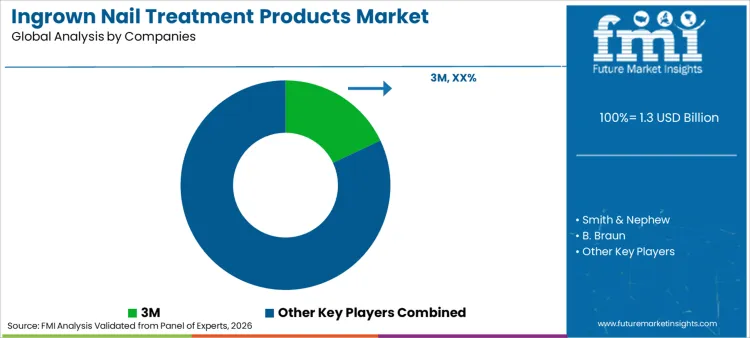
Market participants are increasingly focusing on vertical integration to capture value across the patient journey. Leading players like 3M and Smith & Nephew are directing R&D budgets toward hybrid devices combining mechanical correction with chemical softening agents. Significant trend involves developing "smart" braces that indicate when correction is complete, enhancing user compliance. Companies actively engage in strategic collaborations with diabetic associations to create specialized care bundles. Sustainability emerges as competitive frontier, with manufacturers exploring biodegradable materials for single-use applicators. Consolidation activities remain high as large medical conglomerates acquire niche podiatry firms to fortify their wound care portfolios against generic competition.
Key Players in Ingrown Nail Treatment Products Market
- 3M
- Smith & Nephew
- B. Braun
- Medline
- Convatec
Scope of Report
| Items | Values |
|---|---|
| Quantitative Units | USD Million, USD Billion |
| Product Categories | Corrective braces & strips, Topical antiseptics & antibiotics, Surgical instruments & kits, Pain management products, Post-procedure care products |
| Care Settings | Podiatry clinics, Dermatology clinics, Home-based self-care, Hospital outpatient departments |
| Sales Channels | Retail pharmacies, Medical supply stores, Online sales, Hospital procurement |
| Regions | North America, Europe, East Asia, South Asia, Latin America, MEA |
Ingrown Nail Treatment Products Market by Segments
Product Categories
- Corrective braces & strips
- Topical antiseptics & antibiotics
- Surgical instruments & kits
- Pain management products
- Post-procedure care products
Care Settings
- Podiatry clinics
- Dermatology clinics
- Home-based self-care
- Hospital outpatient departments
Sales Channels
- Retail pharmacies
- Medical supply stores
- Online sales
- Hospital procurement
Regions
- North America
- Europe
- East Asia
- South Asia
- Latin America
- Middle East & Africa
Bibliography
- American Podiatric Medical Association. (2024, October 10). Ingrown toenails. American Podiatric Medical Association, United States.
- National Institute of Diabetes and Digestive and Kidney Diseases. (2025, August 25). Diabetes, peripheral arterial disease, and foot ulcers. National Institute of Diabetes and Digestive and Kidney Diseases, United States.
- USA Food and Drug Administration. (2024, July 15). Prescription-to-nonprescription switch list. USA Food and Drug Administration, United States.
- World Health Organization. (2024, November 13). Diabetes fact sheet. World Health Organization.
- Journal of Foot and Ankle Research. (2024, January 17). Surgical strategies for ingrown toenails: A comprehensive review. Journal of Foot and Ankle Research.
Frequently Asked Questions
How large is the demand for Ingrown Nail Treatment Products in the global market in 2026?
Demand for Ingrown Nail Treatment Products in global market is estimated to be valued at USD 1.3 billion in 2026.
What will be the market size of Ingrown Nail Treatment Products in the global market by 2036?
Market size for Ingrown Nail Treatment Products in global market is projected to reach USD 2.5 billion by 2036.
What is the expected demand growth for Ingrown Nail Treatment Products in the global market between 2026 and 2036?
Demand for Ingrown Nail Treatment Products in global market is expected to grow at CAGR of 6.5% between 2026 and 2036.
Which Product Category is poised to lead global sales by 2026?
Corrective braces & strips are expected to be dominant product category, capturing approximately 28% of global market share in 2026 due to non-invasive benefits.
How significant is the role of Podiatry Clinics in driving Ingrown Nail Treatment Products adoption in 2026?
Podiatry Clinics represent critical care setting, projected to hold substantial 44% share of total market in 2026 as patients seek specialist intervention.
Preview the report firsthand - request a free sample
Get SampleGet the brochure for pricing and purchase details.
Get PDFTable of Content
- Executive Summary
- Global Market Outlook
- Demand-side Trends
- Supply-side Trends
- Technology Roadmap Analysis
- Analysis and Recommendations
- Market Overview
- Market Coverage / Taxonomy
- Market Definition / Scope / Limitations
- Market Background
- Market Dynamics
- Drivers
- Restraints
- Opportunity
- Trends
- Scenario Forecast
- Demand in Optimistic Scenario
- Demand in Likely Scenario
- Demand in Conservative Scenario
- Opportunity Map Analysis
- Product Life Cycle Analysis
- Supply Chain Analysis
- Investment Feasibility Matrix
- Value Chain Analysis
- PESTLE and Porter’s Analysis
- Regulatory Landscape
- Regional Parent Market Outlook
- Production and Consumption Statistics
- Import and Export Statistics
- Market Dynamics
- Global Market Analysis 2021 to 2025 and Forecast, 2026 to 2036
- Historical Market Size Value (USD Million) Analysis, 2021 to 2025
- Current and Future Market Size Value (USD Million) Projections, 2026 to 2036
- Y-o-Y Growth Trend Analysis
- Absolute $ Opportunity Analysis
- Global Market Pricing Analysis 2021 to 2025 and Forecast 2026 to 2036
- Global Market Analysis 2021 to 2025 and Forecast 2026 to 2036, By Product Categories
- Introduction / Key Findings
- Historical Market Size Value (USD Million) Analysis By Product Categories , 2021 to 2025
- Current and Future Market Size Value (USD Million) Analysis and Forecast By Product Categories , 2026 to 2036
- Corrective braces & strips
- Topical antiseptics & antibiotics
- Surgical instruments & kits
- Pain management products
- Post-procedure care products
- Corrective braces & strips
- Y-o-Y Growth Trend Analysis By Product Categories , 2021 to 2025
- Absolute $ Opportunity Analysis By Product Categories , 2026 to 2036
- Global Market Analysis 2021 to 2025 and Forecast 2026 to 2036, By Care Settings
- Introduction / Key Findings
- Historical Market Size Value (USD Million) Analysis By Care Settings, 2021 to 2025
- Current and Future Market Size Value (USD Million) Analysis and Forecast By Care Settings, 2026 to 2036
- Podiatry clinics
- Dermatology clinics
- Home-based self-care
- Hospital outpatient departments
- Podiatry clinics
- Y-o-Y Growth Trend Analysis By Care Settings, 2021 to 2025
- Absolute $ Opportunity Analysis By Care Settings, 2026 to 2036
- Global Market Analysis 2021 to 2025 and Forecast 2026 to 2036, By Sales Channels
- Introduction / Key Findings
- Historical Market Size Value (USD Million) Analysis By Sales Channels, 2021 to 2025
- Current and Future Market Size Value (USD Million) Analysis and Forecast By Sales Channels, 2026 to 2036
- Retail pharmacies
- Medical supply stores
- Online sales
- Hospital procurement
- Retail pharmacies
- Y-o-Y Growth Trend Analysis By Sales Channels, 2021 to 2025
- Absolute $ Opportunity Analysis By Sales Channels, 2026 to 2036
- Global Market Analysis 2021 to 2025 and Forecast 2026 to 2036, By Region
- Introduction
- Historical Market Size Value (USD Million) Analysis By Region, 2021 to 2025
- Current Market Size Value (USD Million) Analysis and Forecast By Region, 2026 to 2036
- North America
- Latin America
- Western Europe
- Eastern Europe
- East Asia
- South Asia and Pacific
- Middle East & Africa
- Market Attractiveness Analysis By Region
- North America Market Analysis 2021 to 2025 and Forecast 2026 to 2036, By Country
- Historical Market Size Value (USD Million) Trend Analysis By Market Taxonomy, 2021 to 2025
- Market Size Value (USD Million) Forecast By Market Taxonomy, 2026 to 2036
- By Country
- USA
- Canada
- Mexico
- By Product Categories
- By Care Settings
- By Sales Channels
- By Country
- Market Attractiveness Analysis
- By Country
- By Product Categories
- By Care Settings
- By Sales Channels
- Key Takeaways
- Latin America Market Analysis 2021 to 2025 and Forecast 2026 to 2036, By Country
- Historical Market Size Value (USD Million) Trend Analysis By Market Taxonomy, 2021 to 2025
- Market Size Value (USD Million) Forecast By Market Taxonomy, 2026 to 2036
- By Country
- Brazil
- Chile
- Rest of Latin America
- By Product Categories
- By Care Settings
- By Sales Channels
- By Country
- Market Attractiveness Analysis
- By Country
- By Product Categories
- By Care Settings
- By Sales Channels
- Key Takeaways
- Western Europe Market Analysis 2021 to 2025 and Forecast 2026 to 2036, By Country
- Historical Market Size Value (USD Million) Trend Analysis By Market Taxonomy, 2021 to 2025
- Market Size Value (USD Million) Forecast By Market Taxonomy, 2026 to 2036
- By Country
- Germany
- UK
- Italy
- Spain
- France
- Nordic
- BENELUX
- Rest of Western Europe
- By Product Categories
- By Care Settings
- By Sales Channels
- By Country
- Market Attractiveness Analysis
- By Country
- By Product Categories
- By Care Settings
- By Sales Channels
- Key Takeaways
- Eastern Europe Market Analysis 2021 to 2025 and Forecast 2026 to 2036, By Country
- Historical Market Size Value (USD Million) Trend Analysis By Market Taxonomy, 2021 to 2025
- Market Size Value (USD Million) Forecast By Market Taxonomy, 2026 to 2036
- By Country
- Russia
- Poland
- Hungary
- Balkan & Baltic
- Rest of Eastern Europe
- By Product Categories
- By Care Settings
- By Sales Channels
- By Country
- Market Attractiveness Analysis
- By Country
- By Product Categories
- By Care Settings
- By Sales Channels
- Key Takeaways
- East Asia Market Analysis 2021 to 2025 and Forecast 2026 to 2036, By Country
- Historical Market Size Value (USD Million) Trend Analysis By Market Taxonomy, 2021 to 2025
- Market Size Value (USD Million) Forecast By Market Taxonomy, 2026 to 2036
- By Country
- China
- Japan
- South Korea
- By Product Categories
- By Care Settings
- By Sales Channels
- By Country
- Market Attractiveness Analysis
- By Country
- By Product Categories
- By Care Settings
- By Sales Channels
- Key Takeaways
- South Asia and Pacific Market Analysis 2021 to 2025 and Forecast 2026 to 2036, By Country
- Historical Market Size Value (USD Million) Trend Analysis By Market Taxonomy, 2021 to 2025
- Market Size Value (USD Million) Forecast By Market Taxonomy, 2026 to 2036
- By Country
- India
- ASEAN
- Australia & New Zealand
- Rest of South Asia and Pacific
- By Product Categories
- By Care Settings
- By Sales Channels
- By Country
- Market Attractiveness Analysis
- By Country
- By Product Categories
- By Care Settings
- By Sales Channels
- Key Takeaways
- Middle East & Africa Market Analysis 2021 to 2025 and Forecast 2026 to 2036, By Country
- Historical Market Size Value (USD Million) Trend Analysis By Market Taxonomy, 2021 to 2025
- Market Size Value (USD Million) Forecast By Market Taxonomy, 2026 to 2036
- By Country
- Kingdom of Saudi Arabia
- Other GCC Countries
- Turkiye
- South Africa
- Other African Union
- Rest of Middle East & Africa
- By Product Categories
- By Care Settings
- By Sales Channels
- By Country
- Market Attractiveness Analysis
- By Country
- By Product Categories
- By Care Settings
- By Sales Channels
- Key Takeaways
- Key Countries Market Analysis
- USA
- Pricing Analysis
- Market Share Analysis, 2025
- By Product Categories
- By Care Settings
- By Sales Channels
- Canada
- Pricing Analysis
- Market Share Analysis, 2025
- By Product Categories
- By Care Settings
- By Sales Channels
- Mexico
- Pricing Analysis
- Market Share Analysis, 2025
- By Product Categories
- By Care Settings
- By Sales Channels
- Brazil
- Pricing Analysis
- Market Share Analysis, 2025
- By Product Categories
- By Care Settings
- By Sales Channels
- Chile
- Pricing Analysis
- Market Share Analysis, 2025
- By Product Categories
- By Care Settings
- By Sales Channels
- Germany
- Pricing Analysis
- Market Share Analysis, 2025
- By Product Categories
- By Care Settings
- By Sales Channels
- UK
- Pricing Analysis
- Market Share Analysis, 2025
- By Product Categories
- By Care Settings
- By Sales Channels
- Italy
- Pricing Analysis
- Market Share Analysis, 2025
- By Product Categories
- By Care Settings
- By Sales Channels
- Spain
- Pricing Analysis
- Market Share Analysis, 2025
- By Product Categories
- By Care Settings
- By Sales Channels
- France
- Pricing Analysis
- Market Share Analysis, 2025
- By Product Categories
- By Care Settings
- By Sales Channels
- India
- Pricing Analysis
- Market Share Analysis, 2025
- By Product Categories
- By Care Settings
- By Sales Channels
- ASEAN
- Pricing Analysis
- Market Share Analysis, 2025
- By Product Categories
- By Care Settings
- By Sales Channels
- Australia & New Zealand
- Pricing Analysis
- Market Share Analysis, 2025
- By Product Categories
- By Care Settings
- By Sales Channels
- China
- Pricing Analysis
- Market Share Analysis, 2025
- By Product Categories
- By Care Settings
- By Sales Channels
- Japan
- Pricing Analysis
- Market Share Analysis, 2025
- By Product Categories
- By Care Settings
- By Sales Channels
- South Korea
- Pricing Analysis
- Market Share Analysis, 2025
- By Product Categories
- By Care Settings
- By Sales Channels
- Russia
- Pricing Analysis
- Market Share Analysis, 2025
- By Product Categories
- By Care Settings
- By Sales Channels
- Poland
- Pricing Analysis
- Market Share Analysis, 2025
- By Product Categories
- By Care Settings
- By Sales Channels
- Hungary
- Pricing Analysis
- Market Share Analysis, 2025
- By Product Categories
- By Care Settings
- By Sales Channels
- Kingdom of Saudi Arabia
- Pricing Analysis
- Market Share Analysis, 2025
- By Product Categories
- By Care Settings
- By Sales Channels
- Turkiye
- Pricing Analysis
- Market Share Analysis, 2025
- By Product Categories
- By Care Settings
- By Sales Channels
- South Africa
- Pricing Analysis
- Market Share Analysis, 2025
- By Product Categories
- By Care Settings
- By Sales Channels
- USA
- Market Structure Analysis
- Competition Dashboard
- Competition Benchmarking
- Market Share Analysis of Top Players
- By Regional
- By Product Categories
- By Care Settings
- By Sales Channels
- Competition Analysis
- Competition Deep Dive
- 3M
- Overview
- Product Portfolio
- Profitability by Market Segments (Product/Age /Sales Channel/Region)
- Sales Footprint
- Strategy Overview
- Marketing Strategy
- Product Strategy
- Channel Strategy
- Smith & Nephew
- B. Braun
- Medline
- Convatec
- 3M
- Competition Deep Dive
- Assumptions & Acronyms Used
- Research Methodology


