

- Market Size (2026)
- USD 458.2 Mn
- Forecast (2036)
- USD 1385.4 Mn
- CAGR (2026 to 2036)
- 11.7%
How big is Insulin-Resistance Nutrition Products Market in 2026?
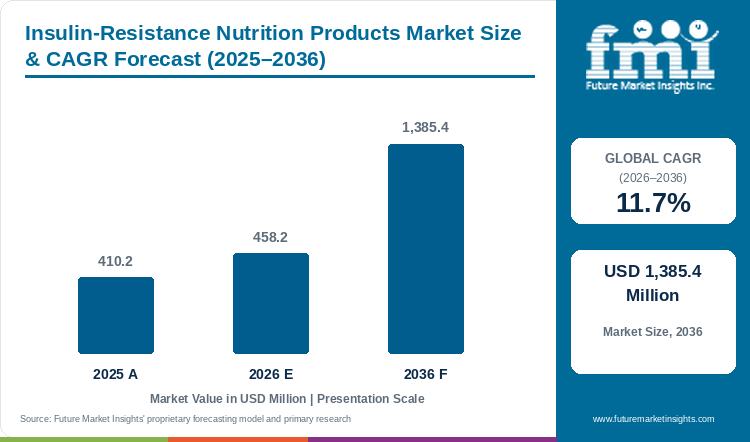
Demand for insulin-resistance nutrition products is projected to expand at 11.7% CAGR between 2026 and 2036. Industry value grows from USD 410.2 million in 2025 to USD 458.2 million in 2026 and is projected to reach USD 1,385.4 million by 2036.
Sales of insulin-resistance nutrition products are estimated to grow at 11.7% CAGR between 2026 and 2036. Valuation grows from USD 410.2 million in 2025 to USD 458.2 million in 2026 and is projected to reach USD 1,385.4 million by 2036. Increasing identification of prediabetes is bringing prediabetes nutrition products into everyday routine. The American Diabetes Association reported in January 2025 that lifestyle and targeted nutritional support significantly reduce progression risk in adults with impaired fasting glucose[1]. This large base is increasing use of capsules, fiber blends, low-glycemic functional foods and glucose-oriented drinks. As noted by FMI, premium products having measured serving and finished-product evidence are expected to gain higher preference. However, these products remain nutrition support and cannot be taken equal to treatment.
Regional demand develops along distinct tracks, as South Korea is projected at 11.9% CAGR through 2036, whilst the USA is anticipated at 11.3%. Korea Health Functional Food Association reported in September 2025 that certified functional food ingredients expanded to 372 standardized substances, providing qualified products a visible commercial route[2]. The USA has wider self-purchase across capsules, fiber foods and metabolic drinks. Japan remains documentation driven because Foods with Function Claims require filed safety and functionality evidence. Hence, countries will grow through different buying routes, but specification, lawful wording and finished-product documentation will remain the final commercial filter.
Key Takeaways
- Increasing identification of glucose risk is widening the consumer base for nutrition products that can be followed everyday.
- Berberine and dihydroberberine are expected to account for 42.7% in 2026, owing to their established recognition in concentrated supplement formats.
- Supplements are estimated to hold 41.5% in 2026, as measured dosing can be included without changing the complete meal routine.
- Uneven ingredient evidence and medicine-interaction concerns will continue to restrict strong claims and slow repeat purchasing through 2036.
- South Korea is projected at 11.9% CAGR and the USA at 11.3% through 2036, backed by different regulatory and prevention routes.
- Notable companies include Pendulum Therapeutics, Supergut, Abbott, Nestle Health Science, Metagenics, Thorne, NOW Health Group, and Jarrow Formulas.
Analyst Perspective
“Measured supplements will gain where daily serving remains simple and affordable. Fiber products can move faster when taste supports repeat use.”
- Anurag Sharma, Principal Consultant, Future Market Insights.
How is the insulin-resistance nutrition products market segmented?
Insulin-resistance nutrition products market is segmented by key ingredient, product type, consumer, form, sales channel, and region. Berberine and dihydroberberine are projected at 42.7%, supplements at 41.5%, and PCOS-linked consumers at 42.2% in 2026.
By key ingredient: berberine and dihydroberberine, targeted probiotics, inositol blends, chromium and alpha-lipoic acid, and others.
By product type: supplements, functional shakes and fibers, low-glycemic snacks, and others.
By consumer: PCOS-linked, metabolic syndrome, weight-management-driven, and others.
By form: capsules, powders, ready-to-drink products and snacks, and others.
By sales channel: online and direct-to-consumer, retail pharmacy, supermarkets and hypermarkets, specialty health stores, and others.
By region: North America, Latin America, Western Europe, Eastern Europe, East Asia, South Asia and Pacific, and Middle East and Africa.
Why does berberine hold notable key ingredient demand?
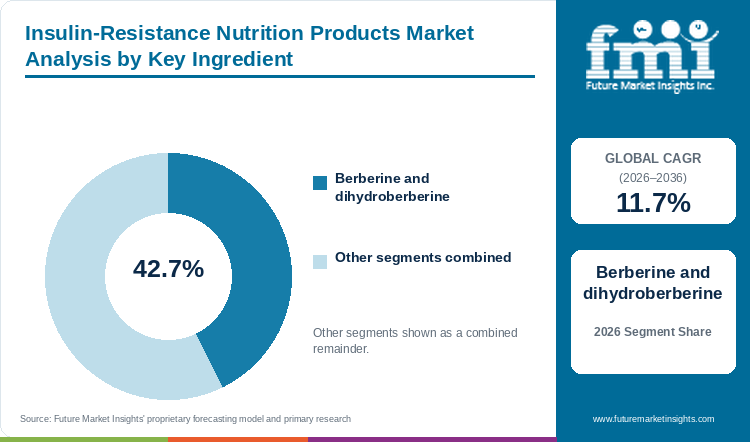
Based on key ingredient, berberine and dihydroberberine are projected to account for 42.7% in 2026, supported by familiar capsule routines.
Berberine is one of the highly recognized ingredients among metabolic supplement buyers, as it can be offered in compact and concentrated formats. Due to this familiarity, consumers can adopt the ingredient without changing the complete food routine. However, familiar ingredient cannot be considered suitable for every consumer. In April 2025, HighTide reported that two Phase III trials of a berberine-derived metabolic candidate met primary endpoints, expanding scientific validation around berberine chemistry[3]. This clinical evidence is expected to keep commercial claims within a defined nutrition purpose while encouraging higher purity standards. In addition, interaction concern with medicines can restrict uncontrolled use. Defined serving, clear warning and evidence on the actual formulation are therefore expected to support the demand for better qualified concentrated berberine products.
- Berberine and dihydroberberine are projected at 42.7%, as small and concentrated servings fit the familiar capsule routine.
- Defined serving and medicine-interaction guidance are expected to improve comparison between concentrated ingredients.
What supports supplements as the preferred product type?
By product type, supplements are estimated to hold 41.5% in 2026, driven by controlled servings and broad ingredient compatibility.
Supplements are gaining high preference because a measured ingredient serving can be added without replacing the complete meal. Capsules are suitable for smaller quantity, while powders provide space for fiber and protein which cannot be practically filled into one capsule. In June 2025, Supergut launched three GLP-1 Booster flavors containing 7 grams of prebiotic fiber per serving[4]. This development shows that measured nutrition is moving towards food and drink occasions as well. Apart from the ingredient, taste, mixability and digestive tolerance will decide whether the consumer continues the serving after first purchase. Owing to these factors, suppliers are expected to widen formats across dietary supplements instead of depending only on capsules.
- Supplements are estimated at 41.5%, owing to measured servings and easy addition into the existing nutrition routine.
- Flavor, mixability and digestive tolerance will decide whether powder servings continue beyond first purchase.
How does PCOS-linked demand shape the consumer category?
In 2026, PCOS-linked consumers are expected to lead with 42.2% share, underpinned by direct discussion of insulin resistance in care.
PCOS-linked demand is developing because insulin sensitivity, body weight and food routine are commonly discussed together in PCOS care. This has given fertility supplements and specialized nutrition products a direct application beside an already recognized endocrine condition. Still, one ingredient cannot work in the same manner for every consumer. The 2026 umbrella review covering 13 meta-analyses found uneven certainty across metabolic outcomes[5]. Due to this, products having a narrow nutrition role, tolerable daily serving and clear position beside clinical care are expected to gain continued use. Broad metabolic promises can create higher first interest; however, the same can weaken repeat purchase when expected outcome is not maintained.
- PCOS-linked consumers are expected at 42.2% because the nutrition question arises beside a recognized endocrine condition.
- Tolerability and clear use beside food and clinical care are expected to support continued adoption.
Why do capsules remain relevant within the form category?
Capsules are projected to hold 44.9% share in 2026, owing to portable servings and compatibility with concentrated metabolic ingredients.
Capsules remain one of the preferred forms owing to portable serving, limited taste issue and easy comparison of concentrated ingredients. These are also easy to include in the existing supplement routine. However, the form becomes less practical when the required nutrition quantity is high. Abbott’s 2025 adult nutrition reference includes several glucose-oriented liquid and powder products, which indicates why larger fiber, protein and meal servings move outside capsule formats[6]. Hence, capsules are expected to remain strong for compact actives, whereas powders and drinks will gain application for heavier nutrition servings. Easy storage and serving consistency will further support capsule use during the forecast period.
- Capsules are projected at 44.9% because portability and serving consistency support regular use.
- Powders and drinks can support higher nutrition quantity without increasing the number of capsules.
What keeps online channels relevant for repeat purchasing?
Online and direct-to-consumer channels are forecast to represent 35.3% in 2026, enabled by education, subscriptions and replenishment reminders.
Online and direct-to-consumer channels provide more space for ingredient details, warnings, serving instructions and replenishment. This is important for metabolic products where the consumer compares composition before the purchase. In October 2025, Supergut entered Walmart nationwide with six fiber-blend SKUs after developing demand through direct channels[7]. This move indicates that online education can prepare a specialized product for wider retail entry. However, a long website explanation cannot support the product at every shelf. The label has to explain the serving and purpose in a simple manner. Retail pharmacy is also expected to remain important where buyers require reassurance before combining a nutrition product with medicines.
- Online and direct-to-consumer channels are forecast at 35.3% because product education and replenishment happen in one place.
- Retail pharmacy can gain preference where consumers require reassurance before combining products with medicines.
What are the drivers, restraints, and opportunities in the market?
In the insulin-resistance nutrition products market, the key driver is risk identification, the key restraint is evidence uncertainty, and the key opportunity is routine-based support.
- Driver: Increasing identification of prediabetes and metabolic risk is bringing consumers into the nutrition discussion before advanced disease develops.
- Restraint: Uneven ingredient evidence and medicine-interaction concerns are limiting strong claims and can weaken repeat purchase.
- Opportunity: Products fitting prevention, PCOS and weight-management routine can gain continued use through defined servings and practical expectations.
Risk Identification Expands Daily Demand
Increasing identification of metabolic risk is opening the nutrition discussion before advanced disease develops. The International Diabetes Federation reported 589 million adults living with diabetes worldwide in 2025, equal to one in nine adults[8]. This burden is expected to increase the demand for measured diabetes management supplements, fiber products and low-glycemic servings which can be added in everyday food routine. Also, these products do not require replacement of every meal, due to which adoption can take place through gradual use. According to FMI, products explaining the ordinary use of the serving are likely to gain higher acceptance than products only using broad metabolic support claims.
Evidence Gaps Limit Strong Claims
The absence of high-quality evidence does not remove the category; however, it reduces the extent of claims which can be made responsibly. In May 2025, the U.S. Food and Drug Administration issued warning letters regarding unapproved disease claims on dietary supplements marketed for blood glucose and insulin support[9]. This is important for berberine and other concentrated ingredients where the consumer can already be taking glucose-lowering medicines. Treatment-like wording can create an expectation that the finished formulation cannot maintain. In addition to this, interaction concern can restrict recommendation through pharmacy and practitioner routes. Evidence matching with the actual formula, controlled claim and clear warning are therefore expected to remain major factors in purchase and repeat use.
Prevention Pathways Create A Practical Opening
Prevention education is creating a supporting role for clinical nutrition products, fiber products and measured supplements. In November 2025, Nestle Health Science linked BOOST Nutritional Drinks with American Diabetes Association education around early detection and adult nutrition[10]. Such activities can bring ordinary nutrition products beside screening and prevention discussion. However, these products cannot replace clinical care and will require a limited supporting purpose. FMI research indicates that brands connecting the claim with actual serving size and finished-product evidence are likely to gain better opportunity. Affordable monthly use and easy addition into food routine will also decide continued demand.
Which country CAGRs are profiled in the market?
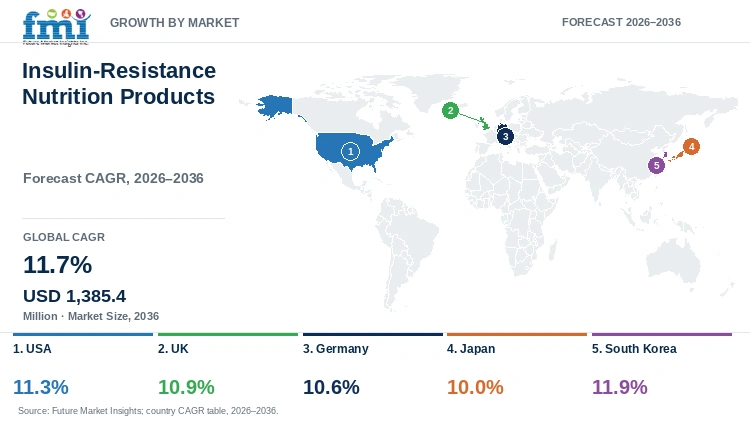
| Country | CAGR |
|---|---|
| USA | 11.3% |
| UK | 10.9% |
| Germany | 10.6% |
| Japan | 10.0% |
| South Korea | 11.9% |
How do country-level CAGRs compare in the insulin-resistance nutrition products market?
Country outlooks remain close, but their demand routes differ. Public prevention supports structured nutrition use, while functional-food rules decide which claims and formats reach buyers.
- USA demand spans online access, self-directed supplement purchasing, and structured screening across a large identified prediabetes population.
- UK demand sits beside a national prevention service that already structures diet and activity change.
- Germany buyers operate in a care environment with high expectations for evidence and pharmacy credibility.
- Japan requires supplier responsibility for filed safety and functionality evidence under its claims framework.
- South Korea provides a formal regulatory gateway for recognized functional ingredients across direct and retail channels.
Full report country CAGRs cover: North America; Latin America; Western Europe; Eastern Europe; East Asia; South Asia and Pacific; Middle East and Africa.
Country-wise Analysis
- USA demand is projected to expand at 11.3% CAGR through 2036, backed by a large identified and unidentified prediabetes base. The CDC estimated 115.2 million U.S. adults with prediabetes in September 2026, while eight in ten were unaware of it[11]. This creates high room for screening-led nutrition discussion and product trial. Online access and glucose monitoring devices make supplements and glucose-oriented food products easy to compare, but availability alone will not secure continued use. The product must fit with medicines, food habits, weight objectives and monthly cost. Hence, the forecast is connected more with supportive positioning and repeat routine than treatment-like promise.
- The UK market is anticipated to rise at 10.9% CAGR through 2036, supported by an established prevention pathway. NHS England reported in December 2025 that around two million people in England are vulnerable to type 2 diabetes every year[12]. The Healthier You programme provides diet, weight and activity support for nine months through physical and digital routes. Commercial nutrition products can enter beside this pathway through measured portions, prebiotic fiber supplements and simple supplement routines. However, public guidance also increases scrutiny on claims, due to which affordable products with a narrow nutrition purpose are expected to gain better acceptance.
- Germany is forecast to expand at 10.6% CAGR through 2036, as the diagnosed diabetes burden continues to increase. A Robert Koch Institute analysis published in 2025 estimated 6.05 million diagnosed type 2 diabetes cases in 2022 and projected 11.01 million by 2050 under the reference scenario[13]. This is likely to keep prevention and dietary support visible beside regular care. German demand is expected to favor transparent ingredient reasoning, consistent composition and pharmacy or practitioner credibility. Therefore, growth will depend on how clearly the product explains its place beside food and medicines, rather than only presenting a familiar ingredient name.
- Japan is estimated to register 10.0% CAGR through 2036, shaped by the filed-claim route for Foods with Function Claims. In October 2025, Japan’s Consumer Affairs Agency updated the guidance and notification materials under the framework[14]. Businesses remain responsible for filing safety and functionality evidence before sale, and the submitted information is available for public review. This route may slow product entry, but can support suppliers that prepare product-specific evidence, quality record and careful advertising in advance. Hence, label credibility is expected to influence adoption along with ingredient familiarity.
- South Korea is projected to record 11.9% CAGR through 2036, supported by a formal route for recognized functional ingredients. The Ministry of Food and Drug Safety issued Regulation No. 2026-33 on August 13, 2026, covering recognition of functional ingredients and standards for health functional foods[15]. The route requires specification, safety and functionality evidence, giving the buyer a more visible qualification cue while restricting unsupported wording. Suppliers localizing evidence, serving instructions and compliant claims before launch are expected to move faster across online and retail channels.
Who are the notable companies in the insulin-resistance nutrition products market?
Pendulum Therapeutics, Supergut, Abbott, Nestle Health Science, Metagenics, Thorne, NOW Health Group, and Jarrow Formulas are notable companies in this market.
Competition is moderately fragmented because the market combines microbiome platforms, clinical nutrition businesses and supplement specialists. Pendulum Therapeutics and Supergut are developing demand through gut-focused and prebiotic routes. Abbott and Nestle Health Science have wider adult nutrition systems, whereas Metagenics, Thorne, NOW Health Group and Jarrow Formulas offer familiar ingredient-led formats. FMI data suggests that novelty alone will not maintain market position. The companies having evidence on finished product, practical serving and affordable repeat use are expected to hold stronger commercial position through the forecast period.
- Microbiome and prebiotic platforms: Pendulum Therapeutics and Supergut compete through gut-focused metabolic propositions.
- Established nutrition platforms: Abbott and Nestle Health Science connect glucose or weight-management nutrition with broader distribution.
- Ingredient-led specialists: Metagenics, Thorne, NOW Health Group and Jarrow Formulas compete through capsule, powder and practitioner channels.
Competitive Benchmarking: Insulin-Resistance Nutrition Products Market
| Company | Metabolic Focus | Format Breadth | Evidence Integration | Geographic Reach |
|---|---|---|---|---|
| Pendulum Therapeutics | High | Medium | High | Medium |
| Supergut | High | Medium | Medium | Medium |
| Abbott | High | Medium | High | High |
| Nestle Health Science | High | Medium | High | High |
| Metagenics | Medium | Medium | High | Medium |
| Thorne | Medium | Medium | High | Medium |
| NOW Health Group | Medium | Medium | Medium | Medium |
| Jarrow Formulas | Medium | Medium | Medium | Medium |
Scoring basis: High represents broad documented capability, Medium represents credible but narrower capability, and Low represents limited documented breadth. The ratings explain public capability and do not rank product quality or revenue share.
Key Developments in the Insulin-Resistance Nutrition Products Market
- In September 2025, Abbott introduced a U.S. nutrition programme around GLP-1 use and muscle preservation through its broader metabolic nutrition portfolio.
- In April 2025, HighTide reported that two Phase III trials of a berberine-derived candidate met primary endpoints in China, expanding attention around berberine chemistry beyond retail supplements.
- In March 2025, FDA cleared the Signos Glucose Monitoring System for over-the-counter use, widening consumer access to food-response information relevant to metabolic nutrition choices.
Key Players in the Insulin-Resistance Nutrition Products Market
Microbiome and Prebiotic Metabolic Platforms
- Pendulum Therapeutics
- Supergut
Established Glucose and Weight-Management Nutrition Platforms
- Abbott
- Nestle Health Science
Ingredient-Led Supplement and Practitioner Brands
- Metagenics
- Thorne
- NOW Health Group
- Jarrow Formulas
Insulin-Resistance Nutrition Products Market - Report Scope
| Coverage field | Report scope |
|---|---|
| Market breakdown | Key ingredient, product type, consumer, form, sales channel, and region |
| Quantitative units | USD million |
| Market definition | Brand-owner or manufacturer revenue from nutrition products positioned for insulin-resistance or closely linked metabolic support. Prescription drugs, diagnostic devices and ordinary foods without the defined positioning are excluded. |
| Regions covered | North America; Latin America; Western Europe; Eastern Europe; East Asia; South Asia and Pacific; Middle East and Africa |
| Countries covered | USA, UK, Germany, Japan, South Korea, and additional countries in the full report |
| Key companies profiled | Pendulum Therapeutics, Supergut, Abbott, Nestle Health Science, Metagenics, Thorne, NOW Health Group, Jarrow Formulas |
| Forecast period | 2026 to 2036 |
| Approach | The Future Market Insights report covers product revenue, segment structure, channel routes and country demand conditions. |
Insulin-Resistance Nutrition Products Market - Research Methodology
| Method | Approach |
|---|---|
| Primary Research | FMI analysts gathered input from manufacturers, service providers, technology developers, distributors, end users, procurement teams, and subject-matter experts. Interviews examined purchasing decisions, product evaluation, adoption barriers, approval requirements, pricing considerations, and expectations for technical or commercial support. |
| Desk Research | Desk research covered government statistics, regulatory publications, trade data, industry associations, technical literature, standards, company filings, product information, and official corporate announcements. Sources were reviewed for relevance, publication date, geographic coverage, and consistency with the defined market scope. |
| Market Sizing and Forecasting | The market model combined the baseline value with historical performance, segment structure, pricing and volume indicators, adoption levels, company participation, and country-level demand conditions. Segment and regional estimates were reconciled before the final market total was calculated. |
| Data Validation | Estimates were checked against multiple independent indicators, including public data, company activity, trade patterns, industry developments, and findings from primary interviews. Adjacent categories, unsupported claims and overlapping revenues were excluded. |
Insulin-Resistance Nutrition Products Market by Segments
Insulin-Resistance Nutrition Products Market segmented by Key Ingredient:
- Berberine and dihydroberberine
- Targeted probiotics
- Inositol blends
- Chromium and alpha-lipoic acid
- Others
Insulin-Resistance Nutrition Products Market segmented by Product Type:
- Supplements
- Functional shakes and fibers
- Low-glycemic snacks
- Others
Insulin-Resistance Nutrition Products Market segmented by Consumer:
- PCOS-linked
- Metabolic syndrome
- Weight-management-driven
- Others
Insulin-Resistance Nutrition Products Market segmented by Form:
- Capsules
- Powders
- Ready-to-drink products and snacks
- Others
Insulin-Resistance Nutrition Products Market segmented by Sales Channel:
- Online and direct-to-consumer
- Retail pharmacy
- Supermarkets and hypermarkets
- Specialty health stores
- Others
Insulin-Resistance Nutrition Products Market by Region
- North America
- United States
- Canada
- Latin America
- Brazil
- Mexico
- Argentina
- Chile
- Western Europe
- Germany
- France
- United Kingdom
- Italy
- Spain
- Benelux
- Nordics
- Eastern Europe
- Poland
- Czech Republic
- Romania
- Hungary
- East Asia
- China
- Japan
- South Korea
- South Asia and Pacific
- India
- ASEAN
- Australia and New Zealand
- Middle East and Africa
- GCC Countries
- South Africa
- Türkiye
- Israel
Research Sources and Bibliography
- [1] American Diabetes Association. (2025, January 1). Standards of Care in Diabetes-2025. Diabetes Care, 48(Suppl. 1), S1-S345.
- [2] Korea Health Functional Food Association. (2025, September 12). Health Functional Food Market in Korea 2025.
- [3] HighTide Therapeutics, Inc. (2025, April 22). HighTide announces positive topline results from two Phase III trials of berberine-based metabolic candidate.
- [4] Supergut. (2025, June 17). Supergut unveils new GLP-1 Booster flavors for summer.
- [5] Duan, M., et al. (2026). Effects of inositol in women with polycystic ovary syndrome: An umbrella review of meta-analyses from randomized controlled trials. Frontiers in Endocrinology, 17, 1741509.
- [6] Abbott. (2025). Abbott Nutrition adult product reference.
- [7] Supergut. (2025, October 27). Supergut launches at Walmart nationwide.
- [8] International Diabetes Federation. (2025). IDF Diabetes Atlas, 11th edition.
- [9] U.S. Food and Drug Administration. (2025, May 15). FDA Warning Letters: Dietary supplements and disease claims.
- [10] Nestle Health Science. (2025, November 20). BOOST Nutritional Drinks teams with the American Diabetes Association to promote early detection.
- [11] Centers for Disease Control and Prevention. (2026, September 16). National Diabetes Statistics Report.
- [12] NHS England. (2025, December 30). NHS diabetes prevention scheme helps one million people.
- [13] Robert Koch Institute. (2025, July 2). Diabetes mellitus: Prevalence among adults.
- [14] Consumer Affairs Agency, Japan. (2025, October 1). Foods with Function Claims: Guidance and notification materials.
- [15] Ministry of Food and Drug Safety, Republic of Korea. (2026, August 13). Regulation on Recognition of Functional Ingredient and Standards and Specifications for Health Functional Foods, No. 2026-33.
This bibliography is provided for reader reference. The full report contains the complete reference list and detailed citations.
This Report Answers
- What is Insulin-Resistance Nutrition Products Market worth during 2026?
- What value is Insulin-Resistance Nutrition Products Market projected by 2036?
- Which key ingredient holds notable Insulin-Resistance Nutrition Products Market share?
- Which product type holds notable Insulin-Resistance Nutrition Products Market share?
- Which countries have notable Insulin-Resistance Nutrition Products Market growth?
- Which companies are notable in Insulin-Resistance Nutrition Products Market today?
Frequently Asked Questions
How large is the insulin-resistance nutrition products market in 2026?
Future Market Insights estimates that the insulin-resistance nutrition products market will reach USD 458.2 million in 2026. The market is projected to expand further and reach USD 1,385.4 million by 2036.
What CAGR is forecast for the Insulin-Resistance Nutrition Products Market through 2036?
As per FMI, the insulin-resistance nutrition products market is projected to grow at an 11.7% CAGR from 2026 to 2036. Growth is supported by increasing identification of prediabetes and integration of metabolic nutrition into daily routines.
Which key ingredient holds a notable insulin-resistance nutrition products demand share in 2026?
Future Market Insights projects berberine and dihydroberberine to hold 42.7% of key ingredient demand in 2026. The segment benefits from concentrated dosing and familiar capsule routines among metabolic health consumers.
Which product type holds a notable insulin-resistance nutrition products share in 2026?
FMI finds that supplements will account for 41.5% of product type demand in 2026. Demand is supported by controlled servings and compatibility with existing nutritional routines without replacing full meals.
Which country has a notable insulin-resistance nutrition products expansion outlook during the forecast period?
Future Market Insights predicts South Korea to expand at an 11.9% CAGR during the 2026 to 2036 assessment period. Growth is supported by a structured regulatory pathway for recognized functional ingredients and rising consumer engagement.
Which companies are active in the Insulin-Resistance Nutrition Products Market during 2026?
As per FMI analysis, notable companies include Pendulum Therapeutics, Supergut, Abbott, Nestle Health Science, Metagenics, Thorne, NOW Health Group, and Jarrow Formulas. These companies are focusing on microbiome formulations, adult clinical nutrition, specialized fiber blends, and practitioner-channel distribution.
Preview the report firsthand - request a free sample
Get SampleGet the brochure for pricing and purchase details.
Get PDFTable of Content
- Key Takeaways
- Market Size and CAGR
- Top Growth Driver
- Fastest Growing Segment
- Leading Region
- Key Companies
- Emerging Opportunities
- Executive Summary
- Global Market Outlook
- Demand-side Trends
- Supply-side Trends
- Technology Roadmap Analysis
- Analysis and Recommendations
- Analyst Perspective (What is happening? Why now? What should investors know?)
- Key Questions Answered
- How large is the market?
- What is the CAGR?
- What are key trends?
- Which region dominates?
- Who are the leaders?
- Market Overview
- Market Coverage / Taxonomy
- Market Definition / Scope / Limitations
- Research Methodology
- Chapter Orientation
- Analytical Lens and Working Hypotheses
- Market Structure, Signals, and Trend Drivers
- Benchmarking and Cross-market Comparability
- Market Sizing, Forecasting, and Opportunity Mapping
- Research Design and Evidence Framework
- Desk Research Programme (Secondary Evidence)
- Expert Input and Fieldwork (Primary Evidence)
- Tooling, Models, and Reference Databases
- Data Engineering and Model Build
- Quality Assurance and Audit Trail
- Market Background
- Market Dynamics (Drivers, Restraints, Opportunity, Trends)
- Scenario Forecast (Optimistic, Likely, Conservative)
- Impact Analysis
- AI Impact
- Sustainability Impact
- Regulatory Impact
- Technology Impact
- Consumer / Buyer Analysis
- Purchase Drivers
- Adoption Barriers
- Buyer Journey
- Opportunity Map Analysis
- Product Life Cycle Analysis
- Supply Chain Analysis
- Investment Feasibility Matrix
- Value Chain Analysis
- PESTLE and Porter's Analysis
- Regulatory Landscape
- Regional Parent Market Outlook
- Production and Consumption Statistics
- Import and Export Statistics
- Global Market Analysis and Forecast, 2021 to 2036
- Historical Market Size Value (USD Million) Analysis, 2021 to 2025
- Current and Future Market Size Value (USD Million) Projections, 2026 to 2036
- Y-o-Y Growth Trend Analysis
- Absolute $ Opportunity Analysis
- Global Market Pricing Analysis, 2021 to 2036
- Global Market Analysis and Forecast, By Key Ingredient, 2021 to 2036
- Introduction / Key Findings
- Historical Market Size Value (USD Million) Analysis By Key Ingredient, 2021 to 2025
- Current and Future Market Size Value (USD Million) Analysis and Forecast By Key Ingredient, 2026 to 2036
- Berberine and dihydroberberine
- Targeted probiotics
- Inositol blends
- Chromium and alpha-lipoic acid
- Others
- Y-o-Y Growth Trend Analysis By Key Ingredient, 2021 to 2025
- Absolute $ Opportunity Analysis By Key Ingredient, 2026 to 2036
- Global Market Analysis and Forecast, By Product Type, 2021 to 2036
- Introduction / Key Findings
- Historical Market Size Value (USD Million) Analysis By Product Type, 2021 to 2025
- Current and Future Market Size Value (USD Million) Analysis and Forecast By Product Type, 2026 to 2036
- Supplements
- Functional shakes and fibers
- Low-glycemic snacks
- Others
- Y-o-Y Growth Trend Analysis By Product Type, 2021 to 2025
- Absolute $ Opportunity Analysis By Product Type, 2026 to 2036
- Global Market Analysis and Forecast, By Consumer, 2021 to 2036
- Introduction / Key Findings
- Historical Market Size Value (USD Million) Analysis By Consumer, 2021 to 2025
- Current and Future Market Size Value (USD Million) Analysis and Forecast By Consumer, 2026 to 2036
- PCOS-linked
- Metabolic syndrome
- Weight-management-driven
- Others
- Y-o-Y Growth Trend Analysis By Consumer, 2021 to 2025
- Absolute $ Opportunity Analysis By Consumer, 2026 to 2036
- Global Market Analysis and Forecast, By Form, 2021 to 2036
- Introduction / Key Findings
- Historical Market Size Value (USD Million) Analysis By Form, 2021 to 2025
- Current and Future Market Size Value (USD Million) Analysis and Forecast By Form, 2026 to 2036
- Capsules
- Powders
- Ready-to-drink products and snacks
- Others
- Y-o-Y Growth Trend Analysis By Form, 2021 to 2025
- Absolute $ Opportunity Analysis By Form, 2026 to 2036
- Global Market Analysis and Forecast, By Sales Channel, 2021 to 2036
- Introduction / Key Findings
- Historical Market Size Value (USD Million) Analysis By Sales Channel, 2021 to 2025
- Current and Future Market Size Value (USD Million) Analysis and Forecast By Sales Channel, 2026 to 2036
- Online and direct-to-consumer
- Retail pharmacy
- Supermarkets and hypermarkets
- Specialty health stores
- Others
- Y-o-Y Growth Trend Analysis By Sales Channel, 2021 to 2025
- Absolute $ Opportunity Analysis By Sales Channel, 2026 to 2036
- Global Market Analysis and Forecast, By Region, 2021 to 2036
- Introduction
- Historical Market Size Value (USD Million) Analysis By Region, 2021 to 2025
- Current Market Size Value (USD Million) Analysis and Forecast By Region, 2026 to 2036
- North America
- Latin America
- Western Europe
- Eastern Europe
- East Asia
- South Asia and Pacific
- Middle East and Africa
- Market Attractiveness Analysis By Region
- North America Market Analysis and Forecast, By Country, 2021 to 2036
- Historical Market Size Value (USD Million) Trend Analysis By Market Taxonomy, 2021 to 2025
- Market Size Value (USD Million) Forecast By Market Taxonomy, 2026 to 2036
- By Country
- United States
- Canada
- By Key Ingredient
- By Product Type
- By Consumer
- By Form
- By Sales Channel
- By Country
- Market Attractiveness Analysis
- By Country
- By Key Ingredient
- By Product Type
- By Consumer
- By Form
- By Sales Channel
- Key Takeaways
- Latin America Market Analysis and Forecast, By Country
- Historical Market Size Value (USD Million) Trend Analysis By Market Taxonomy, 2021 to 2025
- Market Size Value (USD Million) Forecast By Market Taxonomy, 2026 to 2036
- By Country
- Brazil
- Mexico
- Argentina
- Chile
- By Key Ingredient
- By Product Type
- By Consumer
- By Form
- By Sales Channel
- By Country
- Market Attractiveness Analysis
- By Country
- By Key Ingredient
- By Product Type
- By Consumer
- By Form
- By Sales Channel
- Key Takeaways
- Western Europe Market Analysis and Forecast, By Country
- Historical Market Size Value (USD Million) Trend Analysis By Market Taxonomy, 2021 to 2025
- Market Size Value (USD Million) Forecast By Market Taxonomy, 2026 to 2036
- By Country
- Germany
- France
- United Kingdom
- Italy
- Spain
- Benelux
- Nordics
- By Key Ingredient
- By Product Type
- By Consumer
- By Form
- By Sales Channel
- By Country
- Market Attractiveness Analysis
- By Country
- By Key Ingredient
- By Product Type
- By Consumer
- By Form
- By Sales Channel
- Key Takeaways
- Eastern Europe Market Analysis and Forecast, By Country
- Historical Market Size Value (USD Million) Trend Analysis By Market Taxonomy, 2021 to 2025
- Market Size Value (USD Million) Forecast By Market Taxonomy, 2026 to 2036
- By Country
- Poland
- Czech Republic
- Romania
- Hungary
- By Key Ingredient
- By Product Type
- By Consumer
- By Form
- By Sales Channel
- By Country
- Market Attractiveness Analysis
- By Country
- By Key Ingredient
- By Product Type
- By Consumer
- By Form
- By Sales Channel
- Key Takeaways
- East Asia Market Analysis and Forecast, By Country
- Historical Market Size Value (USD Million) Trend Analysis By Market Taxonomy, 2021 to 2025
- Market Size Value (USD Million) Forecast By Market Taxonomy, 2026 to 2036
- By Country
- China
- Japan
- South Korea
- By Key Ingredient
- By Product Type
- By Consumer
- By Form
- By Sales Channel
- By Country
- Market Attractiveness Analysis
- By Country
- By Key Ingredient
- By Product Type
- By Consumer
- By Form
- By Sales Channel
- Key Takeaways
- South Asia and Pacific Market Analysis and Forecast, By Country
- Historical Market Size Value (USD Million) Trend Analysis By Market Taxonomy, 2021 to 2025
- Market Size Value (USD Million) Forecast By Market Taxonomy, 2026 to 2036
- By Country
- India
- ASEAN
- Australia and New Zealand
- By Key Ingredient
- By Product Type
- By Consumer
- By Form
- By Sales Channel
- By Country
- Market Attractiveness Analysis
- By Country
- By Key Ingredient
- By Product Type
- By Consumer
- By Form
- By Sales Channel
- Key Takeaways
- Middle East and Africa Market Analysis and Forecast, By Country
- Historical Market Size Value (USD Million) Trend Analysis By Market Taxonomy, 2021 to 2025
- Market Size Value (USD Million) Forecast By Market Taxonomy, 2026 to 2036
- By Country
- GCC Countries
- South Africa
- Türkiye
- Israel
- By Key Ingredient
- By Product Type
- By Consumer
- By Form
- By Sales Channel
- By Country
- Market Attractiveness Analysis
- By Country
- By Key Ingredient
- By Product Type
- By Consumer
- By Form
- By Sales Channel
- Key Takeaways
- Key Countries Market Analysis
- United States
- Pricing Analysis
- Market Share Analysis, 2025
- By Key Ingredient
- By Product Type
- By Consumer
- By Form
- By Sales Channel
- Canada
- Pricing Analysis
- Market Share Analysis, 2025
- By Key Ingredient
- By Product Type
- By Consumer
- By Form
- By Sales Channel
- Mexico
- Pricing Analysis
- Market Share Analysis, 2025
- By Key Ingredient
- By Product Type
- By Consumer
- By Form
- By Sales Channel
- Brazil
- Pricing Analysis
- Market Share Analysis, 2025
- By Key Ingredient
- By Product Type
- By Consumer
- By Form
- By Sales Channel
- Chile
- Pricing Analysis
- Market Share Analysis, 2025
- By Key Ingredient
- By Product Type
- By Consumer
- By Form
- By Sales Channel
- Germany
- Pricing Analysis
- Market Share Analysis, 2025
- By Key Ingredient
- By Product Type
- By Consumer
- By Form
- By Sales Channel
- United Kingdom
- Pricing Analysis
- Market Share Analysis, 2025
- By Key Ingredient
- By Product Type
- By Consumer
- By Form
- By Sales Channel
- Italy
- Pricing Analysis
- Market Share Analysis, 2025
- By Key Ingredient
- By Product Type
- By Consumer
- By Form
- By Sales Channel
- Spain
- Pricing Analysis
- Market Share Analysis, 2025
- By Key Ingredient
- By Product Type
- By Consumer
- By Form
- By Sales Channel
- France
- Pricing Analysis
- Market Share Analysis, 2025
- By Key Ingredient
- By Product Type
- By Consumer
- By Form
- By Sales Channel
- India
- Pricing Analysis
- Market Share Analysis, 2025
- By Key Ingredient
- By Product Type
- By Consumer
- By Form
- By Sales Channel
- ASEAN
- Pricing Analysis
- Market Share Analysis, 2025
- By Key Ingredient
- By Product Type
- By Consumer
- By Form
- By Sales Channel
- Australia and New Zealand
- Pricing Analysis
- Market Share Analysis, 2025
- By Key Ingredient
- By Product Type
- By Consumer
- By Form
- By Sales Channel
- China
- Pricing Analysis
- Market Share Analysis, 2025
- By Key Ingredient
- By Product Type
- By Consumer
- By Form
- By Sales Channel
- Japan
- Pricing Analysis
- Market Share Analysis, 2025
- By Key Ingredient
- By Product Type
- By Consumer
- By Form
- By Sales Channel
- South Korea
- Pricing Analysis
- Market Share Analysis, 2025
- By Key Ingredient
- By Product Type
- By Consumer
- By Form
- By Sales Channel
- Poland
- Pricing Analysis
- Market Share Analysis, 2025
- By Key Ingredient
- By Product Type
- By Consumer
- By Form
- By Sales Channel
- Hungary
- Pricing Analysis
- Market Share Analysis, 2025
- By Key Ingredient
- By Product Type
- By Consumer
- By Form
- By Sales Channel
- Türkiye
- Pricing Analysis
- Market Share Analysis, 2025
- By Key Ingredient
- By Product Type
- By Consumer
- By Form
- By Sales Channel
- South Africa
- Pricing Analysis
- Market Share Analysis, 2025
- By Key Ingredient
- By Product Type
- By Consumer
- By Form
- By Sales Channel
- United States
- Market Structure Analysis
- Competition Dashboard
- Competition Benchmarking
- Market Share Analysis of Top Players
- By Regional
- By Key Ingredient
- By Product Type
- By Consumer
- By Form
- By Sales Channel
- Emerging Startups
- Innovation Benchmarking
- Competition Analysis
- Competition Deep Dive
- Pendulum Therapeutics
- Overview
- Product Portfolio
- Profitability by Market Segments
- Sales Footprint
- Strategy Overview
- Marketing Strategy
- Product Strategy
- Channel Strategy
- Supergut
- Abbott
- Nestle Health Science
- Metagenics
- Thorne
- NOW Health Group
- Jarrow Formulas
- Pendulum Therapeutics
- Case Studies
- Success Stories
- Recent Developments
- Competition Deep Dive
- Assumptions & Acronyms Used


