

- Industry Size (2025)
- USD 38.4 Mn
- Forecast (2035)
- USD 57.2 Mn
- CAGR (2025 to 2035)
- 4.1%
Demand for Billing Paper in Japan 2025 to 2035
The Japan billing paper demand is valued at USD 38.4 million in 2025 and is forecasted to reach USD 57.2 million by 2035, reflecting a CAGR of 4.1%. Demand remains linked to transactional documentation requirements across logistics, retail, healthcare, and field-service operations. Although digital billing is expanding, sectors with regulatory retention needs and cash-handling workflows continue to rely on physical records. Procurement preferences emphasize print clarity, resistance to smudging, and compatibility with thermal and dot-matrix printers used at point-of-sale counters and dispatch centers.
2-part NCR paper leads the product landscape due to its ability to generate instant duplicate copies without carbon sheets. Its adoption supports proof-of-delivery slips, invoicing forms, and check-out receipts in businesses that require multi-copy traceability for auditing or logistics handovers. Performance features include strong image longevity, reduced paper dust, and lower printer maintenance.
Kyushu & Okinawa, Kanto, and Kansai account for the highest utilization due to their concentration of distribution hubs, retail chains, clinics, and administrative offices. Key suppliers include Oji Imaging Media Co., Ltd., Mitsubishi HiTec Paper, Jujo Thermal, TPJ Co., Ltd., and Nippon Paper Industries Co., Ltd. These companies provide coated and uncoated NCR formats with varied basis weights tailored to billing automation systems and continuous-form printing environments.
Quick Stats for Japan Billing Paper Demand
- Japan Billing Paper Sales Value (2025): USD 38.4 million
- Japan Billing Paper Forecast Value (2035): USD 57.2 million
- Japan Billing Paper Forecast CAGR (2025–2035): 4.1%
- Leading Paper Type in Japan Billing Paper Demand: 2-Part NCR Paper
- Key Growth Regions in Japan Billing Paper Demand: Kyushu & Okinawa, Kanto, Kansai
- Top Players in Japan Billing Paper Demand: Oji Imaging Media Co., Ltd., Mitsubishi HiTec Paper, Jujo Thermal, TPJ Co., Ltd., Nippon Paper Industries Co., Ltd.
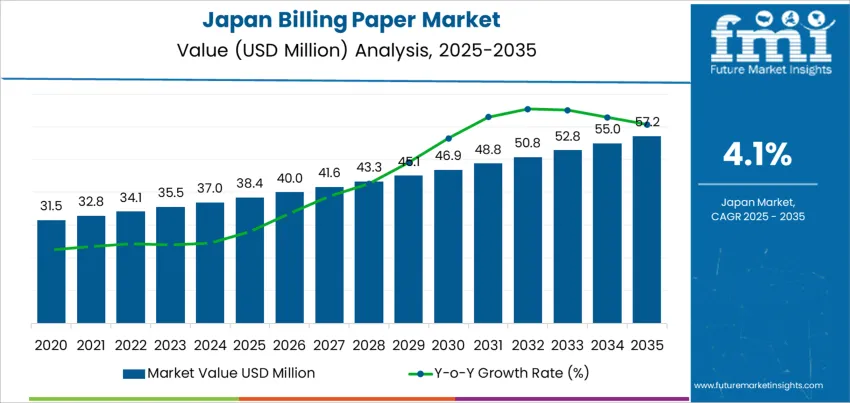
What is the Growth Forecast for Billing Paper Industry in Japan through 2035?
Demand for billing paper in Japan reflects uneven contribution levels across retail, healthcare, and administrative environments. Retail point-of-sale systems remain the primary contributor due to receipt-issuance requirements, supporting a stable baseline. Healthcare facilities add a secondary share through documentation and patient-record printouts where digital conversion progresses cautiously. Public-sector offices sustain additional volume through formal paper-archiving practices that continue under regulated retention rules.
Lower contribution comes from logistics and banking, where digital invoicing and electronic statements reduce routine print volumes. These shifts gradually redistribute contribution toward segments where paper continuity is required for compliance or customer-confirmation purposes. Environmental policies encourage usage reduction, but change is incremental due to established workflows and consumer preference for printed proof of payment in several service interactions. The growth contribution index therefore indicates resilience built on necessity-driven use rather than expansion. Retail and healthcare dominate incremental gains, while digital transformation moderates’ growth in other sectors. The structure remains balanced, but long-term contribution increasingly depends on segments with verified documentation needs.
Japan Billing Paper Key Takeaways
| Metric | Value |
|---|---|
| Japan Billing Paper Sales Value (2025) | USD 38.4 million |
| Japan Billing Paper Forecast Value (2035) | USD 57.2 million |
| Japan Billing Paper Forecast CAGR (2025-2035) | 4.1% |
Why is the Demand for Billing Paper in Japan Growing?
Demand for billing paper in Japan is increasing because retail shops, convenience stores and small restaurants continue to rely on printed receipts as part of daily transaction records. Many point-of-sale systems in Japan still require thermal billing paper for customer proof of purchase and store-level accounting. Businesses use printed receipts to support loyalty systems, returns processing and tax documentation, which maintains steady consumption. Public institutions and medical facilities also rely on printed billing information for patient communication and reimbursement procedures that require standardized documentation.
Growth in takeout services and parcel deliveries contributes to expanded use of billing paper for order slips and delivery confirmations. Japan’s large network of vending machines also uses receipt rolls in models that include purchase tracking features. Manufacturers improve paper quality to support clear print results and longer legibility, which aligns with consumer expectations for durable records. Constraints include ongoing adoption of digital receipts and mobile payment systems that reduce paper output in certain retail formats. Cost sensitivity can influence product choice when thermal paper prices fluctuate. Some organizations delay upgrades to newer printing technologies, maintaining existing paper-based systems until operational priorities change.
Which Paper Types, Basis Weights, and Product Categories Lead Demand for Billing Paper in Japan?
Demand for billing paper in Japan is shaped by continued reliance on printed transaction documentation in retail, healthcare, logistics, and regulated commercial sectors. Despite digital invoicing growth, secure physical billing records remain essential in compliance-driven workflows. Buyers prioritize print clarity, durability, and compatibility with high-speed printers used in point-of-sale systems, delivery verification, and administrative accounting environments. Ecofriendly initiatives also influence material preferences, supporting increased recycled content adoption.
By Paper Type, 2-Part NCR Paper Holds the Largest Share
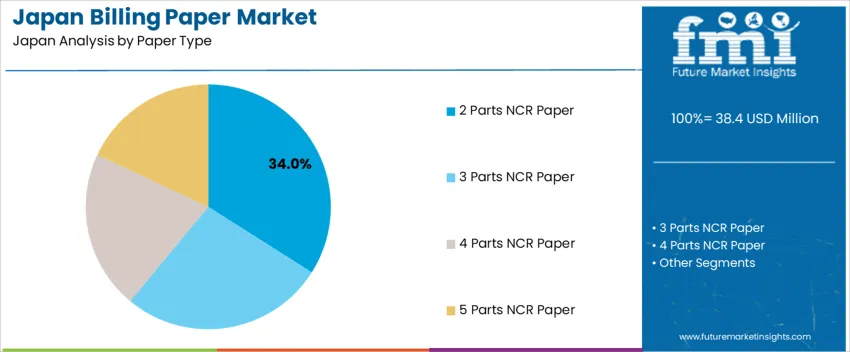
2-part NCR (No Carbon Required) paper holds 34.0%, as dual-copy formats suit retail receipts, delivery acknowledgments, and hotel or clinic billing where both issuer and customer maintain a record. 3-part NCR accounts for 27.0%, enabling multi-department processing in distribution and supply chain operations. 4-part NCR represents 21.0%, supporting regulated documentation where audit trails are critical. 5-part formats hold 18.0%, serving archival or multi-approval environments including transportation and warehouse tracking. Multi-part paper selection reflects workflow complexity, signature verification needs, and distribution of physical records across Japanese organizations.
Key Points:
- 2-part NCR dominates customer-facing billing
- Higher-part formats maintain adoption in compliance-heavy sectors
- Copy count aligns with approval and archiving requirements
By Basis Weight, 40–100 GSM Holds the Largest Share
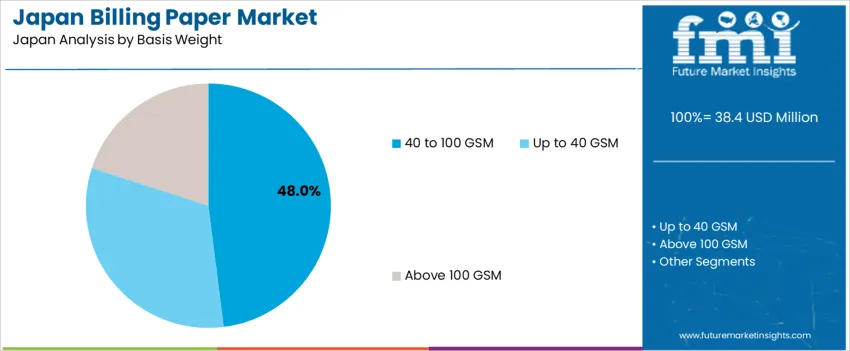
Papers within 40–100 GSM hold 48.0%, balancing strength and printer compatibility for thermal and impact printing systems widely used across Japan. They maintain sufficient opacity and tear resistance for frequent handling. Up to 40 GSM paper holds 32.0%, supporting low-cost volume printing for courier receipts and mass retail needs. Above 100 GSM accounts for 20.0%, used in high-durability formats requiring long-term storage or enhanced perception quality. Weight selection is influenced by equipment performance, image retention durability, and cost sensitivity within high-volume billing operations.
Key Points:
- 40–100 GSM paper meets durability and print performance standards
- Lower weights serve high-volume, cost-controlled printing
- Heavier papers support premium or archival documentation
By Product Type, Carbonless Paper Leads Demand
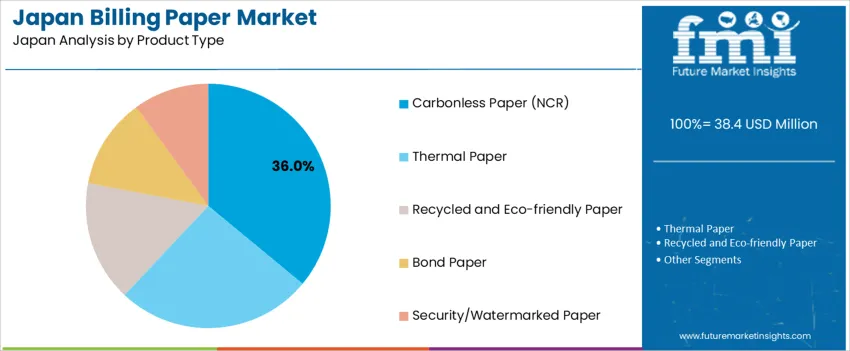
Carbonless paper represents 36.0%, driven by its role in multipart billing and signature-based verification within Japan’s retail, logistics, and medical administration. Thermal paper holds 26.0%, widely used in fast-printing POS systems though affected by print fade over time. Recycled and eco-friendly paper accounts for 16.0%, supported by ecofriendly certifications and environmental procurement mandates. Bond paper holds 12.0%, serving office-grade invoicing. Security or watermarked paper holds 10.0%, used where fraud protection is required. Product category decisions reflect print durability, sensitivity to storage conditions, and operational compliance priorities.
Key Points:
- Carbonless formats enable multi-copy, signature-driven workflows
- Thermal printing dominates rapid retail transactions
- Recycled grades align with environmental procurement policies
What are the Drivers, Restraints, and Key Trends of the Demand for Billing Paper in Japan?
Continued use of printed receipts in retail, regulatory documentation in medical and public services, and reliability needs in legacy POS systems are driving demand.
In Japan, billing paper demand remains stable because convenience stores, supermarkets and specialty retail locations continue issuing printed receipts to support returns, tax records and expense reimbursement. Healthcare providers, including clinics and pharmacies, print visit summaries and prescription details for patients under national insurance guidelines, reinforcing usage of thermal billing paper. Government offices and transportation operators rely on printed proof-of-payment and transaction slips in settings where digital systems are not universally adopted across age groups. Legacy POS terminals widely deployed in small family-run shops, restaurants and municipal facilities depend on consistent thermal roll compatibility, sustaining baseline procurement volumes. Regional distributors ensure reliable supply to support dense retail networks, particularly near rail stations and commercial districts.
Gradual transition to digital receipts, environmental concerns about paper waste and slower adoption among new minimal-service retail formats restrain demand.
Retailers in major cities are promoting digital receipt options linked to loyalty programs and smartphone wallets, reducing the frequency of printed receipts for younger consumers who favor cashless payment. Municipal waste-reduction initiatives encourage businesses to limit unnecessary receipt printing, influencing behavioral shifts in certain prefectures. Some emerging retail formats, including unmanned stores and vending-based services, rely primarily on mobile confirmation without printed output. These evolving practices contribute to a slow decline in long-term print volume despite widespread current usage.
Shift toward phenol-free and recyclable thermal grades, increased customization for branding and rising demand in logistics documentation define key trends.
Manufacturers expand phenol-free thermal papers to address safety concerns related to chemical coatings, aligning with Japan’s preference for consumer-friendly materials. Retailers and service companies are adopting branded receipts that incorporate QR codes for promotions, customer feedback and digital onboarding. Parcel carriers and third-party logistics providers continue using thermal documentation for label printing and delivery confirmations, supporting demand linked to e-commerce. Compact roll formats tailored for mobile POS systems are becoming more common in pop-up shops and outdoor events. These trends indicate steady but gradually modernizing demand for billing paper in Japan.
Analysis of the Demand for Billing Paper in Japan by Region
Demand for billing paper in Japan connects to retail invoicing, logistics documentation, restaurant POS usage, and administrative printing within offices that still maintain hybrid digital–paper workflows. Transaction-based sectors contribute recurring procurement due to continuous consumption. Growth varies by region based on retail density, tourism activity, and the operational structure of SMEs. Kyushu & Okinawa leads at 5.1%, followed by Kanto (4.7%), Kansai (4.1%), Chubu (3.6%), Tohoku (3.2%), and the Rest of Japan (3.0%).
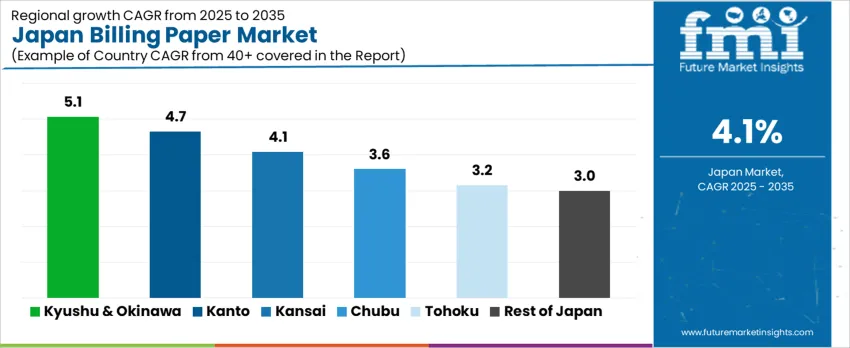
| Region | CAGR (2025-2035) |
|---|---|
| Kyushu & Okinawa | 5.1% |
| Kanto | 4.7% |
| Kansai | 4.1% |
| Chubu | 3.6% |
| Tohoku | 3.2% |
| Rest of Japan | 3.0% |
How is Kyushu & Okinawa influencing demand for billing paper?
Kyushu & Okinawa record 5.1% CAGR due to retail and hospitality businesses requiring steady billing paper replenishment across food service, transport, and small-format stores. Restaurants and tourism-linked outlets generate continuous printed receipts for dine-in and takeaway orders, sustaining POS paper purchases. Consumer-goods retailers rely on thermal rolls and duplicate formats compatible with commercial checkout systems. Local offices in logistics corridors maintain billing documentation for freight and warehouse operations, reinforcing baseline usage. Shops focus on reliable print clarity and paper composition that withstands handling without smudging. Distributors in port cities ensure access to standardized roll sizes supporting uninterrupted system operation. Budget-oriented procurement emphasizes bulk supply based on monthly usage cycles. Billing paper forms remain embedded in workflow routines where digital receipts adoption is gradual, maintaining consistent demand from SMEs across daily transaction processes.
- Tourism establishments generating continuous receipt volume
- Logistics operations requiring durable invoice documentation
- Bulk supply reinforcing predictable reorder cycles
- Compatibility with POS systems influencing product choice
How is Kanto shaping demand for billing paper?
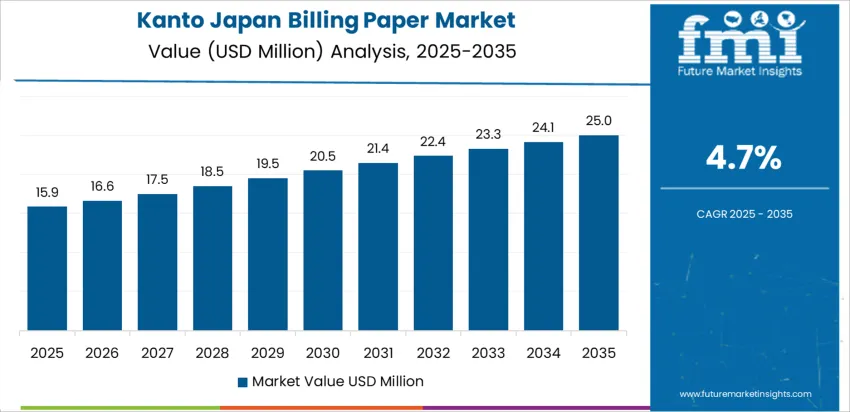
Kanto posts 4.7% CAGR driven by dense commercial activity in Tokyo, Kanagawa, Saitama, and Chiba. Transaction-heavy retail zones maintain stable consumption of thermal receipt rolls and multi-copy papers supporting high-traffic POS lanes. Supermarkets, convenience stores, and pharmacies depend on billing paper for clear transactional records aligned with regulatory documentation practices. Office environments preserve printed billing archives for audit-readiness, combining digital systems with physical filing. E-commerce packaging hubs in the region continue paper labeling use for operational verification, supporting recurring volume. Replacement cycles follow large order batching to minimize downtime across checkout counters. Buyers evaluate print durability and smooth surface performance for efficient thermal-head operation. Central warehouse networks manage logistics, offering short-lead fulfillment to keep business continuity intact.
- Dense retail footprint sustaining transaction printing
- Compliant record-keeping driving persistent paper usage
- Logistics centers supporting labeling and verification
- Warehoused supply maintaining high availability
How is Kansai affecting demand for billing paper?
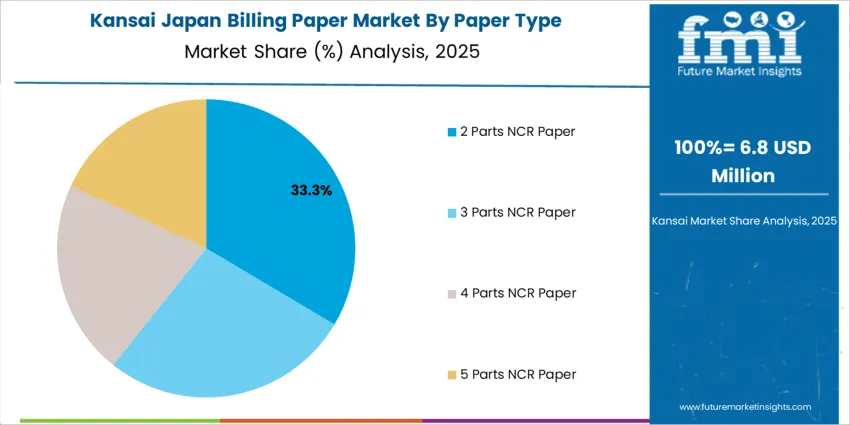
Kansai records 4.1% CAGR with demand centered on Osaka, Kyoto, and Hyogo’s retail and service hubs. POS-dependent businesses maintain continuous billing paper use for transaction logs required by standardized store operations. Small enterprises such as specialty shops and cafés rely on billing rolls sized for compact terminals. Regional transportation and delivery services support thermal printing for billing confirmation linked to daily distribution activity. Office printing remains operational where physical copies support vendor reconciliation and expense tracking. Procurement behavior favors cost-stable paper options with acceptable print contrast. Local wholesalers serve shops with direct resupply aligned to weekly consumption. Training institutions and healthcare facilities implement billing documentation supporting service verification.
- Retail clusters driving routine usage
- Distribution services generating continuous paper demand
- Vendor reconciliation requiring printed documentation
- Wholesalers ensuring consistent product flow
How is Chubu contributing to demand for billing paper?
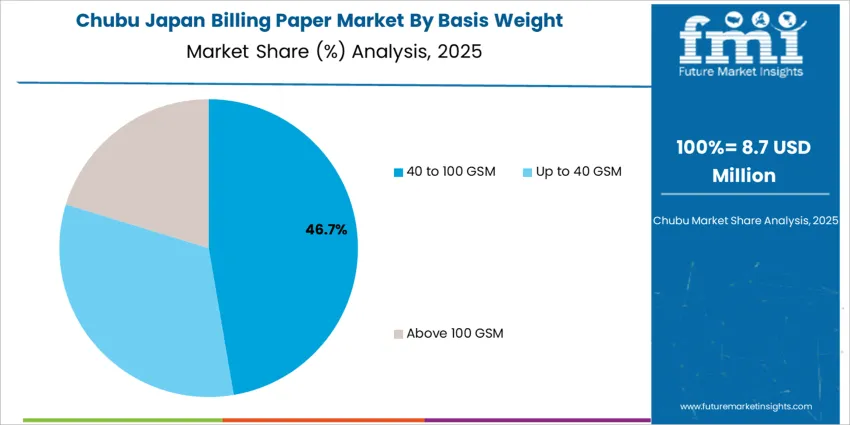
Chubu achieves 3.6% CAGR with usage anchored in manufacturing-linked service providers around Nagoya and surrounding prefectures. Production facilities interacting with vendor networks maintain printed billing tags for goods-handling checkpoints. Retail activity remains a reliable consumption driver as stores depend on compatible POS paper for receipt issuance. Offices maintain hybrid documentation practices where billing sheets remain part of standardized accounting procedures. Regional buying decisions emphasize paper longevity and stable thermal response to reduce waste. Distribution centers ensure supply availability for varied business types including hospitality and automotive after-sales. Procurement aligns with invoice processing schedules reinforcing reorder predictability.
- Vendor transaction records linked to manufacturing activity
- Multi-sector reliance supporting baseline throughput
- Thermal stability considered in purchasing
- Hybrid workflows maintaining ongoing paper use
How is Tohoku shaping demand for billing paper?
Tohoku reaches 3.2% CAGR with regional SMEs operating stores, service counters, and administrative offices that continue printing billing documents for customer communication and verification. Retailers prioritize durable paper that maintains legibility under varied climate exposure. Local distribution centers and convenience outlets form routine procurement channels supporting straightforward restocking cycles. Billing paper remains integral across municipal services and public facilities managing payment documentation. Buyers review price consistency to maintain operational budget control. Seasonal fluctuations occur when tourism peaks increase dining and hospitality receipts.
- SMEs depending on printed billing for customer transactions
- Durable paper demanded for climate variation
- Routine procurement through regional distributors
- Seasonal tourism providing peak usage periods
How is the Rest of Japan contributing to demand for billing paper?
The Rest of Japan posts 3.0% CAGR with demand sustained in provinces where retail and public offices operate POS devices requiring printed output. Billing paper offers predictable transaction records supporting daily trade. Smaller-scale logistics operations print shipment confirmations and collection notices. Cost-focused procurement favors standard roll sizes enabling compatibility across entry-level printers. Paper quality that prevents misprints remains important to avoid repeated receipts during busy hours. Availability through e-commerce supports steady access for businesses located away from major commercial zones.
- Transaction documentation supporting small retail networks
- Cost-conscious purchasing tied to standardized formats
- Use in logistics verification printing
- E-commerce channels enhancing distribution reach
What is the competitive landscape of demand for billing paper in Japan?
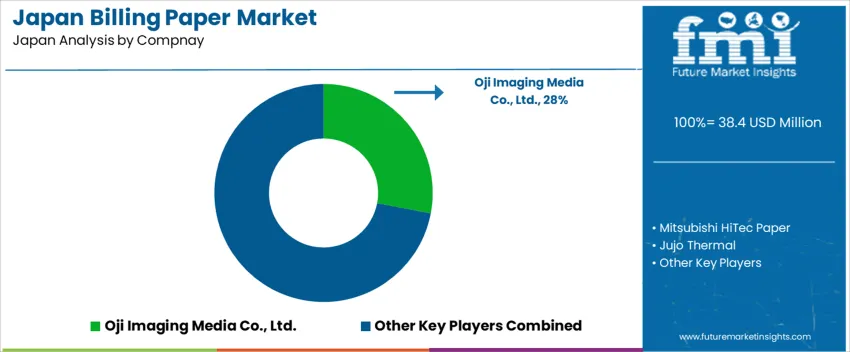
Demand for billing paper in Japan is driven by suppliers of thermal and coated receipt rolls used in POS terminals, kiosks, ticketing systems, and public-transport payment stations. Oji Imaging Media Co., Ltd. holds an estimated 28.0% share, supported by controlled coating-layer uniformity, stable print-density performance, and strong distribution across Japanese retailers and service operators. Its products maintain legibility and abrasion resistance under continuous daily receipt printing. Mitsubishi HiTec Paper maintains strong participation through thermal grades with BPA/BPS-free chemistry, delivering consistent head-sensitivity and clean image retention required by regulated retail applications. Jujo Thermal supports targeted demand with specialized substrates for transport ticketing and logistics labeling where durability and chemical resistance are priorities.
TPJ Co., Ltd. provides steady supply of POS rolls for independent stores and regional retail chains, emphasizing reliable core alignment and smooth printer feeding. Nippon Paper Industries Co., Ltd. adds capacity in coated-paper grades where receipt durability, moisture tolerance, and domestic availability must remain secure. Competition in Japan focuses on print-clarity stability, coating-layer adherence, POS-mechanism compatibility, environmental compliance, and consistent national distribution. Demand remains stable as receipting and billing workflows continue across retail and transportation networks in Japan’s service-driven economy.
Key Players in Japan Billing Paper Demand
- Oji Imaging Media Co., Ltd.
- Mitsubishi HiTec Paper
- Jujo Thermal
- TPJ Co., Ltd.
- Nippon Paper Industries Co., Ltd.
Scope of the Report
| Items | Values |
|---|---|
| Quantitative Units | USD million |
| Paper Type | 2 Parts NCR Paper, 3 Parts NCR Paper, 4 Parts NCR Paper, 5 Parts NCR Paper |
| Basis Weight | 40 to 100 GSM, Up to 40 GSM, Above 100 GSM |
| Product Type | Carbonless Paper (NCR), Thermal Paper, Recycled and Eco-friendly Paper, Bond Paper, Security/Watermarked Paper |
| Application | Retail, E-commerce & Packaging, Banking, Government & Legal Documentation, Healthcare, Educational |
| Regions Covered | Kyushu & Okinawa, Kanto, Kansai, Chubu, Tohoku, Rest of Japan |
| Key Companies Profiled | Oji Imaging Media Co., Ltd., Mitsubishi HiTec Paper, Jujo Thermal, TPJ Co., Ltd., Nippon Paper Industries Co., Ltd. |
| Additional Attributes | Demand driven by POS systems, financial documentation, compliance-related printing, and e-commerce logistics; growth in thermal printing for digital receipts and automated billing; focus on eco-friendly and BPA-free thermal rolls; alignment with government records security standards including watermark technology; regional consumption varies with concentration of retail chains and financial institutions in Kanto and Kansai. |
Japan Billing Paper Demand by Segments
Paper Type:
- 2 Parts NCR Paper
- 3 Parts NCR Paper
- 4 Parts NCR Paper
- 5 Parts NCR Paper
Basis Weight:
- 40 to 100 GSM
- Up to 40 GSM
- Above 100 GSM
Product Type:
- Carbonless Paper (NCR)
- Thermal Paper
- Recycled and Eco-friendly Paper
- Bond Paper
- Security/Watermarked Paper
Application:
- Retail
- E-commerce & Packaging
- Banking
- Government & Legal Documentation
- Healthcare
- Educational
Region:
- Kyushu & Okinawa
- Kanto
- Kansai
- Chubu
- Tohoku
- Rest of Japan
Frequently Asked Questions
How big is the demand for billing paper in Japan in 2025?
The demand for billing paper in Japan is estimated to be valued at USD 38.4 million in 2025.
What will be the size of billing paper in Japan in 2035?
The market size for the billing paper in Japan is projected to reach USD 57.2 million by 2035.
How much will be the demand for billing paper in Japan growth between 2025 and 2035?
The demand for billing paper in Japan is expected to grow at a 4.1% CAGR between 2025 and 2035.
What are the key product types in the billing paper in Japan?
The key product types in billing paper in Japan are 2 parts ncr paper, 3 parts ncr paper, 4 parts ncr paper and 5 parts ncr paper.
Which basis weight segment is expected to contribute significant share in the billing paper in Japan in 2025?
In terms of basis weight, 40 to 100 gsm segment is expected to command 48.0% share in the billing paper in Japan in 2025.
Preview the report firsthand - request a free sample
Get SampleGet the brochure for pricing and purchase details.
Get PDFTable of Content
- Executive Summary
- Japan Market Outlook
- Demand-side Trends
- Supply-side Trends
- Technology Roadmap Analysis
- Analysis and Recommendations
- Market Overview
- Market Coverage / Taxonomy
- Market Definition / Scope / Limitations
- Market Background
- Market Dynamics
- Drivers
- Restraints
- Opportunity
- Trends
- Scenario Forecast
- Demand in Optimistic Scenario
- Demand in Likely Scenario
- Demand in Conservative Scenario
- Opportunity Map Analysis
- Product Life Cycle Analysis
- Supply Chain Analysis
- Investment Feasibility Matrix
- Value Chain Analysis
- PESTLE and Porter’s Analysis
- Regulatory Landscape
- Regional Parent Market Outlook
- Production and Consumption Statistics
- Import and Export Statistics
- Market Dynamics
- Japan Market Analysis 2020 to 2024 and Forecast, 2025 to 2035
- Historical Market Size Value (USD Million) Analysis, 2020 to 2024
- Current and Future Market Size Value (USD Million) Projections, 2025 to 2035
- Y-o-Y Growth Trend Analysis
- Absolute $ Opportunity Analysis
- Japan Market Pricing Analysis 2020 to 2024 and Forecast 2025 to 2035
- Japan Market Analysis 2020 to 2024 and Forecast 2025 to 2035, By Paper Type
- Introduction / Key Findings
- Historical Market Size Value (USD Million) Analysis By Paper Type , 2020 to 2024
- Current and Future Market Size Value (USD Million) Analysis and Forecast By Paper Type , 2025 to 2035
- 2 Parts NCR Paper
- 3 Parts NCR Paper
- 4 Parts NCR Paper
- 5 Parts NCR Paper
- Y-o-Y Growth Trend Analysis By Paper Type , 2020 to 2024
- Absolute $ Opportunity Analysis By Paper Type , 2025 to 2035
- Japan Market Analysis 2020 to 2024 and Forecast 2025 to 2035, By Basis Weight
- Introduction / Key Findings
- Historical Market Size Value (USD Million) Analysis By Basis Weight, 2020 to 2024
- Current and Future Market Size Value (USD Million) Analysis and Forecast By Basis Weight, 2025 to 2035
- 40 to 100 GSM
- Up to 40 GSM
- Above 100 GSM
- Y-o-Y Growth Trend Analysis By Basis Weight, 2020 to 2024
- Absolute $ Opportunity Analysis By Basis Weight, 2025 to 2035
- Japan Market Analysis 2020 to 2024 and Forecast 2025 to 2035, By Product Type
- Introduction / Key Findings
- Historical Market Size Value (USD Million) Analysis By Product Type, 2020 to 2024
- Current and Future Market Size Value (USD Million) Analysis and Forecast By Product Type, 2025 to 2035
- Carbonless Paper (NCR)
- Thermal Paper
- Recycled and Eco-friendly Paper
- Bond Paper
- Security/Watermarked Paper
- Y-o-Y Growth Trend Analysis By Product Type, 2020 to 2024
- Absolute $ Opportunity Analysis By Product Type, 2025 to 2035
- Japan Market Analysis 2020 to 2024 and Forecast 2025 to 2035, By Application
- Introduction / Key Findings
- Historical Market Size Value (USD Million) Analysis By Application, 2020 to 2024
- Current and Future Market Size Value (USD Million) Analysis and Forecast By Application, 2025 to 2035
- Retail
- E-commerce & Packaging
- Banking
- Government & Legal Documentation
- Healthcare
- Educational
- Y-o-Y Growth Trend Analysis By Application, 2020 to 2024
- Absolute $ Opportunity Analysis By Application, 2025 to 2035
- Market Structure Analysis
- Competition Dashboard
- Competition Benchmarking
- Market Share Analysis of Top Players
- By Regional
- By Paper Type
- By Basis Weight
- By Product Type
- By Application
- Competition Analysis
- Competition Deep Dive
- Oji Imaging Media Co., Ltd.
- Overview
- Product Portfolio
- Profitability by Market Segments (Product/Age /Sales Channel/Region)
- Sales Footprint
- Strategy Overview
- Marketing Strategy
- Product Strategy
- Channel Strategy
- Mitsubishi HiTec Paper
- Jujo Thermal
- TPJ Co., Ltd.
- Nippon Paper Industries Co., Ltd.
- Oji Imaging Media Co., Ltd.
- Competition Deep Dive
- Assumptions & Acronyms Used
- Research Methodology


