

- Industry Size (2026)
- USD 0.82 Bn
- Forecast (2036)
- USD 1.35 Bn
- CAGR (2026 to 2036)
- 5.1%
Cheese Flavor Market Size, Market Forecast and Outlook By FMI
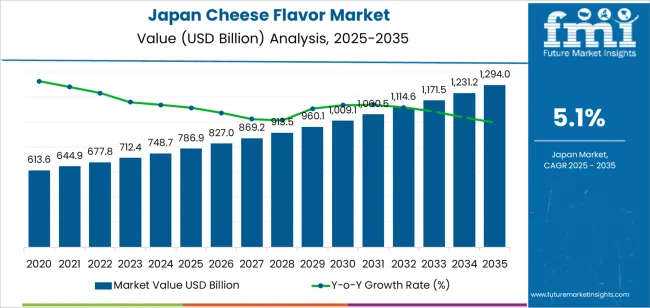
Demand for cheese flavor in Japan was valued at USD Billion 0.78 in 2025. Based on Future Market Insights' analysis, demand for cheese flavor is estimated to grow to USD Billion 0.82 in 2026 and USD Billion 1.35 by 2036. FMI projects a CAGR of 5.1% during the forecast period from 2026 to 2036. This translates to an incremental opportunity worth USD Billion 0.53 over the ten-year assessment window. Japan's cheese flavor market is driven by the country's expanding processed snack sector and the growing consumer appetite for cheese-flavored convenience foods. The market operates under flavor ingredient regulations administered by the Japan Flavour and Fragrance Materials Association and food safety standards enforced by the Ministry of Health, Labour and Welfare. As per FMI, the competitive landscape is defined by the ability of flavor houses to deliver application-specific cheese profiles that meet the stringent organoleptic standards of Japanese food manufacturers. The emergence of plant-based cheese flavor formulations is adding a new competitive dimension, as snack and bakery producers seek to address dietary preference diversification without compromising taste authenticity.
Summary of Cheese Flavor Market in Japan
- Market Snapshot
- Demand for cheese flavor in Japan is valued at USD Billion 0.78 in 2025 and is projected to reach USD Billion 1.35 by 2036.
- The market is expected to grow at a 5.1% CAGR from 2026 to 2036, creating an incremental opportunity of USD Billion 0.53.
- The market is a formulation-driven, flavor ingredient category where application-specific consistency, plant-based reformulation capability, and retail shelf allocation trends define competitive positioning.
- Demand and Growth Drivers
- Japan's expanding processed snack sector, driven by convenience store and retail-ready product launches, is increasing procurement volumes for cheese flavor ingredients.
- Growth of plant-based food product lines is creating demand for cheese flavor formulations that replicate dairy taste profiles without animal-derived substrates.
- Stringent organoleptic consistency requirements from Japanese food manufacturers drive competitive differentiation among flavor ingredient suppliers.
- Among key regions, Kyushu & Okinawa leads at 5.3% CAGR, followed by Kanto at 4.9%, Kansai at 4.3%, Chubu at 3.8%, Tohoku at 3.3%, and Rest of Japan at 3.2%.
- Product and Segment View
- Cheese flavor ingredients are formulated compounds replicating cheese taste profiles, supplied in powder and liquid formats for food manufacturing integration.
- Applications span snack seasoning, fast food preparation, bakery product formulation, and convenience food manufacturing across Japan's processed food sector.
- Powder leads by Product Form with 64% share in 2026, preferred for shelf stability, ease of blending, and compatibility with dry-process snack seasoning lines.
- Animal-Based leads by Source with 38% share in 2026, reflecting established dairy-derived formulation expertise among major flavor suppliers.
- Scope includes animal-based and plant-based cheese flavor ingredients. Excluded are natural cheese, processed cheese products, and general savory flavorings.
- Geography and Competitive Outlook
- Kyushu & Okinawa and Kanto are the fastest-growing regional clusters, driven by concentrated processing and distribution infrastructure serving metropolitan consumption.
- Demand in Tohoku and Rest of Japan follows steadier, replacement-driven procurement cycles in established manufacturing and retail networks.
- Competition depends on application-specific flavor profile consistency, reformulation agility across animal and plant-based substrates, and speed to market for new product development cycles.
- Key players include Kerry Group, Givaudan, Archer Daniels Midland (ADM), International Flavors & Fragrances.
- Analyst Opinion at FMI
- Nandini Roy Choudhury, Principal Consultant for Food & Beverages, opines: 'In my analysis, I have observed that the cheese flavor market in Japan is being reshaped by the convergence of snack product premiumization and plant-based reformulation requirements. Snack manufacturers scaling product lines for convenience store distribution need flavor suppliers who can guarantee batch-to-batch consistency across both animal-derived and plant-based cheese profiles. Ingredient companies that position their portfolios exclusively around traditional dairy-sourced cheese flavors are exposed to margin compression as plant-based alternatives gain shelf allocation in Japan's tightly managed retail environment.'
- Strategic Implications / Executive Takeaways
- Flavor suppliers should build dual-capability portfolios across animal-based and plant-based cheese profiles to serve both conventional and reformulated product lines.
- Snack manufacturers should establish batch-consistency agreements with cheese flavor suppliers to maintain organoleptic standards across high-volume production runs.
- Product developers should accelerate plant-based cheese flavor development to capture incremental shelf allocation as Japanese retailers expand alternative protein sections.
Cheese Flavor Market Key Takeaways
| Metric | Details |
|---|---|
| Industry Size (2026) | USD Billion 0.82 |
| Industry Value (2036) | USD Billion 1.35 |
| CAGR (2026 to 2036) | 5.1% |
Source: Future Market Insights, 2026
Across Japanese prefectural clusters, growth trajectories vary based on industrial concentration and end-use demand density. Kyushu & Okinawa is projected to expand at 5.3% CAGR. Kanto is projected to expand at 4.9% CAGR. Kansai is projected to expand at 4.3% CAGR. Chubu is projected to expand at 3.8% CAGR. Tohoku is projected to expand at 3.3% CAGR. Rest of Japan is projected to expand at 3.2% CAGR. Kyushu & Okinawa leads the growth ranking, supported by concentrated processing activity and proximity to distribution logistics infrastructure in the region. Kanto, anchoring the Tokyo metropolitan consumption base, follows closely. Mature clusters such as Tohoku and Rest of Japan register steadier, replacement-driven demand patterns.
Cheese Flavor Market Definition
Cheese flavor ingredients are formulated compounds designed to replicate the taste and aroma profiles of natural cheese in processed food manufacturing. Available in powder and liquid delivery formats, these ingredients are sourced from animal-based dairy substrates or plant-based alternatives. In the Japanese market, cheese flavors are used across snack production, fast food preparation, bakery formulation, and convenience food manufacturing.
Cheese Flavor Market Inclusions
Market scope includes animal-based and plant-based cheese flavor ingredients in powder and liquid formats sold for food manufacturing use in Japan. Coverage extends to snack, fast food, bakery, convenience, and other food processing applications. The assessment covers market sizes by product form, source, application, and Japanese prefectural region for 2026 to 2036.
Cheese Flavor Market Exclusions
The scope excludes natural cheese, processed cheese, and cheese-based spreads sold as finished dairy products. It also omits general-purpose savory flavoring agents not specifically formulated to replicate cheese taste profiles.
Cheese Flavor Market Research Methodology
- Primary Research: Analysts engaged with procurement managers, product formulators, and quality assurance leads at cheese flavor manufacturing and distribution facilities across Japan to map decision triggers and specification requirements.
- Desk Research: Data collection aggregated regulatory filings from the Ministry of Health, Labour and Welfare, trade statistics from Japan Customs, and published technical standards relevant to cheese flavor production and distribution in Japan.
- Market-Sizing and Forecasting: Baseline values derive from a bottom-up aggregation of manufacturer shipments and import volumes, applying region-specific consumption curves to project adoption velocity through 2036.
- Data Validation and Update Cycle: Projections are cross-checked against publicly reported production volumes, trade data, and downstream procurement disclosures from major processors and distributors operating in Japan.
What Is Driving the Demand for Cheese Flavor in Japan?
The demand for cheese flavor in Japan has historically been shaped by the strength of domestic snack food manufacturing, where savory profiles dominated consumer preferences across potato chips, corn puffs and rice crackers. Japanese food manufacturers focused on delivering bold umami notes, authentic cheese taste and consumer-preferred texture combinations, which supported steady procurement of powder and liquid cheese flavor systems. Convenience store expansion accelerated demand as Japan's dense retail network required diverse flavor options for packaged sandwiches, bento components and ready-to-eat meals. Historical growth was reinforced by consistent innovation activity, since Japanese flavor houses developed region-specific profiles that balanced Western cheese characteristics with local taste expectations. These conditions created predictable, long-term demand for cheese flavor tied closely to the output volume of processed snacks and convenience foods across manufacturing centers within the country.
Future growth will be influenced by Japan's shift toward premium snacking experiences, health-conscious formulation requirements and the need for authentic flavor systems in plant-based and reduced-sodium platforms. Fusion cuisine applications, which blend Japanese culinary traditions with global cheese varieties, require specialized flavor profiles that deliver complexity without overpowering delicate ingredients. This creates a continuing but more refined demand. Long-term challenges arise from the expansion of clean-label movements that require simpler ingredient declarations and natural sourcing. As Japan moves toward more transparent food labeling, cheese flavor demand will rely increasingly on natural extracts, fermentation-derived compounds and specialized enzyme-modified systems rather than broad, synthetic flavor formulations.
What Factors Are Affecting the Demand for Cheese Flavor in Japan in Terms of Product Form and Source?
The demand for cheese flavor in Japan is shaped by the product forms used to deliver taste profiles and the sourcing methods that determine ingredient authenticity. Product categories include powder and liquid systems, each offering different handling characteristics and application suitability. Sources such as animal-based, plant-based, snacks incorporation, fast food integration, bakery inclusion, convenience meals and others support varied manufacturing and consumer preference requirements. As food processors and flavor developers focus on consistent taste delivery and practical formulation compatibility, the combination of physical form and ingredient origin influences purchasing decisions across Japan's snack food, processed meal and bakery ingredient settings.
What Drives the Leading Demand for Powder Form Cheese Flavor in Japan?
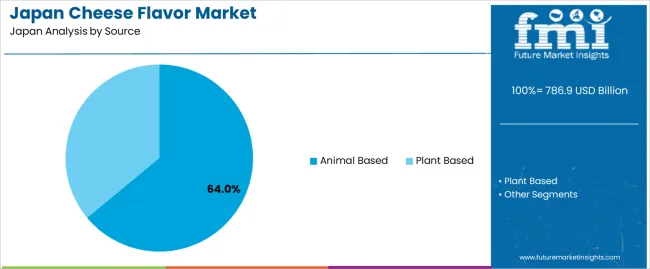
Powder form accounts for 64% of total demand across product form categories in Japan. Its leading share reflects straightforward storage requirements, predictable dosing accuracy and suitability for dry snack applications. Many snack manufacturers value powder systems for consistent coating adhesion that supports uniform flavor distribution across potato chips, corn snacks and rice crackers. These systems offer manageable transportation logistics and easy integration into existing production lines. Their dry format suits environments that prioritize extended shelf stability without refrigeration, reinforcing steady use across high-volume snack processing operations.
Demand for powder cheese flavor also grows as companies adopt spray-drying technology that preserves volatile aroma compounds. Facilities appreciate the reduced handling complexity and predictable reconstitution behavior associated with these materials. Their free-flowing characteristics support automated seasoning equipment, making them practical for continuous production settings. The technology provides sufficient flavor intensity for typical application rates, meeting expectations for bold taste delivery. As processors continue seeking efficient seasoning solutions, powder form cheese flavor maintains a strong presence in Japan.
What Drives the Leading Demand for Animal-Based Source in Cheese Flavor Applications in Japan?
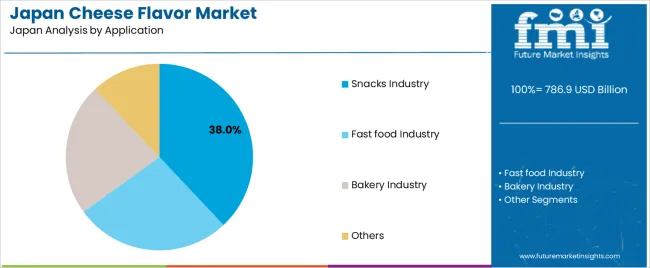
Animal-based sourcing accounts for 38.0% of total demand across source categories in Japan. Its leading position reflects clear advantages in authentic dairy character, rich mouthfeel and flavor depth. Animal-derived cheese flavor systems support traditional taste expectations in snack foods, seasonings and processed dairy applications, enabling manufacturers to deliver profiles that closely match natural cheese varieties. Their biochemical complexity allows reproduction of aged cheddar notes, parmesan umami and mozzarella creaminess without extensive flavor masking. Processors rely on these systems for applications that require genuine dairy authenticity and consumer-preferred taste recognition.
Demand for animal-based cheese flavor grows as premium snack segments emphasize real ingredient declarations. The sourcing approach supports label claims that resonate with consumers seeking familiar dairy origins. Food developers value the material's ability to provide consistent batch-to-batch performance during extended production runs. Sensory panels appreciate the nuanced taste profiles that emerge from milk-derived precursors and enzymatic modification. As Japan continues to emphasize authentic flavor experiences, animal-based cheese flavor remains central to processed food ingredient adoption.
What Is Shaping the Current Demand for Cheese Flavor in Japan?
Demand for cheese flavor in Japan is influenced by robust snack food consumption, strong convenience store penetration and a consumer base that values bold umami-forward taste profiles. Japan's food manufacturing ecosystem favors ingredients that offer predictable performance, extended shelf stability and compatibility with high-speed production equipment, which positions cheese flavor systems well for potato snack coating, corn puff seasoning and bakery filling applications. At the same time, ingredient procurement remains selective, and flavor systems must meet strict domestic standards for food safety, allergen declaration and compatibility with clean-label initiatives across manufacturing operations.
How Are Japan's Consumer Preferences and Retail Structures Encouraging New Applications?
Cheese flavor gains traction because Japan's convenience store network requires continuous product innovation and limited-edition seasonal offerings that drive repeat purchases. Snack manufacturers and ready-meal producers rely heavily on bold flavor differentiation, and cheese profiles align with this long-standing competitive requirement. Japanese product developers also favor ingredients that perform consistently within short production cycles, making cheese flavor systems useful in potato chip seasoning, instant noodle flavor packets and sandwich spread formulations. These patterns reflect Japan's emphasis on taste variety and rapid product turnover across retail food channels.
Where Are Practical Growth Opportunities for Cheese Flavor in Japan?
Opportunities exist in premium snack segments, plant-based convenience foods, bakery filling innovations and fusion cuisine applications combining Japanese ingredients with global cheese profiles. Japan's established flavor house ecosystem creates openings for customized cheese systems that integrate with traditional dashi umami, soy fermentation notes and local ingredient preferences. As food service operators expand delivery-focused menus, demand increases for shelf-stable cheese flavor concentrates with rapid flavor release. Ingredient suppliers offering Japan-specific taste profiles, technical application support and regulatory compliance documentation may find strong adoption.
What Local Factors Are Constraining Wider Adoption of Cheese Flavor in Japan?
Constraints stem from health-conscious consumer movements favoring sodium reduction, clean-label skepticism toward synthetic flavor compounds and strong preference for traditional Japanese seasoning profiles among older demographics. Some food manufacturers rely on established soy sauce, miso and seaweed umami systems rather than Western cheese flavors, slowing category expansion. Integration challenges with traditional Japanese production methods and the need for alignment with domestic taste calibration norms further delay uptake. In addition, smaller regional food processors may hesitate due to limited technical support for flavor system optimization, creating uneven adoption across Japan.
What is the Demand for Cheese Flavor in Japan by Region?
.webp "Top Country Growth Comparison Japan Cheese Flavor Market Cagr (2026 2036)")
| Region | CAGR (%) |
|---|---|
| Kyushu & Okinawa | 5.3% |
| Kanto | 4.9% |
| Kansai | 4.3% |
| Chubu | 3.8% |
| Tohoku | 3.3% |
| Rest of Japan | 3.2% |
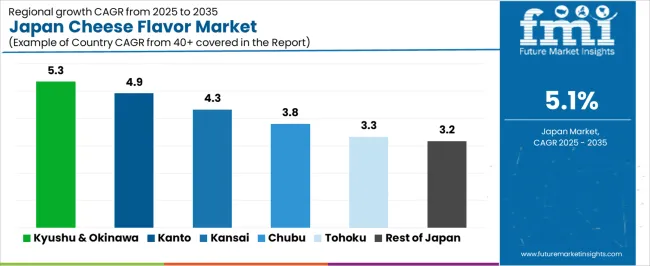
Demand for cheese flavor in Japan is rising across regions, with Kyushu and Okinawa leading at 5.3%. Growth in this region reflects expanding use of bold seasoning profiles in snack foods, instant noodles and convenience store meal preparations. Kanto follows at 4.9%, supported by dense food manufacturing clusters and steady innovation in processed food categories.
Kansai records 4.3%, shaped by active bakery operations and snack food producers applying cheese flavor in traditional and fusion applications. Chubu grows at 3.8%, influenced by regional food processors and ingredient distributors integrating flavor systems into local product lines. Tohoku reaches 3.3%, showing gradual but consistent adoption. The rest of Japan posts 3.2%, reflecting broader interest in cheese flavor technologies across smaller food manufacturing facilities.
How Is Kyushu & Okinawa Driving Demand for Cheese Flavor?
Kyushu & Okinawa is projected to grow at a CAGR of 5.3% through 2036 in demand for cheese flavor. Fukuoka food manufacturers and surrounding processing centers are increasingly adopting flavor systems for snack coating, instant noodle seasoning and bakery applications. Rising demand for bold taste innovation, limited-edition seasonal products and fusion cuisine offerings drives adoption. Ingredient suppliers provide high-performance, customized and shelf-stable cheese flavor compounds suitable for snack producers and convenience meal manufacturers. Distributors ensure accessibility across urban, semi-urban and processing facilities. Growth in snack food production, convenience meal innovation and bakery filling applications supports steady adoption of cheese flavor in Kyushu & Okinawa.
- Fukuoka snack producers adopt flavor systems for bold seasoning applications.
- Limited-edition products and fusion cuisine drive regional flavor innovation trends.
- High-performance and customized compounds suit snack food manufacturing requirements.
- Distributors ensure access across urban, semi-urban and processing facilities.
How Is Kanto Supporting Demand for Cheese Flavor?
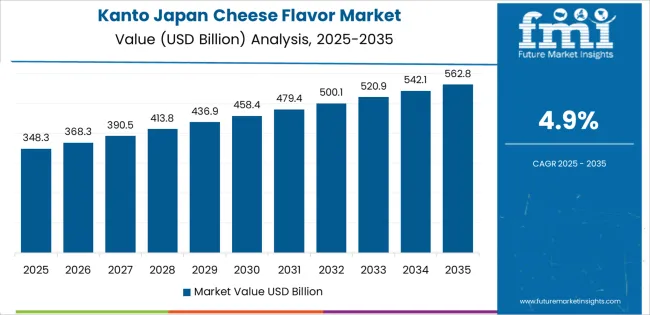
Kanto is projected to grow at a CAGR of 4.9% through 2036 in demand for cheese flavor. Tokyo and surrounding regions are increasingly using flavor systems for processed snack foods, convenience store products and bakery innovations. Rising focus on taste differentiation, premium snacking experiences and rapid product development cycles drives adoption. Ingredient suppliers provide versatile, technical-grade and application-specific cheese flavor solutions suitable for high-volume manufacturers and specialty food producers. Distributors ensure accessibility across urban, semi-urban and manufacturing networks. Expansion in snack food coating, convenience meal seasoning and bakery filling supports steady adoption of cheese flavor across Kanto.
- Tokyo manufacturers adopt flavor systems for snack food and convenience meal applications.
- Taste differentiation and premium snacking experiences drive regional innovation trends.
- Versatile, technical-grade and application-specific solutions support diverse production needs.
- Distributors ensure access across urban, semi-urban and manufacturing networks.
How Is Kansai Contributing to Demand for Cheese Flavor?
Kansai is projected to grow at a CAGR of 4.3% through 2036 in demand for cheese flavor. Osaka, Kyoto and surrounding regions are increasingly adopting flavor systems for snack seasoning, processed food applications and bakery filling innovations. Rising demand for umami-forward profiles, product differentiation and regional taste preferences drives adoption. Ingredient suppliers provide authentic, customized and production-ready cheese flavor compounds suitable for snack manufacturers, bakery operations and processed food facilities. Distributors ensure accessibility across urban and semi-urban manufacturing centers. Growth in snack food production, bakery innovations and processed meal applications supports steady adoption of cheese flavor across Kansai.
- Osaka and Kyoto manufacturers adopt flavor systems for snack and bakery applications.
- Umami-forward profiles and product differentiation drive regional flavor development trends.
- Authentic, customized and production-ready compounds support manufacturing requirements.
- Distributors ensure access across urban and semi-urban manufacturing centers.
How Is Chubu Contributing to Demand for Cheese Flavor?
Chubu is projected to grow at a CAGR of 3.8% through 2036 in demand for cheese flavor. Nagoya and surrounding areas are increasingly adopting flavor systems for snack food production, processed meal seasoning and bakery applications in food manufacturing facilities. Rising focus on taste consistency, production efficiency and ingredient compatibility drives adoption. Ingredient suppliers provide reliable, cost-effective and application-tested cheese flavor solutions suitable for regional processors and snack manufacturers. Distributors ensure availability across urban and semi-urban food production facilities. Expansion in snack coating, processed food seasoning and bakery filling supports steady adoption of cheese flavor across Chubu.
- Nagoya processors adopt flavor systems for snack and processed food applications.
- Taste consistency and production efficiency drive regional ingredient selection trends.
- Reliable, cost-effective and application-tested solutions support manufacturing operations.
- Distributors ensure availability across urban and semi-urban production facilities.
How Is Tohoku Contributing to Demand for Cheese Flavor?
Tohoku is projected to grow at a CAGR of 3.3% through 2036 in demand for cheese flavor. Sendai and surrounding food manufacturing centers are gradually adopting flavor systems for snack products, processed foods and regional specialty items. Rising focus on product innovation, taste enhancement and regional food branding drives adoption. Ingredient suppliers provide dependable, regionally-adapted and processing-compatible cheese flavor compounds suitable for local manufacturers and specialty food producers. Distributors ensure accessibility across urban, semi-urban and regional production facilities. Expansion in snack food manufacturing, processed meal production and regional food innovation supports steady adoption of cheese flavor across Tohoku.
- Sendai manufacturers adopt flavor systems for snack and regional specialty applications.
- Product innovation and regional food branding drive local flavor adoption trends.
- Dependable, regionally-adapted and processing-compatible compounds support production needs.
- Distributors ensure access across urban, semi-urban and regional facilities.
How Is Rest of Japan Supporting Demand for Cheese Flavor?
The Rest of Japan is projected to grow at a CAGR of 3.2% through 2036 in demand for cheese flavor. Smaller towns and rural food processing centers gradually adopt flavor systems for local snack production, processed food manufacturing and specialty product development. Rising demand for taste enhancement, product variety and regional food offerings drives adoption. Ingredient suppliers provide accessible, straightforward and application-ready cheese flavor solutions suitable for small-scale manufacturers, regional processors and specialty food operations. Distributors ensure accessibility across urban, semi-urban and rural production centers. Expansion in local snack manufacturing, processed food production and regional specialty items supports steady adoption of cheese flavor across the Rest of Japan.
- Rural processors adopt flavor systems for local snack and specialty food production.
- Taste enhancement and regional food offerings drive local ingredient adoption trends.
- Accessible, straightforward and application-ready solutions support small-scale operations.
- Distributors ensure access across urban, semi-urban and rural facilities.
What Is Driving the Demand for Cheese Flavor in Japan and Who Are the Key Players Shaping the Industry?
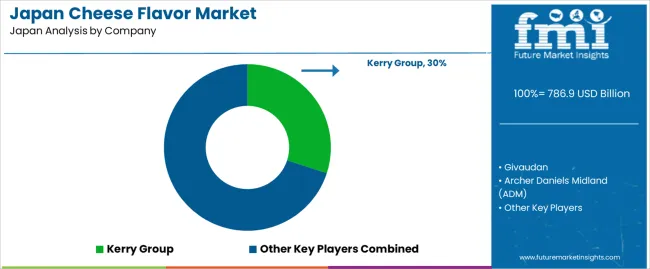
The demand for cheese flavor in Japan is driven by the country's robust snack food consumption, expanding convenience store networks and growing interest in fusion cuisine that blends Western cheese profiles with traditional Japanese ingredients. Food manufacturers seek versatile flavor systems to create product differentiation, deliver bold umami notes and meet consumer expectations for authentic taste experiences.
Concurrently, premium snacking and health-conscious segments expand, pushing interest in cheese flavor compounds capable of providing natural declarations, reduced sodium formulations and clean-label compatibility. Technological improvements such as spray-drying optimization, encapsulation advances and fermentation-derived flavor precursors further enhance suitability of cheese flavor in Japanese snack plants, bakery operations and convenience meal production facilities.
Key companies active in Japan's cheese flavor space include Irish ingredient specialist Kerry Group, Swiss flavor house Givaudan and global suppliers such as Archer Daniels Midland (ADM) and International Flavors & Fragrances. Kerry operates regional facilities serving Asian food manufacturers with customized cheese flavor solutions, while Givaudan maintains application laboratories in Japan for local product development support. ADM and IFF supply natural and synthetic cheese flavor compounds through established distribution networks. This mix of multinational flavor houses and regional ingredient specialists reflects the competitive landscape in Japan, ensuring that cheese flavor adoption is shaped by global flavor technology leadership and local application expertise.
Key Players in Cheese Flavor Industry in Japan
- Kerry Group
- Givaudan
- Archer Daniels Midland (ADM)
- International Flavors & Fragrances
Scope of the Report
| Metric | Value |
|---|---|
| Quantitative Units | USD Billion 0.82 to USD Billion 1.35, at a CAGR of 5.1% |
| Market Definition | Cheese flavor ingredients are formulated compounds designed to replicate the taste and aroma profiles of natural cheese in processed food manufacturing. Available in powder and liquid delivery formats, these ingredients are sourced from animal-based dairy substrates or plant-based alternatives. |
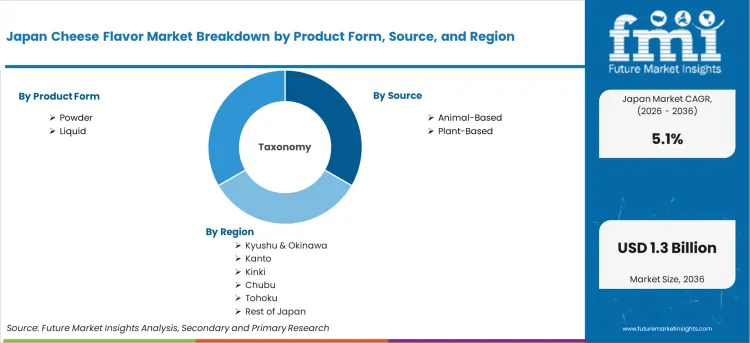
| Segmentation | Product Form: Powder, Liquid; Source: Animal-Based, Plant-Based; Application: Snacks, Fast Food, Bakery, Convenience, Others |
| Regions Covered | Kyushu & Okinawa, Kanto, Kansai, Chubu, Tohoku, Rest of Japan |
| Key Companies Profiled | Kerry Group, Givaudan, Archer Daniels Midland (ADM), International Flavors & Fragrances |
| Forecast Period | 2026 to 2036 |
| Approach | Forecasting models apply a bottom-up methodology starting with manufacturer shipment metrics and import volume data, cross-validated against downstream consumption patterns and regulatory compliance filings. |
Cheese Flavor Industry in Japan Segmentation
Product Form:
- Powder
- Liquid
Source:
- Animal-based
- Plant-based
Application:
- Snacks Inc
- Fast Food
- Bakery Inc
- Convenience
- Others
Region:
- Kyushu & Okinawa
- Kanto
- Kansai
- Chubu
- Tohoku
- Rest of Japan
Bibliography
- 1. Japan Flavour and Fragrance Materials Association. (2024). Industry Statistics Report. JFFMA.
- 2. Ministry of Health, Labour and Welfare. (2024). Food Sanitation Act: Flavor Ingredient Standards. MHLW.
- 3. Codex Alimentarius Commission. (2024). Guidelines on the Use of Flavourings. FAO/WHO.
- 4. Japan External Trade Organization. (2025). Processed Food Ingredient Import Trends. JETRO.
- 5. Food Safety Commission of Japan. (2024). Risk Assessment: Flavoring Compounds. FSCJ.
This bibliography is provided for reader reference. The full Future Market Insights report contains the complete reference list with primary research documentation.
Frequently Asked Questions
How large is the demand for Cheese Flavor in Japan in 2026?
Demand for cheese flavor in Japan is estimated to be valued at USD Billion 0.82 in 2026.
What will be the market size of Cheese Flavor in Japan by 2036?
Market size for cheese flavor in Japan is projected to reach USD Billion 1.35 by 2036.
What is the expected demand growth for Cheese Flavor in Japan between 2026 and 2036?
Demand for cheese flavor in Japan is expected to grow at a CAGR of 5.1% between 2026 and 2036.
Which Product Form is poised to lead sales in 2026?
Powder accounts for 64% share in 2026, driven by established procurement preferences and formulation compatibility across primary end-use applications.
Which region is growing fastest for Cheese Flavor in Japan?
Kyushu & Okinawa is projected to grow at a CAGR of 5.3% during 2026 to 2036, leading all regional clusters in Japan.
What is included in the scope of this Cheese Flavor report?
Market scope includes animal-based and plant-based cheese flavor ingredients in powder and liquid formats sold for food manufacturing use in Japan. Coverage extends to snack, fast food, bakery, convenience, and other food processing applications.
What is excluded from the scope of this report?
The scope excludes natural cheese, processed cheese, and cheese-based spreads sold as finished dairy products. It also omits general-purpose savory flavoring agents not specifically formulated to replicate cheese taste profiles.
How does FMI build and validate the Cheese Flavor forecast?
Forecasting models apply a bottom-up methodology starting with manufacturer shipment data and import volumes, cross-validated against downstream consumption patterns and regulatory compliance filings.
Preview the report firsthand - request a free sample
Get SampleGet the brochure for pricing and purchase details.
Get PDFTable of Content
- Executive Summary
- Japan Market Outlook
- Demand-side Trends
- Supply-side Trends
- Technology Roadmap Analysis
- Analysis and Recommendations
- Market Overview
- Market Coverage / Taxonomy
- Market Definition / Scope / Limitations
- Research Methodology
- Chapter Orientation
- Analytical Lens and Working Hypotheses
- Market Structure, Signals, and Trend Drivers
- Benchmarking and Cross-market Comparability
- Market Sizing, Forecasting, and Opportunity Mapping
- Research Design and Evidence Framework
- Desk Research Programme (Secondary Evidence)
- Company Annual and Sustainability Reports
- Peer-reviewed Journals and Academic Literature
- Corporate Websites, Product Literature, and Technical Notes
- Earnings Decks and Investor Briefings
- Statutory Filings and Regulatory Disclosures
- Technical White Papers and Standards Notes
- Trade Journals, Industry Magazines, and Analyst Briefs
- Conference Proceedings, Webinars, and Seminar Materials
- Government Statistics Portals and Public Data Releases
- Press Releases and Reputable Media Coverage
- Specialist Newsletters and Curated Briefings
- Sector Databases and Reference Repositories
- FMI Internal Proprietary Databases and Historical Market Datasets
- Subscription Datasets and Paid Sources
- Social Channels, Communities, and Digital Listening Inputs
- Additional Desk Sources
- Expert Input and Fieldwork (Primary Evidence)
- Primary Modes
- Qualitative Interviews and Expert Elicitation
- Quantitative Surveys and Structured Data Capture
- Blended Approach
- Why Primary Evidence is Used
- Field Techniques
- Interviews
- Surveys
- Focus Groups
- Observational and In-context Research
- Social and Community Interactions
- Stakeholder Universe Engaged
- C-suite Leaders
- Board Members
- Presidents and Vice Presidents
- R&D and Innovation Heads
- Technical Specialists
- Domain Subject-matter Experts
- Scientists
- Physicians and Other Healthcare Professionals
- Governance, Ethics, and Data Stewardship
- Research Ethics
- Data Integrity and Handling
- Primary Modes
- Tooling, Models, and Reference Databases
- Desk Research Programme (Secondary Evidence)
- Data Engineering and Model Build
- Data Acquisition and Ingestion
- Cleaning, Normalisation, and Verification
- Synthesis, Triangulation, and Analysis
- Quality Assurance and Audit Trail
- Market Background
- Market Dynamics
- Drivers
- Restraints
- Opportunity
- Trends
- Scenario Forecast
- Demand in Optimistic Scenario
- Demand in Likely Scenario
- Demand in Conservative Scenario
- Opportunity Map Analysis
- Product Life Cycle Analysis
- Supply Chain Analysis
- Investment Feasibility Matrix
- Value Chain Analysis
- PESTLE and Porter’s Analysis
- Regulatory Landscape
- Regional Parent Market Outlook
- Production and Consumption Statistics
- Import and Export Statistics
- Market Dynamics
- Japan Market Analysis 2021 to 2025 and Forecast, 2026 to 2036
- Historical Market Size Value (USD Million) Analysis, 2021 to 2025
- Current and Future Market Size Value (USD Million) Projections, 2026 to 2036
- Y-o-Y Growth Trend Analysis
- Absolute $ Opportunity Analysis
- Japan Market Pricing Analysis 2021 to 2025 and Forecast 2026 to 2036
- Japan Market Analysis 2021 to 2025 and Forecast 2026 to 2036, By Product Form
- Introduction / Key Findings
- Historical Market Size Value (USD Million) Analysis By Product Form , 2021 to 2025
- Current and Future Market Size Value (USD Million) Analysis and Forecast By Product Form , 2026 to 2036
- Powder
- Liquid
- Powder
- Y-o-Y Growth Trend Analysis By Product Form , 2021 to 2025
- Absolute $ Opportunity Analysis By Product Form , 2026 to 2036
- Japan Market Analysis 2021 to 2025 and Forecast 2026 to 2036, By Source
- Introduction / Key Findings
- Historical Market Size Value (USD Million) Analysis By Source, 2021 to 2025
- Current and Future Market Size Value (USD Million) Analysis and Forecast By Source, 2026 to 2036
- Animal-Based
- Plant-Based
- Animal-Based
- Y-o-Y Growth Trend Analysis By Source, 2021 to 2025
- Absolute $ Opportunity Analysis By Source, 2026 to 2036
- Japan Market Analysis 2021 to 2025 and Forecast 2026 to 2036, By Application
- Introduction / Key Findings
- Historical Market Size Value (USD Million) Analysis By Application, 2021 to 2025
- Current and Future Market Size Value (USD Million) Analysis and Forecast By Application, 2026 to 2036
- Snacks Inc
- Fast Food
- Bakery Inc
- Convenience
- Others
- Snacks Inc
- Y-o-Y Growth Trend Analysis By Application, 2021 to 2025
- Absolute $ Opportunity Analysis By Application, 2026 to 2036
- Japan Market Analysis 2021 to 2025 and Forecast 2026 to 2036, By Region
- Introduction
- Historical Market Size Value (USD Million) Analysis By Region, 2021 to 2025
- Current Market Size Value (USD Million) Analysis and Forecast By Region, 2026 to 2036
- Kyushu & Okinawa
- Kanto
- Kinki
- Chubu
- Tohoku
- Rest of Japan
- Market Attractiveness Analysis By Region
- Kyushu & Okinawa Market Analysis 2021 to 2025 and Forecast 2026 to 2036, By Country
- Historical Market Size Value (USD Million) Trend Analysis By Market Taxonomy, 2021 to 2025
- Market Size Value (USD Million) Forecast By Market Taxonomy, 2026 to 2036
- By Country
- By Product Form
- By Source
- By Application
- By Country
- Market Attractiveness Analysis
- By Country
- By Product Form
- By Source
- By Application
- Key Takeaways
- Kanto Market Analysis 2021 to 2025 and Forecast 2026 to 2036, By Country
- Historical Market Size Value (USD Million) Trend Analysis By Market Taxonomy, 2021 to 2025
- Market Size Value (USD Million) Forecast By Market Taxonomy, 2026 to 2036
- By Country
- By Product Form
- By Source
- By Application
- By Country
- Market Attractiveness Analysis
- By Country
- By Product Form
- By Source
- By Application
- Key Takeaways
- Kinki Market Analysis 2021 to 2025 and Forecast 2026 to 2036, By Country
- Historical Market Size Value (USD Million) Trend Analysis By Market Taxonomy, 2021 to 2025
- Market Size Value (USD Million) Forecast By Market Taxonomy, 2026 to 2036
- By Country
- By Product Form
- By Source
- By Application
- By Country
- Market Attractiveness Analysis
- By Country
- By Product Form
- By Source
- By Application
- Key Takeaways
- Chubu Market Analysis 2021 to 2025 and Forecast 2026 to 2036, By Country
- Historical Market Size Value (USD Million) Trend Analysis By Market Taxonomy, 2021 to 2025
- Market Size Value (USD Million) Forecast By Market Taxonomy, 2026 to 2036
- By Country
- By Product Form
- By Source
- By Application
- By Country
- Market Attractiveness Analysis
- By Country
- By Product Form
- By Source
- By Application
- Key Takeaways
- Tohoku Market Analysis 2021 to 2025 and Forecast 2026 to 2036, By Country
- Historical Market Size Value (USD Million) Trend Analysis By Market Taxonomy, 2021 to 2025
- Market Size Value (USD Million) Forecast By Market Taxonomy, 2026 to 2036
- By Country
- By Product Form
- By Source
- By Application
- By Country
- Market Attractiveness Analysis
- By Country
- By Product Form
- By Source
- By Application
- Key Takeaways
- Rest of Japan Market Analysis 2021 to 2025 and Forecast 2026 to 2036, By Country
- Historical Market Size Value (USD Million) Trend Analysis By Market Taxonomy, 2021 to 2025
- Market Size Value (USD Million) Forecast By Market Taxonomy, 2026 to 2036
- By Country
- By Product Form
- By Source
- By Application
- By Country
- Market Attractiveness Analysis
- By Country
- By Product Form
- By Source
- By Application
- Key Takeaways
- Key Countries Market Analysis
- Kyushu & Okinawa
- Pricing Analysis
- Market Share Analysis, 2025
- By Product Form
- By Source
- By Application
- Kanto
- Pricing Analysis
- Market Share Analysis, 2025
- By Product Form
- By Source
- By Application
- Kinki
- Pricing Analysis
- Market Share Analysis, 2025
- By Product Form
- By Source
- By Application
- Chubu
- Pricing Analysis
- Market Share Analysis, 2025
- By Product Form
- By Source
- By Application
- Tohoku
- Pricing Analysis
- Market Share Analysis, 2025
- By Product Form
- By Source
- By Application
- Rest of Japan
- Pricing Analysis
- Market Share Analysis, 2025
- By Product Form
- By Source
- By Application
- Kyushu & Okinawa
- Market Structure Analysis
- Competition Dashboard
- Competition Benchmarking
- Market Share Analysis of Top Players
- By Regional
- By Product Form
- By Source
- By Application
- Competition Analysis
- Competition Deep Dive
- Kerry Group
- Overview
- Product Portfolio
- Profitability by Market Segments (Product/Age /Sales Channel/Region)
- Sales Footprint
- Strategy Overview
- Marketing Strategy
- Product Strategy
- Channel Strategy
- Givaudan
- Archer Daniels Midland (ADM)
- International Flavors & Fragrances
- Kerry Group
- Competition Deep Dive
- Assumptions & Acronyms Used


