

- Industry Size (2025)
- USD 116.2 Mn
- Forecast (2035)
- USD 200.9 Mn
- CAGR (2025 to 2035)
- 5.6%
Demand for Respiratory Gating in Japan Forecast and Outlook 2025 to 2035
The demand for respiratory gating in Japan is expected to experience steady growth from USD 116.2 million in 2025 to USD 200.9 million in 2035, representing a 5.6% CAGR. The absolute dollar opportunity in this sector highlights a consistent upward trajectory, with the industry expanding by approximately USD 84.7 million over the forecast period. In the initial years, from 2025 to 2026, the demand grows by USD 6.5 million, increasing from USD 116.2 million to USD 122.7 million, which reflects a solid 5.6% YoY growth. This trend continues through 2026 to 2027, with another significant increase of USD 7.0 million.
Quick Stats of the Demand for Respiratory Gating in Japan
- Demand for Respiratory Gating in Japan Value (2025): USD 116.2 million
- Demand for Respiratory Gating in Japan Forecast Value (2035): USD 200.9 million
- Demand for Respiratory Gating in Japan Forecast CAGR (2025-2035): 5.6%
- Demand for Respiratory Gating in Japan Leading Product Type: Systems with In-built Gating
- Demand for Respiratory Gating in Japan Key Growth Regions: Kyushu & Okinawa, Kanto, Kansai, Chubu, Tohoku, Rest of Japan
- Demand for Respiratory Gating in Japan Top Players: Siemens Healthineers, Philips Healthcare, Canon Medical Systems, GE HealthCare, Fujifilm
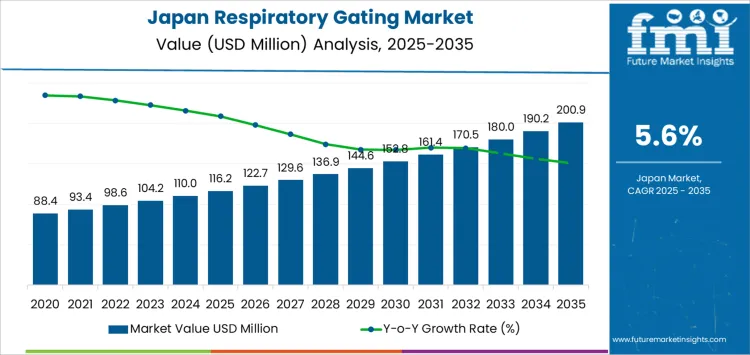
The growth momentum remains strong in subsequent years, with the demand rising by approximately USD 7.0-9.0 million annually until 2035. By 2030, the demand reaches USD 152.8 million, and by 2035, it is expected to hit USD 200.9 million, marking a steady pace of expansion. The growing adoption of respiratory gating technology in Japan, particularly in radiation therapy and oncology, is a major factor driving this increase. As healthcare providers continue to seek advanced technologies to improve the accuracy of radiation treatments, the demand for respiratory gating solutions is projected to continue its upward trend. With ongoing innovations and a larger focus on precision healthcare, the respiratory gating industry in Japan is poised for sustained growth, offering a significant opportunity for stakeholders involved in this sector.
Demand for Respiratory Gating in Japan Key Takeaways
| Metric | Value |
|---|---|
| Demand for Respiratory Gating in Japan Value (2025) | USD 116.2 million |
| Demand for Respiratory Gating in Japan Forecast Value (2035) | USD 200.9 million |
| Demand for Respiratory Gating in Japan Forecast CAGR (2025-2035) | 5.6% |
Why is the Demand for Respiratory Gating in Japan Growing?
The demand for respiratory gating technology in Japan is growing as the healthcare sector increasingly adopts advanced techniques for precise cancer treatment, particularly in radiation therapy. Respiratory gating systems are used to track and adjust the position of tumors during treatment, accounting for respiratory motion, which helps to minimize damage to surrounding healthy tissues. This technology ensures more accurate and effective treatments, driving its adoption in Japan’s cutting-edge medical centers. With an aging population and an increasing incidence of cancer, respiratory gating has become a critical tool in enhancing the accuracy of treatments and improving patient outcomes.
The rise in demand is also fueled by ongoing advancements in imaging and monitoring technologies, which have made respiratory gating systems more reliable and easier to integrate into clinical practice. These innovations allow for real-time tracking of tumor movements, improving the precision of radiation therapy. Japan’s commitment to providing high-quality healthcare and investing in advanced medical technologies contributes to the widespread adoption of respiratory gating. As cancer treatment methods evolve, the need for enhanced treatment accuracy is driving the expansion of respiratory gating solutions across the country.
The growing awareness of the benefits of personalized cancer treatment is a key factor in the demand for respiratory gating. With cancer treatments becoming more targeted, precision in radiation therapy is essential for achieving the best possible outcomes. As the healthcare infrastructure continues to evolve and the need for more effective cancer treatments rises, respiratory gating is expected to play a crucial role in improving therapeutic efficacy and reducing side effects.
What is the Segment-Wise Analysis of Demand for Respiratory Gating in Japan?
Demand for respiratory gating in Japan is segmented by product type, end user, modality, gating type, technology, and region. Systems with in-built gating lead the industry, followed by standalone systems and software. Key end users include imaging and diagnostic centers (30.2%), specialty clinics, hospitals, and cancer treatment centers. Modality demand spans CT, MRI, PET, SPECT, and radiotherapy, with respiratory gating as the primary focus. Gating types include cardiac, respiratory, and multimodality. Technologies used are ECG-triggering, optical surface monitoring, pressure sensor-based, and electromagnetic systems. Regionally, demand spans Kyushu & Okinawa, Kanto, Kansai, Chubu, Tohoku, and beyond.
How Do Systems with In-built Gating Lead the Demand for Respiratory Gating in Japan?
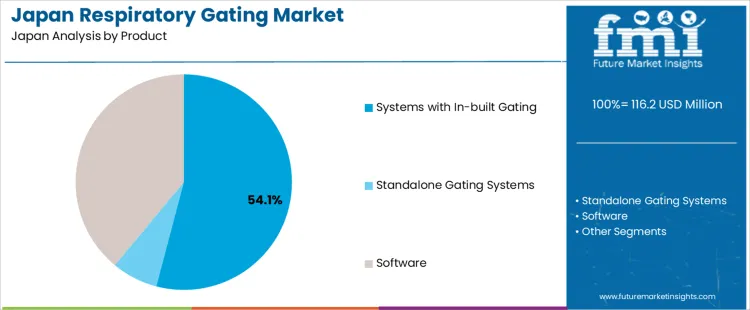
Systems with in-built gating account for 54% of the demand for respiratory gating in Japan, driven by their convenience and integrated functionality. These systems combine imaging and gating capabilities in a single unit, providing a more seamless workflow for medical professionals, especially in diagnostic and treatment settings. They allow for real-time synchronization between respiratory movements and imaging processes, which is crucial in improving the accuracy of imaging, particularly in radiotherapy and cancer treatment.
By eliminating the need for separate gating devices, in-built gating systems help streamline processes, reduce equipment costs, and enhance overall system performance. Their integrated nature also improves patient comfort, as it reduces the need for multiple devices. As demand for more efficient and effective imaging solutions grows, systems with in-built gating are expected to remain the leading product type in the respiratory gating industry in Japan.
Why Does Imaging and Diagnostic Centers Lead the Demand for Respiratory Gating in Japan?
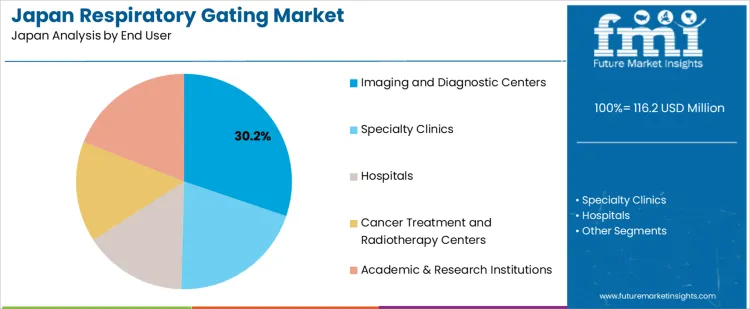
Imaging and diagnostic centers account for 30.2% of the demand for respiratory gating in Japan, driven by their critical role in non-invasive diagnostic imaging and cancer treatment planning. These centers rely heavily on respiratory gating to ensure high-quality, precise imaging of organs that move during respiration, such as the lungs and diaphragm. Respiratory gating helps eliminate motion artifacts caused by breathing, allowing for more accurate imaging and better treatment planning, particularly in radiotherapy and CT imaging.
As the demand for advanced diagnostic tools increases, imaging and diagnostic centers are leading the way in adopting respiratory gating technologies to provide clearer and more reliable results. With Japan’s aging population and the rise in respiratory diseases and cancers, imaging and diagnostic centers will continue to drive the adoption of respiratory gating systems as part of their commitment to improving diagnostic accuracy and patient outcomes.
What are the Key Trends, Drivers, and Restraints in Demand for Respiratory Gating in Japan?
The demand for respiratory gating systems in Japan is increasing due to the rising need for precision therapies, especially in lung, liver, and thoracic cancers. Respiratory gating synchronizes imaging and radiation delivery with a patient's breathing cycle, improving accuracy and reducing radiation exposure to healthy tissues. With Japan’s aging population and the growing prevalence of cancer, the need for highly accurate, non-invasive treatments continues to rise.
The high upfront costs of equipment, the need for trained specialists, and the necessary infrastructure in hospitals can limit accessibility, particularly in smaller or rural facilities. Despite these challenges, demand is growing as healthcare providers prioritize treatment precision, better patient outcomes, and the adoption of advanced imaging and radiotherapy technologies, especially in larger hospitals and cancer centers where resources allow for such innovations.
Why is Demand for Respiratory Gating Growing in Japan?
Demand for respiratory gating in Japan is driven by the increasing number of thoracic cancer cases and a focus on improving treatment accuracy and patient safety. Respiratory gating systems, which synchronize radiation delivery with the patient's breathing cycle, are crucial in treating lung, liver, and abdominal tumors where respiratory motion can affect tumor targeting. As cancer patients seek precision therapies to improve outcomes and reduce damage to healthy tissues, the adoption of respiratory gating systems rises.
Japan's healthcare system is moving toward minimally invasive techniques, and as radiotherapy becomes more widely used for cancer treatment, the demand for systems that address respiratory motion in real-time grows. Innovations in imaging technology, coupled with greater awareness of the benefits of respiratory gating, also contribute to the growing adoption of these systems in hospitals and cancer centers across the country.
How are Technological & Industry Innovations Driving Respiratory Gating Demand in Japan?
Technological advancements are playing a key role in driving the demand for respiratory gating systems in Japan. Improvements in imaging technologies such as 4D CT, MRI, and real-time PET scans allow for more accurate motion tracking and tumor localization, enhancing the precision of respiratory gating systems. Developments in gating algorithms and motion compensation technology have made these systems more efficient and reliable, improving their effectiveness in clinical settings.
Innovations in sensor technology, such as those that track respiratory motion with minimal discomfort to the patient, have further expanded the applications of respiratory gating in radiotherapy. As hospitals and cancer centers upgrade their infrastructure to provide cutting-edge treatments, respiratory gating becomes more accessible and integrated with advanced imaging systems, driving its adoption.
What are the Key Challenges and Risks That Could Limit Respiratory Gating Demand in Japan?
The high initial cost of respiratory gating systems, including the integration with imaging systems and the necessary infrastructure, can be a barrier, particularly for smaller hospitals or clinics with limited budgets. The complexity of using these systems requires specialized training for medical professionals, which could slow adoption rates in regions with fewer experienced electrophysiologists or radiologists. Furthermore, some patients may struggle to cooperate with breath-hold techniques, and inconsistent or irregular breathing patterns may affect the reliability of gating systems.
Limited space on hospital roofs or buildings in urban areas also complicates the installation of necessary equipment. The need for regular maintenance and calibration of these systems, along with competition from other radiation techniques, may pose hurdles to faster adoption, particularly in areas where alternative solutions are already established.
What is the Regional Demand Outlook for Respiratory Gating in Japan?
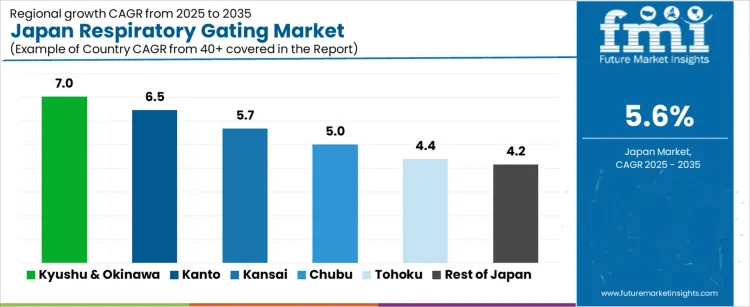
Demand for respiratory gating in Japan is growing steadily across all regions, with Kyushu & Okinawa leading at a 7.0% CAGR, driven by the region’s increasing focus on advanced healthcare technologies for precise cancer treatment. Kanto follows with a 6.5% CAGR, supported by the region’s well-established healthcare infrastructure and the growing adoption of advanced radiation therapy technologies. Kansai shows a 5.7% CAGR, fueled by the region’s strong medical research and healthcare sectors. Chubu experiences a 5.0% CAGR, with steady demand driven by the region’s focus on expanding healthcare services and advanced medical technologies. Tohoku and the Rest of Japan see moderate growth at 4.4% and 4.2%, respectively.
| Region | CAGR (%) |
|---|---|
| Kyushu & Okinawa | 7.0% |
| Kanto | 6.5% |
| Kansai | 5.7% |
| Chubu | 5.0% |
| Tohoku | 4.4% |
| Rest of Japan | 4.2% |
How is Demand for Respiratory Gating Growing in Kyushu & Okinawa?
Kyushu & Okinawa leads the demand for respiratory gating, growing at a 7.0% CAGR. The region’s focus on enhancing healthcare infrastructure and adopting advanced medical technologies is a key factor in driving this growth. Respiratory gating, which improves the precision of radiation therapy for cancer patients, is being increasingly adopted in local hospitals and medical centers to monitor and adjust treatment based on the patient's breathing cycle. This technology helps in targeting tumors more accurately while minimizing the damage to surrounding healthy tissues.
With Kyushu & Okinawa’s aging population and increasing healthcare needs, there is a growing demand for advanced treatment options. Okinawa's expanding medical tourism sector further fuels the adoption of cutting-edge cancer treatments, including respiratory gating. As the region prioritizes precision healthcare and innovative solutions, the demand for respiratory gating is expected to continue expanding steadily, enhancing overall treatment outcomes for patients in Kyushu & Okinawa.
Why is Demand for Respiratory Gating Rising in Kanto?
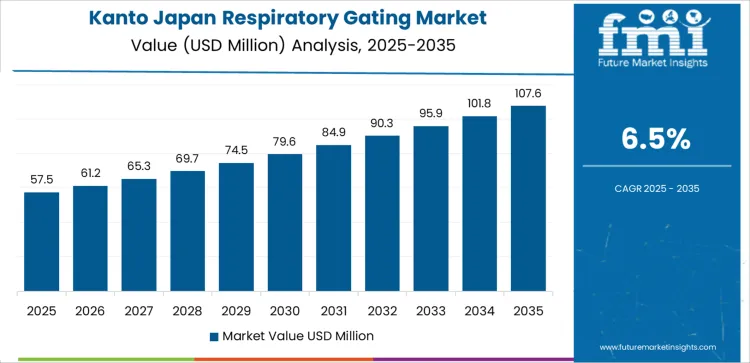
In Kanto, demand for respiratory gating is rising at a 6.5% CAGR. Kanto’s well-established healthcare infrastructure, particularly in Tokyo, has made it a key industry for the adoption of advanced medical technologies like respiratory gating. The region’s dense urban population and high demand for cutting-edge cancer treatments drive the need for precise radiation therapy. Respiratory gating enables radiation therapy to synchronize with the patient’s breathing cycle, ensuring that radiation is delivered accurately to the target tumor while minimizing damage to healthy tissues.
As the region’s hospitals and medical centers continue to integrate more sophisticated technologies into their treatment protocols, respiratory gating is increasingly being adopted. Government support for promoting advanced healthcare technologies and the growing awareness of the benefits of precision cancer treatments further contribute to the steady rise in demand. As Kanto leads in medical innovation, the demand for respiratory gating technologies is expected to continue growing steadily.
How is Demand for Respiratory Gating Expanding in Kansai?
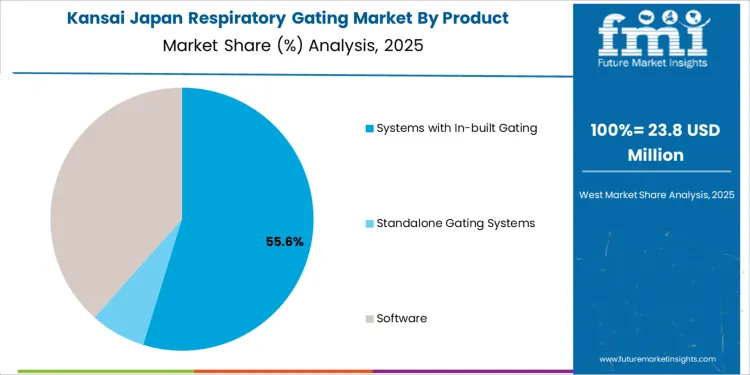
Kansai shows steady demand for respiratory gating, growing at a 5.7% CAGR. The region’s strong healthcare sector, particularly in cities like Osaka and Kyoto, is increasingly adopting advanced technologies to improve the precision and effectiveness of cancer treatments. Respiratory gating systems are particularly beneficial in radiation therapy, where they help reduce exposure to healthy tissues by synchronizing treatment delivery with the patient’s breathing cycle.
As Kansai continues to focus on cutting-edge medical solutions, healthcare providers are increasingly integrating these systems into their cancer treatment protocols. With an aging population and rising cancer diagnoses, the need for more precise treatment methods continues to grow. Kansai’s strong medical research base and commitment to improving patient outcomes through technology further support the demand for respiratory gating. As more hospitals invest in advanced treatment equipment, the adoption of respiratory gating is expected to rise, driving steady industry growth in the region.
Why is Demand for Respiratory Gating Growing in Chubu?
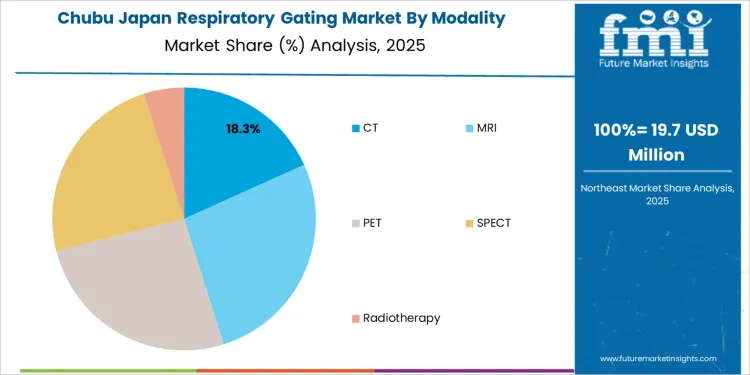
Chubu is experiencing steady demand for respiratory gating, growing at a 5.0% CAGR. The region’s focus on modernizing healthcare services and integrating advanced medical technologies is contributing to the growth in demand for respiratory gating systems. Chubu’s strong industrial base, particularly in Nagoya, is a driving factor, with local hospitals and medical centers investing in technologies that improve the accuracy and effectiveness of cancer treatments.
Respiratory gating helps ensure precise radiation delivery by adjusting for the patient’s breathing cycle, reducing damage to healthy tissues while targeting the tumor. As the region’s healthcare system continues to evolve and as the prevalence of cancer rises, the need for more advanced and precise treatments like respiratory gating will increase. Chubu’s commitment to improving healthcare through innovation and its growing pharmaceutical and medical device sectors further support the steady growth in demand for respiratory gating systems, ensuring continued adoption in the region.
How is Demand for Respiratory Gating Expanding in Tohoku?
Tohoku is seeing moderate growth in respiratory gating demand, with a 4.4% CAGR. While adoption is slower than in major urban centers, there is a growing interest in advanced technologies as healthcare providers in the region modernize their services. Respiratory gating, which synchronizes radiation therapy with the patient’s breathing cycle, is increasingly recognized for its ability to improve treatment precision and minimize side effects. With Tohoku’s aging population and rising cancer diagnoses, the demand for advanced cancer treatment options, including respiratory gating, is on the rise.
As healthcare providers in Tohoku gradually adopt more innovative treatment technologies, the demand for these systems is expected to continue increasing. The region’s focus on sustainable healthcare practices and government initiatives to enhance cancer care also contribute to the adoption of respiratory gating. As Tohoku’s healthcare infrastructure continues to improve, demand for these technologies will steadily rise in both urban and rural areas.
Why is Demand for Respiratory Gating Steady in the Rest of Japan?
The Rest of Japan is experiencing steady demand for respiratory gating, with a 4.2% CAGR. While adoption is slower compared to larger urban centers, there is a gradual increase in the use of advanced medical technologies as healthcare providers in smaller cities and rural areas modernize their cancer treatment services. Respiratory gating systems, which allow for more precise radiation therapy by adjusting treatment according to the patient’s breathing cycle, are becoming more widely adopted in local hospitals and cancer centers.
As the national healthcare system continues to evolve and the demand for more precise cancer treatments grows, the Rest of Japan is seeing an increase in the use of respiratory gating. The region’s aging population and increasing rates of cancer diagnoses are driving the need for effective radiation therapy solutions. Over time, as more healthcare facilities in rural and semi-urban areas adopt advanced treatment technologies, demand for respiratory gating will continue to grow steadily.
What is Driving the Demand for Respiratory Gating in Japan and Who Are the Key Providers?
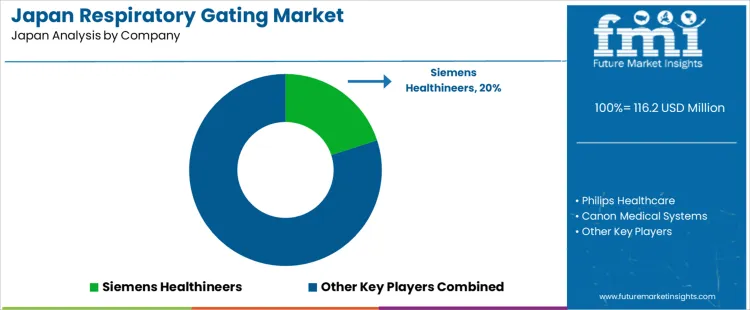
The demand for respiratory‑gating systems in Japan is rising as healthcare providers increasingly prioritize precision in diagnostic imaging and radiotherapy, especially for conditions affecting the chest, lungs, and upper abdomen. Respiratory gating helps synchronize imaging or treatment delivery with a patient’s breathing cycle, reducing motion artifacts and improving image clarity or therapy accuracy. As the population ages and the rates of lung disease and cancer rise, there is a growing need for accurate diagnostics and safer treatment protocols. Advances in imaging technology and tighter safety standards also contribute to the increased reliance on gating-enabled systems.
Key providers of respiratory‑gating equipment in Japan include Siemens Healthineers, Philips Healthcare, Canon Medical Systems, GE HealthCare, and Fujifilm. Siemens Healthineers holds a notable share of 20.0%, offering advanced imaging and therapy systems integrated with gating capabilities. These companies supply solutions that enable clinicians to capture high-quality scans, such as 4D CT or gated MRI, and deliver targeted radiotherapy. Their technologies help improve treatment precision, minimizing exposure to healthy tissue and enhancing patient safety in Japan’s healthcare facilities.
The expansion of respiratory gating adoption is supported by innovations in imaging software, real‑time motion tracking, and image‑guided radiotherapy systems. These advances reduce errors caused by breathing movement and allow safer, more effective treatments for conditions like lung and liver tumors. As medical institutions in Japan continue to upgrade their imaging and radiotherapy infrastructure, the demand for gating‑enabled solutions is set to grow.
Key Players in Japan Respiratory Gating Demand
- Siemens Healthineers
- Philips Healthcare
- Canon Medical Systems
- GE HealthCare
- Fujifilm
Scope of Report
| Items | Values |
|---|---|
| Quantitative Units (2025) | USD million |
| Product | Systems with In-built Gating, Standalone Gating Systems, Software |
| Modality | CT, MRI, PET, SPECT, Radiotherapy |
| Gating Type | Cardiac Gating, Respiratory Gating, Multimodality Gating |
| Technology | ECG-triggering, Optical Surface Monitoring, Pressure Sensor Based, Electromagnetic, Others |
| End User | Imaging and Diagnostic Centers, Specialty Clinics, Hospitals, Cancer Treatment and Radiotherapy Centers, Academic & Research Institutions |
| Region | Kyushu & Okinawa, Kanto, Kansai, Chubu, Tohoku, Rest of Japan |
| Countries Covered | Japan |
| Key Companies Profiled | Siemens Healthineers, Philips Healthcare, Canon Medical Systems, GE HealthCare, Fujifilm |
| Additional Attributes | Dollar sales by product and modality type; regional CAGR and growth trends; increasing adoption of multimodality gating systems; rising use in radiotherapy and cancer treatment. |
Japan Respiratory Gating Demand by Key Segments
Product
- Systems with In-built Gating
- Standalone Gating Systems
- Software
Modality
- CT
- MRI
- PET
- SPECT
- Radiotherapy
Gating Type
- Cardiac Gating
- Respiratory Gating
- Multimodality Gating
Technology
- ECG-triggering
- Optical Surface Monitoring
- Pressure Sensor Based
- Electromagnetic
- Others
End User
- Imaging and Diagnostic Centers
- Specialty Clinics
- Hospitals
- Cancer Treatment and Radiotherapy Centers
- Academic & Research Institutions
Region
- Kyushu & Okinawa
- Kanto
- Kansai
- Chubu
- Tohoku
- Rest of Japan
Frequently Asked Questions
How big is the demand for respiratory gating in Japan in 2025?
The demand for respiratory gating in Japan is estimated to be valued at USD 116.2 million in 2025.
What will be the size of respiratory gating in Japan in 2035?
The market size for the respiratory gating in Japan is projected to reach USD 200.9 million by 2035.
How much will be the demand for respiratory gating in Japan growth between 2025 and 2035?
The demand for respiratory gating in Japan is expected to grow at a 5.6% CAGR between 2025 and 2035.
What are the key product types in the respiratory gating in Japan?
The key product types in respiratory gating in Japan are systems with in-built gating, standalone gating systems and software.
Which modality segment is expected to contribute significant share in the respiratory gating in Japan in 2025?
In terms of modality, ct segment is expected to command 18.0% share in the respiratory gating in Japan in 2025.
Preview the report firsthand - request a free sample
Get SampleGet the brochure for pricing and purchase details.
Get PDFTable of Content
- Executive Summary
- Japan Market Outlook
- Demand-side Trends
- Supply-side Trends
- Technology Roadmap Analysis
- Analysis and Recommendations
- Market Overview
- Market Coverage / Taxonomy
- Market Definition / Scope / Limitations
- Market Background
- Market Dynamics
- Drivers
- Restraints
- Opportunity
- Trends
- Scenario Forecast
- Demand in Optimistic Scenario
- Demand in Likely Scenario
- Demand in Conservative Scenario
- Opportunity Map Analysis
- Product Life Cycle Analysis
- Supply Chain Analysis
- Investment Feasibility Matrix
- Value Chain Analysis
- PESTLE and Porter’s Analysis
- Regulatory Landscape
- Regional Parent Market Outlook
- Production and Consumption Statistics
- Import and Export Statistics
- Market Dynamics
- Japan Market Analysis 2020 to 2024 and Forecast, 2025 to 2035
- Historical Market Size Value (USD Million) Analysis, 2020 to 2024
- Current and Future Market Size Value (USD Million) Projections, 2025 to 2035
- Y-o-Y Growth Trend Analysis
- Absolute $ Opportunity Analysis
- Japan Market Pricing Analysis 2020 to 2024 and Forecast 2025 to 2035
- Japan Market Analysis 2020 to 2024 and Forecast 2025 to 2035, By Product
- Introduction / Key Findings
- Historical Market Size Value (USD Million) Analysis By Product , 2020 to 2024
- Current and Future Market Size Value (USD Million) Analysis and Forecast By Product , 2025 to 2035
- Systems with In-built Gating
- Standalone Gating Systems
- Software
- Y-o-Y Growth Trend Analysis By Product , 2020 to 2024
- Absolute $ Opportunity Analysis By Product , 2025 to 2035
- Japan Market Analysis 2020 to 2024 and Forecast 2025 to 2035, By Modality
- Introduction / Key Findings
- Historical Market Size Value (USD Million) Analysis By Modality, 2020 to 2024
- Current and Future Market Size Value (USD Million) Analysis and Forecast By Modality, 2025 to 2035
- CT
- MRI
- PET
- SPECT
- Radiotherapy
- Y-o-Y Growth Trend Analysis By Modality, 2020 to 2024
- Absolute $ Opportunity Analysis By Modality, 2025 to 2035
- Japan Market Analysis 2020 to 2024 and Forecast 2025 to 2035, By Gating Type
- Introduction / Key Findings
- Historical Market Size Value (USD Million) Analysis By Gating Type, 2020 to 2024
- Current and Future Market Size Value (USD Million) Analysis and Forecast By Gating Type, 2025 to 2035
- Cardiac Gating
- Respiratory Gating
- Multimodality Gating
- Y-o-Y Growth Trend Analysis By Gating Type, 2020 to 2024
- Absolute $ Opportunity Analysis By Gating Type, 2025 to 2035
- Japan Market Analysis 2020 to 2024 and Forecast 2025 to 2035, By Technology
- Introduction / Key Findings
- Historical Market Size Value (USD Million) Analysis By Technology, 2020 to 2024
- Current and Future Market Size Value (USD Million) Analysis and Forecast By Technology, 2025 to 2035
- ECG-triggering
- Optical Surface Monitoring
- Pressure Sensor Based
- Electromagnetic
- Others
- Y-o-Y Growth Trend Analysis By Technology, 2020 to 2024
- Absolute $ Opportunity Analysis By Technology, 2025 to 2035
- Japan Market Analysis 2020 to 2024 and Forecast 2025 to 2035, By End User
- Introduction / Key Findings
- Historical Market Size Value (USD Million) Analysis By End User, 2020 to 2024
- Current and Future Market Size Value (USD Million) Analysis and Forecast By End User, 2025 to 2035
- Imaging and Diagnostic Centers
- Specialty Clinics
- Hospitals
- Cancer Treatment and Radiotherapy Centers
- Academic & Research Institutions
- Y-o-Y Growth Trend Analysis By End User, 2020 to 2024
- Absolute $ Opportunity Analysis By End User, 2025 to 2035
- Market Structure Analysis
- Competition Dashboard
- Competition Benchmarking
- Market Share Analysis of Top Players
- By Regional
- By Product
- By Modality
- By Gating Type
- By Technology
- By End User
- Competition Analysis
- Competition Deep Dive
- Siemens Healthineers
- Overview
- Product Portfolio
- Profitability by Market Segments (Product/Age /Sales Channel/Region)
- Sales Footprint
- Strategy Overview
- Marketing Strategy
- Product Strategy
- Channel Strategy
- Philips Healthcare
- Canon Medical Systems
- GE HealthCare
- Fujifilm
- Siemens Healthineers
- Competition Deep Dive
- Assumptions & Acronyms Used
- Research Methodology


