

- Industry Size (2025)
- USD 0.9 Bn
- Forecast (2035)
- USD 1.7 Bn
- CAGR (2025 to 2035)
- 7.1%
Demand for Respiratory Gating in USA 2025 to 2035
The demand for respiratory gating in the USA is valued at USD 0.9 billion in 2025 and is projected to reach USD 1.7 billion by 2035, at a CAGR of 7.1%. Growth is driven by increasing cancer treatment volumes, particularly radiotherapy procedures that require precise targeting of tumors affected by breathing motion. Respiratory gating enables synchronized radiation delivery during specific phases of the breathing cycle, improving treatment accuracy and reducing radiation exposure to nearby healthy tissues. Systems with in-built gating account for the leading product type. These integrated platforms combine image guidance, motion tracking, and signal processing within a single radiotherapy unit to streamline workflow and reduce treatment setup time. Their higher reliability and compatibility with modern linear accelerators encourage adoption in both public and private oncology centers.
Demand concentration is strongest in the West USA, the South USA, and the Northeast USA. These regions have high availability of radiation oncology facilities, larger patient pools with lung, breast, and upper abdominal cancers, and broader payer coverage for advanced radiotherapy modalities. Investment in hospital infrastructure upgrades and replacement of aging equipment further drives procurement. Key companies include Siemens Healthineers, Philips Healthcare, Canon Medical Systems, GE HealthCare, and Fujifilm. Their commercial strategies emphasize enhanced tracking algorithms, real-time imaging, and digital integration features that reduce motion-related errors and support high-precision radiotherapy across diverse clinical settings.
Quick Stats for USA Respiratory Gating Demand
- USA Respiratory Gating Sales Value (2025): USD 0.9 billion
- USA Respiratory Gating Forecast Value (2035): USD 1.7 billion
- USA Respiratory Gating Forecast CAGR (2025–2035): 7.1%
- Leading Product Type in USA Respiratory Gating Demand: Systems with In-built Gating
- Key Growth Regions in USA Respiratory Gating Demand: West USA, South USA, Northeast USA
- Top Players in USA Respiratory Gating Demand: Siemens Healthineers, Philips Healthcare, Canon Medical Systems, GE HealthCare, Fujifilm
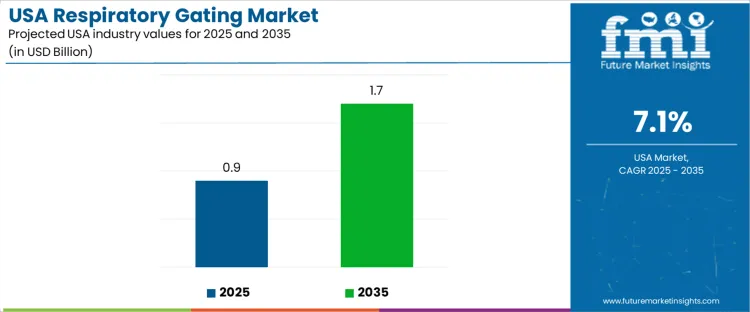
What is the Growth Forecast for Respiratory Gating Industry in USA through 2035?
Demand for respiratory gating in the United States has grown more rapidly in the current decade compared with the previous period. Earlier growth centered on radiotherapy applications in major cancer centers, where respiratory motion management improved targeting accuracy for thoracic and abdominal tumors. Adoption was steady but concentrated, based on limited availability of advanced linear accelerators and localized expertise in motion-compensated treatment planning.
The current decade shows broader expansion as more hospitals invest in image-guided radiotherapy and stereotactic treatment programs. Increased incidence of lung and liver cancers adds clinical demand for motion control to reduce exposure to surrounding tissues. Wider access to CT and MRI techniques that integrate gating workflows supports installation beyond premier oncology sites. The growth profile also reflects expanded use in diagnostic imaging, where motion artifacts must be reduced for high-resolution scans.
Compared with the earlier period, the next ten years are expected to maintain stronger growth as reimbursement alignment improves and software-based gating capabilities reduce dependency on high-cost hardware. The overall comparison indicates a shift from selective adoption to broader integration across oncology networks in the United States, resulting in higher and more consistent annual expansion.
USA Respiratory Gating Key Takeaways
| Metric | Value |
|---|---|
| USA Respiratory Gating Sales Value (2025) | USD 0.9 billion |
| USA Respiratory Gating Forecast Value (2035) | USD 1.7 billion |
| USA Respiratory Gating Forecast CAGR (2025-2035) | 7.1% |
Why is the Demand for Respiratory Gating in the USA Growing?
Demand for respiratory gating in the USA is increasing because hospitals and cancer treatment centers require more precise radiation delivery for tumors that move with breathing. In lung cancer and upper abdominal cancers, organ motion during inhale and exhale can reduce the accuracy of radiation beams. Respiratory gating aligns treatment with the patient’s breathing cycle, helping protect healthy tissue while maintaining therapeutic radiation doses.
The USA has a high incidence of lung cancer and gastrointestinal malignancies, which supports continued adoption of gating systems in radiotherapy suites. Clinics using stereotactic body radiotherapy or image-guided radiation therapy incorporate gating to improve outcomes in patients who need targeted, high dose treatment. Respiratory gating also expands use in diagnostic imaging. Four dimensional CT and motion tracking tools help physicians plan treatment more effectively by understanding tumor movement patterns before therapy begins. Constraints include high equipment investment, extended treatment planning time and the need for clinical staff training. Some facilities choose alternate motion management strategies when resources or patient suitability limit gating.
Which Product Types, Modalities, and Gating Techniques Lead Demand for Respiratory Gating in the USA?
Demand for respiratory gating solutions in the United States is increasing due to rising incidence of lung and abdominal cancers and broader clinical adoption of motion-managed imaging and radiotherapy. Providers aim to improve targeting accuracy, minimize motion artifacts, and reduce overall treatment toxicity. USA hospitals and imaging centers increasingly rely on gating-enabled hardware and software integrated with existing scanners to deliver clearer diagnosis and optimized therapeutic dosing, especially for radiation oncology and PET/CT workflows.
By Product, Systems with In-Built Gating Hold the Largest Share
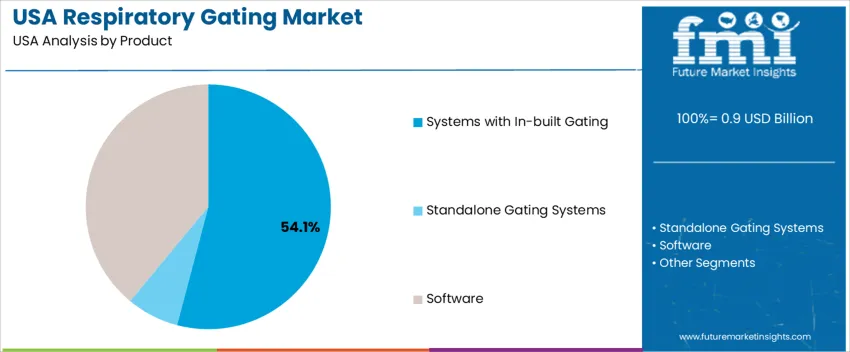
Systems with in-built gating account for 54.1%, driven by direct integration within advanced PET/CT and MRI platforms that reduces workflow complexity and speeds clinical adoption. These systems lower operational variability and provide consistent synchronization between respiratory cycles and imaging capture. Software solutions hold 39.0%, supported by upgrades to legacy imaging fleets where standalone software enables gating without major capital investment. Standalone gating systems represent 6.9%, used selectively in specialized research or retrofit applications requiring flexible motion-tracking modules. Product adoption reflects USA healthcare priorities on interoperability, automation, and reducing imaging time while preserving diagnostic accuracy.
Key Points:
- Integrated systems dominate due to seamless workflow and higher efficiency
- Software upgrades extend capabilities of existing imaging infrastructure
- Standalone systems remain niche and research-focused
By Modality, MRI Holds the Largest Share
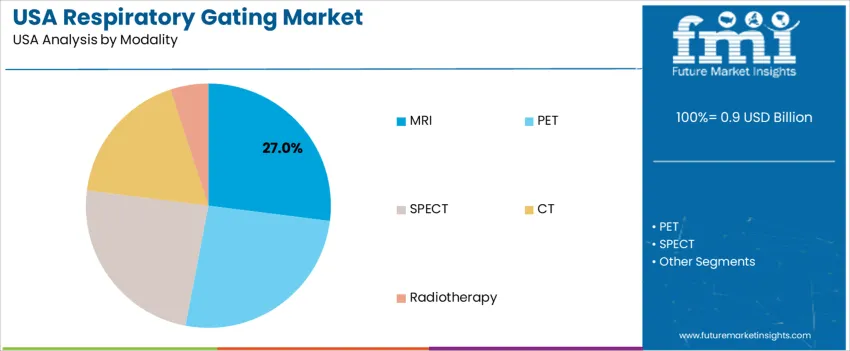
MRI accounts for 27.0%, reflecting its growing role in oncology imaging where soft-tissue motion must be controlled without exposure to ionizing radiation. PET represents 26.0%, supported by respiratory-synchronized imaging for lung cancer staging and treatment planning. SPECT holds 24.0%, used in cardiac and thoracic imaging to suppress motion-related blurring. CT accounts for 18.0%, critical for radiotherapy planning and lesion monitoring, while radiotherapy systems hold 5.0%, limited to high-precision centers performing motion-tracked dose delivery. Modality distribution underscores increased integration of gating into multimodality diagnostic workflows for thoracic and abdominal structures.
Key Points:
- MRI and PET drive demand through high-accuracy cancer assessment
- SPECT and CT ensure motion-managed nuclear and anatomical imaging
- Radiotherapy USAge grows with expansion of precision oncology services
By Gating Type, Cardiac Gating Represents the Largest Share
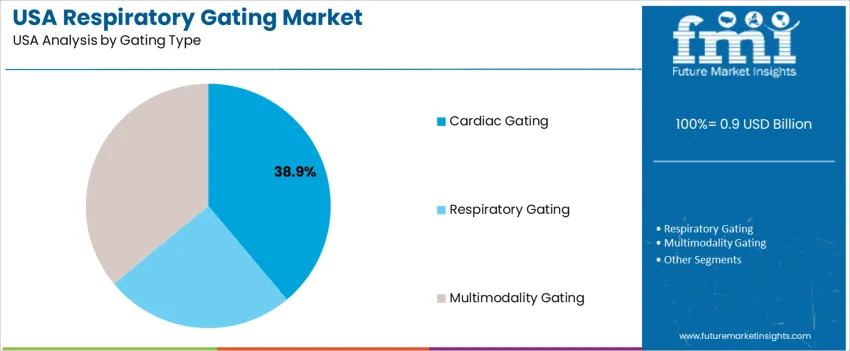
Cardiac gating holds 38.9%, reflecting established use in cardiac perfusion and function measurement where synchronization with heartbeats is essential. Multimodality gating follows at 36.0%, supporting synchronized motion-management across hybrid PET/MRI and PET/CT systems. Respiratory gating holds 25.1%, applied in lung and upper abdominal imaging to improve lesion visibility and enable more accurate tumor contouring in radiation therapy planning. Clinical demand favors gating approaches that reduce physiological motion errors and ensure consistent image reproducibility across advanced USA imaging environments.
Key Points:
- Cardiac gating is standard in cardiovascular imaging
- Multimodality gating rises with PET/CT and PET/MRI installations
- Respiratory gating supports thoracic and abdominal cancer precision workflows
What are the Drivers, Restraints, and Key Trends of the Demand for Respiratory Gating in the USA?
Growth of advanced cancer radiotherapy, increased focus on motion-management accuracy and rising treatment volumes for thoracic and abdominal tumors drive demand.
In the United States, respiratory gating systems support radiation therapy for lung, liver and breast cancers where breathing motion affects treatment precision. Large oncology hospitals and regional cancer centers expand equipment fleets to improve dose delivery while protecting surrounding healthy tissue. Growth of proton therapy and high-precision linear accelerators encourages integration of gating solutions to enhance targeting accuracy. Screening programs drive earlier cancer detection, increasing the number of patients eligible for curative radiation therapy. Training investment in motion-management workflows reinforces clinical confidence, which supports continued procurement of respiratory gating technology across high-volume treatment networks.
High equipment and upgrade cost, workflow complexity and uneven access to precision radiotherapy restrain demand.
Respiratory gating technology requires additional hardware, software and clinician training, creating significant capital and operational expenses for treatment centers. Implementation may extend treatment times if workflows are not optimized, which can reduce daily throughput and affect scheduling efficiency. Smaller hospitals and rural facilities often refer complex motion-sensitive cases to larger centers rather than investing in advanced gating systems. Insurance reimbursement focuses mainly on treatment outcome rather than the specific technology used, creating limited financial incentive for some providers to adopt incremental upgrades. These factors result in concentrated USAge in major oncology institutions rather than broad national deployment.
Shift toward automation and real-time tracking, increased integration with image-guided radiotherapy and rising use in adaptive treatment planning define key trends.
Manufacturers enhance gating accuracy through automated detection of breathing patterns and improved synchronization with treatment beams, reducing clinician workload during sessions. Integration with cone-beam CT and surface-guided radiation systems strengthens real-time monitoring, helping clinicians adjust for anatomical changes across treatment cycles. Adaptive planning platforms incorporate gating data to update dose distribution as tumors respond to therapy, improving treatment personalization. Outpatient cancer centers adopt respiratory gating to compete on quality metrics, especially in metropolitan regions with multiple oncology providers. These developments indicate sustained, precision-driven demand for respiratory gating across the United States radiotherapy ecosystem supported by improved survival and safety outcomes.
Analysis of the Demand for Respiratory Gating in the USA by Region
Demand for respiratory gating solutions in the United States is growing as cancer care facilities expand USAge of motion-compensated radiation therapy and diagnostic imaging techniques. Improving treatment precision for thoracic and abdominal tumors remains a primary driver, especially for lung and breast cancer cases where patient breathing causes anatomical shifts. Increasing CT and MR-guided radiation therapy installation rates support adoption of gating-enabled devices and software. Hospitals evaluate workflow efficiency, interoperability with linear accelerators, and patient-comfort features such as noninvasive tracking systems. West USA leads growth with 8.2% CAGR, followed by South USA at 7.3%, Northeast USA at 6.6%, and Midwest USA at 5.7%, reflecting geographic differences in oncology-care modernization and reimbursement availability.
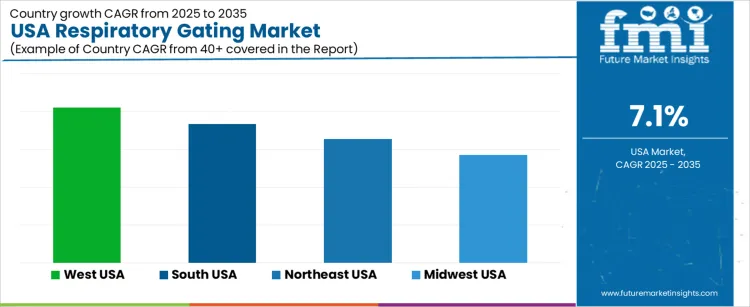
| Region | CAGR (2025-2035) |
|---|---|
| West USA | 8.2% |
| South USA | 7.3% |
| Northeast USA | 6.6% |
| Midwest USA | 5.7% |
How is the West USA driving demand for respiratory gating?
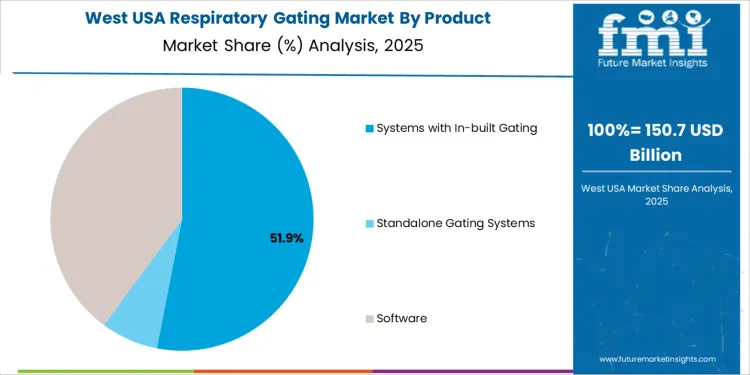
The West USA grows at 8.2% CAGR, driven by rapid expansion of advanced radiation therapy facilities in California and Washington. High cancer-screening participation increases early detection of tumors that benefit from motion-management systems. Healthcare networks are integrating respiratory gating into stereotactic body radiation therapy (SBRT) workflows to minimize margin expansion and protect healthy tissues. Research-intensive hospitals partner with technology developers to evaluate AI-assisted motion tracking through external markers and video-based monitoring, reducing reliance on implanted fiducials. Procurement strategies emphasize vendor service responsiveness, image-guidance accuracy, and compatibility with real-time dose-modulation systems.
- SBRT adoption sustaining gating system requirements
- AI-enabled tracking improving precision and patient comfort
- Strong clinical-trial participation expanding evidence-based USAge
- Equipment-service performance influencing long-term purchases
How is the South USA shaping utilization trends?
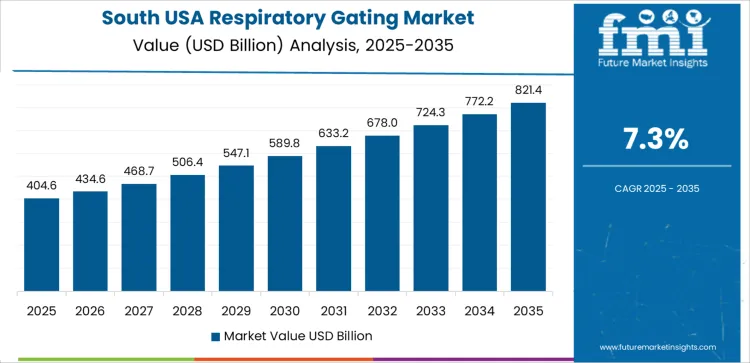
The South USA posts a 7.3% CAGR, supported by rising oncology infrastructure investments in Texas, Florida, and North Carolina. Lung-cancer prevalence linked to smoking and industrial exposure amplifies demand for respiratory motion-control tools in radiotherapy. Newly constructed cancer centers integrate gating as a standard capability in linear accelerator specifications to avoid costly upgrades later. Health systems also extend access through satellite centers designed to handle moderate-complexity cases using noninvasive gating interfaces. Procurement focuses on workflow simplicity that shortens treatment durations, improving patient throughput in high-volume settings.
- Strong infrastructure expansion across hospital cancer centers
- Higher lung-cancer incidence increasing use of gating technologies
- New installations embedding motion-management capability by default
- Throughput priorities guiding technology selection
How is the Northeast USA influencing demand for respiratory gating?
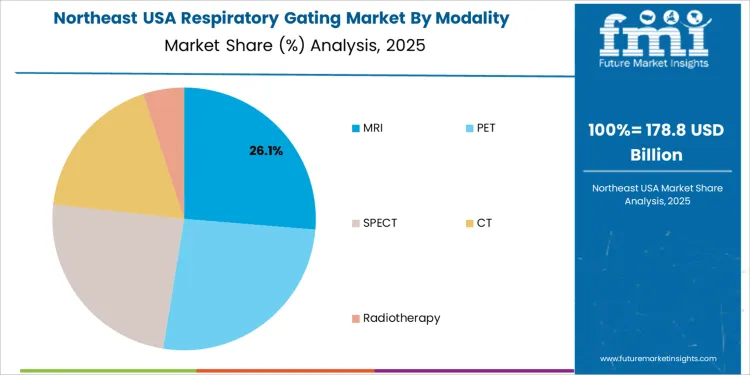
The Northeast USA records 6.6% CAGR, driven by academic oncology programs in New York, New Jersey, and Massachusetts adopting precision radiation therapy platforms. Institutions emphasize gating performance in multi-modality environments combining MRI-guided and CT-based treatment planning. Payers increasingly support USAge where documented clinical benefits exist, improving patient access. Providers deploy contactless tracking methods to enhance patient experience and staff handling efficiency. Supply standards require proven motion-compensation reliability for tumors positioned near sensitive organs.
- Academic hospitals advancing precision treatment protocols
- Payer recognition supporting broader clinical accessibility
- Multi-modality system integration influencing procurement choices
- Comfort-enhancing tracking solutions improving experience and safety
How is the Midwest USA contributing to adoption growth?
The Midwest USA expands at 5.7% CAGR, through steady modernization of oncology departments in Illinois, Ohio, and Minnesota. Providers integrate gating into existing radiotherapy systems during life-cycle replacement projects to enhance procedural accuracy. Health networks emphasize versatility, adopting solutions compatible with diverse patient needs, including those with limited mobility or respiratory irregularities. Care delivery models extend through regional and community cancer centers as tele-oncology partnerships increase case referrals requiring precision treatments. Procurement remains value-focused, prioritizing durability and software update continuity.
- Replacement-cycle upgrades driving motion-management adoption
- Expanded rural-region access through satellite cancer facilities
- Versatile patient-tracking options supporting broader use
- Value-driven evaluation of system longevity and support
How is competitive positioning structured among respiratory-gating technology providers in the United States?
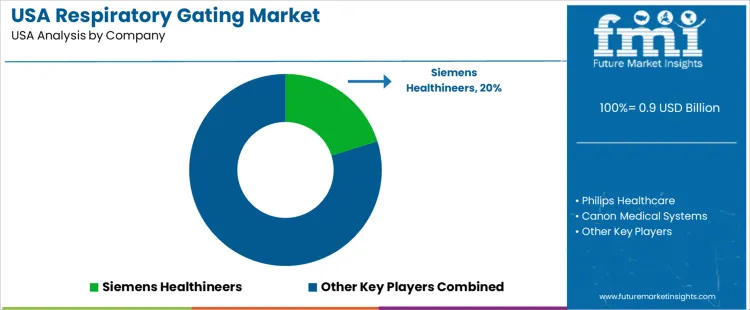
Competitive strength in USA respiratory-gating solutions is shaped by accuracy of motion-tracking during radiotherapy and diagnostic imaging, as well as integration with existing oncology and imaging systems. Siemens Healthineers holds an estimated 20.2%, supported by its installed base in linear accelerators and CT scanners where gating is embedded in treatment-planning and delivery workflows. Its positioning benefits from synchronized hardware-software architecture that reduces motion-related targeting error.
Philips Healthcare competes through optical and sensor-based gating systems that emphasize patient comfort and minimal setup time. Adoption grows in centers focusing on workflow simplicity for thoracic and abdominal imaging. Canon Medical Systems advances participation through robust reconstruction algorithms designed to stabilize images under irregular breathing patterns, supporting clinical confidence in lesion localization.
GE HealthCare maintains strong relationships with USA hospital networks, integrating gating alongside adaptive imaging features that help manage motion during high-precision diagnostic procedures. Its presence strengthens where radiology and radiation-oncology teams seek unified operational support. Fujifilm expands selectively through interoperability with third-party equipment, targeting clinics prioritizing cost-effective motion-compensation upgrades.
Advantage increasingly depends on reducing dose exposure, maintaining reproducibility across treatment fractions, and ensuring compatibility with established planning systems used for lung and liver cases. Firms offering seamless integration, low-profile patient-tracking interfaces, and stable service coverage retain greater long-term positioning in USA respiratory-gating demand.
Key Players in USA Respiratory Gating Demand
- Siemens Healthineers
- Philips Healthcare
- Canon Medical Systems
- GE HealthCare
- Fujifilm
Scope of the Report
| Items | Values |
|---|---|
| Quantitative Units | USD billion |
| Product | Systems with In-built Gating, Standalone Gating Systems, Software |
| Modality | MRI, PET, SPECT, CT, Radiotherapy |
| Gating Type | Cardiac Gating, Respiratory Gating, Multimodality Gating |
| Technology | Pressure Sensor Based, Electromagnetic, ECG-triggering, Optical Surface Monitoring, Others |
| End User | Imaging and Diagnostic Centers, Specialty Clinics, Hospitals, Cancer Treatment and Radiotherapy Centers, Academic & Research Institutions |
| Regions Covered | West USA, South USA, Northeast USA, Midwest USA |
| Key Companies Profiled | Siemens Healthineers, Philips Healthcare, Canon Medical Systems, GE HealthCare, Fujifilm |
| Additional Attributes | Dollar sales by product, modality, gating technology, and end-user environments; regional adoption trends across USA imaging centers and radiotherapy facilities; advancements in motion management for oncology and diagnostic imaging; influence of respiratory motion control in PET/CT accuracy, MRI clarity, and precision radiotherapy; competitive positioning in integrated vs. standalone gating platforms. |
USA Respiratory Gating Demand by Segments
Product:
- Systems with In-built Gating
- Standalone Gating Systems
- Software
Modality:
- MRI
- PET
- SPECT
- CT
- Radiotherapy
Gating Type:
- Cardiac Gating
- Respiratory Gating
- Multimodality Gating
Technology:
- Pressure Sensor Based
- Electromagnetic
- ECG-triggering
- Optical Surface Monitoring
- Others
End User:
- Imaging and Diagnostic Centers
- Specialty Clinics
- Hospitals
- Cancer Treatment and Radiotherapy Centers
- Academic & Research Institutions
Region:
- West USA
- South USA
- Northeast USA
- Midwest USA
Frequently Asked Questions
How big is the demand for respiratory gating in USA in 2025?
The demand for respiratory gating in USA is estimated to be valued at USD 0.9 billion in 2025.
What will be the size of respiratory gating in USA in 2035?
The market size for the respiratory gating in USA is projected to reach USD 1.7 billion by 2035.
How much will be the demand for respiratory gating in USA growth between 2025 and 2035?
The demand for respiratory gating in USA is expected to grow at a 7.1% CAGR between 2025 and 2035.
What are the key product types in the respiratory gating in USA?
The key product types in respiratory gating in USA are systems with in-built gating, standalone gating systems and software.
Which modality segment is expected to contribute significant share in the respiratory gating in USA in 2025?
In terms of modality, mri segment is expected to command 27.0% share in the respiratory gating in USA in 2025.
Preview the report firsthand - request a free sample
Get SampleGet the brochure for pricing and purchase details.
Get PDFTable of Content
- Executive Summary
- USA Market Outlook
- Demand-side Trends
- Supply-side Trends
- Technology Roadmap Analysis
- Analysis and Recommendations
- Market Overview
- Market Coverage / Taxonomy
- Market Definition / Scope / Limitations
- Market Background
- Market Dynamics
- Drivers
- Restraints
- Opportunity
- Trends
- Scenario Forecast
- Demand in Optimistic Scenario
- Demand in Likely Scenario
- Demand in Conservative Scenario
- Opportunity Map Analysis
- Product Life Cycle Analysis
- Supply Chain Analysis
- Investment Feasibility Matrix
- Value Chain Analysis
- PESTLE and Porter’s Analysis
- Regulatory Landscape
- Regional Parent Market Outlook
- Production and Consumption Statistics
- Import and Export Statistics
- Market Dynamics
- USA Market Analysis 2020 to 2024 and Forecast, 2025 to 2035
- Historical Market Size Value (USD Million) Analysis, 2020 to 2024
- Current and Future Market Size Value (USD Million) Projections, 2025 to 2035
- Y-o-Y Growth Trend Analysis
- Absolute $ Opportunity Analysis
- USA Market Pricing Analysis 2020 to 2024 and Forecast 2025 to 2035
- USA Market Analysis 2020 to 2024 and Forecast 2025 to 2035, By Product
- Introduction / Key Findings
- Historical Market Size Value (USD Million) Analysis By Product , 2020 to 2024
- Current and Future Market Size Value (USD Million) Analysis and Forecast By Product , 2025 to 2035
- Systems with In-built Gating
- Standalone Gating Systems
- Software
- Y-o-Y Growth Trend Analysis By Product , 2020 to 2024
- Absolute $ Opportunity Analysis By Product , 2025 to 2035
- USA Market Analysis 2020 to 2024 and Forecast 2025 to 2035, By Modality
- Introduction / Key Findings
- Historical Market Size Value (USD Million) Analysis By Modality, 2020 to 2024
- Current and Future Market Size Value (USD Million) Analysis and Forecast By Modality, 2025 to 2035
- MRI
- PET
- SPECT
- CT
- Radiotherapy
- Y-o-Y Growth Trend Analysis By Modality, 2020 to 2024
- Absolute $ Opportunity Analysis By Modality, 2025 to 2035
- USA Market Analysis 2020 to 2024 and Forecast 2025 to 2035, By Gating Type
- Introduction / Key Findings
- Historical Market Size Value (USD Million) Analysis By Gating Type, 2020 to 2024
- Current and Future Market Size Value (USD Million) Analysis and Forecast By Gating Type, 2025 to 2035
- Cardiac Gating
- Respiratory Gating
- Multimodality Gating
- Y-o-Y Growth Trend Analysis By Gating Type, 2020 to 2024
- Absolute $ Opportunity Analysis By Gating Type, 2025 to 2035
- USA Market Analysis 2020 to 2024 and Forecast 2025 to 2035, By Technology
- Introduction / Key Findings
- Historical Market Size Value (USD Million) Analysis By Technology, 2020 to 2024
- Current and Future Market Size Value (USD Million) Analysis and Forecast By Technology, 2025 to 2035
- Pressure Sensor Based
- Electromagnetic
- ECG-triggering
- Optical Surface Monitoring
- Others
- Y-o-Y Growth Trend Analysis By Technology, 2020 to 2024
- Absolute $ Opportunity Analysis By Technology, 2025 to 2035
- USA Market Analysis 2020 to 2024 and Forecast 2025 to 2035, By End User
- Introduction / Key Findings
- Historical Market Size Value (USD Million) Analysis By End User, 2020 to 2024
- Current and Future Market Size Value (USD Million) Analysis and Forecast By End User, 2025 to 2035
- Imaging and Diagnostic Centers
- Specialty Clinics
- Hospitals
- Cancer Treatment and Radiotherapy Centers
- Academic & Research Institutions
- Y-o-Y Growth Trend Analysis By End User, 2020 to 2024
- Absolute $ Opportunity Analysis By End User, 2025 to 2035
- Market Structure Analysis
- Competition Dashboard
- Competition Benchmarking
- Market Share Analysis of Top Players
- By Regional
- By Product
- By Modality
- By Gating Type
- By Technology
- By End User
- Competition Analysis
- Competition Deep Dive
- Siemens Healthineers
- Overview
- Product Portfolio
- Profitability by Market Segments (Product/Age /Sales Channel/Region)
- Sales Footprint
- Strategy Overview
- Marketing Strategy
- Product Strategy
- Channel Strategy
- Philips Healthcare
- Canon Medical Systems
- GE HealthCare
- Fujifilm
- Siemens Healthineers
- Competition Deep Dive
- Assumptions & Acronyms Used
- Research Methodology


