

- Market Size (2026)
- USD 298.7 Mn
- Forecast (2036)
- USD 733.5 Mn
- CAGR (2026 to 2036)
- 9.4%
How big is Lavash Market in 2026?
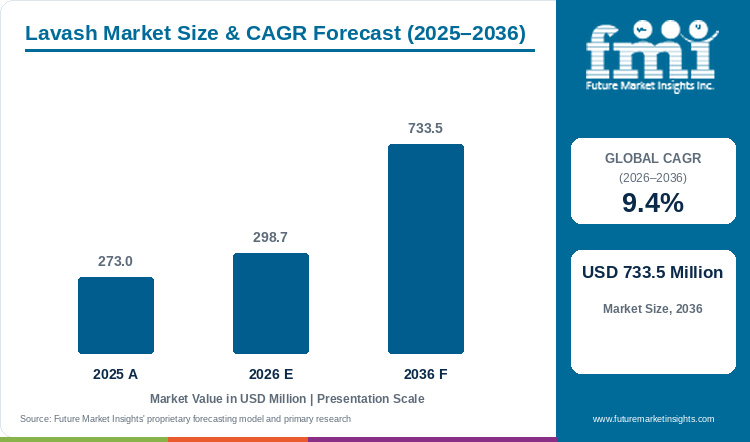
Registering a value of USD 273.0 million in 2025, the lavash market expanded to USD 298.7 million in 2026 and is anticipated to achieve USD 733.5 million by 2036, driven by a 9.4% CAGR.
The global lavash market was valued at USD 273.0 million in 2025 and is estimated to reach USD 298.7 million in 2026. The market is projected to reach USD 733.5 million by 2036, expanding at a compound annual growth rate (CAGR) of 9.4% between 2026 and 2036. Classic original sheets are projected to capture 36.0% of 2026 product type demand, since neutral wheat profiles serve both hot shawarma service and chilled deli wrapping from one SKU. Demand is supported by labor-saving preformed wrap sheets that let commissaries drop manual dough sheeting while avoiding the 180-degree fold seam ruptures that thin wraps suffer in sandwich rolling [1]. That institutional convenience premium places lavash above the bakery products market growing at 4.5% CAGR, because category-wide bakery growth tracks consumer snacking while lavash growth tracks foodservice headcount [2]. Retail and ingredient signals both point the same way, as Toufayan completed the nationwide Seed Oil-Free flatbread rollout across deli and Amazon channels in April 2026 [3] [6], and Gruma's February 2026 results credited better-for-you wrap formats across North America and Europe [19] [20]. Wheat price relief eased input pressure when the FAO Food Price Index averaged 130.1 points in August 2025 [21]. The wraps that survive high-protein clean-label reformulation without seam failure hold the commissary contracts through 2036.
Key Market Trends & Insights
- By product type: Classic / Original sheets are projected to capture 36.0% of the product type segment in 2026 because neutral wheat profiles serve both hot shawarma wraps and cold pinwheel trays.
- By claim: Conventional formulations are estimated to command 52.0% of the claim segment in 2026 as native wheat gluten networks prevent tearing during tight mechanical rolling.
- By format: Fresh lavash is expected to hold 30.0% of the format segment in 2026 because immediate sheet pliability eliminates thawing labor at supermarket delis.
- By packaging format: Multipack configurations are forecast to generate 30.0% of the packaging format segment in 2026 owing to multi-meal household wrap assembly.
- By sales channel: Supermarkets & Hypermarkets are anticipated to account for 43.0% of the sales channel segment in 2026 through perimeter deli placement and repeat grocery basket rotation.
Regional Highlights
- Top national expansion: Germany is projected to lead evaluated national markets at a 10.7% CAGR through 2036 as mainstream supermarkets expand packaged Mediterranean flatbread bays.
- Broader country progression: Russia is expected to expand at a 10.3% CAGR ahead of the UAE at 10.0% and Turkey at 9.7%, while France is forecast to progress at an 8.4% CAGR.
Market Size & Forecast
Table 1: Market Size and Forecast for the Lavash Market (USD million and CAGR percentage), 2025 to 2036
| Metric | Value |
|---|---|
| 2025 Market Size | USD 273.0 million |
| Estimated Market Size in 2026 | USD 298.7 million |
| Projected Market Size by 2036 | USD 733.5 million |
| CAGR, 2026 to 2036 | 9.4% |
| Added Revenue, 2026 to 2036 | USD 434.8 million |
Maintaining sheet pliability during high-speed tunnel baking is a primary operational variable governing commercial lavash adoption and repeat retail sales. When dough is sheeted to 1.5-millimeter thickness on steel conveyor bands, excessive radiant heat strips free water from the perimeter and leads to brittle edge cracking during flow-wrapping. Thermal baking trials published in Applied Sciences in August 2025 confirmed that baking 1.5-millimeter flatbread sheets at 450 to 650 degrees Celsius for 10 to 12 seconds triggers a 14.8% evaporative water mass loss and reduces final crumb moisture to 20.0% [2]. Commercial bakeries therefore combine modulated oven burners with ready-to-finish bakery products packaging films so thin sheets retain folding softness across multi-week grocery distribution.
Commercial Production and Sheet-Throughput Sizing
Table 2: Commercial Production and Sheet-Throughput Sizing for the Lavash Market (USD million and operational ranges), 2025 to 2036
| Metric | 2025 | 2026 | 2036 |
|---|---|---|---|
| Market size (USD million) | 273.0 | 298.7 | 733.5 |
| Commercial lavash output (thousand tonnes) | 68.5 to 74.0 | 74.2 to 80.5 | 168.0 to 184.0 |
| Packaged sheet volume (million packs) | 210.0 to 235.0 | 228.0 to 255.0 | 520.0 to 580.0 |
| Average wholesale realization per kg (USD) | 3.7 to 4.0 | 3.8 to 4.1 | 4.1 to 4.4 |
Operational note: Throughput ranges reconcile commercial tunnel-oven line capacities against 85-gram to 100-gram standardized sheet weights and 14.8% baking evaporation loss benchmarks across retail and foodservice packs.
Multi-unit sandwich chains evaluate flatbread suppliers on usable sheets per case rather than nominal invoice price alone. Commissary procurement teams partner with artisan bread co-packers to enforce uniform rectangular sheet dimensions and minimize corner tearing during automated tray sealing.
Per Capita & Retail Channel Sizing
Table 3: Per Capita and Channel Spending Indicators for the Lavash Market (USD), 2025 to 2036
| Metric | 2025 | 2026 | 2036 |
|---|---|---|---|
| World population (billion) | 8.2 | 8.3 | 9.0 |
| Spend per 1,000 people (USD) | 33.3 | 36.0 | 81.5 |
| Annual procurement per deli / QSR site (USD) | 410.0 to 480.0 | 445.0 to 520.0 | 890.0 to 1,050.0 |
| Modern grocery & foodservice contract share (%) | 61.0% to 65.0% | 63.0% to 67.0% | 72.0% to 76.0% |
Table 4: Retail & Foodservice Channel Spending Indicators for the Lavash Market (USD and percentages), 2026
| Metric | Value | Institutional Reference Basis |
|---|---|---|
| Market size, 2026 | USD 298.7 million | 2026 global revenue baseline |
| Supermarkets & hypermarkets revenue, 2026 | USD 128.4 million | 43.0% sales-channel segment allocation |
| Classic / Original revenue, 2026 | USD 107.5 million | 36.0% product-type segment allocation |
| Conventional claim revenue, 2026 | USD 155.3 million | 52.0% claim segment allocation |
Capturing repeat supermarket velocity requires protecting thin wheat sheets from ambient dehumidification once shoppers open the outer bag. Commercial bakeries actively adopt resealable low-density polyethylene bread bags with zip closures to extend home pantry usability across five-sheet and six-sheet multipacks.
Analyst Perspective
"Supermarket category buyers and foodservice commissaries judge lavash lines on 180-degree fold pliability and post-opening moisture retention rather than heritage claims alone. Bakeries pairing enzymatic crumb softening with resealable modified-atmosphere packs will capture national grocery and QSR supply contracts."
- Nandini Roy Choudhury, Principal Analyst at Future Market Insights
How is the lavash market segmented?
The lavash market is segmented by product type, claim, format, packaging format, and sales channel. In 2026, Classic / Original is projected at 36.0%, Conventional at 52.0%, Fresh at 30.0%, Multipack at 30.0%, and Supermarkets & Hypermarkets at 43.0%.
By product type: Classic / Original, Whole Grain & Seeded, Flavored & Filled, Mini & Snacking, and Premium / Artisan.
By claim: Conventional, Clean Label, Organic, Gluten-Free, and High-Protein.
By format: Fresh, Frozen, Ambient Packaged, Chilled, and Par-Baked.
By packaging format: Multipack, Single-Serve, Family Pack, and Bulk Foodservice.
By sales channel: Supermarkets & Hypermarkets, Artisan Bakeries, Convenience Stores, Online & DTC, and Foodservice Distributors.
Why does Classic / Original lead the product type segment?
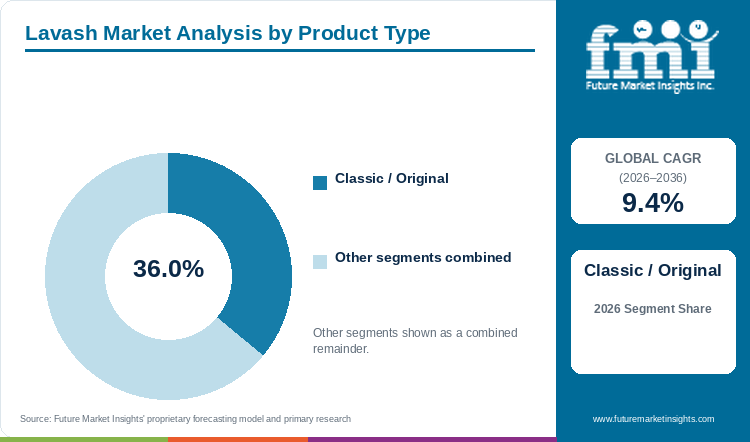
Classic / Original sheets are projected to capture 36.0% of the product type segment in 2026, supported by multi-menu wrap versatility.
Table 5: Product Type Share for the Lavash Market (percentage share), 2026
| Product Type | Share (2026) |
|---|---|
| Classic / Original | 36.0% |
| Other Segments Combined | 64.0%* |
| Total | 100.0% |
*Note: Remaining product type subsegments sum to 100.0% of 2026 lavash revenue.
Table 6: Product Type Leadership and Market Growth for the Lavash Market (segment and CAGR percentage), 2026 to 2036
| Metric | Value |
|---|---|
| Global CAGR (2026 to 2036) | 9.4% |
| Leading Segment | Classic / Original |
Commercial restaurant chains and institutional caterers standardize procurement around unflavored wheat lavash because a single neutral carrier works across hot gyro wraps and cold deli pinwheels. Stocking one baseline sheet eliminates flavor carryover and reduces back-of-house SKU complexity compared with seasoned pita bread assortments.
- Classic / Original is projected to account for 36.0% of the product type segment in 2026 because unseasoned sheets allow foodservice operators to consolidate bread inventory into one high-turnover specification.
- In March 2025, Toufayan Bakeries published wholesale guidance for U.S. Mediterranean restaurants and caterers specifying rectangular Authentic Lavash sheets for rolled sandwiches and thin-crust flatbread applications [3].
Why does Conventional define the largest claim segment?
Conventional formulations are estimated to secure 52.0% of the claim segment in 2026, driven by native wheat gluten extensibility.
Sheeting dough below 2 millimeters without pinhole tearing requires cohesive glutenin and gliadin networks that non-wheat flours struggle to replicate at industrial conveyor speeds. Conventional refined and blended whole-wheat flour recipes deliver predictable water absorption and avoid costly allergen-segregated washdowns.
- Conventional formulations command an estimated 52.0% share of the claim segment in 2026 as high tensile elasticity prevents cracking when wraps are tightly rolled around wet sauces.
- Experimental dough rheology trials published in Plant Foods for Human Nutrition in January 2026 confirmed that wheat flatbread doughs exhibited 827 grams of hardness and 12.9 millimeters of baked tensile extensibility versus 3,911 grams of hardness and 4.4 millimeters of extensibility in gluten-free formulations [4].
What keeps Fresh ahead in the format segment?
Fresh sheets are expected to command 30.0% of the format segment in 2026, reflecting immediate folding softness at preparation counters.
Deli counter staff and household shoppers evaluate lavash quality by folding a sheet directly inside the package before purchase. While frozen bakery cases protect long-distance freight, fresh ambient-merchandised packs eliminate slack-out waiting times and condensation sogginess during lunch service.
- Fresh lavash is expected to hold 30.0% of the format segment in 2026 because zero-thaw readiness speeds up sandwich assembly across grocery delis and fast-casual kitchens.
- Baking trials published in Scientific Reports in December 2025 showed that supplementing wheat dough with 300 U/kg of xylanase-cellulase enzyme complex lowered 7-day stored crumb hardness from 8.24 N to 4.95 N while lifting specific volume from 2.51 to 5.50 mL/g [5].
Why does Multipack lead the packaging format segment?
Multipack configurations are forecast to generate 30.0% of the packaging format segment in 2026, owing to multi-occasion household and catering use.
Packaging five to eight rectangular sheets inside a single barrier pouch balances retail price-per-serving economics against weekly household meal prep. Bakers pair nitrogen headspace flushing with resealable zipper tracks so remaining sheets stay pliable after the first wrap is prepared.
- Multipack formats are forecast to represent 30.0% of the packaging format segment in 2026 because multi-sheet bags match weekly household lunch preparation cycles.
- In April 2026, Toufayan Bakeries rolled out its clean-label Seed Oil-Free Flatbread Wraps nationwide across U.S. supermarket delis and Amazon multipack bundles to complement its Authentic Lavash range [6].
What gives Supermarkets & Hypermarkets the leading position in sales channel?
Supermarkets & Hypermarkets are anticipated to account for 43.0% of the sales channel segment in 2026, reinforced by perimeter deli cross-merchandising.
Mainstream grocery chains drive packaged flatbread volume by displaying lavash on perimeter deli tables beside hummus tubs and rotisserie chickens. High weekly foot traffic allows supermarkets to rotate short-shelf-life fresh bags faster than independent specialty grocers.
- Supermarkets & Hypermarkets are anticipated to capture 43.0% of the sales channel segment in 2026 as perimeter cross-merchandising converts impulse dip buyers into repeat flatbread purchasers.
- According to USDA Economic Research Service figures updated in June 2026, U.S. food-at-home spending reached USD 1.10 trillion in 2025 while cereal and bakery retail prices rose just 1.0% year-on-year, supporting steady grocery basket unit volume [7].
What are the drivers, restraints, and opportunities in the lavash market?
In the lavash market, labor-saving preformed wrap sheets expand foodservice and grocery turnover whereas rapid starch retrogradation restrains shelf life and high-protein clean-label reformulations create premium retail opportunities.
- Driver: Pre-baked rectangular lavash sheets eliminate scratch dough rolling in commercial kitchens and serve multiple dayparts from breakfast wraps to flatbread pizzas.
- Restraint: High surface-to-volume geometry accelerates moisture evaporation and edge breakage, while mandatory sesame allergen labeling complicates seeded production lines.
- Opportunity: Formulating seed-oil-free, flax-fortified, and mini portion packs unlocks health-positioned supermarket bays and reduces post-opening household waste.
Growth Analysis and Future Potential: Qualitative Demand Catalysts
Fast-casual restaurant operators and supermarket commissaries are replacing thick sandwich loaves with thin lavash sheets to lower carbohydrate weight per serving and eliminate toaster bottlenecks. Unlike pocketed flatbreads that split unevenly during stuffing, single-layer rectangular lavash rolls tightly around grilled proteins and cold salads for grab-and-go display cases. This menu shift expands wholesale contract volume across naan and tortilla programs at multi-site catering groups. In July 2025, fermentation kinetics research published in Food Science & Nutrition demonstrated that controlled cereal dough fermentation degraded phytic acid by 91.3% to 98.2% and raffinose by up to 95.0% to improve mineral bioaccessibility in flatbreads [8]. Retailers consequently allocate permanent eye-level deli fixtures to branded lavash multipacks.
Risk Assessment of the Lavash Market: Operational and Formulation Friction
Amylopectin retrogradation and mechanical corner fracture represent the primary operational barriers restricting commercial lavash margins. Because baked sheets measure just 1.5 to 2.0 millimeters thick, minor packaging seal leaks allow ambient air to dehydrate the starch matrix within 48 hours and cause sheets to crack when folded. Grain mycotoxin carryover and allergen cross-contact rules add further quality-assurance overhead across multi-seed bakery lines. In March 2025, LC-MS/MS baking trials published in Foods showed that baking contaminated flatbread doughs at 220 to 320 degrees Celsius reduced aflatoxins B1 and G1 by 39% and deoxynivalenol by 16% to 25% while ochratoxin A remained thermostable [9]. Bakeries evaluating gluten-free bakery premix or sesame-topped variants must enforce strict lot testing and line segregation before supermarket onboarding.
Commercial Opportunity Analysis: Formulation Differentiation and Value-Add Formats
Bakery processors capture substantial margin premiums by engineering hydrocolloid- and fiber-enriched lavash sheets that retain rollability after refrigerated storage. Smaller 4-count mini lavash packs and seed-oil-free recipes directly address single-person household shrink and clean-label ingredient audits. Upgrading specialty bread flour blends with water-binding plant fibers slows moisture migration without requiring synthetic chemical preservatives. In January 2025, composite bread storage trials published in Foods confirmed that replacing 10% of soft wheat flour with fiber-rich tiger nut flour maintained water activity at 0.978 and cut 7-day crumb hardness from 23.99 N to 14.56 N [10]. Suppliers combining enzyme-assisted softness with resealable barrier films secure national private-label and branded grocery distribution.
Lavash Market by Country (2026 to 2036)
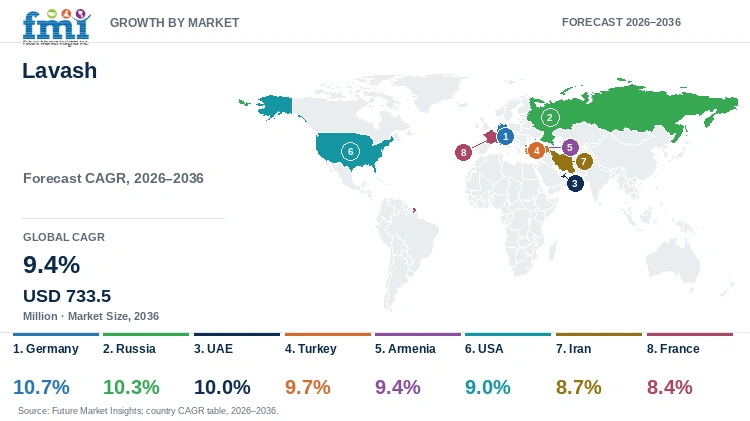
As per FMI, Germany is projected to lead lavash market growth across evaluated countries at a 10.7% CAGR through 2036, whereas France is forecast to expand at an 8.4% CAGR. Commercial performance across European supermarket chains, Eurasian wheat-milling corridors, and Gulf hospitality hubs depends on cold-chain distribution discipline and packaged shelf-life stability.
Table 7: Country CAGR and Primary Growth Levers for the Lavash Market (CAGR percentage and operational drivers), 2026 to 2036
| Country | CAGR (2026 to 2036) | Primary Growth Lever |
|---|---|---|
| Germany | 10.7% | Mainstream supermarket listing of packaged Mediterranean flatbreads and EU allergen-compliant multipacks |
| Russia | 10.3% | Domestic wheat milling surplus and automated roll-up lavash lines serving urban convenience chains |
| UAE | 10.0% | High-volume hotel and QSR shawarma catering requiring standardized frozen and chilled sheet cases |
| Turkey | 9.7% | Conversion of urban grocery shoppers from unwrapped bazaar flatbreads to packaged hygienic lavash |
| Armenia | 9.4% | Export-oriented vacuum-packed lavash production and domestic wheat flour price stabilization |
| USA | 9.0% | Supermarket perimeter deli placement and clean-label seed-oil-free wrap adoption across foodservice |
| Iran | 8.7% | Industrial tunnel-oven mechanization and subsidized bakery wheat procurement stabilizing urban supply |
| France | 8.4% | Hypermarket ethnic-bread aisle expansion and fast-casual kebab and sandwich chain standardization |
Source: Future Market Insights analysis
Germany Lavash Market Outlook (2026 to 2036)
Unlike heritage Middle Eastern markets dominated by unpackaged neighborhood tandoor shops, Germany channels lavash volume through national discount and full-service supermarket chains. Commercial lavash sales in Germany are projected to expand at a leading 10.7% CAGR from 2026 to 2036 across retail and foodservice accounts. Demographic figures released by the Federal Statistical Office (Destatis) in June 2025 recorded 291,955 naturalizations in 2024 across Germany, led by residents originating from Syria and Turkey who anchor household flatbread wrap consumption [11]. Strict European Union allergen disclosure rules for sesame and lupin with discounter private-label price caps nevertheless compel suppliers to validate automated packaging lines before securing nationwide grocery listings.
Key takeaway: In Germany, mainstream supermarket assimilation of Mediterranean wrap carriers and strict EU allergen-compliant packaging are projected to anchor commercial lavash expansion.
Russia Lavash Market Outlook (2026 to 2036)
Commercial lavash revenues in Russia are forecast to rise at a 10.3% CAGR between 2026 and 2036 across modern grocery formats and fast-casual street-food chains. Whereas Western European retailers treat lavash as a specialty import, supermarkets in Russia stock thin wheat sheets as an everyday household bread and shawarma wrapper. An April 2026 FAO GIEWS Country Brief on the Russian Federation reported 2025 national wheat production at 91.1 million tonnes and noted a 20.0 million tonne grain export quota in force from February to June 2026 that kept domestic milling wheat prices 5% lower year-on-year [12]. Even so, 6.0% annual consumer inflation and regional cold-weather freight distances force industrial bakeries to rely on frozen distribution for eastern retail chains.
Key takeaway: In Russia, abundant domestic milling wheat supply and high-velocity urban shawarma foodservice demand are forecast to sustain automated lavash bakery output.
UAE Lavash Market Outlook (2026 to 2036)
Hospitality catering and multi-brand cloud kitchens set the UAE apart from household-led European bakery markets by demanding bulk 5-kilogram foodservice cases with zero sheet breakage. Tourism statistics published by the Dubai Department of Economy and Tourism in September 2026 documented 6.97 million international overnight visitors between January and August 2026, which sustains high daily hotel banquet and shawarma counter throughput across the emirate [13]. Institutional and retail lavash turnover in the UAE is anticipated to grow at a 10.0% CAGR through 2036 across resort commissaries and hypermarkets. High coastal ambient humidity and total reliance on imported milling wheat still require suppliers to ship sheets inside moisture-barrier frozen cartons.
Key takeaway: In the UAE, international hospitality visitor volumes and standardized QSR wrap assembly are anticipated to drive bulk frozen and chilled lavash procurement.
Turkey Lavash Market Outlook (2026 to 2036)
In contrast to import-dependent Gulf markets, Turkey possesses an extensive domestic wheat-milling and traditional flatbread baking infrastructure where packaged lavash competes directly against fresh neighborhood ovens. Modern supermarket chains and organized kebab franchises across metropolitan centers are shifting urban volume toward hygienically sealed barcoded lavash multipacks with standardized sheet weights. According to the April 2026 USDA Foreign Agricultural Service Grain and Feed Annual report for Türkiye (TU2026-0013), improved autumn and winter rainfall is projected to lift 2026/27 domestic wheat and barley harvests after drought-constrained 2025/26 yields [14]. Domestic flour price swings and low-cost artisanal bakehouses moderate packaged retail conversion and put Turkey on a 9.7% CAGR through 2036.
Key takeaway: In Turkey, organized kebab chain standardization and recovering domestic wheat harvests are expected to support commercial packaged lavash adoption.
Armenia Lavash Market Outlook (2026 to 2036)
Armenia represents the cultural epicenter of thin tonir-baked lavash, where commercial growth depends on converting household consumption and diaspora demand into shelf-stable packaged sales. Packaged lavash revenue in Armenia is projected to advance at a 9.4% CAGR over the 2026 to 2036 forecast period across urban supermarkets and export channels. The April 2026 FAO GIEWS Country Brief on Armenia estimated 2025 domestic wheat production at 132,700 tonnes against 400,000 tonnes of wheat import requirements for 2025/26 and noted that the government extended its temporary grain export ban through July 2026 to stabilize domestic first-grade flour prices [15]. Persistent reliance on imported milling wheat and competition from informal village bakeries cap domestic retail price realization.
Key takeaway: In Armenia, stabilized domestic first-grade flour pricing and vacuum-packed diaspora export programs are projected to drive packaged lavash commercialization.
USA Lavash Market Outlook (2026 to 2036)
What differentiates the USA from traditional Eurasian markets is the positioning of lavash as a low-calorie, high-protein, and flax-enriched sandwich wrap inside supermarket perimeter delis. Controlled baking trials published in Foods in March 2025 demonstrated that incorporating 5% steam-treated functional leaf powder into wheat bread formulations reduced differential scanning calorimetry starch retrogradation enthalpy by 30% to 40% while doubling specific loaf volume from 2.2 to 4.6 cm3/g [16]. Commercial lavash sales in the USA are projected to rise at a 9.0% CAGR from 2026 to 2036 across grocery and foodservice channels. High supermarket slotting fees and perimeter staling markdowns compel bakers like Atoria's Family Bakery and Toufayan Bakeries to supply mini and resealable formats.
Key takeaway: In the USA, supermarket perimeter deli merchandising and clean-label functional wrap reformulations are projected to sustain commercial lavash growth.
Iran Lavash Market Outlook (2026 to 2036)
Market demand for commercial lavash in Iran is forecast to expand at an 8.7% CAGR between 2026 and 2036 across urban bakeries and institutional catering networks. Whereas Western markets sell lavash at premium specialty prices, Iran treats lavash as a price-regulated daily staple produced across thousands of licensed rotary and tunnel ovens. Data from the June 2026 FAO GIEWS Country Brief on Iran placed 2025 domestic wheat production at 12.0 million tonnes and noted that the government raised the April 2026 wheat procurement price by 140% year-on-year to 49,650 tomans per kilogram while maintaining a preferential wheat import exchange rate of IRR 285,000 per USD [17]. Currency depreciation and state bread price ceilings compress commercial packaging margins.
Key takeaway: In Iran, state-backed wheat import subsidies and automated tunnel-oven upgrades are forecast to support steady commercial lavash volume.
France Lavash Market Outlook (2026 to 2036)
France features Europe's densest network of independent artisan boulangeries, which forces packaged lavash suppliers to compete for hypermarket shelf space through long-life ambient and chilled wrap formats. National commercial facility statistics published by INSEE in July 2025 recorded 50,106 bakery-pastry outlets and 14,871 supermarkets and hypermarkets operating across France [18]. Fast-casual taco, kebab, and Mediterranean wrap chains across metropolitan areas in France actively procure standardized rectangular lavash cases from wholesale distributors to speed up daily lunch assembly and eliminate back-of-house dough rolling. Strict Nutri-Score front-of-pack sodium grading and entrenched baguette consumption habits moderate retail shelf expansion and place France on an 8.4% CAGR from 2026 to 2036.
Key takeaway: In France, fast-casual wrap chain standardization and hypermarket world-food aisle expansion are expected to support steady lavash demand.
Full report country CAGRs cover: North America; Latin America; Western Europe; Eastern Europe; East Asia; South Asia and Pacific; Middle East and Africa.
Who are the notable companies in the lavash market?
Atoria's Family Bakery (California Lavash), Breadmasters (Ara-Z), Damascus Bakeries, Toufayan Bakeries, Kontos Foods, Joseph's Bakery, Signature Flatbreads, and Angel Bakeries are the notable companies in the lavash market.
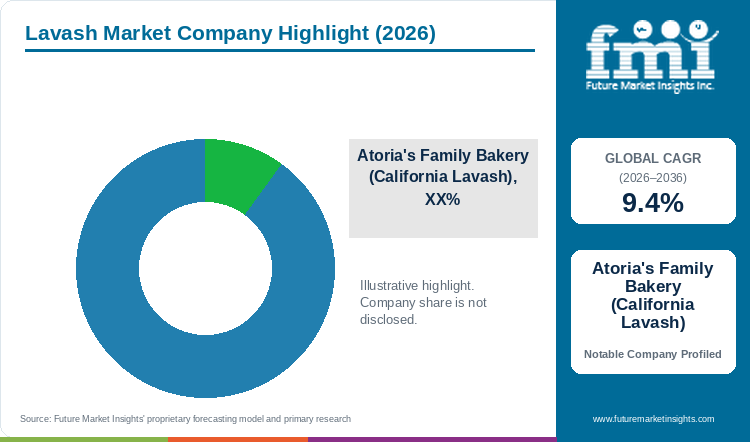
Cross-checking commercial product catalogs and wholesale foodservice filings shows that competition divides between dedicated heritage lavash sheet bakers and diversified industrial flatbread manufacturers. Atoria's Family Bakery works as the current corporate identity of California Lavash following its May 2019 rebrand so procurement audits avoid duplicate entity counting. Dedicated lavash producers supply hearth-baked rectangular sheets in traditional and whole-grain flax retail packs, whereas broad flatbread platforms operate high-speed tunnel ovens and national cold-chain distribution.
- Dedicated Lavash Sheet Bakers: Atoria's Family Bakery (California Lavash), Breadmasters (Ara-Z), and Damascus Bakeries specialize in thin hearth-baked rectangular lavash sheets for retail delis and sandwich chains.
- Multi-Channel Flatbread & Lavash Producers: Toufayan Bakeries, Kontos Foods, and Joseph's Bakery supply packaged retail lavash and bulk foodservice cases.
- Industrial Flatbread Manufacturing Platforms: Signature Flatbreads and Angel Bakeries operate high-capacity multi-line flatbread bakeries across Europe, India, and the Middle East with transferable sheet-baking infrastructure.
Competitive Benchmarking: Lavash Market
Table 8: Competitive Benchmarking for the Lavash Market (qualitative capability ratings), 2026
| Company | Named Lavash Range | Claim & Fiber Breadth | Foodservice Case Access | Geographic Reach |
|---|---|---|---|---|
| Atoria's Family Bakery (California Lavash) | High | High | High | Medium |
| Breadmasters (Ara-Z) | High | Medium | Medium | Medium |
| Damascus Bakeries | High | Medium | High | Medium |
| Toufayan Bakeries | High | High | High | High |
| Kontos Foods | High | Medium | High | High |
| Joseph's Bakery | High | High | Medium | Medium |
| Signature Flatbreads | Medium | High | High | High |
| Angel Bakeries | Medium | Medium | High | High |
Scoring basis: Capability tiers evaluate documented rectangular and round lavash SKU breadth and clean-label claim certifications. Foodservice access and geographic ratings reflect verified wholesale case pack specifications and multi-region supermarket distribution.
Key Developments in the Lavash Market
- Toufayan Bakeries completed the nationwide U.S. supermarket deli and Amazon rollout of its Seed Oil-Free Flatbread Wraps in April 2026 to complement its wholesale Authentic Lavash portfolio [3] [6].
- Gruma S.A.B. de C.V. (parent of Mission Foods) reported fourth-quarter and full-year 2025 results in February 2026 followed by third-quarter 2026 results in October 2026, driven by health-positioned better-for-you flatbread wraps in North America and Europe [19] [20].
- Food and Agriculture Organization (FAO) commodity tracking reported in August 2025 that international cereal and wheat prices declined in July 2025 even as the overall FAO Food Price Index averaged 130.1 points, easing flour input cost pressure for commercial flatbread bakers [21].
Key Players in the Lavash Market
Dedicated Lavash Sheet Bakers
- Atoria's Family Bakery (California Lavash)
- Breadmasters (Ara-Z)
- Damascus Bakeries
Multi-Channel Flatbread and Lavash Producers
- Toufayan Bakeries
- Kontos Foods
- Joseph's Bakery
Industrial Flatbread Manufacturing Platforms
- Signature Flatbreads
- Angel Bakeries
Lavash Market - Report Scope
Table 9: Report Scope for the Lavash Market (coverage fields and definitions), 2026 to 2036
| Coverage field | Report scope |
|---|---|
| Market breakdown | Product Type; Claim; Format; Packaging Format; Sales Channel |
| Quantitative Units | USD Million |
| Market Definition | Includes commercial manufacturer revenue from packaged and bulk foodservice lavash flatbread sheets across covered product, claim, format, packaging, and channel segments. Category Scope Note: Excludes downstream revenue from assembled restaurant wraps or kebabs and excludes pocket pita, corn/flour tortillas, and leavened naan sold under non-lavash identities. |
| Regions Covered | North America; Latin America; Western Europe; Eastern Europe; East Asia; South Asia and Pacific; Middle East and Africa |
| Countries Covered | Germany, Russia, UAE, Turkey, Armenia, USA, Iran, France, and additional countries in the full report |
| Key Companies Covered | Atoria's Family Bakery (California Lavash), Breadmasters (Ara-Z), Damascus Bakeries, Toufayan Bakeries, Kontos Foods, Joseph's Bakery, Signature Flatbreads, Angel Bakeries |
| Forecast Period | 2026 to 2036 |
| Approach | Primary and secondary research with top-down and bottom-up market triangulation. |
Lavash Market - Research Methodology
Table 10: Research Methodology for the Lavash Market (research methods and approach), 2026 edition
| Method | Approach |
|---|---|
| Primary Research | Structured interviews with commercial flatbread plant directors, supermarket deli category buyers, foodservice commissary QA managers, and specialty bakery distributors to validate sheet breakage rates, enzyme dosing, and case pricing. |
| Secondary Research | Audit of USDA ERS Food Expenditure Series, USDA FAS GAIN country grain reports, FAO GIEWS cereal balance sheets, Destatis and INSEE retail registries, and peer-reviewed baking rheology journals (Applied Sciences, Foods, Scientific Reports, Plant Foods for Human Nutrition). |
| Market Sizing and Forecasting | Top-down specialty flatbread expenditure models reconciled against bottom-up tunnel-oven line throughput (150 kg/hour benchmark at 14.8% evaporative baking mass loss) from 2026 to 2036. |
| Country Forecasting Model | Econometric national projections weight Mediterranean and Middle Eastern diaspora demographics, modern grocery store density, hospitality visitor arrivals, and domestic milling wheat price stability across eight countries. |
| Operational Benchmark Traceability | Production tonnage, sheet pack volumes, and channel indicators in Tables 2, 3, and 4 trace to instrumented tunnel-oven mass balances, USDA ERS food-at-home and food-away-from-home accounts, and audited distributor case specifications. |
| Data Triangulation and Validation | Supplier revenues are cross-checked against verified lavash SKU listings and corporate M&A records (merging California Lavash under Atoria's Family Bakery) while excluding assembled meal value and non-lavash flatbreads. |
Lavash Market by Segments
Lavash Market segmented by Product Type:
- Classic / Original
- Whole Grain & Seeded
- Flavored & Filled
- Mini & Snacking
- Premium / Artisan
Lavash Market segmented by Claim:
- Conventional
- Clean Label
- Organic
- Gluten-Free
- High-Protein
Lavash Market segmented by Format:
- Fresh
- Frozen
- Ambient Packaged
- Chilled
- Par-Baked
Lavash Market segmented by Packaging Format:
- Multipack
- Single-Serve
- Family Pack
- Bulk Foodservice
Lavash Market segmented by Sales Channel:
- Supermarkets & Hypermarkets
- Artisan Bakeries
- Convenience Stores
- Online & DTC
- Foodservice Distributors
Lavash Market by Region
- North America
- United States
- Canada
- Latin America
- Brazil
- Mexico
- Argentina
- Chile
- Western Europe
- Germany
- France
- United Kingdom
- Italy
- Spain
- Benelux
- Nordics
- Eastern Europe
- Poland
- Czech Republic
- Romania
- Hungary
- East Asia
- China
- Japan
- South Korea
- South Asia and Pacific
- India
- ASEAN
- Australia and New Zealand
- Middle East and Africa
- GCC Countries
- South Africa
- Türkiye
- Israel
Research Sources and Bibliography
- [1] Zeballos, E., & Sinclair, W. (2026, June 1). Ag and Food Statistics: Charting the Essentials - Food Prices and Spending. U.S. Department of Agriculture, Economic Research Service.
- [2] Mansour, Y., Rahmé, P., El Hajj, N., & Rouaud, O. (2025, August 3). Thermal and Expansion Analysis of the Lebanese Flatbread Baking Process Using a High-Temperature Tunnel Oven. Applied Sciences, 15(15), 8611.
- [3] Toufayan Bakeries. (2025, March 13). Looking for a U.S.-Based Wholesale Bakery? Meet Toufayan!. Toufayan Bakeries Newsroom.
- [4] Santamaria, M., Leguet, C., Doumani, N., Le-Bail, P., & Rosell, C. M. (2026, January 26). Substitution of Salt with Choline Chloride in Double-Layer Flatbreads: Impact on Technological Properties and Starch Digestibility. Plant Foods for Human Nutrition, 81(1), 16 (PubMed PMID 41586942).
- [5] Askari, H., Soleimanian-Zad, S., Kadivar, M., & Shahbazi, S. (2025, December 2). Enhancement of wheat bread quality using xylanase cellulase from gamma radiated Trichoderma afroharzianum mutant. Scientific Reports, 15, 43001 (PubMed PMID 41330969).
- [6] Perishable News & Toufayan Bakeries. (2026, April 7). Toufayan Bakeries Seed Oil-Free Wraps Now Available Nationwide and on Amazon. Perishable News Bakery Division.
- [7] Sinclair, W., & Stewart, H. (2026, April 30). U.S. food-at-home prices increased 2.3 percent in 2025, compared with 2024. U.S. Department of Agriculture, Economic Research Service.
- [8] Yehuala, T. F., Atlabachew, M., Aslam, M. F., Allen, L., Griffith, H., Ward, J. L., Shewry, P. R., Kanellou, A., Gichohi-Wainaina, W., Endalew, H. W., Abera, M. K., Tenagashaw, M. W., Gessesse, G. D., & Cherie, H. A. (2025, July 9). Fermentation Kinetics and Changes in Levels of Antinutrients in Pearl Millet and Pearl Millet-Maize Composite Dough Recipes Used to Prepare Injera. Food Science & Nutrition, 13(7), e70598 (PubMed PMID 40641565).
- [9] Kotsiou, K., Terzidis, M. A., & Papageorgiou, M. (2025, March 7). Effect of Baking Conditions on Mycotoxin Levels in Flatbreads Prepared from Artificially Contaminated Doughs. Foods, 14(6), 910 (PubMed PMID 40231926).
- [10] Nedviha, S., & Harasym, J. (2025, January 13). Characteristics of Soft Wheat and Tiger Nut (Cyperus esculentus) Composite Flour Bread. Foods, 14(2), 229 (PubMed PMID 39856895).
- [11] Federal Statistical Office of Germany (Destatis). (2025, June 10). 291 955 Einbürgerungen im Jahr 2024. Statistisches Bundesamt (Destatis) Press Release No. 204.
- [12] Food and Agriculture Organization of the United Nations. (2026, April 10). FAO GIEWS Country Brief on Russian Federation. Global Information and Early Warning System on Food and Agriculture (FAO GIEWS).
- [13] Dubai Department of Economy and Tourism. (2026, September 9). Tourism Performance Report January - August 2026. Government of Dubai, Department of Economy and Tourism.
- [14] USDA Foreign Agricultural Service. (2026, April 8). Türkiye: Grain and Feed Annual. Global Agricultural Information Network (GAIN) Report No. TU2026-0013.
- [15] Food and Agriculture Organization of the United Nations. (2026, April 30). FAO GIEWS Country Brief on Armenia. Global Information and Early Warning System on Food and Agriculture (FAO GIEWS).
- [16] Koriyama, T., Kurosu, Y., & Hosoya, T. (2025, March 8). Enhancing Bread Quality with Steam-Treated Moringa (Moringa oleifera) Powder. Foods, 14(6), 927 (PubMed PMID 40231919).
- [17] Food and Agriculture Organization of the United Nations. (2026, June 10). FAO GIEWS Country Brief on Iran (Islamic Republic of). Global Information and Early Warning System on Food and Agriculture (FAO GIEWS).
- [18] Institut national de la statistique et des études économiques (INSEE). (2025, July 10). Équipements et services à la population en 2024 - France entière. INSEE Base permanente des équipements (BPE).
- [19] Gruma, S.A.B. de C.V. (2026, February 18). GRUMA reports fourth quarter 2025 results. Gruma Investor Relations Press Release.
- [20] Gruma, S.A.B. de C.V. (2026, October 21). GRUMA reports third quarter 2026 results. Gruma Investor Relations Press Release.
- [21] Food and Agriculture Organization of the United Nations. (2025, August 8). FAO Food Price Index edges up in July. FAO Markets and Trade Newsroom.
- [22] Vandemoortele NV. (2026, March 30). Vandemoortele Annual Financial Report 2025: Group Revenue Reaches EUR 2,215 Million Supported by Bakery Acquisitions. Vandemoortele Corporate Press Release.
- [23] Flowers Foods, Inc. (2026, February 12). Flowers Foods, Inc. Reports Fourth Quarter and Full Year 2025 Results. Flowers Foods Investor Relations.
This bibliography is provided for reader reference and is not exhaustive. The full report contains the complete reference list and detailed citations.
This Report Answers
- How large is the lavash market in 2026 and what value is forecast for 2036?
- Which foodservice labor and menu versatility pressures support demand for lavash?
- Why does Classic / Original lead the product type segment?
- Why does Conventional retain the largest share in the claim segment?
- How do projected CAGRs differ across Germany, Russia, the UAE, and the USA?
- Which companies document primary lavash sheet production versus broader flatbread capacity?
- What operational and staling constraints limit adoption or supplier switching?
- What technical specifications should retail and foodservice buyers verify before contracting?
Frequently Asked Questions
How big is the lavash market in 2026, and what is forecast for 2036?
According to FMI, global lavash revenue is estimated to reach USD 298.7 million in 2026 from USD 273.0 million in 2025. Sales are forecast to hit USD 733.5 million by 2036 as supermarket delis and restaurant chains standardize preformed wrap procurement.
What is the CAGR for the lavash market from 2026 to 2036?
Future Market Insights projects a 9.4% CAGR between 2026 and 2036. This expansion yields USD 434.8 million in incremental annual revenue across retail and foodservice channels.
Which product type segment leads the lavash market?
Classic / Original is projected to capture 36.0% of the product type segment in 2026 because unflavored wheat sheets accommodate both hot grilled meats and chilled deli fillings.
Which claim segment represents the largest share in the lavash market?
Conventional formulations are estimated to hold 52.0% of the claim segment in 2026 as intact wheat gluten matrices deliver high tear resistance during mechanical rolling.
Which country has the highest growth outlook during the assessment period?
Germany is projected to lead evaluated national markets at a 10.7% CAGR through 2036, followed by Russia at 10.3% and the UAE at 10.0%.
Who are the key players in the market?
Notable participants include Atoria's Family Bakery (California Lavash) and Breadmasters (Ara-Z) as well as Damascus Bakeries. Additional evaluated suppliers include Toufayan Bakeries and Kontos Foods in addition to Joseph's Bakery, Signature Flatbreads, and Angel Bakeries.
Preview the report firsthand - request a free sample
Get SampleGet the brochure for pricing and purchase details.
Get PDFTable of Content
- Key Takeaways
- Market Size and CAGR
- Top Growth Driver
- Fastest Growing Segment
- Leading Region
- Key Companies
- Emerging Opportunities
- Executive Summary
- Global Market Outlook
- Demand-side Trends
- Supply-side Trends
- Technology Roadmap Analysis
- Analysis and Recommendations
- Analyst Perspective (What is happening? Why now? What should investors know?)
- Key Questions Answered
- How large is the market?
- What is the CAGR?
- What are key trends?
- Which region dominates?
- Who are the leaders?
- Market Overview
- Market Coverage / Taxonomy
- Market Definition / Scope / Limitations
- Research Methodology
- Chapter Orientation
- Analytical Lens and Working Hypotheses
- Market Structure, Signals, and Trend Drivers
- Benchmarking and Cross-market Comparability
- Market Sizing, Forecasting, and Opportunity Mapping
- Research Design and Evidence Framework
- Desk Research Programme (Secondary Evidence)
- Expert Input and Fieldwork (Primary Evidence)
- Tooling, Models, and Reference Databases
- Data Engineering and Model Build
- Quality Assurance and Audit Trail
- Market Background
- Market Dynamics (Drivers, Restraints, Opportunity, Trends)
- Scenario Forecast (Optimistic, Likely, Conservative)
- Impact Analysis
- AI Impact
- Sustainability Impact
- Regulatory Impact
- Technology Impact
- Consumer / Buyer Analysis
- Purchase Drivers
- Adoption Barriers
- Buyer Journey
- Opportunity Map Analysis
- Product Life Cycle Analysis
- Supply Chain Analysis
- Investment Feasibility Matrix
- Value Chain Analysis
- PESTLE and Porter's Analysis
- Regulatory Landscape
- Regional Parent Market Outlook
- Production and Consumption Statistics
- Import and Export Statistics
- Global Market Analysis and Forecast, 2021 to 2036
- Historical Market Size Value (USD Million) Analysis, 2021 to 2025
- Current and Future Market Size Value (USD Million) Projections, 2026 to 2036
- Y-o-Y Growth Trend Analysis
- Absolute $ Opportunity Analysis
- Global Market Pricing Analysis, 2021 to 2036
- Global Market Analysis and Forecast, By Product Type, 2021 to 2036
- Introduction / Key Findings
- Historical Market Size Value (USD Million) Analysis By Product Type, 2021 to 2025
- Current and Future Market Size Value (USD Million) Analysis and Forecast By Product Type, 2026 to 2036
- Classic / Original
- Whole Grain & Seeded
- Flavored & Filled
- Mini & Snacking
- Premium / Artisan
- Y-o-Y Growth Trend Analysis By Product Type, 2021 to 2025
- Absolute $ Opportunity Analysis By Product Type, 2026 to 2036
- Global Market Analysis and Forecast, By Claim, 2021 to 2036
- Introduction / Key Findings
- Historical Market Size Value (USD Million) Analysis By Claim, 2021 to 2025
- Current and Future Market Size Value (USD Million) Analysis and Forecast By Claim, 2026 to 2036
- Conventional
- Clean Label
- Organic
- Gluten-Free
- High-Protein
- Y-o-Y Growth Trend Analysis By Claim, 2021 to 2025
- Absolute $ Opportunity Analysis By Claim, 2026 to 2036
- Global Market Analysis and Forecast, By Format, 2021 to 2036
- Introduction / Key Findings
- Historical Market Size Value (USD Million) Analysis By Format, 2021 to 2025
- Current and Future Market Size Value (USD Million) Analysis and Forecast By Format, 2026 to 2036
- Fresh
- Frozen
- Ambient Packaged
- Chilled
- Par-Baked
- Y-o-Y Growth Trend Analysis By Format, 2021 to 2025
- Absolute $ Opportunity Analysis By Format, 2026 to 2036
- Global Market Analysis and Forecast, By Packaging Format, 2021 to 2036
- Introduction / Key Findings
- Historical Market Size Value (USD Million) Analysis By Packaging Format, 2021 to 2025
- Current and Future Market Size Value (USD Million) Analysis and Forecast By Packaging Format, 2026 to 2036
- Multipack
- Single-Serve
- Family Pack
- Bulk Foodservice
- Y-o-Y Growth Trend Analysis By Packaging Format, 2021 to 2025
- Absolute $ Opportunity Analysis By Packaging Format, 2026 to 2036
- Global Market Analysis and Forecast, By Sales Channel, 2021 to 2036
- Introduction / Key Findings
- Historical Market Size Value (USD Million) Analysis By Sales Channel, 2021 to 2025
- Current and Future Market Size Value (USD Million) Analysis and Forecast By Sales Channel, 2026 to 2036
- Supermarkets & Hypermarkets
- Artisan Bakeries
- Convenience Stores
- Online & DTC
- Foodservice Distributors
- Y-o-Y Growth Trend Analysis By Sales Channel, 2021 to 2025
- Absolute $ Opportunity Analysis By Sales Channel, 2026 to 2036
- Global Market Analysis and Forecast, By Region, 2021 to 2036
- Introduction
- Historical Market Size Value (USD Million) Analysis By Region, 2021 to 2025
- Current Market Size Value (USD Million) Analysis and Forecast By Region, 2026 to 2036
- North America
- Latin America
- Western Europe
- Eastern Europe
- East Asia
- South Asia and Pacific
- Middle East and Africa
- Market Attractiveness Analysis By Region
- North America Market Analysis and Forecast, By Country, 2021 to 2036
- Historical Market Size Value (USD Million) Trend Analysis By Market Taxonomy, 2021 to 2025
- Market Size Value (USD Million) Forecast By Market Taxonomy, 2026 to 2036
- By Country
- United States
- Canada
- By Product Type
- By Claim
- By Format
- By Packaging Format
- By Sales Channel
- By Country
- Market Attractiveness Analysis
- By Country
- By Product Type
- By Claim
- By Format
- By Packaging Format
- By Sales Channel
- Key Takeaways
- Latin America Market Analysis and Forecast, By Country
- Historical Market Size Value (USD Million) Trend Analysis By Market Taxonomy, 2021 to 2025
- Market Size Value (USD Million) Forecast By Market Taxonomy, 2026 to 2036
- By Country
- Brazil
- Mexico
- Argentina
- Chile
- By Product Type
- By Claim
- By Format
- By Packaging Format
- By Sales Channel
- By Country
- Market Attractiveness Analysis
- By Country
- By Product Type
- By Claim
- By Format
- By Packaging Format
- By Sales Channel
- Key Takeaways
- Western Europe Market Analysis and Forecast, By Country
- Historical Market Size Value (USD Million) Trend Analysis By Market Taxonomy, 2021 to 2025
- Market Size Value (USD Million) Forecast By Market Taxonomy, 2026 to 2036
- By Country
- Germany
- France
- United Kingdom
- Italy
- Spain
- Benelux
- Nordics
- By Product Type
- By Claim
- By Format
- By Packaging Format
- By Sales Channel
- By Country
- Market Attractiveness Analysis
- By Country
- By Product Type
- By Claim
- By Format
- By Packaging Format
- By Sales Channel
- Key Takeaways
- Eastern Europe Market Analysis and Forecast, By Country
- Historical Market Size Value (USD Million) Trend Analysis By Market Taxonomy, 2021 to 2025
- Market Size Value (USD Million) Forecast By Market Taxonomy, 2026 to 2036
- By Country
- Poland
- Czech Republic
- Romania
- Hungary
- By Product Type
- By Claim
- By Format
- By Packaging Format
- By Sales Channel
- By Country
- Market Attractiveness Analysis
- By Country
- By Product Type
- By Claim
- By Format
- By Packaging Format
- By Sales Channel
- Key Takeaways
- East Asia Market Analysis and Forecast, By Country
- Historical Market Size Value (USD Million) Trend Analysis By Market Taxonomy, 2021 to 2025
- Market Size Value (USD Million) Forecast By Market Taxonomy, 2026 to 2036
- By Country
- China
- Japan
- South Korea
- By Product Type
- By Claim
- By Format
- By Packaging Format
- By Sales Channel
- By Country
- Market Attractiveness Analysis
- By Country
- By Product Type
- By Claim
- By Format
- By Packaging Format
- By Sales Channel
- Key Takeaways
- South Asia and Pacific Market Analysis and Forecast, By Country
- Historical Market Size Value (USD Million) Trend Analysis By Market Taxonomy, 2021 to 2025
- Market Size Value (USD Million) Forecast By Market Taxonomy, 2026 to 2036
- By Country
- India
- ASEAN
- Australia and New Zealand
- By Product Type
- By Claim
- By Format
- By Packaging Format
- By Sales Channel
- By Country
- Market Attractiveness Analysis
- By Country
- By Product Type
- By Claim
- By Format
- By Packaging Format
- By Sales Channel
- Key Takeaways
- Middle East and Africa Market Analysis and Forecast, By Country
- Historical Market Size Value (USD Million) Trend Analysis By Market Taxonomy, 2021 to 2025
- Market Size Value (USD Million) Forecast By Market Taxonomy, 2026 to 2036
- By Country
- GCC Countries
- South Africa
- Türkiye
- Israel
- By Product Type
- By Claim
- By Format
- By Packaging Format
- By Sales Channel
- By Country
- Market Attractiveness Analysis
- By Country
- By Product Type
- By Claim
- By Format
- By Packaging Format
- By Sales Channel
- Key Takeaways
- Key Countries Market Analysis
- United States
- Pricing Analysis
- Market Share Analysis, 2025
- By Product Type
- By Claim
- By Format
- By Packaging Format
- By Sales Channel
- Canada
- Pricing Analysis
- Market Share Analysis, 2025
- By Product Type
- By Claim
- By Format
- By Packaging Format
- By Sales Channel
- Mexico
- Pricing Analysis
- Market Share Analysis, 2025
- By Product Type
- By Claim
- By Format
- By Packaging Format
- By Sales Channel
- Brazil
- Pricing Analysis
- Market Share Analysis, 2025
- By Product Type
- By Claim
- By Format
- By Packaging Format
- By Sales Channel
- Chile
- Pricing Analysis
- Market Share Analysis, 2025
- By Product Type
- By Claim
- By Format
- By Packaging Format
- By Sales Channel
- Germany
- Pricing Analysis
- Market Share Analysis, 2025
- By Product Type
- By Claim
- By Format
- By Packaging Format
- By Sales Channel
- United Kingdom
- Pricing Analysis
- Market Share Analysis, 2025
- By Product Type
- By Claim
- By Format
- By Packaging Format
- By Sales Channel
- Italy
- Pricing Analysis
- Market Share Analysis, 2025
- By Product Type
- By Claim
- By Format
- By Packaging Format
- By Sales Channel
- Spain
- Pricing Analysis
- Market Share Analysis, 2025
- By Product Type
- By Claim
- By Format
- By Packaging Format
- By Sales Channel
- France
- Pricing Analysis
- Market Share Analysis, 2025
- By Product Type
- By Claim
- By Format
- By Packaging Format
- By Sales Channel
- India
- Pricing Analysis
- Market Share Analysis, 2025
- By Product Type
- By Claim
- By Format
- By Packaging Format
- By Sales Channel
- ASEAN
- Pricing Analysis
- Market Share Analysis, 2025
- By Product Type
- By Claim
- By Format
- By Packaging Format
- By Sales Channel
- Australia and New Zealand
- Pricing Analysis
- Market Share Analysis, 2025
- By Product Type
- By Claim
- By Format
- By Packaging Format
- By Sales Channel
- China
- Pricing Analysis
- Market Share Analysis, 2025
- By Product Type
- By Claim
- By Format
- By Packaging Format
- By Sales Channel
- Japan
- Pricing Analysis
- Market Share Analysis, 2025
- By Product Type
- By Claim
- By Format
- By Packaging Format
- By Sales Channel
- South Korea
- Pricing Analysis
- Market Share Analysis, 2025
- By Product Type
- By Claim
- By Format
- By Packaging Format
- By Sales Channel
- Poland
- Pricing Analysis
- Market Share Analysis, 2025
- By Product Type
- By Claim
- By Format
- By Packaging Format
- By Sales Channel
- Hungary
- Pricing Analysis
- Market Share Analysis, 2025
- By Product Type
- By Claim
- By Format
- By Packaging Format
- By Sales Channel
- Türkiye
- Pricing Analysis
- Market Share Analysis, 2025
- By Product Type
- By Claim
- By Format
- By Packaging Format
- By Sales Channel
- South Africa
- Pricing Analysis
- Market Share Analysis, 2025
- By Product Type
- By Claim
- By Format
- By Packaging Format
- By Sales Channel
- Russia
- Pricing Analysis
- Market Share Analysis, 2025
- By Product Type
- By Claim
- By Format
- By Packaging Format
- By Sales Channel
- UAE
- Pricing Analysis
- Market Share Analysis, 2025
- By Product Type
- By Claim
- By Format
- By Packaging Format
- By Sales Channel
- Turkey
- Pricing Analysis
- Market Share Analysis, 2025
- By Product Type
- By Claim
- By Format
- By Packaging Format
- By Sales Channel
- Armenia
- Pricing Analysis
- Market Share Analysis, 2025
- By Product Type
- By Claim
- By Format
- By Packaging Format
- By Sales Channel
- Iran
- Pricing Analysis
- Market Share Analysis, 2025
- By Product Type
- By Claim
- By Format
- By Packaging Format
- By Sales Channel
- United States
- Market Structure Analysis
- Competition Dashboard
- Competition Benchmarking
- Market Share Analysis of Top Players
- By Regional
- By Product Type
- By Claim
- By Format
- By Packaging Format
- By Sales Channel
- Emerging Startups
- Innovation Benchmarking
- Competition Analysis
- Competition Deep Dive
- Atoria's Family Bakery (California Lavash)
- Overview
- Product Portfolio
- Profitability by Market Segments
- Sales Footprint
- Strategy Overview
- Marketing Strategy
- Product Strategy
- Channel Strategy
- Breadmasters (Ara-Z)
- Damascus Bakeries
- Toufayan Bakeries
- Kontos Foods
- Joseph's Bakery
- Signature Flatbreads
- Angel Bakeries
- Atoria's Family Bakery (California Lavash)
- Case Studies
- Success Stories
- Recent Developments
- Competition Deep Dive
- Assumptions & Acronyms Used


