

- Industry Size (2026)
- USD 0.7 Bn
- Forecast (2036)
- USD 1.1 Bn
- CAGR (2026 to 2036)
- 5.00%
Loofah Bath Sponge Market Size, Market Forecast, and Outlook By FMI
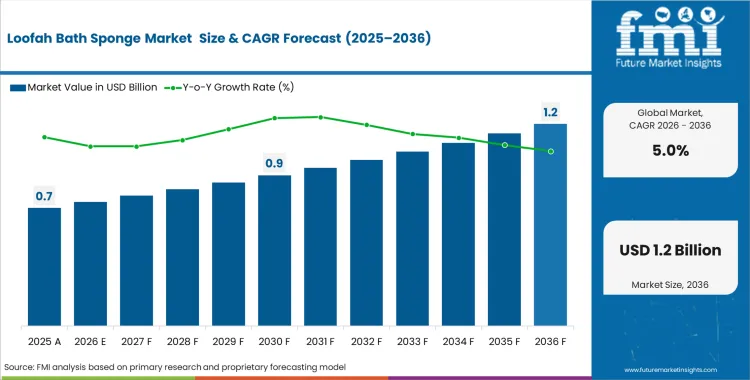
The loofah bath sponge market was valued at USD 0.6 billion in 2025. Demand is estimated to reach USD 0.7 billion in 2026 at a CAGR of 5.00% during the forecast period. Continuous investment carries total valuation to USD 1.1 billion through 2036 as retail category managers mandate biodegradable alternatives across personal care aisles. It fundamentally shapes the global loofah bath sponge size and forecast models.
Summary of Loofah Bath Sponge Market
- Market Snapshot
- The loofah bath sponge market was valued at USD 0.64 billion in 2025 and is projected to reach USD 1.09 billion by 2036.
- The industry is expected to rise at a 5.0% CAGR from 2026 to 2036, creating an incremental opportunity of USD 0.42 billion over the period.
- The market operates as a repeat-purchase personal-care accessories category where material feel, hygiene replacement frequency, price accessibility, and channel visibility shape competitiveness.
- The category functions as a defined physical-goods niche within personal-care accessories rather than as a loose merchandising label.
- Demand and Growth Drivers
- Demand is rising because exfoliation remains a visible body-care ritual, but dermatologist guidance still favors controlled use, which supports steady replacement rather than aggressive overuse.
- Natural-material positioning is strengthening the category as biodegradable, compostable, and plant-based claims gain more traction in bath accessory purchases.
- E-commerce is an expanding category reach because online assortments now span value mesh sponges, natural pads, back straps, and premium specialty loofah tools in one searchable buying flow.
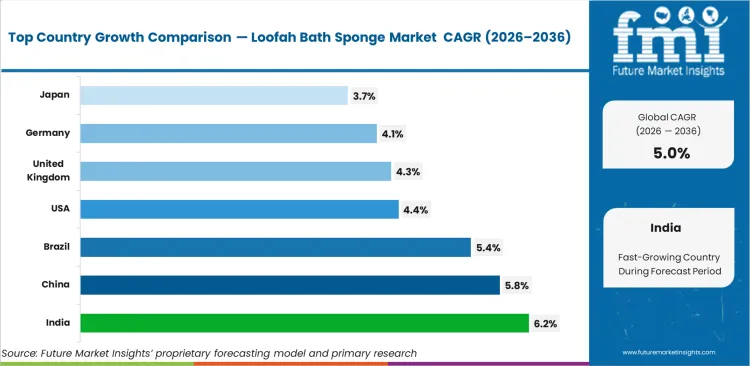
- Among key countries, India leads at 6.2% CAGR, followed by China at 5.8%, Brazil at 5.4%, United States at 4.4%, United Kingdom at 4.3%, Germany at 4.1%, and Japan at 3.7%.
- Growth is moderated by hygiene concerns and usage caution because loofahs require regular drying and replacement, and exfoliation is not appropriate at the same frequency for every skin type.
- Product and Segment View
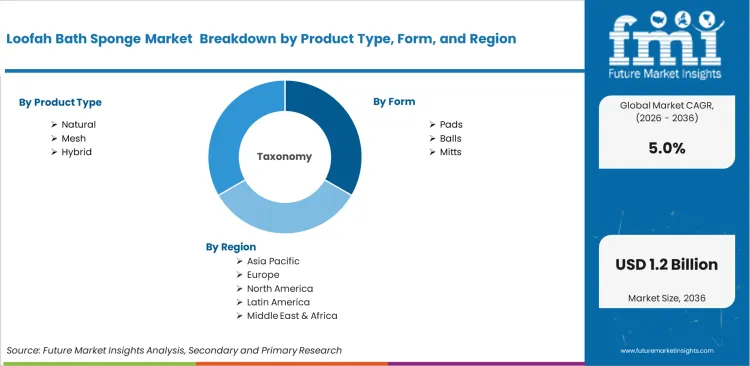
- The market covers natural loofah, mesh loofah, and hybrid loofah products designed mainly for cleansing and physical exfoliation in bath and shower routines.
- Products appear most commonly as pads, balls, mitts, and back straps, with pricing spanning entry-level mass retail to premium natural bath-accessory ranges.
- Natural loofah is estimated to hold 54% of the Product Type segment in 2026, supported by biodegradable appeal and stronger alignment with plant-based bath-care positioning.
- Pads are anticipated to capture 36% of the Form segment in 2026, helped by broad usability across full-body and targeted exfoliation routines.
- E-commerce is expected to account for 39% of the Distribution Channel segment in 2026, reflecting assortment breadth and D2C discovery behavior.
- Household use is projected to command 82% of the End Use segment in 2026, as spa and salon consumption remains comparatively limited.
- The scope includes manual bath sponges used for cleansing and exfoliation, but excludes powered cleansing devices, chemical exfoliant formulations, and non-bath household scouring products.
- Geography and Competitive Outlook
- India, China, and Brazil are the fastest-growing national markets, while the United States remains a stable high-value demand base.
- Competition is fragmented, with participants such as Earth Therapeutics, EcoTools, Hydréa London, Urban Spa, Vega, IberLuffa, and Deyga competing across mass, natural, and specialty channels.
- Market scope includes loofah body sponges, body scrubbers, pads, mitts, and back tools, indicating competition is shaped more by range architecture and positioning than by heavy technical barriers.
Pharmacy chains face immediate shelf-space resets favoring compostable bath accessories over synthetic products. Delayed compliance risks categorical delisting from major retailers enforcing new sustainability targets. Sourcing body scrub implements requires navigating agricultural supply constraints rather than adjusting factory injection-molding schedules. This material shift forces supply chains to operate on harvest cycles rather than chemical manufacturing timelines, which defines the underlying loofah bath sponge growth pattern.
As zero-plastic and lower-plastic bath accessories gain wider shelf presence, consumer adoption is expected to become more durable. Inventory realignment toward natural formats is likely to reinforce that shift. Shelf space acts as a strict filter preventing legacy synthetic dominance from returning, securing the long-term loofah bath sponge forecast.
India is estimated to record 6.2% CAGR as digital beauty retail expands access to natural bath accessories. China is expected to register 5.8% CAGR, supported by the wider penetration of bath and personal care accessories across urban consumers. Brazil is likely to post 5.4% CAGR from 2026 to 2036, reflecting the steady role of body-care routines in household spending. The United States is forecast to see 4.4% CAGR, with demand tied largely to replacement purchases in a mature market. The United Kingdom is expected to register 4.3% CAGR as demand shifts gradually away from synthetic substitutes. Germany is set to witness 4.1% CAGR, supported by stronger preference for natural and lower-plastic bath products. Japan is anticipated to record 3.7% CAGR as gentler skincare habits limit use of abrasive bath tools. Differences across countries reflect local supply access, familiarity with natural loofah products, and reliance on imports.
Segmental Analysis
Loofah Bath Sponge Market Analysis by Product Type
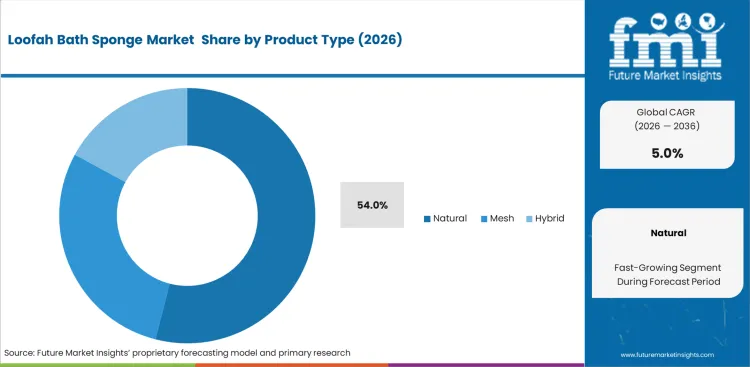
Natural loofah remains commercially ahead because biodegradable bath tools align more closely with current demand for plant-based and lower-plastic organic personal care accessories. Material preference also benefits from stronger shelf compatibility in categories where natural loofah vs plastic bath sponge reveals natural one more durability alone. Supply conditions are more dependent on agricultural output and harvest consistency than on petrochemical input availability, which changes how manufacturers plan inventory and sourcing continuity. Natural loofah is estimated to hold 54.0% share of the product type segment in 2026. Faster wear in repeated wet-use conditions also supports replacement demand, which helps keep this segment structurally favored despite tighter raw material consistency requirements.
- Initial screening: Biodegradable material positioning improves shelf acceptance in personal care assortments where plastic content is under greater scrutiny. Products lacking that fit are more likely to face slower retail expansion.
- Validation hurdles: Consistent gourd size, fiber density, and finish quality remain important for product uniformity. Irregular raw material characteristics can reduce conversion efficiency and weaken assortment reliability.
- Volume expansion: Stable agricultural supply supports better production planning and improves continuity across high-turn bath accessory lines.
Loofah Bath Sponge Market Analysis by Form
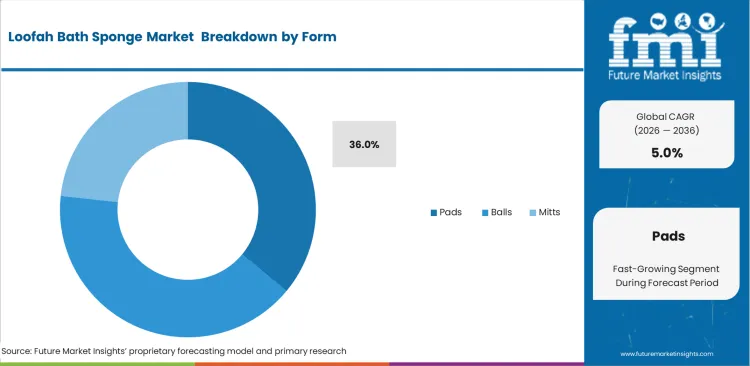
Versatility across multiple body areas keeps pad formats commercially ahead within the form segment of the body loofah market. Pads are anticipated to capture 36.0% share of the form segment in 2026. Flat profiles provide broader surface contact during exfoliation, which makes them easier to use across larger skin areas while also improving handling consistency in daily bath routines. Packaging efficiency adds another advantage because slimmer shapes fit retail display formats and shipping cartons more effectively than bulkier alternatives. Extra stitching and finishing requirements for sponge and scouring pads do add some production complexity, but format convenience and merchandising efficiency continue to keep pads in a leading position.
- Material utilization: Flat profiles reduce trimming loss during cutting and allow better yield from each harvested gourd. Higher raw material efficiency helps support more stable conversion economics.
- Shipping density: Compressed pad formats improve carton utilization and lower freight cost per unit. Better packing efficiency also supports broader retail distribution without adding equivalent logistics pressure.
- Durability limits: Stitched edges can weaken faster under repeated moisture exposure than more intact loofah sections. Earlier wear can shorten usable life, and it also supports repeat replacement demand within the category.
Loofah Bath Sponge Market Analysis by Distribution Channel
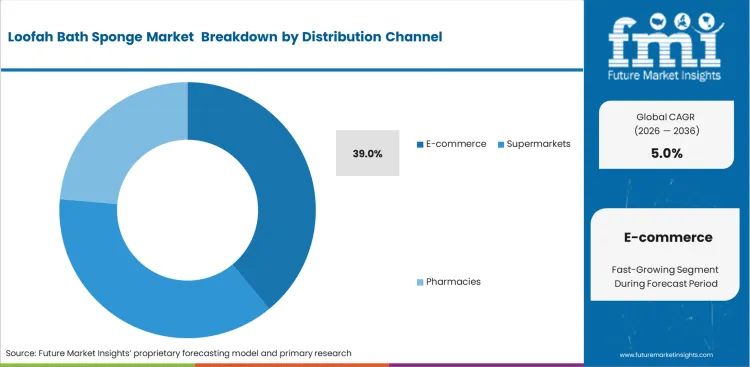
E-commerce remains the leading sales channel because bundle economics and direct digital merchandising make loofah bath sponges easier to scale outside traditional retail margin structures. Online platforms also support clearer product storytelling around material origin, usage, and replacement frequency, while recommendation flows help attach these products to broader beauty and personal care purchases. Multi-pack formats strengthen channel performance further by lowering perceived per-unit cost and encouraging planned replacement buying. E-commerce is expected to account for 39.0% share of the distribution channel segment in 2026. Texture inconsistency in natural loofah products can still create retention pressure when buyers expect the visual and tactile uniformity associated with synthetic alternatives, but channel convenience and assortment depth continue to keep online sales ahead.
- Discovery mechanisms: Algorithm-led product discovery improves visibility for eco-friendly and body-care accessory searches. Stronger search placement helps newer brands enter consideration without depending entirely on shelf presence.
- Conversion triggers: Multi-pack pricing lowers per-unit buying resistance and supports advance replacement purchases. Higher basket value also improves channel efficiency for lower-ticket bath accessory sales.
- Retention failures: Natural texture inconsistency can weaken repeat purchase confidence when the product feels different across units. Review sensitivity remains a practical constraint for subscription-style or recurring online demand.
Loofah Bath Sponge Market Analysis by End Use
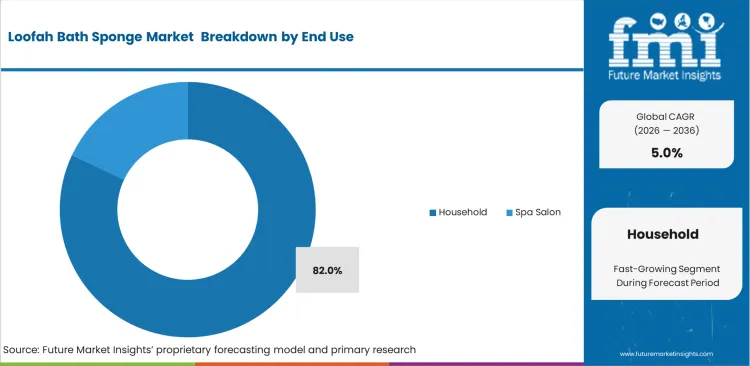
Household use remains the dominant end-use segment because daily bathing routines generate far more consistent replacement demand than occasional professional treatments. Household applications are projected to command 82.0% share of the segment in 2026. Regular cleansing and physical exfoliation keep purchase frequency tied to everyday bathroom use rather than to salon-led consumption. Familiarity with using a loofah sponge for dead skin removal during routine showers also supports stronger volume movement in domestic settings. Professional settings still influence some premium format development, but volume concentration continues to sit firmly within household demand because consumers prioritize accessible, repeat-use bath accessories over higher-priced specialty alternatives.
- Primary function: Daily epidermal maintenance keeps demand centered on affordable and accessible bath accessories used in home routines. Household consumers continue to favor functional utility over premium texture positioning.
- Degradation reality: Bathroom moisture accelerates wear in natural loofah materials and shortens usable life under repeated exposure. Frequent replacement remains necessary to maintain hygiene and product usability.
- Upsell resistance: Domestic buyers show limited willingness to pay premium prices for products viewed as routine-use bath tools. Margin expansion remains harder in household tiers than in more specialized niche formats.
Loofah Bath Sponge Market Drivers, Restraints, and Opportunities
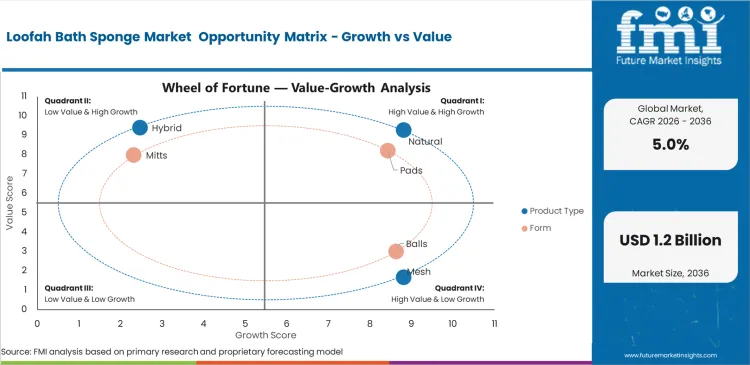
Retail sustainability mandates compel pharmacy category managers to execute immediate shelf-space transitions. Plastic mesh formats face categorical delisting as major retailers enforce strict environmental compliance targets. Sourcing directors must replace synthetic inventory with biodegradable bath accessories before deadline penalties apply. Failing to secure compliant dry body exfoliant powders and natural sponges means losing access to critical high-footfall distribution channels entirely.
Agricultural yield variability fundamentally limits rapid supply scaling. Botanical gourds require specific climate conditions, restricting geographic cultivation zones and exposing brands to unpredictable weather disruptions. Supply chain directors cannot authorize sudden production spikes via factory mandates. Synthesizing durable hybrid alternatives mitigates some friction. Strict organic certifications complicate material blending efforts.
Opportunities in the Loofah Bath Sponge Market
- Contract cultivation: Direct farming agreements bypass wholesale spot markets. Supply chain directors secure guaranteed yields for sustainable personal care accessories.
- Antimicrobial integration: Impregnating natural fibers with active agents extends functional lifespan. Product managers differentiate commodity botanical items.
- Subscription logistics: Automated replacement models solve high degradation rates. Digital retention teams capture recurring revenue streams efficiently.
Regional Analysis
.webp "Top Country Growth Comparison Loofah Bath Sponge Market Cagr (2026 2036)")
Based on regional analysis, Loofah Bath Sponge Market is segmented into Asia Pacific, Europe, and North America across 40 plus countries.
| Country | CAGR (2026 to 2036) |
|---|---|
| India | 6.2% |
| China | 5.8% |
| Brazil | 5.4% |
| United States | 4.4% |
| United Kingdom | 4.3% |
| Germany | 4.1% |
| Japan | 3.7% |
Source: Future Market Insights (FMI) analysis, based on a proprietary forecasting model and primary research
Asia Pacific Loofah Bath Sponge Market Analysis
Agricultural proximity, expanding digital retail reach, and rising personal-care participation keep the Asia Pacific central to loofah bath sponge demand growth. Regional momentum is supported by easier access to natural raw material supply, broader online assortment visibility, and stronger consumer acceptance of botanical bath accessories across urban and semi-urban markets. Cost conditions also remain more favorable than in import-dependent regions because local sourcing and conversion chains reduce freight exposure and improve replenishment flexibility. Demand across Asia Pacific is therefore expected to remain structurally stronger, where natural material familiarity and digital product discovery continue to move together.
- India: A large consumer base, rising personal grooming expenditure, and expanding online beauty retail keep India ahead within the region. Wider access to affordable natural bath accessories is improving category penetration beyond premium urban niches and into secondary consumption centers. Demand for loofah bath sponges in India is projected to rise at a CAGR of 6.2% from 2026 to 2036. Organized retail expansion and stronger digital visibility are likely to keep the country at the front of regional volume growth.
- China: Broad urban demand, improving access to modern bath accessories, and deep domestic manufacturing capacity sustain China’s commercial relevance. Sales of loofah bath sponges in China are expected to increase at a 5.8% CAGR. Shorter supply chains and wider price-point coverage also support stronger market availability across mass and mid-tier segments. Local production depth is likely to preserve China’s importance in both regional demand and supply continuity.
- Japan: Gentler skincare routines keep product usage more selective in Japan than in markets where physical exfoliation is used more frequently. Preference leans more toward texture refinement, material quality, and finish consistency than toward rapid replacement-driven consumption. Loofah bath sponge demand in Japan is anticipated to grow at a CAGR of 3.7% through 2036. Growth is expected to remain steady in a premium-oriented niche where quality matters more than volume turnover.
FMI’s report also includes Australia and South Korea, where supply networks remain closely linked to regional agricultural availability and conversion capability. Australia is likely to benefit from stronger alignment with natural-fiber and sustainability-led personal care preferences, while South Korea adds relevance through premium bath and beauty routines that support broader adoption of differentiated natural accessories.
Europe Loofah Bath Sponge Market Analysis
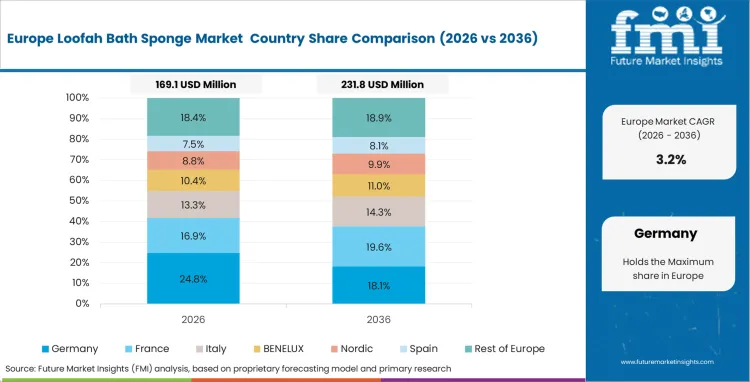
Packaging discipline, tighter sustainability expectations, and rising consumer resistance to plastic-heavy bath accessories keep Europe structurally favorable for natural loofah formats. Demand across the region is shaped less by raw material availability and more by retail compliance, product acceptability, and steady access to imported botanical supply. Limited local cultivation capacity leaves much of the region dependent on external sourcing, which makes supplier reliability and import consistency more important than in producing markets. Europe is expected to remain commercially relevant where biodegradable positioning aligns with retail standards and consumer purchase behavior.
- United Kingdom: Consumer resistance to synthetic bath tools and rising preference for lower-plastic personal care accessories continue to support demand in the United Kingdom. Private-label expansion and stronger acceptance of biodegradable formats are also improving shelf access for natural alternatives across mainstream retail. Reliable access to compliant imported supply is likely to remain central to category stability in the country. Demand for loofah bath sponges in the United Kingdom is expected to increase at a CAGR of 4.3%. Steady progress is likely to favor suppliers that can combine compliant sourcing with consistent retail availability.
- Germany: Circular economy discipline and stricter product sustainability expectations keep Germany commercially important within the regional outlook. Sales of loofah bath sponges in Germany are projected to rise at a 4.1% CAGR during 2026 to 2036. Market development is supported by stronger acceptance of compostable and natural bath accessories, although import dependence still adds operating sensitivity around supply continuity and certification requirements. Suppliers able to deliver consistent quality, complete documentation, and reliable replenishment are expected to remain better placed in Germany’s compliance-sensitive retail environment.
FMI’s report also includes France and Italy, where tighter sustainability expectations continue to support the shift away from petroleum-based bath accessories. Demand in both markets is likely to benefit from stronger acceptance of natural personal care products, although import dependence and compliance requirements will remain important to supply continuity.
North America Loofah Bath Sponge Market Analysis
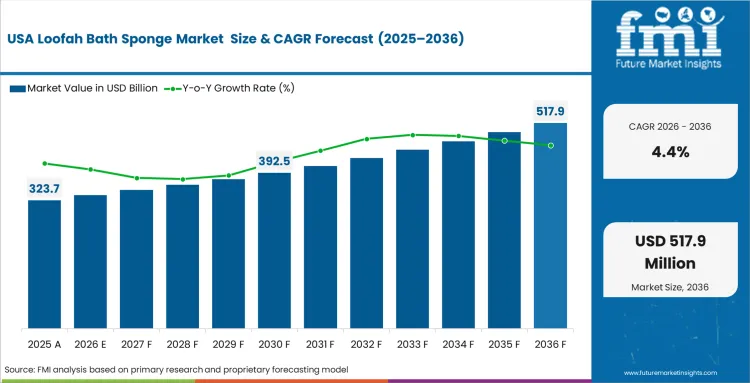
Mature replacement demand keeps North America commercially stable rather than high velocity, with category movement tied more to routine replenishment than to first-time adoption. Strong retail infrastructure, broad product availability, and established personal-care purchasing habits continue to support steady offtake across both store-based and online channels. Pricing pressure remains more visible in this region because basic loofah formats compete in a well-distributed bath accessories market where differentiation is often limited at the material level. Premium packaging and positioning can improve shelf appeal, but replacement frequency and retail reach still shape the core volume base.
- United States: Established hygiene routines and broad retail penetration keep the United States central to North American demand. Demand for loofah bath sponges in the United States is expected to rise at a 4.4% CAGR. Online replenishment models and mass retail availability support recurring purchase behavior across everyday bath accessory categories. Consistent placement across large retail networks remains important in a market where volume stability is shaped more by repeat household purchases than by rapid category expansion.
FMI’s report also includes Canada, where cross-border logistics efficiency remains important to brand profitability within mass-market bath accessory tiers. Stable access to USA-linked distribution channels and imported natural-fiber supply is likely to support steady category movement, especially where replenishment speed and retail continuity influence shelf performance.
Competitive Aligners for Market Players
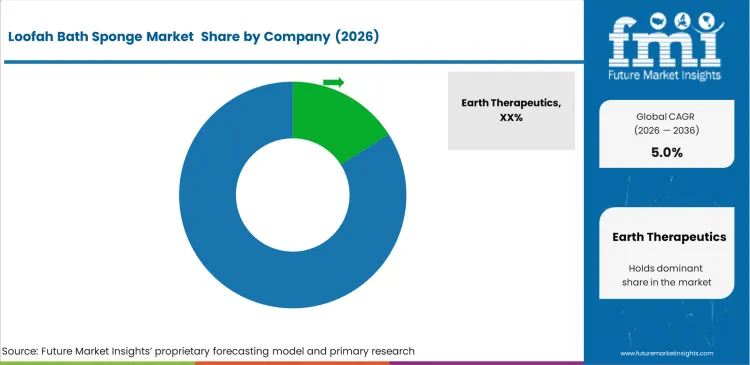
Fragmented brand structures allow agile natural-material specialists to compete effectively with larger bath accessory players that operate at a broader category scale. Questions around which companies lead the loofah bath sponge market are ultimately tied less to synthetic manufacturing capability and more to the ability to secure dependable agricultural output with acceptable quality consistency. Competitive standing among loofah bath sponge manufacturers is shaped by access to stable loofah harvests, controlled sorting, and the ability to convert variable botanical input into retail-ready products without compromising presentation. Leadership in the loofah bath sponge market rests on sourcing discipline and execution consistency rather than on scale alone.
Established participants continue to benefit from wider distribution reach and stronger logistical coverage across pharmacy, personal care, and general merchandise channels. Market positioning also depends on the ability to manage irregular natural harvest characteristics so finished products reach shelves with acceptable uniformity in shape, finish, and visual quality. New entrants face a more difficult path because agricultural sourcing networks, quality control discipline, and replenishment reliability take time to build. Access to a dependable bulk natural loofah sponge supplier remains an important requirement where uninterrupted inventory flow matters as much as shelf presence.
Retailers also avoid overdependence on a single source, particularly in a category exposed to seasonal crop variability and inconsistency in raw material availability. Purchase volumes are therefore often distributed across multiple natural-fiber loofah bath sponge suppliers to reduce the risk of inventory gaps. Private label loofah bath sponge programs add another layer of pressure because buyers maintain flexible skin care device pricing models. Competitive success is likely to remain with suppliers that can balance agricultural risk, pricing discipline, and dependable fulfillment without weakening retail margins.
Key Players in Loofah Bath Sponge Market
- Earth Therapeutics
- EcoTools
- Hydréa London
- Urban Spa
- Vega
- IberLuffa
- Deyga
Scope of the Report
| Metric | Value |
|---|---|
| Quantitative Units | USD 0.7 Billion to USD 1.1 Billion, at a CAGR of 5.00% |
| Market Definition | Physical exfoliation tools derived from Luffa aegyptiaca gourds or manufactured from synthetic mesh, utilized primarily during personal bathing routines to accelerate epidermal turnover. |
| Segmentation | Product Type, Form, Distribution Channel, End Use, Region |
| Regions Covered | North America, Latin America, Europe, Asia Pacific, Middle East and Africa |
| Countries Covered | India, China, Brazil, United States, United Kingdom, Germany, Japan |
| Key Companies Profiled | Earth Therapeutics, EcoTools, Hydréa London, Urban Spa, Vega, IberLuffa, Deyga |
| Forecast Period | 2026 to 2036 |
| Approach | Top-down addressable-base model combined with bottom-up realized ASP and competitor validation |
Source: Future Market Insights (FMI) analysis, based on proprietary forecasting model and primary research
Loofah Bath Sponge Market Analysis by Segments
Product Type
- Natural loofah
- Mesh loofah
- Hybrid loofah
Form
- Pads
- Balls
- Mitts
- Back straps
Distribution Channel
- E-commerce
- Supermarkets
- Specialty stores
- Pharmacies
End Use
- Household
- Spa salon
Region
- North America
- United States
- Canada
- Latin America
- Brazil
- Mexico
- Europe
- Germany
- United Kingdom
- France
- Italy
- Asia Pacific
- China
- India
- Japan
- South Korea
- Australia
- Middle East and Africa
- GCC Countries
- South Africa
Bibliography
- American Academy of Dermatology Association. (2026, February 6). How to safely exfoliate at home.
- Board of Governors of the Federal Reserve System (US). (2026). Population Ages 15 to 64 for World (SPPOP1564TOZSWLD). Federal Reserve Bank of St. Louis.
- Gamage, S., Liyanage, A., Yatigammana, S. K., Wijesekara, H., & Vithanage, M. (2024). Microplastics in personal care products and cosmetics: Unseen contributors to environmental pollution and health risks. Heliyon, 10(24), e40535.
- Lei, Y., Li, T., He, Y., & Xu, Z. (2025). Functionalization of loofah sponge as a natural cellulose-based scaffold: A review. Carbohydrate Polymers, 355, 123777.
- Li, C., Wang, L., & Zhang, L. (2024). A case study in natural fibre material (Luffa sponge) development using E²-material-driven design. Sustainability, 16(8), 3490.
- Thomas, N. M., & Nirmalarani, R. (2025). Microplastics in cosmetics and their impact on human health. Discover Sustainability, 6, 176.
- United Nations Development Programme. (2024, November 26). Combatting plastic pollution for sustainable development.
- United Nations Environment Programme. (2026, March 12). Plastic pollution.
This bibliography is provided for reader reference. The full FMI report contains the complete reference list with primary source documentation.
This Report Addresses
- Retail sustainability mandates reshaping shelf space
- Agricultural yield dependencies replacing synthetic supply chains
- Multi-year botanical sourcing contracts stabilizing volumes
- Stitching constraints limiting pad format production speeds
- Moisture degradation accelerating household replacement cycles
- Biodegradable certifications acting as strict pharmacy filters
- Digital subscription models capturing rapid consumer turnover
- Irregular gourd textures threatening online brand reputations
Frequently Asked Questions
What structural condition drives natural loofah expansion?
Zero-plastic retail merchandising policies force pharmacy category managers to reject synthetic mesh. Biodegradable botanical alternatives secure mandatory shelf placement.
Why do pad forms dominate unit volume?
Flat configurations minimize logistics costs through high shipping density. Production managers maximize raw material yield per harvested gourd.
How does agricultural variability impact brands?
Irregular harvest dimensions complicate automated packaging lines. Supply chain directors reject non-uniform crops, creating unexpected stockouts.
Why does India grow faster than the United Kingdom?
Deepening digital beauty retail penetration exposes massive new consumer bases to physical exfoliation tools. Mature European markets rely purely on replacement cycles.
What limits rapid supply scaling for botanical options?
Specific climate requirements restrict global cultivation zones. Sourcing directors cannot instantly mandate factory volume increases like synthetic alternatives.
How do professional spas influence mass-market development?
Salons test premium hybrid material durability under intensive usage. Retail product managers integrate these material findings into household formulations.
Why is e-commerce critical for botanical accessories?
Online platforms bypass strict supermarket slotting fees. Digital merchandisers leverage bundle pricing to offset low individual unit margins.
What causes high digital return rates for natural sponges?
Inconsistent texture profiles frustrate buyers accustomed to identical synthetic mesh. Customer success teams battle negative reviews regarding abrasive variability.
How do major retailers prevent vendor lock-in?
National buyers deliberately split massive orders across multiple agricultural suppliers. Distributed sourcing mitigates catastrophic single-crop failure risks.
What hidden production cost affects flat formats?
Converting round gourds into flat pads requires extensive secondary edge stitching. Labor bottlenecks at sewing stations constrain total factory output.
Why do household applications command overwhelming share?
Daily epidermal maintenance demands frequent tool usage. Bathroom moisture accelerates material breakdown, forcing rapid consumer replacement purchases.
How do brands differentiate commodity agricultural inputs?
Product development leads impregnate raw fibers with antimicrobial agents. Premium packaging structures mask identical botanical base materials.
What role do customs data play in forecasting?
Agricultural import logs verify true physical volume movements. Desk researchers track international shipments to validate brand growth claims.
Why do German retailers pivot aggressively toward botanical imports?
Strict circular economy regulations penalize non-compostable consumer waste. Procurement teams must source organic alternatives to avoid steep compliance fines.
What defines competitive victory in the United States?
Securing multi-year placement within massive big-box retail infrastructure. Logistics directors optimize cross-border shipping to maintain mass-market margin requirements.
How does moisture exposure affect brand loyalty?
Rapid botanical degradation requires frequent substitution. Brands establishing automated subscription models capture recurring revenue before consumers switch providers.
Why are medical applications excluded from this scope?
Clinical debridement requires specialized sterilization pathways. Regular agricultural sourcing fails strict medical regulatory compliance standards entirely.
What validates active SKU velocity during research?
Procurement directors confirm actual retail sell-through rates. Shelf-space allocation tracking anchors baseline volume assumptions accurately.
How do pricing structures differ across distribution channels?
Supermarkets compress supplier margins enforcing massive wholesale discounts. Specialty stores permit higher unit prices supporting premium material narratives.
What forces legacy synthetic manufacturers to adapt?
Consumer backlash against microplastic pollution destroys brand equity. Traditional plastics factories must retool equipment for biodegradable polymer alternatives.
Why does Brazil maintain elevated growth rates?
Cultural embedding of intensive body-care routines sustains high per-capita usage. Frequent exfoliation habits drive continuous regional volume consumption.
How do companies secure stable botanical pricing?
Direct farming agreements bypass volatile wholesale spot markets. Operations directors negotiate long-term cultivation contracts ensuring predictable raw material costs.
What is the difference evaluating a bath loofah vs silicone scrubber?
Silicone scrubbers offer extreme microbial resistance and multi-year durability. Natural botanical gourds provide deeper physical exfoliation but require frequent replacement due to organic degradation.
How often should a loofah for body exfoliation be replaced?
Dermatologists recommend replacing natural botanical gourds every three to four weeks. High bathroom humidity accelerates bacterial accumulation within porous plant fibers.
Preview the report firsthand - request a free sample
Get SampleGet the brochure for pricing and purchase details.
Get PDFTable of Content
- Executive Summary
- Global Market Outlook
- Demand-side Trends
- Supply-side Trends
- Technology Roadmap Analysis
- Analysis and Recommendations
- Market Overview
- Market Coverage / Taxonomy
- Market Definition / Scope / Limitations
- Research Methodology
- Chapter Orientation
- Analytical Lens and Working Hypotheses
- Market Structure, Signals, and Trend Drivers
- Benchmarking and Cross-market Comparability
- Market Sizing, Forecasting, and Opportunity Mapping
- Research Design and Evidence Framework
- Desk Research Programme (Secondary Evidence)
- Company Annual and Sustainability Reports
- Peer-reviewed Journals and Academic Literature
- Corporate Websites, Product Literature, and Technical Notes
- Earnings Decks and Investor Briefings
- Statutory Filings and Regulatory Disclosures
- Technical White Papers and Standards Notes
- Trade Journals, Industry Magazines, and Analyst Briefs
- Conference Proceedings, Webinars, and Seminar Materials
- Government Statistics Portals and Public Data Releases
- Press Releases and Reputable Media Coverage
- Specialist Newsletters and Curated Briefings
- Sector Databases and Reference Repositories
- FMI Internal Proprietary Databases and Historical Market Datasets
- Subscription Datasets and Paid Sources
- Social Channels, Communities, and Digital Listening Inputs
- Additional Desk Sources
- Expert Input and Fieldwork (Primary Evidence)
- Primary Modes
- Qualitative Interviews and Expert Elicitation
- Quantitative Surveys and Structured Data Capture
- Blended Approach
- Why Primary Evidence is Used
- Observational and In-context Research
- Social and Community Interactions
- Primary Modes
- Stakeholder Universe Engaged
- C-suite Leaders
- Board Members
- Presidents and Vice Presidents
- R&D and Innovation Heads
- Technical Specialists
- Domain Subject-matter Experts
- Scientists
- Physicians and Other Healthcare Professionals
- Governance, Ethics, and Data Stewardship
- Research Ethics
- Data Integrity and Handling
- Desk Research Programme (Secondary Evidence)
- Tooling, Models, and Reference Databases
- Data Engineering and Model Build
- Data Acquisition and Ingestion
- Cleaning, Normalisation, and Verification
- Synthesis, Triangulation, and Analysis
- Quality Assurance and Audit Trail
- Market Background
- Market Dynamics
- Drivers
- Restraints
- Opportunity
- Trends
- Scenario Forecast
- Demand in Optimistic Scenario
- Demand in Likely Scenario
- Demand in Conservative Scenario
- Opportunity Map Analysis
- Product Life Cycle Analysis
- Supply Chain Analysis
- Investment Feasibility Matrix
- Value Chain Analysis
- PESTLE and Porter’s Analysis
- Regulatory Landscape
- Regional Parent Market Outlook
- Production and Consumption Statistics
- Import and Export Statistics
- Market Dynamics
- Global Market Analysis 2021 to 2025 and Forecast, 2026 to 2036
- Historical Market Size Value (USD Million) Analysis, 2021 to 2025
- Current and Future Market Size Value (USD Million) Projections, 2026 to 2036
- Y-o-Y Growth Trend Analysis
- Absolute $ Opportunity Analysis
- Global Market Pricing Analysis 2021 to 2025 and Forecast 2026 to 2036
- Global Market Analysis 2021 to 2025 and Forecast 2026 to 2036, By Product Type
- Introduction / Key Findings
- Historical Market Size Value (USD Million) Analysis By Product Type , 2021 to 2025
- Current and Future Market Size Value (USD Million) Analysis and Forecast By Product Type , 2026 to 2036
- Natural
- Mesh
- Hybrid
- Natural
- Y-o-Y Growth Trend Analysis By Product Type , 2021 to 2025
- Absolute $ Opportunity Analysis By Product Type , 2026 to 2036
- Global Market Analysis 2021 to 2025 and Forecast 2026 to 2036, By Form
- Introduction / Key Findings
- Historical Market Size Value (USD Million) Analysis By Form, 2021 to 2025
- Current and Future Market Size Value (USD Million) Analysis and Forecast By Form, 2026 to 2036
- Pads
- Balls
- Mitts
- Pads
- Y-o-Y Growth Trend Analysis By Form, 2021 to 2025
- Absolute $ Opportunity Analysis By Form, 2026 to 2036
- Global Market Analysis 2021 to 2025 and Forecast 2026 to 2036, By Distribution Channel
- Introduction / Key Findings
- Historical Market Size Value (USD Million) Analysis By Distribution Channel, 2021 to 2025
- Current and Future Market Size Value (USD Million) Analysis and Forecast By Distribution Channel, 2026 to 2036
- E-commerce
- Supermarkets
- Pharmacies
- E-commerce
- Y-o-Y Growth Trend Analysis By Distribution Channel, 2021 to 2025
- Absolute $ Opportunity Analysis By Distribution Channel, 2026 to 2036
- Global Market Analysis 2021 to 2025 and Forecast 2026 to 2036, By End Use
- Introduction / Key Findings
- Historical Market Size Value (USD Million) Analysis By End Use, 2021 to 2025
- Current and Future Market Size Value (USD Million) Analysis and Forecast By End Use, 2026 to 2036
- Household
- Spa Salon
- Household
- Y-o-Y Growth Trend Analysis By End Use, 2021 to 2025
- Absolute $ Opportunity Analysis By End Use, 2026 to 2036
- Global Market Analysis 2021 to 2025 and Forecast 2026 to 2036, By Region
- Introduction
- Historical Market Size Value (USD Million) Analysis By Region, 2021 to 2025
- Current Market Size Value (USD Million) Analysis and Forecast By Region, 2026 to 2036
- North America
- Latin America
- Western Europe
- Eastern Europe
- East Asia
- South Asia and Pacific
- Middle East & Africa
- Market Attractiveness Analysis By Region
- North America Market Analysis 2021 to 2025 and Forecast 2026 to 2036, By Country
- Historical Market Size Value (USD Million) Trend Analysis By Market Taxonomy, 2021 to 2025
- Market Size Value (USD Million) Forecast By Market Taxonomy, 2026 to 2036
- By Country
- USA
- Canada
- Mexico
- By Product Type
- By Form
- By Distribution Channel
- By End Use
- By Country
- Market Attractiveness Analysis
- By Country
- By Product Type
- By Form
- By Distribution Channel
- By End Use
- Key Takeaways
- Latin America Market Analysis 2021 to 2025 and Forecast 2026 to 2036, By Country
- Historical Market Size Value (USD Million) Trend Analysis By Market Taxonomy, 2021 to 2025
- Market Size Value (USD Million) Forecast By Market Taxonomy, 2026 to 2036
- By Country
- Brazil
- Chile
- Rest of Latin America
- By Product Type
- By Form
- By Distribution Channel
- By End Use
- By Country
- Market Attractiveness Analysis
- By Country
- By Product Type
- By Form
- By Distribution Channel
- By End Use
- Key Takeaways
- Western Europe Market Analysis 2021 to 2025 and Forecast 2026 to 2036, By Country
- Historical Market Size Value (USD Million) Trend Analysis By Market Taxonomy, 2021 to 2025
- Market Size Value (USD Million) Forecast By Market Taxonomy, 2026 to 2036
- By Country
- Germany
- UK
- Italy
- Spain
- France
- Nordic
- BENELUX
- Rest of Western Europe
- By Product Type
- By Form
- By Distribution Channel
- By End Use
- By Country
- Market Attractiveness Analysis
- By Country
- By Product Type
- By Form
- By Distribution Channel
- By End Use
- Key Takeaways
- Eastern Europe Market Analysis 2021 to 2025 and Forecast 2026 to 2036, By Country
- Historical Market Size Value (USD Million) Trend Analysis By Market Taxonomy, 2021 to 2025
- Market Size Value (USD Million) Forecast By Market Taxonomy, 2026 to 2036
- By Country
- Russia
- Poland
- Hungary
- Balkan & Baltic
- Rest of Eastern Europe
- By Product Type
- By Form
- By Distribution Channel
- By End Use
- By Country
- Market Attractiveness Analysis
- By Country
- By Product Type
- By Form
- By Distribution Channel
- By End Use
- Key Takeaways
- East Asia Market Analysis 2021 to 2025 and Forecast 2026 to 2036, By Country
- Historical Market Size Value (USD Million) Trend Analysis By Market Taxonomy, 2021 to 2025
- Market Size Value (USD Million) Forecast By Market Taxonomy, 2026 to 2036
- By Country
- China
- Japan
- South Korea
- By Product Type
- By Form
- By Distribution Channel
- By End Use
- By Country
- Market Attractiveness Analysis
- By Country
- By Product Type
- By Form
- By Distribution Channel
- By End Use
- Key Takeaways
- South Asia and Pacific Market Analysis 2021 to 2025 and Forecast 2026 to 2036, By Country
- Historical Market Size Value (USD Million) Trend Analysis By Market Taxonomy, 2021 to 2025
- Market Size Value (USD Million) Forecast By Market Taxonomy, 2026 to 2036
- By Country
- India
- ASEAN
- Australia & New Zealand
- Rest of South Asia and Pacific
- By Product Type
- By Form
- By Distribution Channel
- By End Use
- By Country
- Market Attractiveness Analysis
- By Country
- By Product Type
- By Form
- By Distribution Channel
- By End Use
- Key Takeaways
- Middle East & Africa Market Analysis 2021 to 2025 and Forecast 2026 to 2036, By Country
- Historical Market Size Value (USD Million) Trend Analysis By Market Taxonomy, 2021 to 2025
- Market Size Value (USD Million) Forecast By Market Taxonomy, 2026 to 2036
- By Country
- Kingdom of Saudi Arabia
- Other GCC Countries
- Turkiye
- South Africa
- Other African Union
- Rest of Middle East & Africa
- By Product Type
- By Form
- By Distribution Channel
- By End Use
- By Country
- Market Attractiveness Analysis
- By Country
- By Product Type
- By Form
- By Distribution Channel
- By End Use
- Key Takeaways
- Key Countries Market Analysis
- USA
- Pricing Analysis
- Market Share Analysis, 2025
- By Product Type
- By Form
- By Distribution Channel
- By End Use
- Canada
- Pricing Analysis
- Market Share Analysis, 2025
- By Product Type
- By Form
- By Distribution Channel
- By End Use
- Mexico
- Pricing Analysis
- Market Share Analysis, 2025
- By Product Type
- By Form
- By Distribution Channel
- By End Use
- Brazil
- Pricing Analysis
- Market Share Analysis, 2025
- By Product Type
- By Form
- By Distribution Channel
- By End Use
- Chile
- Pricing Analysis
- Market Share Analysis, 2025
- By Product Type
- By Form
- By Distribution Channel
- By End Use
- Germany
- Pricing Analysis
- Market Share Analysis, 2025
- By Product Type
- By Form
- By Distribution Channel
- By End Use
- UK
- Pricing Analysis
- Market Share Analysis, 2025
- By Product Type
- By Form
- By Distribution Channel
- By End Use
- Italy
- Pricing Analysis
- Market Share Analysis, 2025
- By Product Type
- By Form
- By Distribution Channel
- By End Use
- Spain
- Pricing Analysis
- Market Share Analysis, 2025
- By Product Type
- By Form
- By Distribution Channel
- By End Use
- France
- Pricing Analysis
- Market Share Analysis, 2025
- By Product Type
- By Form
- By Distribution Channel
- By End Use
- India
- Pricing Analysis
- Market Share Analysis, 2025
- By Product Type
- By Form
- By Distribution Channel
- By End Use
- ASEAN
- Pricing Analysis
- Market Share Analysis, 2025
- By Product Type
- By Form
- By Distribution Channel
- By End Use
- Australia & New Zealand
- Pricing Analysis
- Market Share Analysis, 2025
- By Product Type
- By Form
- By Distribution Channel
- By End Use
- China
- Pricing Analysis
- Market Share Analysis, 2025
- By Product Type
- By Form
- By Distribution Channel
- By End Use
- Japan
- Pricing Analysis
- Market Share Analysis, 2025
- By Product Type
- By Form
- By Distribution Channel
- By End Use
- South Korea
- Pricing Analysis
- Market Share Analysis, 2025
- By Product Type
- By Form
- By Distribution Channel
- By End Use
- Russia
- Pricing Analysis
- Market Share Analysis, 2025
- By Product Type
- By Form
- By Distribution Channel
- By End Use
- Poland
- Pricing Analysis
- Market Share Analysis, 2025
- By Product Type
- By Form
- By Distribution Channel
- By End Use
- Hungary
- Pricing Analysis
- Market Share Analysis, 2025
- By Product Type
- By Form
- By Distribution Channel
- By End Use
- Kingdom of Saudi Arabia
- Pricing Analysis
- Market Share Analysis, 2025
- By Product Type
- By Form
- By Distribution Channel
- By End Use
- Turkiye
- Pricing Analysis
- Market Share Analysis, 2025
- By Product Type
- By Form
- By Distribution Channel
- By End Use
- South Africa
- Pricing Analysis
- Market Share Analysis, 2025
- By Product Type
- By Form
- By Distribution Channel
- By End Use
- USA
- Market Structure Analysis
- Competition Dashboard
- Competition Benchmarking
- Market Share Analysis of Top Players
- By Region
- By Product Type
- By Form
- By Distribution Channel
- By End Use
- Competition Analysis
- Competition Deep Dive
- Earth Therapeutics
- Overview
- Product Portfolio
- Profitability by Market Segments (Product/Age /Sales Channel/Region)
- Sales Footprint
- Strategy Overview
- Marketing Strategy
- Product Strategy
- Channel Strategy
- EcoTools
- Hydréa London
- Urban Spa
- Vega
- IberLuffa
- Earth Therapeutics
- Competition Deep Dive
- Assumptions & Acronyms Used


