

- Industry Size (2026)
- USD 1.6 Bn
- Forecast (2036)
- USD 3.5 Bn
- CAGR (2026 to 2036)
- 8.1%
Dry Body Exfoliant Powders Market Forecast and Outlook 2026 to 2036
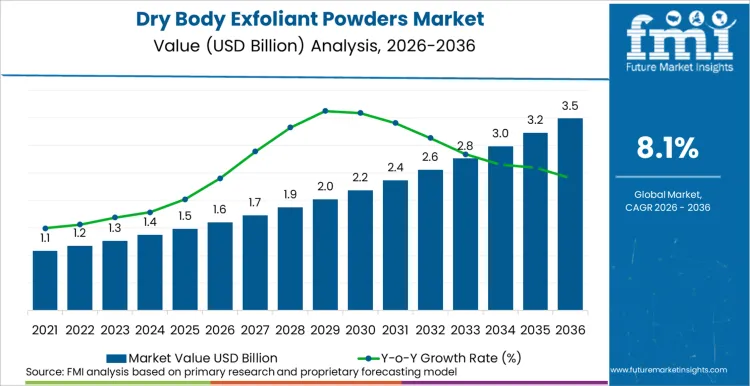
The global dry body exfoliant powders market is forecasted to reach USD 1.6 billion in 2026 and expand to USD 3.5 billion by 2036, advancing at a CAGR of 8.1%. As per FMI, this outlook demonstrates a transformation in formulation technology toward precision-milled particle systems, where traditional exfoliation methods are evolving toward multi-functional platforms. Expansion is driven by the rising demand for waterless beauty solutions, with personal care manufacturers and cosmetic brands embracing specialized powder formulations across skincare product categories globally.
By leveraging advanced particle engineering and precision grinding techniques, producers can now develop powders that offer controlled exfoliation intensity and enhanced skin conditioning through improved particle size distribution and moisture-activating mechanisms. This technological advancement allows for the creation of travel-friendly products with concentrated efficacy and reduced environmental impact, effectively addressing consumer demands for sustainable beauty solutions while maintaining performance quality throughout extended usage cycles.
"At L'Oréal, we've always believed that beauty is deeply connected to scientific discovery, a belief that has been central to our company since its inception over 115 years ago. Today, we tirelessly combine the latest scientific and technological breakthroughs with our creativity to craft innovative beauty experiences that are more effective and tailored to individual needs. This year, our pioneering advancements in light technologies at CES 2026 once again demonstrate our commitment to pushing the boundaries of new beauty solutions," said Barbara Lavernos, Deputy CEO in charge of Research, Innovation and Technology at L'Oréal Groupe.
The industry's value proposition is shifting from basic exfoliation functionality toward comprehensive skincare solutions that address specific skin texture requirements. Advanced manufacturers are integrating botanical actives, mineral complexes, and customizable particle gradations to reduce formulation limitations while improving skin conditioning outcomes. Specialized ingredient providers are gaining preference among brands, enabling direct supply partnerships and customized powder solutions across personal care, professional spa, and luxury skincare channels.
Summary of Dry Body Exfoliant Powders Market
- The dry body exfoliant powders market comprises natural exfoliating powders, synthetic particle systems, facial powder variants, and specialty body treatments used for controlled skin exfoliation across personal care, professional spa, retail, and luxury skincare applications.
- The defined scope is structured under FMI taxonomy with product categorization across conventional, organic, botanical, and mineral formulations, excluding liquid exfoliants, cream-based scrubs, mechanical devices, and professional treatment services.
- The dry body exfoliant powders market is projected to grow at a CAGR of 8.1% from 2026 to 2036, expanding from USD 1.6 billion in 2026 to USD 3.5 billion by 2036, based on FMI proprietary bottom-up ingredient revenue modeling, production cost analysis, consumer preference assessment, and formulation performance evaluation.
- The sector is transitioning toward premium botanical innovations, waterless beauty technology integration, and clean label compliance advancement, supported by primary interviews with manufacturers and ingredient suppliers and scenario modeling aligned with personal care expansion and regulatory momentum.
- Competition is concentrated among major players such as L'Oréal, Unilever, and Procter & Gamble, with strategic partnerships and acquisitions strengthening portfolios, expanding comprehensive skincare solutions, and reinforcing market leadership across beauty and personal care channels.
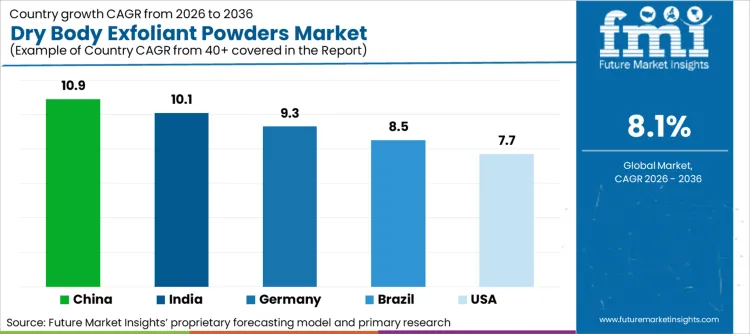
- China is projected to record the fastest growth at 10.9% CAGR through 2036, while India retains significant value share supported by favorable personal care expansion and high demand for natural, affordable skincare solutions.
Dry Body Exfoliant Powders Market Key Takeaways
| Metric | Value |
|---|---|
| Market Value (2026) | USD 1.6 billion |
| Market Forecast Value (2036) | USD 3.5 billion |
| Forecast CAGR (2026 to 2036) | 8.1% |
Source: Future Market Insights (FMI) analysis, based on proprietary forecasting model and primary research
What is Driving the Demand for Dry Body Exfoliant Powders?
Demand for dry body exfoliant powders is being propelled by the broad consumer shift toward waterless beauty products and the escalating complexity of skincare routines requiring controlled exfoliation mechanisms. The increasing preference for travel-friendly formulations in personal care applications, professional spa treatments, and luxury skincare operations has amplified demand for precision-engineered powder solutions that minimize packaging waste and enhance product concentration.
The regulatory momentum toward clean beauty requirements, exemplified by updated FDA guidelines for cosmetic ingredient transparency, is driving widespread adoption of natural exfoliating particles and additive-reduced powder systems in personal care product workflows. Manufacturers are responding to these requirements through specialized formulation features that integrate compliance measures without compromising exfoliation effectiveness. The expanding beauty market in emerging economies is shifting consumption toward cost-effective, multi-functional powder solutions, underscoring a sustained demand trajectory rooted in accessibility and performance-driven purchasing patterns.
How is the Dry Body Exfoliant Powders Market Segmented?
The dry body exfoliant powders market has been segmented based on product type, application, end user, and distribution channel. In terms of product type, the market is divided into natural/organic powders and conventional/synthetic powders. By application, the market includes body exfoliation powders, facial exfoliating powders, and other personal care powder uses. By end user, the market is segmented into women, men, and unisex products. By distribution channel, the market spans online retail/e-commerce and offline stores. Regionally, the market covers North America, Europe, East Asia, South Asia, Latin America, and Middle East and Africa.
Why Do Natural/Organic Formulations Dominate the Dry Body Exfoliant Powders Market?
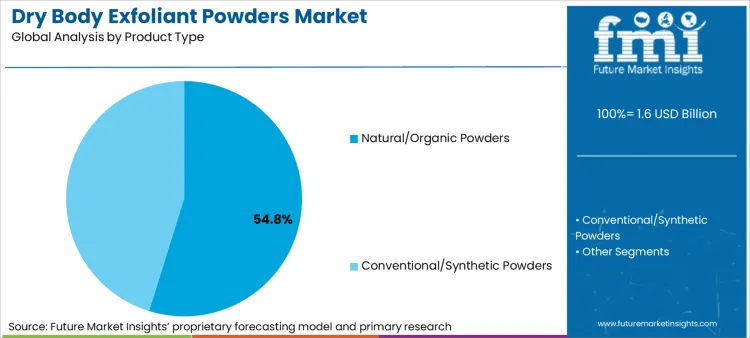
Natural/organic formulations continue to lead the market, accounting for 54.8% of the share, driven by their compatibility with sensitive skin types, clean beauty positioning, and adaptability to various skincare applications. This formulation type offers the gentleness needed for regular exfoliation routines while maintaining effectiveness across different skin conditions, making it essential for personal care brands, luxury skincare manufacturers, and professional spa applications. Natural powders provide manufacturers with formulation flexibility for custom product development and scaling capabilities while supporting consumer health preferences.
Conventional/synthetic components capture a smaller but significant portion of the market, supporting cost-effective product positioning where consistent particle performance and shelf stability are critical factors. These formulations remain popular for specific applications requiring precise exfoliation intensity and standardized texture outcomes, particularly in mass market and professional segments where performance consistency and manufacturing efficiency justify formulation costs.
How Do Application Requirements Influence Exfoliant Powder Formulation Selection?
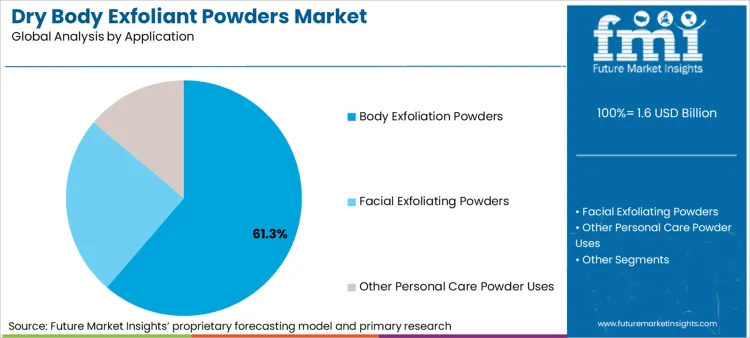
Body exfoliation applications stand as the dominant segment, commanding 61.3% of the market share. Dry exfoliant powders remain centered on body applications due to the exceptional versatility these formulations offer in texture customization and exfoliation control. Body care operations often require gentle yet effective particle systems and consistent performance outcomes, making specialized powders ideal for controlled exfoliation while maintaining skin comfort throughout extended usage cycles.
The market is shaped by the development of application-specific formulations and enhanced particle technologies that require rigorous testing to establish safety profiles and optimal particle size distribution. Facial applications demand specialized powders that integrate gentleness features and skin conditioning properties to prevent irritation while ensuring effective dead skin removal. Companies are expanding their capabilities to address these specialized requirements. Advanced testing protocols help developers optimize particle engineering and ensure consistent performance across different skin types, making these validation services essential for market approval and consumer acceptance.
How Is Technological Evolution Reshaping Dry Body Exfoliant Powders?
The dry body exfoliant powders sector is shifting from traditional mechanical exfoliation methods to integrated formulation platforms that combine controlled particle engineering, skin conditioning optimization, and moisture activation systems. Strategic partnerships between ingredient suppliers and cosmetic manufacturers are accelerating this transition toward more sophisticated powder solutions. This evolution brings exfoliant powders closer to luxury skincare standards by enabling more predictable skin texture improvement and enhanced conditioning benefits using advanced cosmetic science and particle technology innovations.
Improved formulation design reduces product waste during application cycles and enhances skin outcomes through smoother exfoliation and consistent performance delivery. The ability to customize particle gradations and incorporate active ingredients is reshaping product development decisions, allowing manufacturers to address specific skin requirements while maintaining consumer appeal and application convenience.
How Is the Dry Body Exfoliant Powders Market Evolving Globally?
Global demand for dry body exfoliant powders is increasing as manufacturers expand product portfolios while addressing skin safety requirements, performance standardization specifications, and regulatory compliance across personal care, professional spa, and luxury skincare applications. Growth demonstrates rising adoption of waterless beauty systems, application-specific formulation positioning, and performance-optimized powder solutions across cosmetic manufacturers, ingredient suppliers, and beauty retailers. Formulation selection focuses on skin compatibility, cost efficiency, and regulatory compliance under various commercial scenarios.
China records 10.9% CAGR, India records 10.1% CAGR, Germany records 9.3% CAGR, Brazil records 8.5% CAGR, and United States records 7.7% CAGR. Adoption remains driven by skincare efficacy requirements and consumer convenience rather than volume expansion alone.
| Country | CAGR (2026-2036) |
|---|---|
| China | 10.9% |
| India | 10.1% |
| Germany | 9.3% |
| Brazil | 8.5% |
| United States | 7.7% |
Source: FMI historical analysis and forecast data
China: How is Beauty Innovation Driving Market Expansion?
The primary driver in China is the significant advancement of beauty technology capabilities and premium skincare infrastructure. With the growth of luxury personal care and retail beauty industries, Chinese consumption patterns are experiencing substantial increases in waterless beauty demand, making traditional liquid exfoliation methods insufficient for current consumer preferences. This has promoted advanced powder technology adoption for personal care manufacturing to ensure product innovation and market differentiation.
Driven by this national scale of beauty market expansion, the Chinese dry body exfoliant powders market is set to grow at a 10.9% CAGR during the study period, led by massive demand in luxury skincare and e-commerce sectors. Over the next five years, the most significant opportunity lies in the integration of traditional Chinese medicine ingredients with modern powder technologies. As China targets leadership in beauty innovation, there is growing demand for natural solutions that support complex skincare requirements and premium positioning capabilities.
India: How is Personal Care Growth Reinforcing the Demand for Exfoliant Powders?
The growth of the dry body exfoliant powders market in India is primarily driven by a convergence of personal care expansion and the rising popularity of natural skincare methods, convenience-positioned beauty manufacturing. As Indian consumers increasingly adopt premium skincare routines, brands are shifting toward specialized formulations, such as botanical powders, mineral scrubs, and ayurvedic preparations, which rely on traditional exfoliation methods to offer gentle effectiveness, natural ingredients without the need for synthetic particle sourcing. This trend is accelerated by stringent Indian cosmetic regulations, pushing manufacturers to innovate with plant-based powder designs made from tested botanicals, standardized systems, or enhanced natural formulations, thereby combining tradition with regulatory compliance.
The market is being propelled by the mainstream adoption of natural personal care, a sector no longer limited to traditional ayurvedic brands but now expanding into premium cosmetic manufacturing, specialized skincare production, and professional spa services. High-profile beauty success stories have normalized the natural beauty revolution, proving that consumers are willing to invest in premium botanical powder systems that eliminate synthetic additives entirely. This shift is further supported by a demand for travel-ready and concentrated formats, where consistent, specialized exfoliant powders offer an efficient alternative to liquid scrubs, effectively merging regulatory compliance with high-performance skincare convenience.
Germany: Will Engineering Excellence Drive Premium Powder Innovation?
Germany's dry body exfoliant powders market is shaped by precision formulation capabilities and quality-focused manufacturing standards. German manufacturers are adopting advanced particle technologies that integrate safety assurance with innovative botanical features for premium market positioning. The German market is expected to grow at a 9.3% CAGR during the study period.
Over the next five years, opportunities exist in developing specialized powders for professional and luxury personal care applications. As German companies maintain leadership in precision cosmetic manufacturing, there is significant demand for powders that integrate advanced safety features, regulatory compliance, and premium functionality to serve both domestic and export markets effectively.
Brazil: Is Natural Beauty Heritage Strengthening Market Position?
In Brazil, the market is dominated by the evolution toward natural formulation standards and heritage-positioned personal care applications. This natural-first approach is essential for Brazilian manufacturers leveraging biodiversity advantages in domestic and international beauty applications. The Brazilian market is projected to grow at a 8.5% CAGR during the study period.
Over the next five years, the rise of natural beauty consciousness and expanding middle-class consumption will necessitate high-quality botanical solutions for skincare and personal care products. Brazil's growing role as a natural ingredients hub for global beauty brands creates opportunities for sustainable powder solutions that meet international quality standards while addressing local market preferences and environmental sensitivity requirements.
United States: How is Premium Skincare Innovation Shaping Market Development?
The United States market focuses on innovation and specialized applications for premium personal care and professional skincare products. This approach emphasizes performance validation and advanced functionality while maintaining competitive positioning in global markets. The United States market is set to grow at a 7.7% CAGR during the study period.
Over the next five years, opportunities lie in developing specialized powders for luxury applications and clinical formulations. As regulatory requirements become more stringent for cosmetic manufacturing applications, there is growing demand for powders that integrate clean beauty features, precise particle mechanisms, and premium functionality while maintaining application convenience and manufacturing efficiency.
Who are the Major Players Active in the Dry Body Exfoliant Powders Market?
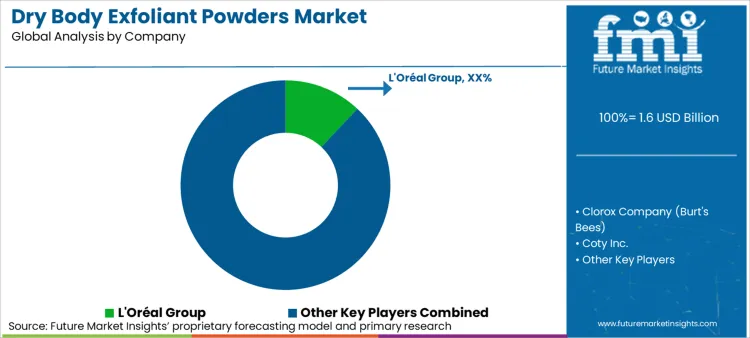
With skincare formulations becoming more sophisticated and regulatory requirements being more stringent, major players like L'Oréal, Unilever, and Procter & Gamble are competing on their ability to offer comprehensive beauty solutions that integrate formulation precision with regulatory compliance. These industry leaders are investing in advanced particle technologies and botanical innovations to provide seamless integration capabilities, allowing beauty brands to focus on product development while outsourcing specialized powder requirements.
The market is observing distinct regional specialization in competitive strategy. While North American firms like Neutrogena and Clinique maintain leadership through clinical formulation expertise and proximity to major beauty retailers, European players like Kiehl's are advancing precision particle engineering and natural ingredient capabilities. This has created an innovation cycle where ingredient providers are diversifying into specialized applications such as sensitive skin formulations and luxury powder systems to address the complex requirements of premium and regulated beauty products.
Key Industry Developments:
- In June 2025, L'Oréal inked a deal to acquire Color Wow, one of the world's fastest growing and most innovative professional haircare brands to broaden its customer base.
- In June 2025, Unilever announced to acquire men’s personal care brand Dr. Squatch.
Key Players in the Dry Body Exfoliant Powders Market
- L'Oréal Group
- Clorox Company (Burt's Bees)
- Coty Inc.
- Unilever PLC (Tatcha, Dove, Dermalogica)
- Shiseido Company, Limited
- Estée Lauder Companies Inc. (Clinique)
- Johnson & Johnson (Neutrogena)
- Procter & Gamble Co.
- Paula's Choice, Inc.
Market Definition
The dry body exfoliant powders market refers to the global beauty applications of specialized powder formulation systems designed to support controlled skin exfoliation through waterless application processes. It includes both natural and synthetic powder offerings, with segments that cater to various application requirements such as personal care, professional spa, and luxury skincare manufacturing. The market size is measured in USD billion and analyzed over the 2026 to 2036 period.
The dry body exfoliant powders market includes formulation systems categorized by product type, application, end user, and distribution channel, utilized through personal care manufacturing and retail applications. The market is expanding due to growing demand for waterless beauty solutions, formulation innovation requirements, and evolving consumer preferences toward natural ingredients and concentrated product effectiveness capabilities.
Market Inclusion
Included in the dry body exfoliant powders market scope are powder formulation systems categorized by product type (natural/organic powders, conventional/synthetic powders), application (body exfoliation, facial exfoliation, other personal care uses), end user (women, men, unisex), and distribution channel (online retail, offline stores). The scope includes powder systems with focus on skin safety, performance consistency, and regulatory compliance, particularly those marketed through beauty retailers, cosmetic manufacturers, and personal care companies.
Geographically, the market encompasses key regions such as North America, Europe, East Asia, South Asia, Latin America, and the Middle East and Africa, with country-level analysis for significant markets like China, India, Germany, Brazil, United States, United Kingdom, and Japan.
Market Exclusion
Excluded from the dry body exfoliant powders market scope are liquid exfoliation solutions and products not designed for powder-based skin exfoliation, such as cream scrubs, gel exfoliants, and mechanical exfoliation devices. Additionally, formulations not intended for personal care applications are not included.
The market excludes non-powder beauty products, as well as formulation systems that are not marketed as exfoliating solutions, such as cleansing powders or treatment masks. Products with non-compliant ingredient specifications or those that do not meet regional cosmetic safety standards for personal care applications are outside the market's defined scope.
Scope of the Report
| Items | Values |
|---|---|
| Quantitative Units | USD 1.6 billion |
| Product Type | Natural/Organic Powders; Conventional/Synthetic Powders |
| Application | Body Exfoliation Powders; Facial Exfoliating Powders; Other Personal Care Powder Uses |
| End User | Women; Men; Unisex Products |
| Distribution Channel | Online Retail/E-commerce; Offline Stores |
| Regions Covered | North America, Europe, East Asia, South Asia, Latin America, Middle East & Africa |
| Countries Covered | China, India, Germany, Brazil, United States, United Kingdom, Japan, and 40+ countries |
| Key Companies Profiled | L'Oréal; Unilever; Procter & Gamble; Estée Lauder; Shiseido; Others |
| Additional Attributes | Revenue analysis by product type and application; performance in personal care applications and skincare capabilities across beauty manufacturers, ingredient suppliers, and retail facilities; formulation safety enhancement, skin conditioning optimization, and performance reliability under various application scenarios; impact on skin texture, application convenience, and product differentiation during consumer usage; compatibility with skincare requirements and consumer preferences; procurement dynamics driven by quality positioning, regulatory compliance programs, and long-term supply partnerships. |
Dry Body Exfoliant Powders Market by Segment
Product Type:
- Natural/Organic Powders
- Conventional/Synthetic Powders
Application:
- Body Exfoliation Powders
- Facial Exfoliating Powders
- Other Personal Care Powder Uses
End User:
- Women
- Men
- Unisex Products
Distribution Channel:
- Online Retail/E-commerce
- Offline Stores
Region
- East Asia
- China
- Japan
- South Korea
- Taiwan
- Rest of East Asia
- Europe
- Germany
- United Kingdom
- France
- Italy
- Spain
- BENELUX
- Nordic
- Rest of Europe
- North America
- United States
- Canada
- Mexico
- South Asia
- India
- Australia & New Zealand
- Southeast Asia
- Rest of South Asia
- Latin America
- Brazil
- Chile
- Colombia
- Argentina
- Rest of Latin America
- Middle East & Africa
- Kingdom of Saudi Arabia
- Other GCC Countries
- Turkey
- South Africa
- Other African Union
- Rest of Middle East & Africa
Bibliography
- International Cosmetic Ingredient Association. (2023). Global beauty ingredient trends and personal care applications: Recommendations from formulation assessments. Personal Care Innovation Initiative.
- Thompson, R., & co-authors. (2023). Advanced particle technologies and beauty product manufacturing: A review on recent developments. Cosmetic Technology Journal, 18(2), 892.
- Martinez, A. (2024). Fostering natural personal care industry: Global trends and efficient formulation systems. International Journal of Cosmetic Science.
Frequently Asked Questions
How big is the dry body exfoliant powders market in 2026?
The global dry body exfoliant powders market is estimated to be valued at USD 1.6 billion in 2026.
What will be the size of dry body exfoliant powders market in 2036?
The market size for the dry body exfoliant powders market is projected to reach USD 3.5 billion by 2036.
How much will be the dry body exfoliant powders market growth between 2026 and 2036?
The dry body exfoliant powders market is expected to grow at a 8.1% CAGR between 2026 and 2036.
What are the key product types in the dry body exfoliant powders market?
The key product types in dry body exfoliant powders market are natural/organic powders and conventional/synthetic powders.
Which application segment to contribute significant share in the dry body exfoliant powders market in 2026?
In terms of application, body exfoliation powders segment to command 61.3% share in the dry body exfoliant powders market in 2026.
Preview the report firsthand - request a free sample
Get SampleGet the brochure for pricing and purchase details.
Get PDFTable of Content
- Executive Summary
- Global Market Outlook
- Demand-side Trends
- Supply-side Trends
- Technology Roadmap Analysis
- Analysis and Recommendations
- Market Overview
- Market Coverage / Taxonomy
- Market Definition / Scope / Limitations
- Research Methodology
- Chapter Orientation
- Analytical Lens and Working Hypotheses
- Market Structure, Signals, and Trend Drivers
- Company Annual and Sustainability Reports
- Peer-reviewed Journals and Academic Literature
- Corporate Websites, Product Literature, and Technical Notes
- Earnings Decks and Investor Briefings
- Statutory Filings and Regulatory Disclosures
- Technical White Papers and Standards Notes
- Trade Journals, Industry Magazines, and Analyst Briefs
- Conference Proceedings, Webinars, and Seminar Materials
- Government Statistics Portals and Public Data Releases
- Press Releases and Reputable Media Coverage
- Specialist Newsletters and Curated Briefings
- Sector Databases and Reference Repositories
- FMI Internal Proprietary Databases and Historical Market Datasets
- Subscription Datasets and Paid Sources
- Social Channels, Communities, and Digital Listening Inputs
- Additional Desk Sources
- Expert Input and Fieldwork (Primary Evidence)
- Primary Modes
- Qualitative Interviews and Expert Elicitation
- Quantitative Surveys and Structured Data Capture
- Blended Approach
- Why Primary Evidence is Used
- Field Techniques
- Interviews
- Surveys
- Focus Groups
- Observational and In-context Research
- Social and Community Interactions
- Stakeholder Universe Engaged
- C-suite Leaders
- Board Members
- Presidents and Vice Presidents
- R&D and Innovation Heads
- Technical Specialists
- Domain Subject-matter Experts
- Scientists
- Physicians and Other Healthcare Professionals
- Governance, Ethics, and Data Stewardship
- Research Ethics
- Data Integrity and Handling
- Primary Modes
- Tooling, Models, and Reference Databases
- Data Engineering and Model Build
- Data Acquisition and Ingestion
- Cleaning, Normalisation, and Verification
- Synthesis, Triangulation, and Analysis
- Quality Assurance and Audit Trail
- Market Background
- Market Dynamics
- Drivers
- Restraints
- Opportunity
- Trends
- Scenario Forecast
- Demand in Optimistic Scenario
- Demand in Likely Scenario
- Demand in Conservative Scenario
- Opportunity Map Analysis
- Product Life Cycle Analysis
- Supply Chain Analysis
- Investment Feasibility Matrix
- Value Chain Analysis
- PESTLE and Porter’s Analysis
- Regulatory Landscape
- Regional Parent Market Outlook
- Production and Consumption Statistics
- Import and Export Statistics
- Market Dynamics
- Global Market Analysis 2021 to 2025 and Forecast, 2026 to 2036
- Historical Market Size Value (USD Million) Analysis, 2021 to 2025
- Current and Future Market Size Value (USD Million) Projections, 2026 to 2036
- Y-o-Y Growth Trend Analysis
- Absolute $ Opportunity Analysis
- Global Market Pricing Analysis 2021 to 2025 and Forecast 2026 to 2036
- Global Market Analysis 2021 to 2025 and Forecast 2026 to 2036, By Product Type
- Introduction / Key Findings
- Historical Market Size Value (USD Million) Analysis By Product Type , 2021 to 2025
- Current and Future Market Size Value (USD Million) Analysis and Forecast By Product Type , 2026 to 2036
- Natural/Organic Powders
- Conventional/Synthetic Powders
- Natural/Organic Powders
- Y-o-Y Growth Trend Analysis By Product Type , 2021 to 2025
- Absolute $ Opportunity Analysis By Product Type , 2026 to 2036
- Global Market Analysis 2021 to 2025 and Forecast 2026 to 2036, By Application
- Introduction / Key Findings
- Historical Market Size Value (USD Million) Analysis By Application, 2021 to 2025
- Current and Future Market Size Value (USD Million) Analysis and Forecast By Application, 2026 to 2036
- Body Exfoliation Powders
- Facial Exfoliating Powders
- Other Personal Care Powder Uses
- Body Exfoliation Powders
- Y-o-Y Growth Trend Analysis By Application, 2021 to 2025
- Absolute $ Opportunity Analysis By Application, 2026 to 2036
- Global Market Analysis 2021 to 2025 and Forecast 2026 to 2036, By Region
- Introduction
- Historical Market Size Value (USD Million) Analysis By Region, 2021 to 2025
- Current Market Size Value (USD Million) Analysis and Forecast By Region, 2026 to 2036
- North America
- Latin America
- Western Europe
- Eastern Europe
- East Asia
- South Asia and Pacific
- Middle East & Africa
- Market Attractiveness Analysis By Region
- North America Market Analysis 2021 to 2025 and Forecast 2026 to 2036, By Country
- Historical Market Size Value (USD Million) Trend Analysis By Market Taxonomy, 2021 to 2025
- Market Size Value (USD Million) Forecast By Market Taxonomy, 2026 to 2036
- By Country
- USA
- Canada
- Mexico
- By Product Type
- By Application
- By Country
- Market Attractiveness Analysis
- By Country
- By Product Type
- By Application
- Key Takeaways
- Latin America Market Analysis 2021 to 2025 and Forecast 2026 to 2036, By Country
- Historical Market Size Value (USD Million) Trend Analysis By Market Taxonomy, 2021 to 2025
- Market Size Value (USD Million) Forecast By Market Taxonomy, 2026 to 2036
- By Country
- Brazil
- Chile
- Rest of Latin America
- By Product Type
- By Application
- By Country
- Market Attractiveness Analysis
- By Country
- By Product Type
- By Application
- Key Takeaways
- Western Europe Market Analysis 2021 to 2025 and Forecast 2026 to 2036, By Country
- Historical Market Size Value (USD Million) Trend Analysis By Market Taxonomy, 2021 to 2025
- Market Size Value (USD Million) Forecast By Market Taxonomy, 2026 to 2036
- By Country
- Germany
- UK
- Italy
- Spain
- France
- Nordic
- BENELUX
- Rest of Western Europe
- By Product Type
- By Application
- By Country
- Market Attractiveness Analysis
- By Country
- By Product Type
- By Application
- Key Takeaways
- Eastern Europe Market Analysis 2021 to 2025 and Forecast 2026 to 2036, By Country
- Historical Market Size Value (USD Million) Trend Analysis By Market Taxonomy, 2021 to 2025
- Market Size Value (USD Million) Forecast By Market Taxonomy, 2026 to 2036
- By Country
- Russia
- Poland
- Hungary
- Balkan & Baltic
- Rest of Eastern Europe
- By Product Type
- By Application
- By Country
- Market Attractiveness Analysis
- By Country
- By Product Type
- By Application
- Key Takeaways
- East Asia Market Analysis 2021 to 2025 and Forecast 2026 to 2036, By Country
- Historical Market Size Value (USD Million) Trend Analysis By Market Taxonomy, 2021 to 2025
- Market Size Value (USD Million) Forecast By Market Taxonomy, 2026 to 2036
- By Country
- China
- Japan
- South Korea
- By Product Type
- By Application
- By Country
- Market Attractiveness Analysis
- By Country
- By Product Type
- By Application
- Key Takeaways
- South Asia and Pacific Market Analysis 2021 to 2025 and Forecast 2026 to 2036, By Country
- Historical Market Size Value (USD Million) Trend Analysis By Market Taxonomy, 2021 to 2025
- Market Size Value (USD Million) Forecast By Market Taxonomy, 2026 to 2036
- By Country
- India
- ASEAN
- Australia & New Zealand
- Rest of South Asia and Pacific
- By Product Type
- By Application
- By Country
- Market Attractiveness Analysis
- By Country
- By Product Type
- By Application
- Key Takeaways
- Middle East & Africa Market Analysis 2021 to 2025 and Forecast 2026 to 2036, By Country
- Historical Market Size Value (USD Million) Trend Analysis By Market Taxonomy, 2021 to 2025
- Market Size Value (USD Million) Forecast By Market Taxonomy, 2026 to 2036
- By Country
- Kingdom of Saudi Arabia
- Other GCC Countries
- Turkiye
- South Africa
- Other African Union
- Rest of Middle East & Africa
- By Product Type
- By Application
- By Country
- Market Attractiveness Analysis
- By Country
- By Product Type
- By Application
- Key Takeaways
- Key Countries Market Analysis
- USA
- Pricing Analysis
- Market Share Analysis, 2025
- By Product Type
- By Application
- Canada
- Pricing Analysis
- Market Share Analysis, 2025
- By Product Type
- By Application
- Mexico
- Pricing Analysis
- Market Share Analysis, 2025
- By Product Type
- By Application
- Brazil
- Pricing Analysis
- Market Share Analysis, 2025
- By Product Type
- By Application
- Chile
- Pricing Analysis
- Market Share Analysis, 2025
- By Product Type
- By Application
- Germany
- Pricing Analysis
- Market Share Analysis, 2025
- By Product Type
- By Application
- UK
- Pricing Analysis
- Market Share Analysis, 2025
- By Product Type
- By Application
- Italy
- Pricing Analysis
- Market Share Analysis, 2025
- By Product Type
- By Application
- Spain
- Pricing Analysis
- Market Share Analysis, 2025
- By Product Type
- By Application
- France
- Pricing Analysis
- Market Share Analysis, 2025
- By Product Type
- By Application
- India
- Pricing Analysis
- Market Share Analysis, 2025
- By Product Type
- By Application
- ASEAN
- Pricing Analysis
- Market Share Analysis, 2025
- By Product Type
- By Application
- Australia & New Zealand
- Pricing Analysis
- Market Share Analysis, 2025
- By Product Type
- By Application
- China
- Pricing Analysis
- Market Share Analysis, 2025
- By Product Type
- By Application
- Japan
- Pricing Analysis
- Market Share Analysis, 2025
- By Product Type
- By Application
- South Korea
- Pricing Analysis
- Market Share Analysis, 2025
- By Product Type
- By Application
- Russia
- Pricing Analysis
- Market Share Analysis, 2025
- By Product Type
- By Application
- Poland
- Pricing Analysis
- Market Share Analysis, 2025
- By Product Type
- By Application
- Hungary
- Pricing Analysis
- Market Share Analysis, 2025
- By Product Type
- By Application
- Kingdom of Saudi Arabia
- Pricing Analysis
- Market Share Analysis, 2025
- By Product Type
- By Application
- Turkiye
- Pricing Analysis
- Market Share Analysis, 2025
- By Product Type
- By Application
- South Africa
- Pricing Analysis
- Market Share Analysis, 2025
- By Product Type
- By Application
- USA
- Market Structure Analysis
- Competition Dashboard
- Competition Benchmarking
- Market Share Analysis of Top Players
- By Regional
- By Product Type
- By Application
- Competition Analysis
- Competition Deep Dive
- L'Oréal Group
- Overview
- Product Portfolio
- Profitability by Market Segments (Product/Age /Sales Channel/Region)
- Sales Footprint
- Strategy Overview
- Marketing Strategy
- Product Strategy
- Channel Strategy
- Clorox Company (Burt's Bees)
- Coty Inc.
- Unilever PLC (Tatcha, Dove, Dermalogica)
- Shiseido Company, Limited
- L'Oréal Group
- Competition Deep Dive
- Assumptions & Acronyms Used


