

- Industry Size (2026)
- USD 1.4 Bn
- Forecast (2036)
- USD 3.0 Bn
- CAGR (2026 to 2036)
- 7.8%
Low Frequency RFID Tag Market Forecast and Outlook 2026 to 2036
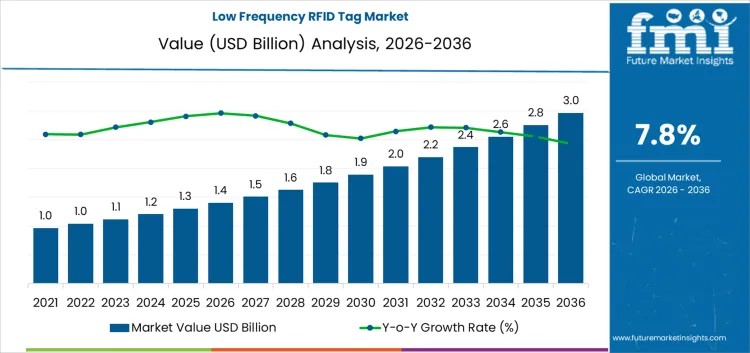
The low frequency RFID tag market is projected to expand from USD 1.4 billion in 2026 to USD 3.0 billion by 2036, corresponding to a CAGR of 7.80%. Demand is concentrated in applications where read reliability near metal or liquids matters more than data rate or range, such as animal identification, access control, and industrial asset tracking. Adoption remains uneven because many sectors have shifted to higher frequency systems where conditions allow. Geographic cost advantages favor regions with large scale inlay production and antenna winding capacity, particularly in East Asia, which shapes global sourcing and pricing.
System integrators and end users typically select these tags as part of closed loop identification schemes rather than as interchangeable components. Once encoded into equipment, livestock registries, or security systems, tag formats are rarely changed because of reprogramming and database migration costs. Certification rules in animal tracking and access systems also limit substitution. Smaller markets continue to rely on this technology due to environmental tolerance and legacy system compatibility. The market grows through stable niche use cases and gradual extension of regulated identification programs, not through broad replacement of other RFID standards.
Quick Stats for Low Frequency RFID Tag Market
- Low Frequency RFID Tag Market Value (2026): USD 1.4 billion
- Low Frequency RFID Tag Market Forecast Value (2036): USD 3.0 billion
- Low Frequency RFID Tag Market Forecast CAGR 2026 to 2036: 7.8%
- Leading Type in Low Frequency RFID Tag Market: LF RFID proximity tags
- Key Growth Regions in Low Frequency RFID Tag Market: Asia Pacific, North America, Europe
- Top Players in Low Frequency RFID Tag Market: Zebra Technologies, HID Global, Alien Technology, Impinj, NXP Semiconductors, Smartrac (Avery Dennison), GAO RFID
What is the Growth Forecast for Low Frequency RFID Tag Market through 2036?
The low frequency RFID tag market has been growing through slow accumulation rather than through step-change adoption. The value sits around USD 0.9 billion at the start of the period and moves to about USD 1.0 billion and USD 1.1 billion as expansion remains tightly linked to animal identification, access control, and immobilizer systems. Even when the market reaches USD 1.2 billion and then USD 1.3 billion, momentum stays measured because these applications scale by population and regulation, not by technology cycles. The shift to roughly USD 1.4 billion and USD 1.5 billion reflects steady growth in tagged livestock, pets, and secured assets rather than any structural change in how the technology is used. Pricing remains stable, and unit growth does most of the work.
As the installed base compounds, the market gradually moves through USD 1.6 billion, USD 1.7 billion, and USD 1.8 billion, driven increasingly by coverage expansion and system refresh rather than by new use cases. The step beyond USD 1.9 billion and into the USD 2.1 billion and USD 2.3 billion range marks the point where replacement demand and regulatory programs begin to contribute as much as first-time tagging. Later growth toward USD 2.5 billion, USD 2.7 billion, and finally about USD 3.0 billion is dominated by broader geographic rollout of the same core applications and higher tagging density per herd, facility, or secured system. Throughout the period, the market remains conservative and reliability-driven, with certification continuity and compatibility valued more than new features or higher data rates.
Low Frequency RFID Tag Market Key Takeaways
| Metric | Value |
|---|---|
| Market Value (2026) | USD 1.4 billion |
| Forecast Value (2036) | USD 3.0 billion |
| Forecast CAGR 2026 to 2036 | 7.8% |
How Is the Low-Frequency RFID Tag Market Supporting Asset Identification and Tracking?
Low-frequency (LF) RFID tags are increasingly adopted for reliable identification and tracking of assets, livestock, and access-controlled environments. Historically, identification relied on barcodes, magnetic strips, or manual logs, which limited read range, durability, and real-time visibility. Modern LF RFID tags operate at 125-134 kHz, offering robust performance in challenging environments, including metal-rich or high-moisture settings, and enabling contactless reading over short distances. Asset managers, logistics providers, animal husbandry operators, and security administrators prioritize tag reliability, read accuracy, and compatibility with existing RFID readers. Early adoption focused on livestock tracking and access control, while current demand spans industrial inventory management, supply chain monitoring, and event access systems, driven by operational efficiency, security requirements, and regulatory compliance. Tag durability, read range, and environmental resistance influence supplier selection.
Operational efficiency, asset visibility, and security considerations are shaping market growth. Compared with high- or ultra-high-frequency RFID tags, LF solutions emphasize robust performance in challenging conditions, low interference, and long-term reliability. Cost structures depend on tag material, encoding technology, and durability, concentrating margins among suppliers capable of delivering high-performance, certified RFID components. Organizations adopt LF RFID tags to track assets accurately, reduce losses, and streamline operational processes. By 2036, low-frequency RFID tags are expected to be widely deployed in industrial, agricultural, and access-control applications, supporting reliable identification, process efficiency, and asset management across diverse environments.
What Factors Are Shaping the Demand for Low Frequency RFID Tags, Segment wise by Technology Type and Application, in 2026?
The low frequency RFID tag market in 2026 is segmented by technology type and by application. By technology, demand is divided into LF RFID proximity tags, read only tags, writable tags, and on metal tags, each designed around different memory needs, attachment conditions, and read reliability in challenging environments. By application, demand is organized around animal identification, access control and security, supply chain and inventory, and healthcare asset tracking, which differ in deployment scale, regulatory oversight, and tolerance for read errors. These segments reflect how users prioritize reliability in noisy or metal rich environments over read range or data throughput.
Why Do LF RFID Proximity Tags Dominate Through Installed Base Scale?
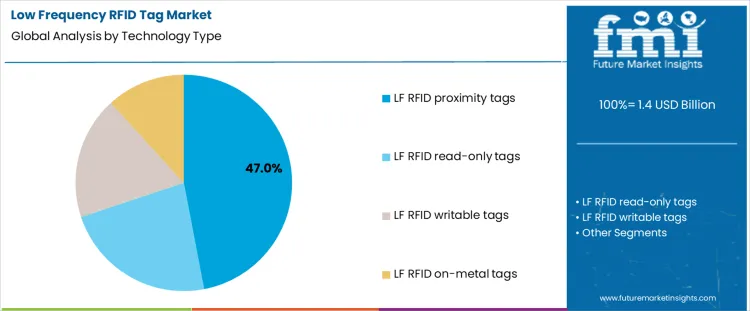
LF RFID proximity tags account for about 47% of demand in 2026, largely because of the size and inertia of their installed base in long running identification systems. Animal tagging programs, basic access systems, and legacy industrial identification setups were built around LF proximity technology many years ago and continue to operate with the same architecture. Once such systems are deployed, operators tend to replace tags like for like to avoid changing readers, software, and procedures. The technology is also tolerant of water, dirt, and biological tissue, which reinforces its use in livestock and pet identification. This accumulated infrastructure and conservative replacement behavior keep proximity tags at the center of unit volumes.
Read only, writable, and on metal tags serve more specific needs. Writable tags support limited data updates, yet many LF systems do not require in field rewriting. On metal tags solve attachment problems on tools and equipment, but their use is tied to narrower industrial cases. These categories grow where function demands them, but they do not displace the broad base of proximity tags that are already embedded in millions of existing systems. The weight of this installed base continues to anchor demand around the simplest and most widely deployed LF tag format.
Why Does Animal Identification Lead Application Demand?
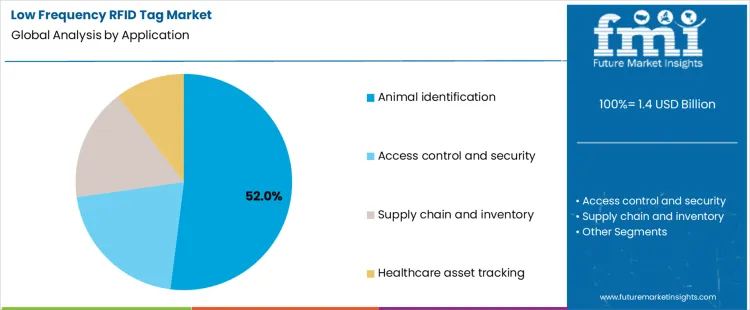
Animal identification represents about 52% of demand in 2026 because LF RFID remains the standard technology in many livestock and companion animal registration programs. Regulatory frameworks, veterinary practices, and farm management systems in many regions were designed around LF chips because of their reliable performance in biological environments. Once an identification scheme is mandated, every animal requires a tag, which creates very large, recurring volume demand. Replacement and new births add continuous flow to this base. The low cost per tag and the long service life also fit the economics of agriculture and veterinary use. This scale and institutionalization explain why animal identification dominates application demand.
Access control, supply chain, and healthcare asset tracking follow different adoption patterns. Access systems increasingly migrate to higher frequency technologies for longer range or higher security features. Supply chain tracking favors UHF for bulk reading, which limits the role of LF. Healthcare asset tracking uses LF mainly in specific interference sensitive areas rather than across whole hospitals. These applications remain important, yet they are more selective and fragmented. In contrast, animal identification programs are universal within their scope, which keeps them as the primary volume driver for low frequency RFID tags.
How Are the Key Dynamics of Traceability Mandates, Integration Friction, and Platform Standardization Reshaping the Low Frequency RFID Tag Market through 2036?
The category is being shaped by how industries formalize identification and tracking rather than by tag technology itself. Low frequency RFID remains entrenched in applications where reliability around metal, liquids, and harsh environments matters more than read speed or range. At the same time, adoption is moderated by integration work and conservative operational practices. As organizations move toward standardized identification platforms across sites and processes, LF tags are increasingly specified as part of system architectures rather than as standalone consumables. The result is a market driven by compliance programs, asset governance, and platform choices, where volumes follow institutional rollout plans more than ad hoc labeling decisions.
Why Are Traceability and Compliance Requirements Sustaining Demand for Low Frequency RFID Tags?
Demand is anchored in regulated and mission critical environments. Animal identification, access control, healthcare asset tracking, and industrial process control require dependable identification that works in difficult conditions and supports auditable records. In these settings, LF RFID is trusted because it is stable, mature, and tolerant of interference. Once a regulatory or procedural framework mandates electronic identification, tags become a required input rather than an optional upgrade. Replacement cycles and expansion into new sites then drive steady volume. This ties demand to program rollouts and compliance coverage rather than to experimentation with newer but less proven identification technologies.
What Integration Effort and Organizational Conservatism Are Limiting Faster Migration or Expansion?
The main barrier is system inertia, not tag performance. LF RFID systems are often embedded in long established workflows, equipment, and databases. Changing or expanding them requires updating readers, software, and procedures, which creates operational risk. Many organizations prefer to keep proven setups rather than introduce parallel systems or migrate to different frequencies. Budget holders also prioritize core operations over infrastructure changes that do not show immediate productivity gains. These factors slow large scale upgrades and keep new deployments concentrated in sectors where LF is already accepted rather than opening many new application domains quickly.
How Is Platform Standardization Changing How LF RFID Tags Are Procured and Deployed?
The trend is toward governed identification platforms. Large organizations increasingly define standard tagging and reader architectures that are reused across sites, plants, or facilities. LF tags that fit into these standards benefit from repeat orders across programs without being re evaluated each time. Procurement shifts toward framework agreements with a small number of approved suppliers to guarantee continuity and compatibility. This reduces fragmentation but also raises switching costs. Over time, the market becomes less about individual tag sales and more about being embedded in long term identification systems that support multi site operations and audited processes.
What is the Demand for Low Frequency RFID Tags by Country?
| Country | CAGR (%) |
|---|---|
| USA | 7.2% |
| UK | 6.8% |
| China | 8.5% |
| India | 9.0% |
| Brazil | 7.5% |
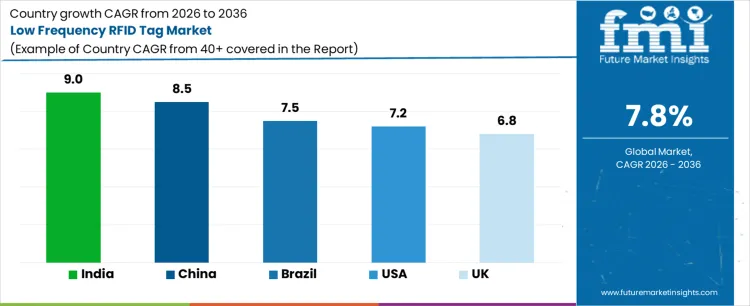
Demand for low frequency RFID tags is rising as industries adopt tracking and identification solutions for inventory management, asset tracking, and access control. India leads with a 9.0% CAGR, driven by increasing adoption in manufacturing, logistics, and retail sectors. China follows at 8.5%, supported by industrial automation, supply chain optimization, and adoption of RFID-enabled processes. Brazil records 7.5% growth, shaped by demand in logistics and manufacturing applications. The USA grows at 7.2%, influenced by integration in inventory and asset management systems. The UK shows 6.8% CAGR, reflecting steady adoption of low frequency RFID technology across commercial and industrial sectors.
How is the United States experiencing growth in the low frequency RFID tag market?
United States is experiencing growth at a CAGR of 7.2%, driven by widespread adoption in livestock monitoring, access control, and inventory tracking across California, Texas, and Iowa. Installed base size is substantial, and replacement cycles are predictable, encouraging steady demand. Industry concentration in agriculture, logistics, and security sectors anchors growth. Investments focus on durable tag performance, system integration, and compliance with federal standards. Growth reflects the need for operational efficiency, enhanced traceability, and reliable asset tracking across multiple sectors.
- Livestock monitoring and access control drive adoption.
- Industrial and agricultural hubs concentrate demand.
- Tag durability and system integration guide investment.
- Predictable replacement cycles support steady growth.
How is the United Kingdom witnessing growth in the low frequency RFID tag market?
United Kingdom is witnessing growth at a CAGR of 6.8%, supported by applications in library management, retail inventory control, and transportation systems in London, Manchester, and Birmingham. Market concentration is moderate, with regional dispersion across urban and suburban centers. Labor cost structure and productivity pressures drive preference for low-maintenance RFID tags. Investments prioritize tag readability, integration with management software, and compliance with UK data and electrical standards. Growth reflects increasing adoption of RFID for process optimization, asset tracking, and public sector management.
- Libraries, retail, and transport sectors drive adoption.
- Urban and suburban hubs concentrate demand.
- Low-maintenance and readable tags enhance efficiency.
- System integration and regulatory compliance guide investment.
How is China experiencing growth in the low frequency RFID tag market?
China is experiencing growth at a CAGR of 8.5%, fueled by large-scale logistics, industrial tracking, and livestock management in Guangdong, Jiangsu, and Zhejiang. Installed base expansion and shorter replacement cycles support rapid adoption. Industry concentration in industrial clusters anchors demand, while productivity pressure encourages automated and high-throughput RFID systems. Investments focus on domestic production, integration with IoT platforms, and compliance with national standards. Growth reflects industrial expansion, dense logistics networks, and strong government support for asset tracking technologies.
- Logistics and industrial applications drive adoption.
- Industrial clusters concentrate demand.
- Automated systems improve productivity.
- Domestic production and standards compliance guide investment.
How is India witnessing growth in the low frequency RFID tag market?
India is experiencing growth at a CAGR of 9%, supported by increasing deployment in agriculture, transportation, and warehouse management across Maharashtra, Karnataka, and Tamil Nadu. Installed base size is growing, with replacement cycles aligned with livestock and industrial monitoring needs. Industry concentration in key urban and agricultural hubs anchors demand. Investments focus on cost-effective, durable tags and integration with digital management systems. Growth reflects rising traceability requirements, operational efficiency pressures, and adoption of scalable RFID solutions in both urban and rural markets.
- Agriculture and transportation drive adoption.
- Urban and rural hubs concentrate demand.
- Durable, cost-effective tags enhance adoption.
- Integration with digital systems supports efficiency.
How is Brazil experiencing growth in the low frequency RFID tag market?
Brazil is experiencing growth at a CAGR of 7.5%, driven by applications in livestock tracking, industrial inventory management, and urban transportation in São Paulo, Rio de Janeiro, and Paraná. Installed base size is moderate, with replacement cycles aligned to operational needs. Market concentration is moderate, while regional dispersion requires reliable RFID tags capable of diverse environmental conditions. Investments focus on tag durability, system integration, and compliance with national regulations. Growth reflects increasing operational efficiency demands, adoption in agricultural and industrial sectors, and integration into urban transport monitoring systems.
- Livestock and industrial tracking drive adoption.
- Urban and regional hubs concentrate demand.
- Durable tags enhance reliability.
- System integration and compliance guide investment.
Who Are the Key Competitors in the Low Frequency RFID Tag Market and How Do They Compete?
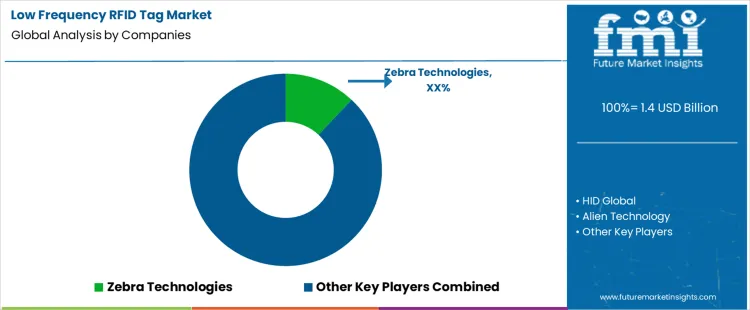
Competition in the low frequency (LF) RFID tag market is shaped by tag reliability, read range performance, and compatibility with access control, animal identification, and asset tracking systems. Zebra Technologies supplies LF RFID tags and encoders engineered for consistent read/write performance and integration with its broader printing and scanning platforms. HID Global provides LF tags optimized for secure access control applications and interoperability with credential management systems. Alien Technology develops tag chips and inlays with stable performance in challenging environments and broad reader compatibility. Impinj offers RFID solutions with ecosystem support and device level integration for scalable deployments. NXP Semiconductors supplies LF RFID ICs that underpin tag interoperability and reliable field performance.
Smartrac (Avery Dennison) delivers LF tag inlays and finished tags tailored to specific use cases such as animal tagging or industrial tracking and emphasizes supply chain flexibility. GAO RFID provides LF tags and readers designed for cost effective deployments in asset tracking and identification scenarios. Other regional and niche suppliers focus on custom form factors, specialized encapsulation for harsh conditions, or integration with sensors. Competitive differentiation arises from tag durability, form factor variety, read range stability, manufacturing quality, and compliance with global LF RFID standards. Suppliers that support comprehensive ecosystems, documentation, and integration with end user systems attract buyers in sectors such as logistics, access control, and livestock management.
Key Players in the Low Frequency RFID Tag Market
- Garmin
- TomTom
- Trimble
- Aptiv (via Mojio)
- CalAmp
- Teletrac Navman
- Sierra Wireless
Scope of the Report
| Items | Values |
|---|---|
| Quantitative Units (2026) | USD billion |
| Device Type | Personal GPS Trackers, Vehicle Trackers, Asset Trackers, Wearable GPS Devices |
| Application | Fleet Management, Personal Safety and Fitness, Asset Tracking and Logistics, Pet Tracking |
| Regions Covered | Asia Pacific, Europe, North America, Latin America, Middle East & Africa |
| Countries Covered | China, Japan, South Korea, India, Australia & New Zealand, ASEAN, Germany, United Kingdom, France, Italy, Spain, Nordic, BENELUX, United States, Canada, Mexico, Brazil, Chile, Saudi Arabia, Turkey, South Africa, and other regional markets |
| Key Companies Profiled | Garmin, TomTom, Trimble, Aptiv (via Mojio), CalAmp, Teletrac Navman, Sierra Wireless |
| Additional Attributes | Dollar sales by device type and application; fleet management as the largest deployment segment; personal trackers leading unit volumes; growth driven by fleet digitization and regulatory enforcement; replacement of legacy 2G/3G units and multi-device fleet deployments; shift toward platform-based, bundled hardware-software services; procurement shaped by total cost of ownership, data integration, and long-term service contracts. |
Low Frequency RFID Tag Market Segmentation
Technology Type:
- LF RFID proximity tags
- LF RFID read-only tags
- LF RFID writable tags
- LF RFID on-metal tags
Application:
- Animal identification
- Access control and security
- Supply chain and inventory
- Healthcare asset tracking
Region:
- Asia Pacific
- China
- Japan
- South Korea
- India
- Australia & New Zealand
- ASEAN
- Rest of Asia Pacific
- Europe
- Germany
- United Kingdom
- France
- Italy
- Spain
- Nordic
- BENELUX
- Rest of Europe
- North America
- United States
- Canada
- Mexico
- Latin America
- Brazil
- Chile
- Rest of Latin America
- Middle East & Africa
- Kingdom of Saudi Arabia
- Other GCC Countries
- Turkey
- South Africa
- Other African Union
- Rest of Middle East & Africa
Bibliography
- European Commission. (2024). Digitalization of industrial traceability and asset identification systems. Publications Office of the European Union.
- USA Department of Agriculture. (2023). Animal disease traceability and electronic identification systems in livestock. USDA.
- USA Department of Health and Human Services / FDA. (2023). UDI and device identification systems in healthcare asset tracking. FDA.
- Organisation for Economic Co-operation and Development. (2023). Digital traceability, identification systems, and industrial data infrastructure. OECD.
- UN Comtrade. (2024). International trade statistics database: RFID devices, identification tags, and electronic identification equipment. United Nations Statistics Division.
Frequently Asked Questions
How big is the low frequency rfid tag market in 2026?
The global low frequency rfid tag market is estimated to be valued at USD 1.4 billion in 2026.
What will be the size of low frequency rfid tag market in 2036?
The market size for the low frequency rfid tag market is projected to reach USD 3.0 billion by 2036.
How much will be the low frequency rfid tag market growth between 2026 and 2036?
The low frequency rfid tag market is expected to grow at a 7.8% CAGR between 2026 and 2036.
What are the key product types in the low frequency rfid tag market?
The key product types in low frequency rfid tag market are lf rfid proximity tags , lf rfid read‑only tags, lf rfid writable tags and lf rfid on‑metal tags.
Which application segment to contribute significant share in the low frequency rfid tag market in 2026?
In terms of application, animal identification segment to command 52.0% share in the low frequency rfid tag market in 2026.
Preview the report firsthand - request a free sample
Get SampleGet the brochure for pricing and purchase details.
Get PDFTable of Content
- Executive Summary
- Global Market Outlook
- Demand-side Trends
- Supply-side Trends
- Technology Roadmap Analysis
- Analysis and Recommendations
- Market Overview
- Market Coverage / Taxonomy
- Market Definition / Scope / Limitations
- Market Background
- Market Dynamics
- Drivers
- Restraints
- Opportunity
- Trends
- Scenario Forecast
- Demand in Optimistic Scenario
- Demand in Likely Scenario
- Demand in Conservative Scenario
- Opportunity Map Analysis
- Product Life Cycle Analysis
- Supply Chain Analysis
- Investment Feasibility Matrix
- Value Chain Analysis
- PESTLE and Porter’s Analysis
- Regulatory Landscape
- Regional Parent Market Outlook
- Production and Consumption Statistics
- Import and Export Statistics
- Market Dynamics
- Global Market Analysis 2021 to 2025 and Forecast, 2026 to 2036
- Historical Market Size Value (USD Million) Analysis, 2021 to 2025
- Current and Future Market Size Value (USD Million) Projections, 2026 to 2036
- Y-o-Y Growth Trend Analysis
- Absolute $ Opportunity Analysis
- Global Market Pricing Analysis 2021 to 2025 and Forecast 2026 to 2036
- Global Market Analysis 2021 to 2025 and Forecast 2026 to 2036, By Technology Type
- Introduction / Key Findings
- Historical Market Size Value (USD Million) Analysis By Technology Type, 2021 to 2025
- Current and Future Market Size Value (USD Million) Analysis and Forecast By Technology Type, 2026 to 2036
- LF RFID proximity tags
- LF RFID read‑only tags
- LF RFID writable tags
- LF RFID on‑metal tags
- LF RFID proximity tags
- Y-o-Y Growth Trend Analysis By Technology Type, 2021 to 2025
- Absolute $ Opportunity Analysis By Technology Type, 2026 to 2036
- Global Market Analysis 2021 to 2025 and Forecast 2026 to 2036, By Application
- Introduction / Key Findings
- Historical Market Size Value (USD Million) Analysis By Application, 2021 to 2025
- Current and Future Market Size Value (USD Million) Analysis and Forecast By Application, 2026 to 2036
- Animal identification
- Access control and security
- Supply chain and inventory
- Healthcare asset tracking
- Animal identification
- Y-o-Y Growth Trend Analysis By Application, 2021 to 2025
- Absolute $ Opportunity Analysis By Application, 2026 to 2036
- Global Market Analysis 2021 to 2025 and Forecast 2026 to 2036, By Region
- Introduction
- Historical Market Size Value (USD Million) Analysis By Region, 2021 to 2025
- Current Market Size Value (USD Million) Analysis and Forecast By Region, 2026 to 2036
- North America
- Latin America
- Western Europe
- Eastern Europe
- East Asia
- South Asia and Pacific
- Middle East & Africa
- Market Attractiveness Analysis By Region
- North America Market Analysis 2021 to 2025 and Forecast 2026 to 2036, By Country
- Historical Market Size Value (USD Million) Trend Analysis By Market Taxonomy, 2021 to 2025
- Market Size Value (USD Million) Forecast By Market Taxonomy, 2026 to 2036
- By Country
- USA
- Canada
- Mexico
- By Technology Type
- By Application
- By Country
- Market Attractiveness Analysis
- By Country
- By Technology Type
- By Application
- Key Takeaways
- Latin America Market Analysis 2021 to 2025 and Forecast 2026 to 2036, By Country
- Historical Market Size Value (USD Million) Trend Analysis By Market Taxonomy, 2021 to 2025
- Market Size Value (USD Million) Forecast By Market Taxonomy, 2026 to 2036
- By Country
- Brazil
- Chile
- Rest of Latin America
- By Technology Type
- By Application
- By Country
- Market Attractiveness Analysis
- By Country
- By Technology Type
- By Application
- Key Takeaways
- Western Europe Market Analysis 2021 to 2025 and Forecast 2026 to 2036, By Country
- Historical Market Size Value (USD Million) Trend Analysis By Market Taxonomy, 2021 to 2025
- Market Size Value (USD Million) Forecast By Market Taxonomy, 2026 to 2036
- By Country
- Germany
- UK
- Italy
- Spain
- France
- Nordic
- BENELUX
- Rest of Western Europe
- By Technology Type
- By Application
- By Country
- Market Attractiveness Analysis
- By Country
- By Technology Type
- By Application
- Key Takeaways
- Eastern Europe Market Analysis 2021 to 2025 and Forecast 2026 to 2036, By Country
- Historical Market Size Value (USD Million) Trend Analysis By Market Taxonomy, 2021 to 2025
- Market Size Value (USD Million) Forecast By Market Taxonomy, 2026 to 2036
- By Country
- Russia
- Poland
- Hungary
- Balkan & Baltic
- Rest of Eastern Europe
- By Technology Type
- By Application
- By Country
- Market Attractiveness Analysis
- By Country
- By Technology Type
- By Application
- Key Takeaways
- East Asia Market Analysis 2021 to 2025 and Forecast 2026 to 2036, By Country
- Historical Market Size Value (USD Million) Trend Analysis By Market Taxonomy, 2021 to 2025
- Market Size Value (USD Million) Forecast By Market Taxonomy, 2026 to 2036
- By Country
- China
- Japan
- South Korea
- By Technology Type
- By Application
- By Country
- Market Attractiveness Analysis
- By Country
- By Technology Type
- By Application
- Key Takeaways
- South Asia and Pacific Market Analysis 2021 to 2025 and Forecast 2026 to 2036, By Country
- Historical Market Size Value (USD Million) Trend Analysis By Market Taxonomy, 2021 to 2025
- Market Size Value (USD Million) Forecast By Market Taxonomy, 2026 to 2036
- By Country
- India
- ASEAN
- Australia & New Zealand
- Rest of South Asia and Pacific
- By Technology Type
- By Application
- By Country
- Market Attractiveness Analysis
- By Country
- By Technology Type
- By Application
- Key Takeaways
- Middle East & Africa Market Analysis 2021 to 2025 and Forecast 2026 to 2036, By Country
- Historical Market Size Value (USD Million) Trend Analysis By Market Taxonomy, 2021 to 2025
- Market Size Value (USD Million) Forecast By Market Taxonomy, 2026 to 2036
- By Country
- Kingdom of Saudi Arabia
- Other GCC Countries
- Turkiye
- South Africa
- Other African Union
- Rest of Middle East & Africa
- By Technology Type
- By Application
- By Country
- Market Attractiveness Analysis
- By Country
- By Technology Type
- By Application
- Key Takeaways
- Key Countries Market Analysis
- USA
- Pricing Analysis
- Market Share Analysis, 2025
- By Technology Type
- By Application
- Canada
- Pricing Analysis
- Market Share Analysis, 2025
- By Technology Type
- By Application
- Mexico
- Pricing Analysis
- Market Share Analysis, 2025
- By Technology Type
- By Application
- Brazil
- Pricing Analysis
- Market Share Analysis, 2025
- By Technology Type
- By Application
- Chile
- Pricing Analysis
- Market Share Analysis, 2025
- By Technology Type
- By Application
- Germany
- Pricing Analysis
- Market Share Analysis, 2025
- By Technology Type
- By Application
- UK
- Pricing Analysis
- Market Share Analysis, 2025
- By Technology Type
- By Application
- Italy
- Pricing Analysis
- Market Share Analysis, 2025
- By Technology Type
- By Application
- Spain
- Pricing Analysis
- Market Share Analysis, 2025
- By Technology Type
- By Application
- France
- Pricing Analysis
- Market Share Analysis, 2025
- By Technology Type
- By Application
- India
- Pricing Analysis
- Market Share Analysis, 2025
- By Technology Type
- By Application
- ASEAN
- Pricing Analysis
- Market Share Analysis, 2025
- By Technology Type
- By Application
- Australia & New Zealand
- Pricing Analysis
- Market Share Analysis, 2025
- By Technology Type
- By Application
- China
- Pricing Analysis
- Market Share Analysis, 2025
- By Technology Type
- By Application
- Japan
- Pricing Analysis
- Market Share Analysis, 2025
- By Technology Type
- By Application
- South Korea
- Pricing Analysis
- Market Share Analysis, 2025
- By Technology Type
- By Application
- Russia
- Pricing Analysis
- Market Share Analysis, 2025
- By Technology Type
- By Application
- Poland
- Pricing Analysis
- Market Share Analysis, 2025
- By Technology Type
- By Application
- Hungary
- Pricing Analysis
- Market Share Analysis, 2025
- By Technology Type
- By Application
- Kingdom of Saudi Arabia
- Pricing Analysis
- Market Share Analysis, 2025
- By Technology Type
- By Application
- Turkiye
- Pricing Analysis
- Market Share Analysis, 2025
- By Technology Type
- By Application
- South Africa
- Pricing Analysis
- Market Share Analysis, 2025
- By Technology Type
- By Application
- USA
- Market Structure Analysis
- Competition Dashboard
- Competition Benchmarking
- Market Share Analysis of Top Players
- By Regional
- By Technology Type
- By Application
- Competition Analysis
- Competition Deep Dive
- Zebra Technologies
- Overview
- Product Portfolio
- Profitability by Market Segments (Product/Age /Sales Channel/Region)
- Sales Footprint
- Strategy Overview
- Marketing Strategy
- Product Strategy
- Channel Strategy
- HID Global
- Alien Technology
- Impinj
- NXP Semiconductors
- Smartrac (Avery Dennison)
- GAO RFID
- Zebra Technologies
- Competition Deep Dive
- Assumptions & Acronyms Used
- Research Methodology


