

- Market Size (2026)
- USD 423.5 Mn
- Forecast (2036)
- USD 787.5 Mn
- CAGR (2026 to 2036)
- 6.4%
How big is Malted Flour & Malt Powders Market in 2026?
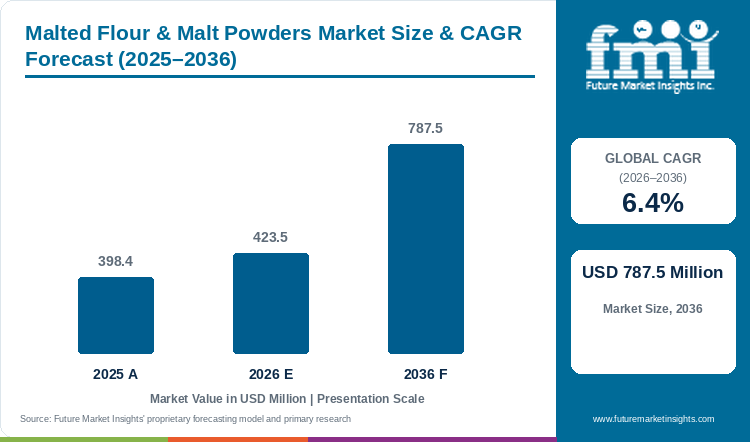
With a valuation of USD 398.4 million in 2025 and moving to USD 423.5 million in 2026, the global malted flour & malt powders market is positioned to attain USD 787.5 million by 2036, exhibiting a CAGR of 6.4%.
Commercial flour millers and high-speed pan-bread bakeries are phasing out synthetic chemical oxidizers, which increases their reliance on germinated cereal enzymes to correct seasonal wheat alpha-amylase deficits. To highlight this better, under USA federal standard of identity 21 CFR Section 137.105 updated in November 2025, flour processors may dose malted barley flour at up to 0.75% of flour weight to compensate for natural enzyme deficiency [1]. Through this regulatory allowance, diastatic standard milling grade is projected to represent 38.6% of the Grade category in 2026 as commercial mills blend functional malt ingredients directly into bulk bread grists. Milling procurement patterns indicate that the global malted flour and malt powders market value stands at USD 398.4 million in 2025 and reaches USD 423.5 million in 2026. Over the forecast decade, global market size is forecast to reach USD 787.5 million by 2036 at a 6.4% CAGR, generating USD 364.0 million in added annual market value. However, issues such as tight Degrees Lintner tolerances remain a major restraining factor because excess active amylase degrades crumb elasticity and slows vendor switching.
Key Market Trends & Insights
- By grade: Diastatic standard milling grade is projected to account for 38.6% of Grade demand in 2026, driven by statutory flour enzyme standardization at commercial wheat mills.
- By form: In 2026, roller-milled dry malt flour is estimated to hold 46.2% of the Form category, owing to direct compatibility with dry micro-dosing augers and bulk flour blenders.
- By application: Based on Application, yeast-leavened bread & rolls are expected to represent 34.8% of 2026 demand, attributable to maltose release requirements during industrial dough proofing.
- By claim: Conventional accounts for a forecast 52.4% share of the Claim category in 2026, supported by cost-effective two-row barley procurement across mainstream bread lines.
- By sales channel: Direct to industrial bakeries & mills is anticipated to capture 48.4% of Sales Channel demand in 2026, enabled by lot-certified Falling Number audit contracts.
Regional Highlights
- Top national expansion: The USA is projected to lead major milling economies at a 7.3% CAGR through 2036 under federal flour identity rules and clean-label bread reformulation.
- Broader country progression: France is expected to advance at a 6.9% CAGR ahead of Germany at 6.6% and South Korea at 6.4%, whereas Japan is forecast to record a 4.9% annual rate.
Market Size & Forecast
Table 1: Market Size and Forecast for the Malted Flour & Malt Powders Market (USD million and CAGR percentage), 2025 to 2036
| Metric | Value |
|---|---|
| 2025 Market Size | USD 398.4 million |
| Estimated Market Size in 2026 | USD 423.5 million |
| Projected Market Size by 2036 | USD 787.5 million |
| CAGR, 2026 to 2036 | 6.4% |
| Added Revenue, 2026 to 2036 | USD 364.0 million |
Unpredictable rain and heat waves during wheat harvesting cause wide fluctuations in endogenous grain enzymes, which directly destabilizes dough proof heights and crust browning on high-speed tunnel ovens. Because uncalibrated wheat flour disrupts automated baking schedules, commercial millers must adjust diastatic supplementation at the mill gate. For instance, in February 2026, Ardent Mills published technical flour-treatment guidance explaining how controlled cereal germination releases amylase enzymes that cleave damaged starch granules into fermentable sugars for yeast metabolism [2]. As a result of this enzymatic requirement, bakery quality managers pair alpha-amylase enzyme systems with Lintner-calibrated malted flours to keep loaf volume uniform without chemical oxidizers.
Commercial Milling Tonnage and Malt Inclusion Sizing
Table 2: Commercial Milling Tonnage and Malt Inclusion Sizing for the Malted Flour & Malt Powders Market (USD million and operational ranges), 2025 to 2036
| Metric | 2025 | 2026 | 2036 |
|---|---|---|---|
| Market size (USD million) | 398.4 | 423.5 | 787.5 |
| Malted flour & powder volume (thousand MT) | 310.0 to 322.0 | 328.5 to 341.0 | 535.0 to 558.0 |
| Enzyme-standardized bread flour pool (million MT) | 66.5 to 69.0 | 68.4 to 71.2 | 86.0 to 90.5 |
| Average industrial contract price (USD/kg) | 1.2 to 1.3 | 1.3 to 1.4 | 1.4 to 1.5 |
Operational note: Milling tonnage ranges apply statutory 0.15% to 0.75% diastatic malt inclusion rates across standardized bread flours and 1.5% to 4.0% non-diastatic malt powder dosing across malted beverages and biscuits.
Retailer restrictions on artificial caramel coloring and volatile cocoa prices are shifting ingredient procurement across biscuit and dark rye bread plants. When bakery formulators need rich brown crumb color and toasted flavor at 1.5% to 4.0% dosing without liquefying dough gluten networks, active diastatic malt cannot be used. This generates a strong commercial need for high-temperature kilned cereal malts where roasting deactivates amylase enzymes while concentrating natural Maillard melanoidins. In addition to this, rotary biscuit lines require narrow micron particle milling so non-diastatic malt powders disperse evenly across low-moisture doughs.
Per Capita & Milling Facility Sizing
Table 3: Per Capita and Industrial Bakery Spending Indicators for the Malted Flour & Malt Powders Market (USD), 2025 to 2036
| Metric | 2025 | 2026 | 2036 |
|---|---|---|---|
| Global population (billion) | 8.2 | 8.3 | 9.0 |
| Market value per 1,000 people (USD) | 48.6 | 51.0 | 87.5 |
| Annual malt procurement per industrial bakery (USD) | 14,200 to 16,500 | 15,100 to 17,400 | 24,500 to 28,200 |
| Clean-label enzyme replacement contract share (%) | 58.0% to 62.0% | 60.5% to 64.5% | 71.0% to 75.0% |
Table 4: Milling & Bakery Facility Indicators for the Malted Flour & Malt Powders Market (USD and percentages), 2026
| Metric | Value | Institutional Reference Basis |
|---|---|---|
| Market size, 2026 | USD 423.5 million | 2026 global valuation baseline |
| Global commercial mills & bakeries | 26,400 facilities | Commercial flour milling & industrial baking registry |
| Average value per facility | USD 16,041.7 | Annualized malted ingredient allocation |
| Direct to industrial bakeries & mills allocation | USD 205.0 million | 48.4% sales-channel segment share |
Consolidation among wholesale bakeries is changing how commercial flour mills structure annual ingredient tenders. Rather than purchasing unblended commodity malt meal on short-term spot contracts, multi-plant bakery groups demand custom enzyme-calibrated grists matched to high-speed dough dividers. To satisfy these rheology specifications, flour millers co-blend barley-based diastatic powders with wheat malt formulations that align with the gluten protein structure of baguette and pan-loaf flours. However, high kilning natural-gas costs and mandatory mycotoxin screening per grain lot still restrain margin expansion for smaller regional maltsters.
Analyst Perspective
"Commercial flour millers and industrial bread plants no longer buy malted flour as an uncalibrated commodity flavor adjunct. Suppliers that certify narrow Falling Number tolerances and offer both diastatic roller-milled flours and non-diastatic vacuum-dried malt powders win multi-year grist standardization contracts."
- Nandini Roy Choudhury, Principal Consultant, Future Market Insights.
How is the malted flour & malt powders market segmented?
The malted flour & malt powders market is segmented by grade, form, application, claim, and sales channel. In 2026, diastatic standard milling grade is projected at 38.6%, roller-milled dry malt flour at 46.2%, yeast-leavened bread & rolls at 34.8%, conventional at 52.4%, and direct to industrial bakeries & mills at 48.4%.
By grade: Diastatic standard milling grade, non-diastatic flavor & color grade, dark & roasted specialty malt grade, and organic & identity-preserved grade.
By form: Roller-milled dry malt flour, spray-dried malt extract powder, vacuum-dried band malt powder, and granulated & flaked malt grit.
By application: Yeast-leavened bread & rolls, malted beverages & nutritional dairy drinks, biscuits, crackers & savory snacks, breakfast cereals & granola bars, and viennoiserie, pretzels & artisan crusts.
By claim: Conventional, clean-label enzyme-active, organic certified, and non-GMO & identity-preserved.
By sales channel: Direct to industrial bakeries & mills, specialty food ingredient distributors, brewing & beverage formulation supply, and foodservice & artisan bakery wholesalers.
Why does Diastatic standard milling grade lead the grade category?
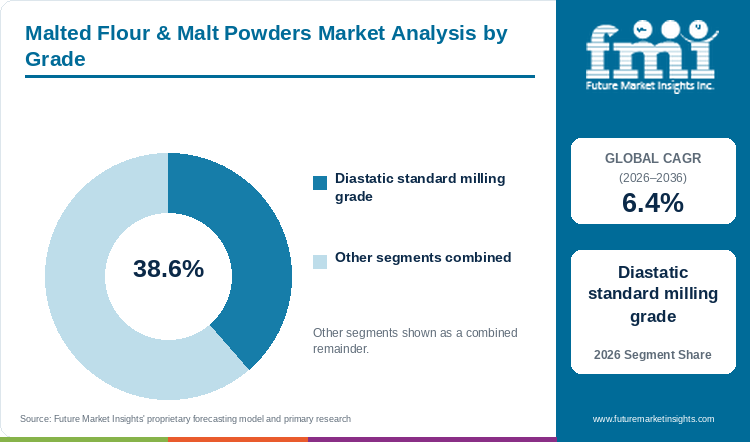
Diastatic standard milling grade is projected to account for 38.6% of the Grade category in 2026, driven by statutory flour enzyme standardization.
Table 5: Grade Share for the Malted Flour & Malt Powders Market (percentage share), 2026
| Grade | Share (2026) |
|---|---|
| Diastatic standard milling grade | 38.6% |
| Other Segments Combined | 61.4%* |
| Total | 100.0% |
*Calculated as the balance remaining after deducting the leading segment's reported share from 100.0%.
Table 6: Grade Leadership and Market Growth for the Malted Flour & Malt Powders Market (segment and CAGR percentage), 2026 to 2036
| Metric | Value |
|---|---|
| Global CAGR (2026 to 2036) | 6.4% |
| Leading Segment | Diastatic standard milling grade |
Supermarket clean-label bread standards are pushing wholesale bakeries to remove synthetic chemical improvers while keeping proof times short on automated dough lines. Because low-temperature kilning preserves endogenous alpha-amylase and beta-amylase enzymes, dosing 0.15% to 0.50% active malted barley flour regulates Hagberg Falling Numbers and replaces synthetic commercial baking enzymes on retail ingredient panels.
- Diastatic standard milling grade is projected to account for 38.6% of Grade demand in 2026, supported by routine enzyme compensation across commercial wheat mills.
- For instance, in October 2025, technical documentation from Muntons plc for its Diax Malt Flour confirmed that high-diastatic malted barley flour supplies active cereal enzymes that accelerate yeast fermentation and loaf volume in commercial bread doughs [3].
What keeps Roller-milled dry malt flour ahead across product forms?
In 2026, roller-milled dry malt flour is estimated to hold 46.2% of the Form category, owing to automated dry micro-dosing compatibility.
High cleaning labor costs and syrup line sanitation downtime discourage flour mills and dry-mix plants from handling viscous liquid malt extracts. By contrast, free-flowing roller-milled dry malt flour meters directly through gravimetric loss-in-weight screw feeders and blends uniformly into flour improver premixes without caking in humid storage rooms.
- In 2026, roller-milled dry malt flour is estimated to hold 46.2% of Form demand, enabled by ambient warehouse stability and pneumatic silo transfer.
- To serve this dry-dosing preference, in April 2026, GoodMills Innovation updated its Slow Milling catalog featuring item 500130 enzyme-active Malzmehl dry malt flour alongside 15-kilogram liquid malt canisters for specialized bakeries [4].
How do Yeast-leavened bread & rolls drive application demand?
Based on Application, yeast-leavened bread & rolls are expected to represent 34.8% of 2026 demand, attributable to continuous fermentation and crust browning needs.
High-speed pan-bread and hamburger-bun lines operate on compressed 45-to-60-minute proofing schedules where baker's yeast rapidly exhausts native flour sucrose before oven entry. Adding diastatic malted flour generates steady maltose release during proofing while non-diastatic malt powders complement commercial bakery ingredients to promote golden Maillard crust color without extra added sugar.
- Based on Application, yeast-leavened bread & rolls are expected to represent 34.8% of 2026 demand, reinforced by daily high-volume pan-bread and bun manufacturing.
- As a matter of fact, in January 2026, technical specifications from Briess Malt & Ingredients confirmed that sprouted malted barley and malted wheat flours improve dough extensibility and crust color in yeast-raised bread and roll production [5].
Why does Conventional remain the largest claim category?
Within the Claim category, Conventional is forecast to register a 52.4% share in 2026, influenced by mainstream two-row malting barley economics.
Tight retail price competition on supermarket sliced bread prevents wholesale millers from absorbing the 35% to 50% grain price premium attached to certified organic malting barley. Because conventional two-row malting barley already qualifies for a clean malted barley flour label declaration, mainstream mills achieve clean-label compliance without paying organic segregation surcharges.
- Within the Claim category, Conventional is forecast to register a 52.4% share in 2026, stemming from established North America and Europe malting barley supply chains.
- At the same time, specialty artisan demand is rising; in September 2025, Doves Farm documented how its 25-kilogram Organic Malthouse Bread Flour blends certified organic malted barley flour into roller-milled wheat grists for craft loaves [6].
Why does Direct to industrial bakeries & mills lead sales channels?
Direct to industrial bakeries & mills is anticipated to capture 48.4% of Sales Channel demand in 2026, linked to lot-calibrated enzyme contracts.
Every annual wheat harvest exhibits a different amylograph viscosity profile, which prevents large flour mills from ordering off-the-shelf malt flour through general foodservice wholesalers. Instead, multi-plant milling and baking groups contract directly with industrial maltsters so cereal chemists can run pilot bake tests on incoming wheat crops and ship custom-calibrated bulk totes directly to mill blending towers.
- Direct to industrial bakeries & mills is anticipated to capture 48.4% of Sales Channel demand in 2026, resulting from annual bulk tote contracting and mill-level technical audits.
- In practice, commercial milling catalog data released by ADM in January 2026 confirms that direct B2B buyers contract custom-milled malted barley flour and enzyme-standardized bread flours in bulk totes and multi-wall sacks for industrial scale-up [7].
What are the drivers, restraints, and opportunities in the malted flour & malt powders market?
In the malted flour and malt powders market, clean-label dough conditioning and seasonal wheat enzyme correction drive demand, whereas alpha-amylase overdosing risks restrain rapid switching and solid-state fermented grain powders create high-margin opportunities.
- Driver: Clean-label retail bread mandates and variable wheat harvest Falling Numbers push millers to standardize grists with diastatic malted cereal flours.
- Restraint: Narrow alpha-amylase dosing tolerances and hygroscopic powder caking plus mandatory cereal gluten allergen declarations lengthen factory qualification cycles.
- Opportunity: Solid-state fermentation of germinated grains and specialty roasted malt powders open new cocoa-replacement and clean-label snack seasoning applications.
Growth Analysis and Future Potential: Enzymatic Flour Standardization and Clean-Label Bakery Reformulation
Weather-induced swings in wheat harvest alpha-amylase levels force commercial flour millers to adjust diastatic supplementation across every milling campaign. When dry summer harvests produce wheat with excessively high Hagberg Falling Numbers above 300 seconds, doughs ferment slowly and yield pale loaves unless millers dose active malted barley flour. As a matter of fact, in September 2025, the UK House of Lords Library published its sector briefing documenting that UK flour mills process roughly 5 million tonnes of wheat annually into 4 million tonnes of flour while managing domestic harvest quality swings [8]. Because of this raw-grain variability, industrial bakeries replace synthetic azodicarbonamide and chemical oxidizers with natural dough conditioners built around diastatic malted wheat and barley flours.
Risk Assessment of the Malted Flour & Malt Powders Market: Amylase Overdosing Friction and Competing Clean-Label Aids
Strict enzymatic dosing ceilings and competition from alternative clean-label dough relaxers represent the primary operational barriers restricting volume expansion. If a bakery overdoses diastatic malt flour by even 0.3% above target flour weight, excess alpha-amylase dextrinizes starch granules during baking and leaves loaves with collapsing sidewalls and sticky crumbs that jam high-speed slicers. Beyond this dosing risk, competing grain aids are entering the sector; in July 2026, GoodMills Innovation launched GOOD NatureRelax as a clean-label dough-relaxation ingredient derived from stabilized wheat germ rather than malted grain [9]. Because plant managers also compare malt flours against micro-dosed fungal amylase industrial bread improvers, suppliers must provide lot-certified Lintner activity sheets before winning formula approvals.
Commercial Opportunity Analysis: Solid-State Germinated Grain Fermentation and Cocoa-Extension Malt Powders
Volatile cocoa bean prices and demand for low-sugar savory snack coatings are creating lucrative openings for dark roasted malt powders and fermented germinated-grain ingredients. Through controlled kilning of sprouted barley and wheat at elevated roasting temperatures between 160 and 220 degrees Celsius, specialty maltsters deactivate amylase enzymes while generating deep mahogany colors and cocoa-like pyrazine aromatics. To capture this reformulation wave, in May 2026, Soufflet Malt and Ferments du Futur launched an 18-month research partnership utilizing solid-state fermentation of germinated grains to engineer functional food ingredients starting with cocoa alternatives [10]. As a result, ingredient converters that pair traceable barley grain supplies with precision roasting and vacuum-band drying are winning premium confectionery and biscuit contracts.
Malted Flour & Malt Powders Market by Country (2026 to 2036)
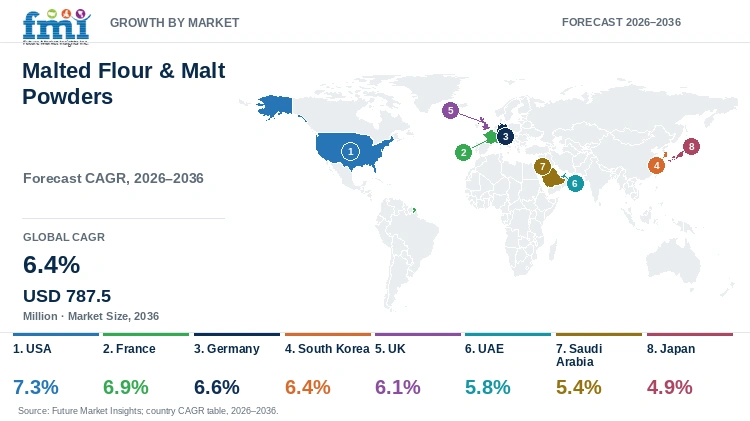
Consumption patterns show the USA leading malted flour and malt powders growth across major economies at a 7.3% CAGR through 2036, while France is estimated to advance at 6.9% and Japan is forecast to progress at a 4.9% yearly rate. Country-level expansion reflects statutory flour identity standards and craft bakery density as well as domestic malting capacity.
Table 7: Country CAGR and Primary Growth Levers for the Malted Flour & Malt Powders Market (CAGR percentage and operational drivers), 2026 to 2036
| Country | CAGR (2026 to 2036) | Primary Growth Lever |
|---|---|---|
| USA | 7.3% | 21 CFR 137.105 enzyme-compensating flour rules and clean-label bun reformulation |
| France | 6.9% | Artisan boulangerie and industrial bread flour standardization across 2.57M MT flour |
| Germany | 6.6% | Craft bakery dough-tolerance optimization across 8,659 operating bakery enterprises |
| South Korea | 6.4% | Export-driven biscuit, cracker, and snack manufacturing utilizing imported malt powders |
| UK | 6.1% | High-diastatic malt dosing to offset domestic wheat harvest Falling Number swings |
| UAE | 5.8% | Re-export flour milling and hospitality bakery premix blending across Gulf food plants |
| Saudi Arabia | 5.4% | Industrial pan-bread and biscuit expansion supported by multi-origin wheat imports |
| Japan | 4.9% | Precision color and flavor standardization in packaged shokupan and confectionery lines |
Source: Future Market Insights analysis
USA Malted Flour & Malt Powders Market Outlook (2026 to 2036)
Statutory flour identity allowances and grocery clean-label bread reformulation make the USA the fastest-growing major market for malted cereal flours. Because federal standard 21 CFR Section 137.105 permits up to 0.75% malted barley flour directly inside standardized wheat flour, commercial millers in the USA routinely dose diastatic malt to balance Falling Numbers across Hard Red Winter and Spring wheat crops. As a matter of fact, in May 2026, the USDA National Agricultural Statistics Service published its 2025 Flour Milling Products summary documenting commercial wheat flour production across the USA milling network [11]. Demand in the USA is projected to expand at a 7.3% CAGR from 2026 to 2036, although tight Lintner tolerances still govern supplier qualification.
Key takeaway: In the USA, federal flour identity standards and supermarket clean-label bread mandates are projected to sustain bulk diastatic malted flour contracts.
France Malted Flour & Malt Powders Market Outlook (2026 to 2036)
Strict national bread purity regulations in France prohibit chemical dough oxidizers in traditional baguettes, which creates steady structural demand for natural cereal malt enzymes across both street boulangeries and industrial bakeries. To achieve crisp golden crusts and open crumb alveolation during deck-oven baking, millers in France blend enzyme-active malted wheat and barley flours directly into Label Rouge bread grists. For instance, in its June 2026 report to Parliament, FranceAgriMer documented that bread production in France consumed 1.39 million tonnes of flour in artisan bakeries and 1.18 million tonnes in industrial bakeries [12]. Market value in France is estimated to rise at a 6.9% yearly rate through 2036 owing to germinated-grain fermentation, even though artisan purity laws cap non-cereal additives.
Key takeaway: In France, high flour throughput across artisan boulangeries and industrial bread plants is estimated to sustain steady malted wheat flour dosing.
Germany Malted Flour & Malt Powders Market Outlook (2026 to 2036)
Night-shift baker shortages and elevated oven energy tariffs are pushing craft and chain bakeries in Germany toward overnight retarded dough proofing, which requires precise enzymatic starch conversion and dark roasted malt color. When multi-grain and rye-blend doughs sit in refrigerated proofers for 16 hours, uncalibrated flour loses gas retention unless stabilized with specialized baking malts. Trade figures released by the Central Association of the Bakers' Confederation in Germany in March 2026 recorded EUR 18.14 billion in 2025 craft-bakery turnover across 8,659 operating businesses [13]. Between 2026 and 2036, demand in Germany is forecast to advance at a 6.6% annual rate driven by Slow Milling malt powders, yet tight wholesale margins restrict organic surcharges.
Key takeaway: In Germany, overnight dough-proofing automation and dark multigrain bread traditions are forecast to drive demand for specialized baking malt flours.
South Korea Malted Flour & Malt Powders Market Outlook (2026 to 2036)
Rapid export growth in packaged biscuits and fermented cereal snacks is reshaping ingredient procurement across commercial food plants in South Korea. Because domestic malting barley acreage in South Korea remains limited, flour millers and confectionery processors rely on imported North America and Europe malt powders to standardize biscuit Maillard browning and cereal drink sweetness. In practice, grain market data released by the USDA Foreign Agricultural Service in April 2026 confirmed that strong processed-food and noodle exports continued to support food-grade wheat milling consumption in South Korea [14]. Industry demand in South Korea is anticipated to expand at a 6.4% compound rate over the 2026 to 2036 window linked to European hearth-bread localization, while humid summer storage requires moisture-barrier packaging.
Key takeaway: In South Korea, expanding biscuit and premium bakery manufacturing is anticipated to accelerate imports of moisture-protected diastatic and non-diastatic malt powders.
UK Malted Flour & Malt Powders Market Outlook (2026 to 2036)
High-speed Chorleywood bread mixing and long-established malthouse granary loaf consumption make the UK heavily reliant on both enzyme-active diastatic malt flour and kibbled malted grains. Because wet summer harvests in the UK frequently depress or destabilize domestic wheat Hagberg Falling Numbers, commercial millers must recalibrate malted barley flour inclusion across every autumn milling campaign. Specifically, official crop statistics published by the UK Department for Environment, Food and Rural Affairs in June 2026 detail harvest quality swings and milling wheat supply shifts across UK farms [15]. Market demand in the UK is expected to progress at a 6.1% annual rate through 2036 across plant bakeries and malted beverage lines, whereas mycotoxin screening and allergen segregation remain strict qualification gates.
Key takeaway: In the UK, variable domestic wheat harvest quality and strong malthouse loaf demand are expected to sustain mill-level malted flour blending.
UAE Malted Flour & Malt Powders Market Outlook (2026 to 2036)
Expansion of port-side flour milling and regional bakery premix manufacturing positions the UAE as the Gulf region's primary re-export and formulation hub for dry malt ingredients. Commercial mills in Dubai and Abu Dhabi blend imported diastatic malted barley flour into hotel and airline-catering bread grists so doughs tolerate rapid frozen-to-oven baking schedules. As a matter of fact, in August 2026, the USDA Foreign Agricultural Service documented how food and beverage processors in the UAE rely on imported intermediate grain ingredients to serve domestic hospitality and Gulf export channels [16]. Market demand in the UAE is projected to climb at a 5.8% yearly rate between 2026 and 2036 due to regional premix capacity additions, although port cold-storage fees elevate landed costs.
Key takeaway: In the UAE, port-side flour milling and hospitality bakery premix production are projected to support distributor-led imports of dry malt powders.
Saudi Arabia Malted Flour & Malt Powders Market Outlook (2026 to 2036)
Multi-origin wheat import tenders and privatized flour-mill modernization across Riyadh and Jeddah as well as Dammam shape commercial demand for enzyme-active malted flours in Saudi Arabia. Because wheat cargoes arriving at ports in Saudi Arabia originate from diverse Black Sea and Europe harvests with varying protein and amylase levels, millers dose 0.2% to 0.5% diastatic malted barley flour to harmonize dough proofing speed. In April 2026, the USDA Foreign Agricultural Service published its annual grain assessment for Saudi Arabia detailing food-wheat import tenders and modern milling utilization [17]. Demand in Saudi Arabia is estimated to grow at a 5.4% annual rate from 2026 to 2036, reinforced by domestic biscuit and pan-bread capacity expansions and SFDA halal compliance.
Key takeaway: In Saudi Arabia, multi-origin wheat import blending across privatized flour mills is estimated to drive recurring contracts for diastatic malted barley flour.
Japan Malted Flour & Malt Powders Market Outlook (2026 to 2036)
Ultra-strict crumb whiteness standards in packaged shokupan pullman loaves and precision sweetness targets in convenience-store bakery items govern how processors qualify malted flours in Japan. If a diastatic malt flour carries excessive kilning color or erratic protease activity, high-speed pullman bread doughs lose interior brightness and sidewall strength during baking. In March 2026, the USDA Foreign Agricultural Service documented Japan's state-managed food wheat and barley import framework and commercial milling allocation [18]. Over the 2026 to 2036 period, market expansion in Japan is forecast to record a 4.9% annual rate attributable to beverage and biscuit formulators adopting non-diastatic malt powders for clean-label sweetness, while multi-quarter pilot bake testing slows foreign supplier onboarding.
Key takeaway: In Japan, strict crumb-color tolerances across packaged shokupan and confectionery lines are forecast to favor precision-kilned imported malt flours.
Full report country CAGRs cover: North America; Latin America; Western Europe; Eastern Europe; East Asia; South Asia and Pacific; Middle East and Africa.
Who are the notable companies in the malted flour & malt powders market?
Ardent Mills, ADM, GoodMills Group, Soufflet Malt (InVivo Group), Briess Malt & Ingredients, Muntons plc, Bay State Milling, Limagrain Ingredients, King Arthur Baking, and Doves Farm are the notable companies in the malted flour & malt powders market.
Supplier competition divides between dedicated cereal maltsters that control steep-germination-kiln vessels and commercial wheat millers that blend malted flours directly into bulk bakery grists. Because industrial bakeries increasingly demand dust-free handling and lot-certified enzyme curves, suppliers are investing in automated kilning and regional milling capacity to lock in multi-year contracts.
- Dedicated Maltsters & Functional Malt Powder Producers: Soufflet Malt (InVivo Group) and Briess Malt & Ingredients plus Muntons plc manufacture kilned and roasted malted barley and wheat flours as well as spray-dried and vacuum-dried malt powders.
- Industrial Flour Millers & Hydrothermal Grain Processors: Ardent Mills and ADM along with GoodMills Group and Bay State Milling plus Limagrain Ingredients supply enzyme-standardized malted flours to high-speed bakeries.
- Artisan & Organic Malthouse Flour Brands: King Arthur Baking and Doves Farm distribute packaged diastatic malt powders and certified organic malthouse bread flours to craft bakeries and foodservice kitchens.
Competitive Benchmarking: Malted Flour & Malt Powders Market
Table 8: Competitive Benchmarking for the Malted Flour & Malt Powders Market (qualitative capability ratings), 2026
| Company | Malt Flour & Powder Breadth | Industrial Bakery Formulation Support | Specialty & Clean-Label Traceability | Geographic Reach |
|---|---|---|---|---|
| Ardent Mills | High | High | High | North America (USA, Canada, Puerto Rico) |
| ADM | High | High | Medium | North America, UK, and global milling network |
| GoodMills Group | High | High | High | Germany, Poland, Austria, and Central Europe |
| Soufflet Malt (InVivo Group) | High | High | High | Europe, India, Latin America, and global malting |
| Briess Malt & Ingredients | High | High | High | North America and international B2B export |
| Muntons plc | High | High | High | UK, Europe, and Asia-Pacific ingredient hubs |
| Bay State Milling | Medium | High | High | USA commercial bakery channels |
| Limagrain Ingredients | Medium | High | High | France, Western Europe, and international markets |
| King Arthur Baking | Medium | Medium | Medium | USA professional and artisan channels |
| Doves Farm | Medium | Medium | High | UK and Europe organic bakery wholesale |
Scoring basis: Malt Flour & Powder Breadth evaluates documented SKUs across diastatic malted flours and non-diastatic flavor powders plus roasted specialty malts. Industrial Bakery Formulation Support and Traceability reflect pilot-bake amylograph testing and organic chain-of-custody across bulk tote fulfillment.
Key Developments in the Malted Flour & Malt Powders Market
- Soufflet Malt (InVivo Group) announced a EUR 100 million investment in February 2026 to construct an AI-driven malthouse in South Rajasthan, India with 110,000 tonnes of annual capacity for food and beverage processors [19].
- GoodMills Group inaugurated its expanded Kutno mill in Poland in June 2025, doubling site flour milling capacity to 280,000 tonnes annually to serve industrial bakery accounts across Central Europe [20].
- Limagrain Group highlighted the commercial rollout of its functional cereal flours and high-fiber wheat ingredients in its January 2025 corporate review for bakery and snack processors [21].
Key Players in the Malted Flour & Malt Powders Market
Dedicated Maltsters & Functional Malt Powder Producers
- Soufflet Malt (InVivo Group)
- Briess Malt & Ingredients
- Muntons plc
Industrial Flour Millers & Hydrothermal Grain Processors
- Ardent Mills
- ADM
- GoodMills Group
- Bay State Milling
- Limagrain Ingredients
Artisan & Organic Malthouse Flour Brands
- King Arthur Baking
- Doves Farm
Malted Flour & Malt Powders Market - Report Scope
Table 9: Report Scope for the Malted Flour & Malt Powders Market (coverage fields and definitions), 2026 to 2036
| Coverage field | Report scope |
|---|---|
| Market breakdown | Grade; Form; Application; Claim; Sales Channel |
| Quantitative Units | USD Million |
| Market Definition | Commercial supplier revenue from milled malted cereal flours (diastatic and non-diastatic malted barley, wheat, and rye flours) and dry malt extract powders sold to flour millers, bakeries, and food or beverage processors. Excludes whole unmilled brewing malt, bulk liquid malt syrups, unmalted pregelatinized flours, and finished baked goods. |
| Regions Covered | North America; Latin America; Western Europe; Eastern Europe; East Asia; South Asia and Pacific; Middle East and Africa |
| Countries Covered | USA, France, Germany, South Korea, UK, UAE, Saudi Arabia, Japan, and additional countries in the full report |
| Key Companies Covered | Ardent Mills, ADM, GoodMills Group, Soufflet Malt (InVivo Group), Briess Malt & Ingredients, Muntons plc, Bay State Milling, Limagrain Ingredients, King Arthur Baking, Doves Farm |
| Forecast Period | 2026 to 2036 |
| Approach | Primary and secondary research with top-down and bottom-up market triangulation. |
Malted Flour & Malt Powders Market - Research Methodology
Table 10: Research Methodology for the Malted Flour & Malt Powders Market (research methods and approach), 2026 edition
| Method | Approach |
|---|---|
| Primary Research | Structured interviews with head flour millers, bakery rheology directors, malting plant engineers, and B2B ingredient procurement managers to validate Degrees Lintner dosing and contract pricing. |
| Secondary Research | Review of 21 CFR Section 137.105 flour standards, USDA Foreign Agricultural Service grain annuals, FranceAgriMer and Central Association of the Bakers' Confederation statistics in Germany, and technical malt catalogs. |
| Market Sizing and Forecasting | Top-down commercial bread flour and malted food ingredient budgets reconciled against bottom-up diastatic inclusion rates (0.15% to 0.75%) and non-diastatic powder volumes from 2026 to 2036. |
| Country Forecasting Model | Econometric national projections weight commercial wheat milling tonnage, clean-label bakery reformulation rates, and domestic malthouse or import distribution capacity across eight national markets. |
| Operational Benchmark Traceability | Milling tonnage and bakery facility indicators in Tables 2, 3, and 4 trace to UK House of Lords Library, FranceAgriMer, USDA FAS, and craft bakery registries in Germany. |
| Data Triangulation and Validation | Estimates are cross-checked against commercial malthouse milling yields and industrial bakery bill-of-materials dosing while excluding whole brewing malt grain and unmalted flour blends. |
Malted Flour & Malt Powders Market by Segments
Malted Flour & Malt Powders Market segmented by Grade:
- Diastatic standard milling grade
- Non-diastatic flavor & color grade
- Dark & roasted specialty malt grade
- Organic & identity-preserved grade
Malted Flour & Malt Powders Market segmented by Form:
- Roller-milled dry malt flour
- Spray-dried malt extract powder
- Vacuum-dried band malt powder
- Granulated & flaked malt grit
Malted Flour & Malt Powders Market segmented by Application:
- Yeast-leavened bread & rolls
- Malted beverages & nutritional dairy drinks
- Biscuits, crackers & savory snacks
- Breakfast cereals & granola bars
- Viennoiserie, pretzels & artisan crusts
Malted Flour & Malt Powders Market segmented by Claim:
- Conventional
- Clean-label enzyme-active
- Organic certified
- Non-GMO & identity-preserved
Malted Flour & Malt Powders Market segmented by Sales Channel:
- Direct to industrial bakeries & mills
- Specialty food ingredient distributors
- Brewing & beverage formulation supply
- Foodservice & artisan bakery wholesalers
Malted Flour & Malt Powders Market by Region
- North America
- United States
- Canada
- Latin America
- Brazil
- Mexico
- Argentina
- Chile
- Western Europe
- Germany
- France
- United Kingdom
- Italy
- Spain
- Benelux
- Nordics
- Eastern Europe
- Poland
- Czech Republic
- Romania
- Hungary
- East Asia
- China
- Japan
- South Korea
- South Asia and Pacific
- India
- ASEAN
- Australia and New Zealand
- Middle East and Africa
- GCC Countries
- South Africa
- Türkiye
- Israel
Research Sources and Bibliography
- [1] U.S. Food and Drug Administration / National Archives. (2025, November 21). eCFR :: 21 CFR 137.105 -- Flour. Electronic Code of Federal Regulations (eCFR).
- [2] Ardent Mills. (2026, February 16). A Guide to Flour Treatments | Ardent Mills. Ardent Mills Technical Insights.
- [3] Muntons plc. (2025, October 10). Diax Malt Flour - Muntons. Muntons Food & Beverage Ingredients.
- [4] GoodMills Innovation GmbH. (2026, April 2). Slow Milling® Malzmehl - GoodMills Innovation. GoodMills Innovation Product Catalog.
- [5] Briess Malt & Ingredients Co. (2026, January 12). Malted Flours - Briess Malt & Ingredients. Briess Food Ingredients.
- [6] Doves Farm Foods Ltd. (2025, September 15). Doves Farm Organic Malthouse Bread Flour 25kg. Doves Farm Specialty Flours.
- [7] Archer Daniels Midland Company (ADM). (2026, January 18). Bulk Flours & Milling | Explore Wholesale Commercial Flours | ADM. ADM Human Nutrition Product Catalog.
- [8] UK Parliament House of Lords Library. (2025, September 4). UK flour milling sector - House of Lords Library. House of Lords Library Research Briefings.
- [9] GoodMills Innovation GmbH. (2026, July 17). GOOD NatureRelax: Kontrollierte Teigentspannung für stabile Prozesse in der Weizenteig-Verarbeitung - GoodMills Innovation. GoodMills Innovation Newsroom.
- [10] InVivo Group / Soufflet Malt. (2026, May 27). Soufflet Malt and Ferments du Futur accelerate the development of new food applications through solid-state malt fermentation | InVivo. InVivo Group Press Releases.
- [11] USDA National Agricultural Statistics Service (NASS). (2026, May 1). Flour Milling Products 2025 Summary 05/01/2026. United States Department of Agriculture (USDA NASS).
- [12] FranceAgriMer. (2026, June 15). Section 7 - Pain - Observatoire de la formation des prix et des marges des produits alimentaires / rapport au Parlement / 2026. République Française / FranceAgriMer.
- [13] Zentralverband des Deutschen Bäckerhandwerks e.V. (2026, March 15). Zahlen rund ums Bäckerhandwerks - Zentralverband des Deutschen Bäckerhandwerks. Deutsches Bäckerhandwerk Official Statistics.
- [14] USDA Foreign Agricultural Service. (2026, April 4). South Korea: Grain and Feed Annual | USDA Foreign Agricultural Service. United States Department of Agriculture (USDA FAS).
- [15] UK Department for Environment, Food & Rural Affairs (DEFRA). (2026, June 18). Chapter 7: Crops - GOV.UK. GOV.UK Official Agricultural Statistics.
- [16] USDA Foreign Agricultural Service. (2026, August 12). United Arab Emirates: Food Processing Ingredients Annual | USDA Foreign Agricultural Service. United States Department of Agriculture (USDA FAS).
- [17] USDA Foreign Agricultural Service. (2026, April 10). Saudi Arabia: Grain and Feed Annual | USDA Foreign Agricultural Service. United States Department of Agriculture (USDA FAS).
- [18] USDA Foreign Agricultural Service. (2026, March 19). Japan: Grain and Feed Annual | USDA Foreign Agricultural Service. United States Department of Agriculture (USDA FAS).
- [19] InVivo Group / Soufflet Malt. (2026, February 20). Soufflet Malt invests €100 Million in India to build a new AI-driven malthouse for the food and beverage sector | InVivo. InVivo Group Press Releases.
- [20] GoodMills Group GmbH. (2025, June 20). GoodMills Group Expands Operations in Poland, Reinforcing European Market Leadership - GoodMills Group. GoodMills Group Corporate News.
- [21] Limagrain Group. (2025, January 22). Discover the Limagrain Highlights. Limagrain Corporate Newsroom.
- [22] GoodMills Innovation GmbH. (2026, March 2). Low-dust process flour from GoodMills Innovation reduces fine particle content, extends cleaning intervals and improves workplace safety - GoodMills Innovation. GoodMills Innovation Newsroom.
This bibliography is provided for reader reference and is not exhaustive. The full report contains the complete reference list and detailed citations.
This Report Answers
- How large is the malted flour & malt powders market in 2026 and what is forecast for 2036?
- Which milling and dough-fermentation pressures support demand for malted cereal flours?
- Why does diastatic standard milling grade lead the grade category?
- Why does roller-milled dry malt flour hold the largest form share globally?
- How do growth rates differ across the USA, France, Germany, and South Korea?
- Which leading maltsters and flour millers supply calibrated malted ingredients today?
- What enzymatic dosing and allergen hurdles limit rapid supplier switching?
- What Falling Number and Lintner tests should buyers verify before contracting a malt supplier?
Frequently Asked Questions
How big is the malted flour & malt powders market in 2026, and what is forecast for 2036?
Global malted flour and malt powders market size reaches USD 423.5 million in 2026, up from USD 398.4 million in 2025. Total industry valuation is projected to hit USD 787.5 million by 2036 as wheat mills standardize alpha-amylase activity.
What is the CAGR for the malted flour & malt powders market from 2026 to 2036?
The global market is projected to expand at a 6.4% compound annual growth rate between 2026 and 2036, generating USD 364.0 million in added annual revenue across commercial milling and bakery accounts.
Which grade segment leads the malted flour & malt powders market?
Diastatic standard milling grade is projected to account for 38.6% of Grade demand in 2026, driven by statutory 0.15% to 0.75% enzyme-compensation dosing in commercial bread flour grists.
Which form segment leads the malted flour & malt powders market?
In 2026, roller-milled dry malt flour is estimated to hold 46.2% of the Form category, owing to effortless metering through dry micro-dosing screws and pneumatic flour blending towers.
Which country has a notable growth outlook during the assessment period?
The USA is projected to lead national expansion at a 7.3% CAGR through 2036, supported by 21 CFR Section 137.105 flour standards and clean-label commercial bun reformulation.
Who are the key players in the market?
Notable market participants include Ardent Mills, ADM, GoodMills Group, Soufflet Malt (InVivo Group), Briess Malt & Ingredients, Muntons plc, Bay State Milling, Limagrain Ingredients, King Arthur Baking, and Doves Farm across commercial milling channels.
Preview the report firsthand - request a free sample
Get SampleGet the brochure for pricing and purchase details.
Get PDFTable of Content
- Key Takeaways
- Market Size and CAGR
- Top Growth Driver
- Fastest Growing Segment
- Leading Region
- Key Companies
- Emerging Opportunities
- Executive Summary
- Global Market Outlook
- Demand-side Trends
- Supply-side Trends
- Technology Roadmap Analysis
- Analysis and Recommendations
- Analyst Perspective (What is happening? Why now? What should investors know?)
- Key Questions Answered
- How large is the market?
- What is the CAGR?
- What are key trends?
- Which region dominates?
- Who are the leaders?
- Market Overview
- Market Coverage / Taxonomy
- Market Definition / Scope / Limitations
- Research Methodology
- Chapter Orientation
- Analytical Lens and Working Hypotheses
- Market Structure, Signals, and Trend Drivers
- Benchmarking and Cross-market Comparability
- Market Sizing, Forecasting, and Opportunity Mapping
- Research Design and Evidence Framework
- Desk Research Programme (Secondary Evidence)
- Expert Input and Fieldwork (Primary Evidence)
- Tooling, Models, and Reference Databases
- Data Engineering and Model Build
- Quality Assurance and Audit Trail
- Market Background
- Market Dynamics (Drivers, Restraints, Opportunity, Trends)
- Scenario Forecast (Optimistic, Likely, Conservative)
- Impact Analysis
- AI Impact
- Sustainability Impact
- Regulatory Impact
- Technology Impact
- Consumer / Buyer Analysis
- Purchase Drivers
- Adoption Barriers
- Buyer Journey
- Opportunity Map Analysis
- Product Life Cycle Analysis
- Supply Chain Analysis
- Investment Feasibility Matrix
- Value Chain Analysis
- PESTLE and Porter's Analysis
- Regulatory Landscape
- Regional Parent Market Outlook
- Production and Consumption Statistics
- Import and Export Statistics
- Global Market Analysis and Forecast, 2021 to 2036
- Historical Market Size Value (USD Million) Analysis, 2021 to 2025
- Current and Future Market Size Value (USD Million) Projections, 2026 to 2036
- Y-o-Y Growth Trend Analysis
- Absolute $ Opportunity Analysis
- Global Market Pricing Analysis, 2021 to 2036
- Global Market Analysis and Forecast, By Grade, 2021 to 2036
- Introduction / Key Findings
- Historical Market Size Value (USD Million) Analysis By Grade, 2021 to 2025
- Current and Future Market Size Value (USD Million) Analysis and Forecast By Grade, 2026 to 2036
- Diastatic standard milling grade
- Non-diastatic flavor & color grade
- Dark & roasted specialty malt grade
- Organic & identity-preserved grade
- Y-o-Y Growth Trend Analysis By Grade, 2021 to 2025
- Absolute $ Opportunity Analysis By Grade, 2026 to 2036
- Global Market Analysis and Forecast, By Form, 2021 to 2036
- Introduction / Key Findings
- Historical Market Size Value (USD Million) Analysis By Form, 2021 to 2025
- Current and Future Market Size Value (USD Million) Analysis and Forecast By Form, 2026 to 2036
- Roller-milled dry malt flour
- Spray-dried malt extract powder
- Vacuum-dried band malt powder
- Granulated & flaked malt grit
- Y-o-Y Growth Trend Analysis By Form, 2021 to 2025
- Absolute $ Opportunity Analysis By Form, 2026 to 2036
- Global Market Analysis and Forecast, By Application, 2021 to 2036
- Introduction / Key Findings
- Historical Market Size Value (USD Million) Analysis By Application, 2021 to 2025
- Current and Future Market Size Value (USD Million) Analysis and Forecast By Application, 2026 to 2036
- Yeast-leavened bread & rolls
- Malted beverages & nutritional dairy drinks
- Biscuits, crackers & savory snacks
- Breakfast cereals & granola bars
- Viennoiserie, pretzels & artisan crusts
- Y-o-Y Growth Trend Analysis By Application, 2021 to 2025
- Absolute $ Opportunity Analysis By Application, 2026 to 2036
- Global Market Analysis and Forecast, By Claim, 2021 to 2036
- Introduction / Key Findings
- Historical Market Size Value (USD Million) Analysis By Claim, 2021 to 2025
- Current and Future Market Size Value (USD Million) Analysis and Forecast By Claim, 2026 to 2036
- Conventional
- Clean-label enzyme-active
- Organic certified
- Non-GMO & identity-preserved
- Y-o-Y Growth Trend Analysis By Claim, 2021 to 2025
- Absolute $ Opportunity Analysis By Claim, 2026 to 2036
- Global Market Analysis and Forecast, By Sales Channel, 2021 to 2036
- Introduction / Key Findings
- Historical Market Size Value (USD Million) Analysis By Sales Channel, 2021 to 2025
- Current and Future Market Size Value (USD Million) Analysis and Forecast By Sales Channel, 2026 to 2036
- Direct to industrial bakeries & mills
- Specialty food ingredient distributors
- Brewing & beverage formulation supply
- Foodservice & artisan bakery wholesalers
- Y-o-Y Growth Trend Analysis By Sales Channel, 2021 to 2025
- Absolute $ Opportunity Analysis By Sales Channel, 2026 to 2036
- Global Market Analysis and Forecast, By Region, 2021 to 2036
- Introduction
- Historical Market Size Value (USD Million) Analysis By Region, 2021 to 2025
- Current Market Size Value (USD Million) Analysis and Forecast By Region, 2026 to 2036
- North America
- Latin America
- Western Europe
- Eastern Europe
- East Asia
- South Asia and Pacific
- Middle East and Africa
- Market Attractiveness Analysis By Region
- North America Market Analysis and Forecast, By Country, 2021 to 2036
- Historical Market Size Value (USD Million) Trend Analysis By Market Taxonomy, 2021 to 2025
- Market Size Value (USD Million) Forecast By Market Taxonomy, 2026 to 2036
- By Country
- United States
- Canada
- By Grade
- By Form
- By Application
- By Claim
- By Sales Channel
- By Country
- Market Attractiveness Analysis
- By Country
- By Grade
- By Form
- By Application
- By Claim
- By Sales Channel
- Key Takeaways
- Latin America Market Analysis and Forecast, By Country
- Historical Market Size Value (USD Million) Trend Analysis By Market Taxonomy, 2021 to 2025
- Market Size Value (USD Million) Forecast By Market Taxonomy, 2026 to 2036
- By Country
- Brazil
- Mexico
- Argentina
- Chile
- By Grade
- By Form
- By Application
- By Claim
- By Sales Channel
- By Country
- Market Attractiveness Analysis
- By Country
- By Grade
- By Form
- By Application
- By Claim
- By Sales Channel
- Key Takeaways
- Western Europe Market Analysis and Forecast, By Country
- Historical Market Size Value (USD Million) Trend Analysis By Market Taxonomy, 2021 to 2025
- Market Size Value (USD Million) Forecast By Market Taxonomy, 2026 to 2036
- By Country
- Germany
- France
- United Kingdom
- Italy
- Spain
- Benelux
- Nordics
- By Grade
- By Form
- By Application
- By Claim
- By Sales Channel
- By Country
- Market Attractiveness Analysis
- By Country
- By Grade
- By Form
- By Application
- By Claim
- By Sales Channel
- Key Takeaways
- Eastern Europe Market Analysis and Forecast, By Country
- Historical Market Size Value (USD Million) Trend Analysis By Market Taxonomy, 2021 to 2025
- Market Size Value (USD Million) Forecast By Market Taxonomy, 2026 to 2036
- By Country
- Poland
- Czech Republic
- Romania
- Hungary
- By Grade
- By Form
- By Application
- By Claim
- By Sales Channel
- By Country
- Market Attractiveness Analysis
- By Country
- By Grade
- By Form
- By Application
- By Claim
- By Sales Channel
- Key Takeaways
- East Asia Market Analysis and Forecast, By Country
- Historical Market Size Value (USD Million) Trend Analysis By Market Taxonomy, 2021 to 2025
- Market Size Value (USD Million) Forecast By Market Taxonomy, 2026 to 2036
- By Country
- China
- Japan
- South Korea
- By Grade
- By Form
- By Application
- By Claim
- By Sales Channel
- By Country
- Market Attractiveness Analysis
- By Country
- By Grade
- By Form
- By Application
- By Claim
- By Sales Channel
- Key Takeaways
- South Asia and Pacific Market Analysis and Forecast, By Country
- Historical Market Size Value (USD Million) Trend Analysis By Market Taxonomy, 2021 to 2025
- Market Size Value (USD Million) Forecast By Market Taxonomy, 2026 to 2036
- By Country
- India
- ASEAN
- Australia and New Zealand
- By Grade
- By Form
- By Application
- By Claim
- By Sales Channel
- By Country
- Market Attractiveness Analysis
- By Country
- By Grade
- By Form
- By Application
- By Claim
- By Sales Channel
- Key Takeaways
- Middle East and Africa Market Analysis and Forecast, By Country
- Historical Market Size Value (USD Million) Trend Analysis By Market Taxonomy, 2021 to 2025
- Market Size Value (USD Million) Forecast By Market Taxonomy, 2026 to 2036
- By Country
- GCC Countries
- South Africa
- Türkiye
- Israel
- By Grade
- By Form
- By Application
- By Claim
- By Sales Channel
- By Country
- Market Attractiveness Analysis
- By Country
- By Grade
- By Form
- By Application
- By Claim
- By Sales Channel
- Key Takeaways
- Key Countries Market Analysis
- United States
- Pricing Analysis
- Market Share Analysis, 2025
- By Grade
- By Form
- By Application
- By Claim
- By Sales Channel
- Canada
- Pricing Analysis
- Market Share Analysis, 2025
- By Grade
- By Form
- By Application
- By Claim
- By Sales Channel
- Mexico
- Pricing Analysis
- Market Share Analysis, 2025
- By Grade
- By Form
- By Application
- By Claim
- By Sales Channel
- Brazil
- Pricing Analysis
- Market Share Analysis, 2025
- By Grade
- By Form
- By Application
- By Claim
- By Sales Channel
- Chile
- Pricing Analysis
- Market Share Analysis, 2025
- By Grade
- By Form
- By Application
- By Claim
- By Sales Channel
- Germany
- Pricing Analysis
- Market Share Analysis, 2025
- By Grade
- By Form
- By Application
- By Claim
- By Sales Channel
- United Kingdom
- Pricing Analysis
- Market Share Analysis, 2025
- By Grade
- By Form
- By Application
- By Claim
- By Sales Channel
- Italy
- Pricing Analysis
- Market Share Analysis, 2025
- By Grade
- By Form
- By Application
- By Claim
- By Sales Channel
- Spain
- Pricing Analysis
- Market Share Analysis, 2025
- By Grade
- By Form
- By Application
- By Claim
- By Sales Channel
- France
- Pricing Analysis
- Market Share Analysis, 2025
- By Grade
- By Form
- By Application
- By Claim
- By Sales Channel
- India
- Pricing Analysis
- Market Share Analysis, 2025
- By Grade
- By Form
- By Application
- By Claim
- By Sales Channel
- ASEAN
- Pricing Analysis
- Market Share Analysis, 2025
- By Grade
- By Form
- By Application
- By Claim
- By Sales Channel
- Australia and New Zealand
- Pricing Analysis
- Market Share Analysis, 2025
- By Grade
- By Form
- By Application
- By Claim
- By Sales Channel
- China
- Pricing Analysis
- Market Share Analysis, 2025
- By Grade
- By Form
- By Application
- By Claim
- By Sales Channel
- Japan
- Pricing Analysis
- Market Share Analysis, 2025
- By Grade
- By Form
- By Application
- By Claim
- By Sales Channel
- South Korea
- Pricing Analysis
- Market Share Analysis, 2025
- By Grade
- By Form
- By Application
- By Claim
- By Sales Channel
- Poland
- Pricing Analysis
- Market Share Analysis, 2025
- By Grade
- By Form
- By Application
- By Claim
- By Sales Channel
- Hungary
- Pricing Analysis
- Market Share Analysis, 2025
- By Grade
- By Form
- By Application
- By Claim
- By Sales Channel
- Türkiye
- Pricing Analysis
- Market Share Analysis, 2025
- By Grade
- By Form
- By Application
- By Claim
- By Sales Channel
- South Africa
- Pricing Analysis
- Market Share Analysis, 2025
- By Grade
- By Form
- By Application
- By Claim
- By Sales Channel
- UAE
- Pricing Analysis
- Market Share Analysis, 2025
- By Grade
- By Form
- By Application
- By Claim
- By Sales Channel
- Saudi Arabia
- Pricing Analysis
- Market Share Analysis, 2025
- By Grade
- By Form
- By Application
- By Claim
- By Sales Channel
- United States
- Market Structure Analysis
- Competition Dashboard
- Competition Benchmarking
- Market Share Analysis of Top Players
- By Regional
- By Grade
- By Form
- By Application
- By Claim
- By Sales Channel
- Emerging Startups
- Innovation Benchmarking
- Competition Analysis
- Competition Deep Dive
- Ardent Mills
- Overview
- Product Portfolio
- Profitability by Market Segments
- Sales Footprint
- Strategy Overview
- Marketing Strategy
- Product Strategy
- Channel Strategy
- ADM
- GoodMills Group
- Soufflet Malt (InVivo Group)
- Briess Malt & Ingredients
- Muntons plc
- Bay State Milling
- Limagrain Ingredients
- King Arthur Baking
- Doves Farm
- Ardent Mills
- Case Studies
- Success Stories
- Recent Developments
- Competition Deep Dive
- Assumptions & Acronyms Used


