

- Market Size (2026)
- USD 8.4 Bn
- Forecast (2036)
- USD 15.8 Bn
- CAGR (2026 to 2036)
- 6.5%
Molded Fiber Pulp Packaging Market Size, Market Forecast and Outlook By FMI
The molded fiber pulp packaging market was valued at USD 7.9 billion in 2025. The sector is projected to stand at USD 8.4 billion in 2026 and move to USD 15.8 billion by 2036. Sales are poised to expand at 6.5% CAGR from 2026 to 2036. Recycled paper pulp is likely to lead with 62.0% material share in 2026. Electronics packaging is set to account for 38.0% end-use share in 2026.
Summary of the Molded Fiber Pulp Packaging Market
- Demand and Growth Drivers
- Plastic reduction goals are likely to push more brands toward molded fiber formats.
- Electronics packaging demand is set to grow as device brands replace plastic inserts.
- Foodservice conversion is anticipated to improve where fiber trays meet daily handling needs.
- Product and Segment View
- Recycled paper pulp is likely to stay ahead due to cost control and broad feedstock access.
- Transfer molded formats are set to lead because converters know the process well.
- Trays are projected to hold strong demand through food packs and device inserts.
- Geography and Competitive Outlook
- Asia is likely to lead through export packaging depth and converter scale.
- North America is set to stay important through foodservice and protective packaging use.
- Europe is projected to grow through packaging redesign and plastic reduction rules.
- Analyst Opinion
- Ismail Sutaria, Principal Consultant for Packaging at FMI, suggests, “Molded fiber pulp packaging is likely to favor converters that can deliver stable tooling and repeatable part quality. Brands will prefer suppliers that balance plastic reduction with pack strength and smooth line handling.”
- Molded Fiber Pulp Packaging Market Value Analysis
- The molded fiber pulp packaging market is moving from trial programs into repeat commercial runs.
- Recycled pulp keeps mainstream demand practical because cost control matters in high-volume packs.
- Electronics inserts give molded fiber a clear route into premium protective packaging.
- Converter advantage will depend on part consistency and tool response across repeat orders.
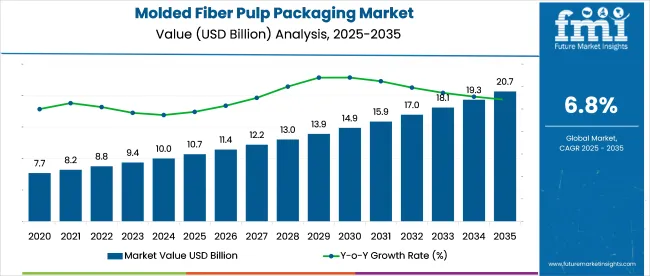
Key Takeaways, Market Size, and Forecast
| Metric | Value |
|---|---|
| Market Size (2025) | USD 7.9 Billion |
| Market Size (2026) | USD 8.4 Billion |
| Market Size (2036) | USD 15.8 Billion |
| CAGR (2026–2036) | 6.5% |
| Leading Material (2026) | Recycled Paper Pulp (62.0%) |
| Leading End Use (2026) | Electronics Packaging (38.0%) |
| Fastest-Growing Country | India (8.4% CAGR through 2036) |
Molded Fiber Pulp Packaging Market Key Takeaways
| Parameter | Details |
|---|---|
| Market value (2026) | USD 8.4 billion |
| Forecast value (2036) | USD 15.8 billion |
| CAGR (2026 to 2036) | 6.5% |
| Estimated market value (2025) | USD 7.9 billion |
| Leading end use | Electronics packaging |
| End-use share (2026) | 38.0% |
| Leading product type | Transfer molded |
| Product type share (2026) | 46.0% |
| Leading material | Recycled paper pulp |
| Material share (2026) | 62.0% |
| Leading packaging format | Trays |
| Packaging format share (2026) | 36.0% |
| Leading application | Protective packaging |
| Application share (2026) | 40.0% |
| Leading region | East Asia |
| Regional share (2026) | 32.0% |
| Fastest-growing country | India |
| India CAGR | 8.4% |
Source: Future Market Insights, 2026.
Segmental Analysis
Key Facts About Segments
- Product protection and part geometry keep electronics packaging as the largest end-use segment. It is expected to account for 38.0% share in 2026, as device brands continue to look for inserts that cushion products while lowering plastic content after unboxing.
- Broad use across retail packs and transit support keeps transfer molded formats in the largest product-type position. In 2026, this segment is projected to secure 46.0% of total market demand because converters still rely on it for utility-grade output and high-volume runs.
- Feedstock economics remain anchored to recycled paper pulp, which is anticipated to garner 62.0% share in 2026. Availability at scale and fit with repeat-order trays, inserts, and protective components keep it central to mainstream molded pulp production.
- Daily packaging use across food packs, device inserts, and consumer goods keeps trays in the leading format position. Trays are expected to account for 36.0% share in 2026 because they serve more routine end uses than most other molded fiber formats.
- Breakage control keeps protective packaging in the leading application slot, with a projected 40.0% share in 2026. Buyers tend to adopt molded fiber earlier in pack components where damage risk is visible and commercially easier to justify.
- Food retail and takeaway handling support food packaging, which follows electronics with an anticipated 32.0% share in 2026. Trays and carry formats remain commercially useful where nesting and disposal clarity both matter in daily service.
Molded Fiber Pulp Packaging Market Analysis by End Use
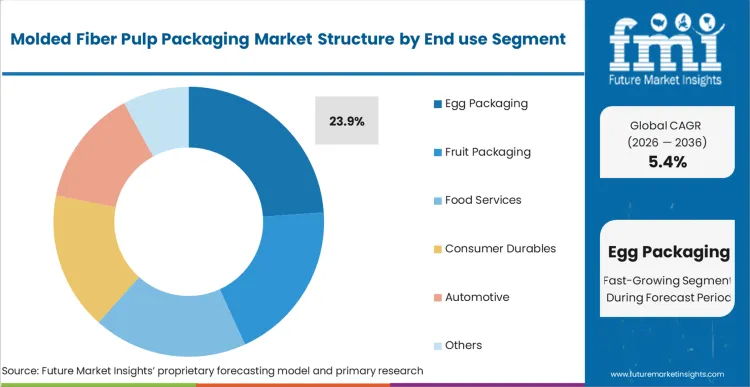
Electronics packaging remains the strongest molded fiber use case because buyers can justify conversion where inserts must control movement, prevent surface contact, and reduce plastic visibility at unboxing without compromising shipping performance. Consumer device brands also need inserts that stack cleanly and travel without adding bulky waste after unboxing. Electronics packaging is set to account for an estimated 38.0% share in 2026 because product value is high and plastic replacement pressure is hard to ignore in premium consumer goods. Food packaging follows closely because trays, takeaway containers, and carry formats fit daily handling needs in retail and foodservice. Industrial packaging and egg packaging stay relevant where shock control and nesting matter more than surface finish. Use-case mix therefore favors categories that need both cushioning and easier disposal.
- Pack Performance: Electronics inserts need shape retention and steady nesting so products reach shelves and homes with less movement inside the box.
- Commercial Pull: Food packaging stays broad because molded pulp can serve trays, takeaway bowls, and secondary supports without forcing a glass or metal solution.
- Use-Case Limit: Egg and industrial packs remain dependable outlets, yet surface finish needs are lower in those uses and average value per unit stays tighter.
Molded Fiber Pulp Packaging Market Analysis by Product Type
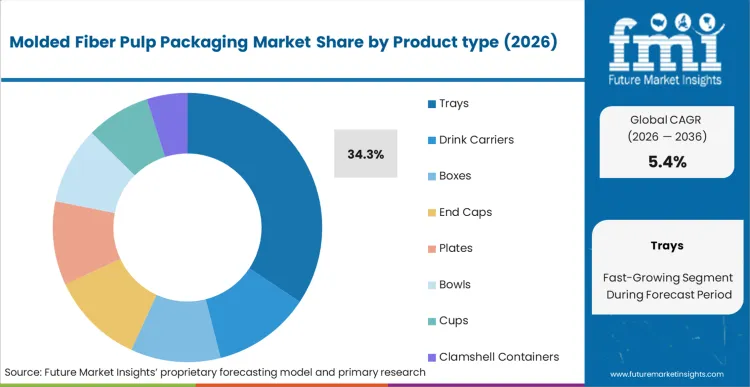
Transfer molded formats remain the volume backbone because they offer the most practical balance of tooling familiarity, repeatable output, and acceptable finish for high-volume protective packaging where cost discipline matters more than premium presentation. Surface perfection matters in some categories, yet many buyers still place higher weight on repeat output and stable handling. Thermoformed fiber moves well in smoother consumer-facing packs where sharper edges and cleaner finish help shelf presentation. Thick-wall molded formats keep a role in heavier protective use where part strength and shock absorption matter more than refined appearance. Process choice therefore follows pack purpose rather than fashion. In 2026, transfer molded is projected to account for 46.0% of total market share because it balances pack utility, converter familiarity, and acceptable finish across a broad spread of shipping and retail uses.
- Scale fit: Transfer molded supports dependable volume programs where nesting, drying, and part consistency matter more than premium presentation.
- Premium route: Thermoformed fiber works better in presentation-led packs where smoother walls and better edge definition support brand appearance.
- Protective role: Thick-wall molded remains useful in heavier-duty packs where part rigidity and product spacing matter more than a cleaner surface.
Molded Fiber Pulp Packaging Market Analysis by Material
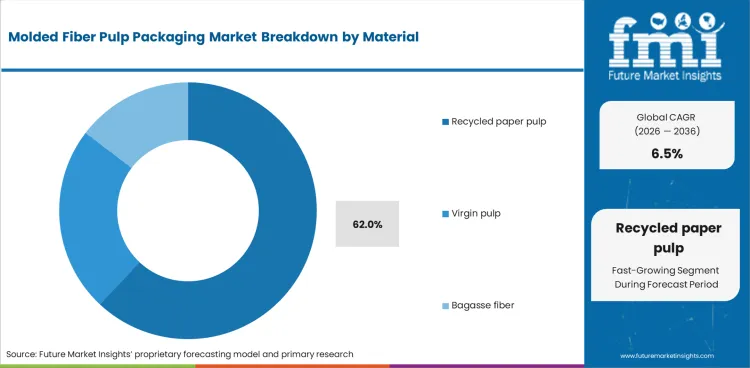
Recycled paper pulp is poised to secure an anticipated 62.0% of the market in 2026 because it matches the practical needs of high-volume trays, inserts, and protective components sold on repeat order cycles. Material choice shapes the cost logic of molded pulp more directly than many outside observers assume. Recovered fiber stays central because converters need feedstock that is available at scale and priced for routine packaging programs rather than niche design runs. Virgin pulp keeps a place where color consistency, surface quality, and tighter forming behavior carry more weight. Bagasse fiber remains smaller but meaningful in sustainability-led applications where non-wood fiber stories support brand communication and purchase preference. Fiber economics therefore favor recycled input for most mainstream demand.
- Feedstock Logic: Recycled paper pulp works best for large run lengths because supply chains are broader and cost discipline is easier to protect.
- Quality Trade-Off: Virgin pulp supports cleaner finish and more uniform appearance, yet it raises input cost for programs sold on tight packaging budgets.
- Niche Value: Bagasse fiber adds story value in selected packs, though scaling depends on local source access and converter familiarity with the blend.
Molded Fiber Pulp Packaging Market Analysis by Packaging Format
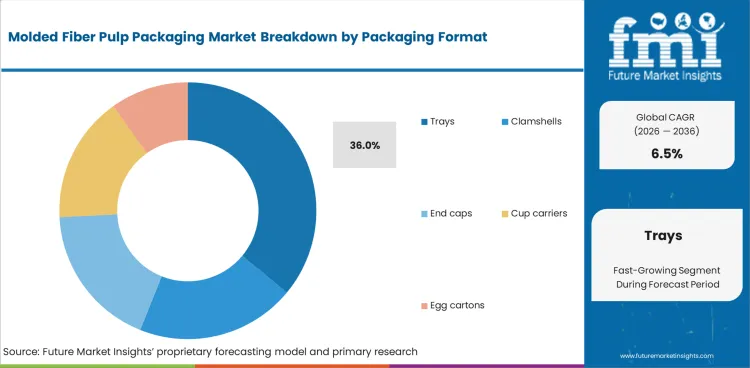
Format choice decides how molded fiber shows up in daily packaging practice. Trays stay widely used because they combine simple geometry with easy stacking and broad relevance across food packs, device inserts, and retail-ready packaging. Clamshells add value where closure and presentation must sit in the same part. End caps remain important in shipped goods because product corners and edges often take the hardest impact during transit. Cup carriers and egg cartons hold steady as routine molded pulp formats with repeat purchase demand and established converter know-how. Coverage in molded fiber tray and molded fiber egg packaging shows how format depth stretches from commodity uses to more tailored pack architecture. Trays are set to garner an expected 36.0% share in 2026 because they fit the widest range of pack uses and work well with stacking, nesting, and high-volume conversion. Format selection therefore follows daily handling reality before it follows visual preference.
- Tray demand: Trays stay versatile because they work in foodservice, electronics, and retail support roles with straightforward pack-out behavior.
- Protective need: End caps remain important where drop risk is concentrated at the product edge and corner rather than across a flat support surface.
- Routine volume: Cup carriers and egg cartons keep steady demand because repeat-use applications protect converter utilization even when premium projects slow.
Molded Fiber Pulp Packaging Market Analysis by Application
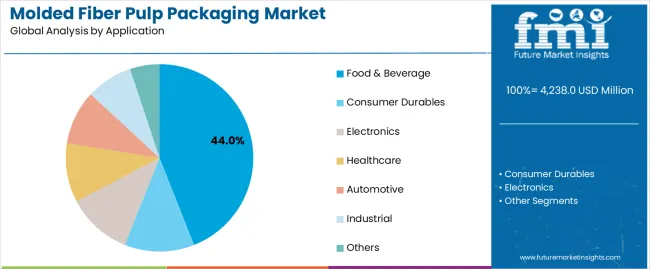
Application mix matters because molded fiber sells into packaging jobs with very different operating demands. Protective packaging is poised to secure a projected 40.0% share in 2026 because shock control, part separation, and transit safety remain the most common reasons molded fiber is selected across shipped goods. Protective packaging carries a wide practical role since it must limit product movement, absorb impact, and hold parts in place through long shipping cycles. Food-contact packaging moves on a different logic where cleanliness, stack efficiency, and quick disposal matter just as much as protection. Retail-ready packaging needs a cleaner surface and a more deliberate shape because shelf presentation affects buying behavior. Transit cushioning keeps a quieter but durable role in logistics where edge contact and empty-space control decide whether fragile goods arrive intact. Demand in molded fiber pulp edge protectors and pulp liners reflects how molded fiber can serve both inside-the-box support and shipment-facing reinforcement. Application spread keeps the category resilient because no single packaging job defines all demand.
- Protection First: Protective packaging remains central where shock control and part separation matter more than premium surface finish.
- Food-Contact Fit: Food-contact packs need cleaner appearance and steady nesting because unit handling is frequent and disposal happens at consumer touchpoints.
- Transit Value: Cushioning and liners stay relevant where freight damage costs outweigh the small savings of lighter or simpler pack choices.
Molded Fiber Pulp Packaging Market Analysis by Region
Regional shape in this industry follows where converter networks, export production, and plastic replacement programs already intersect. Manufacturing density helps because molded fiber adoption rises faster when pack users and converters operate close to each other. East Asia is poised to garner an expected 32.0% share in 2026 as conversion can scale through supplier depth and daily production rhythm rather than through isolated sustainability pilots. North America seemingly follows because foodservice, consumer goods, and medical-adjacent packaging use molded parts across a broad installed base. Europe remains important as waste policy and packaging redesign keep fiber on the table in many product reviews. South Asia grows from a smaller base while Latin America stays relevant in food and agriculture-linked protection.
- East Asia Lead: Dense manufacturing clusters and export-oriented packing activity keep East Asia in front on regional share.
- North America Base: Broad end-use spread and established custom molding capabilities support steady demand across food, electronics, and industrial packs.
- Europe Role: Regulation matters in Europe, yet conversion speed still depends on cost tolerance, fiber availability, and the pace of packaging redesign.
Molded Fiber Pulp Packaging Market Drivers, Restraints, and Opportunities
Plastic reduction goals keep molded fiber under serious review because many packaged goods can shift away from foam and rigid plastic inserts without changing the product itself. Brands also like the way molded pulp supports a simpler disposal message in high-visibility categories such as electronics, foodservice, and selected personal care packs. Protection still matters more than image alone. Molded fiber keeps moving because it can protect goods, nest efficiently, and fit pallet and shelf routines with less redesign than many alternative materials. Interest across wet-molded fibre and dry-molded fibre also shows that buyers are not chasing one single technical path. Demand grows where fiber formats can meet daily packing requirements with acceptable tool cost and acceptable run stability. Driver strength therefore comes from practical substitution rather than from novelty.
Wider conversion is still constrained where molded fiber passes sustainability review but struggles on moisture exposure, finish consistency, nesting reliability, or tooling payback in applications with tight operational tolerances. Protective packaging can tolerate utility surfaces, yet presentation-led applications ask more from edge quality and dimensional control. Packaging lines also need repeatable nesting and stable part release or labor burden starts to climb. Material choice adds another layer because recycled pulp keeps cost under control but can make surface uniformity harder in some applications. Programs that need smoother walls or tighter tolerances often move toward thermoformed fibre for a cleaner finish and more defined part geometry. Conversion slows when molded fiber solves the plastic question but creates a handling or finish question. Restraint therefore lies in execution quality more than in basic market interest.
- Electronics Conversion: Device brands can widen use where inserts, trays, and end caps replace legacy plastic supports without adding new disposal burden after unboxing.
- Foodservice Spread: Takeaway and ready-meal programs offer room for fiber growth when nesting, grease resistance, and stack performance meet daily service needs.
- Protective Export Packs: Industrial and transit packaging can move further toward molded pulp where corner protection and inner support reduce damage claims and freight waste.
Regional Analysis
Key Facts About Country
- A newer conversion base gives India more room to add molded fiber into electronics, takeaway, and general consumer goods programs. Molded fiber pulp packaging demand in India is expected to rise at 8.4% CAGR through 2036.
- Export packaging depth and converter scale continue to support China. Sales of molded fiber pulp packaging in China are projected to increase at 7.8% CAGR by 2036, helped by faster spread across protective formats.
- Agriculture, food transit, and retail protection keep Brazil commercially relevant in this study. By 2036, Brazil is expected to post 6.2% CAGR in molded fiber pulp packaging.
- Fiber substitution in foodservice and device packaging continues to move through a more specification-heavy process in the United States. Market growth for molded fiber pulp packaging in the United States is expected to run at 5.8% CAGR through 2036.
- Compliance pressure supports demand in Germany, though buyers still apply hard filters around finish, tolerances, and operating fit. A 5.4% CAGR is expected for molded fiber pulp packaging in Germany through 2036.
- Practical application and spend discipline shape the outlook in the United Kingdom. Molded fiber pulp packaging demand across the UK is set to increase at a projected 5.2% CAGR by 2036.
- Fit, finish, and process discipline keep Japan on a steadier path than faster-conversion markets. Through 2036, molded fiber pulp packaging sales in Japan are expected to grow at 4.9% CAGR.
.webp "Top Country Growth Comparison Molded Fiber Pulp Packaging Market Cagr (2026 2036)")
| Country | CAGR (2026 to 2036) |
|---|---|
| India | 8.4% |
| China | 7.8% |
| Brazil | 6.2% |
| USA | 5.8% |
| Germany | 5.4% |
| UK | 5.2% |
| Japan | 4.9% |
Source: Future Market Insights analysis, based on proprietary forecasting model and primary research.
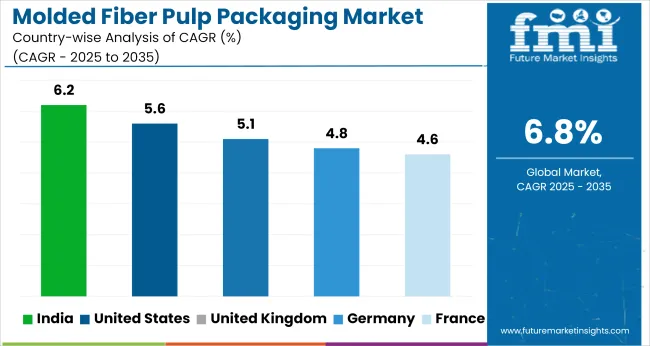
Regional analysis in molded fiber pulp packaging industry is less about abstract sustainability positioning and more about where converter capacity, export packaging demand, and retail pressure meet in daily practice. Regions with broader manufacturing bases can move faster because molded pulp needs tool support, drying control, and steady customer programs to scale well.
Asia Pacific Molded Fiber Pulp Packaging Market Analysis
East Asia holds the largest regional position in this industry. Manufacturing concentration explains much of that lead because molded fiber adoption rises faster when converters sit near electronics assembly with appliance production, and export packing operations. South Asia remains smaller in regional share and yet it carries one of the stronger forward growth profiles in the study. Packaging conversion in the region is also helped by the fact that newer lines can consider fiber earlier in the specification process. Regional depth also supports a broader mix of utility-grade and smoother premium parts.
- China: Demand for molded fiber pulp packaging in China is ready to scale at an estimated CAGR of 7.8% by 2036 as export manufacturing keeps packaging volumes high across electronics and general consumer goods. Converter networks are deeper here than in many other countries, which makes tooling support and repeat supply easier to secure. Protective inserts, trays, and end caps fit well with China’s shipping-heavy industrial base. Food packaging also stays relevant where takeaway and retail-ready packs move in large unit volumes. Conversion is still selective because surface finish and moisture behavior must match each product brief. China remains a fast-growth country because scale, supplier depth, and replacement demand work in the same direction.
- Japan: Clean presentation matters in consumer-facing formats, which keeps quality requirements high even in fiber-based conversion. Manufacturers also weigh part consistency and storage efficiency very closely before a wider pack change is approved. Opportunity stays real in electronics support parts and selected food applications, yet conversion tends to move through carefully defined programs rather than broad portfolio resets. Japan is forecast to post 4.9% CAGR in molded fiber pulp packaging sector by 2036 as the demand grows on a more measured path because packaging expectations around fit, finish, and process discipline are exacting. Japan therefore adds stable demand, though pace remains lower than China and India.
- India: India is anticipated to see molded fiber pulp packaging industry develop at a projected CAGR of 8.4% over the forecast period because expansion room is wide and supplier capability continues to improve. Consumer goods manufacturing is broadening and food packaging demand continues to deepen across urban and semi-urban channels. Converters also benefit from a market where many plastic replacement decisions are still ahead rather than already completed. Protective packaging for electronics and appliance categories adds another route for growth because product movement is increasing with domestic production and wider distribution. Tooling and quality consistency can still slow premium conversion in some categories.
FMI observes, East Asia will likely keep its lead because demand comes from many repeat-use packaging jobs rather than one narrow niche. China gives the region speed while Japan gives it discipline around quality and specification. South Asia should gain weight over time because its growth starts from a lower base and more packaging categories are still open to conversion. India drives most of that outlook, though long-term gains depend on reliable production quality and converter discipline. Food and electronics will likely remain the clearest demand anchors. Regional strength also comes from the way molded fiber serves both inner protection and presentation needs. Leadership in this industry therefore depends on execution depth, not on broad sustainability language alone.
North America Molded Fiber Pulp Packaging Market Analysis
North America remains one of the clearest demand bases for molded fiber in protective and food-related packaging. Installed converter capability helps because buyers often prefer proven suppliers with reliable tooling response and repeat quality. Latin America remains a practical growth region rather than a saturated one. Regional demand here is less polished than in premium presentation-led categories, yet utility-grade fiber formats fit many transport and handling needs well. Converter depth is narrower than in East Asia or North America, which means application spread can vary by country. Brazil remains the main reference point for regional direction because it combines scale, agriculture, and expanding packaged goods demand. North America is less about first discovery and more about disciplined program expansion across categories that already understand the material.
- United States: Foodservice demand keeps the base broad, while electronics and health-related packaging add value in custom protective parts. Domestic converters offer strong design and molding support, which helps buyers test fiber formats without shifting overseas. Adoption is not automatic because pack-outs still need to clear stackability, fit, and shipping abuse standards. Retail and brand pressure keep the material under review, though final decisions still come down to performance in distribution. Sales of molded fiber pulp packaging in the United States are likely to increase at an expected CAGR of 5.8% by 2036, reflecting a mature packaging system where replacement happens by program and not by wholesale switch.
- Brazil: Brazil is poised to witness a scale at an anticipated 6.2% CAGR in molded fiber pulp packaging by 2036, as the demand benefits from a broad packaging base, with converter capacity and logistics consistency still shaping how far premium formats can spread. Agriculture and food distribution keep protective trays and transit supports in regular use. Retail-ready packaging also offers room where molded pulp can replace plastic supports in selected consumer goods. Brazil stays above several mature markets because growth begins from a more open conversion base. Commercial uptake should remain strongest where molded fiber solves handling needs first and brand image second.
FMI analyses, North America should remain a steady high-value region because molded fiber already lies inside several mainstream packaging conversations. United States demand gives the region scale, while custom design capability supports more complex inserts and protective forms. Latin America is likely to stay a smaller share region, yet it still offers worthwhile room for molded fiber expansion. Brazil shows how food and agriculture can keep fiber packaging practical even without a premium presentation focus. Regional upside will depend on converter capability, freight conditions, and the pace of plastic replacement in mass-market goods. Performance will hold best where converters can balance protection, unit economics, and pack-line ease in the same offer.
Europe Molded Fiber Pulp Packaging Market Analysis
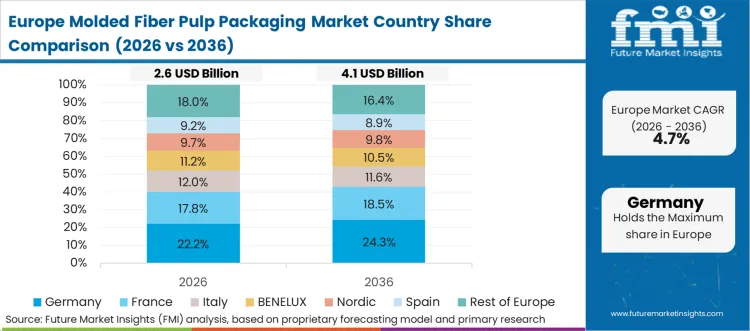
Europe remains one of the most closely watched regions for molded fiber conversion. Packaging regulation matters here, though demand does not move on policy talk alone. Commercial progress depends on whether fiber parts can match product presentation, stacking, and recycling logic without pushing cost beyond what branded goods can absorb. Food, household products, and selected electronics all keep the region active. Converter capability varies by country, which is why growth rates do not move in one straight line across Europe. Regional direction remains positive because compliance pressure and packaging redesign are both part of day-to-day operating decisions.
- United Kingdom: Takeaway food, grocery convenience packs, and general retail protection keep fiber solutions visible in regular packaging reviews. Buyers still look closely at cost and pack appearance, which means simple utility formats often move first. Food-contact applications stay important because molded pulp can support disposal messaging more clearly than several mixed-material alternatives. Molded fiber pulp packaging demand across the United Kingdom is set to increase at a projected 5.2% CAGR by 2036 as the demand rises on practical use rather than on broad experimentation. Growth remains steady because many applications are clear, though spend discipline still limits abrupt change.
- Germany: Germany is expected to progress at a 5.4% CAGR by 2036 in molded fiber pulp packaging because packaging changes must work operationally before they work symbolically. Industrial discipline gives the country a solid base for transport protection and engineered pack components. Food and household goods also contribute because packaging redesign often links environmental expectations with pack efficiency. Performance checks remain strict, especially when molded parts need cleaner finish or tighter tolerances. Germany therefore offers dependable growth, yet programs usually move after detailed testing instead of broad headline-led conversion.
FMI assesses, Europe will continue to matter because fiber packaging stays close to both compliance goals and brand presentation needs. United Kingdom and Germany show that growth can stay healthy even when buyers apply hard filters on cost and performance. Country variation will remain visible because converter depth, product mix, and disposal systems still differ across the region. Regional expansion should favor formats that combine visual acceptability with straightforward recycling logic. Programs that ask molded fiber to do too much without solving finish or moisture issues may still slow before reaching full commercial scale.
Competitive Aligners for Market Players
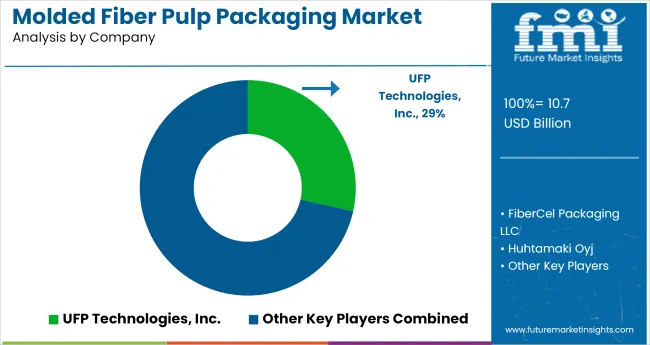
Competition remains fragmented because supplier advantage changes by application: scale and drying efficiency matter most in egg and food formats, while tooling precision, geometry control, and development responsiveness matter more in electronics and custom protective inserts. Huhtamaki and YFY Jupiter stand out where broad packaging reach and design capability help them serve larger branded programs. Brødrene Hartmann brings deep formed-fiber experience from egg and fruit packaging, which gives it strong process understanding in high-volume molded applications. Broader category context also shows how scale players use fiber as one part of a wider packaging offer. Competitive advantage does not come from size alone. Repeat quality, lead time, and the ability to move from drawing to commercial tool without long delay still shape who wins the next pack program.
UFP Technologies and Henry Molded Products matter because custom protective packaging often turns on part fit, transit security, and a converter’s ability to solve awkward product geometry. EnviroPAK stays relevant in custom molded fiber where project work needs close shape adaptation and responsive development. Novolex adds weight through its broader food and consumer packaging presence, even though molded fiber is central to a much wider packaging portfolio. Buyers in this category rarely choose on brand name alone. Pack-out reliability, nesting behavior, part finish, and freight efficiency often decide the order once basic sustainability claims are already on the table. Adjacent demand in edge protector demand and molded fiber pulp cap shows why application detail matters as much as headline category size.
Market structure favors suppliers that can stay practical. Smooth presentation parts draw attention, yet many commercial programs still move first through trays, inserts, and protective formats with simpler geometry. Large groups can cover more regions and more customer categories, while specialist converters often win where pack design needs closer iteration and faster correction. Commercial pressure therefore pushes all players toward better tool discipline and steadier output rather than toward abstract brand positioning. Winning in this market means matching molded fiber performance to the actual packaging job and keeping the offer easy enough to scale after the first approved run.
Recent Developments
- In October 2024, Huhtamaki expanded smooth molded fiber lid production in Lurgan, Northern Ireland.
- In October 2025, HZ Green Pulp began full-scale commercial production of Dry Molded Fiber coffee lids in Malaysia.
- In January 2026, Hartmann North America announced another major expansion to support rising demand for recyclable and compostable molded fiber egg packaging.
Key Players in Molded Fiber Pulp Packaging Market
- Huhtamaki
- YFY Jupiter
- UFP Technologies
- Brødrene Hartmann
- Henry Molded Products
- EnviroPAK
- Novolex
Scope of the Report
| Item | Value |
|---|---|
| Quantitative Units | USD 7.9 billion in 2025, USD 8.4 billion in 2026, and USD 15.8 billion by 2036 at a CAGR of 6.5% from 2026 to 2036. |
| Market Definition | Rigid molded pulp packaging formats made from recycled or virgin fiber substrates and used for protective, food-contact, retail-ready, and transit support applications. |
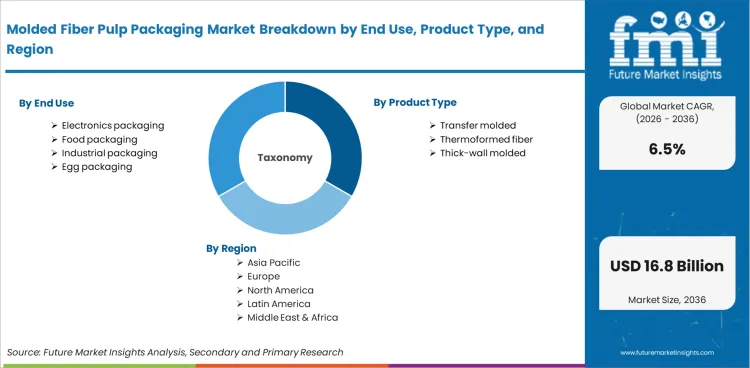
| Segmentation | By End Use, By Product Type, By Material, By Packaging Format, By Application, and By Region. |
| Regions Covered | East Asia, North America, Europe, South Asia, and Latin America. |
| Countries Covered | China, Japan, United States, United Kingdom, Germany, India, and Brazil. |
| Key Companies Profiled | Huhtamaki, YFY Jupiter, UFP Technologies, Brødrene Hartmann, Henry Molded Products, EnviroPAK, and Novolex. |
| Forecast Period | 2026 to 2036. |
| Approach | Baseline sizing anchored to molded fiber packaging demand across protective, food-contact, and retail-ready uses, with growth interpreted through converter capability, pack substitution, and regional adoption logic. |
Source: Future Market Insights (FMI) analysis, based on proprietary forecasting model and primary research
Molded Fiber Pulp Packaging Market Analysis by Segments
By End Use:
- Electronics packaging
- Food packaging
- Industrial packaging
- Egg packaging
By Product Type:
- Transfer molded
- Thermoformed fiber
- Thick-wall molded
By Material:
- Recycled paper pulp
- Virgin pulp
- Bagasse fiber
By Packaging Format:
- Trays
- Clamshells
- End caps
- Cup carriers
- Egg cartons
By Application:
- Protective packaging
- Food-contact packaging
- Retail-ready packaging
- Transit cushioning
By Region:
- Asia Pacific
- China
- Japan
- India
- North America & Latin America
- United States
- Brazil
- Europe
- United Kingdom
- Germany
Bibliography
- Huhtamäki Oyj. (2024, October 18). Huhtamaki Expands Its Capacity For Fiber Lid Production To Lurgan, Northern Ireland. Press Release.
- PulPac. (2025, October 28). HZ Green Pulp Enters Full-Scale Production. Press Release.
- Hartmann Packaging. (2026, January 20). Press Release: Hartmann North America Announces Another Major Expansion. Press Release.
- European Commission. (2026). Commission Publishes Guidance To Support Implementation Of New EU Packaging Rules.
- European Commission. (2026). Packaging Waste Regulation.
- American Forest & Paper Association. (2025, August 12). Paper Industry Announces 2024 USA Paper Recycling Rates.
- Confederation of European Paper Industries. (2025). Key Statistics 2024.
- Confederation of European Paper Industries. (2025). Monitoring Report 2024.
- Huhtamäki Oyj. (2024). Huhtamäki Annual Report 2024.
- Brødrene Hartmann A/S. (2025). Annual Report 2024.
- UFP Technologies, Inc. (2025). 2024 Annual Report.
- YFY. (2025). Assurance Statement for YFY Sustainability Report 2024.
- Danielewicz, D. (2025). Manufacturing Of Form-Molded Pulp Products (Fmpps) In The Papermaking Industry - A Review. Bioresources, 20(2), 5114-5156.
This bibliography is provided for reader reference. The full FMI report contains the complete reference list with primary source documentation.
This Report Addresses
- Market intelligence across electronics packaging, food packaging, industrial packaging, and egg packaging within the molded fiber pulp packaging category.
- Market size estimation and ten-year forecasts from 2026 to 2036 built around converter capability, replacement demand, and pack substitution logic.
- Growth opportunity mapping across transfer molded, thermoformed fiber, thick-wall molded, recycled paper pulp, virgin pulp, and bagasse fiber formats.
- Segment and regional interpretation covering East Asia, North America, Europe, South Asia, and Latin America with country focus on China, Japan, the United States, the United Kingdom, Germany, India, and Brazil.
- Competition assessment across design support, tooling response, surface finish capability, nesting efficiency, and repeat-order reliability.
- Packaging format analysis covering trays, clamshells, end caps, cup carriers, egg cartons, and related protective support formats.
- Application review across protective packaging, food-contact packaging, retail-ready packaging, and transit cushioning in consumer goods and industrial logistics.
- Report delivery for strategy planning, packaging conversion review, supplier comparison, and operating-level benchmarking.
Frequently Asked Questions
How large is the market in 2026?
The molded fiber pulp packaging industry is expected to cross USD 8.4 billion in 2026, which reflects steady replacement demand across protective and food-contact packaging uses.
What will it be worth by 2036?
Industry value is projected to reach USD 15.8 billion by 2036 as broader fiber conversion moves through electronics, foodservice, and industrial packaging programs.
What CAGR is projected for the forecast period?
Scale in demand for the sector is anticipated at 6.5% CAGR from 2026 to 2036, which points to disciplined expansion rather than a short burst of one-time adoption.
Which end-use segment leads?
Electronics packaging is set to lead end use with an estimated 38.0% share in 2026 because device inserts and trays combine protection needs with stronger pressure to reduce plastic.
Which product type leads?
Transfer molded is poised to lead product type with a projected 46.0% share in 2026 because converters know the process well and it fits high-volume protective packaging work.
Which material leads?
Recycled paper pulp is likely to lead material demand with an expected 62.0% share in 2026 since it supports cost control and broad feedstock availability for mainstream molded applications.
Which region stays in front?
East Asia is poised to remain the leading region with a projected 32.0% share in 2026 because manufacturing density and export packing activity keep molded fiber in regular use.
Why does electronics packaging stay ahead?
Electronics packaging stays ahead because inserts must protect higher-value goods and brands also want packaging that lowers plastic content after unboxing.
Why does transfer molded remain the biggest process route?
Transfer molded remains largest because it balances output scale, acceptable finish, and tool familiarity better than many premium molded alternatives.
Why does recycled paper pulp dominate the material mix?
Recycled paper pulp dominates because most commercial programs need broad feedstock access and workable cost structures before they need cleaner premium appearance.
Which countries are growing fastest?
India is likely to lead at a projected 8.4% CAGR and China seemingly follows at an estimated 7.8%, while Brazil, the United States, Germany, the United Kingdom, and Japan grow at steadier rates.
Why is India growing faster than China?
India grows faster because conversion starts from a lower installed base, which leaves more room for fiber adoption in food and consumer goods packaging.
Why does East Asia hold the largest regional share?
East Asia holds the largest share because converter networks sit close to export manufacturing, electronics assembly, and high-volume protective packaging demand.
What keeps North America commercially important?
North America remains important because foodservice, consumer goods, and custom protective packaging all support repeat molded fiber demand across a mature converter base.
How is Europe different from other regions?
Europe differs because packaging redesign is closely tied to compliance and recycling logic, yet buyers still expect molded parts to meet strict cost and finish needs.
Where do the main restraints sit?
Main restraints sit in moisture control, tooling expense, and finish consistency, which can slow conversion even when buyers like fiber on paper.
Which opportunities look the clearest through 2036?
Electronics inserts, takeaway food packs, and export-oriented protective formats look clearest because each can replace legacy plastic supports with workable molded designs.
How important are trays and end caps in this industry?
Trays matter because they serve food, retail, and device packaging, while end caps stay important where corner impact and transit damage remain the bigger risk.
How fragmented is competition?
Competition is fragmented because no single supplier leads every geometry, every quality tier, and every region inside the molded fiber pulp packaging space.
Which companies are active in the category?
Active names include Huhtamaki, YFY Jupiter, UFP Technologies, Brødrene Hartmann, Henry Molded Products, EnviroPAK, and Novolex across broader or specialist fiber packaging roles.
What is outside the study scope?
Flexible paper packaging, corrugated board, rigid plastic, glass containers, and metal packs remain outside scope because they do not rely on molded pulp forming.
What should readers watch through 2036?
Readers should watch how quickly molded fiber moves from pilot projects into repeat program conversion, especially where tool quality and pack handling stay under pressure.
Preview the report firsthand - request a free sample
Get SampleGet the brochure for pricing and purchase details.
Get PDFTable of Content
- Executive Summary
- Global Market Outlook
- Demand-side Trends
- Supply-side Trends
- Technology Roadmap Analysis
- Analysis and Recommendations
- Market Overview
- Market Coverage / Taxonomy
- Market Definition / Scope / Limitations
- Research Methodology
- Chapter Orientation
- Analytical Lens and Working Hypotheses
- Market Structure, Signals, and Trend Drivers
- Benchmarking and Cross-market Comparability
- Market Sizing, Forecasting, and Opportunity Mapping
- Research Design and Evidence Framework
- Desk Research Programme (Secondary Evidence)
- Company Annual and Sustainability Reports
- Peer-reviewed Journals and Academic Literature
- Corporate Websites, Product Literature, and Technical Notes
- Earnings Decks and Investor Briefings
- Statutory Filings and Regulatory Disclosures
- Technical White Papers and Standards Notes
- Trade Journals, Industry Magazines, and Analyst Briefs
- Conference Proceedings, Webinars, and Seminar Materials
- Government Statistics Portals and Public Data Releases
- Press Releases and Reputable Media Coverage
- Specialist Newsletters and Curated Briefings
- Sector Databases and Reference Repositories
- FMI Internal Proprietary Databases and Historical Market Datasets
- Subscription Datasets and Paid Sources
- Social Channels, Communities, and Digital Listening Inputs
- Additional Desk Sources
- Expert Input and Fieldwork (Primary Evidence)
- Primary Modes
- Qualitative Interviews and Expert Elicitation
- Quantitative Surveys and Structured Data Capture
- Blended Approach
- Why Primary Evidence is Used
- Field Techniques
- Interviews
- Surveys
- Focus Groups
- Observational and In-context Research
- Social and Community Interactions
- Stakeholder Universe Engaged
- C-suite Leaders
- Board Members
- Presidents and Vice Presidents
- R&D and Innovation Heads
- Technical Specialists
- Domain Subject-matter Experts
- Scientists
- Physicians and Other Healthcare Professionals
- Governance, Ethics, and Data Stewardship
- Research Ethics
- Data Integrity and Handling
- Primary Modes
- Tooling, Models, and Reference Databases
- Desk Research Programme (Secondary Evidence)
- Data Engineering and Model Build
- Data Acquisition and Ingestion
- Cleaning, Normalisation, and Verification
- Synthesis, Triangulation, and Analysis
- Quality Assurance and Audit Trail
- Market Background
- Market Dynamics
- Drivers
- Restraints
- Opportunity
- Trends
- Scenario Forecast
- Demand in Optimistic Scenario
- Demand in Likely Scenario
- Demand in Conservative Scenario
- Opportunity Map Analysis
- Product Life Cycle Analysis
- Supply Chain Analysis
- Investment Feasibility Matrix
- Value Chain Analysis
- PESTLE and Porter’s Analysis
- Regulatory Landscape
- Regional Parent Market Outlook
- Production and Consumption Statistics
- Import and Export Statistics
- Market Dynamics
- Global Market Analysis 2021 to 2025 and Forecast, 2026 to 2036
- Historical Market Size Value (USD Million) Analysis, 2021 to 2025
- Current and Future Market Size Value (USD Million) Projections, 2026 to 2036
- Y-o-Y Growth Trend Analysis
- Absolute $ Opportunity Analysis
- Global Market Pricing Analysis 2021 to 2025 and Forecast 2026 to 2036
- Global Market Analysis 2021 to 2025 and Forecast 2026 to 2036, By End Use
- Introduction / Key Findings
- Historical Market Size Value (USD Million) Analysis By End Use , 2021 to 2025
- Current and Future Market Size Value (USD Million) Analysis and Forecast By End Use , 2026 to 2036
- Electronics packaging
- Food packaging
- Industrial packaging
- Egg packaging
- Electronics packaging
- Y-o-Y Growth Trend Analysis By End Use , 2021 to 2025
- Absolute $ Opportunity Analysis By End Use , 2026 to 2036
- Global Market Analysis 2021 to 2025 and Forecast 2026 to 2036, By Product Type
- Introduction / Key Findings
- Historical Market Size Value (USD Million) Analysis By Product Type, 2021 to 2025
- Current and Future Market Size Value (USD Million) Analysis and Forecast By Product Type, 2026 to 2036
- Transfer molded
- Thermoformed fiber
- Thick-wall molded
- Transfer molded
- Y-o-Y Growth Trend Analysis By Product Type, 2021 to 2025
- Absolute $ Opportunity Analysis By Product Type, 2026 to 2036
- Global Market Analysis 2021 to 2025 and Forecast 2026 to 2036, By Material
- Introduction / Key Findings
- Historical Market Size Value (USD Million) Analysis By Material, 2021 to 2025
- Current and Future Market Size Value (USD Million) Analysis and Forecast By Material, 2026 to 2036
- Recycled paper pulp
- Virgin pulp
- Bagasse fiber
- Recycled paper pulp
- Y-o-Y Growth Trend Analysis By Material, 2021 to 2025
- Absolute $ Opportunity Analysis By Material, 2026 to 2036
- Global Market Analysis 2021 to 2025 and Forecast 2026 to 2036, By Packaging Format
- Introduction / Key Findings
- Historical Market Size Value (USD Million) Analysis By Packaging Format, 2021 to 2025
- Current and Future Market Size Value (USD Million) Analysis and Forecast By Packaging Format, 2026 to 2036
- Trays
- Clamshells
- End caps
- Cup carriers
- Egg cartons
- Trays
- Y-o-Y Growth Trend Analysis By Packaging Format, 2021 to 2025
- Absolute $ Opportunity Analysis By Packaging Format, 2026 to 2036
- Global Market Analysis 2021 to 2025 and Forecast 2026 to 2036, By Application
- Introduction / Key Findings
- Historical Market Size Value (USD Million) Analysis By Application, 2021 to 2025
- Current and Future Market Size Value (USD Million) Analysis and Forecast By Application, 2026 to 2036
- Protective packaging
- Food-contact packaging
- Retail-ready packaging
- Transit cushioning
- Protective packaging
- Y-o-Y Growth Trend Analysis By Application, 2021 to 2025
- Absolute $ Opportunity Analysis By Application, 2026 to 2036
- Global Market Analysis 2021 to 2025 and Forecast 2026 to 2036, By Region
- Introduction
- Historical Market Size Value (USD Million) Analysis By Region, 2021 to 2025
- Current Market Size Value (USD Million) Analysis and Forecast By Region, 2026 to 2036
- North America
- Latin America
- Western Europe
- Eastern Europe
- East Asia
- South Asia and Pacific
- Middle East & Africa
- Market Attractiveness Analysis By Region
- North America Market Analysis 2021 to 2025 and Forecast 2026 to 2036, By Country
- Historical Market Size Value (USD Million) Trend Analysis By Market Taxonomy, 2021 to 2025
- Market Size Value (USD Million) Forecast By Market Taxonomy, 2026 to 2036
- By Country
- USA
- Canada
- Mexico
- By End Use
- By Product Type
- By Material
- By Packaging Format
- By Application
- By Country
- Market Attractiveness Analysis
- By Country
- By End Use
- By Product Type
- By Material
- By Packaging Format
- By Application
- Key Takeaways
- Latin America Market Analysis 2021 to 2025 and Forecast 2026 to 2036, By Country
- Historical Market Size Value (USD Million) Trend Analysis By Market Taxonomy, 2021 to 2025
- Market Size Value (USD Million) Forecast By Market Taxonomy, 2026 to 2036
- By Country
- Brazil
- Chile
- Rest of Latin America
- By End Use
- By Product Type
- By Material
- By Packaging Format
- By Application
- By Country
- Market Attractiveness Analysis
- By Country
- By End Use
- By Product Type
- By Material
- By Packaging Format
- By Application
- Key Takeaways
- Western Europe Market Analysis 2021 to 2025 and Forecast 2026 to 2036, By Country
- Historical Market Size Value (USD Million) Trend Analysis By Market Taxonomy, 2021 to 2025
- Market Size Value (USD Million) Forecast By Market Taxonomy, 2026 to 2036
- By Country
- Germany
- UK
- Italy
- Spain
- France
- Nordic
- BENELUX
- Rest of Western Europe
- By End Use
- By Product Type
- By Material
- By Packaging Format
- By Application
- By Country
- Market Attractiveness Analysis
- By Country
- By End Use
- By Product Type
- By Material
- By Packaging Format
- By Application
- Key Takeaways
- Eastern Europe Market Analysis 2021 to 2025 and Forecast 2026 to 2036, By Country
- Historical Market Size Value (USD Million) Trend Analysis By Market Taxonomy, 2021 to 2025
- Market Size Value (USD Million) Forecast By Market Taxonomy, 2026 to 2036
- By Country
- Russia
- Poland
- Hungary
- Balkan & Baltic
- Rest of Eastern Europe
- By End Use
- By Product Type
- By Material
- By Packaging Format
- By Application
- By Country
- Market Attractiveness Analysis
- By Country
- By End Use
- By Product Type
- By Material
- By Packaging Format
- By Application
- Key Takeaways
- East Asia Market Analysis 2021 to 2025 and Forecast 2026 to 2036, By Country
- Historical Market Size Value (USD Million) Trend Analysis By Market Taxonomy, 2021 to 2025
- Market Size Value (USD Million) Forecast By Market Taxonomy, 2026 to 2036
- By Country
- China
- Japan
- South Korea
- By End Use
- By Product Type
- By Material
- By Packaging Format
- By Application
- By Country
- Market Attractiveness Analysis
- By Country
- By End Use
- By Product Type
- By Material
- By Packaging Format
- By Application
- Key Takeaways
- South Asia and Pacific Market Analysis 2021 to 2025 and Forecast 2026 to 2036, By Country
- Historical Market Size Value (USD Million) Trend Analysis By Market Taxonomy, 2021 to 2025
- Market Size Value (USD Million) Forecast By Market Taxonomy, 2026 to 2036
- By Country
- India
- ASEAN
- Australia & New Zealand
- Rest of South Asia and Pacific
- By End Use
- By Product Type
- By Material
- By Packaging Format
- By Application
- By Country
- Market Attractiveness Analysis
- By Country
- By End Use
- By Product Type
- By Material
- By Packaging Format
- By Application
- Key Takeaways
- Middle East & Africa Market Analysis 2021 to 2025 and Forecast 2026 to 2036, By Country
- Historical Market Size Value (USD Million) Trend Analysis By Market Taxonomy, 2021 to 2025
- Market Size Value (USD Million) Forecast By Market Taxonomy, 2026 to 2036
- By Country
- Kingdom of Saudi Arabia
- Other GCC Countries
- Turkiye
- South Africa
- Other African Union
- Rest of Middle East & Africa
- By End Use
- By Product Type
- By Material
- By Packaging Format
- By Application
- By Country
- Market Attractiveness Analysis
- By Country
- By End Use
- By Product Type
- By Material
- By Packaging Format
- By Application
- Key Takeaways
- Key Countries Market Analysis
- USA
- Pricing Analysis
- Market Share Analysis, 2025
- By End Use
- By Product Type
- By Material
- By Packaging Format
- By Application
- Canada
- Pricing Analysis
- Market Share Analysis, 2025
- By End Use
- By Product Type
- By Material
- By Packaging Format
- By Application
- Mexico
- Pricing Analysis
- Market Share Analysis, 2025
- By End Use
- By Product Type
- By Material
- By Packaging Format
- By Application
- Brazil
- Pricing Analysis
- Market Share Analysis, 2025
- By End Use
- By Product Type
- By Material
- By Packaging Format
- By Application
- Chile
- Pricing Analysis
- Market Share Analysis, 2025
- By End Use
- By Product Type
- By Material
- By Packaging Format
- By Application
- Germany
- Pricing Analysis
- Market Share Analysis, 2025
- By End Use
- By Product Type
- By Material
- By Packaging Format
- By Application
- UK
- Pricing Analysis
- Market Share Analysis, 2025
- By End Use
- By Product Type
- By Material
- By Packaging Format
- By Application
- Italy
- Pricing Analysis
- Market Share Analysis, 2025
- By End Use
- By Product Type
- By Material
- By Packaging Format
- By Application
- Spain
- Pricing Analysis
- Market Share Analysis, 2025
- By End Use
- By Product Type
- By Material
- By Packaging Format
- By Application
- France
- Pricing Analysis
- Market Share Analysis, 2025
- By End Use
- By Product Type
- By Material
- By Packaging Format
- By Application
- India
- Pricing Analysis
- Market Share Analysis, 2025
- By End Use
- By Product Type
- By Material
- By Packaging Format
- By Application
- ASEAN
- Pricing Analysis
- Market Share Analysis, 2025
- By End Use
- By Product Type
- By Material
- By Packaging Format
- By Application
- Australia & New Zealand
- Pricing Analysis
- Market Share Analysis, 2025
- By End Use
- By Product Type
- By Material
- By Packaging Format
- By Application
- China
- Pricing Analysis
- Market Share Analysis, 2025
- By End Use
- By Product Type
- By Material
- By Packaging Format
- By Application
- Japan
- Pricing Analysis
- Market Share Analysis, 2025
- By End Use
- By Product Type
- By Material
- By Packaging Format
- By Application
- South Korea
- Pricing Analysis
- Market Share Analysis, 2025
- By End Use
- By Product Type
- By Material
- By Packaging Format
- By Application
- Russia
- Pricing Analysis
- Market Share Analysis, 2025
- By End Use
- By Product Type
- By Material
- By Packaging Format
- By Application
- Poland
- Pricing Analysis
- Market Share Analysis, 2025
- By End Use
- By Product Type
- By Material
- By Packaging Format
- By Application
- Hungary
- Pricing Analysis
- Market Share Analysis, 2025
- By End Use
- By Product Type
- By Material
- By Packaging Format
- By Application
- Kingdom of Saudi Arabia
- Pricing Analysis
- Market Share Analysis, 2025
- By End Use
- By Product Type
- By Material
- By Packaging Format
- By Application
- Turkiye
- Pricing Analysis
- Market Share Analysis, 2025
- By End Use
- By Product Type
- By Material
- By Packaging Format
- By Application
- South Africa
- Pricing Analysis
- Market Share Analysis, 2025
- By End Use
- By Product Type
- By Material
- By Packaging Format
- By Application
- USA
- Market Structure Analysis
- Competition Dashboard
- Competition Benchmarking
- Market Share Analysis of Top Players
- By Regional
- By End Use
- By Product Type
- By Material
- By Packaging Format
- By Application
- Competition Analysis
- Competition Deep Dive
- Huhtamaki
- Overview
- Product Portfolio
- Profitability by Market Segments (Product/Age /Sales Channel/Region)
- Sales Footprint
- Strategy Overview
- Marketing Strategy
- Product Strategy
- Channel Strategy
- YFY Jupiter
- UFP Technologies
- Brødrene Hartmann
- Henry Molded Products
- EnviroPAK
- Novolex
- Huhtamaki
- Competition Deep Dive
- Assumptions & Acronyms Used


