

- Industry Size (2025)
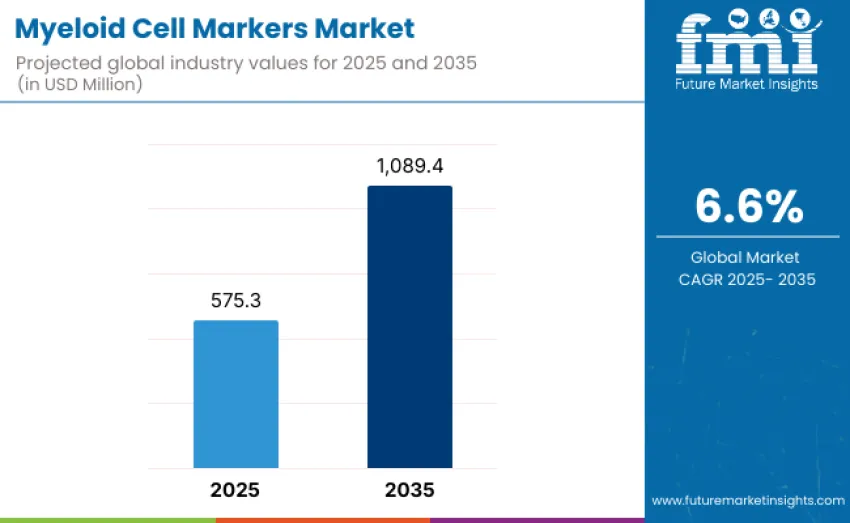
- USD 575.3 Mn
- Forecast (2035)
- USD 1089.4 Mn
- CAGR (2025 to 2035)
- 6.6%
Myeloid Cell Markers Market Forecast and Outlook 2025 to 2035
The global myeloid cell markers market is projected to reach USD 1,089.4 million by 2035, recording an absolute increase of USD 514.1 million over the forecast period. This market is valued at USD 575.3 million in 2025 and is projected to grow at a CAGR of 6.6% over the assessment period. Growth is expected to be supported by rising adoption of high-parameter immunophenotyping tools across immuno-oncology, infectious disease monitoring, and translational research programs, where detailed profiling of monocytes, macrophages, dendritic cells, and granulocyte subsets has become essential for characterizing immune system dynamics.
Technological advancements in cytometry instrumentation, fluorochrome design, and antibody validation protocols are reshaping the competitive landscape. Spectral flow cytometry systems are incorporating full-spectrum detectors and refined optical layouts that reduce signal spillover, supporting more complex myeloid marker combinations without compromising panel performance. Integration with advanced analytics platforms and bioinformatics workflows enables automated gating, high-dimensional clustering, and functional signature identification, ensuring that myeloid marker datasets can be translated more efficiently into actionable biological insights.
Quick Stats for Myeloid Cell Markers Market
- Myeloid Cell Markers Market Value (2025): USD 575.3 million
- Myeloid Cell Markers Market Forecast Value (2035): USD 1,089.4 million
- Myeloid Cell Markers Market Forecast CAGR: 6.6%
- Leading Marker Class in Myeloid Cell Markers Market: CD Antigens (Core Myeloid Markers) with 34.2% share
- Key Growth Regions in Myeloid Cell Markers Market: Asia Pacific, Europe, and North America
- Top Players in Myeloid Cell Markers Market: BD Biosciences, Beckman Coulter (Danaher), BioLegend, MiltenyiBiotec, Thermo Fisher Scientific, Bio-Rad Laboratories, R&D Systems/Bio-Techne, Abcam, Standard BioTools (Fluidigm), Others
Government research investments, large-scale immunology initiatives, and strengthening of translational infrastructure within academic medical centers are expected to accelerate expansion. Training programs in cytometry, immuno-oncology, and computational immunology are being incorporated into university and biotechnology curricula, increasing the number of skilled researchers able to operate advanced cytometry systems and standardized myeloid marker panels. Biopharmaceutical companies are prioritizing immune monitoring capabilities for early-phase trials, driving consistent demand for high-quality myeloid antibodies and conjugates.
Myeloid Cell Markers Market Year-over-Year Forecast (2025 to 2035)
Between 2025 and 2030, the myeloid cell markers market is projected to expand from USD 575.3 million to USD 791.7 million, resulting in a value increase of USD 216.4 million, which represents 42.1% of total forecast growth for the decade. Growth during this period is expected to be driven by rising immunophenotyping demand in hematological malignancies, wider adoption of high-parameter flow cytometry systems, and increasing use of standardized myeloid marker panels in clinical diagnostics and translational research.
From 2030 to 2035, growth is forecast from USD 791.7 million to USD 1,089.4 million, adding USD 297.7 million, which constitutes 57.9% of overall ten-year expansion. This phase will be shaped by increasing clinical integration of multi-omic immune profiling, rising adoption of fully automated flow cytometry platforms, and broader use of advanced myeloid marker panels in immuno-oncology, vaccine development, and chronic inflammatory disease research. Continued standardization of diagnostic criteria for myelodysplastic syndromes, acute myeloid leukemia, and sepsis-related immune dysregulation will elevate demand.
Myeloid Cell Markers Market Key Takeaways
| Metric | Value |
|---|---|
| Market Value (2025) | USD 575.3 million |
| Market Forecast Value (2035) | USD 1,089.4 million |
| Forecast CAGR (2025 to 2035) | 6.6% |
Why Is the Myeloid Cell Markers Market Growing Worldwide?
The myeloid cell markers market is expanding globally due to rising demand for high-precision immunophenotyping in oncology, immunology, and infectious disease research. Growth is supported by the increasing global burden of hematologic cancers such as acute myeloid leukemia, myelodysplastic syndromes, and chronic myelomonocyticleukemia, where accurate characterization of monocytes, granulocytes, dendritic cells, and myeloid-derived suppressor cells is essential for diagnosis, prognosis, and therapeutic decision-making. This clinical need drives routine use of multi-color flow cytometry panels incorporating CD11b, CD14, CD15, CD16, CD33, CD34, CD64, HLA-DR.
Biopharmaceutical companies are accelerating adoption as myeloid cell populations increasingly become central targets and biomarkers in immuno-oncology, particularly for therapies involving tumor-associated macrophages, dendritic cell vaccines, checkpoint inhibitors, and myeloid-modulating agents. Large-scale translational studies and clinical trials require standardized, reproducible myeloid marker panels that ensure data comparability across sites, thereby boosting demand for validated antibodies, companion kits, and quality-control reagents. Government and institutional investments in precision medicine, cancer immunology programs, and infectious disease surveillance reinforce expansion.
How Is the Myeloid Cell Markers Market Segmented by Marker Class, Technology, and Region?
The myeloid cell markers market is segmented by marker class, technology and region. Based on marker class, categorization includes CD antigens (core myeloid markers), checkpoint and activation markers, lineage and differentiation panels, MDSC panels, and other immune-modulatory markers. By technology, division covers flow cytometry antibodies, IHC/IF antibodies, mass cytometry (CyTOF) panels, multiplex immuno-oncology panels, and genomic/proteomic panels. Regionally, segmentation spans Asia Pacific, Europe, North America, Latin America, and Middle East & Africa.
By Marker Class, CD Antigens Account for Largest Share
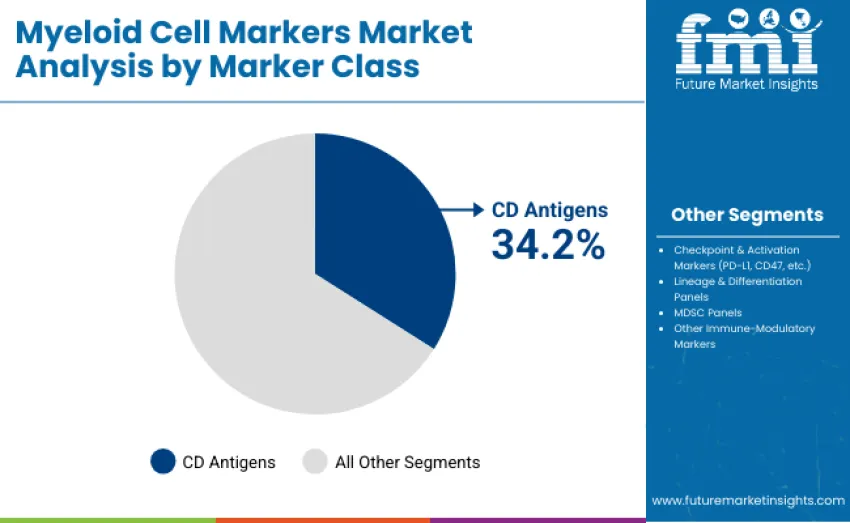
The CD antigens segment represents the dominant class, capturing 34.2% of total revenue in 2025. This category includes core myeloid phenotyping markers such as CD11b, CD14, CD15, CD33, and CD68, which are essential for baseline identification, maturation profiling, and functional assessment of myeloid populations. Leadership is reinforced by their foundational role in hematology workflows, tumor microenvironment analysis, and standardized immune profiling protocols used across both clinical and research settings.
Checkpoint and activation markers, including PD-L1, CD47, and TIM-3, hold a substantial 21.7% share, driven by their expanding relevance in immuno-oncology and therapeutic response monitoring. Lineage and differentiation panels account for 19.8%, supporting studies on myeloid development, plasticity, and disease-associated phenotypes. Myeloid-derived suppressor cell panels represent 13.6%, reflecting growing interest in tumor immune evasion and therapeutic resistance mechanisms. Other immune-modulatory markers contribute 10.7%, addressing highly specialized mechanistic and translational research needs.
Key advantages driving the CD antigens segment include:
- Central utility in routine myeloid identification enabling highly reproducible phenotyping across laboratories
- Broad compatibility with clinical diagnostics, translational oncology, and inflammatory disease research
- Ability to anchor high-parameter immunophenotyping workflows by providing stable lineage-defining markers
By Technology, Flow Cytometry Antibodies Hold Largest Share
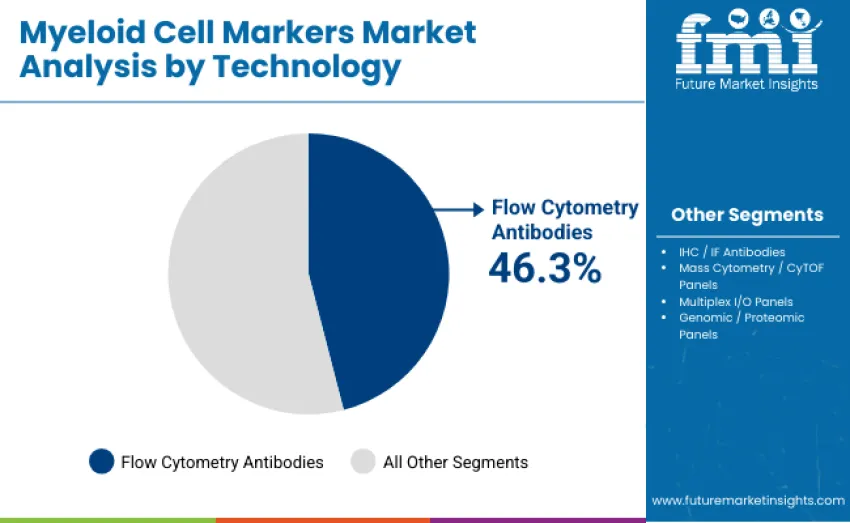
Flow cytometry antibodies dominate the technology landscape with 46.3% revenue share in 2025, driven by their central role in high-parameter immune profiling, rapid single-cell resolution, and widespread use in both clinical and research laboratories. Their scalability, multiplexing capacity, and compatibility with automated cytometry platforms reinforce leadership. IHC/IF antibodies account for 23.4%, supporting tissue-level localization and pathology-based immune profiling.
Multiplex immuno-oncology panels hold 12.7% share, reflecting expanding use in tumor microenvironment characterization. Mass cytometry/CyTOF panels contribute 9.8% as researchers adopt ultra-high-parameter analysis for deep myeloid profiling. Genomic and proteomic panels represent 7.8%, driven by emerging multi-omics workflows linking myeloid phenotype to transcriptional and proteomic signatures.
Key factors supporting technology preferences include:
- Strong demand for high-parameter flow cytometry enabling detailed myeloid subset and functional analyses
- Tissue-based IHC/IF assays providing spatial context for myeloid infiltration and activation states
- Growth in multiplex I/O and CyTOF applications supporting deep immune profiling in oncology research
What Are the Major Drivers, Restraints, and Emerging Trends Influencing the Myeloid Cell Markers Market?
The myeloid cell markers market is driven by several key factors shaping demand within the immunology and clinical research landscape. Increasing prevalence of cancer, autoimmune disorders, and infectious diseases creates growing demand for precise immunophenotyping and myeloid cell profiling solutions, with global incidence rates rising by 5-7% annually, which necessitates reliable biomarkers for diagnostic, prognostic, and therapeutic monitoring applications. Expansion of translational and clinical research programs accelerates adoption of myeloid cell markers, as 40-55% of research institutions integrate advanced flow cytometry, mass cytometry, and multiplex panels into workflows.
What Are the Major Restraints Limiting Adoption in the Myeloid Cell Markers Market?
Restraints include high reagent and instrumentation costs, which can limit adoption in smaller laboratories and emerging regions, as complete myeloid marker panels combined with flow cytometers or CyTOF instruments represent significant capital expenditure relative to standard immunoassays. Technical complexity and the need for specialized training create adoption barriers, as effective assay design, panel optimization, and data analysis require significant expertise that can take months to acquire.
What Emerging Trends Are Shaping the Myeloid Cell Markers Market?
Key trends include accelerated adoption in Asia-Pacific countries, particularly China and India, driven by government initiatives supporting biomedical research, investment in high-end laboratory infrastructure, and training programs for advanced immunology techniques. Technological innovation shapes development, with advancements in high-dimensional flow cytometry, multiplexed immunoassays, and mass cytometry panels.
How Are Leading Countries Driving Growth in the Myeloid Cell Markers Market?
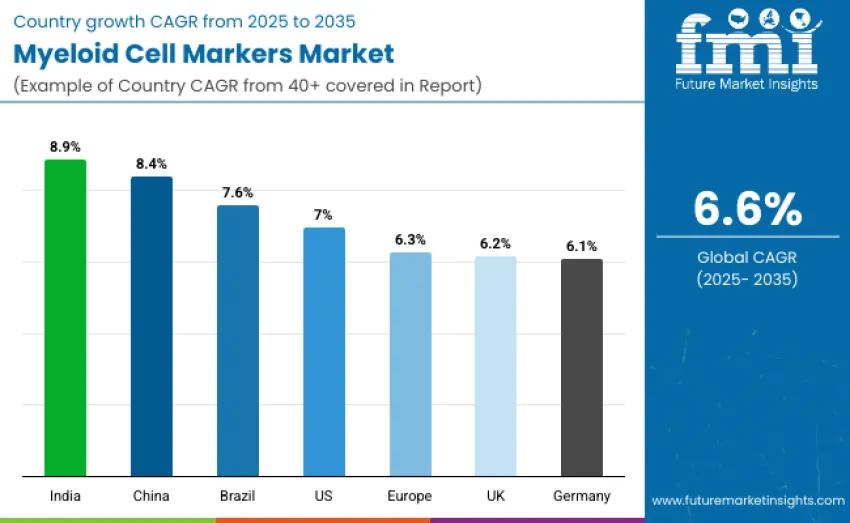
| Country/Region | CAGR (2025 to 2035)% |
|---|---|
| United States | 7.0 |
| Brazil | 7.6 |
| China | 8.4 |
| India | 8.9 |
| Europe | 6.3 |
| Germany | 6.1 |
| United Kingdom | 6.2 |
The myeloid cell markers market is expanding globally, with India leading at an 8.9% CAGR driven by government biomedical research initiatives and growing clinical and academic laboratory capacity. China follows at 8.4%, supported by rapid adoption of advanced assays and biotechnology expansion. Brazil grows at 7.6% through strengthening research ecosystems and rising immune-monitoring demand. The USA advances steadily at 7.0%, anchored by mature laboratory infrastructure and established panel usage. Europe grows at 6.3%, with Germany at 6.1% and the UK at 6.2%, supported by strong clinical research and healthcare systems.
How Are Policy Initiatives and Hospital Automation Shaping Growth in China?
China's myeloid cell markers market is projected to grow at a CAGR of 8.4% from 2025 to 2035, driven by widespread implementation in premier hospitals and specialized research centers in Beijing, Shanghai, and Guangzhou. Panels are utilized for hematologic malignancy diagnostics, immune cell profiling, and personalized treatment stratification. Expansion is propelled by government-backed biotechnology programs, precision medicine policies, and oncology research funding. Domestic manufacturers produce automated high-throughput panels and reagents, enabling rapid sample processing and high-volume testing.
Urban laboratory modernization projects, coupled with digital reporting systems, support efficient workflow management. Nationwide screening campaigns for leukemia and immune disorders encourage adoption. Training programs tailored to laboratory personnel ensure proper execution and data reliability. Integration of innovative analytical instruments enhances assay precision and reproducibility, allowing Chinese hospitals to maintain competitive standards in clinical diagnostics. Government-backed programs provide structured guidance, subsidies, and infrastructure support for biotechnology and precision medicine initiatives.
How Are Regional Laboratory Networks and Local Production Driving Expansion in India?
India's myeloid cell markers market is projected to grow at a CAGR of 8.9% from 2025 to 2035, supported by diagnostic laboratories, cancer centers, and academic institutions in Bengaluru, Hyderabad, and Mumbai. Panels are applied for leukemia classification, immune system monitoring, and clinical trial biomarker validation. Local reagent and panel manufacturing reduces procurement costs and strengthens regional supply chains, enhancing accessibility for semi-urban laboratories. Expansion is enabled by government programs aimed at increasing healthcare coverage, biotechnology research, and diagnostic capacity.
Investments in laboratory instrumentation and automated cytometry platforms accelerate testing throughput. National early detection initiatives and hematologic surveillance programs stimulate wider panel deployment. Technical skill development programs ensure consistent assay execution and reliability. Focus on affordable, scalable solutions allows broader reach into smaller hospitals and emerging healthcare facilities. Regional laboratories implement panels for leukemia classification and immune monitoring across multiple metropolitan centers throughout the country.
How Are Regulatory Standards and Sustainable Laboratory Practices Supporting Growth in Germany?
Germany's myeloid cell markers market is projected to grow at a CAGR of 6.1% from 2025 to 2035, concentrated in university hospitals and specialized diagnostic centers in Berlin, Munich, and Frankfurt. Panels are deployed for hematologic malignancy profiling, immune system characterization, and translational clinical studies. Stringent IVDR regulations ensure assay precision, reproducibility, and diagnostic credibility. Adoption is reinforced by automated cytometry instrumentation integrated with laboratory information management systems for real-time sample tracking and data integrity.
Investments in energy-efficient laboratory infrastructure, environmentally friendly equipment, and standardized assay protocols promote sustainable operations. Multi-parametric immunophenotyping technologies enable detailed cellular analysis for research and clinical purposes. Focused integration of genomics and proteomics datasets with myeloid markers allows advanced precision medicine applications. Growth is underpinned by commitment to compliance, operational efficiency, and scientific rigor. University hospitals and specialized diagnostic centers adopt panels for hematologic profiling and translational studies.
How Are Cost-Effective Solutions and Regional Networks Fueling Expansion in Brazil?
Brazil's myeloid cell markers market is projected to grow at a CAGR of 7.6% from 2025 to 2035, supported by adoption in metropolitan and regional laboratories in São Paulo, Rio de Janeiro, Brasília, and Porto Alegre. Panels are utilized for leukemia diagnostics, immune monitoring, and clinical trial biomarker evaluation. Local biotechnology companies supply affordable reagents and panels, enabling widespread access in resource-constrained facilities. Development of regional laboratory networks improves sample distribution, operational efficiency, and testing capacity.
Public health programs targeting hematologic disorders, coupled with oncology research funding, foster early detection initiatives. Investment in mid-tier laboratory instrumentation and workflow optimization facilitates high-throughput panel processing. Focus on cost-efficiency allows smaller hospitals and clinics to implement advanced diagnostic solutions without substantial financial burden. Metropolitan and regional laboratories use panels for leukemia diagnostics and immune monitoring in clinical settings.
How Are Advanced Automation Platforms and Federal Research Funding Driving Growth in United States?
The USA myeloid cell markers market is projected to grow at a CAGR of 7.0% from 2025 to 2035, driven by implementation in academic hospitals, oncology centers, and clinical research laboratories in Boston, New York, and San Francisco. Panels are applied for immunophenotyping, leukemia classification, and immune function monitoring in clinical trials. Adoption is strengthened by sophisticated automated cytometry platforms and pre-validated reagents that improve workflow speed and reproducibility.
Federal grants and research funding for immuno-oncology, hematology, and translational studies accelerate panel deployment. Investments in high-performance instrumentation and real-time analytics enhance assay precision and consistency. Early detection programs in both urban and suburban healthcare systems increase overall panel utilization. Integration of laboratory analytics platforms with clinical decision support systems provides actionable insights. Academic hospitals, oncology centers, and research labs implement panels for immunophenotyping and leukemia classification.
How Are NHS Networks and Digital Infrastructure Driving Expansion in United Kingdom?
The UK myeloid cell markers market is projected to grow at a CAGR of 6.2% from 2025 to 2035, centered on NHS hospitals, academic centers, and specialized laboratories in London, Manchester, Bristol, and Edinburgh. Panels are applied for leukemia diagnostics, immune system characterization, and translational research. Standardized digital workflows integrated with laboratory information management systems ensure operational consistency, reduce errors, and facilitate data sharing across regional centers.
Government-funded precision medicine initiatives, clinical trial support programs, and national hematologic surveillance schemes reinforce adoption. Investments in modern cytometry equipment, software analytics, and staff competency development increase assay reliability and throughput. Emphasis on scalable laboratory practices enables smaller hospitals to access advanced immunophenotyping panels efficiently. NHS hospitals, academic centers, and specialized labs implement panels for leukemia diagnostics and immune profiling.
How Are Healthcare Infrastructure Investments Advancing Expansion Across Europe?
The myeloid cell markers market in Europe is projected to grow from USD 165.1 million in 2025 to USD 299.6 million by 2035, registering a CAGR of 6.3% over the forecast period. Germany is expected to lead the region with a 27.4% share in 2025, slightly declining to 27% by 2035, supported by advanced clinical research networks and key immunology and hematologycenters in Berlin, Munich, and Hamburg.
France follows with a 21% share in 2025, reducing marginally to 20.7% by 2035, driven by expanding translational medicine programs and adoption of flow cytometry and multiplex myeloid panels in Paris and Lyon. Italy holds a 15.5% share in 2025, remaining stable at 15.4% by 2035, underpinned by strong oncology and hematology research facilities. Spain accounts for 12.1% in 2025, increasing slightly to 12.4% by 2035, supported by growing laboratory adoption of immune profiling panels. BENELUX maintains a 9% share in 2025, rising to 9.2% by 2035.
How Competitive Is the Global Myeloid Cell Markers Market and What Defines Its Structure?
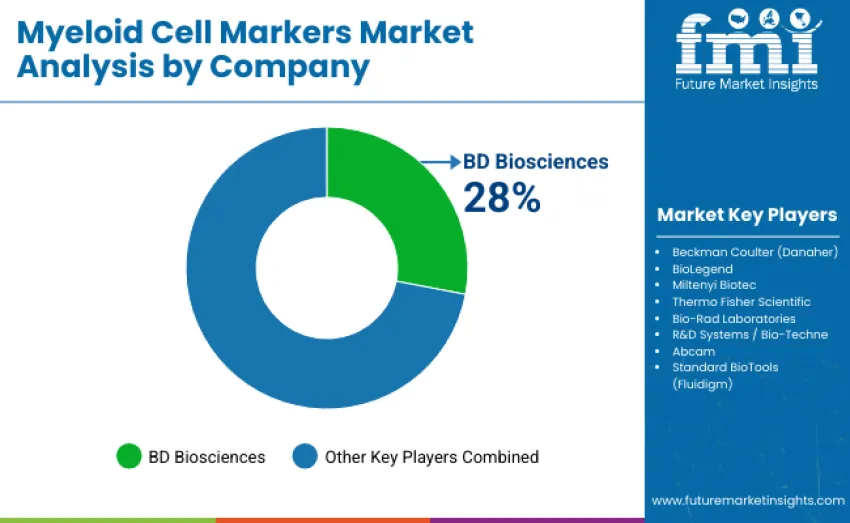
The myeloid cell markers market is moderately concentrated, with 10–12 players contributing to global competition. The top three companies collectively control an estimated 55–60% of the global share, driven by established flow cytometry panels, validated antibody sets, and widespread cytometer installed bases. BD Biosciences leads with a 28% share, supported by its extensive CD11b, CD14, CD33, and HLA-DR marker panels and a large global cytometer network. Competition is defined by panel breadth, reagent quality, assay reproducibility, and seamless workflow integration rather than price competition alone.
Key leaders, BD Biosciences, Beckman Coulter (Danaher), and BioLegend, maintain strong positions through proprietary antibody clones, validated fluorochrome combinations, high reagent consistency, and strong adoption across research and clinical environments. These companies invest heavily in high-quality reagent manufacturing, dry panel formats, and integrated cytometry workflows, expanding their influence in immune-oncology, translational research, and high-throughput immunophenotyping.
Challengers such as MiltenyiBiotec and Thermo Fisher Scientific compete through complete myeloid research workflows that integrate cell separation technologies with reagent–instrument pairing, enabling standardized sample processing and improved reproducibility. Product specialists, including Bio-Rad Laboratories, R&D Systems/Bio-Techne, Abcam, and Standard BioTools, differentiate through high-parameter CyTOF panels, novel fluorophores, recombinant proteins, and validated antibodies tailored for advanced immunology research.
Key Players in the Myeloid Cell Markers Market
- BD Biosciences
- Beckman Coulter (Danaher)
- BioLegend
- MiltenyiBiotec
- Thermo Fisher Scientific
- Bio-Rad Laboratories
- R&D Systems / Bio-Techne
- Abcam
- Standard BioTools (Fluidigm)
Scope of the Report
| Items | Values |
|---|---|
| Quantitative Units | USD 575.3 million |
| Marker Class | CD Antigens (Core Myeloid Markers), Checkpoint & Activation Markers (PD-L1, CD47, etc.), Lineage & Differentiation Panels, MDSC Panels, Other Immune-Modulatory Markers |
| Technology | Flow Cytometry Antibodies, IHC/IF Antibodies, Mass Cytometry/ CyTOF Panels, Multiplex I/O Panels, Genomic/Proteomic Panels |
| Regions Covered | Asia Pacific, Europe, North America, Latin America, Middle East & Africa |
| Country Covered | China, India, Germany, Brazil, USA, UK, Japan, and 40+ countries |
| Key Companies Profiled | BD Biosciences, Beckman Coulter (Danaher), BioLegend , Miltenyi Biotec , Thermo Fisher Scientific, Bio-Rad Laboratories, R&D Systems/Bio- Techne , Abcam , Standard BioTools ( Fluidigm ), Others |
| Additional Attributes | Dollar sales by marker class and technology, regional trends across Asia Pacific, Europe, and North America, competitive landscape of assay providers, technical specifications, integration with cytometry and immunoassay workflows, innovations in antibody panels, detection sensitivity, reproducibility, and development of specialized panels for enhanced lineage coverage and quantitative accuracy |
Myeloid Cell Markers Market by Segments
By Marker Class:
- CD Antigens (Core Myeloid Markers)
- Checkpoint & Activation Markers (PD-L1, CD47, etc.)
- Lineage & Differentiation Panels
- MDSC Panels
- Other Immune-Modulatory Markers
By Technology:
- Flow Cytometry Antibodies
- IHC / IF Antibodies
- Mass Cytometry / CyTOF Panels
- Multiplex I/O Panels
- Genomic / Proteomic Panels
By Region:
- Asia Pacific
- China
- India
- Japan
- South Korea
- Vietnam
- Australia & New Zealand
- ASEAN
- Rest of Asia Pacific
- Europe
- Germany
- United Kingdom
- France
- Italy
- Spain
- Netherlands
- Nordic
- BENELUX
- Rest of Europe
- North America
- United States
- Canada
- Mexico
- Latin America
- Brazil
- Argentina
- Rest of Latin America
- Middle East & Africa
- Kingdom of Saudi Arabia
- Other GCC Countries
- Turkey
- South Africa
- Other African Union
- Rest of Middle East & Africa
Frequently Asked Questions
How big is the myeloid cell markers market in 2025?
The global myeloid cell markers market is valued at USD 575.3 million in 2025.
What will be the size of the myeloid cell markers market in 2035?
The market is projected to reach USD 1,089.4 million by 2035.
How fast will the myeloid cell markers market grow between 2025 and 2035?
The market will grow at a CAGR of 6.6% from 2025 to 2035.
Which marker class leads the myeloid cell markers market in 2025?
CD antigens lead the market with a 34.2% share in 2025.
Who are the major players in the myeloid cell markers market?
Key players include BD Biosciences, Beckman Coulter, BioLegend, Miltenyi Biotec, Thermo Fisher Scientific, Bio-Rad, R&D Systems/Bio-Techne, Abcam, and Standard BioTools.
Preview the report firsthand - request a free sample
Get SampleGet the brochure for pricing and purchase details.
Get PDFTable of Content
- Executive Summary
- Regional Level Market Outlook
- Demand-side Trends
- Supply-side Trends
- Technology Roadmap Analysis
- Analysis and Recommendations
- Market Overview
- Market Coverage / Taxonomy
- Market Definition / Scope / Limitations
- Market Background
- Market Dynamics
- Drivers
- Restraints
- Opportunity
- Trends
- Scenario Forecast
- Demand in Optimistic Scenario
- Demand in Likely Scenario
- Demand in Conservative Scenario
- Opportunity Map Analysis
- Technological Advancement
- Investment Feasibility Matrix
- Value Chain Analysis
- PESTLE and Porter’s Analysis
- Regulatory Landscape
- By Key Regions
- By Key Countries
- Regional Parent Market Outlook
- Market Dynamics
- Regional Level Markers Market Analysis 2020 to 2024 and Forecast, 2025 to 2035
- Historical Market Size USD Million Analysis, 2020 to 2024
- Current and Future Market Size USD Million Projections, 2025 to 2035
- Y-o-Y Growth Trend Analysis
- Absolute $ Opportunity Analysis
- Regional Level Markers Market Analysis 2020 to 2024 and Forecast 2025 to 2035, By Marker Class
- Introduction / Key Findings
- Historical Market Size USD Million Analysis By Marker Class, 2020 to 2024
- Current and Future Market Size USD Million Analysis and Forecast By Marker Class, 2025 to 2035
- CD Antigens (Core Myeloid Markers)
- Checkpoint & Activation Markers (PD-L1, CD47, etc.)
- Lineage & Differentiation Panels
- MDSC Panels
- Other Immune-Modulatory Markers
- Y-o-Y Growth Trend Analysis By Marker Class, 2020 to 2024
- Absolute $ Opportunity Analysis By Marker Class, 2025 to 2035
- Regional Level Markers Market Analysis 2020 to 2024 and Forecast 2025 to 2035, By Technology
- Introduction / Key Findings
- Historical Market Size USD Million Analysis By Technology, 2020 to 2024
- Current and Future Market Size USD Million Analysis and Forecast By Technology, 2025 to 2035
- Flow Cytometry Antibodies
- IHC / IF Antibodies
- Mass Cytometry / CyTOF Panels
- Multiplex I/O Panels
- Genomic / Proteomic Panels
- Y-o-Y Growth Trend Analysis By Technology, 2020 to 2024
- Absolute $ Opportunity Analysis By Technology, 2025 to 2035
- Regional Level Markers Market Analysis 2020 to 2024 and Forecast 2025 to 2035, By Application
- Introduction / Key Findings
- Historical Market Size USD Million Analysis By Application, 2020 to 2024
- Current and Future Market Size USD Million Analysis and Forecast By Application, 2025 to 2035
- Oncology & Immuno-Oncology
- Hematology & Transplant
- Inflammation & Autoimmune
- Infectious Disease & Sepsis
- Translational Research Tools
- Y-o-Y Growth Trend Analysis By Application, 2020 to 2024
- Absolute $ Opportunity Analysis By Application, 2025 to 2035
- Regional Level Markers Market Analysis 2020 to 2024 and Forecast 2025 to 2035, By End User
- Introduction / Key Findings
- Historical Market Size USD Million Analysis By End User, 2020 to 2024
- Current and Future Market Size USD Million Analysis and Forecast By End User, 2025 to 2035
- Pharma & Biotech
- CROs & Central Labs
- Academic & Translational Centers
- Hospital / Clinical Labs
- Others
- Y-o-Y Growth Trend Analysis By End User, 2020 to 2024
- Absolute $ Opportunity Analysis By End User, 2025 to 2035
- Regional Level Markers Market Analysis 2020 to 2024 and Forecast 2025 to 2035, By Region
- Introduction
- Historical Market Size USD Million Analysis By Region, 2020 to 2024
- Current Market Size USD Million Analysis and Forecast By Region, 2025 to 2035
- North America
- Latin America
- East Asia
- South Asia
- Western Europe
- Eastern Europe
- Middle East & Africa
- Market Attractiveness Analysis By Region
- North America Markers Market Analysis 2020 to 2024 and Forecast 2025 to 2035, By Country
- Historical Market Size USD Million Trend Analysis By Market Taxonomy, 2020 to 2024
- Market Size USD Million Forecast By Market Taxonomy, 2025 to 2035
- By Country
- USA
- Canada
- Mexico
- By Marker Class
- By Technology
- By Application
- By End User
- By Country
- Market Attractiveness Analysis
- By Country
- By Marker Class
- By Technology
- By Application
- By End User
- Key Takeaways
- Latin America Markers Market Analysis 2020 to 2024 and Forecast 2025 to 2035, By Country
- Historical Market Size USD Million Trend Analysis By Market Taxonomy, 2020 to 2024
- Market Size USD Million Forecast By Market Taxonomy, 2025 to 2035
- By Country
- Brazil
- Argentina
- Rest of Latin America
- By Marker Class
- By Technology
- By Application
- By End User
- By Country
- Market Attractiveness Analysis
- By Country
- By Marker Class
- By Technology
- By Application
- By End User
- Key Takeaways
- East Asia Markers Market Analysis 2020 to 2024 and Forecast 2025 to 2035, By Country
- Historical Market Size USD Million Trend Analysis By Market Taxonomy, 2020 to 2024
- Market Size USD Million Forecast By Market Taxonomy, 2025 to 2035
- By Country
- China
- Japan
- South Korea
- By Marker Class
- By Technology
- By Application
- By End User
- By Country
- Market Attractiveness Analysis
- By Country
- By Marker Class
- By Technology
- By Application
- By End User
- Key Takeaways
- South Asia Markers Market Analysis 2020 to 2024 and Forecast 2025 to 2035, By Country
- Historical Market Size USD Million Trend Analysis By Market Taxonomy, 2020 to 2024
- Market Size USD Million Forecast By Market Taxonomy, 2025 to 2035
- By Country
- India
- ASEAN Countries
- Australia & New Zealand
- Rest of South Asia
- By Marker Class
- By Technology
- By Application
- By End User
- By Country
- Market Attractiveness Analysis
- By Country
- By Marker Class
- By Technology
- By Application
- By End User
- Key Takeaways
- Western Europe Markers Market Analysis 2020 to 2024 and Forecast 2025 to 2035, By Country
- Historical Market Size USD Million Trend Analysis By Market Taxonomy, 2020 to 2024
- Market Size USD Million Forecast By Market Taxonomy, 2025 to 2035
- By Country
- Germany
- UK
- France
- Italy
- Spain
- BENELUX
- Nordic Countries
- Rest of Western Europe
- By Marker Class
- By Technology
- By Application
- By End User
- By Country
- Market Attractiveness Analysis
- By Country
- By Marker Class
- By Technology
- By Application
- By End User
- Key Takeaways
- Eastern Europe Markers Market Analysis 2020 to 2024 and Forecast 2025 to 2035, By Country
- Historical Market Size USD Million Trend Analysis By Market Taxonomy, 2020 to 2024
- Market Size USD Million Forecast By Market Taxonomy, 2025 to 2035
- By Country
- Russia
- Hungary
- Poland
- Rest of Eastern Europe
- By Marker Class
- By Technology
- By Application
- By End User
- By Country
- Market Attractiveness Analysis
- By Country
- By Marker Class
- By Technology
- By Application
- By End User
- Key Takeaways
- Middle East & Africa Markers Market Analysis 2020 to 2024 and Forecast 2025 to 2035, By Country
- Historical Market Size USD Million Trend Analysis By Market Taxonomy, 2020 to 2024
- Market Size USD Million Forecast By Market Taxonomy, 2025 to 2035
- By Country
- Saudi Arabia
- Other GCC Countries
- Türkiye
- South Africa
- Rest of MEA
- By Marker Class
- By Technology
- By Application
- By End User
- By Country
- Market Attractiveness Analysis
- By Country
- By Marker Class
- By Technology
- By Application
- By End User
- Key Takeaways
- Market Structure Analysis
- Competition Dashboard
- Competition Benchmarking
- Market Share Analysis of Top Players
- By Regional
- By Marker Class
- By Technology
- By Application
- By End User
- Competition Analysis
- Competition Deep Dive
- BD Biosciences
- Overview
- Product Portfolio
- Profitability by Market Segments (Product/Age /Sales Channel/Region)
- Sales Footprint
- Strategy Overview
- Marketing Strategy
- Product Strategy
- Channel Strategy
- Beckman Coulter (Danaher)
- Overview
- Product Portfolio
- Profitability by Market Segments (Product/Age /Sales Channel/Region)
- Sales Footprint
- Strategy Overview
- Marketing Strategy
- Product Strategy
- Channel Strategy
- BioLegend
- Overview
- Product Portfolio
- Profitability by Market Segments (Product/Age /Sales Channel/Region)
- Sales Footprint
- Strategy Overview
- Marketing Strategy
- Product Strategy
- Channel Strategy
- Miltenyi Biotec
- Overview
- Product Portfolio
- Profitability by Market Segments (Product/Age /Sales Channel/Region)
- Sales Footprint
- Strategy Overview
- Marketing Strategy
- Product Strategy
- Channel Strategy
- Thermo Fisher Scientific
- Overview
- Product Portfolio
- Profitability by Market Segments (Product/Age /Sales Channel/Region)
- Sales Footprint
- Strategy Overview
- Marketing Strategy
- Product Strategy
- Channel Strategy
- Bio-Rad Laboratories
- Overview
- Product Portfolio
- Profitability by Market Segments (Product/Age /Sales Channel/Region)
- Sales Footprint
- Strategy Overview
- Marketing Strategy
- Product Strategy
- Channel Strategy
- R&D Systems / Bio-Techne
- Overview
- Product Portfolio
- Profitability by Market Segments (Product/Age /Sales Channel/Region)
- Sales Footprint
- Strategy Overview
- Marketing Strategy
- Product Strategy
- Channel Strategy
- Abcam
- Overview
- Product Portfolio
- Profitability by Market Segments (Product/Age /Sales Channel/Region)
- Sales Footprint
- Strategy Overview
- Marketing Strategy
- Product Strategy
- Channel Strategy
- Standard BioTools (Fluidigm)
- Overview
- Product Portfolio
- Profitability by Market Segments (Product/Age /Sales Channel/Region)
- Sales Footprint
- Strategy Overview
- Marketing Strategy
- Product Strategy
- Channel Strategy
- BD Biosciences
- Competition Deep Dive
- Assumptions & Acronyms Used
- Research Methodology


