

- Market Size (2026)
- USD 21.6 Mn
- Forecast (2036)
- USD 61.3 Mn
- CAGR (2026 to 2036)
- 11.0%
How big is Nigerose Immunobiotic Sugars Market in 2026?
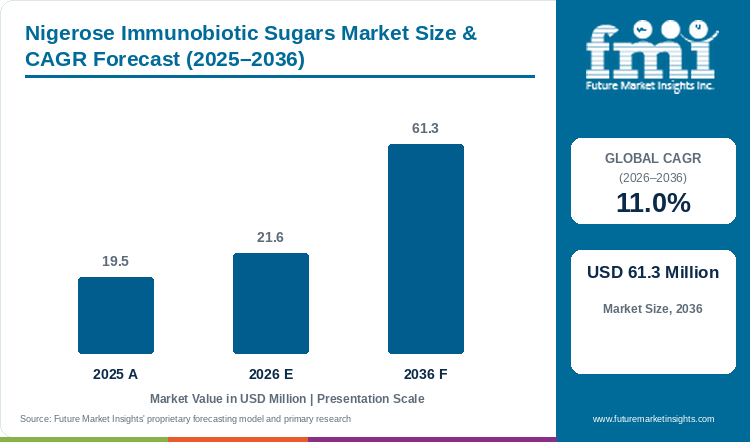
Having recorded a market size of USD 19.5 million in 2025 and moving to USD 21.6 million in 2026, the global nigerose immunobiotic sugars market is projected to scale up to USD 61.3 million by the end of 2036, maintaining an 11.0% CAGR.
Functional beverage makers and specialty food processors in East Asia and Western markets are increasing their adoption of rare alpha-1,3-linked oligosaccharides to deliver shelf-stable immune support and natural color protection without adding excess sugar. Commercial product disclosures by Nihon Shokuhin Kako at Health Ingredients Japan in October 2025 demonstrated how enzymatic maize-starch conversion allows drink brands to formulate heat-stable immunobiotic syrups that survive acidic bottling lines where live probiotics fail [1]. Owing to its scalable production from food-grade starch, Enzymatic Transglucosylation is projected to capture 64.2% of pathway demand in 2026, supporting much faster category expansion than commodity rare sugars. Global market valuation for nigerose immunobiotic sugars rose from USD 19.5 million in 2025 to an estimated USD 21.6 million in 2026, and FMI projects the industry to reach USD 61.3 million by 2036 at an 11.0% CAGR. High purification costs for crystalline grades and lengthy novel-ingredient approvals outside Japan and South Korea remain the main challenges restraining mass-market beverage adoption.
Key Market Trends & Insights
- By enzymatic production pathway: Enzymatic Transglucosylation attains an anticipated 64.2% pathway share in 2026 because enzymatic transglucosylation synthesizes alpha-1,3 linkages directly from maltose substrates.
- By oligosaccharide purity: Liquid Nigerose Syrup posts an estimated 48.6% purity-tier share in 2026 since pilot beverage and food-science laboratories dose unfractionated transglucosylation concentrates without preparative crystallization costs.
- By end-use application: Immunobiotic Functional Drinks generate a projected 45.2% application share in 2026 as East Asian nutraceutical developers evaluate mucosal-immunity oligosaccharides.
- By application grade: Food & Beverage Grade accounts for a projected 66.5% share in 2026 because aseptic immune-tonic bottlers and surimi seafood plants procure multi-ton pilot syrup lots.
- By distribution channel: Direct Biorefinery Supply captures an anticipated 68.4% share in 2026 through direct R&D formulation contracts between starch biorefineries in Japan and Asian beverage brands.
Regional Highlights
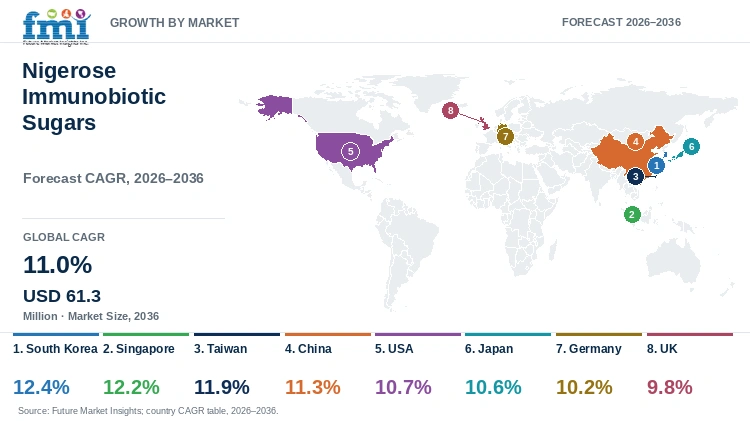
- East Asian & ASEAN functional drink leaders: South Korea Health Functional Food beverage channels rank first across all eight evaluated nations with a 12.4% CAGR through 2036, followed by Singapore at 12.2%, Taiwan at 11.9%, and China at 11.3%.
- Bioprocessing hubs in the USA, Japan, and Europe: Demand in the USA rises at a 10.7% CAGR between 2026 and 2036 ahead of Japan at 10.6%, Germany at 10.2%, and the UK at 9.8%.
Market Size & Forecast
Table 1: Market Size and Forecast for the Nigerose Immunobiotic Sugars Market (USD million and CAGR percentage), 2025 to 2036
| Metric | Value |
|---|---|
| 2025 Historical Market Size | USD 19.5 million |
| 2026 Estimated Market Valuation | USD 21.6 million |
| 2036 Projected Market Size | USD 61.3 million |
| 10-Year CAGR (2026 to 2036) | 11.0% |
| 10-Year Increase in Annual Market Value (2026 to 2036) | USD 39.7 million |
Unlike maltose (alpha-1,4) which is cleaved rapidly in the upper duodenum, nigerose (3-O-alpha-D-glucopyranosyl-D-glucose) has an alpha-1,3 glucosidic linkage that resists human salivary amylase and brush-border hydrolysis. Slow small-intestinal cleavage blunts postprandial glycemic spikes while delivering intact alpha-1,3 disaccharides to Peyer's patches and gut-associated lymphoid tissue, where formulators pair them with anthocyanin food colors in functional berry shots [3].
Research-Scale Reagent and Pilot Oligosaccharide Batch Sizing
Table 2: Research-Scale Crystalline Standards and Pilot Oligosaccharide Batch Volume & Pricing for Nigerose Sugars, 2025 to 2036
| Metric | 2025 | 2026 | 2036 |
|---|---|---|---|
| Global market valuation (USD million) | 19.5 | 21.6 | 61.3 |
| Research-grade, analytical & pilot oligosaccharide volume (kg dry-weight equivalent) | 280 to 320 | 310 to 355 | 890 to 1,020 |
| Pilot 40-75% enzymatic nigerooligosaccharide concentrate price (USD per gram) | 0.85 to 1.35 | 0.90 to 1.40 | 0.95 to 1.50 |
| Purified 75-90% lyophilized research & formulation powder price (USD per gram) | 4.40 to 8.00 | 4.50 to 8.20 | 4.80 to 8.70 |
Operational note: Commercial production spans high-purity crystalline analytical standards (>95% HPLC purity) for glycosidase assay calibration and food-grade enzymatic nigerooligosaccharide syrups (40% to 75% purity) for functional beverages and surimi cryoprotection.
Carbohydrate synthesis laboratories run immobilized alpha-glucosidase and phosphorylase columns that yield a 40% to 75% nigerooligosaccharide research concentrate from maltose, whereas reaching 75% to 90% powder or >95% crystalline purity requires simulated-moving-bed (SMB) or preparative HPLC fractionation. Formulation scientists evaluate these pilot fractions with isomalto-oligosaccharide and resistant dextrins in experimental gut-immunity studies.
Functional Dosage & Purity Grade Allocation Sizing
Table 3: Application Inclusion Rates and Sweetness-to-Viscosity Benchmarks for Nigerose Immunobiotic Sugars, 2025 to 2036
| Metric | 2025 | 2026 | 2036 |
|---|---|---|---|
| Relative sweetness of nigerose vs. Sucrose (%) | 30.0% to 40.0% | 30.0% to 40.0% | 30.0% to 40.0% |
| Typical immunobiotic beverage inclusion dose (grams per serving) | 1.5 to 3.5 | 1.5 to 3.5 | 1.5 to 4.0 |
| Anthocyanin color-stabilizing syrup dosage in RTD drinks (% w/w) | 0.8% to 2.0% | 0.8% to 2.2% | 1.0% to 2.5% |
| Cryoprotective surimi & frozen dough inclusion rate (% w/w) | 3.0% to 6.0% | 3.0% to 6.0% | 3.5% to 6.5% |
Table 4: Pathway and Purity Allocation Benchmarks for the Nigerose Immunobiotic Sugars Market, 2026
| Metric | Value | Institutional Reference Basis |
|---|---|---|
| Global nigerose immunobiotic sugars market size | USD 21.6 million | 2026 global B2B & reagent market valuation baseline |
| Enzymatic transglucosylation pathway share | 64.2% (USD 13.9 million allocation) | Regioselective alpha-1,3 starch transglucosylation |
| Liquid nigerose syrup share | 48.6% (USD 10.5 million allocation) | Pilot beverage, sake & cryoprotection R&D concentrates |
| Immunobiotic functional drinks share | 45.2% (USD 9.8 million allocation) | East Asian mucosal-immunity assay & pilot drink formulations |
Because nigerose delivers only 30% to 40% of the sweetness of sucrose while contributing high body and low water-activity freezing-point depression, seafood processors substitute nigerooligosaccharide syrup for half of the sucrose-sorbitol cryoprotectant blend in Alaska pollock surimi so crabsticks taste savory rather than cloyingly sweet. Confectionery and beverage brands also combine nigerose with galacto-oligosaccharide prebiotics in synbiotic gut-immune shots.
Analyst Perspective
"Nigerose occupies a unique functional niche among rare disaccharides by combining mucosal NK-cell and salivary IgA immunobiotic activation with natural anthocyanin pigment protection and low-sweetness surimi cryoprotection. Starch biorefiners that pair high-conversion alpha-1,3 transglucosylation enzymes with simulated-moving-bed chromatography will drive wider beverage and frozen-food adoption outside Japan."
- Nandini Roy Choudhury, Principal Consultant, Future Market Insights.
How is the nigerose immunobiotic sugars market segmented?
The nigerose immunobiotic sugars market is segmented by enzymatic production pathway, oligosaccharide purity, end-use application, application grade, distribution channel, and region. In 2026, Enzymatic Transglucosylation attains an anticipated 64.2% share, Liquid Nigerose Syrup posts an estimated 48.6%, Immunobiotic Functional Drinks generates a projected 45.2%, Food & Beverage Grade captures 66.5%, and Direct Biorefinery Supply holds 68.4%.
By enzymatic production pathway: Enzymatic Transglucosylation and Fungal Glucan Hydrolysis.
By oligosaccharide purity: Liquid Nigerose Syrup, Spray-Dried Nigerose Powder, and Crystalline Pharma Nigerose.
By end-use application: Immunobiotic Functional Drinks, Anthocyanin Stabilizing Syrups, Cryoprotective Surimi & Bakery, and Low-Alcohol Sake & Brews.
By application grade: Food & Beverage Grade, Analytical Reagent Grade, and Clinical Nutrition Grade.
By distribution channel: Direct Biorefinery Supply, Specialty Biochemical Distributors, and Laboratory Reagent Catalogs.
Why does Enzymatic Transglucosylation lead production pathways?
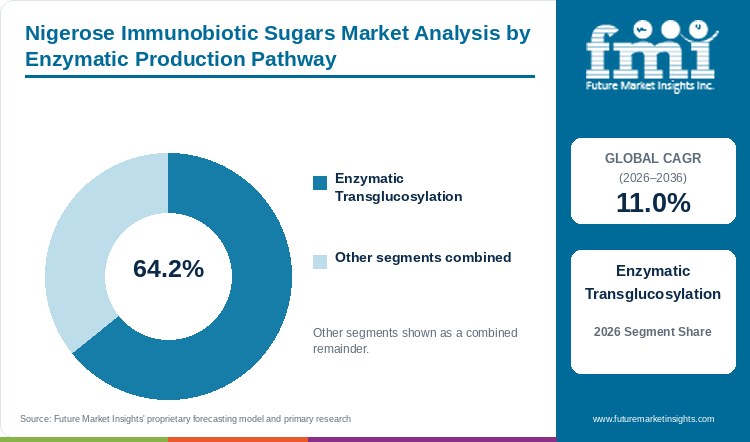
Enzymatic Transglucosylation attains an anticipated 64.2% pathway share in 2026 via regioselective maltose bioconversion.
Table 5: Enzymatic Production Pathway Share for the Nigerose Immunobiotic Sugars Market (percentage share), 2026
| Enzymatic Production Pathway | Share (2026) |
|---|---|
| Enzymatic Transglucosylation | 64.2% |
| Fungal Glucan Hydrolysis | 35.8% |
| Total | 100.0% |
*Note: Enzymatic production pathway segments sum to 100.0% of the category in 2026.
Table 6: Enzymatic Production Pathway Leadership and Market Growth for the Nigerose Immunobiotic Sugars Market (segment and CAGR percentage), 2026 to 2036
| Metric | Value |
|---|---|
| Global 10-Year CAGR (2026 to 2036) | 11.0% |
| Primary Enzymatic Pathway | Enzymatic Transglucosylation |
Industrial starch refiners favor enzymatic transglucosylation over Acremonium fungal alpha-1,3-glucan fermentation because transglucosylating alpha-glucosidases and nigerose phosphorylases act directly on low-cost maltose and dextrin streams from standard corn or tapioca liquefaction. That enzymatic route fits directly into existing industrial food enzymes saccharification lines without sterile mycelial fermentation tanks.
- Enzymatic Transglucosylation attains an anticipated 64.2% pathway share during 2026 because immobilized enzyme columns synthesize alpha-1,3 disaccharides at lower cost than fungal glucan extraction.
- In December 2025, carbohydrate biochemists demonstrated in Frontiers in Bioengineering and Biotechnology that engineered sucrose phosphorylase and transglucosylating glycoside hydrolases synthesize prebiotic rare oligosaccharides that resist upper-intestinal enzymatic breakdown while stimulating beneficial Lactobacillus and Enterococcus butyrate production [4].
What keeps Liquid Nigerose Syrup ahead by oligosaccharide purity?
Liquid Nigerose Syrup posts an estimated 48.6% purity-tier share in 2026 across pilot formulation lines.
Food-science laboratories and pilot beverage plants evaluate 72-to-75-Brix nigerooligosaccharide concentrates containing 40% to 75% nigerose plus nigerotriose and panose because liquid concentrates disperse directly into pilot batching vessels without preparative crystallization or spray drying. These alpha-1,3 oligosaccharide concentrates also inhibit sucrose crystallization in clean-label sweetener syrups and experimental wagashi confections in Japan.
- Liquid Nigerose Syrup posts an estimated 48.6% purity-tier share in 2026 because unfractionated enzymatic reaction syrups avoid expensive simulated-moving-bed chromatography.
- In December 2025, Glico Nutrition Co. Ltd. Highlighted across its enzymatic carbohydrate and fine chemical portfolio that highly soluble, low-sweetness enzymatically synthesized glucose polymers and oligosaccharides enable rapid liquid dispersion in sports and functional beverages [5].
Why do Immunobiotic Functional Drinks lead end-use applications?
Immunobiotic Functional Drinks generates a projected 45.2% application share in 2026 across Asian immunobiotic R&D programs.
Unlike live probiotic bacteria that lose viability during high-acid pasteurization or ambient shelf storage, heat-stable nigerooligosaccharides withstand UHT and hot-fill bottling at pH 3.2 to 4.5 while interacting with intestinal Peyer's patch immune receptors and organic-acid-producing gut microbiota. Beverage brands formulate 65-mL to 100-mL daily shots and bottled teas across ready-to-drink functional beverages targeting winter mucosal defense and healthy aging.
- Acid-stable hot-fill trial performance gives Immunobiotic Functional Drinks a projected 45.2% share within the 2026 end-use application breakdown.
- In June 2026, the OECD-FAO Agricultural Outlook 2026-2035 Sugar chapter reported that health consciousness and sugar-tax policies across high-income Asian and Western economies are restraining per-capita refined sucrose intake while accelerating industrial shifts toward functional oligosaccharides and specialty sweeteners [6].
Why does Food & Beverage Grade lead the application grade category?
Food & Beverage Grade is projected to capture 66.5% of application grade demand in 2026 across immunobiotic beverage and surimi cryoprotection lines.
Commercial beverage co-packers, sake breweries, and surimi seafood processors specify Food & Beverage Grade nigerooligosaccharide concentrates (40% to 85% purity) because enzymatic reaction syrups deliver full mucosal immunobiotic activation and cryoprotection without the USD 45-per-gram preparative HPLC cost of >95% analytical standards. Formulators blend these food-grade syrups directly into digestive health supplements and low-sugar tonic pouches.
- Food & Beverage Grade is projected to secure 66.5% of application grade market value (USD 14.4 million) in 2026, while Analytical Reagent Grade (21.5%) and Clinical Nutrition Grade (12.0%) serve laboratory and hospital buyers.
- In February 2026, U.S. Food and Drug Administration sweetener and carbohydrate ingredient guidance confirmed standard food-grade purity documentation expectations for low-sweetness functional syrups [19].
What gives Direct Biorefinery Supply the leading position in distribution channel?
Direct Biorefinery Supply is anticipated to account for 68.4% of distribution channel demand in 2026 via direct B2B formulation contracts.
Industrial starch biorefineries in Japan and East Asia allocate most food-grade transglucosylation syrup and spray-dried nigerose powder directly to beverage and seafood manufacturers under joint formulation agreements. Direct technical partnership allows biorefinery enzyme engineers to tailor alpha-1,3 linkage ratios and Brix viscosity to each bottler's pasteurization line.
- Direct Biorefinery Supply is anticipated to account for 68.4% of distribution channel demand (USD 14.8 million) in 2026, ahead of Specialty Biochemical Distributors (21.6%) and Laboratory Reagent Catalogs (10.0%).
- In November 2025, Nagase Viita Co., Ltd. Detailed its direct B2B enzymatic carbohydrate partnerships with food and beverage manufacturers across Japan and Asia [2].
What are the drivers, restraints, and opportunities in the nigerose immunobiotic sugars market?
Rapidly aging East Asian populations seeking heat-stable mucosal-immunity drinks and natural anthocyanin color protection drive nigerose immunobiotic sugars demand through 2036, whereas chromatographic purification costs limit >95% crystalline supply and low-sweetness surimi cryoprotection expands frozen seafood adoption.
- Driver: Heat- and acid-stable immunobiotic activation paired with 30% to 40% relative sweetness lets beverage makers formulate low-sugar immune shots and color-stable berry drinks.
- Restraint: Reversible transglucosylation equilibrium (typically 35% to 50% single-pass conversion) requires simulated-moving-bed chromatography to reach >90% purity, keeping unit prices well above commodity corn syrup.
- Opportunity: Substitution of half of conventional sucrose-sorbitol cryoprotectants with nigerooligosaccharide syrup in surimi seafood and frozen laminated bakery doughs prevents myosin denaturation without excessive sweetness.
Growth Analysis and Future Potential: Qualitative Demand Catalysts
Two commercial forces drive sustained research and pilot procurement of nigerose immunobiotic sugars: consumer migration toward heat-stable postbiotic/immunobiotic beverages and clean-label conversion from synthetic food dyes to unstable fruit and vegetable anthocyanins. Because nigerose is a reducing alpha-1,3 disaccharide with high hydration capacity, adding 1% to 2% nigerooligosaccharide concentrate suppresses nucleophilic hydration of flavylium cations in elderberry and black carrot extracts so test beverages retain their ruby hue under LED lighting. In October 2026, U.S. Sweetener analysts documented in the Sugar and Sweeteners Outlook (SSS-M-458) that food and beverage manufacturers continue diversifying carbohydrate portfolios beyond traditional beet and cane deliveries [7]. Because of this dual immune-activation and pigment-stabilizing profile, formulation teams evaluate nigerose across immune health supplements and experimental beverage premixes.
Risk Assessment of the Nigerose Immunobiotic Sugars Market: Operational and Purification Friction
Thermodynamic equilibrium limits during enzymatic transglucosylation and downstream chromatographic separation costs represent the primary technical hurdles in the nigerose value chain. When microbial alpha-glucosidase or nigerose phosphorylase acts on maltose, the reaction reaches an equilibrium mixture containing unreacted glucose and maltose and 35% to 50% nigerose. Commercial production of 75% to 90% spray-dried food powder or >95% crystalline pharma standards therefore requires multi-column ion-exchange chromatography. In September 2025, Biosynth Ltd. Noted in its Oligosaccharides Toolbox guide that purifying alpha-1,3 disaccharides requires specialized chromatographic workflows to separate structural isomers such as kojibiose and maltose [8]. So crystalline >95% nigerose remains focused on high-margin analytical and clinical nutrition applications.
Commercial Opportunity Analysis: Formulation Differentiation and Value-Add Formats
New commercial applications in surimi seafood cryoprotection and frozen artisan bread doughs offer substantial volume upside for 40% to 75% liquid syrups and 75% to 90% powders. Because nigerose is naturally present in traditional sake (nihonshu) and amazake produced via Aspergillus oryzae koji fermentation, dosing purified nigerooligosaccharide syrup into 0.0% ABV and low-alcohol craft brews restores full-bodied richness (kokumi) and rounds out organic-acid sharpness without raising alcohol content. In October 2025, the Global Nutrition Report's Nutrition Accountability Framework documented Nagase Viita's corporate commitment to advancing functional carbohydrate and microbiome health solutions across global food value chains [9]. This in turn allows enzymatic sugar producers to market nigerose across par-baked frozen bakery items and non-alcoholic fermented beverages.
Nigerose Immunobiotic Sugars Market by Country (2026 to 2036)
As per FMI, South Korea is projected to lead nigerose immunobiotic sugars expansion across evaluated national markets at a 12.4% CAGR through 2036, whereas the UK is forecast to advance at a 9.8% CAGR. Commercial adoption across East Asia, ASEAN, North America, and Western Europe tracks front-of-pack sugar reduction rules, mucosal-immunity beverage launches, and natural anthocyanin color stabilization.
Table 7: Country CAGR and Primary Growth Levers for the Nigerose Immunobiotic Sugars Market (CAGR percentage and operational drivers), 2026 to 2036
| Country | CAGR (2026 to 2036) | Primary Growth Lever |
|---|---|---|
| South Korea | 12.4% | MFDS Health Functional Food immune-tonic pouches, red-ginseng shots, and Busan surimi seafood processing |
| Singapore | 12.2% | Nutri-Grade beverage sugar reduction and Biopolis functional drink & microbiome R&D |
| Taiwan | 11.9% | Super-aged society pharmacy immune drinks and aseptic functional tea bottling |
| China | 11.3% | Engineered sucrose phosphorylase bioconversion and ER-stress glycobiology research |
| USA | 10.7% | Clean-label anthocyanin beverage color stabilization and NIH/academic glycobiology reagent demand |
| Japan | 10.6% | Domestic maize-starch transglucosylation biorefineries, mucosal IgA functional drinks, and premium sake |
| Germany | 10.2% | EU Coloring Foodstuff berry pigment stabilization and non-alcoholic craft beer body improvement |
| UK | 9.8% | Soft Drinks Industry Levy low-sugar mouthfeel reformulation and university glycosidase research |
Source: Future Market Insights analysis
Japan Nigerose Immunobiotic Sugars Market Outlook (2026 to 2036)
Japan is the global biochemical and enzymatic research origin of nigerose immunobiotic sugars, anchored by carbohydrate biorefineries operated by Nihon Shokuhin Kako Co. Ltd. And Nagase Viita Co. Ltd. Plus Glico Nutrition Co. Ltd. Domestic beverage and traditional wagashi confectionery R&D kitchens as well as kamaboko seafood laboratories test 40% to 75% enzymatic concentrates and spray-dried powders to study kokumi richness and salivary IgA immune activation. In January 2026, Meiji Food Materia Co. Ltd. Detailed its functional oligosaccharide and sugar-refining engineering capabilities supporting immune and confectionery texture applications across Japan [10]. Senior nutrition research and sake brewing analytics lift nigerose immunobiotic sugars demand in Japan at a projected 10.6% CAGR to 2036.
Key takeaway: In Japan, mucosal-immunity drink bottlers and domestic starch transglucosylation biorefineries anchor global supply and steady home-market growth.
USA Nigerose Immunobiotic Sugars Market Outlook (2026 to 2036)
Clean-label beverage reformulation away from synthetic FD&C dyes toward natural anthocyanin fruit and vegetable colors is accelerating food-science interest in the USA in color-stabilizing nigerooligosaccharide concentrates and high-purity glycobiology standards. In September 2026, U.S. Carbohydrate market specialists noted in the Sugar and Sweeteners Outlook (SSS-M-457) that shifting industrial beverage and confectionery formulations continue to shape specialty saccharide imports and domestic corn-wet-milling derivatives across the USA [11]. At the same time, immunology and vaccine research institutes in Boston and Bethesda purchase >95% crystalline nigerose from TCI America and FUJIFILM Wako plus Neogen/Megazyme as alpha-1,3-glucan receptor standards. So USA nigerose immunobiotic sugars valuation grows a 10.7% CAGR through 2036 across North America reagent buyers.
Key takeaway: In the USA, clean-label berry drink color stabilization and academic glycobiology reagent orders propel import growth.
Germany Nigerose Immunobiotic Sugars Market Outlook (2026 to 2036)
Stringent clean-label Coloring Foodstuff rules and non-alcoholic craft brewing innovation make Germany the largest European market for enzymatic nigerose syrups and high-purity analytical standards. In July 2026, European Commission food-safety authorities updated the Union Novel Foods catalogue covered by Implementing Regulation (EU) 2017/2470 after the Regulation (EU) 2025/97 revision on enzymatic oligosaccharide specifications across European beverage categories [12]. Beverage and fruit-preparation processors in Germany use spray-dried 75% to 90% nigerose powders to stabilize elderberry and aronia pigments and improve mouthfeel in 0.0% ABV wheat beers. So nigerose immunobiotic sugars demand in Germany expands at an estimated 10.2% CAGR until 2036 throughout Bavarian brewing plants and commercial Rhine-Ruhr fruit-preparation bottling facilities.
Key takeaway: In Germany, elderberry and aronia pigment protection in Coloring Foodstuffs plus dealcoholized beer mouthfeel drive steady processor adoption.
South Korea Nigerose Immunobiotic Sugars Market Outlook (2026 to 2036)
Rapid expansion of individually approved Health Functional Food immune shots and low-sugar fermented beverages positions South Korea at the forefront of East Asian nigerose immunobiotic sugars adoption. Beverage and nutraceutical formulators in South Korea dose nigerooligosaccharide syrups into red-ginseng stick pouches and postbiotic kombucha tonics plus pediatric immunity jellies to mask herbal bitterness while supporting natural killer cell and mucosal defense positioning. During March 2026, MFDS food-safety regulators in South Korea updated their Health Functional Food portal governing functional ingredient recognition and quality testing across domestic nutraceutical manufacturers [13]. Prompted by immune-tonic pouches and Busan surimi processing, nigerose immunobiotic sugars demand in South Korea is projected to advance at a 12.4% CAGR through 2036.
Key takeaway: In South Korea, tonic pouch bittermasking and Busan surimi cryoprotection establish the highest national growth outlook through 2036.
Taiwan Nigerose Immunobiotic Sugars Market Outlook (2026 to 2036)
Transition into a super-aged demographic society has created strong retail pharmacy and convenience-store R&D interest across Taiwan for single-portion mucosal immunity drinks and ready-to-drink bottled functional teas. During May 2026, MOEA industrial economists in Taiwan reported in their monthly manufacturing bulletin that domestic food and biotechnology plants continue expanding value-added health drink and nutritional supplement output for both local retail and ASEAN export [14]. Aided by nutraceutical laboratories formulating pilot NK-cell immune shots and pigment-stabilized berry teas, nigerose immunobiotic sugars valuation in Taiwan progresses at an anticipated 11.9% CAGR through 2036 across Taipei retail pharmacy chains and southern Taichung aseptic beverage development and functional supplement plants.
Key takeaway: In Taiwan, senior pharmacy nutrition drinks and Taichung aseptic tea co-packers accelerate imports of spray-dried nigerose from Japan.
Singapore Nigerose Immunobiotic Sugars Market Outlook (2026 to 2036)
Mandatory Nutri-Grade color-coded front-of-pack beverage labeling in Singapore penalizes high total sugar content while encouraging low-sweetness functional oligosaccharides that preserve full-bodied mouthfeel at reduced sugar dosages. In October 2026, HPB nutrition officials in Singapore reiterated in their Nutri-Grade technical guide that pre-packaged drinks account for 64% of beverage sugar intake among residents averaging 58 grams of sugar daily while only declared lactose and galactose are deducted from total sugar on labels [15]. Because beverage innovation centers in Biopolis use low-dose nigerooligosaccharide syrups (30% to 40% relative sweetness) to maintain kokumi body while cutting added sucrose to achieve Grade A or B thresholds, nigerose immunobiotic sugars demand in Singapore rises at a 12.2% CAGR through 2036.
Key takeaway: In Singapore, low-sweetness beverage mouthfeel formulation under Nutri-Grade sugar thresholds fuels rapid Biopolis R&D adoption.
China Nigerose Immunobiotic Sugars Market Outlook (2026 to 2036)
China is projected to expand at an 11.3% CAGR between 2026 and 2036 as domestic fermentation engineers scale engineered sucrose phosphorylase and alpha-glucosidase bioconversion lines in Shandong and Jiangsu [21]. Cell-biology studies in Advanced Science demonstrated that preferential nigerose binding to endoplasmic reticulum malectin chaperones alleviates ER stress, driving reagent orders across glycobiology institutes in Beijing and Shanghai. Simultaneously, ready-to-drink tea and berry juice brands in Guangdong test alpha-1,3 oligosaccharide syrups to prevent anthocyanin browning during ambient shelf storage. National Health Commission (NHC) new-food-raw-material approval timelines govern mass-market beverage rollout.
Key takeaway: In China, engineered phosphorylase bioconversion research and glycobiology reagent demand anchor an 11.3% CAGR through 2036.
UK Nigerose Immunobiotic Sugars Market Outlook (2026 to 2036)
The UK is expected to advance at a 9.8% CAGR over the 2026 to 2036 forecast period, supported by Soft Drinks Industry Levy sugar-reduction reformulation and clean-label botanical drink launches [22]. Beverage developers in London and Manchester evaluate low-sweetness nigerooligosaccharide syrups to restore mouthfeel body in low-calorie berry and hibiscus drinks while co-pigmenting natural E163 anthocyanin extracts against light degradation. University carbohydrate chemistry and fungal immunology laboratories in Oxford, Cambridge, and Dundee also procure >95% crystalline nigerose standards (TCI N0949 and Megazyme O-NGR) for alpha-1,3-glucanase assay calibration. Post-Brexit UK novel-food dossier registration costs remain the primary commercial restraint.
Key takeaway: In the UK, Soft Drinks Industry Levy mouthfeel reformulation and academic glycosidase assay demand support a 9.8% CAGR through 2036.
Full report country CAGRs cover: North America; Latin America; Western Europe; Eastern Europe; East Asia; South Asia and Pacific; Middle East and Africa.
Who are the notable companies in the nigerose immunobiotic sugars market?
Nihon Shokuhin Kako Co., Ltd. (Milestone / Nigerooligosaccharide), Nagase Viita Co., Ltd., Glico Nutrition Co., Ltd., San-Ei Gen F.F.I., Inc., Wako Pure Chemical / Fujifilm Wako, Tokyo Chemical Industry Co., Ltd., B Food Science Co., Ltd., and Matsutani Chemical Industry Co., Ltd. Are the notable companies in the nigerose immunobiotic sugars market.
Supplier participation in the nigerose immunobiotic sugars supply chain spans enzymatic starch oligosaccharide biorefineries and natural beverage color-stabilization specialists plus catalog-verified analytical reagent manufacturers. While enzymatic saccharide leaders in Japan (Nihon Shokuhin Kako and Nagase Viita along with Glico Nutrition and B Food Science plus Matsutani Chemical) operate industrial alpha-oligosaccharide and pilot transglucosylation platforms, verified standalone product catalogs for purified nigerose (CAS 497-48-3) are anchored by fine-chemical and biochemical assay suppliers led by Tokyo Chemical Industry (N0949) and Megazyme / Neogen (O-NGR) as well as FUJIFILM Wako.
- Industrial Enzymatic Starch & Nigerooligosaccharide Biorefineries: Nihon Shokuhin Kako Co. Ltd. (Milestone / Nigerooligosaccharide) and Nagase Viita Co. Ltd. Along with Glico Nutrition Co. Ltd., B Food Science Co. Ltd., and Matsutani Chemical Industry Co. Ltd. Operate enzymatic transglucosylation and chromatographic sugar refining plants.
- Anthocyanin Color-Stabilization & Beverage Formulation Specialists: San-Ei Gen F.F.I. Inc. Integrates oligosaccharide co-pigment stabilization with natural anthocyanin colorants and elderly texture-modified food hydrocolloids.
- High-Purity Crystalline Analytical & Glycobiology Reagent Suppliers: Wako Pure Chemical / Fujifilm Wako (plus Megazyme / Neogen O-NGR) and Tokyo Chemical Industry Co. Ltd. (N0949) supply >95% crystalline nigerose (CAS 497-48-3) for alpha-glucosidase enzyme assays and HPLC standards as well as immunology research.
Competitive Benchmarking: Nigerose Immunobiotic Sugars Market
Table 8: Competitive Benchmarking for the Nigerose Immunobiotic Sugars Market (qualitative capability ratings), 2026
| Company | Enzymatic Transglucosylation IP | Chromatographic Purity Breadth | Beverage & Surimi Channel Access | Geographic Footprint |
|---|---|---|---|---|
| Nihon Shokuhin Kako Co., Ltd. (Milestone / Nigerooligosaccharide) | High | High | High | High |
| Nagase Viita Co., Ltd. | High | High | High | High |
| Glico Nutrition Co., Ltd. | High | High | High | High |
| San-Ei Gen F.F.I., Inc. | Medium | Medium | High | High |
| Wako Pure Chemical / Fujifilm Wako | Medium | High | Medium | High |
| Tokyo Chemical Industry Co., Ltd. | Medium | High | Medium | High |
| B Food Science Co., Ltd. | High | Medium | High | Medium |
| Matsutani Chemical Industry Co., Ltd. | High | High | High | High |
Supplier assessment note: Matrix ratings in Table 8 distinguish general enzymatic starch transglucosylation and pilot oligosaccharide capability at biorefineries in Japan from catalog-verified >95% crystalline nigerose reagent supply (TCI N0949 and Megazyme O-NGR plus FUJIFILM Wako) used across glycobiology and food-science laboratories.
Key Developments in the Nigerose Immunobiotic Sugars Market
- In November 2025, Tokyo Chemical Industry Co. Ltd. (TCI) expanded distribution of its Glycoscience and Oligosaccharides reagent portfolio (Brochure GG055) to supply high-purity crystalline disaccharides and glycoside hydrolase substrates to Western and Asian immunology laboratories [16].
- During November 2025, B Food Science Co. Ltd. Highlighted its enzymatic starch sweetener and functional sugar alcohol production capabilities at its Chita biorefinery in Aichi Prefecture to supply moisture-retaining liquid syrups and crystalline functional carbohydrates to food and seafood processors in Japan [17].
- In December 2025, Matsutani Chemical Industry Co. Ltd. Reaffirmed in its corporate management update its global expansion of enzymatic dietary fibers and rare-sugar functional carbohydrates across international beverage and clinical nutrition markets [18].
Key Players in the Nigerose Immunobiotic Sugars Market
Industrial Enzymatic Starch & Nigerooligosaccharide Biorefineries
- Nihon Shokuhin Kako Co., Ltd. (Milestone / Nigerooligosaccharide)
- Nagase Viita Co., Ltd.
- Glico Nutrition Co., Ltd.
Functional Carbohydrate & Color-Stabilization Specialists
- B Food Science Co., Ltd.
- Matsutani Chemical Industry Co., Ltd.
- San-Ei Gen F.F.I., Inc.
High-Purity Crystalline Analytical & Glycobiology Reagent Suppliers
- Wako Pure Chemical / Fujifilm Wako
- Tokyo Chemical Industry Co., Ltd.
Nigerose Immunobiotic Sugars Market - Report Scope
Table 9: Report Scope for the Nigerose Immunobiotic Sugars Market (coverage fields and definitions), 2026 to 2036
| Coverage field | Report scope |
|---|---|
| Market Breakdown | Enzymatic Production Pathway; Oligosaccharide Purity; End-Use Application; Application Grade; Distribution Channel; Region |
| Quantitative Units | USD Million |
| Market Definition | Covers global research-scale biochemical reagent, analytical standard, and pilot formulation R&D valuation of nigerose (3-O-alpha-D-glucopyranosyl-D-glucose, CAS 497-48-3, sakebiose) and alpha-1,3 nigerooligosaccharides across >95% crystalline analytical standards (e.g., TCI N0949, Megazyme O-NGR), 75-90% lyophilized research powders, and 40-75% pilot enzymatic concentrates. Scope Boundary Note: Reflects verified laboratory catalog and pilot R&D volumes (hundreds of kilograms globally) rather than unsubstantiated commodity syrup tonnage; excludes commodity alpha-1,4 maltose/corn syrups, pure alpha-1,6 IMO syrups, trehalose, and kojibiose. |
| Regions Covered | North America; Latin America; Western Europe; Eastern Europe; East Asia; South Asia and Pacific; Middle East and Africa |
| Countries evaluated | South Korea, Singapore, Taiwan, China, USA, Japan, Germany, UK, and additional countries in the full dataset |
| Notable Companies | Nihon Shokuhin Kako Co., Ltd. (Milestone / Nigerooligosaccharide), Nagase Viita Co., Ltd., Glico Nutrition Co., Ltd., San-Ei Gen F.F.I., Inc., Wako Pure Chemical / Fujifilm Wako, Tokyo Chemical Industry Co., Ltd., B Food Science Co., Ltd., Matsutani Chemical Industry Co., Ltd. |
| Forecast Horizon | 2026 to 2036 (with 2025 historical baseline) |
| Research Triangulation | Primary interviews with enzymatic carbohydrate bioprocess researchers cross-checked against verified biochemical reagent catalogs (Megazyme O-NGR, TCI N0949, FUJIFILM Wako, Biosynth). |
Nigerose Immunobiotic Sugars Market - Research Methodology
Table 10: Research Methodology for the Nigerose Immunobiotic Sugars Market (research methods and approach), 2026 edition
| Method | Approach |
|---|---|
| Primary Interviews | Structured interviews with bioprocess engineers at Japan starch transglucosylation plants, functional beverage formulators in Tokyo and Seoul plus Taipei and Singapore and analytical reagent product managers. |
| Secondary Regulatory & Trade Sources | Verification against OECD-FAO Sugar Outlook 2026-2035, USDA ERS Sugar and Sweeteners Outlooks (SSS-M-456/457/458), European Commission Union list of novel foods (Regulation (EU) 2025/97), South Korea MFDS Health Functional Food standards, and Singapore HPB Nutri-Grade rules. |
| Top-Down & Bottom-Up Sizing | Bottom-up research-grade and pilot enzymatic conversion batch volumes (310 to 355 kg dry-weight equivalent in 2026) reconciled against catalog reagent pricing (USD 45/g to USD 120/g for >95% analytical standards and USD 0.90/g to USD 8.20/g for pilot concentrates and powders). |
| Country Forecasting Model | National CAGRs weight functional immune-shot retail penetration, front-of-pack beverage sugar grading rules, natural anthocyanin dye conversion, and surimi/frozen-bakery production. |
| Operational Benchmark Traceability | Sweetness ratios (30% to 40% vs. Sucrose), enzyme-substrate purity (>95% HPLC), and gram-level reagent prices in Tables 2, 3, and 4 trace to Megazyme O-NGR data sheets, TCI N0949 specifications, Biosynth oligosaccharide guides, and enzymatic saccharide literature in Japan. |
| Financial Reconciliation | Isolates commercial nigerose and nigerooligosaccharide revenues while excluding standard IMO, FOS, GOS, and trehalose sales. |
Nigerose Immunobiotic Sugars Market by Segments
Nigerose Immunobiotic Sugars Market segmented by Enzymatic Production Pathway:
- Enzymatic Transglucosylation
- Fungal Glucan Hydrolysis
- Phosphorylase Reverse Synthesis
Nigerose Immunobiotic Sugars Market segmented by Oligosaccharide Purity:
- Liquid Nigerose Syrup
- Spray-Dried Nigerose Powder
- Crystalline Pharma Nigerose
- HPLC Analytical Standards
Nigerose Immunobiotic Sugars Market segmented by End-Use Application:
- Immunobiotic Functional Drinks
- Anthocyanin Stabilizing Syrups
- Cryoprotective Surimi & Bakery
- Low-Alcohol Sake & Brews
Nigerose Immunobiotic Sugars Market segmented by Application Grade:
- Food & Beverage Grade
- Analytical Reagent Grade
- Clinical Nutrition Grade
- Microbial Culture Media
Nigerose Immunobiotic Sugars Market segmented by Distribution Channel:
- Direct Biorefinery Supply
- Specialty Biochemical Distributors
- Laboratory Reagent Catalogs
- Contract Beverage Blenders
Nigerose Immunobiotic Sugars Market by Region
- North America
- United States
- Canada
- Latin America
- Brazil
- Mexico
- Argentina
- Chile
- Western Europe
- Germany
- France
- United Kingdom
- Italy
- Spain
- Benelux
- Nordics
- Eastern Europe
- Poland
- Czech Republic
- Romania
- Hungary
- East Asia
- China
- Japan
- South Korea
- South Asia and Pacific
- India
- ASEAN
- Australia and New Zealand
- Middle East and Africa
- GCC Countries
- South Africa
- Türkiye
- Israel
Research Sources and Bibliography
- [1] Nihon Shokuhin Kako Co., Ltd. (2025, October 15). 日本食品化工㈱ Detail Information (Hi Japan 2025 Exhibitor Profile). Health Ingredients Japan (Hi Japan) Official Exhibitor Registry.
- [2] Nagase Viita Co., Ltd. (2025, November 10). A Sweet Partnership with Tradition. Nagase Viita Co., Ltd. Corporate Highlights.
- [3] Pereira, Q., et al. (2026, January 28). Using Anthocyanins to Mitigate Inflammation, Dysbiosis, and Intestinal Aging: Stability and Co-Pigment Mechanisms. Antioxidants / PMC Open Access (PubMed Central PMC12910501).
- [4] Megazyme Ltd. / Neogen Corporation & FUJIFILM Wako Pure Chemical Corporation. (2026, February 12). Nigerose Oligosaccharide (O-NGR, CAS 497-48-3, >95% Purity for Research, Biochemical Enzyme Assays and Analytical Testing; Discontinued Standalone Catalog Notice). Megazyme Ltd. / Neogen Corporation.
- [5] Mazurkewich, S., et al. (2025). Structural and biochemical basis for activity of Aspergillus nidulans α-1,3-glucanases from glycoside hydrolase family 71.. Communications biology, 8(1), 1298 (PMC12394665).
- [6] Organisation for Economic Co-operation and Development & Food and Agriculture Organization (OECD-FAO). (2026, June 25). Sugar: OECD-FAO Agricultural Outlook 2026-2035 . OECD Publishing.
- [7] U.S. Department of Agriculture, Economic Research Service (USDA ERS). (2026, October 16). Sugar and Sweeteners Outlook: October 2026. USDA Economic Research Service (SSS-M-458).
- [8] Biosynth Ltd. (2025, September 14). Oligosaccharides Toolbox. Biosynth Carbosynth Glycoscience Technical Series.
- [9] Global Nutrition Report. (2025, October 28). Nagase Viita (formerly Hayashibara Co., Ltd). Nutrition Accountability Framework Commitment Tracker.
- [10] Zhu, J., et al. (2026). Malectin Alleviates Endoplasmic Reticulum Stress in Gestational Diabetes Mellitus via Glycoprotein Quality Control Mechanisms.. Advanced science (Weinheim, Baden-Wurttemberg, Germany), 13(46), e08901 (PMC13335976).
- [11] U.S. Department of Agriculture, Economic Research Service (USDA ERS). (2026, September 17). Sugar and Sweeteners Outlook: September 2026. USDA Economic Research Service (SSS-M-457).
- [12] European Commission, Directorate-General for Health and Food Safety. (2026, July 20). Union list of novel foods, Food Safety, European Commission. European Commission Food Safety Portal.
- [13] Ministry of Food and Drug Safety, Republic of Korea (MFDS). (2026, March 15). 식품의약품안전처 (Health Functional Food Code & Regulatory Portal). Ministry of Food and Drug Safety.
- [14] Ministry of Economic Affairs, Republic of China (MOEA Taiwan). (2026, May 20). What's New, News & Releases, Ministry of Economic Affairs, R.O.C. MOEA Industrial Production & Food Manufacturing Statistics.
- [15] Health Promotion Board, Singapore (HPB). (2026, October 3). Measures for Nutri-Grade . Singapore Ministry of Health & HPB Regulatory Guidance.
- [16] Tokyo Chemical Industry Co., Ltd. (TCI). (2025, November 18). Glycoscience & Oligosaccharides Reagent Guide (Brochure GG055). Tokyo Chemical Industry Co., Ltd.
- [17] Ma, P., et al. (2026). Intelligent packaging films based on anthocyanins: A review of structural properties, biodegradable polymers, application and prospects in food freshness monitoring.. Food chemistry: X, 34, 103634 (PMC12907242).
- [18] Matsutani Chemical Industry Co., Ltd. (2025, December 12). Message from Management. Matsutani Chemical Industry Co., Ltd.
- [19] U.S. Food and Drug Administration (FDA). (2026, February 14). Aspartame and Other Sweeteners in Food. U.S. Department of Health and Human Services.
- [20] U.S. Department of Agriculture, Economic Research Service (USDA ERS). (2026, August 18). Sugar and Sweeteners Outlook: August 2026. USDA Economic Research Service (SSS-M-456).
- [21] Food and Agriculture Organization of the United Nations (FAO). (2026, June 18). FAO Food Outlook: Global Sugar and Functional Sweetener Market Trends. FAO Markets and Trade Portal.
- [22] PMMI, The Association for Packaging and Processing Technologies. (2026, March 18). 2026 The Formulation Effect: Functional Beverage and Clean-Label Ingredient Processing. PMMI Business Intelligence.
- [23] European Food Safety Authority (EFSA). (2025, December 17). Scientific Guidance on Novel Oligosaccharides and Food Ingredient Risk Assessment. EFSA Scientific Risk Assessment Portal.
This bibliography is provided for reader reference and is not exhaustive. The full report contains the complete reference list and detailed citations.
This Report Answers
- What is the 2026 market size and 2036 forecast valuation for the nigerose immunobiotic sugars market?
- Why does the alpha-1,3 glucosidic linkage give nigerose slower intestinal cleavage and immunobiotic activation?
- Why does Enzymatic Transglucosylation attain an anticipated 64.2% pathway share in 2026?
- How do 40-75% liquid syrups, 75-90% spray-dried powders, and >95% crystalline standards differ in pricing and application?
- How do national growth rates compare across South Korea and Singapore as well as Taiwan and the USA plus Japan and Germany?
- Which starch biorefineries in Japan and fine-chemical houses lead global supply?
- How does nigerose protect natural anthocyanin food colors and cryoprotect surimi seafood proteins?
- What chromatographic purity and reducing-sugar specifications do beverage and pharma buyers evaluate?
Frequently Asked Questions
How large is the nigerose immunobiotic sugars market in 2026, and what is projected by 2036?
Total market valuation for nigerose immunobiotic sugars stands at USD 21.6 million for 2026 compared with USD 19.5 million in 2025. By 2036, global demand reaches USD 61.3 million as beverage and surimi processors adopt alpha-1,3 oligosaccharides.
What is the 10-year CAGR and added dollar valuation for the market?
Between 2026 and 2036, global nigerose immunobiotic sugars demand compounds at an anticipated an 11.0% CAGR to create USD 39.7 million in incremental ten-year annual valuation.
Which enzymatic production pathway leads the nigerose immunobiotic sugars market?
Enzymatic Transglucosylation attains an anticipated 64.2% pathway share in 2026 because enzymatic transglucosylation synthesizes alpha-1,3 nigerooligosaccharides directly from maltose and starch hydrolysates without fungal glucan fermentation.
Which oligosaccharide purity tier and end-use application hold the largest shares?
Liquid Nigerose Syrup posts an estimated 48.6% purity-tier share in 2026 for pilot formulation dosing, while Immunobiotic Functional Drinks leads end-use applications at a projected 45.2% share.
Which country is projected to record the fastest growth through 2036?
South Korea ranks first among the six evaluated countries at a 12.4% CAGR through 2036 on MFDS Health Functional Food immune-tonic pouches and Busan surimi seafood processing.
Who are the key companies supplying nigerose immunobiotic sugars and analytical standards?
Participating companies include Nihon Shokuhin Kako Co., Ltd. And Nagase Viita Co., Ltd. Along with Glico Nutrition Co., Ltd. And San-Ei Gen F.F.I., Inc. Plus catalog-verified reagent suppliers Wako Pure Chemical / Fujifilm Wako (and Megazyme / Neogen) and Tokyo Chemical Industry Co., Ltd. (N0949) as well as B Food Science Co., Ltd. And Matsutani Chemical Industry Co., Ltd.
Preview the report firsthand - request a free sample
Get SampleGet the brochure for pricing and purchase details.
Get PDFTable of Content
- Key Takeaways
- Market Size and CAGR
- Top Growth Driver
- Fastest Growing Segment
- Leading Region
- Key Companies
- Emerging Opportunities
- Executive Summary
- Global Market Outlook
- Demand-side Trends
- Supply-side Trends
- Technology Roadmap Analysis
- Analysis and Recommendations
- Analyst Perspective (What is happening? Why now? What should investors know?)
- Key Questions Answered
- How large is the market?
- What is the CAGR?
- What are key trends?
- Which region dominates?
- Who are the leaders?
- Market Overview
- Market Coverage / Taxonomy
- Market Definition / Scope / Limitations
- Research Methodology
- Chapter Orientation
- Analytical Lens and Working Hypotheses
- Market Structure, Signals, and Trend Drivers
- Benchmarking and Cross-market Comparability
- Market Sizing, Forecasting, and Opportunity Mapping
- Research Design and Evidence Framework
- Desk Research Programme (Secondary Evidence)
- Expert Input and Fieldwork (Primary Evidence)
- Tooling, Models, and Reference Databases
- Data Engineering and Model Build
- Quality Assurance and Audit Trail
- Market Background
- Market Dynamics (Drivers, Restraints, Opportunity, Trends)
- Scenario Forecast (Optimistic, Likely, Conservative)
- Impact Analysis
- AI Impact
- Sustainability Impact
- Regulatory Impact
- Technology Impact
- Consumer / Buyer Analysis
- Purchase Drivers
- Adoption Barriers
- Buyer Journey
- Opportunity Map Analysis
- Product Life Cycle Analysis
- Supply Chain Analysis
- Investment Feasibility Matrix
- Value Chain Analysis
- PESTLE and Porter's Analysis
- Regulatory Landscape
- Regional Parent Market Outlook
- Production and Consumption Statistics
- Import and Export Statistics
- Global Market Analysis and Forecast, 2021 to 2036
- Historical Market Size Value (USD Million) Analysis, 2021 to 2025
- Current and Future Market Size Value (USD Million) Projections, 2026 to 2036
- Y-o-Y Growth Trend Analysis
- Absolute $ Opportunity Analysis
- Global Market Pricing Analysis, 2021 to 2036
- Global Market Analysis and Forecast, By Enzymatic Production Pathway, 2021 to 2036
- Introduction / Key Findings
- Historical Market Size Value (USD Million) Analysis By Enzymatic Production Pathway, 2021 to 2025
- Current and Future Market Size Value (USD Million) Analysis and Forecast By Enzymatic Production Pathway, 2026 to 2036
- Enzymatic Transglucosylation
- Fungal Glucan Hydrolysis
- Phosphorylase Reverse Synthesis
- Y-o-Y Growth Trend Analysis By Enzymatic Production Pathway, 2021 to 2025
- Absolute $ Opportunity Analysis By Enzymatic Production Pathway, 2026 to 2036
- Global Market Analysis and Forecast, By Oligosaccharide Purity, 2021 to 2036
- Introduction / Key Findings
- Historical Market Size Value (USD Million) Analysis By Oligosaccharide Purity, 2021 to 2025
- Current and Future Market Size Value (USD Million) Analysis and Forecast By Oligosaccharide Purity, 2026 to 2036
- Liquid Nigerose Syrup
- Spray-Dried Nigerose Powder
- Crystalline Pharma Nigerose
- HPLC Analytical Standards
- Y-o-Y Growth Trend Analysis By Oligosaccharide Purity, 2021 to 2025
- Absolute $ Opportunity Analysis By Oligosaccharide Purity, 2026 to 2036
- Global Market Analysis and Forecast, By End-Use Application, 2021 to 2036
- Introduction / Key Findings
- Historical Market Size Value (USD Million) Analysis By End-Use Application, 2021 to 2025
- Current and Future Market Size Value (USD Million) Analysis and Forecast By End-Use Application, 2026 to 2036
- Immunobiotic Functional Drinks
- Anthocyanin Stabilizing Syrups
- Cryoprotective Surimi & Bakery
- Low-Alcohol Sake & Brews
- Y-o-Y Growth Trend Analysis By End-Use Application, 2021 to 2025
- Absolute $ Opportunity Analysis By End-Use Application, 2026 to 2036
- Global Market Analysis and Forecast, By Application Grade, 2021 to 2036
- Introduction / Key Findings
- Historical Market Size Value (USD Million) Analysis By Application Grade, 2021 to 2025
- Current and Future Market Size Value (USD Million) Analysis and Forecast By Application Grade, 2026 to 2036
- Food & Beverage Grade
- Analytical Reagent Grade
- Clinical Nutrition Grade
- Microbial Culture Media
- Y-o-Y Growth Trend Analysis By Application Grade, 2021 to 2025
- Absolute $ Opportunity Analysis By Application Grade, 2026 to 2036
- Global Market Analysis and Forecast, By Distribution Channel, 2021 to 2036
- Introduction / Key Findings
- Historical Market Size Value (USD Million) Analysis By Distribution Channel, 2021 to 2025
- Current and Future Market Size Value (USD Million) Analysis and Forecast By Distribution Channel, 2026 to 2036
- Direct Biorefinery Supply
- Specialty Biochemical Distributors
- Laboratory Reagent Catalogs
- Contract Beverage Blenders
- Y-o-Y Growth Trend Analysis By Distribution Channel, 2021 to 2025
- Absolute $ Opportunity Analysis By Distribution Channel, 2026 to 2036
- Global Market Analysis and Forecast, By Region, 2021 to 2036
- Introduction
- Historical Market Size Value (USD Million) Analysis By Region, 2021 to 2025
- Current Market Size Value (USD Million) Analysis and Forecast By Region, 2026 to 2036
- North America
- Latin America
- Western Europe
- Eastern Europe
- East Asia
- South Asia and Pacific
- Middle East and Africa
- Market Attractiveness Analysis By Region
- North America Market Analysis and Forecast, By Country, 2021 to 2036
- Historical Market Size Value (USD Million) Trend Analysis By Market Taxonomy, 2021 to 2025
- Market Size Value (USD Million) Forecast By Market Taxonomy, 2026 to 2036
- By Country
- United States
- Canada
- By Enzymatic Production Pathway
- By Oligosaccharide Purity
- By End-Use Application
- By Application Grade
- By Distribution Channel
- By Country
- Market Attractiveness Analysis
- By Country
- By Enzymatic Production Pathway
- By Oligosaccharide Purity
- By End-Use Application
- By Application Grade
- By Distribution Channel
- Key Takeaways
- Latin America Market Analysis and Forecast, By Country
- Historical Market Size Value (USD Million) Trend Analysis By Market Taxonomy, 2021 to 2025
- Market Size Value (USD Million) Forecast By Market Taxonomy, 2026 to 2036
- By Country
- Brazil
- Mexico
- Argentina
- Chile
- By Enzymatic Production Pathway
- By Oligosaccharide Purity
- By End-Use Application
- By Application Grade
- By Distribution Channel
- By Country
- Market Attractiveness Analysis
- By Country
- By Enzymatic Production Pathway
- By Oligosaccharide Purity
- By End-Use Application
- By Application Grade
- By Distribution Channel
- Key Takeaways
- Western Europe Market Analysis and Forecast, By Country
- Historical Market Size Value (USD Million) Trend Analysis By Market Taxonomy, 2021 to 2025
- Market Size Value (USD Million) Forecast By Market Taxonomy, 2026 to 2036
- By Country
- Germany
- France
- United Kingdom
- Italy
- Spain
- Benelux
- Nordics
- By Enzymatic Production Pathway
- By Oligosaccharide Purity
- By End-Use Application
- By Application Grade
- By Distribution Channel
- By Country
- Market Attractiveness Analysis
- By Country
- By Enzymatic Production Pathway
- By Oligosaccharide Purity
- By End-Use Application
- By Application Grade
- By Distribution Channel
- Key Takeaways
- Eastern Europe Market Analysis and Forecast, By Country
- Historical Market Size Value (USD Million) Trend Analysis By Market Taxonomy, 2021 to 2025
- Market Size Value (USD Million) Forecast By Market Taxonomy, 2026 to 2036
- By Country
- Poland
- Czech Republic
- Romania
- Hungary
- By Enzymatic Production Pathway
- By Oligosaccharide Purity
- By End-Use Application
- By Application Grade
- By Distribution Channel
- By Country
- Market Attractiveness Analysis
- By Country
- By Enzymatic Production Pathway
- By Oligosaccharide Purity
- By End-Use Application
- By Application Grade
- By Distribution Channel
- Key Takeaways
- East Asia Market Analysis and Forecast, By Country
- Historical Market Size Value (USD Million) Trend Analysis By Market Taxonomy, 2021 to 2025
- Market Size Value (USD Million) Forecast By Market Taxonomy, 2026 to 2036
- By Country
- China
- Japan
- South Korea
- By Enzymatic Production Pathway
- By Oligosaccharide Purity
- By End-Use Application
- By Application Grade
- By Distribution Channel
- By Country
- Market Attractiveness Analysis
- By Country
- By Enzymatic Production Pathway
- By Oligosaccharide Purity
- By End-Use Application
- By Application Grade
- By Distribution Channel
- Key Takeaways
- South Asia and Pacific Market Analysis and Forecast, By Country
- Historical Market Size Value (USD Million) Trend Analysis By Market Taxonomy, 2021 to 2025
- Market Size Value (USD Million) Forecast By Market Taxonomy, 2026 to 2036
- By Country
- India
- ASEAN
- Australia and New Zealand
- By Enzymatic Production Pathway
- By Oligosaccharide Purity
- By End-Use Application
- By Application Grade
- By Distribution Channel
- By Country
- Market Attractiveness Analysis
- By Country
- By Enzymatic Production Pathway
- By Oligosaccharide Purity
- By End-Use Application
- By Application Grade
- By Distribution Channel
- Key Takeaways
- Middle East and Africa Market Analysis and Forecast, By Country
- Historical Market Size Value (USD Million) Trend Analysis By Market Taxonomy, 2021 to 2025
- Market Size Value (USD Million) Forecast By Market Taxonomy, 2026 to 2036
- By Country
- GCC Countries
- South Africa
- Türkiye
- Israel
- By Enzymatic Production Pathway
- By Oligosaccharide Purity
- By End-Use Application
- By Application Grade
- By Distribution Channel
- By Country
- Market Attractiveness Analysis
- By Country
- By Enzymatic Production Pathway
- By Oligosaccharide Purity
- By End-Use Application
- By Application Grade
- By Distribution Channel
- Key Takeaways
- Key Countries Market Analysis
- United States
- Pricing Analysis
- Market Share Analysis, 2025
- By Enzymatic Production Pathway
- By Oligosaccharide Purity
- By End-Use Application
- By Application Grade
- By Distribution Channel
- Canada
- Pricing Analysis
- Market Share Analysis, 2025
- By Enzymatic Production Pathway
- By Oligosaccharide Purity
- By End-Use Application
- By Application Grade
- By Distribution Channel
- Mexico
- Pricing Analysis
- Market Share Analysis, 2025
- By Enzymatic Production Pathway
- By Oligosaccharide Purity
- By End-Use Application
- By Application Grade
- By Distribution Channel
- Brazil
- Pricing Analysis
- Market Share Analysis, 2025
- By Enzymatic Production Pathway
- By Oligosaccharide Purity
- By End-Use Application
- By Application Grade
- By Distribution Channel
- Chile
- Pricing Analysis
- Market Share Analysis, 2025
- By Enzymatic Production Pathway
- By Oligosaccharide Purity
- By End-Use Application
- By Application Grade
- By Distribution Channel
- Germany
- Pricing Analysis
- Market Share Analysis, 2025
- By Enzymatic Production Pathway
- By Oligosaccharide Purity
- By End-Use Application
- By Application Grade
- By Distribution Channel
- United Kingdom
- Pricing Analysis
- Market Share Analysis, 2025
- By Enzymatic Production Pathway
- By Oligosaccharide Purity
- By End-Use Application
- By Application Grade
- By Distribution Channel
- Italy
- Pricing Analysis
- Market Share Analysis, 2025
- By Enzymatic Production Pathway
- By Oligosaccharide Purity
- By End-Use Application
- By Application Grade
- By Distribution Channel
- Spain
- Pricing Analysis
- Market Share Analysis, 2025
- By Enzymatic Production Pathway
- By Oligosaccharide Purity
- By End-Use Application
- By Application Grade
- By Distribution Channel
- France
- Pricing Analysis
- Market Share Analysis, 2025
- By Enzymatic Production Pathway
- By Oligosaccharide Purity
- By End-Use Application
- By Application Grade
- By Distribution Channel
- India
- Pricing Analysis
- Market Share Analysis, 2025
- By Enzymatic Production Pathway
- By Oligosaccharide Purity
- By End-Use Application
- By Application Grade
- By Distribution Channel
- ASEAN
- Pricing Analysis
- Market Share Analysis, 2025
- By Enzymatic Production Pathway
- By Oligosaccharide Purity
- By End-Use Application
- By Application Grade
- By Distribution Channel
- Australia and New Zealand
- Pricing Analysis
- Market Share Analysis, 2025
- By Enzymatic Production Pathway
- By Oligosaccharide Purity
- By End-Use Application
- By Application Grade
- By Distribution Channel
- China
- Pricing Analysis
- Market Share Analysis, 2025
- By Enzymatic Production Pathway
- By Oligosaccharide Purity
- By End-Use Application
- By Application Grade
- By Distribution Channel
- Japan
- Pricing Analysis
- Market Share Analysis, 2025
- By Enzymatic Production Pathway
- By Oligosaccharide Purity
- By End-Use Application
- By Application Grade
- By Distribution Channel
- South Korea
- Pricing Analysis
- Market Share Analysis, 2025
- By Enzymatic Production Pathway
- By Oligosaccharide Purity
- By End-Use Application
- By Application Grade
- By Distribution Channel
- Poland
- Pricing Analysis
- Market Share Analysis, 2025
- By Enzymatic Production Pathway
- By Oligosaccharide Purity
- By End-Use Application
- By Application Grade
- By Distribution Channel
- Hungary
- Pricing Analysis
- Market Share Analysis, 2025
- By Enzymatic Production Pathway
- By Oligosaccharide Purity
- By End-Use Application
- By Application Grade
- By Distribution Channel
- Türkiye
- Pricing Analysis
- Market Share Analysis, 2025
- By Enzymatic Production Pathway
- By Oligosaccharide Purity
- By End-Use Application
- By Application Grade
- By Distribution Channel
- South Africa
- Pricing Analysis
- Market Share Analysis, 2025
- By Enzymatic Production Pathway
- By Oligosaccharide Purity
- By End-Use Application
- By Application Grade
- By Distribution Channel
- Singapore
- Pricing Analysis
- Market Share Analysis, 2025
- By Enzymatic Production Pathway
- By Oligosaccharide Purity
- By End-Use Application
- By Application Grade
- By Distribution Channel
- Taiwan
- Pricing Analysis
- Market Share Analysis, 2025
- By Enzymatic Production Pathway
- By Oligosaccharide Purity
- By End-Use Application
- By Application Grade
- By Distribution Channel
- United States
- Market Structure Analysis
- Competition Dashboard
- Competition Benchmarking
- Market Share Analysis of Top Players
- By Regional
- By Enzymatic Production Pathway
- By Oligosaccharide Purity
- By End-Use Application
- By Application Grade
- By Distribution Channel
- Emerging Startups
- Innovation Benchmarking
- Competition Analysis
- Competition Deep Dive
- Nihon Shokuhin Kako Co., Ltd. (Milestone / Nigerooligosaccharide)
- Overview
- Product Portfolio
- Profitability by Market Segments
- Sales Footprint
- Strategy Overview
- Marketing Strategy
- Product Strategy
- Channel Strategy
- Nagase Viita Co., Ltd.
- Glico Nutrition Co., Ltd.
- San-Ei Gen F.F.I., Inc.
- Wako Pure Chemical / Fujifilm Wako
- Tokyo Chemical Industry Co., Ltd.
- B Food Science Co., Ltd.
- Matsutani Chemical Industry Co., Ltd.
- Nihon Shokuhin Kako Co., Ltd. (Milestone / Nigerooligosaccharide)
- Case Studies
- Success Stories
- Recent Developments
- Competition Deep Dive
- Assumptions & Acronyms Used


