

- Industry Size (2026)
- USD 0.89 Bn
- Forecast (2036)
- USD 1.83 Bn
- CAGR (2026 to 2036)
- 7.5%
Oat Drink Market Size, Market Forecast and Outlook By FMI
The oat drink market is projected to total USD 0.89 billion in 2026. Revenue is forecast to rise to USD 1.83 billion by 2036. Sales are anticipated to expand at 7.5% CAGR from 2026 to 2036. Regular full fat oat drinks are likely to lead with 65.3% product share. Food services are projected to account for 67.0% end-use share.
Summary of the Oat Drink Market
- Demand and Growth Drivers
- Café use may keep oat drinks important across high-frequency beverage routines.
- Shelf-stable formats can improve distribution reach across food service channels.
- Plant-based beverage preference is likely to support repeat household purchases.
- Product and Segment View
- Regular/full fat variants are likely to lead through taste familiarity and texture stability.
- Vanilla may stay ahead because it works across coffee and blended drinks.
- Conventional oat drinks are forecast to retain share through pricing and availability.
- Geography and Competitive Outlook
- Asia is likely to grow faster through modern retail and café-led beverage adoption.
- North America may retain strong value through established plant-based drink use.
- Europe is projected to support steady demand through quality-focused retail channels.
- Analyst Opinion
- Nandini Roy Choudhury, Principal Consultant for Food and Beverage at FMI, suggests, “Oat drink demand is likely to favor suppliers that deliver stable taste and dependable format performance. Food service buyers will prefer products that work smoothly across storage and preparation routines.”
- Oat Drink Market Value Analysis
- The oat drink market is moving from niche dairy alternative use into routine beverage menus.
- Shelf-stable packs improve value by reducing storage pressure for retailers and cafés.
- Vanilla gives brands a dependable flavor base across daily drinking occasions.
- Suppliers with steady quality and wider channel access will gain stronger repeat orders.
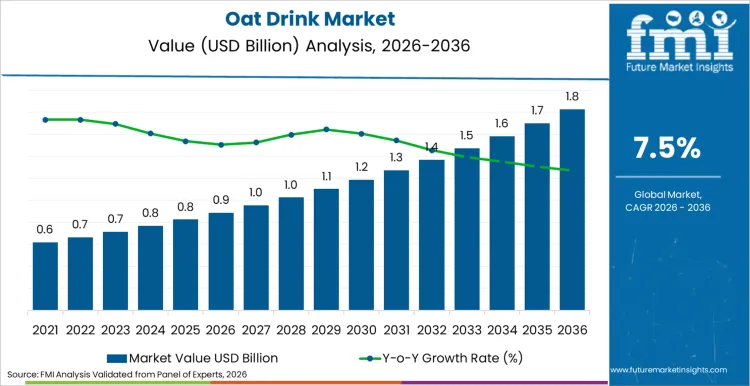
Key Takeaways, Market Size, and Forecast
| Metric | Value |
|---|---|
| Market Size (2026) | USD 0.89 Billion |
| Market Size (2036) | USD 1.83 Billion |
| CAGR (2026–2036) | 7.5% |
| Leading Product | Regular/Full Fat Oat Drinks |
| Regular/Full Fat Oat Drinks Share | 65.3% |
| Leading Flavor (2026) | Vanilla |
| Vanilla Share (2026) | 24.8% |
| Leading End-Use Application | Food Services |
| Food Services Share | 67.0% |
| Fastest-Growing Country | India |
| India CAGR | 9.3% |
Oat Drink Market Key Takeaways
| Metric | Value |
|---|---|
| Market Value (2026) | USD 0.89 billion |
| Market Forecast Value (2036) | USD 1.83 billion |
| Forecast CAGR (2026 to 2036) | 7.5% |
Why is Oat Drink Demand Being Driven by Format Discipline and Food Service Repeatability?
Oat drink demand is rising because buyers are prioritizing formats that reduce operational friction across cafés, quick-service networks, and institutional channels. Food service operators need predictable results across batching, steaming, dispensing, and storage routines. This pushes selection toward products that hold stable performance over repeated daily cycles, improving outlet consistency and reducing wastage risk.
Format discipline is also shaping retail purchasing. Consumers and retailers favor options that fit routine replenishment behavior, which supports stable velocity for products that are easy to store and distribute. Category momentum connects strongly with broader plant-based beverage positioning captured across oat milk and the wider shift toward dairy alternatives, where convenience and availability often decide repeat purchase outcomes.
Flavor also plays a reinforcing role in repeat purchase behavior. Vanilla maintains leadership because it performs well across coffee workflows and blended drinks, giving outlets and households an all-purpose selection that avoids frequent SKU switching.
Segmental Analysis
Why does Regular/Full Fat lead the product type mix?
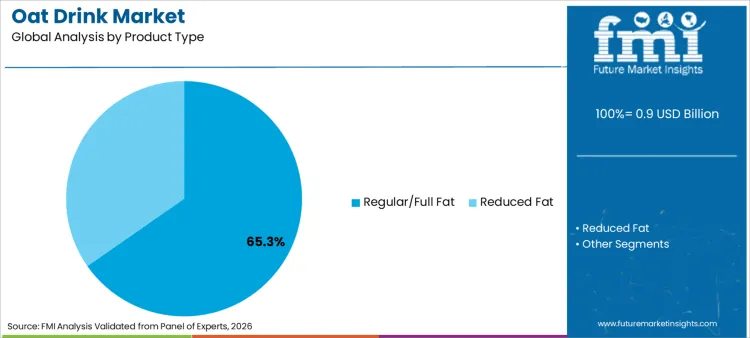
Regular/full fat holds a 65.3% share, reflecting preference for profiles that deliver familiarity and consistency across daily usage occasions. Buyers often select products that maintain stable sensory performance across coffee, breakfast routines, and culinary applications. This supports repeat ordering in food service where standardization reduces complexity across menu execution.
Reduced fat remains relevant for consumers and channels that prioritize lighter positioning, though volume concentration stays higher in regular/full fat due to broader usage versatility.
Why does Vanilla lead the Flavor Portfolio?
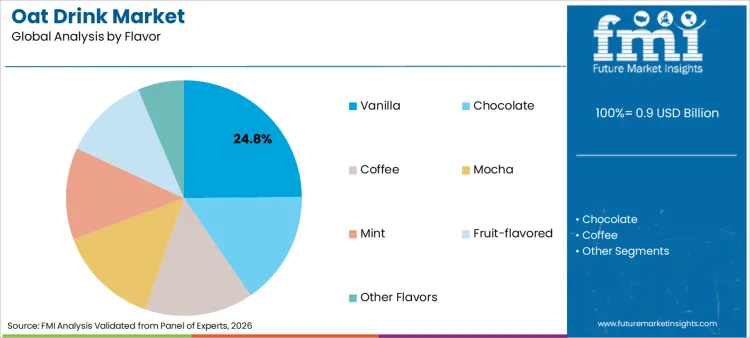
Vanilla-flavored oat beverages lead with a 24.8% share, supported by multi-occasion fit across coffee beverages, blended drinks, and retail consumption. It is frequently treated as a dependable default flavor that performs across hot and cold preparation routines. Chocolate, coffee, mocha, mint, fruit-flavored options, and other variants support portfolio expansion and incremental trial, while vanilla maintains the strongest baseline demand.
Why does Food Services dominate end-use application demand?
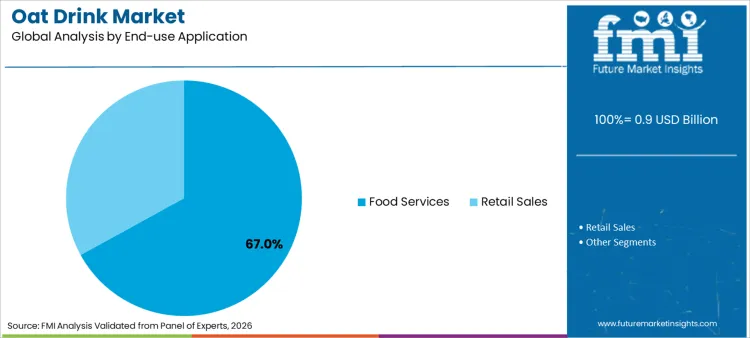
Food services account for a 67.0% share, reflecting the scale of consumption occurring through cafés, QSR chains, and away-from-home beverage routines. These channels benefit from streamlined SKU strategies, stable supply planning, and predictable product behavior in high-frequency use environments. Retail sales contribute meaningful volume through home consumption and routine grocery replenishment, supporting category resilience across different demand cycles.
Why do Conventional Oat Drinks lead by nature?
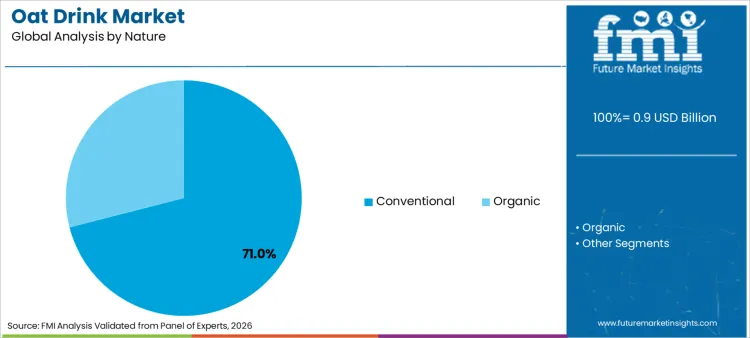
Conventional oat drinks hold a 71.0% share, shaped by supply availability, pricing accessibility, and procurement scale across food service buyers. High-volume channels typically prioritize continuity and broad distribution coverage, which supports conventional dominance in standardized purchasing programs. Organic demand remains active where brands position premium attributes and clean-label expectations as core differentiators.
Why does Shelf-stable dominate the format mix?
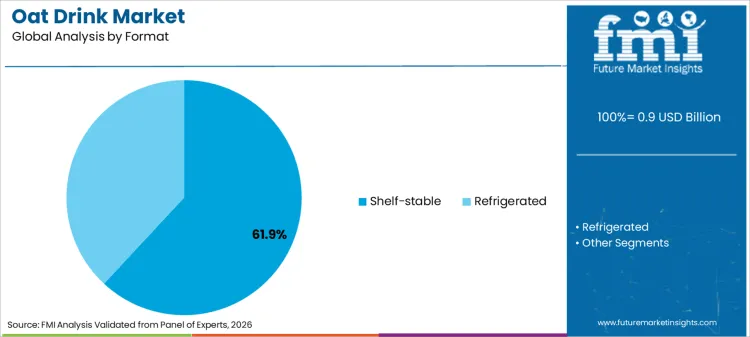
Shelf-stable leads with a 61.9% share, supported by logistics efficiency and flexible storage requirements across retail and food service. Shelf-stable formats reduce inventory pressure, improve distribution reach, and support consistent outlet replenishment without reliance on chilled infrastructure. Refrigerated formats remain important in channels that favor fresh positioning and cold-chain merchandising strategies.
Market Dynamics
What is supporting strong share concentration in shelf-stable and food service channels?
Demand is supported by operating simplicity and procurement consistency. Shelf-stable products align well with distribution efficiency, while food service buyers value repeatable results and reduced storage constraints.
These factors reinforce reordering patterns and support volume concentration in dominant segments. This buying logic follows broader plant-based beverage expansion captured in plant-based milk and milk alternatives, where channel readiness often determines how fast products scale.
How are portfolios being shaped by flavor strategies and coffee usage occasions?
Flavor strategies are being optimized to balance high-velocity staples and trial-driven variants. Vanilla anchors repeat demand because it performs across multiple usage occasions and reduces decision fatigue for buyers. Coffee and mocha variants strengthen café relevance, while fruit-flavored and niche options support brand differentiation and seasonal rotations.
What slows down switching and accelerates supplier retention?
Switching is slowed by operational fit testing and performance verification across preparation conditions. Buyers often stay with validated suppliers once consistency is proven, since substitution can disrupt menu execution, retail ratings, or supply planning. This creates stable retention dynamics in both retail and food service procurement.
Analysis of the Oat Drink Market by Key Countries
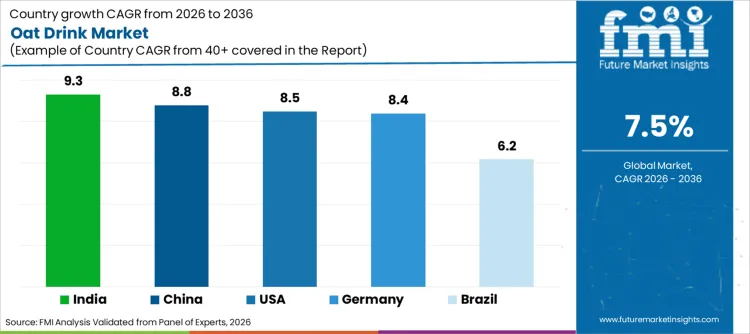
| Country | CAGR (2026-2036) |
|---|---|
| USA | 8.5% |
| Brazil | 6.2% |
| Germany | 8.4% |
| China | 8.8% |
| India | 9.3% |
Why is India projected to expand the fastest within this group?
India is forecast to grow at a 9.3% CAGR, supported by increasing adoption across modern retail and food service environments where plant-based beverage choices are expanding. Growth is reinforced by rising availability of shelf-stable formats that improve distribution reach and simplify storage across a wide range of outlets.
Why is China sustaining strong growth through expanding Retail and Café Demand?
China is expected to advance at an 8.8% CAGR, driven by strong momentum in urban consumption routines and expanding product accessibility across retail and away-from-home channels. Growth benefits from structured purchasing where formats with reliable storage and repeatable performance are prioritized for scaling.
Why does the USA remain a High-growth anchor with Strong Channel Diversity?
The USA is projected to expand at an 8.5% CAGR, supported by diversified participation across food service and retail. Shelf-stable distribution strength and strong outlet penetration encourage repeat purchase behavior, while flavor variety supports portfolio segmentation across different usage occasions.
Why does Germany show growth shaped by Format Discipline and Quality-Led Buying?
Germany is forecast to grow at an 8.4% CAGR, reflecting demand patterns where buyers value consistent performance and predictable quality outcomes. Growth remains supported by structured retail adoption and food service participation, with shelf-stable formats strengthening distribution efficiency and repeat procurement.
Why does Brazil progress through steady scaling in food service-led consumption?
Brazil is expected to advance at a 6.2% CAGR, shaped by steady expansion where food service remains a key demand channel and shelf-stable logistics improve availability. Growth is paced by distribution coverage and portfolio consolidation as buyers prioritize high-velocity products that fit routine purchasing behavior.
Competitive Landscape
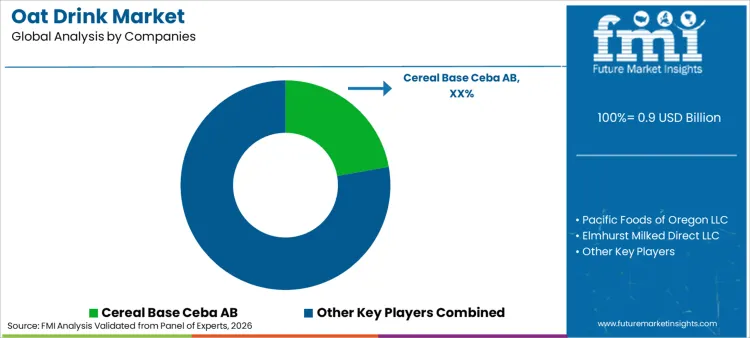
Competition is shaped by distribution reach, channel penetration in food service, and the ability to maintain consistent product performance across repeat preparation conditions. Suppliers that support shelf-stable scaling and maintain stable sensory outcomes across batches tend to secure stronger retention, especially in high-frequency outlet environments.
Portfolio design also influences positioning. Brands that balance staple formats with selective flavor expansion can maintain high baseline volumes while creating targeted differentiation for café and retail segments. Scale readiness remains a core advantage as food service buyers prioritize availability and continuity across multi-location networks.
Key Players
- Cereal Base Ceba AB
- Pacific Foods of Oregon LLC
- Elmhurst Milked Direct LLC
- Danone S.A.
- Lima Food SRL
- Oatworks
- The Hain Celestial Group, Inc.
- Abafoods s.r.l.
- Kaslink Foods Oy
- Rude Health
- Valsoia S.p.A.
- Earth’s Own Food Company Inc.
Scope of Report
| Items | Values |
|---|---|
| Quantitative Units | USD Billion |
| Product Type | Regular/Full Fat; Reduced Fat |
| Flavor | Vanilla; Chocolate; Coffee; Mocha; Mint; Fruit-flavored; Other Flavors |
| End-use Application | Food Services; Retail Sales |
| Nature | Conventional; Organic |
| Format | Shelf-stable; Refrigerated |
| Key Countries | USA; Brazil; Germany; China; India |
| Key Companies Profiled | Cereal Base Ceba AB; Pacific Foods of Oregon LLC; Elmhurst Milked Direct LLC; Danone S.A.; Lima Food SRL; Oatworks; The Hain Celestial Group, Inc.; Abafoods s.r.l.; Kaslink Foods Oy; Rude Health; Valsoia S.p.A.; Earth’s Own Food Company Inc. |
Global Oat Drink Market Outlook by Category
By Product Type
- Regular/Full Fat
- Reduced Fat
By Flavor
- Vanilla
- Chocolate
- Coffee
- Mocha
- Mint
- Fruit-flavored
- Other Flavors
By End-use Application
- Food Services
- Retail Sales
By Nature
- Conventional
- Organic
By Format
- Shelf-stable
- Refrigerated
By Region
- North America
- Latin America
- Western Europe
- Eastern Europe
- East Asia
- South Asia and Pacific
- Middle East and Africa
Bibliography
- USA Food and Drug Administration. (2023). Draft guidance for industry: Labeling of plant-based milk alternatives and voluntary nutrient statements. FDA.
- USA Food and Drug Administration. (2025). Plant-based milk and animal food alternatives. FDA.
- Food and Agriculture Organization of the United Nations & World Health Organization. (2024). Review of nutrient profiles of foods and beverages made from plant-based and other alternative protein sources (Agenda item document for CCNFSDU). Codex Alimentarius.
- Scientific Advisory Committee on Nutrition. (2024). Fortifying foods and drinks with vitamin D: Main report. GOV.UK.
- Tan, Y. Q., et al. (2024). Addressing the safety of new food sources and production systems: A review for food systems transformation. Food and Agriculture Organization of the United Nations.
Frequently Asked Questions
What is the projected oat drink market size for 2026?
The oat drink market is expected to total USD 0.89 billion in 2026.
What value is expected for oat drink in 2036?
In 2036, demand for oat drink is forecast to reach USD 1.83 billion.
At what rate will the oat drink market progress from 2026 to 2036?
Oat drink demand is expected to grow at a 7.5% CAGR during 2026 to 2036.
Which product type leads demand and what share does it hold?
Regular/full fat leads by product type with a 65.3% share.
Which flavor leads demand and what share does it hold?
Vanilla leads by flavor with a 24.8% share.
Which end-use application leads demand and what share does it hold?
Food services lead by end-use application with a 67.0% share.
Which nature segment leads demand and what share does it hold?
Conventional oat beverages lead by nature with a 71.0% share.
Which format leads demand and what share does it hold?
Shelf-stable oat drinks lead by format with a 61.9% share.
Preview the report firsthand - request a free sample
Get SampleGet the brochure for pricing and purchase details.
Get PDFTable of Content
- Executive Summary
- Global Market Outlook
- Demand-side Trends
- Supply-side Trends
- Technology Roadmap Analysis
- Analysis and Recommendations
- Market Overview
- Market Coverage / Taxonomy
- Market Definition / Scope / Limitations
- Market Background
- Market Dynamics
- Drivers
- Restraints
- Opportunity
- Trends
- Scenario Forecast
- Demand in Optimistic Scenario
- Demand in Likely Scenario
- Demand in Conservative Scenario
- Opportunity Map Analysis
- Product Life Cycle Analysis
- Supply Chain Analysis
- Investment Feasibility Matrix
- Value Chain Analysis
- PESTLE and Porter’s Analysis
- Regulatory Landscape
- Regional Parent Market Outlook
- Production and Consumption Statistics
- Import and Export Statistics
- Market Dynamics
- Global Market Analysis 2021 to 2025 and Forecast, 2026 to 2036
- Historical Market Size Value (USD Million) Analysis, 2021 to 2025
- Current and Future Market Size Value (USD Million) Projections, 2026 to 2036
- Y-o-Y Growth Trend Analysis
- Absolute $ Opportunity Analysis
- Global Market Pricing Analysis 2021 to 2025 and Forecast 2026 to 2036
- Global Market Analysis 2021 to 2025 and Forecast 2026 to 2036, By Product Type
- Introduction / Key Findings
- Historical Market Size Value (USD Million) Analysis By Product Type , 2021 to 2025
- Current and Future Market Size Value (USD Million) Analysis and Forecast By Product Type , 2026 to 2036
- Regular/Full Fat
- Reduced Fat
- Regular/Full Fat
- Y-o-Y Growth Trend Analysis By Product Type , 2021 to 2025
- Absolute $ Opportunity Analysis By Product Type , 2026 to 2036
- Global Market Analysis 2021 to 2025 and Forecast 2026 to 2036, By Flavor
- Introduction / Key Findings
- Historical Market Size Value (USD Million) Analysis By Flavor, 2021 to 2025
- Current and Future Market Size Value (USD Million) Analysis and Forecast By Flavor, 2026 to 2036
- Vanilla
- Chocolate
- Coffee
- Mocha
- Mint
- Fruit-flavored
- Other Flavors
- Vanilla
- Y-o-Y Growth Trend Analysis By Flavor, 2021 to 2025
- Absolute $ Opportunity Analysis By Flavor, 2026 to 2036
- Global Market Analysis 2021 to 2025 and Forecast 2026 to 2036, By End-use Application
- Introduction / Key Findings
- Historical Market Size Value (USD Million) Analysis By End-use Application, 2021 to 2025
- Current and Future Market Size Value (USD Million) Analysis and Forecast By End-use Application, 2026 to 2036
- Food Services
- Retail Sales
- Food Services
- Y-o-Y Growth Trend Analysis By End-use Application, 2021 to 2025
- Absolute $ Opportunity Analysis By End-use Application, 2026 to 2036
- Global Market Analysis 2021 to 2025 and Forecast 2026 to 2036, By Nature
- Introduction / Key Findings
- Historical Market Size Value (USD Million) Analysis By Nature, 2021 to 2025
- Current and Future Market Size Value (USD Million) Analysis and Forecast By Nature, 2026 to 2036
- Conventional
- Organic
- Conventional
- Y-o-Y Growth Trend Analysis By Nature, 2021 to 2025
- Absolute $ Opportunity Analysis By Nature, 2026 to 2036
- Global Market Analysis 2021 to 2025 and Forecast 2026 to 2036, By Format
- Introduction / Key Findings
- Historical Market Size Value (USD Million) Analysis By Format, 2021 to 2025
- Current and Future Market Size Value (USD Million) Analysis and Forecast By Format, 2026 to 2036
- Shelf-stable
- Refrigerated
- Shelf-stable
- Y-o-Y Growth Trend Analysis By Format, 2021 to 2025
- Absolute $ Opportunity Analysis By Format, 2026 to 2036
- Global Market Analysis 2021 to 2025 and Forecast 2026 to 2036, By Region
- Introduction
- Historical Market Size Value (USD Million) Analysis By Region, 2021 to 2025
- Current Market Size Value (USD Million) Analysis and Forecast By Region, 2026 to 2036
- North America
- Latin America
- Western Europe
- Eastern Europe
- East Asia
- South Asia and Pacific
- Middle East & Africa
- Market Attractiveness Analysis By Region
- North America Market Analysis 2021 to 2025 and Forecast 2026 to 2036, By Country
- Historical Market Size Value (USD Million) Trend Analysis By Market Taxonomy, 2021 to 2025
- Market Size Value (USD Million) Forecast By Market Taxonomy, 2026 to 2036
- By Country
- USA
- Canada
- Mexico
- By Product Type
- By Flavor
- By End-use Application
- By Nature
- By Format
- By Country
- Market Attractiveness Analysis
- By Country
- By Product Type
- By Flavor
- By End-use Application
- By Nature
- By Format
- Key Takeaways
- Latin America Market Analysis 2021 to 2025 and Forecast 2026 to 2036, By Country
- Historical Market Size Value (USD Million) Trend Analysis By Market Taxonomy, 2021 to 2025
- Market Size Value (USD Million) Forecast By Market Taxonomy, 2026 to 2036
- By Country
- Brazil
- Chile
- Rest of Latin America
- By Product Type
- By Flavor
- By End-use Application
- By Nature
- By Format
- By Country
- Market Attractiveness Analysis
- By Country
- By Product Type
- By Flavor
- By End-use Application
- By Nature
- By Format
- Key Takeaways
- Western Europe Market Analysis 2021 to 2025 and Forecast 2026 to 2036, By Country
- Historical Market Size Value (USD Million) Trend Analysis By Market Taxonomy, 2021 to 2025
- Market Size Value (USD Million) Forecast By Market Taxonomy, 2026 to 2036
- By Country
- Germany
- UK
- Italy
- Spain
- France
- Nordic
- BENELUX
- Rest of Western Europe
- By Product Type
- By Flavor
- By End-use Application
- By Nature
- By Format
- By Country
- Market Attractiveness Analysis
- By Country
- By Product Type
- By Flavor
- By End-use Application
- By Nature
- By Format
- Key Takeaways
- Eastern Europe Market Analysis 2021 to 2025 and Forecast 2026 to 2036, By Country
- Historical Market Size Value (USD Million) Trend Analysis By Market Taxonomy, 2021 to 2025
- Market Size Value (USD Million) Forecast By Market Taxonomy, 2026 to 2036
- By Country
- Russia
- Poland
- Hungary
- Balkan & Baltic
- Rest of Eastern Europe
- By Product Type
- By Flavor
- By End-use Application
- By Nature
- By Format
- By Country
- Market Attractiveness Analysis
- By Country
- By Product Type
- By Flavor
- By End-use Application
- By Nature
- By Format
- Key Takeaways
- East Asia Market Analysis 2021 to 2025 and Forecast 2026 to 2036, By Country
- Historical Market Size Value (USD Million) Trend Analysis By Market Taxonomy, 2021 to 2025
- Market Size Value (USD Million) Forecast By Market Taxonomy, 2026 to 2036
- By Country
- China
- Japan
- South Korea
- By Product Type
- By Flavor
- By End-use Application
- By Nature
- By Format
- By Country
- Market Attractiveness Analysis
- By Country
- By Product Type
- By Flavor
- By End-use Application
- By Nature
- By Format
- Key Takeaways
- South Asia and Pacific Market Analysis 2021 to 2025 and Forecast 2026 to 2036, By Country
- Historical Market Size Value (USD Million) Trend Analysis By Market Taxonomy, 2021 to 2025
- Market Size Value (USD Million) Forecast By Market Taxonomy, 2026 to 2036
- By Country
- India
- ASEAN
- Australia & New Zealand
- Rest of South Asia and Pacific
- By Product Type
- By Flavor
- By End-use Application
- By Nature
- By Format
- By Country
- Market Attractiveness Analysis
- By Country
- By Product Type
- By Flavor
- By End-use Application
- By Nature
- By Format
- Key Takeaways
- Middle East & Africa Market Analysis 2021 to 2025 and Forecast 2026 to 2036, By Country
- Historical Market Size Value (USD Million) Trend Analysis By Market Taxonomy, 2021 to 2025
- Market Size Value (USD Million) Forecast By Market Taxonomy, 2026 to 2036
- By Country
- Kingdom of Saudi Arabia
- Other GCC Countries
- Turkiye
- South Africa
- Other African Union
- Rest of Middle East & Africa
- By Product Type
- By Flavor
- By End-use Application
- By Nature
- By Format
- By Country
- Market Attractiveness Analysis
- By Country
- By Product Type
- By Flavor
- By End-use Application
- By Nature
- By Format
- Key Takeaways
- Key Countries Market Analysis
- USA
- Pricing Analysis
- Market Share Analysis, 2025
- By Product Type
- By Flavor
- By End-use Application
- By Nature
- By Format
- Canada
- Pricing Analysis
- Market Share Analysis, 2025
- By Product Type
- By Flavor
- By End-use Application
- By Nature
- By Format
- Mexico
- Pricing Analysis
- Market Share Analysis, 2025
- By Product Type
- By Flavor
- By End-use Application
- By Nature
- By Format
- Brazil
- Pricing Analysis
- Market Share Analysis, 2025
- By Product Type
- By Flavor
- By End-use Application
- By Nature
- By Format
- Chile
- Pricing Analysis
- Market Share Analysis, 2025
- By Product Type
- By Flavor
- By End-use Application
- By Nature
- By Format
- Germany
- Pricing Analysis
- Market Share Analysis, 2025
- By Product Type
- By Flavor
- By End-use Application
- By Nature
- By Format
- UK
- Pricing Analysis
- Market Share Analysis, 2025
- By Product Type
- By Flavor
- By End-use Application
- By Nature
- By Format
- Italy
- Pricing Analysis
- Market Share Analysis, 2025
- By Product Type
- By Flavor
- By End-use Application
- By Nature
- By Format
- Spain
- Pricing Analysis
- Market Share Analysis, 2025
- By Product Type
- By Flavor
- By End-use Application
- By Nature
- By Format
- France
- Pricing Analysis
- Market Share Analysis, 2025
- By Product Type
- By Flavor
- By End-use Application
- By Nature
- By Format
- India
- Pricing Analysis
- Market Share Analysis, 2025
- By Product Type
- By Flavor
- By End-use Application
- By Nature
- By Format
- ASEAN
- Pricing Analysis
- Market Share Analysis, 2025
- By Product Type
- By Flavor
- By End-use Application
- By Nature
- By Format
- Australia & New Zealand
- Pricing Analysis
- Market Share Analysis, 2025
- By Product Type
- By Flavor
- By End-use Application
- By Nature
- By Format
- China
- Pricing Analysis
- Market Share Analysis, 2025
- By Product Type
- By Flavor
- By End-use Application
- By Nature
- By Format
- Japan
- Pricing Analysis
- Market Share Analysis, 2025
- By Product Type
- By Flavor
- By End-use Application
- By Nature
- By Format
- South Korea
- Pricing Analysis
- Market Share Analysis, 2025
- By Product Type
- By Flavor
- By End-use Application
- By Nature
- By Format
- Russia
- Pricing Analysis
- Market Share Analysis, 2025
- By Product Type
- By Flavor
- By End-use Application
- By Nature
- By Format
- Poland
- Pricing Analysis
- Market Share Analysis, 2025
- By Product Type
- By Flavor
- By End-use Application
- By Nature
- By Format
- Hungary
- Pricing Analysis
- Market Share Analysis, 2025
- By Product Type
- By Flavor
- By End-use Application
- By Nature
- By Format
- Kingdom of Saudi Arabia
- Pricing Analysis
- Market Share Analysis, 2025
- By Product Type
- By Flavor
- By End-use Application
- By Nature
- By Format
- Turkiye
- Pricing Analysis
- Market Share Analysis, 2025
- By Product Type
- By Flavor
- By End-use Application
- By Nature
- By Format
- South Africa
- Pricing Analysis
- Market Share Analysis, 2025
- By Product Type
- By Flavor
- By End-use Application
- By Nature
- By Format
- USA
- Market Structure Analysis
- Competition Dashboard
- Competition Benchmarking
- Market Share Analysis of Top Players
- By Regional
- By Product Type
- By Flavor
- By End-use Application
- By Nature
- By Format
- Competition Analysis
- Competition Deep Dive
- Cereal Base Ceba AB
- Overview
- Product Portfolio
- Profitability by Market Segments (Product/Age /Sales Channel/Region)
- Sales Footprint
- Strategy Overview
- Marketing Strategy
- Product Strategy
- Channel Strategy
- Pacific Foods of Oregon LLC
- Elmhurst Milked Direct LLC
- Danone S.A.
- Lima Food SRL
- Oatworks
- The Hain Celestial Group, Inc.
- Abafoods s.r.l.
- Kaslink Foods Oy
- Rude Health
- Valsoia S.p.A.
- Earth’s Own Food Company Inc.
- Cereal Base Ceba AB
- Competition Deep Dive
- Assumptions & Acronyms Used
- Research Methodology


