

- Market Size (2026)
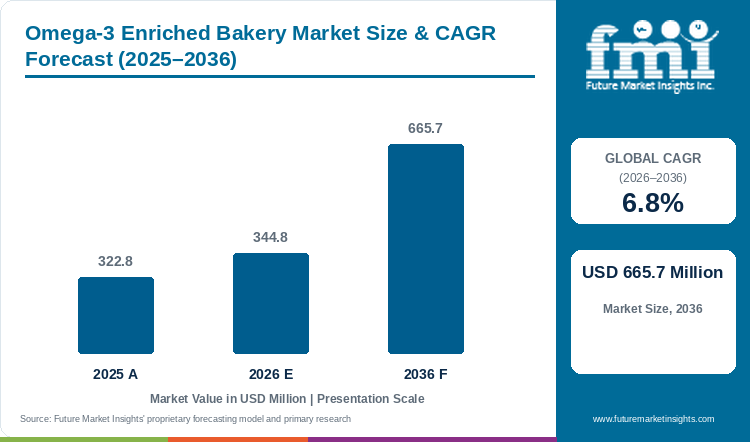
- USD 344.8 Mn
- Forecast (2036)
- USD 665.7 Mn
- CAGR (2026 to 2036)
- 6.8%
How big is Omega-3 Enriched Bakery Market in 2026?
The global omega-3 enriched bakery market establishes its foundation at USD 322.8 million in 2025, advances to USD 344.8 million in 2026, and is forecast to scale to USD 665.7 million by 2036 at a CAGR of 6.8%.
Consumer preference for getting heart and cognitive nutrients from regular meals rather than synthetic pills is pushing commercial bakeries to fortify daily bread and morning goods with omega-3 fatty acids. However, high deck and tunnel oven temperatures challenge market expansion because polyunsaturated lipids oxidize rapidly under heat and ruin loaf flavor if left unprotected. As a matter of fact, a November 2025 review published in Sci showed that while flaxseed delivers 30% to 56.7% lipid and 17.3% to 28% protein, heating unprotected flaxseed oil between 120 and 180 degrees Celsius triggers rapid free-radical oxidation unless bakers stabilize the dough with secoisolariciresinol diglucoside and tea polyphenol blends [1]. Control of this thermal stability barrier allows commercial bakers to scale retail distribution, taking the global omega-3 enriched bakery market size from a 2025 baseline of USD 322.8 million to an estimated USD 344.8 million in 2026 and a projected USD 665.7 million by 2036 on a 6.8% CAGR (generating USD 320.9 million in incremental market value). In 2026, whole grain & seeded loaves are projected to capture 43.4% within the product type segment because industrial bakers pair natural seed-coat protection with microencapsulated omega-3 powders to prevent rancid off-notes.
Key Market Trends & Insights
- By product type: Natural seed coat lignans shield alpha-linolenic acid during oven baking, putting whole grain & seeded loaves at an expected 43.4% share in 2026.
- By claim / nature: Everyday grocery pricing without organic grain surcharges places plant-based ALA conventional products at an estimated 54.6% share in 2026.
- By format: Weekly household sandwich bread replenishment keeps fresh packaged items ahead with a projected 46.8% share in 2026.
- By packaging format: Opaque polybags that block oxygen ingress during home storage give family / loaf pack configurations an anticipated 48.2% share in 2026.
- By sales channel: Side-by-side shelf comparison of per-slice ALA badges allows supermarkets & hypermarkets to secure a forecast 47.5% share in 2026.
Regional Highlights
- North American and East Asian momentum: The USA is projected to lead national growth at a 7.5% CAGR through 2036 ahead of South Korea at 7.2%, supported by quantified per-slice ALA labeling on mainstream grocery loaves.
- European and Middle Eastern progression: The UK is expected to advance at a 6.9% CAGR followed by Germany at 6.6% and the UAE at 6.4%, while France (6.1%) and Saudi Arabia (5.8%) outpace mature demand in Japan (5.3%).
Market Size & Forecast
Table 1: Market Size and Forecast for the Omega-3 Enriched Bakery Market (USD million and CAGR percentage), 2025 to 2036
| Metric | Value |
|---|---|
| 2025 Market Size | USD 322.8 million |
| Estimated Market Size in 2026 | USD 344.8 million |
| Projected Market Size by 2036 | USD 665.7 million |
| CAGR, 2026 to 2036 | 6.8% |
| Added Revenue, 2026 to 2036 | USD 320.9 million |
Retail supermarket buyers only grant functional price premiums to bakery brands that can legally print an omega-3 claim on the front of the bag. Simply sprinkling raw seeds on top of a loaf no longer qualifies as a functional product in regulated grocery markets. For instance, under European Commission Regulation (EC) No 1924/2006 nutrition claim rules updated in January 2025, a baked good must supply at least 0.3 grams of alpha-linolenic acid or 40 milligrams of combined EPA and DHA per 100 grams and per 100 kilocalories to legally carry a source of omega-3 label [2]. Because oven heat degrades unprotected lipids during baking, manufacturers expanding multigrain and seeded bread portfolios must overdose raw lipid inputs and run post-bake gas chromatography tests to avoid regulatory recalls.
Fortified Loaf Volume and Nutrient Dosing Sizing
Table 2: Fortified Loaf Volume and Nutrient Dosing Sizing for the Omega-3 Enriched Bakery Market (USD million and operational ranges), 2025 to 2036
| Metric | 2025 | 2026 | 2036 |
|---|---|---|---|
| Market size (USD million) | 322.8 | 344.8 | 665.7 |
| Qualifying omega-3 bakery units sold (million packs) | 82.0 to 91.0 | 87.0 to 96.5 | 158.0 to 176.0 |
| Active ALA / EPA+DHA lipid dosed in bakery (metric tons) | 1,180 to 1,340 | 1,260 to 1,430 | 2,410 to 2,720 |
| Average retail pack realization (USD per unit) | 3.6 to 3.9 | 3.6 to 4.0 | 3.8 to 4.2 |
Operational note: Pack volume and active lipid ranges reconcile commercial loaf weights of 450 to 800 grams against statutory EU thresholds of 0.3 grams ALA per 100 grams and USA per-slice declarations of 130 to 440 milligrams ALA.
The gap between active lipid tonnage dosed (1,260 to 1,430 metric tons in 2026) and finished pack realization directly impacts bakery gross margins. Commercial ovens destroy 12% to 18% of unshielded fatty acids during a 22-minute bake cycle, which forces formulators to build a safety buffer into every dough batch. In addition to this thermal loss, whole unmilled flaxseeds pass through human digestion only partially absorbed, limiting the nutritional value delivered to the shopper. To protect batch economics and guarantee bioavailability, industrial bakeries blend cold-milled golden flax meal with food-grade omega-3 ingredients that survive high-temperature baking.
Per Capita & Commercial Bakery Line Sizing
Table 3: Per Capita and Bakery Line Valuation Indicators for the Omega-3 Enriched Bakery Market (USD), 2025 to 2036
| Metric | 2025 | 2026 | 2036 |
|---|---|---|---|
| World population (billion) | 8.2 | 8.3 | 9.0 |
| Market value per 1,000 people (USD) | 39.4 | 41.5 | 74.0 |
| Annual fortified output per certified bakery line (USD thousand) | 410.0 to 480.0 | 430.0 to 505.0 | 680.0 to 790.0 |
| Microencapsulated marine & algal share of fortified SKUs (%) | 18.5% to 21.5% | 19.5% to 22.5% | 27.0% to 31.0% |
Table 4: Retail & Formulation Allocation Indicators for the Omega-3 Enriched Bakery Market (USD and percentages), 2026
| Metric | Value | Institutional Reference Basis |
|---|---|---|
| Market size, 2026 | USD 344.8 million | 2026 global enriched bakery valuation baseline |
| Commercial functional bakery lines globally | 740 lines | Global industrial & specialty functional bakery registry |
| Whole grain & seeded loaf share, 2026 | 43.4% (USD 149.6 million allocation) | 43.4% product type segment allocation |
| Supermarkets & hypermarkets share, 2026 | 47.5% (USD 163.8 million allocation) | 47.5% sales channel segment allocation |
Growth in annual output per certified bakery line from USD 430.0-505.0 thousand in 2026 toward USD 680.0-790.0 thousand by 2036 depends on extending mold-free and rancidity-free shelf life. Supermarket chains allocating USD 163.8 million in 2026 shelf sales refuse to stock functional loaves that turn rancid before day seven in ambient aisles. Because crushed oilseeds release free lipids that react with headspace oxygen inside the bag, bakeries must control dough water activity and antioxidant dosing to ship across wider regional radii. As a result, plant bakers pair rosemary extract and mixed tocopherols with commercial chia seed ingredients so peroxide values stay below 2.0 milliequivalents per kilogram throughout grocery distribution.
Analyst Perspective
"Retail buyers no longer accept raw seed percentages as proof of omega-3 enrichment. Bakers winning permanent grocery shelf space pair cold-milled flax or encapsulated marine lipids with verified post-bake fatty acid certificates and oxygen-barrier loaf packaging."
- Nandini Roy Choudhury, Principal Consultant, Future Market Insights.
How is the omega-3 enriched bakery market segmented?
The omega-3 enriched bakery market is segmented by product type, claim / nature, format, packaging format, and sales channel. In 2026, whole grain & seeded loaves are projected at 43.4%, plant-based ALA conventional at 54.6%, fresh packaged at 46.8%, family / loaf pack at 48.2%, and supermarkets & hypermarkets at 47.5%.
By product type: Whole grain & seeded loaves, fortified white & sandwich breads, multigrain rolls & hamburger buns, omega-3 crackers & crispbreads, and enriched morning goods & muffins.
By claim / nature: Plant-based ALA conventional, certified organic omega-3, gluten-free omega-3 enriched, clean-label & non-GMO, and dual protein- & fiber-fortified.
By format: Fresh packaged, ambient extended-shelf-life (MAP), frozen ready-to-thaw, par-baked & bake-off, and chilled.
By packaging format: Family / loaf pack, multipack trays & pouches, single-serve packs, and bulk foodservice cases.
By sales channel: Supermarkets & hypermarkets, natural & specialty grocery chains, online & DTC, convenience & forecourt, and institutional & healthcare foodservice.
Why do Whole Grain & Seeded Loaves lead the product type segment?
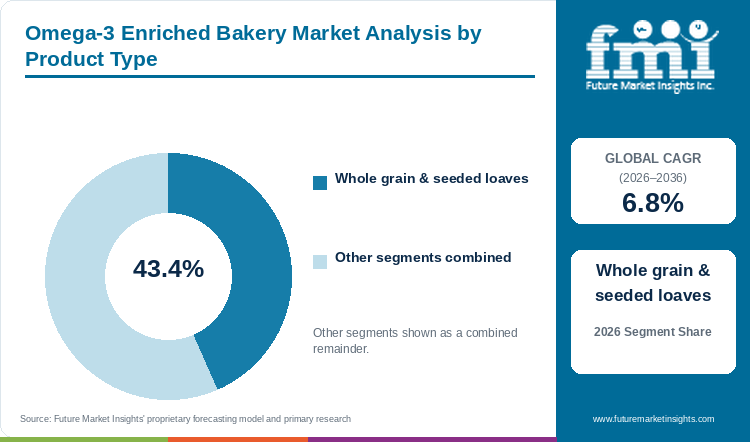
In 2026, whole grain & seeded loaves are expected to hold a 43.4% share of the product type segment because intact oilseed coats naturally supply concentrated ALA.
Table 5: Product Type Share for the Omega-3 Enriched Bakery Market (percentage share), 2026
| Product Type | Share (2026) |
|---|---|
| Whole grain & seeded loaves | 43.4% |
| Other Segments Combined* | 56.6% |
| Total | 100.0% |
*Calculated as the balance remaining after deducting the leading segment's reported share from 100.0%.
Table 6: Product Type Leadership and Market Growth for the Omega-3 Enriched Bakery Market (segment and CAGR percentage), 2026 to 2036
| Metric | Value |
|---|---|
| Global CAGR (2026 to 2036) | 6.8% |
| Leading Segment | Whole grain & seeded loaves |
Formulating omega-3 claims into plain white bread or sweet morning muffins requires expensive microencapsulated marine powders that raise raw material costs by 18% to 25% per batch. By contrast, whole grain and seeded loaves let commercial bakers hit high alpha-linolenic acid targets at a much lower ingredient cost because intact seed coats and lignans shield polyunsaturated lipids from oven heat. Shoppers purchasing seeded bread already seek visible health cues on the crust and crumb, which lifts repeat basket velocity and drives industrial bakeries to expand food-grade flaxseeds contracts across national pan-bread lines.
- Repeat household purchases of sliced seeded sandwich bread give whole grain & seeded loaves an expected 43.4% of product type demand in 2026.
- For instance, Flowers Foods' January 2026 nutrition disclosures for Dave's Killer Bread show that its Good Seed loaf delivers 440 milligrams of ALA omega-3 per 45-gram slice while its Powerseed loaf provides 260 milligrams of ALA per 42-gram slice [3].
What keeps Plant-Based ALA Conventional ahead within the claim / nature segment?
Within the claim / nature segment, plant-based ALA conventional lines are estimated at a 54.6% share in 2026 since conventional oilseed sourcing avoids organic grain price premiums.
Retail price elasticity remains the main barrier preventing organic and gluten-free omega-3 breads from capturing majority volume in mass grocery channels. Certified organic oilseeds and segregated gluten-free baking rooms add 25% to 40% to per-loaf production costs, pricing those items above everyday family budgets. Conventional plant-based ALA formulations allow industrial bakeries to dose concentrated flax and chia meal into high-speed pan lines right beside standard whole wheat bread assortments, keeping retail prices competitive for middle-income shoppers.
- Plant-based ALA conventional products are estimated to represent 54.6% of claim / nature volume in 2026 because accessible loaf pricing supports broad grocery distribution.
- As a matter of fact, July 2025 composition data from the National Institutes of Health Office of Dietary Supplements confirm that flaxseed oil contains 53% alpha-linolenic acid while whole flaxseed supplies 2.35 grams of ALA per tablespoon, giving conventional bakers an economical fortification base [4].
How does Fresh Packaged remain the principal format sub-segment?
In 2026, fresh packaged bakery goods are projected to account for 46.8% of the format segment as households replenish soft sandwich loaves every week.
Consumer purchase frequency in the bakery aisle depends heavily on soft crumb elasticity for morning toast and packed school or office sandwiches. While frozen ready-to-thaw and modified-atmosphere ambient formats help exporters avoid transit spoilage, many shoppers associate long-life or thawed bread with firmer crumb texture. Direct-store-delivery fleets restock fresh packaged omega-3 loaves three to four times a week alongside functional fiber bakery items, ensuring high shelf turn before lipid oxidation can affect flavor.
- Shoppers prefer soft un-frozen crumb texture for daily sandwiches, so fresh packaged loaves are projected to make up 46.8% of format sales in 2026.
- To support refrigerated and ambient stability in fresh loaves, a January 2025 study in Foods by University of Saskatchewan and Korea University researchers showed that flaxseed-meal-fortified bread retained bioactive antioxidant linusorb peptides across 7 days at 4 degrees Celsius and 4 weeks at minus 18 degrees Celsius [5].
Why does Family / Loaf Pack lead the packaging format segment?
Reclosable oxygen-barrier polybags give family / loaf pack designs an anticipated 48.2% share of the packaging format segment in 2026.
Packaging economics in functional bread require balancing per-slice film cost against protection from light-induced lipid rancidity. Single-serve pouches and multipack trays add significant plastic and carton overhead per gram of bread, which restricts their use to convenience kiosks and school catering. By contrast, 500-gram to 800-gram family loaf packs hold 16 to 22 slices in a single reclosable opaque polyethylene bag with an inner wax or high-barrier liner, protecting polyunsaturated seed oils across a week of household openings in line with commercial bakery products standards.
- Within the packaging format segment, family / loaf pack designs are anticipated to capture 48.2% in 2026 on steady multi-serving family consumption.
- To illustrate this family-loaf positioning, January 2026 product disclosures from Flowers Foods confirm that Dave's Killer Bread Good Seed organic omega-3 bread is sold in a 27-ounce (765-gram) loaf and a 20.5-ounce thin-sliced pack supplying 230 mg of plant ALA in each 28-gram thin slice [6].
What sustains Supermarkets & Hypermarkets in the sales channel segment?
Supermarkets & hypermarkets are forecast to hold 47.5% of the sales channel segment in 2026 where side-by-side nutrition panels guide shopper selection.
Launching an enriched bakery SKU requires high weekly shelf turn so loaves do not sit under warm retail lighting and develop stale or oxidized flavors. Independent health-food stores and online grocery portals struggle with slower inventory rotation and costly last-mile parcel shipping for bulky, low-unit-price bread loaves. Supermarkets and hypermarkets solve this velocity problem by consolidating household bread purchases in high-traffic center aisles supported by direct-store-delivery routes.
- Supermarkets & hypermarkets are forecast to generate 47.5% of sales channel turnover in 2026 through nationwide direct-store-delivery routes and weekly grocery trips.
- Demonstrating the value of mass grocery reach, Flowers Foods completed its acquisition of Simple Mills in February 2025 to scale seed- and nut-flour cracker and baking mix distribution across more than 30,000 retail stores in the USA [7].
What are the drivers, restraints, and opportunities in the omega-3 enriched bakery market?
Habitual daily bread consumption supports functional ALA fortification, whereas lipid autoxidation and strict regional claim rules restrain rapid rollout and microencapsulated algal or fish oil emulsions create clean-label expansion opportunities.
- Driver: Incorporating milled flaxseed and chia into everyday sandwich loaves allows consumers to increase daily omega-3 intake without adopting separate capsule supplements.
- Restraint: High baking temperatures accelerate polyunsaturated fatty acid peroxidation and volatile hexanal formation, raising sensory rejection and analytical verification costs.
- Opportunity: Co-encapsulating marine or algal DHA oils within whey protein and antioxidant hydrocolloid gels enables odorless EPA and DHA fortification in mainstream soft breads.
Growth Analysis and Future Potential: Habitual Staple Fortification
Human metabolic conversion of plant alpha-linolenic acid into active eicosapentaenoic acid and docosahexaenoic acid remains below 10%, which creates a persistent dietary gap among adults who rarely eat oily fish. Rather than buying expensive marine oil capsules, health-conscious families prefer fortified breakfast toast and sandwich rolls that deliver essential fatty acids as part of regular meals. As a matter of fact, a September 2026 preclinical study from the National Research Centre in Cairo published in Food & Function proved that functional sourdough muffins enriched with plant bioactive lipids and dietary fiber lowered omega-6-to-omega-3 ratios and reduced hepatic ATP citrate lyase expression by 42% to 52% in metabolic liver models [8]. This clinical validation encourages commercial bakeries to combine whole-seed doughs with epa and dha omega-3 ingredients to command higher retail prices.
Risk Assessment of the Omega-3 Enriched Bakery Market: Lipid Peroxidation and Regulatory Friction
Despite strong consumer interest, market expansion is restrained by how easily polyunsaturated omega-3 fatty acids oxidize during high-shear dough mixing and 200-degree-Celsius baking. When bis-allylic double bonds break down into volatile propanal and 2,4-heptadienal, even a slight fishy or paint-like odor ruins repeat sales. To overcome this shelf-life restraint, Mestemacher GmbH formulates its Organic Flax Seed Bread by pairing whole rye meal with a 5% organic linseed inclusion and thermal pasteurization, delivering 2 grams of fat and 6 grams of dietary fiber per 56-gram slice over multi-month ambient storage [9]. In addition to sensory risk, U.S. Food and Drug Administration enforcement under 21 CFR 101.54 guidance updated in March 2025 restricts nutrient content claims for ALA and DHA to verified reference values, blocking unsubstantiated health claims on bakery labels [10].
Commercial Opportunity Analysis: Co-Encapsulation and Algal DHA Bakery Formats
Expansion beyond coarse seeded breads into soft white sandwich loaves and children's rolls represents the biggest commercial growth avenue for bakery formulators over the next decade. Spray-dried and cold-set gel encapsulation now allow bakers to lock vegan algal DHA or marine oils inside whey protein isolate or modified starch shells that survive spiral mixing and oven heat without releasing odors. At the same time, regulatory authorities are tightening the clinical bar for new functional claims. For instance, a January 2026 scientific opinion issued by the UK Nutrition and Health Claims Committee and the Department of Health and Social Care confirmed that Article 13(5) health claim approvals under assimilated Regulation (EC) No 1924/2006 require human clinical trials proving a direct physiological effect [11]. As a result, industrial bakeries are pairing clinically validated vegan algae omega oils with sourdough fermentation to secure compliant front-of-pack claims.
Omega-3 Enriched Bakery Market by Country (2026 to 2036)
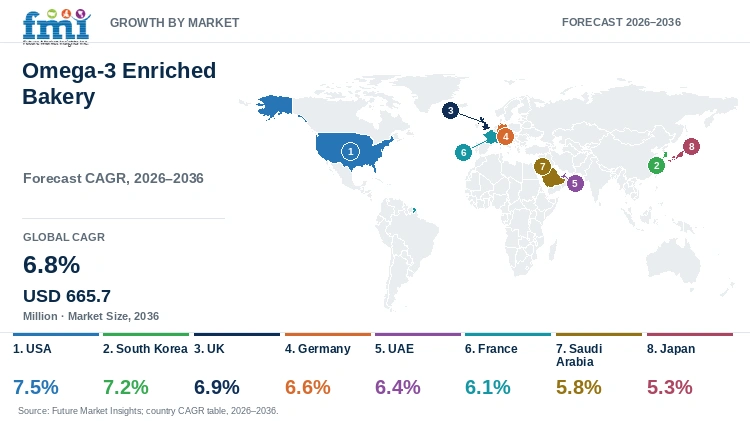
Retail basket patterns and national nutrition-claim rules place the USA at the front of country-level omega-3 enriched bakery growth with a 7.5% CAGR from 2026 to 2036, followed by South Korea at 7.2% and the UK at 6.9%, whereas Japan is forecast to advance at a 5.3% annual pace. National growth divergence reflects differences in front-of-pack claim thresholds, retail velocity of organic seeded pan loaves, and import registration procedures across grocery channels.
Table 7: Country CAGR and Primary Growth Levers for the Omega-3 Enriched Bakery Market (CAGR percentage and operational drivers), 2026 to 2036
| Country | CAGR (2026 to 2036) | Primary Growth Lever |
|---|---|---|
| USA | 7.5% | FDA 21 CFR 101.54 ALA claim adoption and nationwide organic seeded loaf velocity |
| South Korea | 7.2% | Microalgal and flaxseed bakery fortification and convenience bakery upgrades |
| UK | 6.9% | High grocery penetration of 7-seed batch loaves and specialist gluten-free formats |
| Germany | 6.6% | EU Regulation 1924/2006 omega-3 thresholds and DGE plant-oil dietary guidelines |
| UAE | 6.4% | Dubai Municipality digital food registration and demand for extended-shelf-life loaves |
| France | 6.1% | March 2025 Nutri-Score algorithm revision favoring whole-grain and oilseed breads |
| Saudi Arabia | 5.8% | Saudi Public Health Authority nutrient profiling and hypermarket bakery growth |
| Japan | 5.3% | CAA Foods with Function Claims (FFC) and n-3 fatty acid labeling standards |
Source: Future Market Insights analysis
USA Omega-3 Enriched Bakery Market Outlook (2026 to 2036)
Sales in the USA are projected to advance at a 7.5% compound annual rate between 2026 and 2036, driven by supermarket shelf expansion for organic flax and chia sandwich loaves. What sets the USA apart from European markets is how brands compete using bold front-of-pack milligram callouts of plant alpha-linolenic acid per slice rather than generic source claims. To capture rising celiac and wellness demand without relying on frozen imports, Dr. Schar reported in February 2025 that it centralized its USA operations in Swedesboro, New Jersey and upgraded its baking facility for gluten-free and soy-free bread and rolls [12]. Even so, bakers must still align label claims with U.S. Food and Drug Administration 1.6-gram daily ALA reference values.
Key takeaway: In the USA, transparent per-slice ALA milligram badges and expanded domestic specialty baking capacity are projected to anchor 7.5% annual growth.
South Korea Omega-3 Enriched Bakery Market Outlook (2026 to 2036)
Unlike Western markets built around family sandwich loaves, demand in South Korea is shaped by single-person households buying individually wrapped breakfast rolls and convenience-store meal replacements. Bakery demand across South Korea is estimated to climb 7.2% per year over 2026 to 2036, supported by domestic food-tech commercialization of odorless flaxseed meal and encapsulated lipid doughs. As a matter of fact, a February 2026 review in Phycology documented that enriching commercial bread and biscuits with microalgal bioactives and polyunsaturated fatty acids boosts antioxidant capacity under functional food standards in South Korea [13]. However, warm convenience-store display lighting can oxidize exposed surface seeds, forcing local bakers to use microencapsulated lipid emulsions.
Key takeaway: In South Korea, functional microalgal and oilseed bread fortification combined with single-serve convenience bakery formats is estimated to drive a 7.2% CAGR through 2036.
UK Omega-3 Enriched Bakery Market Outlook (2026 to 2036)
Shoppers in the UK already buy thick-sliced 800-gram seeded batch loaves as an everyday grocery staple, giving commercial bakers a built-in consumer base for omega-3 upgrades. For instance, Warburtons' January 2026 product specifications for its 800-gram Seven Seeds batch loaf highlight a blend of brown and golden linseed with chia seed delivering 4.3 grams of fat per 100 grams [14]. What restrains faster label conversion in the UK is that Department of Health and Social Care rules require explicit omega-3 claims to pass assimilated Regulation (EC) No 1924/2006 minimums across both weight and energy density. Revenue across the UK is forecast to rise 6.9% annually through 2036 because plant bakers reformulate standard seeded loaves to pass these analytical audits.
Key takeaway: In the UK, high consumer affinity for multi-seed batch loaves coupled with strict nutrition claim verification is forecast to support a 6.9% CAGR.
Germany Omega-3 Enriched Bakery Market Outlook (2026 to 2036)
Consumer acceptance of dense whole-grain rye and linseed bread in Germany removes the sensory resistance that slows functional bakery adoption in white-bread markets. Supporting this dietary habit, guidelines updated in March 2025 by the Nutrition Society in Germany (DGE) advise households to replace saturated animal fats with alpha-linolenic-acid-rich plant oils such as linseed and rapeseed oil [15]. Commercial turnover in Germany is anticipated to record a 6.6% yearly growth rate across 2026 to 2036, owing to expanding distribution in discount supermarkets and organic reformhaus stores. Because discount grocers in Germany enforce tight retail price caps while regulators audit the 0.3-gram ALA per 100-gram threshold, bakers rely on thermal-pasteurized rye-flax loaves that eliminate store waste.
Key takeaway: In Germany, national plant-lipid dietary guidance and pasteurized whole-grain rye-flax bread manufacturing are anticipated to sustain a 6.6% annual growth rate.
UAE Omega-3 Enriched Bakery Market Outlook (2026 to 2036)
Enriched bakery demand in the UAE is projected to log a 6.4% annual expansion pace over the 2026 to 2036 period, enabled by preventative wellness purchasing among expatriate and local households in Dubai and Abu Dhabi. Unlike self-sufficient grain producers in Europe, the UAE relies heavily on imported specialty loaves and premium in-store hypermarket bakeries where municipal registration and heat stability govern market entry. According to July 2025 figures from Dubai Municipality, food safety inspectors cleared 173,775 imported food consignments totaling 4.9 million tons and registered 77,700 new food products in digital municipal databases during the first half of 2025 [16]. High Gulf warehouse temperatures therefore push suppliers in the UAE toward gas-flushed and frozen thaw-and-serve seeded loaves.
Key takeaway: In the UAE, digital food product registration and hypermarket demand for shelf-stable functional loaves are projected to yield a 6.4% CAGR.
France Omega-3 Enriched Bakery Market Outlook (2026 to 2036)
While artisanal baguettes still anchor daily bread habits in France, prepackaged supermarket pains speciaux are undergoing rapid nutritional reformulation due to stricter front-of-pack scoring. In March 2025, ministries in France signed the updated Nutri-Score decree, introducing a revised algorithm that rewards whole-grain fiber and unsaturated plant lipids while penalizing sodium and sugar [17]. Sales across France are expected to progress at a 6.1% CAGR through 2036, attributable to hypermarket buyers expanding shelf space for A- and B-rated functional loaves. To keep a favorable Nutri-Score badge while meeting European Union omega-3 minimums, industrial boulangers in France are replacing refined wheat flour with extruded linseed flour and roasted chia seeds in low-sodium sourdough recipes.
Key takeaway: In France, the March 2025 Nutri-Score algorithm update rewarding whole-grain and unsaturated-lipid profiles is expected to guide 6.1% annual market growth.
Saudi Arabia Omega-3 Enriched Bakery Market Outlook (2026 to 2036)
Packaged bread and baked goods represent a massive share of household grocery baskets in Saudi Arabia, yet most conventional items fail modern preventive health benchmarks. According to a May 2025 Nutrients study by King Saud University and national public health researchers evaluating 6,940 packaged foods in Saudi Arabia, baked goods account for 26% of food sales while only 13% to 14% meet nutrient profiling standards [18]. This nutritional gap is prompting modern hypermarkets in Riyadh and Jeddah to recruit functional flax- and chia-fortified loaves, though bilingual claim verification slows import onboarding. Enriched bakery sales in Saudi Arabia are forecast to increase 5.8% per annum from 2026 to 2036 since domestic plant bakeries reformulate staple pan breads.
Key takeaway: In Saudi Arabia, nutrient profiling initiatives across expanding Riyadh and Jeddah hypermarket bakeries are forecast to support a 5.8% annual growth pace.
Japan Omega-3 Enriched Bakery Market Outlook (2026 to 2036)
Aging consumers in Japan actively seek cardiovascular and cognitive maintenance from functional breakfast foods, yet domestic texture preferences differ sharply from Western seeded-bread markets. Category sales in Japan are forecast to progress at a 5.3% compound annual pace through 2036, reinforced by repeat purchases across convenience stores and supermarket bakery corners. Shoppers in Japan strongly favor pillowy, crustless shokupan pullman loaves and reject gritty seed husks or marine odors. To address this formulation hurdle, a February 2026 review in Foods examining Japan's Consumer Affairs Agency FOSHU and Foods with Function Claims frameworks noted that microencapsulation of omega-3 fatty acids prevents thermal oxidation and off-flavors during baking [19]. Domestic bakers therefore dose ultra-fine golden flax flour and deodorized DHA capsules into soft breads.
Key takeaway: In Japan, strict Consumer Affairs Agency n-3 fatty acid labeling rules and soft-crumb sensory standards are forecast to shape a 5.3% annual growth rate.
Full report country CAGRs cover: North America; Latin America; Western Europe; Eastern Europe; East Asia; South Asia and Pacific; Middle East and Africa.
Who are the notable companies in the omega-3 enriched bakery market?
Flowers Foods, Grupo Bimbo, Mestemacher GmbH, Dr. Schar, Warburtons, Genius Foods, BFree Foods, and George Weston are the notable companies in the omega-3 enriched bakery market.
Competitive positioning in the omega-3 enriched bakery market depends on whether a manufacturer can guarantee post-bake alpha-linolenic acid or marine EPA+DHA potency through the end of shelf life without sacrificing loaf softness. Large North American and European plant bakeries use cold-milled flaxseed and chia blends across direct-store-delivery grocery routes, whereas specialty rye-bread makers and gluten-free formulators use thermal pasteurization and hydrocolloid gels to keep polyunsaturated lipids stable during multi-week ambient distribution.
- Industrial Packaged Bread & Organic Seeded Platforms: Flowers Foods and Grupo Bimbo as well as Warburtons and George Weston operate high-speed pan-bread bakeries and nationwide grocery distribution routes supporting quantified ALA seeded loaves.
- Pasteurized Extended-Shelf-Life Rye & Flax Specialists: Mestemacher GmbH produces thermal-pasteurized whole-grain rye and flaxseed loaves engineered for multi-month ambient shelf stability and export compliance.
- Gluten-Free & Seed-Enriched Free-From Bakeries: Dr. Schar and Genius Foods along with BFree Foods formulate gluten-free multigrain loaves and crispbreads incorporating linseed and chia with strict nutritional quality controls.
Competitive Benchmarking: Omega-3 Enriched Bakery Market
Table 8: Competitive Benchmarking for the Omega-3 Enriched Bakery Market (qualitative capability ratings), 2026
| Company | Omega-3 & Seeded SKU Breadth | Post-Bake Lipid Stability Control | Mainstream Grocery Route-to-Market | Geographic Reach |
|---|---|---|---|---|
| Flowers Foods | High | High | High | High |
| Grupo Bimbo | High | High | High | High |
| Mestemacher GmbH | High | High | Medium | High |
| Dr. Schar | Medium | High | High | High |
| Warburtons | High | Medium | High | Medium |
| Genius Foods | Medium | Medium | High | Medium |
| BFree Foods | Medium | Medium | High | High |
| George Weston | High | Medium | High | Medium |
Scoring basis: Capability tiers evaluate documented per-serving ALA or EPA+DHA product declarations, seeded multigrain portfolio breadth, and post-bake oxidative stability controls. Route-to-market and geographic reach ratings reflect verified supermarket direct-store-delivery coverage and multi-country export distribution.
Key Developments in the Omega-3 Enriched Bakery Market
- Flowers Foods highlighted its Dave's Killer Bread 21 Whole Grains & Seeds organic loaf formulation in April 2025, delivering 250 milligrams of ALA omega-3 and 5 grams of protein per slice across North American grocery aisles [20].
- Dr. Schar published its updated Always Tastier, Always More Balanced nutritional composition commitments in May 2025 to establish strict fiber and unsaturated lipid reformulation benchmarks across its gluten-free bakery range [21].
- Grupo Bimbo announced a global reformulation milestone in July 2025 confirming that 99% of its daily-consumption bread and bakery staples were free from artificial flavors and colorants, committing to remove artificial colorants across all products by the end of 2026 [22].
Key Players in the Omega-3 Enriched Bakery Market
Industrial Packaged Bread and Organic Seeded Platforms
- Flowers Foods
- Grupo Bimbo
- Warburtons
- George Weston
Pasteurized Extended-Shelf-Life Flaxseed Specialists
- Mestemacher GmbH
Gluten-Free and Seed-Enriched Free-From Bakeries
- Dr. Schar
- Genius Foods
- BFree Foods
Omega-3 Enriched Bakery Market - Report Scope
Table 9: Report Scope for the Omega-3 Enriched Bakery Market (coverage fields and definitions), 2026 to 2036
| Coverage field | Report scope |
|---|---|
| Market breakdown | Product Type; Claim / Nature; Format; Packaging Format; Sales Channel |
| Quantitative Units | USD Million |
| Market Definition | Commercial revenue from finished bakery goods (loaves, rolls, buns, crackers, crispbreads, and morning goods) marketed with a substantiated omega-3 (ALA, EPA, or DHA) nutrition claim or quantified per-serving declaration. Category Scope Note: Excludes unverified plain seeded bakery lacking omega-3 quantification, bulk raw oilseeds or fish oils sold as upstream ingredients, dry baking mixes, and unfilled foodservice sandwich carriers. |
| Regions Covered | North America; Latin America; Western Europe; Eastern Europe; East Asia; South Asia and Pacific; Middle East and Africa |
| Countries Covered | USA, South Korea, UK, Germany, UAE, France, Saudi Arabia, Japan, and additional countries in the full report |
| Key Companies Covered | Flowers Foods, Grupo Bimbo, Mestemacher GmbH, Dr. Schar, Warburtons, Genius Foods, BFree Foods, George Weston |
| Forecast Period | 2026 to 2036 |
| Approach | Primary and secondary research with top-down and bottom-up market triangulation. |
Omega-3 Enriched Bakery Market - Research Methodology
Table 10: Research Methodology for the Omega-3 Enriched Bakery Market (research methods and approach), 2026 edition
| Method | Approach |
|---|---|
| Primary Research | Structured interviews with commercial bakery R&D directors, lipid microencapsulation formulators, retail grocery category buyers, and food-labeling regulatory specialists across North America, Europe, and Asia. |
| Secondary Research | Verification of European Commission Regulation (EC) No 1924/2006 claim thresholds, FDA 21 CFR 101.54 guidance, NIH omega-3 composition databases, peer-reviewed baking stability studies in Sci and Foods, and corporate disclosures. |
| Market Sizing and Forecasting | Bottom-up SKU velocity modeling across qualifying omega-3 bread and cracker lines reconciled against top-down functional bakery expenditure from 2025 to 2036. |
| Country Forecasting Model | Econometric country growth projections weight statutory omega-3 claim enforcement, per-capita seeded bread consumption, modern supermarket density, and cold/MAP logistics capacity across eight national markets. |
| Operational Benchmark Traceability | Pack volume, active lipid tonnage, and post-bake fatty acid retention indicators in Tables 2, 3, and 4 trace to experimental baking and stability trials (Frolova et al., 2025; Shim et al., 2025) and commercial loaf nutrition panels. |
| Data Triangulation and Validation | Segment shares and country CAGRs are cross-validated against grocery scanner audits and industrial bakery capacity disclosures while excluding unsubstantiated seeded bread and standalone foodservice carrier revenues. |
Omega-3 Enriched Bakery Market by Segments
Omega-3 Enriched Bakery Market segmented by Product Type:
- Whole grain & seeded loaves
- Fortified white & sandwich breads
- Multigrain rolls & hamburger buns
- Omega-3 crackers & crispbreads
- Enriched morning goods & muffins
Omega-3 Enriched Bakery Market segmented by Claim / Nature:
- Plant-based ALA conventional
- Certified organic omega-3
- Gluten-free omega-3 enriched
- Clean-label & non-GMO
- Dual protein- & fiber-fortified
Omega-3 Enriched Bakery Market segmented by Format:
- Fresh packaged
- Ambient extended-shelf-life (MAP)
- Frozen ready-to-thaw
- Par-baked & bake-off
- Chilled
Omega-3 Enriched Bakery Market segmented by Packaging Format:
- Family / loaf pack
- Multipack trays & pouches
- Single-serve packs
- Bulk foodservice cases
Omega-3 Enriched Bakery Market segmented by Sales Channel:
- Supermarkets & hypermarkets
- Natural & specialty grocery chains
- Online & DTC
- Convenience & forecourt
- Institutional & healthcare foodservice
Omega-3 Enriched Bakery Market by Region
- North America
- USA
- Canada
- Latin America
- Brazil
- Mexico
- Argentina
- Chile
- Western Europe
- Germany
- France
- UK
- Italy
- Spain
- Benelux
- Nordics
- Eastern Europe
- Poland
- Czech Republic
- Romania
- Hungary
- East Asia
- China
- Japan
- South Korea
- South Asia and Pacific
- India
- ASEAN
- Australia and New Zealand
- Middle East and Africa
- GCC Countries
- South Africa
- Türkiye
- Israel
Research Sources and Bibliography
- [1] Frolova, Y., Sobolev, R., & Kochetkova, A. (2025, November 1). Antioxidant Activity and Oxidative Stability of Flaxseed and Its Processed Products: A Review. Sci, 7(4), 155 (MDPI).
- [2] European Commission. (2025, January 15). Nutrition claims - Food Safety - European Commission. Directorate-General for Health and Food Safety.
- [3] Flowers Foods, Inc. (2026, January 10). Dave's Killer Bread Nutrition Facts. Dave's Killer Bread (Flowers Foods).
- [4] National Institutes of Health. (2025, July 18). Omega-3 Fatty Acids - Health Professional Fact Sheet. NIH Office of Dietary Supplements.
- [5] Shim, Y. Y., Burnett, P.-G. G., Olivia, C. M., Zou, X.-G., Lee, S. J., Kim, H.-J., Kim, Y. J., & Reaney, M. J. T. (2025, January 28). Oxidative Stability of Novel Peptides (Linusorbs) in Flaxseed Meal-Fortified Gluten-Free Bread. Foods, 14(3), 439 (MDPI).
- [6] Flowers Foods, Inc. (2026, January 10). Good Seed Bread - Dave's Killer Bread. Dave's Killer Bread (Flowers Foods).
- [7] Flowers Foods, Inc. (2025, February 21). FLOWERS FOODS, INC. COMPLETES ACQUISITION OF SIMPLE MILLS - Flowers Foods. Flowers Foods Corporate Newsroom.
- [8] Mohamed, D. A., Mabrok, H. B., Bassuoni, R. A., & Hamed, I. M. (2026, September 1). Functional sourdough muffins attenuate metabolic dysfunction-associated steatotic liver disease through modulation of lipid metabolism, oxidative stress, inflammation, and ATPCL expression - PubMed. Food & Function, 17(17), 7864-7878 (PubMed PMID 42605832).
- [9] Mestemacher GmbH. (2026, January 12). Organic Flax Seed Bread - Mestemacher. Mestemacher Wholemeal Bread Specialities.
- [10] U.S. Food and Drug Administration. (2025, March 12). Label Claims for Conventional Foods and Dietary Supplements | FDA. U.S. Department of Health and Human Services.
- [11] UK Office for Health Improvement and Disparities & UKNHCC. (2026, January 29). UKNHCC scientific opinion: green kiwifruit powder and maintenance of normal defecation - GOV.UK. Department of Health and Social Care (Assimilated Regulation (EC) No 1924/2006).
- [12] Dr. Schar AG / SpA. (2025, February 19). A record-breaking 2024 for Dr. Schär. Dr. Schar Corporate Press Room.
- [13] Eldiehy, K. S. H., Haraz, Y. G., Alkhazi, I. S., Alrashidi, M., Alghamdi, M., Elbanhawy, N. M., & Atta, O. M. (2026, February 1). Microalgal Biofactories: Sustainable Solutions for Nutrition and Cosmetics. Phycology, 6(1), 17 (MDPI).
- [14] Warburtons Limited. (2026, January 15). Seven Seeds (800g) - Warburtons. Warburtons Product Range.
- [15] Nutrition Society in Germany (DGE). (2025, March 5). Pflanzliche Öle bevorzugen | DGE. Deutsche Gesellschaft fuer Ernaehrung e.V.
- [16] Dubai Municipality. (2025, July 30). Over 34,000 food inspections conducted in first half of 2025. Government of Dubai Media Center.
- [17] Sante publique France. (2025, March 17). Signing of the Nutri-Score decree: another step toward better nutritional information for consumers. Sante publique France.
- [18] Dunford, E. K., Alsukait, R. F., Alkhalaf, M. M., Hamza, M. M., Shahin, M. A., Cetinkaya, V., & Alghaith, T. (2025, May 30). The Healthiness of Packaged Food and Beverage Products in the Kingdom of Saudi Arabia. Nutrients, 17(11), 1895 (MDPI / Saudi Public Health Authority).
- [19] Ma, Z. F., Liu, S., Fu, C., Zhou, S., & Lee, Y. Y. (2026, February 18). Functional Foods in Health Promotion and Disease Prevention: Innovations, Evidence and Challenges. Foods, 15(4), 764 (MDPI).
- [20] Flowers Foods, Inc. (2025, April 14). Dave's Killer Bread 21 Whole Grains & Seeds. Dave's Killer Bread Product Portfolio.
- [21] Dr. Schar AG / SpA. (2025, May 8). Always Tastier, Always More Balanced - Dr. Schär. Dr. Schar Corporate Newsroom.
- [22] Grupo Bimbo, S.A.B. de C.V. (2025, July 29). We are committed to removing artificial colorants from all our products by the end of 2026 | Grupo Bimbo. Grupo Bimbo Corporate Wellness Releases.
- [23] BFree Foods Ltd. (2025, June 12). Brown Seeded Loaf - BFree Foods. BFree Foods Product Portfolio.
This bibliography is provided for reader reference and is not exhaustive. The full report contains the complete reference list and detailed citations.
This Report Answers
- How large is the omega-3 enriched bakery market in 2026 and what is projected by 2036?
- Which thermal baking and lipid oxidation challenges govern omega-3 bakery formulation?
- Why do whole grain & seeded loaves lead the product type segment?
- What keeps plant-based ALA conventional ahead within the claim / nature segment?
- How do national growth rates compare across the USA, South Korea, the UK, and Germany?
- Which bakery manufacturers document substantiated omega-3 SKUs and seeded bread platforms?
- What regulatory claim thresholds and shelf-life stability tests delay retail listing?
- What analytical documentation should grocery buyers verify before approving an enriched loaf?
Frequently Asked Questions
How big is the omega-3 enriched bakery market in 2026, and what is forecast for 2036?
Starting from USD 322.8 million in 2025, the global omega-3 enriched bakery market size reaches an estimated USD 344.8 million in 2026 and is projected to hit USD 665.7 million by 2036.
What is the omega-3 enriched bakery market CAGR from 2026 to 2036?
Between 2026 and 2036, the global omega-3 enriched bakery market is projected to record a 6.8% CAGR, creating USD 320.9 million in incremental revenue across grocery and specialty bakery channels.
Which product type leads the omega-3 enriched bakery market?
In 2026, whole grain & seeded loaves are expected to represent 43.4% of the product type segment because natural flaxseed and chia supply concentrated ALA inside everyday sandwich bread.
Which claim / nature segment accounts for the largest share?
Within the claim / nature segment, plant-based ALA conventional lines are estimated at 54.6% in 2026 since mainstream grocery pricing avoids organic certification surcharges.
Which countries have the highest projected growth rates for omega-3 enriched bakery?
The USA at 7.5% CAGR and South Korea at 7.2% CAGR lead national expansion from 2026 to 2036, followed by the UK at 6.9% and Germany at 6.6%.
Which companies are notable participants in the omega-3 enriched bakery market?
Flowers Foods, Grupo Bimbo, Mestemacher GmbH, Dr. Schar, Warburtons, Genius Foods, BFree Foods, and George Weston lead commercial production across North America and Europe.
Preview the report firsthand - request a free sample
Get SampleGet the brochure for pricing and purchase details.
Get PDFTable of Content
- Key Takeaways
- Market Size and CAGR
- Top Growth Driver
- Fastest Growing Segment
- Leading Region
- Key Companies
- Emerging Opportunities
- Executive Summary
- Global Market Outlook
- Demand-side Trends
- Supply-side Trends
- Technology Roadmap Analysis
- Analysis and Recommendations
- Analyst Perspective (What is happening? Why now? What should investors know?)
- Key Questions Answered
- How large is the market?
- What is the CAGR?
- What are key trends?
- Which region dominates?
- Who are the leaders?
- Market Overview
- Market Coverage / Taxonomy
- Market Definition / Scope / Limitations
- Research Methodology
- Chapter Orientation
- Analytical Lens and Working Hypotheses
- Market Structure, Signals, and Trend Drivers
- Benchmarking and Cross-market Comparability
- Market Sizing, Forecasting, and Opportunity Mapping
- Research Design and Evidence Framework
- Desk Research Programme (Secondary Evidence)
- Expert Input and Fieldwork (Primary Evidence)
- Tooling, Models, and Reference Databases
- Data Engineering and Model Build
- Quality Assurance and Audit Trail
- Market Background
- Market Dynamics (Drivers, Restraints, Opportunity, Trends)
- Scenario Forecast (Optimistic, Likely, Conservative)
- Impact Analysis
- AI Impact
- Sustainability Impact
- Regulatory Impact
- Technology Impact
- Consumer / Buyer Analysis
- Purchase Drivers
- Adoption Barriers
- Buyer Journey
- Opportunity Map Analysis
- Product Life Cycle Analysis
- Supply Chain Analysis
- Investment Feasibility Matrix
- Value Chain Analysis
- PESTLE and Porter's Analysis
- Regulatory Landscape
- Regional Parent Market Outlook
- Production and Consumption Statistics
- Import and Export Statistics
- Global Market Analysis and Forecast, 2021 to 2036
- Historical Market Size Value (USD Million) Analysis, 2021 to 2025
- Current and Future Market Size Value (USD Million) Projections, 2026 to 2036
- Y-o-Y Growth Trend Analysis
- Absolute $ Opportunity Analysis
- Global Market Pricing Analysis, 2021 to 2036
- Global Market Analysis and Forecast, By Product Type, 2021 to 2036
- Introduction / Key Findings
- Historical Market Size Value (USD Million) Analysis By Product Type, 2021 to 2025
- Current and Future Market Size Value (USD Million) Analysis and Forecast By Product Type, 2026 to 2036
- Whole grain & seeded loaves
- Fortified white & sandwich breads
- Multigrain rolls & hamburger buns
- Omega-3 crackers & crispbreads
- Enriched morning goods & muffins
- Y-o-Y Growth Trend Analysis By Product Type, 2021 to 2025
- Absolute $ Opportunity Analysis By Product Type, 2026 to 2036
- Global Market Analysis and Forecast, By Claim / Nature, 2021 to 2036
- Introduction / Key Findings
- Historical Market Size Value (USD Million) Analysis By Claim / Nature, 2021 to 2025
- Current and Future Market Size Value (USD Million) Analysis and Forecast By Claim / Nature, 2026 to 2036
- Plant-based ALA conventional
- Certified organic omega-3
- Gluten-free omega-3 enriched
- Clean-label & non-GMO
- Dual protein- & fiber-fortified
- Y-o-Y Growth Trend Analysis By Claim / Nature, 2021 to 2025
- Absolute $ Opportunity Analysis By Claim / Nature, 2026 to 2036
- Global Market Analysis and Forecast, By Format, 2021 to 2036
- Introduction / Key Findings
- Historical Market Size Value (USD Million) Analysis By Format, 2021 to 2025
- Current and Future Market Size Value (USD Million) Analysis and Forecast By Format, 2026 to 2036
- Fresh packaged
- Ambient extended-shelf-life (MAP)
- Frozen ready-to-thaw
- Par-baked & bake-off
- Chilled
- Y-o-Y Growth Trend Analysis By Format, 2021 to 2025
- Absolute $ Opportunity Analysis By Format, 2026 to 2036
- Global Market Analysis and Forecast, By Packaging Format, 2021 to 2036
- Introduction / Key Findings
- Historical Market Size Value (USD Million) Analysis By Packaging Format, 2021 to 2025
- Current and Future Market Size Value (USD Million) Analysis and Forecast By Packaging Format, 2026 to 2036
- Family / loaf pack
- Multipack trays & pouches
- Single-serve packs
- Bulk foodservice cases
- Y-o-Y Growth Trend Analysis By Packaging Format, 2021 to 2025
- Absolute $ Opportunity Analysis By Packaging Format, 2026 to 2036
- Global Market Analysis and Forecast, By Sales Channel, 2021 to 2036
- Introduction / Key Findings
- Historical Market Size Value (USD Million) Analysis By Sales Channel, 2021 to 2025
- Current and Future Market Size Value (USD Million) Analysis and Forecast By Sales Channel, 2026 to 2036
- Supermarkets & hypermarkets
- Natural & specialty grocery chains
- Online & DTC
- Convenience & forecourt
- Institutional & healthcare foodservice
- Y-o-Y Growth Trend Analysis By Sales Channel, 2021 to 2025
- Absolute $ Opportunity Analysis By Sales Channel, 2026 to 2036
- Global Market Analysis and Forecast, By Region, 2021 to 2036
- Introduction
- Historical Market Size Value (USD Million) Analysis By Region, 2021 to 2025
- Current Market Size Value (USD Million) Analysis and Forecast By Region, 2026 to 2036
- North America
- Latin America
- Western Europe
- Eastern Europe
- East Asia
- South Asia and Pacific
- Middle East and Africa
- Market Attractiveness Analysis By Region
- North America Market Analysis and Forecast, By Country, 2021 to 2036
- Historical Market Size Value (USD Million) Trend Analysis By Market Taxonomy, 2021 to 2025
- Market Size Value (USD Million) Forecast By Market Taxonomy, 2026 to 2036
- By Country
- USA
- Canada
- By Product Type
- By Claim / Nature
- By Format
- By Packaging Format
- By Sales Channel
- By Country
- Market Attractiveness Analysis
- By Country
- By Product Type
- By Claim / Nature
- By Format
- By Packaging Format
- By Sales Channel
- Key Takeaways
- Latin America Market Analysis and Forecast, By Country
- Historical Market Size Value (USD Million) Trend Analysis By Market Taxonomy, 2021 to 2025
- Market Size Value (USD Million) Forecast By Market Taxonomy, 2026 to 2036
- By Country
- Brazil
- Mexico
- Argentina
- Chile
- By Product Type
- By Claim / Nature
- By Format
- By Packaging Format
- By Sales Channel
- By Country
- Market Attractiveness Analysis
- By Country
- By Product Type
- By Claim / Nature
- By Format
- By Packaging Format
- By Sales Channel
- Key Takeaways
- Western Europe Market Analysis and Forecast, By Country
- Historical Market Size Value (USD Million) Trend Analysis By Market Taxonomy, 2021 to 2025
- Market Size Value (USD Million) Forecast By Market Taxonomy, 2026 to 2036
- By Country
- Germany
- France
- UK
- Italy
- Spain
- Benelux
- Nordics
- By Product Type
- By Claim / Nature
- By Format
- By Packaging Format
- By Sales Channel
- By Country
- Market Attractiveness Analysis
- By Country
- By Product Type
- By Claim / Nature
- By Format
- By Packaging Format
- By Sales Channel
- Key Takeaways
- Eastern Europe Market Analysis and Forecast, By Country
- Historical Market Size Value (USD Million) Trend Analysis By Market Taxonomy, 2021 to 2025
- Market Size Value (USD Million) Forecast By Market Taxonomy, 2026 to 2036
- By Country
- Poland
- Czech Republic
- Romania
- Hungary
- By Product Type
- By Claim / Nature
- By Format
- By Packaging Format
- By Sales Channel
- By Country
- Market Attractiveness Analysis
- By Country
- By Product Type
- By Claim / Nature
- By Format
- By Packaging Format
- By Sales Channel
- Key Takeaways
- East Asia Market Analysis and Forecast, By Country
- Historical Market Size Value (USD Million) Trend Analysis By Market Taxonomy, 2021 to 2025
- Market Size Value (USD Million) Forecast By Market Taxonomy, 2026 to 2036
- By Country
- China
- Japan
- South Korea
- By Product Type
- By Claim / Nature
- By Format
- By Packaging Format
- By Sales Channel
- By Country
- Market Attractiveness Analysis
- By Country
- By Product Type
- By Claim / Nature
- By Format
- By Packaging Format
- By Sales Channel
- Key Takeaways
- South Asia and Pacific Market Analysis and Forecast, By Country
- Historical Market Size Value (USD Million) Trend Analysis By Market Taxonomy, 2021 to 2025
- Market Size Value (USD Million) Forecast By Market Taxonomy, 2026 to 2036
- By Country
- India
- ASEAN
- Australia and New Zealand
- By Product Type
- By Claim / Nature
- By Format
- By Packaging Format
- By Sales Channel
- By Country
- Market Attractiveness Analysis
- By Country
- By Product Type
- By Claim / Nature
- By Format
- By Packaging Format
- By Sales Channel
- Key Takeaways
- Middle East and Africa Market Analysis and Forecast, By Country
- Historical Market Size Value (USD Million) Trend Analysis By Market Taxonomy, 2021 to 2025
- Market Size Value (USD Million) Forecast By Market Taxonomy, 2026 to 2036
- By Country
- GCC Countries
- South Africa
- Türkiye
- Israel
- By Product Type
- By Claim / Nature
- By Format
- By Packaging Format
- By Sales Channel
- By Country
- Market Attractiveness Analysis
- By Country
- By Product Type
- By Claim / Nature
- By Format
- By Packaging Format
- By Sales Channel
- Key Takeaways
- Key Countries Market Analysis
- USA
- Pricing Analysis
- Market Share Analysis, 2025
- By Product Type
- By Claim / Nature
- By Format
- By Packaging Format
- By Sales Channel
- Canada
- Pricing Analysis
- Market Share Analysis, 2025
- By Product Type
- By Claim / Nature
- By Format
- By Packaging Format
- By Sales Channel
- Mexico
- Pricing Analysis
- Market Share Analysis, 2025
- By Product Type
- By Claim / Nature
- By Format
- By Packaging Format
- By Sales Channel
- Brazil
- Pricing Analysis
- Market Share Analysis, 2025
- By Product Type
- By Claim / Nature
- By Format
- By Packaging Format
- By Sales Channel
- Chile
- Pricing Analysis
- Market Share Analysis, 2025
- By Product Type
- By Claim / Nature
- By Format
- By Packaging Format
- By Sales Channel
- Germany
- Pricing Analysis
- Market Share Analysis, 2025
- By Product Type
- By Claim / Nature
- By Format
- By Packaging Format
- By Sales Channel
- UK
- Pricing Analysis
- Market Share Analysis, 2025
- By Product Type
- By Claim / Nature
- By Format
- By Packaging Format
- By Sales Channel
- Italy
- Pricing Analysis
- Market Share Analysis, 2025
- By Product Type
- By Claim / Nature
- By Format
- By Packaging Format
- By Sales Channel
- Spain
- Pricing Analysis
- Market Share Analysis, 2025
- By Product Type
- By Claim / Nature
- By Format
- By Packaging Format
- By Sales Channel
- France
- Pricing Analysis
- Market Share Analysis, 2025
- By Product Type
- By Claim / Nature
- By Format
- By Packaging Format
- By Sales Channel
- India
- Pricing Analysis
- Market Share Analysis, 2025
- By Product Type
- By Claim / Nature
- By Format
- By Packaging Format
- By Sales Channel
- ASEAN
- Pricing Analysis
- Market Share Analysis, 2025
- By Product Type
- By Claim / Nature
- By Format
- By Packaging Format
- By Sales Channel
- Australia and New Zealand
- Pricing Analysis
- Market Share Analysis, 2025
- By Product Type
- By Claim / Nature
- By Format
- By Packaging Format
- By Sales Channel
- China
- Pricing Analysis
- Market Share Analysis, 2025
- By Product Type
- By Claim / Nature
- By Format
- By Packaging Format
- By Sales Channel
- Japan
- Pricing Analysis
- Market Share Analysis, 2025
- By Product Type
- By Claim / Nature
- By Format
- By Packaging Format
- By Sales Channel
- South Korea
- Pricing Analysis
- Market Share Analysis, 2025
- By Product Type
- By Claim / Nature
- By Format
- By Packaging Format
- By Sales Channel
- Poland
- Pricing Analysis
- Market Share Analysis, 2025
- By Product Type
- By Claim / Nature
- By Format
- By Packaging Format
- By Sales Channel
- Hungary
- Pricing Analysis
- Market Share Analysis, 2025
- By Product Type
- By Claim / Nature
- By Format
- By Packaging Format
- By Sales Channel
- Türkiye
- Pricing Analysis
- Market Share Analysis, 2025
- By Product Type
- By Claim / Nature
- By Format
- By Packaging Format
- By Sales Channel
- South Africa
- Pricing Analysis
- Market Share Analysis, 2025
- By Product Type
- By Claim / Nature
- By Format
- By Packaging Format
- By Sales Channel
- UAE
- Pricing Analysis
- Market Share Analysis, 2025
- By Product Type
- By Claim / Nature
- By Format
- By Packaging Format
- By Sales Channel
- Saudi Arabia
- Pricing Analysis
- Market Share Analysis, 2025
- By Product Type
- By Claim / Nature
- By Format
- By Packaging Format
- By Sales Channel
- USA
- Market Structure Analysis
- Competition Dashboard
- Competition Benchmarking
- Market Share Analysis of Top Players
- By Regional
- By Product Type
- By Claim / Nature
- By Format
- By Packaging Format
- By Sales Channel
- Emerging Startups
- Innovation Benchmarking
- Competition Analysis
- Competition Deep Dive
- Flowers Foods
- Overview
- Product Portfolio
- Profitability by Market Segments
- Sales Footprint
- Strategy Overview
- Marketing Strategy
- Product Strategy
- Channel Strategy
- Grupo Bimbo
- Mestemacher GmbH
- Dr. Schar
- Warburtons
- Genius Foods
- BFree Foods
- George Weston
- Flowers Foods
- Case Studies
- Success Stories
- Recent Developments
- Competition Deep Dive
- Assumptions & Acronyms Used


