
- Market Size (2026)
- USD 940.3 Mn
- Forecast (2036)
- USD 2946.6 Mn
- CAGR (2026 to 2036)
- 12.1%
How Big Is the Palm-Free Shortenings Market in 2026?
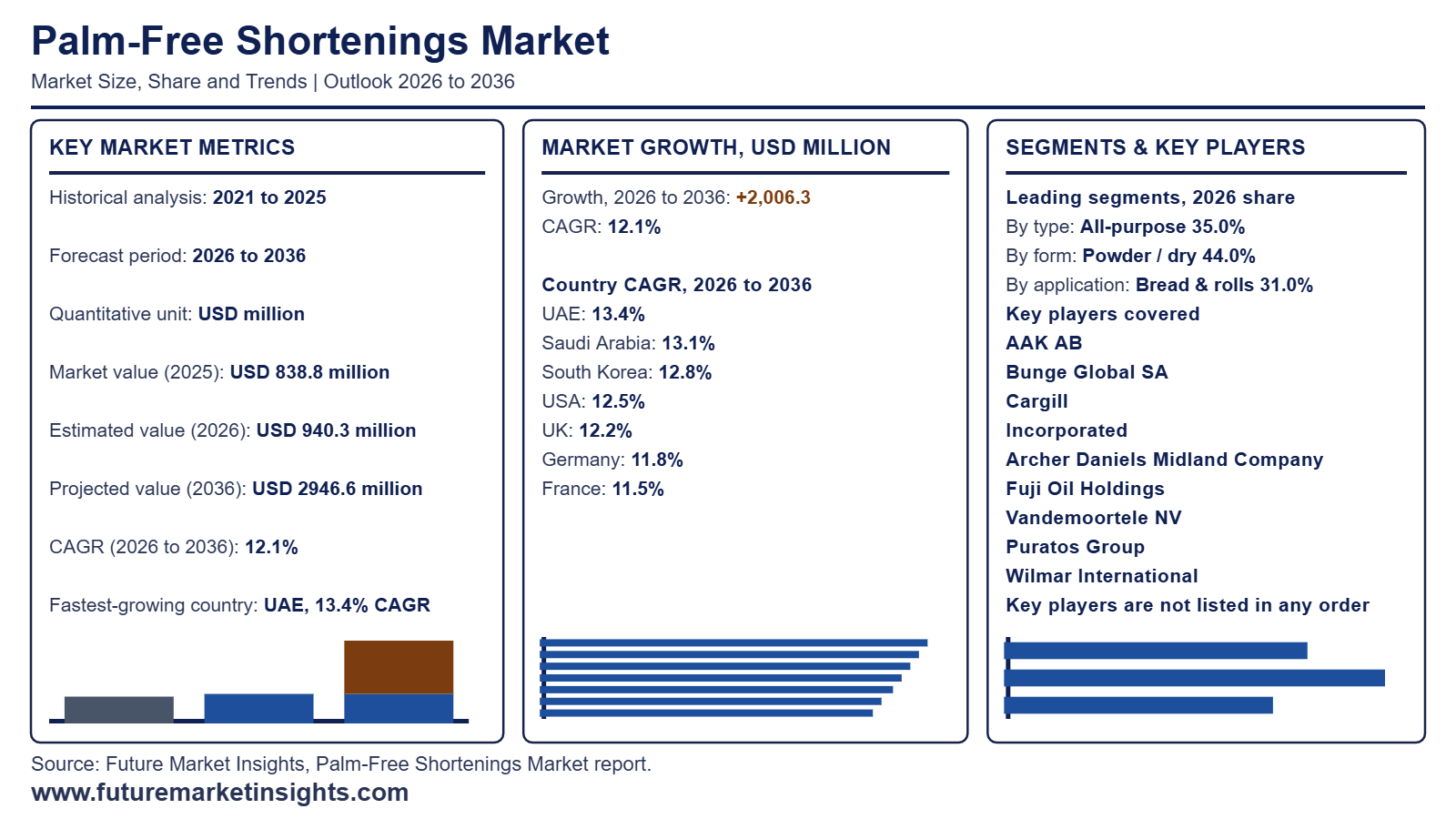
Global palm-free shortenings market held a valuation of USD 838.8 million in 2025, grew to USD 940.3 million in 2026, and is projected by Future Market Insights (FMI) to reach USD 2,946.6 million by 2036, reflecting a 12.1% CAGR and creating USD 2,006.3 million in incremental revenue between 2026 and 2036.
| Market Metric | Valuation / Share / Forecast Benchmark |
|---|---|
| 2025 Market Size (Historical) | USD 838.8 million |
| 2026 Market Size (Estimated) | USD 940.3 million |
| 2036 Market Size (Projected) | USD 2,946.6 million |
| Compound Annual Growth Rate (2026 to 2036) | 12.1% CAGR |
| Incremental Dollar Opportunity (2026 to 2036) | USD 2,006.3 million |
| Dominant Type (2026 Share) | All-purpose (35.0% share in 2026; Other Segment Combined 65.0%) |
| Dominant Form (2026 Share) | Powder / dry (44.0% share in 2026; Other Segment Combined 56.0%) |
| Dominant Application (2026 Share) | Bread & rolls (31.0% share in 2026; Other Segment Combined 69.0%) |
| Dominant Claim & Sales Channel (2026 Share) | Conventional (45.0% share) | Direct to industrial bakeries (51.0% share) |
| Largest Country Markets (2026 Global Share) | USA (34.0% share; USD 319.7 million), UK (11.5% share), Germany (10.5% share) |
| Fastest-Growing Country Markets (2026 to 2036) | UAE (13.4% CAGR), Saudi Arabia (13.1% CAGR), South Korea (12.8% CAGR) |
| Leading Tier-1 Companies | AAK AB, Bunge Global SA, Cargill, Incorporated, Archer Daniels Midland Company, Fuji Oil Holdings, Vandemoortele NV, Puratos Group, Wilmar International |
Source: Future Market Insights analysis of the palm-free shortenings market, 2026.
This Report Answers
- How large the palm-free shortenings market is in 2026 and what it reaches by 2036
- Which type, form and application segments lead in 2026
- What is driving demand and what is holding the category back
- Which countries grow fastest between 2026 and 2036
- What AAK AB and other leading players have launched
- How the palm-free shortenings market is defined, segmented and measured
Executive Market Overview
Industrial bakeries and packaged snack formulators are replacing tropical fats with shea, high-oleic sunflower, and enzymatic soft oils to satisfy European deforestation guidelines without sacrificing aeration. FMI finds that procurement teams are shifting toward enzymatically interesterified soybean, high-oleic canola, and shea-stearin lipid systems in place of conventional shortenings. Upstream oilseed crushers are scaling non-palm processing capacity to supply these structured bakery fats; in November 2026, Cargill, Incorporated (November 2026) highlighted the opening of its Regina, Saskatchewan canola processing plant with 1.0 million metric tons of annual capacity, while Bunge Global SA (October 2026) reported USD 2.56 in third-quarter 2026 adjusted earnings per share after starting up its new Destrehan oilseed processing line.
Replacing palm oil with untreated liquid vegetable oil causes oil migration and crumb collapse, compelling lipid formulators to engineer solid-fat crystallization curves using West African shea hardstocks and fractionated domestic oilseeds that compete with standard bakery fat lines. In FMI's view, traceable shea stearin supply has become a decisive competitive moat for palm-free bakery formulators. In March 2025, Fuji Oil Europe (March 2025) commissioned a 300-metric-ton shea warehouse in Ghana to secure non-palm fat raw materials, while AAK AB (May 2025) expanded its Kolo Nafaso direct shea sourcing network supporting over 230,000 women in West Africa. Market sizing covers palm-free shortenings sold as bakery and food-processing ingredients, excluding palm-based fats, untexturized cooking oils, dairy butter, and finished baked goods.
Analyst Perspective
"Palm-free shortening suppliers win multi-year bakery contracts when non-palm hardstocks match the beta-prime crystal structure and 20-to-35-degree Celsius plasticity of palm stearin without raising line reject rates. The primary commercial risk is oilseed crushing margin competition from renewable diesel, which tightens food-grade soybean and canola oil availability through 2036."
- Nandini Roy Choudhury, Principal Consultant, Future Market Insights (FMI)
Key Market Trends & Insights
- Shea Stearin Hardstocks Anchor European and Asian Palm-Free Bakery Formulations:Because liquid rapeseed and sunflower oils lack solid triglycerides at room temperature, specialty fat processors blend fractionated West African shea stearin to create firm, zero-trans palm-free shortenings in competition with normal and specialty fats. FMI observes that direct origin investments in Ghana and Burkina Faso protect formulators against tropical oil volatility. In March 2025, Fuji Oil Europe (March 2025) inaugurated its largest donated 300-metric-ton shea warehouse in Ghana under the Tebma Kandu program, while AAK AB (May 2025) documented that 70% of women enrolled in its Kolo Nafaso shea program reinvest earnings into local agricultural supply resilience.
- North American Canola and Soybean Crushing Expansions Stabilize Non-Palm Feedstock:Industrial bakeries in North America rely on interesterified high-oleic soybean and canola shortenings to achieve clean-label, palm-free ingredient declarations with vegetable shortening staples. FMI believes expanded domestic crushing infrastructure is lowering basis risk for bulk shortening contracts. In November 2026, Cargill, Incorporated (November 2026) detailed the commissioning of its 1.0-million-metric-ton Regina canola facility in its 2026 Annual Report, while Archer Daniels Midland Company (November 2026) reported USD 858 million in third-quarter 2026 adjusted net earnings driven by oilseed crushing and refined oil execution.
- European Bakery Fat Consolidation Reshapes B2B Shortening and Margarine Supply:Multinational agribusinesses are reorganizing regional margarine and shortening assets, transferring specialized European bakery-fat plants to focused ingredient operators. FMI's analysis indicates that portfolio realignment requires bakery procurement teams to re-validate vendor specifications across continental plants. On 25 March 2025, Vandemoortele NV (March 2025) signed an agreement to acquire Bunge's European Margarines and Spreads business representing over EUR 450 million in turnover across manufacturing sites in Germany and Poland, with Vandemoortele NV (September 2026) reporting EUR 339.5 million in first-half 2026 Plant-Based Food Solutions revenue ahead of final closing.
What Are the Main Drivers, Restraints, and Opportunities?
Retail palm-exclusion commitments and mandatory trans-fat bans drive bakery reformulation into structured non-palm shortenings, whereas biofuel feedstock competition and oleogel storage instability restrain rapid conversion, leaving dry powdered shortenings and enzymatic interesterification as key growth avenues.
Driver: Deforestation-Free Retail Mandates and Strict Trans-Fat Prohibitions
Supermarket chains and quick-service restaurant brands are requiring bakery suppliers to eliminate both palm oil and partially hydrogenated oils from bread and cookie formulations bills of materials across the [edible oils and fats] supply chain(https://www.futuremarketinsights.com/reports/edible-oils-and-fats-market).FMI finds that dual compliance with zero-trans regulations and palm-free claims forces bakers to purchase engineered non-palm shortenings rather than commodity oils. Supply chain traceability audits documented by Cargill, Incorporated (November 2026) and European deforestation-free supply chain rules have accelerated supplier qualification. To meet rising demand, AAK AB (July 2025) expanded its certified organic and non-palm fats and oils portfolio for North American and European bakery manufacturers.
Restraint: Biofuel Oilseed Competition and Formulation Qualification Failures
Diverting soybean and canola oil into biomass-based diesel tightens food-grade vegetable oil supplies, while unvalidated palm-free oleogels frequently suffer fat leakage and dough cracking on high-speed pastry lines.FMI notes that feedstock competition directly elevates non-palm shortening quotes, as documented in the USDA Economic Research Service (March 2026) Oil Crops Yearbook and USDA Economic Research Service (February 2025) outlook tracking renewable diesel demand for vegetable oils. Furthermore, Vandemoortele NV (September 2026) reported a 6% volume contraction in its Plant-Based Food Solutions division during the first half of 2026 on account of raw material cost pressure and cautious retail private-label ordering.
Opportunity: Enzymatically Interesterified Blends and Flaked Dry-Mix Shortenings
Lipid engineers are replacing chemical catalysts with enzymatic interesterification and micro-encapsulated dry fat powders to deliver clean-label palm-free shortenings that dose cleanly into automated batter based premixes. FMI projects dry-format and high-oleic non-palm shortenings to capture high-margin contracts across industrial baking through 2036. In October 2026, Bunge Global SA (October 2026) reported strong third-quarter 2026 performance across its Soybean and Softseed Processing and Refining segments, while Puratos Group (March 2025) expanded its plant-based fat reformulation solutions to cut saturated fat and eliminate palm oil in commercial patisserie.
How Is the Palm-Free Shortenings Market Segmented?
Palm-Free Shortenings Market is segmented by Type, Form, Application, Claim, Sales Channel, and Region. Forecast period from 2026 to 2036.
| Segmentation Axis | Sub-Segments Covered | Dominant Sub-Segment (2026 Share %) | Other Segment Combined & Total (100.0%) |
|---|---|---|---|
| Type | All-purpose, Cake & icing, Laminating, Liquid | All-purpose (35.0%) | Other Segment Combined (65.0%) | Total (100.0%) |
| Form | Powder / dry, Liquid, Paste / semi-solid, Granules / pieces | Powder / dry (44.0%) | Other Segment Combined (56.0%) | Total (100.0%) |
| Application | Bread & rolls, Cakes & muffins, Biscuits & cookies, Viennoiserie & pastry, Other bakery & snacks | Bread & rolls (31.0%) | Other Segment Combined (69.0%) | Total (100.0%) |
| Claim | Conventional, Clean label, Organic, Non-GMO / identity preserved | Conventional (45.0%) | Other Segment Combined (55.0%) | Total (100.0%) |
| Sales Channel | Direct to industrial bakeries, Ingredient distributors, Foodservice & artisan supply, Online B2B | Direct to industrial bakeries (51.0%) | Other Segment Combined (49.0%) | Total (100.0%) |
Source: Future Market Insights analysis of the palm-free shortenings market, 2026.
Why Does All-purpose Anchor the Type Segment?
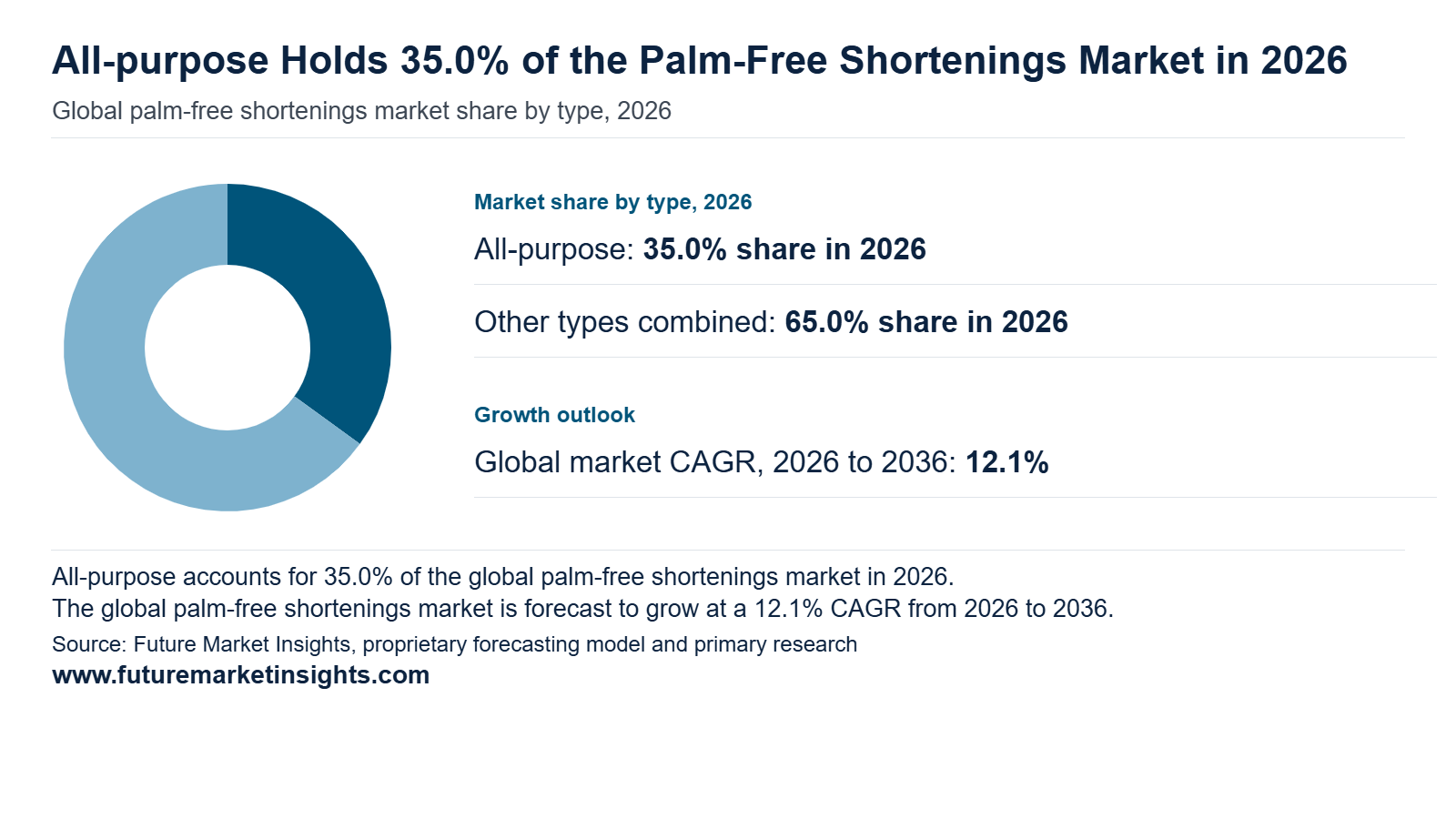
All-purpose varieties secure a leading 35.0% share of Type revenue in 2026, favored by multi-line commercial bakeries to run pan breads and pie crusts from a single non-palm fat base formulated with clean-label ingredients. Portfolio guides from Cargill, Incorporated (May 2025) and refining updates from Bunge Global SA (October 2026) confirm that non-palm all-purpose shortenings anchor bulk North American and European contracts. In FMI's view, multi-recipe line flexibility will keep ahead through 2036.
How Does Powder / dry Support Form Selection?
Powder / dry varieties secure a leading 44.0% share of Form revenue in 2026, favored by automated bakery premix facilities for precise pneumatic dosing and clean dispersion without melting tanks.). pneumatic dosing accuracy in automated bakery premix plants and tortilla lines. Dry-format non-palm fats eliminate heated block-melting kettles and blend evenly with tortilla improvers and dry flour silos. Product disclosures from AAK AB (July 2025)Cargill, Incorporated (May 2025) highlight strong demand for flaked non-palm bakery fats that resist caking in ambient warehouse storage. FMI expects premix automation and reduced manual handling to preserve leadership through 2036.
What Keeps Bread & rolls Ahead in Application?
Bread & rolls represents the commercial foundation of Application demand with a 31.0% share in 2026, as buyers prioritize formulations where high daily loaf volumes requiring 2% to 4% structured lipid inclusion for crumb tenderness and slicing lubricity.). high daily loaf volumes requiring 2% to 4% structured lipid inclusion for crumb tenderness and slicing lubricity. Industrial bakeries pairing non-palm shortening with specialty food ingredients can convert bread recipes faster than laminated pastries, where fat layering is more sensitive. Sector data from the Zentralverband des Deutschen Bäckerhandwerks (April 2025)Office for National Statistics (July 2026) confirms the large scale of European industrial bread manufacturing. FMI projects packaged sandwich bread and QSR bun contracts to keep first through 2036.
Why Does Conventional Retain the Leading Claim Position?
Conventional shortenings command 45.0% of the Claim segment in 2026, driven by immediate supply of refined canola and sunflower oil feedstocks without identity-preservation surcharges, serving in competition with bakery butter blends. Crushing and refining reports from Archer Daniels Midland Company (February 2026) and USDA Economic Research Service (March 2026) confirm that conventional oilseed streams supply the vast majority of bulk shortening refineries. FMI expects mainstream grocery bread and biscuit contracts to keep Conventional in the top spot through 2036.
Why Do Direct to industrial bakeries Contracts Lead Sales Channel?
Direct to industrial bakeries channels anchor 51.0% of category sales in 2026, as bakeries partner directly with lipid refiners to validate solid-fat curves and aeration stability in cookie and tart lines.). ready-to-fill tart shells and cookie production. Consequently, large bakeries contract directly with refinery application teams at AAK AB (May 2025)Bunge Global SA (October 2026)Cargill, Incorporated (November 2026) rather than buying generic catalog fats through third-party wholesalers. In FMI's view, heated liquid-tanker deliveries and custom solid-fat index blending will sustain leadership through 2036.
Regional & Country Outlook
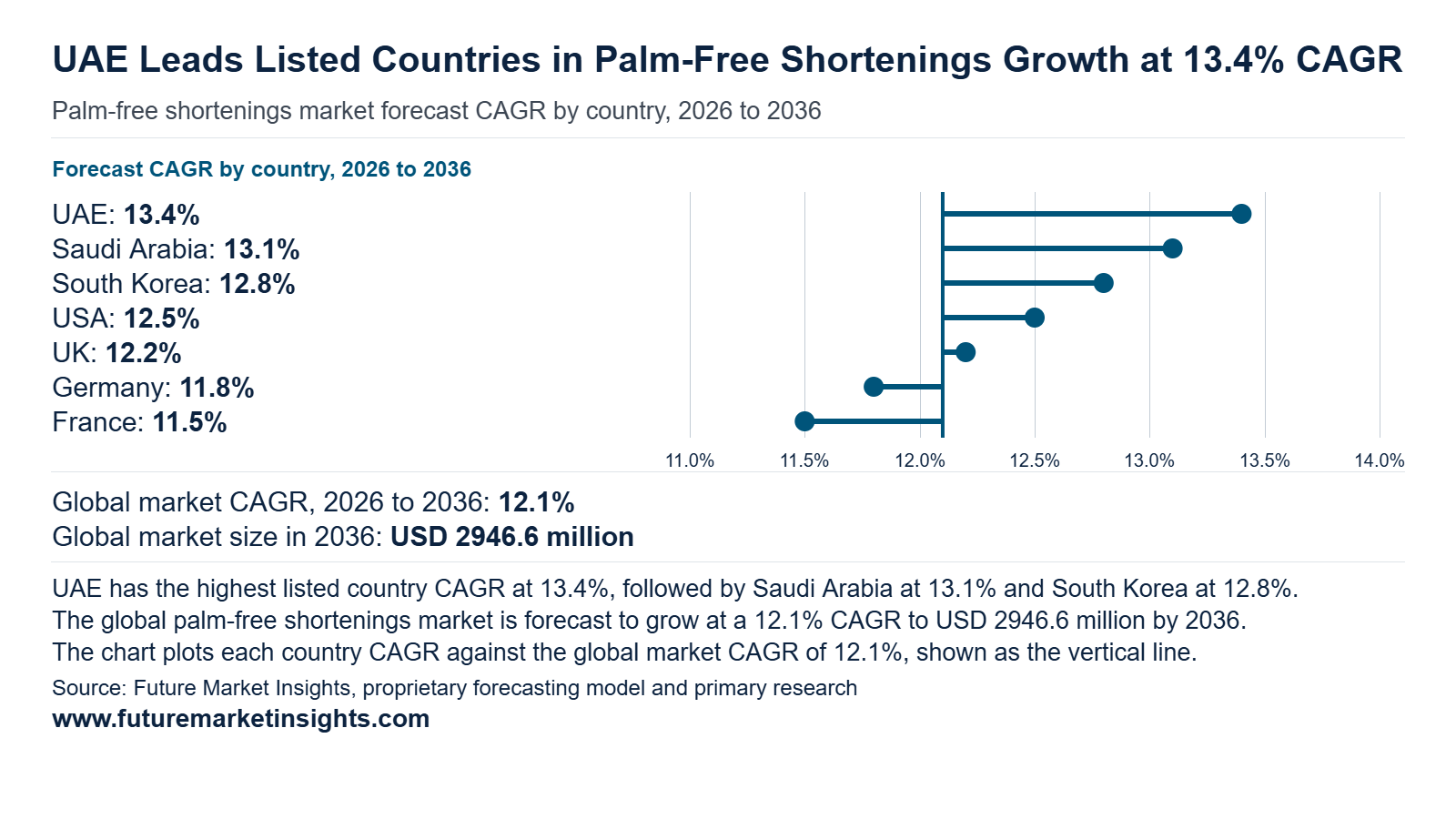
North America and Western Europe generate the majority of global palm-free shortenings revenue in 2026, while Gulf Cooperation Council and East Asian food-processing hubs record the fastest compound annual growth through 2036.FMI projects the eight profiled countries below to account for 80.0% of global market value in 2026 (USD 752.2 million), rising to 80.9% by 2036 (USD 2,383.8 million). Across the USA, anchors global demand at USD 319.7 million in 2026 (34.0% share), helped by abundant domestic soybean and canola oil refining capacity operated by Bunge as well as ADM. Meanwhile, the UAE (13.4% CAGR), Saudi Arabia (13.1% CAGR), and South Korea (12.8% CAGR) lead percentage growth as regional bakeries qualify imported non-palm structured fats.
| Country | 2026 Revenue | 2036 Revenue | 10-Year Addition | 2026 to 2036 CAGR | Global Share (2026 to 2036) |
|---|---|---|---|---|---|
| UAE | USD 37.6 million | USD 132.4 million | +USD 94.8 million | 13.4% | 4.0% to 4.5% |
| Saudi Arabia | USD 47.0 million | USD 161.1 million | +USD 114.1 million | 13.1% | 5.0% to 5.5% |
| South Korea | USD 56.4 million | USD 188.3 million | +USD 131.9 million | 12.8% | 6.0% to 6.4% |
| USA | USD 319.7 million | USD 1,038.2 million | +USD 718.5 million | 12.5% | 34.0% to 35.2% |
| UK | USD 108.1 million | USD 341.8 million | +USD 233.7 million | 12.2% | 11.5% to 11.6% |
| Germany | USD 98.7 million | USD 301.1 million | +USD 202.4 million | 11.8% | 10.5% to 10.2% |
| France | USD 47.0 million | USD 139.6 million | +USD 92.6 million | 11.5% | 5.0% to 4.7% |
| Japan | USD 37.6 million | USD 108.7 million | +USD 71.1 million | 11.2% | 4.0% to 3.7% |
Source: Future Market Insights analysis of the palm-free shortenings market, 2026.
UAE
Demand for palm-free shortenings in UAE is projected to rise from USD 37.6 million in 2026 to USD 132.4 million by 2036, advancing at a 13.4% CAGR and adding USD 94.8 million in new revenue. FMI finds that commercial bakeries and hospitality commissaries in Dubai and Abu Dhabi are adopting imported shea- and high-oleic sunflower-based shortenings owing to international hotel sustainability pledges and high ambient distribution temperatures. Trade assessments from the U.S. Department of Agriculture Foreign Agricultural Service (August 2026) and U.S. Department of Agriculture Foreign Agricultural Service (October 2026) confirm that UAE consumer-oriented food imports rose 9.3% to USD 17.7 billion in 2025 across 568 local processors. FMI expects thermal-stable non-palm shortening blends to capture rising Gulf bakery contract orders through 2036.
Saudi Arabia
Buyer adoption of palm-free shortenings across Saudi Arabia is estimated to expand from USD 47.0 million in 2026 to USD 161.1 million by 2036, spurred by a 13.1% CAGR and generating USD 114.1 million in commercial expansion. In FMI's assessment, statutory enforcement against partially hydrogenated oils and modern supermarket private-label growth are steering industrial bakeries toward interesterified non-palm fats. According to the U.S. Department of Agriculture Foreign Agricultural Service (August 2026), Saudi food retail sales reached USD 57.0 billion in 2025, with top supermarket chains accounting for over 80% of packaged grocery turnover. FMI projects zero-trans non-palm bakery shortening tenders to expand steadily across Saudi Arabia through 2036.
South Korea
Palm-free shortenings industry in South Korea is set to scale from USD 56.4 million in 2026 to USD 188.3 million by 2036, driven by a 12.8% CAGR and adding USD 131.9 million in incremental market value. FMI observes that Korean packaged cake and biscuit applications exporters are qualifying soybean- and shea-based shortenings to satisfy clean-label export standards in North America and Europe. Industry data from the U.S. Department of Agriculture Foreign Agricultural Service (May 2025) shows Korea's food-processing sector generated over KRW 85 trillion in output while relying on imported edible oil feedstocks. In FMI's view, domestic refinery partnerships with global specialty-fat suppliers will accelerate palm-free shortening adoption across South Korea through 2036.
USA
Sales of palm-free shortenings throughout USA are projected to increase from USD 319.7 million in 2026 to USD 1,038.2 million by 2036, progressing at a 12.5% CAGR and creating USD 718.5 million in additional revenue. FMI believes United States demand is anchored by domestic interesterified soybean and high-oleic canola shortenings that allow commercial bakeries to drop both artificial trans fats and palm oil on ingredient labels. Corporate filings from Bunge Global SA (October 2026), Cargill, Incorporated (November 2026), and Archer Daniels Midland Company (November 2026) confirm expanding North American softseed and soybean refining capacity. FMI anticipates bulk liquid and cubed soy-shortening contracts to lift the USA to 35.2% of global market value by 2036.
UK
Consumption of palm-free shortenings across UK is estimated to climb from USD 108.1 million in 2026 to USD 341.8 million by 2036, reflecting a 12.2% CAGR and contributing USD 233.7 million over the forecast decade. FMI's analysis indicates that British grocery retailers enforce some of Europe's strictest palm-free private-label bakery specifications across savory scones and shortbread biscuits. Official manufacturing data from the Office for National Statistics (July 2026) shows food manufacturing accounted for 22.9% of total UK manufacturers' product sales in 2025, representing the largest single industrial sector. FMI expects continued retail reformulation into rapeseed- and shea-based bakery shortenings to sustain double-digit UK growth through 2036.
Germany
Revenue generated by palm-free shortenings suppliers in Germany is forecast to expand from USD 98.7 million in 2026 to USD 301.1 million by 2036, anchored by a 11.8% CAGR and generating USD 202.4 million in new category sales. FMI finds that German industrial bake-off plants and artisan bakery chains are replacing palm-based fats with sunflower- and rapeseed-stearin shortenings to qualify for clean-label and regional origin retail tiers. Sector statistics from the Zentralverband des Deutschen Bäckerhandwerks (April 2025) document 8,912 bakery businesses generating EUR 17.92 billion in annual sales, while Vandemoortele NV (March 2025) expanded its German bakery-fat manufacturing footprint via the Bunge European margarines acquisition. FMI projects steady German contract conversion through 2036.
France
Buyer procurement of palm-free shortenings throughout France is tracking from USD 47.0 million in 2026 to USD 139.6 million by 2036, exhibiting a 11.5% CAGR and contributing USD 92.6 million to national market value. FMI observes that French brioche and tartlet doughs manufacturers face strong consumer scrutiny over tropical oil imports, prompting widespread recipe reformulations across the 50,106 French bakery-pastry establishments documented by INSEE (July 2025). European specialty-fat producers including Fuji Oil Europe (March 2025) and Vandemoortele NV (September 2026) supply shea- and rapeseed-based shortenings tailored to French pastry lines. FMI expects supermarket sans huile de palme shelf claims to drive French shortening orders through 2036.
Japan
Demand for palm-free shortenings in Japan is projected to rise from USD 37.6 million in 2026 to USD 108.7 million by 2036, advancing at a 11.2% CAGR and adding USD 71.1 million in new revenue. FMI notes that Japanese commercial bakeries and confectionery producers are increasing consumption of domestically crushed canola and soybean oils to formulate clean-label shortenings. Official oilseed balance sheets from the U.S. Department of Agriculture Foreign Agricultural Service (March 2026) forecast Japan's 2025/26 rapeseed crush at 2.15 million metric tons (up 1.0%) and soybean crush at 2.45 million metric tons, while Fuji Oil Holdings (February 2025) supplies low-trans specialty bakery fats across Japanese food processors. FMI expects consistent process-stability upgrades to support Japanese demand through 2036.
Competitive Environment and Notable Companies
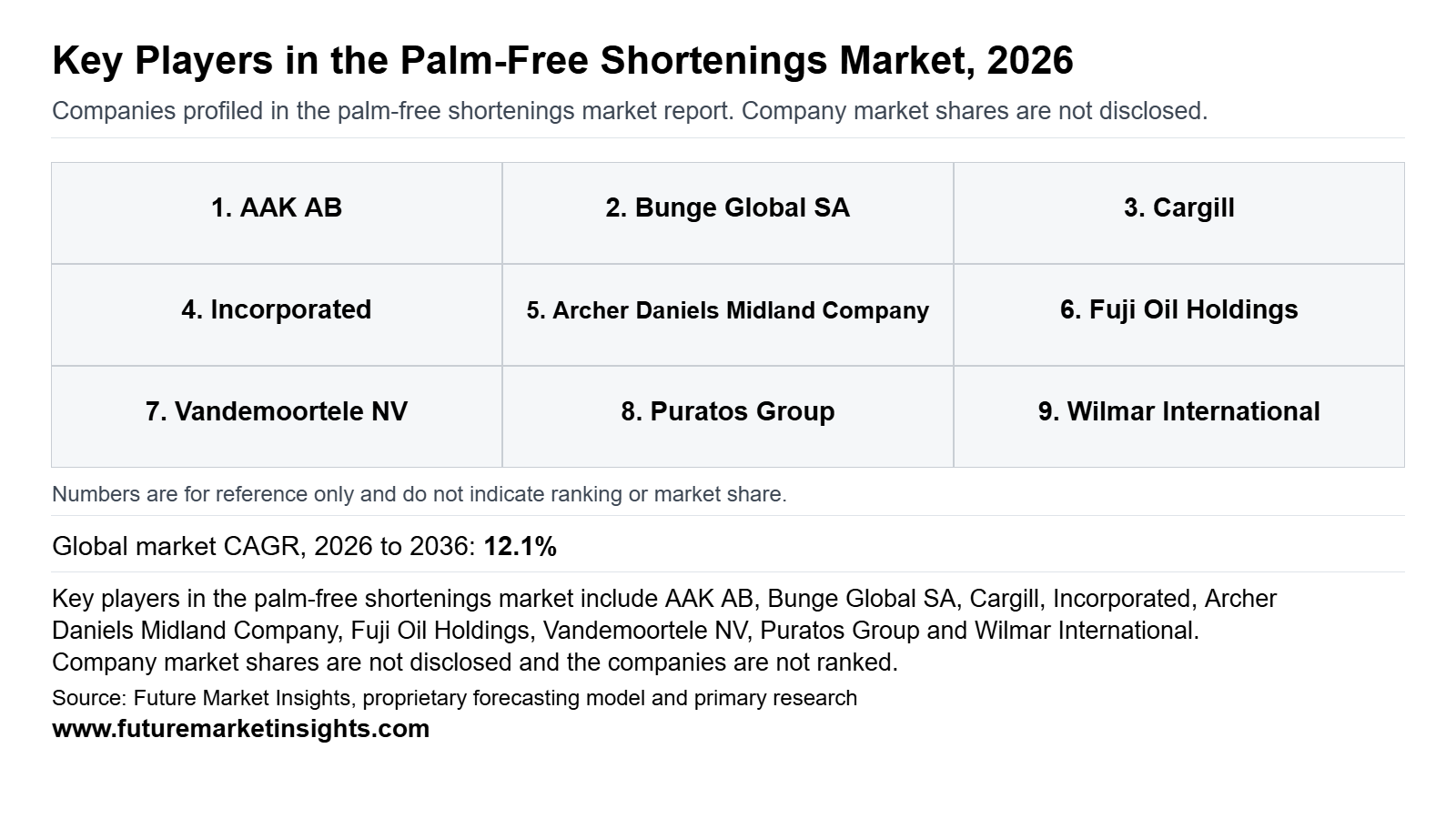
Competition in the global palm-free shortenings market is led by integrated oilseed crushers and specialty plant-fat formulators capable of structuring liquid sunflower and shea butter butter oils into plastic zero-trans bakery fats. Active market participants include AAK AB, Bunge Global SA, Cargill, Incorporated, Archer Daniels Midland Company, Fuji Oil Holdings (Fuji Oil Europe), Vandemoortele NV, Puratos Group, and Wilmar International. FMI finds that suppliers combining traceable non-palm hardstock origination with customer pilot-bakery validation secure the highest contract retention across industrial bread and cookie formulations manufacturers.
How Are Companies Positioned in the Palm-Free Shortenings Market?
North American bulk palm-free shortening supply is anchored byBunge Global SA (October 2026) (Vream soy shortenings), Cargill, Incorporated (November 2026) (Regal non-palm soybean and high-oleic canola shortenings), and Archer Daniels Midland Company (November 2026). In Europe and Asia, AAK AB (May 2025) and Fuji Oil Europe (March 2025) lead shea-stearin and low-saturated-fat bakery shortening co-development, while Vandemoortele NV (September 2026) expanded its European plant-fat footprint through the acquisition of Bunge's European margarines and spreads plants, competing with Puratos Group (March 2025) and Wilmar International.
What Matters When a Buyer Selects a Palm-Free Shortening Supplier?
Industrial bakery quality teams qualify palm-free shortening vendors on solid-fat content curves across 10 to 40 degrees Celsius, beta-prime crystal stability for icing aeration, oxidative shelf life, and audited palm-free segregation certificates. Unoptimized liquid-oil blends frequently suffer oil exudation during ambient storage, proving why buyers demand full-scale pilot-line validation from suppliers likeAAK AB (July 2025) and Cargill, Incorporated (May 2025) before signing annual bulk supply contracts.
Which Capabilities Distinguish Product Offers?
Leading suppliers differentiate their palm-free shortenings through enzymatic interesterification, micro-flaked dry-mix formats, and sustainable shea or high-oleic oilseed integration.Cargill, Incorporated (November 2026) operates its 1.0-million-metric-ton Regina canola facility and Regal bakery shortening platform to supply zero-trans non-palm fats, while Fuji Oil Europe (March 2025) and AAK AB (May 2025) use fractionated West African shea stearin to replicate the snap and plasticity of palm oil without tropical deforestation exposure.
How Does Geographic Reach Affect Competition?
Regional oilseed crushing economics determine which non-palm lipid base dominates local shortening supply. In North America,Bunge Global SA (October 2026), Archer Daniels Midland Company (November 2026), and Cargill, Incorporated (November 2026) supply soybean- and canola-based shortenings directly from domestic refineries. In Europe, Vandemoortele NV (March 2025), AAK AB (May 2025), and Fuji Oil Europe (March 2025) combine European rapeseed and sunflower oil with imported Ghanaian shea stearin across continental innovation centers.
| Verified Company Evidence (2025 to 2026) | Commercial Effect | Buyer Action |
|---|---|---|
| 25 March 2025 & 14 September 2026: Vandemoortele NV signed an agreement to acquire Bunge's EUR 450 million European Margarines & Spreads business across Germany, Poland, and Finland and reported EUR 339.5 million H1 2026 Plant-Based Food Solutions revenue (Vandemoortele NV, March 2025; Vandemoortele NV, September 2026). | Consolidates 20 European bakery fat and margarine brands under Vandemoortele across Western, Central, and Scandinavian markets. | Review European plant-fat supply agreements and confirm post-closing specification continuity across German and Polish sites. |
| 27 March 2025: Fuji Oil Europe inaugurated a 300-metric-ton donated shea warehouse in Ghana under its Tebma Kandu shea sourcing strategy (Fuji Oil Europe, March 2025). | Strengthens traceable non-palm shea stearin feedstock supply for European bakery and confectionery fat formulations. | Audit shea-stearin shortening blends as high-stability, non-palm replacements for laminated pastries and fillings. |
| 29 October 2026: Bunge Global SA reported Q3 2026 adjusted EPS of USD 2.56 and commissioned its new Destrehan, Louisiana oilseed processing line (Bunge Global SA, October 2026). | Expands North American soybean and softseed refining capacity supporting Vream and bulk non-palm bakery shortenings. | Benchmark multi-quarter soybean and softseed shortening basis contracts against expanded Gulf Coast refining supply. |
| 9 November 2026: Cargill, Incorporated published its 2026 Annual and Impact Reports highlighting its new 1.0-million-metric-ton Regina canola processing facility and specialty bakery fat investments (Cargill, Incorporated, November 2026). | Increases North American high-oleic canola and non-palm oilseed supply for Regal all-purpose and cake shortenings. | Evaluate high-oleic canola and soybean shortening blends to lock in zero-trans, palm-free bakery labels through 2027. |
Source: Verified corporate disclosures and Future Market Insights analysis, 2026.
| Company | Core Positioning | Verified Activity & Source Attribution |
|---|---|---|
| AAK AB | Global specialist in plant-based bakery shortenings, AkoPlanet, and shea-stearin fats | Expanded Kolo Nafaso shea program to >230,000 women in May 2025 (AAK AB, May 2025) and added organic non-palm fat offerings in July 2025 (AAK AB, July 2025). |
| Bunge Global SA | Producer of Vream palm-free soy shortenings and refined softseed bakery fats | Reported Q3 2026 adjusted EPS of USD 2.56 and started up its new Destrehan oilseed processing line in October 2026 (Bunge Global SA, October 2026). |
| Cargill, Incorporated | Supplier of Regal non-palm soybean and high-oleic canola bakery shortenings | Opened a 1.0-million-metric-ton canola plant in Regina and published its 2025/2026 Bakery Portfolio and Impact Reports (Cargill, Incorporated, November 2026). |
| Archer Daniels Midland Company | Global oilseed crusher supplying interesterified soybean and canola bakery shortenings | Delivered USD 858 million in Q3 2026 adjusted net earnings across global oilseed crushing and refined oils (Archer Daniels Midland Company, November 2026). |
| Fuji Oil Holdings (Fuji Oil Europe) | Producer of shea-based and non-palm structured bakery and coating fats | Inaugurated a 300 MT Ghana shea warehouse in March 2025 to expand traceable non-palm fat supply (Fuji Oil Europe, March 2025). |
| Vandemoortele NV | European manufacturer of plant-based bakery fats, margarines, and shortenings | Agreed in March 2025 to acquire Bunge's EUR 450M European margarines business and reported EUR 339.5M H1 2026 PBFS sales (Vandemoortele NV, September 2026). |
| Puratos Group | Global bakery ingredient formulator supplying plant-based and palm-free fat systems | Expanded plant-based and clean-label bakery fat reformulation solutions for commercial patisserie in 2025 and 2026 (Puratos Group, March 2025). |
| Wilmar International | Asian agribusiness supplying specialty bakery fats and blended oilseed shortenings | Supplies WILSHORT industrial bakery shortenings and oilseed blends across Asia-Pacific food processors. |
Source: Verified corporate disclosures and Future Market Insights analysis, 2026.
Key takeaways
- Valued at USD 940.3 million in 2026, on course for USD 2,946.6 million by 2036.
- The decade adds USD 2,006.3 million in new value at a 12.1% CAGR.
- The type segment is led by All-purpose at 35.0% of 2026 revenue.
- 44.0% of form revenue goes to Powder / dry in 2026.
- The UAE grows fastest at 13.4% CAGR, ahead of Saudi Arabia at 13.1%.
Palm-Free Shortenings Market - Report Scope and Research Methodology
FMI sizes the global palm-free shortenings market through a bottom-up and top-down model reconciling non-palm oilseed refining allocations, shea-stearin fractionation volumes, and B2B bakery shortening contract prices across each country. core estimates cross-check national oilseed crushing logs from the USDA Economic Research Service and USDA Foreign Agricultural Service, industrial bakery output from the UK Office for National Statistics and the German Bakers Confederation, and audited corporate disclosures from AAK, Bunge, Cargill, ADM, Fuji Oil, and Vandemoortele. All valuations are reported in USD million at ingredient transaction level, strictly excluding palm-containing shortenings, untexturized cooking oils, dairy butter, and downstream finished baked goods.
| Coverage Field | Report Scope |
|---|---|
| Market Definition | Revenue from structured, zero-trans palm-free shortenings made from soybean, canola, sunflower, shea, or other non-palm lipids sold as bakery and food-processing ingredients. |
| Historical Year | 2025 (USD 838.8 million) |
| Base & Estimated Year | 2026 (USD 940.3 million) |
| Forecast Period & 2036 Projection | 2026 to 2036 (USD 2,946.6 million; 12.1% CAGR; +USD 2,006.3 million incremental addition) |
| Quantitative Units | USD million for all global, segment, and national revenue figures. |
| Type Coverage | All-purpose (35.0%), Cake & icing, Laminating, Liquid (Other Segment Combined 65.0%). |
| Form Coverage | Powder / dry (44.0%), Liquid, Paste / semi-solid, Granules / pieces (Other Segment Combined 56.0%). |
| Application Coverage | Bread & rolls (31.0%), Cakes & muffins, Biscuits & cookies, Viennoiserie & pastry, Other bakery & snacks (Other Segment Combined 69.0%). |
| Claim Coverage | Conventional (45.0%), Clean label, Organic, Non-GMO / identity preserved (Other Segment Combined 55.0%). |
| Sales Channel Coverage | Direct to industrial bakeries (51.0%), Ingredient distributors, Foodservice & artisan supply, Online B2B (Other Segment Combined 49.0%). |
| Regions Covered | North America, Latin America, Western Europe, Eastern Europe, East Asia, South Asia and Pacific, Middle East and Africa. |
| Countries Profiled | UAE, Saudi Arabia, South Korea, USA, UK, Germany, France, and Japan. |
| Scope Exclusions | Palm-containing shortenings, ordinary liquid cooking oils without shortening functionality, dairy butter, and downstream finished baked goods. |
| Companies Profiled | AAK AB, Bunge Global SA, Cargill, Incorporated, Archer Daniels Midland Company, Fuji Oil Holdings, Vandemoortele NV, Puratos Group, and Wilmar International. |
Source: Future Market Insights analysis of the palm-free shortenings market, 2026.
Research Sources and Bibliography
- AAK AB. (2025, May 15).Shea Empowering Women Award: Kolo Nafaso Direct Shea Sourcing Program in West Africa. https://www.aak.com/news-and-media/stories/shea-empowering-women-award/
- AAK AB. (2025, July 10).AAK Adds Organic Offerings to Expand Fats and Oils Portfolio for Bakery and Confectionery. https://betterwithaak.com/blog/news/aak-adds-organic-offerings-to-expand-fats-and-oils-portfolio/
- Archer Daniels Midland Company. (2026, February 3).ADM Reports Fourth Quarter and Full-Year 2025 Results and Provides 2026 Guidance. https://investors.adm.com/news/news-details/2026/ADM-Reports-Fourth-Quarter-and-Full-year-2025-Results-Provides-2026-Guidance/default.aspx
- Archer Daniels Midland Company. (2026, November 3).ADM Reports Third Quarter 2026 Results and Updates Full-Year 2026 Outlook. https://www.adm.com/en-us/news/news-releases/2026/11/adm-reports-third-quarter-2026-results/
- Bunge Global SA. (2026, October 29).Bunge Reports Third Quarter 2026 Results and Destrehan Oilseed Processing Startup. https://investors.bunge.com/news-and-events/press-releases/2026/10-29-2026-100043413
- Cargill, Incorporated. (2025, May 1).Cargill Bakery Product Portfolio Guide: Regal Shortenings and High-Oleic Oils. https://www.cargill.com/food-beverage/doc/1451370792304/bakery-product-portfolio-guide.pdf?file=1
- Cargill, Incorporated. (2026, November 9).Cargill 2026 Annual Report: Grow Forward and Regina Canola Processing Facility. https://www.cargill.com/about/2026-annual-report
- Cargill, Incorporated. (2026, November 9).2026 Impact Report: Climate, Land and Water, and Deforestation-Free Supply Chains. https://www.cargill.com/sustainability/2026-impact-report
- Fuji Oil Europe. (2025, March 27).Largest-Ever Donated Warehouse in Ghana Strengthens Tebma Kandu Shea Strategy. https://www.fujioileurope.com/en/news-release/largestever-donated-warehouse-in-ghana-strengthens-tebma-kandu-shea-strategy
- Fuji Oil Holdings. (2025, February 7).FY2024 Third-Quarter Financial Results Presentation: Vegetable Oils and Specialty Fats. https://www.fujioil.co.jp/en/pdf/ir/library/hosoku/250207_presentation_en.pdf
- INSEE. (2025, July 10).Equipements et Services a la Population en 2024: Boulangeries et Patisseries en France. https://www.insee.fr/fr/statistiques/8610258?geo=FRANCE-1
- Office for National Statistics. (2026, July 24).UK Manufacturers' Sales by Product (PRODCOM): 2025 Food Manufacturing Output. https://www.ons.gov.uk/businessindustryandtrade/manufacturingandproductionindustry/bulletins/ukmanufacturerssalesbyproductprodcom/latest
- Puratos Group. (2025, March 15).Plant-Based Bakery Solutions: Reducing Saturated Fat and Replacing Palm Oil in Patisserie. https://www.puratos.com/health-well-being/plant-based
- U.S. Department of Agriculture Foreign Agricultural Service. (2025, May 5).South Korea: Food Processing Ingredients Annual Report. https://www.fas.usda.gov/data/south-korea-food-processing-ingredients-annual-0
- U.S. Department of Agriculture Foreign Agricultural Service. (2026, March 31).Japan: Oilseeds and Products Annual (Report JA2026-0016). https://apps.fas.usda.gov/newgainapi/api/Report/DownloadReportByFileName?fileName=Oilseeds%20and%20Products%20Annual_Tokyo_Japan_JA2026-0016
- U.S. Department of Agriculture Foreign Agricultural Service. (2026, August 4).United Arab Emirates: Food Processing Ingredients Annual Report. https://www.fas.usda.gov/data/gain/2026/08/united-arab-emirates-food-processing-ingredients-annual
- U.S. Department of Agriculture Foreign Agricultural Service. (2026, August 31).Saudi Arabia: Retail Foods Annual (Report SA2026-0013). https://www.fas.usda.gov/data/gain/2026/08/saudi-arabia-retail-foods-annual
- U.S. Department of Agriculture Foreign Agricultural Service. (2026, October 19).United Arab Emirates: Retail Foods Annual (Report TC2026-0013). https://www.fas.usda.gov/data/gain/2026/10/united-arab-emirates-retail-foods-annual
- USDA Economic Research Service. (2025, February 13).Oil Crops Outlook: Biomass-Based Diesel and Vegetable Oil Demand (OCS-25b). https://ers.usda.gov/sites/default/files/_laserfiche/outlooks/110935/OCS-25b.pdf
- USDA Economic Research Service. (2026, March 23).Oil Crops Yearbook: Oilseed, Oilmeal, and Fats and Oils Supply and Use Statistics. https://www.ers.usda.gov/data-products/oil-crops-yearbook
- Vandemoortele NV. (2025, March 25).Vandemoortele Signs Agreement to Acquire the European Margarines and Spreads Activities of Bunge. https://www.vandemoortele.com/en/open/file/121418
- Vandemoortele NV. (2026, September 14).Vandemoortele Delivers Resilient Results and Advances Acquisition Strategy in H1 2026. https://www.vandemoortele.com/fr-be/open/file/122739
- Zentralverband des Deutschen Bäckerhandwerks. (2025, April 14).Bäckerhandwerk Beweist Resilienz: Betriebsrückgang, Stabile Neugründungen und Umsatz 2024. https://www.baeckerhandwerk.de/aktuelles/blog-beitrag/baeckerhandwerk-beweist-resilienz-betriebsrueckgang-aber-stabile-zahl-an-neugruendungen-und-mehr-azubis
Table of Content
- Key Takeaways
- Market Size and CAGR
- Top Growth Driver
- Fastest Growing Segment
- Leading Region
- Key Companies
- Emerging Opportunities
- Executive Summary
- Global Market Outlook
- Demand-side Trends
- Supply-side Trends
- Technology Roadmap Analysis
- Analysis and Recommendations
- Analyst Perspective (What is happening? Why now? What should investors know?)
- Key Questions Answered
- How large is the market?
- What is the CAGR?
- What are key trends?
- Which region dominates?
- Who are the leaders?
Read More...
- Market Overview
- Market Coverage / Taxonomy
- Market Definition / Scope / Limitations
- Research Methodology
- Chapter Orientation
- Analytical Lens and Working Hypotheses
- Market Structure, Signals, and Trend Drivers
- Benchmarking and Cross-market Comparability
- Market Sizing, Forecasting, and Opportunity Mapping
- Research Design and Evidence Framework
- Desk Research Programme (Secondary Evidence)
- Expert Input and Fieldwork (Primary Evidence)
- Tooling, Models, and Reference Databases
- Data Engineering and Model Build
- Quality Assurance and Audit Trail
- Market Background
- Market Dynamics (Drivers, Restraints, Opportunity, Trends)
- Scenario Forecast (Optimistic, Likely, Conservative)
- Impact Analysis
- AI Impact
- Sustainability Impact
- Regulatory Impact
- Technology Impact
- Consumer / Buyer Analysis
- Purchase Drivers
- Adoption Barriers
- Buyer Journey
- Opportunity Map Analysis
- Product Life Cycle Analysis
- Supply Chain Analysis
- Investment Feasibility Matrix
- Value Chain Analysis
- PESTLE and Porter's Analysis
- Regulatory Landscape
- Regional Parent Market Outlook
- Production and Consumption Statistics
- Import and Export Statistics
- Global Market Analysis and Forecast, 2021 to 2036
- Historical Market Size Value (USD Million) Analysis, 2021 to 2025
- Current and Future Market Size Value (USD Million) Projections, 2026 to 2036
- Y-o-Y Growth Trend Analysis
- Absolute $ Opportunity Analysis
- Global Market Pricing Analysis, 2021 to 2036
- Global Market Analysis and Forecast, By Type, 2021 to 2036
- Introduction / Key Findings
- Historical Market Size Value (USD Million) Analysis By Type, 2021 to 2025
- Current and Future Market Size Value (USD Million) Analysis and Forecast By Type, 2026 to 2036
- All-purpose
- Cake & icing
- Laminating
- Liquid
- Y-o-Y Growth Trend Analysis By Type, 2021 to 2025
- Absolute $ Opportunity Analysis By Type, 2026 to 2036
- Global Market Analysis and Forecast, By Form, 2021 to 2036
- Introduction / Key Findings
- Historical Market Size Value (USD Million) Analysis By Form, 2021 to 2025
- Current and Future Market Size Value (USD Million) Analysis and Forecast By Form, 2026 to 2036
- Powder / dry
- Liquid
- Paste / semi-solid
- Granules / pieces
- Y-o-Y Growth Trend Analysis By Form, 2021 to 2025
- Absolute $ Opportunity Analysis By Form, 2026 to 2036
- Global Market Analysis and Forecast, By Application, 2021 to 2036
- Introduction / Key Findings
- Historical Market Size Value (USD Million) Analysis By Application, 2021 to 2025
- Current and Future Market Size Value (USD Million) Analysis and Forecast By Application, 2026 to 2036
- Bread & rolls
- Cakes & muffins
- Biscuits & cookies
- Viennoiserie & pastry
- Other bakery & snacks
- Y-o-Y Growth Trend Analysis By Application, 2021 to 2025
- Absolute $ Opportunity Analysis By Application, 2026 to 2036
- Global Market Analysis and Forecast, By Claim, 2021 to 2036
- Introduction / Key Findings
- Historical Market Size Value (USD Million) Analysis By Claim, 2021 to 2025
- Current and Future Market Size Value (USD Million) Analysis and Forecast By Claim, 2026 to 2036
- Conventional
- Clean label
- Organic
- Non-GMO / identity preserved
- Y-o-Y Growth Trend Analysis By Claim, 2021 to 2025
- Absolute $ Opportunity Analysis By Claim, 2026 to 2036
- Global Market Analysis and Forecast, By Sales Channel, 2021 to 2036
- Introduction / Key Findings
- Historical Market Size Value (USD Million) Analysis By Sales Channel, 2021 to 2025
- Current and Future Market Size Value (USD Million) Analysis and Forecast By Sales Channel, 2026 to 2036
- Direct to industrial bakeries
- Ingredient distributors
- Foodservice & artisan supply
- Online B2B
- Y-o-Y Growth Trend Analysis By Sales Channel, 2021 to 2025
- Absolute $ Opportunity Analysis By Sales Channel, 2026 to 2036
- Global Market Analysis and Forecast, By Region, 2021 to 2036
- Introduction
- Historical Market Size Value (USD Million) Analysis By Region, 2021 to 2025
- Current Market Size Value (USD Million) Analysis and Forecast By Region, 2026 to 2036
- North America
- Western Europe
- East Asia
- South Asia and Pacific
- Market Attractiveness Analysis By Region
- North America Market Analysis and Forecast, By Country, 2021 to 2036
- Historical Market Size Value (USD Million) Trend Analysis By Market Taxonomy, 2021 to 2025
- Market Size Value (USD Million) Forecast By Market Taxonomy, 2026 to 2036
- By Country
- United States
- Canada
- By Type
- By Form
- By Application
- By Claim
- By Sales Channel
- By Country
- Market Attractiveness Analysis
- By Country
- By Type
- By Form
- By Application
- By Claim
- By Sales Channel
- Key Takeaways
- Western Europe Market Analysis and Forecast, By Country
- Historical Market Size Value (USD Million) Trend Analysis By Market Taxonomy, 2021 to 2025
- Market Size Value (USD Million) Forecast By Market Taxonomy, 2026 to 2036
- By Country
- United Kingdom
- Germany
- France
- By Type
- By Form
- By Application
- By Claim
- By Sales Channel
- By Country
- Market Attractiveness Analysis
- By Country
- By Type
- By Form
- By Application
- By Claim
- By Sales Channel
- Key Takeaways
- East Asia Market Analysis and Forecast, By Country
- Historical Market Size Value (USD Million) Trend Analysis By Market Taxonomy, 2021 to 2025
- Market Size Value (USD Million) Forecast By Market Taxonomy, 2026 to 2036
- By Country
- China
- Japan
- South Korea
- By Type
- By Form
- By Application
- By Claim
- By Sales Channel
- By Country
- Market Attractiveness Analysis
- By Country
- By Type
- By Form
- By Application
- By Claim
- By Sales Channel
- Key Takeaways
- South Asia and Pacific Market Analysis and Forecast, By Country
- Historical Market Size Value (USD Million) Trend Analysis By Market Taxonomy, 2021 to 2025
- Market Size Value (USD Million) Forecast By Market Taxonomy, 2026 to 2036
- By Country
- India
- Australia
- Rest of world aggregate
- By Type
- By Form
- By Application
- By Claim
- By Sales Channel
- By Country
- Market Attractiveness Analysis
- By Country
- By Type
- By Form
- By Application
- By Claim
- By Sales Channel
- Key Takeaways
- Key Countries Market Analysis
- United States
- Pricing Analysis
- Market Share Analysis, 2025
- By Type
- By Form
- By Application
- By Claim
- By Sales Channel
- Canada
- Pricing Analysis
- Market Share Analysis, 2025
- By Type
- By Form
- By Application
- By Claim
- By Sales Channel
- Germany
- Pricing Analysis
- Market Share Analysis, 2025
- By Type
- By Form
- By Application
- By Claim
- By Sales Channel
- United Kingdom
- Pricing Analysis
- Market Share Analysis, 2025
- By Type
- By Form
- By Application
- By Claim
- By Sales Channel
- France
- Pricing Analysis
- Market Share Analysis, 2025
- By Type
- By Form
- By Application
- By Claim
- By Sales Channel
- India
- Pricing Analysis
- Market Share Analysis, 2025
- By Type
- By Form
- By Application
- By Claim
- By Sales Channel
- China
- Pricing Analysis
- Market Share Analysis, 2025
- By Type
- By Form
- By Application
- By Claim
- By Sales Channel
- Japan
- Pricing Analysis
- Market Share Analysis, 2025
- By Type
- By Form
- By Application
- By Claim
- By Sales Channel
- South Korea
- Pricing Analysis
- Market Share Analysis, 2025
- By Type
- By Form
- By Application
- By Claim
- By Sales Channel
- Australia
- Pricing Analysis
- Market Share Analysis, 2025
- By Type
- By Form
- By Application
- By Claim
- By Sales Channel
- United States
- Market Structure Analysis
- Competition Dashboard
- Competition Benchmarking
- Market Share Analysis of Top Players
- By Regional
- By Type
- By Form
- By Application
- By Claim
- By Sales Channel
- Emerging Startups
- Innovation Benchmarking
- Competition Analysis
- Competition Deep Dive
- AAK AB
- Overview
- Product Portfolio
- Profitability by Market Segments
- Sales Footprint
- Strategy Overview
- Marketing Strategy
- Product Strategy
- Channel Strategy
- Bunge Global SA
- Cargill, Incorporated
- Archer Daniels Midland Company
- Fuji Oil Holdings (Fuji Oil Europe)
- Vandemoortele NV
- Puratos Group
- Wilmar International
- AAK AB
- Case Studies
- Success Stories
- Recent Developments
- Competition Deep Dive
- Assumptions & Acronyms Used
List of Tables
- Table 1: Global Market Value (USD Million) Forecast by Region, 2021 to 2036
- Table 2: Global Market Value (USD Million) Forecast by Type, 2021 to 2036
- Table 3: Global Market Value (USD Million) Forecast by Form, 2021 to 2036
- Table 4: Global Market Value (USD Million) Forecast by Application, 2021 to 2036
- Table 5: Global Market Value (USD Million) Forecast by Claim, 2021 to 2036
- Table 6: Global Market Value (USD Million) Forecast by Sales Channel, 2021 to 2036
- Table 7: North America Market Value (USD Million) Forecast by Country, 2021 to 2036
- Table 8: North America Market Value (USD Million) Forecast by Type, 2021 to 2036
- Table 9: North America Market Value (USD Million) Forecast by Form, 2021 to 2036
- Table 10: North America Market Value (USD Million) Forecast by Application, 2021 to 2036
- Table 11: North America Market Value (USD Million) Forecast by Claim, 2021 to 2036
- Table 12: North America Market Value (USD Million) Forecast by Sales Channel, 2021 to 2036
- Table 13: Western Europe Market Value (USD Million) Forecast by Country, 2021 to 2036
- Table 14: Western Europe Market Value (USD Million) Forecast by Type, 2021 to 2036
- Table 15: Western Europe Market Value (USD Million) Forecast by Form, 2021 to 2036
- Table 16: Western Europe Market Value (USD Million) Forecast by Application, 2021 to 2036
- Table 17: Western Europe Market Value (USD Million) Forecast by Claim, 2021 to 2036
- Table 18: Western Europe Market Value (USD Million) Forecast by Sales Channel, 2021 to 2036
- Table 19: East Asia Market Value (USD Million) Forecast by Country, 2021 to 2036
- Table 20: East Asia Market Value (USD Million) Forecast by Type, 2021 to 2036
- Table 21: East Asia Market Value (USD Million) Forecast by Form, 2021 to 2036
- Table 22: East Asia Market Value (USD Million) Forecast by Application, 2021 to 2036
- Table 23: East Asia Market Value (USD Million) Forecast by Claim, 2021 to 2036
- Table 24: East Asia Market Value (USD Million) Forecast by Sales Channel, 2021 to 2036
- Table 25: South Asia and Pacific Market Value (USD Million) Forecast by Country, 2021 to 2036
- Table 26: South Asia and Pacific Market Value (USD Million) Forecast by Type, 2021 to 2036
- Table 27: South Asia and Pacific Market Value (USD Million) Forecast by Form, 2021 to 2036
- Table 28: South Asia and Pacific Market Value (USD Million) Forecast by Application, 2021 to 2036
- Table 29: South Asia and Pacific Market Value (USD Million) Forecast by Claim, 2021 to 2036
- Table 30: South Asia and Pacific Market Value (USD Million) Forecast by Sales Channel, 2021 to 2036
List of Figures
- Figure 1: Global Market Pricing Analysis
- Figure 2: Global Market Value (USD Million) Forecast 2021-2036
- Figure 3: Global Market Value Share and BPS Analysis by Type, 2026 and 2036
- Figure 4: Global Market Y-o-Y Growth Comparison by Type, 2026-2036
- Figure 5: Global Market Attractiveness Analysis by Type
- Figure 6: Global Market Value Share and BPS Analysis by Form, 2026 and 2036
- Figure 7: Global Market Y-o-Y Growth Comparison by Form, 2026-2036
- Figure 8: Global Market Attractiveness Analysis by Form
- Figure 9: Global Market Value Share and BPS Analysis by Application, 2026 and 2036
- Figure 10: Global Market Y-o-Y Growth Comparison by Application, 2026-2036
- Figure 11: Global Market Attractiveness Analysis by Application
- Figure 12: Global Market Value Share and BPS Analysis by Claim, 2026 and 2036
- Figure 13: Global Market Y-o-Y Growth Comparison by Claim, 2026-2036
- Figure 14: Global Market Attractiveness Analysis by Claim
- Figure 15: Global Market Value Share and BPS Analysis by Sales Channel, 2026 and 2036
- Figure 16: Global Market Y-o-Y Growth Comparison by Sales Channel, 2026-2036
- Figure 17: Global Market Attractiveness Analysis by Sales Channel
- Figure 18: Global Market Value (USD Million) Share and BPS Analysis by Region, 2026 and 2036
- Figure 19: Global Market Y-o-Y Growth Comparison by Region, 2026-2036
- Figure 20: Global Market Attractiveness Analysis by Region
- Figure 21: North America Market Incremental Dollar Opportunity, 2026-2036
- Figure 22: Western Europe Market Incremental Dollar Opportunity, 2026-2036
- Figure 23: East Asia Market Incremental Dollar Opportunity, 2026-2036
- Figure 24: South Asia and Pacific Market Incremental Dollar Opportunity, 2026-2036
- Figure 25: North America Market Value Share and BPS Analysis by Country, 2026 and 2036
- Figure 26: North America Market Value Share and BPS Analysis by Type, 2026 and 2036
- Figure 27: North America Market Y-o-Y Growth Comparison by Type, 2026-2036
- Figure 28: North America Market Attractiveness Analysis by Type
- Figure 29: North America Market Value Share and BPS Analysis by Form, 2026 and 2036
- Figure 30: North America Market Y-o-Y Growth Comparison by Form, 2026-2036
- Figure 31: North America Market Attractiveness Analysis by Form
- Figure 32: North America Market Value Share and BPS Analysis by Application, 2026 and 2036
- Figure 33: North America Market Y-o-Y Growth Comparison by Application, 2026-2036
- Figure 34: North America Market Attractiveness Analysis by Application
- Figure 35: North America Market Value Share and BPS Analysis by Claim, 2026 and 2036
- Figure 36: North America Market Y-o-Y Growth Comparison by Claim, 2026-2036
- Figure 37: North America Market Attractiveness Analysis by Claim
- Figure 38: North America Market Value Share and BPS Analysis by Sales Channel, 2026 and 2036
- Figure 39: North America Market Y-o-Y Growth Comparison by Sales Channel, 2026-2036
- Figure 40: North America Market Attractiveness Analysis by Sales Channel
- Figure 41: Western Europe Market Value Share and BPS Analysis by Country, 2026 and 2036
- Figure 42: Western Europe Market Value Share and BPS Analysis by Type, 2026 and 2036
- Figure 43: Western Europe Market Y-o-Y Growth Comparison by Type, 2026-2036
- Figure 44: Western Europe Market Attractiveness Analysis by Type
- Figure 45: Western Europe Market Value Share and BPS Analysis by Form, 2026 and 2036
- Figure 46: Western Europe Market Y-o-Y Growth Comparison by Form, 2026-2036
- Figure 47: Western Europe Market Attractiveness Analysis by Form
- Figure 48: Western Europe Market Value Share and BPS Analysis by Application, 2026 and 2036
- Figure 49: Western Europe Market Y-o-Y Growth Comparison by Application, 2026-2036
- Figure 50: Western Europe Market Attractiveness Analysis by Application
- Figure 51: Western Europe Market Value Share and BPS Analysis by Claim, 2026 and 2036
- Figure 52: Western Europe Market Y-o-Y Growth Comparison by Claim, 2026-2036
- Figure 53: Western Europe Market Attractiveness Analysis by Claim
- Figure 54: Western Europe Market Value Share and BPS Analysis by Sales Channel, 2026 and 2036
- Figure 55: Western Europe Market Y-o-Y Growth Comparison by Sales Channel, 2026-2036
- Figure 56: Western Europe Market Attractiveness Analysis by Sales Channel
- Figure 57: East Asia Market Value Share and BPS Analysis by Country, 2026 and 2036
- Figure 58: East Asia Market Value Share and BPS Analysis by Type, 2026 and 2036
- Figure 59: East Asia Market Y-o-Y Growth Comparison by Type, 2026-2036
- Figure 60: East Asia Market Attractiveness Analysis by Type
- Figure 61: East Asia Market Value Share and BPS Analysis by Form, 2026 and 2036
- Figure 62: East Asia Market Y-o-Y Growth Comparison by Form, 2026-2036
- Figure 63: East Asia Market Attractiveness Analysis by Form
- Figure 64: East Asia Market Value Share and BPS Analysis by Application, 2026 and 2036
- Figure 65: East Asia Market Y-o-Y Growth Comparison by Application, 2026-2036
- Figure 66: East Asia Market Attractiveness Analysis by Application
- Figure 67: East Asia Market Value Share and BPS Analysis by Claim, 2026 and 2036
- Figure 68: East Asia Market Y-o-Y Growth Comparison by Claim, 2026-2036
- Figure 69: East Asia Market Attractiveness Analysis by Claim
- Figure 70: East Asia Market Value Share and BPS Analysis by Sales Channel, 2026 and 2036
- Figure 71: East Asia Market Y-o-Y Growth Comparison by Sales Channel, 2026-2036
- Figure 72: East Asia Market Attractiveness Analysis by Sales Channel
- Figure 73: South Asia and Pacific Market Value Share and BPS Analysis by Country, 2026 and 2036
- Figure 74: South Asia and Pacific Market Value Share and BPS Analysis by Type, 2026 and 2036
- Figure 75: South Asia and Pacific Market Y-o-Y Growth Comparison by Type, 2026-2036
- Figure 76: South Asia and Pacific Market Attractiveness Analysis by Type
- Figure 77: South Asia and Pacific Market Value Share and BPS Analysis by Form, 2026 and 2036
- Figure 78: South Asia and Pacific Market Y-o-Y Growth Comparison by Form, 2026-2036
- Figure 79: South Asia and Pacific Market Attractiveness Analysis by Form
- Figure 80: South Asia and Pacific Market Value Share and BPS Analysis by Application, 2026 and 2036
- Figure 81: South Asia and Pacific Market Y-o-Y Growth Comparison by Application, 2026-2036
- Figure 82: South Asia and Pacific Market Attractiveness Analysis by Application
- Figure 83: South Asia and Pacific Market Value Share and BPS Analysis by Claim, 2026 and 2036
- Figure 84: South Asia and Pacific Market Y-o-Y Growth Comparison by Claim, 2026-2036
- Figure 85: South Asia and Pacific Market Attractiveness Analysis by Claim
- Figure 86: South Asia and Pacific Market Value Share and BPS Analysis by Sales Channel, 2026 and 2036
- Figure 87: South Asia and Pacific Market Y-o-Y Growth Comparison by Sales Channel, 2026-2036
- Figure 88: South Asia and Pacific Market Attractiveness Analysis by Sales Channel
- Figure 89: Global Market - Tier Structure Analysis
- Figure 90: Global Market - Company Share Analysis
Frequently Asked Questions
How big is the palm-free shortenings market in 2026?
Future Market Insights estimates the global palm-free shortenings market valuation at USD 940.3 million in 2026, advancing from USD 838.8 million in 2025 across industrial bakery and food-processing accounts.
What is the 2036 forecast size and CAGR for the palm-free shortenings market?
Global palm-free shortenings market is projected to reach USD 2,946.6 million by 2036, expanding at a 12.1% CAGR from 2026 to 2036 and generating USD 2,006.3 million in incremental revenue.
Which Type segment leads the palm-free shortenings market?
All-purpose leads the Type segment with a 35.0% share in 2026 across cake and laminating and liquid shortenings shortenings.
Which Form segment captures the highest share of palm-free shortenings?
Powder / dry leads the Form segment with a 44.0% share in 2026 across paste and liquid formats shortening formats.
How does Bread & rolls perform within the Application segment?
Bread & rolls leads the Application segment at 31.0% in 2026 across biscuits and savory pastries pastries snacks.
Which profiled countries grow fastest in the palm-free shortenings market?
Within the UAE, records the highest forecast growth at a13.4% CAGR from 2026 to 2036, followed by Saudi Arabia at 13.1% and South Korea at 12.8%, while the USA leads in market value at USD 319.7 million in 2026.
Which oilseed and plant-fat inputs replace palm oil in commercial bakery shortenings?
Formulators structure palm-free shortenings using enzymatically interesterified soybean oil, high-oleic canola and sunflower oils, and fractionated West African shea stearin hardstocks.
Which companies lead the global palm-free shortenings competitive landscape?
Key market players include AAK AB, Bunge Global SA, Cargill, Incorporated, Archer Daniels Midland Company, Fuji Oil Holdings, Vandemoortele NV, Puratos Group, and Wilmar International.
Preview the report firsthand - request a free sample
Get SampleGet the brochure for pricing and purchase details.
Get PDF
