

- Market Size (2026)
- USD 680.6 Mn
- Forecast (2036)
- USD 1301.8 Mn
- CAGR (2026 to 2036)
- 6.7%
How big is Pin Gear Drive Unit Market in 2026?
USD 680.6 million in 2026 and USD 1301.8 million by 2036 at a 6.7% CAGR.
Sales of pin gear drive units are estimated to rise at 6.7% CAGR through 2036, increasing valuation from USD 680.6 million in 2026 to USD 1301.8 million by 2036. The USD 637.9 million baseline in 2025 marks the transition into machinery investment as frequent reversals make backlash control essential. Kamo Seiko explains that sectional trochoid racks support long travel without bending or alignment problems associated with extended ball-screw axes. The design gives precision gearbox machinery engineers clear criteria for installed accuracy and service access while industrial automation programs widen use across packaging and machine-tool equipment.
United States factories compare pin gear units with servo drives during cell redesign and equipment modernization programs. Multi-axis motion control projects raise repeatability expectations across synchronized mechanical axes that reverse within compact production layouts. Robot orders provide a practical measure of automation projects entering North American integration pipelines and related machinery design reviews. A3 reported in August 2025 that first-half robot orders increased 4.3% from the previous year across the region. The project flow broadens potential long-travel axes, although German and Japanese builders emphasize continuity while Korean and Italian programs remain sensitive to commissioning capacity and regional service coverage.
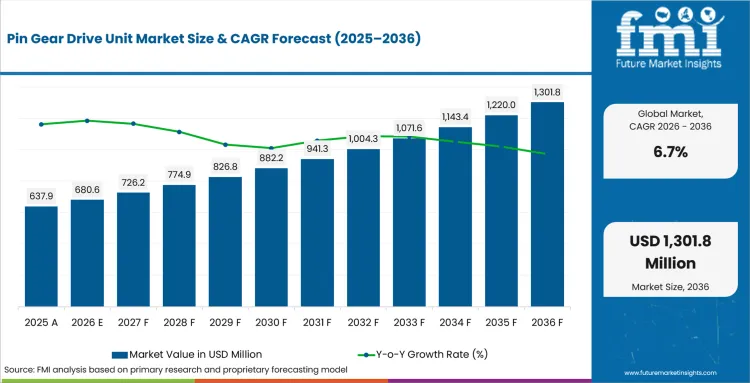
Key Takeaways of Pin Gear Drive Unit Market
- Machinery builders select compact axes delivering repeatable positioning and accountable service support across automated equipment.
- Cam pin gear drives is projected to represent 27.0% share in 2026 due to dependable backlash-controlled rolling contact.
- Medium torque is estimated at 39.0% share in 2026 owing to common indexing duties.
- High precision is anticipated to hold 46.0% share in 2026 as automated axes require repeatable bidirectional positioning.
- Poor mounting practices restrain adoption by weakening repeatability and accelerating wear across installed pin gear assemblies.
- Roller-pinion specialists and matched-drive providers compete through distinct architectures and regional engineering support models worldwide.
Analyst Perspective
“Pin gear drive units suit machines that reverse frequently or require travel beyond practical screw lengths. The decisive test compares complete-axis repeatability under representative load with the accuracy claimed for individual transmission components. Machinery builders should assess alignment with preload and service access to preserve low-backlash performance through commissioning and maintenance.”
- Nikhil Kaitwade, Principal Analyst, Future Market Insights
How is the Pin Gear Drive Unit Market segmented?
The pin gear drive unit industry is segmented by drive type, torque range, precision class, application, sales channel, and region.
The framework separates drive type according to contact geometry translating rotary motion into controlled linear or rotary travel. Torque range groups units by working load and structural capacity across each equipment duty profile. Precision class distinguishes standard accuracy from high-precision and preloaded configurations supporting repeated bidirectional positioning across diverse industrial machinery. Application categories cover indexing tables and robotics beside packaging machinery and machine tools within material-handling systems. Sales channel separates direct OEM supply from motion-control distribution and system-integration routes with different engineering responsibilities. Regional analysis compares service access and installation capability across established manufacturing markets and emerging automation centers worldwide.
What makes cam pin gear drives central to the drive type category?
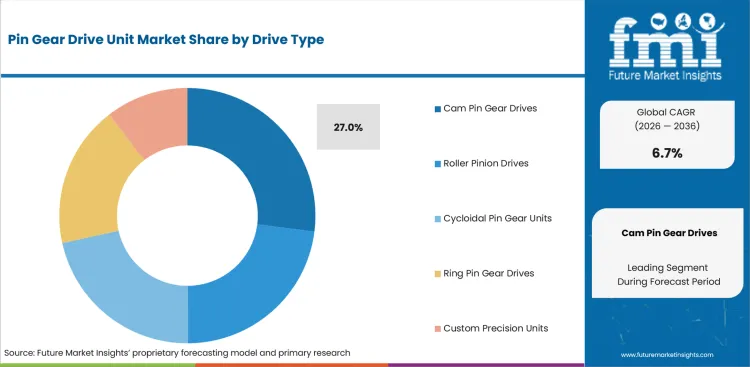
Cam pin gear drives translate rotation through bearing-supported rollers engaging a trochoid cam rack across compact linear or rotary axes. Kamo Seiko documents adjustable preload and sectional rack construction for systems requiring zero backlash across extended travel. Verified design features let machinery builders test reversal accuracy and replace damaged sections without rebuilding the complete assembly during planned maintenance service cycles.
- Cam pin gear drives are set to lead the drive type with 27.0% share in 2026 due to dependable reversal. Rolling contact limits sliding wear and supports reliable movement across machinery intolerant of lost motion. Alternative architectures remain relevant for machines requiring unusual torque density or constrained installation geometry worldwide.
- Packaging machinery manufacturers apply cam pin gear drives across axes that reverse throughout filling and assembly cycles. Industrial robotic motors programs support integrated axis designs across compact automation cells and coordinated production platforms. Adoption depends on alignment guidance and replacement access beside coordinated motor selection for recurring regional machinery builds.
What supports medium torque within the torque range category?
Medium-torque units cover common indexing and transfer loads without oversized housings across standard industrial machinery. Tsubaki documents pin gear configurations supporting large torque and segmented installation across wide equipment footprints. Verified product data helps builders retain service margin while reusing component families across machinery platforms. Published engineering guidance also supports load review before integrators release repeated recurring designs into production.
- By torque range, medium torque is estimated to hold 39.0% share in 2026 owing to capacity across machinery duties. The category supports equipment needing more force than positioning devices without the cost of ultra-heavy assemblies. Common motor interfaces widen component availability across recurring industrial programs and established regional service channels.
- Medium-torque assemblies let system integrators verify loads across packaging and material-handling duty cycles without excessive engineering complexity. Automated material handling systems increase demand for documented force margins and dependable service access across transfer axes. Local engineering support helps teams validate loads without oversized housings or unnecessary component costs during recurring equipment builds.
How does high precision shape the precision class category?
High-precision units address axes that cannot tolerate position loss during repeated reversal or indexing movements. Nexen Group publishes roller pinion accuracy within 30 micrometers and repeatability reaching 5 micrometers consistently. Published limits give builders acceptance criteria for factory testing and maintenance across the installed axis. Mounting tolerances and lubrication responsibility must preserve those specifications throughout extended industrial production service periods.
- The precision class is forecast to be led by high precision at 46.0% share in 2026 due to positioning needs. The segment supports repeatable placement without forcing every project into fully preloaded zero-backlash configurations worldwide. Commercial acceptance depends on documented complete-axis accuracy rather than isolated component specifications during machinery qualification.
- Machine-tool builders select high-precision systems for feed axes that preserve accuracy through reversal and normal thermal variation. Factory automation controls raise expectations for documented repeatability across coordinated mechanical axes and integrated production systems. Regional engineering support protects complete-axis performance by aligning rack geometry and preload with acceptance requirements beyond gearbox specifications.
What supports indexing tables within the application category?
Indexing tables convert controlled rotary motion into repeatable part presentation across assembly and machining stations carrying changing fixtures and workpieces. Nexen Group publishes indexing precision up to ±11 arc-seconds and repeatability up to ±1.2 arc-seconds for its indexing packages. The specifications help machinery builders evaluate workholding under acceleration rather than relying on unloaded component accuracy during recurring production cycles.
- Based on application, indexing tables are projected to account for 28.0% share in 2026 due to frequent assembly use. Low backlash protects angular position before robotic loading or machining begins at each indexed station. Equipment builders reuse validated table architectures across several machine sizes and payload ranges within product families.
- Manufacturers favor table drives that reduce engineering work across bearings and reducers within one rotary package. Integrated table drives support industrial robotics programs with automated loading across connected production lines and inspection stations. Adoption improves when replacement access and documented payload limits support future expansion without redesigning the complete station.
Why does direct OEM lead the sales channel category?
Direct OEM purchasing gives machinery builders early application engineering during load calculation and installation design. GAM Enterprises documents matched rack-and-pinion systems that coordinate gearboxes and pinions around published force requirements. Direct engagement clarifies interface responsibility before component selection becomes fixed across a recurring equipment platform. Distribution channels remain useful for standard replacements requiring limited engineering and faster local component availability.
- In 2026, direct OEM is expected to lead the sales channel with 48.0% share because coordinated sizing reduces interface risk. Machinery builders resolve mounting and preload questions before releasing repeatable designs across multiple customer programs. The route gives one organization clearer responsibility for application records and later service support activities.
- Direct relationships give large equipment programs clearer performance responsibility across integrated motion assemblies and related service obligations. Automated material handling equipment projects require coordinated sizing across racks and pinions alongside gearboxes and servo controls. Direct engineering access resolves mounting tolerances and lubrication plans during design release for recurring machine platforms and regional installations.
What are the drivers, restraints, and opportunities in the Pin Gear Drive Unit Market?
Machine builders need repeatable low-backlash motion while installation precision restrains adoption and matched drive packages reduce engineering complexity.
- Driver: Equipment designers need repeatable positioning integrated with faster servo control across compact automated machinery.
- Restraint: Rack alignment and preload weaken complete-axis accuracy through divided commissioning responsibility across mechanical contractors.
- Opportunity: Matched drive packages shorten engineering cycles through documented components and coordinated local installation support.
Automation investment is increasing machinery platforms that require accurate positioning across repeated reversals and extended travel within compact layouts. Regional robot orders measure projects entering integration pipelines and related machinery design reviews across manufacturing sectors. A3 reported in February 2026 that North American robot orders rose 6.6% during 2025 across general industries. The project base gives pin gear manufacturers more axes requiring documented backlash control across recurring machinery platforms.
Installation accuracy limits adoption since complete-axis performance depends on rack straightness and consistent engagement across the travel path. Machinery builders need repeatable mounting methods that translate nominal precision into dependable results under operating loads. WITTENSTEIN alpha addresses the requirement through its INIRA system for rack adjustment and pinning during installation. Integrated adjustment reduces variation, although divided responsibility between mechanical contractors and controls integrators lengthens acceptance cycles and raises service risk.
Matched drive packages reduce interfaces that machinery builders must validate across motion assemblies and recurring equipment platforms. Engineering teams compare force and precision tiers while selecting coordinated gearbox and pinion packages for each axis. ATLANTA offers rack-and-pinion systems across five precision levels with matched gearboxes and lubrication options for documented application review. A coordinated technical route shortens selection work and helps production teams preserve performance through commissioning and later maintenance.
Which country CAGRs are profiled in the Pin Gear Drive Unit Market?
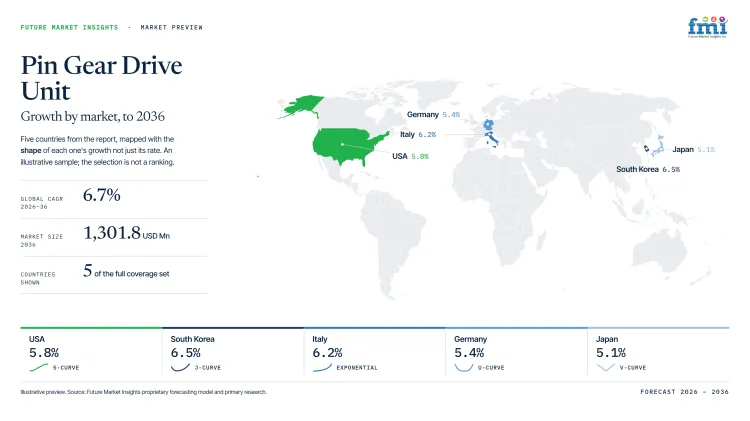
| Country | CAGR |
|---|---|
| United States | 5.8% |
| Germany | 5.4% |
| Japan | 5.1% |
| South Korea | 6.5% |
| Italy | 6.2% |
How do country-level CAGRs compare in the Pin Gear Drive Unit Market?
A 1.4-point spread reflects commissioning capacity rather than different precision-motion needs across profiled countries.
- South Korea converts concentrated machinery investment into automation projects through integrator networks around industrial centers.
- Italy combines equipment consumption with export uncertainty across packaging and machine-tool manufacturers serving international customers.
- United States adoption reflects automation investment beside safety and commissioning requirements for production machinery nationwide.
- Germany pairs engineering capability with cautious capital spending across export-dependent machinery programs and investment cycles.
- Japan prioritizes compact precision and component continuity across machine-tool projects requiring qualification and planned maintenance.
Comparable rates reflect distinct entry routes shaped by local service practices and equipment approval requirements. The full report provides country-level CAGR analysis across North America, Latin America, Europe, East Asia, South Asia, Oceania and the Middle East and Africa.
Country-wise Analysis
- United States machinery builders obtain application engineering through distributors and integrators serving industrial regions with established automation capacity and precision-motion service coverage. The United States is estimated to post 5.8% CAGR over the forecast period, supported by robotics investment and flexible manufacturing programs. Safety approval requires a consistent framework for integrated robot systems and mechanical interfaces across automated production cells. A3 announced ANSI/A3 R15.06-2025 in September 2025 as the revised national standard for industrial robot safety. The requirements reinforce documented risk assessment and local commissioning, although divided responsibility between mechanical and controls contractors can delay final acceptance.
- German machinery projects require detailed application files and disciplined commissioning across equipment programs serving manufacturers and approval teams. Germany’s pin gear drive unit outlook is anticipated to advance at 5.4% CAGR over the assessment period, influenced by engineering depth and established motion-control channels. Capital spending remains uneven across machinery programs and can delay platform approvals despite strong engineering capacity. Destatis reported in June 2026 that machinery and equipment orders fell 7.4% from March to April after seasonal adjustment. The contraction forces retrofit proposals to justify savings clearly, although regional service networks can support complex alignment and component qualification.
- Japanese machinery builders prioritize compact assemblies and specialized engineering support across precision machine tools and tightly arranged regional production cells. Adoption of pin gear drive units in Japan is estimated to expand at 5.1% CAGR through 2036, supported by equipment renewal and investment routes. Certified advanced-equipment plans give smaller manufacturers a tax and financing route for qualifying machinery upgrades. The Small and Medium Enterprise Agency reported in May 2026 that 4,523 plans covered 14,522 equipment units nationwide. The funding route supports accurate feed and indexing motion, although long qualification periods remain a friction for unfamiliar component families.
- South Korean factories operate inside industrial clusters with strong automation integration and direct engineering access near major manufacturing centers for recurring equipment programs. Pin gear drive unit sales in South Korea are forecast to expand at 6.5% CAGR by 2036, reinforced by machinery investment and dense integrator networks. National order data provides evidence of machinery entering local integration pipelines and planned local commissioning activity. The Ministry of Data and Statistics reported in January 2026 that machinery orders increased 6.9% during December 2025. Clustered engineering capacity supports adoption, although limited alignment service can prolong commissioning outside major industrial corridors.
- Italian machinery producers serve packaging and specialized equipment manufacturers through regional integrators with established component relationships and local commissioning experience during planned upgrades. By 2036, Italy is projected to grow at 6.2% CAGR, aided by recovering domestic equipment investment. Sector performance directly affects precision transmission purchases across recurring machinery platforms and export-oriented customer modernization programs. UCIMU reported in July 2026 that consumption of machine tools and automation increased 22.3% in 2025 while exports contracted 12%. Regional application support enables coordinated commissioning, although export weakness postpones platform launches and component qualification across international customer programs with longer approval cycles.
Who are the notable companies in the Pin Gear Drive Unit Market?
Tsubaki, Nexen Group, Kamo Seiko, GAM Enterprises, WITTENSTEIN alpha, APEX Dynamics, STOBER, and ATLANTA Drive Systems are notable companies profiled in this market.
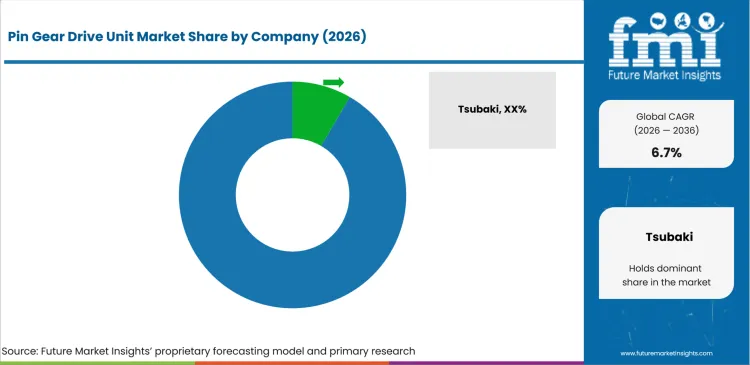
The competitive field is moderately fragmented, with roller-pinion specialists competing beside diversified gearbox manufacturers and regional rack-system providers with technical service channels. No company covers every contact geometry and torque class across all manufacturing regions or service routes for precision machinery worldwide. Entry remains possible for precision-motion companies combining verified load data with application engineering near established regional machinery clusters. Qualification favors established brands; alignment and preload govern complete-axis performance while machine condition monitoring and replacement support shape lifecycle acceptance.
- Tsubaki and Nexen Group focus on roller-based mechanisms supporting low backlash across linear and rotary motion duties for automated machinery. Kamo Seiko adds trochoid cam designs with sectional racks and adjustable preload for extended travel across recurring equipment platforms worldwide.
- GAM Enterprises and WITTENSTEIN alpha provide matched gearbox and pinion systems for machinery requiring coordinated component sizing and mounting support. Their engineering guidance reduces ambiguity across feed-force calculations and gives builders one technical route from selection through commissioning and service.
Competitive Benchmarking: Pin Gear Drive Unit Market
| Company | Load Capability | Precision Control | Compact Integration | Geographic Reach |
|---|---|---|---|---|
| Tsubaki | High | Medium | High | Global or multi-region |
| Nexen Group | High | High | Medium | Global or multi-region |
| Kamo Seiko | High | High | Medium | Asia and selected export markets |
| GAM Enterprises | High | Medium | High | North America and export markets |
| WITTENSTEIN alpha | High | High | High | Global or multi-region |
| APEX Dynamics | Medium | High | High | Global or multi-region |
| STOBER | High | Medium | High | Europe and North America |
| ATLANTA Drive Systems | High | High | High | Global distributor network |
Key Developments in the Pin Gear Drive Unit Market
- In March 2025, Tsubaki displayed pin gear drive units at Smart Factory plus Automation World in Seoul. The exhibit placed pin gear systems beside linear actuators so Korean machinery builders could compare motion architectures within a working automation setting.
- In August 2025, APEX Dynamics presented precision gearboxes and rack-and-pinion systems at the China International Industry Fair. The display linked linear-motion components with machine-tool applications requiring accurate positioning and regional engineering support across smart manufacturing programs.
- In April 2026, GAM Enterprises signed an agreement to acquire selected Schaeffler Ultra Precision Drives assets. The announcement linked the assets with expanded precision-motion capability but did not describe the transaction as completed.
- In March 2026, STOBER introduced its next-generation KS servo gearbox with expanded ratios and an optional geared-motor configuration. The redesign supports tighter integration with rack-and-pinion architectures across automated machinery requiring coordinated speed and torque selection.
Pin Gear Drive Unit Market - Report Scope
| Coverage field | Report scope |
|---|---|
| Market breakdown | Drive type, torque range, precision class, application, sales channel, and region. |
| Market Definition | Precision mechanical drive units using pin wheels, roller pinions, cam racks, or matched rack-and-pinion assemblies for controlled linear or rotary positioning. |
| Regions Covered | North America, Latin America, Europe, East Asia, South Asia, Oceania, and Middle East and Africa. |
| Countries Covered | United States, Canada, Brazil, Mexico, Argentina, Chile, Germany, France, United Kingdom, Italy, Spain, Benelux, Nordics, Poland, Czech Republic, Romania, Hungary, China, Japan, South Korea, India, ASEAN, Australia and New Zealand, GCC Countries, South Africa, Türkiye, and Israel. |
| Key Companies Profiled | Tsubaki, Nexen Group, Kamo Seiko, GAM Enterprises, WITTENSTEIN alpha, APEX Dynamics, STOBER, and ATLANTA Drive Systems. |
| Forecast Period | 2026 to 2036. |
| Approach | Hybrid bottom-up and top-down market sizing supported by primary interviews and official desk research. |
Pin Gear Drive Unit Market - Research Methodology
| Method | Approach |
|---|---|
| Primary Research | FMI analysts gathered input from manufacturers, service providers, technology developers, distributors, end users, procurement teams, and subject-matter experts. Interviews examined purchasing decisions, product or service evaluation, adoption barriers, approval requirements, pricing considerations, and expectations for technical or commercial support. Respondents were also asked what evidence is required before a trial, pilot, or initial order develops into regular purchasing. |
| Desk Research | Desk research covered government statistics, regulatory publications, trade data, industry associations, technical literature, standards, company filings, product information, and official corporate announcements. Sources were reviewed for relevance, publication date, geographic coverage, and consistency with the defined market scope. Claims relating to performance, applications, approvals, capacity, investment, and commercial activity were retained only when supported by credible public evidence. |
| Market Sizing and Forecasting | The market model combined the baseline value with historical performance, segment structure, pricing and volume indicators, adoption levels, company participation, and country-level demand conditions. Forecast assumptions considered economic activity, investment trends, regulatory developments, technology adoption, purchasing cycles, supply availability, and barriers to wider market use. Segment and regional estimates were reconciled before the final market total was calculated. |
| Data Validation | Estimates were checked against multiple independent indicators, including public data, company activity, trade patterns, industry developments, and findings from primary interviews. Validation also tested whether products, services, applications, and company revenues fell within the defined market boundaries. Adjacent categories, unsupported claims, overlapping revenues, and activities without direct market relevance were excluded to reduce double counting and maintain consistency across segments and countries. |
Pin Gear Drive Unit Market by Segments
Pin Gear Drive Unit Market segmented by Drive Type:
- Cam Pin Gear Drives
- Roller Pinion Drives
- Cycloidal Pin Gear Units
- Ring Pin Gear Drives
- Custom Precision Units
Pin Gear Drive Unit Market segmented by Torque Range:
- Medium Torque
- Low Torque
- High Torque
- Ultra-high Torque
Pin Gear Drive Unit Market segmented by Precision Class:
- High Precision
- Standard Precision
- Zero-backlash / Preloaded
Pin Gear Drive Unit Market segmented by Application:
- Indexing Tables
- Robotics
- Packaging Machinery
- Machine Tools
- Material Handling
Pin Gear Drive Unit Market segmented by Sales Channel:
- Direct OEM
- Motion Control Distributors
- System Integrators
Pin Gear Drive Unit Market by Region:
- North America
- United States
- Canada
- Latin America
- Brazil
- Mexico
- Argentina
- Chile
- Western Europe
- Germany
- France
- United Kingdom
- Italy
- Spain
- Benelux
- Nordics
- Eastern Europe
- Poland
- Czech Republic
- Romania
- Hungary
- East Asia
- China
- Japan
- South Korea
- South Asia and Pacific
- India
- ASEAN
- Australia and New Zealand
- Middle East and Africa
- GCC Countries
- South Africa
- Türkiye
- Israel
Research Sources and Bibliography
- Association for Advancing Automation. (2026, February 6). Robot Orders Grow 6.6% in 2025 as General Industries Drive Broader Automation Adoption.
- Association for Advancing Automation. (2025, August 12). New A3 Report Signals Steady Automation Investment in First Half of 2025.
- Association for Advancing Automation. (2025, September 9). New ANSI/A3 R15.06-2025 American National Standard for Industrial Robot Safety Now Available for Purchase.
- Kamo Seiko Corp. (n.d.)
- Nexen Group. (n.d.). Roller Pinion Racks deliver constant positional accuracy.
- Nexen Group. (n.d.). Precision indexing package with low backlash and high torque.
- Tsubakimoto Chain Co. (2025, March 12). Smart Factory + Automation World 2025(AW2025).
- Tsubakimoto Europe B.V. (n.d.). Pin Gear Drive Unit.
- GAM Enterprises, LLC. (n.d.). Helical Rack and Pinion Systems.
- GAM Enterprises, LLC. (2026, April 14). GAM acquires certain assets of Schaeffler Ultra Precision Drives (SUPD).
- Federal Statistical Office. (2026, June 8). New orders in manufacturing in April 2026: -3.8% on the previous month.
- Small and Medium Enterprise Agency. (2026, May 8).
- Ministry of Data and Statistics. (2026, January 30). Monthly Industrial Statistics, December 2025.
- UCIMU-SISTEMI PER PRODURRE. (2026, July 7). ASSEMBLEA UCIMU: dopo un 2025 complessivamente debole, nel 2026 l’industria italiana costruttrice di macchine utensili, robot e automazione dovrebbe registrare una timida ripresa. Grandi aspettative per l’effetto dell’Iperammortamento.
- APEX Dynamics, Inc. (2025, August 1). APEX DYNAMICS at the 25th China International Industry Fair 09/23–09/27, 2025 | CIIF 2025 (Shanghai, China): Precision gearboxes and rack & pinion for smart manufacturing.
- STOBER Drives Inc. (2026, March 5). STOBER introduces next-generation KS servo gearbox with compact design.
This bibliography is provided for reader reference and is not exhaustive. The full report contains the complete reference list and detailed citations
This Report Answers
- How large is the global Pin Gear Drive Unit market, and what is its growth outlook?
- What factors are supporting the adoption of pin gear drive units across industrial applications?
- Why do cam-driven pin gear drive units account for the significant market share?
- Why does the medium-torque segment dominate demand in the market?
- Why is high-precision motion control a critical requirement in pin gear drive unit applications?
- How do market growth rates and demand trends compare across key countries?
- Which leading companies are competing in the global Pin Gear Drive Unit market?
- Which operational, alignment, and maintenance issues can weaken system accuracy and performance?
Frequently Asked Questions
How big is the Pin Gear Drive Unit Market in 2026?
The pin gear drive unit market is valued at USD 680.6 million in 2026 and is forecast to reach USD 1301.8 million by 2036. Growth is supported by industrial automation programs that require repeatable backlash-controlled positioning across frequently reversing machinery in packaging and machine-tool equipment.
What is the CAGR of the Pin Gear Drive Unit Market from 2026 to 2036?
The pin gear drive unit market grows at a CAGR of 6.7% between 2026 and 2036, supported by equipment designers needing repeatable positioning integrated with faster servo control across compact automated machinery, alongside expanding robot order volumes entering regional integration pipelines.
Which precision class leads the Pin Gear Drive Unit Market?
High precision accounts for 46.0% of the pin gear drive unit market by precision class in 2026, driven by axes that cannot tolerate position loss during repeated reversal or indexing movements, supported by documented complete-axis accuracy required during machinery qualification.
How much will the Pin Gear Drive Unit Market add between 2026 and 2036?
The pin gear drive unit market is set to add USD 621.2 million between 2026 and 2036, growing from USD 680.6 million to USD 1301.8 million as automation investment expands machinery platforms requiring documented backlash control across repeated reversals and extended travel worldwide.
Who are the leading companies in the Pin Gear Drive Unit Market?
Eight companies lead the pin gear drive unit market, including Tsubaki, Nexen Group, Kamo Seiko, GAM Enterprises, WITTENSTEIN alpha, APEX Dynamics, STOBER, and ATLANTA Drive Systems, competing through load capability, precision control, and compact integration across global distributor networks.
Preview the report firsthand - request a free sample
Get SampleGet the brochure for pricing and purchase details.
Get PDFTable of Content
- Key Takeaways
- Market Size and CAGR
- Top Growth Driver
- Fastest Growing Segment
- Leading Region
- Key Companies
- Emerging Opportunities
- Executive Summary
- Global Market Outlook
- Demand-side Trends
- Supply-side Trends
- Technology Roadmap Analysis
- Analysis and Recommendations
- Analyst Perspective (What is happening? Why now? What should investors know?)
- Key Questions Answered
- How large is the market?
- What is the CAGR?
- What are key trends?
- Which region dominates?
- Who are the leaders?
- Market Overview
- Market Coverage / Taxonomy
- Market Definition / Scope / Limitations
- Research Methodology
- Chapter Orientation
- Analytical Lens and Working Hypotheses
- Market Structure, Signals, and Trend Drivers
- Benchmarking and Cross-market Comparability
- Market Sizing, Forecasting, and Opportunity Mapping
- Research Design and Evidence Framework
- Desk Research Programme (Secondary Evidence)
- Expert Input and Fieldwork (Primary Evidence)
- Tooling, Models, and Reference Databases
- Data Engineering and Model Build
- Quality Assurance and Audit Trail
- Market Background
- Market Dynamics (Drivers, Restraints, Opportunity, Trends)
- Scenario Forecast (Optimistic, Likely, Conservative)
- Impact Analysis
- AI Impact
- Sustainability Impact
- Regulatory Impact
- Technology Impact
- Consumer / Buyer Analysis
- Purchase Drivers
- Adoption Barriers
- Buyer Journey
- Opportunity Map Analysis
- Product Life Cycle Analysis
- Supply Chain Analysis
- Investment Feasibility Matrix
- Value Chain Analysis
- PESTLE and Porter's Analysis
- Regulatory Landscape
- Regional Parent Market Outlook
- Production and Consumption Statistics
- Import and Export Statistics
- Global Market Analysis and Forecast, 2021 to 2036
- Historical Market Size Value (USD Million) Analysis, 2021 to 2025
- Current and Future Market Size Value (USD Million) Projections, 2026 to 2036
- Y-o-Y Growth Trend Analysis
- Absolute $ Opportunity Analysis
- Global Market Pricing Analysis, 2021 to 2036
- Global Market Analysis and Forecast, By Drive Type, 2021 to 2036
- Introduction / Key Findings
- Historical Market Size Value (USD Million) Analysis By Drive Type, 2021 to 2025
- Current and Future Market Size Value (USD Million) Analysis and Forecast By Drive Type, 2026 to 2036
- Cam Pin Gear Drives
- Roller Pinion Drives
- Cycloidal Pin Gear Units
- Ring Pin Gear Drives
- Custom Precision Units
- Cam Pin Gear Drives
- Y-o-Y Growth Trend Analysis By Drive Type, 2021 to 2025
- Absolute $ Opportunity Analysis By Drive Type, 2026 to 2036
- Global Market Analysis and Forecast, By Torque Range, 2021 to 2036
- Introduction / Key Findings
- Historical Market Size Value (USD Million) Analysis By Torque Range, 2021 to 2025
- Current and Future Market Size Value (USD Million) Analysis and Forecast By Torque Range, 2026 to 2036
- Medium Torque
- Low Torque
- High Torque
- Ultra-high Torque
- Medium Torque
- Y-o-Y Growth Trend Analysis By Torque Range, 2021 to 2025
- Absolute $ Opportunity Analysis By Torque Range, 2026 to 2036
- Global Market Analysis and Forecast, By Precision Class, 2021 to 2036
- Introduction / Key Findings
- Historical Market Size Value (USD Million) Analysis By Precision Class, 2021 to 2025
- Current and Future Market Size Value (USD Million) Analysis and Forecast By Precision Class, 2026 to 2036
- High Precision
- Standard Precision
- Zero-backlash / Preloaded
- High Precision
- Y-o-Y Growth Trend Analysis By Precision Class, 2021 to 2025
- Absolute $ Opportunity Analysis By Precision Class, 2026 to 2036
- Global Market Analysis and Forecast, By Application, 2021 to 2036
- Introduction / Key Findings
- Historical Market Size Value (USD Million) Analysis By Application, 2021 to 2025
- Current and Future Market Size Value (USD Million) Analysis and Forecast By Application, 2026 to 2036
- Indexing Tables
- Robotics
- Packaging Machinery
- Machine Tools
- Material Handling
- Indexing Tables
- Y-o-Y Growth Trend Analysis By Application, 2021 to 2025
- Absolute $ Opportunity Analysis By Application, 2026 to 2036
- Global Market Analysis and Forecast, By Sales Channel, 2021 to 2036
- Introduction / Key Findings
- Historical Market Size Value (USD Million) Analysis By Sales Channel, 2021 to 2025
- Current and Future Market Size Value (USD Million) Analysis and Forecast By Sales Channel, 2026 to 2036
- Direct OEM
- Motion Control Distributors
- System Integrators
- Direct OEM
- Y-o-Y Growth Trend Analysis By Sales Channel, 2021 to 2025
- Absolute $ Opportunity Analysis By Sales Channel, 2026 to 2036
- Global Market Analysis and Forecast, By Region, 2021 to 2036
- Introduction
- Historical Market Size Value (USD Million) Analysis By Region, 2021 to 2025
- Current Market Size Value (USD Million) Analysis and Forecast By Region, 2026 to 2036
- North America
- Latin America
- Western Europe
- Eastern Europe
- East Asia
- South Asia and Pacific
- Middle East & Africa
- Market Attractiveness Analysis By Region
- North America Market Analysis and Forecast, By Country, 2021 to 2036
- Historical Market Size Value (USD Million) Trend Analysis By Market Taxonomy, 2021 to 2025
- Market Size Value (USD Million) Forecast By Market Taxonomy, 2026 to 2036
- By Country
- USA
- Canada
- By Drive Type
- By Torque Range
- By Precision Class
- By Application
- By Sales Channel
- By Country
- Market Attractiveness Analysis
- By Country
- By Drive Type
- By Torque Range
- By Precision Class
- By Application
- By Sales Channel
- Key Takeaways
- Latin America Market Analysis and Forecast, By Country
- Historical Market Size Value (USD Million) Trend Analysis By Market Taxonomy, 2021 to 2025
- Market Size Value (USD Million) Forecast By Market Taxonomy, 2026 to 2036
- By Country
- Brazil
- Mexico
- Chile
- Rest of Latin America
- By Drive Type
- By Torque Range
- By Precision Class
- By Application
- By Sales Channel
- By Country
- Market Attractiveness Analysis
- By Country
- By Drive Type
- By Torque Range
- By Precision Class
- By Application
- By Sales Channel
- Key Takeaways
- Western Europe Market Analysis and Forecast, By Country
- Historical Market Size Value (USD Million) Trend Analysis By Market Taxonomy, 2021 to 2025
- Market Size Value (USD Million) Forecast By Market Taxonomy, 2026 to 2036
- By Country
- Germany
- UK
- Italy
- Spain
- France
- Nordic
- BENELUX
- Rest of Western Europe
- By Drive Type
- By Torque Range
- By Precision Class
- By Application
- By Sales Channel
- By Country
- Market Attractiveness Analysis
- By Country
- By Drive Type
- By Torque Range
- By Precision Class
- By Application
- By Sales Channel
- Key Takeaways
- Eastern Europe Market Analysis and Forecast, By Country
- Historical Market Size Value (USD Million) Trend Analysis By Market Taxonomy, 2021 to 2025
- Market Size Value (USD Million) Forecast By Market Taxonomy, 2026 to 2036
- By Country
- Russia
- Poland
- Hungary
- Balkan & Baltic
- Rest of Eastern Europe
- By Drive Type
- By Torque Range
- By Precision Class
- By Application
- By Sales Channel
- By Country
- Market Attractiveness Analysis
- By Country
- By Drive Type
- By Torque Range
- By Precision Class
- By Application
- By Sales Channel
- Key Takeaways
- East Asia Market Analysis and Forecast, By Country
- Historical Market Size Value (USD Million) Trend Analysis By Market Taxonomy, 2021 to 2025
- Market Size Value (USD Million) Forecast By Market Taxonomy, 2026 to 2036
- By Country
- China
- Japan
- South Korea
- By Drive Type
- By Torque Range
- By Precision Class
- By Application
- By Sales Channel
- By Country
- Market Attractiveness Analysis
- By Country
- By Drive Type
- By Torque Range
- By Precision Class
- By Application
- By Sales Channel
- Key Takeaways
- South Asia and Pacific Market Analysis and Forecast, By Country
- Historical Market Size Value (USD Million) Trend Analysis By Market Taxonomy, 2021 to 2025
- Market Size Value (USD Million) Forecast By Market Taxonomy, 2026 to 2036
- By Country
- India
- ASEAN
- Australia & New Zealand
- Rest of South Asia and Pacific
- By Drive Type
- By Torque Range
- By Precision Class
- By Application
- By Sales Channel
- By Country
- Market Attractiveness Analysis
- By Country
- By Drive Type
- By Torque Range
- By Precision Class
- By Application
- By Sales Channel
- Key Takeaways
- Middle East & Africa Market Analysis and Forecast, By Country
- Historical Market Size Value (USD Million) Trend Analysis By Market Taxonomy, 2021 to 2025
- Market Size Value (USD Million) Forecast By Market Taxonomy, 2026 to 2036
- By Country
- Kingdom of Saudi Arabia
- Other GCC Countries
- Türkiye
- South Africa
- Other African Union
- Rest of Middle East & Africa
- By Drive Type
- By Torque Range
- By Precision Class
- By Application
- By Sales Channel
- By Country
- Market Attractiveness Analysis
- By Country
- By Drive Type
- By Torque Range
- By Precision Class
- By Application
- By Sales Channel
- Key Takeaways
- Key Countries Market Analysis
- USA
- Pricing Analysis
- Market Share Analysis, 2025
- By Drive Type
- By Torque Range
- By Precision Class
- By Application
- By Sales Channel
- Canada
- Pricing Analysis
- Market Share Analysis, 2025
- By Drive Type
- By Torque Range
- By Precision Class
- By Application
- By Sales Channel
- Mexico
- Pricing Analysis
- Market Share Analysis, 2025
- By Drive Type
- By Torque Range
- By Precision Class
- By Application
- By Sales Channel
- Brazil
- Pricing Analysis
- Market Share Analysis, 2025
- By Drive Type
- By Torque Range
- By Precision Class
- By Application
- By Sales Channel
- Chile
- Pricing Analysis
- Market Share Analysis, 2025
- By Drive Type
- By Torque Range
- By Precision Class
- By Application
- By Sales Channel
- Germany
- Pricing Analysis
- Market Share Analysis, 2025
- By Drive Type
- By Torque Range
- By Precision Class
- By Application
- By Sales Channel
- UK
- Pricing Analysis
- Market Share Analysis, 2025
- By Drive Type
- By Torque Range
- By Precision Class
- By Application
- By Sales Channel
- Italy
- Pricing Analysis
- Market Share Analysis, 2025
- By Drive Type
- By Torque Range
- By Precision Class
- By Application
- By Sales Channel
- Spain
- Pricing Analysis
- Market Share Analysis, 2025
- By Drive Type
- By Torque Range
- By Precision Class
- By Application
- By Sales Channel
- France
- Pricing Analysis
- Market Share Analysis, 2025
- By Drive Type
- By Torque Range
- By Precision Class
- By Application
- By Sales Channel
- India
- Pricing Analysis
- Market Share Analysis, 2025
- By Drive Type
- By Torque Range
- By Precision Class
- By Application
- By Sales Channel
- ASEAN
- Pricing Analysis
- Market Share Analysis, 2025
- By Drive Type
- By Torque Range
- By Precision Class
- By Application
- By Sales Channel
- Australia & New Zealand
- Pricing Analysis
- Market Share Analysis, 2025
- By Drive Type
- By Torque Range
- By Precision Class
- By Application
- By Sales Channel
- China
- Pricing Analysis
- Market Share Analysis, 2025
- By Drive Type
- By Torque Range
- By Precision Class
- By Application
- By Sales Channel
- Japan
- Pricing Analysis
- Market Share Analysis, 2025
- By Drive Type
- By Torque Range
- By Precision Class
- By Application
- By Sales Channel
- South Korea
- Pricing Analysis
- Market Share Analysis, 2025
- By Drive Type
- By Torque Range
- By Precision Class
- By Application
- By Sales Channel
- Russia
- Pricing Analysis
- Market Share Analysis, 2025
- By Drive Type
- By Torque Range
- By Precision Class
- By Application
- By Sales Channel
- Poland
- Pricing Analysis
- Market Share Analysis, 2025
- By Drive Type
- By Torque Range
- By Precision Class
- By Application
- By Sales Channel
- Hungary
- Pricing Analysis
- Market Share Analysis, 2025
- By Drive Type
- By Torque Range
- By Precision Class
- By Application
- By Sales Channel
- Kingdom of Saudi Arabia
- Pricing Analysis
- Market Share Analysis, 2025
- By Drive Type
- By Torque Range
- By Precision Class
- By Application
- By Sales Channel
- Türkiye
- Pricing Analysis
- Market Share Analysis, 2025
- By Drive Type
- By Torque Range
- By Precision Class
- By Application
- By Sales Channel
- South Africa
- Pricing Analysis
- Market Share Analysis, 2025
- By Drive Type
- By Torque Range
- By Precision Class
- By Application
- By Sales Channel
- USA
- Market Structure Analysis
- Competition Dashboard
- Competition Benchmarking
- Market Share Analysis of Top Players
- By Regional
- By Drive Type
- By Torque Range
- By Precision Class
- By Application
- By Sales Channel
- Emerging Startups
- Innovation Benchmarking
- Competition Analysis
- Competition Deep Dive
- Tsubaki
- Overview
- Product Portfolio
- Profitability by Market Segments
- Sales Footprint
- Strategy Overview
- Marketing Strategy
- Product Strategy
- Channel Strategy
- Nexen Group
- Kamo Seiko
- GAM Enterprises
- Nabtesco
- Sumitomo Drive Technologies
- Wittenstein
- Apex Dynamics
- Stöber
- ATLANTA Drive Systems
- Tsubaki
- Case Studies
- Success Stories
- Recent Developments
- Competition Deep Dive
- Assumptions & Acronyms Used


