

- Market Size (2026)
- USD 1.1 Bn
- Forecast (2036)
- USD 2.0 Bn
- CAGR (2026 to 2036)
- 5.7%
How big is Polypropylene Adhesives Market in 2026?
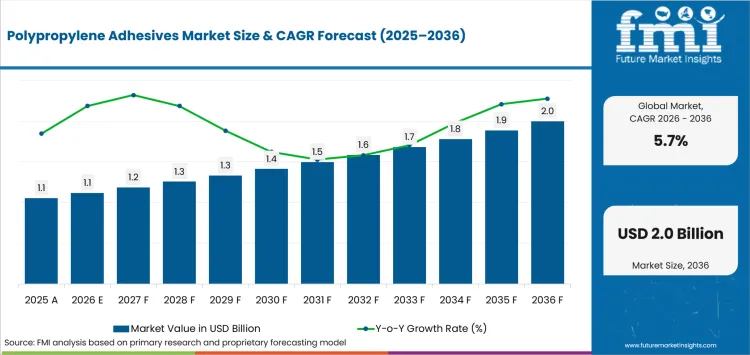
USD 1.1 billion in 2026 and USD 2.0 billion by 2036 at a 5.7% CAGR.
Demand for polypropylene adhesives is projected to expand at 5.7% CAGR between 2026 and 2036, increasing valuation from USD 1.1 billion in 2026 to USD 2.0 billion by 2036. Packaging remains the clearest volume route because polypropylene structures need bonds that tolerate line speed and recycling checks. In March 2025 Henkel introduced TECHNOMELT SUPRA PRO 301 PLUS for pharmaceutical carton sealing with 160-millisecond curing. Faster curing reduces the risk that adhesive becomes the bottleneck as packaging lines raise throughput.
Country growth diverges because packaging rules and manufacturing concentration change how quickly adhesive systems reach qualification. Australia is expected to rise at 6.4% CAGR while Japan is forecast at 4.5% CAGR. Australia’s environment department confirmed the Australian Packaging Covenant Organisation as the national co-regulator for packaging on October 2 2025. The co-regulatory model raises the value of local converter testing because recyclability claims must fit domestic packaging obligations. Japan’s mature manufacturing base instead places more weight on process stability and controlled change.
Key Takeaways
- Recyclable packaging and polypropylene-intensive assemblies support demand because adhesive approval now depends on both bond performance and the intended recovery route.
- Based on chemistry, polyolefin hot melts are projected to account for 29.0% in 2026 due to fast setting and tunable processing behavior.
- In 2026 hot melt is expected to lead the form category with 34.0% share because automated dosing fits continuous production lines.
- By surface treatment, primer required is estimated to hold 38.0% in 2026 owing to repeatable wet-out on difficult polypropylene grades.
- Low polypropylene surface energy raises switching cost because each new grade or treatment state may require another bond-validation cycle.
- Some of the key players in this market include Henkel, 3M, H.B. Fuller, Arkema / Bostik, Sika, Dow, Avery Dennison, Jowat, Permabond, and Lohmann.
Analyst Perspective
"Polypropylene adhesive selection should begin with the exact resin grade and treatment state because small surface changes can alter bond strength. Commercial value comes from reducing trial work and keeping line settings stable after a formulation passes qualification."
- Nikhil Kaitwade, Principal Consultant, Future Market Insights
How is the polypropylene adhesives market segmented?
The polypropylene adhesives market is segmented by chemistry, form, surface treatment, application and sales channel.
Chemistry covers polyolefin hot melts, modified acrylic adhesives, solvent-based PP adhesives, cyanoacrylate primers + adhesives and reactive polyurethane adhesives. Form includes hot melt, liquid, tape - film, spray adhesive and structural adhesive. Surface treatment covers primer required, corona - plasma treated, flame treated and no-treatment specialty. Applications include packaging, automotive interiors, appliances, medical disposables and consumer goods. Sales channels include industrial distributors, packaging converters, direct OEM supply and specialty formulators.
Why do polyolefin hot melts lead demand within the chemistry category?
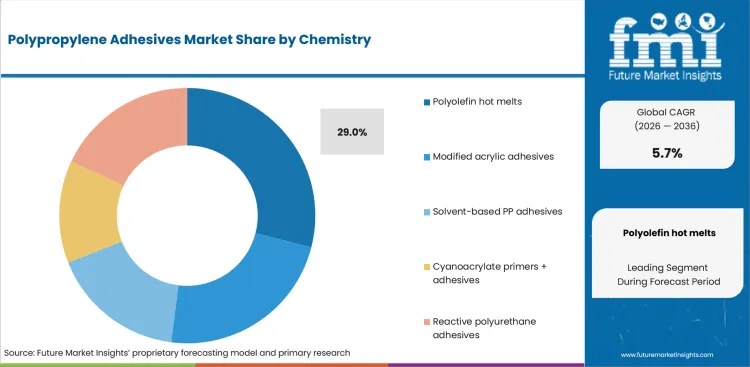
Polyolefin hot melt adhesives suit packaging lines that meter adhesive continuously and need handling strength before the next converting step. Their short set time also limits the dwell space required between application and compression on fast carton or assembly lines.
- Based on chemistry, polyolefin hot melts are projected to account for 29.0% in 2026 owing to short set times and tunable viscosity for polypropylene-rich packaging and assembly.
- Henkel expanded this formulation route in May 2025 by introducing TECHNOMELT KS 928 for polypropylene edge banding. The launch targets heat resistance and low application temperature, giving formulators a recent example of polyolefin-compatible hot-melt qualification.
Why does hot melt lead demand within the form category?
Industrial adhesives in hot melt form fit automated dosing because the adhesive reaches handling strength without a solvent-drying stage. Packaging lines still need open time and application temperature matched to each line’s compression window.
- In 2026 hot melt is expected to lead the form category with 34.0% share because fast setting supports continuous dosing and reduces waiting time between application and handling.
- H.B. Fuller introduced a new sustainable hot melt for case and carton sealing at FachPack in September 2025. The company also presented Flextra laminating products, showing how hot-melt selection is being tied to material reduction and recycling goals.
How does primer required lead demand within the surface treatment category?
Primer-required systems address polypropylene’s low surface energy by changing the interface before the structural adhesive is applied. Pressure-sensitive adhesives may avoid that step on selected surfaces, but primer remains practical where established adhesive families already meet durability requirements.
- By surface treatment, primer required is estimated to hold 38.0% in 2026 attributable to the need for repeatable wet-out on difficult polypropylene grades.
- RecyClass updated its laminating-adhesive guidance for PE and PP flexible packaging in January 2025. The change places adhesive compatibility inside packaging design reviews, which increases the value of documented primer use and tested recycling performance.
Why does packaging lead demand within the application category?
Packaging uses adhesives repeatedly in carton sealing and labels as well as flexible lamination. Flexible adhesives must protect the package during filling and distribution without undermining the recovery route selected for a polypropylene-rich structure.
- By application, packaging is forecast to represent 31.0% in 2026 driven by frequent adhesive use in converting and end-of-line sealing.
- Arkema presented new Bostik flexible-packaging lamination adhesives at K 2025 in September 2025. The announcement focused on recyclable structures and processing performance, giving converters a current route for qualifying adhesives against material-reduction targets.
Why do industrial distributors lead demand within the sales channel category?
Industrial distributors remain useful where smaller plants need samples and local stock before an adhesive reaches routine use. Adhesive transfer tape and liquid systems also require application guidance because polypropylene surface condition can vary by grade and treatment.
- Industrial distributors are set to lead the sales channel with 35.0% share in 2026 due to local inventory and technical support during qualification.
- Lohmann named Dantex its exclusive UK distributor for DuploFLEX plate-mounting tapes in February 2025. The partnership shortens access to technical support for flexible-packaging printers, which illustrates why distribution depth can influence adhesive adoption.
What are the drivers, restraints and opportunities in the polypropylene adhesives market?
Packaging redesign raises demand for qualified polypropylene bonding systems. Low surface energy lengthens validation, while application support can shorten the path from trial to repeat order.
- Driver: Packaging redesign increases adhesive qualification because bond performance must fit recyclability and production-speed requirements.
- Restraint: Low surface energy can require primer or surface treatment and extend approval work for each polypropylene grade.
- Opportunity: Better application testing can reduce trial cycles for no-treatment adhesives and tape systems without weakening durability checks.
Packaging redesign increases qualification demand
Packaging redesign raises adhesive demand because polypropylene structures must satisfy bond performance and recyclability tests within the same approval program. Regulation (EU) 2025/40 entered into force in February 2025 and requires packaging to meet staged recyclability performance rules. The rule changes qualification: converters must test polypropylene materials and adhesive choices as one package before committing a structure to volume production.
Low surface energy lengthens validation
Low surface energy is the main technical barrier as many structural adhesives cannot wet untreated polypropylene well enough for durable bonding. RecyClass revised design guidance for PP films and rigid packs in March 2026 after new laboratory findings. Qualification can therefore require treatment checks and recycling tests before a formulation is accepted, extending changeover work for each new substrate.
Application support can shorten the route to repeat orders
Application support is the clearest route to faster adoption where surface treatment and aging tests delay approval. 3M announced Ask 3M and an expanded Digital Materials Hub in December 2025 to speed material discovery and technical collaboration. For industrial tapes and liquid adhesives, faster screening can reduce trial cycles before plant testing while keeping final bond qualification on the actual polypropylene part.
Which country CAGRs are profiled in the polypropylene adhesives market?
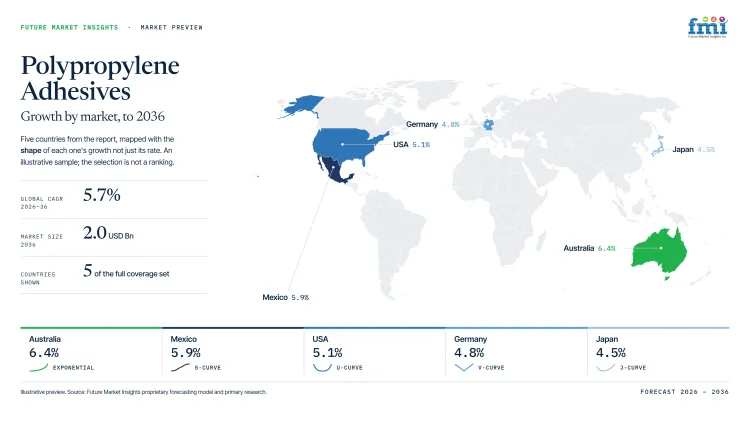
| Country | CAGR |
|---|---|
| Australia | 6.4% |
| Mexico | 5.9% |
| Brazil | 5.5% |
| USA | 5.1% |
| Italy | 4.9% |
| Germany | 4.8% |
| Japan | 4.5% |
How do country-level CAGRs compare in the polypropylene adhesives market?
The profiled countries span 1.9 percentage points, with Australia and Mexico forming the upper growth band and Japan defining the lower edge. Brazil occupies the middle at 5.5% while the USA, Italy and Germany cluster within 0.3 points. The spread points to different qualification speeds more than different levels of technical sophistication.
- Packaging reform raises qualification demand in dispersed Australian channels.
- Border-linked manufacturing favors fast sample replenishment for Mexican plants.
- Brazil’s large geography increases the value of regional technical coverage.
- US accounts span packaging plants and multi-site automotive programs.
- Italian converters often qualify adhesives beside film-structure changes.
- German chemical and automotive clusters sustain demanding technical accounts.
- Japanese plants favor controlled process change and longer validation.
Comparable CAGRs can produce different entry conditions because service depth and qualification routes determine how quickly trials become orders. The full report provides country-level CAGR analysis across North America, Latin America, Western Europe, Eastern Europe, East Asia, South Asia and Pacific, and the Middle East and Africa.
Country-wise Analysis
- Long service distances shape Australian adhesive programs because plant trials and sample replenishment can take longer outside major coastal hubs. Polypropylene adhesive sales in Australia are forecast to expand at 6.4% CAGR by 2036, tied to packaging redesign and local technical support. DCCEEW documented in October 2025 that Australia Post had recycled more than 100 tonnes of plastic mail bags through Big Bag Recovery into recycled polypropylene pellets. That traceability route gives packaging teams a clear local recovery reference. Distance remains the commercial friction, favoring companies with local stock and application support.
- Vehicle-program release schedules shape Mexican adhesive purchases because tier plants need materials ready before line trials begin. Mexico is set to post 5.9% CAGR over the forecast period, propelled by dense manufacturing clusters and shorter replenishment routes. INEGI recorded 1,496,806 light-vehicle sales in 2024 in its January 2025 release, up 9.8% from the prior year. Vehicle-program timing favors rapid automotive bonding trials on interiors and trim, but adhesive changes can stall if resin grades differ between plants. Local inventory becomes decisive when a new program cannot absorb a long sample lead time.
- A wide national territory makes regional technical coverage important for Brazilian packaging plants and consumer-goods converters. Plastic-packaging qualification gained a stronger recovery requirement after Brazil issued Decree 12,688 in October 2025 and set minimum recycled content at 22% for 2026. Polypropylene adhesive demand in Brazil is projected to rise at 5.5% CAGR over the forecast period, attributable to packaging volume and tighter recovery rules. Regional distribution reduces sample lead times, but uneven collection and documentation can slow approval of new recyclable structures. Companies with local test support can convert trials more reliably than firms serving Brazil from distant hubs.
- High-volume packaging lines coexist with automotive and appliance plants in the USA, making application conditions less uniform than national scale suggests. The USA is projected to grow at 5.1% CAGR through 2036, helped by a broad manufacturing base and deep technical distribution. BLS counted about 106,000 jobs in plastics packaging materials and unlaminated film and sheet manufacturing in December 2025. The manufacturing base supports local trial capacity for medical adhesive and packaging applications, but validation still follows each resin grade and production environment. National reach is useful only if test data transfers between plants without losing approval assumptions.
- In Italy’s mature collection system, flexible-packaging converters increasingly judge adhesive changes by whether simplified structures preserve bond integrity during filling and recovery. CONAI reported in June 2025 that Italy recycled 76.7% of packaging placed on the market during 2024. Polypropylene adhesive demand in Italy is anticipated to advance at 4.9% CAGR over the assessment period, driven by converter investment in recyclable film and label structures. High recycling performance gives brand owners an established recovery route for qualified packages. The friction shifts to formulation change because converters must preserve line speed while removing layers or coatings that complicate recycling.
- Recyclability documentation has become a practical part of German packaging approval because adhesive and label choices can alter the intended recovery route. Germany is on track to deliver 4.8% CAGR through 2036, supported by strong converting capability and formal design-for-recycling checks. The German Environment Agency issued its 2025 minimum standard for recycling-friendly packaging on August 29 2025 and linked assessment to the Packaging Act framework. The standard gives converters a clear qualification reference, though strong polypropylene adhesion can conflict with removable labels or simplified laminates. Companies that pair recyclability documentation with bond testing are better placed to win repeat programs.
- Controlled plant trials shape Japanese adhesive changes because production teams value repeatable settings and traceable material revisions over faster switching. Japan’s environment ministry recorded 767,595 tonnes of separately collected plastic containers and packaging for fiscal 2024 in its March 2026 release. Adoption of polypropylene adhesives in Japan is estimated to expand at 4.5% CAGR through 2036, owing to steady packaging recovery and high process discipline. Collection scale makes end-of-life requirements visible during package design. Long validation cycles remain the friction, so a formulation that saves one treatment step still needs proof that it will not disturb established line conditions.
Who are the notable companies in the polypropylene adhesives market?
Henkel, 3M, H.B. Fuller, Arkema / Bostik, Sika, Dow, Avery Dennison, Jowat, Permabond, and Lohmann are the notable companies serving this market.
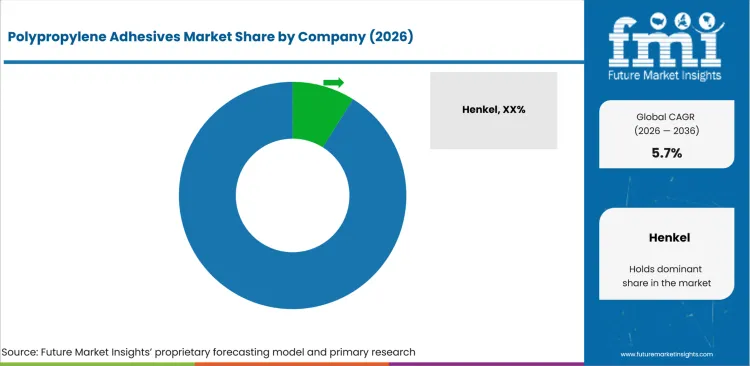
The field separates into broad formulators, low-surface-energy specialists and tape or material platforms. Entry is difficult because polypropylene adhesion depends on surface condition and each application requires proof on the actual grade. Large packaging and OEM accounts also expect local technical support and repeatable production supply.
- Henkel, H.B. Fuller, Arkema / Bostik and Jowat provide broad industrial or packaging adhesive platforms with formulation support.
- 3M, Sika and Permabond address difficult-plastic bonding through structural adhesives, surface-treatment routes or application-specific technical support.
- Dow supplies polyolefin formulation inputs while Avery Dennison and Lohmann compete through pressure-sensitive tape and converting technologies.
Competitive Benchmarking: Polypropylene Adhesives Market
| Company | Relevant Format Breadth | Application Channel Depth | Qualification Support | Geographic Reach |
|---|---|---|---|---|
| Henkel | High | High | High | Global |
| 3M | High | High | High | Global |
| H.B. Fuller | High | High | High | Global |
| Arkema / Bostik | High | High | High | Global |
| Sika | High | Medium | High | Global |
| Dow | Medium | High | High | Global |
| Avery Dennison | Medium | High | High | Global |
| Jowat | High | High | Medium | Global |
| Permabond | Medium | Low | High | Europe, Americas and Asia-Pacific |
| Lohmann | Medium | High | High | Europe, Americas and Asia |
Scoring basis: High format breadth requires at least three documented adhesive or tape routes while Medium requires two and Low identifies one. High channel depth requires documented participation in at least three relevant application or converting groups while Medium requires two and Low identifies one. High qualification support requires multiple documented technical-service or validation routes while Medium is narrower and Low reflects a documented limited route.
Key Developments in the Polypropylene Adhesives Market
- In May 2026, Lohmann and BOBST Florence completed the “Lohmann Certified” qualification for pressure-sensitive plate-mounting tapes. The certification gives flexible-packaging printers a documented machine-and-tape pairing that can shorten validation before commercial runs.
- In April 2026, Arkema / Bostik unified its flexible-material laminating adhesives and coatings under the ADCOTE brand after expanding the portfolio. The move gives converters one global product architecture while preserving local technical support for lamination qualification.
- In May 2025, Henkel and Sasol announced a lower-carbon hot-melt collaboration using SASOLWAX LC100 in TECHNOMELT packaging formulations. The drop-in wax route targets carbon reduction without requiring packaging lines to rebuild established application settings.
Key Players in the Polypropylene Adhesives Market
Broad formulation and packaging platforms
- Henkel
- H.B. Fuller
- Arkema / Bostik
- Jowat
Low-surface-energy bonding and treatment specialists
- 3M
- Sika
- Permabond
Tape, film and polyolefin material platforms
- Dow
- Avery Dennison
- Lohmann
Polypropylene Adhesives Market - Report Scope
| Coverage field | Report scope |
|---|---|
| Market breakdown | By chemistry, form, surface treatment, application, sales channel and region. |
| Quantitative Units | USD billion. |
| Market Definition | Revenue from formulated adhesives and paired primer-adhesive systems sold for bonding polypropylene within the stated segmentation universe. Downstream finished-product revenue and stand-alone surface-treatment equipment are excluded. |
| Regions Covered | North America; Latin America; Western Europe; Eastern Europe; East Asia; South Asia and Pacific; Middle East and Africa. |
| Countries Covered | Australia, Mexico, Brazil, USA, Italy, Germany, Japan, and 20+ countries included in the full report. |
| Key Companies Profiled | Henkel, 3M, H.B. Fuller, Arkema / Bostik, Sika, Dow, Avery Dennison, Jowat, Permabond, Lohmann. |
| Forecast Period | 2026 to 2036. |
| Approach | Primary and secondary research with market triangulation. |
Polypropylene Adhesives Market - Research Methodology
| Method | Approach |
|---|---|
| Primary Research | FMI analysts gathered input from manufacturers, service providers, technology developers, distributors, end users, procurement teams, and subject-matter experts. Interviews examined purchasing decisions, product or service evaluation, adoption barriers, approval requirements, pricing considerations, and expectations for technical or commercial support. Respondents were also asked what evidence is required before a trial, pilot, or initial order develops into regular purchasing. |
| Desk Research | Desk research covered government statistics, regulatory publications, trade data, industry associations, technical literature, standards, company filings, product information, and official corporate announcements. Sources were reviewed for relevance, publication date, geographic coverage, and consistency with the defined market scope. Claims relating to performance, applications, approvals, capacity, investment, and commercial activity were retained only when supported by credible public evidence. |
| Market Sizing and Forecasting | The market model combined the baseline value with historical performance, segment structure, pricing and volume indicators, adoption levels, company participation, and country-level demand conditions. Forecast assumptions considered economic activity, investment trends, regulatory developments, technology adoption, purchasing cycles, supply availability, and barriers to wider market use. Segment and regional estimates were reconciled before the final market total was calculated. |
| Data Validation | Estimates were checked against multiple independent indicators, including public data, company activity, trade patterns, industry developments, and findings from primary interviews. Validation also tested whether products, services, applications, and company revenues fell within the defined market boundaries. Adjacent categories, unsupported claims, overlapping revenues, and activities without direct market relevance were excluded to reduce double counting and maintain consistency across segments and countries. |
Polypropylene Adhesives Market by Segments
Polypropylene Adhesives Market segmented by Chemistry:
- Polyolefin hot melts
- Modified acrylic adhesives
- Solvent-based PP adhesives
- Cyanoacrylate primers + adhesives
- Reactive polyurethane adhesives
Polypropylene Adhesives Market segmented by Form:
- Hot melt
- Liquid
- Tape - film
- Spray adhesive
- Structural adhesive
Polypropylene Adhesives Market segmented by Surface Treatment:
- Primer required
- Corona - plasma treated
- Flame treated
- No-treatment specialty
Polypropylene Adhesives Market segmented by Application:
- Packaging
- Automotive interiors
- Appliances
- Medical disposables
- Consumer goods
Polypropylene Adhesives Market segmented by Sales Channel:
- Industrial distributors
- Packaging converters
- Direct OEM supply
- Specialty formulators
Polypropylene Adhesives Market by Region:
- North America
- United States
- Canada
- Latin America
- Brazil
- Mexico
- Argentina
- Chile
- Western Europe
- Germany
- France
- United Kingdom
- Italy
- Spain
- Benelux
- Nordics
- Eastern Europe
- Poland
- Czech Republic
- Romania
- Hungary
- East Asia
- China
- Japan
- South Korea
- South Asia and Pacific
- India
- ASEAN
- Australia and New Zealand
- Middle East and Africa
- GCC Countries
- South Africa
- Türkiye
- Israel
Research Sources and Bibliography
- Henkel. (2025, March 17). Trust is good, adhesion is better: Henkel’s TECHNOMELT SUPRA PRO 301 PLUS bonds at the high speed of the pharmaceutical industry.
- Australian Government Department of Climate Change, Energy, the Environment and Water. (2025, October 2). Australian Packaging Covenant Organisation.
- Henkel. (2025, May 7). Sustainability across the entire value chain.
- H.B. Fuller. (2025, September 23). FachPack 2025.
- RecyClass. (2025, January 28). DfR Guidelines January 2025.
- Arkema. (2025, September 12). Arkema will showcase innovations at K2025 in Düsseldorf.
- Lohmann. (2025, February 3). Lohmann forges strategic partnership with Dantex, advancing flexo market solutions.
- European Parliament and Council. (2025, January 22). Regulation (EU) 2025/40 on packaging and packaging waste.
- RecyClass. (2026, March 11). Changelog: DfR Guidelines March 2026.
- 3M. (2025, December 29). 3M to debut AI-powered assistant Ask 3M and expanded 3M Digital Materials Hub at CES 2026.
- Australian Government Department of Climate Change, Energy, the Environment and Water. (2025, October 28). Traceability in action: Big Bag Recovery.
- Instituto Nacional de Estadística y Geografía. (2025, January 6). Administrative Record of the Automotive Industry of Light Vehicles: December 2024.
- Presidency of the Republic of Brazil. (2025, October 21). Decreto nº 12.688, de 21 de outubro de 2025.
- USA Bureau of Labor Statistics. (2025, December). Table B-1a. Employees on nonfarm payrolls by industry sector and selected industry detail, seasonally adjusted.
- CONAI. (2025, June 25). Packaging recycling: Italy reaches 76.7%.
- German Environment Agency. (2025, August 29). Recyclingfähigkeit von Verpackungen: Mindeststandard 2025.
- Ministry of the Environment, Japan. (2026, March 31). 令和6年度容器包装リサイクル法に基づく市町村の分別収集等の実績について.
- Henkel. (2026, March 11). Annual Report 2025.
- 3M. (2026). 2025 Annual Report.
- H.B. Fuller. (2026, January 14). H.B. Fuller reports fourth quarter and fiscal year 2025 results.
- Arkema. (2026). 2025 Arkema Annual Report.
- Sika. (2026, July 28). Sika delivers 4.0% local currency revenue growth and upgrades full-year growth expectations.
- Dow. (2026). 2025 Progress Report.
- Avery Dennison. (2026). 2025 Integrated Report.
- Jowat. (2026, September 6). Jowat corporate overview. Retrieved September 6, 2026.
- Permabond. (2026, September 6). About Permabond®. Retrieved September 6, 2026.
- Lohmann. (2026, April 22). Better Print. Smarter Processes. Lohmann and BOBST strengthen collaboration.
- Lohmann. (2026, May 6). Another Milestone in Collaboration: BOBST Florence Achieves “Lohmann Certified” Status.
- Bostik. (2026, April 20). Bostik unifies its flexible materials portfolio under one global brand: ADCOTE™.
- Henkel. (2025, May 19). Henkel and Sasol collaborate to deliver lower carbon emission adhesives.
- Henkel. (2026, May 11). Henkel opens upgraded Packaging Competence Center to facilitate future-ready packaging solutions.
- Sika. (2026, September 3). Sika closes acquisition of Akkim - Accelerating global expansion in adhesives and sealants.
- H.B. Fuller. (2026, May 28). H.B. Fuller advances sustainable packaging, enhancing barrier coating solutions, with VerdaFresh, new advanced oxygen barrier technology.
- 3M. (2025, December 30). 3M™ Adhesive Mix Monitor reimagines two-part adhesive dispensing for manufacturers.
- Dow. (2025, June 30). Dow Announces INNATE™ TF 220 Precision Packaging Resin and Advances Collaborations to Redefine Packaging Circularity.
- Henkel. (2026, February 24). Adhesives and coatings that enable circularity and CO2 reduction: Henkel’s sustainable packaging solutions at Interpack.
- 3M. (2025, September 8). 3M at IAA Mobility 2025: What the automotive industry needs next, 3M is innovating now.
- Bostik. (2026, April 17). Advancing resource efficiency in mono-PE pouches through value chain collaboration.
- Sika. (2025, June 18). Sika strengthens global presence with strategic investments across all regions.
- Dow. (2025, July 30). Dow inspires next-generation innovation at K 2025.
- Avery Dennison. (2026, April 14). News release: Avery Dennison introduces tapes for EV battery cell connection systems.
- Permabond. (2026, June 18). Permabond launches new multi-purpose adhesive, TA4551.
- Lohmann. (2026, April 24). Lohmann Expands its Flex Printing Offer with a New DuploFLEX with OVX Adhesive that Saves Cost by Reducing Make-Ready Time.
This bibliography is provided for reader reference and is not exhaustive. The full report contains the complete reference list and detailed citations.
This Report Answers
- What is the polypropylene adhesives market size in 2026 and what value is forecast for 2036?
- Which packaging and manufacturing conditions support demand for polypropylene adhesives?
- Why do polyolefin hot melts hold the leading position within chemistry?
- How does hot melt form affect dosing speed and production-line qualification?
- Why does primer required remain the leading surface-treatment route?
- How do growth rates differ across Australia, Mexico, Brazil, USA, Italy, Germany and Japan?
- Which companies provide broad formulation, treatment, tape or polyolefin material platforms?
- How does low polypropylene surface energy lengthen adhesive qualification?
Frequently Asked Questions
How big is the polypropylene adhesives market in 2026?
The polypropylene adhesives market is valued at USD 1.1 billion in 2026 and is projected to reach USD 2.0 billion by 2036. Growth is supported by packaging applications that require fast bonding and recycling-compatible structures.
What is the CAGR of the polypropylene adhesives market from 2026 to 2036?
The polypropylene adhesives market is projected to grow at a CAGR of 5.7% between 2026 and 2036. Expansion is tied to polypropylene-rich packaging and molded assemblies that require grade-specific bond qualification.
Which chemistry segment leads the polypropylene adhesives market?
The polyolefin hot melts segment is expected to hold 29.0% of the polypropylene adhesives market in 2026, driven by short set times and tunable processing behavior. The chemistry fits packaging and assembly lines that meter adhesive continuously.
Which surface treatment segment leads the polypropylene adhesives market?
The primer required segment is expected to hold 38.0% of the polypropylene adhesives market in 2026, attributable to controlled wet-out on difficult polypropylene grades. Primer remains practical where existing adhesive families already satisfy durability requirements.
Which companies are active in the polypropylene adhesives market?
Key companies operating in the polypropylene adhesives market include Henkel, 3M, H.B. Fuller, Arkema / Bostik, Sika, Dow, Avery Dennison, Jowat, Permabond, and Lohmann. Their roles cover formulation, surface treatment, pressure-sensitive tapes and polyolefin material inputs.
Preview the report firsthand - request a free sample
Get SampleGet the brochure for pricing and purchase details.
Get PDFTable of Content
- Key Takeaways
- Market Size and CAGR
- Top Growth Driver
- Fastest Growing Segment
- Leading Region
- Key Companies
- Emerging Opportunities
- Executive Summary
- Global Market Outlook
- Demand-side Trends
- Supply-side Trends
- Technology Roadmap Analysis
- Analysis and Recommendations
- Analyst Perspective (What is happening? Why now? What should investors know?)
- Key Questions Answered
- How large is the market?
- What is the CAGR?
- What are key trends?
- Which region dominates?
- Who are the leaders?
- Market Overview
- Market Coverage / Taxonomy
- Market Definition / Scope / Limitations
- Research Methodology
- Chapter Orientation
- Analytical Lens and Working Hypotheses
- Market Structure, Signals, and Trend Drivers
- Benchmarking and Cross-market Comparability
- Market Sizing, Forecasting, and Opportunity Mapping
- Research Design and Evidence Framework
- Desk Research Programme (Secondary Evidence)
- Expert Input and Fieldwork (Primary Evidence)
- Tooling, Models, and Reference Databases
- Data Engineering and Model Build
- Quality Assurance and Audit Trail
- Market Background
- Market Dynamics (Drivers, Restraints, Opportunity, Trends)
- Scenario Forecast (Optimistic, Likely, Conservative)
- Impact Analysis
- AI Impact
- Sustainability Impact
- Regulatory Impact
- Technology Impact
- Consumer / Buyer Analysis
- Purchase Drivers
- Adoption Barriers
- Buyer Journey
- Opportunity Map Analysis
- Product Life Cycle Analysis
- Supply Chain Analysis
- Investment Feasibility Matrix
- Value Chain Analysis
- PESTLE and Porter's Analysis
- Regulatory Landscape
- Regional Parent Market Outlook
- Production and Consumption Statistics
- Import and Export Statistics
- Global Market Analysis and Forecast, 2021 to 2036
- Historical Market Size Value (USD Billion) Analysis, 2021 to 2025
- Current and Future Market Size Value (USD Billion) Projections, 2026 to 2036
- Y-o-Y Growth Trend Analysis
- Absolute $ Opportunity Analysis
- Global Market Pricing Analysis, 2021 to 2036
- Global Market Analysis and Forecast, By Chemistry, 2021 to 2036
- Introduction / Key Findings
- Historical Market Size Value (USD Billion) Analysis By Chemistry, 2021 to 2025
- Current and Future Market Size Value (USD Billion) Analysis and Forecast By Chemistry, 2026 to 2036
- Polyolefin hot melts
- Modified acrylic adhesives
- Solvent-based PP adhesives
- Cyanoacrylate primers + adhesives
- Reactive polyurethane adhesives
- Polyolefin hot melts
- Y-o-Y Growth Trend Analysis By Chemistry, 2021 to 2025
- Absolute $ Opportunity Analysis By Chemistry, 2026 to 2036
- Global Market Analysis and Forecast, By Form, 2021 to 2036
- Introduction / Key Findings
- Historical Market Size Value (USD Billion) Analysis By Form, 2021 to 2025
- Current and Future Market Size Value (USD Billion) Analysis and Forecast By Form, 2026 to 2036
- Hot melt
- Liquid
- Tape / film
- Spray adhesive
- Structural adhesive
- Hot melt
- Y-o-Y Growth Trend Analysis By Form, 2021 to 2025
- Absolute $ Opportunity Analysis By Form, 2026 to 2036
- Global Market Analysis and Forecast, By Surface Treatment, 2021 to 2036
- Introduction / Key Findings
- Historical Market Size Value (USD Billion) Analysis By Surface Treatment, 2021 to 2025
- Current and Future Market Size Value (USD Billion) Analysis and Forecast By Surface Treatment, 2026 to 2036
- Primer required
- Corona/plasma treated
- Flame treated
- No-treatment specialty
- Primer required
- Y-o-Y Growth Trend Analysis By Surface Treatment, 2021 to 2025
- Absolute $ Opportunity Analysis By Surface Treatment, 2026 to 2036
- Global Market Analysis and Forecast, By Application, 2021 to 2036
- Introduction / Key Findings
- Historical Market Size Value (USD Billion) Analysis By Application, 2021 to 2025
- Current and Future Market Size Value (USD Billion) Analysis and Forecast By Application, 2026 to 2036
- Packaging
- Automotive interiors
- Appliances
- Medical disposables
- Consumer goods
- Packaging
- Y-o-Y Growth Trend Analysis By Application, 2021 to 2025
- Absolute $ Opportunity Analysis By Application, 2026 to 2036
- Global Market Analysis and Forecast, By Sales Channel, 2021 to 2036
- Introduction / Key Findings
- Historical Market Size Value (USD Billion) Analysis By Sales Channel, 2021 to 2025
- Current and Future Market Size Value (USD Billion) Analysis and Forecast By Sales Channel, 2026 to 2036
- Industrial distributors
- Packaging converters
- Direct OEM supply
- Specialty formulators
- Industrial distributors
- Y-o-Y Growth Trend Analysis By Sales Channel, 2021 to 2025
- Absolute $ Opportunity Analysis By Sales Channel, 2026 to 2036
- Global Market Analysis and Forecast, By Region, 2021 to 2036
- Introduction
- Historical Market Size Value (USD Billion) Analysis By Region, 2021 to 2025
- Current Market Size Value (USD Billion) Analysis and Forecast By Region, 2026 to 2036
- North America
- Latin America
- Western Europe
- Eastern Europe
- East Asia
- South Asia and Pacific
- Middle East & Africa
- Market Attractiveness Analysis By Region
- North America Market Analysis and Forecast, By Country, 2021 to 2036
- Historical Market Size Value (USD Billion) Trend Analysis By Market Taxonomy, 2021 to 2025
- Market Size Value (USD Billion) Forecast By Market Taxonomy, 2026 to 2036
- By Country
- USA
- Canada
- By Chemistry
- By Form
- By Surface Treatment
- By Application
- By Sales Channel
- By Country
- Market Attractiveness Analysis
- By Country
- By Chemistry
- By Form
- By Surface Treatment
- By Application
- By Sales Channel
- Key Takeaways
- Latin America Market Analysis and Forecast, By Country
- Historical Market Size Value (USD Billion) Trend Analysis By Market Taxonomy, 2021 to 2025
- Market Size Value (USD Billion) Forecast By Market Taxonomy, 2026 to 2036
- By Country
- Brazil
- Mexico
- Chile
- Rest of Latin America
- By Chemistry
- By Form
- By Surface Treatment
- By Application
- By Sales Channel
- By Country
- Market Attractiveness Analysis
- By Country
- By Chemistry
- By Form
- By Surface Treatment
- By Application
- By Sales Channel
- Key Takeaways
- Western Europe Market Analysis and Forecast, By Country
- Historical Market Size Value (USD Billion) Trend Analysis By Market Taxonomy, 2021 to 2025
- Market Size Value (USD Billion) Forecast By Market Taxonomy, 2026 to 2036
- By Country
- Germany
- UK
- Italy
- Spain
- France
- Nordic
- BENELUX
- Rest of Western Europe
- By Chemistry
- By Form
- By Surface Treatment
- By Application
- By Sales Channel
- By Country
- Market Attractiveness Analysis
- By Country
- By Chemistry
- By Form
- By Surface Treatment
- By Application
- By Sales Channel
- Key Takeaways
- Eastern Europe Market Analysis and Forecast, By Country
- Historical Market Size Value (USD Billion) Trend Analysis By Market Taxonomy, 2021 to 2025
- Market Size Value (USD Billion) Forecast By Market Taxonomy, 2026 to 2036
- By Country
- Russia
- Poland
- Hungary
- Balkan & Baltic
- Rest of Eastern Europe
- By Chemistry
- By Form
- By Surface Treatment
- By Application
- By Sales Channel
- By Country
- Market Attractiveness Analysis
- By Country
- By Chemistry
- By Form
- By Surface Treatment
- By Application
- By Sales Channel
- Key Takeaways
- East Asia Market Analysis and Forecast, By Country
- Historical Market Size Value (USD Billion) Trend Analysis By Market Taxonomy, 2021 to 2025
- Market Size Value (USD Billion) Forecast By Market Taxonomy, 2026 to 2036
- By Country
- China
- Japan
- South Korea
- By Chemistry
- By Form
- By Surface Treatment
- By Application
- By Sales Channel
- By Country
- Market Attractiveness Analysis
- By Country
- By Chemistry
- By Form
- By Surface Treatment
- By Application
- By Sales Channel
- Key Takeaways
- South Asia and Pacific Market Analysis and Forecast, By Country
- Historical Market Size Value (USD Billion) Trend Analysis By Market Taxonomy, 2021 to 2025
- Market Size Value (USD Billion) Forecast By Market Taxonomy, 2026 to 2036
- By Country
- India
- ASEAN
- Australia & New Zealand
- Rest of South Asia and Pacific
- By Chemistry
- By Form
- By Surface Treatment
- By Application
- By Sales Channel
- By Country
- Market Attractiveness Analysis
- By Country
- By Chemistry
- By Form
- By Surface Treatment
- By Application
- By Sales Channel
- Key Takeaways
- Middle East & Africa Market Analysis and Forecast, By Country
- Historical Market Size Value (USD Billion) Trend Analysis By Market Taxonomy, 2021 to 2025
- Market Size Value (USD Billion) Forecast By Market Taxonomy, 2026 to 2036
- By Country
- Kingdom of Saudi Arabia
- Other GCC Countries
- Türkiye
- South Africa
- Other African Union
- Rest of Middle East & Africa
- By Chemistry
- By Form
- By Surface Treatment
- By Application
- By Sales Channel
- By Country
- Market Attractiveness Analysis
- By Country
- By Chemistry
- By Form
- By Surface Treatment
- By Application
- By Sales Channel
- Key Takeaways
- Key Countries Market Analysis
- USA
- Pricing Analysis
- Market Share Analysis, 2025
- By Chemistry
- By Form
- By Surface Treatment
- By Application
- By Sales Channel
- Canada
- Pricing Analysis
- Market Share Analysis, 2025
- By Chemistry
- By Form
- By Surface Treatment
- By Application
- By Sales Channel
- Mexico
- Pricing Analysis
- Market Share Analysis, 2025
- By Chemistry
- By Form
- By Surface Treatment
- By Application
- By Sales Channel
- Brazil
- Pricing Analysis
- Market Share Analysis, 2025
- By Chemistry
- By Form
- By Surface Treatment
- By Application
- By Sales Channel
- Chile
- Pricing Analysis
- Market Share Analysis, 2025
- By Chemistry
- By Form
- By Surface Treatment
- By Application
- By Sales Channel
- Germany
- Pricing Analysis
- Market Share Analysis, 2025
- By Chemistry
- By Form
- By Surface Treatment
- By Application
- By Sales Channel
- UK
- Pricing Analysis
- Market Share Analysis, 2025
- By Chemistry
- By Form
- By Surface Treatment
- By Application
- By Sales Channel
- Italy
- Pricing Analysis
- Market Share Analysis, 2025
- By Chemistry
- By Form
- By Surface Treatment
- By Application
- By Sales Channel
- Spain
- Pricing Analysis
- Market Share Analysis, 2025
- By Chemistry
- By Form
- By Surface Treatment
- By Application
- By Sales Channel
- France
- Pricing Analysis
- Market Share Analysis, 2025
- By Chemistry
- By Form
- By Surface Treatment
- By Application
- By Sales Channel
- India
- Pricing Analysis
- Market Share Analysis, 2025
- By Chemistry
- By Form
- By Surface Treatment
- By Application
- By Sales Channel
- ASEAN
- Pricing Analysis
- Market Share Analysis, 2025
- By Chemistry
- By Form
- By Surface Treatment
- By Application
- By Sales Channel
- Australia & New Zealand
- Pricing Analysis
- Market Share Analysis, 2025
- By Chemistry
- By Form
- By Surface Treatment
- By Application
- By Sales Channel
- China
- Pricing Analysis
- Market Share Analysis, 2025
- By Chemistry
- By Form
- By Surface Treatment
- By Application
- By Sales Channel
- Japan
- Pricing Analysis
- Market Share Analysis, 2025
- By Chemistry
- By Form
- By Surface Treatment
- By Application
- By Sales Channel
- South Korea
- Pricing Analysis
- Market Share Analysis, 2025
- By Chemistry
- By Form
- By Surface Treatment
- By Application
- By Sales Channel
- Russia
- Pricing Analysis
- Market Share Analysis, 2025
- By Chemistry
- By Form
- By Surface Treatment
- By Application
- By Sales Channel
- Poland
- Pricing Analysis
- Market Share Analysis, 2025
- By Chemistry
- By Form
- By Surface Treatment
- By Application
- By Sales Channel
- Hungary
- Pricing Analysis
- Market Share Analysis, 2025
- By Chemistry
- By Form
- By Surface Treatment
- By Application
- By Sales Channel
- Kingdom of Saudi Arabia
- Pricing Analysis
- Market Share Analysis, 2025
- By Chemistry
- By Form
- By Surface Treatment
- By Application
- By Sales Channel
- Türkiye
- Pricing Analysis
- Market Share Analysis, 2025
- By Chemistry
- By Form
- By Surface Treatment
- By Application
- By Sales Channel
- South Africa
- Pricing Analysis
- Market Share Analysis, 2025
- By Chemistry
- By Form
- By Surface Treatment
- By Application
- By Sales Channel
- USA
- Market Structure Analysis
- Competition Dashboard
- Competition Benchmarking
- Market Share Analysis of Top Players
- By Regional
- By Chemistry
- By Form
- By Surface Treatment
- By Application
- By Sales Channel
- Emerging Startups
- Innovation Benchmarking
- Competition Analysis
- Competition Deep Dive
- Henkel
- Overview
- Product Portfolio
- Profitability by Market Segments
- Sales Footprint
- Strategy Overview
- Marketing Strategy
- Product Strategy
- Channel Strategy
- 3M
- H.B. Fuller
- Arkema / Bostik
- Sika
- Dow
- Avery Dennison
- Jowat
- Permabond
- Lohmann
- Henkel
- Case Studies
- Success Stories
- Recent Developments
- Competition Deep Dive
- Assumptions & Acronyms Used


