

- Market Size (2026)
- USD 121.2 Mn
- Forecast (2036)
- USD 311.6 Mn
- CAGR (2026 to 2036)
- 9.9%
How big is Pregnancy Heartburn Nutrition Market in 2026?
USD 121.2 million in 2026 and USD 311.6 million by 2036 at a 9.9% CAGR.
Demand for pregnancy heartburn nutrition is projected to expand at 9.9% CAGR between 2026 and 2036, increasing valuation from USD 121.2 million in 2026 to USD 311.6 million by 2036. Reflux symptoms recur during pregnancy and turn self-care into repeated purchase occasions instead of one isolated event. A December 2025 meta-analysis published in BMC Pregnancy and Childbirth estimated GERD symptoms in 40.96% of pregnancies. That prevalence sustains antacid demand, while repeat use depends on understanding the relief mechanism and dose.
South Korea at 10.1% CAGR is forecast to outpace Japan at 8.1% with their maternity cohorts moving in different directions. In June 2025, Japan's Ministry of Health, Labour and Welfare reported 686,061 births in 2024 and 41,227 fewer births than the prior year. South Korea's 2025 birth rebound produces a different near-term testing environment for pregnancy care products without proving a larger absolute revenue base.
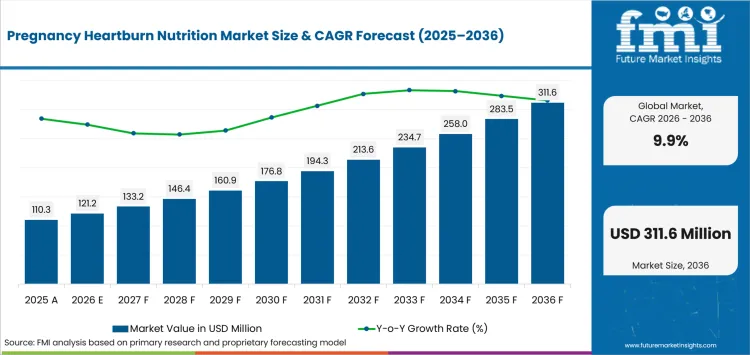
Key Takeaways of Pregnancy Heartburn Nutrition Market
- Recurring pregnancy reflux supports repeat self-care demand for products with a clear heartburn role and practical dose for routine use.
- In 2026, calcium-based antacid chews are expected to lead product type with 41.4% share because visible unit dosing fits short heartburn relief occasions.
- By trimester, first is estimated to hold 45.7% in 2026 owing to medicine screening that can bring initial product trial forward.
- Chews & drops are projected to hold 46.2% share in 2026 attributable to water-free dosing that removes preparation from the relief moment.
- Pregnancy-specific medicine screening can delay conversion if labels leave ingredient limits or interaction timing unclear for a repeated-use product.
- Some of the key players in this market include Haleon (Tums), Kenvue (Pepcid), Procter & Gamble (Rolaids, Wonderbelly), Perrigo Company plc, CVS Pharmacy, Inc., Walgreen Co., Walmart Inc. (Equate), and Meijer Distribution Inc.
Analyst Perspective
"Pregnancy heartburn products should be compared first by relief mechanism, pregnancy-use directions and interaction limits ahead of flavor or channel reach. A format earns repeat purchase once consumers can understand the dose quickly and pharmacists do not need to resolve avoidable label gaps."
- Nandini Roy Choudhury, Principal Consultant, Future Market Insights
How is the pregnancy heartburn nutrition market segmented?
The pregnancy heartburn nutrition market is segmented by product type, trimester, form, buyer priority, sales channel and region.
Product type covers calcium-based antacid chews, papaya enzyme and botanical products, alginate-style soothing drinks, ginger-based drops and teas, and others. Trimester covers first, second and third while form covers chews & drops, liquids & teas, gummies and others. Buyer priority includes Drug-free - natural-first, fast relief and sensitive stomach while sales channels include online / DTC, retail pharmacy, supermarkets & hypermarkets, specialty & health stores and others.
How does Drug-free - natural-first influence selection within the Buyer Priority category?
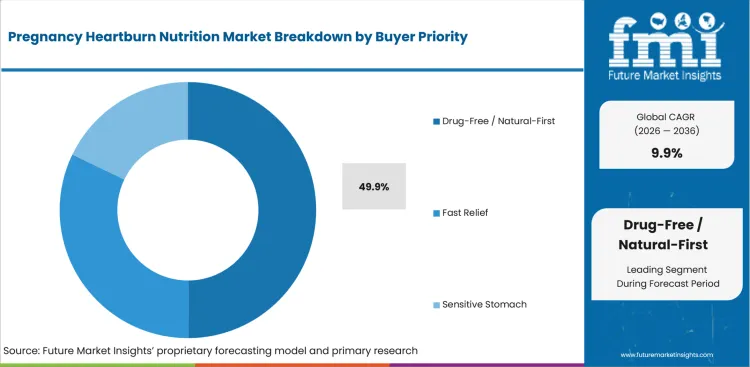
Drug-free - natural-first screening starts with ingredient identity and dose clarity instead of a stronger-relief promise. Pregnancy raises scrutiny of botanical supplements, since familiar ingredients do not settle safety or evidence questions.
- Drug-free - natural-first is set to lead buyer priority with 49.9% share in 2026 due to ingredient simplicity during screening. Natural-first positioning works best with labels that state ingredients and intended digestive use without relying on broad wellness language.
- The UK Committee on Toxicity published May 2025 pregnancy guidance for ginger supplements and found safety evidence and supplement composition uncertain. That uncertainty keeps dose disclosure central to herbal supplements sold for digestive comfort during pregnancy.
What makes Calcium-Based Antacid Chews central to the Product Type category?
Calcium-based antacid chews give heartburn shoppers a direct acid-neutralization route with a visible unit dose for short relief occasions. Familiar use of calcium supplements can reduce format friction, but heartburn labeling still needs to separate symptom relief from prenatal nutrition.
- By product type, calcium-based antacid chews are estimated to hold 41.4% in 2026 owing to familiar dosing and direct acid-neutralization. Pharmacy staff can explain a chewable dose during selection without demonstrating a preparation step to the customer.
- DailyMed updated the TUMS Chewy Bites Gas Relief label in June 2026 with calcium carbonate as the antacid ingredient and a direct heartburn indication for repeated OTC use.
Why does First lead spending within the Trimester category?
First-trimester spending reflects product-screening timing more than the clinical peak of reflux symptoms later in gestation. Pregnancy confirmation often prompts consumers to reassess prenatal vitamin supplements and OTC medicines before settling on repeat-use digestive relief.
- First is projected to hold 45.7% share in 2026 owing to early screening that can move initial product trial ahead of later replenishment. An accepted early purchase gives brands more weeks to earn repeat orders during the same pregnancy.
- CDC birth data published in June 2026 show 75.5% of USA births received first-trimester prenatal care during 2024, placing professional contact close to the initial product-screening window.
How do Chews & Drops shape demand within the Form category?
Chews & drops remove preparation from the relief moment and suit use away from home after meals. Portability also matters in the OTC heartburn drugs market when pregnant consumers prefer a small unit over mixing liquid or preparing tea.
- In 2026, chews & drops are expected to lead form with 46.2% share because portable units require no water or preparation. Retail pharmacy shelves can place compact chews beside conventional acid reducers without changing the purchase routine.
- DailyMed updated the Pepcid Complete label in June 2026 with chewable antacid and acid-reducer actives for heartburn, confirming current regulated use of low-preparation relief formats.
What are the drivers, restraints and opportunities in the Pregnancy Heartburn Nutrition Market?
Repeated reflux episodes support demand while pregnancy-specific medicine screening slows conversion and clearer label architecture gives brands a route to repeat purchase.
- Driver: Recurrent reflux produces several relief occasions during pregnancy and makes simple dosing more useful for products intended for repeat self-care.
- Restraint: Medicine and supplement screening can delay purchase if product labels leave pregnancy suitability or interaction timing unclear for consumers.
- Opportunity: Clear ingredient disclosure and pregnancy-aware directions can shift safety screening from a sales barrier into a reason for brand preference.
Recurrent Symptoms Sustain Repeat Relief Demand
Repeated reflux gives antacid and acid-reducer brands more than one purchase opportunity during a single pregnancy. Kenvue reported in August 2026 that Digestive Health execution helped Pepcid outperform its market during the second quarter. Pepcid's result keeps branded heartburn relief visible within the same self-care budget also targeted by digestive health supplements, while pregnancy conversion still depends on clear dose and use limits.
Pregnancy Screening Raises the Conversion Threshold
Safety screening inserts an extra decision step into a purchase that would otherwise be routine during pregnancy self-care. DailyMed updated a CVS Health calcium-carbonate heartburn label in June 2026 with a five-tablet daily limit for pregnant users. That dosing distinction makes ePharmacy channels with complete label guidance more useful and leaves poorly documented listings at a conversion disadvantage.
Transparent Labels Can Convert Safety Scrutiny
Clear labeling can make safety scrutiny a basis for product choice instead of a pure conversion cost. Procter & Gamble acquired Wonderbelly in January 2026 and placed the free-from antacid brand beside Rolaids within its digestive portfolio. Wonderbelly gives brands in the maternity products market a concrete benchmark for ingredient disclosure while preserving a direct heartburn use case.
Which country CAGRs are profiled in the Pregnancy Heartburn Nutrition Market?
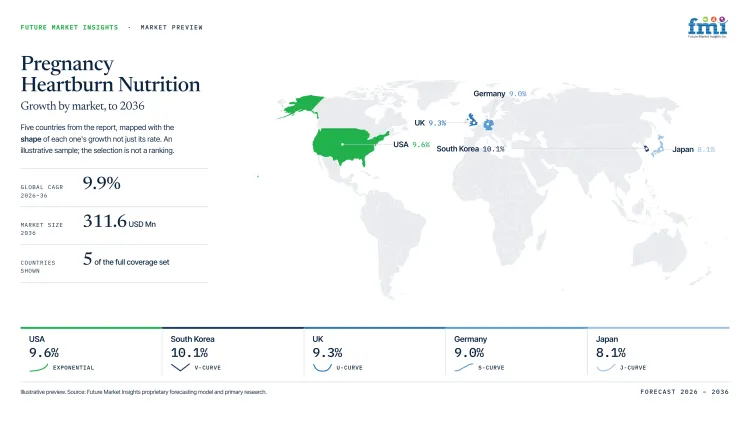
| Country | CAGR |
|---|---|
| South Korea | 10.1% |
| USA | 9.6% |
| UK | 9.3% |
| Germany | 9.0% |
| Japan | 8.1% |
How do country-level CAGRs compare in the Pregnancy Heartburn Nutrition Market?
The five country forecasts span 2.0 percentage points overall and divide into an upper pair plus a middle group. South Korea and the USA occupy the upper range while the UK and Germany follow closely. Japan separates from Germany by 0.9 percentage points with medicine-selection routes differing among these markets.
- South Korea’s birth rebound expands the maternity cohort for digital-first product testing.
- USA retail breadth gives familiar antacid brands several national pregnancy self-care routes.
- UK pharmacy guidance increases the value of concise pregnancy-use instructions beside indigestion treatments.
- Germany’s shrinking birth cohort raises the commercial cost of weak pharmacy conversion.
- Japan’s consultation-led medicine culture makes localized guidance central to OTC product selection.
Similar growth rates require different channel choices from brands entering each country. The full report provides country-level CAGR analysis across North America, Latin America, Europe, East Asia, South Asia, Oceania and the Middle East and Africa.
Country-wise Analysis
- For South Korean maternity shoppers, routine online discovery increasingly precedes local pharmacy checking for medicine suitability during repeated heartburn self-care purchases early in pregnancy. In February 2026, the Ministry of Data and Statistics recorded 254,500 births during 2025 with a 6.8% annual increase that enlarged the near-term maternity cohort despite the country’s historically low fertility base. Pregnancy heartburn nutrition demand in South Korea is forecast to expand at 10.1% CAGR through 2036, given faster cohort growth although brands still need Korean-language ingredient directions and pharmacy-ready information for digital discovery to convert into routine repeat purchases during later pregnancy stages.
- United States shoppers move among mass retail pharmacies and direct-to-consumer ordering without leaving the familiar OTC heartburn category while established antacid brands gain several routes to capture pregnancy-driven purchases nationwide. The United States pregnancy heartburn nutrition sector is projected to grow at 9.6% CAGR through 2036, aided by national retail breadth although unclear pregnancy directions can still send a routine purchase back to a pharmacist. CDC data published in July 2025 recorded 3,628,934 births during 2024, which means portable-format tests can reach national scale while retailer education determines whether initial trial develops into repeat use over several pregnancy stages.
- Community pharmacies anchor many UK heartburn purchases and let pregnant consumers check antacid suitability plus prenatal-supplement timing during the same self-care conversation with a professional. Office for National Statistics data published in May 2026 counted 585,396 live births in England and Wales during 2025 and leaves brands competing for repeat use within a contracting maternity cohort. Pregnancy heartburn nutrition demand in the UK is forecast to rise at 9.3% CAGR through 2036, reflecting established pharmacy access although concise dosing instructions matter more than broad wellness claims when each new customer must justify repeated purchases in a smaller annual cohort.
- Relying on pharmacy advice is common in German pregnancy self-care, while products framed mainly as general digestive wellness face a higher entry threshold at purchase under conservative medicine-use norms. Germany is estimated to post 9.0% CAGR over the forecast period because a defined heartburn indication supports self-care, although thinner pharmacy access can make professional reassurance less convenient outside larger population centers. ABDA reported in January 2026 that Germany ended 2025 with 16,601 pharmacies and 440 fewer operating sites than a year earlier, which makes credible German-language digital support more valuable as the physical counseling network continues to thin steadily.
- Professional consultation often precedes purchase in Japan while ambiguous Japanese-language pregnancy directions can block unfamiliar brands unless a pharmacist recommends repeated heartburn self-care within a retail system where drugstores are common and routine professional consultation is expected. Pregnancy heartburn nutrition sales in Japan are forecast to expand at 8.1% CAGR by 2036, tied to professional screening that supports appropriate self-care despite a smaller maternity cohort and slower modeled growth. In October 2025, Japan’s Ministry of Health, Labour and Welfare updated pregnancy-medicine guidance and confirmed consultation hubs in all 47 prefectures to route medicine questions through qualified professionals ahead of purchase.
Who are the notable companies in the Pregnancy Heartburn Nutrition Market?
Haleon (Tums), Kenvue (Pepcid), Procter & Gamble (Rolaids, Wonderbelly), Perrigo Company plc, CVS Pharmacy, Inc., Walgreen Co., Walmart Inc. (Equate), and Meijer Distribution Inc. are the notable companies serving this market.
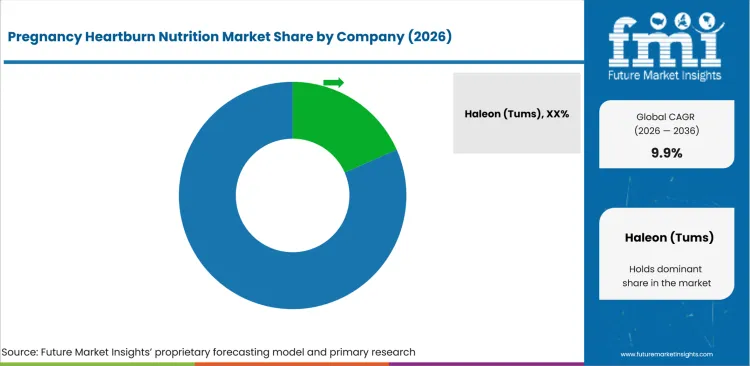
Regulated heartburn portfolios set the competitive baseline even under pregnancy-specific screening since a direct OTC indication still defines the use case. Haleon, Kenvue and Procter & Gamble enter with national brand recognition while Perrigo and the retail-label operators compete through shelf control and price. The harder entry barrier is label clarity around pregnancy use and interactions since familiar active ingredients alone do not settle those questions.
- Branded digestive-health portfolios: Haleon (Tums), Kenvue (Pepcid) and Procter & Gamble (Rolaids, Wonderbelly) compete with established heartburn indications and broad consumer-health recognition.
- Store-brand and retail-label operators: Perrigo Company plc, CVS Pharmacy, Inc., Walgreen Co., Walmart Inc. (Equate) and Meijer Distribution Inc. compete with regulated OTC access and retailer-controlled distribution.
Competitive Benchmarking: Pregnancy Heartburn Nutrition Market
| Company | Direct Heartburn Indication | Relief Route Breadth | Pregnancy & Interaction Guidance | Geographic Reach |
|---|---|---|---|---|
| Haleon (Tums) | High | High | High | Global |
| Kenvue (Pepcid) | High | High | High | Global |
| Procter & Gamble (Rolaids, Wonderbelly) | High | Medium | High | United States |
| Perrigo Company plc | High | High | High | North America and Europe |
| CVS Pharmacy, Inc. | High | Medium | Medium | United States |
| Walgreen Co. | High | High | High | United States |
| Walmart Inc. (Equate) | High | High | High | United States |
| Meijer Distribution Inc. | Medium | Medium | High | United States |
Scoring basis: High direct indication requires at least two verified heartburn-labelled routes while Medium requires one and Low identifies one edge-of-scope digestive indication. High relief breadth requires two distinct mechanism classes while Medium requires one and Low reflects one documented mechanism. High guidance requires a current pregnancy warning plus an interaction warning while Medium requires one warning class and Low records basic directions only. Geographic reach describes documented active markets and does not use company size as a proxy for coverage.
Key Developments in the Pregnancy Heartburn Nutrition Market
- In August 2026, CVS Pharmacy, Inc. updated its DailyMed filing for Extra Strength Heartburn Relief with an active antacid indication and current regulated directions.
- In June 2026, Perrigo Company plc revised its GoodSense omeprazole DailyMed filing for frequent heartburn with a 2026 marketing start and current OTC directions.
- In February 2026, Haleon (Tums) reported that Tums Gummy Bites innovation and retail-exclusive flavors contributed to Digestive Health growth during 2025.
Key Players in the Pregnancy Heartburn Nutrition Market
Branded Heartburn Portfolios
- Haleon (Tums)
- Kenvue (Pepcid)
- Procter & Gamble (Rolaids, Wonderbelly)
Store-Brand and Retail-Label Operators
- Perrigo Company plc
- CVS Pharmacy, Inc.
- Walgreen Co.
- Walmart Inc. (Equate)
- Meijer Distribution Inc.
Pregnancy Heartburn Nutrition Market - Report Scope
| Coverage field | Report scope |
|---|---|
| Market breakdown | By product type, trimester, form, buyer priority, sales channel and region. |
| Quantitative Units | USD million. |
| Market Definition | Nonprescription products sold for pregnancy heartburn, acid reflux, indigestion or acid-related digestive comfort. Prescription acid suppression and general prenatal nutrition without a heartburn use case are excluded. |
| Regions Covered | North America, Latin America, Europe, East Asia, South Asia and Pacific, and Middle East and Africa. |
| Countries Covered | South Korea, USA, UK, Germany, Japan, and 20+ countries included in the full report. |
| Key Companies Profiled | Haleon (Tums), Kenvue (Pepcid), Procter & Gamble (Rolaids, Wonderbelly), Perrigo Company plc, CVS Pharmacy, Inc., Walgreen Co., Walmart Inc. (Equate), and Meijer Distribution Inc. |
| Forecast Period | 2026 to 2036. |
| Approach | Primary and secondary research with market triangulation. |
Pregnancy Heartburn Nutrition Market - Research Methodology
| Method | Approach |
|---|---|
| Primary Research | FMI analysts gathered input from manufacturers, service providers, technology developers, distributors, end users, procurement teams, and subject-matter experts. Interviews examined purchasing decisions, product or service evaluation, adoption barriers, approval requirements, pricing considerations, and expectations for technical or commercial support. Respondents were also asked what evidence is required before a trial, pilot, or initial order develops into regular purchasing. |
| Desk Research | Desk research covered government statistics, regulatory publications, trade data, industry associations, technical literature, standards, company filings, product information, and official corporate announcements. Sources were reviewed for relevance, publication date, geographic coverage, and consistency with the defined market scope. Claims relating to performance, applications, approvals, capacity, investment, and commercial activity were retained only when supported by credible public evidence. |
| Market Sizing and Forecasting | The market model combined the baseline value with historical performance, segment structure, pricing and volume indicators, adoption levels, company participation, and country-level demand conditions. Forecast assumptions considered economic activity, investment trends, regulatory developments, technology adoption, purchasing cycles, supply availability, and barriers to wider market use. Segment and regional estimates were reconciled before the final market total was calculated. |
| Data Validation | Estimates were checked against multiple independent indicators, including public data, company activity, trade patterns, industry developments, and findings from primary interviews. Validation also tested whether products, services, applications, and company revenues fell within the defined market boundaries. Adjacent categories, unsupported claims, overlapping revenues, and activities without direct market relevance were excluded to reduce double counting and maintain consistency across segments and countries. |
Pregnancy Heartburn Nutrition Market by Segments
Pregnancy Heartburn Nutrition Market segmented by Product Type:
- Calcium-Based Antacid Chews
- Papaya Enzyme & Botanical Products
- Alginate-Style Soothing Drinks
- Ginger-Based Drops & Teas
- Others
Pregnancy Heartburn Nutrition Market segmented by Trimester:
- First
- Second
- Third
Pregnancy Heartburn Nutrition Market segmented by Form:
- Chews & Drops
- Liquids & Teas
- Gummies
- Others
Pregnancy Heartburn Nutrition Market segmented by Buyer Priority:
- Drug-free - natural-first
- Fast Relief
- Sensitive Stomach
Pregnancy Heartburn Nutrition Market segmented by Sales Channel:
- Online / DTC
- Retail Pharmacy
- Supermarkets & Hypermarkets
- Specialty & Health Stores
- Others
Pregnancy Heartburn Nutrition Market by Region:
- North America
- United States
- Canada
- Latin America
- Brazil
- Mexico
- Argentina
- Chile
- Western Europe
- Germany
- France
- United Kingdom
- Italy
- Spain
- Benelux
- Nordics
- Eastern Europe
- Poland
- Czech Republic
- Romania
- Hungary
- East Asia
- China
- Japan
- South Korea
- South Asia and Pacific
- India
- ASEAN
- Australia and New Zealand
- Middle East and Africa
- GCC Countries
- South Africa
- Türkiye
- Israel
Research Sources and Bibliography
- Khurmatullina, A. R., et al. (2025, December 9). Global prevalence and risk of gastroesophageal reflux disease symptoms in pregnancy: a systematic review and meta-analysis.
- Ministry of Data and Statistics, Republic of Korea. (2026, February 25). Preliminary Results of Birth and Death Statistics in 2025.
- National Center for Health Statistics. (2026, June 9). Births: Final Data for 2024.
- Martin, J. A., Hamilton, B. E., & Osterman, M. J. K. (2025, July). Births in the United States, 2024.
- Office for National Statistics. (2026, May 27). Births in England and Wales: 2025.
- ABDA - Federal Union of German Associations of Pharmacists. (2026, January 13). 2025: Apothekenzahl sinkt auf 16.601 Betriebsstätten.
- Ministry of Health, Labour and Welfare, Japan. (2025, October 17).
- Committee on Toxicity of Chemicals in Food, Consumer Products and the Environment. (2025, May 22). Statement on the safety of ginger supplement use in pregnancy.
- Ministry of Health, Labour and Welfare, Japan. (2025, June 4).
- Kenvue Inc. (2026, August 6). Kenvue Reports Second Quarter 2026 Results.
- Procter & Gamble. (2026, January 26). Accelerating Innovation: Wonderbelly Joins the P&G Personal Health Care Portfolio.
- Haleon plc. (2026, February 25). Full-year results 2025 video transcript.
- USA National Library of Medicine. (2026, June 10). TUMS CHEWY BITES WITH GAS RELIEF - calcium carbonate and simethicone tablet, chewable.
- USA National Library of Medicine. (2026, June 22). PEPCID COMPLETE - famotidine, calcium carbonate, and magnesium hydroxide tablet, chewable.
- USA National Library of Medicine. (2026, July 9). TUMS ULTRA - calcium carbonate tablet, chewable.
- USA National Library of Medicine. (2026, July 21). ROLAIDS MAX STRENGTH 1500 - calcium carbonate tablet, chewable.
- USA National Library of Medicine. (2026, March 30). GOOD SENSE DUAL ACTION COMPLETE - famotidine, calcium carbonate and magnesium hydroxide tablet, chewable.
- USA National Library of Medicine. (2026, January 13). CVS HEALTH EXTRA STRENGTH SUGAR FREE ANTACID - calcium carbonate tablet, chewable.
- USA National Library of Medicine. (2026, June 10). MAXIMUM STRENGTH CALCIUM CARBONATE 1000MG - calcium carbonate chewable tablets tablet, chewable.
- USA National Library of Medicine. (2026, March 5). ACID REDUCER COMPLETE - famotidine, calcium carbonate and magnesium hydroxide tablet, chewable.
- USA National Library of Medicine. (2026, April 2). EQUATE FAMOTIDINE - famotidine tablet.
- USA National Library of Medicine. (2026, January 21). DUAL ACTION COMPLETE - famotidine, calcium carbonate and magnesium hydroxide tablet, chewable.
- USA National Library of Medicine. (2026, August 17). CVS HEALTH EXTRA STRENGTH HEARTBURN RELIEF ANTACID ORIGINAL FLAVOR - aluminum hydroxide and magnesium carbonate tablet, chewable.
- USA National Library of Medicine. (2026, June 29). GOOD SENSE OMEPRAZOLE - omeprazole capsule, delayed release.
- USA National Library of Medicine. (2026, February 4). TUMS CHEWY BITES RASPBERRY LEMONADE - calcium carbonate tablet, chewable.
- USA National Library of Medicine. (2026, February 11). PEPCID AC ORIGINAL STRENGTH - famotidine tablet.
- USA National Library of Medicine. (2026, January 14). ROLAIDS ADVANCED ANTACID ANTI-GAS WILD BERRY - calcium carbonate, magnesium hydroxide and simethicone tablet, chewable.
- USA National Library of Medicine. (2026, May 11). CVS SUPREME ANTACID CHERRY - aluminum hydroxide, magnesium hydroxide and simethicone suspension.
- USA National Library of Medicine. (2026, January 19). WALGREEN LIQUID ANTACID - aluminum hydroxide, magnesium hydroxide and simethicone suspension.
- USA National Library of Medicine. (2026, January 21). ASSORTED FRUIT ANTACID FLAVOR CHEWS - calcium carbonate tablet, chewable.
- USA National Library of Medicine. (2026, July 20). BEST CHOICE EXTRA STRENGTH BERRY FLAVOR - calcium carbonate and simethicone tablet, chewable.
- USA National Library of Medicine. (2025, February 14). KIRKLAND SIGNATURE ACID CONTROLLER - famotidine tablet.
This bibliography is provided for reader reference and is not exhaustive. The full report contains the complete reference list and detailed citations.
This Report Answers
- How large is the pregnancy heartburn nutrition market in 2026 and 2036?
- Which symptom pattern supports repeat pregnancy heartburn purchases?
- Why do calcium-based antacid chews hold the largest product type share in 2026?
- Why does first trimester timing influence purchase initiation and later replenishment?
- Why do chews & drops account for the largest form share in 2026?
- How do the five profiled country CAGRs differ between South Korea and Japan?
- Which eight companies supply regulated heartburn relief routes in the profiled competitive set?
- Which label and interaction factors determine whether pregnancy-focused product trial becomes repeat purchase?
Frequently Asked Questions
How big is the Pregnancy Heartburn Nutrition Market in 2026?
The pregnancy heartburn nutrition market is valued at USD 121.2 million in 2026 and is projected to reach USD 311.6 million by 2036. Repeated reflux produces multiple self-care occasions during pregnancy, so clear heartburn directions matter for repeat purchase.
What is the CAGR of the Pregnancy Heartburn Nutrition Market from 2026 to 2036?
The pregnancy heartburn nutrition market is projected to grow at a CAGR of 9.9% between 2026 and 2036. Growth is driven by repeated symptom episodes and wider access to portable nonprescription heartburn formats with clear use instructions.
Which product type leads the Pregnancy Heartburn Nutrition Market?
The calcium-based antacid chews segment is expected to hold 41.4% of the pregnancy heartburn nutrition market in 2026, supported by familiar unit dosing and direct acid-neutralization use. Clear pregnancy directions protect repeat purchase since familiar OTC use still carries dosing and interaction questions.
Which buyer priority leads the Pregnancy Heartburn Nutrition Market?
The Drug-free - natural-first segment is expected to hold 49.9% of the pregnancy heartburn nutrition market in 2026, attributable to early ingredient screening during pregnancy. Clear dose and ingredient statements help natural-first products retain credibility when consumers compare digestive comfort options.
Which companies are active in the Pregnancy Heartburn Nutrition Market?
Key companies operating in the pregnancy heartburn nutrition market include Haleon (Tums), Kenvue (Pepcid), Procter & Gamble (Rolaids, Wonderbelly), Perrigo Company plc, CVS Pharmacy, Inc., Walgreen Co., Walmart Inc. (Equate), and Meijer Distribution Inc. Their portfolios span branded antacids, acid reducers and retailer-controlled OTC heartburn routes.
Preview the report firsthand - request a free sample
Get SampleGet the brochure for pricing and purchase details.
Get PDFTable of Content
- Key Takeaways
- Market Size and CAGR
- Top Growth Driver
- Fastest Growing Segment
- Leading Region
- Key Companies
- Emerging Opportunities
- Executive Summary
- Global Market Outlook
- Demand-side Trends
- Supply-side Trends
- Technology Roadmap Analysis
- Analysis and Recommendations
- Analyst Perspective (What is happening? Why now? What should investors know?)
- Key Questions Answered
- How large is the market?
- What is the CAGR?
- What are key trends?
- Which region dominates?
- Who are the leaders?
- Market Overview
- Market Coverage / Taxonomy
- Market Definition / Scope / Limitations
- Research Methodology
- Chapter Orientation
- Analytical Lens and Working Hypotheses
- Market Structure, Signals, and Trend Drivers
- Benchmarking and Cross-market Comparability
- Market Sizing, Forecasting, and Opportunity Mapping
- Research Design and Evidence Framework
- Desk Research Programme (Secondary Evidence)
- Expert Input and Fieldwork (Primary Evidence)
- Tooling, Models, and Reference Databases
- Data Engineering and Model Build
- Quality Assurance and Audit Trail
- Market Background
- Market Dynamics (Drivers, Restraints, Opportunity, Trends)
- Scenario Forecast (Optimistic, Likely, Conservative)
- Impact Analysis
- AI Impact
- Sustainability Impact
- Regulatory Impact
- Technology Impact
- Consumer / Buyer Analysis
- Purchase Drivers
- Adoption Barriers
- Buyer Journey
- Opportunity Map Analysis
- Product Life Cycle Analysis
- Supply Chain Analysis
- Investment Feasibility Matrix
- Value Chain Analysis
- PESTLE and Porter's Analysis
- Regulatory Landscape
- Regional Parent Market Outlook
- Production and Consumption Statistics
- Import and Export Statistics
- Global Market Analysis and Forecast, 2021 to 2036
- Historical Market Size Value (USD Million) Analysis, 2021 to 2025
- Current and Future Market Size Value (USD Million) Projections, 2026 to 2036
- Y-o-Y Growth Trend Analysis
- Absolute $ Opportunity Analysis
- Global Market Pricing Analysis, 2021 to 2036
- Global Market Analysis and Forecast, By Product Type, 2021 to 2036
- Introduction / Key Findings
- Historical Market Size Value (USD Million) Analysis By Product Type, 2021 to 2025
- Current and Future Market Size Value (USD Million) Analysis and Forecast By Product Type, 2026 to 2036
- Calcium-Based Antacid Chews
- Papaya Enzyme & Botanical Products
- Alginate-Style Soothing Drinks
- Ginger-Based Drops & Teas
- Others
- Calcium-Based Antacid Chews
- Y-o-Y Growth Trend Analysis By Product Type, 2021 to 2025
- Absolute $ Opportunity Analysis By Product Type, 2026 to 2036
- Global Market Analysis and Forecast, By Trimester, 2021 to 2036
- Introduction / Key Findings
- Historical Market Size Value (USD Million) Analysis By Trimester, 2021 to 2025
- Current and Future Market Size Value (USD Million) Analysis and Forecast By Trimester, 2026 to 2036
- First
- Second
- Third
- First
- Y-o-Y Growth Trend Analysis By Trimester, 2021 to 2025
- Absolute $ Opportunity Analysis By Trimester, 2026 to 2036
- Global Market Analysis and Forecast, By Form, 2021 to 2036
- Introduction / Key Findings
- Historical Market Size Value (USD Million) Analysis By Form, 2021 to 2025
- Current and Future Market Size Value (USD Million) Analysis and Forecast By Form, 2026 to 2036
- Chews & Drops
- Liquids & Teas
- Gummies
- Others
- Chews & Drops
- Y-o-Y Growth Trend Analysis By Form, 2021 to 2025
- Absolute $ Opportunity Analysis By Form, 2026 to 2036
- Global Market Analysis and Forecast, By Buyer Priority, 2021 to 2036
- Introduction / Key Findings
- Historical Market Size Value (USD Million) Analysis By Buyer Priority, 2021 to 2025
- Current and Future Market Size Value (USD Million) Analysis and Forecast By Buyer Priority, 2026 to 2036
- Drug-Free / Natural-First
- Fast Relief
- Sensitive Stomach
- Drug-Free / Natural-First
- Y-o-Y Growth Trend Analysis By Buyer Priority, 2021 to 2025
- Absolute $ Opportunity Analysis By Buyer Priority, 2026 to 2036
- Global Market Analysis and Forecast, By Sales Channel, 2021 to 2036
- Introduction / Key Findings
- Historical Market Size Value (USD Million) Analysis By Sales Channel, 2021 to 2025
- Current and Future Market Size Value (USD Million) Analysis and Forecast By Sales Channel, 2026 to 2036
- Online / DTC
- Retail Pharmacy
- Supermarkets & Hypermarkets
- Specialty & Health Stores
- Others
- Online / DTC
- Y-o-Y Growth Trend Analysis By Sales Channel, 2021 to 2025
- Absolute $ Opportunity Analysis By Sales Channel, 2026 to 2036
- Global Market Analysis and Forecast, By Region, 2021 to 2036
- Introduction
- Historical Market Size Value (USD Million) Analysis By Region, 2021 to 2025
- Current Market Size Value (USD Million) Analysis and Forecast By Region, 2026 to 2036
- North America
- Latin America
- Western Europe
- Eastern Europe
- East Asia
- South Asia and Pacific
- Middle East & Africa
- Market Attractiveness Analysis By Region
- North America Market Analysis and Forecast, By Country, 2021 to 2036
- Historical Market Size Value (USD Million) Trend Analysis By Market Taxonomy, 2021 to 2025
- Market Size Value (USD Million) Forecast By Market Taxonomy, 2026 to 2036
- By Country
- USA
- Canada
- By Product Type
- By Trimester
- By Form
- By Buyer Priority
- By Sales Channel
- By Country
- Market Attractiveness Analysis
- By Country
- By Product Type
- By Trimester
- By Form
- By Buyer Priority
- By Sales Channel
- Key Takeaways
- Latin America Market Analysis and Forecast, By Country
- Historical Market Size Value (USD Million) Trend Analysis By Market Taxonomy, 2021 to 2025
- Market Size Value (USD Million) Forecast By Market Taxonomy, 2026 to 2036
- By Country
- Brazil
- Mexico
- Chile
- Rest of Latin America
- By Product Type
- By Trimester
- By Form
- By Buyer Priority
- By Sales Channel
- By Country
- Market Attractiveness Analysis
- By Country
- By Product Type
- By Trimester
- By Form
- By Buyer Priority
- By Sales Channel
- Key Takeaways
- Western Europe Market Analysis and Forecast, By Country
- Historical Market Size Value (USD Million) Trend Analysis By Market Taxonomy, 2021 to 2025
- Market Size Value (USD Million) Forecast By Market Taxonomy, 2026 to 2036
- By Country
- Germany
- UK
- Italy
- Spain
- France
- Nordic
- BENELUX
- Rest of Western Europe
- By Product Type
- By Trimester
- By Form
- By Buyer Priority
- By Sales Channel
- By Country
- Market Attractiveness Analysis
- By Country
- By Product Type
- By Trimester
- By Form
- By Buyer Priority
- By Sales Channel
- Key Takeaways
- Eastern Europe Market Analysis and Forecast, By Country
- Historical Market Size Value (USD Million) Trend Analysis By Market Taxonomy, 2021 to 2025
- Market Size Value (USD Million) Forecast By Market Taxonomy, 2026 to 2036
- By Country
- Russia
- Poland
- Hungary
- Balkan & Baltic
- Rest of Eastern Europe
- By Product Type
- By Trimester
- By Form
- By Buyer Priority
- By Sales Channel
- By Country
- Market Attractiveness Analysis
- By Country
- By Product Type
- By Trimester
- By Form
- By Buyer Priority
- By Sales Channel
- Key Takeaways
- East Asia Market Analysis and Forecast, By Country
- Historical Market Size Value (USD Million) Trend Analysis By Market Taxonomy, 2021 to 2025
- Market Size Value (USD Million) Forecast By Market Taxonomy, 2026 to 2036
- By Country
- China
- Japan
- South Korea
- By Product Type
- By Trimester
- By Form
- By Buyer Priority
- By Sales Channel
- By Country
- Market Attractiveness Analysis
- By Country
- By Product Type
- By Trimester
- By Form
- By Buyer Priority
- By Sales Channel
- Key Takeaways
- South Asia and Pacific Market Analysis and Forecast, By Country
- Historical Market Size Value (USD Million) Trend Analysis By Market Taxonomy, 2021 to 2025
- Market Size Value (USD Million) Forecast By Market Taxonomy, 2026 to 2036
- By Country
- India
- ASEAN
- Australia & New Zealand
- Rest of South Asia and Pacific
- By Product Type
- By Trimester
- By Form
- By Buyer Priority
- By Sales Channel
- By Country
- Market Attractiveness Analysis
- By Country
- By Product Type
- By Trimester
- By Form
- By Buyer Priority
- By Sales Channel
- Key Takeaways
- Middle East & Africa Market Analysis and Forecast, By Country
- Historical Market Size Value (USD Million) Trend Analysis By Market Taxonomy, 2021 to 2025
- Market Size Value (USD Million) Forecast By Market Taxonomy, 2026 to 2036
- By Country
- Kingdom of Saudi Arabia
- Other GCC Countries
- Türkiye
- South Africa
- Other African Union
- Rest of Middle East & Africa
- By Product Type
- By Trimester
- By Form
- By Buyer Priority
- By Sales Channel
- By Country
- Market Attractiveness Analysis
- By Country
- By Product Type
- By Trimester
- By Form
- By Buyer Priority
- By Sales Channel
- Key Takeaways
- Key Countries Market Analysis
- USA
- Pricing Analysis
- Market Share Analysis, 2025
- By Product Type
- By Trimester
- By Form
- By Buyer Priority
- By Sales Channel
- Canada
- Pricing Analysis
- Market Share Analysis, 2025
- By Product Type
- By Trimester
- By Form
- By Buyer Priority
- By Sales Channel
- Mexico
- Pricing Analysis
- Market Share Analysis, 2025
- By Product Type
- By Trimester
- By Form
- By Buyer Priority
- By Sales Channel
- Brazil
- Pricing Analysis
- Market Share Analysis, 2025
- By Product Type
- By Trimester
- By Form
- By Buyer Priority
- By Sales Channel
- Chile
- Pricing Analysis
- Market Share Analysis, 2025
- By Product Type
- By Trimester
- By Form
- By Buyer Priority
- By Sales Channel
- Germany
- Pricing Analysis
- Market Share Analysis, 2025
- By Product Type
- By Trimester
- By Form
- By Buyer Priority
- By Sales Channel
- UK
- Pricing Analysis
- Market Share Analysis, 2025
- By Product Type
- By Trimester
- By Form
- By Buyer Priority
- By Sales Channel
- Italy
- Pricing Analysis
- Market Share Analysis, 2025
- By Product Type
- By Trimester
- By Form
- By Buyer Priority
- By Sales Channel
- Spain
- Pricing Analysis
- Market Share Analysis, 2025
- By Product Type
- By Trimester
- By Form
- By Buyer Priority
- By Sales Channel
- France
- Pricing Analysis
- Market Share Analysis, 2025
- By Product Type
- By Trimester
- By Form
- By Buyer Priority
- By Sales Channel
- India
- Pricing Analysis
- Market Share Analysis, 2025
- By Product Type
- By Trimester
- By Form
- By Buyer Priority
- By Sales Channel
- ASEAN
- Pricing Analysis
- Market Share Analysis, 2025
- By Product Type
- By Trimester
- By Form
- By Buyer Priority
- By Sales Channel
- Australia & New Zealand
- Pricing Analysis
- Market Share Analysis, 2025
- By Product Type
- By Trimester
- By Form
- By Buyer Priority
- By Sales Channel
- China
- Pricing Analysis
- Market Share Analysis, 2025
- By Product Type
- By Trimester
- By Form
- By Buyer Priority
- By Sales Channel
- Japan
- Pricing Analysis
- Market Share Analysis, 2025
- By Product Type
- By Trimester
- By Form
- By Buyer Priority
- By Sales Channel
- South Korea
- Pricing Analysis
- Market Share Analysis, 2025
- By Product Type
- By Trimester
- By Form
- By Buyer Priority
- By Sales Channel
- Russia
- Pricing Analysis
- Market Share Analysis, 2025
- By Product Type
- By Trimester
- By Form
- By Buyer Priority
- By Sales Channel
- Poland
- Pricing Analysis
- Market Share Analysis, 2025
- By Product Type
- By Trimester
- By Form
- By Buyer Priority
- By Sales Channel
- Hungary
- Pricing Analysis
- Market Share Analysis, 2025
- By Product Type
- By Trimester
- By Form
- By Buyer Priority
- By Sales Channel
- Kingdom of Saudi Arabia
- Pricing Analysis
- Market Share Analysis, 2025
- By Product Type
- By Trimester
- By Form
- By Buyer Priority
- By Sales Channel
- Türkiye
- Pricing Analysis
- Market Share Analysis, 2025
- By Product Type
- By Trimester
- By Form
- By Buyer Priority
- By Sales Channel
- South Africa
- Pricing Analysis
- Market Share Analysis, 2025
- By Product Type
- By Trimester
- By Form
- By Buyer Priority
- By Sales Channel
- USA
- Market Structure Analysis
- Competition Dashboard
- Competition Benchmarking
- Market Share Analysis of Top Players
- By Regional
- By Product Type
- By Trimester
- By Form
- By Buyer Priority
- By Sales Channel
- Emerging Startups
- Innovation Benchmarking
- Competition Analysis
- Competition Deep Dive
- Haleon (Tums)
- Overview
- Product Portfolio
- Profitability by Market Segments
- Sales Footprint
- Strategy Overview
- Marketing Strategy
- Product Strategy
- Channel Strategy
- Pink Stork
- UpSpring (Stomach Settle)
- Tummydrops
- Needed
- Premama
- Traditional Medicinals
- Wedderspoon
- Haleon (Tums)
- Case Studies
- Success Stories
- Recent Developments
- Competition Deep Dive
- Assumptions & Acronyms Used


